Article

Innovation Efficiency and Its Influencing Factors in China’s New Energy Enterprises: An Empirical Analysis

Farabi International Business School, Al-Farabi Kazakh National University, Almaty 050000, Kazakhstan
*
Author to whom correspondence should be addressed.
Adm. Sci. 2026, 16(2), 65; https://doi.org/10.3390/admsci16020065
Submission received: 26 December 2025 / Revised: 24 January 2026 / Accepted: 26 January 2026 / Published: 27 January 2026

Abstract

Against the backdrop of global energy transition and sustainable development, advancing the new energy industry has become a critical pathway for optimizing energy structures and achieving the dual carbon goals. However, while China’s new energy sector has experienced rapid growth, it has also exposed a series of challenges, including insufficient innovation momentum, irrational resource allocation, and low conversion rates of R&D outcomes. To delve into the root causes and propose improvement pathways, this study selected 76 listed new energy enterprises from 2021 to 2023 as samples. It comprehensively employed the DEA-BCC model, Malmquist productivity index, and Tobit regression model to conduct empirical analysis across three dimensions: static, dynamic, and influencing factors. The findings revealed: firstly, during the study period, overall static efficiency remained low, with only about 32.90% of enterprises operating efficiently. Efficiency decomposition indicated that low and unstable pure technical efficiency constrained overall efficiency gains. In contrast, while scale efficiency was relatively high, its growth was sluggish, and some enterprises exhibited significant scale irrelevance. Secondly, dynamic total factor productivity exhibited fluctuating growth primarily driven by technological progress. However, declining technical efficiency—particularly the deterioration of scale efficiency—indicated that while the new energy industry advanced technologically and expanded in scale, its management capabilities had not kept pace. This mismatch among the three factors trapped the industry in a “high investment, low efficiency” dilemma. Thirdly, regression analysis of influencing factors indicated that corporate governance and market competitiveness were pivotal to innovation efficiency: the proportion of independent directors and revenue growth rate exerted significant positive impacts, while equity concentration showed a significant negative effect. Firm size had a weaker influence, and government support did not demonstrate a significant positive impact. Accordingly, this paper proposes pathways to enhance innovation efficiency in new energy enterprises, including optimizing corporate governance structures, formulating differentiated subsidy policies, and improving the innovation ecosystem. The findings of this study not only provide empirical references for the innovative development of the new energy industry but also offer theoretical support for relevant policy formulation.

1. Introduction

Driven by the global energy transition and China’s “dual carbon” strategy, the new energy industry is emerging as a key driver of high-quality economic growth. Innovation, as the core force propelling the development of the new energy sector, directly determines the core competitiveness of enterprises and the healthy, sustainable development of the industry. However, compared to the rapid expansion of the industry’s scale, China’s new energy enterprises currently face the common challenge of low innovation efficiency. This manifests primarily as insufficient innovation motivation, irrational resource allocation, and low conversion rates of R&D outcomes. Given the limited resources of new energy enterprises and the inherent risks of R&D innovation, these companies must consider how to optimize the allocation of innovation resources, make informed innovation decisions, and formulate effective innovation strategies to enhance their innovation efficiency. Therefore, studying the innovation efficiency of new energy enterprises serves two purposes: firstly, it helps identify high-performing enterprises as benchmarks, pinpointing the reasons for existing disparities to achieve rational allocation and utilization of innovation resources; secondly, it highlights areas where innovation capabilities are relatively weak, thereby providing insights for improving innovation efficiency.

2. Literature Review

2.1. Measurement of Innovation Efficiency

Existing literature primarily employs parametric and nonparametric methods to study corporate innovation efficiency. Regarding parametric approaches, most scholars utilize Stochastic Frontier Analysis (SFA). Aigner et al. (1977) first proposed applying SFA to measure efficiency. This method distinguishes error terms within the model, thereby enhancing the precision of technical efficiency measurement. In recent years, the international academic community has progressively applied SFA measurement methods to efficiency evaluations in new energy-related fields. Xu et al. (2020) employed the SFA method to separately calculate the efficiency of new energy power generation in OECD and non-OECD countries; Koç (2021) similarly utilized SFA to conduct a cross-country comparative study of renewable energy efficiency among BRICS nations and Turkey. Domestically, S. Li (2016) employed the SFA model to assess innovation efficiency in China’s new energy sector based on 2010–2014 panel data.
In the realm of nonparametric methods, numerous scholars have primarily adopted techniques related to the Data Envelopment Analysis (DEA) model, which was established by Charnes et al. (1978). Compared to SFA, the DEA method is more suitable for complex decision-making units involving multiple inputs and outputs, and has become one of the mainstream tools for measuring the efficiency of such units. Within the international energy innovation field, the DEA model and its derivative models are widely applied to assess the efficiency of the new energy industry. Halkos and Tzeremes (2012) employed the DEA method to evaluate the financial performance of Greece’s new energy sector; Kim et al. (2015) utilized a DEA model to assess the investment efficiency of three new energy technologies—wind power, photovoltaics, and fuel cells—in South Korea; Hu et al. (2024) employed a DSBM-DEA model to measure the efficiency of renewable energy power generation across 44 Asian economies from 2010 to 2021. Domestically, H. Li et al. (2017) employed DEA to evaluate the green technological innovation performance of listed new energy enterprises from 2013 to 2015, and their findings indicated that China’s new energy enterprises exhibited overall low levels of green technological innovation performance, with the primary issue being low pure technical efficiency.

2.2. Factors Influencing Innovation Efficiency

Regarding influencing factors, existing research primarily explores their impact mechanisms across two dimensions: internal corporate characteristics and external environments. From the internal dimension, Griliches (1979) found that sustained R&D funding and human capital investment constitute essential material prerequisites for corporate innovation activities. Hill and Snell (1989) argued that equity structure exerts dual effects: concentrated ownership may enhance management oversight of innovation, thereby promoting it, while large shareholders may suppress innovation driven by risk-averse motives. Manso (2011) found that strong market performance not only provides financial support for innovation but also signals positive market expectations, thereby stimulating corporate innovation vitality. Balsmeier et al. (2017), examining board governance, found that independent directors enhance innovation resource allocation efficiency by introducing external knowledge and strengthening accountability mechanisms. Fan and Du (2018), using a Tobit model, demonstrated that firm size significantly boosts technological R&D efficiency.
Regarding the external environment, government support has been a focal point for numerous scholars, though research conclusions remain divergent. Some scholars have identified a significant positive impact of government support. Studies such as Barros et al. (2013) suggest that the policy environment enhances technological innovation efficiency. However, other research indicates that government support may generate a “crowding-out effect.” Chi (2003), through constructing a regression model for corporate technological innovation efficiency, found that the primary drivers of improved innovation efficiency stem from regulatory frameworks, interdepartmental coordination, and innovation method selection, while government subsidies and tax breaks exerted no significant influence. Hong et al. (2016), focusing on China’s high-tech sector, employed the applied stochastic frontier method to measure innovation efficiency. Their findings indicated that private R&D funding positively enhanced innovation efficiency, while government subsidies showed no significant impact.
However, existing research also has its shortcomings: Firstly, the research focus of scholars both domestically and internationally has largely centered on the development of the new energy industry and the impact of policies. In recent years, some scholars have begun to examine the regional evolution characteristics of the new energy industry from an economic geography perspective. Most scholars’ research indicates that numerous issues exist in the development of China’s new energy industry, with one of the most critical problems being the lack of innovation within the industry. Therefore, research on innovation-driven development of the new energy industry requires further exploration. Secondly, scholars worldwide have conducted relatively in-depth and detailed research on innovation efficiency evaluation. However, assessing an enterprise’s innovation capability cannot be accurately determined by relying on a single indicator alone. It requires constructing a comprehensive evaluation index system by integrating multiple input and output indicators. Thirdly, scholars predominantly employ SFA and DEA to evaluate innovation efficiency in the new energy sector. DEA, in particular, is widely applied to assess changes in innovation efficiency among new energy enterprises. However, this model’s limitations in handling panel data result in a lack of comparability between innovation efficiency values across different years. Fourthly, while existing research addresses factors influencing innovation efficiency, it insufficiently explores the interactive effects between internal governance and external resources within new energy enterprises. Consequently, it fails to provide clear pathways for how these enterprises can enhance innovation efficiency by optimizing governance structures and resource utilization efficiency. Therefore, this study employs the DEA-Malmquist-Tobit method to examine the innovation efficiency and its determinants among 76 listed new energy enterprises in China from 2021 to 2023. It aims to provide practical guidance for enhancing the innovation capabilities of China’s new energy enterprises, thereby promoting the comprehensive improvement of innovation efficiency within the new energy industry and achieving high-quality, sustainable development.

3. Research Design

3.1. Research Methods

3.1.1. DEA-BCC Model

The DEA model, grounded in the concept of relative efficiency, employs linear programming techniques to evaluate the performance of similar decision-making units within complex systems involving multiple inputs and outputs. The DEA model has evolved into over 150 application variants. Among these, the most traditional and representative are the CCR model proposed by Charnes et al. (1978) and the BCC model introduced by Banker et al. (1984). These two static evaluation methods differ primarily in that the CCR model assesses comprehensive efficiency under constant returns to scale, while the BCC model evaluates efficiency under variable returns to scale. In this study, given the multi-stage, multi-factor interactive complexity of innovation activities in new energy enterprises—where the relationship between inputs and outputs constitutes a complex combinatorial behavior—a variable returns to scale framework is more appropriate. Therefore, this paper employs the BCC model for efficiency assessment. This model further decomposes total technical efficiency (TE) into pure technical efficiency (PTE) and scale efficiency (SE). PTE reflects the enterprise’s technological and managerial capabilities under given conditions, while SE indicates the gap between the enterprise’s actual scale and its optimal production scale under existing technological conditions. Accordingly, when decision units exhibit inefficiency, it can be further determined whether the inefficiency stems from technical inefficiency or scale inefficiency. The relationship among these three can be expressed as:
TE = PTE × SE

3.1.2. Malmquist Index

Traditional DEA models primarily measure the static efficiency of each decision-making unit and cannot reflect dynamic changes across periods. Therefore, this paper adopts the Malmquist index proposed by Malmquist (1953) to measure the dynamic efficiency of innovation in new energy enterprises. This index was further refined by Caves et al. (1982) and others, modified by Fare et al. (1994) to address issues of arbitrariness in the technology reference system, and adjusted by Zhang (1996) and others based on domestic applications. Currently, the Malmquist index is widely used to measure changes in total factor productivity. The TFPCH measured by the Malmquist index can be decomposed into technological efficiency (TECCH) and technical efficiency (EFFCH). When returns to scale are variable, technical efficiency can be further decomposed into pure technical efficiency change (PECH) and scale efficiency change (SECH). The relationship among these four components is as follows:
TFPCH = TECCH × EFFCH = TECCH × (PECH × SECH)

3.1.3. Tobit Regression Model

Based on the model’s principles and applicability, the dependent variable in this study (innovation efficiency values measured by the DEA-BCC model) ranges between 0 and 1, leading to censoring at the limits. If ordinary least squares (OLS) regression is employed, the parameter estimates will be biased and inconsistent. Therefore, this study employs the Tobit regression model proposed by Tobin (1958) for analysis, as it effectively addresses such issues. The specific model specification is as follows:
Y i = α + β X i + ε i Y i = 0 ,   Y i 0 Y i ,   0 < Y i < 1 1 ,   Y i 1
In the equation, Yi* represents the latent innovation efficiency value that cannot be directly observed, Yi denotes the actual observed efficiency value, Xi is the independent variable, and εi is the random error term following a normal distribution.

3.2. Data Sources

Given that new energy enterprises typically operate across multiple sectors and engage in diverse new energy industries, their business boundaries and industry attributes exhibit significant cross-sector integration. This makes it challenging to categorize them precisely using traditional industry segmentation methods. Therefore, this paper references the 2021 Revised Edition of the Shenwan Hongyuan Industry Classification and the East Money Securities Network Industry Classification. It integrates data from CSMAR, China Securities Regulatory Commission’s Juchao Information Network, Sina Finance, among other financial portals. Considering microdata availability and comparability, we excluded ST companies with operational abnormalities and enterprises with missing data. Ultimately, we selected financial data from 76 listed new energy companies annually from 2021 to 2023 as the research sample. This sample broadly covers various types of listed new energy enterprises in China, including central state-owned enterprises, local state-owned enterprises, private enterprises, and other entities, to represent industry development trends.

3.3. Indicator Selection

Innovation efficiency refers to the ratio of innovation output to innovation input. Regarding inputs, based on the resource-based view, Barney (1991) emphasized that financial and human capital investments are crucial for innovation activities. Adhering to international R&D statistical standards (OECD, 2015), this study selects R&D expenditure as a proxy variable for financial resource input (Griliches, 1979) and the number of R&D personnel as a proxy for human resource input (Hagedoorn & Cloodt, 2003). Regarding outputs, innovation outcomes primarily manifest in two dimensions: the accumulation of technological knowledge and the realization of market value. Patent applications serve as an internationally recognized metric for technical outputs, reflecting a firm’s intermediate knowledge production (Acs & Audretsch, 1989; Hall et al., 2002). Main business revenue acts as a proxy for economic outputs, capturing the market growth and value generated by corporate innovation activities (Guan & Chen, 2012; Fang et al., 2020). Therefore, building upon prior research, this paper constructs the following indicator system(as shown in Table 1).

4. Analysis of Innovation Efficiency in New Energy Enterprises

4.1. Static Analysis of Innovation Efficiency in New Energy Enterprises

4.1.1. Overall Efficiency Level: Low with Few Efficient Enterprises

Using DEAP 2.1 software and based on the input-oriented BCC model, this study measured and analyzed the innovation efficiency of 76 listed new energy enterprises in China from 2021 to 2023. The results are as follows:
Table 2 shows that during the three-year period from 2021 to 2023, only 25 new energy enterprises achieved efficient levels of innovation efficiency (Crste), accounting for just 32.90% of the total sample. Pure technical efficiency was effective for 39 enterprises, accounting for 51.33% of the total sample. Meanwhile, scale efficiency reached an effective level for 29 enterprises, representing 38.16% of the total sample. Enterprises with effective pure technical efficiency constituted a larger proportion, while those achieving effective technical efficiency and scale efficiency accounted for a relatively smaller share. Furthermore, Table 2 clearly indicates that the overall innovation efficiency of the new energy industry remained low. The reasons for this were twofold: On one hand, some new energy enterprises exhibited high debt-to-asset ratios, resulting in low financial flexibility and exposure to funding shortages. This severely undermined R&D intensity, hindering improvements in innovation efficiency. On the other hand, internal management practices at certain enterprises were misaligned with their innovation development strategies, further constraining their ability to enhance innovation efficiency.

4.1.2. Efficiency Trend: Slow Recovery Amid Fluctuations

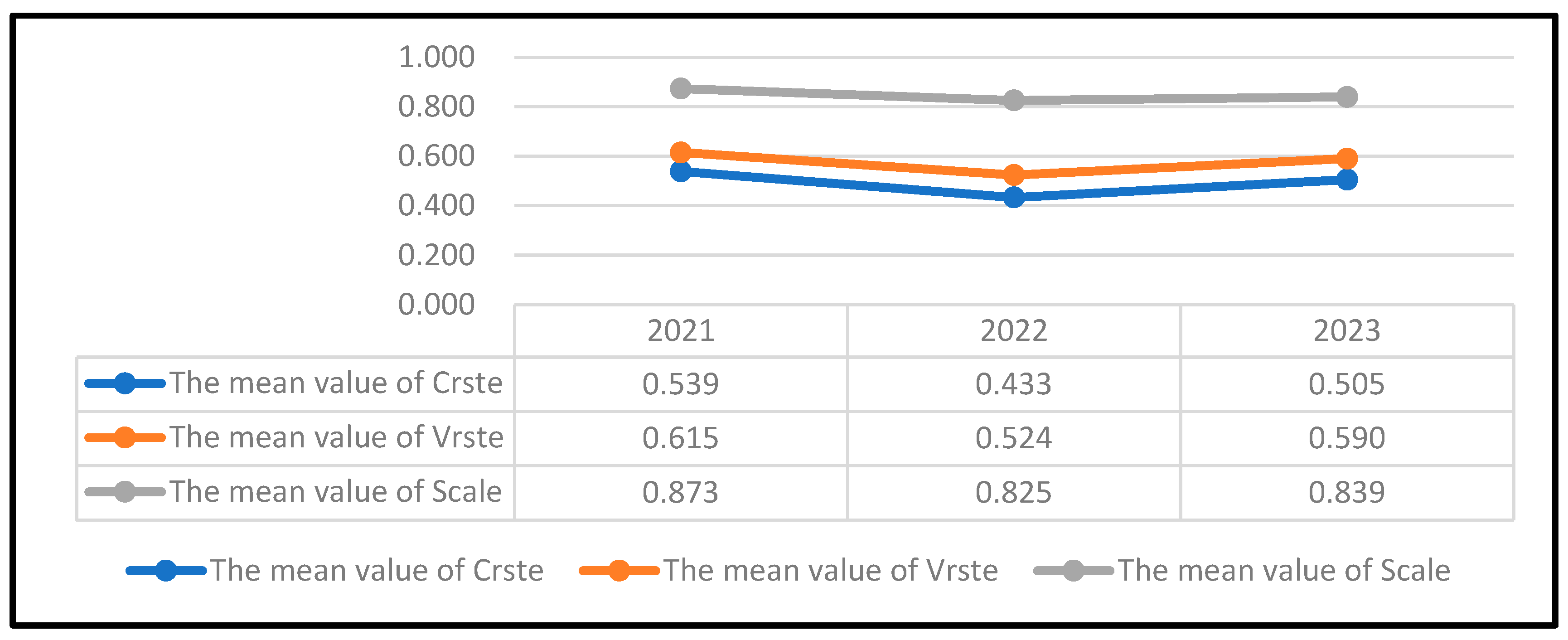
Trends in Innovation Efficiency Among New Energy Enterprises (as shown in Figure 1) reveal that both Crste and Vrste averages exhibited a downward trend from 2021 to 2022, followed by an upward shift from 2022 to 2023, forming a V-shaped fluctuation. This volatility indicated instability in technology application and resource allocation during the R&D innovation process of new energy enterprises. The reasons for this were twofold: on one hand, some new energy enterprises had not established long-term, stable mechanisms for innovation and R&D investment; on the other hand, certain enterprises frequently adjusted their R&D strategies in response to external market demand fluctuations, leading to significant and unpredictable fluctuations in innovation efficiency. While the mean value of Scale fluctuated relatively stably, its growth over the three years was limited. This indicated that during their scale expansion, new energy enterprises had not fully tapped into the potential of economies of scale, making it difficult to achieve further improvements in innovation efficiency through scale expansion alone. Furthermore, from 2021 to 2023, the Scale mean consistently exceeded the Crste and Vrste means. This indicated an imbalance in new energy enterprises’ technological innovation and scale development. Companies had pursued blind expansion, investing heavily in machinery procurement and factory construction while allocating relatively fewer resources to pure technical efficiency improvements like R&D and innovation management. Consequently, technological innovation efficiency had lagged significantly behind scale growth.

4.1.3. Efficiency Component Breakdown: The Primary Shortfall Lies in Pure Technology

Within the DEA analytical framework, pure technical efficiency and scale efficiency are derived from the decomposition of technical efficiency. Pure technical efficiency primarily refers to the efficiency achieved by enterprises in optimizing resource allocation through technological capabilities and management skills, after eliminating the impact of scale effects. Scale efficiency, at its core, denotes the degree of alignment between an enterprise’s current production scale and the optimal economic scale within its industry. This alignment directly influences innovation effectiveness through resource allocation efficiency. Based on the decomposition results in Table 3, it is evident that the two exhibit distinctly different characteristics and challenges:
Firstly, in terms of efficiency levels and stability, scale efficiency significantly outperformed pure technical efficiency, with the latter being relatively weak and constituting the primary bottleneck for overall efficiency improvement. Throughout the sample period, the mean scale efficiency consistently remained above 0.83 at a relatively high level, exhibiting minimal fluctuation (standard deviation between 0.180 and 0.190). This overall proximity to the efficient frontier indicated that most new energy enterprises demonstrated strong efficiency in production scale and resource allocation. In contrast, the mean pure technical efficiency fluctuated sharply within the 0.52–0.62 range, exhibiting a pattern of “decline followed by recovery” (falling from 0.615 in 2021 to 0.524 in 2022, then rebounding to 0.590 in 2023). This indicated significant instability persisted in the technological R&D and operational management segments of new energy enterprises, highlighting substantial room for improvement.
Secondly, examining trends in inter-firm variations reveals that the standard deviation of scale efficiency has remained relatively stable, indicating that disparities in scale suitability among enterprises have not widened further. Meanwhile, the standard deviation of pure technical efficiency increased from 0.265 in 2021 to 0.288 in 2023, reflecting a significant expansion in differences between companies regarding technological R&D and operational management capabilities. This signaled intensified differentiation within the new energy sector.
Finally, extreme value analysis further highlighted the severity of underlying risks and structural issues. Although overall scale efficiency remained high, its minimum value in 2022 was a mere 0.004, indicating pronounced diseconomies of scale among some new energy enterprises. This exposed potential issues such as inefficient management, reckless expansion, and overcapacity in less efficient firms. Simultaneously, the minimum value for pure technical efficiency in 2022 was only 0.040, creating a substantial gap with high-efficiency enterprises and highlighting severe polarization within the industry.

4.2. Dynamic Analysis of Innovation Efficiency in New Energy Enterprises

Through the preceding calculation of innovation efficiency for 76 Chinese new energy enterprises from 2021 to 2023, this paper has provided a foundational analysis of innovation efficiency. However, this data remains static and fails to delve into the driving factors behind variations, thus limiting its ability to provide comprehensive information for corporate decision-making. Therefore, this paper will further employ the Malmquist index in conjunction with panel data from 2021 to 2023 to conduct an in-depth analysis of the dynamic changes in innovation efficiency within the new energy sector.
Table 4 shows that the average annual Malmquist index for innovation efficiency among China’s 76 new energy enterprises from 2021 to 2023 was 1.046 (an average annual growth rate of 4.6%), indicating that the overall innovation efficiency of China’s new energy enterprises was currently on an upward trajectory. However, a breakdown of the data reveals that the TFPCH remained close to 1 (1.003) from 2021 to 2022, showing almost no significant growth variation. From 2022 to 2023, TFPCH surged to 1.091 (a 9.1% increase), reflecting instability in innovation efficiency. TECHCH averaged 1.103 annually (10.3% annual growth), while EFFCH averaged 0.948 (a 5.2% decline), indicating that new energy enterprises were increasingly relying on external technology imports or R&D investments without effectively converting these into production efficiency, resulting in low technology conversion rates. PECH averaged 0.975, suggesting deficiencies in resource allocation and technology management within new energy enterprises, preventing innovative technologies from being efficiently integrated into production processes. SECH averaged 0.973 annually, dropping to 0.927 in 2021–2022, revealing current mismatches between production scale and resource allocation. Some enterprises’ blind expansion led to low equipment utilization rates. Concurrently, policy shifts (e.g., subsidy phase-outs) may have caused production capacity planning to diverge from market demand, triggering diseconomies of scale. Furthermore, TFP growth relied primarily on technological progress, while scale efficiency improvements remain limited. This indicates that new energy enterprises prioritized technological investment significantly more than refining scale management. Such preferences, particularly when technological progress slows (e.g., TECHCH declining to 0.890 in 2022–2023), would lead to sluggish efficiency growth.
Overall, technological progress served as the core driver of innovation efficiency growth. However, the mean values for technological efficiency, pure technological efficiency, and scale efficiency all fell below or near 1. This indicated a mismatch between the pace of technological innovation in new energy enterprises and their capacity to translate efficiency gains into practical applications. Insufficient investment in talent development, production management, and other critical areas has trapped these enterprises in a dilemma characterized by high innovation input but low efficiency returns, ultimately constraining the sustainable development of the new energy industry.

5. Tobit Regression Analysis of Factors Affecting Innovation Efficiency in New Energy Enterprises

5.1. Model Construction

The innovation efficiency of China’s new energy industry is influenced by multiple factors. Building upon the research findings of numerous scholars and considering the characteristics of the new energy sector, this study examined both internal and external environmental dimensions. Five representative explanatory variables were selected: equity concentration, government support intensity, firm size, corporate governance independence, and market competitiveness. The comprehensive technical efficiency measured earlier served as the dependent variable. A Tobit model was employed to empirically analyze the impact of each explanatory variable (Specific variable indicators are shown in Table 5).
In summary, this paper constructs the regression model as follows:
Crste = β1Top10 + β2Sub + β3Size + β4IDR + β5ORG + ε
Among these, ε represents the random error term, while β1, β2, β3, β4 and β5 denote the regression coefficients for each independent variable.

5.2. Descriptive Statistical Analysis

Descriptive statistical analysis was conducted on data from new energy enterprises for the period 2021–2023. The results are presented in Table 6.
Table 6 indicates that the mean innovation efficiency is relatively low (0.492) with high dispersion. Regarding corporate governance structures, equity ownership is relatively concentrated (mean of 0.547) and independence meets standards (mean of 0.372). From the resource and market dimensions, significant intra-group differences exist in government subsidies, firm size, and revenue growth rate. Some new energy enterprises experience rapid growth, while others face declining revenues.

5.3. Correlation Analysis

Pearson correlation tests were conducted to assess the degree of association between the dependent variable and each independent variable. The results, presented in Table 7, reveal a multifaceted correlation among the variables, further validating the applicability of the selected independent variables. Additionally, the correlation coefficients between independent variables all fall below 0.7, indicating no multicollinearity exists among them.

5.4. Tobit Regression

This study employed Stata 17.0 software to conduct benchmark Tobit model regressions, with specific results presented in Table 8. To ensure estimation validity, marginal effects (dy/dx) calculated at the sample mean for explanatory variables are reported. The regression model exhibits high significance at the 1% level (Pseudo R2 = 0.688), indicating that the selected explanatory variables collectively possess strong explanatory power for innovation efficiency in new energy enterprises.
Firstly, from the perspective of corporate governance, the marginal effect of equity concentration is −0.340, which is significantly negative at the 1% level. This indicates that for every 1 percentage point increase in the shareholding ratio of the top ten shareholders, the expected innovation efficiency of new energy enterprises decreases by an average of 0.340 units. This result validates the “opportunity cost effect” hypothesis, suggesting that excessive equity concentration in new energy enterprises may lead major shareholders to suppress innovation activities in order to mitigate risks. In contrast, the marginal effect of the proportion of independent directors is 0.011, also significantly positive at the 1% level. This implies that for every 1 percentage point increase in the proportion of independent directors, innovation efficiency increases by an average of 0.011 units. The results indicate that independent directors, by strengthening oversight and providing professional advice, can effectively enhance the scientific nature of innovation decisions and the compliance of resource utilization in new energy enterprises, thereby promoting innovation efficiency. Secondly, regarding market competitiveness, the marginal effect of revenue growth rate is 0.150, significantly positive at the 5% level. This reflects the positive driving role of market performance in new energy enterprises’ innovation activities and further confirms that increased revenue provides crucial resource support for corporate innovation. From the perspective of resources and scale, the impact of government support is not significant, suggesting that the effectiveness of subsidy policies needs optimization. Firm size is only marginally significant (p < 0.1), indicating that mere scale expansion does not necessarily lead to improved innovation efficiency.

5.5. Heterogeneity Analysis

Given the significant variations among new energy enterprises in terms of scale, governance, and resources, the average effects revealed by benchmark regression could not fully capture the impact of these differences. Therefore, this study conducted a heterogeneity analysis by grouping firms according to their scale, equity concentration, and government support intensity(as shown in Table 9). This aimed to uncover the boundary conditions of innovation efficiency drivers, thereby providing a basis for tailored policy formulation.
Firstly, when grouped by enterprise size, the positive relationship between the proportion of independent directors and revenue growth rate is more pronounced in small-scale enterprises. This indicates that for small-scale new energy firms facing tighter resource constraints, improving corporate governance structures and accelerating market expansion are key pathways to enhancing innovation efficiency. In the large-scale enterprise sample, the effects of all explanatory variables are insignificant, suggesting that large new energy enterprises can no longer effectively drive innovation by solely relying on optimizing governance structures and expanding scale.
Secondly, when grouped by equity concentration, the negative impact of equity concentration, the positive impact of enterprise size, and the positive impact of independent director representation were all highly significant in the sample of highly concentrated enterprises. Conversely, in relatively dispersed enterprises, the effects of all explanatory variables were insignificant. These results indicate that improving corporate governance structures is crucial for enhancing innovation efficiency in equity-concentrated new energy enterprises.
Finally, when grouped by the level of government support, the effects of equity concentration, proportion of independent directors, firm size, and revenue growth rate were more pronounced among sample firms receiving low government support. In contrast, among firms receiving relatively high government support, only the government support itself exhibited a significant positive effect. This finding reveals the “subsidy crowding-out effect”: while substantial subsidies alleviate resource constraints, they may simultaneously weaken firms’ incentives to optimize internal governance and enhance market competitiveness, thereby reducing innovation efficiency.

5.6. Robustness Tests

To assess the reliability of the benchmark regression results, this study re-ran Tobit regressions by substituting the dependent variable with PTE and SE. The robustness test results (as shown in Table 10) indicated that the core findings remained largely consistent: the positive promotional effect of independent director share persisted across different efficiency dimensions; equity concentration, firm size, and revenue growth rate primarily influenced pure technical efficiency, while the impact of government support remained consistently insignificant. These findings further indicate that enhancing innovation efficiency in new energy enterprises cannot rely solely on government subsidies and scale expansion, but should instead be grounded in optimizing internal governance structures and strengthening technological innovation capabilities.

6. Discussion

This paper has revealed the characteristics and causes of innovation efficiency in new energy enterprises through static and dynamic efficiency analysis and factor impact testing. It then engages with existing theories and literature in two key areas.
Firstly, the innovation efficiency findings indicate that China’s new energy industry faces a classic “catch-up dilemma.” At the dynamic level, the industry’s technological frontier expands rapidly (TECHCH grows at an average annual rate of 10.3%), while enterprises’ ability to catch up to the production frontier weakens (EFFCH declines at an average annual rate of 5.2%). This finding aligns closely with Brynjolfsson’s (1993) “productivity paradox” and Cohen and Levinthal’s (1990) “absorptive capacity theory.” This indicates that for China’s new energy enterprises, achieving technological progress through external technology imports and increased R&D investment is relatively straightforward. However, internalizing technical knowledge, transforming it into organizational capabilities, and subsequently enhancing efficiency through optimized management processes proves significantly more challenging. At its core, deficiencies in soft management aspects—such as knowledge absorption and organizational learning—prevent enterprises from effectively integrating and applying external technical knowledge. Consequently, substantial investments in hard technology struggle to translate into tangible productivity gains. This mechanism aligns with the findings from the static efficiency decomposition in the preceding BCC analysis, confirming that the key to technology transformation lies in pure technical efficiency (i.e., management and technical application capabilities), not scale expansion. This discovery also cautions policymakers and enterprises against solely pursuing technological catch-up while neglecting improvements in “soft power”—such as organizational structures, management processes, and human capital. Otherwise, industries may fall into a growth trap, unable to achieve efficiency gains.
Secondly, Tobit regression results indicate that equity concentration exerts a significant negative impact on innovation efficiency. This aligns with the core tenets of agency theory, which posits that concentrated ownership may induce firms to adopt short-termism and risk aversion in R&D innovation (Jensen & Meckling, 1976), thereby providing fresh empirical support for the high-risk innovation sector of new energy. Conversely, the proportion of independent directors exerts a significant positive effect on innovation efficiency, aligning with Balsmeier et al. (2017). Notably, heterogeneity analysis reveals that corporate governance (particularly the proportion of independent directors) exerts a more pronounced effect in small-scale enterprises, firms with high equity concentration, and companies with low subsidy dependency. This finding aligns with the “institutional complementarity” theory, suggesting that robust governance structures enhance innovation efficiency when firms face strong external resource constraints or weak internal checks and balances. Meanwhile, government subsidies exhibit crowding-out effects in high-support groups, consistent with Chi (2003) and Hong et al. (2016), cautioning that unconditional subsidy policies may yield unintended consequences.

7. Conclusions and Recommendations

7.1. Key Findings

This study employed the DEA-Malmquist-Tobit method, using 76 Chinese new energy enterprises from 2021 to 2023 as the sample, to investigate the innovation efficiency of the new energy industry and its influencing factors. Empirical results indicate:
Against the backdrop of innovation-driven strategies and industrial transformation, sustainable development for new energy enterprises requires prioritizing R&D on efficient clean energy utilization, with technological innovation serving as the critical enabler. However, insufficient independent innovation capacity has become the primary constraint on their growth.
Static DEA of innovation efficiency revealed that overall innovation efficiency among new energy enterprises was low during the sample period. Only 25 enterprises (32.90% of the sample) achieved efficient levels. This stemmed partly from low pure technical efficiency, which constrained overall technological innovation efficiency. On the other hand, scale efficiency among new energy enterprises exhibited a divergent pattern where “most were close to efficient while a minority were significantly inefficient.” This characteristic reflected a pronounced efficiency stratification within the new energy industry during its development process, which led to an overall unbalanced development trajectory for the sector.
Based on the results of the Malmquist dynamic analysis of innovation efficiency, both the mean values of the pure technical efficiency and scale efficiency indices were less than 1. This jointly constrained the further improvement of total factor productivity. It was precisely due to the inadequate alignment among technology, management, and scale that the new energy industry had fallen into the dilemma of “high R&D investment but low efficiency returns,” thereby reducing the competitiveness of the new energy industry.
Based on the Tobit regression results for factors influencing innovation efficiency, during the sample period, the key drivers of innovation efficiency for new energy enterprises primarily stemmed from corporate governance and market competitiveness. Specifically, equity concentration exerted a significant negative impact on innovation efficiency, while the proportion of independent directors and revenue growth rate significantly enhanced innovation efficiency. In contrast, firm size exerted a relatively weak actual impact on innovation efficiency; government support showed no significant impact. This indicates that relying solely on scale expansion and subsidy policies may not necessarily translate effectively into innovation effectiveness.

7.2. Recommendations

7.2.1. Optimizing Corporate Governance Structures

As key innovation drivers, new energy enterprises should prioritize optimizing corporate governance structures and enhancing core market competitiveness. For companies with highly concentrated shareholdings, addressing the governance challenge of dominant shareholders is imperative. This can be achieved by introducing counterbalancing shareholders and strengthening the oversight role of independent directors, thereby establishing rational and efficient internal governance mechanisms that provide institutional safeguards for innovation-driven decision-making. Simultaneously, new energy enterprises should establish a market-driven innovation cycle, reinvesting revenue growth into R&D activities while effectively leveraging government subsidies to catalyze high-risk innovation. This approach helps avoid excessive reliance on external resources.

7.2.2. Implement Differentiated Subsidy Policies

As the driving force behind new energy development, the government should formulate precise and tiered industrial support strategies. Fiscal subsidies should transition from universal funding to performance-based incentive mechanisms tied to innovation efficiency. Regulatory efforts should focus on guiding new energy enterprises to improve governance structures, particularly by enhancing the professionalism of independent directors. Additionally, a differentiated policy framework should be established: alleviating financing pressures for small and medium-sized enterprises; encouraging large enterprises to engage in fundamental R&D; and establishing clear exit mechanisms for subsidy-dependent enterprises to effectively prevent resource misallocation.

7.2.3. Enhancing the Innovation Ecosystem

Both enterprises and governments must collaborate to propel the new energy industry from policy- and scale-driven growth toward efficiency- and innovation-driven advancement. By strengthening corporate governance and market competition mechanisms, combined with differentiated policy support, a systematic pathway for enhancing innovation efficiency can be forged. This will fully unleash the creative vitality of new energy enterprises, thereby propelling the industry toward innovation-driven, high-quality development.

7.3. Research Limitations and Future Prospects

This study strives for rigor, yet it still has the following limitations that require further refinement in the future:
Firstly, sample period limitations. Due to the lag in the disclosure of corporate financial data, coupled with significant policy adjustments and subsidy reforms in China’s new energy sector since 2024, the release of relevant data may experience phased delays. Consequently, the findings of this study reflect the transitional characteristics of the new energy industry during its period of profound adjustment up to 2023. Future research will incorporate updated data to further refine and deepen the analysis. Secondly, endogeneity challenges. This paper faces endogeneity challenges in causal inference. Although robustness tests have enhanced the reliability of the results, this issue remains partially mitigated. Future research may explore more precise instrumental variables or natural experiment designs to further reduce endogeneity bias and strengthen the robustness of the findings.

Author Contributions

Conceptualization, B.L.; methodology, B.L.; software, B.L.; validation, B.L.; formal analysis, B.L.; investigation, B.L.; resources, B.L. and D.L.; data curation, B.L. and D.L.; writing—original draft preparation, B.L.; writ-ing—review and editing, B.L.; visualization, B.L.; project administration, B.L. All authors have read and agreed to the published version of the manuscript.

Funding

This research received no external funding.

Institutional Review Board Statement

Not applicable.

Informed Consent Statement

Not applicable.

Data Availability Statement

The data underlying this study are from the CSMAR database under license and cannot be shared publicly. Processed data and replication code are available from the corresponding author upon reasonable request.

Conflicts of Interest

The authors declare no conflict of interest.

References

  1. Acs, Z. J., & Audretsch, D. B. (1989). Patents as a measure of innovative activity. Kyklos, 42(2), 171–180. [Google Scholar] [CrossRef]
  2. Aigner, D., Lovell, C. K., & Schmidt, P. (1977). Formulation and estimation of stochastic frontier production function models. Journal of Econometrics, 6(1), 21–37. [Google Scholar] [CrossRef]
  3. Balsmeier, B., Fleming, L., & Manso, G. (2017). Independent boards and innovation. Journal of Financial Economics, 123(3), 536–557. [Google Scholar] [CrossRef]
  4. Banker, R. D., Charnes, A., & Cooper, W. W. (1984). Some models for estimating technical and scale inefficiencies in data envelopment analysis. Management Science, 30(9), 1078–1092. [Google Scholar] [CrossRef]
  5. Barney, J. (1991). Firm resources and sustained competitive advantage. Journal of Management, 17(1), 99–120. [Google Scholar] [CrossRef]
  6. Barros, C. P., Liang, Q. B., & Peypoch, N. (2013). The technical efficiency of US airlines. Transportation Research Part A: Policy and Practice, 50, 139–148. [Google Scholar] [CrossRef]
  7. Brynjolfsson, E. (1993). The productivity paradox of information technology. Communications of the ACM, 36(12), 66–77. [Google Scholar] [CrossRef]
  8. Caves, D. W., Christensen, L. R., & Diewert, W. E. (1982). The economic theory of index numbers and the measurement of input, output, and productivity. Econometrica: Journal of the Econometric Society, 50, 1393–1414. [Google Scholar] [CrossRef]
  9. Charnes, A., Cooper, W. W., & Rhodes, E. (1978). Measuring the efficiency of decision making units. European Journal of Operational Research, 2(6), 429–444. [Google Scholar] [CrossRef]
  10. Chi, R. (2003). Research on the efficiency of technological innovation in enterprises and its influencing factors. Journal of Quantitative Economics and Technical Economics, 6, 105. [Google Scholar]
  11. Cohen, W. M., & Levinthal, D. A. (1990). Absorptive capacity: A new perspective on learning and innovation. Administrative Science Quarterly, 35(1), 128–152. [Google Scholar] [CrossRef]
  12. Fan, D. C., & Du, M. Y. (2018). Research on the efficiency and influencing factors of technological innovation resource allocation in high-end equipment manufacturing: An empirical analysis based on two-stage StoNED and Tobit models. Chinese Journal of Management Science, 26(1), 13. [Google Scholar]
  13. Fang, S., Xue, X., Yin, G., Fang, H., Li, J., & Zhang, Y. (2020). Evaluation and improvement of technological innovation efficiency of new energy vehicle enterprises in China based on DEA-Tobit model. Sustainability, 12(18), 7509. [Google Scholar] [CrossRef]
  14. Fare, R., Grosskopf, S., & Lovell, C. K. (1994). Production frontiers. Cambridge University Press. [Google Scholar]
  15. Griliches, Z. (1979). Issues in assessing the contribution of research and development to productivity growth. The Bell Journal of Economics, 10, 92–116. [Google Scholar] [CrossRef]
  16. Guan, J., & Chen, K. (2012). Modeling the relative efficiency of national innovation systems. Research Policy, 41(1), 102–115. [Google Scholar] [CrossRef]
  17. Hagedoorn, J., & Cloodt, M. (2003). Measuring innovative performance: Is there an advantage in using multiple indicators? Research Policy, 32(8), 1365–1379. [Google Scholar] [CrossRef]
  18. Halkos, G. E., & Tzeremes, N. G. (2012). Analyzing the Greek renewable energy sector: A data envelopment analysis approach. Renewable and Sustainable Energy Reviews, 16(5), 2884–2893. [Google Scholar] [CrossRef]
  19. Hall, B. H., Jaffe, A., & Trajtenberg, M. (2002). Market value and patent citations: A first look. (No. 0201001). University Library of Munich. [Google Scholar]
  20. Hill, C. W., & Snell, S. A. (1989). Effects of ownership structure and control on corporate productivity. Academy of Management Journal, 32(1), 25–46. [Google Scholar] [CrossRef]
  21. Hong, J., Feng, B., Wu, Y., & Wang, L. (2016). Do government grants promote innovation efficiency in China’s high-tech industries? Technovation, 57, 4–13. [Google Scholar] [CrossRef]
  22. Hu, J. L., Huang, Y. S., & You, C. Y. (2024). Renewable energy generation efficiency of Asian economies: An application of dynamic data envelopment analysis. Energies, 17(18), 4682. [Google Scholar] [CrossRef]
  23. Jensen, M. C., & Meckling, W. H. (1976). Theory of the firm: Managerial behavior, agency costs and ownership structure. Journal of Financial Economics, 3(4), 305–360. [Google Scholar] [CrossRef]
  24. Kim, K. T., Lee, D. J., Park, S. J., Zhang, Y., & Sultanov, A. (2015). Measuring the efficiency of the investment for renewable energy in Korea using data envelopment analysis. Renewable and Sustainable Energy Reviews, 47, 694–702. [Google Scholar] [CrossRef]
  25. Koç, H. (2021). Assessing the renewable energy efficiency levels of BRICS countries and Turkey using stochastic frontier analysis and information complexity criteria. Adıyaman University Journal of Science, 11(1), 136–146. [Google Scholar] [CrossRef]
  26. Li, H., Sun, Y., & Ren, L. (2017). Research on green technological innovation performance of new energy listed companies. Research on Science and Technology Management, 37(21), 240–246. [Google Scholar]
  27. Li, S. (2016). R&D intensity, government support, and technological innovation efficiency in new energy enterprises. Soft Science, 30(3), 11–14. [Google Scholar]
  28. Malmquist, S. (1953). Index numbers and indifference surfaces. Trabajos de Estadística, 4(2), 209–242. [Google Scholar] [CrossRef]
  29. Manso, G. (2011). Motivating innovation. The Journal of Finance, 66(5), 1823–1860. [Google Scholar] [CrossRef]
  30. OECD. (2015). Frascati manual 2015: Guidelines for collecting and reporting data on research and experimental development. OECD Publishing. [Google Scholar]
  31. Tobin, J. (1958). Estimation of relationships for limited dependent variables. Econometrica: Journal of the Econometric Society, 26, 24–36. [Google Scholar] [CrossRef]
  32. Xu, X. L., Qiao, S., & Chen, H. H. (2020). Exploring the efficiency of new energy generation: Evidence from OECD and non-OECD countries. Energy & Environment, 31(3), 389–404. [Google Scholar]
  33. Zhang, X. (1996). Mathematical analysis of some neural networks for solving linear and quadratic programming. Acta Mathematicae Applicatae Sinica, 12(1), 1–10. [Google Scholar] [CrossRef]
Figure 1. The Changing Trend of the Mean Value of Innovation Efficiency of New Energy Enterprises from 2021 to 2023.
Admsci 16 00065 g001
Table 1. Innovation Efficiency Indicator System.
Indicator CategoriesName of the IndicatorFormulae
Innovation inputsHuman resources inputsRepresented by the number of R&D personnel in the enterprise
Financial resource inputsRepresented by corporate R&D expenditures
Innovation outputsTechnical outputsRepresented by the number of patent applications filed by firms
Economic outputsRepresented by the main business income of the enterprise
Table 2. Summary of 3 Years of Innovation Efficiency.
YearCrsteVrsteScale
2021The number of DEA-efficient enterprises (proportion)7 (9.21%)13 (17.11%)7 (9.21%)
2022The number of DEA-efficient enterprises (proportion)8 (10.53%)13 (17.11%)10 (13.16%)
2023The number of DEA-efficient enterprises (proportion)10 (13.16%)13 (17.11%)12 (15.79%)
Note: The figures in parentheses represent the percentage of valid enterprises.
Table 3. Descriptive Statistics of Innovation Efficiency Components for Chinese New Energy Enterprises, 2021–2023.
Efficiency ComponentsYearNumber of SamplesMeanStd. Dev.MinMax
PTE2021760.6150.2650.0671
2022760.5240.2850.0401
2023760.5900.2880.0991
SE2021760.8730.1900.0411
2022760.8250.1800.0041
2023760.8390.1850.0061
Table 4. Average Malmquist Index Changes and Decompositions of New Energy Enterprises in China.
YearEFFCHTECHCHPECHSECHTFPCH
2021~20220.7341.3660.7920.9271.003
2022~20231.2260.8901.2001.0211.091
Mean0.9481.1030.9750.9731.046
Table 5. Measurement Indicators for Factors Affecting Innovation Efficiency in New Energy Enterprises.
VariableIndicatorIndicator ExplanationSymbol Representation
Explanatory variableEquity ConcentrationThe combined shareholding ratio of the top 10 shareholders of an enterpriseTop10
Government Support IntensityLn(Government Subsidies)Sub
Firm SizeLn(Number of Employees)Size
Corporate Governance IndependenceProportion of Independent DirectorsIDR
Market CompetitivenessOperating Revenue Growth RateORG
Dependent variableInnovation EfficiencyOverall Technical EfficiencyCrste
Table 6. Sample Descriptive Statistics.
Index NameMeanStd. Dev.MaxMin
Crste0.4920.2811.0000.003
Top100.5470.1680.9990.092
Sub17.9181.57621.89813.218
Size8.3851.12611.2266.230
IDR0.3720.4610.5000.333
ORG0.1940.4302.628−0.638
Note: The data in this table is based on calculations using samples from 2021 to 2023.
Table 7. Correlation Test.
VariableCrsteTop10SubSizeIDRORG
Crste1.0000
Top10−0.1755 *1.0000
Sub0.1759 *0.10901.0000
Size0.1756 *0.15870.6239 *1.0000
IDR0.1922 *−0.0357−0.1150−0.08981.0000
ORG0.2192 *−0.02720.0634−0.03270.2235 *1.0000
Note: * indicates significance at the 1% level (two-tailed tests).
Table 8. Tobit Regression Results.
Crste(dy/dx)Std. Err.tp > |t|[95% Conf. Interval]
Top10−0.340 ***0.113 −3.01 0.003 [−0.563, −0.117]
IDR0.011 ***0.004 2.70 0.007 [0.003, 0.020]
ORG0.150 **0.062 2.41 0.017 [0.027, 0.273]
Sub0.0190.018 1.05 0.293 [−0.017, 0.055]
Size0.045 *0.025 1.77 0.078 [−0.005, 0.094]
_cons−0.474 0.282 −1.68 0.095 [−1.031, 0.083]
Note: *** p < 0.01, ** p < 0.05, * p < 0.1.
Table 9. Results of Endogeneity Test.
VariablesScale ClassificationEquity Concentration ClassificationGovernment Support Classification
Small
Enterprises
Large
Enterprises
Lowly
Concentrated
Equity Enterprises
Highly
Concentrated
Equity Enterprises
Low
Government
Support Enterprises
High
Government
Support Enterprises
Top10−0.384
(0.015)
−0.263
(0.169)
0.204
(0.620)
−0.520
(0.029)
−0.465 *
(0.003)
−0.301
(0.126)
Sub0.019
(0.398)
0.024
(0.426)
0.333
(0.273)
0.017
(0.396)
0.003
(0.905)
0.080
(0.037)
Size0.004
(0.926)
0.033
(0.612)
−0.042
(0.311)
0.111 *
(0.000)
0.089
(0.025)
0.020
(0.580)
IDR0.021 *
(0.000)
0.001
(0.868)
0.012 *
(0.056)
0.012
(0.028)
0.021 *
(0.001)
0.004
(0.491)
ORG0.0136
(0.038)
0.119
(0.312)
0.117
(0.122)
0.103
(0.256)
0.160
(0.038)
0.139
(0.141)
sample size114114114114114114
Pseudo R20.6880.0740.1770.4260.3940.190
Note: Robust standard errors are shown in parentheses; * p < 0.1; the grouping criteria are based on the median values of enterprise size, top 10 shareholder concentration, and government support intensity.
Table 10. Robustness Test Results.
Variables(1) PTE(2) SE
Top10−0.337 *
(0.128)
−0.088
(0.100)
IDR0.010 **
(0.005)
0.007 **
(0.003)
ORG0.159 ***
(0.060)
0.032
(0.045)
Sub0.035 *
(0.020)
−0.012
(0.010)
Size0.054 *
(0.028)
0.031
(0.020)
_cons−0.686 **
(0.315)
0.619 ***
(0.224)
sample size228228
Pseudo R20.186−0.999
Note: Robust standard errors are shown in parentheses; * p < 0.1, ** p < 0.05, *** p < 0.01.
Disclaimer/Publisher’s Note: The statements, opinions and data contained in all publications are solely those of the individual author(s) and contributor(s) and not of MDPI and/or the editor(s). MDPI and/or the editor(s) disclaim responsibility for any injury to people or property resulting from any ideas, methods, instructions or products referred to in the content.