Moving Against Turnover Intentions Through Transactional Leadership, Organizational Climate, and Psychological Contract Fulfillment: Evidence from the Middle Eastern Hotel Industry



Abstract
1. Introduction
2. Hypotheses and Theories
2.1. Theoretical Setting
2.2. Transactional Leadership and Turnover Intentions
2.3. Mediating Role of Organizational Climate
2.4. Moderating Role of Psychological Contract Fulfillment
3. Research Design
3.1. Methodology and Approach
3.2. Measurements
3.3. Sample Characteristics
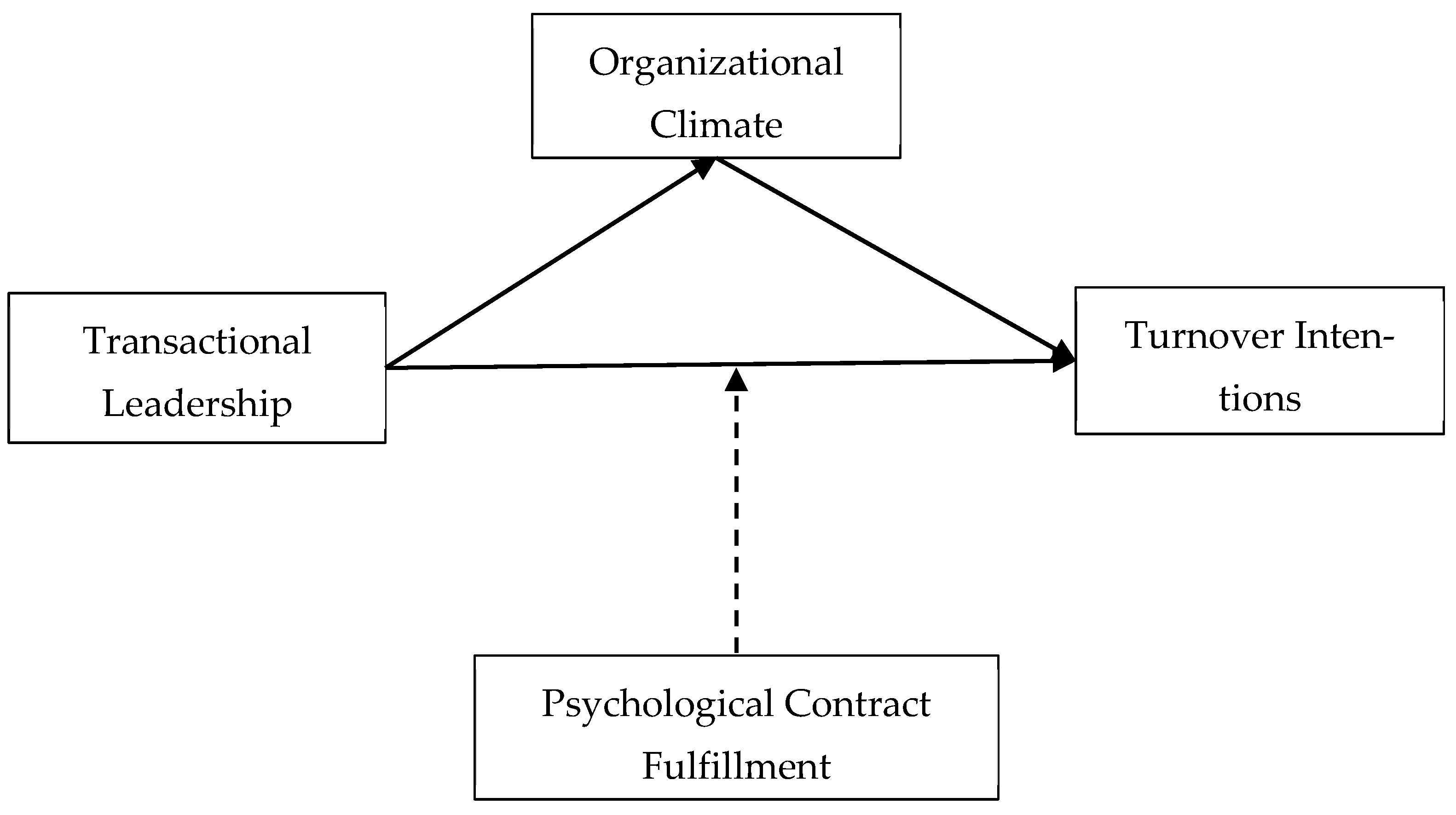
3.4. Research Model
4. Data Analysis
Discussions and Findings
5. Conclusions
5.1. Theoretical Implications
5.2. Practical Implications
5.3. Limitations and Recommendations
Author Contributions
Funding
Institutional Review Board Statement
Informed Consent Statement
Data Availability Statement
Conflicts of Interest
References
- Abdou, A. H., Khalil, A. A. F., Mahmoud, H. M. E., Elsaied, M. A., & Elsaed, A. A. (2022). The impact of hospitality work environment on employees’ turnover intentions during COVID-19 pandemic: The mediating role of work-family conflict. Frontiers in Psychology, 13, 890418. [Google Scholar] [CrossRef]
- Abdullah, T., Carr, N., & Lee, C. (2024). Tourism enterprises and barriers to business growth. In Handbook of tourism entrepreneurship (pp. 176–187). Edward Elgar Publishing. [Google Scholar]
- Ahmad, R., Nawaz, M. R., Ishaq, M. I., Khan, M. M., & Ashraf, H. A. (2023). Social exchange theory: Systematic review and future directions. Frontiers in Psychology, 13, 1015921. [Google Scholar] [CrossRef] [PubMed]
- Allen, D. G., Shore, L. M., & Griffeth, R. W. (2003). The role of perceived organizational support and supportive human resource practices in the turnover process. Journal of Management, 29(1), 99–118. [Google Scholar] [CrossRef]
- Al-Romeedy, B. S., Abou-Hamad, M. M., & Ali, I. E. H. (2023). The impact of psychological contract breach on job silence in tourism companies: Workplace bullying as a mediator. Journal of the Faculty of Tourism and Hotels-University of Sadat City, 7(1/1), 21–39. [Google Scholar]
- Amankwaa, A., Seet, P. S., & Susomrith, P. (2022). Tackling hotel employees’ turnover: A moderated-mediation analysis of transformational leadership, organisational embeddedness, and community embeddedness. Journal of Hospitality and Tourism Management, 51, 67–78. [Google Scholar] [CrossRef]
- Baquero, A. (2022). Job insecurity and intention to quit: The role of psychological distress and resistance to change in the UAE hotel industry. International Journal of Environmental Research and Public Health, 19(20), 13629. [Google Scholar] [CrossRef]
- Baquero, A. (2023). Hotel employees’ burnout and intention to quit: The role of psychological distress and financial well-being in a moderation mediation model. Behavioral Sciences, 13(2), 84. [Google Scholar] [CrossRef]
- Baquero, A., Khairy, H. A., & Al-Romeedy, B. S. (2025). Workplace stressors and the intention to quit: The role of psychological distress and psychological flexibility among hospitality employees. Tourism and Hospitality, 6(2), 72. [Google Scholar] [CrossRef]
- Bass, B. M., & Avolio, B. J. (1995). Multifactor leadership questionnaire leader form (5X-short). Mind Garden. [Google Scholar] [CrossRef]
- Bass, B. M., & Avolio, B. J. (2004). Multifactor leadership questionnaire: MLQ; manual and sampler set. Mind Garden. [Google Scholar]
- Baum, T., & Hai, N. T. T. (2020). Hospitality, tourism, human rights and the impact of COVID-19. International Journal of Contemporary Hospitality Management, 32(7), 2397–2407. [Google Scholar] [CrossRef]
- Blau, P. M. (1964). Exchange and power in social life. John Wiley & Sons. [Google Scholar]
- Breevaart, K., & Zacher, H. (2019). Main and interactive effects of weekly transformational and laissez-faire leadership on followers’ trust in the leader and leader effectiveness. Journal of Occupational and Organizational Psychology, 92(2), 384–409. [Google Scholar] [CrossRef]
- Caesens, G., Stinglhamber, F., Demoulin, S., & De Wilde, M. (2017). Perceived organizational support and employees’ well-being: The mediating role of organizational dehumanization. European Journal of Work and Organizational Psychology, 26(4), 527–540. [Google Scholar] [CrossRef]
- Cammann, C. (1983). Assessing the attitudes and perceptions of organizational members. In Assessing organizational change: A guide to methods, measures, and practices (pp. 71–138). Wiley. [Google Scholar]
- Casula, M., Rangarajan, N., & Shields, P. (2021). The potential of working hypotheses for deductive exploratory research. Quality & Quantity, 55(5), 1703–1725. [Google Scholar]
- Chen, T. J., & Wu, C. M. (2017). Improving the turnover intention of tourist hotel employees: Transformational leadership, leader-member exchange, and psychological contract breach. International Journal of Contemporary Hospitality Management, 29(7), 1914–1936. [Google Scholar] [CrossRef]
- Chung, H., Quan, W., Koo, B., Ariza-Montes, A., Vega-Muñoz, A., Giorgi, G., & Han, H. (2021). A threat of customer incivility and job stress to hotel employee retention: Do supervisor and co-worker supports reduce turnover rates? International Journal of Environmental Research and Public Health, 18(12), 6616. [Google Scholar] [CrossRef] [PubMed]
- Daouk, A., Farmanesh, P., & Zargar, P. (2021). The relationship between transactional leadership and OCB: A conditional analysis of organizational justice perception and psychological contract fulfillment. Sage Open, 11(4), 21582440211061563. [Google Scholar] [CrossRef]
- Datta, A. (2020). Measuring the influence of hospitality organizational climate on employee turnover tendency. The TQM Journal, 32(6), 1307–1326. [Google Scholar] [CrossRef]
- Dempsey, A. M. (2021). Examining the impact of leadership style and employee engagement on turnover intent moderated by emotional Intelligence in front line employees of hotels [Doctoral dissertation, Saint Leo University]. [Google Scholar]
- Diamantopoulos, A., Sarstedt, M., Fuchs, C., Wilczynski, P., & Kaiser, S. (2012). Guidelines for choosing between multi-item and single-item scales for construct measurement: A predictive validity perspective. Journal of the Academy of Marketing Science, 40(3), 434–449. [Google Scholar] [CrossRef]
- Dijkstra, T. K., & Henseler, J. (2015). Consistent partial least squares path modeling. MIS Quarterly, 39(2), 297–316. [Google Scholar] [CrossRef]
- Donkor, F., Sekyere, I., & Oduro, F. A. (2022). Transformational and transactional leadership styles and employee performance in public sector organizations in Africa: A comprehensive analysis in Ghana. Journal of African Business, 23(4), 945–963. [Google Scholar] [CrossRef]
- Farmanesh, P., & Zargar, P. (2021). Trust in leader as a psychological factor on employee and organizational outcome. In The psychology of trust. IntechOpen. [Google Scholar]
- García-Cabrera, A. M., García-Soto, M. G., & Nieves, J. (2021). Knowledge, innovation and NTBF short-and long-term performance. International Entrepreneurship and Management Journal, 17(3), 1067–1089. [Google Scholar] [CrossRef]
- Gom, D., Lew, T. Y., Jiony, M. M., Tanakinjal, G. H., & Sondoh, S., Jr. (2021). The role of transformational leadership and psychological capital in the hotel industry: A sustainable approach to reducing turnover intention. Sustainability, 13(19), 10799. [Google Scholar] [CrossRef]
- Griffeth, R. W., Hom, P. W., & Gaertner, S. (2000). A meta-analysis of antecedents and correlates of employee turnover: Update, moderator tests, and research implications for the next millennium. Journal of Management, 26(3), 463–488. [Google Scholar] [CrossRef]
- Gulakdeniz, E., & Karadas, G. (2025). Assessing the impact of employees’ perceptions of green intellectual capital on career and life satisfaction: A mediating moderation model in Turkish hotels. Sustainability, 17(14), 6448. [Google Scholar] [CrossRef]
- Hair, J. F., Jr., Hult, G. T. M., Ringle, C. M., Sarstedt, M., Danks, N. P., & Ray, S. (2021). Evaluation of reflective measurement models. In Partial least squares structural equation modeling (PLS-SEM) using R: A workbook (pp. 75–90). Springer International Publishing. [Google Scholar]
- Hair, J. F., Jr., Sarstedt, M., Ringle, C. M., & Gudergan, S. P. (2017). Advanced issues in partial least squares structural equation modeling. Sage Publications. [Google Scholar]
- Hair, J. F., Risher, J. J., Sarstedt, M., & Ringle, C. M. (2019). When to use and how to report the results of PLS-SEM. European Business Review, 31(1), 2–24. [Google Scholar] [CrossRef]
- Hannah, S. T., Perez, A. L., Lester, P. B., & Quick, J. C. (2020). Bolstering workplace psychological well-being through transactional and transformational leadership. Journal of Leadership & Organizational Studies, 27(3), 222–240. [Google Scholar] [CrossRef]
- Hassanein, F., Daouk, A., Yassine, D., Bou Zakhem, N., Elsayed, R., & Saleh, A. (2024). Green human resource management and employee retention in the hotel industry of UAE: The mediating effect of green innovation. Sustainability, 16(11), 4668. [Google Scholar] [CrossRef]
- Hassanein, F., & Özgit, H. (2022). Sustaining human resources through talent management strategies and employee engagement in the Middle East hotel industry. Sustainability, 14(22), 15365. [Google Scholar] [CrossRef]
- Hayat, A., & Afshari, L. (2021). Supportive organizational climate: A moderated mediation model of workplace bullying and employee well-being. Personnel Review, 50(7/8), 1685–1704. [Google Scholar] [CrossRef]
- Henseler, J., Dijkstra, T. K., Sarstedt, M., Ringle, C. M., Diamantopoulos, A., Straub, D. W., Ketchen, D. J., Jr., Hair, J. F., Hult, G. T. M., & Calantone, R. J. (2014). Common beliefs and reality about PLS: Comments on Rönkkö and Evermann (2013). Organizational Research Methods, 17(2), 182–209. [Google Scholar]
- Henseler, J., Ringle, C. M., & Sarstedt, M. (2015). A new criterion for assessing discriminant validity in variance-based structural equation modeling. Journal of the Academy of Marketing Science, 43(1), 115–135. [Google Scholar] [CrossRef]
- Holston-Okae, B. (2017). Employee turnover intentions in the hospitality industry. Walden University. [Google Scholar]
- Hom, P. W., & Griffeth, R. W. (1991). Structural equations modeling test of a turnover theory: Cross-sectional and longitudinal analyses. Journal of Applied Psychology, 76(3), 350. [Google Scholar] [CrossRef]
- Jabutay, F. A., & Rungruang, P. (2021). Turnover intent of new workers: Social exchange perspectives. Asia-Pacific Journal of Business Administration, 13(1), 60–79. [Google Scholar] [CrossRef]
- Jia, K., Zhu, T., Zhang, W., Rasool, S. F., Asghar, A., & Chin, T. (2022). The linkage between ethical leadership, well-being, work engagement, and innovative work behavior: The empirical evidence from the higher education sector of China. International Journal of Environmental Research and Public Health, 19(9), 5414. [Google Scholar] [CrossRef]
- Jiang, Z., & Probst, T. M. (2021). The mediating effect of organizational climate on the relationship between leadership and employee outcomes: A cross-cultural study. International Journal of Stress Management, 28(1), 1–14. [Google Scholar]
- Jöreskog, K. G. (1971). Simultaneous factor analysis in several populations. Psychometrika, 36(4), 409–426. [Google Scholar] [CrossRef]
- Kang, H. J., Busser, J., & Choi, H. M. (2018). Service climate: How does it affect turnover intention? International Journal of Contemporary Hospitality Management, 30(1), 76–94. [Google Scholar] [CrossRef]
- Kaya, B., & Karatepe, O. M. (2020). Attitudinal and behavioral outcomes of work-life balance among hotel employees: The mediating role of psychological contract breach. Journal of Hospitality and Tourism Management, 42, 199–209. [Google Scholar] [CrossRef]
- Khairy, H. A., Baquero, A., & Al-Romeedy, B. S. (2023). The effect of transactional leadership on organizational agility in tourism and hospitality businesses: The mediating roles of organizational trust and ambidexterity. Sustainability, 15(19), 14337. [Google Scholar] [CrossRef]
- Khan, A. N., Khan, N. A., & Bodla, A. A. (2021). The after-shock effects of high-performers turnover in hotel industry: A multi-level study. International Journal of Contemporary Hospitality Management, 33(10), 3277–3295. [Google Scholar] [CrossRef]
- Khan, R. N. A., Masih, S., & Ali, W. (2021). Influence of transactional leadership and trust in leader on employee well-being and mediating role of organizational climate. International Journal of Business and Economic Affairs, 6(1), 13–23. [Google Scholar] [CrossRef]
- Kock, N. (2015). Common method bias in PLS-SEM: A full collinearity assessment approach. International Journal of e-Collaboration, 11(4), 1–10. [Google Scholar] [CrossRef]
- Lee, L., Guchait, P., & Madera, J. M. (2020). Negative affect, deep acting, and customer compensation as responses to customer mistreatment: The effect of customer-based perspective-taking. International Journal of Hospitality Management, 89, 102532. [Google Scholar] [CrossRef]
- Li, Q., Mohamed, R., Mahomed, A., & Khan, H. (2022). The effect of perceived organizational support and employee care on turnover intention and work engagement: A mediated moderation model using age in the post pandemic period. Sustainability, 14(15), 9125. [Google Scholar] [CrossRef]
- Mehta, A., Mall, S., Kothari, T., & Deshpande, R. (2024). Hotel employees’ intention to stay through psychological contract fulfillment and positive emotions in post-lockdown era. Tourism Review, 79(1), 104–118. [Google Scholar] [CrossRef]
- Meira, J. V. D. S., & Hancer, M. (2021). Using the social exchange theory to explore the employee-organization relationship in the hospitality industry. International Journal of Contemporary Hospitality Management, 33(2), 670–692. [Google Scholar] [CrossRef]
- Michael, N., & Fotiadis, A. (2022). Employee turnover: The hotel industry perspective. Journal of Tourism, Heritage & Services Marketing, 8(1), 38–47. [Google Scholar]
- Mobley, W. H., Griffeth, R. W., Hand, H. H., & Meglino, B. M. (1979). Review and conceptual analysis of the employee turnover process. Psychological Bulletin, 86(3), 493. [Google Scholar] [CrossRef]
- Montano, D., & Peter, R. (2022). Informal care-giving and the intention to give up employment: The role of perceived supervisor behaviour in a cohort of German employees. European Journal of Ageing, 19(3), 575–585. [Google Scholar] [CrossRef]
- Moustafa, M. A., Elrayah, M., Aljoghaiman, A., Hasanein, A. M., & Ali, M. A. (2024). How does sustainable organizational support affect job burnout in the hospitality sector? The mediating role of psychological capital. Sustainability, 16(2), 840. [Google Scholar] [CrossRef]
- Nadiri, H., & Tanova, C. (2016). What factors influence employee service recovery performance and what are the consequences in health care? Quality Management in Healthcare, 25(3), 162–175. [Google Scholar] [CrossRef]
- Nazarian, A., Ranjbaran, A., Afifi, M., Atkinson, P., & Sadeghilar, N. (2024). Cross-cultural examination of effects of ethical leadership of independent hotels based on Social Exchange Theory. International Journal of Cross Cultural Management, 24(3), 463–484. [Google Scholar] [CrossRef]
- Parker, C. P., Baltes, B. B., Young, S. A., Huff, J. W., Altmann, R. A., Lacost, H. A., & Roberts, J. E. (2003). Relationships between psychological climate perceptions and work outcomes: A meta-analytic review. Journal of Organizational Behavior: The International Journal of Industrial, Occupational and Organizational Psychology and Behavior, 24(4), 389–416. [Google Scholar] [CrossRef]
- Pattali, S., Sankar, J. P., Al Qahtani, H., Menon, N., & Faizal, S. (2024). Effect of leadership styles on turnover intention among staff nurses in private hospitals: The moderating effect of perceived organizational support. BMC Health Services Research, 24(1), 199. [Google Scholar] [CrossRef] [PubMed]
- Patterson, M. G., West, M. A., Shackleton, V. J., Dawson, J. F., Lawthom, R., Maitlis, S., Robinson, D. L., & Wallace, A. M. (2005). Validating the organizational climate measure: Links to managerial practices, productivity and innovation. Journal of Organizational Behavior, 26(4), 379–408. [Google Scholar] [CrossRef]
- Pu, B., Sang, W., Ji, S., Hu, J., & Phau, I. (2024). The effect of customer incivility on employees’ turnover intention in hospitality industry: A chain mediating effect of emotional exhaustion and job satisfaction. International Journal of Hospitality Management, 118, 103665. [Google Scholar]
- Purwanto, A., & Sudargini, Y. (2021). Partial least squares structural equation modeling (PLS-SEM) analysis for social and management research: A literature review. Journal of Industrial Engineering & Management Research, 2(4), 114–123. [Google Scholar]
- Rabiul, M. K. (2024). Does transactional leadership generate work engagement in the hotel industry? The role of motivating language and job prestige. Journal of Quality Assurance in Hospitality & Tourism, 25(3), 442–466. [Google Scholar]
- Rhoades, L., & Eisenberger, R. (2002). Perceived organizational support: A review of the literature. Journal of Applied Psychology, 87(4), 698. [Google Scholar] [CrossRef]
- Robinson, S. L., & Wolfe Morrison, E. (2000). The development of psychological contract breach and violation: A longitudinal study. Journal of Organizational Behavior, 21(5), 525–546. [Google Scholar] [CrossRef]
- Rousseau, D. M., & Tijoriwala, S. A. (1998). Assessing psychological contracts: Issues, alternatives and measures. Journal of Organizational Behavior: The International Journal of Industrial, Occupational and Organizational Psychology and Behavior, 19(S1), 679–695. [Google Scholar] [CrossRef]
- Saleem, S., Rasheed, M. I., Malik, M., & Okumus, F. (2021). Employee-fit and turnover intentions: The role of job engagement and psychological contract violation in the hospitality industry. Journal of Hospitality and Tourism Management, 49, 385–395. [Google Scholar] [CrossRef]
- Samuel, O. M., & Engelbrecht, A. S. (2021). How transformational leadership, psychological contract violation, empowerment and affective commitment influence employee’s intention to quit an organisation. South African Journal of Business Management, 52(1), 12. [Google Scholar] [CrossRef]
- Sarstedt, M., Ringle, C. M., & Hair, J. F. (2017). Treating unobserved heterogeneity in PLS-SEM: A multi-method approach. In Partial least squares path modeling: Basic concepts, methodological issues and applications (pp. 197–217). Springer International Publishing. [Google Scholar]
- Schneider, B., Ehrhart, M. G., & Macey, W. H. (2013). Organizational climate and culture. Annual Review of Psychology, 64, 361–388. [Google Scholar] [CrossRef] [PubMed]
- Schneider, B., White, S. S., & Paul, M. C. (1998). Linking service climate and customer perceptions of service quality: Tests of a causal model. Journal of Applied Psychology, 83(2), 150. [Google Scholar] [CrossRef]
- Shmueli, G., Ray, S., Velasquez Estrada, J. M., & Chatla, S. B. (2016). The elephant in the room: Predictive performance of PLS models. Journal of business Research, 69, 4552–4564. [Google Scholar]
- Sobaih, A. E. E., Hasanein, A. M., Aliedan, M. M., & Abdallah, H. S. (2022). The impact of transactional and transformational leadership on employee intention to stay in deluxe hotels: Mediating role of organisational commitment. Tourism and Hospitality Research, 22(3), 257–270. [Google Scholar] [CrossRef]
- Sung, T. P., Joo, L. W., Rahim, I. H. A., & Sondoh, S. (2019). Transformational and transactional leadership styles towards organizational commitment in the hotel industry. Journal of Tourism, 4(17), 34–45. [Google Scholar]
- Turnley, W. H., Bolino, M. C., Lester, S. W., & Bloodgood, J. M. (2003). The impact of psychological contract fulfillment on the performance of in-role and organizational citizenship behaviors. Journal of Management, 29(2), 187–206. [Google Scholar] [CrossRef]
- Turnley, W. H., & Feldman, D. C. (1999). The impact of psychological contract violations on exit, voice, loyalty, and neglect. Human Relations, 52(7), 895–922. [Google Scholar]
- Uzundemir, A., Albattat, A., & Ahamed, F. O. R. B. I. S. (2023). The impact of work environment and transactional leadership style on employees’ performance. International Journal of Multidisciplinary Research and Studies, 6, 1–38. [Google Scholar]
- Wang, C. J. (2022). Exploring the mechanisms linking transformational leadership, perceived organizational support, creativity, and performance in hospitality: The mediating role of affective organizational commitment. Behavioral Sciences, 12(10), 406. [Google Scholar] [CrossRef] [PubMed]
- Wu, T. J., Yuan, K. S., & Yen, D. C. (2023). Leader-member exchange, turnover intention and presenteeism–the moderated mediating effect of perceived organizational support. Current Psychology, 42(6), 4873–4884. [Google Scholar] [CrossRef]
- Xu, Y., Jie, D., Wu, H., Shi, X., Badulescu, D., Akbar, S., & Badulescu, A. (2022). Reducing employee turnover intentions in tourism and hospitality sector: The mediating effect of quality of work life and intrinsic motivation. International Journal of Environmental Research and Public Health, 19(18), 11222. [Google Scholar] [CrossRef] [PubMed]
- Yan, Z., Mansor, Z. D., Choo, W. C., & Abdullah, A. R. (2021). How to reduce employees’ turnover intention from the psychological perspective: A mediated moderation model. Psychology Research and Behavior Management, 14, 185–197. [Google Scholar] [CrossRef]
- Young, H. R., Glerum, D. R., Joseph, D. L., & McCord, M. A. (2021). A meta-analysis of transactional leadership and follower performance: Double-edged effects of LMX and empowerment. Journal of Management, 47(5), 1255–1280. [Google Scholar] [CrossRef]
- Zhang, C., Deeprasert, J., & Jiang, S. (2024). Psychological contract and turnover intention in luxury hotels. Problems and Perspectives in Management, 22(3), 80. [Google Scholar] [CrossRef]
- Zhang, M., Chen, H., Wang, N., Li, Y., Li, X., & Liu, Y. (2023). The mediating role of job satisfaction between psychological capital and work engagement among Chinese nurses during COVID-19 outbreak: A comparative study between nurse specialists and general nurses. Frontiers in Psychiatry, 13, 990216. [Google Scholar] [CrossRef]
- Zhang, Y., Liu, D., & Wang, J. (2021). How organizational climate mediates the relationship between leadership and employee well-being: A meta-analytic path analysis. Human Resource Management Journal, 31(1), 1–22. [Google Scholar]



| Age | Frequency | Percentage |
|---|---|---|
| 20–30 | 113 | 34.3 |
| 31–40 | 172 | 45.7 |
| 41–50 | 65 | 20.0 |
| Gender | ||
| Male | 183 | 52.29% |
| Female | 167 | 47.71% |
| Work Experience | ||
| 1–3 years | 102 | 29.15% |
| 3–5 years | 171 | 48.85% |
| +5 years | 77 | 22.00% |
| Factors | Indicators | Outer Loadings | Alpha | Rho A | CR | AVE |
|---|---|---|---|---|---|---|
| Transactional Leadership | TL1 | 0.766 | 0.781 | 0.807 | 0.848 | 0.684 |
| TL2 | 0.774 | |||||
| TL3 | 0.767 | |||||
| TL4 | 0.784 | |||||
| TL5 | 0.779 | |||||
| Organizational Climate | OC1 | 0.751 | 0.793 | 0.801 | 0.818 | 0.670 |
| OC2 | 0.744 | |||||
| OC3 | 0.737 | |||||
| OC4 | 0.764 | |||||
| OC5 | 0.728 | |||||
| Psychological Contract Fulfillment | PCF1 | 0.746 | 0.786 | 0.801 | 0.821 | 0.671 |
| PCF2 | 0.771 | |||||
| PCF3 | 0.729 | |||||
| PCF4 | 0.718 | |||||
| PCF5 | 0.721 | |||||
| Turnover Intentions | TI1 | 0.761 | 0.801 | 0.804 | 0.837 | 0.681 |
| TI2 | 0.778 | |||||
| TI3 | 0.774 | |||||
| TI4 | 0.749 | |||||
| TI5 | 0.763 |
| TL | OC | PCF | |
|---|---|---|---|
| TL | - | ||
| OC | 0.601 | - | |
| PCF | 0.494 | 0.572 | - |
| TI | 0.638 | 0.594 | 0.647 |
| Effects | Relations | β | t-Statistics | p-Value | Hypothesis |
|---|---|---|---|---|---|
| Direct | |||||
| H1 | TL → TI | −0.323 | −3.403 ** | 0.001 | Supported |
| Mediation | |||||
| H2 | TL → OC → TI | −0.332 | −2.884 * | 0.009 | Supported |
| Moderation | |||||
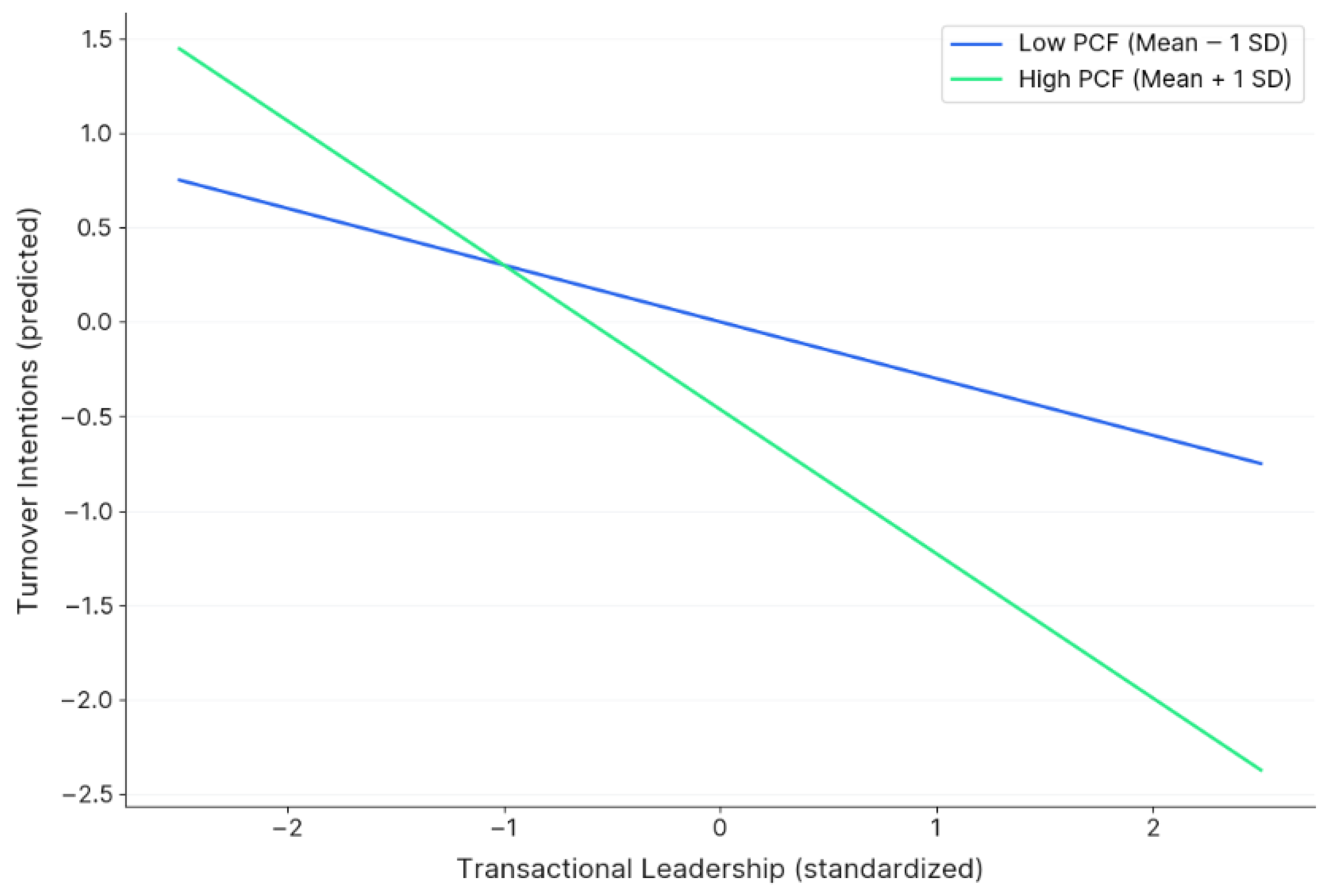
| H3 | TL → PCF → TI | −0.353 | −2.932 * | 0.009 | Supported |
| Control Variables | |||||
| Gender → TI | 0.120 | 2.101 * | |||
| Age → TI | −0.114 | −2.107 * | |||
| * 0.05, ** 0.01 | Experience → TI | −0.122 | −2.112 * | ||
| R2OC = 0.629/Q2OC = 0.533/RMSE = 0.661/MAE = 0.513 R2TI = 0.665/Q2TI = 0.541/RMSE = 0.662/MAE = 0.562 SRMR: 0.033; NFI: 0.924; CFI: 0.980 | |||||
Disclaimer/Publisher’s Note: The statements, opinions and data contained in all publications are solely those of the individual author(s) and contributor(s) and not of MDPI and/or the editor(s). MDPI and/or the editor(s) disclaim responsibility for any injury to people or property resulting from any ideas, methods, instructions or products referred to in the content. |
© 2026 by the authors. Licensee MDPI, Basel, Switzerland. This article is an open access article distributed under the terms and conditions of the Creative Commons Attribution (CC BY) license.
Share and Cite
Hassanein, F.; Daouk, A. Moving Against Turnover Intentions Through Transactional Leadership, Organizational Climate, and Psychological Contract Fulfillment: Evidence from the Middle Eastern Hotel Industry. Adm. Sci. 2026, 16, 62. https://doi.org/10.3390/admsci16020062
Hassanein F, Daouk A. Moving Against Turnover Intentions Through Transactional Leadership, Organizational Climate, and Psychological Contract Fulfillment: Evidence from the Middle Eastern Hotel Industry. Administrative Sciences. 2026; 16(2):62. https://doi.org/10.3390/admsci16020062
Chicago/Turabian StyleHassanein, Fida, and Amira Daouk. 2026. "Moving Against Turnover Intentions Through Transactional Leadership, Organizational Climate, and Psychological Contract Fulfillment: Evidence from the Middle Eastern Hotel Industry" Administrative Sciences 16, no. 2: 62. https://doi.org/10.3390/admsci16020062
APA StyleHassanein, F., & Daouk, A. (2026). Moving Against Turnover Intentions Through Transactional Leadership, Organizational Climate, and Psychological Contract Fulfillment: Evidence from the Middle Eastern Hotel Industry. Administrative Sciences, 16(2), 62. https://doi.org/10.3390/admsci16020062