
Exploring the Relationship Between Creativity and Organisational Resilience in Service Organisations



Abstract
1. Introduction
2. Theoretical Framework
3. Materials and Methods
4. Results
5. Discussion
6. Conclusions
Author Contributions
Funding
Institutional Review Board Statement
Informed Consent Statement
Data Availability Statement
Conflicts of Interest
| 1 | https://ec.europa.eu/eurostat/en/web/products-eurostat-news/ (accessed on 15 May 2025). |
References
- Akgün, A. E., & Keskin, H. (2014). Organisational resilience capacity and firm product innovativeness and performance. International Journal of Production Research, 52(23), 6918–6937. [Google Scholar] [CrossRef]
- Andriopoulos, C. (2001). Determinants of organisational creativity: A literature review. Management Decision, 39(10), 834–841. [Google Scholar] [CrossRef]
- Awe, O. A., & Church, E. M. (2021). Project flexibility and creativity: The moderating role of training utility. Management Decision, 59(9), 2077–2100. [Google Scholar] [CrossRef]
- Barron, F. B., & Harrington, D. M. (1981). Creativity, intelligence, and personality. Annual Review of Psychology, 32, 439–476. [Google Scholar] [CrossRef]
- Bhamra, R., Dani, S., & Burnard, K. (2011). Resilience: The concept, a literature review and future directions. International Journal of Production Research, 49(18), 5375–5393. [Google Scholar] [CrossRef]
- Bhattarai, G., Karki, D., Rai, B., & Budhathoki, P. B. (2024). Interactive effect of supervisory styles and careerist orientation on enhancing creativity. Cogent Business & Management, 11(1), 2351404. [Google Scholar] [CrossRef]
- Brueller, D., Brueller, N. N., Brueller, R., & Carmeli, A. (2019). Interorganisational relationships in times of decline: Implications for organisational resilience. Applied Psychology, 68(4), 719–758. [Google Scholar] [CrossRef]
- Bui, H., Chau, V. S., Degl’Innocenti, M., Leone, L., & Vicentini, F. (2019). The resilient organisation: A meta-analysis of the effect of communication on team diversity and team performance. Applied Psychology, 68(4), 621–657. [Google Scholar] [CrossRef]
- Burnard, K., & Bhamra, R. (2011). Organisational resilience: Development of a conceptual framework for organisational responses. International Journal of Production Research, 49(18), 5581–5599. [Google Scholar] [CrossRef]
- Burnard, K. J., & Bhamra, R. (2019). Challenges for organisational resilience. Continuity & Resilience Review, 1(1), 17–25. [Google Scholar] [CrossRef]
- Chen, K. X., Ye, Y., Han, Y., & Li, N. (2026). Creativity under siege: Investigating the influence of exploitative leadership on service creativity. International Journal of Hospitality Management, 133, 104471. [Google Scholar] [CrossRef]
- Choi, H.-S., & Thompson, L. (2005). Old wine in a new bottle: Impact of membership change on group creativity. Organisational Behaviour and Human Decision Processes, 98(2), 121–132. [Google Scholar] [CrossRef]
- Cropley, D. H. (2009). Fostering and measuring creativity and innovation: Individuals, organisations and products. In Measuring creativity (pp. 257–279). Publications Office of the EU. [Google Scholar]
- Fernández-Díaz, J. R., Gutiérrez-Ortega, M., Llamas-Salguero, F., & Cantón-Mayo, I. (2021). Creativity and resilience as predictors of career success. Sustainability, 13(8), 4489. [Google Scholar] [CrossRef]
- Flatau-Harrison, H., Griffin, M. A., & Gagne, M. (2020). Trickling down: The impact of leaders on individual role clarity through safety climate strength across time. Safety Science, 121, 485–495. [Google Scholar] [CrossRef]
- Franken, E. (2019). Building people up: Leadership and employee resilience [Doctoral dissertation, Open Access Te Herenga Waka–Victoria University of Wellington]. [Google Scholar]
- Goldschmidt, C. C., de Paiva, K. C. M., & Irigaray, H. A. R. (2019). Organisational resilience: A proposal of an integrated model and research agenda. Tourism & Management Studies, 15(3), 37–46. [Google Scholar]
- Gray, D., & Jones, K. (2018). The resilience and wellbeing of public sector leaders. International Journal of Public Leadership, 14(3), 138–154. [Google Scholar] [CrossRef]
- Gupta, R., & Banerjee, P. (2016). Antecedents of organisational creativity: A multi-level approach. Business: Theory and Practice, 17, 167. [Google Scholar] [CrossRef][Green Version]
- Homer, S. T., & Lim, W. M. (2024). Theory development in a globalized world: Bridging “doing as the romans do” with “understanding why the romans do it”. Global Business and Organizational Excellence, 43(3), 127–138. [Google Scholar] [CrossRef]
- Kamissoko, D., Nastov, B., & Allon, M. (2021). Improved model for continuous, real-time assessment and monitoring of the resilience of systems based on multiple data sources and stakeholders. Structure and Infrastructure Engineering, 19, 1122–1137. [Google Scholar] [CrossRef]
- Kemp, T., Ayton, J., Butler-Henderson, K., & Lam, M. (2024). Using socio-technical systems theory to study the health information management workforce in Australian acute hospitals. Social Theory & Health, 22(4), 285–300. [Google Scholar] [CrossRef]
- Klijn, M., & Tomic, W. (2010). A review of creativity within organisations from a psychological perspective. Journal of Management Development, 29(4), 322–343. [Google Scholar] [CrossRef]
- Kratzer, J., Leenders, R. T. A. J., & Van Engelen, J. M. L. (2005). Informal contacts and performance in innovation teams. International Journal of Manpower, 26(6), 513–528. [Google Scholar] [CrossRef]
- Le, K. G. H., & Le, N. H. (2024). The benefits of service employees’ resilience in the workplace: A mediation and moderation analysis. Service Business, 18(2), 315–338. [Google Scholar] [CrossRef]
- Lengnick-Hall, C. A., Beck, T. E., & Lengnick-Hall, M. L. (2011). Developing a capacity for organisational resilience through strategic human resource management. Human Resource Management Review, 21(3), 243–255. [Google Scholar] [CrossRef]
- Liu, P., Phawitpiriyakliti, C., & Terason, S. (2024). Leadership and innovation management: Driving performance through agility and resilience in automotive enterprises. Journal of Ecohumanism, 3(6), 834–848. [Google Scholar] [CrossRef]
- Mafabi, S., Munene, J. C., & Ahiauzu, A. (2015). Creative climate and organisational resilience: The mediating role of innovation. International Journal of Organisational Analysis, 23(4), 564–587. [Google Scholar] [CrossRef]
- Mai, K. N., & Nguyen, V. T. (2023). Entrepreneurial ecosystem affects organisational learning, creativity and success. Cogent Business & Management, 10(3), 2260125. [Google Scholar] [CrossRef]
- Martins, E. C., & Terblanche, F. (2003). Building organisational culture that stimulates creativity and innovation. European Journal of Innovation Management, 6(1), 64–74. [Google Scholar] [CrossRef]
- Mathisen, G. E., Einarsen, S., Jørstad, K., & Brønnick, K. S. (2004). Climate for work group creativity and innovation: Norwegian validation of the team climate inventory (TCI). Scandinavian Journal of Psychology, 45(5), 383–392. [Google Scholar] [CrossRef]
- Mohammad, S., Sağsan, M., & Şeşen, H. (2024). The impact of “learning organisations” on innovation: The mediating role of “employee resilience” and work engagement. SAGE Open, 14(4), 21582440241289185. [Google Scholar] [CrossRef]
- Musa, S., & Enggarsyah, D. T. (2025). Absorptive capacity, organisational creativity, organisational agility, organisational resilience and competitive advantage in disruptive environments. Journal of Strategy and Management, 18(2), 303–325. [Google Scholar] [CrossRef]
- Nanda, M. K. (2025). Micro-climate and its management for building resilience. In Sustainable production and food security: An overview through climate smart agricultural interventions (pp. 209–218). World Scientific. [Google Scholar]
- Nemeth, C. J., Personnaz, B., Personnaz, M., & Goncalo, J. A. (2004). The liberating role of conflict in group creativity: A study in two countries. European Journal of Social Psychology, 34(5), 365–374. [Google Scholar] [CrossRef]
- Ofori, D. (2024). Necessary condition analysis of organisational capabilities for a resilient service operation in the hotel industry in Ghana. Heliyon, 10(4), e26473. [Google Scholar] [CrossRef] [PubMed]
- Park, I. J., Choi, J. N., Park, J., & Hai, S. (2024). Being resilient to maintain interpersonal stability: Resource caravan toward employee creativity. European Journal of Work and Organisational Psychology, 33(6), 824–837. [Google Scholar] [CrossRef]
- Pörzse, G., Takács, S., Csedő, Z., Berta, Z., Sára, Z., & Fejes, J. (2012). The impact of creative organisational climate on the innovation activity of medical device manufacturing firms in Hungary. European Journal of Business and Management, 4(13), 1–11. [Google Scholar]
- Quendler, E. (2017). Organisational resilience: Building business value in a changing world. Journal for International Business and Entrepreneurship Development, 10(2), 101–119. [Google Scholar] [CrossRef]
- Ramus, C. A. (2001). Organisational support for employees: Encouraging creative ideas for environmental sustainability. California Management Review, 43(3), 85–105. [Google Scholar] [CrossRef]
- Rice, G. (2006). Individual values, organisational context, and self-perceptions of employee creativity: Evidence from Egyptian organisations. Journal of Business Research, 59, 233–241. [Google Scholar] [CrossRef]
- Richtnér, A., & Löfsten, H. (2014). Managing in turbulence: How the capacity for resilience influences creativity. R&D Management, 44(2), 137–151. [Google Scholar] [CrossRef]
- Ruiz-Martin, C., López-Paredes, A., & Wainer, G. (2018). What we know and do not know about organisational resilience. International Journal of Production Management and Engineering, 6(1), 11–28. [Google Scholar] [CrossRef]
- Seville, E., Brunsdon, D., Dantas, A., Le Masurier, J., Wilkinson, S., & Vargo, J. (2006). Building organisational resilience: A summary of key research findings. University of Canterbury. [Google Scholar]
- Sharma, S., & Mehta, S. (2025). Psychological safety and creativity in teams: A mediated moderation model of shared leadership and team diversity. IIM Kozhikode Society & Management Review, 14(2), 135–148. [Google Scholar]
- Shojaee, A., Rashed, M., Islam, M. F., & Vasa, L. (2025). Innovative configurations for organisational resilience: Bridging the proactive and reactive capability in volatile environments. Sustainable Futures, 10, 101236. [Google Scholar] [CrossRef]
- Sinniah, S., Soomro, M. A., Rawshdeh, M., Rahman, M. R. C. A., Kadir, K. A., & Jamil, A. H. (2022). Post-COVID-19 organisational resilience in the manufacturing and service industries. Jurnal Pengurusan, 66, 15–28. [Google Scholar]
- Song, M., & Meier, K. J. (2022). Walking the walk: Does perceptual congruence between managers and employees promote employee job satisfaction? Review of Public Personnel Administration, 42(2), 195–225. [Google Scholar] [CrossRef]
- Stenmark, D. (2005). Organisational creativity in context: Learning from a failing attempt to introduce IT support for creativity. International Journal of Technology and Human Interaction (IJTHI), 1(4), 80–98. [Google Scholar] [CrossRef]
- Succar, B., Hazime, A., Johnston, M., Daniel, W., Holroyd, A. F., & Dumas, R. P. (2025). Lead the room: Impact of leadership style on team resilience among trainees in the trauma bay. Journal of Trauma and Acute Care Surgery, 99(1), 89–95. [Google Scholar] [CrossRef]
- Sundgren, M., Dimenäs, E., Gustafsson, J.-E., & Selart, M. (2005). Drivers of organisational creativity: A path model of creative climate in pharmaceutical R&D. R&D Management, 35(4), 359–370. [Google Scholar]
- Sutcliffe, K. M., & Vogus, T. J. (2003). Organising for resilience. In K. Cameron, J. E. Dutton, & R. E. Quinn (Eds.), Positive organisational scholarship: Foundations of a new discipline (pp. 94–110). Berrett-Koehler. [Google Scholar]
- Taylor, S. B. (2021). Resilient leadership—The pathway beyond COVID. The APPEA Journal, 61(2), 501–504. [Google Scholar] [CrossRef]
- Tekla, P. S. (1995). Designing a culture for creativity. Research Technology Management, 38(2), 14–17. [Google Scholar]
- Thielmann, B., Ifferth, M., & Böckelmann, I. (2025). The role of personal traits in shaping resilience and safety culture in emergency medical services. Gruppe. Interaktion. Organisation. Zeitschrift für Angewandte Organisationspsychologie (GIO), 56, 417–429. [Google Scholar] [CrossRef]
- Tyagi, P. K., Nadda, V., Bharti, V., & Kemer, E. (2023). Embracing business sustainability through innovation and creativity in the service sector. IGI Global. [Google Scholar]
- Wang, X., Li, H., & Yin, H. (2020). Antecedents and consequences of creativity in teams: When and how leader humility promotes performance via team creativity. The Journal of Creative Behavior, 54(4), 843–856. [Google Scholar] [CrossRef]
- Wilkins, R., & London, M. (2006). Relationships between climate, process, and performance in continuous quality improvement groups. Journal of Vocational Behaviour, 69(3), 510–523. [Google Scholar] [CrossRef]
- Woodman, R. W., Sawyer, J. E., & Griffin, R. W. (1993). Toward a theory of organisational creativity. Academy of Management Review, 18(2), 293–321. [Google Scholar] [CrossRef]
- Yu, J., & Xiang, K. (2024). Transformational leadership, organizational resilience, and team innovation performance: A model for testing moderation and mediation effects. Behavioral Sciences, 15(1), 10. [Google Scholar] [CrossRef] [PubMed]
- Zutshi, A., Mendy, J., Sharma, G. D., Thomas, A., & Sarker, T. (2021). From challenges to creativity: Enhancing SMEs’ resilience in the context of COVID-19. Sustainability, 13(12), 6542. [Google Scholar] [CrossRef]



| Level | Factors | Sources |
|---|---|---|
| Individual | Sensitivity to problems, high appreciation of aesthetic qualities, broad interests, attraction to complexity, energy, independence, intuition, self-confidence, playfulness, creative well-being, and the capacity to reconcile seemingly opposing or contradictory traits within one’s self-awareness, curiosity, perseverance, causal thinking, a sense of justice. | Barron and Harrington (1981); Rice (2006). |
| Group | Open working groups with rotational systems, informal relations among team members, a climate conducive to creativity, support for leaders, cooperation, psychological safety, opportunities for self-expression, reduction in conflict and criticism, diversity across functional or specialist fields. | Woodman et al. (1993); Choi and Thompson (2005); Mathisen et al. (2004); Nemeth et al. (2004); Kratzer et al. (2005); Wilkins and London (2006). |
| Organisation | Organisational culture, availability of resources, remuneration policy, organisational mission and strategy, organisational structure, use of technology, non-hierarchical structure, flexible working arrangements, allocation of time and resources to experimentation, competence development opportunities/learning culture, recognition of innovative efforts, information sharing. | Tekla (1995); Ramus (2001); Sundgren et al. (2005); Klijn and Tomic (2010) |
| Defined as an Organisation’s: | Definition | Source |
|---|---|---|
| Capacity | The ability of an organisation to maintain a positive adaptability and in difficult situations to emerge stronger and more resourceful. | Sutcliffe and Vogus (2003) |
| Function | The organisational functions of situational awareness and the capacity to manage key vulnerabilities in order to adapt within a complex, dynamic and interconnected environment. | Seville et al. (2006) |
| Emergent property | A characteristic of an organisation related to its innate and adaptive attributes that enable the organisation to take a proactive approach to reducing threats and risks. | K. Burnard and Bhamra (2011) |
| Ability | The capacity of a company to effectively absorb shocks, develop responses tailored to the specific situations, and undertake transformational activities to exploit disruptive events that might otherwise threaten the survival of the organisation. | Lengnick-Hall et al. (2011). |
| Ability | The ability of an organisation to effectively absorb shocks, develop situation-specific responses, and undertake transformational activities that leverage disruptive events that may threaten the survival of the organisation as opportunities for growth. | Akgün and Keskin (2014) |
| Capacity | An organisation’s ability to anticipate disruptions, adapt to events, create long-term value, and thrive in an ever-changing environment. | Quendler (2017) |
| Combination of qualities or abilities | A measurable combination of characteristics, abilities or capabilities that enables an organisation to withstand known and unforeseen disruptions and continue operating. | Ruiz-Martin et al. (2018) |
| Capacity | A procedural, dynamic and ecosystem-based capacity that is activated by individuals (individual resilience) and processes (systemic resilience) when facing adversity, which restores balance and adaptive recovery through the activation of subjective or internal elements or resources and objective or external mechanisms that can be strengthened or renewed during the process, ensuring the sustainability of resilient outcomes and the continued strengthening of resilience. | Goldschmidt et al. (2019) |
| Ability | The ability of an organisation to absorb the effects of disruptions and to restore functional capacity across all operations in the shortest possible time at minimal costs (financial, human, operational, etc.). | Kamissoko et al. (2021) |
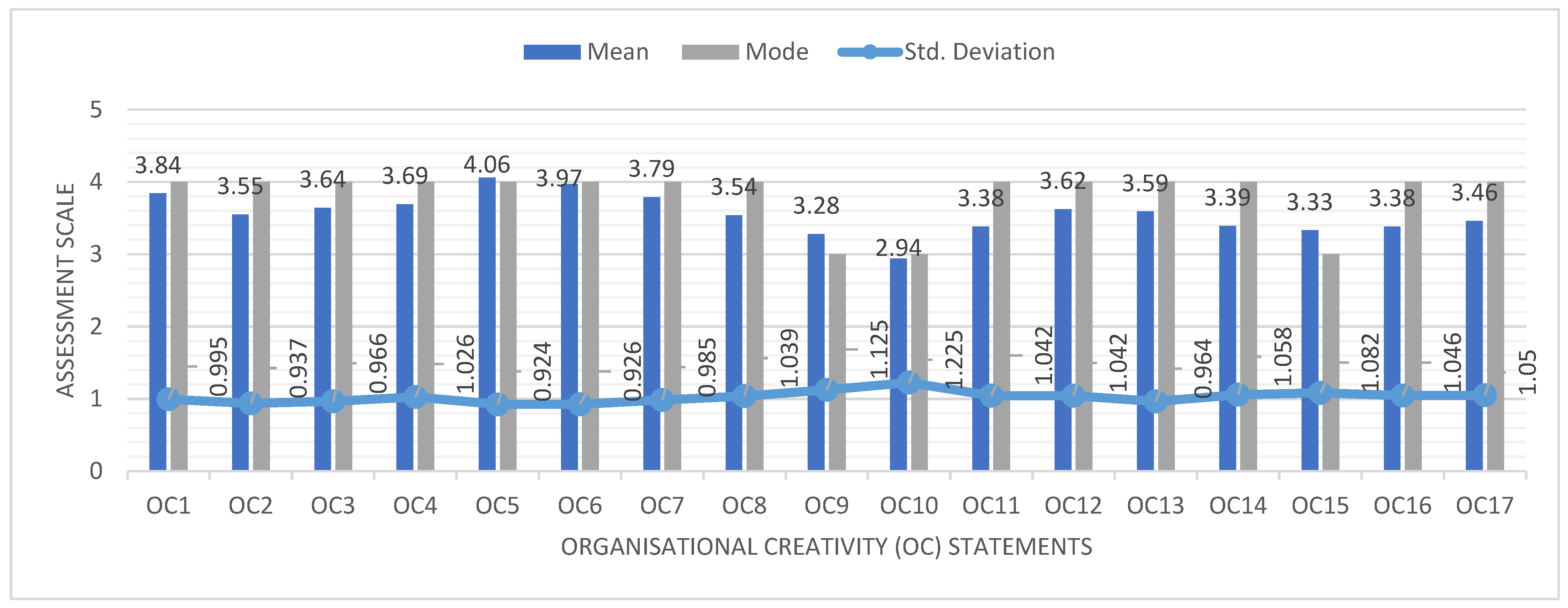
| Organisational Creativity | Sources | |
|---|---|---|
| OC1 | My organisation encourages innovation | Gupta and Banerjee (2016); Andriopoulos (2001); Martins and Terblanche (2003); Cropley (2009); Mai and Nguyen (2023); Bhattarai et al. (2024); Stenmark (2005). |
| OC2 | In my organisation, mistakes are seen as a learning opportunity | |
| OC3 | Different opinions are accepted in my organisation | |
| OC4 | Initiative is accepted and encouraged in my organisation | |
| OC5 | Learning is encouraged in my organisation | |
| OC6 | In my organisation, cooperation and sharing of information between different departments is encouraged | |
| OC7 | In my organisation, managers trust employees | |
| OC8 | In my organisation, work processes and procedures are flexible | |
| OC9 | In my organisation, the remuneration policy encourages initiative | |
| OC10 | Creativity training is held in my organisation | |
| OC11 | Innovative working and learning methods are applied in my organisation | |
| OC12 | My organisation invests in new technologies | |
| OC13 | My organisation encourages the generation of new ideas to solve everyday problems | |
| OC14 | In my organisation, managerial communication motivates creative problem solving | |
| OC15 | Creativity in my organisation is considered a priority at the managerial level | |
| OC16 | The organisation creates conditions for creative thinking and experimentation | |
| OC17 | Creative thinking in an organisation is considered an important value | |
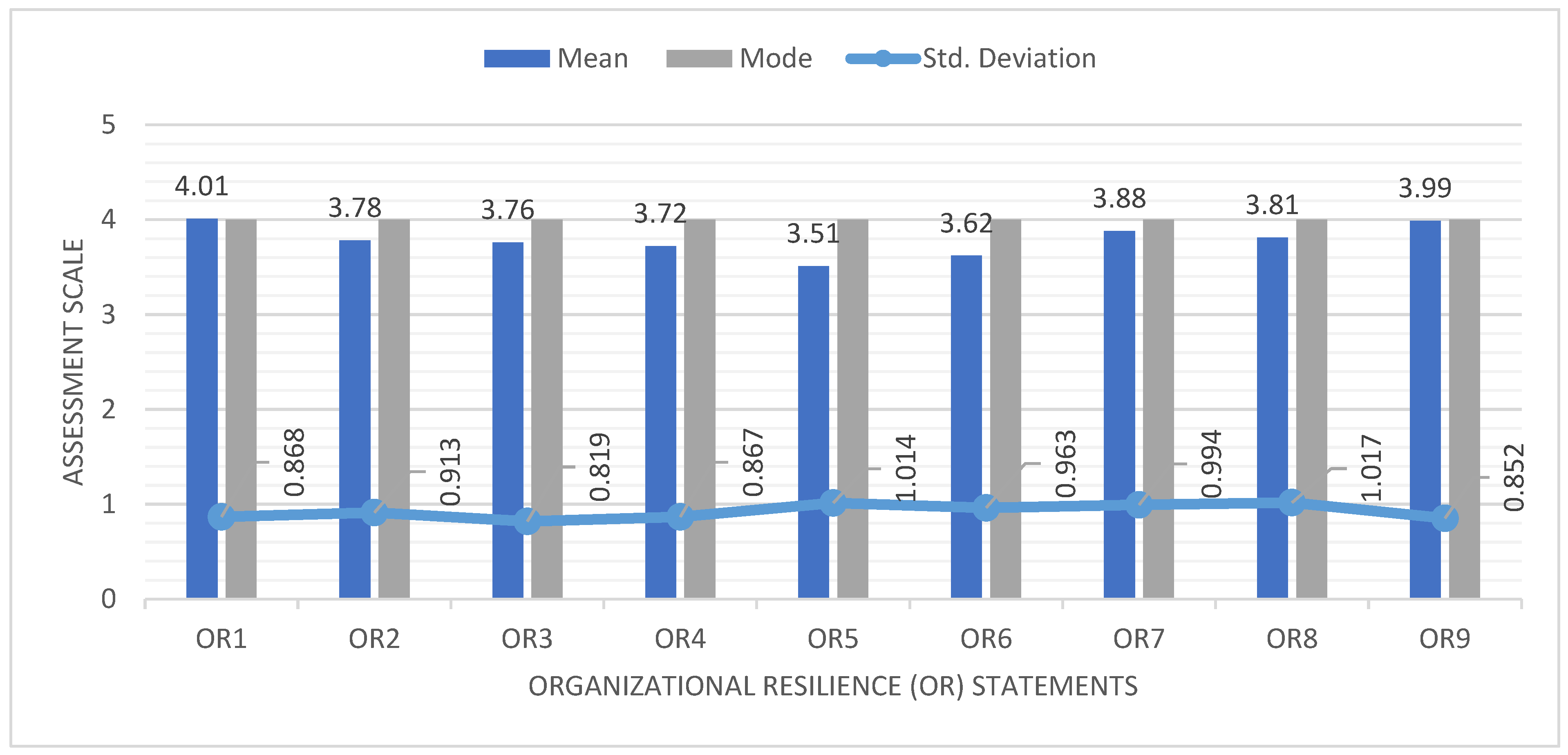
| Organisational Resilience | Sources | |
|---|---|---|
| OR1 | My organisation, as a whole, operates successfully | Bui et al. (2019); Seville et al. (2006); Taylor (2021); Gray and Jones (2018); Franken (2019). |
| OR2 | In my organisation, everyone knows their responsibilities and performs them well | |
| OR3 | My organisation, in the event of an unexpected crisis situation, is able to respond promptly | |
| OR4 | My organisation, in an unforeseen crisis situation, is able to allocate financial resources to resolve the issues that have occurred as a result | |
| OR5 | My organisation, which has unexpectedly found itself in a crisis situation, has enough employees to perform the necessary functions | |
| OR6 | My organisation, which has suddenly found itself in a crisis situation, is able to quickly reorganise its work processes | |
| OR7 | In my organisation, when faced with an unexpected crisis situation, employees are not afraid to turn to managers | |
| OR8 | During crises at work, I feel the support and help of managers | |
| OR9 | The organisation is able to ensure business continuity during unforeseen events | |
| Scale | Cronbach’s Alpha | Cronbach’s Alpha Based on Standardised Items | N of Items |
|---|---|---|---|
| Organisational Creativity (OC) | 0.955 | 0.956 | 17 |
| Organisational Resilience (OR) | 0.901 | 0.902 | 9 |
| OC Statements | Responsibilities | N | Mean | Sig. (p Value) | Mean Difference |
|---|---|---|---|---|---|
| OC1 | M | 152 | 3.95 | p > 0.05 = 0.087 | 0.175 |
| N | 294 | 3.78 | 0.175 | ||
| OC2 | M | 152 | 3.70 | p > 0.05 = 0.518 | 0.221 |
| N | 294 | 3.48 | 0.221 | ||
| OC3 | M | 152 | 3.86 | p < 0.05 = 0.049 | 0.328 |
| N | 294 | 3.53 | 0.328 | ||
| OC4 | M | 152 | 3.82 | p > 0.05 = 0.173 | 0.207 |
| N | 294 | 3.62 | 0.207 | ||
| OC5 | M | 152 | 4.21 | p > 0.05 = 0.789 | 0.234 |
| N | 294 | 3.98 | 0.234 | ||
| OC6 | M | 152 | 4.13 | p > 0.05 = 0.173 | 0.247 |
| N | 294 | 3.88 | 0.247 | ||
| OC7 | M | 152 | 3.89 | p > 0.05 = 0.323 | 0.150 |
| N | 294 | 3.74 | 0.150 | ||
| OC8 | M | 152 | 3.63 | p > 0.05 = 0.378 | 0.132 |
| N | 294 | 3.50 | 0.132 | ||
| OC9 | M | 152 | 3.49 | p > 0.05 = 0.520 | 0.327 |
| N | 294 | 3.17 | 0.327 | ||
| OC10 | M | 152 | 3.06 | p > 0.05 = 0.221 | 0.182 |
| N | 294 | 2.88 | 0.182 | ||
| OC11 | M | 152 | 3.49 | p > 0.05 = 0.563 | 0.174 |
| N | 294 | 3.32 | 0.174 | ||
| OC12 | M | 152 | 3.79 | p < 0.05 = 0.020 | 0.252 |
| N | 294 | 3.54 | 0.252 | ||
| OC13 | M | 152 | 3.76 | p < 0.05 = 0.027 | 0.260 |
| N | 294 | 3.50 | 0.260 | ||
| OC14 | M | 152 | 3.60 | p > 0.05 = 0.546 | 0.316 |
| N | 294 | 3.28 | 0.316 | ||
| OC15 | M | 152 | 3.47 | p > 0.05 = 0.871 | 0.209 |
| N | 294 | 3.26 | 0.209 | ||
| OC16 | M | 152 | 3.66 | p > 0.05 = 0.057 | 0.427 |
| N | 294 | 3.23 | 0.427 | ||
| OC17 | M | 152 | 3.69 | p < 0.05 = 0.022 | 0.357 |
| N | 294 | 3.33 | 0.357 |
| OR Statements | Obligations | N | Mean | Sig. (p Value) | Mean Difference |
|---|---|---|---|---|---|
| OR1 | M | 152 | 4.07 | p > 0.05 = 0.111 | 0.100 |
| N | 294 | 3.97 | 0.100 | ||
| OR2 | M | 152 | 3.73 | p > 0.05 = 0.757 | −0.083 |
| N | 294 | 3.81 | −0.083 | ||
| OR3 | M | 152 | 3.84 | p < 0.05 = 0.000 | 0.111 |
| N | 294 | 3.72 | 0.111 | ||
| OR4 | M | 152 | 3.89 | p < 0.05 = 0.000 | 0.272 |
| N | 294 | 3.62 | 0.272 | ||
| OR5 | M | 152 | 3.58 | p > 0.05 = 0.067 | 0.103 |
| N | 294 | 3.48 | 0.103 | ||
| OR6 | M | 152 | 3.70 | p < 0.05 = 0.025 | 0.126 |
| N | 294 | 3.58 | 0.126 | ||
| OR7 | M | 152 | 4.06 | p < 0.05 = 0.049 | 0.267 |
| N | 294 | 3.79 | 0.267 | ||
| OR8 | M | 152 | 3.94 | p > 0.05 = 0.253 | 0.196 |
| N | 294 | 3.74 | 0.196 | ||
| OR9 | M | 152 | 4.13 | p > 0.05 = 0.613 | 0.200 |
| N | 294 | 3.93 | 0.200 |
Disclaimer/Publisher’s Note: The statements, opinions and data contained in all publications are solely those of the individual author(s) and contributor(s) and not of MDPI and/or the editor(s). MDPI and/or the editor(s) disclaim responsibility for any injury to people or property resulting from any ideas, methods, instructions or products referred to in the content. |
© 2026 by the authors. Licensee MDPI, Basel, Switzerland. This article is an open access article distributed under the terms and conditions of the Creative Commons Attribution (CC BY) license.
Share and Cite
Paulikienė, B.; Šimanskienė, L.; Paužuolienė, J. Exploring the Relationship Between Creativity and Organisational Resilience in Service Organisations. Adm. Sci. 2026, 16, 40. https://doi.org/10.3390/admsci16010040
Paulikienė B, Šimanskienė L, Paužuolienė J. Exploring the Relationship Between Creativity and Organisational Resilience in Service Organisations. Administrative Sciences. 2026; 16(1):40. https://doi.org/10.3390/admsci16010040
Chicago/Turabian StylePaulikienė, Birutė, Ligita Šimanskienė, and Jurgita Paužuolienė. 2026. "Exploring the Relationship Between Creativity and Organisational Resilience in Service Organisations" Administrative Sciences 16, no. 1: 40. https://doi.org/10.3390/admsci16010040
APA StylePaulikienė, B., Šimanskienė, L., & Paužuolienė, J. (2026). Exploring the Relationship Between Creativity and Organisational Resilience in Service Organisations. Administrative Sciences, 16(1), 40. https://doi.org/10.3390/admsci16010040