Psychometric Validation of the Constant Connectivity Scale in the Context of Digital Work in Italian Organizations




Abstract
1. Introduction
1.1. Job Demands–Resources Model and the Constant Connectivity
1.2. Constant Connectivity: Conceptualization, Antecedents, and Consequences
1.3. Constant Connectivity Scale (CCS)
1.4. Cultural and Contextual Specificity of Digital Work Demands in Italian Organizations
1.5. Aim
2. Materials and Methods
2.1. Participants and Description of Sample
2.2. Ethical Considerations
2.3. Procedure
Survey Preparation
2.4. Questionnaire
- CCS (Constant connectivity scale; Büchler et al., 2020). It consists of statements that assess employees’ perception of the need to remain constantly connected to work through mobile devices. It uses a 5-point Likert-type format, where respondents indicate their level of agreement with the statements. An example of a question in the questionnaire is: “I feel that I need to be constantly available for work.” This scale provides valuable insights into how continuous connectivity affects employees’ work–life balance. Alpha 0.93 was obtained in this study.
- GHQ-12 (General Health Questionnaire, Anxiety Subscale; Fraccaroli et al., 1991). It was assessed anxiety, the potential psychological effects of hyperconnectivity with the GHQ-12 anxiety subscale Italian version. This instrument gauging mental well-being which contains questions like, “have you felt under strain during the past few years;} and “Have you recently lost a lot of sleep worrying?” Responses were coded for indicators of elevated anxiety levels in employees experiencing constant connectivity. Alpha 0.87 was obtained in this study.
- Smart Working Questionnaire (Ingusci et al., 2023). This scale has items such as “I have greater control over my work schedule” and “Smart working allows me to better balance my professional and personal life. Alpha 0.67 was obtained in the current study.
- Job Performance Scale (Bal & De Lange, 2015). This instrument is an indicator of work productivity, which assesses various dimensions of employee job productivity and effectiveness. The scale has been applied in the field of human resources management and work psychology to focus on issues such as aging and job performance. Questions are designed to evaluate individual performance based on personal and team contributions (e.g., How would you rate your work performance?), with responses rated on a 10-point Likert scale (1 = Very poor; 10 = Very high). Alpha 0.91 was obtained in the present study.
Instrument Adaptation and Translation Procedure
- (1)
- Forward Translation: Two independent translators (native Italian speakers fluent in English) translated the original English-language Scale into Italian. Both translations were compared and synthesized into a single Italian version emphasizing semantic and conceptual equivalence.
- (2)
- Expert Review: The synthesized Italian version was reviewed by three experts in occupational psychology to ensure conceptual relevance and cultural appropriateness within Italian organizational contexts.
- (3)
- Back-Translation: Two independent bilingual translators (native English speakers fluent in Italian) back-translated the Italian version into English without access to the original instrument. This back-translated version was compared with the original English version to identify and resolve discrepancies in meaning and semantic equivalence.
- (4)
- Pilot Testing: The finalized Italian version was then pilot-tested with a small sample (n = 10) of Italian employees to assess comprehensibility and clarity of item wording before full administration.
2.5. Analyses
3. Results
3.1. Reliability Analysis
3.2. Items Descriptive Statistics
3.3. Correlation Between Items
3.4. Exploratory Factor Analysis (EFA)
3.5. Confirmatory Factor Analysis (CFA)
3.6. Additional Analysis
4. Discussion
4.1. Theoretical and Practical Implications
Implications for Building a Resilient Workforce
4.2. Limitations and Future Research
5. Conclusions
Author Contributions
Funding
Institutional Review Board Statement
Informed Consent Statement
Data Availability Statement
Conflicts of Interest
References
- Alimova, S. (2023). The economic implications of increasing global connectivity and the digital economy. In Proceedings of the 2nd pamir transboundary conference for sustainable societies (pp. 740–743). SciTePress. [Google Scholar] [CrossRef]
- Amankwah-Amoah, J., Khan, Z., Wood, G., & Knight, G. (2021). COVID-19 and digitalization: The great acceleration. Journal of Business Research, 136, 602–611. [Google Scholar] [CrossRef] [PubMed]
- Bakker, A. B., & Demerouti, E. (2007). The job demands-resources model: State of the art. Journal of Managerial Psychology, 22(3), 309–328. [Google Scholar] [CrossRef]
- Bakker, A. B., & Demerouti, E. (2017). Job demands–resources theory: Taking stock and looking forward. Journal of Occupational Health Psychology, 22(3), 273–285. [Google Scholar] [CrossRef] [PubMed]
- Bal, P. M., & De Lange, A. H. (2015). From flexibility human resource management to employee engagement and perceived job performance across the lifespan: A multisample study. Journal of Occupational and Organizational Psychology, 88(1), 126–154. [Google Scholar] [CrossRef]
- Barker, J. R. (1993). Tightening the iron cage: Concertive control in self-managing teams. Administrative Science Quarterly, 38(3), 408. [Google Scholar] [CrossRef]
- Barley, S. R., Meyerson, D. E., & Grodal, S. (2011). E-mail as a source and symbol of stress. Organization Science, 22(4), 887–906. [Google Scholar] [CrossRef]
- Beaton, D. E., Bombardier, C., Guillemin, F., & Ferraz, M. B. (2000). Guidelines for the process of cross-cultural adaptation of self-report measures. Spine, 25(24), 3186–3191. [Google Scholar] [CrossRef]
- Boswell, W. R., Olson-Buchanan, J. B., Butts, M. M., & Becker, W. J. (2016). Managing “after hours” electronic work communication. Organizational Dynamics, 45(4), 291–297. [Google Scholar] [CrossRef]
- Bottaro, R., De Giovanni, K., & Faraci, P. (2025). Assessing work–life balance in Malta and Italy: A cross-cultural investigation using Exploratory Structural Equation Modelling (ESEM). Psychology Research and Behavior Management, 18, 1637–1656. [Google Scholar] [CrossRef] [PubMed]
- Büchler, N., Ter Hoeven, C. L., & Van Zoonen, W. (2020). Understanding constant connectivity to work: How and for whom is constant connectivity related to employee well-being? Information and Organization, 30(3), 100302. [Google Scholar] [CrossRef]
- Cavicchioli, M., Demaria, F., Nannetti, F., Scapolan, A. C., & Fabbri, T. (2025). Employees’ attitudes and work-related stress in the digital workplace: An empirical investigation. Frontiers in Psychology, 16, 1546832. [Google Scholar] [CrossRef]
- Chatterjee, S., Chaudhuri, R., Vrontis, D., & Giovando, G. (2023). Digital workplace and organization performance: Moderating role of digital leadership capability. Journal of Innovation & Knowledge, 8(1), 100334. [Google Scholar] [CrossRef]
- Choung, Y., Chatterjee, S., & Pak, T.-Y. (2023). Digital financial literacy and financial well-being. Finance Research Letters, 58, 104438. [Google Scholar] [CrossRef]
- Cimperman, S. (2023). Informal socialization in virtual work environments: Creating a digital culture of connectivity. Global Business and Organizational Excellence, 43(1), 53–71. [Google Scholar] [CrossRef]
- Demerouti, E., Bakker, A. B., Nachreiner, F., & Schaufeli, W. B. (2001). The job demands-resources model of burnout. Journal of Applied Psychology, 86(3), 499–512. [Google Scholar] [CrossRef]
- Deng, H., Duan, S. X., & Wibowo, S. (2023). Digital technology driven knowledge sharing for job performance. Journal of Knowledge Management, 27(2), 404–425. [Google Scholar] [CrossRef]
- Derks, D., Bakker, A. B., Peters, P., & Van Wingerden, P. (2016). Work-related smartphone use, work–family conflict and family role performance: The role of segmentation preference. Human Relations, 69(5), 1045–1068. [Google Scholar] [CrossRef]
- Diaz, I., Chiaburu, D. S., Zimmerman, R. D., & Boswell, W. R. (2012). Communication technology: Pros and cons of constant connection to work. Journal of Vocational Behavior, 80(2), 500–508. [Google Scholar] [CrossRef]
- Dwivedi, Y. K., Hughes, L., Kar, A. K., Baabdullah, A. M., Grover, P., Abbas, R., Andreini, D., Abumoghli, I., Barlette, Y., Bunker, D., Chandra Kruse, L., Constantiou, I., Davison, R. M., De’, R., Dubey, R., Fenby-Taylor, H., Gupta, B., He, W., Kodama, M., … Wade, M. (2022). Climate change and COP26: Are digital technologies and information management part of the problem or the solution? An editorial reflection and call to action. International Journal of Information Management, 63, 102456. [Google Scholar] [CrossRef]
- Edwards, P., & Ramirez, P. (2016). When should workers embrace or resist new technology? New Technology, Work and Employment, 31(2), 99–113. [Google Scholar] [CrossRef]
- Fenner, G. H., & Renn, R. W. (2010). Technology-assisted supplemental work and work-to-family conflict: The role of instrumentality beliefs, organizational expectations and time management. Human Relations, 63(1), 63–82. [Google Scholar] [CrossRef]
- Fraccaroli, F., Depolo, M., & Sarchielli, G. (1991). The use of goldberg’s general health questionnaire in a study of unemployed young people. Giunti Organizzazioni Speciali. [Google Scholar]
- Ingusci, E., Signore, F., Cortese, C. G., Molino, M., Pasca, P., & Ciavolino, E. (2023). Development and validation of the remote working benefits & disadvantages scale. Quality & Quantity, 57(2), 1159–1183. [Google Scholar] [CrossRef]
- Kain, J., & Jex, S. (2010). Karasek’s (1979) job demands-control model: A summary of current issues and recommendations for future research. In P. L. Perrewé, & D. C. Ganster (Eds.), Research in occupational stress and well-being (Vol. 8, pp. 237–268). Emerald Group Publishing Limited. [Google Scholar] [CrossRef]
- Kaiser, H. F., & Rice, J. (1974). Little Jiffy, Mark IV. Educational and Psychological Measurement, 34(1), 111–117. [Google Scholar] [CrossRef]
- Kreiner, G. E. (2006). Consequences of work-home segmentation or integration: A person-environment fit perspective. Journal of Organizational Behavior, 27(4), 485–507. [Google Scholar] [CrossRef]
- Machado Silva, H. (2025). The reconfiguration of social bonds in the digital age: Virtual connections vs. face-to-face relationships. Nature Anthropology, 3(1), 10003. [Google Scholar] [CrossRef]
- Mazmanian, M. (2013). Avoiding the trap of constant connectivity: When congruent frames allow for heterogeneous practices. Academy of Management Journal, 56(5), 1225–1250. [Google Scholar] [CrossRef]
- Ren, S., Hu, J., Tang, G., & Chadee, D. (2023). Digital connectivity for work after hours: Its curvilinear relationship with employee job performance. Personnel Psychology, 76(3), 731–757. [Google Scholar] [CrossRef]
- Risi, E., & Pronzato, R. (2021). Smart working is not so smart: Always-on lives and the dark side of platformisation. Work Organisation, Labour & Globalisation, 15(1), 107–125. [Google Scholar] [CrossRef]
- Sonnentag, S., & Bayer, U.-V. (2005). Switching off mentally: Predictors and consequences of psychological detachment from work during off-job time. Journal of Occupational Health Psychology, 10(4), 393–414. [Google Scholar] [CrossRef]
- Sousa, V. D., & Rojjanasrirat, W. (2011). Translation, adaptation and validation of instruments or scales for use in cross-cultural health care research: A clear and user-friendly guideline. Journal of Evaluation in Clinical Practice, 17(2), 268–274. [Google Scholar] [CrossRef]
- Straus, E., Uhlig, L., Kühnel, J., & Korunka, C. (2023). Remote workers’ well-being, perceived productivity, and engagement: Which resources should HRM improve during COVID-19? A longitudinal diary study. The International Journal of Human Resource Management, 34(15), 2960–2990. [Google Scholar] [CrossRef]
- Tarafdar, M., Pullins, E. B., & Ragu-Nathan, T. S. (2015). Technostress: Negative effect on performance and possible mitigations. Information Systems Journal, 25(2), 103–132. [Google Scholar] [CrossRef]
- Taris, T. W., & Schaufeli, W. B. (2015). The job demands-resources model. In S. Clarke, T. M. Probst, F. Guldenmund, & J. Passmore (Eds.), The Wiley Blackwell handbook of the psychology of occupational safety and workplace health (1st ed., pp. 155–180). Wiley. [Google Scholar] [CrossRef]
- Thwaites, T. (2021). Technologizing the human condition: Hyperconnectivity and control. Educational Philosophy and Theory, 53(4), 373–382. [Google Scholar] [CrossRef]
- Tramontano, C., Grant, C., & Clarke, C. (2021). Development and validation of the e-work self-efficacy scale to assess digital competencies in remote working. Computers in Human Behavior Reports, 4, 100129. [Google Scholar] [CrossRef]
- Treem, J. W. (2013). Technology use as a status cue: The influences of mundane and novel technologies on knowledge assessments in organizations: Technology use as a status cue. Journal of Communication, 63(6), 1032–1053. [Google Scholar] [CrossRef]
- Vanden Abeele, M. M. P., & Nguyen, M. H. (2022). Digital well-being in an age of mobile connectivity: An introduction to the special issue. Mobile Media & Communication, 10(2), 174–189. [Google Scholar] [CrossRef]
- Vyas, L., & Butakhieo, N. (2020). The impact of working from home during COVID-19 on work and life domains: An exploratory study on Hong Kong. Policy Design and Practice, 4(1), 59–76. [Google Scholar] [CrossRef]


| Item | Mean | Std. Deviation | N |
|---|---|---|---|
| CC1-Through my work mobile device, I am always available to my colleagues and/or clients, even during non-working hours | 2.75 | 1.101 | 300 |
| CC2-During non-working hours, I check my work through my work mobile device (e.g., checking emails or similar work-related messages, intranet, etc.) | 2.70 | 1.040 | 300 |
| CC3-Through my work mobile device, I know what to expect at work before I arrive | 3.01 | 0.998 | 300 |
| CC4-For me, it is common to check and respond to emails or other work-related messages during non-working hours | 2.52 | 1.061 | 300 |
| CC5-Through the use of my work mobile device, I remain connected to work during non-working hours | 2.60 | 1.100 | 300 |
| CC1 | CC2 | CC3 | CC4 | CC5 | |
|---|---|---|---|---|---|
| CC1 | 1.000 | ||||
| CC2 | 0.719 | 1.000 | |||
| CC3 | 0.606 | 0.671 | 1.000 | ||
| CC4 | 0.725 | 0.811 | 0.700 | 1.000 | |
| CC5 | 0.737 | 0.782 | 0.663 | 0.847 | 1.000 |
| χ2 | p Value | RMSEA | CFI | TLI | NFI | PRATIO | PCFI | PNFI | AIC |
|---|---|---|---|---|---|---|---|---|---|
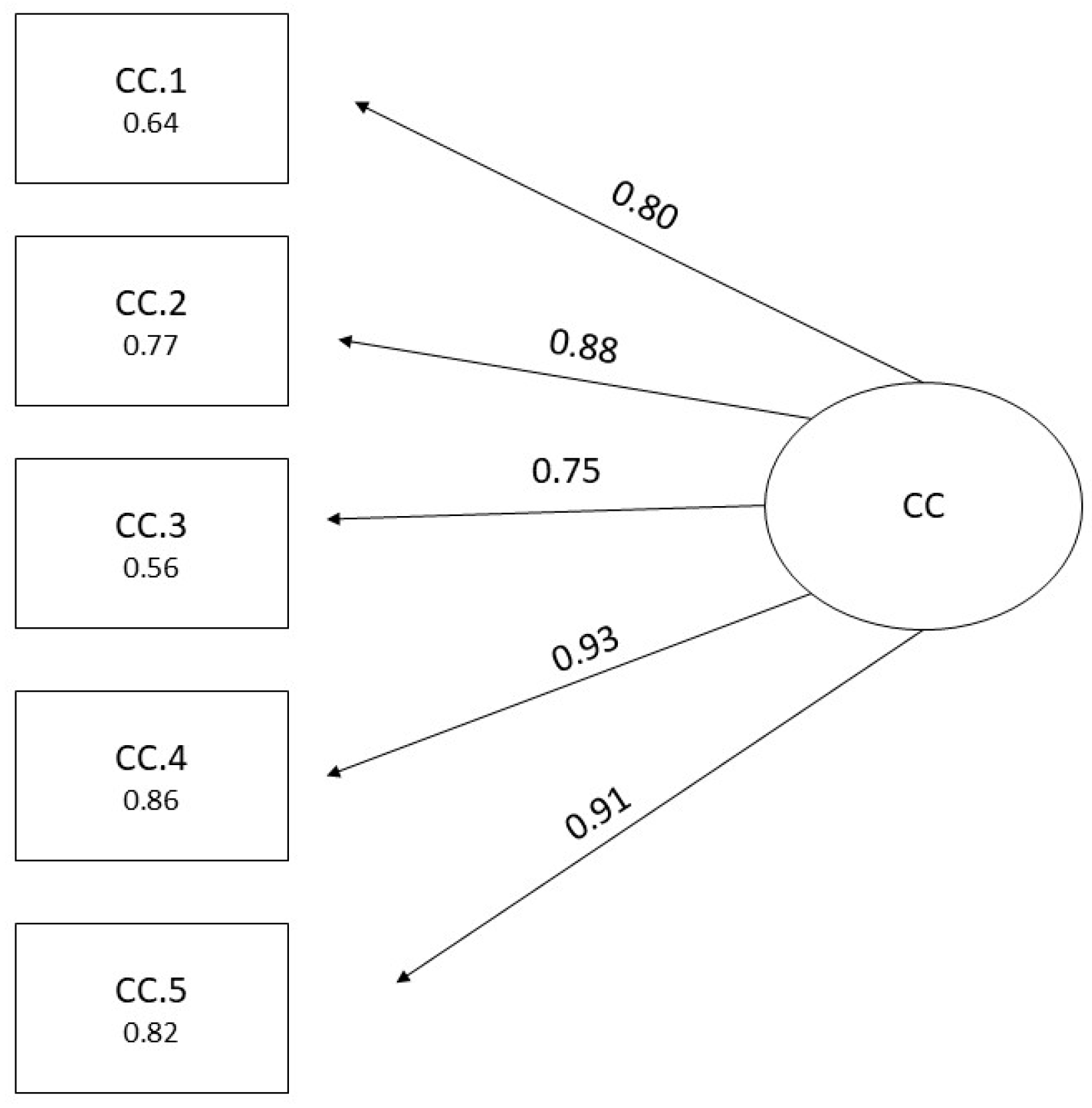
| 7.167 | 0.208 | 0.038 | 0.998 | 0.996 | 0.994 | 0.500 | 0.499 | 0.497 | 37.167 |
Disclaimer/Publisher’s Note: The statements, opinions and data contained in all publications are solely those of the individual author(s) and contributor(s) and not of MDPI and/or the editor(s). MDPI and/or the editor(s) disclaim responsibility for any injury to people or property resulting from any ideas, methods, instructions or products referred to in the content. |
© 2026 by the authors. Licensee MDPI, Basel, Switzerland. This article is an open access article distributed under the terms and conditions of the Creative Commons Attribution (CC BY) license.
Share and Cite
Bondanini, G.; Sanchez-Gomez, M.; Mucci, N.; Giorgi, G. Psychometric Validation of the Constant Connectivity Scale in the Context of Digital Work in Italian Organizations. Adm. Sci. 2026, 16, 39. https://doi.org/10.3390/admsci16010039
Bondanini G, Sanchez-Gomez M, Mucci N, Giorgi G. Psychometric Validation of the Constant Connectivity Scale in the Context of Digital Work in Italian Organizations. Administrative Sciences. 2026; 16(1):39. https://doi.org/10.3390/admsci16010039
Chicago/Turabian StyleBondanini, Giorgia, Martin Sanchez-Gomez, Nicola Mucci, and Gabriele Giorgi. 2026. "Psychometric Validation of the Constant Connectivity Scale in the Context of Digital Work in Italian Organizations" Administrative Sciences 16, no. 1: 39. https://doi.org/10.3390/admsci16010039
APA StyleBondanini, G., Sanchez-Gomez, M., Mucci, N., & Giorgi, G. (2026). Psychometric Validation of the Constant Connectivity Scale in the Context of Digital Work in Italian Organizations. Administrative Sciences, 16(1), 39. https://doi.org/10.3390/admsci16010039