A Systematic Analysis of Big Data-Driven Humanitarian Supply Chain Management Research: Implications for Emerging Economies


Abstract
1. Introduction
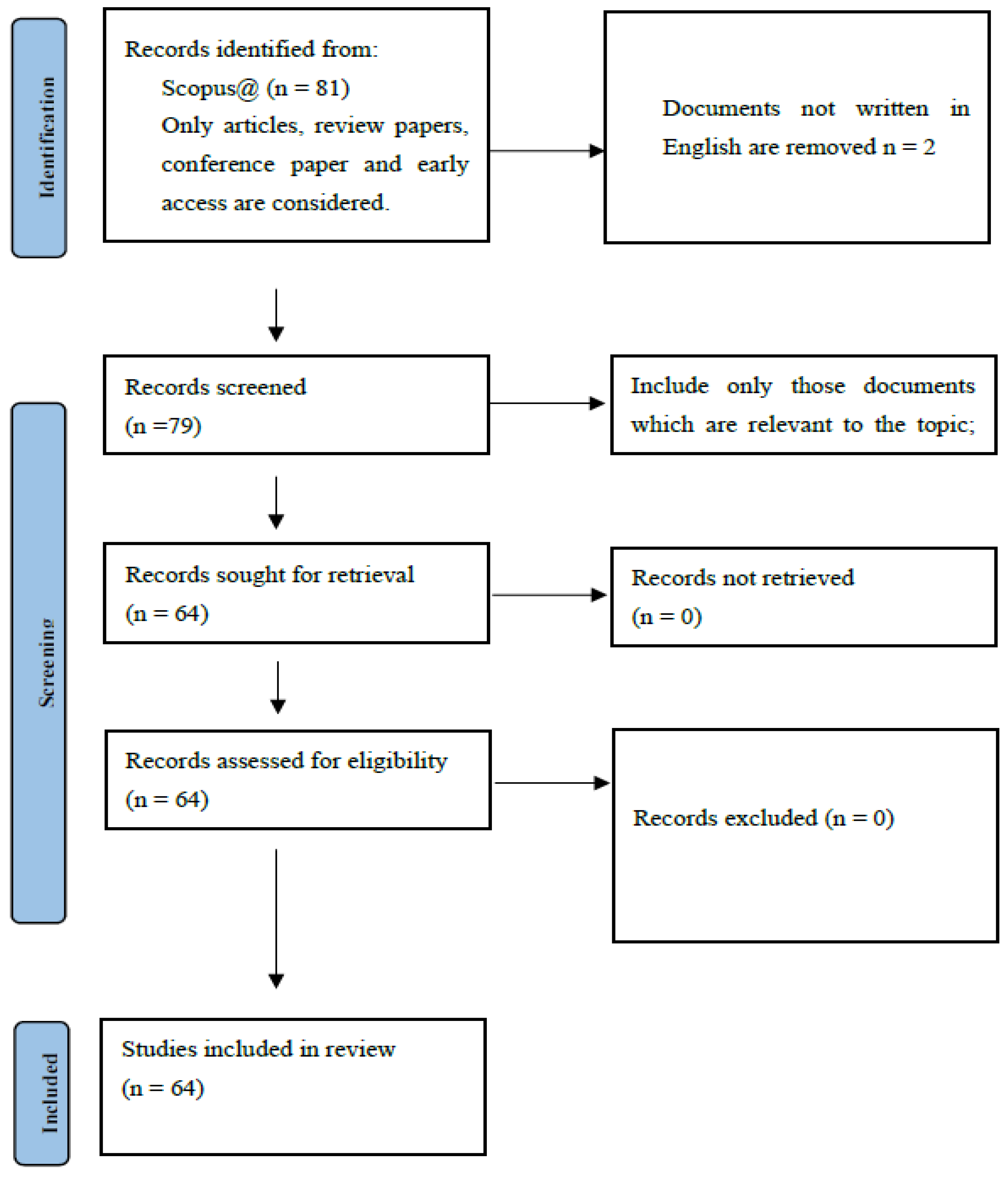
2. Material and Methods
- RQ1: What are the most influential individual works and institutions in big data-based research on humanitarian supply chains?
- RQ2: What are the current and emerging themes (conceptual knowledge maps) in big data-related research on humanitarian supply chains?
- RQ3: What is the pattern of collaboration among the most productive authors and institutions?
- RQ4: What are the theoretical and practical implications of big data-based humanitarian supply chain knowledge in the context of emerging countries?
2.1. Data Retrieval
2.2. Data Analysis
3. Results
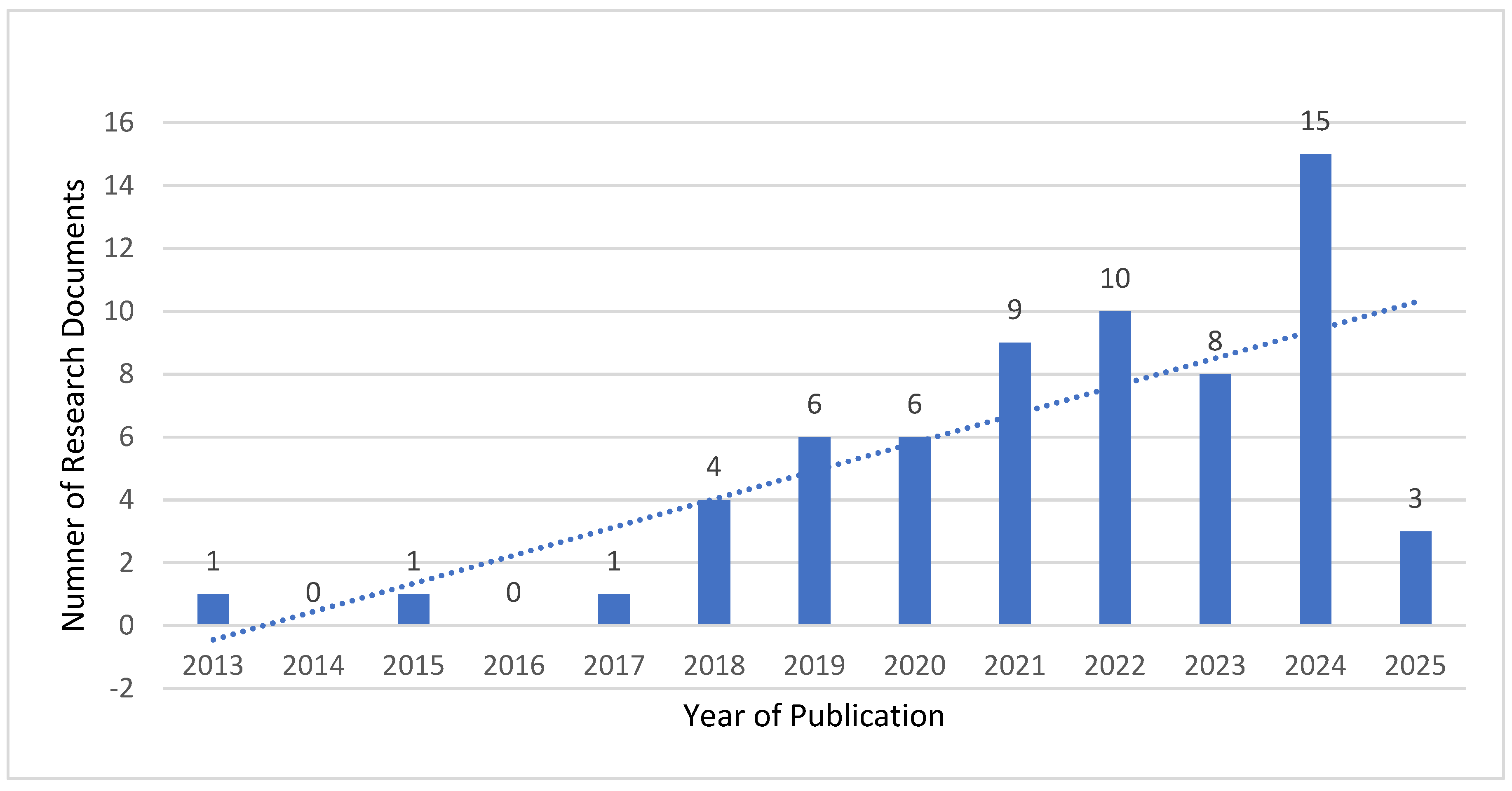
3.1. Performance Analysis
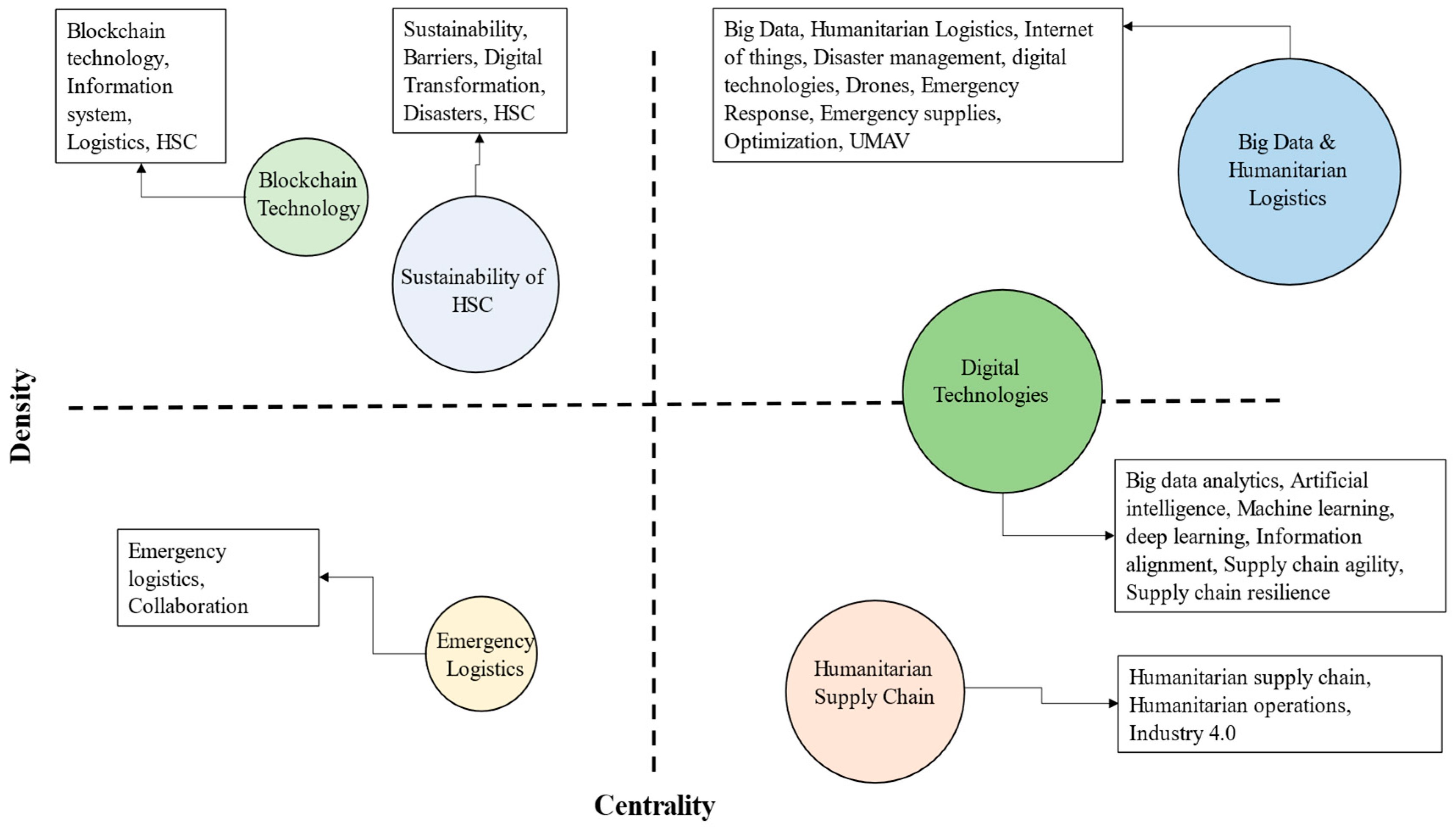
3.2. Conceptual Map of Big Data and Humanitarian Logistics
3.2.1. Motor Theme
3.2.2. Base Theme
3.2.3. Base/Motor Transition Theme
3.2.4. Niche Themes
3.2.5. Emerging Theme
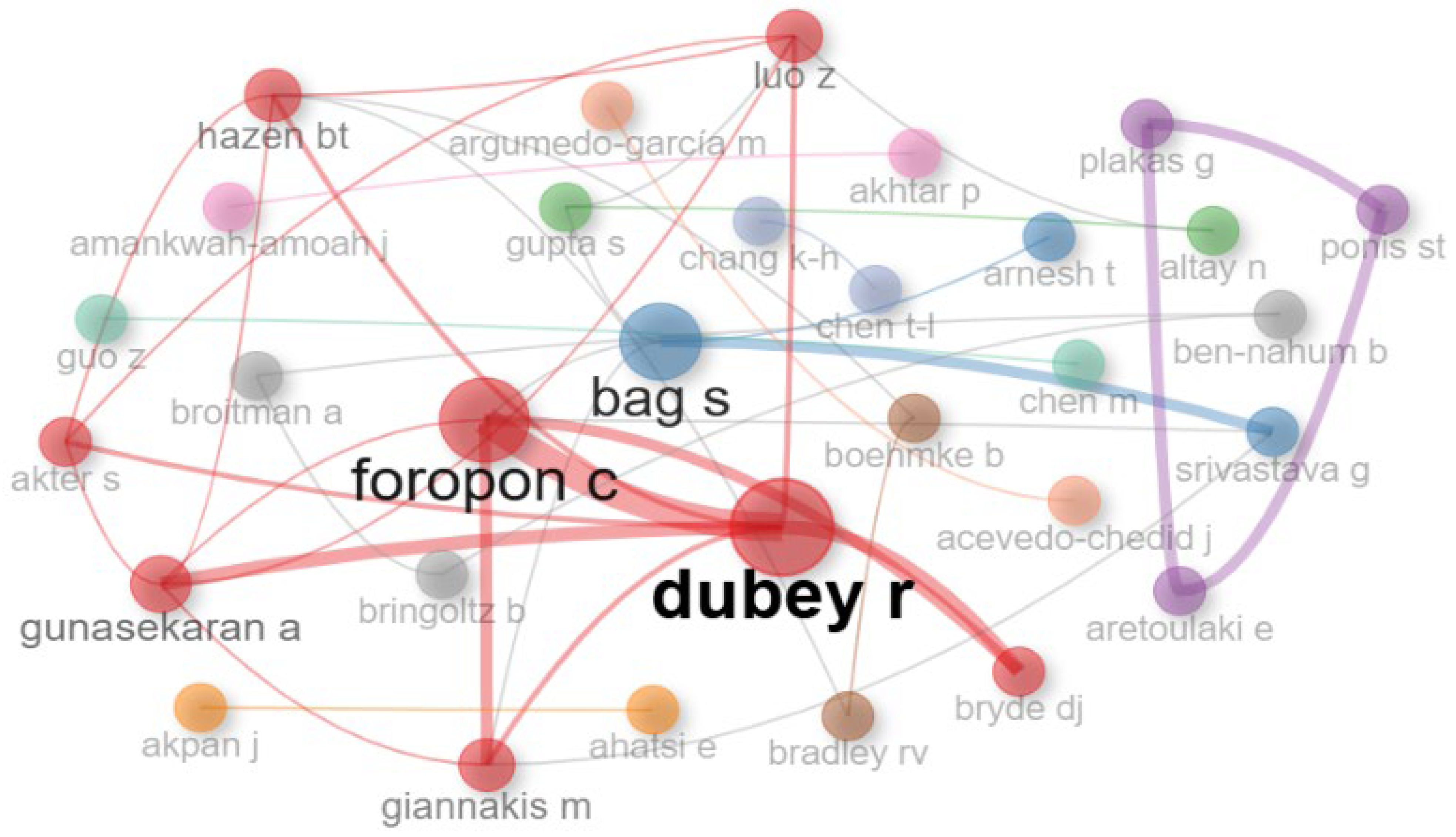
3.3. Authors’ Collaboration Map
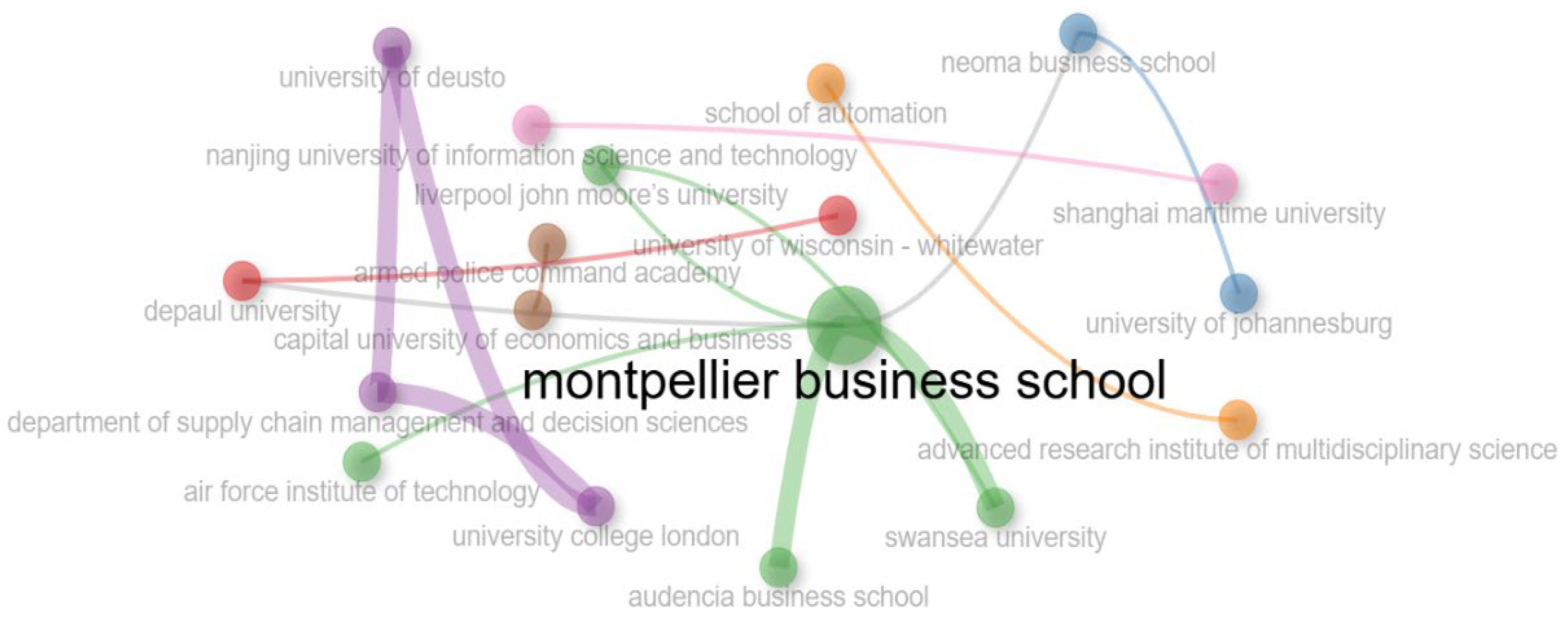
3.4. Institute Collaboration Map
4. Discussion and Implications
- RQ1: Conduct a performance analysis of this research field.
- RQ2: Construct a conceptual knowledge map of the current research landscape.
- RQ3: Develop a collaboration map of the most productive authors and institutions.
- RQ4: Identify theoretical and practical implications of big data-related research (global knowledge) for humanitarian supply chains in emerging economies.
- Big data and humanitarian logistics (motor theme);
- Digital technologies (transition theme between base and motor);
- Humanitarian supply chain (base theme);
- Emergency logistics (emerging theme);
- Blockchain technology;
- Sustainability of humanitarian supply chains (niche theme).
4.1. Theoretical Implications for the Emerging Countries Context
4.2. Practical Implications for the Emerging Countries Context
5. Conclusions, Limitations, and Future Research
Funding
Institutional Review Board Statement
Informed Consent Statement
Data Availability Statement
Conflicts of Interest
References
- Ahatsi, E., & Olanrewaju, O. A. (2025). Enhancing humanitarian supply chain resilience: Evaluating artificial intelligence and big data analytics in two nations. Logistics, 9(2), 64. [Google Scholar] [CrossRef]
- Akhtar, P., De Silva, M., Khan, Z., Tarba, S., Amankwah-Amoah, J., & Wood, G. (2025). Digital transformation in public-private collaborations: The success of humanitarian supply chain operations. International Journal of Production Economics, 279, 109461. [Google Scholar] [CrossRef]
- Alshahrani, S. T. (2023). Industry 4.0 in “major emerging markets”: A systematic literature review of benefits, use, challenges, and mitigation strategies in supply chain management. Sustainability, 15, 14811. [Google Scholar] [CrossRef]
- Altay, N., & Labonte, M. (2014). Challenges in humanitarian information management and exchange: Evidence from Haiti. Disasters, 38, S50–S72. [Google Scholar] [CrossRef] [PubMed]
- Altay, N., & Narayanan, A. (2022). Forecasting in humanitarian operations: Literature review and research needs. International Journal of Forecasting, 38(3), 1234–1244. [Google Scholar] [CrossRef] [PubMed]
- Altay, N., & Pal, R. (2014). Information diffusion among agents: Implications for humanitarian logistics. International Journal of Production Economics, 151, 93–104. [Google Scholar]
- Aria, M., & Cuccurullo, C. (2017). Bibliometrix: An R-tool for comprehensive science mapping analysis. Journal of Informetrics, 11(4), 959–975. [Google Scholar] [CrossRef]
- Azarian, M., Yu, H., Shiferaw, A. T., & Stevik, T. K. (2023). Do we perform systematic literature review right? A scientific mapping and methodological assessment. Logistics, 7(4), 89. [Google Scholar] [CrossRef]
- Bag, S., & Arnesh, T. (2019, October 23–25). Barriers to BDPA applications in sustainable HSC practices. International Conference on Industrial Engineering and Operations Management (pp. 319–334), Toronto, ON, Canada. [Google Scholar]
- Bag, S., Gupta, S., & Wood, L. (2022). Big data analytics in sustainable humanitarian supply chain: Barriers and their interactions. Annals of Operations Research, 319(1), 721–760. [Google Scholar] [CrossRef]
- Bag, S., Rahman, M. S., Srivastava, G., Giannakis, M., & Foropon, C. (2023). Data-driven digital transformation and the implications for antifragility in the humanitarian supply chain. International Journal of Production Economics, 266, 109059. [Google Scholar] [CrossRef]
- Baharmand, H., Maghsoudi, A., & Coppi, G. (2021). Exploring the application of blockchain to humanitarian supply chains: Insights from Humanitarian Supply Blockchain pilot project. International Journal of Operations & Production Management, 41(9), 1522–1543. [Google Scholar] [CrossRef]
- Bansal, S., Kumar, S., Ali, S., Singh, S., Nangia, P., & Bamel, U. (2024). Harnessing digital finance for sustainability: An integrative review and research agenda. Research in International Business and Finance, 74, 102682. [Google Scholar] [CrossRef]
- Boell, S. K., & Cecez-Kecmanovic, D. (2015). On being ‘systematic’ in literature reviews in IS. Journal of Information Technology, 30(2), 161–173. [Google Scholar] [CrossRef]
- Carnero Quispe, M. F., Chambilla Mamani, L. D., Yoshizaki, H. T. Y., & Brito Junior, I. D. (2025). Temporary facility location problem in humanitarian logistics: A systematic literature review. Logistics, 9(1), 42. [Google Scholar] [CrossRef]
- Carnero Quispe, M. F., Couto, A. S., de Brito Junior, I., Cunha, L. R. A., Siqueira, R. M., & Yoshizaki, H. T. Y. (2024). Humanitarian logistics prioritization models: A systematic literature review. Logistics, 8(2), 60. [Google Scholar] [CrossRef]
- Dubey, R., Bryde, D. J., Dwivedi, Y. K., Graham, G., & Foropon, C. (2022). Impact of artificial intelligence-driven big data analytics culture on agility and resilience in humanitarian supply chain: A practice-based view. International Journal of Production Economics, 250, 108618. [Google Scholar] [CrossRef]
- Dubey, R., Bryde, D. J., Foropon, C., Tiwari, M., Dwivedi, Y., & Schiffling, S. (2021a). An investigation of information alignment and collaboration as complements to supply chain agility in humanitarian supply chain. International Journal of Production Research, 59(5), 1586–1605. [Google Scholar] [CrossRef]
- Dubey, R., Gunasekaran, A., Bryde, D. J., Dwivedi, Y. K., & Papadopoulos, T. (2020). Blockchain technology for enhancing swift-trust, collaboration and resilience within a humanitarian supply chain setting. International Journal of Production Research, 58, 3381–3398. [Google Scholar] [CrossRef]
- Dubey, R., Gunasekaran, A., Childe, S. J., Fosso Wamba, S., Roubaud, D., & Foropon, C. (2021b). Empirical investigation of data analytics capability and organizational flexibility as complements to supply chain resilience. International Journal of Production Research, 59(1), 110–128. [Google Scholar] [CrossRef]
- Dubey, R., Gunasekaran, A., Childe, S. J., Roubaud, D., Wamba, S. F., Giannakis, M., & Foropon, C. (2019). Big data analytics and organizational culture as complements to swift trust and collaborative performance in the humanitarian supply chain. International Journal of Production Economics, 210, 120–136. [Google Scholar] [CrossRef]
- Dubey, R., Luo, Z., Gunasekaran, A., Akter, S., Hazen, B. T., & Douglas, M. A. (2018). Big data and predictive analytics in humanitarian supply chains: Enabling visibility and coordination in the presence of swift trust. The International Journal of Logistics Management, 29(2), 485–512. [Google Scholar] [CrossRef]
- Emich, K. J., Kumar, S., Lu, L., Norder, K., & Pandey, N. (2020). Mapping 50 years of small group research through small group research. Small Group Research, 51(6), 659–699. [Google Scholar] [CrossRef]
- Gao, X., Chen, Z., Huang, G., & Hezam, I. M. (2024). Blockchain-enabled safeguard mechanism in SCP-based relief supply chain designs in response to long-term disasters. IEEE Access, 12, 133054–133066. [Google Scholar] [CrossRef]
- Gupta, S., Altay, N., & Luo, Z. (2019). Big data in humanitarian supply chain management: A review and further research directions. Annals of Operations Research, 283(1), 1153–1173. [Google Scholar] [CrossRef]
- Güleser, D. (2026). Data-driven humanitarian supply chains in disaster relief: Enhancing responsiveness and efficiency through predictive analytics. In Reshaping humanitarian logistics with AI, predictive analytics, and autonomous systems (pp. 45–68). IGI Global Scientific Publishing. [Google Scholar]
- Jeble, S., Kumari, S., Venkatesh, V. G., & Singh, M. (2020). Influence of big data and predictive analytics and social capital on performance of humanitarian supply chain: Developing framework and future research directions. Benchmarking: An International Journal, 27(2), 606–633. [Google Scholar] [CrossRef]
- Khoshakhlagh, A. H., Mohammadzadeh, M., Bamel, U., & Gruszecka-Kosowska, A. (2023). Human exposure to heavy metals and related cancer development: A bibliometric analysis. Environmental Science and Pollution Research, 30(51), 109867–109888. [Google Scholar] [CrossRef]
- Khoshakhlagh, A. H., Mohammadzadeh, M., Sicard, P., & Bamel, U. (2024). Human exposure to formaldehyde and health risk assessment: A 46-year systematic literature review. Environmental Geochemistry and Health, 46(6), 206. [Google Scholar] [CrossRef]
- Kondraganti, A., Narayanamurthy, G., & Sharifi, H. (2024). A systematic literature review on the use of big data analytics in humanitarian and disaster operations. Annals of Operations Research, 335, 1015–1052. [Google Scholar] [CrossRef] [PubMed]
- Kumar, P., Singh, R. K., & Shahgholian, A. (2024). Learnings from COVID-19 for managing humanitarian supply chains: Systematic literature review and future research directions. Annals of Operations Research, 335(3), 899–935. [Google Scholar] [CrossRef]
- Kumar, S., Lim, W. M., Sureka, R., Jabbour, C. J. C., & Bamel, U. (2024). Balanced scorecard: Trends, developments, and future directions. Review of Managerial Science, 18(8), 2397–2439. [Google Scholar] [CrossRef]
- Lakshmanaprabu, S. K., Shankar, K., Ilayaraja, M., Nasir, A. W., Vijayakumar, V., & Chilamkurti, N. (2019). Random forest for big data classification in the internet of things using optimal features. International Journal of Machine Learning and Cybernetics, 10(10), 2609–2618. [Google Scholar] [CrossRef]
- Liberati, A., Altman, D. G., Tetzlaff, J., Mulrow, C., Gøtzsche, P. C., Ioannidis, J. P., Clarke, M., Devereaux, P. J., Kleijnen, J., & Moher, D. (2009). The PRISMA statement for reporting systematic reviews and meta-analyses of studies that evaluate healthcare interventions: Explanation and elaboration. Bmj, 339, b2700. [Google Scholar] [CrossRef]
- Marić, J., Galera-Zarco, C., & Opazo-Basáez, M. (2022). The emergent role of digital technologies in the context of humanitarian supply chains: A systematic literature review. Annals of Operations Research, 319(1), 1003–1044. [Google Scholar] [CrossRef]
- Massaro, M., Dumay, J., & Guthrie, J. (2016). On the shoulders of giants: Undertaking a structured literature review in accounting. Accounting, Auditing & Accountability Journal, 29(5), 767–801. [Google Scholar] [CrossRef]
- Mazar, M., Gossett, K., & Shashi, M. (2025). Sustainable strategies for improving humanitarian supply chain management in the united nations using dynamic capability theory. Standards, 4, 154–175. [Google Scholar] [CrossRef]
- Michel, S., Gerbaix, S., & Bidan, M. (2023). Dimensions and sub-dimensions of emergency supply chain resilience: A case study of Médecins Sans Frontières Logistique during the COVID-19 pandemic. Supply Chain Management: An International Journal, 28(5), 939–953. [Google Scholar] [CrossRef]
- Nagendra, N. P., Narayanamurthy, G., & Moser, R. (2022). Management of humanitarian relief operations using satellite big data analytics: The case of Kerala floods. Annals of Operations Research, 319, 885–910. [Google Scholar] [CrossRef]
- Nawazish, M., Nandakumar, M. K., & Mateen, A. (2024). Are humanitarian supply chains sustainable? A systematic review and future research themes. Benchmarking: An International Journal, 31(8), 2565–2601. [Google Scholar] [CrossRef]
- Papadopoulos, T., Gunasekaran, A., Dubey, R., Altay, N., Childe, S. J., & Fosso-Wamba, S. (2017). The role of Big Data in explaining disaster resilience in supply chains for sustainability. Journal of Cleaner Production, 142, 1108–1118. [Google Scholar] [CrossRef]
- Patil, A., & Madaan, J. (2024). A study on the research clusters in the humanitarian supply chain literature: A systematic review. Logistics, 8, 128. [Google Scholar] [CrossRef]
- Pereira, E. T., & Shafique, M. N. (2024). The role of artificial intelligence in supply chain agility: A perspective of humanitarian supply chain. Engineering Economics, 35(1), 77–89. [Google Scholar] [CrossRef]
- Pereira, V., Laker, B., Bamel, U., Sharma, G. D., & Paul, H. (2024). Customer engagement strategies within family businesses in emerging economies: A multi-method study. Journal of Business Research, 174, 114508. [Google Scholar] [CrossRef]
- Prasad, S., Zakaria, R., & Altay, N. (2018). Big data in humanitarian supply chain networks: A resource dependence perspective. Annals of Operations Research, 270, 383–413. [Google Scholar] [CrossRef]
- Rejeb, A., Rejeb, K., & Zrelli, I. (2024). Analyzing barriers to internet of things (IoT) adoption in humanitarian logistics: An ISM–DEMATEL approach. Logistics, 8(2), 38. [Google Scholar] [CrossRef]
- Rocco, T. S., Plakhotnik, M. S., McGill, C. M., Huyler, D., & Collins, J. C. (2023). Conducting and writing a structured literature review in human resource development. Human Resource Development Review, 22(1), 104–125. [Google Scholar] [CrossRef]
- Sakas, D. P., Giannakopoulos, N. T., Terzi, M. C., Kanellos, N., & Liontakis, A. (2023). Digital transformation management of supply chain firms based on big data from DeFi social media profiles. Electronics, 12, 4219. [Google Scholar] [CrossRef]
- Sengupta, T., Narayanamurthy, G., Moser, R., Pereira, V., & Bhattacharjee, D. (2022). Disruptive technologies for achieving supply chain resilience in COVID-19 era: An implementation case study of satellite imagery and blockchain technologies in fish supply chain. Information Systems Frontiers, 24(4), 1107–1123. [Google Scholar] [CrossRef] [PubMed]
- Sharma, P., & Joshi, A. (2020). Challenges of using big data for humanitarian relief: Lessons from the literature. Journal of Humanitarian Logistics and Supply Chain Management, 10(4), 423–446. [Google Scholar] [CrossRef]
- Shayganmehr, M., Gupta, S., Laguir, I., Stekelorum, R., & Kumar, A. (2024). Assessing the role of industry 4.0 for enhancing swift trust and coordination in humanitarian supply chain. Annals of Operations Research, 335, 1053–1085. [Google Scholar] [CrossRef]
- Sohrabi, C., Franchi, T., Mathew, G., Kerwan, A., Nicola, M., Griffin, M., & Agha, R. (2021). PRISMA 2020 statement: What’s new and the importance of reporting guidelines. International Journal of Surgery, 88, 105918. [Google Scholar] [CrossRef]
- Song, X., Zhang, H., Akerkar, R., Huang, H., Guo, S., Zhong, L., & Culotta, A. (2020). Big data and emergency management: Concepts, methodologies, and applications. IEEE Transactions on Big Data, 8(2), 397–419. [Google Scholar] [CrossRef]
- Vanajakumari, M., Kumar, S., & Gupta, S. (2016). An integrated logistic model for predictable disasters. Production and Operations Management, 25(5), 791–811. [Google Scholar] [CrossRef]
- Wu, X., Cao, Y., Xiao, Y., & Guo, J. (2020). Finding urban rainstorms and waterlogging disasters based on microblogging data and the location-routing problem model of urban emergency logistics. Annals of Operations Research, 290(1), 865–896. [Google Scholar] [CrossRef]
- Zekhnini, K., Tarei, P. K., Benabdellah, A. C., & Oktari, R. S. (2024). Analyzing the dyadic relationship between the performance enablers to achieve the humanitarian supply chain 4.0. International Journal of Disaster Risk Reduction, 115, 105046. [Google Scholar] [CrossRef]
- Zeng, X., & Yi, J. (2023). Analysis of the impact of big data and artificial intelligence technology on supply chain management. Symmetry, 15, 1801. [Google Scholar] [CrossRef]


| Citation | Title | Journal | TC | TC per Year | NTC |
|---|---|---|---|---|---|
| Dubey et al. (2019) | Big data analytics and organisational culture as complements to swift trust and collaborative performance in the humanitarian supply chain | International Journal of Production Economics | 318 | 45.43 | 3.27 |
| Dubey et al. (2018) | Big data and predictive analytics in humanitarian supply chains: Enabling visibility and coordination in the presence of swift trust | The International Journal of Logistics Management | 172 | 21.50 | 2.60 |
| Dubey et al. (2021a) | An investigation of information alignment and collaboration as complements to supply chain agility in the humanitarian supply chain | International Journal of Production Research | 158 | 31.60 | 7.90 |
| Dubey et al. (2022) | Impact of artificial intelligence-driven big data analytics culture on agility and resilience in humanitarian supply chain: A practice-based view | International Journal of Production Economics | 156 | 39.00 | 4.47 |
| Lakshmanaprabu et al. (2019) | Random forest for big data classification in the Internet of Things using optimal features | International journal of machine learning and cybernetics | 137 | 19.57 | 1.41 |
| Gupta et al. (2019) | Big data in humanitarian supply chain management: A review and further research directions | Annals of Operations Research | 92 | 13.14 | 0.95 |
| Prasad et al. (2018) | Big data in humanitarian supply chain networks: A resource dependence perspective. | Annals of Operations Research | 91 | 11.38 | 1.37 |
| Wu et al. (2020) | Finding urban rainstorm and waterlogging disasters based on microblogging data and the location-routing problem model of urban emergency logistics | Annals of Operations Research | 58 | 9.67 | 2.49 |
| Bag et al. (2022) | Big data analytics in sustainable humanitarian supply chain: Barriers and their interactions | Annals of Operations Research | 51 | 12.75 | 1.46 |
| Jeble et al. (2020) | Influence of big data, predictive analytics and social capital on performance of humanitarian supply chain: Developing framework and future research directions | Benchmarking: An International Journal | 48 | 8.00 | 2.06 |
| Affiliation | Articles |
|---|---|
| Montpellier Business School, France | 9 |
| National Technical University of Athens, Greece | 6 |
| Air Force Institute of Technology, USA | 5 |
| Capital University of Economics and Business, China | 5 |
| North China Institute of Science and Technology, China | 5 |
| North China University of Water Resources and Electric Power, China | 5 |
| China People’s Police University, China | 4 |
| Liverpool John Moores University, UK | 4 |
| Changyi People’s Hospital, China | 3 |
| Durban University of Technology, South Africa | 3 |
Disclaimer/Publisher’s Note: The statements, opinions and data contained in all publications are solely those of the individual author(s) and contributor(s) and not of MDPI and/or the editor(s). MDPI and/or the editor(s) disclaim responsibility for any injury to people or property resulting from any ideas, methods, instructions or products referred to in the content. |
© 2025 by the author. Licensee MDPI, Basel, Switzerland. This article is an open access article distributed under the terms and conditions of the Creative Commons Attribution (CC BY) license (https://creativecommons.org/licenses/by/4.0/).
Share and Cite
Bamel, U. A Systematic Analysis of Big Data-Driven Humanitarian Supply Chain Management Research: Implications for Emerging Economies. Adm. Sci. 2025, 15, 478. https://doi.org/10.3390/admsci15120478
Bamel U. A Systematic Analysis of Big Data-Driven Humanitarian Supply Chain Management Research: Implications for Emerging Economies. Administrative Sciences. 2025; 15(12):478. https://doi.org/10.3390/admsci15120478
Chicago/Turabian StyleBamel, Umesh. 2025. "A Systematic Analysis of Big Data-Driven Humanitarian Supply Chain Management Research: Implications for Emerging Economies" Administrative Sciences 15, no. 12: 478. https://doi.org/10.3390/admsci15120478
APA StyleBamel, U. (2025). A Systematic Analysis of Big Data-Driven Humanitarian Supply Chain Management Research: Implications for Emerging Economies. Administrative Sciences, 15(12), 478. https://doi.org/10.3390/admsci15120478