
From Buzzword to Framework: A Systematic Review of the Massive Transformative Purpose Concept


Abstract
1. Introduction
- How can the MTP be distinguished from related concepts of organisational purpose? (RQ1)
- What are the dimensions that distinguish the MTP? (RQ2)
- How can the MTP be converted from a buzzword into an operational framework useful for research and managerial practice? (RQ3)
2. Theoretical Framework
2.1. Reviewing Corporate Purpose
A Multidisciplinary Approach to Corporate Purpose
- -
- Friedman’s credo: A firm exists to maximise value for its shareholders (Friedman, 1970, 2007). Accordingly, any action that is not focused on profit maximisation could damage the business, leading to underperformance (Jensen, 2002; Henderson & Van den Steen, 2015; Gartenberg et al., 2019). Questions that remain are about the long- or short-term perspective to be applied for profit maximisation, as well as which elements should be considered when discussing long-term economic value (Jordi, 2010; Eccles et al., 2020).
- -
- Freeman’s (1984) perspective: Organisations exist in a civil society context (Clegg et al., 2021), and synergy is needed with every group of stakeholders (Freeman & Reed, 1983). Stakeholders are necessary for the existence of the organisation (Cennamo et al., 2009), and “stakeholderism” (Bebchuk & Tallarita, 2020) involves social and civil parts of the firm (Clegg et al., 2021), a concept moving toward new stakeholder theory (NST) (McGahan, 2021). More socially and legally prescriptive views about the purpose of the corporation (Mayer, 2021) should be considered according to this logic.
2.2. Reviewing Exponential Organisations
A Systematic Approach to Exponential Organisations
2.3. Reviewing Massive Transformative Purpose
Massive Transformative Purpose in the Literature
3. Methodology
4. Results
4.1. The MTP as Concept
4.2. The Public Policy Dimension
4.3. The Internal Dimension
4.4. The External Dimension
4.5. The Strategic Dimension
4.6. The Internal/External Dimension
4.7. The Strategic/External Dimension
4.8. The Strategic/Internal Dimension
4.9. The Core Dimension
4.10. The MTP as a Management Tool
5. Discussion
5.1. Theoretical Contribution
5.2. Addressing the Research Questions
5.3. Implications for Practitioners
6. Conclusions
6.1. Limitations
6.2. Future Research
Funding
Institutional Review Board Statement
Informed Consent Statement
Data Availability Statement
Acknowledgments
Conflicts of Interest
Abbreviations
| ExO(s) | Exponential Organisation(s) |
| MTP | Massive Transformative Purpose |
Appendix A

| Goal-Based Purpose Perspective | Table A2 |
| Duty-Based Purpose Perspective | Table A3 |
| Brand Purpose | Table A4 |
| Corporate Brand Identity | Table A5 |
| Duty-Based Purpose Perspective | ||
|---|---|---|
| Purpose and Values | Purpose and Social Service | Purpose and Stewardship |
| Sciarelli (1999) | Johnson (1990) | Matten and Crane (2005) |
| Jensen (2002) | Mallette (1992) | Aßländer and Curbach (2014) |
| Kolk and Van Tulder (2004) | Cadbury (1999) | Lewis and Maslin (2015) |
| Hollensbe et al. (2014) | Harris and Carr (2008) | Dahlmann et al. (2020) |
| Espedal and Carlsen (2021) | Lankoski and Smith (2018) | Bebbington and Rubin (2022) |
| Harrison et al. (2019) | Lawton et al. (2020) | |
| Mañas-Viniegra et al. (2020) | Mayer (2021) | |
| Van Ingen et al. (2021) | Davis (2021) | |
| Dacin et al. (2022) | Patriotta (2021) | |
| Segrestin et al. (2021) | ||
| Zattoni and Pugliese (2021) | ||
| Kim and Scheller-Wolf (2022) | ||
| Brand Purpose | |||
|---|---|---|---|
| Brand for Social Change/Activism | Brand Purpose and Brand Identity | Credibility and Reputation | Purpose Driven Branding/Marketing |
| Holt (2002) | Kramer (2017) | Winston (2019) | Hsu (2017) |
| Kotler (2011) | Annweiler (2018) | de Jong et al. (2020) | Mañas-Viniegra et al. (2020) |
| Vredenburg et al. (2020) | Boukis (2022) | von Ahsen and Gauch (2021) | Hajdas and Kłeczek (2021) |
| Kapitan et al. (2022) | Narayanan and Das (2022) | Calder (2022) | |
| Iglesias et al. (2023) | Veloutsou (2023) | Gray et al. (2024) | |
| Gray et al. (2024) | |||
| Corporate Brand Identity | ||
|---|---|---|
| Brand Core/Identity Management | Intangible Assets | Stakeholders Co-Creation/Collaboration |
| Urde and Greyser (2015) | Dall’Olmo Riley and De Chernatony (2000) | Bravo et al. (2013) |
| Balmer (2008) | Anson (2000) | Lourenção and Giraldi (2017) |
| Balmer and Thomson (2009) | Buil et al. (2016) | Törmälä and Gyrd-Jones (2017) |
| Balmer and Podnar (2021) | Brown et al. (2019) | Essamri et al. (2019) |
| Foroudi (2023) | Kristal et al. (2020) | |
| Iglesias et al. (2020) | ||
| Cullinan et al. (2021) | ||
References
- Aghion, P., Akcigit, U., & Howitt, P. (2015). The schumpeterian growth paradigm. Annual Review of Economics, 7(1), 557–575. [Google Scholar] [CrossRef]
- Al-Amad, A. H., & Balmer, J. M. T. (2023). Augmented role identity saliency of CSR in corporate heritage organisations. Journal of Business Research, 155, 113418. [Google Scholar] [CrossRef]
- Allen, K. (2020, October 16). Exponential organisations 2nd edition: Your chance to participate. Prnewswire. Available online: https://www.prnewswire.com/news-releases/exponential-organizations-2nd-edition--your-chance-to-participate-301153953.html (accessed on 25 July 2025).
- Anderson, C. (2006). The long tail: Why the future of business is selling less of more. Hachette. [Google Scholar]
- Annweiler, B. (2018). Purpose is at the core of branding. Journal of Brand Strategy, 7(3), 214–224. [Google Scholar] [CrossRef]
- Anson, W. (2000). Corporate identity—Value and valuation. Corporate Reputation Review, 3, 164–168. [Google Scholar] [CrossRef]
- Araya, D. (2013). Thinking forward: Vivek wadhwa on singularity university. E-Learning and Digital Media, 10(3), 320–323. [Google Scholar] [CrossRef]
- Aßländer, M. S. (2013). Honorableness or beneficialness? Cicero on natural law, virtues, glory, and (corporate) reputation. Journal of Business Ethics, 116, 751–767. [Google Scholar] [CrossRef]
- Aßländer, M. S., & Curbach, J. (2014). The corporation as citoyen? Towards a new understanding of corporate citizenship. Journal of Business Ethics, 120, 541–554. [Google Scholar] [CrossRef]
- Baier, V. E., March, J. G., & Saetren, H. (1989). Implementation and ambiguity. In J. G. March (Ed.), Decisions and organizations (pp. 150–164). Basil Blackwell. [Google Scholar]
- Balmer, J. M. T. (2008). Identity based view of the corporation: Insights from corporate identity, organisational identity, social identity, visual identity, corporate brand identity and corporate image. European Journal of Marketing, 42(9–10), 879–906. [Google Scholar] [CrossRef]
- Balmer, J. M. T. (2013). Corporate brand orientation: What is it? What of it? Journal of Brand Management, 20(9), 723–741. [Google Scholar] [CrossRef]
- Balmer, J. M. T., & Podnar, K. (2021). Corporate brand orientation: Identity, internal images, and corporate identification matters. Journal of Business Research, 134, 729–737. [Google Scholar] [CrossRef]
- Balmer, J. M. T., & Thomson, I. (2009). The shared management and ownership of corporate brands: The case of Hilton. Journal of General Management, 34(4), 15–37. [Google Scholar] [CrossRef]
- Bansal, P., Bertels, S., Ewart, T., MacConnachie, P., & O’Brien, J. (2012). Bridging the research-practice gap. Academy of Management Perspectives, 26, 73–92. [Google Scholar] [CrossRef]
- Barbazzeni, B., Fritzsche, H., & Friebe, M. (2021). Forecasting the future of healthcare democratization. Current Directions in Biomedical Engineering, 7(2), 155–158. [Google Scholar] [CrossRef]
- Barnard, C. I. (1938). The functions of the executive. Harvard University Press. [Google Scholar]
- Bartlett, C. A., & Ghoshal, S. (1994). Changing the role of top management: Beyond strategy to purpose. Harvard Business Review, 72, 79–88. [Google Scholar]
- Bartlett, C. A., & Ghoshal, S. (2002). Building competitive advantage through people. MIT Sloan Management Review, 43(2). Available online: https://sloanreview.mit.edu/article/building-competitive-advantage-through-people/ (accessed on 24 July 2025).
- Bebbington, J., & Rubin, A. (2022). Accounting in the Anthropocene: A roadmap for stewardship. Accounting and Business Research, 52(5), 582–596. [Google Scholar] [CrossRef]
- Bebchuk, L. (2020). Capitalism the great debate—Stakeholder V shareholder—Lucian bebchuk. Harvard Kennedy School. Available online: https://www.hks.harvard.edu/centers/mrcbg/programs/growthpolicy/capitalism-great-debate-stakeholder-v-shareholder-lucian (accessed on 24 July 2025).
- Bebchuk, L., & Tallarita, R. (2020). The illusory promise of ‘stakeholderism’: Why embracing stakeholder governance would fail stakeholders. In L. Zingales, J. Kasperkevic, & A. Schecter (Eds.), Milton Friedman 50 years later (pp. 26–29). Stigle Center at the University of Chicago Booth School of Business. [Google Scholar]
- Benghozi, P. J., & Benhamou, F. (2010). The long tail: Myth or reality? International Journal of Arts Management, 12, 43–53. [Google Scholar]
- Bennett, N., & Lemoine, J. (2014). What a difference a word makes: Understanding threats to performance in a VUCA world. Business Horizons, 57(3), 311–317. [Google Scholar] [CrossRef]
- Bernstein, R. S., Bulger, M., Salipante, P., & Weisinger, J. Y. (2020). From diversity to inclusion to equity: A theory of generative interactions. Journal of Business Ethics, 167(3), 395–410. [Google Scholar] [CrossRef]
- Bertoli, G., Busacca, B., & Macciani, A. (2018). Brand purpose: L’esperienza di sunlight in Indonesia. Micro & Macro Marketing, 27(3), 481–502. [Google Scholar]
- Bhattacharya, C. B., Korschun, D., & Sen, S. (2009). Strengthening stakeholder–company relationships through mutually beneficial corporate social responsibility initiatives. Journal of Business Ethics, 85(2), 257–272. [Google Scholar] [CrossRef]
- Bhattacharya, C. B., Sen, S., Edinger-Schons, L. M., & Neureiter, M. (2023). Corporate purpose and employee sustainability behaviors. Journal of Business Ethics, 183(4), 963–981. [Google Scholar] [CrossRef]
- Biraghi, S., Gambetti, R. C., & Quigley, S. (2020). Brand purpose as a cultural entity between business and society. In Social entrepreneurship and corporate social responsibility (pp. 401–422). Springer. [Google Scholar]
- Birkinshaw, J. (2018). How is technological change affecting the nature of the corporation? Journal of the British Academy, 6(s1), 185–214. [Google Scholar] [CrossRef]
- Birkinshaw, J. (2020). What is the value of firms in an AI world? In J. Canals, & F. Heukamp (Eds.), The future of management in an AI world. IESE Business Collection. Palgrave Macmillan. [Google Scholar]
- Boswijk, A. (2017). Transforming business value through digitalized networks: A case study on the value drivers of Airbnb. Journal of Creating Value, 3(1), 104–114. [Google Scholar] [CrossRef]
- Botsman, R., & Rogers, R. (2010). What’s mine is yours. The rise of collaborative consumption. Harper Business. [Google Scholar]
- Boukis, A. (2022). Exploring the sources of consumer-based brand equity in the cryptocurrency market. Review of Marketing Science, 20(1), 233–255. [Google Scholar] [CrossRef]
- Bower, J. L., & Weinberg, M. W. (1988). Statecraft, strategy, and corporate leadership. California Management Review, 30(2), 39–56. [Google Scholar] [CrossRef]
- Braun, V., & Clarke, V. (2013). Successful qualitative research: A practical guide for beginners. Sage. [Google Scholar]
- Bravo, R., De Chernatony, L., Matute, J., & Pina, J. M. (2013). Projecting banks’ identities through corporate websites: A comparative analysis of Spain and the United Kingdom. Journal of Brand Management, 20, 533–557. [Google Scholar] [CrossRef]
- Briner, R. B., Denyer, D., & Rousseau, D. M. (2009). Evidence-based management: Concept cleanup time? Academy of Management Perspectives, 23(4), 19–32. [Google Scholar] [CrossRef]
- Brown, D., Foroudi, P., & Hafeez, K. (2019). Marketing management capability: The construct and its dimensions: An examination of managers’ and entrepreneurs’ perceptions in a retail setting. Qualitative Market Research: An International Journal, 22(5), 609–637. [Google Scholar] [CrossRef]
- Buil, I., Catalán, S., & Martínez, E. (2016). The importance of corporate brand identity in business management: An application to the UK banking sector. BRQ Business Research Quarterly, 19(1), 3–12. [Google Scholar] [CrossRef]
- Cadbury, A. (1999). What are the trends in corporate governance? How will they impact your company? Long Range Planning, 32(1), 12–19. [Google Scholar]
- Calder, B. J. (2022). Customer interaction strategy, brand purpose and brand communities. Journal of Service Management, 33(4/5), 747–757. [Google Scholar] [CrossRef]
- Campbell, A., & Yeung, S. (1991). Creating a sense of mission. Long Range Planning, 24(4), 10–20. [Google Scholar] [CrossRef] [PubMed]
- Cennamo, C., Berrone, P., & Gomez-Mejia, L. R. (2009). Does stakeholder management have a dark side? Journal of Business Ethics, 89, 491–507. [Google Scholar] [CrossRef]
- Cheng, M. (2016). Sharing economy: A review and agenda for future research. International Journal of Hospitality Management, 57, 60–70. [Google Scholar] [CrossRef]
- Clegg, S., Cunha, M. P. E., Rego, A., & Santos, F. (2021). Open purpose: Embracing organisations as expressive systems. Organisation Theory, 2(4), 26317877211054860. [Google Scholar] [CrossRef]
- Collins, J. C., & Porras, J. I. (1991). Organisational vision and visionary organisations. California Management Review, 34(1), 30–52. [Google Scholar] [CrossRef]
- Collins, J. C., & Porras, J. I. (1996). Building your company’s vision. Harvard Business Review, 74(5), 65–77. [Google Scholar]
- Cullinan, J. A., Abratt, R., & Mingione, M. (2021). Challenges of corporate brand building and management in a state-owned enterprise. Journal of Product & Brand Management, 30(2), 293–305. [Google Scholar]
- Cyert, R. M., & March, J. G. (1963). A behavioral theory of the firm. Prentice-Hall. [Google Scholar]
- Dacin, M. T., Harrison, J. S., Hess, D., Killian, S., & Roloff, J. (2022). Business versus ethics? Thoughts on the future of business ethics. Journal of Business Ethics, 180(3), 863–877. [Google Scholar] [CrossRef]
- Dahlmann, F., Stubbs, W., Raven, R., & de Albuquerque, J. P. (2020). The ‘purpose ecosystem’: Emerging private sector actors in earth system governance. Earth System Governance, 4, 100053. [Google Scholar] [CrossRef]
- Dall’Olmo Riley, F., & De Chernatony, L. (2000). The service brand as relationships builder. British Journal of Management, 11(2), 137–150. [Google Scholar] [CrossRef]
- Davis, G. F. (2021). Corporate purpose needs democracy. Journal of Management Studies, 58(3), 902–913. [Google Scholar] [CrossRef]
- de Jong, M. D., Huluba, G., & Beldad, A. D. (2020). Different shades of greenwashing: Consumers’ reactions to environmental lies, half-lies, and organizations taking credit for following legal obligations. Journal of Business and Technical Communication, 34, 38–76. [Google Scholar] [CrossRef]
- Derchi, F. (2022). Tales from the disruption world. Impresa Progetto. Electronic Journal of Management, (1). [Google Scholar] [CrossRef]
- Diamandis, P. H., & Kotler, S. (2015). Bold: How to go big, create wealth, and impact the world. Simon and Schuster. [Google Scholar]
- Dimitrov, K. (2019). Human resource management in business organisations under exponential growth conditions. Vanguard Scientific Instruments in Management, 15(1), 1–32. [Google Scholar]
- Dimitrov, K. (2022). Organisational leadership through the massive transformative purpose. Economic Alternatives, 28(2), 318–344. [Google Scholar]
- Díaz-Piloneta, M., Ortega-Fernández, F., Morán-Palacios, H., & Rodríguez-Montequín, V. (2021). Monitoring the implementation of exponential organisations through the assessment of their project portfolio: Case study. Sustainability, 13(2), 464. [Google Scholar] [CrossRef]
- Drucker, P. F. (1974). Management: Tasks, responsibilities, practices. Harper & Row. [Google Scholar]
- Dubinsky, Y., & Hazzan, O. (2019, May 27–28). Agile exponential software organisations. 2019 IEEE/ACM 41st International Conference on Software Engineering: Software Engineering in Practice (ICSE-SEIP), Montreal, QC, Canada. [Google Scholar]
- Eccles, R. G., Strine, L. E., & Youmans, T. (2020, May 14). 3 ways to put your corporate purpose into action. Harvard Business Review. Available online: https://hbr.org/2020/05/3-ways-to-put-your-corporate-purpose-into-action (accessed on 25 July 2025).
- Eden, R., Burton-Jones, A., Casey, V., & Draheim, M. (2019). Digital transformation requires workforce transformation. MIS Quarterly Executive, 18(1), 1–17. [Google Scholar] [CrossRef]
- Elberse, A. (2008). Should you invest in the long tail? Harvard Business Review, 86(7/8), 88. [Google Scholar]
- Elberse, A. (2010). Bye-bye bundles: The unbundling of music in digital channels. Journal of Marketing, 74(3), 107–123. [Google Scholar] [CrossRef]
- Espedal, G., & Carlsen, A. (2021). Don’t pass them by: Figuring the sacred in organisational values work. Journal of Business Ethics, 169(4), 767–784. [Google Scholar] [CrossRef]
- Essamri, A., McKechnie, S., & Winklhofer, H. (2019). Co-creating corporate brand identity with online brand communities: A managerial perspective. Journal of Business Research, 96, 366–375. [Google Scholar] [CrossRef]
- Fernandes, S., Lucas, J., Madeira, M. J., & Cruchinho, A. (2019). Exponential system strategy for sustainability in fashion design. Procedia CIRP Design Conference, 84, 447–450. [Google Scholar] [CrossRef]
- Ferrando, P. M. (2022). Il purpose. Ovvero: Quale impresa per uno sviluppos sostenibile ed inclusivo? Impresa Progetto. Electronic Journal of Management, (1). [Google Scholar] [CrossRef]
- Ferrarini, G. (2020). Corporate purpose and sustainability. Working Paper, 559. European Corporate Governance Institute-Law. [Google Scholar]
- Ferreira, L. G. A., Viegas, P. B., & Trento, D. (2018). An agile approach applied in enterprise project management office. In V. Santos, G. Pinto, & A. Serra Seca Neto (Eds.), Agile methods, 8th Brazilian workshop, WBMA 2017 (Vol. 802, pp. 95–102). Revised Selected Papers 8. Communications in Computer and Information Science. Springer. [Google Scholar]
- Financial Times. (2006, September 18). Award shortlist announced. Financial Times. Available online: https://www.ft.com/content/62bd09a6-4734-11db-83df-0000779e2340#axzz1wN6ZbWuA (accessed on 24 July 2025).
- Fontana, E., Frandsen, S., & Morsing, M. (2023). Saving the world? How CSR practitioners live their calling by constructing different types of purpose in three occupational stages. Journal of Business Ethics, 185(4), 741–766. [Google Scholar] [CrossRef]
- Ford, C. J., & Friesl, M. (2019). Abseiling from the shard: The cognitive foundations of capability development in temporary organisations. European Management Review, 16(3), 507–523. [Google Scholar] [CrossRef]
- Foroudi, P. (2023). Conceptualizing, measuring, and managing marketing assets: Developing the marketing assets, communication focus, and capability nexus. Corporate Reputation Review, 26(3), 203–222. [Google Scholar] [CrossRef]
- Freeman, R. E. (1984). Strategic management: A stakeholder approach. Pitman. [Google Scholar]
- Freeman, R. E., & Reed, D. L. (1983). Stockholders and stakeholders: A new perspective on corporate governance. California Management Review, 25(3), 88–106. [Google Scholar] [CrossRef]
- Freund, A. (2018). Automated, decentralized trust: A path to financial inclusion. In Handbook of blockchain, digital finance, and inclusion, volume 1 (pp. 431–450). Academic Press. [Google Scholar]
- Friedman, M. (1970, September 13). A Friedman doctrine—The social responsibility of business is to increase its profits. The New York Times. Available online: https://www.nytimes.com/1970/09/13/archives/a-friedman-doctrine-the-social-responsibility-of-business-is-to.html (accessed on 25 July 2025).
- Friedman, M. (2007). The social responsibility of business is to increase its profits. In W. C. Zimmerli, M. Holzinger, & K. Richter (Eds.), Corporate ethics and corporate governance. Springer. [Google Scholar]
- Fritzsche, H., Barbazzeni, B., Mahmeen, M., Haider, S., & Friebe, M. (2021). A structured pathway toward disruption: A novel healthtec innovation design curriculum with entrepreneurship in mind. Frontiers in Public Health, 9, 715768. [Google Scholar] [CrossRef]
- Gartenberg, C., Prat, A., & Serafeim, G. (2019). Corporate purpose and financial performance. Organisation Science, 30(1), 1–18. [Google Scholar] [CrossRef]
- Gatignon-Turnau, A. L., & Mignonac, K. (2015). (Mis) Using employee volunteering for public relations: Implications for corporate volunteers’ organisational commitment. Journal of Business Research, 68(1), 7–18. [Google Scholar] [CrossRef]
- George, G., Haas, M. R., McGahan, A. M., Schillebeeckx, S. J., & Tracey, P. (2023). Purpose in the for-profit firm: A review and framework for management research. Journal of Management, 49(6), 1841–1869. [Google Scholar] [CrossRef]
- George, G., & Schillebeeckx, S. J. (2022). Digital transformation, sustainability, and purpose in the multinational enterprise. Journal of World Business, 57(3), 101326. [Google Scholar] [CrossRef]
- Gioia, D. (2021). A systematic methodology for doing qualitative research. The Journal of Applied Behavioral Science, 57(1), 20–29. [Google Scholar] [CrossRef]
- Gioia, D. A., Corley, K. G., & Hamilton, A. L. (2013). Seeking qualitative rigor in inductive research: Notes on the Gioia methodology. Organisational Research Methods, 16(1), 15–31. [Google Scholar] [CrossRef]
- Gray, H., Dolan, R., Wilkie, D. C. H., Conduit, J., & Burgess, A. (2024). Social purpose branding approaches: A typology of how brands engage with a social purpose. European Journal of Marketing, 58(5), 1207–1240. [Google Scholar] [CrossRef]
- Greig, I. (1984). Basic motivation and decision style in organisation management. Omega, 12(1), 31–41. [Google Scholar] [CrossRef]
- Greyser, S. A., & Urde, M. (2019). What does your corporate brand stand for? Harvard Business Review, 82–89. Available online: https://icc.se/wp-content/uploads/2022/03/Urde-Greyser-2019-HBR-What-Does-Your-Corporate-Brand-Stand-For.pdf (accessed on 24 July 2025).
- Guiso, L., Sapienza, P., & Zingales, L. (2015). The value of corporate culture. Journal of Financial Economics, 117(1), 60–76. [Google Scholar] [CrossRef]
- Gümüsay, A. A., Smets, M., & Morris, T. (2020). “God at work”: Engaging central and incompatible institutional logics through elastic hybridity. Academy of Management Journal, 63(1), 124–154. [Google Scholar] [CrossRef]
- Hajdas, M., & Kłeczek, R. (2021). The real purpose of purpose-driven branding: Consumer empowerment and social transformations. Journal of Brand Management, 28, 359–373. [Google Scholar] [CrossRef]
- Hamel, G. (2008). The future of management. Human Resource Management International Digest, 16(6). [Google Scholar] [CrossRef]
- Hamel, G., & Prahalad, C. K. (1994). Competing for the future. Harvard Business Review, 72(4), 122–128. [Google Scholar]
- Harris, S., & Carr, C. (2008). National cultural values and the purpose of businesses. International Business Review, 17(1), 103–117. [Google Scholar] [CrossRef]
- Harrison, J. S., Phillips, R. A., & Freeman, R. E. (2019). On the 2019 Business Roundtable “Statement on the Purpose of a Corporation”. Journal of Management, 46(7), 1223–1237. [Google Scholar] [CrossRef]
- Harvey, C., Kelly, A., Morris, H., & Rowlinson, M. (2010). The association of business schools. Academic Journal Quality Guide. Version 4. Available online: https://www.kimep.kz/files/downloads/The_Association_of_Business_Schools.pdf (accessed on 24 July 2025).
- Henderson, R. M. (2021). Innovation in the 21st century: Architectural change, purpose, and the challenges of our time. Management Science, 67(9), 5479–5488. [Google Scholar] [CrossRef]
- Henderson, R. M., & Van den Steen, E. (2015). Why do firms have “Purpose”? The firm’s role as carrier of identity and reputation. American Economic Review, 105(5), 326–330. [Google Scholar] [CrossRef]
- Henisz, W. J. (2023). The value of organisational purpose. Strategy Science, 8(2), 159–169. [Google Scholar] [CrossRef]
- Herrera, Á. M., & Palao, F. (2020). Propósito transformador masivo. Bubok. [Google Scholar]
- Hoffman, R., & Yeh, C. (2018). Blitzscaling: The lightning-fast path to building massively valuable companies. Crown Currency. [Google Scholar]
- Hollensbe, E., Wookey, C., Hickey, L., George, G., & Nichols, C. V. (2014). Organisations with purpose. Academy of Management Journal, 57(5), 1227–1234. [Google Scholar] [CrossRef]
- Holt, D. B. (2002). Why do brands cause trouble? A dialectical theory of consumer culture and branding. Journal of Consumer Research, 29(1), 70–90. [Google Scholar] [CrossRef]
- Hsu, C. K. J. (2017). Selling products by selling brand purpose. Journal of Brand Strategy, 5(4), 373–394. [Google Scholar] [CrossRef]
- Hurth, V., Ebert, C., & Prabhu, J. (2018). Organisational purpose: The construct and its antecedents and consequences. Cambridge Judge Business School, Working Papers 201802. University of Cambridge. [Google Scholar]
- Iglesias, O., & Bonet, E. (2012). Persuasive brand management: How managers can influence brand meaning when they are losing control over it. Journal of Organisational Change Management, 25(2), 251–264. [Google Scholar] [CrossRef]
- Iglesias, O., Landgraf, P., Ind, N., Markovic, S., & Koporcic, N. (2020). Corporate brand identity co-creation in business-to-business contexts. Industrial Marketing Management, 85, 32–43. [Google Scholar] [CrossRef]
- Iglesias, O., Mingione, M., Ind, N., & Markovic, S. (2023). How to build a conscientious corporate brand together with business partners: A case study of Unilever. Industrial Marketing Management, 109, 1–13. [Google Scholar] [CrossRef]
- Ismail, S., Lapierre, M., & Palao, F. (2018). Exponential transformation: The ultimate playbook to evolve your business and change the world for the better. Diversion Books—Wiley. [Google Scholar]
- Ismail, S., Malone, M. S., & Van Geest, Y. (2014). Exponential organisations: Why new Organisations are ten times better faster and cheaper than yours (and what to do about it). Diversion Books. [Google Scholar]
- Ismail, S., Palao, F., & Lapierre, M. (2021). Trasformazione esponenziale: La guida definitiva per trasformare la propria impresa in una organizzazione esponenziale. Ulrico Hoepli Editore. [Google Scholar]
- Jain, N., Schroeter, J., & Branson, R. (2018). Moonshots. Creating a world of abundance. Moonshots Press TM. John August Media, LLC. [Google Scholar]
- Jasinenko, A., & Steuber, J. (2022). Perceived organisational purpose: Systematic literature review, construct definition, measurement and potential employee outcomes. Journal of Management Studies, 60(6), 1415–1447. [Google Scholar] [CrossRef]
- Jensen, M. C. (2002). Value maximization, stakeholder theory, and the corporate objective function. Business Ethics Quarterly, 12(2), 235–256. [Google Scholar] [CrossRef]
- Jimenez, D., Franco, I. B., & Smith, T. (2021). A review of corporate purpose: An approach to actioning the sustainable development goals (SDGs). Sustainability, 13(7), 3899. [Google Scholar] [CrossRef]
- Johnson, L. P. Q. (1990). Delaware judiciary and the meaning of corporate life and corporate law. Texas Law Review, 68, 865. [Google Scholar]
- Jordi, C. L. (2010). Rethinking the firm’s mission and purpose. European Management Review, 7(4), 195–204. [Google Scholar] [CrossRef]
- Kaivo-oja, J. R. L., & Lauraeus, I. T. (2018). The VUCA approach as a solution concept to corporate foresight challenges and global technological disruption. Foresight, 20(1), 27–49. [Google Scholar] [CrossRef]
- Kapitan, S., Kemper, J. A., Vredenburg, J., & Spry, A. (2022). Strategic B2B brand activism: Building conscientious purpose for social impact. Industrial Marketing Management, 107, 14–28. [Google Scholar] [CrossRef]
- Keynes, J. M. (1936). The general theory of employment, interest and money. Macmillan. [Google Scholar] [CrossRef]
- Khan, M. S., Khan, A. W., Khan, F., Khan, M. A., & Whangbo, T. K. (2022). Critical challenges to adopt Devops culture in software organisations: A systematic review. IEEE Access, 10, 14339–14349. [Google Scholar] [CrossRef]
- Kim, T. W., & Scheller-Wolf, A. (2022). Technological unemployment, meaning in life, purpose of business, and the future of stakeholders. In K. Martin, K. Shilton, & J. Smith (Eds.), Business and the ethical implications of technology. Springer. [Google Scholar]
- Knowles, J., Hunsaker, B. T., Grove, H., & James, A. (2022). What is the purpose of your purpose? Harvard Business Review, 100(2), 36–43. [Google Scholar]
- Kolk, A., & Van Tulder, R. (2004). Ethics in international business: Multinational approaches to child labor. Journal of World Business, 39(1), 49–60. [Google Scholar] [CrossRef]
- Kotler, P. (2011). Reinventing marketing to manage the environmental imperative. Journal of Marketing, 75(4), 132–135. [Google Scholar] [CrossRef]
- Kramer, M. (2017). Brand purpose: The navigational code for growth. Journal of Brand Strategy, 6(1), 46–54. [Google Scholar] [CrossRef]
- Krantz, J., & Gilmore, T. N. (1990). The splitting of leadership and management as a social defense. Human Relations, 43(2), 183–204. [Google Scholar] [CrossRef]
- Kreutzer, R. T., Neugebauer, T., & Pattloch, A. (2018). Digital business leadership. Management for professionals. Springer. [Google Scholar]
- Kristal, S., Baumgarth, C., & Henseler, J. (2020). Performative corporate brand identity in industrial markets: The case of German prosthetics manufacturer ottobock. Journal of Business Research, 114, 240–253. [Google Scholar] [CrossRef]
- Kristóf, P., & Nagpal, C. (2024). How exponential organisations outcompete (d) their traditional counterparts (in the past eight years)? International Journal of Organisational Analysis, 32(10), 2668–2682. [Google Scholar] [CrossRef]
- Kuratko, D. F., Holt, H. L., & Neubert, E. (2020). Blitzscaling: The good, the bad, and the ugly. Business Horizons, 63(1), 109–119. [Google Scholar] [CrossRef]
- Langley, A. (1988). The roles of formal strategic planning. Long Range Planning, 21(3), 40–50. [Google Scholar] [CrossRef]
- Lankoski, L., & Smith, N. C. (2018). Alternative objective functions for firms. Organisation & Environment, 31(3), 242–262. [Google Scholar]
- Larcker, D. F., Tayan, B., & Watts, E. (2021). Seven Myths of ESG. Rock Center for Corporate Governance at Stanford University Working Paper Forthcoming. Available online: https://ssrn.com/abstract=3956044 (accessed on 24 July 2025).
- Lawler, E. E., & Benson, G. S. (2022). The practitioner-academic gap: A view from the middle. Human Resource Management Review, 32(1), 100748. [Google Scholar] [CrossRef]
- Lawton, T. C., Dorobantu, S., Rajwani, T. S., & Sun, P. (2020). The implications of COVID-19 for nonmarket strategy research. Journal of Management Studies, 57, 1732–1736. [Google Scholar] [CrossRef]
- Lee, A. (2013). Welcome to the unicorn club: Learning from billion-dollar startups. Techcrunch.com. Available online: https://techcrunch.com/2013/11/02/welcome-to-the-unicorn-club/ (accessed on 24 July 2025).
- Lewis, S. L., & Maslin, M. A. (2015). Defining the anthropocene. Nature, 519(7542), 171–180. [Google Scholar] [CrossRef]
- Lima, F., Rainatto, G., de Almeida, N. A., & Rodrigues da silva, F. (2019). Exponential organisations and digital transformation: Two sides of the same coin. International Journal for Innovation Education and Research, 7(10), 385–404. [Google Scholar] [CrossRef]
- Logan, G. M. (1984). Loyalty and a sense of purpose. California Management Review, 27(1), 149–156. [Google Scholar] [CrossRef]
- Lourenção, M. T. D. A., & Giraldi, J. D. M. E. (2017). Development of an identity model for sector brands. Journal of Fashion Marketing and Management: An International Journal, 21(3), 317–340. [Google Scholar] [CrossRef]
- Lysova, E. I., Allan, B. A., Dik, B. J., Duffy, R. D., & Steger, M. F. (2019). Fostering meaningful work in organizations: A multi-level review and integration. Journal of Vocational Behavior, 110, 374–389. [Google Scholar] [CrossRef]
- Mahto, R. V., Belousova, O., & Ahluwalia, S. (2020). Abundance—A new window on how disruptive innovation occurs. Technological Forecasting and Social Change, 155, 119064. [Google Scholar] [CrossRef]
- Mallette, P. (1992). Takeover legislation and corporate purpose: Implications for corporate governance. Journal of Management Inquiry, 1(3), 193–204. [Google Scholar] [CrossRef]
- Mañas-Viniegra, L., González-Villa, I.-A., & Llorente-Barroso, C. (2020). The corporate purpose of spanish listed companies: Neurocommunication research applied to organisational intangibles. Frontiers in Psychology, 11, 2108. [Google Scholar] [CrossRef]
- Marchese, S., Gastaldi, L., & Corso, M. (2020, September 20–22). Taming VUCA with exponential organisational models: A literature review. 21st International Continuous Innovation Network (CINet) Conference “Practicing Continuous Innovation in Digital Ecosystems” (pp. 466–479), Milan, Italy. [Google Scholar]
- Matten, D., & Crane, A. (2005). Corporate citizenship: Toward an extended theoretical conceptualization. Academy of Management Review, 30(1), 166–179. [Google Scholar] [CrossRef]
- Mayer, C. (2016). Sustaining innovation in the midst of success. Journal of Leadership Studies, 10(1), 73–75. [Google Scholar] [CrossRef]
- Mayer, C. (2021). The future of the corporation and the economics of purpose. Journal of Management Studies, 58(3), 887–901. [Google Scholar] [CrossRef]
- McGahan, A. M. (2021). Integrating insights from the resource-based view of the firm into the new stakeholder theory. Journal of Management, 47(7), 1734–1756. [Google Scholar] [CrossRef]
- Meadows, D. H., Meadows, D. L., Randers, J., & Behrens, W. W., III. (1972). The limits to growth. A report to the Club of Rome (1972). Available online: http://www.donellameadows.org/wp-content/userfiles/Limits-to-Growth-digital-scan-version.pdf (accessed on 24 July 2025).
- Medina, J., Gapp, R., & Stewart, H. (2021). The importance of soft systems in managing disruptive technologies: An organisation development view. Organisation Development Journal, 39(2), 53–66. [Google Scholar]
- Miles, M. B., Huberman, A. M., & Saldaña, J. (2014). Qualitative data analysis: A methods sourcebook (3rd ed.). Sage Publications. [Google Scholar]
- Millar, C., Groth, O., & Mahon, J. (2018). Management innovation in a VUCA world: Challenges and recommendations. California Management Review, 61(1), 5–14. [Google Scholar] [CrossRef]
- Molyneaux, D. (2003). “Blessed are the meek, for they shall inherit the earth”—An aspiration applicable to business? Journal of Business Ethics, 48, 347–363. [Google Scholar] [CrossRef]
- Monte Paschi di Siena. (2017). History. Banca MPS—ENG. Available online: https://www.gruppomps.it/gruppo/storia.html (accessed on 24 July 2025).
- Montgomery, C. A. (2008). Putting leadership back into strategy. Harvard Business Review, 86(1), 54. [Google Scholar]
- Moore, G. (2012). Virtue in business: Alliance Boots and an empirical exploration of MacIntyre’s conceptual framework. Organization Studies, 33(3), 363–387. [Google Scholar] [CrossRef]
- Moro Visconti, R. (2020). Digital scalability and growth options of intangible assets. SSRN Electronic Journal. [Google Scholar] [CrossRef]
- Muniz, A. M., Jr., & O’Guinn, T. C. (2001). Brand community. Journal of Consumer Research, 27(4), 412–432. [Google Scholar] [CrossRef]
- Narayanan, S., & Das, J. R. (2022). Can the marketing innovation of purpose branding make brands meaningful and relevant? International Journal of Innovation Science, 14(3/4), 519–536. [Google Scholar] [CrossRef]
- Naydenova, S., de Luca, L., & Yamadjako, S. (2019). Envisioning the expertise of the future. Efsa Journal, 17, e170721. [Google Scholar] [CrossRef] [PubMed]
- Oskam, J., & Boswijk, A. (2016). Airbnb: The future of networked hospitality businesses. Journal of Tourism Futures, 2(1), 22–42. [Google Scholar] [CrossRef]
- Page, M. J., Moher, D., Bossuyt, P. M., Boutron, I., Hoffmann, T. C., Mulrow, C. D., Shamseer, L., Tetzlaff, J. M., Akl, E. A., Brennan, S. E., & Chou, R. (2021). PRISMA 2020 explanation and elaboration: Updated guidance and exemplars for reporting systematic reviews. BMJ, 372, n160. [Google Scholar] [CrossRef]
- Patriotta, G. (2021). The future of the corporation. Journal of Management Studies, 58(3), 879–886. [Google Scholar] [CrossRef]
- Pompa, L. (2019). Exponential atlases: A metaphysical approach to the organisational rapid growth. International Journal of Business and Management, 14(4), 143–156. [Google Scholar] [CrossRef]
- Porter, M. E., & Kramer, M. R. (2006). Strategy and society: The link between competitive advantage and corporate social responsibility. Harvard Business Review, 84(12), 78–163. [Google Scholar]
- Porter, M. E., & Kramer, M. R. (2011). Creating shared value. Redefining capitalism and the role of the corporation in society. Harvard Business Review, 89(1/2), 62–77. [Google Scholar]
- Pratt, M. G., & Ashforth, B. E. (2003). Fostering meaningfulness in working and at work. In K. S. Cameron, J. E. Dutton, & R. E. Quinn (Eds.), Positive organizational scholarship: Foundations of a new discipline (pp. 309–327). Berret-Kohler. [Google Scholar]
- Rahimi, S., & Khatooni, M. (2024). Saturation in qualitative research: An evolutionary concept analysis. International Journal of Nursing Studies Advances, 6, 100174. [Google Scholar] [CrossRef]
- Reis, R., Salmon, A., Binah-Pollak, A., Dubinsky, Y., StepAhead, I., Harari, T., Effect-Tiv, I., Hazan, T., Hazzan, O., Lis-Hacohen, R., & Mike, K. (2017). LinkedResearch-LR: A suggested platform to make research exponential. Available online: https://omnisol-socrates.s3.amazonaws.com/investigation-faf5dd48-46c4-4b57-918d-3386731c67da/document-files/full-text-51ac124a-007a-4903-8899-52aae67b21c1.pdf (accessed on 24 July 2025).
- Rey, C., Bastons, M., & Sotok, P. (2019). Purpose-driven organisations: Management ideas for a better world (p. 138). Springer Nature. [Google Scholar]
- Reyes, J. R., & Kleiner, B. H. (1990). How to establish an organisational purpose. Management Decision, 28(7). [Google Scholar] [CrossRef]
- Rynes, S. L., McNatt, D. B., & Bretz, R. D. (1999). Academic research inside organisations: Inputs, processes, and outcomes. Personnel Psychology, 52(4), 869–898. [Google Scholar] [CrossRef]
- Sackett, P. R., & Larson, J. R. (1990). Research strategies and tactics in industrial and organisational psychology. In M. D. Dunnett, & L. M. Hough (Eds.), Handbook of industrial and organisational psychology (pp. 419–489). Consulting Psychologists Press. [Google Scholar]
- Safaei, M. (2020). Investigating the structure of strategies in developed countries to expand entrepreneurship and technology. A case study: “US singularity university”. Journal of Advanced Research in Dynamical and Control Systems, 12(3), 571–578. [Google Scholar] [CrossRef]
- Saldanha, T. (2019). Why digital transformations fail: The surprising disciplines of how to take off and stay ahead. Berrett-Koehler Publishers. [Google Scholar]
- Schneider, S., & Kokshagina, O. (2021). Digital transformation: What we have learned (thus far) and what is next. Creativity and Innovation Management, 30(2), 384–411. [Google Scholar] [CrossRef]
- Schor, J. B., & Fitzmaurice, C. J. (2015). Collaborating and connecting: The emergence of the sharing economy. In Handbook of research on sustainable consumption. Edward Elgar Publishing. [Google Scholar]
- Sciarelli, S. (1999). Corporate ethics and the entrepreneurial theory of “social success”. Business Ethics Quarterly, 9, 639–649. [Google Scholar] [CrossRef]
- Segrestin, B., Hatchuel, A., & Levillain, K. (2021). When the law distinguishes between the enterprise and the corporation: The case of the new french law on corporate purpose. Journal of Business Ethics, 171(1), 1–13. [Google Scholar] [CrossRef]
- Stone, W. R., & Heany, D. F. (1984). Dealing with a corporate identity crisis. Long Range Planning, 17(1), 10–18. [Google Scholar] [CrossRef]
- Sundararajan, A. (2017). The sharing economy: The end of employment and the rise of crowd-based capitalism. The MIT Press. [Google Scholar]
- Thakor, A. V., & Quinn, R. E. (2013). The economics of higher purpose. Working Paper Series in Finance 395. European Corporate Governance Institute. [Google Scholar]
- Thakor, A. V., & Quinn, R. E. (2020). Higher purpose, incentives, and economic performance. Working Paper Series in Finance 706. European Corporate Governance Institute. [Google Scholar]
- Thiel, P., & Masters, B. (2014). Zero to one: Notes on startups, or how to build the future. Currency. [Google Scholar]
- Thompson, D. (2014, September 25). Peter Thiel’s zero to one might be the best business book I’ve read. The Atlantic. Available online: https://www.theatlantic.com/business/archive/2014/09/peter-thiel-zero-to-one-review/380738/ (accessed on 24 July 2025).
- Thompson, R. J., Payne, S. C., & Taylor, A. B. (2015). Applicant attraction to flexible work arrangements: Separating the influence of flextime and flexplace. Journal of Occupational and Organizational Psychology, 88(4), 726–749. [Google Scholar] [CrossRef]
- Thorén, K., & Vendel, M. (2019). Backcasting as a strategic management tool for meeting VUCA challenges. Journal of Strategy and Management, 12(2), 298–312. [Google Scholar] [CrossRef]
- Torres, C. V., Neiva, E. R., & Glazer, S. (2022). Values in organisations: Theory, measurement, and theoretical reflections. In Assessing organisational behaviors (pp. 191–221). Springer. [Google Scholar]
- Törmälä, M., & Gyrd-Jones, R. I. (2017). Development of new B2B venture corporate brand identity: A narrative performance approach. Industrial Marketing Management, 65, 76–85. [Google Scholar] [CrossRef]
- Trahan, R. T., & Jantz, B. (2023). What is ESG? Rethinking the “E” pillar. Business Strategy and the Environment, 32(7), 4382–4391. [Google Scholar] [CrossRef]
- Tucker, P. (2009). Singularity university set to open. The Futurist, 43(3), 6. [Google Scholar]
- Urde, M. (1999). Brand orientation: A mindset for building brands into strategic resources. Journal of Marketing Management, 15(1–3), 117–133. [Google Scholar] [CrossRef]
- Urde, M. (2013). The corporate brand identity matrix. Journal of Brand Management, 20(9), 742–761. [Google Scholar] [CrossRef]
- Urde, M. (2016). The brand core and its management over time. Journal of Product & Brand Management, 25(1), 26–42. [Google Scholar] [CrossRef]
- Urde, M., & Greyser, S. A. (2015). The Nobel Prize: The identity of a corporate heritage brand. Journal of Product & Brand Management, 24(4), 318–332. [Google Scholar]
- Van Ingen, R., Peters, P., De Ruiter, M., & Robben, H. (2021). Exploring the meaning of organisational purpose at a New Dawn: The development of a conceptual model through expert interviews. Frontiers in Psychology, 12, 675543. [Google Scholar] [CrossRef]
- van Tuin, L., Schaufeli, W. B., van den Broeck, A., & van Rhenen, W. (2020). A corporate purpose as an antecedent to employee motivation and work engagement. Frontiers in Psychology, 11, 572343. [Google Scholar] [CrossRef]
- Veloutsou, C. (2023). Enlightening the brand building–audience response link. Journal of Brand Management, 30(6), 550–566. [Google Scholar] [CrossRef]
- Vogel, R., Hattke, F., & Petersen, J. (2017). Journal rankings in management and business studies: What rules do we play by? Research Policy, 46(10), 1707–1722. [Google Scholar] [CrossRef]
- von Ahsen, A., & Gauch, K. (2021). Opportunities and challenges of purpose-led companies: An empirical study through expert interviews. Corporate Reputation Review, 25(3), 198–211. [Google Scholar] [CrossRef]
- Vredenburg, J., Kapitan, S., Spry, A., & Kemper, J. A. (2020). Brands taking a stand: Authentic brand activism or woke washing? Journal of Public Policy & Marketing, 39(4), 444–460. [Google Scholar]
- Vrontis, D., Morea, D., Basile, G., Bonacci, I., & Mazzitelli, A. (2021). Consequences of technology and social innovation on traditional business model. Technological Forecasting and Social Change, 170, 120877. [Google Scholar] [CrossRef]
- White, A., Yakis-Douglas, B., Helanummi-Cole, H., & Ventresca, M. (2017). Purpose-led organisation: “Saint antony” reflects on the idea of organisational purpose, in principle and practice. Journal of Management Inquiry, 26(1), 101–107. [Google Scholar] [CrossRef]
- Williams, P., Escalas, J. E., & Morningstar, A. (2022). Conceptualizing brand purpose and considering its implications for consumer eudaimonic well-being. Journal of Consumer Psychology, 32(4), 699–723. [Google Scholar] [CrossRef]
- Wilmers, N., & Zhang, L. (2022). Values and inequality: Prosocial jobs and the college wage premium. American Sociological Review, 87(3). [Google Scholar] [CrossRef]
- Winston, A. (2019, August 30). Is the Business Roundtable Statement just empty rhetoric? Harvard Business Review. [Google Scholar]
- Yin, R. K. (2014). Case study research: Design and methods. Sage Publications. [Google Scholar]
- Younger, R., Mayer, C., & Eccles, R. G. (2020, September). Enacting purpose within the modern corporation. Harvard Law School Forum on Corporate Governance. Available online: https://corpgov.law.harvard.edu/2020/09/02/enacting-purpose-within-the-modern-corporation/ (accessed on 24 July 2025).
- Zattoni, A., & Pugliese, A. (2021). Corporate governance research in the wake of a systemic crisis: Lessons and opportunities from the COVID-19 pandemic. Journal of Management Studies, 58(5), 1405–1410. [Google Scholar] [CrossRef]


| Construct | Source | Theoretical Gap | Practical Gap |
|---|---|---|---|
| Massive Transformative Purpose | Ismail et al. (2014) | The construct is not considered management science per se. It lacks a systematic and rigorous approach. | The MTP construct lacks guidelines for applying it in a structured way. |
 |  |
| An Exponential Organisation (ExO) is one whose impact or output is disproportionately large—at least ten times larger—than that of its peers because of new organisational techniques that leverage accelerating technologies. | An ExO is one that combines digital technologies, experimentation, and autonomy of organisational models to enhance its dynamic capabilities, completely adapting to its context and achieving exponential results. |
| Ismail et al. (2014, p. 61) | Marchese et al. (2020, p. 468) |
| Aspect | Corporate Purpose | Massive Transformative Purpose |
|---|---|---|
| Historical Roots |
| |
| Key Definitions |
|
|
| Pivotal Dimensions |
|
|
| Theoretical Perspectives |
| |
| Examples |
|
|
| Critiques |
|
|
| Detail | Keywords Relevant to Literature Review | |
|---|---|---|
| Internal Dimension: Inside the Organisation | ||
| “(It) binds collective aspirations” | Ismail et al. (2014, p. 66) | “Corporate purpose”, “Organisational Purpose”, “Business Purpose”, “Company Purpose” |
| “(It serves as)… an excellent recruiter… magnet for retaining top talents… in today’s hyper competitive talent marketplace” | Ismail et al. (2014, p. 64) | |
| “Supports a cooperative/non political culture” | Ismail et al. (2014, p. 66) | |
| External dimension: The Organisation in the Market | ||
| “Brand management (MTP!)” | Ismail et al. (2014, p. 68) | “Brand Purpose” |
| “(The MTP) will not only establish the right image… for the company’s stakeholders...” | Ismail et al. (2014, p. 266) | |
| “A community forms around the ExO and spontaneously begins operating on its own...” | Ismail et al. (2014, p. 63) | |
| Competitive Strategy Dimension: The Organisation in the World | ||
| “(It)… creates sense of shared direction” | Ismail et al. (2018, p. 40) | “Corporate purpose”, “Organisational Purpose”, “Business Purpose”, “Company Purpose” |
| “...allows you to explore disruptive solutions for a variety of problems” | Ismail et al. (2018, p. 166) | |
| “...enables organisations to scale with less turbulence” | Ismail et al. (2014, p. 64) | |
| Central Dimension: The Identity of the Organisation | ||
| “An overarching MTP… defines the core purpose of the organisations’ existence” | Ismail et al. (2018, p. 76) | “Corporate Brand Identity” |
| “(MTP) aligns most closely with the organisation’s identity” | Ismail et al. (2018, p. 297) | |
| “(MTP) …Inspires action… (drives you toward),… meaningful, positive change” | Ismail et al. (2018, p. 40) | |
| Group | Boolean Indicators |
|---|---|
| Corporate Purpose | TITLE-ABS-KEY (“corporate purpose” OR “organisational purpose” OR “business purpose” OR “company purpose”) AND (LIMIT-TO (DOCTYPE, “ar”)) AND (LIMIT-TO (LANGUAGE, “English”)) |
| Brand Purpose | TITLE-ABS-KEY (“brand purpose”) AND (LIMIT-TO (DOCTYPE, “ar”)) AND (LIMIT-TO (LANGUAGE, “English”)) |
| Corporate Brand Identity | TITLE-ABS-KEY (“corporate brand identity”) AND (LIMIT-TO (DOCTYPE, “ar”)) AND (LIMIT-TO (LANGUAGE, “English”)) |
| Step | Description | Criteria/Decisions |
|---|---|---|
| Databases | Databases consulted | Google Scholar (exploratory phase); Scopus (main source) |
| Search Strings | Boolean combinations applied | See Table 5 (e.g., “corporate purpose” OR “organisational purpose” AND “brand purpose”) |
| Timeframe | Years covered | All years available up to 2024 |
| Language | Language choice | English only |
| Type of Source | Inclusion criteria | Peer-reviewed journal articles in management, business, and related fields |
| Exclusion Criteria | Filters applied | Editorials, non-scientific works, practitioner-only sources |
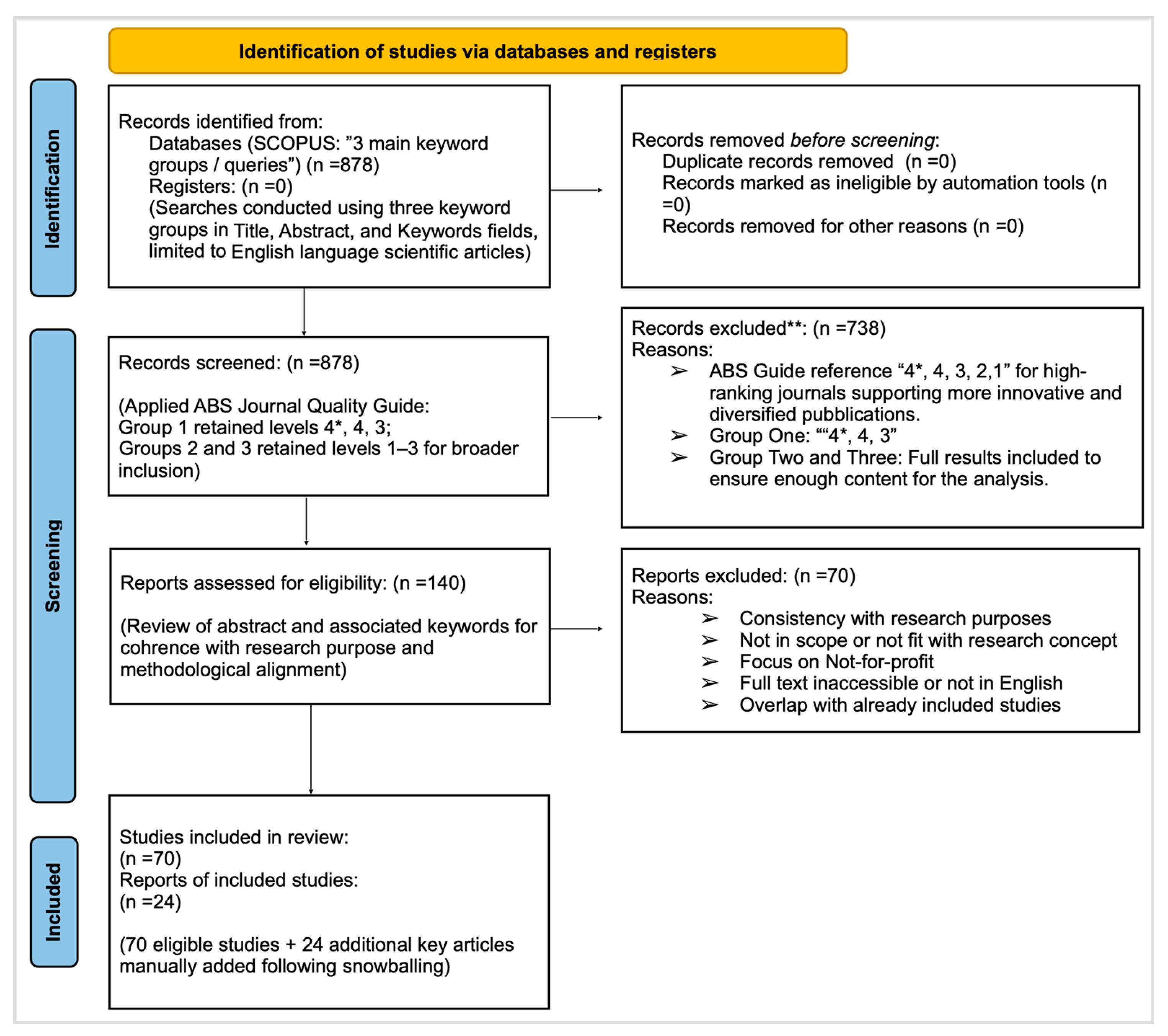
| Quality Filter | Journal ranking | ABS Journal Guide: Levels 3-4-4* for corporate purpose keywords. Levels 1–3 included for brand/identity keywords to ensure broader coverage |
| Screening Procedure | Selection approach | Titles, abstracts, and keywords screened; snowballing strategy applied (Yin, 2014) |
| Final Dataset | Outcome | 94 articles included (See Appendix A) |
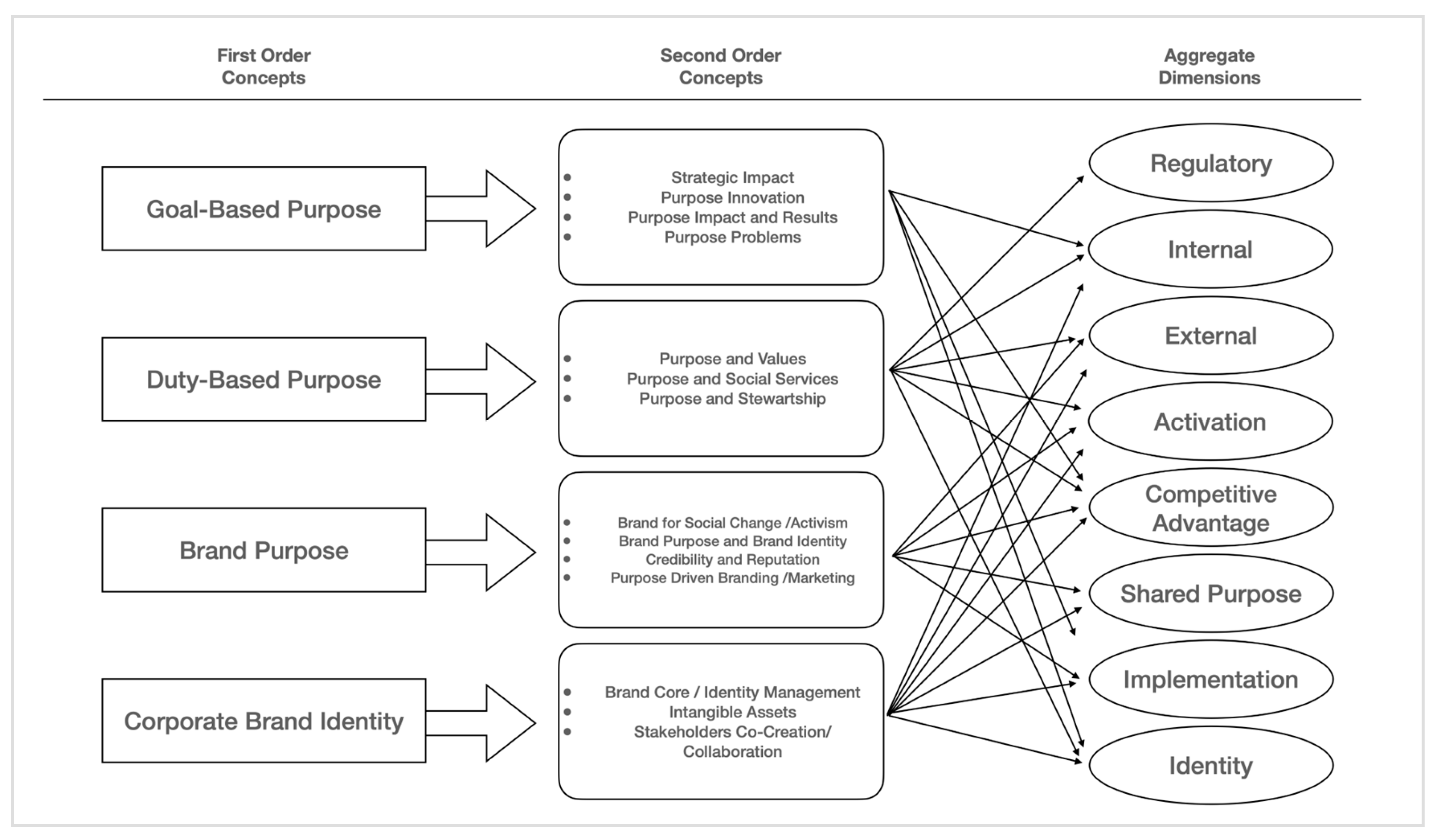
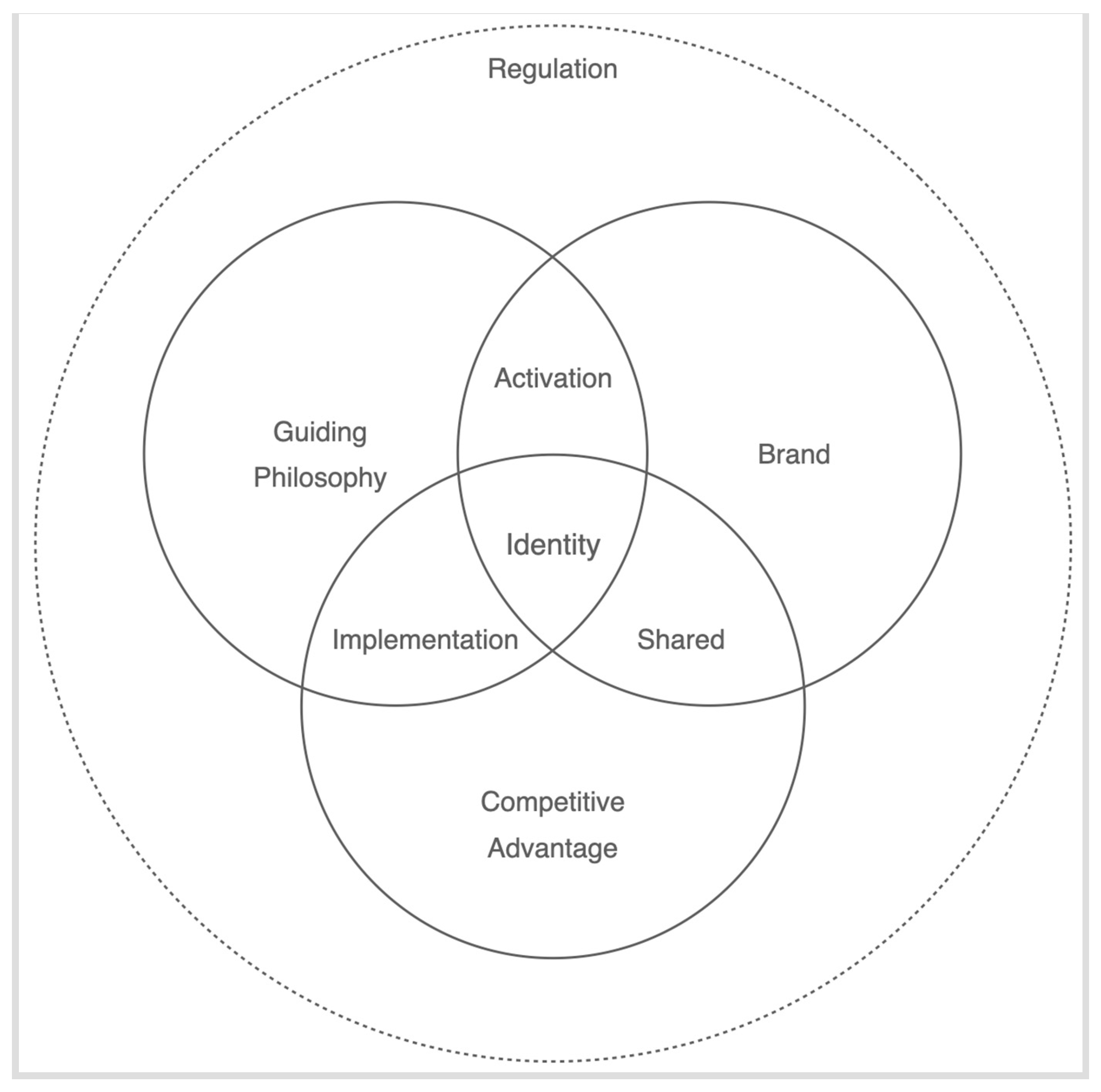
| Dimensions | Purpose |
|---|---|
| Public Policy | Regulation |
| Internal | Organisational/Guiding Philosophy |
| External | Brand Purpose |
| Strategic | Competitive Advantage |
| Internal/External | Activation |
| Strategic/External | Shared Purpose |
| Strategic/Internal | Implementation |
| Core | Identity of the Organisation |
| Concept | Definition | Main Goal | Limitation | References |
|---|---|---|---|---|
| Corporate Purpose | A statement that defines the purpose of the company beyond profit, guiding strategy and stakeholder relations. | Create shared value by integrating profit, social responsibility, and sustainability. | Risk of remaining confined to a CSR approach. | Mayer (2021), Porter and Kramer (2011). |
| Brand Purpose | A purpose that guides the brand and defines its role in consumers’ lives, strengthening its identity and positioning. | Establish emotional connections, trust, and loyalty with customers and other stakeholders. | Risk of purpose-washing or becoming mere storytelling. | Hsu (2017); Kotler (2011); Gray et al. (2024). |
| Massive Transformative Purpose (MTP) | An identity-defining and transformative “guiding star” that directs the company toward systemic and exponential impacts. | Drive radical and transformative change on a social and systemic scale. | Early-stage concept; lack of published studies and professional evidence. | Ismail et al. (2014); Dimitrov (2022). |
| Research Question | Key Findings | Key Contribution |
|---|---|---|
| RQ 1 | MTP differs from corporate/brand purpose by (i) transformative orientation, (ii) exponential ambition, and (iii) identity-based positioning | Clarifies conceptual boundaries; establishes MTP’s unique role |
| RQ 2 | Four dimensions identified: Identity, Internal, External, and Strategic/Competitive | Provides first systematic analytical framework for MTP |
| RQ 3 | Framework enables both (i) research metrics and empirical testing and (ii) managerial levers (identity, engagement, stakeholder trust, and innovation) | Converts MTP into an operational tool; highlights risks and accountability needs |
Disclaimer/Publisher’s Note: The statements, opinions and data contained in all publications are solely those of the individual author(s) and contributor(s) and not of MDPI and/or the editor(s). MDPI and/or the editor(s) disclaim responsibility for any injury to people or property resulting from any ideas, methods, instructions or products referred to in the content. |
© 2025 by the author. Licensee MDPI, Basel, Switzerland. This article is an open access article distributed under the terms and conditions of the Creative Commons Attribution (CC BY) license (https://creativecommons.org/licenses/by/4.0/).
Share and Cite
Derchi, F. From Buzzword to Framework: A Systematic Review of the Massive Transformative Purpose Concept. Adm. Sci. 2025, 15, 472. https://doi.org/10.3390/admsci15120472
Derchi F. From Buzzword to Framework: A Systematic Review of the Massive Transformative Purpose Concept. Administrative Sciences. 2025; 15(12):472. https://doi.org/10.3390/admsci15120472
Chicago/Turabian StyleDerchi, Francesco. 2025. "From Buzzword to Framework: A Systematic Review of the Massive Transformative Purpose Concept" Administrative Sciences 15, no. 12: 472. https://doi.org/10.3390/admsci15120472
APA StyleDerchi, F. (2025). From Buzzword to Framework: A Systematic Review of the Massive Transformative Purpose Concept. Administrative Sciences, 15(12), 472. https://doi.org/10.3390/admsci15120472