Article

Followership in Business Transformation: Hyundai Motor Group Case

by
Kyounghee Sunwoo
1,
Jinhee Choi
1,* and
Victor Blazquez
2,3
1
Seoul Business School, aSSIST University, Seoul 03767, Republic of Korea
2
Competence Centre for Management and Entrepreneurship, Department of Business Economics, Health and Social Care, University of Applied Sciences and Arts of Southern Switzerland, 6928 Manno, Switzerland
3
Taylor Institute, Franklin University Switzerland, 6924 Sorengo, Switzerland
*
Author to whom correspondence should be addressed.
Adm. Sci. 2024, 14(12), 309; https://doi.org/10.3390/admsci14120309

Submission received: 6 September 2024 / Revised: 9 November 2024 / Accepted: 15 November 2024 / Published: 21 November 2024

Abstract

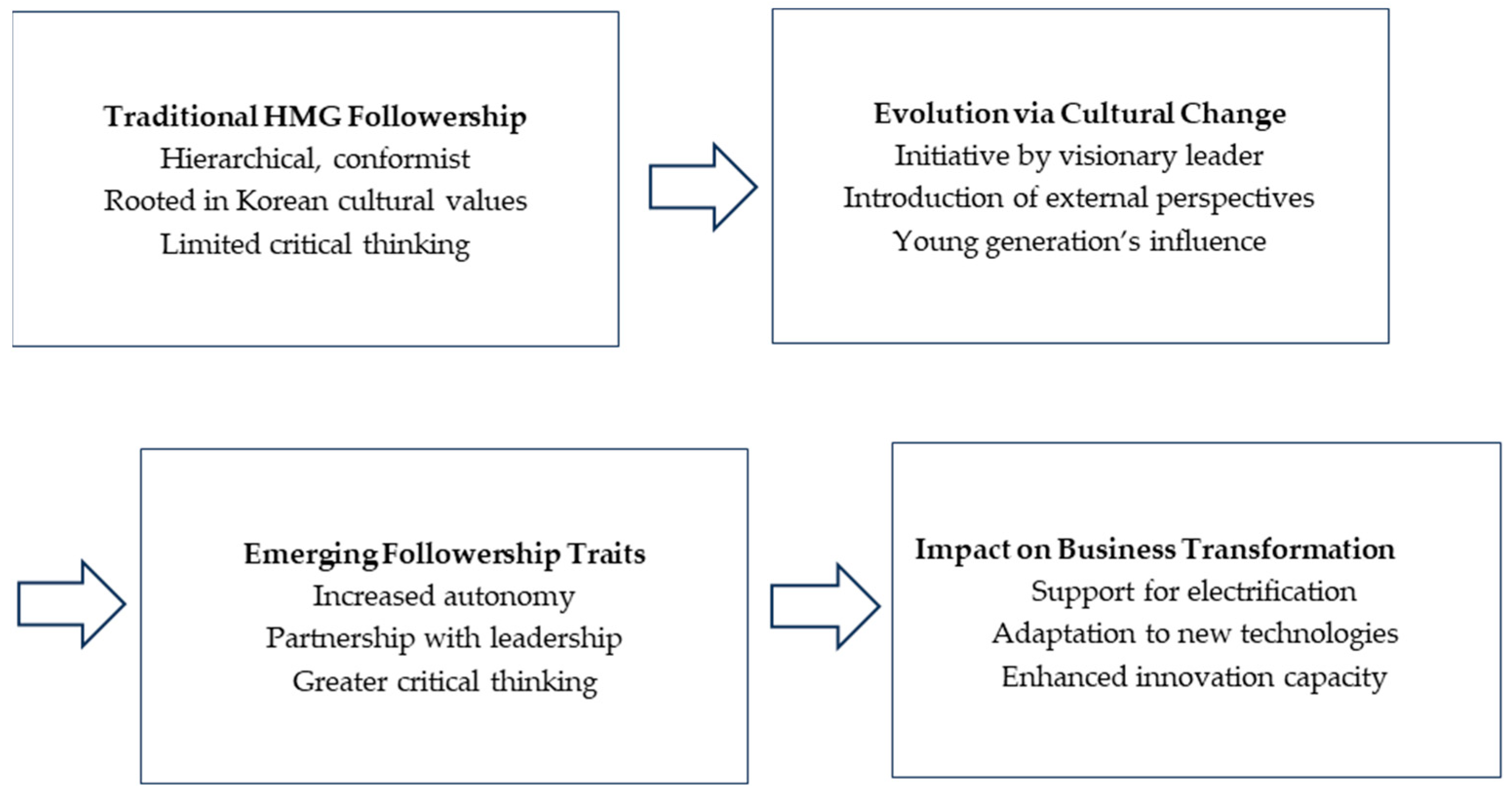
This study explored the employees’ perception of followership and its evolution in business transformation, given the case of the Hyundai Motor Group (HMG). Using a case study approach for explorative research, we conducted informal conversations and in-depth interviews with twenty participants to solicit employees’ and stakeholders’ perceptions of followership and its cultural formation through interpersonal relationships. Drawing on Kelley’s followership typology, we found three characteristics in participants’ followership perceptions: Ill-sa-bul-lan (extraordinarily well-organized), speed, and devotion. To explore the cultural formation of followership between leaders and followers, which is under-explored in Kelley’s theory, we adopted alternative theories (i.e., responsible leadership and implicit followership) to analyze the interpersonal relationship during the business transformation. Consequently, we found that the HMG followership, shaped by the relationships between leaders and followers within the Korean cultural context, evolved to facilitate successful business transformation. Initiated by top management, new and diverse elements from outside spurred the drive for business transformation and instigated changes in organizational culture, including perceptions of followership. This evolution of followership, in turn, reinforced the business transformation, creating a virtuous cycle. This study offers valuable insights into the dynamics of followership and its impact on organizational performance, providing a foundation for further empirical research in this underexplored area of followership.
Keywords: Hyundai Motor Group (HMG); followership; followership typology; mechanism; business transformation; Korean culture Hyundai Motor Group (HMG); followership; followership typology; mechanism; business transformation; Korean culture