
Perspective

Is Analytical Precision Always Necessary? Redefining Real-Time Monitoring Towards Smart Wastewater Treatment Plants

by
Selda Murat Hocaoglu
TUBITAK Marmara Research Center (TUBITAK MAM), Climate and Life Sciences, Gebze 41470, Kocaeli, Türkiye
Environments 2026, 13(7), 383; https://doi.org/10.3390/environments13070383
Submission received: 22 April 2026 / Revised: 2 July 2026 / Accepted: 3 July 2026 / Published: 7 July 2026
(This article belongs to the Topic Soil/Sediment Remediation and Wastewater Treatment)

Abstract

Smart wastewater treatment plants are increasingly essential for improving the resilience of water infrastructure under climate-related disturbances and operational variability. Despite significant advances in sensing technologies and data analytics, full-scale automation remains limited. One of the primary barriers is that monitoring strategies remain primarily designed for regulatory compliance, prioritizing absolute analytical accuracy often at relatively high cost, thereby limiting their widespread use for real-time decision-making. This perspective proposes a shift from compliance-oriented monitoring to purpose-oriented monitoring, in which monitoring systems are designed according to the operational purpose they support. To support this shift, we introduce a framework recognizing that different operational applications require different levels of measurement performance. Accordingly, compliance assessment, early warning, process troubleshooting, real-time control, and asset management each require different combinations of accuracy, precision, temporal resolution, and tolerance to measurement error. Within this framework, high-frequency multi-source data streams from conventional, spectral, visual, and virtual sensors can provide complementary information on process dynamics, effectively supporting operational decisions, even when individual measurements do not achieve laboratory-level analytical performance. When combined with hybrid models that integrate mechanistic and data-driven approaches, this purpose-oriented monitoring framework can enable predictive process management and accelerate the transition toward autonomous wastewater treatment systems.

1. Introduction

Challenges of Wastewater Monitoring: Heterogeneity and Temporal Variability

Wastewater treatment plants face increasing challenges in maintaining sustainability, efficiency, and economic viability under changing environmental conditions. Climate-related pressures, including fluctuations in influent flow, variations in wastewater composition and operating conditions, further complicate process stability [1,2,3,4], emphasizing the importance of real-time monitoring for process optimization.
Wastewater treatment processes are inherently dynamic and heterogeneous; however, our monitoring strategies still remain static, regulatory, and compliance-driven. In practice, most systems rely on discrete sampling and high-precision laboratory analyses. However, this overlooks an important issue: wastewater composition can change significantly over a short time due to diurnal patterns, hydraulic fluctuations, and intermittent discharges. A simple household washing machine cycle illustrates this variability. During a washing machine cycle, wastewater composition differs substantially between detergent washing and rinsing. As a result, samples taken at different times can yield entirely different results, highlighting the importance of accounting for temporal variability in sampling. Consequently, measurements based on infrequent samples often fail to represent actual process conditions, no matter how accurate the analysis is. This points to a more fundamental problem: the limitation is not the measurement technology itself, but the mismatch between how data are collected and how wastewater systems actually behave.
Wastewater monitoring is generally influenced by three distinct sources of uncertainty [5,6] which are (i) analytical uncertainty related to the measurement method, (ii) sampling uncertainty concerning the representativeness, and (iii) temporal variability resulting from process dynamics. Analytical uncertainty comprises detection limit, precision (repeatability), relative standard deviation (RSD), and interlaboratory variability [7,8]. In conventional monitoring, significant efforts have been invested in minimizing analytical uncertainty in “gold standard” laboratory methods [7]. However, significant uncertainty remains due to the complex, heterogeneous nature of wastewater. Laboratory aliquots are typically very small, and suspended solids in wastewater settle rapidly. Accordingly, careful handling is required during sample preparation, but further uncertainty often arises during mixing, pipetting, or dilution. For instance, the presence of a single large organic particle in a small analytical vial may significantly influence the result, a challenge particularly widespread for particulate-influenced parameters such as COD, BOD, TKN, and TP [9]. Even widely accepted laboratory protocols produce significantly different results using the same standard sample. For example, BOD5 measurements often show inter-laboratory uncertainties of 15–30%, while COD and nutrient analyses typically range between 5 and 10% [10,11,12]. Overall, total measurement uncertainty can be substantially higher, reaching up to 19% for total suspended solids and 17% for COD [11]. To bypass the operational complexity of traditional organic matter parameters, the total organic carbon (TOC) measurement may represent a simpler alternative for real-time monitoring [13,14].
Sampling uncertainty is frequently overshadowed by analytical uncertainty, despite its importance to ensure the representativeness of results [15,16,17]. A sample captured near a dead zone, within a surface scum layer, or during a transient hydraulic surge will also fail to represent actual process conditions. Even sampling from a nominally well-mixed location, if the sampling frequency is insufficient to capture the temporal variability, representativeness cannot be achieved [18]. Consequently, the application of high analytical precision to a non-representative sample will yield data that is precisely wrong, highlighting the importance of continuous, real-time monitoring that can reduce uncertainties associated with infrequent sampling while capturing temporal variability.
In practice, equalization tanks are among the most effective solutions for improving the representativeness of wastewater characterization because continuous mixing and homogenization reduce short-term fluctuations in influent flow and composition [19]. However, this approach is often impractical in high-capacity urban WWTPs due to space and cost constraints. An alternative is to increase sampling frequency to capture temporal variability and approximate the true average composition statistically. In this context, high-frequency monitoring can be viewed as a form of statistical homogenization. Total measurement uncertainty ( U t o t a l ) can then be expressed as the combined effect of analytical ( U a ) and sampling ( U s ) uncertainties [8]:
U t o t a l = U a 2 + U s 2
From a statistical perspective, the standard error of the mean ( S E ) decreases with the increasing number of observations ( n ) and is given by:
S E = σ t o t a l n
The standard error ( S E ) of the mean, which reflects how far the measured average is likely to deviate from the true process mean, can be used as an illustrative representation of the sampling uncertainty ( U s ) associated with estimating the process average from a limited number of observations. Substituting this into the uncertainty framework yields:
U t o t a l = U a 2 + ( σ t o t a l n ) 2
Here, σ t o t a l represents the overall standard deviation of process observations. In conventional laboratory-based monitoring, where n is small (often 1 for a grab sample), the standard error remains high. In contrast, high-frequency online monitoring (e.g., one measurement per minute) yields large n values (n = 1440 per day), which substantially reduces sampling-related uncertainty.
This simplified framework is intended as a conceptual illustration rather than a rigorous description of all uncertainty sources in online monitoring. While n reduces the standard error conceptually, advanced time series modeling, such as Kalman filtering, is required in practice to account for autocorrelation. Furthermore, in practice, representativeness also depends on the monitoring system design. Sensor placement is particularly important, as measurements obtained from dead zones, surface scum layers, or other hydraulically unrepresentative locations may fail to reflect actual process conditions. Similarly, an insufficient number of monitoring points may not adequately capture variability within a treatment process. For example, where parallel treatment lines operate under different conditions, measurements from a single location may not be representative of both processes. Furthermore, online monitoring systems are subject to systematic sources of uncertainty, including sensor drift, fouling, calibration bias, matrix effects, and maintenance-related variability. These factors may affect data quality and should be considered according to the operational decisions supported by the monitoring system. Nevertheless, increasing measurement frequency can substantially improve characterization of temporal dynamics and provide a more representative estimate of process behavior than infrequent grab sampling. In real-time process control systems, the effectiveness of a monitoring system not only depends on measurement accuracy but also on its ability to capture process dynamics, support timely decisions, and provide actionable information for the intended operational purpose.

2. Recent Technological Advances in Wastewater Treatment Plants Operation: AI and ML Applications

Historically, research into process optimization focused primarily on adjusting blower speeds through dissolved oxygen (DO) setpoints and integrating nutrient measurements into aeration control strategies [20,21,22]. Recently, these efforts have evolved to include machine learning (ML)-based methods, which demonstrated significantly enhanced aeration management, achieving significant energy saving and operational cost reductions [23,24]. For instance, recent studies have reported energy savings of up to 23% through ML-driven aeration control [25], and air demand by 16% through automated optimization [26].
Over the last decade, monitoring efforts have also evolved significantly, moving toward spectral sensing, virtual sensors, and IoT-based systems with the integration of ML. These advances can contribute to monitoring complex plant dynamics, specifically for influent characteristics, effluent quality, and sludge production [27,28,29]. Among the predictive tools used to manage this data, artificial neural networks (ANNs) have been shown to be effective due to their ability to handle nonlinear and multivariate systems [30,31,32]. Other methods, such as support vector regression (SVR) and adaptive neuro-fuzzy inference systems (ANFIS), have also become key tools reported with successful results [33,34,35,36].
In parallel, spectral sensing technologies, ultraviolet-visible (UV–Vis), and fluorescence and near-infrared (NIR) spectroscopies, have gained increasing attention for wastewater monitoring due to their ability to capture chemical signatures across multiple wavelengths at once. These systems are structurally simple and provide stable signals, making them suitable for real-time monitoring applications. Unlike conventional single-parameter sensors, spectral measurements generate multi-dimensional data that can be correlated with a wide range of water quality variables, including organic matter, nutrients, heavy metals, microbial indicators, and emerging pollutants [37,38,39].
While most work still focuses on predicting effluent quality, there is a growing move toward using ML and advanced sensing technologies to make operational decisions. Recently, spectral sensing has been successfully integrated into control strategies, such as ozone dosing optimization using regression-based control strategies and UV–Vis spectroscopy [40,41] and membrane fouling by combining UV–Vis and fluorescence spectral fingerprints coupled with machine learning models [42].
Additionally, low-cost RGB-based camera sensing has demonstrated potential for process monitoring, as a practical and low-cost approach to estimate several parameters, including color and turbidity [43,44], activated sludge biomass concentration [45], floc characterization [46], microalgal growth in photobioreactors [47], tracking pathogen-related indicators [48], and estimation of dewatered sludge moisture content for failure detection [49]. Collectively, these studies suggest that low-cost RGB-based camera sensors can expand monitoring capabilities and complement conventional analytical methods for real-time process monitoring and different levels of process control decisions in wastewater treatment plants.
Over the last two decades, numerous online sensors and analyzers have entered the market, principally focusing on highly accurate measurements for regulatory compliance, which are also the basis of the current monitoring paradigms. While these technologies provide valuable information, their cost, maintenance requirements, and deployment complexity often limit the dense monitoring architectures required for smart wastewater treatment (WWTP) operation. Therefore, despite recent research advances in various technologies, automation in full-scale plants remains rare [50]. To overcome this challenge, this perspective proposes a shift from accuracy-oriented monitoring toward a purpose-oriented framework that matches monitoring requirements defined by the intended operational objective. Such an approach optimizes not only the required level of data accuracy and precision but also the selection and deployment of real-time monitoring technologies according to the value of information they provide for specific monitoring and decision purposes.

3. Towards Smart WWTPs: Transition from Compliance-Oriented to Purpose-Oriented Monitoring

Smart WWTPs require large volumes of real-time monitoring data, and data acquisition strategies should be designed according to the information needs and operational decisions they support. This perspective proposes a purpose-oriented monitoring framework that aligns monitoring requirements with specific decision objectives, thereby avoiding both under-monitoring and unnecessarily stringent measurement requirements. The framework is built on three principles: (i) smart WWTPs require the integration of multiple complementary monitoring layers; (ii) monitoring requirements should be defined by the decisions they support rather than analytical performance alone; and (iii) different decision objectives require different balances among accuracy, precision, and temporal resolution depending on the consequence of measurement error.
In process control, a signal does not need to be a highly precise concentration measurement; rather, it must be consistent, timely, and sensitive to change and suitable for the intended purpose. In many cases, categorical information, such as identifying whether pollution levels are normal, elevated, or critical, is sufficient to support operational decisions. In smart WWTPs, operational intelligence no longer resides in a single sensor but emerges from systems that integrate, cross-check, and interpret multiple data streams. Consequently, process management increasingly relies not only on concentration measurements but also on information such as mass loads, trends, anomalies, and system states. Within this context, the value of monitoring data is determined less by the analytical performance of individual measurements and more by their ability to support decision-making. When integrated through hybrid models that combine mechanistic process understanding with data-driven machine learning, these data streams can provide enhanced situational awareness and enable more adaptive and responsive process control.
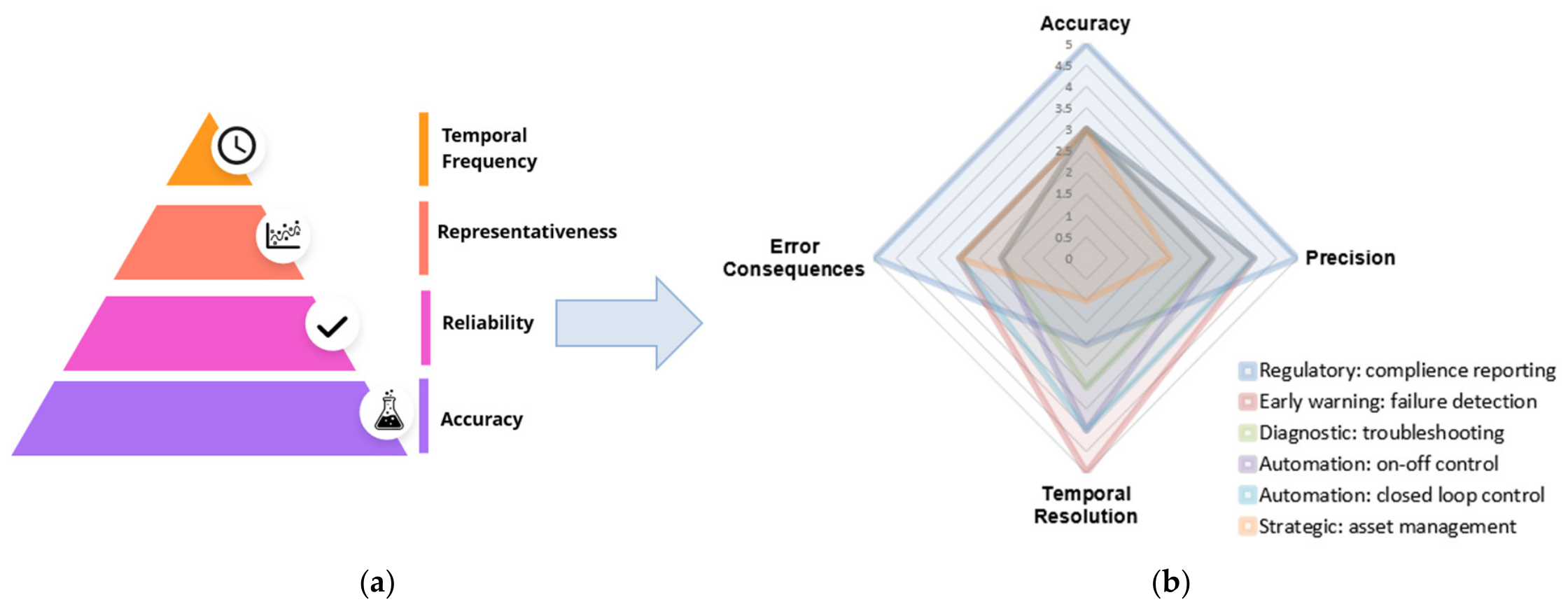
The proposed purpose-oriented monitoring framework defines monitoring requirements according to the operational decisions they support. The framework evaluates monitoring needs using four criteria: (i) accuracy, (ii) precision, (iii) consequence of measurement error, and (iv) temporal resolution. Based on these criteria, monitoring applications are categorized into five decision purposes: regulatory (compliance and reporting), early warning (failure detection), diagnostic (process troubleshooting), automation (real-time control), and strategic (asset management and planning). This taxonomy provides a practical framework for evaluating monitoring systems beyond analytical performance alone. Figure 1 provides a conceptual visualization of the proposed framework rather than a quantitative scoring system. The axes correspond to the four monitoring criteria used throughout the taxonomy, namely accuracy, precision, temporal resolution, and error consequences. While conventional monitoring is largely organized around analytical accuracy, the proposed framework prioritizes monitoring requirements according to decision purpose. Traditional monitoring has a one-dimensional hierarchy that prioritizes analytical accuracy, followed by reliability, with limited emphasis on temporal resolution. On the other hand, smart WWTPs monitoring framework prioritizes a multidimensional approach depending on the purpose of data monitoring, the information generated, and the decision to be supported.
Table 1 summarizes the key differences between conventional and smart wastewater monitoring approaches. In conventional laboratory-based approaches, representativeness is a structural bottleneck constrained by low sampling frequency. In the smart WWTPs framework, there is a potential that representativeness is improved significantly if the location, number of sensors, etc., are selected appropriately, as well as the measurement frequency adjusted to cover variations by time. Table 2 summarizes the relative emphasis assigned to each monitoring criterion for different decision purposes.
The proposed taxonomy highlights that monitoring requirements vary substantially across different decision purposes. Regulatory compliance monitoring requires high analytical accuracy and precision because measurements must be traceable, reproducible, and legally defensible. Consequently, certified laboratory methods and accredited online analyzers remain the preferred approach. In contrast, early-warning applications prioritize reliable detection of trends, anomalies, and threshold exceedances, where sensitivity to change is often more important than absolute accuracy. Similarly, diagnostic and troubleshooting applications require signals that consistently reflect process dynamics, allowing operators to identify gradual shifts in performance, process-state transitions, and emerging operational issues. Within automation applications, monitoring requirements depend on the control strategy employed. For simple threshold-based control, measurements need only be sufficiently reliable to detect setpoint crossings. Moderate drift or limited analytical accuracy may be acceptable as long as the signal consistently indicates whether the process is above or below a predefined threshold. For closed-loop PID control, signal stability and repeatability become more important because excessive measurement variability can destabilize the control loop. By contrast, asset management and long-term planning applications typically require neither high-frequency measurements nor high analytical precision. Instead, they rely on sufficiently reliable indicators of equipment condition, process performance, and long-term trends.
Consequently, the relevant question is not simply “How accurate is this sensor?” but rather “What decision will this signal support?” and “What level of uncertainty is acceptable for that decision?”. Monitoring requirements should therefore be determined by the decision purpose rather than analytical accuracy alone. Table 2 summarizes the proposed framework by relating each operational objective to the required analytical performance, temporal resolution (frequency), and consequences of measurement error. Throughout Table 2, the terms “very high”, “high”, “moderate”, and “low” accuracy and precision are used comparatively rather than as fixed performance thresholds. The appropriate performance level depends on the specific application and operational context, depending on the target parameter, plant configuration, regulatory situation, and operational risk.
Accordingly, validation strategies and the choice of monitoring technologies should also be aligned with the intended application. Compliance monitoring requires validation using certified laboratory methods or accredited online analyzers to ensure traceability and legal defensibility. In contrast, operational applications may employ a range of technologies, including spectral sensors, electrochemical and optical sensors, UV–Vis and fluorescence spectroscopy, RGB imaging, and soft sensors. For these applications, periodic laboratory verification is generally sufficient, rather than continuous laboratory-grade analytical accuracy. For example, early-warning systems should demonstrate robust detection of anomalies and threshold exceedances, while diagnostic applications should consistently reproduce process trends and state changes. Control applications should be validated according to controller performance and process stability, whereas more advanced supervisory and model predictive control systems additionally require periodic model recalibration. Strategic asset management, in contrast, relies primarily on long-term benchmarking using historical operational data, digital twins, power meters, and predictive maintenance indicators.

4. Technologies Enabling Transition: Virtual Sensors, Spectral Sensing, and Hybrid Modeling

The shift from precision-oriented to purpose-oriented monitoring requires technologies capable of delivering high-frequency, information-rich data that support operational decision-making in real time. Recent advances in machine learning have improved the robustness and stability of predictive methods, making them increasingly suitable for tracking the process trends and dynamics required for real-time control.
Virtual sensors, which combine routine low-cost measurements with data-driven models to estimate parameters that are otherwise difficult or costly to measure directly, represent a particularly practical development in this regard. In parallel, spectral sensing, such as UV–Vis, fluorescence, and NIR spectroscopy, enables the simultaneous capture of chemical fingerprints associated with multiple water quality variables. Rather than producing a single measurement, spectral sensors generate multidimensional information that can be related to several process variables simultaneously. Although spectral measurements may not achieve the same level of analytical accuracy as laboratory methods for all parameters and applications, they enable operators to detect process shifts and deviations in real time, supporting early warning and intervention before critical thresholds are exceeded. Low-cost RGB imaging extends this concept by providing visual indicators of process conditions, such as sludge characteristics or settling behavior, through accessible and inexpensive instrumentation [43,44,47,49].
Beyond individual sensing technologies, the most significant development lies in the integration of mechanistic process models with data-driven machine learning approaches. Mechanistic models, such as the activated sludge models (ASMs), encode established biochemical process understanding, while data-driven models identify patterns in high-frequency datasets without requiring complete mechanistic descriptions. Combining the mechanistic framework of ASMs with the pattern-recognition capabilities of machine learning provides a powerful tool for wastewater treatment modeling. By combining process understanding with data-driven adaptability, hybrid models are particularly well-suited to dynamic and uncertain wastewater systems and represent a promising direction for future wastewater treatment modeling [51]. Several studies have demonstrated the practical value of hybrid architectures, reporting improved prediction of key process variables such as MLSS, COD, and nitrate concentrations compared with standalone mechanistic models [52]. Hybrid approaches have also shown greater adaptability to the fluctuations in influent characteristics and operational conditions, highlighting their potential for supporting advanced monitoring and control strategies [53].

5. Operational Challenges and Limitations

The transition toward purpose-oriented monitoring enables optimization, automation, and predictive process control through the integration of spectral, visual, and virtual sensor data streams. More importantly, this shift extends monitoring beyond the measurement of water quality parameters toward the interpretation of process behavior across multiple operational layers, including anomaly detection, process diagnostics, forecasting, and real-time control. While these developments are promising, their full-scale implementation remains subject to several technical, economic, operational, and organizational constraints.
It is important to note that this framework should not be interpreted as a replacement for laboratory measurements, nor does high-frequency monitoring eliminate all sources of uncertainty. Continuous measurements can substantially reduce uncertainties associated with infrequent grab sampling and improve the characterization of temporal dynamics. However, they remain subject to representativeness limitations arising from sensor location, hydraulic heterogeneity, suspended solids distribution, mixing conditions, and hydraulic residence time effects [54,55,56]. In addition, online measurements are susceptible to systematic errors, including sensor drift, biofouling, calibration bias, matrix interferences, and maintenance-related variability [57,58,59,60,61]. These uncertainties are particularly important because high-frequency process data are typically autocorrelated, meaning that increasing the number of observations does not necessarily reduce uncertainty according to simple statistical averaging assumptions.
Another challenge is data preprocessing and quality management. The development of automated data-cleansing pipelines, including outlier detection, noise filtering, and missing-data handling, is essential for reliable automated decision-making and process control. Similarly, data-driven models may experience performance degradation over time as influent characteristics, process configurations, or operational practices change, requiring periodic retraining and/or revalidation.
Consequently, the successful implementation of integrated monitoring frameworks depends not only on sensor deployment but also on robust data management and validation strategies. Periodic laboratory verification remains essential for calibration and quality assurance, while data reconciliation, soft sensing, and hybrid mechanistic–machine learning models can help compensate for individual sensor limitations. Site-specific calibration and model adaptation are frequently required, as sensor responses and process dynamics can vary considerably across treatment facilities, and model transferability between plants remains a significant practical challenge.
In addition to technical considerations, several organizational and regulatory barriers may limit the adoption of monitoring systems. These include sensor acquisition and maintenance costs, data infrastructure requirements, cybersecurity and data governance considerations, operator trust in automated decision-support systems, regulatory acceptance of non-traditional measurements, and the allocation of responsibility for automated operational decisions.

6. Conclusions

This perspective argues that the continued dominance of compliance-oriented monitoring frameworks may limit the adoption of information-rich approaches needed for smart WWTPs. While high analytical accuracy remains essential for regulatory compliance and selected operational applications, many decision functions, including anomaly detection, process diagnostics, forecasting, asset management, and real-time control, can be effectively supported by monitoring systems optimized for temporal resolution, consistency, and decision relevance. Consequently, monitoring requirements should be defined according to the decisions they support, the acceptable consequences of measurement error, and the required response time.
The purpose-oriented framework proposed here provides a practical basis for aligning monitoring requirements with operational objectives. Its successful implementation will not only require advances in spectral sensing, virtual sensing, and hybrid modeling but also robust approaches for calibration, maintenance, validation, data management, and regulatory acceptance. By integrating laboratory analyses with multi-source data streams from spectral, virtual, and low-cost sensors, WWTPs can progressively transition toward more autonomous, adaptive, and resilient operation.
Moving forward, this transition will require coordinated efforts from researchers, utility operators, equipment manufacturers, and regulators. The first step should be pilot-scale implementations led by researchers and pioneering utilities, combining low-cost and spectral sensors with hybrid models for applications such as early warning, process diagnostics, and operational optimization. These applications can demonstrate value, establish data infrastructure, and build operator confidence before wider deployment. In parallel, equipment manufacturers and researchers should focus on developing robust, low-maintenance systems designed for operational decision support rather than laboratory-grade analytical performance alone. Researchers should also work toward performance evaluation frameworks aligned with the decision purpose and operational risk. Together, these efforts can accelerate the transition from compliance-driven monitoring toward autonomous, adaptive, and resilient wastewater treatment systems.

Funding

The authors gratefully acknowledge financial support through the SMART4ENV project. This project has received funding from the European Union’s Horizon Europe Widening Participation and Spreading Excellence Programme under Grant Agreement No 101079251 (Enhancing the Scientific Capacity of TUBITAK MAM in the Field of Smart Environmental Technologies for Climate Change Challenges).

Conflicts of Interest

The authors declare no conflicts of interest.

Abbreviations

The following abbreviations are used in this manuscript:
WWTPWastewater Treatment Plant
BODBiochemical Oxygen Demand
CODChemical Oxygen Demand
TOCTotal Organic Carbon
TSSTotal Suspended Solids
MLMachine Learning
ASMActivated Sludge Models
UV–VisUltraviolet-Visible
NIRNear-Infrared
ANNsArtificial Neural Networks
SVRSupport Vector Regression
ANFISAdaptive Neuro-Fuzzy inference systems
RGBRed, Green, and Blue

References

  1. Li, J.; Li, X.; Liu, H.; Gao, L.; Wang, W.; Wang, Z.; Zhou, T.; Wang, Q. Climate Change Impacts on Wastewater Infrastructure: A Systematic Review and Typological Adaptation Strategy. Water Res. 2023, 242, 120282. [Google Scholar] [CrossRef] [PubMed]
  2. Zhang, S.; Zhou, P.; Xie, Y.; Chai, T. Improved Model-Free Adaptive Predictive Control Method for Direct Data-Driven Control of a Wastewater Treatment Process with High Performance. J. Process Control 2022, 110, 11–23. [Google Scholar] [CrossRef]
  3. Hocaoglu, S.M.; Roghani, B.; Gulcan, H.; Magna, D.J.; Aydöner, C.; Barros, V.G.; Koyunluoglu Aynur, S.; Ratnaweera, H.; Fatone, F.; Eusebi, A.L.; et al. Artificial Intelligence in Wastewater Treatment Plants: A Review of Current Trends and Adaptation Strategies in the Face of Climate-Driven Rainfall Fluctuations. J. Water Clim. Change 2025, 16, 2742–2759. [Google Scholar] [CrossRef]
  4. Alvi, M.; Batstone, D.; Mbamba, C.K.; Keymer, P.; French, T.; Ward, A.; Dwyer, J.; Cardell-Oliver, R. Deep Learning in Wastewater Treatment: A Critical Review. Water Res. 2023, 245, 120518. [Google Scholar] [CrossRef] [PubMed]
  5. ISO 11352: ISO 11352:2025; Water Quality—Estimation of Measurement Uncertainty Based on Validation and Quality Control Data. ISO Central Secretariat: Geneva, Switzerland, 2025.
  6. Montgomery, R.H.; Sanders, T.G. Uncertainty in Water Quality Data. Dev. Water Sci. 1986, 27, 17–29. [Google Scholar] [CrossRef]
  7. APHA American Water Works Association; Water Environment Federation. Standard Methods for the Examination of Water and Wastewater, 24th ed.; Lipps, W.C., Braun-Howland, E.B., Baxter, T.E., Eds.; APHA Press: Washington, DC, USA, 2023. [Google Scholar]
  8. Ellison, S.L.R.; Williams, A. EURACHEM/CITAC Guide: Quantifying Uncertainty in Analytical Measurement, 3rd ed.; Eurachem/CITAC Guide: Teddington, UK, 2012. [Google Scholar]
  9. Henze, M.; Gujer, W.; Mino, T.; van Loosedrecht, M. Activated Sludge Models ASM1, ASM2, ASM2d and ASM3; IWA Publishing: London, UK, 2006; Volume 5. [Google Scholar]
  10. Bertrand-Krajewski, J.L.; Winkler, S.; Saracevic, E.; Torres, A.; Schaar, H. Comparison of and Uncertainties in Raw Sewage COD Measurements by Laboratory Techniques and Field UV-Visible Spectrometry. Water Sci. Technol. 2007, 56, 17–25. [Google Scholar] [CrossRef] [PubMed]
  11. Cotman, M.; Pintar, A. Sampling Uncertainty of Wastewater Monitoring Estimated in a Collaborative Field Trial. TrAC Trends Anal. Chem. 2013, 51, 71–78. [Google Scholar] [CrossRef]
  12. Setiawati, D.; Diksy, Y.; Tirta, A.P. Performance Test for COD Determination in Wastewater Using a Closed Reflux Method with a COD Reactor. Indones. J. Appl. Environ. Stud. 2025, 6, 20–25. [Google Scholar] [CrossRef]
  13. Celine, A.; Scott, A.; Biller, D. Online Total Organic Carbon (TOC) Monitoring for Water and Wastewater Treatment Plants Processes and Operations Optimization. Drink. Water Eng. Sci. 2017, 10, 61–68. [Google Scholar] [CrossRef][Green Version]
  14. Aguilar-Torrejón, J.A.; Balderas-Hernández, P.; Roa-Morales, G.; Barrera-Díaz, C.E.; Rodríguez-Torres, I.; Torres-Blancas, T. Relationship, Importance, and Development of Analytical Techniques: COD, BOD, and, TOC in Water—An Overview through Time. SN Appl. Sci. 2023, 5, 118. [Google Scholar] [CrossRef]
  15. Gy, P. Sampling for Analytical Purposes; John Wiley & Sons: Hoboken, NJ, USA, 1998. [Google Scholar]
  16. Harmel, R.D.; Hathaway, J.M.; Wagner, K.L.; Wolfe, J.E.; Karthikeyan, R.; Francesconi, W.; McCarthy, D.T. Uncertainty in Monitoring E. Coli Concentrations in Streams and Stormwater Runoff. J. Hydrol. 2016, 534, 524–533. [Google Scholar] [CrossRef]
  17. Ahmed, W.; Bertsch, P.M.; Bibby, K.; Haramoto, E.; Hewitt, J.; Huygens, F.; Gyawali, P.; Korajkic, A.; Riddell, S.; Sherchan, S.P.; et al. Understanding and Managing Uncertainty and Variability for Wastewater Monitoring beyond the Pandemic: Lessons Learned from the United Kingdom National COVID-19 Surveillance Programmes. J. Hazard. Mater. 2022, 424, 127456. [Google Scholar] [CrossRef] [PubMed]
  18. Sandoval, S.; Bertrand-Krajewski, J.L.; Caradot, N.; Hofer, T.; Gruber, G. Performance and Uncertainties of TSS Stormwater Sampling Strategies from Online Time Series. Water Sci. Technol. 2018, 78, 1407–1416. [Google Scholar] [CrossRef] [PubMed]
  19. Gantz, R.G.; Liptak, J.; Liu, D.H.F. Equalization and Primary Treatment. In Wastewater Treatment; Liu, D.H.F., Lipták, B.G., Eds.; CRC Press: Boca Raton, FL, USA, 1999; pp. 123–166. [Google Scholar]
  20. Asadi, A.; Verma, A.; Yang, K.; Mejabi, B. Wastewater Treatment Aeration Process Optimization: A Data Mining Approach. J. Environ. Manag. 2017, 203, 630–639. [Google Scholar] [CrossRef] [PubMed]
  21. Santín, I.; Pedret, C.; Vilanova, R. Control and Decision Strategies in Wastewater Treatment Plants for Operation Improvement; Springer: Cham, Switzerland, 2017; p. 86. [Google Scholar] [CrossRef]
  22. Drewnowski, J.; Remiszewska-Skwarek, A.; Duda, S.; Łagód, G. Aeration Process in Bioreactors as the Main Energy Consumer in a Wastewater Treatment Plant. Review of Solutions and Methods of Process Optimization. Processes 2019, 7, 311. [Google Scholar] [CrossRef]
  23. Zhang, Y.; Wang, Z.; Hu, J.; Pu, C. Intelligent Management of Carbon Emissions of Urban Domestic Sewage Based on the Internet of Things. Environ. Res. 2024, 251, 118594. [Google Scholar] [CrossRef] [PubMed]
  24. Singh, N.K.; Yadav, M.; Singh, V.; Padhiyar, H.; Kumar, V.; Bhatia, S.K.; Show, P.L. Artificial Intelligence and Machine Learning-Based Monitoring and Design of Biological Wastewater Treatment Systems. Bioresour. Technol. 2023, 369, 128486. [Google Scholar] [CrossRef] [PubMed]
  25. Ao, Z.; Li, H.; Chen, J.; Yuan, J.; Xia, Z.; Zhang, J.; Chen, H.; Wang, H.; Liu, G.; Qi, L. A New Approach to Optimizing Aeration Using XGB-Bi-LSTM via the Online Monitoring of Oxygen Transfer Efficiency and Oxygen Uptake Rate. Environ. Res. 2023, 238, 117142. [Google Scholar] [CrossRef] [PubMed]
  26. Wang, Y.Q.; Wang, H.C.; Song, Y.P.; Zhou, S.Q.; Li, Q.N.; Liang, B.; Liu, W.Z.; Zhao, Y.W.; Wang, A.J. Machine Learning Framework for Intelligent Aeration Control in Wastewater Treatment Plants: Automatic Feature Engineering Based on Variation Sliding Layer. Water Res. 2023, 246, 120676. [Google Scholar] [CrossRef] [PubMed]
  27. Miller, M.; Kisiel, A.; Cembrowska-Lech, D.; Durlik, I.; Miller, T. IoT in Water Quality Monitoring—Are We Really Here? Sensors 2023, 23, 960. [Google Scholar] [CrossRef] [PubMed]
  28. Dikmen, F.; Demir, A.; Özkaya, B.; Raza, M.O.; Rasheed, J.; Asuroglu, T.; Alsubai, S. AI-Driven Wastewater Management through Comparative Analysis of Feature Selection Techniques and Predictive Models. Sci. Rep. 2025, 15, 25347. [Google Scholar] [CrossRef] [PubMed]
  29. Wei, X.; Yu, J.; Tian, Y.; Ben, Y.; Cai, Z.; Zheng, C. Comparative Performance of Three Machine Learning Models in Predicting Influent Flow Rates and Nutrient Loads at Wastewater Treatment Plants. ACS ES T Water 2023, 4, 1024–1035. [Google Scholar] [CrossRef]
  30. Wang, G.; Jia, Q.S.; Zhou, M.C.; Bi, J.; Qiao, J.; Abusorrah, A. Artificial Neural Networks for Water Quality Soft-Sensing in Wastewater Treatment: A Review. Artif. Intell. Rev. 2021, 55, 565–587. [Google Scholar] [CrossRef]
  31. Nagpal, M.; Siddique, M.A.; Sharma, K.; Sharma, N.; Mittal, A. Optimizing Wastewater Treatment through Artificial Intelligence: Recent Advances and Future Prospects. Water Sci. Technol. 2024, 90, 731–757. [Google Scholar] [CrossRef] [PubMed]
  32. Rios Fuck, J.V.; Cechinel, M.A.P.; Neves, J.; Campos de Andrade, R.; Tristão, R.; Spogis, N.; Riella, H.G.; Soares, C.; Padoin, N. Predicting Effluent Quality Parameters for Wastewater Treatment Plant: A Machine Learning-Based Methodology. Chemosphere 2024, 352, 141472. [Google Scholar] [CrossRef] [PubMed]
  33. Zaghloul, M.S.; Hamza, R.A.; Iorhemen, O.T.; Tay, J.H. Comparison of Adaptive Neuro-Fuzzy Inference Systems (ANFIS) and Support Vector Regression (SVR) for Data-Driven Modelling of Aerobic Granular Sludge Reactors. J. Environ. Chem. Eng. 2020, 8, 103742. [Google Scholar] [CrossRef]
  34. Naghibi, S.A.; Salehi, E.; Khajavian, M.; Vatanpour, V.; Sillanpää, M. Multivariate Data-Based Optimization of Membrane Adsorption Process for Wastewater Treatment: Multi-Layer Perceptron Adaptive Neural Network versus Adaptive Neural Fuzzy Inference System. Chemosphere 2021, 267, 129268. [Google Scholar] [CrossRef] [PubMed]
  35. Alnajjar, H.Y.H.; Üçüncü, O. Enhance and Improve Modelling Prediction by Using an Adaptive Neuro-Fuzzy Inference System-Based Model to Predict Pollution Removal Efficacy in Wastewater Treatment Plants. Desalin. Water Treat. 2023, 286, 52–63. [Google Scholar] [CrossRef]
  36. Ramya, S.; Srinath, S.; Tuppad, P.; Chandan, V. An Attention Infused Multi-Stage Parallel Adaptive Neuro Fuzzy Systems Framework with Metaheuristic Optimization for Accurate Water Quality Prediction. Discov. Artif. Intell. 2025, 5, 359. [Google Scholar] [CrossRef]
  37. Qi, X.; Lian, Y.; Xie, L.; Wang, Y.; Lu, Z. Water Quality Detection Based on UV-Vis and NIR Spectroscopy: A Review. Appl. Spectrosc. Rev. 2024, 59, 1036–1060. [Google Scholar] [CrossRef]
  38. Agiomavriti, A.A.; Bartzanas, T.; Chorianopoulos, N.; Gelasakis, A.I. Spectroscopy-Based Methods for Water Quality Assessment: A Comprehensive Review and Potential Applications in Livestock Farming. Water 2025, 17, 2488. [Google Scholar] [CrossRef]
  39. Basturk, I.; Ozdemir, İ.S.; Gulcan, H.; Hocaoglu, S.M.; Partal, R.; Bozcelik, B.; Meegoda, S.C.; Ratnaweera, H.; Maletskyi, Z. FT-NIR-Based Sludge Moisture Prediction: Spectral Variability and Implications for On-Site Application in WWTPs. Clean Technol. 2026, 8, 74. [Google Scholar] [CrossRef]
  40. Rong, Y.; Wang, X.; Zhu, M.; Chen, W.; Maletskyi, Z.; Ratnaweera, H.; Bi, X. Real-Time Ozonation Monitoring and Control in Wastewater Tertiary Treatment: An Ultraviolet-Visible Monitoring Approach. J. Water Process Eng. 2024, 64, 105664. [Google Scholar] [CrossRef]
  41. Zhang, H.; Wang, X.; Ma, T.; Ma, K.; Gou, X.; Zhu, M.; Maletskyi, Z.; Ratnaweera, H.; Bi, X. UV–Vis Spectral Based Online Monitoring and Control of Ozonation Process for Tertiary Treatment of Leather Tannery Effluent. J. Water Process Eng. 2026, 88, 110187. [Google Scholar] [CrossRef]
  42. Lai, Y.; Xiao, K.; Tian, Y.; Xing, M.; Ding, H.; Tan, J.; Zhang, J.; Peng, Z.; Fan, Y.; Lu, X.; et al. Intelligent Fouling Monitoring in Membrane-Based Wastewater Treatment. Nat. Sustain. 2026, 9, 533–543. [Google Scholar] [CrossRef]
  43. Hocaoglu, S.M.; Partal, R.; Basturk, I.; Hocaoglu, A.K. Rethinking Water Colour Measurement: A Novel Digital Image-Based Method for Apparent Colour Quantification with Implications for Regulation. Environ. Technol. Innov. 2026, 41, 104804. [Google Scholar] [CrossRef]
  44. Parra, L.; Ahmad, A.; Sendra, S.; Lloret, J.; Lorenz, P. Combination of Machine Learning and RGB Sensors to Quantify and Classify Water Turbidity. Chemosensors 2024, 12, 34. [Google Scholar] [CrossRef]
  45. Asgharnejad, H.; Sarrafzadeh, M.H. Development of Digital Image Processing as an Innovative Method for Activated Sludge Biomass Quantification. Front. Microbiol. 2020, 11, 574966. [Google Scholar] [CrossRef] [PubMed]
  46. Sivchenko, N.; Kvaal, K.; Ratnaweera, H. Floc Sensor Prototype Tested in the Municipal Wastewater Treatment Plant. Cogent Eng. 2018, 5, 1436929. [Google Scholar] [CrossRef]
  47. Benavides, M.; Mailier, J.; Hantson, A.L.; Muñoz, G.; Vargas, A.; Van Impe, J.; Wouwer, A. Vande Design and Test of a Low-Cost RGB Sensor for Online Measurement of Microalgae Concentration within a Photo-Bioreactor. Sensors 2015, 15, 4766–4780. [Google Scholar] [CrossRef] [PubMed]
  48. Gowda, H.N.; Kido, H.; Wu, X.; Shoval, O.; Lee, A.; Lorenzana, A.; Madou, M.; Hoffmann, M.; Jiang, S.C. Development of a Proof-of-Concept Microfluidic Portable Pathogen Analysis System for Water Quality Monitoring. Sci. Total Environ. 2022, 813, 152556. [Google Scholar] [CrossRef] [PubMed]
  49. Murat Hocaoglu, S.; Basturk, I.; Partal, R.; Maletskyi, Z.; Eusebi, A.L.; Hocaoglu, A.K. A Low-Cost Smart System for Real-Time Detection of Sludge Dewatering Process Failures in a Full-Scale WWTP. SSRN 2026. [Google Scholar] [CrossRef]
  50. Li, Y.; Zhang, H.; Zhang, P.; Wang, Y.; Hao, Y.; Wang, X.; Guo, W. AI for Smart Wastewater Treatment Plants: A Review of Physics-Informed Water Quality Modeling, Optimization, and Advanced Control. J. Environ. Manag. 2026, 401, 128949. [Google Scholar] [CrossRef] [PubMed]
  51. Zaveri, J.; Li, G.; Wang, Z.; Yan, Y.; Budai, P.; Takács, I.; Gu, A.Z. Rethinking Activated Sludge Modeling: A Critical Review of Modeling Strategies and the Role of Hybrid Integration. Water Environ. Res. 2025, 97, e70181. [Google Scholar] [CrossRef] [PubMed]
  52. Xu, B.; Pooi, C.K.; Yeap, T.S.; Leong, K.Y.; Soh, X.Y.; Huang, S.; Shi, X.; Mannina, G.; Ng, H.Y. Hybrid Model Composed of Machine Learning and ASM3 Predicts Performance of Industrial Wastewater Treatment. J. Water Process Eng. 2024, 65, 105888. [Google Scholar] [CrossRef]
  53. Wu, X.; Zheng, Z.; Wang, L.; Li, X.; Yang, X.; He, J. Coupling Process-Based Modeling with Machine Learning for Long-Term Simulation of Wastewater Treatment Plant Operations. J. Environ. Manag. 2023, 341, 118116. [Google Scholar] [CrossRef] [PubMed]
  54. Xu, Z.; Dehkordy, F.M.; Li, Y.; Fan, Y.; Wang, T.; Huang, Y.; Zhou, W.; Dong, Q.; Lei, Y.; Stuber, M.D.; et al. High-Fidelity Profiling and Modeling of Heterogeneity in Wastewater Systems Using Milli-Electrode Array (MEA): Toward High-Efficiency and Energy-Saving Operation. Water Res. 2019, 165, 114971. [Google Scholar] [CrossRef] [PubMed]
  55. Wang, T.; Wang, C.; Xu, Z.; Cui, C.; Wang, X.; Demitrack, Z.; Dai, Z.; Bagtzoglou, A.; Stuber, M.D.; Li, B. Precise Control of Water and Wastewater Treatment Systems with Non-Ideal Heterogeneous Mixing Models and High-Fidelity Sensing. Chem. Eng. J. 2022, 430, 132819. [Google Scholar] [CrossRef]
  56. Shah, K.A.; Jiao, Y.; Chen, J. CFD Investigation of Dissolved Oxygen Distribution in a Full-Scale Aeration Tank of an Industrial Wastewater Treatment Plant. J. Water Process Eng. 2024, 59, 105078. [Google Scholar] [CrossRef]
  57. Nalakurthi, N.V.S.R.; Abimbola, I.; Ahmed, T.; Anton, I.; Riaz, K.; Ibrahim, Q.; Banerjee, A.; Tiwari, A.; Gharbia, S. Challenges and Opportunities in Calibrating Low-Cost Environmental Sensors. Sensors 2024, 24, 3650. [Google Scholar] [CrossRef] [PubMed]
  58. Koren, K.; McGraw, C.M. Let’s Talk about Slime; or Why Biofouling Needs More Attention in Sensor Science. ACS Sens. 2023, 8, 2432–2439. [Google Scholar] [CrossRef] [PubMed]
  59. Kumar, M.; Khamis, K.; Stevens, R.; Hannah, D.M.; Bradley, C. In-Situ Optical Water Quality Monitoring Sensors—Applications, Challenges, and Future Opportunities. Front. Water 2024, 6, 1380133. [Google Scholar] [CrossRef]
  60. Shi, Z.; Chow, C.W.K.; Gao, J.; Xing, K.; Liu, J.; Li, J. Using Surrogate Parameters to Enhance Monitoring of Community Wastewater Management System Performance for Sustainable Operations. Sensors 2024, 24, 1857. [Google Scholar] [CrossRef] [PubMed]
  61. Kwon, S.; Kang, Y.; Nam, S.H.; Kim, Y. Do Water Quality Monitoring Using Hybrid Physical–Soft Sensors for River Digital Twins: A Comprehensive Review. Water Sci. Technol. 2025, 92, 1286–1307. [Google Scholar] [CrossRef] [PubMed]
Figure 1. Conceptual representation of the proposed purpose-oriented monitoring framework: (a) conventional WWTP and (b) smart WWTP.
Environments 13 00383 g001
Table 1. Key differences between conventional and smart wastewater monitoring approaches.
MetricTraditional Laboratory-Based Monitoring Smart WWTP Monitoring
AccuracyVery high analytical accuracyOperationally sufficient (application-dependent).
Temporal resolution Low (discrete; daily snapshots/composites)High (continuous; real-time data streams).
RepresentativenessLimited (affected by sampling and temporal bias)Representativeness can be substantially improved provided that sensor locations are appropriately selected, the number of monitoring points is sufficient, and measurement frequency is adequate to capture temporal variability.
UncertaintiesDominated by random error (analytical, sampling, matrix-related)Dominated by systematic error (e.g., drift, offset, fouling, calibration bias, matrix effects, etc.), sampling-related random error is minimized.
ActionabilityRetrospective (compliance-focused; delayed feedback)Proactive (real-time decision support and control-oriented).
Table 2. Purpose-oriented monitoring framework for smart WWTPs.
Decision PurposeDecision FunctionUse CaseAccuracy and Precision
Requirement
FrequencyError Consequence
Regulatory: Compliance and ReportingAbsolute quantificationPermit compliance: monitoring against legal effluent discharge limits set by environmental authorities.Very high accuracy and very high precision2–24 h composites, daily/weeklyRegulatory penalties, non-compliance
Early warning: Failure DetectionAnomaly detection, early warningDetection of sudden deviations and forecasting process failures (e.g., industrial discharges, toxic shocks, biomass washout, membrane fouling, and digester instability).Moderate accuracy and high precision Continuous or near-real-time, minutesDelayed response, catastrophic failure
Diagnostic: Process TroubleshootingTrend detection, state estimation, classificationCapturing gradual shifts in process state (e.g., assessment of nitrification, nutrient removal, and sludge settleability).Moderate accuracy and moderate precisionHourly to dailyDelayed response to chronic performance degradation
Automation: Real-Time ControlThreshold detectionSimple on/off control—Threshold-based switching, e.g., pumps, valves start/stop against a fixed setpoint.Moderate accuracy and moderate precisionMinutesUnnecessary cycling, energy waste, or missed switching events
Closed-loop controlClosed-loop (PID) control continuous error correction using setpoints (e.g., aeration, recirculation, chemical dosing, polymer dosing, clarifier, advanced oxidation). Moderate accuracy and high precisionSeconds to minutes Loop oscillation; energy waste; chemical overdosing or underdosing
Multivariable controlCascade/feedforward control: Multivariable control (e.g., integrated aeration + recirculation control and/or dosing control for effluent quality).Moderate accuracy and high precisionMinutes Cross-loop instability; compounded inefficiency
Predictive optimizationSupervisory control/MPC: Plant-wide energy and nutrient optimization, integrated process optimization.Moderate accuracy and moderate precisionMinutes to hoursSuboptimal operation, energy, and process inefficiency
Strategic: Asset Management and planningForecasting, predictive maintenanceCapacity planning, maintenance scheduling, equipment lifecycle management, etc.Low-moderate accuracy and low-moderate precision Daily to monthlyPoor investment decisions, unexpected failures
Disclaimer/Publisher’s Note: The statements, opinions and data contained in all publications are solely those of the individual author(s) and contributor(s) and not of MDPI and/or the editor(s). MDPI and/or the editor(s) disclaim responsibility for any injury to people or property resulting from any ideas, methods, instructions or products referred to in the content.