Article

Synthesis of Double-Coated Urea with Nano-Sulfur and Organic Materials and Their Effect on N2O Emission


1
Department of Soil Sciences, Institute of Environmental Sciences, Hungarian University of Agriculture and Life Sciences, H-2100 Gödöllő, Hungary
2
Department of Soil Science, Faculty of Agriculture, University of Maiduguri, PMB 1069, Maiduguri 600004, Nigeria
3
Department of Integrated Plant Protection, Institute of Plant Protection, Hungarian University of Agriculture and Life Sciences, H-2100 Gödöllő, Hungary
4
Department of Plant Physiology and Plant Ecology, Institute of Agronomy, Hungarian University of Agriculture and Life Sciences, H-2100 Gödöllő, Hungary
*
Author to whom correspondence should be addressed.
Environments 2026, 13(5), 284; https://doi.org/10.3390/environments13050284
Submission received: 13 April 2026 / Revised: 15 May 2026 / Accepted: 18 May 2026 / Published: 20 May 2026
(This article belongs to the Special Issue Coping with Climate Change: Fate of Nutrients and Pollutants in Soil)

Abstract

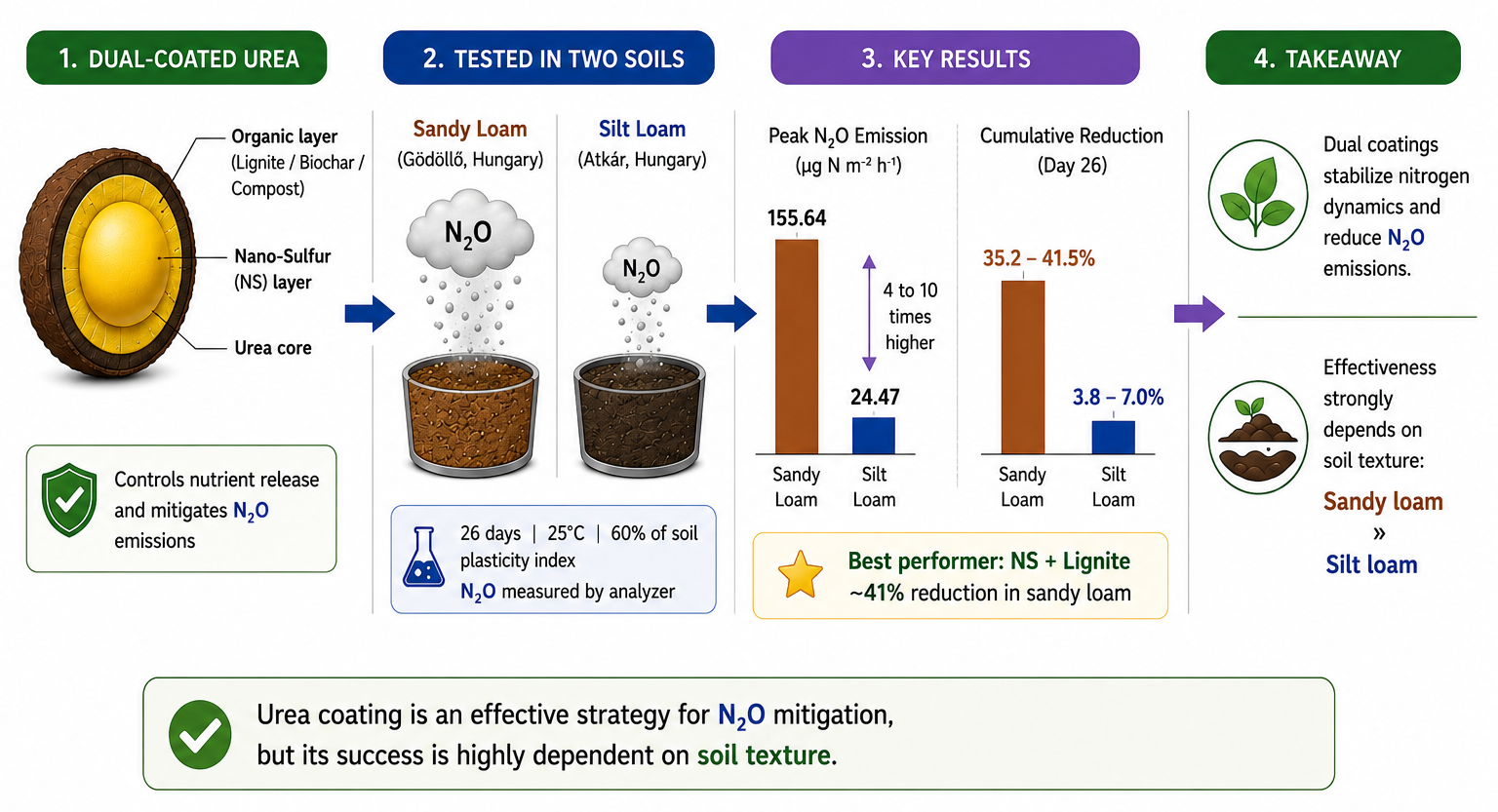
Fertilizer coating is an emerging strategy in fertilizer management in the quest to decrease their loss and environmental impact. Nitrous oxide (N2O) is a significant greenhouse gas, and agricultural soils happen to be an important anthropogenic source of N2O gases, mainly because of the use of nitrogen (N) fertilizers such as urea. This study examined the effects of double urea coating with nano-sulfur (NS) and organic materials; lignite, biochar and compost on N2O fluxes from silt loam and sandy loam soils. N2O fluxes were measured using an N2O analyzer in a controlled environment for a period of 26 days. Cumulative N2O fluxes were calculated for different treatments (nano-sulfur; NS, NS + lignite, NS + biochar, and NS + compost) as coatings on urea fertilizer with propagated uncertainties. Sandy loam soil had higher maximum N2O emission (155.64 µg N m−2 h−1) compared to silt loam soil (24.47 µg N m−2 h−1). Uncoated urea and urea + NS coating resulted in higher N2O emissions in both soils. Meanwhile, NS + organic second layer coatings decreased the N2O fluxes, especially in sandy loam soil. The second organic layer coatings lowered the N2O emissions with relatively lower effects in silt loam soil (3.8–7.0%) and a higher reduction in sandy loam soil (35.2–41.5%). Among the second organic coating materials, NS + lignite performed best, followed by NS + biochar and NS + compost. The results indicate that the urea coating as fertilizer management strategy as well as soil texture have considerable effects on fertilizer-induced N2O emissions. The present study does not address the individual effects of organic coatings on N2O emissions; furthermore, the characterization of the size distribution and morphology of the synthesized nano-sulfur, as well as the physicochemical properties (e.g., particle size, pH, C/N ratio, elemental composition) of the lignite, biochar, and compost coating materials, are omitted. The results of these analyses, together with the physical and chemical characterization of the produced organo-mineral fertilizers, will be presented in a forthcoming paper.

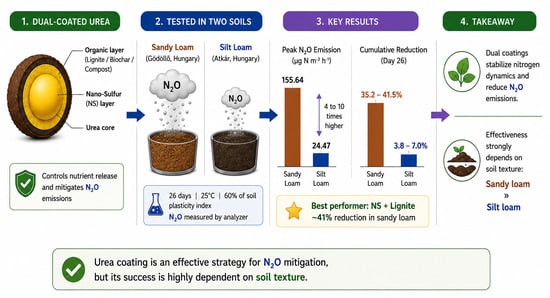
Graphical Abstract

1. Introduction

Nitrogen is a necessary nutritional element and a main limiting factor in plant growth [1]. It is required by plants in relatively large quantities and plays a crucial role in bolstering agricultural production [2]. Due to its importance, there is an increasing demand for nitrogen fertilizers globally, despite its significant environmental impacts.
According to the recent Intergovernmental Panel on Climate Change (IPCC) report [3] there was about a 25% increase in N2O emission due to agricultural activities, forestry practices, and various land-use changes from 1990 to 2019, with agriculture consistently contributing about 96% notably due to nitrogen fertilizer and manure applications to croplands, and manure production and deposition on pastures [4,5].
Urea is one of the most widely applied N fertilizers, accounting for about 55% of global N fertilizer consumption due to minimum risk of explosion under storage conditions, easy handling and low cost [6,7]. However, urea application contributes significantly to N2O emissions due to soil microbial processes like nitrification and denitrification. Emission factors for urea were reported to often be higher compared to other nitrogenous fertilizers, such as ammonium nitrate and ammonium sulfate [8].
Urea application leads to notable N2O emissions [9] due to its rapid conversion to ammonium and nitrate, which are substrates for nitrification and denitrification processes. For instance, in a study comparing urea, ammonium sulfate (AS), and calcium ammonium nitrate (CAN), urea was found to have the highest N2O emissions with emissions ranging from 522 to 617 g N ha−1 (urea) compared to 242–264 g N ha−1 (CAN) [10]. Moreover, it is also very vulnerable to loss through leaching, volatilization (mainly through urease activity) and surface runoff with losses up to 70% [11,12]. This in turn leads to low NUE and high production costs [12]. Hence, the control of nitrogen loss is now a priority in agricultural production due to the necessity to provide sustainable food production with limited negative effects on the environment, as one of the primary objectives of the United Nations (UN) sustainability efforts [13].
Several management techniques have been developed for enhancing applied nitrogen use, including integrated and proper use of chemical fertilizers and organic manures such as synchronizing nitrogen supply with crops need by split applications during crop growth, and reducing loss of applied nitrogen with nest or band placement or large urea granules in soil [14]. Despite these techniques, urea is still very vulnerable to loss as N2O as exemplified in a recent study of [15]. A possible solution could be the use of slow-release fertilizers (SRFs), which release nitrogen progressively, thereby maintaining lower levels of nitrate in soils and minimizing the chances of nitrogen loss through denitrification, runoff, or leaching [16]. Nanotechnology provides superior technique for producing SRFs because it creates particles with a higher surface to mass ratio, surface area, reactivity and porosity, therefore, enabling the precise and controlled delivery of nutrients [17,18,19]. Nano fertilizers, such as nano-coated urea are used to control nitrogen release and slow down their hydrolysis which will possibly minimize their environmental impact and losses [20,21]. They reduce application rates of N fertilizers, frequency of application, environmental losses, and greenhouse gas emissions, serving as an important means towards meeting Sustainable Development Goals of the UN [22]. Therefore, N2O emission from urea is a significant issue and can be managed by coated urea [23].
A diverse range of materials have been utilized for coating urea. Hydrophobic materials like sulfur are utilized in the synthesis of coated fertilizers, thus controlling the release of nutrients [21]. Nano scale materials were reported to exhibit higher efficiency [24] compared to conventional material sizes. Nano-sulfur serves as a dual-purpose input to sustainable agriculture when it is used as a fertilizer coating. It is a critical secondary nutrient that is necessary to all living beings which plays a role in the primary structure of proteins (a component of cysteine and methionine) and in enzymatic activity [25,26]. Moreover, it may increase the rate of oxidation and decrease soil pH; it can be applied before sowing or at a seedling stage and makes the soil acidic, facilitating the release of nutrients [26]. The covering of urea by substances such as sulfur nanoparticles reduces nitrogen losses by lowering urease enzyme activity and ensures a steady supply of nitrogen [12]. This controlled release effect assists in lessening nutrient waste by gaseous pathways [21]. Additionally, nano-sulfur coating is not toxic to the environment and soil, and thus it can be used in sustainable agricultural practices [27].
Despite enhancing nutrient efficacy [28] and offering sulfur nutrition, nano-sulfur coating is still inadequate in terms of building/restoring soil organic carbon to enhance sustainable soil fertility. For that reason, a secondary coating of carbon-rich material like lignite, compost and biochar (recalcitrant) are essential. Moreover, recycling agricultural waste into useful inputs, e.g., through composting organic waste like chicken manure and plant residues and their use in coated fertilizers serves the objective of the circular economy [29,30].
Lignite, a low-rank coal with high porosity, was reported to be useful in minimizing nitrogen loss during composting, which signals its potential in urea coating [31]. This can be explained by the fact that it can establish stable coordination bonds and enhance the mechanical properties of the coated fertilizers and accelerate the period of the nutrient release [32].
Biochar is an environmentally friendly, renewable, and non-toxic material, which contributes to sustainable farming [33]. Biochar coating can contribute to a reduction in nutrient leaching, which reduces environmental pollution and enhances the quality of the soil [34]. Biochar coated urea was reported to decrease nitrogen loss and increase nitrogen use efficiency (NUE) by reducing nitrate leaching and high adsorption of nitrogen through its porous structure and surface functional groups [35], mitigating N2O emissions.
Therefore, the objective of this study was to synthesize dual coated urea fertilizer with, first, a layer of nano-sulfur and, second, a layer coating of carbon-rich materials such as lignite, biochar and compost, and to evaluate their effects on N2O emission with two different soil textures (silt loam and sandy loam).

2. Materials and Methods

2.1. Soil Sample Collection and Preparation

Two composite soil samples were collected at Atkár (northern Hungary, Gyöngyös district; 47°42′24.5″ N, 19°54′35.6″ E) and the MATE Gödöllő Research Farm (47°34′41.8″ N, 19°24′11.6″ E). The samples were transported to the laboratory and prepared by manually removing the debris and plant material. The soil samples were air-dried and ground to a fine consistency with a mechanical grinder. The physico-chemical properties of the soil are given in Table 1 [36].

2.2. Synthesis of Nano-Sulfur and Coated Urea Fertilizer

2.2.1. Source of Lignite, Biochar and Compost Materials

The lignite originates from Visonta, Hungary, and is marketed as a standalone soil improver under the name MátraCoal (Permit No.: 26013274 001-A). Rice straw biochar was obtained from locally produced biochar (Nigeria) using the Bababe kiln as described in [37]. The compost utilized in this study was processed at the Hungarian University of Agriculture and Life Sciences (MATE) experimental station (Gödöllő), derived from a feedstock of green waste and livestock manure.

2.2.2. Preparation of Nano-Sulfur

This was done according to the method of [38], with some modifications. A solution of sodium thiosulphate was prepared by dissolving 80 g of solid sodium thiosulphate pentahydrate (MW: 248.18) in 900 mL double distilled water. For the synthesis of sulfur nanoparticles, 100 mL of 6 M HCl was added to 900 mL of the sodium thiosulphate pentahydrate solution with stirring at 25 °C. After the reaction, the product was placed in a sonicator for 40 min to avoid agglomeration. Precipitates were formed which was washed with double distilled water until the pH of sulfur nanoparticles suspension reached neutral. It was dried in an oven at 60 °C.

2.2.3. Nano-Sulfur Urea Coating (First Layer)

To prepare nano-sulfur-coated urea fertilizer, 100 g of urea granules were weighed into a beaker. The beaker was placed on a hot water bath heated with an electric stove at 55 to 60 °C. While gently stirred, 3 g of nano-sulfur was added continuously until a uniform coating of urea was visible. Then, the fertilizer was dried in an oven at 60 °C and stored.

2.2.4. Preparation of PVA (Polyvinyl Acetate)/Corn Starch Films

To prepare PVA (Polyvinyl Acetate)/corn starch film, 150 mL of distilled water was mixed with 4 g of corn starch, 6 g of PVA and 3 mL glycerin. This was gently mixed, heated, shaken and kept.

2.2.5. Preparation of Second Layer Coating of Lignite, Biochar and Compost on Nano-Sulfur-Coated Urea Fertilizer

To prepare second layer of lignite, biochar and compost, 10 g of nano-sulfur urea-coated granules were weighed into a beaker. While gently stirred, two sprays of Polyvinyl Acetate (PVA)/starch were added to the urea granules and 2 g of prepared lignite was added with stirring until a uniform coating was achieved. It was dried in an oven at 60 °C and stored. This was repeated for both biochar and compost respectively.

2.2.6. Nitrous Oxide (N2O) Emission Experiment

The nitrous oxide emission potential of uncoated urea and synthesized coated urea were evaluated through a laboratory experiment using silt loam and sandy loam soils. About 1.6 to 1.7 kg soil (for sandy loam) and 2.3 to 2.5 kg soil (for silt loam) of the prepared soil were filled to a mark in the tubes. These were carefully set to roughly the same bulk density. The plastic tubes measure a height of 20 cm leaving an inner empty space of 5 cm from the top of the tube to the soil level. During the measurements, this space was closed and used as a gas exchange chamber. Soil moisture was set and maintained at 60% of soil plasticity index. After the first application of distilled water according to weight of soil in each pot, subsequent application was based on the weight loss of the tube to replenish the water lost. Incubation started two weeks before the measurements and was maintained at the same temperature (22 to 23 °C) and moisture (60%) before the commencement of measurements. In closed chambers, gas samples were collected using airtight tubing attached to an N2O analyzer. The gas in the system was constantly pumped through the system by an internal pump.
The experiment was laid out in a completely randomized design (CRD). The experiment consisted of 6 treatments: control, uncoated urea, urea coated with nano-sulfur (NS), urea + NS + Lignite, urea + NS + Biochar and urea + NS + compost, each replicated 5 times. Therefore, 30 individual measurements were done for each data recording day. The fertilizers were added at a rate of 0.32 g pot −1 on day 1 and mixed at 5 cm below the soil surface in the tubes.

2.2.7. N2O Flux Measurement

Thermo Scientific 46i N2O analyzer (Thermo Fisher Scientific, Waltham, MA, USA) was used to measure the flux. The instrument worked on the principle of Gas Filter Correlation. The chamber (tube) used for measurements had a volume of 0.00043295 m3 and soil surface area of 0.008659 m2. During the measurement period, the temperature ranged from 22 to 23 °C, while the pressure was assumed to be standard at 101,325 Pa. Moisture was maintained by regular water addition (as described in Section 2.2.6). Before taking measurements, the N2O analyzer was calibrated using a two-point calibration method; pure N2 gas was first passed through the system to obtain a stable zero point, and then a standard calibration gas with N2O was passed through the system under the same condition. The gas was constantly pumped through the system by an internal pump. In closed tube chambers, gas samples were collected using airtight tubing attached to the N2O analyzer. The flux measurement was carried out for 12 min for each sample tube. The concentration–time relationships observed were mostly linear. The nonlinearity in concentration–time relationships were primarily observed in the initial measurement following chamber closure which may be due to residual gas left over within the N2O analyzer system, ambient air entering the chamber during handling prior to closure or due to incomplete headspace mixing. Due to this, maximum of one initial data points was removed for some treatments as a pre-specified quality control measure. Other data points were used as the data for regression analysis. However, the nonlinear patterns beyond the initial point were preserved because they could be real emission patterns of N2O.
To calculate the flux, N2O concentration was plotted against time and linear regression was fitted to get the slope value. The N2O emission flux (µg N m−2 h−1) was calculated using the following equation:
F = N 2 O   ×   2   ×   A N   ×   V c h   ×   f V m × A c h   ×   t
where F is the flux, ∆N2O is the slope of the N2O mixing ratio during sampling, AN is the atomic weight of N, Vch is the chamber volume (m3), f is the factor, Vm is the molar volume (L), Ach is the soil surface covered by the chamber, t is sampling time. N2O measurements were made on days 0, 1, 2, 3, 5, 8, 11, 15, and 26 respectively.
The cumulative N2O flux emission (mg N m−2) was calculated using the following equation:
T = i = 1 n   X i   +   X i + 1 2 t i + 1   t i   ×   24   ×   1000  
where T is the cumulative N2O flux emission (mg N m−2), X is the daily average flux rate (mg Nm−2), i is the ith measurement, and (ti+1ti) is the number of days between two adjacent measurements.

2.3. Methods of Data Analysis

Data obtained were recorded and saved. The normality of the residuals of each treatment was determined by the Shapiro–Wilk test and the homogeneity of the variances of the different treatments was determined by Levene’s test. If both assumptions were fulfilled (p > 0.05), treatment effects were analyzed with one way analysis of variance (ANOVA). Where there were significant treatment effects, pairwise comparisons were made among treatments by Tukey’s Honest Significant Difference (HSD) test. The interquartile range method (median-IQR) was used to remove outlier values [39]. Using a computer program called R (version 4.4.2), its tool known as dplyr [40,41] was used for data formatting (e.g., decimal place formatting) before plotting. The computer Program R tool called ggplot2 [42,43] was used to plot the graphs. Estimated marginal mean (emmeans) tool of R program [44] was used to calculate post hoc p-values.
Boxplots were used to determine the median flux and interquartile range (IQR). Violin plots were used to illustrate the shape of the data distribution. The breadth of the violin is equal to the number of times it was observed at a particular flux level, which indicates the most frequent emission events.
The jittered scatter plot was used to represent the individual raw data points to make it transparent on the sample sizes and identify possible outliers that could distort the mean values. Gaussian error propagation (propagation of uncertainty) method was used to calculate the standard error of the cumulative flux. Average daily and cumulative N2O fluxes were presented as means ± standard error (SE), calculated and reported from replicate measurements for each treatment and sampling day.

3. Results

3.1. Effect of Urea Coatings on N2O Flux Distribution

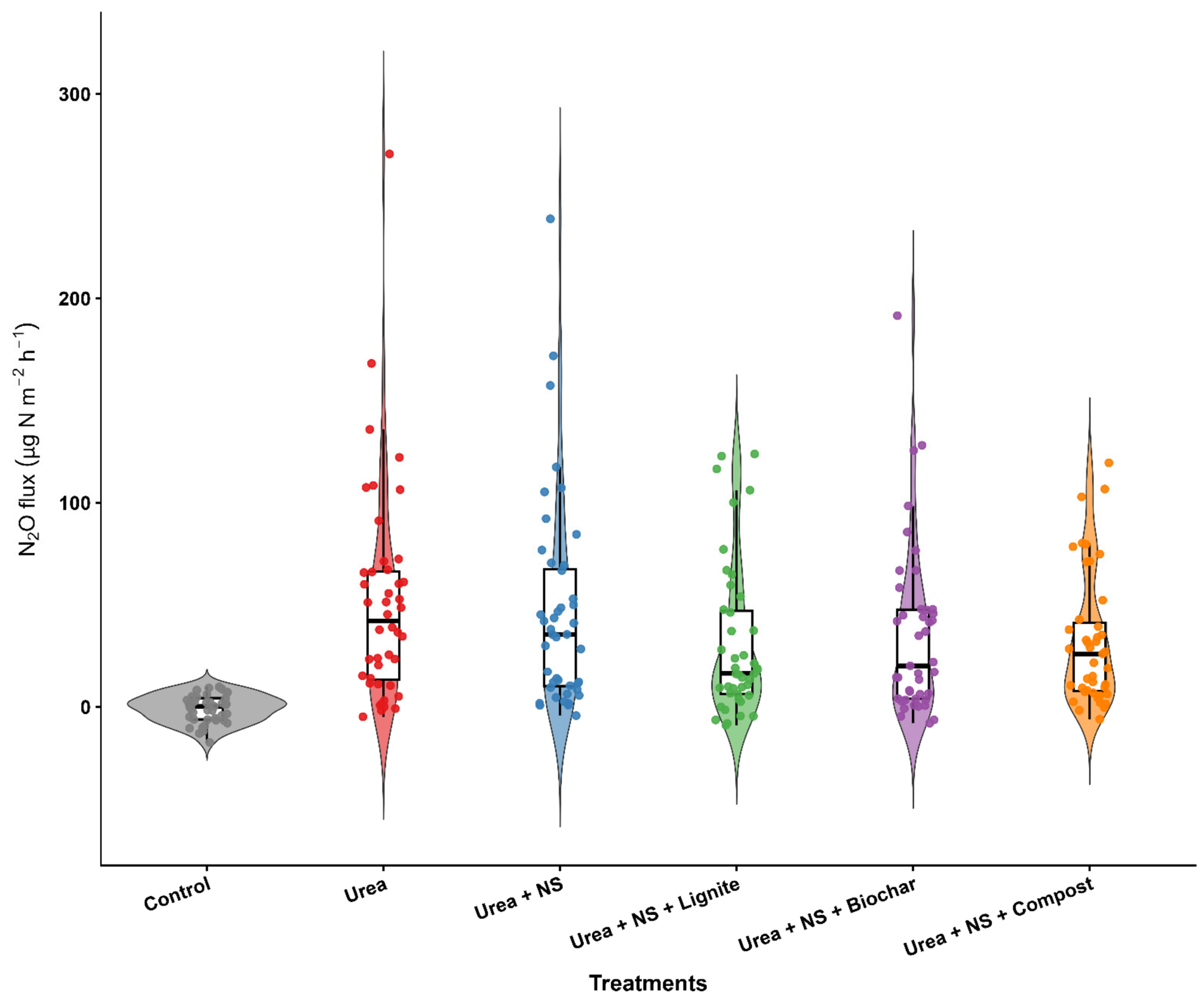
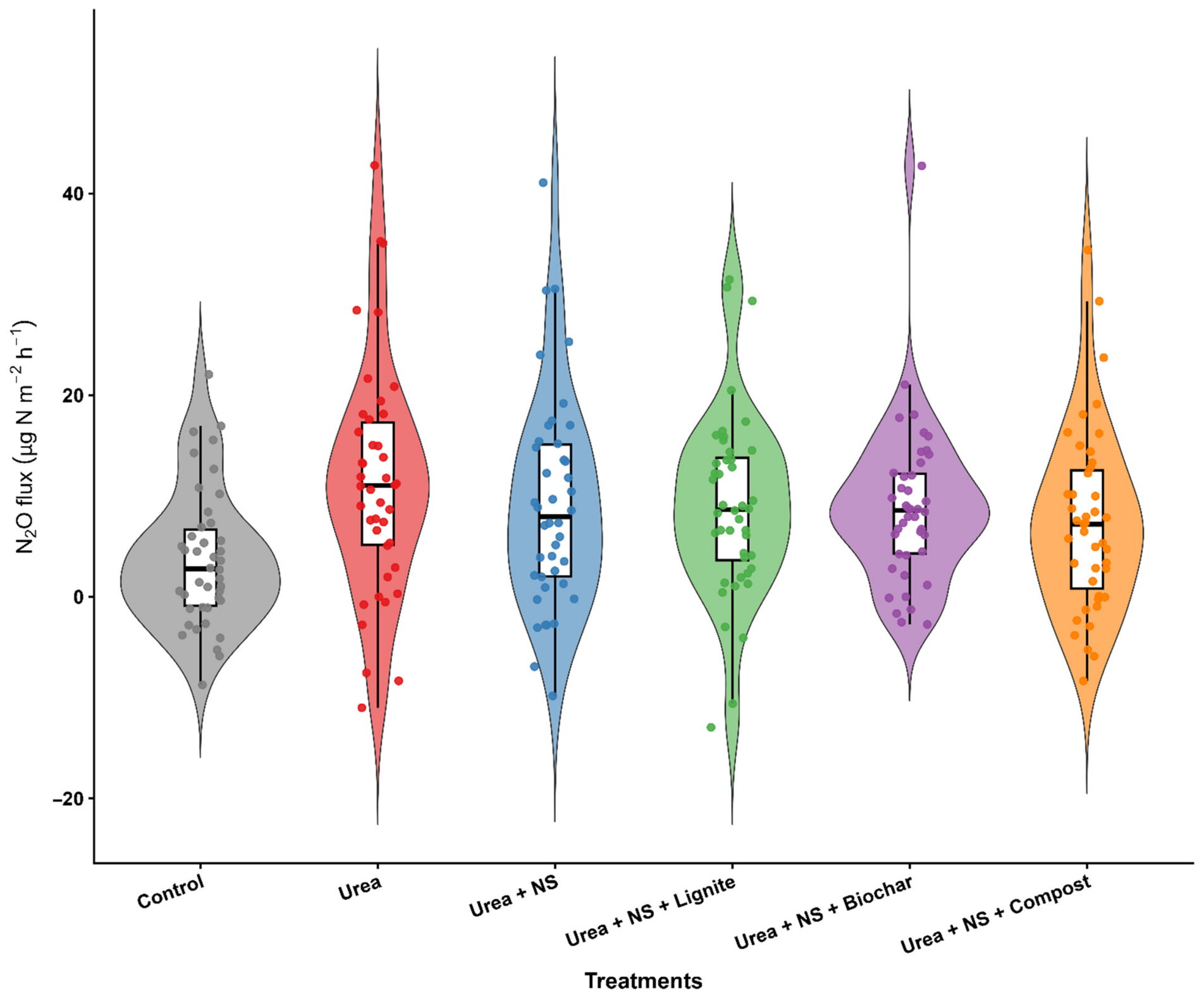
N2O flux value distribution measured in the whole study period were presented for both sandy loam and silt loam soils (Figure 1 and Figure 2). N2O emissions were significantly (p < 0.0001) lower in silt loam soil than in sandy loam soil. The use of uncoated urea in silt loam soil raised the N2O flux distribution (μg N m−2 h−1) greater than in the control. The range in uncoated urea increased and the peak flux increased to 42.79 μg N m−2 h−1 as compared to 16.37 μg N m−2 h−1 in the control, but the lowest flux was slightly lowered by −8.74 to −11.00 μg N m−2 h−1. The median flux was also increased by uncoated urea, indicating that the average emissions were high. The standard deviation (SD) as a measure of variability was high with application of uncoated urea (3.35–15.9 vs. 1.18–11.06 in the control), implying greater variability in emissions. Interestingly, the interquartile range (IQR) was slightly decreased which suggests that the gain in N2O flux was more likely a result of extreme higher values than a consistent increase in all measurements.
The effect of uncoated urea was much greater in the sandy loam soil. The range of N2O flux distribution (μg N m−2 h−1) was higher, and the maximum flux distribution rose to 270.70 μg N m−2 h−1 with uncoated urea; the minimum flux was observed to be slightly lower (−17.38 to −4.80). There was increase in median fluxes which ranged from −6.53 to 3.82 in the control to 0.84 to 122.28 μg N m−2 h−1 with uncoated urea, where the emission increased. The standard deviation and the interquartile range also increased ranging from 5.69 to 79.69 and 5.51 to 60.66, indicating that the high N2O fluxes were always higher in various measurements. This implies that sandy loam soil has greater and more erratic N2O emission than silt loam.
Uncoated urea applied to sandy loam soil showed a large flux of 4.80 to 270.70 μg N m−2 h−1, which signals a high level of variability over time and strong emission peaks. The median flux was between 0.84 and 122.28 μg N m−2 h−1 and the SD was between 5.69 and 79.69 with the interquartile range (IQR) between 5.51 and 60.66, indicating variation in the central tendency of the fluxes. Conversely, maximum flux of 238.97 μg N m−2 h−1 observed with NS-coated urea was slightly lower, but the median attained a slightly higher maximum value of 157.45 μg N m−2 h−1. Notably, SD (3.65 to 56.29) and IQR (5.13 to 4.40) were smaller in the case of uncoated urea, which implies that there was less variation with time and emissions were more stable (Figure 1).
In general, N2O flux distribution (μg N m−2 h−1) in silt loam soil was observed to be lower compared to sandy loam soil. Uncoated urea flux distribution ranged from −11.00 to 42.79 μg N m−2 h−1, with median value ranging from 3.70 to 28.69 μg N m−2 h−1, with median values of −7.94 to 21.64 μg N m−2 h−1. The SD was between 3.35 and 15.90 and IQR was between 2.75 and 9.02 which shows relatively stable and low magnitude of fluxes.
NS-coated urea flux distribution ranged from 41.08 μg N m−2 h−1 to −9.83 μg N m−2 h−1 with median flux of 0.85 to 17.02 μg N m−2 h−1. Initial data showed SD was less (1.99), but subsequent data displayed slightly higher variability (up to 18.22), and IQR between 2.27 and 14.24. This means that NS coating minimizes severe negative fluxes (reduced uptake of N2O) and has more consistent low–to–moderate N2O emissions, though with a slightly wider interquartile range at some periods.
NS-coated urea gave the most extensive N2O distribution fluxes across the coated treatments of the sandy loam soil with a range of −4.25 to 238.97 μg N m−2 h−1 and a median of 157.45 μg N m−2 h−1. Both SD (maximum 56.29) and IQR (maximum 54.40) were large, which shows high degree of variability with NS coating only. This variability was limited by addition of a second coating of lignite. The highest flux was reduced from 238.97 to 123.97 μg N m−2 h−1 and 157.45 to 116.63 μg N m−2 h−1 (48 and 26%, respectively). There was a decrease in variability, with SD from 56.29 to 15.72 (~72%) and IQR from 54.40 to 16.67 (~69%), showing a high attenuation of N2O emissions.
The second organic coating layer of biochar minimized N2O emissions compared to NS-coated urea only, but with less effectiveness. The maximum N2O flux distribution (μg N m−2 h−1) reduced to 191.61 μg N m−2 h−1 (20% reduction) and the upper median reduced to 98.53 μg N m−2 h−1 (37% reduction). The variability was, however, quite high with SD values as high as 66.23 and IQR as high as 48.92, almost equal to or higher than the values of SD and IQR under NS coating alone, and this indicates that biochar is not as efficient in stabilizing temporal flux variability in sandy loam.
Conversely, based on the magnitude and variability, NS + compost as a second coating layer decreased the magnitude and variability of the emissions more regularly. Peak fluxes decreased from 119.62 to 100.50 μg N m−2 h−1 compared with NS only coating, and upper median decreased from 102.95 to 100.50 μg N m−2 h−1. SD and IQR were also smaller (maximum SD = 20.26; IQR = 26.45), which corresponded to a similar decrease in SD and IQR by 64 and 51%, respectively, in comparison with NS-coated urea.
In silt loam soil, NS-coated urea exhibited a narrower N2O flux distribution (μg N m−2 h−1) compared to sandy loam soil, with values ranging from −9.83 to 41.08 μg N m−2 h−1 and median fluxes up to 17.02 μg N m−2 h−1. Variability was moderate with SD up to 18.22 and IQR up to 14.24.
NS + second organic layer coating of lignite led to a decrease in peak N2O flux distribution (μg N m−2 h−1) (Figure 2) with the maximum flux decreasing from 41.08 to 31.46 (23% reduction). At the same time, there was a slight decline in median values from 17.02 to 16.43 μg N m−2 h−1. The variability was minimized since the SD or IQR dropped to 15.04 and 13.09 respectively.
The use of NS + biochar as second organic layer coating shows an opposite effect on silt loam soil. The maximum fluxes were slightly higher than NS-coated urea only (42.74 vs. 41.08 μg N m−2 h−1) with the median fluxes reduced to 13.30 μg N m−2 h−1. SD and IQR values were similar to uncoated urea (SD = 18.33; IQR = 16.28), which indicates low efficiency of biochar (as second layer) in mitigating the maximum emission or the variability.
NS + compost as the second layer of organic coating on urea decreased the maximum fluxes from 41.08 to 34.40 μg N m−2 h−1 with a median of 16.20. SD and IQR values were close to NS-coated urea only (SD ≤ 15.14; IQR ≤ 15.36), which indicates NS + compost had a minimal effect on the N2O flux distribution (μg N m−2 h−1) in silt loam soil.
The nature of organic material employed as the second layer of coating had a greater impact on the magnitude and variability of N2O fluxes in the sandy loam soil. The overall mitigation effect was highest using NS + lignite-coated urea. The peak N2O flux distribution was lowered from 238.97 to 123.97 μg N m−2 h−1 (48%) and the upper median dropped from 157.45 to 116.63 μg N m−2 h−1 (26%). There was decreased variability with maximum SD declining from 56.29 to 15.72 and IQR from 54.40 to 16.67, suggesting a great deal of narrowing of the N2O flux distribution.
NS + biochar-coated urea led to a lower magnitude of emissions with less consistency. Even though the upper median dropped to 98.53 μg N m−2 h−1, the maximum N2O flux distribution was still high at 191.61 μg N m−2 h−1. The variability of the N2O flux distribution was not optimally reduced, and SD value increased to 66.23, with large IQR up to 48.92, suggesting limited effectiveness of NS + biochar in reducing either peak N2O flux distribution or variability in sandy loam soil.
There was an intermediate result obtained from NS + compost coated urea. The highest flux dropped to 119.62 μg N m−2 h−1, which was similar to NS + lignite, and the highest median dropped to 102.95 μg N m−2 h−1. There were less variability (SD and IQR of 20.26 and 26.45) compared to NS-coated urea only. This suggests that NS + compost was able to inhibit both the magnitude and dispersion of emissions but less than NS + lignite.
In general, the mitigation effect of sandy loam soil was in the order: NS + lignite > NS + compost > NS + biochar, especially in terms of reductions in variability (SD and IQR). In silt loam soil, the variability of NS + organic materials was less pronounced which indicated that flux distributions in this soil were generally narrower.

3.2. Effect of Urea Coatings on Temporal Dynamics of N2O Emission

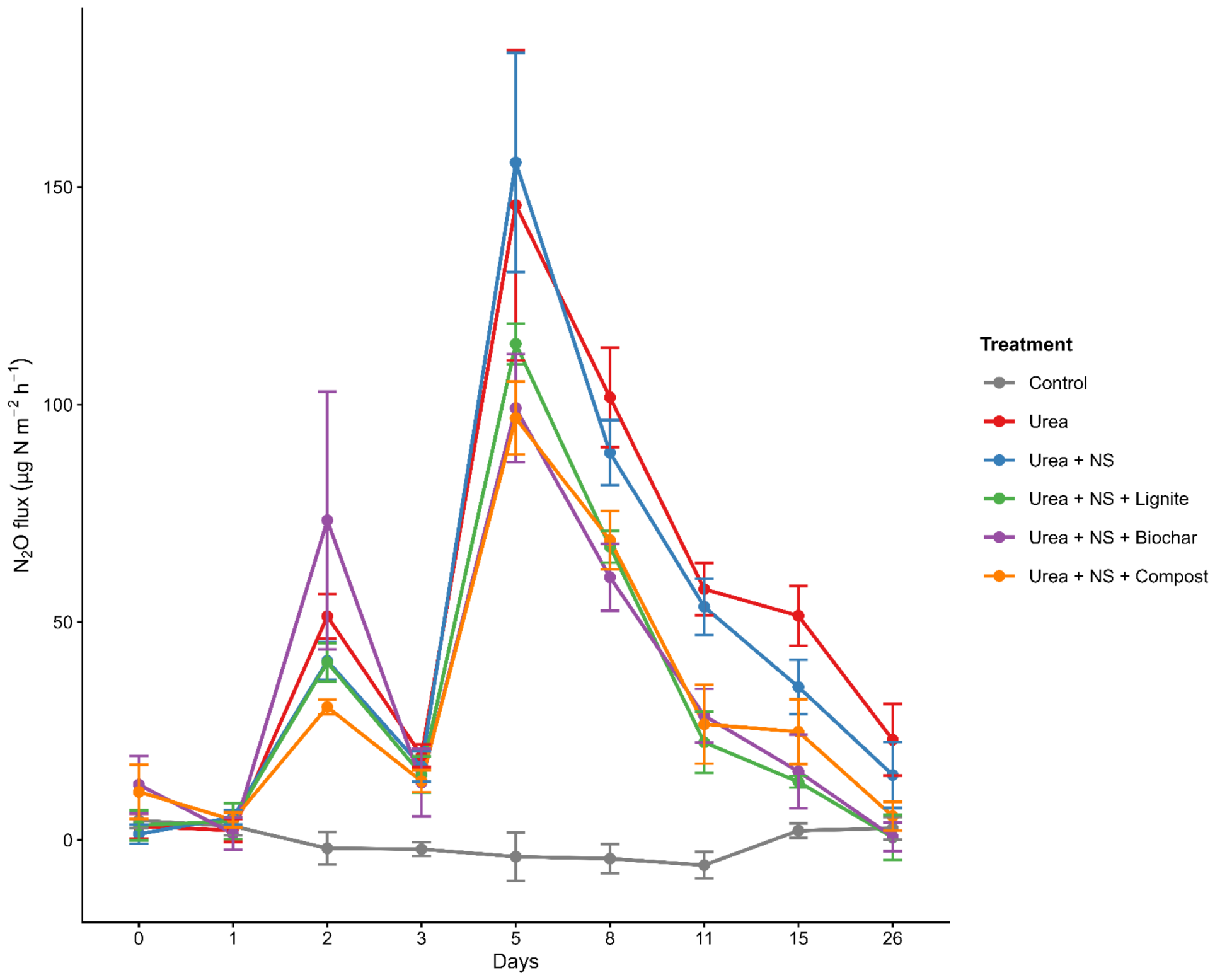
The temporal dynamics of N2O emissions (µg N m−2 h−1) in both sandy loam and silt loam soil had a similar time trend in all treatments. Minimum mean fluxes occurred on day 0–1 of fertilizer application, maximum fluxes occurred on day 5 and 8 for sandy loam and silty loam soils which steadily decreased towards the end of the incubation period (days 8–26).
In sandy loam soil, the initial day (day 1), the treatments produced the lowest level of N2O emissions without much differences (Figure 3). Average fluxes between 2.17 ± 2.62 µg N m−2 h−1 and 5.21 ± 1.63 µg N m−2 h−1 were obtained from uncoated urea and nano-sulfur-coated urea respectively. NS + either lignite or biochar or compost second layer coating of urea produced similar low fluxes (4.32 ± 4.13, 1.43 ± 3.66, and 4.60 ± 1.67 µg N m−2 h−1 respectively). Average flux from control was 3.17 ± 2.12 µg N m−2 h−1. The findings suggest that the N2O emission is negligible just after fertilization, regardless of the coating material. On day 5, all fertilized treatments attained their highest N2O emissions. Uncoated urea gave the highest average peak flux of 145.84 ± 35.64 µg N m−2 h−1, whereas nano-sulfur-coated urea showed the highest peak among all the treatments at 155.64 ± 25.17 µg N m−2 h−1. Treatments with NS + added organic coating materials, on the contrary, had lower maximum fluxes: 113.99 ± 4.67 µg N m−2 h−1 for NS + lignite coating, 99.22 ± 12.41 µg N m−2 h−1 for NS + biochar coating and 96.95 ± 8.38 µg N m−2 h−1 for NS + compost coating. The control treatment was not found to show a similar peak and was negative on day 5 (−3.83 ± 5.55 µg N m−2 h−1). The increased peak fluxes recorded from uncoated urea and nano-sulfur-coated urea relative to NS + lignite or NS + biochar or NS + compost coatings imply that the coating materials that included NS and second coating of organic materials controlled peak N2O emissions in the sandy loam soil.
After reaching maximum emission on day 5, average N2O flux emissions decreased in all treatments that were fertilized. Uncoated urea and nano-sulfur-coated urea continued to give high fluxes compared to the rest of the coated urea fertilizers in this declining stage. Average N2O fluxes were 101.71 ± 11.42 µg N m−2 h−1 for uncoated urea and 89.01 ± 7.44 µg N m−2 h−1 for NS-coated urea compared to 67.30 ± 3.67, 60.30 ± 7.66 and 68.80 ± 6.70 µg N m−2 h−1 for urea coated with NS and second layer either of lignite, biochar or compost respectively. By day 26, urea coated with NS + lignite and NS + biochar showed a near zero (0.60 ± 5.16 and 0.73 ± 3.28 µg N m−2 h−1) average flux emission. Uncoated urea however, had a higher average flux emission (22.99 ± 8.23 µg N m−2 h−1).
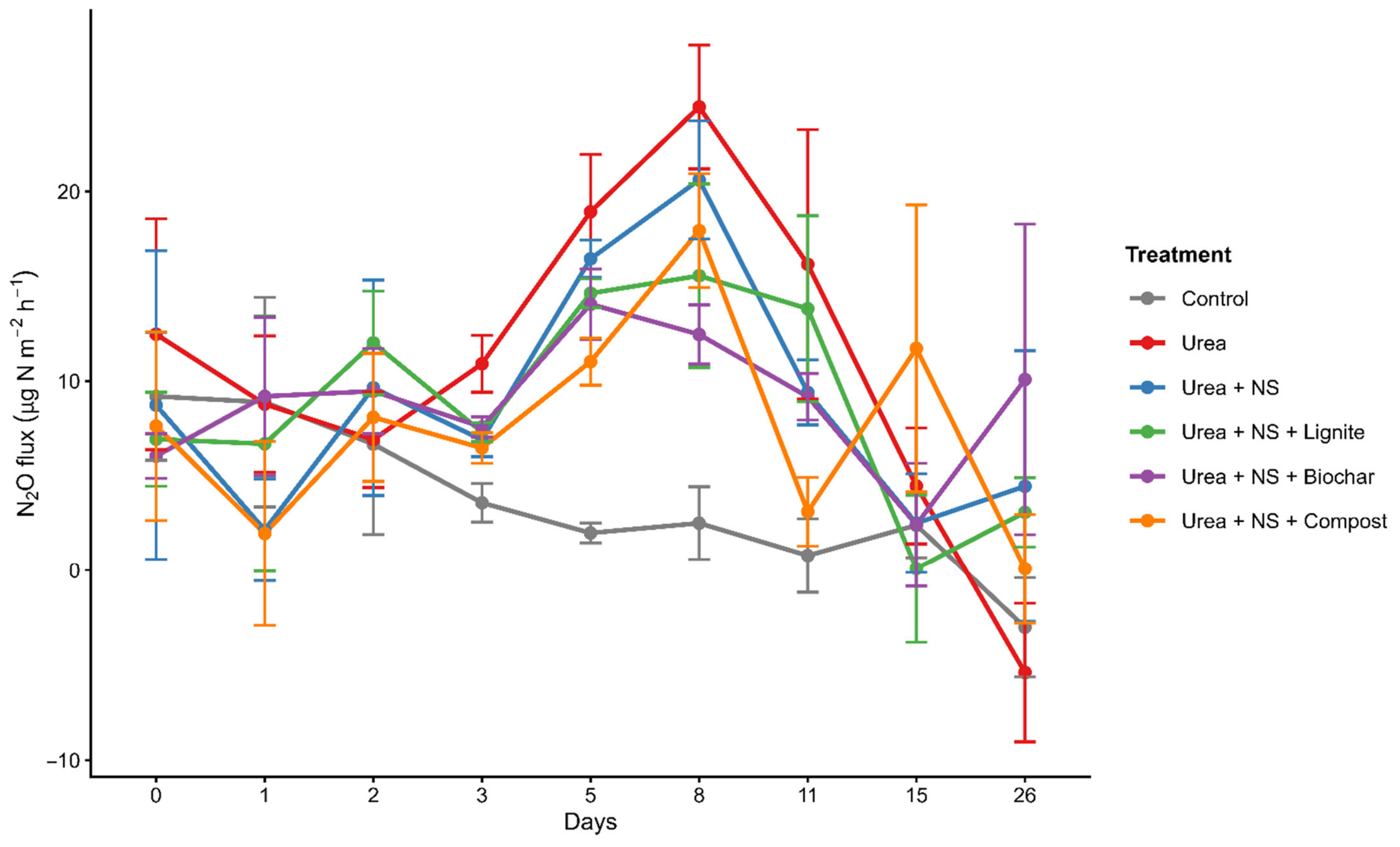
Similar to the sandy loam soil, day 1 resulted in the lowest emission in all treatments with reference to silt loam soil (Figure 4). The mean N2O fluxes were found to be 1.96 ± 4.86 µg N m−2 h−1 in case of NS + compost coating and 9.20 ± 4.17 µg N m−2 h−1 in the case of NS + biochar coating. There were also low fluxes in uncoated urea and nano-sulfur-coated urea (8.79 ± 3.60 and 2.15 ± 2.69 µg N m−2 h−1, respectively). These small values show that little N2O flux occurred immediately after fertilization in the silt loam soil.
Peak average N2O emissions in silt loam soil were found to be lower in magnitude and occurred later than in the sandy loam soil. The maximum N2O flux emission from uncoated urea was observed on day 8, and the average flux was 24.47 ± 3.26 µg N m−2 h−1. The peak values of NS-coated urea were 20.62 ± 3.11 µg N m−2 h−1 on day 8, whereas NS-coated urea with a second layer coating of either lignite, biochar or compost had the maximum range of 15.56 ± 4.84 to 17.94 ± 3.00 µg N m−2 h−1 on days 5–8. During the peak period, average N2O flux from the control remained low throughout, with fluxes ≤2.50 µg N m−2 h−1. The comparatively low variation between the fertilizers and similarity of standard errors indicate that fertilizers did not have much of an effect on the peak N2O emissions in the silt loam soil compared to in the sandy loam soil.
All the treatments recorded a slow decrease in N2O emissions after the peak period. Average fluxes of most of the coated fertilizer treatments were ≤2.50 µg N m−2 h−1 at day 15, with uncoated urea continuing to show an average N2O flux of 4.47 ± 3.06 µg N m−2 h−1. On the last sampling (day 26), the emissions were low and, in most cases, negative meaning that there was minimal continuous production of N2O irrespective of the type of coating. In general, the average N2O fluxes in the sandy loam soil were much greater, more variable and sharply peaked as compared to the silt loam soil.
In all coated treatments, the highest average N2O emission in sandy loam soil was 96.95 ± 8.38 to 155.64 ± 25.17 µg N m−2 h−1, but the highest rate of N2O emission in silt loam soil was only 15.56 ± 4.84 to 24.47 ± 3.27 µg N m−2 h−1. Therefore, the peak N2O emission from the sandy loam soil was about 4 to 10 times greater than that of the silt loam soil, depending on the type of coating. In the case of uncoated urea, the maximum average N2O flux from the sandy loam soil (145.84 ± 35.64 µg N m−2 h−1) was almost 6-fold higher than that of the silt loam soil (24.47 ± 3.26 µg N m−2 h−1). The same was also observed in NS-coated urea with maximum values of 155.64 ± 25.17 µg N m−2 h−1 in sandy loam soil and 20.62 ± 3.11 µg N m−2 h−1 in silt loam soil corresponding to about a 7.5-fold increase in the sandy loam soil. Even with the more effective NS + second layer coatings of either lignite, biochar or compost, the peak emissions in the sandy loam soil were still much higher. For example, NS + biochar-coated urea reached the highest value of 99.22 ± 12.41 µg N m−2 h−1 in sandy loam soil, whereas it was 17.94 ± 3.00 µg N m−2 h−1 in silt loam soil, which is about 5.5-fold.
The presence of quantitative differences between soils continued long after the peak period. In the decline phase, average N2O flux of the sandy loam soil took a longer period. On day 8, the mean fluxes of uncoated urea in sandy loam soil were 101.71 ± 11.42 µg N m−2 h−1 as compared to 20.24 ± 2.75 µg N m−2 h−1 in silt loam, a difference of five times. The emissions in the sandy loam soil (40.17 ± 10.77 µg N m−2 h−1) by day 15 were greater than that of the silt loam soil (4.47 ± 3.06 µg N m−2 h−1).
In the NS + second layer organic coatings of either lignite, biochar or compost, average N2O emissions in the silt loam soil decreased to an almost background level (≤2.50 µg N m−2 h−1) by day 15, with similar fluxes in the sandy loam soil also remaining in the same range (12.60 ± 6.88 to 25.49 ± 7.67 µg N m−2 h−1).
However, standard errors with N2O flux measurements were always larger in the sandy loam soil, especially at their maximum emission (e.g., SE = 35.64 µg N m−2 h−1 with uncoated urea), than with the silt loam soil (SE = 3.26 µg N m−2 h−1 when using the same treatment). The lower SE values of the silt loam soil indicate more stable environments and less spatial or temporal differences in N2O flux emission.

3.3. Effect of Urea Coatings on Cumulative N2O Emission

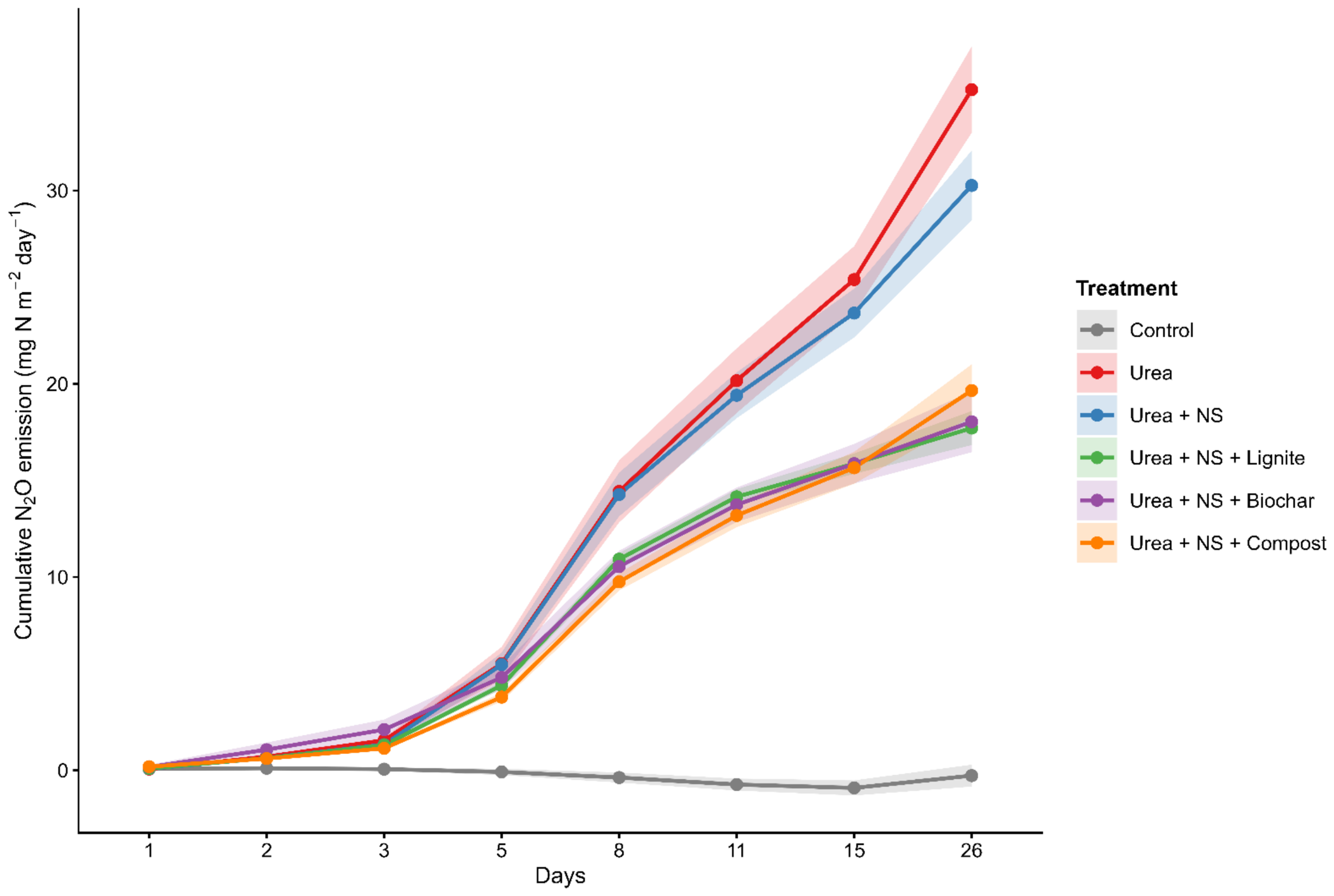
Cumulative N2O emission in sandy loam soil increased rapidly with the application of urea fertilizer and showed evident temporal dynamics (Figure 5). The control treatment was maintained relatively low but decreased slightly in the initial days to −0.28 ± 0.56 mg N m−2 on day 26, which is an indication of minimal net emissions.
Conversely, the cumulative N2O emission of the uncoated urea showed steep and continuous rising increase, starting at 0.06 ± 0.04 mg N m−2 on day 1, reaching 5.52 ± 0.86 mg N m−2 on day 5 and sustained emission reaching 14.43 ± 1.60 mg N m−2 on day 8, 25.40 ± 1.72 mg N m−2 on day 15 and 35.22 ± 2.23 mg N m−2 on day 26.
Meanwhile, a significant difference (p < 0.05) (Table 2) was observed between the control and all coated urea fertilizers, and it revealed that urea fertilization, even in coated form, rises cumulative N2O emissions when compared to unfertilized sandy loam soil.
Nano-sulfur-coated urea had a slight effect on reducing the cumulative N2O emission rate. Emission was 0.08 ± 0.03 mg N m−2 on day 1, and 5.47 ± 0.62 mg N m−2 on day 5, comparable to uncoated urea at the early phase, but differed later, with peaks of 19.41 ± 1.18 mg N m−2 on day 15 and 30.27 ± 1.80 mg N m−2 on day 26, which indicated a moderate mitigation effect exhibited at the later emission time. The second organic layer coating greatly changed the pattern of emission over time. NS + lignite coating of urea decreased early and mid-stage accumulation, with cumulative flux of 4.40 ± 0.19 mg N m−2 on day 5, 10.92 ± 0.31 mg N m−2 on day 8, and 17.71 ± 0.88 mg N m−2 by day 26 which are huge inhibitions of accumulation on the peak period between day 5 and day 15. A comparable pattern was observed with NS + biochar urea coating, which peaked at 4.80 ± 0.63 mg N m−2 on day 5, 10.55 ± 0.82 mg N m−2 on day 8, and 18.04 ± 1.58 mg N m−2 on day 26 with a high reduction in mid-experiment emissions. The NS + compost urea coating also accumulated a little more N2O, 3.79 ± 0.23 mg N m−2 on day 5, 9.75 ± 0.45 mg N m−2 on day 8 and 19.65 ± 1.35 mg N m−2 on day 26, although it remained very low compared to NS + urea coating alone, but with no significant difference (p > 0.05). In general, NS + lignite and NS + biochar showed the greatest effect in reducing cumulative N2O over time, whereas NS + compost was moderately and consistently effective at mitigation though without significant difference (p > 0.05) between the coated treatments but with notable % decreases compared to the uncoated urea with Urea + NS + Lignite giving the highest reduction (49.72%) (Table 2).
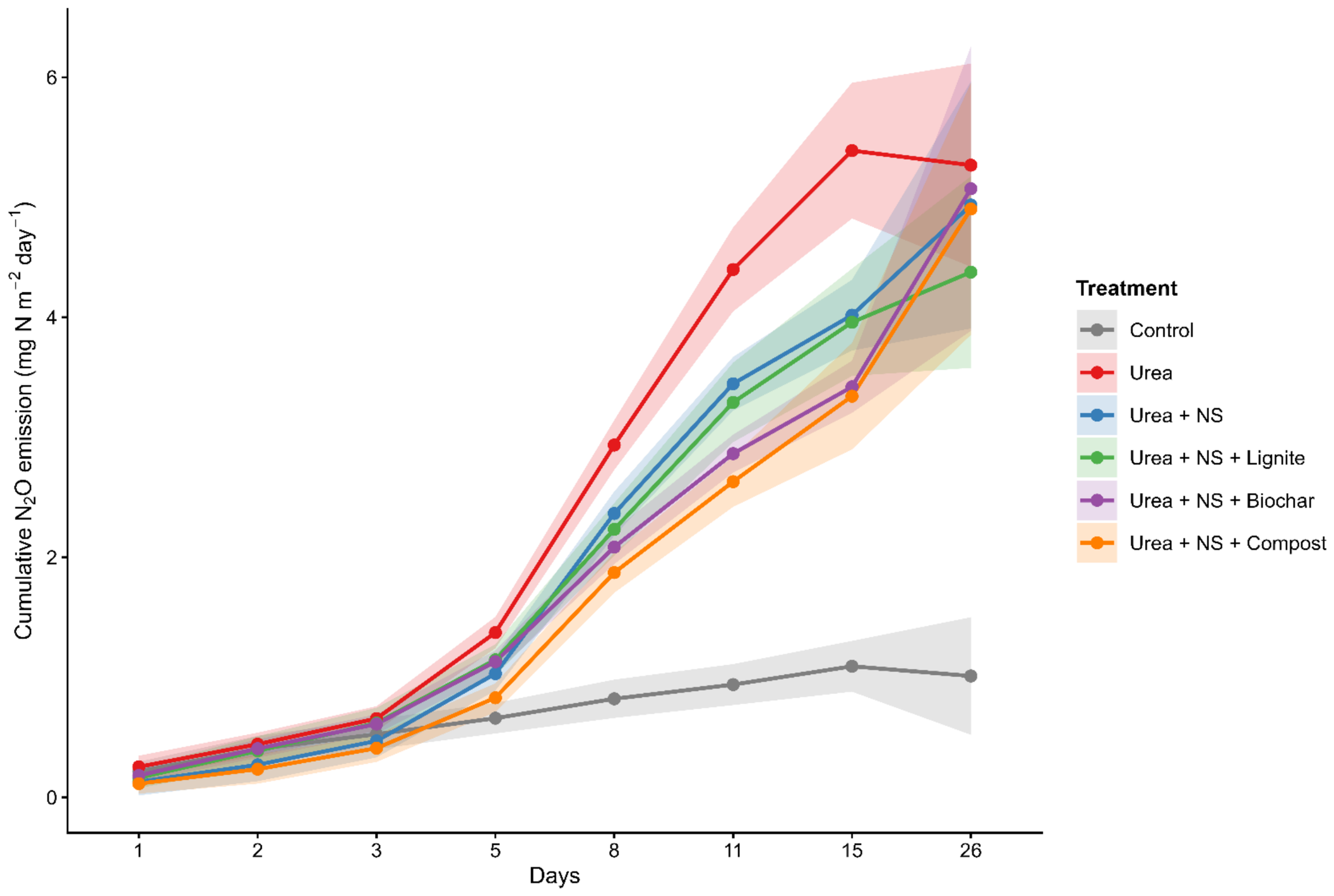
N2O emission in silt loam soil were very low and the cumulative emissions were slow compared to the sandy loam soil (Figure 6). Slow accumulation was observed in the control treatment as indicated by the 0.22 ± 0.08 mg N m−2 on day 1, 0.66 ± 0.13 mg N m−2 on day 5 and 1.01 ± 0.49 mg N m−2 on day 26, showing very low baseline emissions. Uncoated urea caused a steady increase in cumulative N2O as the concentration rose to 0.26 ± 0.09 mg N m−2 on day 1, then 1.37 ± 0.13 on day 5, then 5.27 ± 0.85 mg N m−2 on day 26. In contrast to sandy loam soil, the emissions were not high with a sudden peak at the beginning, indicating a slower transformation of nitrogen in silt loam soil.
NS coating was found to have limited effect on the rate of cumulative N2O rise compared to uncoated urea. The emissions were 0.13 ± 0.11 mg N m−2 on day 1 and then continued to rise steadily to 1.03 ± 0.14 mg N m−2 on day 5 and 3.45 ± 0.22 mg N m−2 on day 26 with only a moderate mitigation of uncoated urea.
The addition of second-layer coatings produced small temporal differences. In silt loam soil the NS + organic coating caused little reductions in the N2O emissions relative to the uncoated urea; there were no significant differences (p > 0.05) between the treatments but relative reduction in N2O emissions were observed to be comparable to uncoated urea with Urea + NS + Lignite giving the highest reduction (16.93%) (Table 3).
NS + lignite urea coating showed the least cumulative N2O at each point in the experiment, starting at 0.16 ± 0.09 mg N m−2 on day 1 and then reaching 1.15 ± 0.13 mg N m−2 on day 5, 3.29 ± 0.33 mg N m−2 on day 11, and 4.38 ± 0.80 mg N m−2 on day 26, which implies a slightly slower accumulation over the duration of the study. The initial pattern in NS + biochar urea coating was the same, with a slight increase later, reaching 5.07 ± 1.18 mg N m−2 at day 26, which was very close to NS alone.
The cumulative flux trend in the two soils is given below from high to low:
Sandy loam: Uncoated Urea > NS > NS + Compost > NS + Biochar > NS + Lignite > Control.
Silt loam: Uncoated Urea > NS > NS + Biochar > NS + Compost > NS + Lignite > Control.

4. Discussion and Conclusions

This study demonstrated that strategies of coating urea with nano-sulfur (NS) and carbon-based materials were promising but are dependent on soil type. In this present study, the observed differences in N2O emissions between soil types may be likely explained by the theoretical knowledge of contrasting effects of soil texture on water-filled pore space (WFPS), gas diffusion, and microbial processes. It is plausible that sandy loam soil, owing to its high porosity and low water retention, promotes rapid moisture fluctuations and alternating aerobic–anaerobic microsites. These conditions could favor both nitrification and denitrification which are two key processes leading to N2O formation. This might explain the substantially higher cumulative N2O emissions observed in sandy loam soil compared to silt loam soil. For example, cumulative emission was 3 to 6 times higher on the 26th day from sandy loam soil treatments than from silt loam soil, with peaks observed for the Urea + NS treatment reaching approximately 30.27 mg N m−2 and 4.94 mg N m−2, respectively. The effect of soil texture appears to be one of the key factors contributing to this difference. The rate of nitrification and denitrification may depend on soil texture, as texture influences the extent of aeration and water retention [45]. Due to their high porosity and low water retention, sandy loam soils may likely allow more gas diffusion, and soil moisture conditions may change rapidly. In many studies on N2O emissions, moisture conditions are standardized to 60% of water-holding capacity (WHC). In the present experiment with sandy loam texture, moisture levels corresponding to soil plasticity (Arany-type binding specification) and 60% WHC were found to be equivalent. However, for soil samples with a lower sand content, adjusting moisture based on the binding constant may have introduced excess water into the system. Such conditions could have contributed to pore saturation and soil compaction, potentially leading to the observed reduction in N2O emissions. These conditions, particularly following wetting–drying cycles, might result in short-term hot moments that enhance N2O production [46]. Conversely, less porous and more water-retentive silt loam soils may exhibit more stable moisture regimes, which could enhance N2O production while reducing its diffusion, potentially trapping more N2O within the soil profile [47,48,49] and thereby decreasing the size and frequency of N2O emission peaks [46,50]. This interpretation is consistent with reports that denitrifying microbes capable of reducing N2O to N2 are likely present in silt soils when low-oxygen conditions exist [51,52,53], possibly mitigating N2O emissions. The differences between the emissions may likely be related to known variations in the nature of WFPS in the two soils. Possible wide variations in WFPS in sandy soils might provide alternating aerobic and anaerobic microsites that can promote both nitrification and denitrification, as two important processes for N2O formation [54]. The increased and more stable WFPS nature of clay soils may promote denitrification, but on the other hand gas diffusion may be reduced, leading to possible reduced N2O emissions or favoring their subsequent reduction to N2 [50,54,55]. This process may potentially explain the slow accumulation and partial rise in emissions observed in silt loam in this experiment.
The availability and retention of nitrogen seem to be another key factor. Low cation exchange capacity (CEC) and organic matter content may be a factor in sandy soil resulting in higher emissions. The experimental sandy loam soil was characterized (Table 1) as having low CEC and organic matter, which could lead to reduced nutrient retention, and could increase N2O losses as well as other gaseous losses [50,56]. The silt loam soil used in this experiment were characterized with higher CEC and organic matter content, indicating that these soil properties could also significantly affect N2O emissions. This interpretation is supported by the findings of [57,58], who reported that fine-textured soils such as silt loam also promote microbial biomass nitrogen accumulation, a potential driver of nitrogen immobilization.
All coated urea formulations led to a lower N2O accumulation rate and amount compared to uncoated urea in the experiment, indicating that a controlled nitrogen release from these formulations could slow down the fast N release dynamics of nitrification and denitrification. Studies have previously shown that coated urea fertilizer may decrease N2O emissions by about 35%. For instance, the use of polymer-coated urea reduced N2O emission by up to 35% [59] which could be important for various soil types as it slows nitrogen release. Similarly, in another study, Ref. [60] reported that the cumulative N2O emission could be reduced by 36% by using coated calcium nitrate, suggesting its potential application for nitrogen management in agriculture. The present findings are in line with this and indicate that the mitigation effect might be very sensitive to the kind of organic coating material as well as to the type of soil texture.
Among the tested coatings, NS + lignite appeared to be the most effective at mitigating N2O emissions. The cumulative N2O emission with NS + Lignite-coated urea was 17.71 mg by Day 26, while NS-coated urea alone was 30.27 mg, which resulted in about a 41% reduction in the cumulative emission of N2O from the soil. Likewise, the highest N2O flux was lowered by about 48%, and the variability of emissions (SD and IQR) lowered by more than 65–70%, indicating a stabilization of the emission processes. These findings are in line with previous studies that showed lignite- and humic-based coatings can increase ammonium adsorption [61], decrease nitrate availability [62], and inhibit denitrification [63] which might result in decreased N2O emissions. NS + biochar coating was also effective for reducing cumulative emissions but was slightly less effective than NS + lignite. In sandy loam soil, cumulative N2O was decreased from 30.27 mg (NS coating) to 18.04 mg, which is about 40%. This is consistent with the reports on the ability of biochar to lower N2O emission, which may be attributed to its CEC characteristics that are potential for adsorption of ammonium and nitrate [64,65,66]. The adsorption of these nitrogen forms may help to limit their leaching and decrease their availability for microbial processes that produce N2O. In this study, however, NS + biochar did not produce the same effect as NS + lignite in reducing emission variability, indicating that although the biochar amendment reduced the overall magnitude of emissions, it may not have been as effective in suppressing episodic emission peaks. This finding is consistent with previous studies reporting that biochar combined with nitrogen fertilizer reduced N2O emissions by 33.3% in acidic vegetable soils [67], and by 20.2% and 25.5% in agricultural and forest soils, respectively [68]. Similarly, Ref. [69] found that biochar combined with ammonium nitrogen fertilizer reduced N2O emission by 31.0–30.8%, while combined with nitrate nitrogen fertilizer, it reduced N2O emission by 63.0–70.6%. Importantly, the effectiveness of this approach is likely to be influenced by soil texture, as demonstrated in this study, where average N2O fluxes in sandy loam soil were significantly higher, more variable, and more extreme than those observed in silt loam soil.
NS + compost urea coating provided moderate but consistent mitigation effects. In sandy loam soil, cumulative N2O emissions were reduced from 30.27 mg (NS coating only) to 19.65 mg, representing a 35% reduction. Although this decrease was slightly lower than those achieved with NS + lignite and NS + biochar, NS + compost had the additional benefit of reducing N2O emission peaks and producing comparatively stable emission patterns over time, as evidenced by moderate reductions in SD and IQR. This finding is consistent with previous studies which, although not involving the direct coating of nitrogenous fertilizer, reported that compost amendments contributed to more stable N2O emission dynamics. Reference [70] reported that a 7-year compost application in an orchard reduced cumulative N2O emissions by half compared to non-composted soil.
Lignite and biochar resulted in approximately a 40–41% reduction in cumulative N2O, and compost resulted in approximately 35% reduction in cumulative N2O from sandy loam soil with significant differences (p < 0.05) for all treatments when compared with the control. By contrast, silt loam soil exhibited slow and gradual accumulation of N2O with smaller differences across treatments; coatings decreased emissions by 0–11%, with no significant differences (p > 0.05). The lower sensitivity of silt loam soils to organic coatings suggests that physical properties such as soil texture may play a significant role in controlling N2O dynamics in finer textured soils. Moreover, the increased moisture levels in silt loam may contribute to mineralization of outer organic coatings, and thereby diminish their long-term effectiveness [71]. By Day 26, the NS + compost and NS + biochar treatment reduced N2O by about 1–3% compared to NS alone, whereas the NS + lignite treatment reduced N2O by about 11%. These small differences suggest that physical conditions of silt loam soils could potentially limit nitrogen transformation and N2O production. However, NS + lignite was the most efficient coating with silt loam soil, indicating that the slow release of N and adsorption may also play a role in emission reductions, but to a lesser extent.
It is important to note that the extent of mitigation was higher in sandy loam texture, indicating that coated fertilizers may have greater mitigation potential in coarse-textured soils. The relatively lower sensitivity of silt loam soil to organic coatings suggests that soil texture may strongly dictate N2O dynamics in finer-textured soils.
In conclusion, the coating of urea with NS or carbon-based substances is a promising solution to address the issue of N2O emissions by controlling the release of nitrogen, trapping more nitrogen by microorganisms, and providing less favorable conditions to the formation of N2O in the soil. Nevertheless, the results highlight the paramount nature of soil texture in the formulation and application of management strategies that will help to reduce agricultural N2O emissions.
A primary limitation of the present study is that the independent effects of organic coatings on nitrous oxide (N2O) emissions were not investigated. Consequently, it is not possible to determine whether the observed variations in N2O emission patterns are attributable solely to the organic coatings or if they result from interactions between the coatings and other experimental variables.
Furthermore, the characterization of the synthesized nano-sulfur (NS) and the physicochemical analysis of the coating materials fall outside the scope of this paper. These data are currently undergoing separate evaluations and are being prepared for independent publication. The absence of these parameters in this report complicates the establishment of correlations between the functional performance of the NS and its physicochemical properties, such as particle uniformity, agglomeration behavior, and surface morphology.
Ultimately, the lack of these data hinders the interpretation of the experimental results regarding the potential influence of material-specific properties.

Author Contributions

Conceptualization, M.G., J.B. and N.B.; methodology, J.B., M.G., N.B., A.M.Z. and C.T.; writing—original draft preparation, A.M.Z., J.B., M.G., M.Z. and C.T.; writing—review and editing, J.B., M.G., N.B., A.M.Z. and M.Z.; visualization, A.M.Z., J.B. and M.G.; supervision, M.G., J.B. and N.B.; funding acquisition, M.G. and J.B. All authors have read and agreed to the published version of the manuscript.

Funding

We acknowledged the support by the Flagship Research Groups Program 2024 and the Research Excellence Program 2025 of the Hungarian University of Agriculture and Life Sciences.

Data Availability Statement

The data presented in this study is available on request from the corresponding author.

Acknowledgments

We thank the Hungarian University of Agriculture and Life Sciences and Tempus Public Foundation by the Hungarian Government for providing the facilities and services needed.

Conflicts of Interest

The authors declare no conflicts of interest.

References

  1. Luo, X.Q.; Wang, S.J.; Liu, X.M. Nitrogen source and its uptake by plants in terrestrial ecosystems. Chin. J. Ecol. 2007, 26, 1094–1100. [Google Scholar]
  2. Pruthviraj, N.; Murali, K.; Chaitanya, A.; Harish, M.C.; Karthik, A.N. Exploring the Dynamics of Nitrogen from Conventional Manures in the Soil Plant Atmosphere Continuum: A Comprehensive Review. Commun. Soil Sci. Plant Anal. 2024, 55, 1690–1701. [Google Scholar] [CrossRef]
  3. Nabuurs, G.-J.; Aoki, L.; Humpenöder, F.; Boone Kauffman, J.; Ayala-Niño, F.; Emmet-Booth, J.P.; Mrabet, R.; Abu Hatab, A.; Bustamante, M.; Clark, H.; et al. Agriculture, Forestry and Other Land Uses (Chapter 7). In Climate Change 2022—Mitigation of Climate Change; Cambridge University Press: Cambridge, UK, 2022; pp. 747–860. [Google Scholar] [CrossRef]
  4. Jia, G.; Shevliakova, E.; Artaxo, P.; De Noblet-Ducoudré, N.; Houghton, R.; House, J.; Kitajima, K.; Lennard, C.; Popp, A.; Sirin, A.; et al. Land-Climate Interactions; Cambridge University Press: Cambridge, UK, 2019; pp. 131–247. [Google Scholar]
  5. Tian, H.; Xu, R.; Canadell, J.G.; Thompson, R.L.; Winiwarter, W.; Suntharalingam, P.; Davidson, E.A.; Ciais, P.; Jackson, R.B.; Janssens-Maenhout, G.; et al. A Comprehensive Quantification of Global Nitrous Oxide Sources and Sinks. Nature 2020, 586, 248–256. [Google Scholar] [CrossRef] [PubMed]
  6. Glibert, P.M.; Harrison, J.; Heil, C.; Seitzinger, S. Escalating Worldwide Use of Urea—A Global Change Contributing to Coastal Eutrophication. Biogeochemistry 2006, 77, 441–463. [Google Scholar] [CrossRef]
  7. Kubota, H.; Iqbal, M.; Quideau, S.; Dyck, M.; Spaner, D. Agronomic and Physiological Aspects of Nitrogen Use Efficiency in Conventional and Organic Cereal-Based Production Systems. Renew. Agric. Food Syst. 2018, 33, 443–466. [Google Scholar] [CrossRef]
  8. Mazzetto, A.M.; Styles, D.; Gibbons, J.; Arndt, C.; Misselbrook, T.; Chadwick, D. Region-Specific Emission Factors for Brazil Increase the Estimate of Nitrous Oxide Emissions from Nitrogen Fertiliser Application by 21%. Atmos. Environ. 2020, 230, 117506. [Google Scholar] [CrossRef]
  9. Dattamudi, S.; Wang, J.J.; Dodla, S.K.; Viator, H.P.; DeLaune, R.; Hiscox, A.; Darapuneni, M.; Jeong, C.; Colyer, P. Greenhouse Gas Emissions as Influenced by Nitrogen Fertilization and Harvest Residue Management in Sugarcane Production. Agrosyst. Geosci. Environ. 2019, 2, 1–10. [Google Scholar] [CrossRef]
  10. Lebender, U.; Senbayram, M.; Lammel, J.; Kuhlmann, H. Effect of Mineral Nitrogen Fertilizer Forms on N2O Emissions from Arable Soils in Winter Wheat Production. J. Plant Nutr. Soil Sci. 2014, 177, 722–732. [Google Scholar] [CrossRef]
  11. Rana, M.A.; Mahmood, R.; Ali, S. Soil Urease Inhibition by Various Plant Extracts. PLoS ONE 2021, 16, e0258568. [Google Scholar] [CrossRef]
  12. Faraz, A.; Imran, A.; Raza, H.; Iqbal, M.; Rehman, A. Sulfur Nanoparticle-Coated Urea Improves Growth and Nitrogen Use Efficiency in Wheat (Triticum aestivum L.) and Rice (Oryza sativa L.). Front. Nanotechnol. 2025, 7, 1565608. [Google Scholar] [CrossRef]
  13. Avila-Quezada, G.D.; Ingle, A.P.; Golińska, P.; Rai, M. Strategic Applications of Nano-Fertilizers for Sustainable Agriculture: Benefits and Bottlenecks. Nanotechnol. Rev. 2022, 11, 2123–2140. [Google Scholar] [CrossRef]
  14. Aulakh, M.S.; Malhi, S.S. Interactions of Nitrogen with Other Nutrients and Water: Effect on Crop Yield and Quality, Nutrient Use Efficiency, Carbon Sequestration, and Environmental Pollution. Adv. Agron. 2005, 86, 341–409. [Google Scholar] [CrossRef]
  15. Wang, H.; Wu, J.; Li, G.; Yuan, J. Influence of Nitrogen Addition Levels on N2O Flux and Yield of Spring Wheat in the Loess Plateau. Agronomy 2025, 15, 1377. [Google Scholar] [CrossRef]
  16. Ma, Q.; Qian, Y.; Yu, Q.; Cao, Y.; Tao, R.; Zhu, M.; Ding, J.; Li, C.; Guo, W.; Zhu, X. Controlled-Release Nitrogen Fertilizer Application Mitigated N Losses and Modified Microbial Community While Improving Wheat Yield and N Use Efficiency. Agric. Ecosyst. Environ. 2023, 349, 108445. [Google Scholar] [CrossRef]
  17. Yang, M.; Dong, C.; Shi, Y. Nano Fertilizer Synergist Effects on Nitrogen Utilization and Related Gene Expression in Wheat. BMC Plant Biol. 2023, 23, 26. [Google Scholar] [CrossRef] [PubMed]
  18. Liu, X.; Liao, J.; Song, H.; Yang, Y.; Guan, C.; Zhang, Z. A Biochar-Based Route for Environmentally Friendly Controlled Release of Nitrogen: Urea-Loaded Biochar and Bentonite Composite. Sci. Rep. 2019, 9, 9548. [Google Scholar] [CrossRef] [PubMed]
  19. Kumar, Y.; Tiwari, K.N.; Singh, T.; Raliya, R. Indian Farmers Fertilizer Cooperative Limited, 8 Gokhale Marg. Gujarat Ann. Plant Soil Res. 2021, 23, 238–255. [Google Scholar] [CrossRef]
  20. Nandini, B.; Nagaraja, G.; Jogigowda, S.C. Multifunctional Nanofertilizer for Inducing Systemic Resistance in Plants In Nanofertilizer Synthesis: Methods and Types; Elsevier: Amsterdam, The Netherlands, 2024; pp. 281–303. [Google Scholar] [CrossRef]
  21. Haydar, M.S.; Ghosh, D.; Roy, S. Slow and Controlled Release Nanofertilizers as an Efficient Tool for Sustainable Agriculture: Recent Understanding and Concerns. Plant Nano Biol. 2024, 7, 100058. [Google Scholar] [CrossRef]
  22. Abhiram, G. Contributions of Nano-Nitrogen Fertilizers to Sustainable Development Goals: A Comprehensive Review. Nitrogen 2023, 4, 397–415. [Google Scholar] [CrossRef]
  23. Su, T.; An, Z.; Greer, K.; Bremer, E.; Chang, S.X. Wheat Straw Biochar-, Recovered Carbon Black- and Activated Carbon-Coated Urea Have Divergent Effects on Soil N2O Emissions. J. Soils Sediments 2025, 25, 2184–2194. [Google Scholar] [CrossRef]
  24. Liu, X.; Nadeem, M.; Rui, Y. Effects of Nanofertilizers on the Mechanism of Photosynthetic Efficiency in Plants: A Review. Phyton-Int. J. Exp. Bot. 2024, 93, 3197–3216. [Google Scholar] [CrossRef]
  25. Giordano, M.; Raven, J.A. Nitrogen and Sulfur Assimilation in Plants and Algae. Aquat. Bot. 2014, 118, 45–61. [Google Scholar] [CrossRef]
  26. Narayan, O.P.; Kumar, P.; Yadav, B.; Dua, M.; Johri, A.K. Sulfur Nutrition and Its Role in Plant Growth and Development. Plant Signal. Behav. 2023, 18, 2030082. [Google Scholar] [CrossRef] [PubMed]
  27. Ardali, T.R.; Soleimanpour, L.; Ma’mani, L.; Chorom, M. Opportunities and Future Perspective of Nanofertilizers and Controlled Release Nanofertilizers in Agriculture. J. Water Environ. Nanotechnol. 2024, 9, 223–247. [Google Scholar] [CrossRef]
  28. Abd El-Aziz, M.A.; Abd Elghany, S.H.; Elbagory, M.; El-Gamal, B.A.; AbdEl-Khalek, A.A.; AbdEL-Azeem, S.M.; Omara, A.E.D.; Khalifa, T.H. Enhancing Soil Health and Crop Performance Under Saline-Sodic Calcareous Soil: A Comparative Study of Nano-Sulfur and Mineral Sulfur Combined with Compost Application. Agronomy 2025, 15, 510. [Google Scholar] [CrossRef]
  29. Bustamante, M.A.; Paredes, C.; Orden, L.; Pérez-Murcia, M.D.; Andreu-Rodríguez, F.J.; Martínez-Sabater, E.; Pérez-Espinosa, A.; Sáez, J.A.; Moral, R. Uses of Compost. In Composting: Fundamentals and Recent Advances; Royal Society of Chemistry: Cambridge, UK, 2025; pp. 246–291. [Google Scholar] [CrossRef]
  30. Maffia, A.; Marra, F.; Celano, G.; Oliva, M.; Mallamaci, C.; Hussain, M.I.; Muscolo, A. Exploring the Potential and Obstacles of Agro-Industrial Waste-Based Fertilizers. Land 2024, 13, 1166. [Google Scholar] [CrossRef]
  31. Pan, X.; Ge, L.J.; Li, Q.J.; Li, L.Q.; Zhou, L.; Deng, T.F.; Yang, L.S.; Yan, Y.F.; Yang, X.S. Effects of Additives on Nitrogen Loss and Bacterial Community During the Co-Composting of Rosa Roxburghii Tratt Fruit Pomace and Spent Mushroom Substrate. Waste Biomass Valorization 2025, 17, 1057–1066. [Google Scholar] [CrossRef]
  32. Sahu, B.K.; Swami, K.; Kapoor, N.; Agrawal, A.; Kataria, S.; Sharma, P.; Kundu, P.; Thangavel, H.; Vattakkuniyil, A.; Chaurasia, O.P.; et al. Soil-Mimetic Eco-Friendly Fertilizer Gates: Nanoclay-Reinforced Binary Carbohydrates for Improving Crop Efficiency. Environ. Sci. Nano 2024, 11, 3006–3018. [Google Scholar] [CrossRef]
  33. Xiuli, S.; Siyuan, L.; Yujun, S.; Haibo, M.; Fang, W.; Ning, L.; Deli, Z. Property and Slow-Release Effect of Coated Urea with Different Particle-Size Biochar. Nongye Gongcheng Xuebao 2020, 36, 159–166. [Google Scholar]
  34. Dong, D.; Wang, C.; Van Zwieten, L.; Wang, H.; Jiang, P.; Zhou, M.; Wu, W. An Effective Biochar-Based Slow-Release Fertilizer for Reducing Nitrogen Loss in Paddy Fields. J. Soils Sediments 2019, 20, 3027–3040. [Google Scholar] [CrossRef]
  35. Jia, Y.; Hu, Z.; Ba, Y.; Qi, W. Application of Biochar-Coated Urea Controlled Loss of Fertilizer Nitrogen and Increased Nitrogen Use Efficiency. Chem. Biol. Technol. Agric. 2021, 8, 3. [Google Scholar] [CrossRef]
  36. Umar, W.; Balogh, J.; Hameed, M.K.; Ayub, M.A.; Anwaar, M.H.; Czinkota, I.; Gulyás, M. Reduction of Nitrous Oxide Emission by Using Stearic Acid Combined Zinc Coated Urea in Silty Clay and Sandy Loam Soils under Bare and Planted Conditions. Heliyon 2023, 9, e22578. [Google Scholar] [CrossRef]
  37. Zubairu, A.M.; Michéli, E.; Ocansey, C.M.; Boros, N.; Rétháti, G.; Lehoczky, É.; Gulyás, M. Biochar Improves Soil Fertility and Crop Performance: A Case Study of Nigeria. Soil Syst. 2023, 7, 105. [Google Scholar] [CrossRef]
  38. Shankar, S.; Pangeni, R.; Park, J.W.; Rhim, J.W. Preparation of Sulfur Nanoparticles and Their Antibacterial Activity and Cytotoxic Effect. Mater. Sci. Eng. C 2018, 92, 508–517. [Google Scholar] [CrossRef]
  39. Vinutha, H.P.; Poornima, B.; Sagar, B.M. Detection of Outliers Using Interquartile Range Technique from Intrusion Dataset. Adv. Intell. Syst. Comput. 2018, 701, 511–518. [Google Scholar] [CrossRef]
  40. Kopra, J.; Tikka, S.; Heinäniemi, M.; López-Pernas, S.; Saqr, M. An R Approach to Data Cleaning and Wrangling for Education Research. In Learning Analytics Methods and Tutorials: A Practical Guide Using R; Springer Nature: Cham, Switzerland, 2024; pp. 95–119. [Google Scholar] [CrossRef]
  41. Cadman, T.; Slofstra, M.; Avraam, D.; Hyde, E.; Kikkert, N.; van der Geest, M.; Postma, D.; Veenstra, R.; Wheater, S.; Zwart, E.; et al. ‘Dstidyverse’: An Implementation of TidyverseWithin the DataSHIELD Ecosystem. F1000Research 2025, 14, 606. [Google Scholar] [CrossRef]
  42. Xu, S.; Chen, M.; Feng, T.; Zhan, L.; Zhou, L.; Yu, G. Use Ggbreak to Effectively Utilize Plotting Space to Deal with Large Datasets and Outliers. Front. Genet. 2021, 12, 774846. [Google Scholar] [CrossRef]
  43. Zhu, Y. Leveraging Data Visualization with Ggplot2 in Translation Pedagogy: Enhancing Learning Through Visual Insights. In Learning Technologies and Systems; Lecture Notes in Computer Science, LNCS; Springer: Cham, Switzerland, 2025; Volume 15589, pp. 135–144. [Google Scholar] [CrossRef]
  44. Arnhold, E. Pacote Em Ambiente R Para Análise de Variância e Análises Complementares. Braz. J. Vet. Res. Anim. Sci. 2013, 50, 488–492. [Google Scholar] [CrossRef]
  45. Zhong, L.; Hoogendoorn, C.J.; Bowatte, S.; Li, F.Y.; Wang, Y.; Luo, D. Slope Class and Grazing Intensity Effects on Microorganisms and Nitrogen Transformation Processes Responsible for Nitrous Oxide Emissions from Hill Pastures. Agric. Ecosyst. Environ. 2016, 217, 70–78. [Google Scholar] [CrossRef]
  46. Zentgraf, I.; Holz, M.; Monzón Díaz, O.R.; Lück, M.; Kramp, K.; Pusch, V.; Grahmann, K.; Hoffmann, M. How Scale Affects N2O Emissions in Heterogeneous Fields of a Diversified Agricultural Landscape. Sci. Rep. 2025, 15, 11013. [Google Scholar] [CrossRef] [PubMed]
  47. Klefoth, R.; Oenema, O.; van Willem Groenigen, J. A Novel Method for Quantifying Nitrous Oxide Reduction in Soil. Vadose Zone J. 2012, 11, vzj2011.0107. [Google Scholar] [CrossRef]
  48. Wei, Q.; Xu, J.; Yang, S.; Ma, Y.; Dalson, T. Nitrous Oxide Emissions from Soils with Different Soil Moisture Distribution Patterns. Pol. J. Environ. Stud. 2016, 25, 2623–2631. [Google Scholar] [CrossRef]
  49. Chamindu Deepagoda, T.K.K.; Jayarathne, J.R.R.N.; Clough, T.J.; Thomas, S.; Elberling, B. Soil-Gas Diffusivity and Soil-Moisture Effects on N2O Emissions from Intact Pasture Soils. Soil Sci. Soc. Am. J. 2019, 83, 1032–1043. [Google Scholar] [CrossRef]
  50. Balashov, E.; Buchkina, N.; Šimanský, V.; Horák, J. Effects of Slow and Fast Pyrolysis Biochar on N2O Emissions and Water Availability of Two Soils with High Water-Filled Pore Space. J. Hydrol. Hydromech. 2021, 69, 467–474. [Google Scholar] [CrossRef]
  51. Mitsunobu, S.; Wagai, R.; Shimada, H.; Kato, H.; Ito, K.; Sato, S.; Hayatsu, M.; Minamisawa, K. First Microscale Data on Depth Profiles of Microbial N2O Reduction, O2 Availability, and Pore Networks inside Contrasting Single Soil Aggregates. Soil Biol. Biochem. 2025, 202, 109684. [Google Scholar] [CrossRef]
  52. Phillips, R.L. Denitrification in Cropping Systems at Sub-Zero Soil Temperatures. A Review. Agron. Sustain. Dev. 2008, 28, 87–93. [Google Scholar] [CrossRef]
  53. Skiba, U. Denitrification. In Encyclopedia of Ecology; Five-Volume Set 2008, 1–5; Academic Press: Oxford, UK, 2008; pp. 866–871. [Google Scholar] [CrossRef]
  54. Pihlatie, M.; Syväsalo, E.; Simojoki, A.; Esala, M.; Regina, K. Contribution of Nitrification and Denitrification to N2O Production in Peat, Clay and Loamy Sand Soils under Different Soil Moisture Conditions. Nutr. Cycl. Agroecosyst. 2004, 70, 135–141. [Google Scholar] [CrossRef]
  55. Fu, Z.; Yan, Z.; Li, S.L. Effects of Soil Pore Structure on Gas Diffusivity under Different Land Uses: Characterization and Modelling. Soil Tillage Res. 2024, 237, 105988. [Google Scholar] [CrossRef]
  56. Ottaiano, L.; Di Mola, I.; Di Tommasi, P.; Mori, M.; Magliulo, V.; Vitale, L. Effects of Irrigation on N2O Emissions in a Maize Crop Grown on Different Soil Types in Two Contrasting Seasons. Agriculture 2020, 10, 623. [Google Scholar] [CrossRef]
  57. Elrys, A.S.; Chen, Z.; Wang, J.; Uwiragiye, Y.; Helmy, A.M.; Desoky, E.S.M.; Cheng, Y.; Zhang, J.B.; Cai, Z.C.; Müller, C. Global Patterns of Soil Gross Immobilization of Ammonium and Nitrate in Terrestrial Ecosystems. Glob. Change Biol. 2022, 28, 4472–4488. [Google Scholar] [CrossRef] [PubMed]
  58. Wang, Y.; Ge, Y.; Deng, Y.; Xu, X.; Zhang, Y.; Li, L.; Xu, Z. DOM Hydrophilic Components of Organic Fertilizers Increased the Soil Nitrogen Retention Capacity and Succession of the Microbial Community. Front. Microbiol. 2023, 14, 1320302. [Google Scholar] [CrossRef] [PubMed]
  59. Wang, W.; Salter, B.; Reeves, S.; Park, G.; Zahmel, M.; Heenan, M. Effects of Urea Formulation on Sugarcane Yield, Nitrogen Uptake and Nitrous Oxide Emission in Tropical Queensland. In Proceedings of the 36th Conference of the Australian Society of Sugar Cane Technologists, ASSCT 2014; Griffith University: Brisbane, Australia, 2014. [Google Scholar]
  60. Nishimura, S.; Sugito, T.; Nagatake, A.; Oka, N. Nitrous Oxide Emission Reduced by Coated Nitrate Fertilizer in a Cool-Temperate Region. Nutr. Cycl. Agroecosyst. 2021, 119, 275–289. [Google Scholar] [CrossRef]
  61. Zhang, S.; Fan, Y.; Dong, X.; Ma, X.; Yang, M.; Xiao, W. Preparation and NH4+ Adsorption Performance of Ultrafine Lignite-Based Porous Materials. Separations 2024, 11, 40. [Google Scholar] [CrossRef]
  62. Bai, S.; Xu, L.; Ren, R.; Luo, Y.; Liu, X.; Guo, J.; Zhao, X.; Zhang, W. Assessment of Different Humate Ureas on Soil Mineral N Balanced Supply. Agronomy 2024, 14, 1856. [Google Scholar] [CrossRef]
  63. Gupta, K.; Bordoloi, N.; Baruah, K.K.; Gorh, D. Role of Starch Polymer-Coated Urea in the Mitigation of Greenhouse Gas Emissions from Rice and Wheat Ecosystems. In Ecological and Practical Applications for Sustainable Agriculture; Springer: Singapore, 2020; pp. 131–148. [Google Scholar] [CrossRef]
  64. Reddy, K.R.; Chetri, J.K. Use of Biochar for Sustainable Environmental Remediation. In Advances in Construction Materials and Sustainable Environment; Lecture Notes in Civil Engineering; Springer: Cham, Switzerland, 2022; Volume 196, pp. 1–10. [Google Scholar] [CrossRef]
  65. Lv, R.; Wang, Y.; Yang, X.; Wen, Y.; Tan, X.; Zeng, Y.; Shang, Q. Adsorption and Leaching Characteristics of Ammonium and Nitrate from Paddy Soil as Affected by Biochar Amendment. Plant Soil Environ. 2021, 67, 8–17. [Google Scholar] [CrossRef]
  66. Zou, G.; Shan, Y.; Dai, M.; Xin, X.; Nawaz, M.; Zhao, F. Comparative Effectiveness of Biochar Derived from Tropical Feedstocks on the Adsorption for Ammonium, Nitrate and Phosphate. Arch. Environ. Prot. 2022, 48, 25–34. [Google Scholar] [CrossRef]
  67. Li, S.S.; Chen, C.; Duan, P.P.; Xu, X.; Xiong, Z.Q. Effects of Biochar Application on N2O Emissions and Abundance of Nitrogen Related Functional Genes in an Acidic Vegetable Soil. J. Plant Nutr. Fertil. 2018, 24, 414–423. [Google Scholar] [CrossRef]
  68. Sun, L.; Li, L.; Chen, Z.; Wang, J.; Xiong, Z. Combined Effects of Nitrogen Deposition and Biochar Application on Emissions of N2O, CO2 and NH3 from Agricultural and Forest Soils. Soil Sci. Plant Nutr. 2014, 60, 254–265. [Google Scholar] [CrossRef]
  69. Tang, Z.; Liu, X.; Li, G.; Liu, X. Mechanism of Biochar on Nitrification and Denitrification to N2O Emissions Based on Isotope Characteristic Values. Environ. Res. 2022, 212, 113219. [Google Scholar] [CrossRef]
  70. Nichols, P.K.; Smart, D.R.; Abu-Najm, M.; Brown, P.; Harter, T.; Steenwerth, K.L. Long-Term Compost Use and High Frequency Low Concentration Fertigation Reduce N2O Emissions from a California Almond Orchard. Soil Sci. Soc. Am. J. 2024, 88, 403–418. [Google Scholar] [CrossRef]
  71. Li, H.; Van den Bulcke, J.; Mendoza, O.; Deroo, H.; Haesaert, G.; Dewitte, K.; De Neve, S.; Sleutel, S. Soil Texture Controls Added Organic Matter Mineralization by Regulating Soil Moisture—Evidence from a Field Experiment in a Maritime Climate. Geoderma 2022, 410, 115690. [Google Scholar] [CrossRef]
Figure 1. Effects of urea coatings with NS, NS + lignite, NS + biochar, and NS + compost on distribution of N2O flux points in sandy loam soil.
Environments 13 00284 g001
Figure 2. Effects of urea coatings with NS, NS + lignite, NS + biochar, and NS + compost on distribution of N2O flux points in silt loam soil.
Environments 13 00284 g002
Figure 3. Effects of urea coatings with NS, NS + lignite, NS + biochar, and NS + compost on temporal dynamics of N2O emission from sandy loam soil.
Environments 13 00284 g003
Figure 4. Effects of urea coatings with NS, NS + lignite, NS + biochar, and NS + compost on temporal dynamics of N2O emission from silt loam soil.
Environments 13 00284 g004
Figure 5. Effects of urea coatings with NS, NS + lignite, NS + biochar, and NS + compost on N2O cumulative flux emission from sandy loam soil measured for a period of 26 days.
Environments 13 00284 g005
Figure 6. Effects of urea coatings with NS, NS + lignite, NS + biochar, and NS + compost on N2O cumulative flux emission from silt loam soil measured for the period of 26 days.
Environments 13 00284 g006
Table 1. Physico-chemical properties of the soil samples used for the experiment [36].
Soil PropertiesSilt LoamSandy Loam
pH 8.80 7.10
Electrical Conductivity, EC (dS m−1)0.101 0.103
Cation Exchange Capacity, CEC (cmol(+) kg−1)40.1 14.6
Exch. Ca (cmol(+) kg−1)26.75
CaCO3 (%)0.080.04
Organic Matter, OM (%)3.67 1.36
Sand (%)31 77
Silt (%)64 15
Clay (%)5 8
Textural Class Silt Loam Sandy loam
P (mg kg−1)23.75170
Zn (mg kg−1)3.16 2.85
N (%)0.18 0.073
Table 2. Relative % cumulative N2O emission reduction between uncoated urea and coated urea treatments on Day 26 in sandy loam soil.
TreatmentCumulative Flux (mg N m−2) *% Reduction
Control−0.28 a-
Uncoated Urea35.22 b0.00
Urea + NS30.27 b14.07
Urea + NS + Lignite17.71 b49.72
Urea + NS + Biochar18.04 b48.79
Urea + NS + Compost19.66 b44.20
* Values followed by same letters are not significantly different at 95% confidence level (p ≥ 0.05).
Table 3. Relative % cumulative N2O emission reduction between uncoated urea and coated urea treatments on Day 26 in silt loam soil.
TreatmentCumulative Flux (mg N m−2) *% Reduction
Control1.01 a-
Uncoated Urea5.27 b0.00
Urea + NS4.94 abc6.31
Urea + NS + Lignite4.38 abc16.93
Urea + NS + Biochar5.07 abc3.73
Urea + NS + Compost4.90 abc6.94
* Values followed by same letters are not significantly different at 95% significance level (p ≥ 0.05).
Disclaimer/Publisher’s Note: The statements, opinions and data contained in all publications are solely those of the individual author(s) and contributor(s) and not of MDPI and/or the editor(s). MDPI and/or the editor(s) disclaim responsibility for any injury to people or property resulting from any ideas, methods, instructions or products referred to in the content.