Article

Dissemination of Extended-Spectrum β-Lactamase-Producing Enterobacterales in Organic Fertilizers: A One Health Perspective from Southwestern Colombia


by
Gabriela Espinosa Santa
1,
Paola Andrea Montero Castrillón
1,
Aura Falco
1,2,
Elsa De La Cadena
3,
María Virginia Villegas
3 and
Adriana Correa
1,*
1
Grupo de Investigación en Microbiología, Industria y Ambiente (GIMIA), Facultad de Ciencias Básicas, Universidad Santiago de Cali, Cali 760035, Colombia
2
Departamento de Biología, Facultad de Ciencias, Universidad del Tolima, Ibague 730006, Colombia
3
Grupo de Investigación en Resistencia Antimicrobiana y Epidemiologia Hospitalaria (RAEH), Universidad El Bosque, Bogota 110121, Colombia
*
Author to whom correspondence should be addressed.
Environments 2026, 13(5), 275; https://doi.org/10.3390/environments13050275
Submission received: 16 February 2026 / Revised: 11 May 2026 / Accepted: 12 May 2026 / Published: 15 May 2026

Abstract

Extended-spectrum β-lactamase (ESBL)-producing bacteria are a growing public health concern within the One Health framework. This study aimed to characterize ESBL-producing Enterobacterales in industrial and artisanal organic fertilizers marketed in southwestern Colombia. Five commercial fertilizer brands were analyzed using a selective culture on ceftriaxone supplemented media (4 µg/mL), antimicrobial susceptibility testing by broth microdilution to determine minimum inhibitory concentrations (MICs), phenotypic synergy testing for ESBL confirmation, and polymerase chain reaction (PCR) to detect blaTEM, blaSHV, and blaCTX-M genes. Overall, 18.6% of the samples showed growth of ceftriaxone-resistant Enterobacterales, predominantly Escherichia coli and Klebsiella pneumoniae. ESBL producers accounted for 84% of the isolates, all of which carried at least one bla gene, predominantly blaCTX-M. Statistically significant differences in bacterial growth frequency were observed among fertilizer types, with higher positivity rates observed in manure-based artisanal formulations (p < 0.05). Whole-genome sequencing of selected isolates identified Klebsiella pneumoniae ST37 and Escherichia coli ST224, both harboring blaCTX-M-55 and additional resistance and virulence determinants. These findings demonstrate that organic fertilizers, particularly manure-derived products, may act as reservoirs and potential dissemination routes for clinically relevant antimicrobial-resistant bacteria. This is the first study in Colombia documenting the presence of ESBL-producing bacteria in organic fertilizers. These results underscore the need to incorporate surveillance of these products into national policies under a One Health perspective.

1. Introduction

While fertilizers are vital for soil fertility and agricultural productivity, most conventional types are derived from mining or industrial compounds, such as petroleum derivatives or ammonium nitrate, which can release toxic substances into the soil [1]. These environmental drawbacks have encouraged the development of more sustainable alternatives, such as organic fertilizers composed of plant, animal, and mineral-based products. Because of their natural origin, these materials are more easily metabolized by plants, thereby improving soil quality, reducing greenhouse gas emissions, and increasing the organic matter content in soil [2].
In Colombia, the production of organic fertilizers is regulated by the national technical standard NTC 5167, which allows the inclusion of animal- or plant-based raw materials, as well as biosolids and residues from domestic or agro-industrial wastewater [3]. However, this regulation overlooks the widespread use of antimicrobial agents in livestock and agricultural practices. Antibiotics are commonly employed as growth promoters in animal production systems, which has led to the emergence of resistant bacteria within the intestinal microbiota. The incomplete metabolism and excretion of these compounds into the environment promote the persistence of active antimicrobial residues, which facilitate the selection and spread of resistance genes across environmental microorganisms [4].
Once these resistant bacteria enter the environment, they can cause infections in humans through direct contact with manure or through exposure to contaminated water and aerosols generated during fertilizer application, eventually entering the food chain [4]. Acknowledging such global concerns, the World Health Organization (WHO) emphasized the need for a comprehensive approach to study antimicrobial resistance (AMR) under the One Health framework, which recognizes the interconnection between human, animal, and environmental health [5,6]. Research on AMR has focused mainly on β-lactamase-producing bacteria, particularly those carrying extended-spectrum β-lactamases (ESBLs), which hydrolyze penicillins, third-generation cephalosporins, and aztreonam [7]. They predominantly belong to order Enterobacterales and are associated with treatment failures and increased risk of clinical complications [8]. The genes encoding β-lactamases are mostly plasmid-borne, facilitating their horizontal dissemination. The most globally prevalent ESBL families produce CTX-M-, TEM-, and SHV-type enzymes, with CTX-M producers being the most widely distributed [9]. The presence of ESBL-producing Enterobacterales in the environment has been reported globally, particularly in regions with intensive agricultural and livestock antibiotic use [10]. ESBL-producing isolates have been detected in pig farm manure and sludge in Central Europe [11], in vegetables irrigated with untreated wastewater in Nigeria [12] and the United States [13]. Similarly, ESBL-producing isolates have been reported in vegetables and soils augmented with manure or organic fertilizers in Tunisia [14] and France [15].
In Colombia, β-lactam resistance has primarily been investigated in the clinical setting, with the first reports of ESBL-producing K. pneumoniae and E. coli isolated from nosocomial infection cases [16,17]. From a One Health perspective, Aristizabal et al., identified cephalosporin-resistant Enterobacterales strains in wastewater treatment plants, while Mondragon et al. identified landfill leachates as potential reservoirs of resistance genes [18].
One of the key relevant aspects of this research lies in the limited information currently available regarding ESBL-producing bacteria in agricultural inputs in Colombia. To date, no studies in Colombia have examined the presence of ESBL-producing bacteria in organic fertilizers. This topic is closely aligned with the One Health framework, as organic fertilizers may act as an interface connecting animal waste, environmental dissemination, agricultural soils, food production systems, and potential human exposure. Given the interrelationships together with the increasing use of organic fertilizers, this study analyzed ESBL-producing Enterobacterales isolates recovered from organic fertilizers marketed in southwestern Colombia and characterized their genetic context and enzyme types.

2. Materials and Methods

2.1. Type of Study and Sample Size

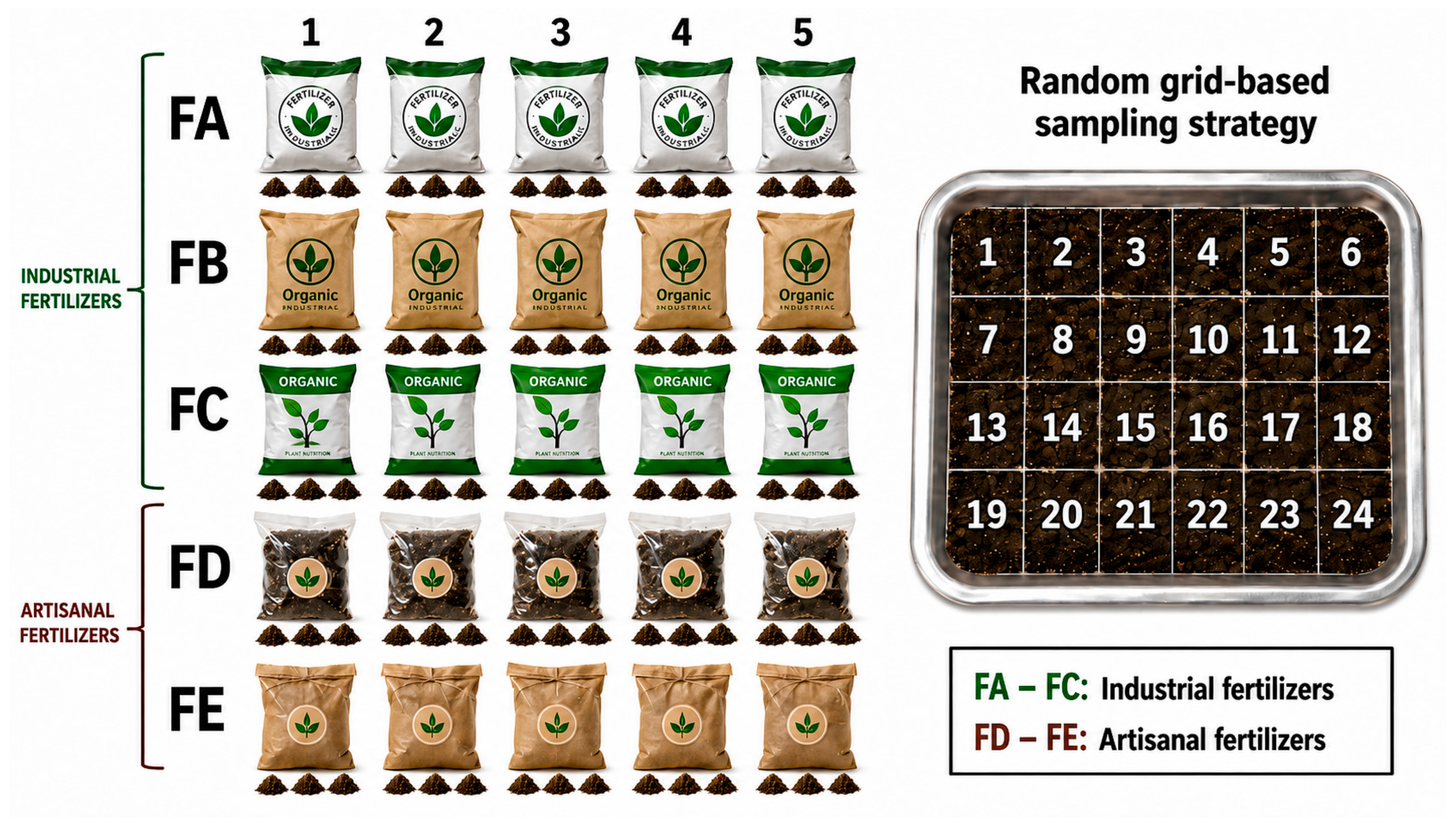
Five types of organic fertilizers were selected based on market availability, including three industrially processed products and two artisanal formulations. A non-probabilistic judgmental sampling design was used to define the sample size (n = 75), ensuring technical feasibility and analytical depth. A significance level of 0.05 was considered [19]. Within each fertilizer bag, sampling was performed using a grid-based random strategy to reduce spatial heterogeneity bias. First, a virtual grid was superimposed onto the fertilizer surface. Then, ten grid squares were randomly selected using Microsoft Excel. Approximately 1 g of material was collected from each square for a total of 10 g. For each fertilizer bag, three independent composite samples were prepared using the same procedure (Figure 1).
Sample identification followed an alphanumeric system. For instance, the code FA1A, indicates that the sample is a fertilizer (F), and the second letter (A–C for industrial fertilizers and D–F for artisanal fertilizers) denotes the fertilizer type. The number represents the bag number (1–5), and the final letter indicates the replicate (A, B, or C) (Figure 1). Of the two artisanal fertilizers, one (FE) contains humus, fruit peels, and eggshells, while the second (FD) is a mixture of black soil, cow manure, rice husks, and decomposing twigs and leaves.

2.2. Total Colony Count, Screening of Ceftriaxone-Resistant Enterobacterales (AXO-Resistant Enterobacterales) and Statistical Analysis

For the microbiological analysis, 10 g of each composite sample was homogenized in 90 mL of nutrient broth with vigorous manual agitation to obtain a 1:10 suspension, followed by incubation at 37 °C for 24 h as a non-selective enrichment step. After incubation, the suspensions were thoroughly mixed and serial tenfold dilutions were prepared. In order to estimate total recoverable Enterobacterales, aliquots (150 µL) from dilutions expected to yield countable colonies (30–300 CFU) were plated onto MacConkey agar (bioMérieux, Marcy l’Étoile, France) and incubated at 37 °C for 24 h.
The same dilution series obtained after non-selective enrichment was used for a selective enrichment of presumptive AXO-resistant Enterobacterales. Briefly, 10 µL from each dilution were inoculated into 990 µL of MacConkey broth (Merck, Darmstadt, Germany) supplemented with 4 µg/mL ceftriaxone (AXO) (Santa Cruz Biotechnology, Dallas, TX, USA) and incubated at 37 °C for 24 h. By following selective enrichment process, aliquots were plated onto MacConkey (bioMérieux, Marcy l’Étoile, France) agar under the same incubation conditions. Since enumeration was performed after enrichment steps, the CFU values were interpreted as semi-quantitative estimates of recoverable Enterobacterales rather than absolute bacterial counts.
In order to obtain a statistical description, the data collected were summarized using mean values and standard deviations (Supplementary Table S1). As CFU counts did not meet assumptions of normality, differences among OF fertilizer types were assessed using the Kruskal–Wallis test. When statistically significant differences were observed (p < 0.05), Dunn’s post hoc test was applied for pairwise comparisons. Statistical analyses were performed using R software version 4.5.3 [20].

2.3. Bacterial Identification

Representative colonies displaying distinct lactose-fermenting morphologies consistent with Enterobacterales were selected and subcultured for further characterization (identification and susceptibility test). To implement the procedure, pure isolates were subcultured onto blood agar plates and incubated at 37 °C for 24 h prior to identification. Bacterial identification was performed using GN identification cards in the VITEK® 2 Compact system (bioMérieux, Marcy l’Étoile, France), following the manufacturer’s instructions. Bacterial suspensions were prepared and adjusted to 0.5 McFarland using a DensiCHEK™ instrument, after which they were loaded into the VITEK® system for automated identification (bioMérieux, Marcy l’Étoile, France). Identification results were interpreted according to the manufacturer’s recommendations.

2.4. Determination of Minimum Inhibitory Concentration by Broth Microdilution and Phenotypic Detection of ESBLs

Minimum inhibitory concentrations (MICs) were determined using the broth microdilution method with Sensititre panels (TREK Diagnostic Systems, Westlake, OH, USA), according to the manufacturer’s instructions. The antibiotics evaluated were cefotaxime (FOT), ceftriaxone (AXO), ceftazidime (TAZ), cefepime (FEP), cefoxitin (FOX), piperacillin/tazobactam (P/T4), doripenem (DORI), imipenem (IMI), meropenem (MERO), ertapenem (ETP), ceftolozane/tazobactam (C/T), and ceftazidime/avibactam (CZA). Results were interpreted according to the Clinical and Laboratory Standards Institute (CLSI) guidelines [21]. E. coli ATCC 25922 was used as the quality control strain.
Phenotypic detection of ESBL production was performed using the double-disk synergy test as described by Calvo et al. [22]. Briefly, a bacterial suspension adjusted to 0.5 McFarland in 0.85% saline solution was inoculated onto Mueller–Hinton agar plates. An amoxicillin/clavulanic acid (AMC) (Becton, Dickinson and Company, Sparks, MD, USA) disk was placed at the center of the plate, while cefotaxime (30 µg) and ceftazidime (30 µg) disks (Becton, Dickinson and Company, Sparks, MD, USA) were positioned 20 mm apart on either side of the AMC disk. Plates were incubated at 35 ± 2 °C for 24 h. ESBL production was indicated by an enhanced inhibition zone (“keyhole effect”) between the cephalosporin disks and the AMC disk, indicating synergy. The absence of this effect was interpreted as a negative result.

2.5. Detection of blaTEM, blaSHV, and blaCTX-M.group1 Genes

All isolates were analyzed by polymerase chain reaction (PCR) to detect resistance genes. Each target gene was amplified in separate PCR reactions using specific primer sets. The primers and conditions used for detection were performed under the protocols previously described [23,24,25]. Amplifications were conducted on a SelectCycler™ II Thermal Cycler (Select BioProducts, Edison, NJ, UEA). PCR conditions were optimized individually for each primer pair, as shown in Table 1.

2.6. Whole-Genome Sequencing

Three isolates were selected for whole-genome sequencing: two K. pneumoniae isolates (one recovered from FD fertilizer containing bovine manure and one from industrially produced FA fertilizer) and one E. coli isolate obtained from FD fertilizer. Because the antimicrobial resistance profiles of the isolates were similar, representative strains were selected based on the type of fertilizer from which they were recovered.
Genomic DNA was extracted from overnight cultures using the DNeasy UltraClean Microbial Kit (Qiagen, Hilden, Germany a) following the manufacturer’s instructions. Whole-genome sequencing (WGS) was performed on an Illumina NextSeq 1000 platform (Illumina Inc., San Diego, CA, USA). Raw sequencing reads were assembled de novo using SPAdes with default parameters. Gene prediction and annotation were performed using the Bacterial and Viral Bioinformatics Resource Center (BV-BRC) platform.
Multi-locus sequence typing (MLST), as well as resistome and virulome analyses, were conducted using the Solugenomics platform based on the PubMLST database (v2.23.0) [26]. Capsular typing (wzi gene), and virulence gene typing using Kleborate for K. pneumoniae [27]. The Whole Genome project has been deposited in DDBJ/ENA/GenBank under the accession number PRJNA1348518.

3. Results

3.1. Colony Counts and Screening of AXO-Resistant Enterobacterales

Enterobacterales growth was detected in 18 out of 75 analyzed samples (24%) following enrichment procedures. Total recoverable Enterobacterales counts varied markedly among fertilizer types as shown in Table 2. The highest counts were consistently observed in fertilizer D, followed by fertilizers A and E. In contrast, no detectable growth was observed in fertilizers B and C under the experimental conditions used. A similar pattern was observed for AXO-resistant Enterobacterales.
Statistically significant differences in microbial load were observed among the evaluated fertilizers (p = 0.001). For the total Enterobacterales count fertilizers A and D showed the highest median values, in contrast no growth was detected in groups B, C, and E. Similarly, AXO-resistant Enterobacterales counts also showed significant variations (p = 0.01), with fertilizer D exhibiting the highest density of resistant isolates. These findings indicate that fertilizer type significantly influences both bacterial abundance and the distribution of antimicrobial resistance (Table 2).
Dunn’s post hoc analysis identified fertilizer D as the main differentiating factor, showing a significantly higher microbial counts than the other treatments. Comparisons between group D and fertilizers B and C yielded the strongest statistical significance for both total Enterobacterales counts (p = 0.001) and AXO-resistant Enterobacterales (p = 0.0003). Additionally, fertilizer D differed significantly from fertilizer A (p = 0.016) and E (p = 0.013). In contrast, no significant differences were observed among groups A, B, C, and E (p > 0.05), indicating homogeneous distribution among these groups (Table 3).

3.2. Identification of ESBL-Producing Isolates

A total of 19 lactose-fermenting isolates were recovered from 14 cultures showing growth under ceftriaxone selective conditions. Based on automated identification using the VITEK® system, two species belonging to the order Enterobacterales were identified: E. coli (n = 13) and K. pneumoniae (n = 6). No additional lactose-fermenting morphotypes were detected. It is worth noting that a significant difference in the number of positive replicates was observed between industrial and artisanal fertilizers. Among the industrial formulations, bacterial growth was detected only in fertilizer FA (2/15 samples, 13.3%). In contrast, artisanal fertilizers showed heterogeneous results. Limited growth was observed in fertilizer FE (1/15 samples, 6.7%), a formulation composed primarily of humus, fruit peels, and eggshell residues. Conversely, fertilizer FD exhibited a substantially higher frequency of positive samples (11/15, 73.3%). This fertilizer consisted of a mixture of black soil, bovine manure, rice husks, and decomposing plant material. These findings suggest that the predominance of AXO-resistant isolates in fertilizer FD may be associated with the use of animal manure.

3.3. Antimicrobial Susceptibility Profiles and Phenotypic Detection of ESBL Production

In the double-disk synergy test, 84% (16/19) of the isolates tested positive for ESBL production, while 16% (3/19) yielded inconclusive results, specifically isolates FE5A-1, FD3A-1, and FD2B-1. Regarding antimicrobial susceptibility patterns, 100% of the isolates were resistant to ceftriaxone and cefotaxime, while 89.5% were resistant to ceftazidime (Table 4). Resistance to cefepime, cefoxitin, and piperacillin/tazobactam was also observed in several isolates. Quality control results were within CLSI acceptable ranges.

3.4. Detection and Distribution of blaTEM, blaSHV, and blaCTX-M.group 1 Genes Among Isolates

Endpoint PCR revealed that 100% of the isolates carried at least one of the screened genes. Among the 19 isolates, 68% co-expressed multiple resistance genes. Specifically, 42% (8/19) harbored blaTEM and blaCTX-M; 21% (4/19) harbored blaSHV and blaCTX-M; and 5% (1/19) simultaneously carried all three genes. Interestingly, PCR-based genotypic characterization revealed that three isolates with phenotypically inconclusive ESBL results carried bla genes, indicating false-negative outcomes in the synergy test. Such discrepancies are often attributed to the co-expression of ESBL and AmpC enzymes or hyperproduction of β-lactamases [28].

3.5. Genomic Characterization of Representative Isolates

Whole-genome sequencing (WGS) was performed for three representative isolates. The genome sizes of K. pneumoniae ranged from 5,486,733 to 5,544,155 bp, with an average GC content of approximately 57.2%. In contrast, the genome size of E. coli ranged from 4,919,848 to 4,942,912 bp, with a GC content of approximately 50.9%. Details of these studies are provided below:
(i) K. pneumoniae: As previously mentioned, two of the samples selected for the analysis were from artisanal organic fertilizer FD and industrial fertilizer FA. MLST analysis classified both isolates as sequence type 37 (ST37).
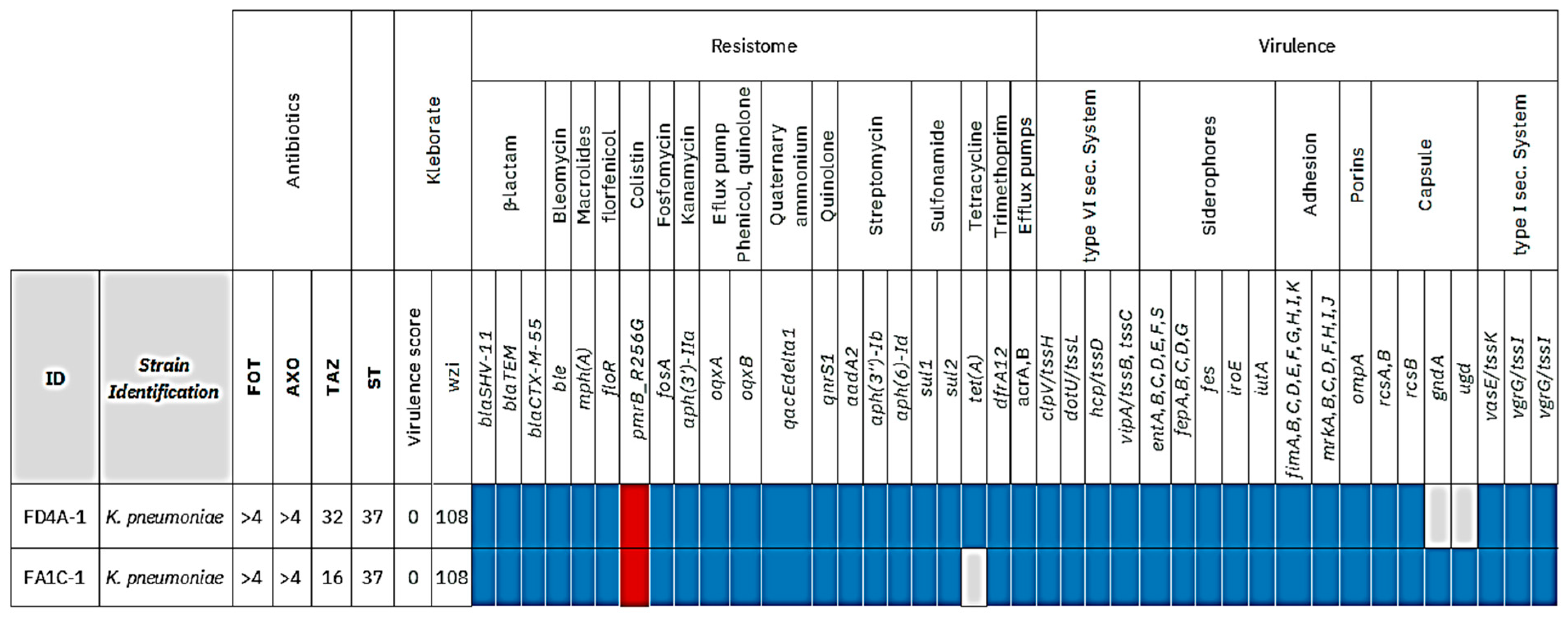
The β-lactam resistance phenotype was consistent with the genes identified. WGS confirmed that resistance to third-generation cephalosporins was mediated by the identified β-lactamase genes; however, blaTEM was not amplified by conventional PCR. Additional resistance determinants included the colistin resistance mutation pmrB_R256G and genes conferring quinolone resistance, among others (Figure 2). Both isolates carried blaCTX-M-55 gene.
Although none of the isolates exhibited a hypervirulent profile, they harbored several virulence factors associated with adherence, dissemination, and infection processes, including efflux pumps, siderophores, adhesins, porins, capsule, and type I and VI secretion systems (Figure 2).
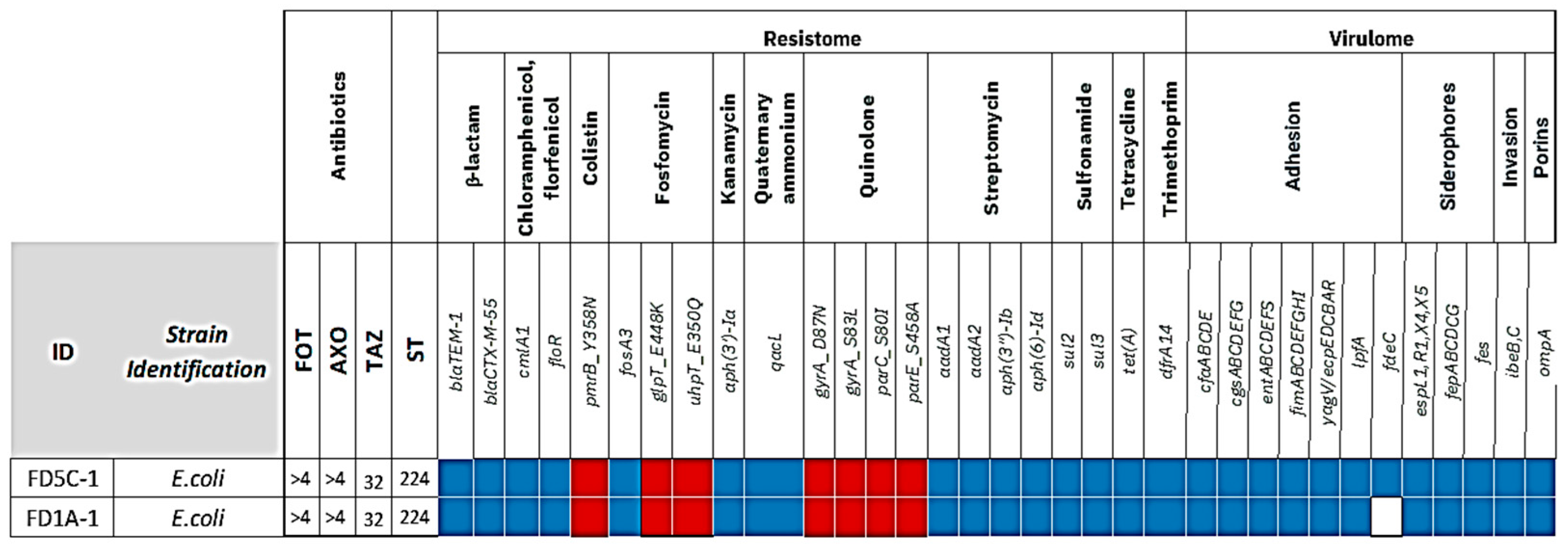
(ii) E. coli: Based on WGS, the β-lactam resistance phenotype of E. coli was consistent with the detected genotype. MLST identified sequence type 224, which was also associated with the presence of blaCTX-M-55. Additional resistance genes conferring resistance to colistin, fosfomycin, and quinolones were also identified. As for the virulome, a greater proportion of adhesion-associated genes were observed, followed by those for siderophores, invasion, and porins (Figure 3).

4. Discussion

Organic fertilizers are widely recognized for their agronomic and environmental benefits, as they contain organic and mineral components free of synthetic additives. However, they have not been widely acknowledged as potential reservoirs and dissemination sources of ESBL-producing bacteria. This concern is particularly relevant because current regulations, both globally and in Colombia, allow the use of animal- or plant-based raw materials, as well as biosolids and residues from domestic or agro-industrial wastewater, without considering routine antimicrobial use in these contexts [29,30]. In this context, the present study provides the first evidence from Colombia demonstrating the occurrence of ESBL-producing Enterobacterales in commercially available organic fertilizers.
Notably, AXO-resistant Enterobacterales were detected in 18.6% of the analyzed samples, further supporting the role of organic fertilizers as environmental reservoirs of antibiotic-resistant bacteria. Although the present study was not designed as a population-based survey, the observed resistance frequencies of ceftriaxone and ceftazidime were comparable to those reported in clinical isolates by the Colombian National Institute of Health in 2020 [31]. Therefore, this finding suggests that resistance mechanisms commonly associated with healthcare settings may also be present in agricultural environments, highlighting the need to integrate One Health approaches into national policies, as already implemented in Europe [32,33].
Multiple factors may contribute to the presence of resistant bacteria in fertilizers [34,35]. As previously pointed out, current regulations permit the incorporation of materials that may originate from environments heavily contaminated with antibiotics [4]. Antibiotics administered for therapeutic purposes or as growth promoters in livestock are often excreted in active or partially metabolized forms through feces and urine. When these residues are incorporated into manure-based fertilizers, they may accumulate in soils and interact with native microbial communities, potentially facilitating the persistence and horizontal transfer of antimicrobial resistance genes (ARGs) [36]. Consequently, resistant bacteria and resistance determinants may disseminate through environmental pathways such as agricultural runoff, surface waters, and indirect exposure along the food production chain [37].
Our statistical analysis confirms that the type of fertilizer significantly influences the colony count (p = 0.001) (Table 2). In particular, the manure-amended formulation (fertilizer D) showed the highest mean colony counts, forming an independent subset, whereas other fertilizers exhibited complete inhibition under the tested conditions. These findings are consistent with previous studies reporting that manure-amended soils can harbor diverse ARGs associated with multiple antimicrobial classes [34,38]. Although β-lactams are typically introduced through manure, subsequent microbial interactions in the soil environment can promote the emergence and proliferation of additional ARGs [36]. Notably, these genes have been detected more abundantly in leaf endophytes than in roots, indicating that manure-derived ARGs can accumulate in aboveground plant tissues, increasing their potential dissemination within agricultural ecosystems [39].
While the transfer of antimicrobial-resistant bacteria from soil to plant products remains complex and not fully understood, several factors, including agricultural practices, environmental conditions, and post-harvest handling may influence this process [34,36]. Therefore, although our study does not directly assess transmission to food products, the presence of ESBL-producing Enterobacterales in fertilizers highlights a potential pathway for indirect dissemination within agroecosystems [37,38].
In Colombia, this situation is compounded by unregulated access to veterinary antibiotics. The Colombian Agricultural Institute currently lists >60 veterinary products whose main active ingredient is a third-generation cephalosporin (ceftiofur) commonly used in cattle and swine, which are primary sources of manure used for fertilizer [11]. Given the structural similarity between ceftiofur and clinically relevant cephalosporins such as ceftriaxone and cefotaxime, shared selective pressures across agricultural and clinical sectors may contribute to the maintenance and spread of resistance determinants [40].
At the molecular level, the predominance of blaCTX-M observed in this study aligns with global reports describing the successful dissemination of this gene family across human, animal, and environmental compartments. Studies of E. coli isolates have demonstrated an alarming expansion across different types of samples analyzed, including broiler chicken [41], water reservoirs in wastewater treatment plants, and recreational [42], swine manure [38], among others.
K. pneumoniae ST37 has previously been reported in clinical settings as a producer of different β-lactamases, such as CTX-M-15 and KPC [42,43]. It has also been associated with resistance of phenotypes to ceftazidime/avibactam and colistin [44]. Reports have also documented the presence of ST37 in environmental samples [45] from around dairy cows in China [46], marine environments in Norway [47], wastewater treatment plants in Europe [48], companion animals in China [49], and surface waters [50]. In Colombia, ST37 has been reported in humans [51]. However, to date, there are no reports of its presence in environmental sources.
Similarly, E. coli ST224 has been mainly associated with environmental and animal sources. It has been reported in pet owners previously infected or colonized with this ST [52], as well as in urinary tract infection (UTIs) [53] and in cases of colistin and carbapenem resistance [54]. Although phylogroup B1 was initially defined as a commensal strain [55], different studies have linked it to high-risk clones, such as ST131 carriers of CTX-M [56].
The detection of the CTX-M-55 variant in both species is of particular importance. A systematic review by Yu et al. [57] revealed CTX-M-55 as a dominant variant in Asia. This variant has been frequently detected in E. coli isolated from humans [52], as well as in eggs [58], poultry [59], and even in herbs such as coriander [60]. Its detection in industrial fertilizers in the present study indicates the regional dissemination of globally relevant resistance determinants.
Most studies have focused on the emergence and spread of ESBL genes in hospital environments, wastewater treatment plants, aquatic ecosystems, and animal-derived food products [61,62,63]. ESBL-producing E. coli can be disseminated from animal farms to the surrounding environments, including rural water reservoirs [53,63]. However, the role of animal-derived composting materials in disseminating ESBL genes remains understudied. Said et al. [14] identified ESBL-producing isolates in 7.31% (3/41) of agricultural soil samples and in 21.93% (25/114) of positive wastewater and surface water samples. Similarly, Gao et al. [38] used Enterobacterial repetitive intergenic consensus–PCR typing to demonstrate that composted soil isolates originated from pig feces used in the composting process.
Although composting is often proposed as a mitigation strategy for reducing the microbial and chemical risks associated with manure reuse in agriculture, its efficiency in removing ARGs is highly variable, and certain resistance determinants can persist despite the treatment [36,53]. Most previous investigations have focused on resistance genes related to tetracyclines, macrolides, or sulfonamides, whereas data on β-lactamase genes in composted agricultural inputs remain scarce.
Because current Colombian technical standards do not include routine screening for fertilizers or food production, these products may contribute to the environmental dissemination of resistance. To the best of our knowledge, this study provides the first evidence of ESBL-producing Enterobacterales in organic fertilizers marketed in Colombia. Furthermore, these findings underscore the importance of incorporating microbiological surveillance of agricultural inputs into national antimicrobial resistance mitigation strategies under a comprehensive One Health approach.

5. Study Limitations: Brief Discussions

This study has several limitations that should be acknowledged. First, fertilizer types were selected based on market availability rather than probabilistic sampling, which may limit the generalizability of the findings. Second, bacterial enumeration was performed following enrichment steps, and therefore CFU values should be interpreted as semi-quantitative estimates of recoverable Enterobacterales rather than absolute bacterial loads. Additionally, only a limited number of isolates were subjected to whole-genome sequencing, which restricts broader conclusions regarding the genomic diversity and dissemination patterns of resistance determinants. Finally, this investigation focused on microbiological characterization and did not evaluate other parameters.
Despite these limitations, this study appears to be the first report from Colombia describing ESBL-producing bacteria in organic fertilizers. These findings provide novel baseline evidence and support the need for integrated surveillance approaches under the One Health framework.

6. Conclusions

This study demonstrates the presence of extended-spectrum β-lactamase (ESBL)-producing Enterobacterales in both industrial and artisanal organic fertilizers commercially available in Southwestern Colombia. These findings suggest that organic fertilizers may act as environmental reservoirs and potential dissemination pathways for antimicrobial-resistant bacteria within agricultural ecosystems. For example, significant differences in recoverable Enterobacterales counts among fertilizer types suggest variability in microbiological quality likely influenced by production practices and raw material composition. Furthermore, the detection of clinically relevant resistance genes, together with the identification of multidrug-resistant isolates and genomic characterization of representative strains, reinforces concerns regarding the environmental circulation of antimicrobial resistance determinants.
From a One Health perspective, the use of untreated or poorly controlled organic fertilizers may contribute to the introduction and persistence of resistant bacteria in soils, crops, and potentially the food chain. Although direct transmission to humans or food products was not evaluated in this study, the findings reported in this contribution support the need for strengthened microbiological surveillance and regulatory oversight of organic fertilizer production and commercialization.
Based on the results reported in this contribution, several important aspects still require further investigation. Future research should focus on the survival dynamics, transmission pathways, and public health implications of antimicrobial-resistant bacteria associated with agricultural inputs to better inform risk mitigation strategies.

Supplementary Materials

The following supporting information can be downloaded at: https://www.mdpi.com/article/10.3390/environments13050275/s1, Table S1: Descriptive statistics of total and AXO-resistant Enterobacterales counts by fertilizer type. Values are presented as mean. standard deviation (SD). median. and interquartile range (Q1–Q3). Data are based on enriched samples and should be interpreted as semi-quantitative estimates. AXO. ceftriaxone.

Author Contributions

Conceptualization, A.C. and A.F.; methodology, G.E.S., P.A.M.C., A.C., A.F. and E.D.L.C.; writing: original draft preparation: A.C., A.F. and E.D.L.C.; writing—review and editing: A.C., A.F., E.D.L.C. and M.V.V. All authors have read and agreed to the published version of the manuscript.

Funding

This research has been funded by Dirección General de Investigaciones of Universidad Santiago de Cali under call No. DGI-01-2026.

Data Availability Statement

The whole-genome sequencing data generated in this study have been deposited in the DDBJ/ENA/GenBank database under accession number PRJNA1348518. All other data supporting the findings of this study are available from the corresponding author upon reasonable request.

Acknowledgments

The authors express their sincere gratitude to Dirección General de Investigaciones of Universidad Santiago de Cali for valuable administrative and technical support.

Conflicts of Interest

The authors declare no conflicts of interest.

Abbreviations

The following abbreviations are used in this manuscript:
ESBLExtended-spectrum β-lactamase
MICMinimum inhibitory concentration
WHOWorld Health Organization
AMRAntimicrobial resistance
ARGsAntimicrobial resistance genes
WGSWhole-genome sequencing
FOTCefotaxime
AXOCeftriaxone
TAZCeftazidime
FEPCefepime
FOXCefoxitin
P/T4Piperacillin/tazobactam
DORIDoripenem
IMIImipenem
MEROMeropenem
ETPErtapenem
CTCeftolozane/tazobactam
CZACeftazidime/avibactam
AMCAmoxicillin–clavulanic acid
UTIsUrinary Tract Infection

References

  1. Stocchero, M. Synthetic and Mixed Fertilizers: Understanding Their Role in Modern Agriculture. J. Res. Environ. Sci. Toxicol. 2024, 13, 1–2. [Google Scholar]
  2. He, Z.; Ding, B.; Pei, S.; Cao, H.; Liang, J.; Li, Z. The impact of organic fertilizer replacement on greenhouse gas emissions and its influencing factors. Sci. Total Environ. 2023, 905, 166917. [Google Scholar] [CrossRef]
  3. NTC 5167-2022; Documentación: Productos Para la Industria Agrícola. Productos Orgánicos Usados Como Abonos o Fertilizantes y Enmiendas o Acondicionadores de Suelo. Instituto Colombiano de Normas Técnicas y Certificación: Bogotá, Colombia, 2022.
  4. Markowicz, A.; Bondarczuk, K.; Cycoń, M.; Sułowicz, S. Land application of sewage sludge: Response of soil microbial communities and potential spread of antibiotic resistance. Environ. Pollut. 2021, 271, 116317. [Google Scholar] [CrossRef]
  5. Al-Khalaifah, H.; Rahman, M.H.; Al-Surrayai, T.; Al-Dhumair, A.; Al-Hasan, M. A One-Health Perspective of Antimicrobial Resistance (AMR): Human, Animals and Environmental Health. Life 2025, 15, 1598. [Google Scholar] [CrossRef]
  6. One Health Joint Plan of Action (2022–2026): Working Together for the Health of Humans, Animals, Plants and the Environment. Available online: https://www.who.int/publications/i/item/9789240059139 (accessed on 29 April 2026).
  7. Bradford, P.A. Extended-Spectrum β-Lactamases in the 21st Century: Characterization, Epidemiology, and Detection of This Important Resistance Threat. Clin. Microbiol. Rev. 2001, 14, 933–951. [Google Scholar] [CrossRef]
  8. Shaikh, S.; Fatima, J.; Shakil, S.; Rizvi, S.M.D.; Kamal, M.A. Antibiotic resistance and extended spectrum beta-lactamases: Types, epidemiology and treatment. Saudi J. Biol. Sci. 2015, 22, 90–101. [Google Scholar] [CrossRef]
  9. Cantón, R.; González-Alba, J.M.; Galán, J.C. CTX-M Enzymes: Origin and Diffusion. Front. Microbiol. 2012, 3, 110. [Google Scholar] [CrossRef]
  10. Cho, S.; Jackson, C.R.; Frye, J.G. Freshwater environment as a reservoir of extended-spectrum β-lactamase-producing Enterobacteriaceae. J. Appl. Microbiol. 2023, 134, lxad034. [Google Scholar] [CrossRef]
  11. von Salviati, C.; Laube, H.; Guerra, B.; Roesler, U.; Friese, A. Emission of ESBL/AmpC-producing Escherichia coli from pig fattening farms to surrounding areas. Vet. Microbiol. 2015, 175, 77–84. [Google Scholar] [CrossRef] [PubMed]
  12. Beshiru, A.; Igbinosa, I.H.; Enabulele, T.I.; Ogofure, A.G.; Kayode, A.J.; Okoh, A.I.; Igbinosa, E.O. Biofilm and antimicrobial resistance profile of extended-spectrum β-lactamase (ESBL) and AmpC β-lactamase producing Enterobacteriaceae in vegetables and salads. LWT 2023, 182, 114913. [Google Scholar] [CrossRef]
  13. Moon, S.H.; Udaondo, Z.; Abram, K.Z.; Li, X.; Yang, X.; DiCaprio, E.L.; Jun, S.-R.; Huang, E. Isolation of AmpC- and extended spectrum β-lactamase-producing Enterobacterales from fresh vegetables in the United States. Food Control 2022, 132, 108559. [Google Scholar] [CrossRef]
  14. Ben Said, L.; Jouini, A.; Klibi, N.; Dziri, R.; Alonso, C.A.; Boudabous, A.; Ben Slama, K.; Torres, C. Detection of extended-spectrum beta-lactamase (ESBL)-producing Enterobacteriaceae in vegetables, soil and water of the farm environment in Tunisia. Int. J. Food Microbiol. 2015, 203, 86–92. [Google Scholar] [CrossRef]
  15. Hartmann, A.; Locatelli, A.; Amoureux, L.; Depret, G.; Jolivet, C.; Gueneau, E.; Neuwirth, C. Occurrence of CTX-M Producing Escherichia coli in Soils, Cattle, and Farm Environment in France (Burgundy Region). Front. Microbiol. 2012, 3, 83. [Google Scholar] [CrossRef] [PubMed]
  16. Villegas, M.V.; Correa, A.; Perez, F.; Zuluaga, T.; Radice, M.; Gutkind, G.; Casellas, J.M.; Ayala, J.; Lolans, K.; Quinn, J.P.; et al. CTX-M-12 beta-lactamase in a Klebsiella pneumoniae clinical isolate in Colombia. Antimicrob. Agents Chemother. 2004, 48, 629–631. [Google Scholar] [CrossRef]
  17. Mantilla, J.R.; Reguero, M.T.; González, E.B.; García, I.A.; Leal, A.L.; Espinal, P.A.; Alpuche, C.; Valderrama, I.A.; Garzón, M.I.; Olarte, N.M. Molecular characterization of an outbreak caused by CTX-M-12-producing Klebsiella pneumoniae in a Colombian hospital’s neonatal intensive care unit. Biomedica 2006, 26, 408–414. [Google Scholar] [CrossRef]
  18. Mondragón-Quiguanas, A.; Villaquirán-Muriel, M.Á.; Rivera, S.P.; Rosero-García, D.; Aranaga, C.; Correa, A.; Falco, A. Beta-Lactam-Resistant Enterobacterales Isolated from Landfill Leachates. Pathogens 2022, 11, 1077. [Google Scholar] [CrossRef]
  19. Etikan, I.; Musa, S.A.; Alkassim, R.S. Comparison of Convenience Sampling and Purposive Sampling. Am. J. Theor. Appl. Stat. 2015, 5, 1–4. [Google Scholar] [CrossRef]
  20. R: The R Project for Statistical Computing. Available online: https://www.r-project.org/ (accessed on 2 November 2025).
  21. EM100 Connect-CLSI M100 ED35:2025. Available online: https://em100.edaptivedocs.net/GetDoc.aspx?doc=CLSI%20M100%20ED35:2025&scope=user (accessed on 21 October 2025).
  22. Calvo, J.; Cantón, R.; Fernández, F.; Mirelis, B.; Navarro, F. Detección Fenotípica de Mecanismos de Resistencia en Gramnegativos; Sociedad Española de Enfermedades Infecciosas y Microbiología Clínica: Madrid, Spain, 2011. [Google Scholar]
  23. Horton, R.A.; Randall, L.P.; Snary, E.L.; Cockrem, H.; Lotz, S.; Wearing, H.; Duncan, D.; Rabie, A.; McLaren, I.; Watson, E.; et al. Fecal Carriage and Shedding Density of CTX-M Extended-Spectrum β-Lactamase-Producing Escherichia coli in Cattle, Chickens, and Pigs: Implications for Environmental Contamination and Food Production. Appl. Environ. Microbiol. 2011, 77, 3715–3719. [Google Scholar] [CrossRef] [PubMed]
  24. Rasheed, J.K.; Jay, C.; Metchock, B.; Berkowitz, F.; Weigel, L.; Crellin, J.; Steward, C.; Hill, B.; Medeiros, A.A.; Tenover, F.C. Evolution of extended-spectrum beta-lactam resistance (SHV-8) in a strain of Escherichia coli during multiple episodes of bacteremia. Antimicrob. Agents Chemother. 1997, 41, 647–653. [Google Scholar] [CrossRef]
  25. Lal, P.; Kapil, A.; Das, B.K.; Sood, S. Occurrence of TEM & SHV gene in extended spectrum beta-lactamases (ESBLs) producing Klebsiella sp. isolated from a tertiary care hospital. Indian J. Med. Res. 2007, 125, 173–178. [Google Scholar]
  26. Saratto, T.; Visuri, K.; Lehtinen, J.; Ortega-Sanz, I.; Steenwyk, J.L.; Sihvonen, S. Solu: A cloud platform for real-time genomic pathogen surveillance. BMC Bioinform. 2025, 26, 12. [Google Scholar] [CrossRef]
  27. Lam, M.M.C.; Wick, R.R.; Watts, S.C.; Cerdeira, L.T.; Wyres, K.L.; Holt, K.E. A genomic surveillance framework and genotyping tool for Klebsiella pneumoniae and its related species complex. Nat. Commun. 2021, 12, 4188. [Google Scholar] [CrossRef]
  28. Kaur, J.; Chopra, S.; Mahajan, G. Modified Double Disc Synergy Test to Detect ESBL Production in Urinary Isolates of Escherichia coli and Klebsiella pneumoniae. J. Clin. Diagn. Res. 2013, 7, 229–233. [Google Scholar] [CrossRef]
  29. Ransirini, A.M.; Elżbieta, M.-S.; Joanna, G.; Bartosz, K.; Mirosław, K.J.; Magdalena, U. Aged Turkey manure shapes microbial diversity and antibiotic resistance genes in soil and plants under fertilization. Sci. Rep. 2025, 15, 20463. [Google Scholar] [CrossRef]
  30. Ji, X.; Shen, Q.; Liu, F.; Ma, J.; Xu, G.; Wang, Y.; Wu, M. Antibiotic resistance gene abundances associated with antibiotics and heavy metals in animal manures and agricultural soils adjacent to feedlots in Shanghai; China. J. Hazard. Mater. 2012, 235–236, 178–185. [Google Scholar] [CrossRef]
  31. Instituto Nacional de Salud. Informe Vigilancia Por WHONET de Resistencia Antimicrobiana en El Ámbito Hospitalario. Available online: https://www.ins.gov.co/BibliotecaDigital/vigilancia-por-whonet-de-resistencia-antimicrobiana-en-el-ambito-hospitalario-colombia-2022.pdf (accessed on 6 November 2025).
  32. One Health|RIVM. Available online: https://www.rivm.nl/en/one-health (accessed on 2 November 2025).
  33. One Health Approach|European Medicines Agency (EMA). Available online: https://www.ema.europa.eu/en/partners-networks/one-health-approach (accessed on 2 November 2025).
  34. Heuer, H.; Schmitt, H.; Smalla, K. Antibiotic resistance gene spread due to manure application on agricultural fields. Curr. Opin. Microbiol. 2011, 14, 236–243. [Google Scholar] [CrossRef]
  35. Chee-Sanford, J.C.; Mackie, R.I.; Koike, S.; Krapac, I.G.; Lin, Y.-F.; Yannarell, A.C.; Maxwell, S.; Aminov, R.I. Fate and transport of antibiotic residues and antibiotic resistance genes following land application of manure waste. J. Env. Qual. 2009, 38, 1086–1108. [Google Scholar] [CrossRef] [PubMed]
  36. Qiu, T.; Huo, L.; Guo, Y.; Gao, M.; Wang, G.; Hu, D.; Li, C.; Wang, Z.; Liu, G.; Wang, X. Metagenomic assembly reveals hosts and mobility of common antibiotic resistome in animal manure and commercial compost. Environ. Microbiome 2022, 17, 42. [Google Scholar] [CrossRef]
  37. Ben, W.; Wang, J.; Pan, X.; Qiang, Z. Dissemination of antibiotic resistance genes and their potential removal by on-farm treatment processes in nine swine feedlots in Shandong Province, China. Chemosphere 2017, 167, 262–268. [Google Scholar] [CrossRef]
  38. Gao, L.; Hu, J.; Zhang, X.; Wei, L.; Li, S.; Miao, Z.; Chai, T. Application of swine manure on agricultural fields contributes to extended-spectrum β-lactamase-producing Escherichia coli spread in Tai’an, China. Front. Microbiol. 2015, 6, 313. [Google Scholar] [CrossRef]
  39. Gekenidis, M.-T.; Rigotti, S.; Hummerjohann, J.; Walsh, F.; Drissner, D. Long-Term Persistence of blaCTX-M-15 in Soil and Lettuce after Introducing Extended-Spectrum β-Lactamase (ESBL)-Producing Escherichia coli via Manure or Water. Microorganisms 2020, 8, 1646. [Google Scholar] [CrossRef]
  40. Tragesser, L.A.; Wittum, T.E.; Funk, J.A.; Winokur, P.L.; Rajala-Schultz, P.J. Association between ceftiofur use and isolation of Escherichia coli with reduced susceptibility to ceftriaxone from fecal samples of dairy cows. Am. J. Vet. Res. 2006, 67, 1696–1700. [Google Scholar] [CrossRef] [PubMed]
  41. Laube, H.; Friese, A.; von Salviati, C.; Guerra, B.; Rösler, U. Transmission of ESBL/AmpC-producing Escherichia coli from broiler chicken farms to surrounding areas. Vet. Microbiol. 2014, 172, 519–527. [Google Scholar] [CrossRef]
  42. Aristizábal-Hoyos, A.M.; Rodríguez, E.A.; Arias, L.; Jiménez, J.N. High clonal diversity of multidrug-resistant and extended spectrum beta-lactamase-producing Escherichia coli in a wastewater treatment plant. J. Environ. Manag. 2019, 245, 37–47. [Google Scholar] [CrossRef]
  43. Lu, S.; Sheng, J.; Ter-Stepanyan, M.M.; Wang, Y.; Mkrtchyan, H.V. Genomic characterization of an ESBL-producing Klebsiella pneumoniae ST37 recovered from a hospitalized patient in Armenia. Microbiol. Spectr. 2025, 13, e00332-25. [Google Scholar] [CrossRef]
  44. Arcari, G.; Polani, R.; Bruno, F.; Capitani, V.; Sacco, F.; Menichincheri, G.; Raponi, G.; Carattoli, A. Ceftazidime–avibactam resistance in Klebsiella pneumoniae sequence type 37: A decade of persistence and concealed evolution. Microb. Genom. 2023, 9, 000931. [Google Scholar] [CrossRef]
  45. Rocha, J.; Henriques, I.; Gomila, M.; Manaia, C.M. Common and distinctive genomic features of Klebsiella pneumoniae thriving in the natural environment or in clinical settings. Sci. Rep. 2022, 12, 10441. [Google Scholar] [CrossRef]
  46. Fu, S.; Wen, C.; Wang, Z.; Qiu, Y.; Zhang, Y.; Zuo, J.; Xu, Y.; Han, X.; Luo, Z.; Chen, W.; et al. Molecular Epidemiology and Antimicrobial Resistance of Outbreaks of Klebsiella pneumoniae Clinical Mastitis in Chinese Dairy Farms. Microbiol. Spectr. 2022, 10, e0299722. [Google Scholar] [CrossRef] [PubMed]
  47. Håkonsholm, F.; Hetland, M.A.K.; Svanevik, C.S.; Lunestad, B.T.; Löhr, I.H.; Marathe, N.P. Insights into the genetic diversity, antibiotic resistance and pathogenic potential of Klebsiella pneumoniae from the Norwegian marine environment using whole-genome analysis. Int. J. Hyg. Environ. Health 2022, 242, 113967. [Google Scholar] [CrossRef] [PubMed]
  48. Martak, D.; Guther, J.; Verschuuren, T.D.; Valot, B.; Conzelmann, N.; Bunk, S.; Riccio, M.E.; Salamanca, E.; Meunier, A.; Henriot, C.P.; et al. Populations of extended-spectrum β-lactamase-producing Escherichia coli and Klebsiella pneumoniae are different in human-polluted environment and food items: A multicentre European study. Clin. Microbiol. Infect. 2022, 28, 447.e7–447.e14. [Google Scholar] [CrossRef]
  49. Xia, J.; Fang, L.-X.; Cheng, K.; Xu, G.-H.; Wang, X.-R.; Liao, X.-P.; Liu, Y.-H.; Sun, J. Clonal Spread of 16S rRNA Methyltransferase-Producing Klebsiella pneumoniae ST37 with High Prevalence of ESBLs from Companion Animals in China. Front. Microbiol. 2017, 8, 529. [Google Scholar] [CrossRef]
  50. Rolbiecki, D.; Kiedrzyńska, E.; Czatzkowska, M.; Kiedrzyński, M.; Korzeniewska, E.; Harnisz, M. Global dissemination of Klebsiella pneumoniae in surface waters: Genomic insights into drug resistance, virulence, and clinical relevance. Drug Resist. Updates 2025, 79, 101204. [Google Scholar] [CrossRef]
  51. Medina, V.A.; García-Vega, A.S.; Rodríguez, F.; Triviño-García, E.S.; Robledo, J.A.; Leal, A.L.; Galvis, J.C.; Reyes, L.F.; Okeke, I.N.; Couto, N.; et al. Epidemiological Genomics of Klebsiella pneumoniae isolates from hospitals across Colombia. npj Antimicrob. Resist. 2025, 3, 64. [Google Scholar] [CrossRef]
  52. Wang, L.; Fang, H.; Feng, J.; Yin, Z.; Xie, X.; Zhu, X.; Wang, J.; Chen, W.; Yang, R.; Du, H.; et al. Complete sequences of KPC-2-encoding plasmid p628-KPC and CTX-M-55-encoding p628-CTXM coexisted in Klebsiella pneumoniae. Front. Microbiol. 2015, 6, 838. [Google Scholar] [CrossRef]
  53. Cao, X.; Zhang, Z.; Shen, H.; Ning, M.; Chen, J.; Wei, H.; Zhang, K. Genotypic characteristics of multidrug-resistant Escherichia coli isolates associated with urinary tract infections. APMIS 2014, 122, 1088–1095. [Google Scholar] [CrossRef]
  54. Lee, Y.; Kim, J.-H. Genomic Analysis of Carbapenemase-Producing Escherichia coli Isolates Analyzed by Whole Genome Sequencing. Ann. Clin. Lab. Sci. 2022, 52, 811–814. [Google Scholar]
  55. Rodrigues, C.; Machado, E.; Pires, J.; Ramos, H.; Novais, Â.; Peixe, L. Increase of Widespread A, B1 and D Escherichia Coli Clones Producing a High Diversity of CTX-M-Types in a Portuguese Hospital. Future Microbiol. 2015, 10, 1125–1131. [Google Scholar] [CrossRef] [PubMed]
  56. Mora, A.; Blanco, M.; López, C.; Mamani, R.; Blanco, J.E.; Alonso, M.P.; García-Garrote, F.; Dahbi, G.; Herrera, A.; Fernández, A.; et al. Emergence of clonal groups O1:HNM-D-ST59, O15:H1-D-ST393, O20:H34/HNM-D-ST354, O25b:H4-B2-ST131 and ONT:H21,42-B1-ST101 among CTX-M-14-producing Escherichia coli clinical isolates in Galicia, northwest Spain. Int. J. Antimicrob. Agents 2011, 37, 16–21. [Google Scholar] [CrossRef] [PubMed]
  57. Ramatla, T.; Mafokwane, T.; Lekota, K.; Monyama, M.; Khasapane, G.; Serage, N.; Nkhebenyane, J.; Bezuidenhout, C.; Thekisoe, O. “One Health” perspective on prevalence of co-existing extended-spectrum β-lactamase (ESBL)-producing Escherichia coli and Klebsiella pneumoniae: A comprehensive systematic review and meta-analysis. Ann. Clin. Microbiol. Antimicrob. 2023, 22, 88. [Google Scholar] [CrossRef]
  58. Bastidas-Caldes, C.; Romero-Alvarez, D.; Valdez-Vélez, V.; Morales, R.D.; Montalvo-Hernández, A.; Gomes-Dias, C.; Calvopiña, M. Extended-Spectrum Beta-Lactamases Producing Escherichia coli in South America: A Systematic Review with a One Health Perspective. Infect. Drug Resist. 2022, 15, 5759–5779. [Google Scholar] [CrossRef] [PubMed]
  59. Castillo, D.A.F. Wild Birds of Chile as Bioindicators of Carbapenemase- or Extended Spectrum Î2 -Lactamase-Producing Enterobacterales. Ph.D. Thesis, Universidade de São Paulo, Sao Paulo, Brazil, 2021. [Google Scholar]
  60. Kurittu, P.; Khakipoor, B.; Aarnio, M.; Nykäsenoja, S.; Brouwer, M.; Myllyniemi, A.-L.; Vatunen, E.; Heikinheimo, A. Plasmid-Borne and Chromosomal ESBL/AmpC Genes in Escherichia coli and Klebsiella pneumoniae in Global Food Products. Front. Microbiol. 2021, 12, 592291. [Google Scholar] [CrossRef] [PubMed]
  61. Agersø, Y.; Aarestrup, F.M.; Pedersen, K.; Seyfarth, A.M.; Struve, T.; Hasman, H. Prevalence of extended-spectrum cephalosporinase (ESC)-producing Escherichia coli in Danish slaughter pigs and retail meat identified by selective enrichment and association with cephalosporin usage. J. Antimicrob. Chemother. 2012, 67, 582–588. [Google Scholar] [CrossRef] [PubMed]
  62. Blaak, H.; de Kruijf, P.; Hamidjaja, R.A.; van Hoek, A.H.A.M.; de Roda Husman, A.M.; Schets, F.M. Prevalence and characteristics of ESBL-producing E. coli in Dutch recreational waters influenced by wastewater treatment plants. Vet. Microbiol. 2014, 171, 448–459. [Google Scholar] [CrossRef] [PubMed]
  63. Zhang, H.; Zhou, Y.; Guo, S.; Chang, W. Multidrug resistance found in extended-spectrum beta-lactamase-producing Enterobacteriaceae from rural water reservoirs in Guantao, China. Front. Microbiol. 2015, 6, 267. [Google Scholar] [CrossRef]
Figure 1. Nomenclature used for sample identification: The codes from FA to FE on the left contain the fertilizer codes, and the top panel contains the number of bags used for each experiment.
Environments 13 00275 g001
Figure 2. Whole-genome sequencing results for the resistome and virulome of K. pneumoniae. Blue: resistance genes, red: amino acid mutations. FOT: cefotaxime, AXO: ceftriaxone, TAZ: ceftazidime.
Environments 13 00275 g002
Figure 3. Whole-genome sequencing results for the resistome and virulome of E. coli. Blue: resistance genes, red: amino acid mutations. FOT: cefotaxime, AXO: ceftriaxone, TAZ: ceftazidime.
Environments 13 00275 g003
Table 1. Primers sequences and PCR conditions used in this study.
GenePrimerOligonucleotide Sequence (5′→3′)PCR ConditionsReference
blaSHVSHVC F5′-CGCCGGGTTATTCTTATTTGTCGC-3′1 cycle of 5 min at 94 °C; 30 cycles of 1 min at 95 °C, 1 min at 51 °C, 1 min at 72 °C; final extension of 10 min at 72 °C[23]
SHVC R5′-TCTTTCCGATGCCGCCGCCAGTCA-3′
blaTEMTEM F5′-CTTCCTGTTTTTGCTCACCCA-3′1 cycle of 5 min at 94 °C; 30 cycles of 1 min at 94 °C, 1 min at 52 °C, 1 min at 72 °C; final extension of 10 min at 72 °C[24]
TEM R5′-TACGATACGGGAGGGCTTAC-3′
blaCTX-MCTX-M G1F5′-CCCATGGTTAAAAAACACTGC-3′1 cycle of 5 min at 95 °C; 30 cycles of 1 min at 95 °C, 1 min at 60 °C, 1 min at 72 °C; final extension of 10 min at 72 °C[25]
CTX-M G1R5′-CAGCGCTTTTGCCGTCTAAG-3′
Table 2. Comparison of total and ceftriaxone-resistant Enterobacterales counts across five fertilizers. Statistical significance is indicated by * (p < 0.05). AXO, ceftriaxone.
Types of
Fertilizers
Total EnterobacteralesAXO-Resistant Enterobacterales
Median[Q1–Q3]Kruskal–Wallis
(p-Value)
Median[Q1–Q3]Kruskal–Wallis
(p-Value)
A7.5 × 10120–2.12 × 1013* 0.0012.0 × 1070–1.0 × 108* 0.001
B00-000-0
C00-000-0
D7.0 × 10115.6 × 109–1.4 × 10128.0 × 1073.0 × 107–1.0 × 10⁸
E00-000-0
Table 3. Comparison of total Enterobacterales counts and AXO-resistant Enterobacterales across five fertilizers (Dunn’s post hoc test). Statistical significance is indicated by * (p < 0.05). AXO, ceftriaxone.
ComparisonTotal EnterobacteralesAXO-Resistant Enterobacterales
Delta Average Rankp-ValueDelta Average Rankp-Value
A vs. B3.10.372.90.41
A vs. C3.10.372.90.41
A vs. D−8.4* 0.016−9.8* 0.005
A vs. E0.20.9510.77
B vs. C0101
B vs. D−11.5* 0.001−12.7* 0.0003
B vs. E−2.90.41−1.90.58
C vs. D−11.5* 0.001−12.7* 0.0003
C vs. E−2.90.41−1.90.58
D vs. E8.6* 0.01310.8* 0.002
Table 4. Antimicrobial susceptibility profiles of AXO-resistant Enterobacterales.
MIC µg/mL
IDStrain IdentificationblaTEMblaCTX-MblaSHVFOTAXOTAZFEPFOXP/T4DORIIMIMEROETPC/TCZA
FA1B-1E. coli >4>488<84/4<1<1<1<0.5<1/4<1/4
FD1A-1E. coli >4>4328<84/4<1<1<1<0.5<1/4<1/4
FD1B-1E. coli >4>4328<84/4<1<1<1<0.52/4<1/4
FD1C-1E. coli >4>48<2<84/4<1<1<1<0.5<1/4<1/4
FD2A-2E. coli >4>416323264/4<1<1<1<0.5<1/4<1/4
FD2B-1E. coli >4>416<2<84/4<1<1<1<0.5<1/4<1/4
FD3A-2E. coli >4>4164<88/4<1<1<1<0.52/4<1/4
FD3B-1E. coli >4>4328<88/4<1<1<1<0.5<1/4<1/4
FD3C-2E. coli >4>4164<88/4<1<1<1<0.5<1/4<1/4
FD4A-2E. coli >4>4324<84/4<1<1<1<0.52/4<1/4
FD5A-2E. coli >4>4168<84/4<1<1<1<0.5<1/4<1/4
FD5C-1E. coli >4>4328<84/4<1<1<1<0.5<1/4<1/4
FE5A-1E. coli >4>432643264/4<1<1<1<0.5<1/4<1/4
FA1C-1K. pneumoniae >4>4168<84/4<1<1<1<0.5<1/4<1/4
FD2A-1K. pneumoniae >4>416<2<84/4<1<1<1<0.5<1/4<1/4
FD3A-1K. pneumoniae >4>432643232/4<1<1<1<0.5<1/4<1/4
FD3C-1K. pneumoniae >4>4168<84/4<1<1<1<0.5<1/4<1/4
FD4A-1K. pneumoniae >4>4328<88/4<1<1<1<0.5<1/4<1/4
FD5A-1K. pneumoniae >4>4164<84/4<1<1<1<0.5<1/4<1/4
Abbreviations used in Table 4: FOT, cefotaxime; AXO, ceftriaxone; TAZ, ceftazidime; FEP, cefepime; FOX, cefoxitin; P/T4, piperacillin/tazobactam; DORI, doripenem; IMI, imipenem; MERO, meropenem; ETP, ertapenem; C/T, ceftolozane/tazobactam; CZA, ceftazidime/avibactam. Minimum inhibitory concentration (MIC) values are presented. Color coding indicates susceptibility interpretation according to CLSI criteria: green (susceptible), yellow (intermediate), and red (resistant). Dark blue: isolates carrying blaTEM gene; orange: isolates carrying blaCTX-M gene; dark green: isolates carrying blaSHV gene; gray: isolates not carrying bla genes.
Disclaimer/Publisher’s Note: The statements, opinions and data contained in all publications are solely those of the individual author(s) and contributor(s) and not of MDPI and/or the editor(s). MDPI and/or the editor(s) disclaim responsibility for any injury to people or property resulting from any ideas, methods, instructions or products referred to in the content.