Article

Impacts of Lantana camara Invasion on Native Woody Species and Soil Nutrients in the Kavango–Zambezi Transfrontier Conservation Area, Zimbabwe

by
Buhle Francis
* and
Charlie Shackleton
Department of Environmental Science, Rhodes University, Somerset Street, P.O. Box 94, Makhanda 6140, South Africa
*
Author to whom correspondence should be addressed.
Environments 2026, 13(5), 243; https://doi.org/10.3390/environments13050243
Submission received: 5 January 2026 / Revised: 24 March 2026 / Accepted: 29 March 2026 / Published: 23 April 2026

Abstract

Invasive alien species such as Lantana camara L. impact native species and soil properties, but context-specific effects in transfrontier conservation areas remain poorly understood. Understanding these effects is essential for biodiversity conservation and management. We assessed associations between L. camara presence and native woody species composition and structure, as well as soil nutrients, in protected and communal areas within the Kavango–Zambezi Transfrontier Conservation Area (KAZA TFCA), Zimbabwe. The study hypothesised that invasion effects on vegetation are stronger in communal areas due to higher disturbance, and that soil changes are influenced by land-use intensity. We used stratified random sampling to select 60 plots across invaded and uninvaded sites. Woody vegetation was assessed for species composition and richness, stem density, canopy cover %, height, and diameter at breast height. Soil samples were analysed for nitrogen, organic carbon, phosphorus, potassium, and pH. The presence of L. camara was negatively associated with native species richness, density, height, and canopy cover %, with stronger effects in communal plots. Invaded plots had lower pH (e.g., 6.1 in Park areas) and higher levels of some soil nutrients, particularly phosphorus and organic carbon, though patterns varied by land-use type. These results suggest that anthropogenic disturbance amplifies invasion impacts. We conclude that L. camara reduces native vegetation diversity and structure in this species-rich transfrontier area. Management should prioritise control at communal edges to support woody species resilience, ecosystem services, and biodiversity, with strategies adapted to local land-use conditions.

1. Introduction

Invasive alien species (IAS) rank among the primary drivers of global biodiversity decline [1], with invasive alien plants (IAPs) playing a particularly prominent role. One widespread and highly problematic IAP is Lantana camara L., an evergreen, aromatic shrub of the family Verbenaceae [2]. It thrives in disturbed environments [3] and frequently dominates invaded habitats, strongly suppressing native vegetation.
L. camara has successfully invaded multiple ecosystem types, including grasslands, woodlands, and forests [4], across all continents except Antarctica. Invasions are generally facilitated by habitat disturbance, such that L. camara rarely invades intact forests and cannot persist under dense canopies unless gaps are created [5,6]. The species frequently forms pure stands in open habitats but can also grow within diverse plant communities [7,8]. Its invasive capacity is further enhanced by climate change in some regions [9]. Although studies have documented L. camara’s impacts on native vegetation in African savannas [2,6,8], there is limited information on its effects in transfrontier conservation areas such as the Kavango–Zambezi Transfrontier Conservation Area (KAZA TFCA), where communal and protected lands occur side by side.
Some impacts of L. camara are mediated through allelopathic effects, which hinder regeneration and growth of neighbouring plant species [6,10]. Coupled with its rapid growth, L. camara presence is typically associated with lower native species richness and diversity, plant density, and seedling recruitment [7,11]. For example, Ruwanza [11] demonstrated in northern South Africa that L. camara presence is associated with major shifts in vegetation structure.
The impacts of L. camara on native vegetation also have secondary effects on fauna. For instance, reductions in grazing areas and forage availability have been linked to negative effects on sable antelope (Hippotragus niger) and plains zebra (Equus quagga) in South Africa [12]. In India, habitat alteration associated with L. camara presence has been linked to declines in insectivorous and canopy bird species [13]. In addition to allelopathy and competition, L. camara increases fire risk and intensity due to high flammability from aromatic leaf oils [14] and increased fuel loads [5]. Altered fire regimes, in turn, affect woody species composition and density. Sundaram and Hiremath [15], for example, reported positive feedback between L. camara presence and fire that altered forest composition and ecosystem functioning in India.
Within soil ecosystems, L. camara presence is often associated with changes in soil properties, including pH and nutrient composition, which may favour its own growth [16,17]. Mandiporera et al. [18] showed that L. camara presence is associated with increased soil carbon, phosphorus, and moisture, changes likely to influence native species growth while facilitating further invasion. Other studies have reported increases in calcium, magnesium, potassium, and soil pH in invaded sites [19]. Similarly, Mahla and Mlambo [20] found that L. camara presence was associated with increased soil carbon, nitrogen, and pH.
Despite extensive research on the associations between L. camara presence and vegetation and soil properties, generalisations regarding IAS impacts remain challenging because effects are often site and species-specific [21,22]. Native woody species constitute a significant component of biodiversity and provide essential ecosystem services that support local livelihoods [23]. The Hwange District in western Zimbabwe forms a critical part of the Kavango–Zambezi Transfrontier Conservation Area (KAZA TFCA). Within this region, the spread of L. camara has raised significant concerns among local leadership, scientists, conservation practitioners, land managers, and policymakers [24,25]. In addition, rural communities in this landscape are already navigating complex livelihood challenges linked to environmental change and human–wildlife interactions [26], which may compound the impacts of invasive species. The increasing threat posed by L. camara in such an important ecological zone, therefore, necessitates a deeper understanding of its localised impacts and effective mitigation strategies to safeguard both biodiversity and the livelihoods dependent on these native ecosystems [27].
The presence of L. camara within the KAZA TFCA is potentially associated with threats to native woody species, with implications for ecosystem functioning, resilience, and ecosystem services, including livestock fodder, medicinal and food plants, and the ecotourism-based economy [23,28,29]. However, research on L. camara in Zimbabwe remains limited, with most available studies focused on other southern African countries, particularly South Africa [11,18]. Critically, few investigations compare protected (low-disturbance) and communal (high-disturbance) land-use contexts within the same transfrontier landscape, constraining the development of context-specific control strategies in large-scale conservation areas like KAZA TFCA.
To address these gaps, we tested the following hypotheses:
H1. 
L. camara presence is associated with lower native woody species richness, density, height, and canopy cover %, with stronger negative effects in communal areas due to higher anthropogenic disturbance and land-use intensity.
H2. 
Invaded sites exhibit altered soil properties (e.g., elevated organic carbon and phosphorus, lower pH), but these changes are context dependent and primarily modulated by pre-existing land-use conditions rather than direct invasion effects alone.
Consequently, this study aimed to assess the associations between L. camara presence and native woody species composition and structure, as well as soil nutrients, within protected and communal areas of the KAZA TFCA. Specifically, the study addressed two questions:
(i)
What associations exist between L. camara presence and native woody species composition and structure in the KAZA TFCA? And
(ii)
What associations exist between L. camara presence and soil nutrients in the KAZA TFCA?

2. Materials and Methods

2.1. Study Site

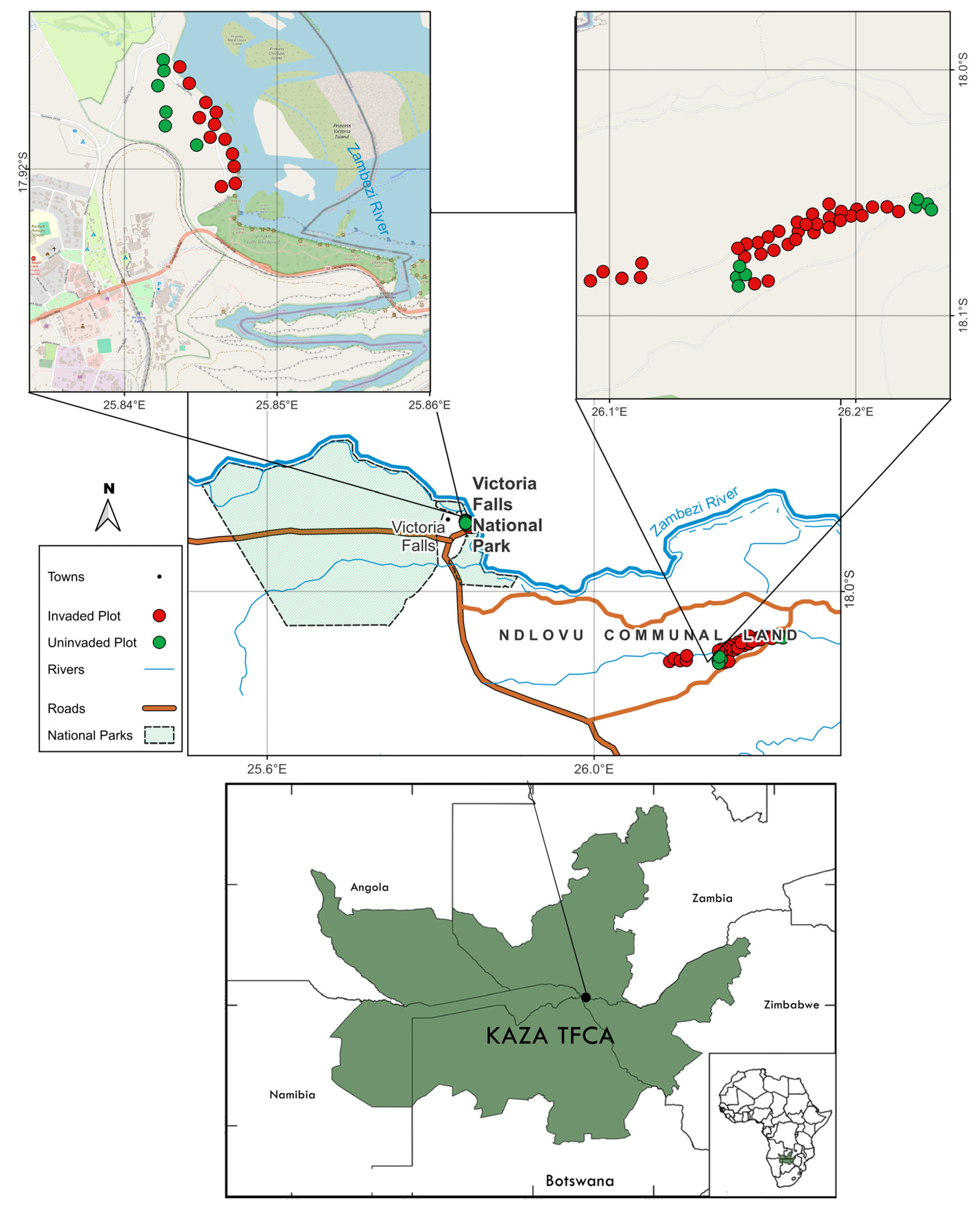
The study was conducted in north-western Zimbabwe within a portion of the Kavango–Zambezi Transfrontier Conservation Area (KAZA TFCA), specifically in Zambezi National Park (hereafter, the Park) and the adjacent Ndlovu Communal Area (hereafter, the Communal Area) (Figure 1). The KAZA TFCA, established in 2011, is the world’s largest transfrontier conservation area, spanning approximately 520,000 km2 across Angola, Botswana, Namibia, Zambia, and Zimbabwe (Figure 1) [24].
Zambezi National Park covers approximately 56,000 ha along the Zambezi River and is a protected area where human activities are minimal and largely limited to tourism and park management. In contrast, the Communal Area is characterised by multiple land-use activities, including small-scale subsistence agriculture, livestock grazing, fuelwood collection, and settlement expansion, resulting in comparatively higher levels of anthropogenic disturbance [25,26,28]. This contrasting land-use context (protected vs. communal) was deliberately selected to allow direct comparison of invasion effects while capturing variation in anthropogenic pressure and conservation status across the transfrontier landscape.
The study area falls within Agro-ecological Regions IV and V of Zimbabwe and receives low annual rainfall (approximately 400–500 mm), with most precipitation occurring during the summer season (October–April) [29,30]. Mean daily temperatures range from approximately 19 °C in winter to 30 °C in summer [31]. Soils are predominantly Kalahari sands with low fertility due to heavy leaching, although isolated patches of sandy loam occur [32]. Vegetation is mainly deciduous savanna woodland dominated by Afzelia quanzensis, Baikiaea plurijuga, Brachystegia boehmii, Colophospermum mopane, Combretum collinum, and Pterocarpus angolensis [33].

2.2. Sampling Design and Plot Selection

A reconnaissance survey was conducted to identify areas invaded by L. camara within both the Park and the Communal Area. Each area was subsequently stratified into “invaded” (visible L. camara cover present) and “uninvaded” (no visible or presence of L. camara) zones.
A stratified random sampling design was employed to assess differences between invaded and uninvaded sites across the two land-use categories (Park and Communal). The study area was divided into a 1 km × 1 km Universal Transverse Mercator (UTM) grid, within which potential sampling locations were randomly selected using Esri ArcGIS ArcMap version 10.6/ArcGIS Pro (Esri, Redlands, CA, USA) GIS software. Sampling plots measured 25 m × 25 m (~625 m2), a size selected to adequately capture woody vegetation structure, density, and canopy heterogeneity in deciduous savanna woodlands typical of the region [34]. This intermediate scale provides reliable estimates for tree and shrub variables in patchy invasions while remaining logistically feasible, consistent with practices in southern African savanna and invasion ecology research (e.g., comparable to 20 m × 20 m or larger plots used in woody vegetation assessments in semi-arid savannas; larger than the 10 m × 10 m plots often employed for herbaceous or seedling sampling in L. camara studies [12,34]. The research design was specifically selected to capture variation in invasion and land-use while controlling for site-level environmental factors. Invaded and uninvaded plots were paired within each site, allowing improved assessment of both main effects and interactions.
To minimise spatial autocorrelation, sampling plots were separated by a minimum distance of 200 m. Where feasible, invaded and uninvaded plots were paired within the same land-use category (Park or Communal). However, suitable uninvaded patches were limited in the Communal Area owing to extensive L. camara invasion and elevated anthropogenic disturbance. Consequently, the sampling was unbalanced, with more invaded than uninvaded plots overall (Park: n = 12 invaded, n = 6 uninvaded; Communal: n = 34 invaded, n = 8 uninvaded; total n = 60 plots). The smaller number of uninvaded plots reflected the scarcity of ecologically comparable reference sites devoid of L. camara, particularly in the Communal Area. Invaded plots were therefore intentionally oversampled to adequately represent the full gradient of invasion intensity and variability, while uninvaded plots were selected to maximise ecological similarity and serve as robust controls. This design choice mirrors real-world landscape patterns of invasion rather than constituting sampling bias and is consistent with established practices in invasion ecology, where the spatial dominance of the invader frequently constrains the availability of balanced uninvaded comparators [11,35].

2.3. Vegetation Attributes

Field data collection was conducted at the end of the rainy season (April–May 2018) to facilitate accurate plant identification. Native woody species were defined as hard-stemmed, self-supporting plants native to the region with a diameter at breast height (DBH) ≥ 5 cm. Species identification was undertaken using appropriate field guides [36,37]. In each plot, all woody plants were identified, and canopy cover %, DBH, and stem height were measured.
Crown cover was estimated by measuring the longest canopy diameter and the diameter perpendicular to it [36]. Mean canopy diameter was calculated as:
D   =   D l o n g + D p e r p 2
where D represents the mean crown diameter. Values were subsequently converted to percentages.
Canopy cover (%) was calculated as follows,
( i = 1 n π ( D i 2 ) 2 A ) × 100
where D i is the canopy diameter (m) of each woody plant in the plot, A is plot area, and the summation is over all woody plants recorded in the 25 m × 25 m plot (area = 625 m2).
Plant height was estimated using a ranging rod, and for multi-stemmed individuals, the height of the tallest stem was recorded [36,38]. DBH was measured using a diameter tape. For multi-stemmed individuals, mean DBH was calculated using the quadratic mean formula [39]:
D B H m e a n = i = 1 n d i n
where di represents the diameter of individual stems (m) and n is the number of stems.

2.4. Soil Attributes

Five soil samples were collected per plot, one from each corner and one from the centre. These were homogenised to form a composite sample [37]. Samples were collected at depths of 10–15 cm and sieved using a 2 mm mesh to remove stones and coarse organic matter.
In total, 60 composite soil samples (one per plot) were collected; however, due to analytical cost constraints, soil chemical analyses were conducted on a subset of 36 samples (20 from the Communal Area and 16 from the Park). Vegetation data were analysed using the full plot dataset, whereas analyses involving soil variables and soil–vegetation relationships are based only on this subset, and this limitation is acknowledged in the Discussion.
Soil analyses included nitrogen (N), phosphorus (P), potassium (K), pH, and organic carbon (OC). Nitrate nitrogen (NO3–N) was determined colorimetrically using a Shimadzu UV-1800 spectrophotometer (Copenhagen Nanosystems A/S, Copenhagen, Denmark), following extraction with a 1:10 soil:1 M KCl solution. Available phosphorus was measured using the Mehlich-3 extraction followed by colorimetric analysis [40]. Exchangeable potassium was analysed using flame emission spectrometry (Varian AA 200 Varian Inc., Palo Alto, CA, USA) after Mehlich extraction. Organic carbon was determined using the Walkley–Black method [41]. All analyses were conducted at the Department of Applied Chemistry Laboratory, National University of Science and Technology (NUST), Zimbabwe.

2.5. Data Analysis

Species diversity was calculated using the Shannon–Wiener diversity index (H′) in PAST software (version 3.26, Øyvind Hammer, Natural History Museum, University of Oslo, Norway). Species density was calculated as stems per hectare, while species frequency of occupancy was calculated as the proportion of plots in which each species occurred.
Normality and homogeneity of variance were assessed using Shapiro–Wilk and Levene’s tests, respectively. Two-way permutational multivariate analysis of variance (PERMANOVA) was used to examine the effects of site and invasion status on woody species diversity and vegetation attributes. Two-way analysis of variance (ANOVA) was applied to normally distributed variables, while the non-parametric Mann–Whitney U test was used to compare invaded Communal and Park sites for L. camara structural attributes, species richness, and diversity.
A two-way analysis of similarities (ANOSIM) was used to test differences in woody species composition between sites and invasion categories [42]. Non-metric multidimensional scaling (NMDS), based on Bray–Curtis dissimilarities, was used to visualise patterns in species composition [42]. NMDS was performed in two dimensions, and ordinations with final stress ≤ 0.10 were considered a good fit. Analysis of similarity (ANOSIM; 999 permutations) was used to test for significant differences among site groupings. Cluster analysis was employed to illustrate similarities between invaded and uninvaded sites. ANOSIM and cluster analyses were conducted using PRIMER v6 with the PERMANOVA+ add-on (PRIMER-E Ltd., Auckland, New Zealand) while NMDS was performed using the Vegan Community Ecology Package in R (Version 4.3-1, R Core Team, Vienna, Austria) with vegan package (version 2.6-4) [43].
Detrended Correspondence Analysis (DCA) was used to determine gradient lengths and select an appropriate ordination model [44,45]. Canonical Correspondence Analysis (CCA) was then applied to examine relationships between woody species composition and soil variables, as gradient lengths exceeded 3.5 standard deviation units. Forward selection with Monte Carlo permutation tests (999 permutations, p < 0.05) was used to assess model significance and identify key soil variables. Pearson correlation analysis was conducted to examine relationships between soil variables and species diversity metrics. Ordination analyses were conducted in Vegan [43], while correlation analyses were performed using STATISTICA v13 (TIBCO Software Inc., Palo Alto, CA, USA).
Statistical analyses were performed in R (version 4.3.1) using the packages vegan, agricolae, and multcomp. Data were tested for normality and homogeneity of variances using the Shapiro–Wilk and Levene’s tests, respectively. Variables that met the assumptions of normality and homogeneity of variances were treated as parametric and analysed using two-way analysis of variance (ANOVA), followed by Tukey’s HSD post hoc tests; these included soil chemical and structural variables such as soil pH, potassium, and canopy cover percentage. Variables that violated these assumptions were treated as non-parametric and analysed using Kruskal–Wallis tests, followed by Dunn’s post hoc tests; these included community and density-related variables such as species richness, stem density, and phosphorus concentration. Significance was assessed at p < 0.05. Different lowercase letters within rows in tables indicate statistically significant differences between groups (p < 0.05) based on the respective post hoc tests.

3. Results

3.1. Vegetation Structure and Diversity

Invaded plots were markedly different from uninvaded plots with respect to all investigated variables, and this pattern was consistent across both the Park and Communal areas (Table 1). Invaded plots had significantly lower woody plant stem height, stem diameter, density, canopy cover %, diversity, and species richness than uninvaded plots (Table 1). The most pronounced difference was observed in native species canopy cover %, which declined from 72.5–81% (±9.4–14.7 SE) in uninvaded plots to 6.6–9% (±5.9–10.5 SE) in invaded plots (Table 1). Stem density also showed a marked reduction due to invasion (p < 0.002; F = 18.59), with uninvaded plots in both the Park and Communal areas having higher stem density (1308–1561 stems/ha) than invaded plots (228–479 stems/ha; Table 1).
Woody plant species richness differed significantly, with the highest richness in uninvaded Park plots, followed by uninvaded Communal plots, and then invaded sites (Table 1). Consequently, the Shannon–Wiener index indicated higher diversity in uninvaded plots than in invaded ones. There were no significant differences in species diversity between sites within the same invasion category (Table 1). Comparison of L. camara between the Communal Area and Park revealed approximately seven times higher density (Z = 4.5; p = 0.001) and more than four times greater canopy cover % (Z = 4.2; p = 0.001) in the Communal Area than in the Park. Mean height of L. camara was also approximately double in the Communal Area compared to the Park (Z = 3.4; p = 0.001; Table 1).

3.2. Species Composition and Its Association with the Invasion of L. camara

Fifty native woody species from 21 families were recorded (Table 2). Uninvaded plots in the Park had the most species (48), whereas the invaded plots in the Communal Area had the lowest number (25). Generally, woody species were more abundant in the uninvaded sites; this was particularly so in Communal areas (ANOSIM R = 0.8; p = 0.001) (Table 3). The same distribution pattern was evident in the Park, except for species such as Diospyros mespiliformis and Hyphaene coriacea that had equal or greater frequency in invaded plots than in uninvaded plots. Apart from the plots in the Park having more frequently occurring species, the ANOSIM revealed that the differentials between invaded and uninvaded conditions were greater in the Communal plots (Table 3).
The most frequently occurring species, with an occupancy frequency greater than 70% across uninvaded sites, were Afzelia quanzensis, Albizia harveyi, Bauhinia petersiana, Colophospermum mopane, Combretum imberbe, Dichrostachys cinerea, Diplorhynchus condylocarpon, Euclea divinorum, Grewia flavescens, and Terminalia sericea. Only Combretum imberbe had high frequencies (greater than 50%) in the invaded sites (Table 2).

3.3. Species Composition-Ordination and Clustering

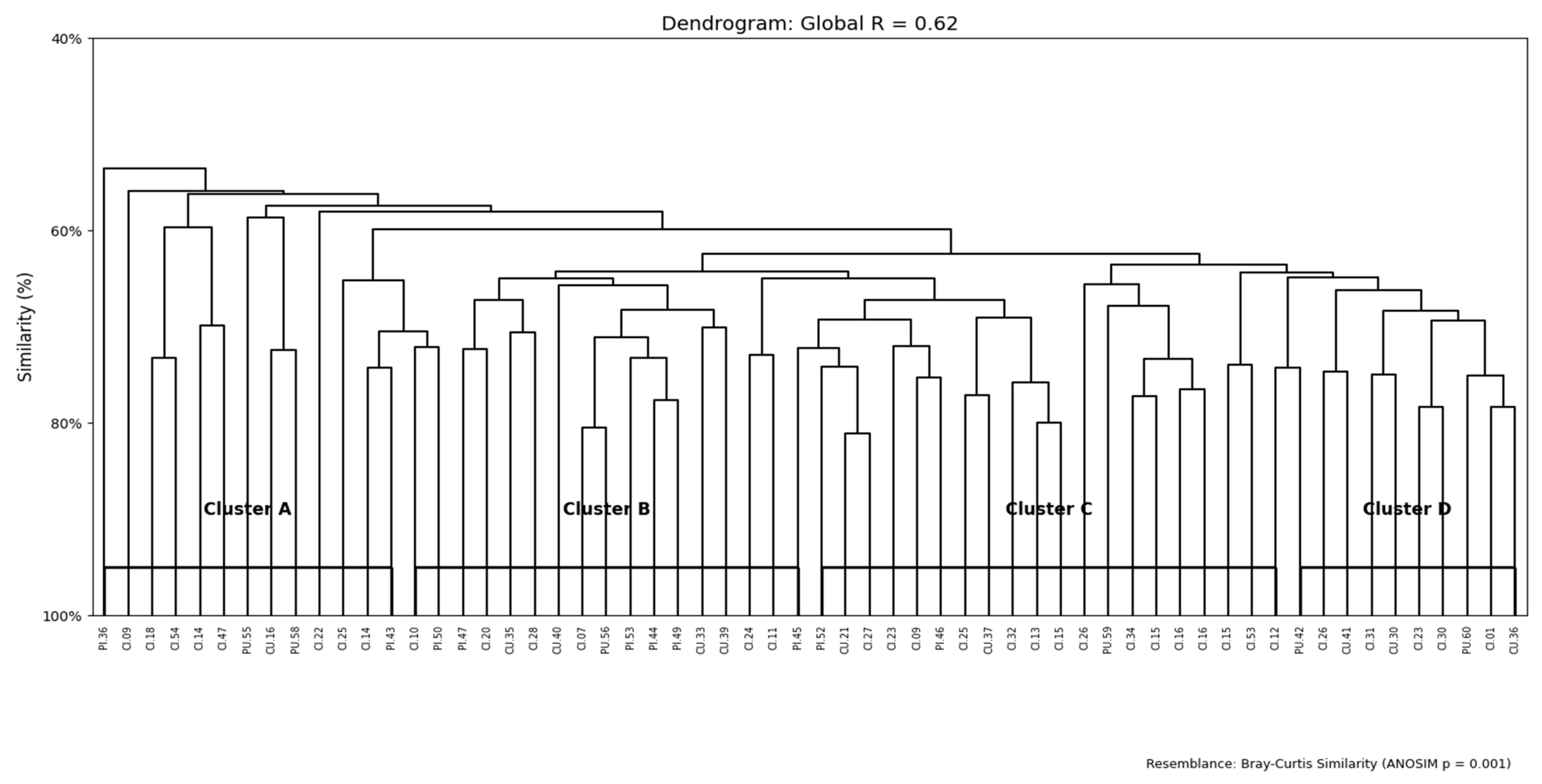
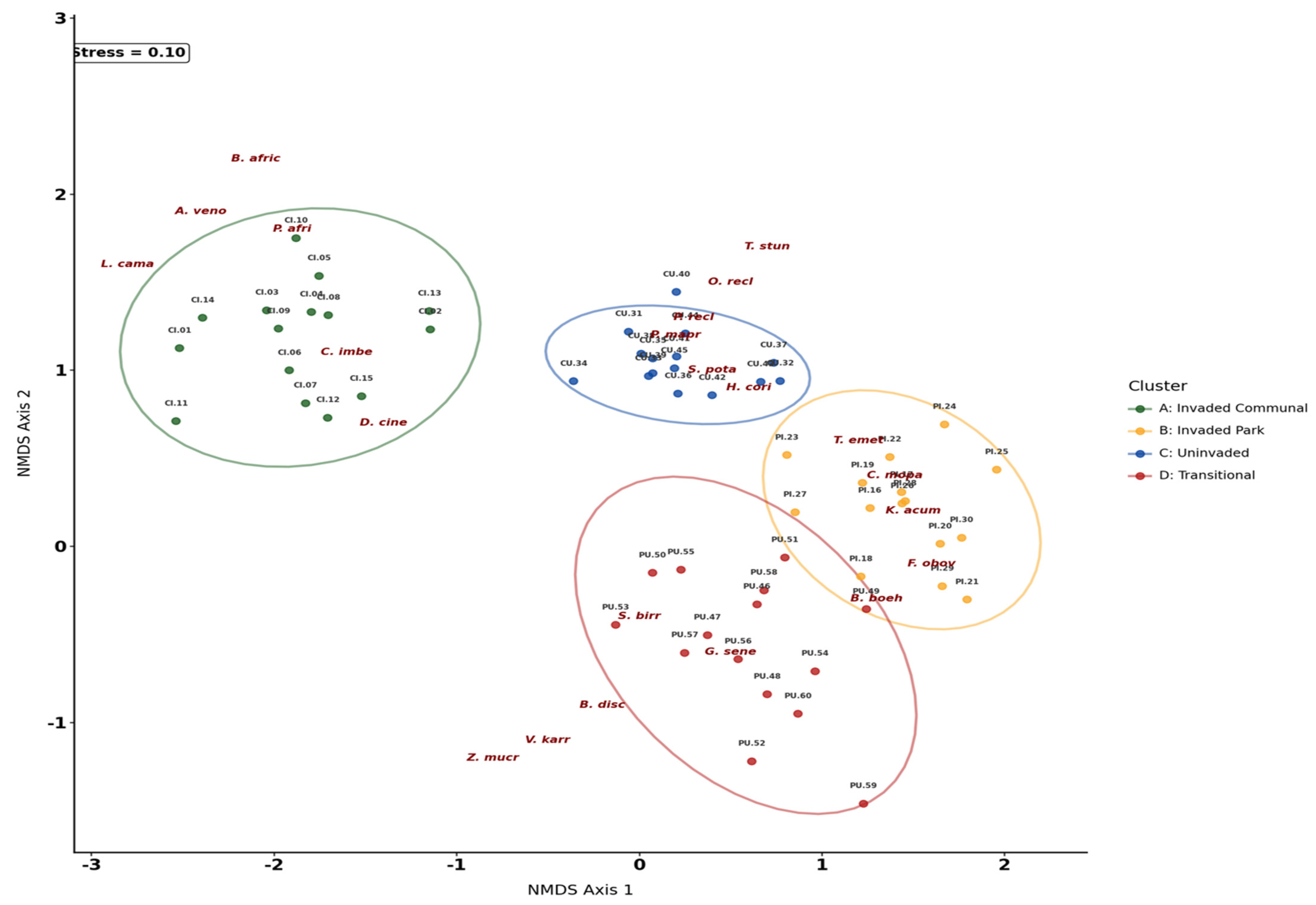
Building on the patterns observed in the NMDS ordination (Figure 2), hierarchical cluster analysis identified four clusters based on compositional similarity (Figure 3). Consistent with the NMDS ordination, these clusters were not discrete and showed overlap among invasion and land-use categories. Cluster A was largely composed of invaded Communal sites, whereas Cluster B was primarily associated with invaded Park sites. Cluster C consisted mostly of uninvaded sites from both land-use types, while Cluster D included a mixture of invaded and uninvaded sites and occupied an intermediate position in the ordination space, reflecting transitional assemblages. Both NMDS ordination and hierarchical clustering were derived from the same dissimilarity matrix but capture different aspects of community structure, which may result in slight variation in the placement of transitional samples.

3.4. Effects of L. camara on Soil Nutrients, Species Composition, and Diversity

There were significant differences in soil nutrients between invaded and uninvaded areas (Table 4). The most significantly affected variable was pH, which was lower in invaded sites across both areas. Phosphorus showed trends toward higher values in invaded sites, especially in Communal areas where uninvaded levels were notably low, and organic carbon was higher in invaded Communal sites but lower in Park sites. For example, organic carbon was approximately two times higher in the invaded sites than in the uninvaded sites in the Communal Area. Phosphorus was up to 19 times higher in the invaded sites than in the uninvaded sites in the Communal Area (Table 4).
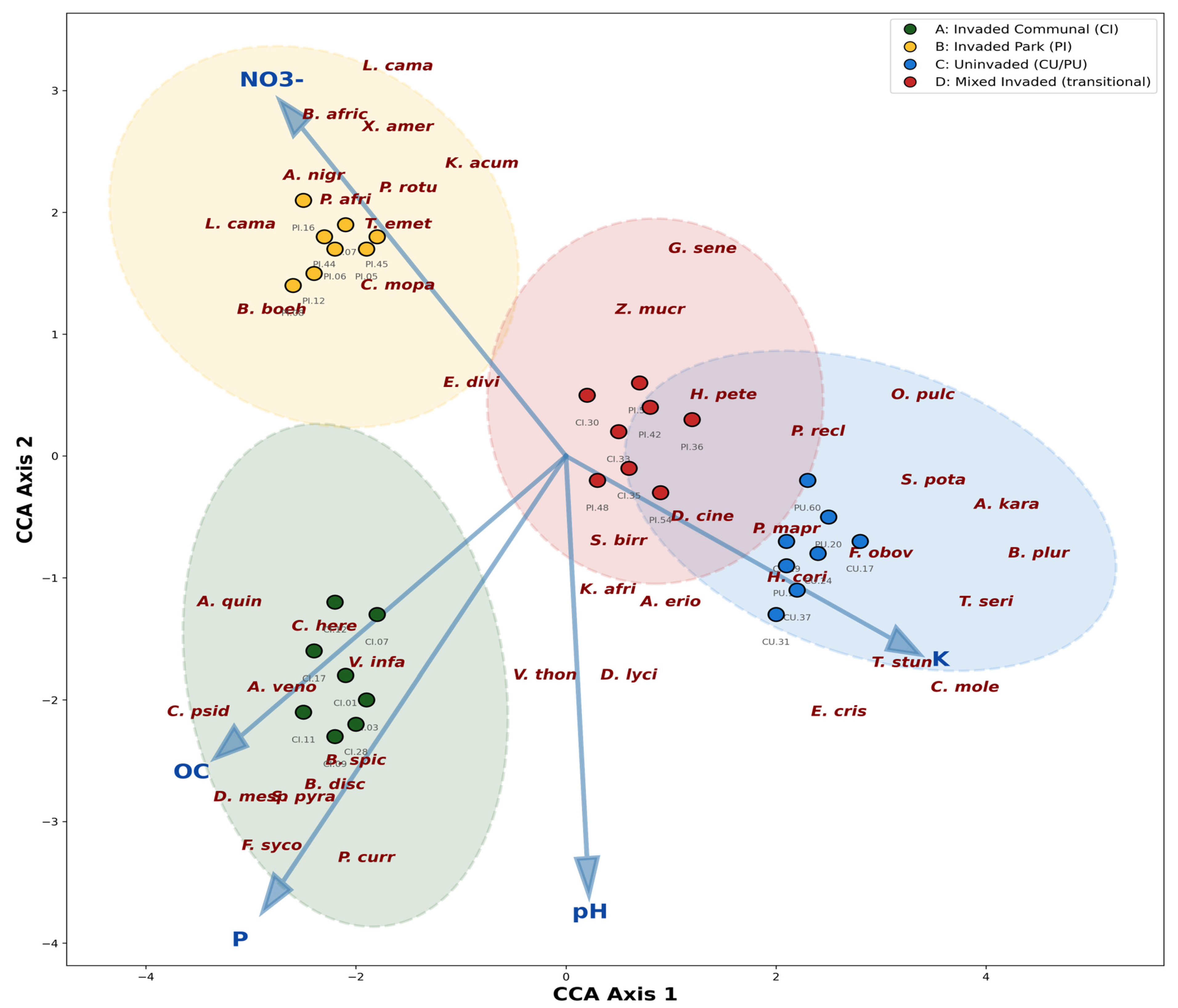
The Monte Carlo permutation test revealed that the CCA model was statistically significant (p < 0.05), indicating that the soil variables had a significant effect on the composition of woody species in both locations. The CCA revealed that the first two axes explained 54% of the total variation between species composition and soil nutrient variables (Table 5, Figure 4). The CCA ordination plot revealed that pH and OC were the most important soil variables influencing the distribution of native woody species at the two sites (Table 5, Figure 4). pH and organic carbon (OC) showed negative associations with the invaded Communal sites (Figure 4).
Cluster analysis and NMDS ordination revealed four clusters representing gradients in woody species composition, with considerable overlap among invasion and land-use categories (Figure 2 and Figure 3). Cluster A, largely comprising communal invaded sites, was associated with elevated NO3 concentrations and disturbance-tolerant taxa, including Lantana camara, Berchemia africana, and Dichrostachys cinerea. Cluster C consisted predominantly of uninvaded sites from both land-use types but included a small subset of communal invaded plots that grouped with uninvaded sites due to high compositional similarity to native savanna states, characterised by lower pH and higher organic carbon. Cluster D represented a mixed/transitional grouping of invaded and uninvaded plots, associated with intermediate assemblages and taxa such as Afzelia quanzensis. In contrast, Cluster B was primarily associated with invaded park sites and species such as Colophospermum mopane and Kigelia africana. Overall, these patterns are supported by ANOSIM (Global R = 0.62, p = 0.001), indicating that while invasion alters woody assemblages, its effects are mediated by land-use history, with some communal sites retaining native-like compositional characteristics despite the presence of L. camara. Species positions in the figures are labelled using abbreviations provided in Table S1 (Supplementary Materials).
Of the ten vegetation attributes considered, only three were significantly associated with soil nutrients (p < 0.05; Table 6). Native woody species DBH significantly lower with increasing pH and OC, whereas L. camara height increased with increasing K. Conversely, K negatively affected the canopy cover % of L. camara (Table 6).
Interaction effects were detected for some variables, indicating context-dependent responses in vegetation structure and soil properties (Table 7).

4. Discussion

4.1. Effects of L. camara Invasion on Vegetation Structure and Diversity

Invaded sites exhibited significantly lower native woody species richness, Shannon–Wiener diversity, stem density, height, diameter at breast height, and canopy cover % compared to uninvaded sites in both land-use categories (Table 1). These patterns support H1, demonstrating that L. camara presence is associated with shifts in native woody structure and reduced diversity, with evidence of stronger suppression in communal areas due to higher anthropogenic disturbance. The significant interactions for canopy cover and soil organic carbon (Table 7) indicate that land-use context modulates some invasion associations [6,10,25,46]. These results are consistent with previous studies reporting reduced native plant diversity and structural attributes in L. camara–invaded sites [11,47,48], including Ruwanza [11], which documented similar declines in South African invaded sites.
In this study, the significant reductions in richness, diversity, and structural variables support the association between L. camara presence and suppression of native woody species, potentially through competition for resources or allelopathic effects [6,48]. However, the lower values observed in uninvaded Communal sites relative to uninvaded Park sites suggest that land-use disturbance may also contribute to lower vegetation attributes independently of invasion [18,25].
These findings have broader ecological implications for savanna woodlands in transfrontier conservation areas: prolonged suppression of woody structure and diversity in disturbed communal zones could reduce ecosystem resilience, limit recruitment of key canopy species, and alter habitat quality for wildlife dependent on diverse woody cover.

4.2. Effects of Invasion on Species Composition

Woody species composition differed significantly between invaded and uninvaded sites, with stronger separation in the Communal Area (ANOSIM R = 0.8, p = 0.001; Table 3). Uninvaded sites had higher species richness (48 species in uninvaded Park plots vs. 25 in invaded Communal plots; Table 2) and greater frequency of occurrence for many native species such as Afzelia quanzensis and Colophospermum mopane (>70% in uninvaded sites). Only Combretum imberbe maintained high frequency (>50%) in invaded sites.
NMDS ordination and cluster analysis revealed clear groupings by invasion status and land use (Figure 2 and Figure 3), consistent with findings that L. camara presence is associated with altered community composition [26]. The more pronounced differences in Communal areas likely reflect higher invasion intensity there. These shifts support H1 by indicating competitive exclusion or lower recruitment of less tolerant natives in invaded sites, although pre-existing site conditions cannot be ruled out as a contributing factor [11,22,49].
From a broader perspective, such compositional shifts may reduce functional diversity (e.g., loss of large-seeded canopy species important for seed dispersal and carbon storage), with cascading effects on ecosystem services like fodder availability and ecotourism value in the KAZA TFCA.

4.3. Effects of L. camara on Soil Nutrients

The soil patterns observed in this study indicate that the influence of L. camara on edaphic conditions is neither uniform nor universally transformative but instead mediated by land-use intensity and local disturbance regimes [8,11]. Rather than producing consistent nutrient enrichment or depletion, invasion appears to interact with pre-existing soil characteristics and management histories, resulting in heterogeneous outcomes across the landscape [18,20,50]. This variability suggests that L. camara functions less as a sole driver of soil change and more as a reinforcing agent within already altered or disturbed environments.
The tendency toward lower soil pH in invaded communal areas points to potential acidification processes associated with dense shrub thickets, possibly linked to increased litter accumulation, altered microbial activity, or shifts in decomposition pathways [16,19]. Such mechanisms are widely recognised in invasion ecology, where changes in litter quality and root exudates can influence soil chemical balances [16]. However, the absence of comparable trends across all nutrients and land-use types indicates that these processes are not universally expressed and may depend on disturbance frequency, grazing pressure, and vegetation turnover [8]. In this context, soil responses appear to reflect an interaction between invasion and anthropogenic land use rather than a direct and uniform ecological transformation [11,18].
The multivariate analysis (Table 5) further supports this interpretation by showing that soil variables contribute to vegetation structuring at the community level, yet exert limited influence on individual species attributes. This pattern implies that while soil conditions help shape overall compositional gradients, they do not singularly determine invasion success or native species performance. Instead, invasion dynamics likely emerge from a combination of above-ground competition, disturbance regimes, and microhabitat variability, with soil nutrients acting as one component within a broader ecological network [8]. The selective nature of these associations supports the importance of considering both biotic and abiotic drivers when interpreting invasion impacts.
Taken together, the findings provide partial support for the hypothesis that L. camara alters soil properties, but they also indicate that such alterations are context dependent and often subtle [20]. The relatively limited number of strong nutrient shifts suggests that invasion may frequently occur in sites where soil conditions are already conducive to establishment, rather than consistently inducing major chemical transformations after colonisation [20]. This differentiation is important, as it shifts the narrative from invasion as a purely causal agent to invasion as a process embedded within existing environmental gradients and land-use legacies.
From a management perspective within the KAZA TFCA, these insights emphasise the need for spatially differentiated and adaptive strategies. Communal landscapes where disturbance pressures and invasion intensity are higher may require more proactive monitoring, community-based control initiatives, and post-clearing ecological restoration to prevent further woody species decline and maintain soil functionality. In contrast, protected areas appear to exhibit greater ecological buffering capacity, suggesting that natural recovery processes may be more effective once invasive pressure is low. Overall, the soil–invasion relationship observed here reinforces the importance of integrating land-use heterogeneity, disturbance history, and local ecological context into conservation planning, rather than assuming uniform below-ground impacts of invasive shrub encroachment across transfrontier conservation systems.

4.4. Limitations and Interpretation of Cause–Effect Relationships

The significant associations between L. camara presence and lower native woody species richness, diversity, and structural attributes are clear (Table 1 and Table 3), but it remains uncertain whether presence directly caused these changes or whether pre-existing site conditions (e.g., higher disturbance, grazing, or soil properties in communal areas) facilitated L. camara establishment while independently affecting native vegetation and soils. The observed associations between the presence of L. camara and reduced native woody species density, height, and canopy cover should be interpreted with caution because the cross-sectional study design does not allow causal inference.
Although reductions in native woody structure are consistent with suppression by L. camara, pre-existing canopy openness or disturbance may have facilitated invasion, rather than being solely a consequence of it. As Sundaram and Hiremath [15] demonstrated across multiple forest types, canopy gaps and anthropogenic disturbance are key drivers of L. camara invasibility. The significant interaction between invasion status and site (Table 7) further indicates that land-use context modulates these relationships, but the cross-sectional design prevents full disentangling of cause and effect. Consistent patterns across the NMDS ordination (Figure 2), dendrogram (Figure 3), and CCA biplot (Figure 4) highlight the association between invasion and altered woody composition, warranting further investigation into causal mechanisms. Future longitudinal or experimental studies are needed to clarify these feedbacks.
Canopy gaps and disturbed conditions are widely reported as important drivers of L. camara invasibility in heterogeneous landscapes [15]. The significant interactions for canopy cover and soil organic carbon (Table 7) indicate that land-use context modulates some invasion associations, further suggesting that the strength and nature of these relationships depend on site-specific conditions [15]. The stronger separation between invaded and uninvaded plots within sites, reflected in pairwise R values ranging from 0.4 to 0.9, compared with differences between land-use types, suggests that invasion status plays a major role in structuring vegetation patterns. However, site-specific disturbance likely influences the magnitude of these associations, which is consistent with the higher anthropogenic pressure observed in communal lands. The unequal sampling (more invaded than uninvaded plots) reflects real landscape patterns but may have low statistical power for some comparisons. Future studies employing paired invaded–uninvaded designs, longitudinal monitoring, or manipulative experiments would help better disentangle cause and effect.

5. Conclusions

The results indicate that the presence of L. camara is associated with reduced native woody vegetation structure and diversity in both Communal and Park areas of the KAZA TFCA (Table 1; Figure 2). Invaded plots showed lower canopy cover (6.6–9.0% vs. 72.5–81.0% in uninvaded plots) and stem density (228–479 stems/ha vs. 1308–1561 stems/ha), together with shifts in species composition (Clusters A and B; Figure 2 and Figure 3). Uninvaded plots (Cluster C) supported more diverse assemblages dominated by native species such as Combretum imberbe, Brachystegia spiciformis, and Kigelia africana. Soil properties showed variable patterns, with trends toward lower pH and higher organic carbon and phosphorus in invaded communal sites (Figure 4), though these were inconsistent and likely modulated by land-use context.
These findings contribute to understanding context-specific effects of L. camara in transfrontier conservation landscapes, where communal areas appear more vulnerable to invasion-associated changes, possibly due to higher anthropogenic disturbances. However, the cross-sectional design limits inference of causation, and pre-existing conditions may have influenced invasion success [15]. Longitudinal or experimental studies are needed to clarify these relationships.
The results highlight the need for targeted management in disturbed communal zones to protect native woody species and ecosystem services such as fodder, medicinal plants, and habitat. Monitoring and early intervention in protected areas could limit edge spread. Adaptive policies tailored to land-use systems would support conservation goals in the KAZA TFCA.


Supplementary Materials

The following supporting information can be downloaded at: https://www.mdpi.com/article/10.3390/environments13050243/s1, Table S1. Standardised abbreviations of woody species used in NMDS ordination (Figure 2), dendrogram (Figure 3), and CCA biplot (Figure 4). Table S2. Representative sampling sites grouped into four clusters (A–D) based on Bray–Curtis similarity of native woody species composition. Site codes are standardised and used consistently across multivariate analyses (CCA, NMDS, dendrograms, and other figures). Only a representative subset of sites is shown; the complete list of all 60 sites is available from the corresponding author upon reasonable request.

Author Contributions

Conceptualization, B.F. and C.S.; methodology, B.F. and C.S.; investigation, B.F.; resources, B.F.; data curation, B.F.; formal analysis, B.F.; writing—original draft preparation, B.F.; writing—review and editing, B.F. and C.S.; visualisation, B.F.; supervision, C.S.; project administration, C.S.; funding acquisition, C.S. All authors have read and agreed to the published version of the manuscript.

Funding

This work was conducted within the framework of the Research Platform “Production and Conservation in Partnership” and has been produced with the financial assistance of the European Union (DREAM project—FED/2013/333-266). The contents of this document are the sole responsibility of the authors and can under no circumstances be regarded as reflecting the position of the European Union. Charlie Shackleton was funded by the South African Research Chairs Initiative of the Department of Science and Technology and the National Research Foundation of South Africa (Grant no. 84379). Any opinion, finding, conclusion or recommendation expressed in this material is that of the authors and the NRF does not accept any liability in this regard.

Data Availability Statement

The data presented in this study were collected as part of a doctoral research project archived in the institutional repository of Rhodes University. The dataset analysed in this article has not been previously published in a peer-reviewed journal. The data are available from the corresponding author upon reasonable request. The data are not publicly available due to ongoing related research.

Acknowledgments

The authors would like to acknowledge the invaluable contributions of the research assistants, namely Frank Akamagwuna, Sibonokuhle Ncube, Tatenda Manyuchi, Ngoni Chiweshe, Tendai Tsopo, Agrippa Ngorima, and Brandon Francis. We are also grateful for the guidance, intellectual input, and support provided by Sheunesu Ruwanza, Gladman Thondlana, and James Gambiza, as well as the many colleagues who offered insights and assistance during and after the fieldwork. We appreciate the invaluable support from the European Union (DREAM project—FED/2013/333-266) in partnership with the Research Platform “Production and Conservation in Partnership”. Also, we are grateful to the Department of Applied Chemistry at the National University of Science and Technology (NUST), Zimbabwe, for assistance with soil sample analysis. Thank you to the Department of Parks and Wildlife in Zimbabwe, for authorising the study (PERMIT No.123(1)(C) (ID 01/2017) in the KAZA TFCA in Zimbabwe. Much appreciation is extended to the CIRAD office in Harare, Zimbabwe, for their generous support throughout the study. During the preparation of this manuscript, the authors used Grok 4 (built by xAI), the free version of Grammarly, and the free version of ChatGPT (GPT-5.2 Instant, provided by OpenAI) for the purposes of drafting and refining section texts, checking formatting compliance, and suggesting structural improvements. The authors have reviewed and edited the output and take full responsibility for the content of this publication.

Conflicts of Interest

The authors declare no conflicts of interest. The funders (European Union under the DREAM project, grant agreement FED/2013/333-266, the Research Platform “Production and Conservation in Partnership”) and NRF had no role in the design of the study; in the collection, analyses, or interpretation of data; in the writing of the manuscript; or in the decision to publish the results.

Abbreviations

The following abbreviations are used in this manuscript:
AbbreviationFull Form
KAZA TFCAKavango–Zambezi Transfrontier Conservation Area
PERMANOVAPermutational Multivariate Analysis of Variance
ANOSIMAnalysis of Similarities
IAPsInvasive Alien Plants
NMDSNon-metric Multidimensional Scaling
NUSTNational University of Science and Technology
TFCATransfrontier Conservation Area
CCACanonical Correspondence Analysis
DBHDiameter at Breast Height
DCADetrended Correspondence Analysis
IAPInvasive Alien Plant
IASInvasive Alien Species
UTMUniversal Transverse Mercator
OCOrganic Carbon

References

  1. Gentili, R.; Schaffner, U.; Martinoli, A.; Citterio, S. Invasive alien species and biodiversity: Impacts and management. Biodiversity 2021, 22, 1–3. [Google Scholar] [CrossRef]
  2. Ssali, F.; Baluku, R.; Drileyo, G.; Muhumuza, M. Associations between Lantana camara L. (Verbenaceae) and common native species in an African savanna. Ecol. Solut. Evid. 2024, 5, e12375. [Google Scholar] [CrossRef]
  3. Dube, T.; Shoko, C.; Sibanda, M.; Madileng, P.; Maluleke, X.G.; Mokwatedi, V.R.; Tshebesebe, T. Remote sensing of invasive Lantana camara in semiarid savanna rangelands of South Africa. Rangel. Ecol. Manag. 2020, 73, 411–419. [Google Scholar] [CrossRef]
  4. Mondal, T.; Bhatt, D.; Ramesh, K. Bioclimatic modelling of Lantana camara invasion in the Shivalik landscape of Western Himalaya. Trop. Ecol. 2023, 64, 249–263. [Google Scholar] [CrossRef]
  5. Barik, S.S.; Sahoo, R.P.; Yadav, M.K. Lantana camara L.: An emerging threat to native flora and livestock: A review. J. Pharmacogn. Phytochem. 2020, 9, 2363–2366. [Google Scholar]
  6. Barahukwa, A.; Chapman, C.A.; Namaganda, M.; Eilu, G.; Omeja, P.A.; Lawes, M.J. The effects of the invasive species, Lantana camara, on regeneration of an African rainforest. Afr. J. Ecol. 2023, 61, e13133. [Google Scholar] [CrossRef]
  7. Kato-Noguchi, H.; Kurniadie, D. Allelopathy of Lantana camara as an invasive plant. Plants 2021, 10, 1028. [Google Scholar] [CrossRef]
  8. Hansda, P.; Kumar, S.; Singh, S.; Garkoti, S.C. Assessing the influence of invasion of Lantana camara on vegetation attributes and soil properties across varied disturbance gradients in semi-arid forests of the Aravali Hills, Delhi. Plant Ecol. 2024, 225, 893–906. [Google Scholar] [CrossRef]
  9. Paul, R.; Subudhi, D.K.; Sahoo, C.K.; Banerjee, K. Invasion of Lantana camara and climate change responses in Eastern Ghats. Biologia 2021, 76, 1391–1408. [Google Scholar] [CrossRef]
  10. Kato-Noguchi, H.; Kato, M. Compounds Involved in the Invasive Characteristics of Lantana camara. Molecules 2025, 30, 411. [Google Scholar] [CrossRef]
  11. Ruwanza, S. Effects of Lantana camara invasion on vegetation diversity and composition in the Vhembe Biosphere Reserve, Limpopo Province of South Africa. Sci. Afr. 2020, 10, e00610. [Google Scholar] [CrossRef]
  12. Raphela, T.D.; Duffy, K.J. Effects of the density of invasive Lantana camara plants on the biodiversity of large and small mammals in the Groenkloof Nature Reserve (GNR) in South Africa. Biology 2023, 12, 296. [Google Scholar] [CrossRef] [PubMed]
  13. Choudaj, K.; Wankhade, V. Reduction in avian diversity due to exotic tree plantations on the native savannas of Pune City, India. Trop. Ecol. 2021, 62, 499–507. [Google Scholar] [CrossRef]
  14. Tomat-Kelly, G.; Flory, S.L. Research gaps in invasion–fire cycles. Biol. Invasions 2023, 25, 693–711. [Google Scholar] [CrossRef]
  15. Sundaram, B.; Hiremath, A.J. Lantana camara invasion in a heterogeneous landscape: Patterns of spread and correlation with changes in native vegetation. Biol. Invasions 2012, 14, 1127–1141. [Google Scholar] [CrossRef]
  16. Kumar, M.; Kumar, S.; Verma, A.K.; Joshi, R.K.; Garkoti, S.C. Invasion of Lantana camara and Ageratina adenophora alters the soil physico-chemical characteristics and microbial biomass of chir pine forests in the central Himalaya, India. Catena 2021, 207, 105624. [Google Scholar] [CrossRef]
  17. Tekulu, K.; Gebrehiwot, W.; Kahsu, G.; Tadele, T.; Berhe, T.; Mebrahtom, S. Response of soil chemical properties under tef (Eragrostis tef (Zucc.) Trotter) field to integrated application of Lantana camara L. weed vermicompost and NPS mineral fertilizer. Int. J. Agron. 2024, 2024, 8814314. [Google Scholar] [CrossRef]
  18. Mandiporeva, J.; Gamundani, T.P.; Gurajena, B.; Mpakairi, K.; Magqina, T. Spatial distribution and effects of Lantana camara invasion on soil properties and native vegetation community composition in Tugwi–Mukosi Recreational Park, Masvingo, Zimbabwe. Afr. J. Ecol. 2023, 61, 185–203. [Google Scholar] [CrossRef]
  19. Paudel, C.K.; Tiwari, A.; Baniya, C.B.; Shrestha, B.B.; Jha, P.K. High impacts of invasive weed Lantana camara on plant community and soil physico-chemical properties across habitat types in Central Nepal. Forests 2024, 15, 1427. [Google Scholar] [CrossRef]
  20. Mahla, N.; Mlambo, D. Influence of two co-occurring invasive plant species on resident woody species and surface soil properties in Chipinge Safari Area, Zimbabwe. Trop. Ecol. 2019, 60, 129–139. [Google Scholar] [CrossRef]
  21. Lone, P.A.; Kothandaraman, S.; Dar, J.A.; Hakeem, K.R.; Khan, M.L. Invasive shrub (Lantana camara L.) alters tree diversity and ecosystem-level carbon pools in tropical forests of Central India. Front. For. Glob. Change 2025, 8, 1412130. [Google Scholar] [CrossRef]
  22. Dar, M.A.; Ahmad, M.; Singh, R.; Kohli, R.K.; Singh, H.P.; Batish, D.R. Invasive plants alter soil properties and nutrient dynamics: A case study of Anthemis cotula invasion in Kashmir Himalaya. Catena 2023, 226, 107069. [Google Scholar] [CrossRef]
  23. Hussain, S.; Sharma, S.; Bhatti, R.C.; Singh, A.N. Sustainability in the Indian Himalayan Region: Under-standing the ecosystem services, climate change impacts, land use shifts and their threats. In The Himalayas in the Anthropocene: Environment and Development; Borthakur, A., Singh, P., Eds.; Springer: Cham, Switzerland, 2024; pp. 33–57. [Google Scholar] [CrossRef]
  24. Stoldt, M.; Göttert, T.; Mann, C.; Zeller, U. Transfrontier Conservation Areas and Human-Wildlife Conflict: The Case of the Namibian Component of the Kavango-Zambezi (KAZA) TFCA. Sci. Rep. 2020, 10, 7964. [Google Scholar] [CrossRef] [PubMed]
  25. Alexiou, P.; Brekl, J.; Köhler, E.; van Engelen, W. Performing multispecies studies in Southern Africa: Historical legacies, marginalised subjects, reflexive positionalities. Anthropol. S. Afr. 2024, 47, 254–267. [Google Scholar] [CrossRef] [PubMed]
  26. Muguti, T. Human-wildlife conflicts and livelihoods in Binga District, Zimbabwe: Local communities’ lived experiences. In Living with Wildlife in Zimbabwe; Matanzima, J., Utete, B., Eds.; Springer: Cham, Switzerland, 2024; pp. 41–57. [Google Scholar] [CrossRef]
  27. Shackleton, R.T.; Witt, A.B.; Aool, W.; Pratt, C.F. Distribution of the invasive alien weed, Lantana camara, and its ecological and livelihood impacts in eastern Africa. Afr. J. Range Forage Sci. 2017, 34, 1–11. [Google Scholar] [CrossRef]
  28. Zimbabwe Vulnerability Assessment Committee (ZimVAC). Food and Nutrition Security Update Report; Zimbabwe Vulnerability Assessment Committee (ZimVAC): Harare, Zimbabwe, 2020; Available online: https://fnc.org.zw/wp-content/uploads/2020/03/ZimVAC-2020-Food-and-Nutrition-Security-Update-Report.pdf (accessed on 15 May 2024).
  29. Tambo, G.; Chabikwa, G.T.; Daga, O.; Dhlomo, J.L. Livestock production system in Ward 12, Tsholotsho District, Zimbabwe: Characterization and potential productivity enhancement. In CGIAR Research Program on Livestock Report; CGIAR: Montpellier, France, 2021; Available online: https://cgspace.cgiar.org/handle/10568/80114 (accessed on 10 June 2024).
  30. Sharara, A.; Shekede, M.D.; Gwitira, I.; Masocha, M.; Dube, T. Fine-scale multi-temporal and spatial analysis of agricultural drought in agro-ecological regions of Zimbabwe. Geomat. Nat. Hazards Risk 2022, 13, 1342–1365. [Google Scholar] [CrossRef]
  31. Mupangwa, W.; Chipindu, L.; Ncube, B.; Mkuhlani, S.; Nhantumbo, N.; Masvaya, E.; Ngwira, A.; Moeletsi, M.; Nyagumbo, I.; Liben, F. Temporal changes in minimum and maximum temperatures at selected locations of Southern Africa. Climate 2023, 11, 84. [Google Scholar] [CrossRef]
  32. Chapungu, L.; Nhamo, G.; Dube, K.; Chikodzi, D. Soil erosion in the savanna biome national parks of South Africa. Phys. Chem. Earth 2023, 130, 103376. [Google Scholar] [CrossRef]
  33. Rutherford, M.C.; Lötter, M.C.; Mucina, L.; Burrows, J.E.; Tsakalos, J.L.; Powrie, L.W. Southern African Savannas and Dry Forests. In Zonal Biomes of Southern Africa; Mucina, L., Rutherford, M.C., Eds.; Biome Ecology; Springer: Cham, Switzerland, 2024; Volume 2. [Google Scholar] [CrossRef]
  34. Moustakas, A.; Kunin, W.E.; Cameron, T.C.; Sankaran, M. Facilitation or competition? Tree effects on grass biomass across a precipitation gradient. Ecology 2013, 94, 1480–1488. [Google Scholar] [CrossRef]
  35. Grzędzicka, E. Assessment of Habitat Selection by Invasive Plants and Conditions with the Best Performance of Invasiveness Traits. Diversity 2023, 15, 333. [Google Scholar] [CrossRef]
  36. Ruwanza, S.; Shackleton, C.M. Effects of the invasive shrub Lantana camara on soil properties in the Eastern Cape, South Africa. Weed Biol. Manag. 2016, 16, 67–79. [Google Scholar] [CrossRef]
  37. Wassie, K.B.; Walle, G.C.; Alemnew, A.T. Woody species composition, structure and regeneration status of Alka forest Beyeda District, North Gondar Zone, Amhara Region, Northern Ethiopia. BMC Plant Biol. 2024, 24, 1105. [Google Scholar] [CrossRef] [PubMed]
  38. Louisson, Z.; Ranjard, L.; Buckley, H.L.; Case, B.S.; Lear, G. Soil bacterial community composition is more stable in kiwifruit orchards relative to phyllosphere communities over time. Environ. Microbiome 2023, 18, 71. [Google Scholar] [CrossRef] [PubMed]
  39. Bilous, A.; Zadorozhniuk, R.; Makarevych, A.; Svynchuk, V.; Lashko, A.; Bilous, M.; Myroniuk, V.; Matsala, M. Sampling protocol for measuring mean diameter at breast height of forked urban trees. Forests 2024, 15, 458. [Google Scholar] [CrossRef]
  40. Ziadi, N.; Gagnon, B.; Lafond, J.; Coté, S.; Bipfubusa, M. Comparison of soil Mehlich-3 phosphorus quantified by colorimetry and inductively coupled plasma: A case study for temperate agroecosystems. Soil Sci. Soc. Am. J. 2025, 89, e70002. [Google Scholar] [CrossRef]
  41. Mustapha, A.A.; Abdu, N.; Oyinlola, E.Y.; Nuhu, A.A. Evaluating Different Methods of Organic Carbon Estimation on Nigerian Savannah Soils. J. Soil Sci. Plant Nutr. 2023, 23, 790–800. [Google Scholar] [CrossRef]
  42. Souza, T. Non-metric Multidimensional Scaling (NMDS). In Advanced Statistical Analysis for Soil Scientists; Springer: Cham, Switzerland, 2025; Chapter 6. [Google Scholar] [CrossRef]
  43. Oksanen, J.; Blanchet, F.G.; Friendly, M.; Kindt, R.; Legendre, P.; McGlinn, D.; Minchin, P.R.; O’Hara, R.B.; Simpson, G.L.; Solymos, P.; et al. Vegan: Community Ecology Package, R Package Version 2.5-7; CRAN: Vienna, Austria, 2020.
  44. Budka, A.; Szoszkiewicz, K.; Pietruczuk, K.; Agaj, T. Discovering the ecological structure of different macrophyte groups in rivers using non-parametric and parametric multivariate ordination techniques. Sci. Rep. 2024, 14, 13313. [Google Scholar] [CrossRef]
  45. Dagne, Y.; Birhanu, L. Floristic composition and plant community distribution along environmental gradients in Guard dry Afromontane forest of Northwestern Ethiopia. BMC Ecol. Evol. 2023, 23, 43. [Google Scholar] [CrossRef]
  46. Bijos, N.R.; da Silva, D.P.; Munhoz, C.B.R. Soil texture and fertility determine the beta diversity of plant species in veredas in Central Brazil. Plant Soil 2023, 492, 241–259. [Google Scholar] [CrossRef]
  47. Kumar, A.; Singh, S.; Kumar, D.; Singh, R.K.; Gupta, A.K.; Premkumar, K.; Chand, H.B.; Kewat, A.K. Investigating the phenology and interactions of competitive plant species co-occurring with invasive Lantana camara in Indian Himalayan Region. Sci. Rep. 2024, 14, 400. [Google Scholar] [CrossRef]
  48. Mulatu, A.; Edmealem, K.; Tesema, H.A.; Alem, S.; Eshete, A. Species Diversity and Grass Cover Change Following the Invasion of Lantana camara in a Woodland Ecosystem. Sci. Rep. 2026, 16, 7677. [Google Scholar] [CrossRef]
  49. Deslippe, J.R.; Veenendaal, J.A. Plant Invasions in a Changing Climate: Reshaping Communities, Ecosystem Functions, and Services. Annu. Rev. Ecol. Evol. Syst. 2025, 56, 571–596. [Google Scholar] [CrossRef]
  50. Ahmad, R.; Lone, S.A.; Rashid, I.; Khuroo, A.A. A global synthesis of the ecological effects of co-invasions. J. Ecol. 2025, 113, 570–581. [Google Scholar] [CrossRef]
Figure 1. Location of the study area in Hwange District, Zimbabwe, within the KAZA TFCA. The map illustrates the distribution of sampling plots across the two land-use types: protected (Park) and adjacent Ndlovu Communal lands (not to scale).
Environments 13 00243 g001
Figure 2. NMDS ordination of native woody species composition based on Bray–Curtis dissimilarity (n = 60 plots; stress = 0.10). Points represent species (abbreviations in Table S1), with site groupings indicated as Communal Invaded (CI), Communal and Park Uninvaded (CU/PU), and Park Invaded (PI). Only representative species are labelled for clarity; full species list and abbreviations are provided in Table S1. Labelling a subset of species is standard for NMDS with >50 species to prevent overplotting.
Environments 13 00243 g002
Figure 3. Dendrogram of woody species assemblages based on Bray–Curtis similarity (n = 60 plots; global ANOSIM R = 0.62, p = 0.001). Site codes: CI## = Communal Invaded, CU## = Communal Uninvaded, PU## = Park Uninvaded, PI## = Park Invaded. Four clusters reflect the influence of Lantana camara invasion and land-use type: A—invaded Communal sites, B—predominantly invaded Park sites, C—uninvaded sites from both land-use types, and D—a mixture of invaded sites. The clustering illustrates how invasion and land-use jointly shape woody community composition.
Environments 13 00243 g003
Figure 4. Canonical Correspondence Analysis (CCA) biplot of native woody species composition constrained by soil variables (pH, NO3–N, P, K, OC). Vectors indicate the strength and direction of correlations with species distribution. Points represent sampling plots by land-use (Communal vs. Zambezi National Park) and invasion status (Invaded vs. Uninvaded). Ellipses show clusters A–D from Figure 3. Separation is primarily driven by phosphorus (P) and organic carbon (OC) gradients associated with Lantana camara presence. Species abbreviations follow Table S1; site codes follow Table S2.
Environments 13 00243 g004
Table 1. Comparison of native woody vegetation structure and diversity metrics between invaded and uninvaded plots across land-use categories (Park and Communal Area) in the KAZA TFCA, Zimbabwe. Values are means ± standard deviation. A total of 60 plots were sampled (invaded: n = 46; uninvaded: n = 14), comprising Park invaded (n = 12), Park uninvaded (n = 6), Communal invaded (n = 34), and Communal uninvaded (n = 8). Statistical comparisons were performed using two-way ANOVA (parametric variables) or Kruskal–Wallis tests (non-parametric variables), followed by Tukey HSD or Dunn’s post hoc tests, respectively (p < 0.05). Different superscript letters within a row indicate statistically significant differences between groups (p < 0.05). ANOVA F-values and p-values are provided for parametric variables; Kruskal–Wallis chi-square and p-values for non-parametric variables.
VariablesCommunal AreaPark Area
InvadedUninvadedInvadedUninvadedTest Statistic
Value
p-Value
Native Woody Species
Stem height (m)5.1 ± 1.6 c9.5 ± 0.6 ab8.5 ± 2.0 b10.7 ± 0.8 a31.520.001
Stem diameter (m)0.4 ± 0.1 b0.6 ± 0.02 a0.7 ± 0.4 a0.8 ± 0.1 a24.680.001
Density/ha228 ± 308 b1 308 ± 432 a479 ± 284 a1 561 ± 706 a18.590.002
Canopy cover (%)6.6 ± 5.9 b81 ± 14.7 a9 ± 10.5 b72.5 ± 9.4 a7.260.01
Shannon–Wiener index0.4 ± 0.6 c2.8 ± 0.4 a1.6 ± 0.5 b3.2 ± 0.4 a74.970.001
Species richness5.4 ± 3.3 d21.3 ± 5.1 b12.7 ± 4.1 c33.5 ± 0.3 a51.020.001
L. camaraInvadedUninvadedInvadedUninvadedZ-valuep-value
Stem height (m)2.2 ± 0.8 aN/A1.8 ± 0.1 bN/A3.40.001
Stem diameter (m)0.04 ± 0.01 bN/A0.07 ± 0.10 aN/A1.10.04
Density/ha5 542 ± 4 747 aN/A747 ± 567 bN/A4.50.001
Canopy cover (%)47.4 ± 27.8 aN/A10.3 ±2.0 bN/A4.20.001
Table 2. Frequency of occupancy (%) of native woody species recorded in invaded and uninvaded plots within Park and Communal land-use categories. Frequencies represent the proportion of plots in which each species occurred within each invasion category (invaded: n = 46; uninvaded: n = 14, pooled across land-use types). This table describes patterns of species presence across invasion categories and does not represent species richness or abundance.
Species NameCommunal AreaPark Area
InvadedUninvadedInvadedUninvaded
Adansonia digitata009100
Afzelia quanzensis3751783
Albizia harveyi1210025100
Albizia nigricans6501733
Antidesma venosum00950
Azanza garckeana00050
Baikiaea plurijuga3633333
Bauhinia petersiana301006883
Berchemia discolor003383
Brachystegia petersiana003383
Brachystegia spiciformis1275950
Bridelia mollis002567
Burkea africana67500
Colophospermum mopane15755083
Combretum apiculatum063917
Combretum hereroense001783
Combretum imberbe538892100
Combretum molle44751733
Corymbia gummifera00067
Dichrostachys cinerea97550100
Diospyros lycioides001783
Diospyros mespiliformis005050
Diospyros quiloensis004233
Diplorhynchus condylocarpon2110017100
Euclea divinorum388833100
Ficus natalensis6881733
Ficus petersii00950
Friesodielsia obovata002567
Grewia flavescens2410075100
Gymnosporia senegalensis9752550
Hyphaene coriacea0098
Kirkia acuminata001767
Kigelia africana00933
Lantana camara10001000
Manilkara mochisia00950
Ozoroa reticulata003367
Peltophorum africanum002583
Philenoptera violacea001750
Phoenix reclinata00983
Piliostigma thonningii009100
Pseudolachnostylis maprouneifolia001750
Pterocarpus rotundifolius31002533
Sclerocarya birrea subsp. caffra18752533
Senegalia galpinii32633367
Senegalia nigrescens1288917
Strychnos potatorum00050
Terminalia sericea218867100
Terminalia stuhlmannii004267
Trichilia emetica0017100
Vachellia erioloba15502583
Vachellia karroo12633367
Vangueria infausta24508100
Ximenia americana001750
Ximenia caffra001733
Ziziphus mucronata15882583
Table 3. Analysis of Similarities (ANOSIM) results showing pairwise differences in woody species composition among invasion status and land-use categories, based on Bray–Curtis similarity. Reported values include the Global R statistic and associated significance levels (p-values).
GroupsGlobal R: 0.62; p = 0.001
R StatisticSignificance Level (p-Value)
Invaded Communal, Uninvaded Communal0.80.001
Invaded Communal, Invaded Park0.40.002
Invaded Communal, Uninvaded Park0.90.001
Invaded Communal, Invaded Park0.70.001
Uninvaded Communal, Uninvaded Park0.50.001
Invaded Park, Uninvaded Park0.60.002
Table 4. Soil physicochemical properties of invaded and uninvaded plots in Park and Communal areas. Values represent mean ± standard error (n = 36; Park = 16, Communal = 20). Statistical comparisons were conducted within each land-use category to test differences between invaded and uninvaded plots using one-way ANOVA (or a non-parametric equivalent where assumptions were not met). Different lowercase letters within the same row and land-use category indicate significant differences at p < 0.05 based on Tukey’s HSD post hoc test. Superscripts do not indicate comparisons between land-use categories.
VariableCommunal AreaPark AreaF-Valuep-Value
InvadedUninvadedInvadedUninvaded
pH6.8 ± 0.5 b7.6 ± 0.6 a6.1 ± 0.3 b7.0 ± 0.8 a6.30.001
NO3-N (mg/kg)2.3 ± 1.5 a1.1 ± 0.7 a6.7 ± 6.2 a7.5 ± 13.0 a1.40.30
P (mg/kg)3.8 ± 5.6 a0.2 ± 0.4 b10.7 ± 8.8 a10.500 ± 0.001 a3.50.03
K (mg/kg)4040 ± 3453 a2050 ± 1629 a1660 ± 523 a1087 ± 554 a1.80.20
OC (%)1.8 ± 1.1 a0.95 ± 0.93 b1.9 ± 0.84 a2.9 ± 0.6 a2.60.04
Table 5. Summary statistics of Canonical Correspondence Analysis (CCA) showing the relationships between nutrient variables and woody species composition in the Communal and Park sites, based on the first two axes (CCA1 and CCA2). Values in bold indicate soil variables that are statistically significant (p < 0.05) based on permutation tests.
CCA PropertiesCCA1CCA2
Eigen value0.210.24
Variance explained0.210.24
Cumulative variance0.210.54
Soil variablesF-valuep-value
pH1.520.03
NO31.650.11
P1.530.01
K1.020.37
OC1.740.03
Table 6. Spearman rank correlation coefficients (ρ) between soil physicochemical properties and vegetation structural attributes in invaded plots (n = 36). Values represent Spearman’s correlation coefficients. p < 0.05; p < 0.001.
Species Diversity/Vegetation AttributespHNO3PKOC
Shannon index0.200.15−0.06−0.090.14
Species richness0.210.28−0.09−0.090.18
Native woody species density/ha−0.19−0.10−0.10−0.13−0.19
Native woody species height (m)0.130.21−0.04−0.210.12
Native woody species diameter (m)−0.010.09−0.07−0.18−0.04
Native woody species cover (%)0.280.10−0.19−0.010.17
L. camara density/ha−0.20−0.12−0.08−0.11−0.19
L. camara height (m)−0.27−0.110.150.04 *−0.17
L. camara canopy (%)−0.17−0.06−0.02−0.03 *−0.12
L. camara diameter (m)−0.030.02−0.060.040.24
Note: Asterisks (*) indicate statistically significant correlations (p < 0.05).
Table 7. Two-way ANOVA results testing the effects of invasion status (Invaded vs. Uninvaded), site (Communal vs. Park), and their interaction (Invasion × Site) on selected native woody vegetation and soil variables. Values represent F-statistics and associated p-values. Asterisks indicate levels of statistical significance (p < 0.05; p < 0.01; p < 0.001).
VariableInvasion (F, p)Site (F, p)Invasion × Site (F, p)
Canopy cover (%)1226.6, p < 0.0010.20, p = 0.6520.22, p < 0.001
Species richness445.5, p < 0.001116.6, p < 0.0010.04, p = 0.85
Stem density (ha−1)203.2, p < 0.00116.9, p < 0.0010.51, p = 0.48
Soil pH43.5, p < 0.00115.3, p < 0.0010.01, p = 0.93
Soil organic carbon (%)0.41, p = 0.529.11, p = 0.005 **4.23, p = 0.048 *
Soil available p (mg kg−1)4.36, p = 0.045 *39.1, p < 0.0010.03, p = 0.86
Note: Asterisks indicate levels of statistical significance: * p < 0.05, ** p < 0.01.
Disclaimer/Publisher’s Note: The statements, opinions and data contained in all publications are solely those of the individual author(s) and contributor(s) and not of MDPI and/or the editor(s). MDPI and/or the editor(s) disclaim responsibility for any injury to people or property resulting from any ideas, methods, instructions or products referred to in the content.