1. Introduction
The global transition to sustainable energy sources has accelerated in response to climate change, energy insecurity and the pressure placed on natural resources [
1]. Solar, wind and bioenergy are key pillars for decarbonising energy systems among renewable options [
2,
3,
4]. However, biomass from agricultural residue—an abundant and renewable resource—remains underutilised, particularly in developing countries [
5]. Valorising it offers environmental and socio-economic benefits, including reduced open burning, lower greenhouse gas emissions, and the creation of rural employment [
6,
7,
8].
Global studies have emphasised the significance of biomass within the context of the circular economy and a just energy transition [
9]. However, its utilisation is dependent on factors such as the geographical location of agricultural production, collection logistics, the physicochemical properties of residues, and the availability of regionalised data [
10,
11,
12].
Within the framework of circular industrial systems, the transition from simple biomass quantification to integrated valorisation requires robust assessment tools. Recent advances emphasise the synergy between Life Cycle Assessment (LCA), Techno-Economic Analysis (TEA), and Multi-Criteria Decision Analysis (MCDA) as the gold standard for evaluating by-product recovery systems [
13]. These analytical approaches enable the simultaneous evaluation of environmental impacts, economic feasibility, and technological alternatives across the entire biomass value chain, providing a comprehensive perspective for decision-making in renewable energy recovery systems derived from agricultural residues [
14,
15].
Within these frameworks, several studies have highlighted the importance of identifying life-cycle hotspots that significantly influence the sustainable performance of biomass-based energy systems. Key factors include electricity demand during preprocessing and conversion stages, transportation logistics associated with feedstock collection and distribution, moisture management in lignocellulosic residues, and the degree of process integration within bioenergy conversion technologies. These parameters directly affect greenhouse gas emissions, operational costs, and resource efficiency across the supply chain, thereby determining the overall viability of agricultural residue valorisation strategies [
16,
17]
In Colombia, biomass represents a significant proportion of the country’s renewable energy potential. However, national assessments by the Unidad de Planeación Minero-Energética (UPME) [
18] and other organisations [
19,
20] lack spatial detail, which limits regional planning. Unlike Brazil or Mexico, where the spatial distribution of agricultural residues has been mapped [
21,
22], Colombia still lacks geospatial analyses that integrate agricultural statistics, energy characterisation of residues and GIS-based modelling. This gap restricts the design of decentralised bioenergy strategies and the formulation of evidence-based policies.
The department of Córdoba, in northern Colombia, is a suitable case study due to its strong agricultural sector and ongoing issues with access to energy [
13,
23]. Despite the abundance of crop residues, such as those from banana, cassava, maize and rice, these resources remain largely untapped. This study addresses this issue by quantifying and mapping the energy potential of the nine main types of crop residue using UPME and SERI estimation models integrated into a GIS environment.
We hypothesise that agricultural residual biomass in Córdoba is not only quantitatively significant but also geographically concentrated, enabling decentralised bioenergy opportunities. This study provides a replicable methodological framework that integrates technical modelling and territorial analysis to support Colombia’s sustainable and just energy transition [
24]. Studies of similar tropical contexts have demonstrated that without a harmonised LCA-TEA approach, regional planning often overlooks the trade-offs between greenhouse gas (GHG) mitigation and local acidification, or eutrophication potentials derived from residue collection [
15]. By acknowledging these multifaceted dimensions, this study situates the geospatial energy potential of Córdoba not as an isolated metric, but as the foundational data layer required for complex circular industrial optimisations [
25].
While there is consensus on the energy potential of biomass, divergent approaches remain regarding the most suitable technology for its utilisation (direct combustion, anaerobic digestion or gasification), as well as its economic viability compared to other renewable resources [
26,
27]. This study does not seek to resolve these controversies, but rather to provide a solid empirical basis for future technical, economic and environmental assessments adapted to the territory.
The main objective of this research is to evaluate and geographically represent the energy potential of agricultural residual biomass from nine key crops in the department of Córdoba, Colombia. To this end, agricultural statistical data from 2015 to 2018, the physical-energy characterisation of residues, and mathematical estimation models were integrated into a GIS platform.
The results enabled us to accurately visualise the distribution of energy resources by municipality, identifying Tierralta, Lorica and Montería as areas with the highest energy density. Furthermore, it was demonstrated that under certain scenarios, this resource could make a significant contribution to regional energy coverage, thereby aligning with the goals of energy transition, rural development, and sustainability.
In summary, this study offers a replicable methodological approach, reinforces the strategic value of biomass in the Colombian Caribbean, and provides technical evidence for formulating public policies based on territorial data. The study’s scope transcends energy analysis by proposing an integrative model based on territory, science and sustainability.
2. Materials and Methods
2.1. Study Area
This study was carried out in Córdoba, a department located in northern Colombia. This region belongs to the Caribbean zone and covers an area of 25,020 km2. It has a strong agricultural sector and a variety of permanent and temporary crops. Favourable soil and climatic conditions in Córdoba facilitate the growth of crops such as bananas, rice, maize, cassava, yucca, yams, sugar cane, cotton, oil palm and coconuts.
2.2. Crop Selection
Nine crops of high economic, social and productive relevance in the Córdoba department were selected for the development of this study. This selection was based on criteria such as officially reported production volumes, geographical distribution within the territory, and degree of consolidation within local agro-industrial chains. The chosen crops were banana, rice, cassava, maize, yam, sugar cane, cotton, oil palm and coconut. These crops were chosen because they represent a significant proportion of the department’s agricultural Gross Domestic Product (GDP) and are widely distributed across different sub-regions, enabling a representative spatial characterisation of the biomass potential.
A key consideration in the selection process was the capacity of these crops to generate agricultural and agro-industrial residues with physicochemical properties suitable for energy use. Often, these residues, such as husks, stems, leaves, roots, bagasse and epicarps, are underutilised or discarded without adequate treatment, representing a valuable opportunity for their valorisation within a circular economy framework. Thus, these nine crops provide a solid foundation for estimating the energy potential of residual biomass in Córdoba. This information can be used to design strategies that promote the sustainability of the agricultural sector and the diversification of the regional energy matrix.
2.3. Agricultural Data Collection
Official data were collected from the Colombian Ministry of Agriculture and Rural Development for the period 2015–2018. The variables analysed for each municipality were area planted (ha), crop yield (t/ha) and annual production (t). This information was organised in a structured database by crop, year and municipality.
2.4. Residue Characterisation
An exhaustive identification of residues generated during the harvesting stage (agricultural residues, AR) and agro-industrial processing (agro-industrial residues, AIR) was carried out for each of the selected crops. This characterisation revealed a wide diversity of by-products, the composition, volume, and energy potential of which vary depending on the crop type and production stage.
The most relevant physicochemical and energy-related properties of these residues were compiled and analysed from specialised and validated scientific literature. The variables considered included (i) the residue-to-product ratio (RPR), defined as the mass of residue generated per unit mass of the main product (tonnes of residue per tonne of product); (ii) the dry residue fraction (YRS), representing the proportion of dry matter in the residue; (iii) the moisture content (MC, %); (iv) the lower heating value (LHV, MJ/kg), corresponding to the net energy available during conversion processes; and (v) the higher heating value (HHV, MJ/kg), representing the total energy content of the biomass. These parameters are essential for estimating the energy potential of biomass and its suitability for thermochemical conversion processes such as combustion, gasification, and pyrolysis.
The properties compiled were primarily obtained from recognised scientific sources [
24,
28] and were adapted to reflect the productive and environmental conditions of Colombia. The consolidated information is presented in
Table 1, which details the types of residues, their origin (AR or AIR), and the characteristic values of each evaluated variable. This table constitutes the technical basis for estimating the theoretical energy potential of agricultural residual biomass in the Córdoba department.
2.5. Estimation of Residual Biomass
The amount of dry residual biomass available in each municipality in the Córdoba department, differentiated by crop, was estimated using a mathematical expression integrating agronomic and technical-energy variables. This was calculated using Equation (1):
where
: mass of dry residue (tonnes/year);
: area sown (ha);
: crop yield (tonnes/ha);
: residue factor (tonnes residue/tonnes product);
: fraction of dry residue (tonnes dry/tonnes wet).
This formula enables the total volume of dry residual biomass that could be used for energy purposes to be quantified, taking into account not only the cultivated area and the yield of each crop, but also the type and proportion of residue produced and its moisture content. Applying this formula at a municipal level provides a precise territorial overview of the available energy potential, facilitating the prioritisation of areas with a high concentration of useful biomass. This supports decision-making for energy recovery projects and the transition to sustainable sources within the bioeconomy.
2.6. Calculation of Energy Potential
The theoretical energy potential (EP) of agricultural residual biomass was estimated using two recognised technical models, which quantify the energy contained in residue according to its mass and calorific value. These models were adapted for the Colombian context by considering local production data and the characteristics of agricultural residues.
To ensure methodological consistency and avoid overestimation of biomass resources, it is necessary to distinguish between different levels of energy potential. The values reported in this study correspond to the theoretical energy potential, defined as the total energy content of all generated residues assuming full recovery and ideal conversion.
However, recent studies emphasise that this approach overestimates real availability, as it does not consider operational and environmental constraints. Therefore, two additional categories are introduced:
Technical potential, which considers constraints related to harvesting efficiency, collection systems, transport logistics, storage degradation, and conversion performance. These factors reduce the amount of usable biomass due to spatial dispersion and infrastructure limitations.
Sustainable (or available) potential further restricts biomass use by incorporating competing uses and environmental requirements, particularly soil conservation and nutrient recycling.
Recent methodological frameworks introduce the concept of the “surplus availability factor (SAF)”, which quantifies the fraction of residues that can be removed without compromising agricultural sustainability. Empirical studies show that this fraction varies significantly depending on crop type and local practices, typically ranging between 30% and 50% of total residues under sustainable management conditions [
33,
34].
Additionally, life-cycle-based analyses highlight that agricultural residues are increasingly valued for alternative uses such as soil amendment, composting, and biochar production, which further limits their availability for energy purposes [
35,
36].
This differentiation is essential to transition from theoretical estimations to realistic bioenergy planning scenarios.
The amount of CO
2 emissions prevented was estimated using a displacement approach based on the potential of electricity generation from biomass. The calculation assumes that biomass-based electricity replaces grid electricity. The avoided emissions were calculated using Equation (2):
where
represents the emissions avoided (kg CO
2/year);
is the electricity generation potential from biomass (kWh/year); and
is the emission factor of the displaced electricity (kg CO
2/kWh).
In this study, an emission factor of 0.21 kg CO2/kWh was used; this is consistent with reported values for Colombia’s electricity grid, which is predominantly hydro-based.
This estimation considers only direct emission displacement and does not include upstream life-cycle emissions associated with biomass supply chains, such as collection, transport, drying, and processing.
2.6.1. UPME Model
The first model corresponds to the methodology proposed by the Colombian Mining and Energy Planning Unit (UPME) in 2008. This methodology has been employed in national studies to calculate the potential energy yield of biomass resources, as demonstrated by Equation (3):
where
This model only considers the available dry biomass (), multiplied by its calorific value. This allows an initial estimate of the total accessible energy resource per crop and municipality to be obtained.
2.6.2. SERI Model
The second model was proposed by the European Sustainable Energy Research Institute (SERI) and was initially applied in Andalusia, Spain, to estimate the energy potential of agricultural and livestock biomass [
9,
37]. This model is conceptually similar to the previous one, but it uses agricultural production as its starting point to estimate residual biomass, as shown in Equation (4).
where
is the energy potential of the agricultural biomass source (TJ/year).
is the residual agricultural biomass of each type of residue per crop (tonnes).
is the lower calorific value of each type of residue per crop (TJ/tonnes).
Furthermore, the residual agricultural biomass is expressed according to Equation (5):
where
This approach enables the energy potential to be estimated as a function of the total energy produced, which is useful when reliable agricultural production data is available but not necessarily helpful when data on the area sown or the dry fraction is missing.
Where the higher heating value (HHV) was reported instead of the ICV, adjustments were made using an empirical formula that takes the residue’s moisture content (MC) into account, as shown in Equation (6) [
38]:
where wb stands for wet basis, and db stands for the dry basis.
This adjustment was necessary to ensure consistency within the data and to accurately reflect the available energy content under real residue management conditions.
The simultaneous use of the UPME and SERI models responds to the need for methodological robustness and adaptability to different data structures. While the UPME model estimates energy potential based on quantified dry biomass, the SERI model derives residual biomass from agricultural production data, making both approaches complementary.
To strengthen the reliability of the results, a cross-validation procedure was implemented. Energy potential estimates obtained from both models were compared for each crop and municipality. The level of agreement between methods was assessed through the relative deviation, calculated as Equation (7):
where
and
represent the energy potential estimated by each model.
Differences between results were analysed considering key input parameters, including the residue-to-product ratio (RPR), moisture content (MC), and lower heating value (LHV). When both methods showed close agreement, the estimates were considered robust. In cases of discrepancy, results were interpreted based on data availability and local agricultural conditions.
This cross-validation approach reduces methodological uncertainty and ensures that the estimated energy potential lies within a consistent and realistic range supported by both models.
2.7. Geospatial Analysis
In order to comprehensively visualise the territorial distribution of the biomass resource and its energy potential in the department of Córdoba, a geospatial analysis was carried out using a GIS (Geographic Information System) approach. The results obtained from the calculation of dry residual biomass and theoretical energy potential by crop and municipality were integrated into a georeferenced database, structured at the municipal level.
For the processing and cartographic representation, the QGIS software version 3.28 was used, which made it possible to produce a series of thematic maps showing:
The spatial distribution of residual biomass by agricultural crops.
The total energy potential available in each municipality of the department.
The relative percentage share of each crop in the total estimated amount of energy per municipality.
These maps enable the identification of spatial patterns of biomass concentration and areas with the greatest potential for energy use, as well as regions with underutilised potential. This visualisation aids decision-making in territorial planning and the strategic placement of bioenergy projects.
The spatial data used for cartographic construction were integrated with the official political-administrative division of the Córdoba department, obtained from the Agustín Codazzi Geographic Institute (IGAC). This integration ensures an accurate representation of municipal boundaries and the correct geographical allocation of agricultural production and residue data.
Geospatial analysis is a key tool for developing decentralised energy use strategies. It enables productive corridors to be identified, proximity to electricity grids and access roads to be assessed, and areas with high socio-economic impact to be prioritised for the implementation of biomass-based energy conversion technologies.
3. Results and Discussion
3.1. Generation of Agricultural Residual Biomass
Evaluating the nine selected crops in Córdoba’s 30 municipalities allowed us to estimate the total annual generation of agricultural residual biomass at 2,600,925.99 tonnes, as shown in
Table 2. This figure includes both crop and agro-industrial residues, which are characterised according to residue factors (RPR), dry residue fraction (YRS), and lower heating value (LHV).
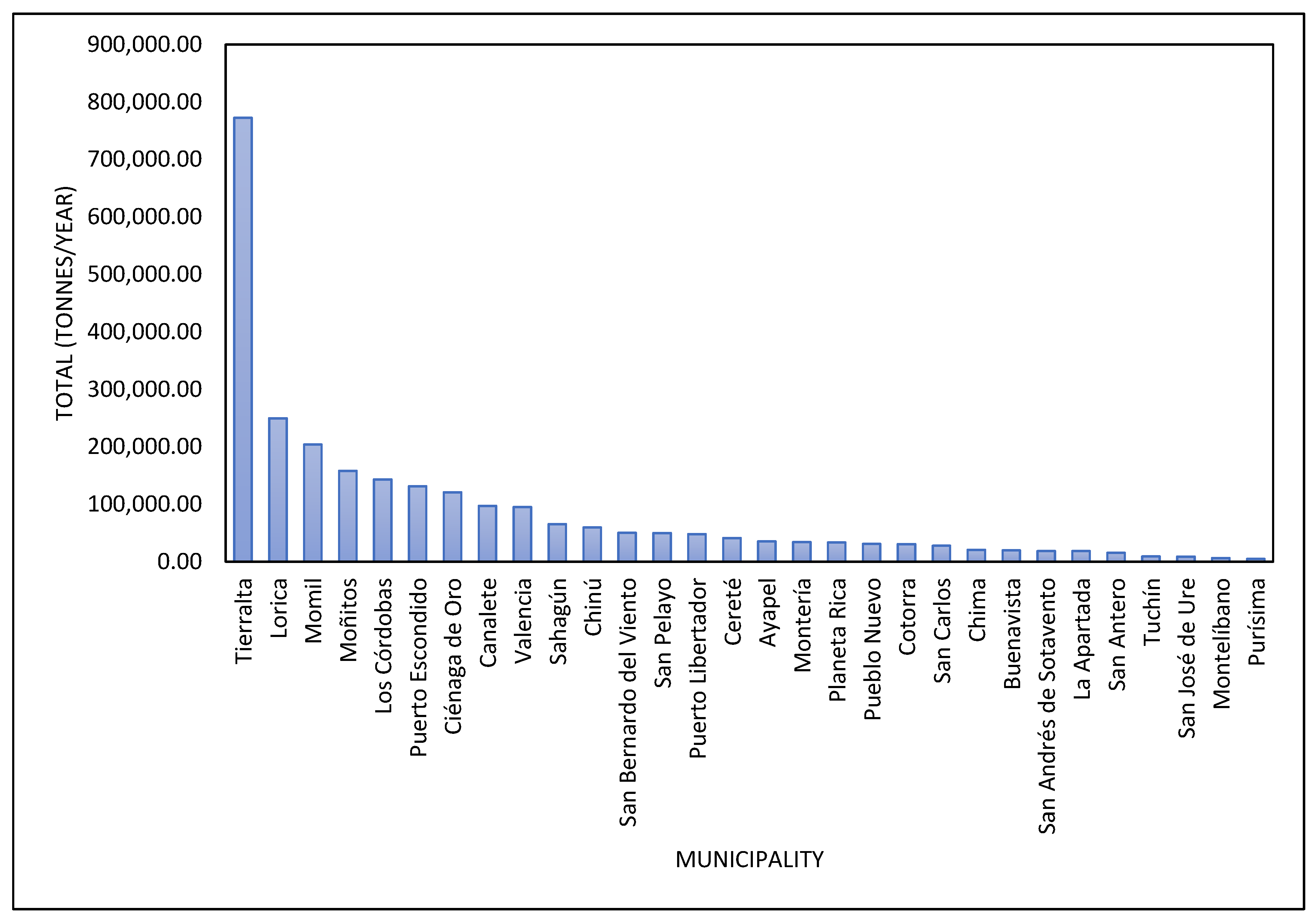
The distribution of residual biomass is not uniform throughout the departmental territory. As can be seen in
Figure 1, Tierralta is the main generator of agricultural residual biomass in the department, with a total of 772,847.91 tonnes per year—equivalent to 29.71% of the total for the department. This figure is considerably higher than those of the second and third largest generators, Lorica and Momil, which produce 249,757.07 tonnes/year (9.6%) and 203,850.83 tonnes/year (7.8%), respectively.
Tierralta’s leadership can be explained by several concurrent factors.
An extensive cultivated area, particularly in rural areas with a strong agricultural focus.
A high presence of banana and cassava crops, which have high residue factors (RPR ≥ 1.0 in some cases), increases the total amount of biomass generated.
Favourable soil and climatic conditions that allow multiple annual production cycles for crops such as bananas, cassava and rice.
Other municipalities that make relevant, albeit moderate, contributions include Moñitos (158,180.77 tonnes per year), Los Córdobas (143,278.65 tonnes per year), Puerto Escondido (131,317.09 tonnes per year), Ciénaga de Oro (120,744.35 tonnes per year) and Canalete (97,219.01 tonnes per year). These municipalities generate over 90 mil tonnes of residual biomass per year and are associated with crops that generate a lot of residues, such as oil palm, rice and maize.
In contrast, municipalities such as Purísima (4693.87 tonnes/year), Montelíbano (6281.92 tonnes/year) and San José de Uré (8915.89 tonnes/year) have the lowest residual biomass generation rates. This low participation can be attributed to limited agricultural coverage, reduced crop diversity with residual potential, or the predominance of non-agricultural economic activities such as mining (in the case of Montelíbano).
The strong concentration of the resource in a few municipalities suggests that efforts to use biomass energy should prioritise areas such as Tierralta, Lorica and Momil, where economies of scale and storage logistics are more feasible. These territories account for over 47% of the regional total, making it possible to propose scenarios for implementing centralised or semi-distributed energy transformation plants.
Furthermore, these results emphasise the importance of formulating differential policies by sub-region, taking into account the volume of available resources, existing infrastructure, and opportunities for collaboration with the local agro-industry.
3.2. Contribution per Crop
The analysis by crop type shows that agricultural residual biomass generation in Córdoba is highly concentrated in a few productive items. This has important implications for targeting energy recovery strategies, as shown in
Table 3.
Bananas account for the largest proportion of the total volume of residues at 1,589,275.31 tonnes per year—approximately 61.1% of the departmental total. This is due to several factors acting simultaneously:
A large area of land is dedicated to cultivation in the department, particularly in municipalities such as Tierralta, Momil and Lorica.
A high residue factor (RPR), particularly in components such as the rachis, the stem and rejected bananas.
The pseudo-woody and bulky nature of the residue significantly increases the total mass generated per hectare.
The second crop in terms of residue generation is cassava at 461,840.53 tonnes per year (17.8%). Although its RPR and moisture content are also high, its contribution is lower due to its highly dispersed territorial distribution and more variable yields in some cases. Nevertheless, it represents a highly available and easily collected resource in certain areas of the south and centre of the department.
Next come maize (250,794.25 tonnes per year, or 9.6%) and rice (209,049.64 tonnes per year, or 8%), both of which are short-cycle transitory crops with widespread municipal distribution. These crops produce residues that are more homogeneous and have a higher energy content. Examples include corn stover and rice husks, which are commonly used in thermal conversion systems.
In contrast, crops such as cotton, yams, sugar cane, coconuts and oil palms contribute only marginally to biomass, representing less than 4% together of the departmental residual biomass. However, this does not imply a low energy value, since several of these residues (such as sugar cane bagasse and palm kernels) have a high calorific value and favourable physicochemical characteristics for thermal or thermochemical utilisation.
While the total amount of residual biomass is a key factor in determining energy potential, other factors should also be considered, such as the following:
The ease with which the residue can be collected (whether it is concentrated or dispersed) is assessed as follows:
Its moisture content, which affects the efficiency of thermal processes.
Energy density (MJ/kg), which defines the amount of energy contained per unit of mass.
Seasonality of production, especially for transitory crops.
Although banana and cassava stand out in terms of volume, residues such as rice husks or sugar cane bagasse could be more attractive from a technical and economic energy point of view due to their low moisture content and high calorific value.
3.3. Total Energy Potential
Analysis of the theoretical energy potential of agricultural residual biomass in Córdoba, calculated using the UPME (2008) and SERI models, yielded an estimated total value of 16,382.72 TJ/year (equivalent to 4550.76 GWh/year), as shown in
Table 4. This significant energy reserve, if exploited, could cover a substantial proportion of the department’s annual electricity consumption and strengthen the diversification of the regional energy matrix.
Although the total theoretical energy potential was estimated at 4550.76 GWh/year, this value represents an upper-bound scenario that assumes full recovery and utilisation of all agricultural residues. To address this limitation, availability scenarios based on surplus biomass factors were developed. These factors reflect realistic constraints such as competing uses, logistical inefficiencies, and sustainability requirements. Based on recent studies, three availability scenarios are defined in
Table 5.
The use of availability factors is consistent with recent bioenergy assessments, where only a fraction of total residues can be mobilised due to competing uses and sustainability constraints [
33,
34].
Furthermore, a sensitivity analysis indicated the following:
Residues with lower competing uses (e.g., rice husk) tend to maintain higher availability.
Residues commonly used in soil management practices show significantly lower recoverability.
Recent reviews also highlight that logistical barriers, seasonal variability, and decentralised production systems introduce additional uncertainty in biomass supply chains, which must be considered in energy planning [
36,
39].
Thus, the realistically exploitable energy potential in Córdoba is expected to lie within 1365–2275 GWh/year, rather than the theoretical maximum.
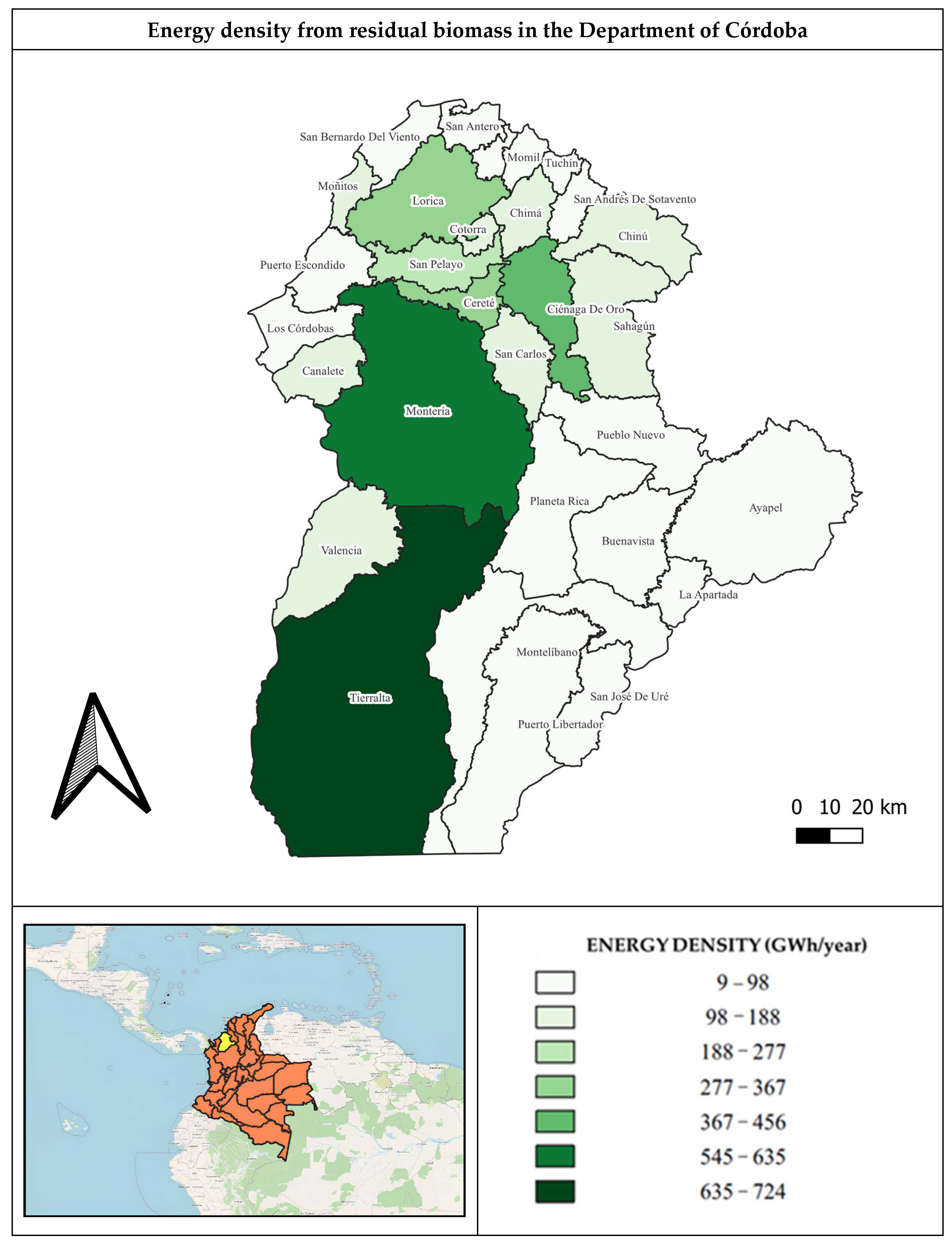
Figure 2, on the other hand, shows the spatial distribution of energy potential in the form of a thematic map of energy density per municipality (GWh/year).
The intensity of the colour indicates the amount of energy that can be obtained from agricultural residual biomass. The analysis reveals a strong territorial concentration of this energy resource in three main municipalities:
Tierralta leads by a wide margin in terms of energy potential with 2607.03 TJ/year (724.17 GWh/year). This is consistent with its high generation of agricultural residue, primarily from the cultivation of bananas, cassava, and maize.
Montería, the departmental capital, is in second place with 2188.96 TJ/year (608.04 GWh/year). This shows that, in addition to its urban role, it also encompasses significant rural productive areas.
Ciénaga de Oro, with 1612.50 TJ/year (447.92 GWh/year), completes the group of the three main energy generators from residual biomass due to a combination of stable agricultural yields and a diverse productive base.
Together, these three municipalities account for around 38% of the total departmental energy potential, positioning them as strategic areas for the development of local or regional bioenergy projects.
However, other municipalities, such as Lorica (301.03 GWh/year), Cereté (293.12 GWh/year), San Pelayo (254.81 GWh/year) and Chima (187.53 GWh/year), also have significant energy availability, albeit considerably less than the top three municipalities. These territories could be considered for decentralised or community projects, especially if collaboration with local agro-industries or cooperative residue collection systems can be established.
Conversely, municipalities such as Purísima (8.91 GWh/year), San José de Uré (10.64 GWh/year) and Momil (12.55 GWh/year) have the lowest potential, due to their limited agricultural base and lower efficiency in generating residue with energy value.
This geographical distribution pattern indicates significant disparities in energy availability that must be considered when planning infrastructure for biomass utilisation. Areas with high energy density allow for economies of scale, making it easier to set up cogeneration plants, produce pellets, generate biogas and build rural thermal power plants.
Furthermore, overlaying this map with the existing electricity grid and road corridors allows priority areas for bioenergy investment to be defined based on technical, economic and logistical criteria. Local utilisation of this resource could also help reduce transport emissions, improve rural energy security, and promote sustainable value chains.
The high energy density identified in municipalities such as Tierralta (724.17 GWh/year) and Montería (608.04 GWh/year) aligns with successful decentralised bioenergy clusters in similar tropical contexts [
40,
41,
42]. However, transitioning from this geospatial potential to a circular industrial system requires addressing specific sustainability “hotspots”. For instance, the high moisture content of cassava (85%) and banana (93.6%) residues in Córdoba represents a critical technical bottleneck; recent Techno-Economic Analysis (TEA) suggests that such moisture levels can increase the Levelised Cost of Energy (LCOE) by up to 30% due to thermal drying demands. To mitigate this, hybrid recovery configurations, such as solar–biomass integration, are proposed as enabling tools to improve net energy ratios and reduce the carbon footprint of the pre-treatment phase by approximately 18% [
43].
Furthermore, the scalability of these circular processes must be governed by harmonised LCA-TEA-MCDA frameworks to navigate the trade-offs between energy yield and logistical emissions. While Tierralta shows the highest absolute potential, Multi-Criteria Decision Analysis (MCDA) indicates that flatter regions like Lorica may offer superior economic viability due to lower transportation costs. The integration of digitalised optimisation and IoT-based monitoring within the supply chain could further reduce these logistical “hotspots” by 15%, transitioning Córdoba’s agricultural sector toward a “Biorefinery 4.0” model [
25]. Consequently, the geospatial data presented here serves as the essential empirical foundation for future high-fidelity simulations and evidence-based public policies in the Colombian Caribbean [
44].
The selected availability factors (30–50%) are consistent with recent studies reporting sustainable residue extraction ranges between 30% and 60%, depending on agronomic conditions and competing uses. This range reflects the need to balance bioenergy production with soil conservation, livestock feeding, and other ecosystem services provided by agricultural residues [
35,
45,
46].
3.4. Comparison Between Residue Generation and Energy Potential
One of the study’s most significant findings was the substantial difference between the amount of residual biomass generated and its corresponding energy potential. While the banana crop generates the most residual biomass in terms of volume (1,589,275.31 tonnes per year), maize has the highest energy potential per unit of biomass, reaching an estimated 9435.79 terajoules per year (2621.05 gigawatt hours per year). This is equivalent to 57.6% of the department’s total energy, as shown in
Table 6.
This behaviour is primarily attributed to the favourable physicochemical properties of maize residues, which include:
A high dry residue fraction (YRS), which reduces moisture content and enhances their suitability for thermochemical conversion processes;
A relatively high lower heating value (LHV), particularly in residues such as tusa and capacho, which are rich in lignocellulosic components contributing to their elevated energy content.
By contrast, although more than 1.5 million tonnes of plantain residue are generated per year, its energy potential is relatively low at 2742.88 TJ/year (761.91 GWh/year), representing only 16.7% of the total departmental energy. This is due to:
The high moisture content of its residues (up to 90% in stems and rachis).
The low energy content per unit mass, which reduces the efficiency of thermochemical processes without prior drying.
Additionally, linking the physicochemical properties of the identified residues with appropriate technological pathways is essential to move from theoretical potential to feasible energy recovery strategies. Residues such as maize, rice and cotton present low moisture contents (generally below 10–15%) and relatively high calorific values, making them particularly suitable for thermochemical processes such as combustion and gasification. Based on the typical lignocellulosic composition and ash content reported in recent studies, it is estimated that approximately 65–75% of maize residues can be technically suitable for gasification systems, especially when particle size and moisture conditions are controlled [
11,
26]. However, the relatively low bulk density of these residues can generate logistical constraints during transport and storage. In this context, palletisation or briquetting processes are widely recommended, as they increase biomass density and significantly improve transport efficiency and supply chain management [
47].
In contrast, residues from banana and cassava exhibit extremely high moisture contents, often exceeding 80–90%, which makes them less suitable for direct thermochemical conversion without costly drying stages. For these biomass streams, biochemical routes such as anaerobic digestion (AD) represent a more appropriate alternative, as wet biomass can be converted into biogas with minimal pre-treatment while simultaneously enabling nutrient recovery through digestate [
48]. Furthermore, recent research highlights the potential of hybrid bioenergy configurations, where thermochemical conversion of dry residues (e.g., rice husk or maize stover) is integrated with anaerobic digestion of wet residues such as banana residue. In such systems, surplus heat from gasification units can support the thermal requirements of digesters, improve overall energy efficiency and increase methane yields [
27].
Considering these technological compatibilities,
Table 7 summarises a simplified conversion matrix linking the principal crop residues identified in Córdoba with their most suitable bioenergy pathways, providing a preliminary framework for future Techno-Economic Analyses.
From a technological standpoint, the contrasting physical and energy properties of these residues dictate their most efficient conversion methods. With a high moisture content (70–90%) and lower energy density, banana residues are better suited to biochemical processes such as anaerobic digestion or co-digestion, which can utilise wet biomass with minimal pre-treatment. In contrast, maize residues, which have a higher dry matter content and lower moisture content (less than 10%), are more efficient in thermochemical conversion processes such as direct combustion, gasification, and pyrolysis. Understanding these differences is crucial for designing locally adapted bioenergy systems that maximise efficiency and minimise processing costs.
Crops such as cassava and rice occupy an intermediate position, with energy potentials of 2023.34 and 1024.70 TJ/year, respectively, confirming that the characteristics of the residue, as well as the volume, play a determining role.
At the other extreme are crops such as yams, sugar cane and coconuts. Although they generate agricultural and agro-industrial residue, their contribution to the total energy balance is marginal. This is due to a combination of factors:
Low residue factors (RPR), i.e., low residue generation per tonne of product;
Lower LHV or high moisture content, as in the case of cassava bagasse and fresh yam residues.
Localised or smaller-scale production, which makes integration into regional energy schemes difficult.
These results highlight the importance of considering the quantity and energy quality of residues when designing biomass utilisation strategies. Planning based solely on residue volume could lead to an overestimation of crops with low energy density and an underestimation of those with high energy efficiency.
Furthermore, maize is an example of a crop that generates transient residues cyclically and in large quantities, and these residues have huge potential for distributed energy generation, especially in municipalities with mechanised agricultural infrastructure.
3.5. Energy Coverage, Capacity and Emission Reductions
Not only does the estimated energy potential from agricultural residual biomass in the department of Córdoba (4550.76 GWh/year) represent a technical opportunity to diversify the regional energy matrix, but it also has significant implications in terms of energy sovereignty and environmental sustainability.
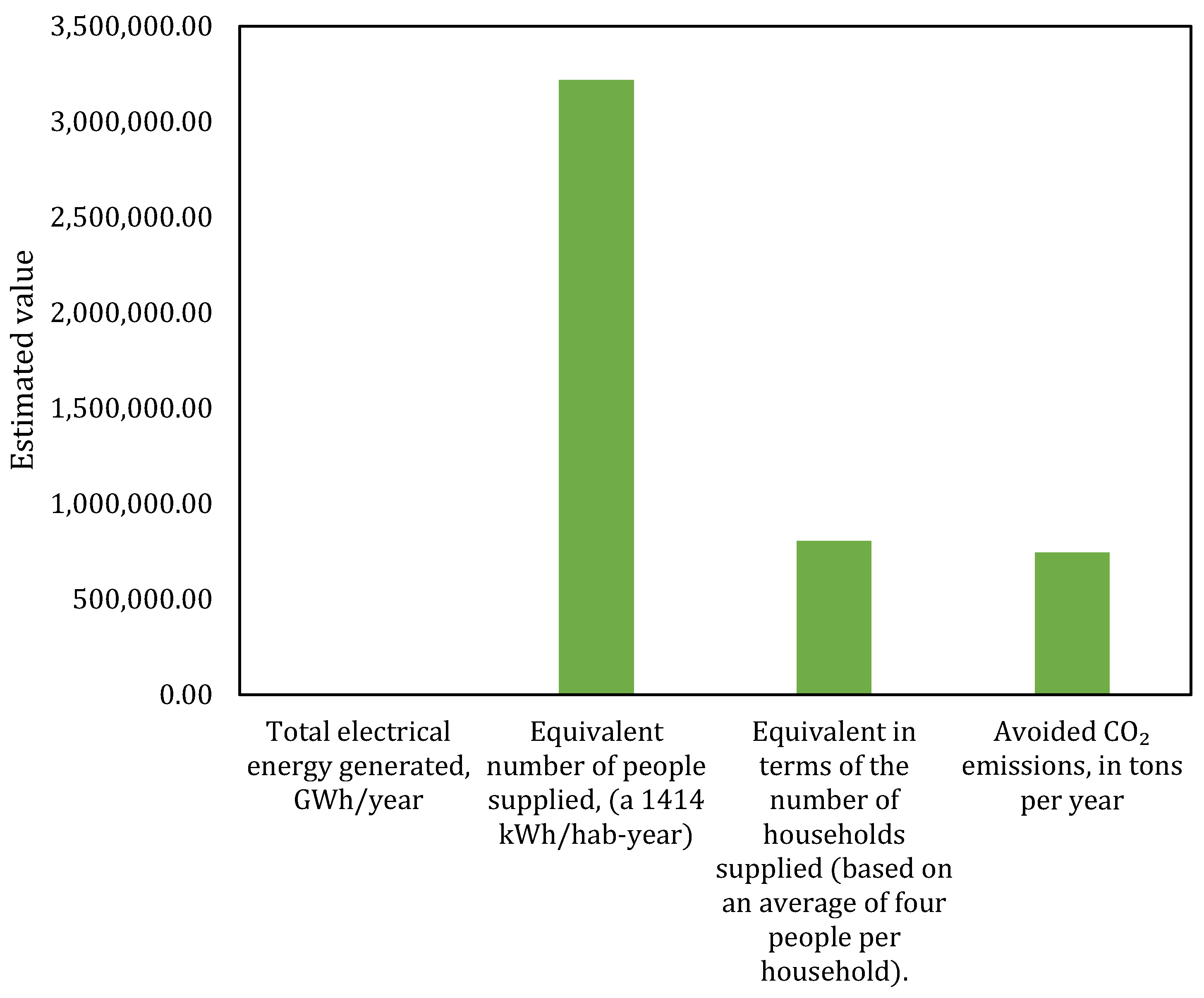
Given that the per capita electricity consumption in Colombia was approximately 1414 kWh/inhabitant/year in 2020, the total energy that could be generated would be sufficient to supply 3,217,564 people with electricity, as illustrated in
Figure 3. This figure is over twice the estimated population of Córdoba (1.8 million), indicating a potential renewable energy surplus if the resource were fully converted.
Assuming there is an average of four people per household, the electricity potential could supply 804,391 households, which far exceeds the current residential coverage. These results reaffirm the strategic role of biomass as a local, constant and decentralised source of energy, capable of strengthening energy security and reducing dependence on fossil fuels.
From an environmental perspective, using residual biomass as an energy source would prevent the emission of around 744,785 tonnes of CO2 equivalent per year by replacing high-emission conventional energy sources such as coal or diesel. This is consistent with Colombia’s targets under the Paris Agreement and Law 1931 of 2018, which guide public policies on climate change management.
The estimation of avoided CO2 emissions assumes the replacement of electricity generated from Colombia’s current energy mix, where fossil sources—primarily coal (approximately 37%) and diesel (around 12%)—represent the main baseline for comparison. This reference provides a realistic benchmark for assessing the environmental benefit of substituting conventional generation with biomass-derived electricity.
In comparative terms, this reduction would be equivalent to removing over 160 million light vehicles from circulation for a year or planting almost 12 million trees.
These results demonstrate that Córdoba has the capacity not only to cover its own energy demand using its agricultural residue, but also to become a net exporter of renewable energy, particularly in rural areas with limited electricity infrastructure and low coverage.
Furthermore, recovering energy from these residues does not conflict with food production because it is based on non-food by-products. This promotes a fair and sustainable energy transition that is aligned with the principles of the circular and bioeconomies.
It is important to note that the Colombian electricity matrix is largely dominated by hydropower, which has a relatively low carbon intensity. Therefore, the estimated amount of CO2 emissions avoided in this study may represent an upper-bound scenario when compared to systems with a higher share of fossil fuels.
Under marginal conditions, such as periods of reduced hydrological availability, biomass could contribute more significantly to displacing fossil-fuel-based generation. Additionally, this study assumes biogenic carbon neutrality, where CO2 emissions from biomass combustion are considered part of the short-term carbon cycle.
Future analyses should incorporate full life-cycle assessment approaches, including emissions from biomass logistics and processing, as well as alternative baseline scenarios (e.g., fossil-intensive vs. hydro-dominant systems), to provide a more comprehensive evaluation of emission reduction potential.
3.6. Comparison with Previous Studies
The results of this research align with previous estimates for the Córdoba department, particularly the Mining and Energy Planning Unit’s report [
14], which calculated an energy potential of between 1177 and 3140 TJ/year from crops such as rice, corn, and bananas. While the absolute values differ, the distribution pattern of the crops and identification of residues with the highest potential are consistent, thus validating the technical robustness of the present study.
Similarly, the estimate obtained in this study is also consistent with the findings of Sagastume et al. (2021) [
13], who projected utilisation of up to 260 GWh/year through direct combustion and 126 GWh/year through anaerobic digestion in the Colombian Caribbean. However, their scope was more limited in terms of the crops evaluated and the spatial scale.
However, the present study makes significant methodological contributions to the state of the art by integrating an extended characterisation of agricultural and agro-industrial residues covering nine crops of regional economic importance:
An extended characterisation of agricultural and agro-industrial residues covering nine crops of regional economic importance;
The complementary use of two energy estimation models (UPME and SERI), which strengthens the robustness of the results.
The development of a detailed geospatial database, enabling the visualisation and prioritisation of areas with higher energy density at the municipal level.
These methodological improvements establish the study as a valuable technical tool for local energy planning, supporting both public institutions and the private sector in bioenergy decision-making processes.
3.7. Limitations and Aspects to Consider
Despite the encouraging results and the estimated high theoretical potential, it is important to recognise that the practical implementation of using agricultural residual biomass for energy is subject to multiple factors that can reduce its actual potential. The main limitations are:
The real availability of residues: Much of the agricultural biomass is reused on site as organic fertiliser, animal bedding, soil cover or livestock feed, reducing the amount that can be recovered for energy use.
Logistic and transportation costs: The geographical dispersion of crops, limited farm accessibility and distances to processing plants directly impact the economic viability of energy use.
Technological suitability: The choice between combustion, gasification, pyrolysis or anaerobic digestion should be based on the physicochemical characteristics of the residue, including its moisture content, composition and scale of generation.
Financial viability and the efficiency of systems: Many pilot projects fail due to a lack of profitable business models or low energy yield, especially in the absence of incentives or subsidies.
Regulatory and environmental aspects: Comprehensive environmental management is required, including licences, emission controls, and compliance with the PRTR (Pollutant Release and Transfer Register). Community acceptance of the implemented technologies is also necessary.
A key constraint in biomass availability assessments is the requirement for soil nutrient recycling and agroecosystem sustainability. Agricultural residues play a critical role in maintaining soil organic matter, nutrient balance, and long-term productivity.
Recent studies demonstrate that crop residues are essential for nitrogen cycling and soil fertility, particularly in cereal-based systems such as rice and maize.
The removal of residues beyond sustainable thresholds can result in [
34,
45] the following:
Depletion of soil organic carbon;
Increased fertiliser demand;
Higher erosion rates;
Reduced long-term agricultural productivity.
Additionally, improper residue management practices, such as open-field burning, not only lead to environmental impacts but also result in the loss of valuable nutrients contained in biomass residues. Therefore, sustainable biomass utilisation requires maintaining a fraction of residues in the field, which directly limits the amount available for energy conversion [
35,
39].
There are several practical strategies that could help to overcome these barriers. For instance, establishing cooperative or community-based residue collection networks could reduce transport costs and guarantee a consistent supply of biomass, particularly in regions where agricultural activity is scattered. Implementing low-cost drying, solar dehydration or palletisation systems would significantly improve the energy efficiency of converting high-moisture residues, such as those from bananas and cassava. Additionally, fiscal incentives, feed-in tariffs or decentralised bioenergy programmes could attract private investment and enhance project viability. Integrating these approaches would facilitate the transition from theoretical potential to operational feasibility within regional energy systems.
A key factor constraining biomass availability is the multi-functional role of agricultural residues within agroecosystems. Beyond energy applications, residues are essential for maintaining soil organic carbon (SOC), supporting nutrient cycling, and improving soil structure. In tropical and intensive agricultural systems, excessive residue removal has been shown to negatively affect soil fertility and long-term productivity [
36,
49]
Additionally, a significant fraction of residues is used as livestock feed, particularly in mixed crop–livestock systems, limiting their availability for bioenergy applications. Residues such as maize stover are frequently utilised as forage, especially during dry periods, which represents a competing use not always accounted for in biomass assessments.
Residues also serve as mulching material, contributing to erosion control, soil moisture conservation, and weed suppression. Maintaining surface residue cover is widely recognised as a key practice for soil protection and sustainable agricultural production [
49,
50].
Moreover, agricultural residues are often used in informal or traditional applications, including domestic energy use and organic fertilisation, which further reduces the fraction of biomass that can be allocated to energy systems.
Future research should focus on validating technical findings through pilot-scale projects and comprehensive Techno-Economic Analyses. Life-cycle assessment (LCA) studies are also essential for quantifying environmental trade-offs and identifying the most efficient conversion process for each residue type. These efforts could enable the development of scalable, cost-effective, sustainable bioenergy systems adaptable to different regional contexts.
4. Conclusions
The results of this research confirm that the volume and energy quality of agricultural residual biomass in the Córdoba department are significant. It was estimated that a total of 2.6 million tonnes of residues from nine strategic crops are available per year, with plantain, cassava, corn and rice being the main contributors. However, analysis of the energy potential revealed that corn contributes the highest proportion of theoretically usable energy due to its high dry fraction and calorific value, accounting for over 57% of the total for the department.
Using a combination of UPME and SERI models alongside GIS tools enabled the geospatial representation of biomass distribution and energy density. This revealed a strong concentration of the resource in municipalities such as Tierralta, Montería and Ciénaga de Oro. These results are essential for the spatial planning of bioenergy projects, as they enable the identification of areas that are technically and logistically feasible for the development of distributed generation systems.
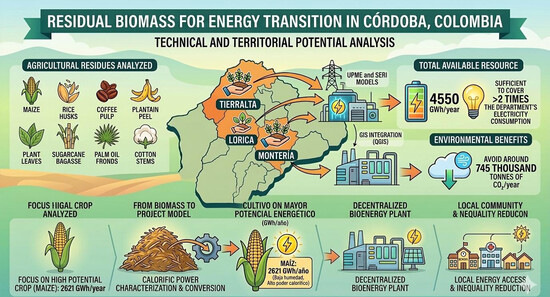
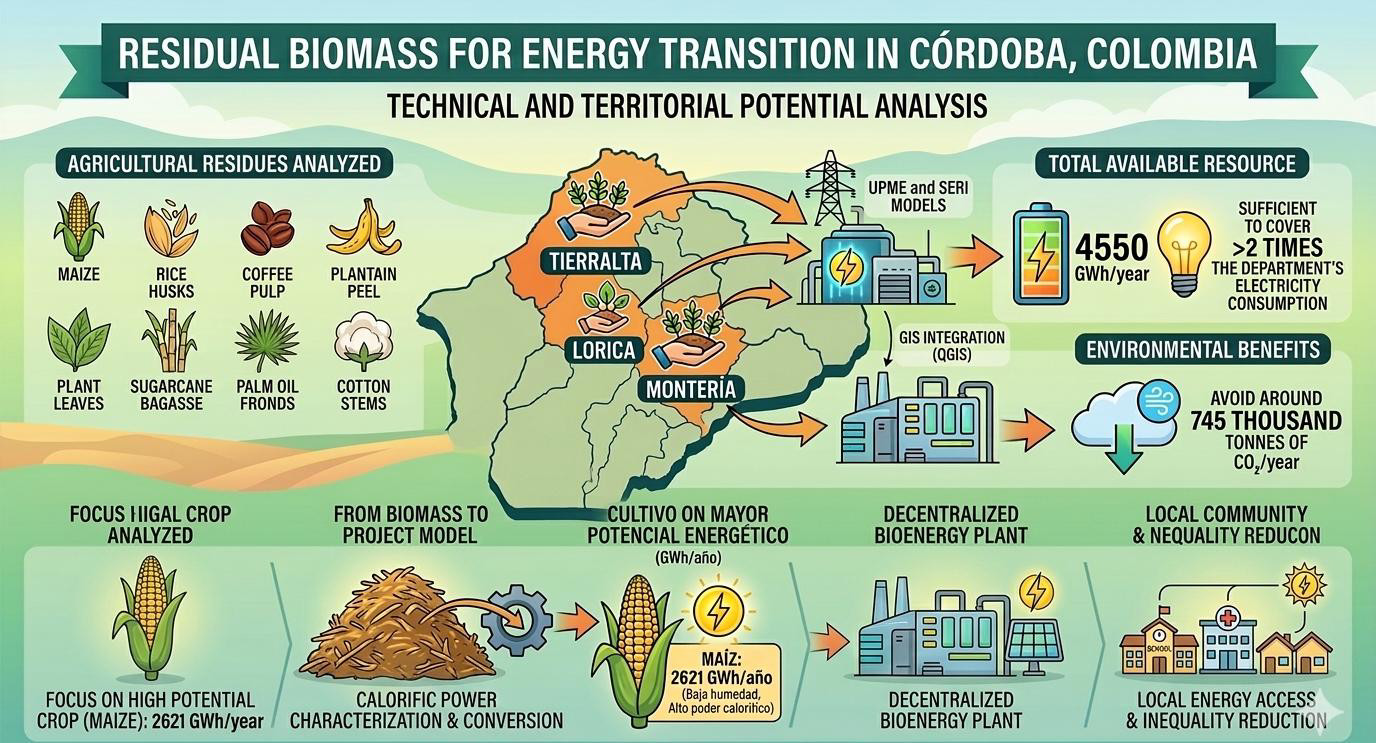
Furthermore, it was demonstrated that the total energy potential of 4550 GWh/year could supply over 3.2 million people, which far exceeds the current population of the department. This capacity would close energy access gaps in rural areas and turn Córdoba into a net exporter of renewable energy based on agricultural residues. Similarly, it was calculated that substituting fossil sources with bioenergy would avoid the emission of around 745 thousand tonnes of CO2 per year, significantly contributing to national climate change mitigation goals.
However, despite the high estimated potential, this study recognises that the fraction of biomass that is actually usable may be limited by factors such as current residue usage, logistical barriers, conversion costs, and regulatory restrictions. Therefore, this technical assessment must be complemented by economic feasibility studies, life cycle analyses, and local governance schemes to ensure implementation is feasible.
This is why this work provides a solid, replicable basis for evaluating the energy use of agricultural residual biomass in Colombia and similar contexts. Integrating geospatial tools, regionalised agricultural data and energy estimation models enables us to move towards a fair and decentralised energy transition based on the principles of the circular economy. This approach also provides essential information for formulating public policies, designing sustainable rural strategies, and promoting clean technologies adapted to the local area.




 ,
,