
Article

Tracing the Legacy of Historical PCB Pollution and Contemporary PAH Contamination in the Kupa River (Danube Basin, Croatia)

1
Institute for Medical Research and Occupational Health, Ksaverska Cesta 2, 10001 Zagreb, Croatia
2
Croatian Veterinary Institute, Savska Cesta 143, 10000 Zagreb, Croatia
3
Aquatika-Freshwater Aquarium Karlovac, Ulica Branka Čavlovića Čavleka 1/A, 47000 Karlovac, Croatia
4
Institute of Physics Belgrade, National Institute of the Republic of Serbia, University of Belgrade, Pregrevica 118, 11080 Belgrade, Serbia
*
Author to whom correspondence should be addressed.
Environments 2026, 13(4), 192; https://doi.org/10.3390/environments13040192
Submission received: 3 February 2026 / Revised: 25 March 2026 / Accepted: 26 March 2026 / Published: 1 April 2026

Abstract

The Kupa River (Croatia), a tributary of the Danube basin forming part of the Slovenian border, was heavily contaminated with polychlorinated biphenyls (PCBs) between 1962 and 1985 due to improper handling and downstream transport via the Krupa and Lahinja rivers. This study evaluated the occurrence, interspecific distribution, and human health implications of PCBs and polycyclic aromatic hydrocarbons (PAHs) in fish (Northern pike, Common carp, Grass carp, Pike-perch, Wels catfish, Bream, and Chub) from the Croatian Kupa River. PCB concentrations were consistently higher than PAH levels across all species. In 30% of samples, Σ6 non-dioxin-like PCBs exceeded the European Commission maximum permissible level for freshwater fish (125 ng⋅g−1 wet weight). Of the 11 PAHs analyzed, only fluoranthene and pyrene were detected. Self-Organizing Map identified distinct pollutant patterns, with chub showing the highest variability and accumulation. PCB concentrations position the Kupa River among moderately to highly impacted European freshwater systems affected by legacy industrial contamination. Health risk assessment, incorporating updated national consumption data, indicates that long-term, uncontrolled consumption of Kupa River fish may pose risks due to PCB exposure, while PAH-related risks appear negligible. These findings highlight the persistence of legacy PCB pollution and the need for integrated sediment–biota monitoring.

1. Introduction

Polychlorinated biphenyls (PCBs) and polycyclic aromatic hydrocarbons (PAHs) are the groups of hydrophobic organic contaminants that frequently co-occur in aquatic environments yet differ substantially in their sources and environmental dynamics [1,2]. Recognized among the 12 most hazardous persistent organic pollutants (POPs) under the Stockholm Convention, PCBs remain a significant environmental concern due to their toxicity, chemical stability and long-term persistence. Despite widespread bans introduced in the 1970s and an overall declining trend in concentrations, effective control remains challenging [3]. PCBs strongly bind to organic matter and accumulate in sediments, which act as important secondary sources sustaining their environmental cycling. In deeper sediment layers, PCBs may be persistent for decades [4]. The remobilisation of sediment-bound PCBs is driven by natural processes, human activities, and climate change. Increased precipitation, flooding, and storm events can disturb contaminated sediments, facilitating downstream transport and renewed release into the environment [5,6]. In contrast, PAHs primarily originate from ongoing anthropogenic activities such as traffic, residential heating, and biomass burning. Although PAHs degrade more rapidly than PCBs, PAHs share comparable physicochemical characteristics and ecotoxicological impacts with PCBs and their continuous atmospheric input results in pseudo-persistent behavior in aquatic systems [7,8,9].
The Kupa River represents an important component of the Danube drainage basin, one of the largest and most internationally interconnected river systems in Europe. It flows along sections of the Croatian–Slovenian border before discharging into the Sava River, one of the main tributaries of the Danube. Through this hydrological connection, contaminants introduced into the Kupa River may propagate downstream and influence aquatic ecosystems across the wider Danube catchment. Hydrophobic organic pollutants can be transported through atmospheric deposition, sediment mobilization, and trophic transfer, meaning that contamination in tributaries such as the Kupa may have implications beyond the immediate study area. The Kupa River is a particularly relevant system for investigating contrasting contamination patterns of PCBs and PAHs. PCBs contamination in this river can be attributed to a well-documented historical pollution event (1962–1985) linked to improper handling and disposal practices in Slovenia, with releases into the Krupa River followed by downstream transport via the Lahinja River to the Kupa River [10,11]. Following landfill remediation efforts, it was estimated that more than 13 tonnes of PCBs entered the karst area of the Krupa River [10,11,12]. Early investigations reported moderate to severe PCB contamination in Kupa River fish collected between 1985 and 1986 [13,14,15]. More recent evidence suggests that contamination may persist. In 2019, the sum of six non-dioxin-like PCBs (Σ6 ndl-PCBs) measured in a single chub specimen reached 107.8 μg kg−1 wet weight, approaching the European Commission’s maximum permissible level of 125 ng⋅g−1 wet weight for freshwater fish [16]. However, these findings are based on limited and spatially constrained data, preventing a comprehensive assessment of current contamination status in fish populations. At the same time, a recent sediment survey (2020–2021) indicated PCB concentrations below international sediment quality guideline thresholds [7,17,18], suggesting a relatively low ecological risk in sediments. Nevertheless, the absence of binding EU sediment standards for PCBs [19,20] and the persistence of these compounds in biota highlight the need for updated monitoring of fish populations.
In contrast to the well-defined historical origin of PCBs, PAHs in the Kupa River basin reflect ongoing anthropogenic pressure. The basis for investigating PAHs in fish from the Kupa River stems from recent studies indicating that PAHs are widely distributed in river sediments across Croatia, as part of the Danube basin [7]. Their presence is associated with continuous anthropogenic emissions, particularly those originating from combustion processes, with seasonally variable sources such as traffic, residential heating, and biomass burning playing a significant role [7,8]. According to the aforementioned study on river sediments in Croatia [7], the Kupa River ranks among the three rivers with the highest levels of PAHs. Furthermore, the spatial distribution of PAHs along the Kupa River indicates significantly elevated concentrations in samples collected from urban areas [7], highlighting the need to investigate their accumulation in fish.
The only available national study addressing PAHs in fish, focused on marine species available on the Croatian market and assessed dietary exposure [21]. Although numerous studies have examined PAHs in freshwater fish worldwide [22,23,24,25], corresponding data for Croatian freshwater ecosystems remain unavailable. This represents a critical knowledge gap, particularly considering that fish constitute an important pathway for human exposure to pollutants such as PAHs and PCBs, as both groups of contaminants bioaccumulate in fish tissues and dietary intake is a dominant route of human exposure [26,27]. The primary aim of this study was to assess the present contamination status of the Kupa River using fish as bioindicators, by (i) quantifying PCB concentrations as markers of persistent, historically derived contamination, (ii) determining PAH levels as indicators of current anthropogenic pressure, and (iii) evaluating potential human health risks associated with fish consumption. The simultaneous assessment of PCBs and PAHs in this study is not based solely on their frequent co-occurrence, but on their ability to represent two complementary dimensions of environmental contamination within the same river system. Evaluating both groups in fish enables an integrated assessment of how past and present contamination sources jointly influence bioaccumulation patterns and potential risks for ecosystems and human health.
Seven fish species were examined: Northern pike (Esox lucius), Common carp (Cyprinus carpio), Grass carp (Ctenopharyngodon idella), Pike-perch (Sander lucioperca), Wels catfish (Silurus glanis), Bream (Abramis brama), and Chub (Squalius cephalus). These species represent diverse ecological niches and feeding behaviors. Predatory species such as Northern pike and Pike-perch occupy higher trophic levels, whereas omnivorous species such as Common carp and Chub consume both plant and animal matter. Wels catfish is a large, long-lived apex predator, while Bream and Grass carp are benthic and herbivorous/omnivorous species, respectively. Owing to their ecological diversity, trophic positions, and importance in fisheries, these species serve as suitable bioindicators for assessing both legacy and ongoing impacts of PCBs contamination in freshwater ecosystems. Additionally, they are widely consumed by humans and targeted by recreational and commercial anglers.
The study was guided by the following hypotheses: (1) PAH and PCB levels differ among fish species; (2) some samples may approach or exceed the European Commission’s maximum permissible level for PCBs (125 ng⋅g−1 wet weight) due to historical contamination; and (3) a health risk assessment for fish consumers, based on the models adapted from the Risk Assessment Information System (RAIS) to Croatian exposure conditions, will provide insight into potential human health impacts. By addressing both legacy and ongoing contamination within a single aquatic system, this study aims to provide a more comprehensive understanding of pollutant dynamics in the Kupa River and contribute to improved environmental management within the Danube basin. The findings should contribute to understanding pollutant persistence and bioaccumulation in interconnected river basins and support basin-wide environmental management under the EU Water Framework Directive and the Danube River Protection Convention.

2. Materials and Methods

2.1. Study Area

The Kupa River is a right tributary of the Sava River and forms a natural border between Croatia and Slovenia along part of its course. The river is 297.4 km long and drains watershed area of 10,226 km2. It originates in Croatia within the protected area of Risnjak National Park in the mountainous region of Gorski Kotar. After flowing eastward for several kilometers, it receives the Čabranka River from the left before reaching the Slovenian border. The river continues along the border, diverges from it after the town of Metlika, and ultimately joins the Sava River in the Croatian town of Sisak. The present study focuses on the middle course of the Kupa River, as this section is located relatively close to the Krupa River, the historical source of PCB oil contamination (Figure 1) [11]. Moreover, this stretch of the river represents an important fishing area, where the species most frequently consumed by residents are commonly caught (Table 1).

2.2. Biology of Fish and Sampling

Thirty-seven fish individuals were collected from 12 locations along the middle course of the Kupa River between 2020 and 2023 (Figure 1). Sampling was conducted in collaboration with recreational anglers. The analyzed species included predatory fish (Northern pike, Wels catfish, and Pike-perch), omnivorous species (Common carp, Bream, and Chub), and a predominantly herbivorous species (Grass carp). The listed species inhabit mainly the middle and lower stretches of the river, except Chub which also lives in the upper stream. They typically feed near the bottom being associated with sandy and silty sediments, as well as in midwater or near the surface, consuming benthic and free-swimming organisms, as well as plant matter. A detailed overview of the biology of the researched species is shown in Table 1. The sampling periods were representative of the main angling seasons for the fish species and generally coincided with their spawning times. An overview of the analyzed fish samples is presented in Table 2.
The research presented in this paper did not involve experiments on live vertebrates. All fish analyzed were edible species, already caught and killed by recreational anglers for consumption. Samples (whole fish or fish tissue) were collected exclusively post-mortem, with no handling or manipulation of live animals. Since the fish were intended for consumption and were not subjected to any experimental procedures while alive, ethical committee approval was not required for this study.

2.3. Analyzed Compounds

Based on the position and number of chlorine atoms, 209 isomers and homologues known as PCB congeners have been identified. In this study, seven ndl-PCBs congeners (IUPAC numbers: 28, 52, 101, 118, 138, 153, 180) were selected for analysis due to their predominant occurrence in technical mixtures, environmental matrices, and animal and human tissues. These congeners are commonly referred to as indicator PCBs because they are representative of overall PCB contamination.
The United States Agency for Environmental Protection (US-EPA) has identified 16 US-EPA priority PAHs. Among them, benzo[a]pyrene is classified as a Group 1 human carcinogen. Other PAHs included in this study fall into Group 2A (probably carcinogenic) or Group 2B (possibly carcinogenic), while some, such as benzo[ghi]perylene, are classified in Group 3 due to insufficient evidence regarding their carcinogenicity. These compounds are the most determined in environmental samples. The samples were analyzed for the following 11 US-EPA PAHs: fluoranthene (Flu), pyrene (Pyr), benzo(a)anthracene (BaA), chrysene (Chry), benzo(j)fluoranthene (BjF), benzo(b)fluoranthene (BbF), benzo(k)fluoranthene (BkF), benzo(a)pyrene (BaP), dibenzo(ah)anthracene (DahA), benzo(ghi)perylene (BghiP), and indeno(1,2,3-cd)pyrene (IP).

2.4. PCB Analysis in Freshwater Fish

2.4.1. Chemicals and Reagents

Certified standards (purity 94–99%) were obtained from Dr. Ehrenstorfer LGC Standards (Augsburg, Germany), Toronto Research Chemicals (Toronto, ON, Canada) and Sigma Aldrich (Seelze, Germany). Mixed standard solutions for validation and calibration were prepared by appropriate dilutions of stock standard solutions with acetonitrile. Gas chromatography–mass spectrometry (GC–MS) purity grade acetonitrile, acetone, cyclohexane and ethyl acetate were supplied by Honeywell (Charlotte, NC, USA). Dimethylformamide, sodium sulphate (anhydrous) and sodium chloride were obtained from Sigma Aldrich (Bellefonte, PA, USA). Tributyl phosphate (Sigma-Aldrich, Seelze, Germany) was used as an internal standard and prepared as a spiking solution at concentrations of 10 µg mL−1 in acetonitrile. Ultrapure water (18.2 MΩ cm−1) was produced by the Direct-Q® 5 UV System (Millipore Corporation Merck, Darmstadt, Germany).

2.4.2. Sample Preparation

Approximately 0.5–1 kg of dorsal and ventral muscle tissue was homogenized using a laboratory blender and freeze-dried for organic contaminants analysis. The water content in the muscle tissues varied between 76.4% and 80.7% (Table 2).
A 1 g of lyophilized fish sample was dissolved in 4 mL of water and transferred into a centrifuge bottle. Subsequently, 100 mL hexane/acetone extraction solvent was added, followed by 20–30 g of anhydrous sodium sulphate. The mixture was homogenized using a vortex blender for approximately 1 min, and the blender blades were rinsed with 3 mL of extraction solvent. The extract was centrifuged at 2500–3500 rpm for 2 to 3 min. The supernatant was decanted through a sodium sulphate column directly into the tube.
An additional 60 mL of hexane/acetone extraction solvent was added to the remaining bottom layer, and the extraction procedure was repeated. The column was subsequently rinsed with 20 mL hexane/acetone extraction solvent. The eluted portions were concentrated to 2 mL in a concentrator under a gentle stream of nitrogen (12 ± 2 psi) at 35 ± 5 °C. The extract was transferred to a labeled graduated test tube and made up to 10 mL with gel permeation chromatography GPC solvent. A 2 mL aliquot of the extract was purified using a GPC system (LC-20 Prominence, Shimadzu, Tokyo, Japan) equipped with an EnviroSep™-ABC preparative column (350 × 21 mm) and a guard column (60 × 21.2 mm) (Phenomenex, Torrance, CA, USA). The GPC system was operated under the following conditions: mobile phase, cyclohexane/ethyl acetate (1:1, v/v); flow rate, 3 mL min−1; detection wavelength, 254 nm; injection volume 2 mL. Fractions were collected from 26 to 47 min.
The eluted fractions were concentrated to 1 mL under a gentle stream of nitrogen (12 ± 2 psi) at 35 ± 5 °C. The concentrated 1 mL extract was transferred into a Chem Elut cartridge (unbuffered; size-graded amorphous diatomaceous earth; 3 mL; mass not specified; Agilent Technologies, CA, USA) and washed with 2 × 1 mL hexane/acetone solvent, allowing it to stand for at least 60 min. The Chem Elute cartridge was positioned directly above two Bond Elut silica cartridges (silica; 500 mg; 10 mL; 40 µL particle size; Agilent Technologies, CA, USA). The silica cartridges were conditioned with 7 mL of hexane-saturated acetonitrile, and the sample was eluted from the Chem Elute cartridge with 3 × 6 mL portions of hexane-saturated acetonitrile. The eluate was again reduced to 1 mL under a gentle stream of nitrogen (12 ± 2 psi) at of 35 ± 5 °C. Prior to GC-MS/MS analysis, the internal standard solution and standard were added to the sample [31]. A five-point matrix-matched calibration curve was prepared by diluting the stock standard solution with blank fish extract. Blank extracts were fortified to obtain calibration levels of 1, 5, 10, 20, and 50 μg L−1. Additionally, 10 μL of the internal standard working solution was added to each calibration level to achieve a final concentration of 10 μg L−1 in the extract. Matrix-matched calibration was used for quantification.

2.4.3. GC-MS/MS Analysis

The concentrations of six indicator PCB congeners (PCB-28, PCB-52, PCB-101, PCB-138, PCB-153, and PCB-180) and PCB-118 were determined using a GC–MS/MS system equipped with an Agilent gas chromatograph 7890A coupled to a 7000B triple quadrupole mass spectrometer with an electron ionization (EI) source and 7693B autosampler (Agilent Technologies, Palo Alto, CA, USA). The instrument was fitted with a split/splitless injector operated in pulsed splitless mode.
Chromatographic separation was achieved on an HP-5MS capillary column (30 m × 0.25 mm i.d., 0.25 μm film thickness; Agilent Technologies, Palo Alto, CA, USA). Helium (99.9999% purity) was used as the carrier gas at a constant flow rate of 0.9 mL min−1. The injection volume was 2 μL. The injector temperature was initially set at 80 °C (held for 0.01 min) and then increased at 720 °C min−1 to 280 °C. The transfer line temperature was maintained at 280 °C, the ion source temperature at 300 °C, and both MS1 and MS2 quadrupole temperatures at 150 °C. Nitrogen was used as the collision gas at a flow rate of 1.5 mL min−1, while helium served as the quench gas at 2.25 mL min−1. Data acquisition and processing were performed using MassHunter software (version B.07.01) [31]. Additional chromatographic conditions are described in a recent publication.
The method was validated for linearity, specificity, repeatability, within-laboratory reproducibility, and recovery in accordance with the SANTE guidance document applicable at the time of analysis [32]. The limits of quantification (LOQ) were determined as the lowest spike level for which the acceptance criteria according to SANTE/11813/2017 document. The LOQ values were 1 μg kg−1. Mean recoveries, assessed during repeatability experiments by comparing measured concentrations with fortified levels, ranged from 80% to 110%. Blank fish samples previously confirmed to be PCB-free were spiked at concentrations corresponding to the LOQ or 2–10 × LOQ within each analytical batch. Recoveries of all analytes were monitored in every batch. Additionally, one reagent blank (solvent without matrix) and one blank fish sample were included in each batch to verify the absence of contamination during sample preparation and instrumental analysis.

2.5. PAH Analysis in Freshwater Fish

2.5.1. Chemicals and Reagents

All organic solvents (methanol, acetone, n-hexane, acetonitrile and toluene p.a.) and LC–MS grade water were obtained from Merck (Darmstadt, Germany).

2.5.2. Sample Preparation

A 2.5 g of freeze-dried samples were dissolved in 5 mL of methanol to improve matrix wetting and analyte release and then extracted with a 30 mL mixture of n-hexane and acetone, 1:1 (v/v), using microwaves by heating to 100 °C for 5 min and then maintaining at 100 °C for 10 min. The extracts were dried under a gentle nitrogen flow; lipid content was determined gravimetrically and dissolved in 1 mL of n-hexane. To reduce matrix interferences, particularly from co-extracted lipids, a clean-up step was performed by adding 2 mL of toluene and 2 mL of KOH to the extract to promote lipid saponification and facilitate the transfer of PAHs into the organic phase. The extract was vortexed for one min, extracted in an ultrasonic bath for thirty min to help phases interact better and centrifuged for ten min at 3000 rpm to separate the layers. Carefully, the top layer was transferred to a fresh vial. The extraction technique with toluene and KOH must be repeated four times before combining all the extracts into one. After the mixture was dried off with a gentle stream of nitrogen, it was redissolved in 5 mL of acetonitrile and put into an HPLC vial.

2.5.3. HPLC Analysis

An Agilent Infinity 1260 high-performance liquid chromatography (HPLC) system equipped with a fluorescence detector and a time-programmed shift in excitation and emission wavelength was used to measure the concentrations of PAHs, enabling sensitive and selective detection. For PAHs separations, a Zorbax Eclipse PAH column (100 × 4.6 mm, 5 µm) specifically designed for aromatic compounds was utilized. A gradient program with solvent acetonitrile and water (60:40) was applied at a flow rate of 1 mL min−1. and temperature of 295 K. The gradient program started at 60% acetonitrile, then increased linearly to 100% in 25 min. Injection volume was 20 µL. Calibration curves were prepared using an external standard method with a commercial PAHs standard (Supelco EPA 610 PAH Mix) in acetonitrile. Calibration curves for HPLC analysis of PAHs were obtained with five points, ranging from 0.005 ng⋅μL−1 to 0.08 ng⋅μL−1 for Pyr, BaA, Chry, BkF, BaP and IP, and for Flu, BjF, BbF, DahA and BghiP from 0.01 ng⋅μL−1 to 0.16 ng⋅μL−1. The R2 coefficients were 0.999. The LOQ was calculated as a concentration equivalent to ten times the signal-to-noise ratio. The LOQ ranged from 0.003 ng⋅g−1 w.w. for BaA to 0.08 ng⋅g−1 w.w. for BjF, while the LOQ for BaP, as a carcinogenic PAH for humans, was 0.005 ng⋅g−1 w.w. A procedural blank (solvent without matrix) was analyzed with each batch to ensure that no contamination was introduced during extraction or instrumental analysis.
Method recovery was evaluated by spiking six samples and one blank sample (2.5 g freeze-dried material) with 100 μL of standard solution at concentrations of 0.08 ng⋅μL−1 for Pyr, BaA, Chry, BkF, BaP, and IP, and 0.16 ng⋅μL−1 for Flu, BjF, BbF, DahA, and BghiP. Spiked samples were processed according to the procedure described in Section 2.5.2. Recoveries ranged from 79% (BghiP) to 110% (IP), with relative standard deviations (RSDs) between 8.1% and 24.8%. Recovery for BaP was 86.5% (RSD = 11.1%).

2.6. Data Analysis

2.6.1. SOM Analysis

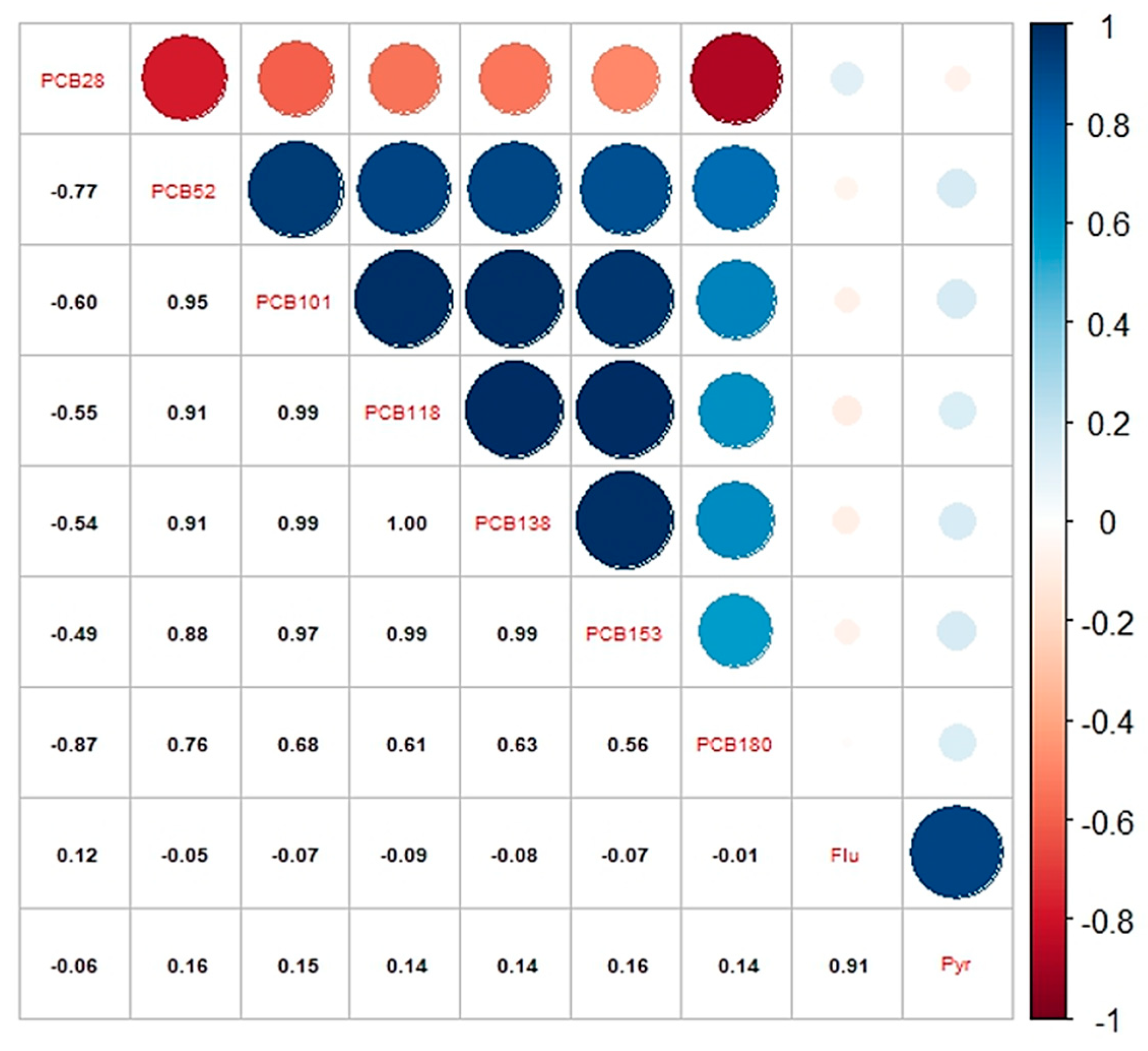
Statistical analyses were conducted using the R software environment for statistical computing [33]. The Pearson correlation coefficient was calculated to assess the linear correlation between PCBs and PAHs concentrations.
To investigate multivariate contamination patterns, we applied a Self-Organizing Map (SOM), an unsupervised artificial neural network designed for clustering and visualization of high-dimensional data. Unlike traditional clustering methods (e.g., hierarchical or k-means clustering), which assign samples to discrete groups without preserving neighborhood structure, SOM simultaneously performs clustering and topology-preserving projection. This means that samples with similar pollutant profiles are positioned in adjacent nodes on a two-dimensional grid, allowing visualization of gradual transitions, mixed profiles, and nonlinear relationships. In addition, SOM is less sensitive to noise and does not require prior assumptions about cluster shape or strict separation boundaries, making it particularly suitable for complex environmental datasets [34].
In the current study, SOM analysis was performed using the concentrations of 7 PCBs (PCB-28, PCB-52, PCB-101, PCB-118, PCB-138, PCB-153, PCB-180) and 2 PAHs (Flu and Pyr) measured in a total of 37 fish samples. To enhance the suitability for SOM analysis, all data were normalized to a range between 0 and 1. The SOM output layer was structured into 9 neurons (3 × 3 grid), ensuring that each neuron corresponded to at least 4–10 samples. A hexagonal grid configuration was chosen for the SOM architecture [35]. The iteration process was optimized until the distance between each sample’s weight and its respective node reached a stable lower plateau.

2.6.2. Human Health Risk Assessment

Concentrations of the organic compounds detected in the fish samples from the Kupa River were used to assess potential health risk for consumers. Risk estimates were calculated using models developed by US EPA [36] and adapted to Croatian exposure conditions. The same risk assessment was applied in our previous study evaluating pelagic fish species from the Adriatic Sea [37]. In the present study, updated national data on fish consumption were incorporated. According to the National Ministry of Croatia, the current average fish consumption rate is 22.12 kg per capita per year, representing a substantial increase compared to values reported six years earlier [38]. This updated consumption rate was used to reflect population-level exposure based on national dietary statistics. Therefore, the health risk assessment in this study represents the worst-case exposure scenario for the consumers of the river fish. Daily intake rate (EDI) for each PCB and PAH determined in fish samples was calculated using the equation [36]:
EDI = (C × IR × ED × EF)/(BW × AT)
where C (ng⋅g−1) is the concentration of PCB or PAH in the investigated fish. For the assessment of carcinogenic risk (CR), the EDI of each PAH was corrected using the Toxic Equivalent Factor (TEF) and expressed as BaP equivalent concentrations. This approach allows the combined carcinogenic potency of individual PAHs to be standardized relative to BaP. In the exposure assessment, IR represents the ingestion rate calculated per day according to public data for fish consumption in Croatia (IR is 60.60 g/day) [38], ED is exposure duration (26 years; a typical residential exposure duration for adults); EF is exposure frequency (350 days/year); AT is the average time (365 days/year × 26 years), and BW is body weight (70 kg for an adult person) [36].
THQPCB/PAH = EDI/RfD
THQndl-PCB = EDI/TDI
CR = EDI × CSF
where EDI is the estimated daily intake rate, and RfD is the reference dose value [36] known for PAH and PCB-118, while for 6 ndl-PCB was used TDI value (10 ng/kg/day) [39,40].
Ndl-PCBs are not genotoxic or carcinogenic, but are linked to neurological, developmental, and immune effects. Their specific contribution to toxicity is often difficult to distinguish from that of the more toxic dioxin-like PCBs. In this study, the worst-case scenario risk was assessed, observing ndl-PCBs, because they may significantly disorder human health via oral exposure. The human health risk assessment was based on total measured POP concentrations, assuming that all the detected levels were bioaccessible following ingestion. This assumption represents a worst-case exposure scenario, as it does not account for possible reductions due to limited bioaccessibility or metabolic factors. The resulting risk estimates for ndl-PCBs should therefore be observed as precautionary, particularly in the context of long-term and uncontrolled diet based on the species investigated.

3. Results

3.1. PCB Levels

Table 3 and Table S1 (Supplementary Material) present the results of PCBs concentrations analyzed in seven different fish species from the Kupa River. The sum of 6 ndl-PCBs ranged from 92.8 to 98.8 (Grass carp), 97.4 to 105.1 (Pike perch), 105.9 to 117.3 (Common carp), 101.8 to 130.6 (Bream), 91.8 to 131.3 (Northern pike), 91.6 to 171.8 (Wels catfish), and 129 to 480.5 ng⋅g−1 wet weight (Chub). PCBs data reveals contamination across the fish species studied. The analysis of Σ6 ndl-PCBs in multiple fish species from the Kupa River indicated that PCB concentrations were both species- and location-dependent. Chub from Jurovski Brod exhibited markedly elevated concentrations, suggesting the presence of a localized contamination source, whereas the highest levels in Wels catfish and Common carp were observed in Koritinja and Rečica, respectively. In contrast, PCB levels in Grass carp and Pike-perch were relatively uniform across all sampling sites. Comparison with Σ7 ndl-PCBs revealed that Σ6 ndl-PCB concentrations were lower, implicating PCB-118 as a contributor to higher total PCB burdens.
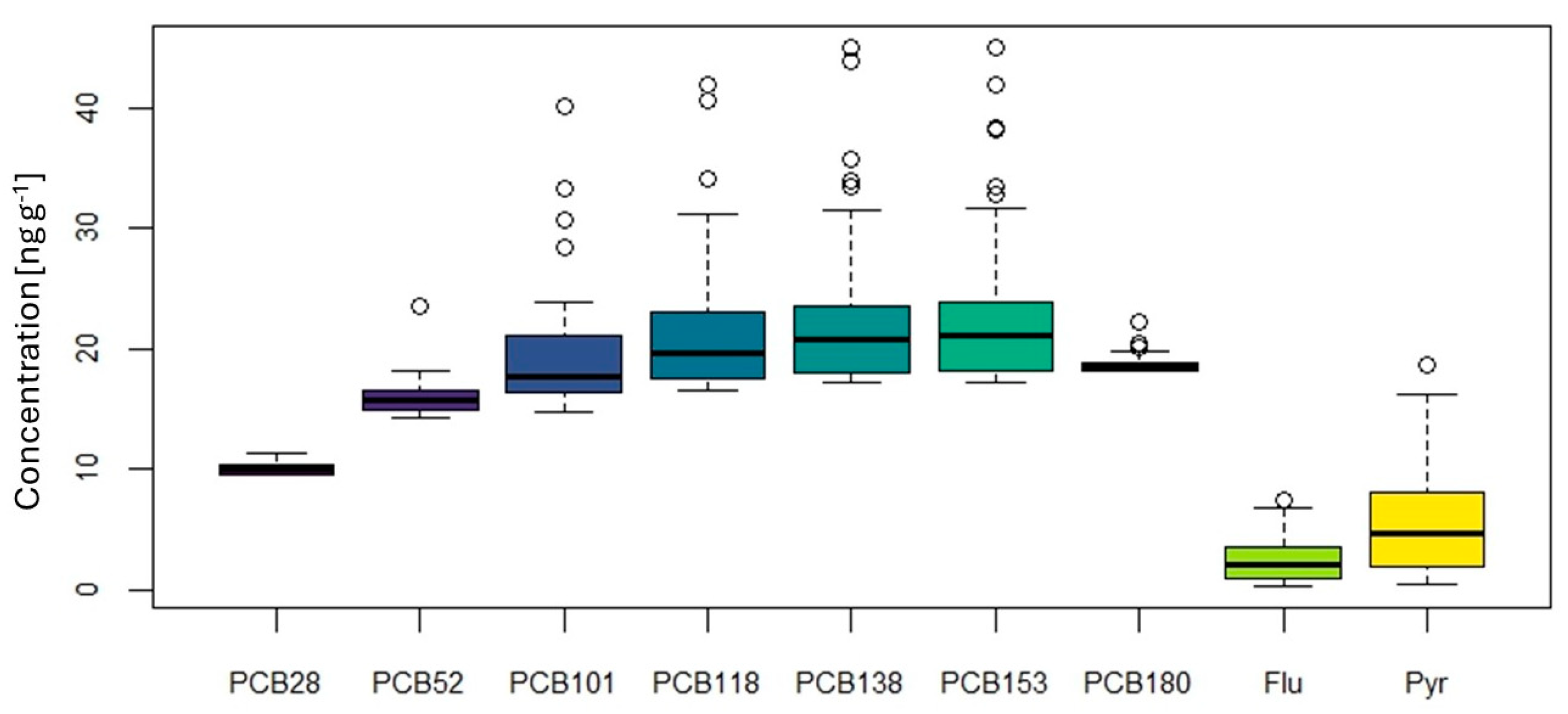
Congener-specific trends suggest that higher chlorinated PCBs congeners, such as PCB-138, PCB-153, and PCB-180, generally exhibit higher concentrations than their lower chlorinated counterparts, like PCB-28 and PCB-52, across all species (Figure 2). A very high correlation coefficient (>0.90) was observed between the following PCBs congener pairs: PCB52–PCB101, PCB52–PCB118, PCB52–PCB138, PCB101–PCB118, PCB101–PCB138, PCB101–PCB153, PCB118–PCB138, PCB118–PCB153, and PCB138–PCB153 (Figure 3).

3.2. PAH Levels

Of the 11 PAHs analyzed (Table S2 Supplementary Material), only the low-molecular-weight compounds, Flu and Pyr, were detected in all analyzed fish samples, at concentrations significantly lower than those of PCBs (Figure 2). BaA were found in only five samples, Chry in three, BjF in four, BbF, BaP, DahA, BghiP, IP in only one sample and BkF in any sample. Flu levels ranged from 0.008 ng⋅g−1 to 7.51 ng⋅g−1, while Pyr concentrations ranged from 0.47 ng⋅g−1 to 18.63 ng⋅g−1. The sum (ng⋅g1) of PAHs in seven fish species ranged from 0.7 to 25 (Chub), 1.9 to 5.8 (Grass carp), 7.6 to 26.1 (Common carp), 3.3 to 20.1 (Bream), 2 to 20 (Northern pike), 1 to 10.5 (Wels catfish), and 1.3 to 13.2 ng⋅g−1 wet weight (Pike-perch). PAH concentrations varied by fish species and location. The highest levels were found in Common carp from Luka Pokupska (up to 26.1 ng/g) and Northern pike from Rečica (up to 20.1 ng/g), while Grass carp (1.4–5.8 ng/g) and most Wels catfish had lower values, except in Koritinja (9.5–10.5 ng/g). Chub from Karlovac exhibited substantial levels (up to 25.0 ng/g), and Bream was highest in Rečica (20.1 ng/g) but lower in Brodarci (3.3–8.6 ng/g).

3.3. SOM Clustering

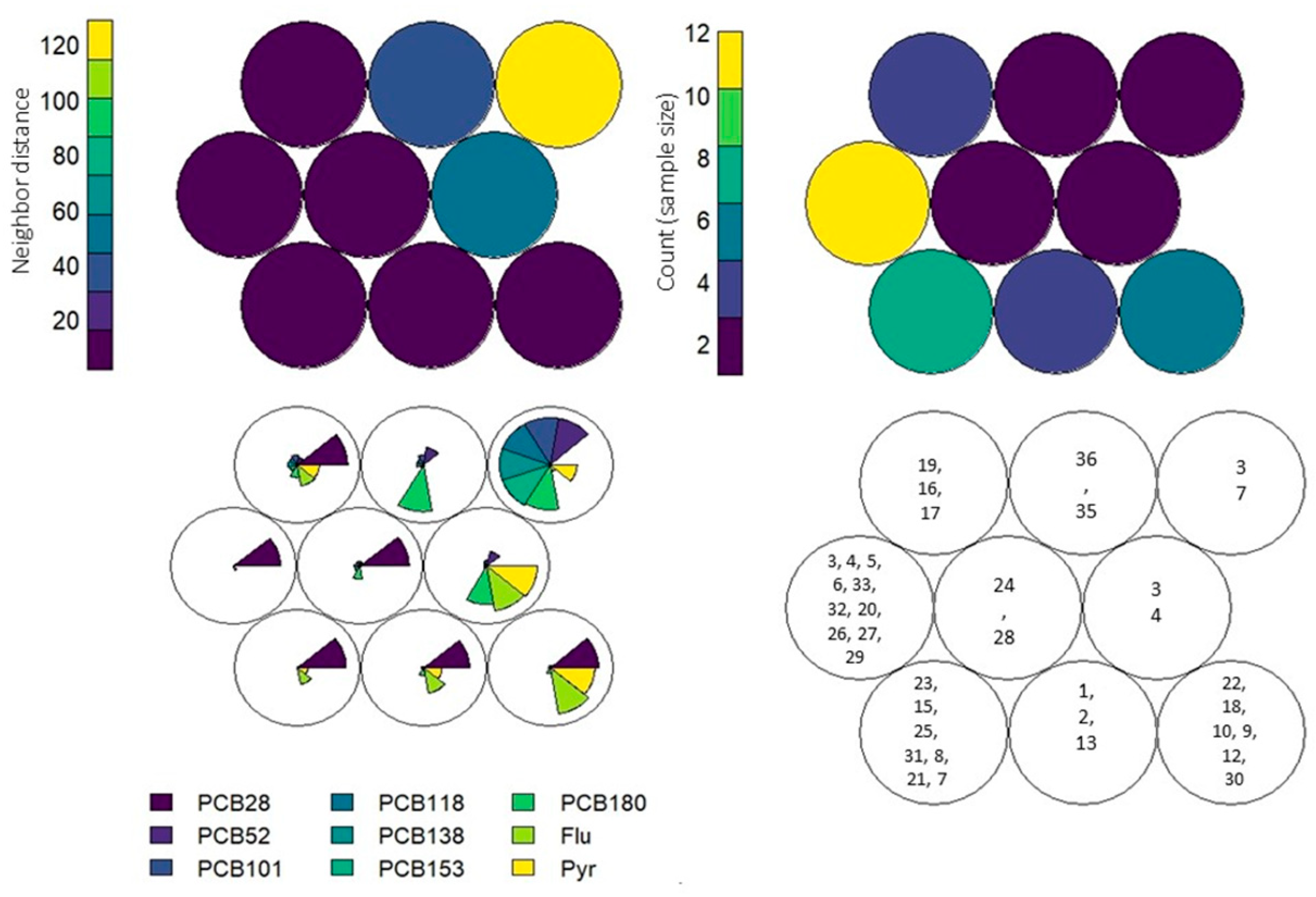
To elucidate patterns of co-occurrence and divergence among contaminants, we employed SOM analysis, which groups samples based on similarity in pollutant profiles rather than single-compound concentrations. As shown in Figure 4, the upper panels summarize cluster proximity and sample density, while the lower panels display the dominant pollutant signatures within each node. The SOM revealed that variability was primarily driven by differences in PCB burdens rather than PAHs. Chub samples were distributed across several nodes, indicating heterogeneous exposure conditions. Notably, one chub sample (37) formed part of a node characterized by the highest PCB loadings, whereas samples 35 and 36 clustered in a low-contamination node. Sample 34 was positioned in a node where PAHs contributed relatively more strongly than PCBs.
In contrast, several nodes grouped species with more homogeneity in pollutant profiles and consistently lower PCB levels. The first group, comprising Northern pike, Grass carp, Wels catfish, Pike-perch, and Bream (samples 3, 4, 5, 6, 33, 32, 20, 26, 27, 29), was associated with lower PCBs levels. A second group, including Wels catfish (samples 16 and 17) and Common carp (sample 19), displayed elevated PCBs concentrations, particularly for congeners 101, 118, 138, and 153. Additionally, moderate-contamination nodes, including some Wels catfish samples (24 and 28), likely reflect intermediate exposure scenarios, potentially influenced by localized sediment contamination or differences in age, lipid content, and trophic position.

3.4. Human Health Risk Assessment

The European Food Safety Authority (EFSA) reports that over 90% of human exposure to non-dioxin-like PCBs (ndl-PCBs) occurs via food, particularly fish, due to their strong lipophilicity and bioaccumulative properties [41,42]. In contrast to dl-PCBs and PAHs, ndl-PCBs are less studied, especially regarding long-term health effects, although even low dietary exposure from fish may impair neurological development in children [41,43]. Although average national consumption data were used, individual dietary variability may influence actual exposure levels. Therefore, the calculated risk represents population-level estimates rather than individual-specific exposure scenarios.
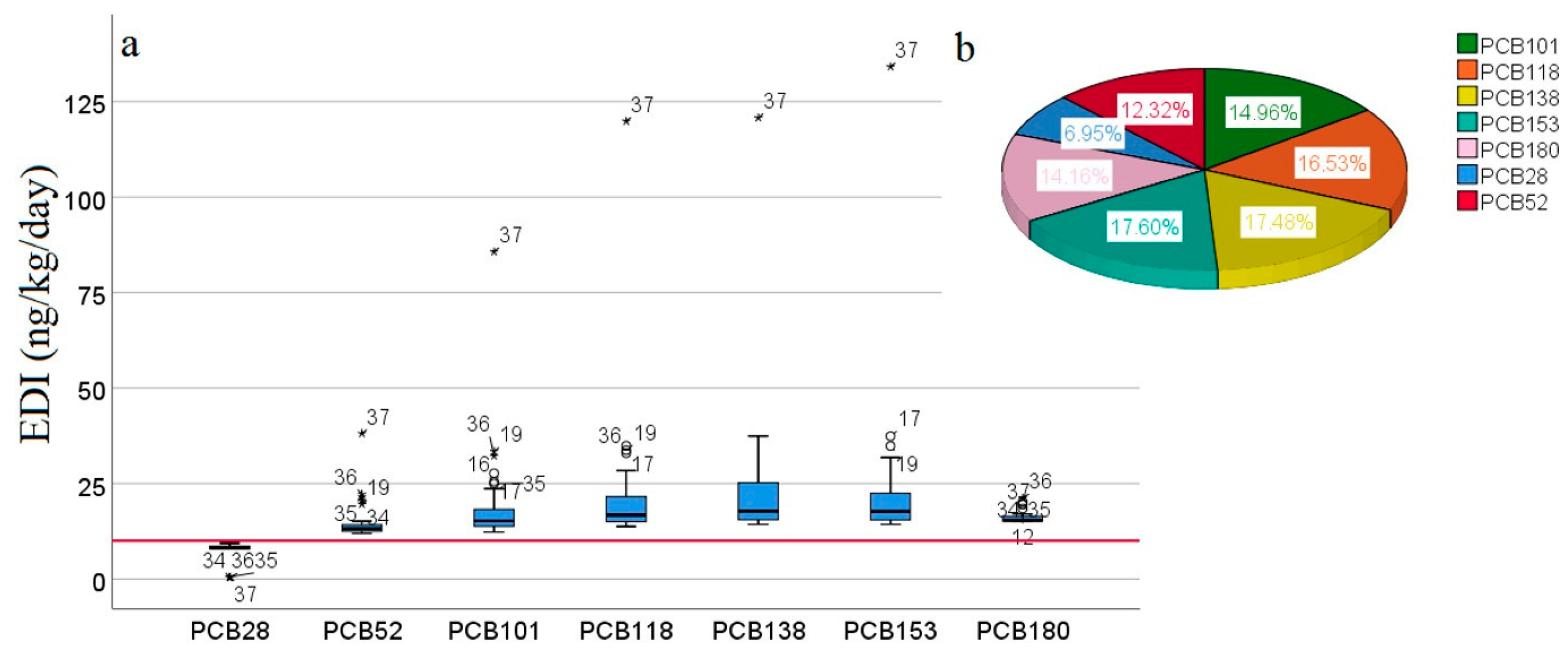
Estimated daily intake values (Figure 5) indicate that consumption of fish from the Kupa River may result in higher intake of PCB-52, PCB-101, PCB-118, PCB-138, PCB-153, and PCB-180 compared to PCB-28 and the investigated PAHs (Flu and Pyr). The contribution of individual congeners to total PCB intake followed the order: PCB-153 > PCB-138 > PCB-118 > PCB-101 > PCB-180 > PCB-52 > PCB-28 (Figure 5b). Elevated EDI values for PCB-52, PCB-101, PCB-118, and PCB-153 in Common carp (sample 19) and Wels catfish (sample 17), while increased PCB-180 intake was noted in Bream (sample 12).
Median EDIs for PCB-118, -138, and -153 (Table S3, Supplementary Material) exceeded the commonly cited tolerable daily intake (TDI) of 20 ng/kg bw/day [44], while Σ6 ndl-PCB intake frequently surpassed 10 ng/kg bw/day, as they account for 50% of total PCB intake [40,44].
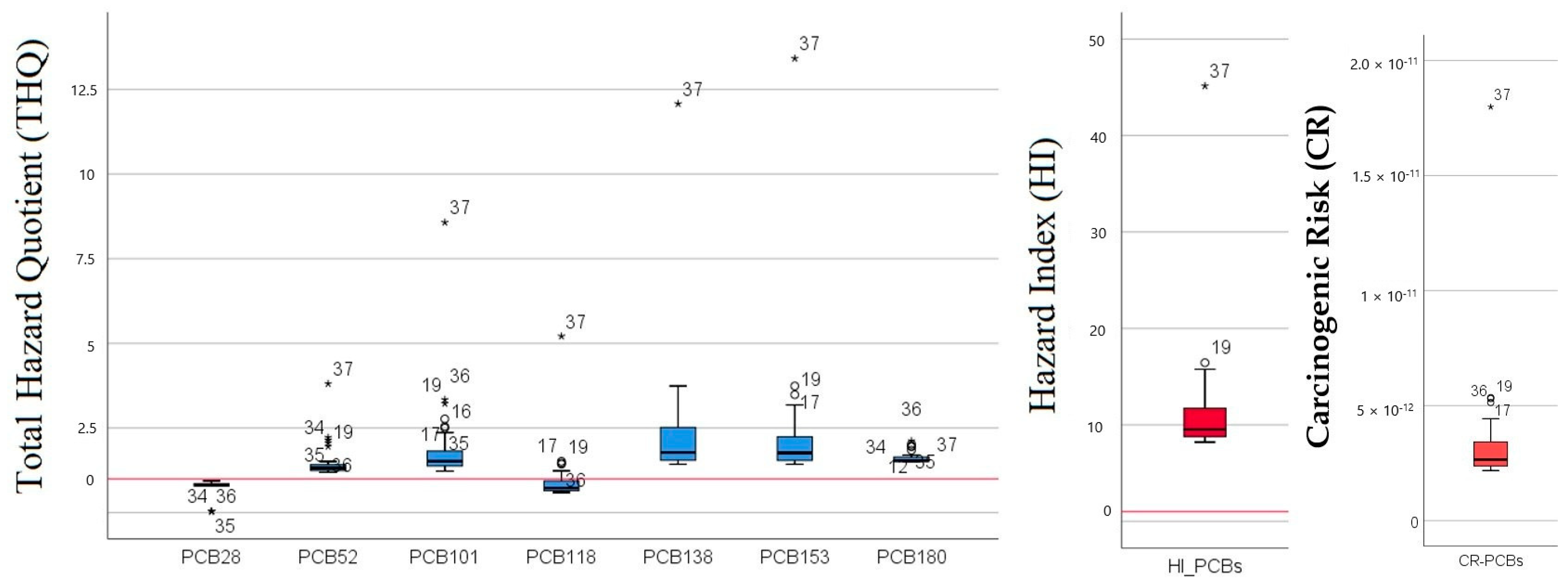
Hazard index (HI) is notably higher than the target value (HI > 1) for PCB-52, PCB-101, PCB-138, PCB-153, and PCB-180 (Figure 6), indicating potential non-carcinogenic effects under chronic exposure scenarios. For PCB-118, exceedances were limited to samples (17, 19, 36, and 37) with the highest concentrations. However, CR values remained below the acceptable carcinogenic risk threshold (CR < 1 × 10⁻⁶; Figure 6).
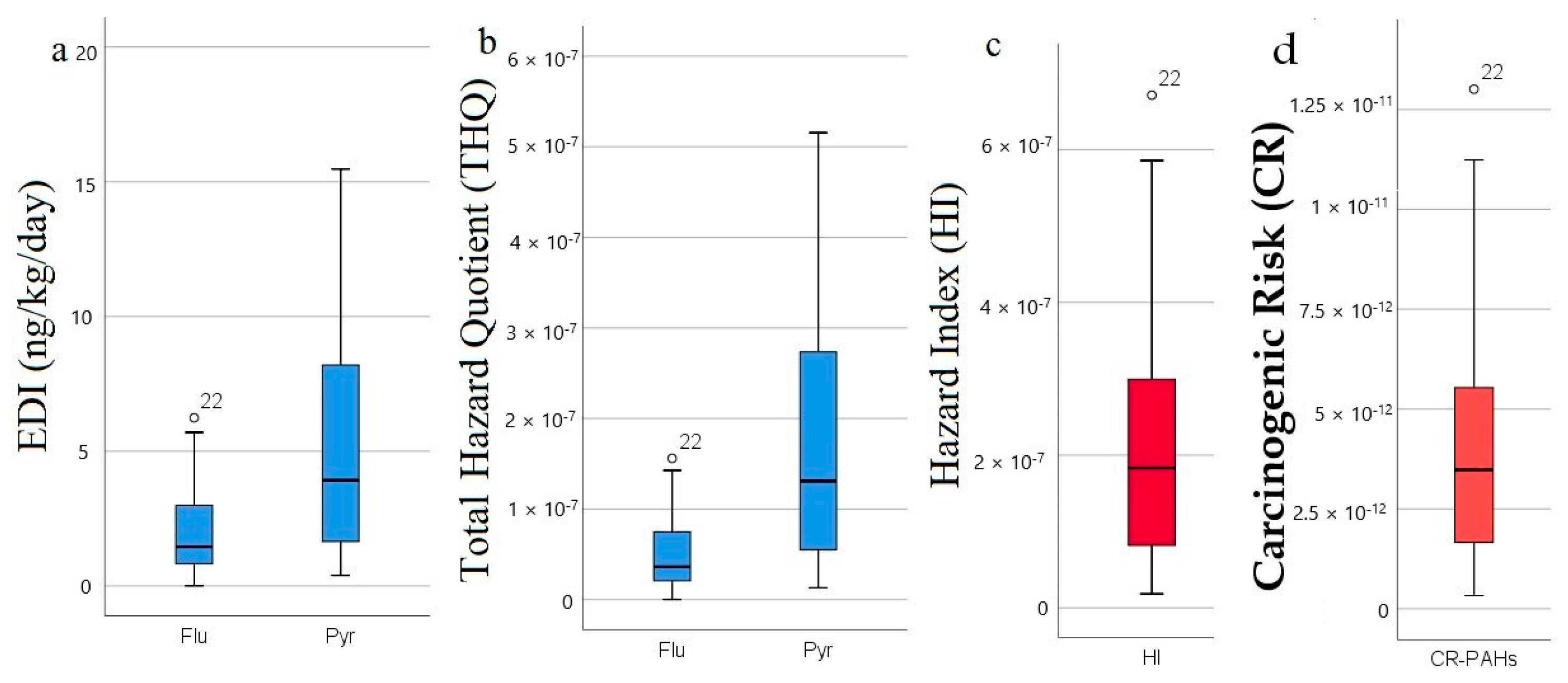
Figure 6. The Total Hazard Quotient (THQ) implies the non-carcinogenic risk and Carcinogenic Risk (CR) for fish consumers based on the PCB concentrations; ”°” represents the outliers and “*” represents extremes. PAH EDI values are significantly lower than those of PCBs (Figure 5a and Figure 7a), with slightly higher intake of Pyr than Flu (Figure 5). The exception was Flu EDI value observed in Common carp (sample 22). As observed for PAH EDIs, THQ values for PAH are negligible compared to the target value (THQ, HI for PAH < 1; Figure 7) while CR values remained below the acceptable carcinogenic risk threshold (CR < 1 × 10⁻⁶; Figure 7).
Environments 13 00192 g006
Figure 7. (a) Estimated daily intake (EDI) of Flu and Pyr; (b) THQ for Flu and Phy; (c) Hazard Index (HI); (d) Carcinogenic risk (CR) for PAH determined in the fish samples from Croatian rivers; “°” represents the outliers.
Environments 13 00192 g007

4. Discussion

PCB contamination in the Kupa River is characterized by localized hotspots and moderate background levels, with clear variability among species. This variability reflects differences in feeding behavior, habitat use, trophic position, and lipid content, suggesting that future spatial assessments should preferentially focus on a single species to reduce interspecific uncertainty.
Congener profiles were dominated by higher chlorinated PCBs (PCB-138, PCB-153, PCB-180), consistent with their greater hydrophobicity, resistance to metabolic degradation, and stronger affinity for lipid-rich tissues. These properties enhance sediment–water partitioning and trophic biomagnification, whereas lower chlorinated congeners (e.g., PCB-28, PCB-52) are more susceptible to volatilization and biotransformation, resulting in lower tissue burdens. Strong correlations among congeners further indicate common sources and accumulation pathways, primarily through sediment-associated dietary exposure rather than direct aqueous uptake, as consistent with the work of Burd et al. (2022) [45].
The observed PCB concentrations are consistent with previous studies in the Kupa River [13,14,15,46], confirming long-term persistence of contamination. Comparable patterns have been reported across Europe. In Slovakia, Σ6 ndl-PCBs exceeded regulatory limits in a substantial proportion of bream samples [47], while in Polish rivers, concentrations were significantly lower in agricultural systems (0.28–14.19 ng⋅g−1) than in urban rivers such as the Vistula near Kraków (15.2–125.5 ng⋅g−1) [48], with reported maxima up to 790 ng⋅g−1 [49]. In northern Italy, up to 33.3% of samples exceeded regulatory thresholds, with concentrations reaching 1015.4 ng⋅g−1 in the Po River [50]. Similarly, increasing trends were observed in the Danube River [51], and concentrations up to 168 ng⋅g−1 were reported in the Sava River [52]. Overall, PCB levels in the Kupa River fall within the upper range observed in European rivers affected by historical industrial contamination and are comparable to urban–industrial systems, indicating continued environmental relevance and potential health concern.
In contrast, PAH concentrations in fish were low and showed no clear interspecies accumulation pattern. This is consistent with their environmental behavior in Croatian aquatic environments, including rivers within the Danube drainage basin [7,53], where continuous emissions from combustion processes (traffic, heating, biomass burning) result in widespread but diffuse inputs. Diagnostic ratios including Flu/(Flu + Pyr), BaA/(BaA + Chry), and IP/(IP + BghiP) are commonly used to differentiate between these sources and demonstrate the dominant influence of combustion-related activities in rural and semi-urban environments of Croatia [54]. Similar approaches applied in recent regional sediment studies have also used PAH diagnostic ratios (e.g., Flu/(Flu + Pyr), BaA/(BaA + Chry)) to indicate predominantly pyrogenic inputs associated with combustion processes in Croatian river systems [7]. However, rapid degradation and metabolic elimination in fish limit PAH bioaccumulation, explaining the generally low concentrations observed.
The negligible correlation between PCBs and PAHs highlights their distinct environmental dynamics. PCBs are governed by persistence, sediment reservoirs, and trophic transfer, whereas PAHs reflect ongoing inputs and short-term environmental conditions. Elevated PAH levels reported in heavily contaminated systems such as the Eleyele and Ogun Rivers [25] indicate that substantial accumulation occurs primarily under continuous high-intensity pollution, which is not evident in the Kupa River.
Fish–sediment comparisons further emphasize these differences. As part of our broader investigation of river sediment contamination across Croatia (May 2020–September 2021), sediment samples from the Kupa River were also analyzed [7]. Concentrations of Σ6 ndl-PCBs ranged from 0.15 to 19.47 ng⋅g−1, while Σ7 ndl-PCBs ranged from 0.15 to 23.49 ng⋅g−1. The concentration range of Σ11 PAHs was 24.27–204.03 ng⋅g−1. Flu and Pyr, which were detected in all fish samples analyzed in the present study, ranged in sediments from 3.34 to 32.00 ng⋅g−1 (Flu) and from 3.78 to 28.03 ng⋅g−1 (Pyr). According to our previous findings [7], PAHs in Kupa River sediments are predominantly of petrogenic origin. All measured PCBs and PAHs sediment concentrations were below the Threshold Effect Levels defined by the Canadian Sediment Quality Guidelines for the Protection of Aquatic Life [17] and the Atlantic RBCA Environmental Quality Standards [18]. Although these thresholds are not necessarily protective of higher trophic level organisms, they are considered suitable benchmarks for screening the potential for contaminant-related biological effects. This interpretation is consistent with O’Rourke et al. [55], who emphasized the importance of multi-trophic biomonitoring, while the PAH results align with Honda and Suzuki [22], who reported limited accumulation due to rapid metabolic transformation despite continuous input.
SOM analysis supports these conclusions, showing that variability in contaminant profiles is primarily driven by PCB burden, whereas PAHs contribute less due to their lower persistence and faster turnover. This underscores the importance of ecological traits, particularly feeding strategy and habitat use, in controlling contaminant accumulation.
These differences are also reflected in the human health risk assessment. Estimated dietary intake was dominated by highly chlorinated PCBs, consistent with their persistence and bioaccumulation. ΣEDI-PCB values exceeded tolerable intake thresholds and were higher than those reported for fish from the Adriatic Sea [37], the Arno River [56], and aquaculture systems in Greece [41], as well as typical dietary exposure ranges (4.3–25.7 ng/kg/day) [42]. In contrast, PAH-related EDI values were substantially lower and consistent with their limited bioaccumulation, remaining below risk thresholds and lower than those reported in more polluted systems such as Nigeria, the Ganga Basin, and Japan [25,57,58].
Although carcinogenic risk values remained below acceptable thresholds, non-carcinogenic risk indicators (HI > 1) for several PCB congeners indicate potential health concerns under chronic exposure. Overall, PCBs represent the dominant toxicological driver in the Kupa River. The exceedance of regulatory limits in 11 of 37 samples confirms that contamination is spatially recurrent rather than isolated. These findings support precautionary consumption advisories and the promotion of catch-and-release practices to reduce human exposure while maintaining recreational fisheries [59].
Limitations. A limitation of the present study is the relatively small sample size and uneven spatial distribution of specimens, which may restrict the generalizability of the findings. In particular, the highest PCB concentration was observed in a single specimen collected near the main historical pollution source, whereas most other individuals were sampled downstream. This sampling pattern introduces a potential confounding between spatial location and biological or ecological differences among species, limiting the strength of comparative interpretations. Future studies should therefore employ a more balanced sampling design, including a larger number of fish and sediment samples collected at multiple sites along the entire course of the Kupa River, and ideally focus on a single fish species to minimize variability related to interspecific differences in bioaccumulation. Despite this limitation, the results presented here provide a valuable baseline dataset and establish a scientific foundation for future investigations into PCB contamination in this freshwater ecosystem. Our findings also support basin-scale environmental management efforts under frameworks such as the EU Water Framework Directive and the Danube River Protection Convention, which emphasize coordinated monitoring and protection of aquatic ecosystems across transboundary river systems.

5. Conclusions

This study evaluated PCBs and PAHs contamination in seven fish species from the Kupa River, Croatia, highlighting the long-term legacy of PCB pollution dating back five decades ago. PCB concentrations were higher than PAHs in all investigated species, while among PAHs only Flu and Pyr were consistently detected, indicating ongoing but low-intensity exposure. Contaminant levels varied by species and location, reflecting differences in feeding behavior, habitat use, and trophic position, as well as spatial heterogeneity within the river system.
While PAH concentrations were low and unlikely to pose health risks, PCB levels exceeded the European Commission limit in 11 of 37 samples, indicating potential risks associated with frequent fish consumption. These results align with historical and recent data, emphasizing the need for basin-wide monitoring due to the river’s connection to the transboundary Danube basin. Currently, no specific EU regulation establishes maximum allowable levels of PCBs or PAHs in freshwater sediments, while regulatory limits primarily address fish and shellfish intended for human consumption. In the case of the Kupa River, sediment analysis alone would not have captured the elevated PCB concentrations detected in fish. The findings highlight the need to reassess sediment quality standards for PCBs and to conduct further research on their levels in sediments, including evaluation of potential resuspension under anticipated changes in river and watershed conditions. Comprehensive monitoring programs specifically focused on POPs, including PCBs, across multiple matrices such as sediment and fish, are essential to provide a robust scientific basis for environmental management and to ensure compliance with EU water quality regulations. Furthermore, rivers with historical contamination sources, such as those within the Danube basin and other European river systems, may remain vulnerable to long-term pollutant cycling through sediment remobilization and trophic transfer. Future monitoring efforts should prioritize organisms at the top of the food chain, as well as assessment of both ecological and human health risks. For monitoring purposes, highly chlorinated congeners (e.g., -138, -153, -180) are preferred due to their exceptional persistence in deeper sediment and soil layers, which act as so-called secondary sources.
The main limitations of this study are the small sample size and uneven spatial distribution of samples, which may limit the generalizability of the findings. Nevertheless, the study provides a valuable baseline for future research and supports coordinated efforts to monitor and mitigate PCB contamination in freshwater ecosystems.

Supplementary Materials

The following supporting information can be downloaded at: https://www.mdpi.com/article/10.3390/environments13040192/s1, Table S1. Summary Statistics: Minimum (Min), maximum (Max), average (Mean), and median values (ng⋅g−1) of PCB congeners in 7 fish species—Northern pike (n = 5), common carp (n = 6), grass carp (n = 7), pike-perch (n = 5), Wels catfish (n = 6), bream (n = 4) and chub (n = 4); Table S2. PAH levels (ng⋅g−1 w. w.) in 7 fish species collected along Kupa (locations available in Figure 1); Table S3. Estimated daily intake (EDI; ng/kg/day) for NDL-PCBs, PCB118 and PAHs; Figure S1. Estimated daily intake—EDI (ng/kg/day) of PCBs and PAHs investigated in fish species from Kupa River and EDI of PCBs investigated for Pelagic fish species [37]; * the model from the study was adapted to nowadays data fish consumption per capita in Croatia).

Author Contributions

Conceptualization, S.H.R., T.M. and G.J. (Gordana Jovanović); methodology, S.H.R., T.M. and G.J. (Gordana Jovanović); formal analysis, I.J., N.B. and M.Đ.; investigation, S.H.R.; resources, S.H.R., G.P. and N.B.; data curation, I.J., N.B., M.B., M.Đ., G.M., G.J. (Goran Jakšić); writing—original draft preparation, S.H.R., G.J. (Goran Jakšić), T.M. and G.J. (Gordana Jovanović); writing—review and editing, S.H.R., G.J. (Goran Jakšić), T.M. and G.J. (Gordana Jovanović); supervision, S.H.R., G.J. (Gordana Jovanović); project administration, G.M.; funding acquisition, S.H.R., G.P., N.B. All authors have read and agreed to the published version of the manuscript.

Funding

This study was performed using the facilities and equipment funded within the European Regional Development Fund project KK.01.1.1.02.0007 “Research and Education Centre of Environmental Health and Radiation Protection—Reconstruction and Expansion of the Institute for Medical Research and Occupational Health”, and funded by the European Union—Next Generation EU (project EnvironPollutHealth, Program Contract of 8 December 2023, Class: 643-02/23-01/00016, Reg. no. 533-03-23-0006). The authors acknowledge funding provided by the Institute of Physics Belgrade (451-03-68/2026-14/200024) through a grant from the Ministry of Science, Technological Development and Innovation of the Republic of Serbia.

Data Availability Statement

The data and methodologies used in the manuscript are provided in the manuscript or in Supplementary Material. All additional data will be provided on request from the corresponding author.

Conflicts of Interest

Author Goran Jakšić was employed by the company Aquatika-Freshwater Aquarium Karlovac. The remaining authors declare that the research was conducted in the absence of any commercial or financial relationships that could be construed as a potential conflict of interest.

Abbreviations

The following abbreviations are used in this manuscript:
PCBsPolyChlorinated Biphenyls
ndl-PCBsNon-dioxin like PCBs
PAHsPolycyclic Aromatic Hydrocarbons
RAISRisk Assessment Information System
US-EPAUnited States Environmental Protection Agency
LOQLimit Of Quantification
SOMSelf-Organizing Map
EDIEstimated Daily Intake rate
THQTotal Hazard Quotient
EFSAEuropean Food Safety Authority
TDITolerable Daily Intake

References

  1. Albarano, L.; Zupo, V.; Guida, M.; Libralato, G.; Caramiello, D.; Ruocco, N.; Costantini, M. PAHs and PCBs Affect Functionally Intercorrelated Genes in the Sea Urchin Paracentrotus lividus Embryos. Int. J. Mol. Sci. 2021, 22, 12498. [Google Scholar] [CrossRef]
  2. Benson, U.N.; Fred-Ahmadu, H.O.; Ekett, I.S.; Basil, O.M.; Adebowale, A.D.; Adewale, G.A.; Ayejuyo, O.O. Occurrence, depth distribution and risk assessment of PAHs and PCBs in sediment cores of Lagos lagoon, Nigeria. Reg. Stud. Mar. Sci. 2020, 37, 101335. [Google Scholar] [CrossRef]
  3. Jones, K.C. Persistent organic pollutants (POPs) and related chemicals in the global environment: Some personal reflections. Environ. Sci. Technol. 2021, 55, 9400–9412. [Google Scholar] [CrossRef]
  4. Marziali, L.; Guzzella, L.; Salerno, F.; Marchetto, A.; Valsecchi, L.; Tasselli, S.; Roscioli, C.; Schiavon, A. Twenty year sediment contamination trends in some tributaries of Lake Maggiore (Northern Italy): Relation with anthropogenic factors. Environ. Sci. Pollut. Res. 2021, 28, 38193–38208. [Google Scholar] [CrossRef]
  5. Girones, L.; Oliva, A.L.; Negrin, V.L.; Marcovecchio, J.E.; Arias, A.H. Persistent organic pollutants (POPs) in coastal wet-lands: A review of their occurrences, toxic effects, and biogeochemical cycling. Mar. Pollut. Bull. 2021, 172, 112864. [Google Scholar] [CrossRef]
  6. Herceg Romanić, S.; Jaćimović, N.; Mendaš, G.; Fingler, S.; Stipišević, S.; Jakšić, G.; Popović, A.; Jovanović, G. Bedload sediment transport model for revealing the multi year trend of polychlorinated biphenyl contamination in the river sediment (Kupa, Croatia). Environ. Geochem. Health 2023, 45, 8473–8487. [Google Scholar] [CrossRef]
  7. Terzić, I.; Jakovljević, I.; Fingler, S.; Mendaš, G.; Stipičević, S.; Pehnec, G.; Biošić, M.; Lovrić, M.; Jakšić, G.; Herceg Romanić, S. Persistent Organic Pollutants and Polycyclic Aromatic Hydrocarbons in River Sediments throughout Croatia: Spatial Distribution and In Silico Toxicity Characterization. Water Air Soil Pollut. 2026, 237, 408. [Google Scholar] [CrossRef]
  8. Sopčić, S.; Jakovljević, I.; Sever Štrukil, Z.; Bešlić, I. Source Identification of Carbohydrates and Polycyclic Aromatic Hy-drocarbons in a Rural Area near the Plitvice Lakes National Park, Croatia. Atmos. Environ. 2025, 345, 121050. [Google Scholar] [CrossRef]
  9. Stanišić, S.; Jovanović, G.; Perišić, M.; Herceg Romanić, S.; Milićević, T.; Stojić, A. Explaining the environmental fate of PAHin indoor outdoor environments by the use of artificial intelligence. In Polycyclic Aromatic Hydrocarbons: Sources, Exposure and Health Effects; Warren, L.G., Ed.; Nova Science Publishers: New York, NY, USA, 2022; ISBN 978-1-68507-626-9. [Google Scholar]
  10. Polič, S.; Leskovšek, H.; Hrovat, M. PCB pollution of the karstic environment (Krupa River, Slovenia). Acta Carsologica 2000, 29, 141–152. [Google Scholar]
  11. Pezdirc, M.; Heath, E.; Bizjak Mali, L.; Bulog, B. PCB accumulation and tissue distribution in cave salamander (Proteus anguinus anguinus, Amphibia, Urodela) in the polluted karstic hinterland of the Krupa River, Slovenia. Chemosphere 2011, 84, 987–993. [Google Scholar] [CrossRef]
  12. NIP. National Implementation Plan for the Management of Persistent Organic Pollutants in the Period 2009–2013; Republic of Slovenia, Government of the Republic Slovenia: Ljubljana, Slovenia, 2009; No. 18400-2/2008/8.
  13. Drevenkar, V.; Fingler, S.; Fröbe, Z. Some organochlorine pollutants in the water environment their influence on drinking water quality. In Chemical Safety. International Reference Manual; Richardson, M., Ed.; VCH: Weinheim, Germany, 1985; pp. 297–310. [Google Scholar] [CrossRef]
  14. Šmit, Z.; Drevenkar, V.; Kodrić-Šmit, M. Polychlorinated biphenyls in the Kupa River, Croatia, Yugoslavia. Chemosphere 1987, 16, 2351–2358. [Google Scholar] [CrossRef]
  15. Picer, M.; Perkov, S.; Picer, N. Contamination of Bela Krajina, Slovenia with polychlorinated biphenyls 1. Levels of some high molecular chlorinated hydrocarbons in the water and fish of the Kupa River in Croatia. Water Air Soil Pollut. 1995, 82, 559–581. [Google Scholar] [CrossRef]
  16. European Commission Regulation (EU) 2023/915, 2023. On Maximum Levels for Certain Contaminants in Food and Repealing Regulation (EC) No 1881/2006 (Text with EEA Relevance). Available online: https://eur-lex.europa.eu/eli/reg/2023/915/oj (accessed on 2 April 2025).
  17. Buchman, M.F. NOAA Screening Quick Reference Table for Organics in Sediment; NOAA OR&R Report 08-1; Office of Response and Restoration Division, National Oceanic and Atmospheric Administration: Seattle, WA, USA, 2008.
  18. Atlantic Risk Based Corrective Action (RBCA). Environmental Quality Standards, 2023. Ecological Tier I Environmental Quality Standards (EQS) for Sediment (Updated June 2023). Available online: https://atlanticrbca.com/wp-content/uploads/2023/06/Ecological_Tier_I_Environmental_Quality_Standards_for_Sediment_June2023.pdf (accessed on 2 April 2025).
  19. Leppanen, T.M.; Sourisseau, S.; Burgess, M.R.; Simpson, L.S.; Sibley, P.; Jonker, M.T. Sediment Toxicity Tests: A Critical Review of Their use in Environmental Regulations. Environ. Toxicol. Chem. 2024, 43, 1697–1716. [Google Scholar] [CrossRef]
  20. European Parliament & Council. Directive 2008/105/EC on Environmental Quality Standards in the Field of Water Policy; Official Journal of the European Union: Luxembourg, 2008. [Google Scholar]
  21. Bogdanović, T.; Pleadin, J.; Petričević, S.; Listeš, E.; Sokolić, D.; Marković, K.; Ozogul, F.; Šimat, V. The occurrence of polycyclic aromatic hydrocarbons in fish and meat products of Croatia and dietary exposure. J. Food Compos. Anal. 2019, 75, 49–60. [Google Scholar] [CrossRef]
  22. Honda, M.; Suzuki, N. Toxicities of polycyclic aromatic hydrocarbons for aquatic animals. Int. J. Environ. Res. Public Health 2020, 17, 1363. [Google Scholar] [CrossRef]
  23. Kuhn, A.V.; Dal Pont, G.; Cozer, N.; Sadauskas Henrique, H. The concentrations of polycyclic aromatic hydrocarbons in fish: A systematic review. Mar. Pollut. Bull. 2024, 198, 115778. [Google Scholar] [CrossRef]
  24. Bon Man, Y.; Yin Mo, W.; Zhang, F.; Hung Wong, M. Health risk assessments based on polycyclic aromatic hydrocarbons in freshwater fish cultured using food waste-based diets. Environ. Pollut. 2020, 256, 113380. [Google Scholar] [CrossRef]
  25. Adewale, A.; Adegbola, P.I.; Owoade, A.O.; Aborisade, A.B. Fish as a bioindicator of polycyclic aromatic hydrocarbon pollution in aquatic ecosystem of Ogun and Eleyele Rivers, Nigeria, and risk assessment for consumer’s health. J. Hazard. Mater. Adv. 2022, 7, 100096. [Google Scholar] [CrossRef]
  26. Li, Y.; Guo, N.; Zou, X.; Li, P.; Zou, S.; Luo, J.; Yang, Y. Pollution level and health risk assessment of polycyclic aromatic hydrocarbons in marine fish from two coastal regions, the South China Sea. Mar. Pollut. Bull. 2021, 168, 112376. [Google Scholar] [CrossRef]
  27. Montano, L.; Pironti, C.; Pinto, G.; Ricciardi, M.; Buono, A.; Brogna, C.; Venier, M.; Piscopo, M.; Amoresano, A.; Motta, O. Polychlorinated Biphenyls (PCBs) in the Environment: Occupational and Exposure Events, Effects on Human Health and Fertility. Toxics 2022, 1, 365. [Google Scholar] [CrossRef]
  28. Kottelat, M.; Freyhof, J. Handbook of European Freshwater Fishes; Kottelat: Cornol, Switzerland; Freyhof: Berlin, Germany, 2007; p. 646. [Google Scholar]
  29. Treer, T.; Piria, M. Osnove Primijenjene Ihtiologije; Sveučilište u Zagrebu, Agronomski Fakultet: Zagreb, Croatia, 2019; p. 145. (In Croatian) [Google Scholar]
  30. Ćaleta, M.; Marčić, Z.; Buj, I.; Zanella, D.; Mustafić, P.; Duplić, A.; Horvatić, S. A review of extant Croatian freshwater fish and lampreys—Annotated list and distribution. Croat. J. Fish. 2019, 77, 137–234. [Google Scholar] [CrossRef]
  31. Đokić, M.; Nekić, T.; Varenina, I.; Varga, I.; Solomun Kolanović, B.; Sedak, M.; Čalopek, B.; Kmetič, I.; Murati, T.; Vratarić, D.; et al. Distribution of pesticides and polychlorinated biphenyls in food of animal origin in Croatia. Foods 2024, 13, 528. [Google Scholar] [CrossRef]
  32. SANTE/11813/2017; Guidance Document on Analytical Quality Control and Validation Procedures for Pesticide Residues Analysis in Food and Feed. European Commission: Brussels, Belgium, 2013.
  33. R Team. A Language and Environment for Statistical Computing; R Foundation for Statistical Computing: Vienna, Austria, 2012; Available online: https://cran.r-project.org/doc/manuals/r-release/fullrefman.pdf (accessed on 1 April 2025).
  34. Budayan, C.; Dikmen, I.; Birgonul, M. Comparing the performance of traditional cluster analysis, self-organizing maps and fuzzy C-means method for strategic grouping. Expert Syst. Appl. 2009, 36, 11772–11781. [Google Scholar] [CrossRef]
  35. Wehrens, R.; Kruisselbrink, J. Supervised and Unsupervised Self-Organising Maps. Package ‘Kohonen’. 2017. Available online: https://cran.r-project.org/web/packages/kohonen/kohonen.pdf (accessed on 1 April 2025).
  36. RAIS—Risk Assessment Information System. 2014. Available online: https://rais.ornl.gov/ (accessed on 9 August 2025).
  37. Milićević, T.; Herceg Romanić, S.; Popović, A.; Mustać, B.; Đinović Stojanović, J.; Jovanović, G.; Relić, D. Human health risks and benefits assessment based on OCPs, PCB, toxic elements and fatty acids in the pelagic fish species from the Adriatic Sea. Chemosphere 2022, 287, 132068. [Google Scholar] [CrossRef]
  38. DZS. Statistical Information 2024. 2024. Available online: https://dzs.gov.hr/agriculture-forestry-and-fisheries/893 (accessed on 2 July 2025).
  39. Baars, A.J.; Theelen, R.M.C.; Janssen, P.J.C.M.; Hesse, J.M.; van Apeldoorn, M.E.; Meijerink, M.C.M.; Verdam, L.; Zeilmaker, M.J. Re-Evaluation of Human Toxicological Maximum Permissible Risk Levels; RIVM Report 711701025; National Institute for Public Health and the Environment (RIVM): Bilthoven, The Netherlands, 2001.
  40. Lee, C.-C.; Chang, W.-H.; Hung, C.-F.; Chen, H.-L. Fish consumption is an indicator of exposure to non dioxin like polychlorinated biphenyls in cumulative risk assessments based on a probabilistic and sensitive approach. Environ. Pollut. 2021, 268, 115732. [Google Scholar] [CrossRef]
  41. Renieri, E.; Goumenou, M.; Kardonsky, D.; Veselov, V.; Alegakis, A.; Buha, A.; Tzatzarakis, M.; Nosyrev, A.; Rakitskii, V.; Kentouri, M.; et al. Indicator PCB in farmed and wild fish in Greece—Risk assessment for the Greek population. Food Chem. Toxicol. 2019, 127, 260–269. [Google Scholar] [CrossRef]
  42. EFSA. Update of the monitoring of levels of dioxins and PCB in food and feed. Eur. Food Saf. Auth. Sci. Rep. EFSA J. 2012, 10, 2832. [Google Scholar]
  43. JECFA, Joint FAO/WHO Expert Committee on Food Additives. Safety Evaluation of Certain Food Additives and Contaminants, Supplement 1: Non-Dioxin-like Polychlorinated Biphenyls; WHO: Geneva, Switzerland, 2016; ISBN 978-92-4-166171-3. [Google Scholar]
  44. Morales Suárez Varela, M.; Lopez Santana, N.; Marti Requena, P.; Beser Santos, M.I.; Peraita Costa, I.; Llopis Gonzalez, A. Estimation of daily intake of polychlorinated biphenyls not similar to dioxins (NDL PCB) from fish consumption in Spain in different population groups. Public Health Nutr. 2018, 21, 2959–2968. [Google Scholar] [CrossRef]
  45. Burd, J.B.; Lowe, J.C.; Morales-Caselles, C. Uptake of PCBs into sediment dwellers and trophic transfer in relation to sediment conditions in the Salish Sea. FACETS 2022, 7, 936–965. [Google Scholar] [CrossRef]
  46. Ahel, M.; Ciglenečki Jušić, I.; Cuculić, V.; Filipović Marijić, V.; Mikac, N.; Mustafić, P.; Terzić, S.; Vdović, N. Identification of Hazardous Substances in Biota and Sediment and Monitoring Their Concentrations over One-Year Period at Trend Sites of Surface Freshwaters; CRORIS: Zagreb, Croatia, 2021. (In Croatian) [Google Scholar]
  47. Brázová, T.; Miklisová, D.; Barčák, D.; Uhrovič, D.; Šalamún, P.; Orosová, M.; Oros, M. Hazardous pollutants in the environment: Fish host parasite interactions and bioaccumulation of polychlorinated biphenyls. Environ. Pollut. 2021, 291, 118175. [Google Scholar] [CrossRef]
  48. Mikolajczyk, S.; Warenik-Bany, M.; Maszewski, S.; Pajurek, M. Dioxins and PCB—Environment impact on freshwater fish contamination and risk to consumers. Environ. Pollut. 2020, 263, 114611. [Google Scholar] [CrossRef]
  49. Niewiadowska, A.; Kiljanek, T.; Semeniuk, S. Contamination of Fish and Sediments from the Vistula River by Organochlorine Pesticides and PCB. Pol. J. Environ. Stud. 2015, 24, 2315–2320. [Google Scholar] [CrossRef]
  50. Squadrone, S.; Favaro, L.; Prearo, M.; Vivaldi, B.; Brizio, P.; Abete, M.C. NDL PCB in muscle of the European catfish (Silurus glanis): An alert from Italian rivers. Chemosphere 2013, 93, 521–525. [Google Scholar] [CrossRef]
  51. Janković, S.; Ćurčić, M.; Radičević, T.; Stefanović, S.; Lenhardt, M.; Durgo, K.; Antonijević, B. Non dioxin like PCB in ten different fish species from the Danube river in Serbia. Environ. Monit. Assess. 2011, 181, 153–163. [Google Scholar] [CrossRef]
  52. Ábalos, M.; Barceló, D.; Parera, J.; la Farré, M.; Llorca, M.; Eljarrat, E.; Giulivo, M.; Capri, E.; Paunović, M.; Milačič, R.; et al. Levels of regulated POPs in fish samples from the Sava River Basin: Comparison to legislated quality standard values. Sci. Total Environ. 2019, 647, 20–28. [Google Scholar] [CrossRef]
  53. Smoljo, I. Polycyclic Aromatic Hydrocarbons in Environmental Compartments in Croatia. Ph.D. Thesis, University of Zagreb, Zagreb, Croatia, 2016. [Google Scholar]
  54. Godec, R.; Jakovljević, I.; Sega, K.; Cacković, M.; Bešlić, I.; Davila, S.; Pehnec, G. Carbon Species in PM10 Particle Fraction at Different Monitoring Sites. Environ. Pollut. 2016, 216, 700–710. [Google Scholar] [CrossRef]
  55. O’Rourke, E.; Schumacher, M.; Charlesworth, M.; Andrade, T.; Pereira, M.G.; Hailer, F.; Chadwick, E. Increasing concentrations of polychlorinated biphenyls (PCBs) in Eurasian otters (Lutra lutra) from Wales suggest remobilisation from sediment sinks. Environ. Pollut. 2026, 388, 127354. [Google Scholar] [CrossRef]
  56. Pastorino, P.; Nocita, A.; Ciccotelli, V.; Zaccaroni, A.; Anselmi, S.; Giugliano, R.; Tomasoni, M.; Silvi, M.; Menconi, V.; Vivaldi, B.; et al. Health risk assessment of potentially toxic elements, persistence of NDL PCB, PAHs, and microplastics in the translocated edible freshwater Sinotaia quadrata (Gasteropoda, Viviparidae): A case study from the Arno River Basin (Central Italy). Expo. Health 2021, 13, 583–596. [Google Scholar] [CrossRef]
  57. Naaz, N.; Pandey, J. Spatial distribution of polycyclic aromatic hydrocarbons in water and sediment in the Ganga River: Source diagnostics and health risk assessment on dietary exposure through a common carp fish. Environ. Geochem. Health 2024, 46, 196. [Google Scholar] [CrossRef]
  58. Gao, Z.; Chen, Z.; Hui, S. Effect of charcoal grilling on polycyclic aromatic hydrocarbons (PAHs): Content, composition, and health risk in edible fish in Japan. Anal. Sci. 2022, 38, 515–523. [Google Scholar] [CrossRef]
  59. Jakšić, G.; Bočić, N.; Piria, M. Huchen Hucho hucho (Linnaeus 1758) in Croatia: Distribution Genetic Diversity Threats Conservation. In Ecological Sustainability of Fish Resources of Inland Waters of the Western Balkans; Fish & Fisheries Series; Simić, V., Simić, S., Pešić, V., Eds.; Springer International Publishing: Cham, Switzerland, 2023; Volume 43. [Google Scholar]
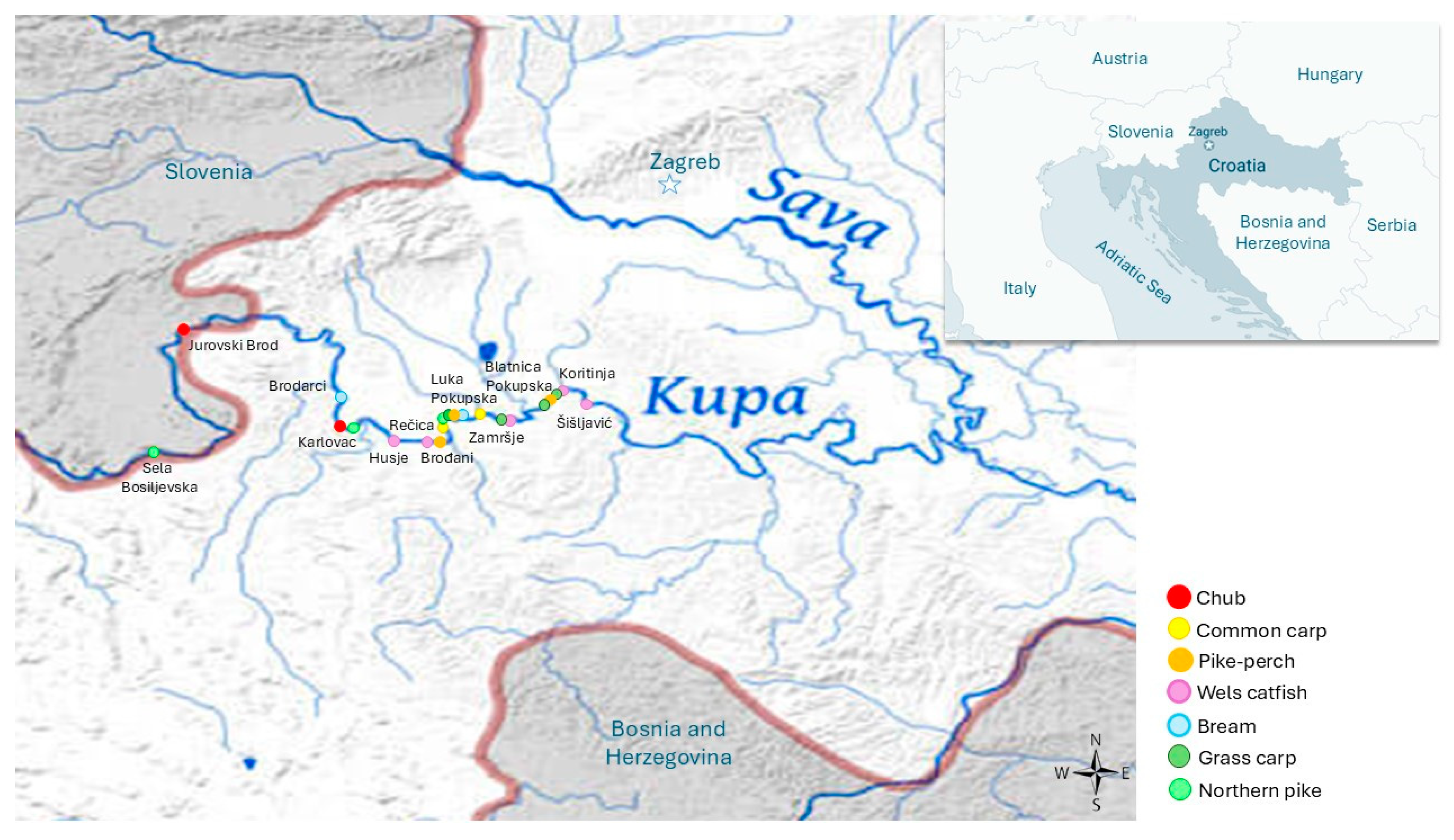
Figure 1. Locations of fish sampling sites along the Kupa River, with species indicated by different colors.
Environments 13 00192 g001
Figure 2. Box plot summary of PCB and PAH concentrations (ng⋅g−1 wet weight) in fish samples (Northern pike, Common carp, Grass carp, Pike perch, Wels catfish, Bream, and Chub) from the Kupa River.
Environments 13 00192 g002
Figure 3. Correlation analysis of PCB and PAH concentrations in fish samples (Northern pike, Common carp, Grass carp, Pike perch, Wels catfish, Bream, and Chub) from the Kupa River.
Environments 13 00192 g003
Figure 4. Self-organizing maps (SOM): the neighboring distance plot (top left), count plot (top right), pollutant concentrations within the clusters (bottom right), and the corresponding fish sample numbers (bottom left); in the distance plot, lighter colors indicate greater differences between clusters.
Environments 13 00192 g004
Figure 5. (a) Estimated daily intake—EDI (ng/kg/day) of PCB in fish species from Kupa River (the red line represents the TDI for ndl-PCB, 10 ng/kg/day); (b) % EDI of each PCB in ƩEDI PCB; ”°” represents the outliers and “*” represents extremes.
Environments 13 00192 g005
Table 1. Biology of fish species: Northern pike, Wels catfish, Pike-perch, Common carp, Bream and Grass carp [28,29,30].
Fish SpeciesNorthern PikeWels CatfishPike-PerchCommon CarpBreamGrass CarpChub
Latin nameEsox luciusSilurus glanisSander luciopercaCyprinus carpioAbramis bramaCtenopharyngodon idellaSqualius cephalus
FamilyEsocidaeSiluridaePercidaeCyprinidaeLeucisidaeXenocyprinidaeLeuciscidae
River basin in CroatiaDanube , Adriatic Danube , Adriatic Danube , Adriatic Danube , Adraitic Danube , Adriatic Danube , Adriatic Danube , Adriatic
Maximum length [cm]1502731501208014080
Maximum mass [kg]30130205011506
Dietfish, frogs, small mammalsfish, frogs, ducks, small mammalssmall fishplant matter, aquatic invertebrates, small fishzooplankton, aquatic invertebratesprimarily plant matterplant matter, aquatic invertebrates, small fish
Life span [year]2580176010–202116
Sexual maturity [year]1–32–33–53–43–47–10 females and 8–11 males3–5 females and 2–4 males
Spawning periodMarchApril–JuneApril–MayMay–JuneMay–JuneApril–AugustMarch–May
Course of rivermiddle, lowermiddle, lowermiddle, lowermiddle, lowermiddle, lowermiddle, lowerupper, middle, lower
* IUCN Red list statusleast concernleast concernleast concernvulnerableleast concernleast concernleast concern
Zone of open waterbenthopelagicbenthopelagicbenthopelagicbenthopelagicbenthopelagicbenthopelagicbentophelagic
Mesohabitatriffle, pool, backwaterriffle, run, poolrun, poolrun, pool, backwaterpool, shallow waterrun, poolrun, pool, riffle, backwater
Sedimentsandy, siltysandy, siltyrocky, gravelly, sandysandy, clay, siltysandy, siltygravelly, sandy, siltyrocky, gravelly, sandy, silty
✓ = Native, † = Non-native, * IUCN = International Union for Conservation of Nature.
Table 2. Analyzed fish samples data. N-number of samples.
Fish
Species
Latin NameSampling YearNAge
[Year]
Mass
[kg]
Sampling Location; Sample Label in ParanthesisWet Weight (%)Fat (%)
Northern pikeEsox lucius Linnaeus, 17582021–202251–40.6–2.5Karlovac (1), Rečica (2,6,30), Sela Bosiljevska (3)77.8–78.91.6–3.5
Grass carpCtenopharyngodon idella
(Valenciennes, 1844)
2021–202278–1610–19.1Koritinja (4), Rečica (7,11,14), Zamršje (21) Blatnica Pokupska(23,27)76.4–80.74.0–8.4
Wels catfishSilurus glanis Linnaeus, 1758202264–233–56.5Husje (5), Koritinja (16,17), Brođani (20), Šišljavić (24), Zamršje (28)76.6–79.50.9–4.0
Common carpCyprinus carpio Linnaeus, 1758202265–93.2–8.5Luka Pokupska (9,10,22), Rečica (18,19,25)77.29–803.1–5.9
Pike-perchSander lucioperca
(Linnaeus, 1758)
202253–41.5–2.1Brođani (8,15) Rečica (13,26), Blatnica Pokupska (29)77.9–79.31.8–2.8
BreamAbramis brama (Linnaeus, 1758)2022–202341–30.6–1,1Rečica (12)
Brodarci (31,32,33)
78.6–793.1–5.6
ChubSqualius
cephalus
2020–202141–50.07–0.95Karlovac (34,35,36),
Jurovski Brod (37)
77.5–80.21.7–3.0
Table 3. Sum of 6 PCB congeners and sum of 7 PCB (ng⋅g−1 wet weight) in 7 fish species—Northern pike (n = 5), common carp (n = 6), grass carp (n = 7), pike-perch (n = 5), Wels catfish (n = 6), bream (n = 4) and chub (n = 4) at locations along the course of the Kupa River (sampling sites are presented at Figure 1).
Sample LabelΣ7ndl-PCBΣ6ndl-PCBSpeciesLocation
1157.2131.3Northern pikeKarlovac
2128.7107.6Northern pikeRečica
3134.1111.8Northern pikeSela Bosiljevska
4114.597.0Grass carpKoritinja
5108.291.6Wels catfishHusje
6109.692.6Northern pikeRečica
7114.597.0Grass carpRečica
8125.2105.1Pike-perchBrodani
9136.2114.6Common carpLuka Pokupska
10140.5117.3Common carpLuka Pokupska
11113.796.4Grass carpRečica
12155.0130.6BreamRečica
13119.7100.8Pike-perchRečica
14109.893.0Grass carpRečica
15115.597.4Pike-perchBrodani
16187.8153.6Wels catfishKoritinja
17213.7171.8Wels catfishKoritinja
18128.2108.1Common carpRečica
19221.0180.4Common carpRečica
20133.7110.5Wels catfishBrodani
21116.398.8Grass carpZamršje
22126.2105.9Common carpLuka Pokupska
23116.098.0Grass carpBlatnica
24173.8142.7Wels catfishŠišljavić
25126.7106.3Common carpRečica
26122.3102.8Pike-perchRečica
27109.692.8Grass carpBlatnica
28175.2144.3Wels catfishZamršje
29119.0100.1Pike-perchBlatnica
30108.691.8Northern pikeRečica
31120.5101.6BreamBrodarci
32120.2101.8BreamBrodarci
33122.4102.8BreamBrodarci
34155.5129.0ChubKarlovac
35172.6142.8ChubKarlovac
36201.3161.5ChubKarlovac
37624.9480.5ChubJurovski Brod
Disclaimer/Publisher’s Note: The statements, opinions and data contained in all publications are solely those of the individual author(s) and contributor(s) and not of MDPI and/or the editor(s). MDPI and/or the editor(s) disclaim responsibility for any injury to people or property resulting from any ideas, methods, instructions or products referred to in the content.