1. Introduction
Cities worldwide are experiencing increasing frequency, duration, and intensity of heatwaves, together with growing exposure to air pollution and hydrometeorological extremes. These trends are particularly critical for children, who spend a substantial share of their time in educational settings and whose thermoregulation, health, and cognitive performance are especially vulnerable to high temperatures and degraded environmental conditions. While a substantial body of research has advanced passive design, retrofit, and life cycle approaches for school and residential buildings, outdoor school environments such as schoolyards have only more recently received comparable analytical attention. Recent studies on urban schoolyards and school climate adaptation interventions show that conventional paved playgrounds can reach extreme surface temperatures, whereas increased vegetation cover, shading, and material changes can significantly improve children’s thermal comfort and reduce heat stress exposure [
1,
2].
Evidence from these schoolyard thermal environment and climate shelter studies underlines the need to treat schoolyards as critical microclimates rather than residual outdoor spaces.
Recent quantitative evidence shows that paved schoolyards and playground surfaces can reach extremely high temperatures during summer heat events, often exceeding ambient air temperature by several tens of degrees, increasing children’s heat exposure and limiting safe outdoor activity. Findings from recent urban heat and school environment studies (2020–2024) reinforce that surface materials, shade provision, and vegetation type substantially influence microclimatic conditions on school grounds, motivating the need for scalable schoolyard retrofitting strategies.
Existing empirical and comparative research remains geographically concentrated and often focuses on a limited set of European cases, with fewer cross-continental comparisons spanning Europe, the Americas, and Oceania. In addition, an integrated analytical framework that combines (i) design strategies, (ii) governance and implementation models, and (iii) transparent prioritisation logic for site selection and investment remains limited. This study addresses these gaps through a comparative review of nine international programmes and the development of a combined CAME–MCA decision support framework.
At the same time, a growing evidence base links green schoolyards with multiple health and educational co-benefits. Systematic reviews and empirical studies show that schoolyard greening is associated with increased physical activity, improved socioemotional health, better attention and perceived restorativeness, and more diverse patterns of play among children [
3,
4,
5,
6].
Green schoolyards are increasingly framed as a specific form of nature-based intervention, deliberately designed to expose all children—including those in socially or environmentally disadvantaged neighbourhoods—to everyday contact with nature, thereby contributing to health equity and long-term environmental attitudes [
4,
5,
6].
More recently, schoolyards have been conceptualised as nature-based solutions (NBS) that serve simultaneously as climate adaptation infrastructure, everyday public space, and ecological steppingstones. Reviews and conceptual work emphasise that schoolyard greening can contribute to urban cooling, stormwater management, carbon sequestration, and biodiversity support, while also strengthening human–nature relationships, environmental learning, and social cohesion [
3,
7,
8,
9].
This multifunctional framing aligns schoolyard interventions with broader agendas on green infrastructure, ecosystem services, and just climate adaptation in dense urban contexts.
In Europe and beyond, several pioneering programmes have operationalised this vision at scale, treating schools as laboratories and anchors for urban resilience. The OASIS programme in Paris has transformed dozens of asphalted schoolyards into “cool oases” that provide shade, permeable surfaces, and accessible green space for both pupils and local communities, explicitly framed as a just adaptation measure to heatwaves [
5,
10,
11,
12,
13].
Similarly, the “Climate Shelters” project in Barcelona combines green, blue, and grey measures (vegetation, water elements, shading structures, and material changes) to adapt schoolyards and buildings to climate change, under a robust mixed-method evaluation protocol [
1,
2].
Comparative work on nature-based climate solutions in European schools further highlights that these initiatives can catalyse wider social–ecological transformations, linking school communities, municipal climate strategies, and metropolitan-scale resilience planning [
8].
Alongside health and climate benefits, recent ecological network studies demonstrate that schoolyards can play a strategic role in urban biodiversity conservation. Large-scale spatial modelling across several European cities shows that greening schoolyards can densify ecological networks for tree-dependent species and improve functional connectivity, particularly in highly built-up, vegetation-poor urban cores [
9,
10]. Although connectivity gains per individual school may be modest, the dense and evenly distributed pattern of school locations means that, collectively, schoolyards can significantly enhance urban green infrastructure, with co-benefits for thermal regulation, recreation, and environmental education.
Despite this rapidly expanding body of evidence, important gaps remain. Existing studies tend to focus on single outcomes (e.g., health, thermal comfort, or biodiversity) and on individual pilot projects, with limited comparative analysis across programmes and cities [
4,
5,
6,
7,
9]. Moreover, local governments and educational authorities still lack robust, actionable frameworks to prioritise interventions and scale up climate-resilient schoolyards as an integrated network of essential public infrastructures. There is thus a need for methodological approaches that (i) synthesise international experiences in climate-resilient schoolyards, (ii) translate lessons into strategic CAME (Correct, Adapt, Maintain, Explore) recommendations, and (iii) support multicriteria prioritisation that jointly considers environmental, social, and urban-planning criteria.
The scientific novelty of this study lies in integrating a SWOT-derived CAME strategic framework with a transferable Multicriteria Analysis (MCA) structure to analyse and prioritise climate-resilient schoolyard interventions across diverse urban contexts. While previous studies have typically focused on single outcomes (e.g., thermal comfort, health, or biodiversity) or individual pilot projects, the present study combines cross-case strategic analysis with an operational decision support framework. Its practical significance lies in providing municipalities and school authorities with a transparent, adaptable tool for prioritising schoolyard interventions as part of wider urban climate adaptation and environmental justice policies.
Responding to these gaps, this paper examines climate-resilient schoolyards as essential public infrastructure for urban adaptation. First, it presents a comparative analysis of selected international programmes for schoolyard transformation in Europe, North America, Latin America, and Oceania. Second, it develops a CAME matrix to identify transferable strategies for local administrations and educational institutions. Third, it proposes a Multicriteria Analysis framework to prioritise interventions according to climate resilience, environmental performance, social equity, and spatial integration. Building on this integrated perspective, the paper concludes with recommendations for designing networks of climate-resilient schoolyards as priority infrastructures within urban sustainability, mitigation, and adaptation policies.
2. Materials and Methods
2.1. Research Design
This study follows a comparative multiple case–study design centred on international programmes that have implemented climate-resilient schoolyards at scale. The approach combines:
- (1)
structured document analysis;
- (2)
qualitative cross-case comparison;
- (3)
coding of strategies into a CAME (Correct, Adapt, Maintain, Explore) matrix; and
- (4)
the development of a Multicriteria Analysis (MCA) framework for prioritising interventions.
The aim is to identify transferable patterns in design, governance, and decision-making rather than to produce exhaustive evaluations of individual programmes.
2.2. Case Selection
Cases were selected through purposive sampling according to four criteria:
The initiative explicitly targets schoolyards or outdoor school spaces as a main focus of intervention.
Climate adaptation, environmental performance or nature-based solutions (e.g., cooling, stormwater management, biodiversity) are stated objectives.
The programme has reached at least a pilot or early scaling phase (i.e., more than one school and/or multi-year implementation).
Sufficient public documentation in English or Spanish is available (policy documents, technical reports, academic publications, project websites).
Applying these criteria led to nine programmes in Europe, North America, Latin America and Oceania (Paris, Barcelona, Madrid, Milan, Rotterdam, Los Angeles, New York, Melbourne, and Santiago de Chile). In this paper, each “case” refers to the programme as a whole, not to individual schools.
Table 1 provides a compact comparative overview of case–study characteristics (climate setting, approximate implementation period, programme scale, and funding logic) to facilitate cross-case interpretation. Because programme documentation is heterogeneous, these descriptors are reported at a general programme level rather than as a standardised quantitative dataset.
2.3. Data Collection
Data were collected between January 2025 and November 2025 from four main types of sources: (1) policy and technical documents (municipal and regional plans, implementation guidelines, and evaluation reports); (2) scientific and grey literature (peer-reviewed papers, project reports, institutional briefs, and technical publications); (3) programme websites and repositories (official descriptions, implementation updates, maps, and communication materials); and (4) open datasets, where available (e.g., school locations, land cover, heat exposure, urban green infrastructure, and demographic indicators).
The documentary corpus used for the comparative analysis was finalised in November 2025. References in the theoretical background were updated during the revision stage. All documents were downloaded or archived locally. The initial corpus comprised 96 documents. After screening for relevance, completeness, and availability of programme-level information, 61 documents were retained for detailed analysis. Documents lacking sufficient information on interventions, implementation, or governance arrangements were excluded.
2.4. Document Coding and Cross-Case Comparison
In this study, the CAME framework is used as a strategic synthesis tool derived from SWOT-based planning logics. In its conventional formulation, CAME translates a diagnostic stage into action-oriented categories (i.e., Correct weaknesses, Adapt to threats, Maintain strengths, and Exploit/Explore opportunities). This four-part logic was adapted to the analysis of climate-resilient schoolyard programmes because it provides a transparent and comparable way to classify interventions according to their principal strategic intention (remedial, adaptive, maintenance-related, or innovation-oriented). The term “matrix” is used to refer to the cross-case analytical structure in which programmes are compared across the four CAME categories.
Coding and classification were conducted through an iterative qualitative coding process. Strategies and measures were identified from programme documents and coded according to their dominant strategic function within the CAME framework. Where a measure could plausibly fit more than one category, classification was assigned based on the primary strategic intent as framed in the programme documentation (e.g., remediation of an existing deficit, climate adaptation, consolidation of existing assets, or innovation/experimentation). When relevant, a secondary tag was recorded only if the programme documentation explicitly framed the measure under an additional strategic intent. Ambiguous cases were revisited during cross-case comparison to ensure consistency of classification.
The construction of the CAME matrix followed three steps. First, programme documents and implementation materials were reviewed to identify explicit and implicit strategies, actions, and design measures related to schoolyard transformation, climate adaptation, and community use. Second, each identified measure was coded according to its dominant strategic function within the CAME framework. Third, coded measures were grouped at programme level to identify the prevailing strategic profile of each case and to enable cross-programme comparison.
For the purposes of this study, the four categories were operationalised as follows:
Correct (C): actions primarily aimed at addressing existing deficits or vulnerabilities in schoolyards (e.g., excessive imperviousness, lack of shade, poor drainage, or limited accessibility).
Adapt (A): actions designed to increase resilience to current and future climate risks, particularly heat stress, heavy rainfall, and drought conditions (e.g., cooling surfaces, water-sensitive design, climate-responsive planting).
Maintain (M): actions focused on preserving and consolidating existing environmental, spatial, or social assets (e.g., mature trees, functional green areas, established community uses, or maintenance systems).
Explore (E): actions that introduce or test innovative approaches in design, governance, participation, funding, monitoring, or educational integration. In this paper, the “E” category is operationalised as Explore to emphasise innovation and experimentation within public sector climate adaptation programmes.
To clarify the coding logic, an illustrative example is provided. Tree planting may have multiple functions (cooling, biodiversity enhancement, educational use, and long-term landscape improvement). In the coding process, tree planting was classified as Correct when it was primarily introduced to address an identified deficit (e.g., lack of shade in highly impervious schoolyards), as Adapt when explicitly framed as a heat and drought resilience measure, and as Maintain when the intervention focused on preserving and strengthening existing canopy systems and maintenance regimes. It was classified as Explore only when linked to innovative monitoring, governance, or experimental design approaches. This example illustrates that classification was based on the primary strategic intent in the programme documentation, rather than on all possible co-benefits of a measure.
The resulting CAME matrix was organised with programmes as rows and CAME categories as columns, allowing the distribution of strategies to be examined across cases. This structure supports both descriptive comparison (which categories dominate in each programme) and interpretive analysis (how programmes combine remedial, adaptive, maintenance, and innovation-oriented strategies).
2.5. Construction of the CAME Matrix and Coding Consistency
To improve methodological transparency, the construction of the CAME matrix is made explicit here as a separate analytical step. The matrix was developed from the screened corpus through iterative qualitative coding, cross-case comparison, and revision of provisional category assignments until a stable comparative coding structure was reached.
Coding consistency was strengthened through repeated comparison of provisional assignments across cases and through iterative revision of borderline classifications until a stable interpretive structure was reached. This process does not constitute formal inter-coder statistical reliability testing, and no formal validation (e.g., inter-coder agreement) was undertaken; rather, it was used to improve internal consistency, traceability, and transparency in the qualitative coding.
In ambiguous cases, measures were assigned according to the dominant strategic function emphasised in the programme documentation rather than according to all possible co-benefits. This means that the same intervention type could be coded differently across cases when it was framed primarily as deficit correction, climate adaptation, maintenance of existing assets, or institutional/technical experimentation.
This procedure should therefore be understood as a comparative qualitative assessment within the sample, intended to improve interpretability and consistency, rather than as a fixed classification based on external quantitative thresholds or on statistically validated coding agreement.
2.6. Development of the Multicriteria Analysis (MCA) Framework
The MCA framework was developed as a generic decision support tool for prioritising schoolyards and intervention packages. It is not calibrated to a specific city but is structured so that local authorities can adapt it to their data and policy priorities.
The development process included:
Definition of criteria families. Drawing on the literature on climate-resilient public space, nature-based solutions and environmental justice, and on insights from the case studies, four criteria families were defined:
Environmental and climatic performance (e.g., cooling potential, stormwater management, biodiversity contribution);
Social and educational equity (e.g., socio-economic vulnerability, green space deficit, school population);
Urban integration and accessibility (e.g., public transport access, potential as neighbourhood climate refuge, connection to green–blue networks);
Feasibility and co-benefits (e.g., depavable surface, readiness of the school community, synergies with planned renovations or energy retrofits).
In applied use, weights may be determined through a combination of municipal policy priorities, expert judgement, and participatory processes involving school communities and local stakeholders. This allows the same analytical structure to remain stable while the weighting profile is adapted to local governance objectives and equity priorities.
- 2.
Selection of indicators. For each criterion, one or more indicators were proposed, favouring variables that can typically be obtained from municipal GIS databases or open statistical sources (for example, percentage of impervious surface, land surface temperature anomaly, distance to nearest public park, or socio-economic deprivation index).
- 3.
Scoring scheme. A five-point ordinal scale (1–5) was defined for each indicator, where 1 represents low priority/benefit and 5 represents very high priority/benefit. Thresholds can be adapted locally (e.g., based on quantiles of city-wide distributions).
- 4.
Weighting and aggregation. The framework allows for adjustable weights for each criterion family to reflect local policy goals (e.g., greater weight for social equity in climate justice-oriented programmes). The weighted sum of indicator scores yields a composite index that can be used to rank schoolyards or compare alternative intervention scenarios.
Although the comparative review analyses programmes that have already been implemented, the MCA is proposed as an ex ante prioritisation tool for future decision-making and programme design. For this reason, the fourth criteria family combines feasibility (e.g., technical and institutional readiness, implementation constraints, cost implications) with co-benefits (e.g., synergies with school–community uses, health and educational agendas, or planned renovations and energy retrofits). Grouping these dimensions makes explicit that high-priority interventions must be both impactful and realistically deliverable in practice.
For operational use, the composite priority score for each schoolyard can be calculated as a weighted sum of normalised indicator scores across the four criteria families:
where P
j is the composite priority score for schoolyard
j, w
f is the weight assigned to criteria family
f, and S
jf is the aggregated score of schoolyard
j within that criteria family. In practice, S
jf can be computed from the average or weighted average of the corresponding indicators after normalisation to a common ordinal scale. This structure is intentionally generic and is designed to be locally calibrated depending on data availability and policy priorities.
2.7. Illustrative Hypothetical MCA Application
To clarify the operational logic of the MCA, a simplified hypothetical example can be considered. Suppose that Schoolyard A receives family scores of 5.0 (environmental and climatic performance), 4.0 (social and educational equity), 3.0 (urban integration and accessibility), and 2.0 (feasibility and co-benefits). If weights of 0.35, 0.30, 0.20, and 0.15 are applied, respectively, the resulting composite score is 3.85. Under the same weighting structure, Schoolyard B with family scores of 3.0, 5.0, 4.0, and 4.0 would obtain a composite score of 3.95.
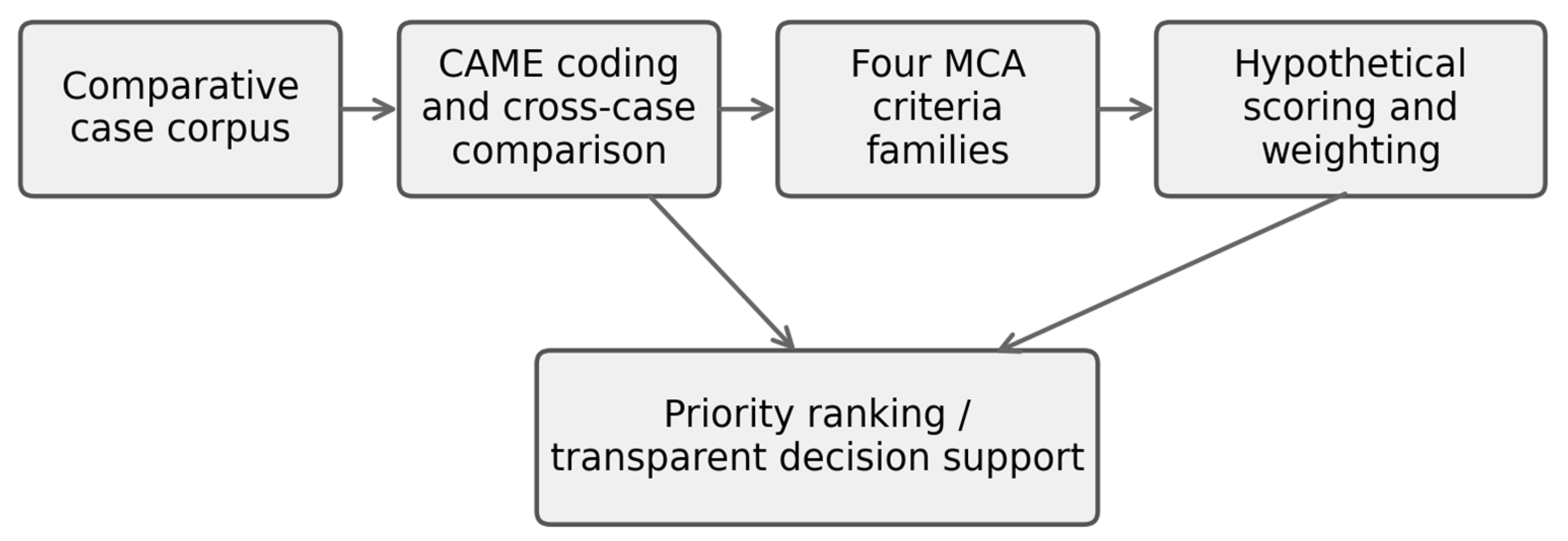
This hypothetical exercise illustrates how different policy priorities and score profiles can alter the relative ranking of candidate schoolyards without implying an empirical ranking of the analysed programmes (
Figure 1). It is included only to demonstrate the mechanics of ordinal scoring, weighting, and aggregation; accordingly, the MCA should be interpreted here as an illustrative and transferable decision support framework rather than as an empirically applied model. In applied municipal practice, thresholds, indicators, and weights should be calibrated locally according to data availability, governance objectives, and stakeholder priorities.
3. Results
3.1. Programme Typologies and Underlying Drivers
The cross-case analysis confirms that climate-resilient schoolyard initiatives emerge in heterogeneous urban and institutional contexts, yet they can be interpreted through four recurrent typologies that reflect their dominant programme drivers: heat–equity, water–resilience, education–community, and hybrid networked models. Previous work on nature-based climate solutions in schools and on the greening of schoolyards as urban infrastructure has likewise highlighted the diversity of contexts and rationales involved in these transformations [
8,
9,
10,
11,
12].
First, heat–equity programmes conceive schoolyards as climate shelter infrastructure for overheated and park-poor neighbourhoods. The OASIS programme in Paris and the Climate Shelters project in Barcelona explicitly target schools located in highly sealed, heat-exposed areas with limited access to green public space and open the transformed schoolyards to the wider community as neighbourhood climate refuges [
7,
11,
12,
13,
14]. In both cases, school selection is guided by social vulnerability indices, heat exposure maps and green space deficits, with the explicit aim of reducing unequal exposure to environmental risks. Similar logics underpin Community Schoolyards and Green Community Schoolyards initiatives in several U.S. cities, where schoolyard greening is framed as a response to both heat stress and park inequities [
15,
16].
Second, water–resilience programmes are primarily driven by stormwater management and flood risk reduction. Rotterdam’s Green–Blue Schoolyards address combined sewer overflows and pluvial flooding by treating schoolyards as microbasins that retain, infiltrate or temporarily store rainwater, while also providing natural play areas and outdoor learning spaces [
8,
16,
17]. In New York, Community Schoolyards incorporate rain gardens, bioswales and permeable sports fields as part of the city’s green infrastructure strategy, with substantial stormwater capture estimates [
16,
17]. Here, cooling and recreational benefits are acknowledged, but are typically framed as co-benefits rather than primary objectives.
Third, education–community programmes originate in agendas of outdoor learning, child-friendly cities or open-school policies. Examples include renaturalised schoolyards in Madrid, “Scuole Aperte” in Milan and “Patios Verdes/Patio Vivo” in Santiago de Chile, many of which are documented in European and Latin American NBS projects such as COOLSCHOOLS and in studies of green schoolyard governance [
8,
10]. In these initiatives, climate adaptation is progressively layered onto existing educational and community frameworks rather than constituting the initial impetus, with a strong emphasis on participation, pedagogical innovation and community use.
Fourth, hybrid networked programmes combine climate adaptation, neighbourhood public space provision, and school–community functions within multi-objective institutional arrangements. New York City and Melbourne are especially illustrative in this regard: rather than fitting neatly into a single driver, they combine greening, accessibility, community use, and implementation partnerships in ways that bridge environmental performance, equity concerns, and broader urban network logics.
Across all typologies, schoolyards are gradually reframed from residual institutional courtyards into multi-functional public infrastructures. Recent research on schoolyard greening as nature-based solution and green infrastructure shows how these spaces are being reimagined as climate refuges, neighbourhood parks and “green classrooms” that combine adaptation, biodiversity, health and educational functions [
5,
9,
10]. This evolution aligns with broader debates on the upscaling of green infrastructure and on the role of green schoolyards in urban resilience and environmental justice [
10].
To synthesise these drivers more clearly,
Table 2 classifies the nine programmes into four analytical typologies and summarises the main characteristics associated with each type. The categories are interpretive and are used to support cross-case comparison rather than to imply rigid boundaries between programmes.
The typological comparison in
Table 2 suggests a broad relationship between programme drivers and the MCA criteria families: heat–equity programmes tend to combine strong environmental and equity emphases; water–resilience programmes privilege environmental performance and urban integration; education–community programmes foreground social use and accessibility; and hybrid networked programmes display a more balanced profile across all four criteria families.
3.2. Design Measures: A Convergent Toolkit Under Divergent Conditions
Despite marked differences in climate, urban morphology and governance, the programmes converge on a relatively stable repertoire of physical interventions:
Depaving and soil restoration. All programmes prioritise the reduction in sealed asphalt surfaces, replacing them with permeable pavements, stabilised gravel, mulch or planting beds. In several cities, depaving targets are quantified (e.g., minimum percentages of unsealed surface), often aligned with local stormwater or heat mitigation objectives.
Where source documents report stormwater-related metrics, these generally point to improved retention or infiltration performance after depaving and nature-based drainage measures; however, direct cross-case comparison remains limited because programmes report results using different indicators, spatial units, and monitoring protocols. For this reason, the present study uses available quantitative ranges illustratively and keeps the cross-case synthesis primarily comparative rather than metrically standardised.
Vegetation and shade provision. Systematic tree planting is ubiquitous, frequently combined with layered vegetation (shrubs, meadows, groundcovers) to create more complex habitats. Shade is provided through canopy trees, pergolas, tensile structures and, in a small number of pilot cases, building-integrated photovoltaic (BIPV) canopies that couple shading with on-site renewable energy production.
Nature-based water management. Rain gardens, bioswales, permeable play surfaces and small retention basins are widely used in Rotterdam, Melbourne and New York, where schoolyards are integrated into broader sponge-city or water-sensitive urban design strategies. In Mediterranean contexts, smaller-scale infiltration and drainage features are preferred due to heritage constraints, limited space or water scarcity considerations.
Cool and reflective materials. In areas where complete renaturalisation is not feasible (e.g., heavily used sports courts or accessible circulation routes), high-albedo and/or porous materials are used to reduce radiative load and improve thermal comfort, particularly in dense, heat-stressed urban fabrics.
Where quantitative evaluation is available, environmental performance is consistently positive and non-trivial. Monitored programmes report marked cooling effects and related thermal comfort improvements, but the detailed quantitative discussion is presented in
Section 3.6.1 to avoid repetition and to keep the design synthesis section focused on the intervention toolkit.
These converging results suggest that a compact combination of depaving, vegetation and shade, water-sensitive design, and the selective use of cool materials constitutes a robust and transferable design toolkit for climate-resilient schoolyards across diverse climatic and socio-spatial contexts.
3.3. Social Use, Health and Educational Dimensions
Beyond physical performance, the analysed programmes report consistent social, health and educational effects, although the depth of monitoring varies.
Greened schoolyards are associated with more diversified and inclusive patterns of play, higher levels of physical activity and perceived restorativeness, in line with findings from intervention studies and systematic reviews. Teachers in several programmes report more evenly distributed use of space, fewer conflicts and new opportunities for quiet play, exploration and informal learning, particularly for younger children and for girls, who gain access to alternative play settings compared with traditional large asphalt courts dominated by ball games.
In cities where transformed schoolyards are opened beyond school hours, neighbourhood use patterns change significantly. In Paris, Barcelona and New York, for example, schoolyards act as “neighbourhood living rooms”, providing shaded, green public space within walking distance for residents who previously lacked such amenities. This extended use reinforces the interpretation of schoolyards as essential public infrastructure but introduces additional governance challenges related to cleaning, security and the coordination of school and community activities.
From an educational perspective, many programmes develop pedagogical resources and teacher-training modules to integrate the transformed yards into everyday teaching—particularly in environmental education, health promotion and STEM subjects. However, the extent to which these resources become structurally embedded in curricula differs in some contexts, they remain optional or project-based, whereas in others they are institutionalised through school improvement plans or local curriculum frameworks.
3.4. Governance and Participation: From Experiments to Networked Infrastructure
The governance analysis shows that climate-resilient schoolyard initiatives often begin as interdepartmental or cross-sectoral experiments, typically involving environment, education, and planning departments, as well as non-profit partners. Only in some cities are they subsequently consolidated into stable, networked infrastructures.
In Paris and Barcelona, schoolyard transformation is anchored in city-wide climate and health strategies and supported by dedicated funding lines and formal collaboration agreements between departments. This institutional embedding facilitates scaling from pilot schools to larger networks and supports the development of technical guidelines and design catalogues. In New York and Los Angeles, partnerships between school districts, parks departments and non-profit organisations (such as community land trusts or environmental NGOs) play a central role in co-design, financing, and maintenance.
Participation mechanisms range from deep co-design processes—involving iterative workshops and model-making with children, teachers, and families—to more limited consultative approaches. Where co-design is systematic, it is reported to enhance local ownership, align spatial interventions with everyday practices and reveal otherwise overlooked needs (e.g., gendered patterns of use, sensory sensitivities, informal routes). However, such processes require specialised facilitation and additional time, which not all administrations can sustain at scale.
Across cases, stakeholders consistently identify maintenance and long-term stewardship as structurally fragile dimensions. Responsibility for irrigation, pruning or repair of play elements is often fragmented across departments, and budget allocations may be short-term or project-based. Programmes that formalise shared-use agreements and secure dedicated maintenance budgets are better positioned to preserve climate and social benefits over time; where this is not the case, there is recurrent concern about vegetation loss, infrastructural degradation and pressures to re-asphalt.
3.5. Strategic Patterns Revealed by the CAME Matrix
Classifying programme actions into the CAME framework reveals strategic patterns that are less visible in purely descriptive accounts.
Correct measures are ubiquitous and form the backbone of most programmes. These include the removal of extensive asphalt, provision of minimum levels of shade and vegetation, replacement of unsafe equipment and correction of drainage problems. Correct actions are politically salient and highly visible, which facilitates their adoption, but they primarily address legacies of underinvestment and poor design rather than future climate conditions.
Adapt measures constitute a more explicitly climate-oriented layer, encompassing nature-based drainage systems, drought-tolerant planting palettes, microclimate-sensitive layouts and, in some cases, sensor-based environmental monitoring. Heat–equity programmes typically display a dense cluster of Adapt strategies tightly linked to municipal adaptation plans, whereas education–community programmes incorporate such measures more incrementally.
Maintain strategies—maintenance protocols, dedicated budgets, stewardship schemes involving schools and community organisations—are recognised as essential but remain the least consistently articulated pillar. Their relative weakness in many programmes is perceived by practitioners as a major risk to the long-term effectiveness of schoolyard transformations, potentially eroding achieved climate and social benefits.
Explore strategies are concentrated in a subset of pilot or flagship schools and include BIPV canopies, experimental water–play elements that double as stormwater devices, advanced sensor networks, or novel co-governance models. These pilots operate as laboratories for innovation, but their translation into routine practice depends on institutional learning, risk tolerance, and the capacity to absorb higher upfront costs.
Overall, the CAME analysis suggests that most cities are currently in a “Correct + Adapt consolidation” phase, with Maintain and Explore dimensions emerging but not yet fully integrated into programmatic logics and budget cycles. Strengthening maintenance capacities and selectively scaling successful exploratory elements appear as key conditions for consolidating climate-resilient schoolyards as long-term infrastructure rather than as one-off projects.
3.6. Cross-Case Validation of the MCA Criteria
As described in
Section 2.6, the proposed MCA framework is organised around four criteria families—environmental and climatic performance, social and educational equity, urban integration and accessibility, and feasibility and co-benefits—synthesised in
Table 3. These families were initially derived from the literature on climate-resilient public space, nature-based solutions, and environmental justice, and then shaped by insights from the case–study corpus.
The proposed MCA intentionally combines indicators of current conditions/deficits (e.g., land surface temperature anomaly, distance to the nearest public park/open space) and indicators of intervention potential/capacity (e.g., potential increase in tree canopy cover, depavable area, suitability for stormwater retention). All indicators are normalised to a common ordinal scoring scale before weighting and aggregation.
The H/M/L coding in
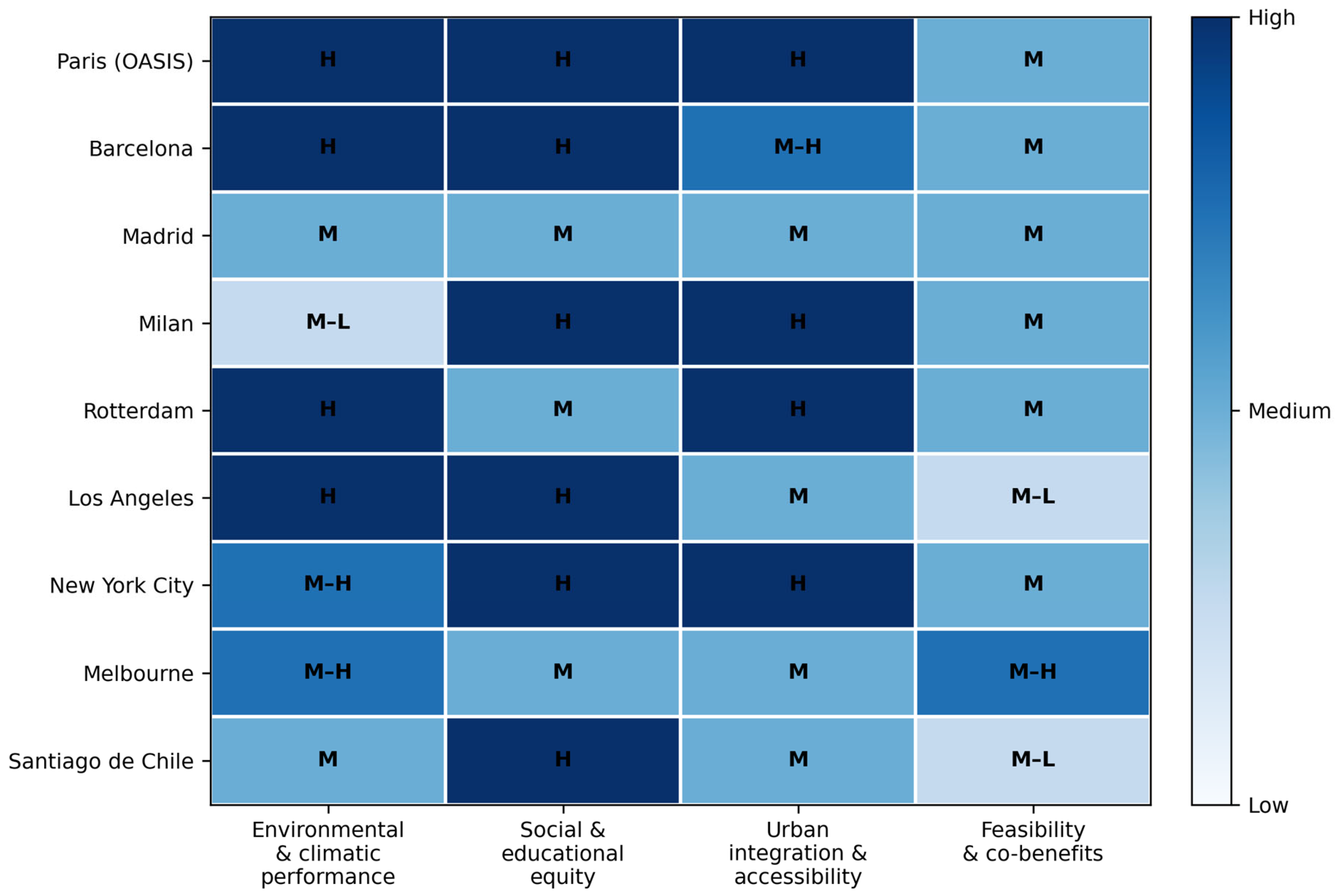
Table 4 was assigned through qualitative document analysis, based on the relative prominence of each criteria family in programme objectives, design guidelines, implementation measures, and monitoring protocols. “High” (H) indicates explicit and repeated emphasis supported by concrete actions or indicators; “Medium” (M) indicates partial or secondary emphasis; and “Low” (L) indicates limited or indirect attention.
Table 4 summarises the relative emphasis placed on each of these four criteria families across the nine schoolyard programmes, using a simple high/medium/low (H/M/L) coding derived from document analysis. This mapping allows us to (i) distinguish different strategic profiles and (ii) assess to what extent existing initiatives already align with, or partially anticipate, the proposed MCA logic.
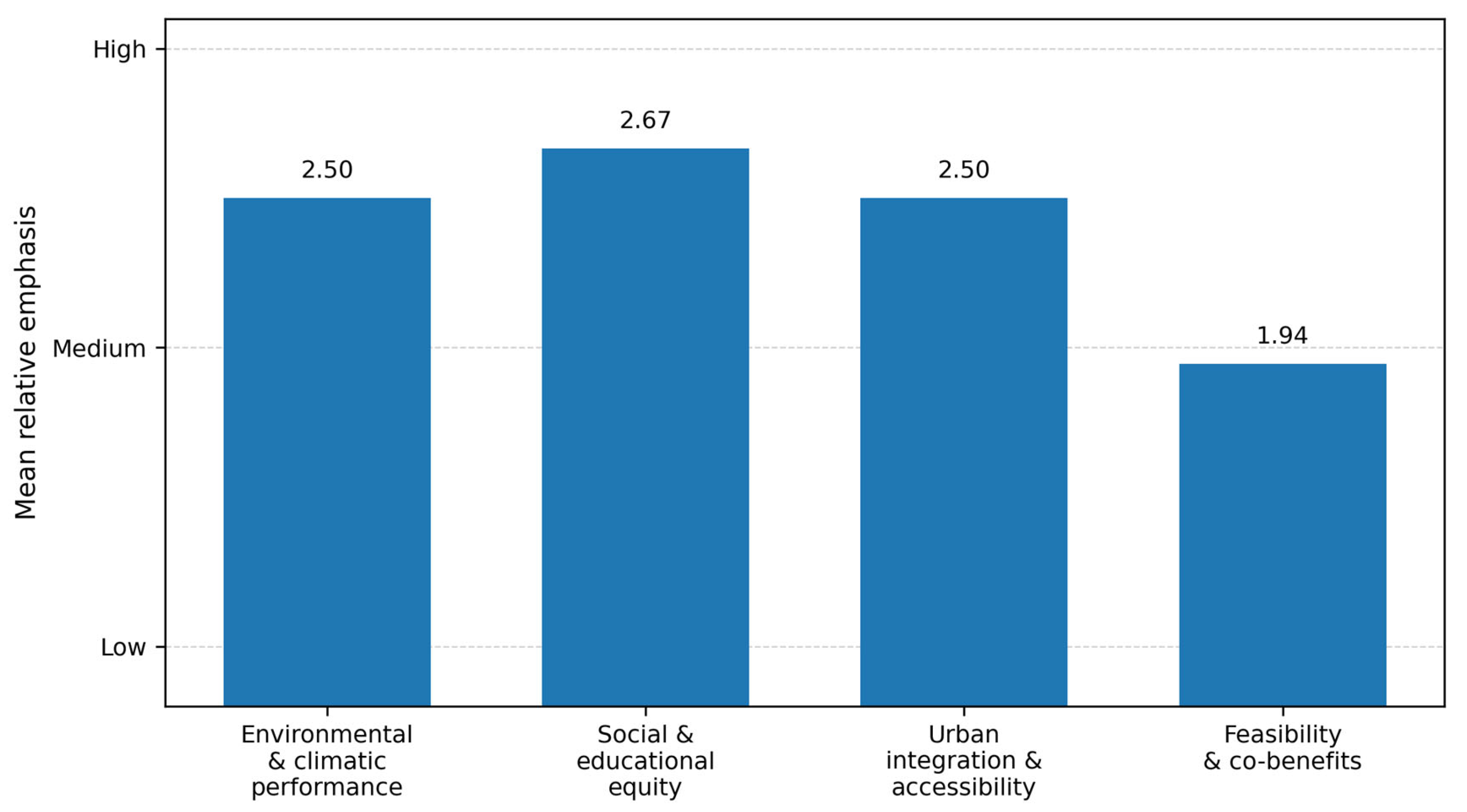
To facilitate comparison beyond the tabular presentation,
Figure 2;
Figure 3 translate the qualitative coding of
Table 4 into graphical summaries.
Figure 2 visualises the relative emphasis assigned to each criteria family across the nine programmes, whereas
Figure 3 synthesises the average emphasis of each MCA criteria family across the full sample (H = 3; M–H = 2.5; M = 2; M–L = 1.5; L = 1).
3.6.1. Environmental and Climatic Performance
The first criteria family addresses the capacity of schoolyard interventions to deliver measurable climate adaptation and ecosystem service benefits. Empirical evidence from monitored programmes such as OASIS Paris and Barcelona Climate Shelters shows that combinations of depaving, vegetation and shade can reduce surface temperatures by approximately 10–12 °C during heat events and improve perceived thermal comfort among pupils. In parallel, microclimate studies and ecological assessments in greened schoolyards highlight gains in evapotranspiration, stormwater infiltration, biodiversity and functional connectivity.
As reflected in
Table 4 and
Figure 2, heat–equity and water–resilience programmes—OASIS Paris, Barcelona Climate Shelters, Rotterdam’s green–blue schoolyards, and several initiatives in Los Angeles, New York and Melbourne—place a high emphasis (H) on environmental and climatic performance, often supported by explicit targets or monitoring protocols. In contrast, education–community programmes (e.g., Milan, Santiago de Chile) still tend to assign a medium (M) weight to this family, with environmental benefits recognised but less systematically quantified.
This pattern empirically reinforces the centrality of the environmental–climatic performance family in the MCA (
Table 3). Indicators such as percentage of impervious surface, land surface temperature anomaly, potential for increased tree canopy and suitability for nature-based drainage are not abstract constructs but metrics already present—explicitly or implicitly—in many of the analysed programmes.
3.6.2. Social and Educational Equity
The second criteria family responds to the question of who benefits from climate-resilient schoolyards and whether interventions help reduce existing inequalities in exposure, access and health/educational outcomes. Several programmes explicitly target schools in socio-economically disadvantaged, park-poor and heat-exposed neighbourhoods, using deprivation indices, green space deficits and other equity-related indicators to guide selection.
This logic is particularly evident in Barcelona Climate Shelters, LA Cool Schools and Community Schoolyards in New York, all of which score high (H) on social and educational equity in
Table 4 and
Figure 2. By contrast, programmes such as Madrid renaturalised schoolyards or Green Schoolyards Victoria incorporate equity considerations more partially, resulting in medium (M) emphasis, while others (e.g., some water-focused pilots) show only implicit or indirect attention to equity.
The cross-case analysis therefore supports a strong equity orientation in the MCA (
Table 3). Indicators such as socio-economic deprivation indices, green space deficit within walking distance, percentage of pupils eligible for social support and school population density provide a robust basis for assigning higher priority to schools where climate-resilient schoolyards can function as levers of climate justice and health equity.
3.6.3. Urban Integration and Accessibility
The third criteria family recognises that schoolyards operate as nodes within wider urban systems of public space, mobility and green–blue infrastructure, rather than as isolated institutional courtyards. In several cities, transformed schoolyards are formally designated as neighbourhood parks or climate refuges and are mapped within networks of cool public spaces or ecological corridors.
Table 4 and
Figure 2 show that programmes such as OASIS Paris, Barcelona Climate Shelters, Community Schoolyards in New York and Scuole Aperte in Milan place high (H) emphasis on urban integration and accessibility, framing schoolyards as neighbourhood “living rooms” or civic hubs. Others, such as Madrid, Rotterdam, Melbourne or Santiago, exhibit medium (M) emphasis, acknowledging the neighbourhood role of schoolyards but with more variable integration into city-wide networks.
This empirical pattern validates the inclusion of urban integration and accessibility in the MCA (
Table 3). Indicators like distance to the nearest public park or open space, public transport accessibility, resident population within walking distance and location relative to existing or planned green–blue corridors are closely aligned with how leading programmes justify and communicate their schoolyard networks.
3.6.4. Feasibility and Co-Benefits
The fourth criteria family concerns the institutional, economic and social conditions under which schoolyard interventions can be implemented and sustained over time. Across all cases, recurring constraints include limited municipal budgets, fragmented responsibilities between departments (education, environment, parks, public works) and uncertain long-term maintenance arrangements. At the same time, several programmes exploit co-benefits and windows of opportunity, such as coupling schoolyard transformation with building renovations, energy retrofits or curriculum reforms, thus improving cost-effectiveness and institutional buy-in.
As
Table 4 and
Figure 3 show, few programmes reach a clearly high (H) emphasis on feasibility and co-benefits; most remain at medium (M) levels, reflecting partial but incomplete institutionalisation of long-term maintenance and cross-department coordination. NGO-led or project-based models (e.g., LA Cool Schools, Patios Verdes) tend to fall in the medium–low (M–L) range, with strong social engagement but constrained budgets and dependence on short-term funding cycles.
These observations confirm that feasibility and co-benefits must be incorporated explicitly in the MCA (
Table 3). Indicators such as area available for depaving, alignment with planned works, estimated implementation and maintenance costs, and degree of engagement of school leadership and community partners are essential to identify “high-impact, high-feasibility” projects and to signal where additional resources or capacity-building efforts will be required.
3.6.5. Strategic Implications of the Four Criteria Families
Taken together, the evidence summarised in
Table 3;
Table 4 and visualised in
Figure 2;
Figure 3 indicates that the four MCA criteria families are not arbitrary analytical categories, but synthetic expressions of how leading climate-resilient schoolyard programmes already operate in practice.
The environmental and climatic performance family ensures that projects deliver tangible adaptation and ecosystem service benefits.
The social and educational equity family grounds prioritisation in climate justice and children’s rights.
The urban integration and accessibility family links individual school interventions to city-wide strategies for green–blue infrastructure and walkable, cool public space networks.
The feasibility and co-benefits family keeps the MCA anchored in real implementation conditions, increasing the likelihood that selected projects will be both deliverable and sustainable.
By making these four dimensions explicit and operational, the MCA framework supports a shift from opportunistic or politically driven selection of schoolyard projects towards transparent, criteria-based prioritisation of climate-resilient schoolyard networks as essential public infrastructure within urban adaptation policies.
By explicitly linking the CAME classification to a SWOT-derived strategic planning logic, the framework improves interpretability and supports comparison across programmes with different climatic, institutional, and socio-spatial contexts.
Read together,
Table 2;
Table 4 indicate that programme typology and criteria emphasis are related but not mechanically determined. Heat–equity initiatives tend to score strongly on environmental performance and social equity, while education–community programmes more often privilege social use and accessibility. Hybrid programmes such as New York and Melbourne demonstrate that these profiles can overlap, suggesting that typology is best understood as a heuristic for interpretation rather than as a fixed predictor of MCA emphasis.
4. Discussion
This study set out from the hypothesis that schoolyards can and should be treated as essential public infrastructures for urban climate adaptation, rather than as residual playgrounds or purely educational spaces. The comparative analysis of nine international programmes, combined with the CAME–MCA framework, provides support for this reframing while also revealing important tensions, blind spots and opportunities for future work.
4.1. From Green “Projects” to Climate Infrastructure
Our results confirm that climate-resilient schoolyards can deliver non-trivial environmental benefits, particularly in terms of surface temperature reduction, stormwater management and biodiversity support, when depaving, vegetation and shade are implemented consistently at scale. These findings are strongly consonant with microclimatic and health evidence from intervention studies on green schoolyards and other nature-based solutions [
3,
4,
5,
6,
7,
9]. In this sense, schoolyards can be read as a specific, spatially dense expression of green infrastructure: they are already distributed throughout the urban fabric, embedded in neighbourhoods, and relatively well served by basic utilities.
However, treating schoolyards as infrastructure rather than as a collection of isolated projects implies a shift in governance and planning. Infrastructure is expected to be reliable, long-lived and subject to systematic maintenance. Yet, as the CAME analysis shows, most programmes are still dominated by Correct and Adapt actions (e.g., depaving, shading, NBS for heat and water), while Maintain and Explore dimensions remain comparatively weak. This imbalance risks creating “green one-offs”: visually transformative pilot projects whose performance and quality may degrade over time in the absence of robust stewardship, echoing concerns raised in broader debates on the long-term governance of nature-based solutions.
Read in this way, the framework contributes to urban green infrastructure debates by treating schoolyards as distributed micronodes within wider ecological, social, and cooling networks, while also operationalising climate justice concerns at the microspatial scale of school selection and neighbourhood access.
The CAME matrix thus helps to make explicit that a truly infrastructural approach would require at least three shifts: (i) consolidating maintenance capacities and stable budget lines; (ii) institutionalising shared responsibilities between education, environment and public works departments; and (iii) embedding exploratory pilots (e.g., BIPV canopies, advanced monitoring, co-governance models) within learning loops that can inform standards and design guidelines rather than remaining as isolated experiments.
4.2. Equity, Justice and the Spatial Politics of Schoolyards
The programmes examined illustrate that climate-resilient schoolyards can be powerful tools for climate and environmental justice, but only when equity is made explicit as a selection criterion and design principle. Heat–equity initiatives such as Barcelona’s Climate Shelters and Community Schoolyards in New York systematically target schools in socio-economically disadvantaged, park-poor and heat-exposed neighbourhoods, thereby aligning with emerging frameworks that link nature-based solutions to distributive and recognitional justice.
At the same time, several programmes with strong educational or water management agendas display only medium emphasis on equity, and some rely on opportunistic selection (e.g., availability of motivated staff or existing project networks) rather than on vulnerability and exposure metrics. In such cases, there is a risk that climate-resilient schoolyards may unintentionally reproduce existing spatial inequalities, for instance by concentrating higher-quality outdoor spaces in schools that are already comparatively advantaged.
The MCA framework responds to this tension by elevating social and educational equity to one of four core decision families (
Table 3). By operationalising deprivation indices, green space deficits and school population characteristics as explicit indicators, it becomes possible to prioritise those schoolyards where interventions are likely to have the greatest impact on exposure gaps and health and learning conditions. Importantly, this does not preclude other priorities (e.g., hydrological performance or feasibility) but requires that equity be considered alongside them in a transparent way.
A further justice dimension relates to public accessibility. Where schoolyards remain closed outside school hours, the benefits of renaturalisation accrue primarily to enrolled pupils and staff; where they are opened as neighbourhood parks or climate refuges, a much broader public can access cooled, green space within walking distance. Our results show that only a subset of cities (notably Paris, Barcelona, New York and Milan) have taken decisive steps in this direction, raising important questions about liability, security and care that future research should address in more depth.
4.3. Bridging Building-Scale Performance Cultures and Outdoor Learning Spaces
In building and envelope design, performance-based and life cycle approaches have become increasingly mainstream, especially in Mediterranean and semi-arid contexts where passive strategies and cost-optimal insulation have been systematically explored [
1,
2]. By contrast, outdoor educational spaces such as schoolyards have often remained outside this performance culture, evaluated through ad hoc indicators or purely qualitative assessments.
This paper suggests that there is considerable value in bridging these two traditions. On the one hand, the CAME–MCA framework translates ideas familiar from building optimisation—such as the need to balance performance, cost and feasibility—into the domain of outdoor spaces and nature-based solutions. On the other hand, schoolyard programmes bring to the fore dimensions that are often underplayed in building optimisation, including children’s agency, play, pedagogy, and community use.
For practitioners, even a simple scoring exercise based on
Table 3 can help move from opportunistic or politically driven project selection towards more robust, criteria-based prioritisation.
4.4. Governance Challenges and Opportunities
The governance patterns observed across cases underline a central tension: climate-resilient schoolyards sit at the intersection of multiple policy domains—education, climate adaptation, health, green infrastructure, public space—each with different cultures, budgets and time frames. While this position creates opportunities for synergies and co-benefits, it also generates coordination challenges and risks of institutional fragmentation.
Programmes that appear most robust in our analysis are those where schoolyard transformation is anchored in:
a city-wide strategy (e.g., climate plan or resilience framework);
formal inter-departmental agreements that clarify roles, responsibilities and budgets; and
stable partnerships with NGOs or community organisations that can support design, implementation and stewardship.
A further limitation concerns geographical coverage: although the sample includes one Latin American case, Latin American and especially tropical contexts remain underrepresented relative to European and North American programmes. This affects the transferability of some design, maintenance, and monitoring assumptions to hotter, more humid, or institutionally different settings.
Conversely, NGO-driven or purely project-based initiatives, although often innovative and socially rich, face difficulties in scaling and sustaining their interventions once initial funding cycles end. These findings echo broader debates on the need to move from project logics to long-term governance models for nature-based solutions and child-friendly cities.
One implication is that future research should pay more attention not only to the design of climate-resilient schoolyards, but to the institutional conditions under which they can become durable infrastructures. Comparative work on governance arrangements, funding mechanisms (including climate adaptation and health budgets) and maintenance regimes could yield valuable lessons for cities seeking to scale such programmes.
In addition, the study does not undertake a formal cost–benefit analysis of intervention packages. Although feasibility and co-benefits are considered conceptually within the MCA, the economic performance of alternative schoolyard strategies remains an important area for future empirical work.
In addition to physical interventions, several programmes highlight the importance of information and communication strategies to build awareness, legitimacy, and long-term use of green school spaces (e.g., public-facing programme portals, on-site signage, community outreach, and monitoring dashboards). Moreover, students can be positioned not only as beneficiaries but as active actors in programme delivery through co-design activities, stewardship and maintenance routines, and citizen science monitoring (e.g., participatory data collection linked to curriculum). Strengthening these communication and participation components may improve programme durability while amplifying educational and health co-benefits.
4.5. Limitations and Future Research Directions
Several limitations of this study should be acknowledged. First, the analysis relies primarily on documentary sources—policy reports, academic publications, websites and evaluation documents—which are heterogeneous in scope and depth. Some programmes provide detailed thermal and hydrological monitoring, while others offer only qualitative narratives or limited indicators. This asymmetry constrains the possibility of fully standardised quantitative comparison.
Second, the CAME coding and the H/M/L ratings in
Table 4 inevitably involve an element of interpretive judgement. While the coding scheme was developed iteratively and applied consistently, different analysts might classify borderline strategies somewhat differently, especially where documents are ambiguous or objectives overlap. No formal inter-coder agreement test was conducted, so the coding should be read as a transparent qualitative synthesis rather than as a statistically validated classification.
Third, the MCA framework is presented as a generic decision support tool, not as an operational model empirically applied to a specific city in this study. Its role in the present paper is illustrative: it shows how a transferable prioritisation structure could be organised, rather than reporting a real-world ranking exercise. Future work should therefore focus on implementing and evaluating the framework in concrete contexts: calibrating indicators and thresholds, testing different weighting schemes with stakeholders, and comparing MCA-based prioritisation with existing political or ad hoc selection processes.
Finally, quantitative research is needed to explore dimensions that remain under-studied, such as long-term health and learning outcomes, impacts on air quality and noise, and interactions between schoolyard networks and wider urban heat island dynamics. Mixed-methods designs combining longitudinal environmental monitoring, epidemiological and educational data, and qualitative research with children, teachers and residents would be particularly valuable.
Future research should prioritise the local implementation and validation of the proposed MCA framework, longitudinal monitoring of environmental and health outcomes, and comparative analysis of governance and maintenance models that enable schoolyards to operate as durable climate adaptation infrastructure.
In addition, because most reviewed programmes are located in relatively high-capacity urban contexts, the transferability of specific intervention packages, monitoring systems, and implementation timelines to lower-capacity settings should be considered cautiously and tested through local calibration.
4.6. Overall Contribution
Practically, it distils lessons from the reviewed international experiences into two synthetic matrices (
Table 3 and
Table 4), together with a typology overview (
Table 2), that can guide cities and school systems interested in designing and scaling networks of climate-resilient schoolyards.
Taken together, these contributions underscore that transforming schoolyards is not a marginal or cosmetic intervention, but a promising, socially embedded and educationally rich strategy for advancing urban climate adaptation and justice in the everyday spaces of children’s lives.
Taken together, these conclusions suggest that the framework has relevance beyond the reviewed cases and may be transferable across different climate zones and governance contexts, provided that indicators, weights, and feasibility assumptions are calibrated locally.
A limitation of this study is that the selected cases are concentrated in cities with relatively strong institutional, technical, and financial capacities. This geographical and governance profile may affect the transferability of specific intervention packages, implementation timelines, and monitoring systems to lower-capacity contexts. For this reason, the proposed framework should be understood as a transferable analytical structure rather than a one-size-fits-all model. Its practical application in other settings requires local calibration of indicators, weighting schemes, and feasibility assumptions, particularly where data availability, maintenance capacity, or public investment is more constrained.




 ,
,