Article

Biogeochemical Processes Including Oxygen Dynamics in a Deep Lake During the Spring Thermal Bar: A Numerical Experiment

Computational Geophysics Laboratory, Tomsk State University, Tomsk 634050, Russia
*
Author to whom correspondence should be addressed.
Environments 2026, 13(4), 178; https://doi.org/10.3390/environments13040178
Submission received: 15 February 2026 / Revised: 17 March 2026 / Accepted: 22 March 2026 / Published: 24 March 2026

Abstract

Biogeochemical processes, including the oxygen cycle, were investigated in Lake Baikal during the spring thermal bar using a coupled numerical model that takes into account the intraday variability of atmospheric parameters and contains the following variables: nitrate, ammonium, phosphate, oxygen, chlorophyll a, phytoplankton, zooplankton, and small and large detritus. Nitrification, photosynthesis, remineralization, and respiration processes describe the biochemical dynamics of oxygen in the model. As a study area, the deep-water cross-section of Lake Baikal, Boldakov River–Maloye More Strait, was considered using meteorological data for June 2024 at the lake surface. Numerical results show that the thermal bar can contribute to the transport of dissolved oxygen and phyto- and zooplankton to the deeper layers of the lake.

1. Introduction

Human activity negatively influences the water quality of Lake Baikal, primarily in the coastal zone [1,2,3], as the main source of anthropogenic and biogenic pollutants is the waters of its tributaries, which accumulate urban and industrial wastewater from the watershed basin. During periods of stratification breakdown, vertical mixing facilitates the transfer of nutrients from the deeper layers to the photic zone, which can trigger a spike in algal blooms [4,5,6].
Cross-shore water exchange in lakes is carried out through different mechanisms [7,8]. One is the thermal bar phenomenon—a sinking of maximum density waters in a narrow zone that appears in mid-latitude lakes during spring heating and autumnal cooling [9,10,11]. The thermal bar, acting as a barrier between littoral and pelagic waters (according to Tikhomirov [12], thermoactive and thermoinert regions, respectively), plays a large role in a lacustrine ecosystem. Cabbeling at the thermal bar can promote the propagation of pollutants and phytoplankton deep into the lake [13,14]. An understanding of the behavior of the thermal bar and its role in the ecological functioning of a lake has significance for limnology and water resources management. For example, during the existence of thermal bars in Lake Onega [9], the quality of water at the Petrozavodsk water intake facility deteriorates due to its unsuccessful location (to prevent this, the water intake should be located outside the thermal bar, in the open lake).
The springtime differential warming of littoral versus pelagic waters establishes a cross-shore density gradient that organizes circulation into the thermal bar. In Lake Baikal, there is an exchange between surface and deep waters due to along-the-slope circulations and density mixing at the thermal bar front [15,16]. Studies of the microbiological composition of Baikal’s waters during the development of the spring thermal bar showed high concentrations of heterotrophic bacteria and chlorophyll in the near-slope areas, as well as at the depths of 400–600 and 900–1100 m [17]. The differential warming of littoral versus pelagic waters by solar radiation in spring drives near-surface density contrasts and sets up the thermal bar circulation, as well as activates the growth of vegetation and many chemical and biological processes. Measurements regularly conducted in Baikal indicate that organic matter is unevenly distributed both in the photic zone, where it is consumed by algae, and in the deep-water parts [18].
When developing numerical models to simulate biogeochemical processes in freshwater lakes, it is very important to consider not only nitrogen and phosphorus—the nutrients that limit the growth of organisms—but also dissolved oxygen, the primary indicator of water quality. Its level rises significantly during intensive photosynthesis (due to the influx of large amounts of these nutrients) and drops sharply during excessive phytoplankton mortality. This work aims to describe a mathematical model for reproducing nutrient–plankton–ecosystem interactions in a freshwater lake. Also, we present here the first, to our knowledge, results of numerical modeling of biogeochemical processes, including the dissolved oxygen dynamics, during the thermal bar for a deep-water cross-section of Lake Baikal.
The paper is organized as follows. The reaction–convection–diffusion equations of the biogeochemical model with the initial and boundary conditions are described in Section 2. Then, the study area with model parameters is given in Section 3. And finally, in Section 4, we present the simulation results and their discussion.

2. Materials and Methods

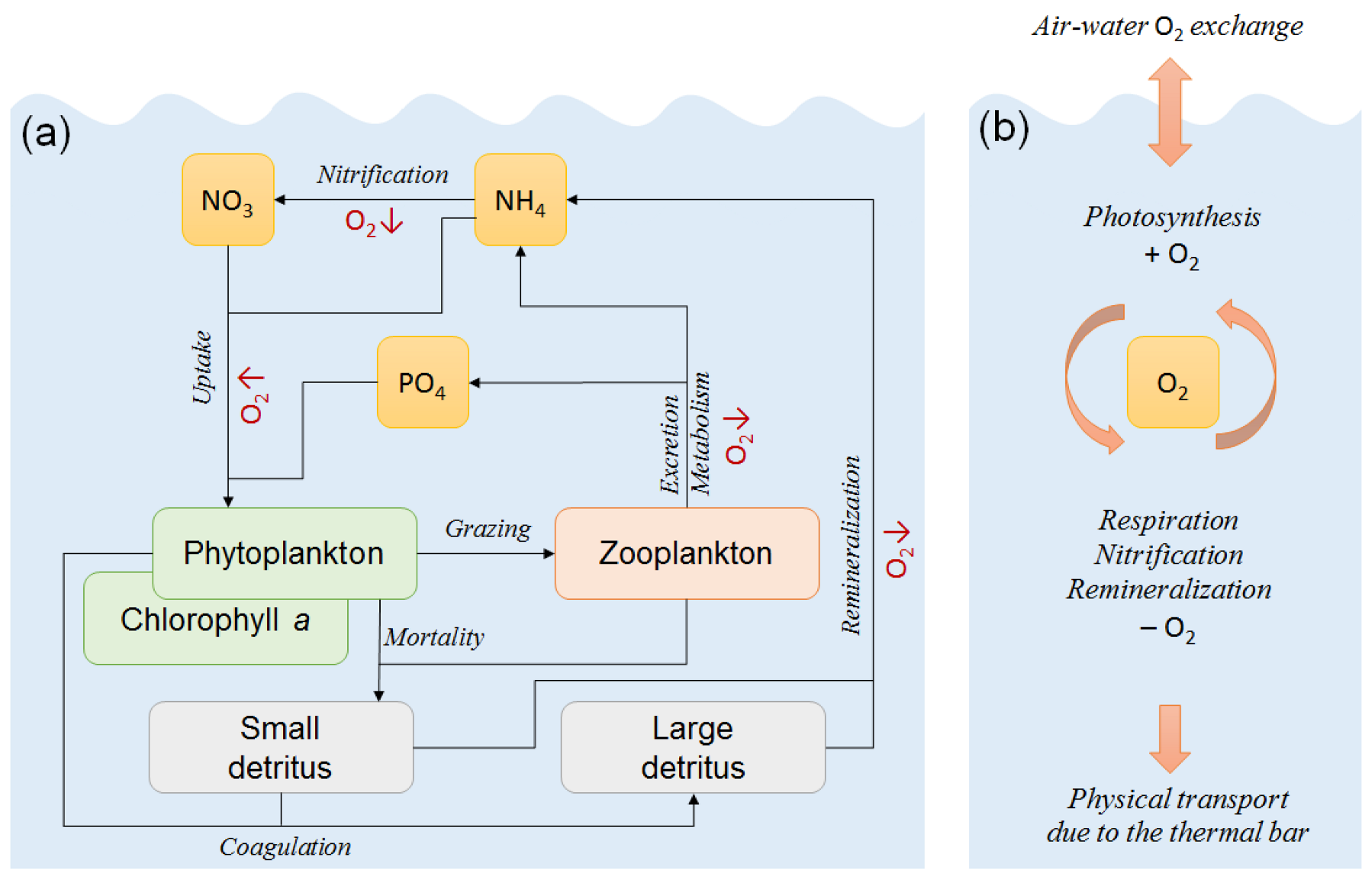
The coupled model includes a 2.5D physical model and a biological model. The latter is developed with nitrogen [19], oxygen [20], and phosphorus [21] cycle models and contains the variables nitrate, ammonium, phosphate, oxygen, chlorophyll a, phyto- and zooplankton, and detritus of two types: small and large. Air–water O2 exchange, biogeochemical processes, and physical transfer describe the dynamics of dissolved oxygen in a lake (Figure 1).
The 2.5D physical model [22,23,24] that transforms the problem into 2D (vertical cross-section of a lake), considering three components of the velocity vector (to take into account the Coriolis force), consists of the following governing equations [25]:
(a)
momentum equations
u t + u 2 x + u w z = 1 ρ 0 p x + x K x u x + z K z u z + 2 Ω z v 2 Ω y w ;
v t + u v x + w v z = x K x v x + z K z v z + 2 Ω x w 2 Ω z u ;
w t + u w x + w 2 z = 1 ρ 0 p z + x K x w x + z K z w z g ρ ρ 0 + 2 Ω y u 2 Ω x v ;
(b)
continuity equation
u x + w z = 0 ;
(c)
energy equation
T t + u T x + w T z = x D x T x + z D z T z + 1 ρ 0 c p H s o l z ;
(d)
equations of salinity balance
S t + u S x + w S z = x D x S x + z D z S z ,
where u, v are the horizontal velocity components along x and y axes, respectively, m/s; w is the vertical velocity component, m/s; T is the temperature, °C; S is the salinity, g/kg; Ωx, Ωy, and Ωz are the vector components of the Earth’s rotation angular velocity, s−1; Kx and Kz are the horizontal and vertical viscosity coefficients, respectively, m2/s; g is the acceleration of gravity (9.81 m/s2); cp is the specific heat capacity, J kg−1 °C−1; p is the pressure, bar; ρ0 is the water density at standard atmospheric pressure, kg/m3. The equation of Chen and Millero [26] connecting water density with temperature, salinity, and pressure, and valid within the range of 0 ≤ T ≤ 30 °C, 0 ≤ S ≤ 0.6 g/kg, and 0 ≤ p ≤ 180 bar, was taken as the state equation.
The parameterization of atmospheric oxygen input into the lake is implemented taking into account the solubility of oxygen in water [27] and wind speed on the lake surface [28]. Processes of nitrification, photosynthesis, remineralization, and respiration are considered in this model to simulate the biochemical dynamics of oxygen. A thermohydrodynamic model, which includes equations of continuity, momentum, energy, and turbulent characteristics [29], reproduces the physical transfer of dissolved oxygen in the body of water.
The reaction–convection–diffusion equations, which represent biochemical dynamics in the lake, are
[ N O 3 ] t + u [ N O 3 ] x + w [ N O 3 ] z = x D x [ N O 3 ] x + z D z [ N O 3 ] z μ max ( T ) f ( I ) L N O 3 L N min L N , L P [ P h y t o ] + L O 2 n [ N H 4 ] ;
[ N H 4 ] t + u [ N H 4 ] x + w [ N H 4 ] z = x D x [ N H 4 ] x + z D z [ N H 4 ] z μ max ( T ) f ( I ) L N H 4 L N min L N , L P [ P h y t o ] L O 2 n [ N H 4 ] + l B M + l E [ P h y t o ] 2 k P h y t o + [ P h y t o ] 2 β [ Z o o ] + L O 2 r S D [ S D ] + r L D [ L D ] ;
[ P O 4 ] t + u [ P O 4 ] x + w [ P O 4 ] z = x D x [ P O 4 ] x + z D z [ P O 4 ] z θ N : P 1 μ max ( T ) f ( I ) min L N , L P [ P h y t o ] + θ N : P 1 l B M + l E [ P h y t o ] 2 k P h y t o + [ P h y t o ] 2 β [ Z o o ] + θ N : P 1 L O 2 r S D [ S D ] + r L D [ L D ] ;
[ O 2 ] t + u [ O 2 ] x + w [ O 2 ] z = x D x [ O 2 ] x + z D z [ O 2 ] z + F a i r - l a k e d 1 + μ max ( T ) f ( I ) L N O 3 L N R O 2 : N O 3 + L N H 4 L N R O 2 : N H 4 min L N , L P [ P h y t o ] 2 L O 2 n [ N H 4 ] R O 2 : N H 4 l B M + l E [ P h y t o ] 2 k P h y t o + [ P h y t o ] 2 β [ Z o o ] R O 2 : N H 4 L O 2 r S D [ S D ] + r L D [ L D ] ;
[ C h l ] t + u [ C h l ] x + w [ C h l ] z = x D x [ C h l ] x + z D z [ C h l ] z + ρ C h l μ max ( T ) f ( I ) min L N , L P m P h y t o τ [ S D ] + [ P h y t o ] [ C h l ] g max [ P h y t o ] 2 k P h y t o + [ P h y t o ] 2 [ Z o o ] [ C h l ] [ P h y t o ] ;
[ P h y t o ] t + u [ P h y t o ] x + w [ P h y t o ] z = x D x [ P h y t o ] x + z D z [ P h y t o ] z + μ max ( T ) f ( I ) min L N , L P m P h y t o τ [ S D ] + [ P h y t o ] [ P h y t o ] g max [ P h y t o ] 2 k P h y t o + [ P h y t o ] 2 [ Z o o ] ;
[ Z o o ] t + u [ Z o o ] x + w [ Z o o ] z = x D x [ Z o o ] x + z D z [ Z o o ] z + g max l E [ P h y t o ] 2 k P h y t o + [ P h y t o ] 2 β l B M [ Z o o ] m Z o o [ Z o o ] 2 ;
[ S D ] t + u [ S D ] x + w [ S D ] z = x D x [ S D ] x + z D z [ S D ] z + g max [ P h y t o ] 2 k P h y t o + [ P h y t o ] 2 1 β [ Z o o ] + m Z o o [ Z o o ] 2 + m P h y t o [ P h y t o ] τ [ S D ] + [ P h y t o ] [ S D ] L O 2 r S D [ S D ] ;
[ L D ] t + u [ L D ] x + w [ L D ] z = x D x [ L D ] x + z D z [ L D ] z + τ [ S D ] + [ P h y t o ] 2 L O 2 r L D [ L D ] ,
where NO3, NH4, PO4, O2, Chl, Phyto, Zoo, SD, and LD are the concentrations of nitrates (mmol N m−3), ammonium (mmol N m−3), phosphate (mmol P m−3), dissolved oxygen (mmol O2 m−3), chlorophyll a (mg m−3), phytoplankton (mmol N m−3), zooplankton (mmol N m−3), small detritus, and large detritus, respectively (mmol N m−3); and Dx and Dz are the diffusion coefficients (m2/s).
The maximum phytoplankton growth rate is calculated by Eppley [30]
μ max ( T ) = μ 0 1.066 T .
The factors L N O 3 ,   L N H 4 ,   L O 2 ,   L N , and L P [31] are responsible for the limitation of lake productivity through major nutrients (Table 1).
Oxygen exchange across the air-lake interface is parameterized as
F a i r - l a k e = ν k O 2 O 2 O 2 .
To calculate the saturation concentration of oxygen, O 2 , an approximation of empirical tabular data within 0–20 °C [32] is used
O 2 = 456.96 12.86 T C + 0.2771 T C 2 0.0033 T C 3 ,
where TC is the water temperature in °C.
The gas transfer velocity for oxygen is parameterized as [28]
ν k O 2 = 0.31 U 10 2 S c C O 2 S c O 2 ,
where U 10 = u 10 2 + v 10 2 is the wind speed 10 m above the lake surface, and S c C O 2 and S c O 2 are the Schmidt numbers for C O 2 and O 2 , respectively. For fresh water,
S c O 2 = 1800.6 120.1 T C + 3.7818 T C 2 0.047608 T C 3 ;
S c C O 2 = 1911.1 118.11 T C + 3.4527 T C 2 0.04132 T C 3 .
The photosynthesis–light relationship is described by the function [33]:
f ( I ) = α I μ max 2 + α 2 I 2 ,
where
I = I s P A R exp d k w a t e r + k c h l d L z C h l ( z ) d z ,
here IS is the incoming light at the surface of the lake; kwater and kchl are the light attenuation for water (=0.04 m−1) and by chlorophyll (=0.025 (mg Chl)−1 m−2), respectively; and PAR is the fraction of light available for photosynthesis (=0.43) [19].
The fraction of phytoplankton growth devoted to chlorophyll synthesis is given by
ρ C h l = θ max μ max ( T ) f ( I ) min L N , L P [ P h y t o ] α I [ C h l ] .
The nitrification rate is determined as [34]:
n = n max 1 max 0 , I I 0 k I + I I 0 .
Values for the model parameters [19,31] are presented in Table 2. Even though several biological model parameters are adopted from marine studies [19,21], we can assume that they are suitable for oligotrophic lakes because our coupled model takes into account the dependence of the plankton biomass on the nutrient concentrations, the incoming solar radiation, and the water temperature and salinity.
Boundary conditions are
(a)
at the surface of the lake
K z u z = τ s u r f u ρ 0 ; K z v z = τ s u r f v ρ 0 ; w = 0 ; D z T z = H n e t ρ 0 c p ; S z = 0 ; N O 3 z = 0 ; N H 4 z = 0 ;   P O 4 z = 0 ; C h l z = 0 ; P h y t o z = 0 ; Z o o z = 0 ; [ S D ] z = 0 ; [ L D ] z = 0 ,
where Hnet is the heat flux of longwave radiation, latent, and sensible heat; τ s u r f u and τ s u r f v describe the wind shear stress on the lake surface;
(b)
in the river mouth
u = u R ; v = 0 ; w = 0 ; T = T R ; S = S R ; N O 3 = N O 3 R ; N H 4 = N H 4 R ; P O 4 = P O 4 R ; O 2 = O 2 R ; C h l = C h l R ; P h y t o = P h y t o R ; Z o o = Z o o R ; S D = S D R ; L D = L D R ,
where N O 3 R , N H 4 R , P O 4 R , O 2 R , C h l R , P h y t o R , Z o o R , S D R , and L D R are the nitrates, ammonium, phosphates, dissolved oxygen, chlorophyll a, phyto-, zooplankton, small and large detritus at the river–lake boundary, respectively;
(c)
at the solid boundaries
u = 0 ; v = 0 ; w = 0 ; D z T n = H g e o ρ 0 c p ; S n = 0 ; N O 3 n = 0 ; N H 4 n = 0 ; P O 4 n = 0 ; O 2 n = 0 ; C h l n = 0 ; P h y t o n = 0 ; Z o o n = 0 ; [ S D ] n = 0 ; [ L D ] n = 0 ,
where Hgeo is the geothermal heat flux, W/m2; n is the direction of the outward normal to the domain; and
(d)
at the open boundary
ϕ t + c ϕ ϕ x = 0 ; w x = 0 ϕ = u , v , T , S , N O 3 , N H 4 , P O 4 , O 2 , C h l , P h y t o , Z o o , [ S D ] , [ L D ]
where cϕ is the phase velocity [35]. While the main objective of this study was to reproduce the oxygen and zooplankton transport at the thermal bar due to cabbeling instability, we did not consider oxygen depletion from the sediment and zooplankton diel vertical migration. Concerning the vertical transport of zooplankton, it is assumed that its vertical propagation at the thermal bar is much more intense than its diel vertical migration. Oxygen exchange at the lake surface is parameterized by (17).
To parameterize radiative and turbulent heat fluxes entering the water surface, the following calculation formulas [36] were used:
  • H l w = ε w ε a σ 1 + 0.17 C 2 T A 4 ε w σ T 4 ,
    where T and TA are the air and water temperature (K), respectively; C is the cloud amount (from 0 to 1); σ = 5.669 × 10⁻⁸ W/m2/K4 is the Stefan–Boltzmann constant; and εw and εa are the water atmospheric emissivity, respectively;
  • H L = f u e A e w ;   f u = 6.9 + 0.345 U 10 2 ;   e w = 6.112 exp 17.67 T A C T A C + 243.5 ,
    where ew is the pressure of saturated water vapor (hPa); eA = 0.01·RH·ew is the pressure of water vapor in the atmosphere (hPa); RH is the relative humidity (%); fu is the heat-transfer coefficient (W/m2/hPa); U 10 = u 10 2 + v 10 2 is the wind speed (m/s); and TAC is the air temperature (°C);
  • H S = β f u T A T ,
    where β = 0.61 hPa/K; and
  • H S s o l , 0 = S 0 a g a w cos ζ a C + b C ln cos ζ , i f cos ζ > 0 ; 0 ,   i f cos ζ 0 ,
    where S0 ≈ 1367 W/m2 is the solar constant; a(C) and b(C) are the empirical coefficients [37]; ζ is the solar zenith angle; and the empirical functions ag and aw represent, respectively, molecular scattering and absorption by permanent gases [38].
The numerical method for solving the coupled differential equations follows [25,29]. Validation of the physical model that has been applied to Lake Baikal is presented in [39,40]. Simulated temperature, dissolved oxygen, and plankton distributions at the initial stage of the thermal bar evolution quantitatively correspond to the data measured in 1993 on the Boldakov River (52.59° N and 107.28° E)–Maloye More Strait (53.00° N and 106.94° E) cross-section of Lake Baikal [41,42]. Unfortunately, this study is limited by a lack of observational data on temperature, dissolved oxygen, and plankton dynamics for this cross-section in 2024. This makes it difficult to quantitatively compare results between different years.

3. Study Area

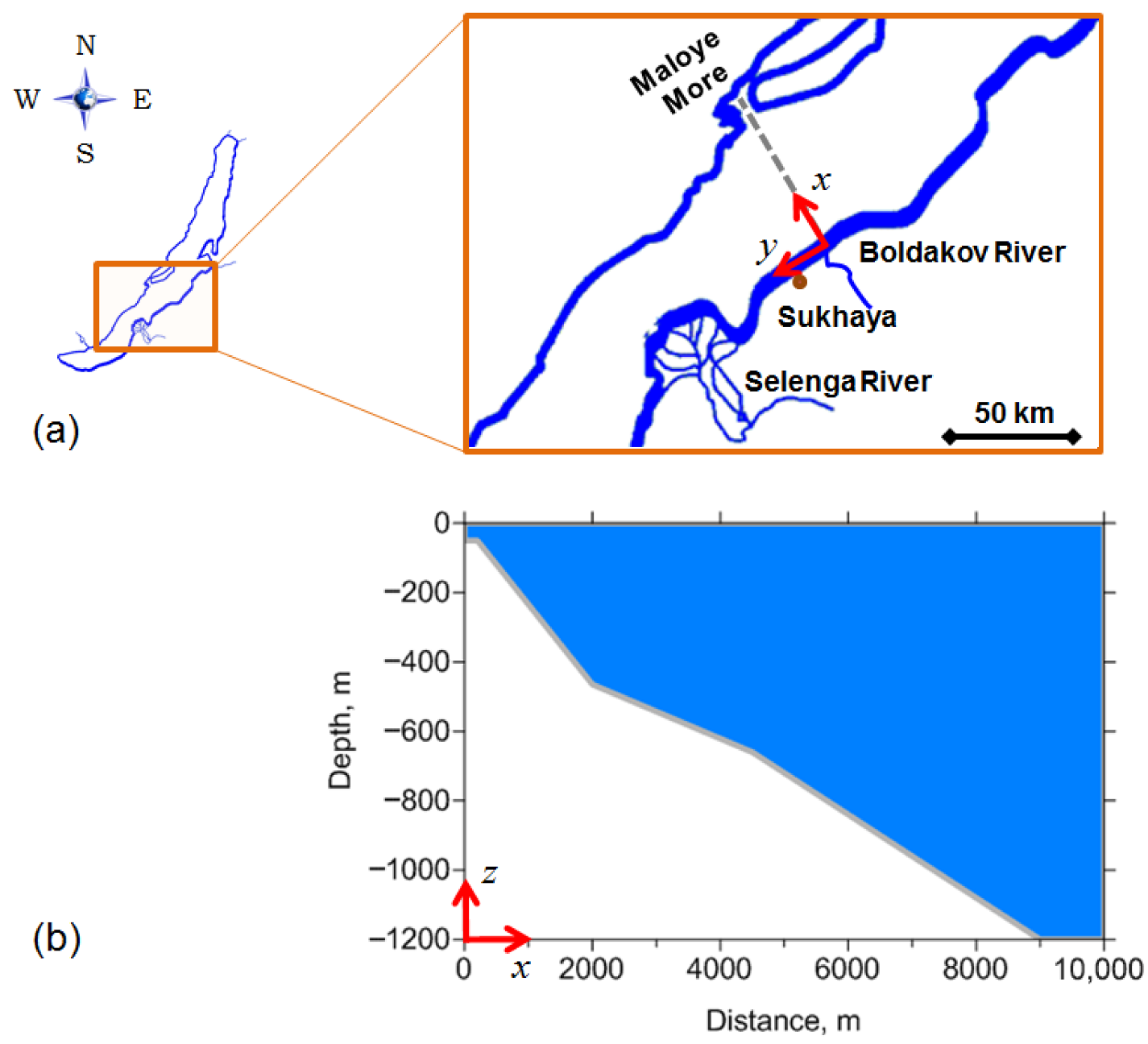
The calculations were performed for the cross-section of the Boldakov River–Maloe More Strait of Lake Baikal (Figure 2a) over a computational domain of 10,000 m × 1200 m (Figure 2b). The bathymetry data corresponding to the specified cross-section were taken from [41]. The computational domain is covered by a uniform rectangular grid with steps hx = 50 m and hz = 5 m. The time step is 30 s. A grid convergence study was conducted in [14]. Comparison of grid resolution results for the cross-section under consideration was discussed in a previous work [40].
The initial and boundary conditions for the biological model were assessed based on available sources on field observations [18,42,43,44,45,46,47]. The initial concentrations of nitrates, phosphates, ammonium, and oxygen were set at 1.0 mmol N m−3, 0.05 mmol P m−3, 1.0 mmol N m−3, and 312 mmol O2 m−3, respectively. The concentrations of all detritus components and zooplankton at the beginning of simulations were 0.1 and 0.2 mmol N m−3, respectively. Chlorophyll a concentration was set based on the ratio of 1.59 for [Chl]/[Phyto] [21]. In the river mouth area, [O2]R = 375 mmol O2 m−3, [PO4]R = 0.15 mmol P m−3, [Phyto]R = 0.6 mmol N m−3, and boundary conditions for the remaining variables of the biogeochemical model matched the initial conditions.
The initial water temperature in the numerical experiments had a vertically non-uniform distribution that corresponded to the average temperature in June in the Central Baikal [46]. At the river mouth, the temperature was 11 °C initially and grew by 0.4 °C per day. Water mineralization in the lake and in the river was 96 mg/L [46] and 128.2 mg/L [47], respectively. The latter corresponds to average mineralization across all tributaries. The river flow velocity at the point of entry into the lake was 0.5 cm/s, which approximately corresponds to the value measured at the Srednyaya arm of the Selenga River [48]. The open boundary at the river inflow is 50 m deep. The horizontal turbulent diffusion coefficient was taken as Dx = 5.0 m2/s [49,50]; more detailed information on horizontal diffusivity diagnostics for Lake Baikal is contained in [51]. Bottom heat flux was set as constant conductive flux, Hgeo = 0.138 W/m2 [52]. Effects of geothermal heating in Lake Baikal were discussed in depth in [53]. Atmospheric parameters were based on meteorological data from the Sukhaya weather station from 1 June 2024 to 30 June 2024 [54].

4. Results and Discussion

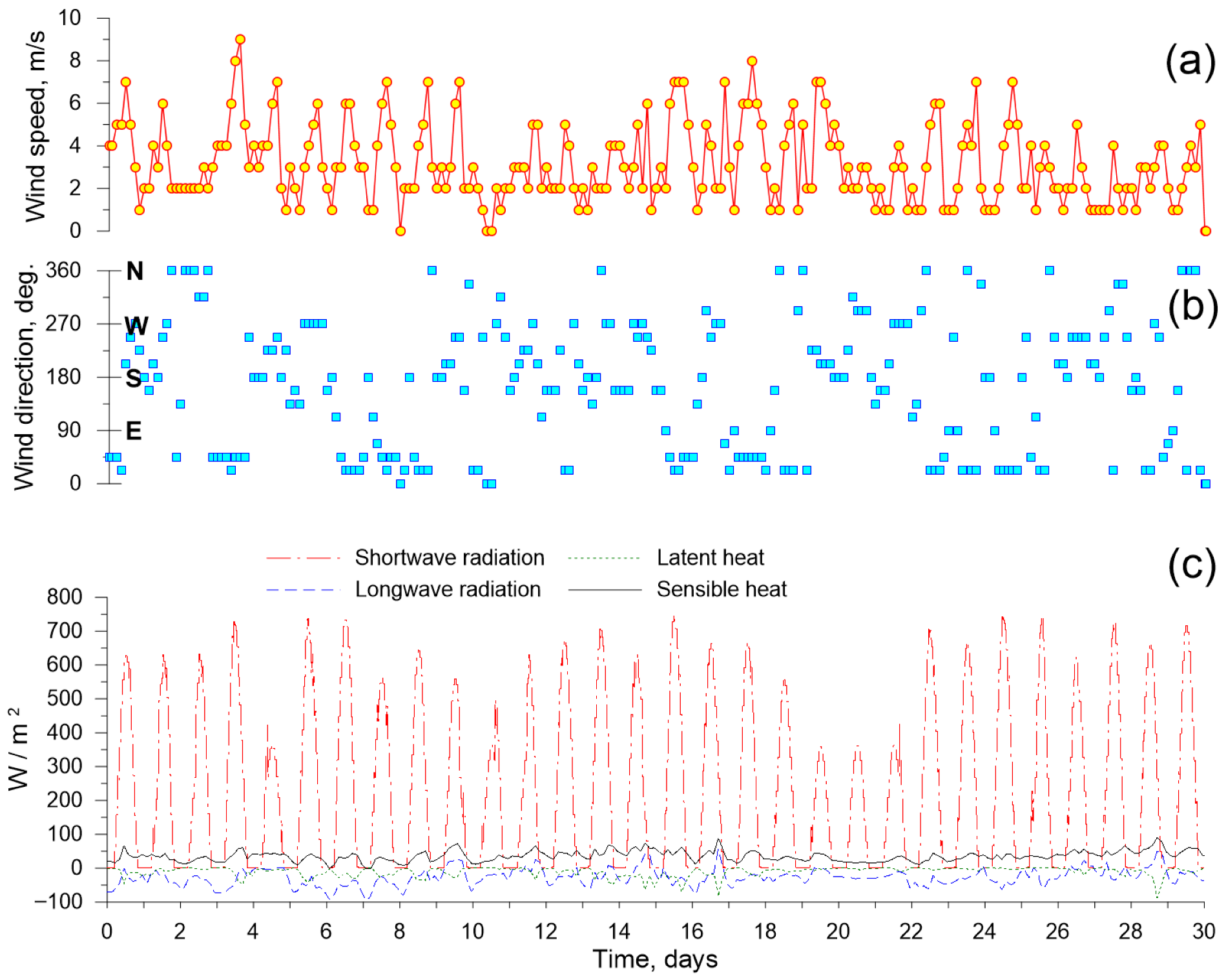
In June 2024, wind speed (Figure 3a) predominantly ranged from 1 to 7 m/s. Gusts of northeastern wind ≥ 8 m/s were observed on the 4th and 18th days. Wind direction changed constantly throughout the month, settling only briefly (Figure 3b). On days 1, 3–4, 7–9, 16, 18–19, 23–26, and 30, prevailing winds were from the north, north-northeast, and northeast. On days 6, 14–15, 22, and 27, wind was from the west, while on days 4–5, 12–15, and 20, winds were from the south and southeast.
The lake warmed due to shortwave radiation and sensible heat flux (Figure 3c). The minimum peaks of shortwave radiation flux (360–420 W/m2) occurred on days 5 and 20–22 due to high cloud cover. The maximum shortwave radiation flux was 749 W/m2, though on 8 out of 30 days (5, 8, 10–11, 19–22) it did not exceed 600 W/m2. Sensible heat flux ranged from −2 to 90 W/m2. Negative contributions to the thermal balance of the lake came from latent heat fluxes (from −88 W/m2 to 0 W/m2) and, to a significant extent, from longwave radiation (from −93 W/m2 to 56 W/m2).
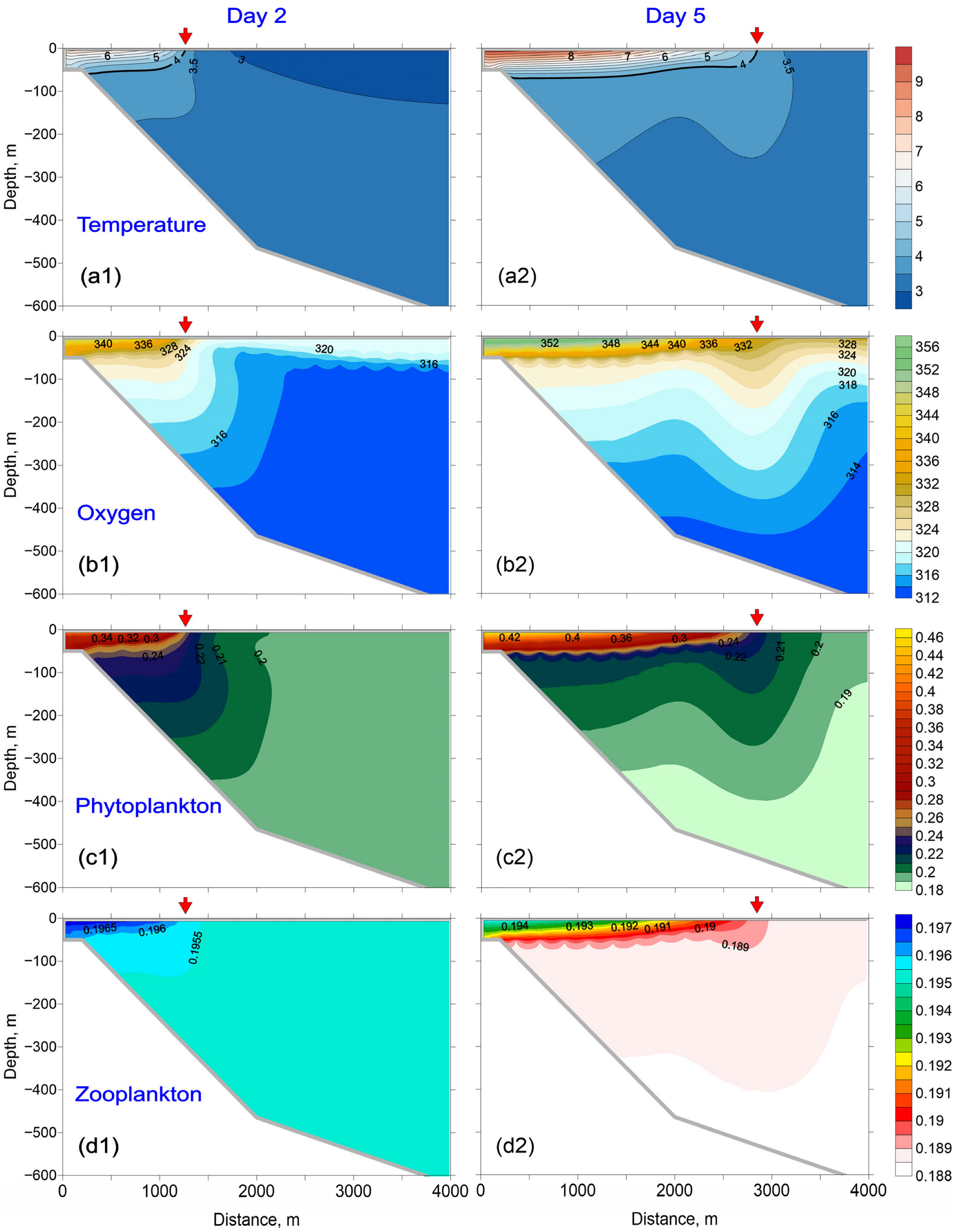
The water in the thermoactive region rose to 8 °C on day 2 (Figure 4(a1)) and 10 °C on day 5 (Figure 4(a2)). These two days most informatively demonstrated the dynamics of the riverine thermal bar under prescribed conditions of simulation. The thermoinert region (especially the upper 200 m layer of the lake at a distance of 3000 m and beyond) remained cold relative to the remainder of the cross-section.
The 4 °C isotherm on day 5 extended from a point 2800 m away from the shore on the lake surface to a point 70 m deep at the estuary area. Dissolved oxygen ranged from 314 mmol O2 m−3 to 360 mmol O2 m−3, with maximum concentrations at the lake surface near the river mouth (Figure 4b). Oxygen transport to the deeper area of the lake was observed at the thermal bar: waters with a high oxygen content (>314 mmol O2 m−3) sank to 390 m on day 2 (Figure 4(b1)), and to 480 m on day 5 (Figure 4(b2)). In the open lake, changes in oxygen concentration were only in the upper 200 m layer. Phytoplankton quantity (Figure 4c) in the thermoactive region varied from 0.24 mmol N m−3 to 0.41 mmol N m−3 on day 2 (to 0.47 mmol N m−3 on day 5). In the remainder of the section under study, phytoplankton concentration dropped to 0.18 mmol N m−3 on day 5. Vertical flows formed at the thermal bar carried phytoplankton biomass into the deeper layers. Over time, the concentration of zooplankton tended to decrease: In the open lake on day 2, it was below 0.1995 mmol N m−3 (Figure 4(d1)), and on day 5 it was below 0.1885 mmol N m−3 (Figure 4(d2)). Phyto- and zooplankton descended to the deep-water area due to downwelling generated by the thermal bar (Figure 5).
Note that the chemical analysis of water samples from the cross-section Kharauz arm (Selenga River)–Cape Krasnyj Yar of Lake Baikal in 2002–2007 [2] showed that the level of nutrients and phytoplankton in the thermoactive region was higher than in the thermoinert region. The vertical transport of oxygen (Figure 4(b1)) and plankton (Figure 4(c1,d1)) along the underwater slope at the initial stage of thermal bar development was consistent with the observation data [41,42]. As the thermal bar moved toward the open lake (this is displayed in the positions of the 4 °C isotherm at the lake surface in Figure 4(a1,a2)), the exchange of upper and deep waters with a higher content of dissolved oxygen occurred to depths of 500–600 m due to instability at the thermal bar position, ~2800 m from the river mouth (Figure 4(b2)).
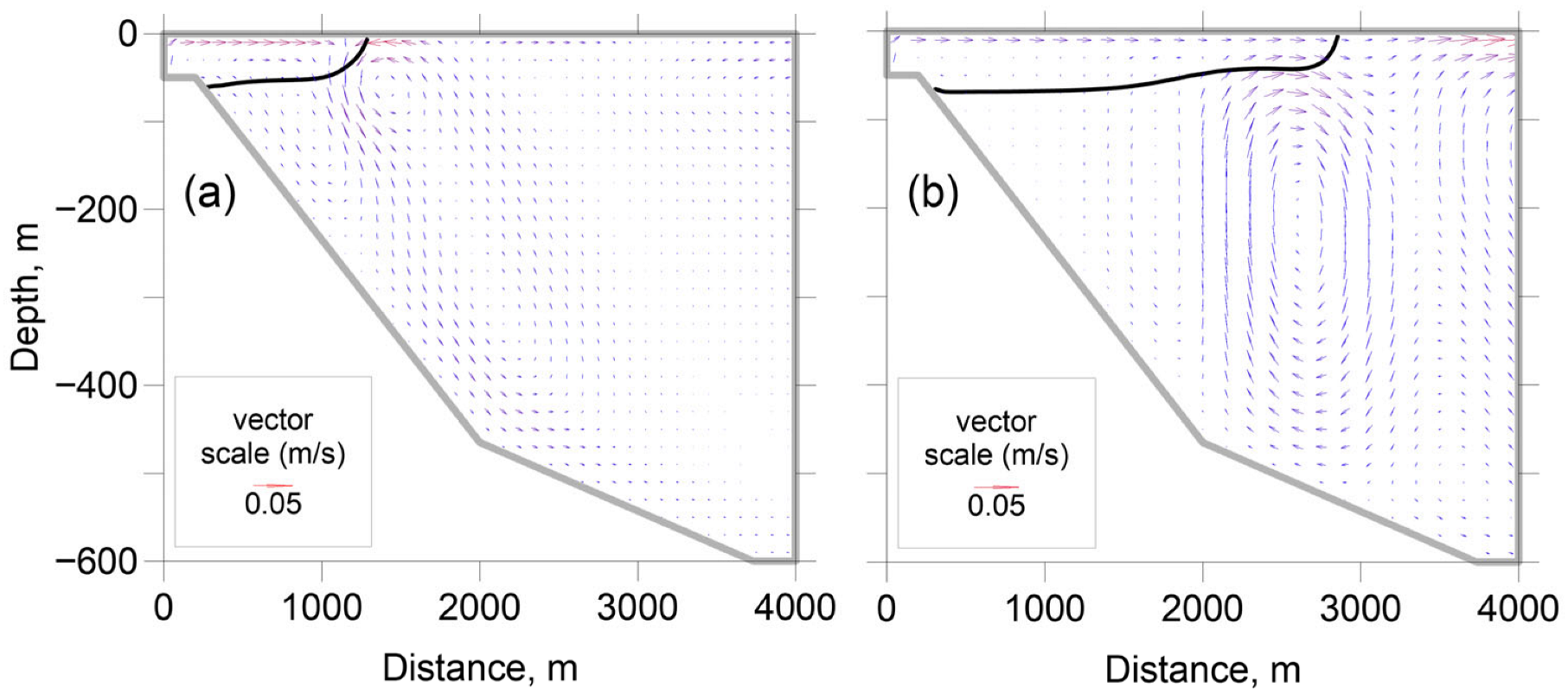
Wind forcing orientations illustrated in Figure 3b demonstrated that wind direction relative to the coastline (Figure 2a) was highly changeable during June 2024. The position of the 4 °C isotherm at the lake surface and the vector velocity field (Figure 5) showed that the sinking of waters at the thermal bar reached a depth of 500 m on day 5. Interestingly, the thermohydrodynamic picture on day 2 (Figure 5a) was consistent with a classical structure of a thermal bar as a zone of water convergence at the temperature of maximum density [12,55], but, on day 5, there was a continuous subsurface flow (Figure 5b) resulting from changing the wind direction from the southwest to the southeast (Figure 3b) and increasing the wind speed from 1 m/s to 3 m/s (Figure 3a). This effect was especially strong in the thermoinert region (Figure 5b).
Coriolis effects on the cross-shore circulation are important during the thermal bar in temperate lakes [22,56,57]. Under these effects, the thermal bar acts as a barrier between alongshore flows in opposing directions, specifically strong cyclonic (inshore of the thermal bar) and weaker anticyclonic (offshore of the thermal bar) circulations [4,58]. At the eastern shore of Lake Baikal, the general cyclonic round-the-Baikal circulation is directed along the shoreline to the north [59,60,61]. The cyclonic circulation in the shallow water of the Selenga River and Lake Baikal can reach a speed of 1.5 cm/s [40]. It is possible to assume, therefore, that lateral gas transport to the thermal front can occur by convective circulation [62], and vertical gas transport to greater depths by thermal bar-driven downwelling. Thermal bar circulations are expected to dominate in deep temperate lakes during spring and autumn transitions.
In Lake Baikal, nutrients and organic matter are distributed very unevenly [44,63]. Nitrate depletion and phytoplankton concentrations can vary significantly over a 2-week period during the formation of thermal stratification [44]. The spring phytoplankton development differs from year to year; in particular, the “Melosira year” has a tenfold increase in productivity of the lake [43,47]. In addition, an unstable wind situation is typical of Lake Baikal, which leads to changeable water circulations [64].
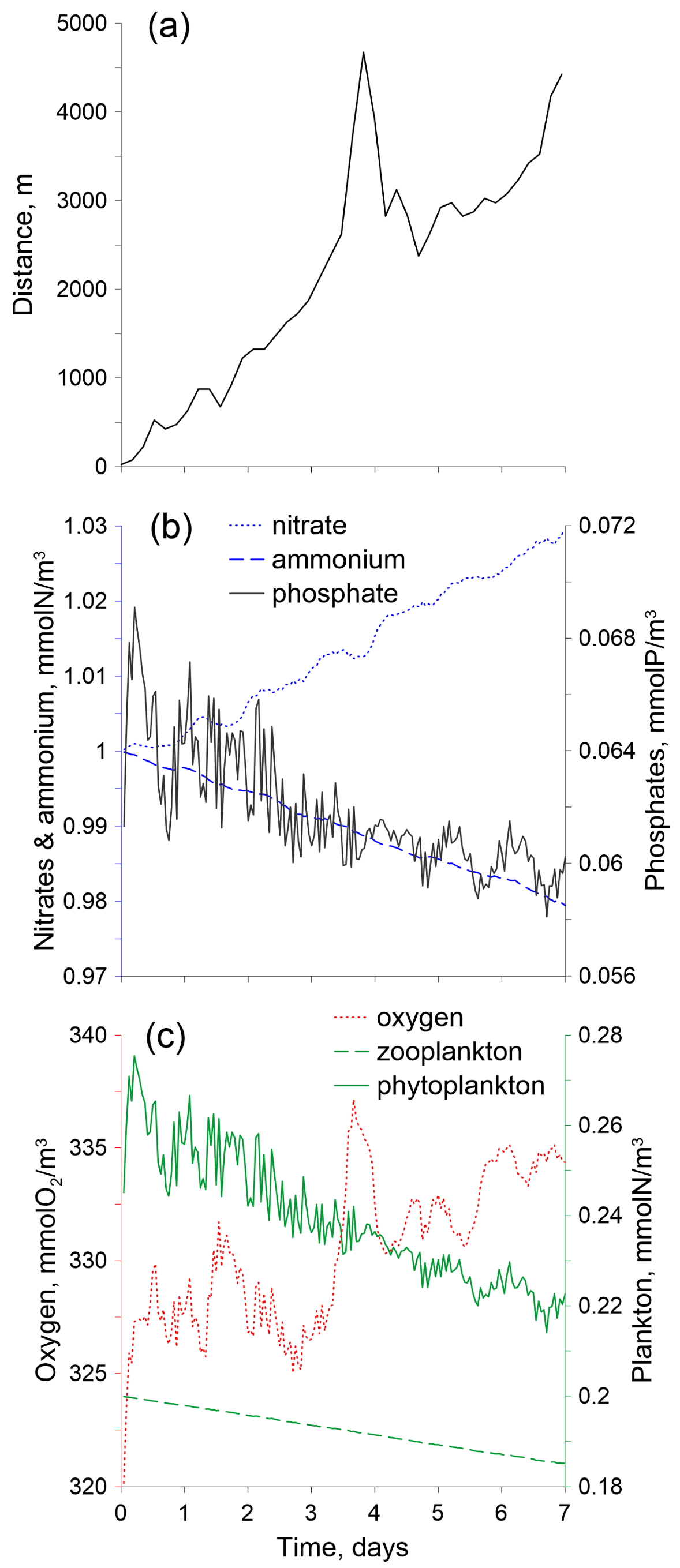
Under the influence of northeastern and north-northeastern winds, the position of maximum density temperature on the lake surface (Figure 6a) quickly moved away from the river mouth on day 4 (from 1800 m to 4200 m) and on day 7 (from 2900 m to 4500 m). Due to southwesterly winds, this position moved toward the river mouth, compensating for the past rapid advance. Speed and direction of wind affect the formation and duration period of thermal bars [23,65], and sometimes active wind forcing can destroy vertical flows induced by a thermal bar [39].
The phosphate concentration at the position of maximum density temperature (Figure 6b) decreased from 0.07 mmol P m−3 to 0.058 mmol P m−3 over 7 days, with diurnal fluctuations exhibiting a diminishing amplitude (from 0.008 mmol P m−3 to 0.0015 mmol P m−3). The ammonium levels also decreased (from 1.0 mmol N m−3 to 0.98 mmol Nm−3), while the nitrate levels increased (from 1.0 mmol N m−3 to 1.03 mmol N m−3). Oxygen concentration in this position (Figure 6c) increased from 320 mmol O2 m−3 to 337 mmol O2 m−3 (with a maximum on day 7). Zooplankton biomass decreased from 0.2 mmol N m−3 to 0.185 mmol N m−3, and phytoplankton biomass decreased from 0.275 mmol N m−3 to 0.215 mmol N m−3. Phytoplankton concentration also fluctuated daily (similar to the phosphate dynamics) with a decreasing amplitude (from 0.03 mmol N m−3 to 0.01 mmol N m−3).
Oxygen at the thermal bar tended to grow when it moved toward the center of the lake (Figure 6c), similar to the case for the shallow section of Lake Baikal [66]. However, due to the shift in the thermal bar front to the river mouth under the opposite wind forcing, the reverse trend was observed. The monotonous nature of the change in the nitrate, ammonium, and zooplankton concentrations at the thermal bar (Figure 6b,c) coincided with the simulation results performed for Barguzin Bay of Lake Baikal [67].
Previous studies show that the behavior of the thermal bar is highly sensitive to wind, cloudiness, and diurnal variability of solar radiation [14,25,36,39]. Hence, the distribution of oxygen and plankton can also depend on the atmospheric factors. Note that global climate changes, documented since the middle of the 20th century, are reflected in the thermal structure of large temperate lakes [68,69,70].
In Lake Baikal, the phytoplankton concentrations between a high and a low production year can vary substantially [47,71]. In these circumstances, numerical modeling of the biogeochemical processes during the riverine thermal bar requires more detailed initial and boundary conditions. Due to the continuous interaction between river and lake waters, the selection of appropriate conditions presents a problem for simulations [4]. In developing aquatic biogeochemical models, it is also important to consider the adopted model complexity and the space-time scale in accordance with the objectives of the study [72].
Thermally driven cross-shore flows affect the biogeochemical functioning of lake ecosystems through the redistribution of water masses between littoral and pelagic areas [7]. Our study was aimed at understanding the effect of the thermal bar on the oxygen and plankton propagation. In this case, it is crucial to analyze first the qualitative picture. Quantitative indicators are also important; however, that is the subject for future work.

5. Conclusions

The mathematical model described here allows us to simulate hydrobiological processes in a deep lake during the spring thermal bar development. It incorporates both biochemical and physical dynamics of dissolved oxygen.
The results of numerical modeling conducted for the cross-section of Lake Baikal, Boldakov River–Maloye More Strait, which is characterized by great depths, show high concentrations of oxygen, phytoplankton, and zooplankton in two areas:
(i)
the upper layer of the lake—in the littoral zone;
(ii)
the deep-water column of the lake—over the underwater slope.
Increased oxygen content was also noted in the surface layer of the thermoinert region, which is related to the influx of atmospheric oxygen into the lake under the influence of wind.
As the spring thermal bar develops in the Boldakov River–Maloe More cross-section under the 2024 meteorological conditions, a tendency was observed at the thermal bar for:
(i)
increased concentration of nitrates and dissolved oxygen;
(ii)
decreased ammonium, phosphates, phyto- and zooplankton.
This study revealed that by contributing to the vertical transfer of dissolved oxygen, thermal bars can play a determining role in natural mechanisms of deep-water renewal in Lake Baikal.

Author Contributions

Conceptualization, B.T.; methodology, B.T.; software, D.D., A.B. and B.T.; validation, A.B., D.D. and B.T.; formal analysis, A.B. and N.T.; investigation, B.T., A.B. and N.T.; writing—original draft preparation, B.T., A.B., N.T. and V.C.; writing—review and editing, B.T.; visualization, D.D. and A.B.; supervision, B.T. All authors have read and agreed to the published version of the manuscript.

Funding

This research was funded by the Russian Science Foundation, grant number 23-71-10020.

Data Availability Statement

The datasets are available upon request from the corresponding author.

Acknowledgments

We thank Jean Kollantai for style review.

Conflicts of Interest

The authors declare no conflicts of interest. The funders had no role in the design of the study; in the collection, analyses, or interpretation of data; in the writing of the manuscript; or in the decision to publish the results.

References

  1. Timoshkin, O.A.; Bondarenko, N.A.; Kulikova, N.N.; Lukhnev, A.G.; Maximova, N.V.; Malnik, V.V.; Moore, M.V.; Nepokrytykh, A.V.; Obolkina, L.A.; Rozhkova, N.A.; et al. Protection of Lake Baikal requires more stringent, not more lenient, environmental regulation. J. Great Lakes Res. 2019, 45, 401–402. [Google Scholar] [CrossRef]
  2. Tomberg, I.V.; Sorokovikova, L.M.; Popovskaya, G.I.; Bashenkhaeva, N.V.; Sinyukovich, V.N.; Ivanov, V.G. Concentration dynamics of biogenic elements and phytoplankton at Selenga R. Mouth and in Selenga shallows (Lake Baikal). Water Resour. 2014, 41, 687–695. [Google Scholar] [CrossRef]
  3. Volkova, E.A.; Bondarenko, N.A.; Timoshkin, O.A. Morphotaxonomy, distribution and abundance of Spirogyra (Zygnematophyceae, Charophyta) in Lake Baikal, East Siberia. Phycologia 2018, 57, 298–308. [Google Scholar] [CrossRef]
  4. Holland, P.R.; Kay, A. A review of the physics and ecological implications of the thermal bar circulation. Limnologica 2003, 33, 153–162. [Google Scholar] [CrossRef]
  5. Moll, R.A.; Bratkovich, A.; Chang, W.Y.B.; Pu, P. Physical, chemical, and biological conditions associated with the early stages of the Lake Michigan vernal thermal front. Estuaries 1993, 16, 92–103. [Google Scholar] [CrossRef]
  6. Reynolds, C.S. Phytoplankton assemblages and their periodicity in stratifying lake systems. Holarct. Ecol. 1980, 3, 141–159. [Google Scholar] [CrossRef]
  7. Bouffard, D.; Doda, T.; Ramón, C.L.; Ulloa, H.N. Thermally driven cross-shore flows in stratified basins: A review on the thermal siphon dynamics. Flow 2025, 5, E1. [Google Scholar] [CrossRef]
  8. Imberger, J.; Patterson, J.C. Physical limnology. Adv. Appl. Mech. 1989, 27, 303–475. [Google Scholar] [CrossRef]
  9. Blokhina, N.S.; Pokazeev, K.V. A unique natural phenomenon is the thermal bar. Earth Universe 2015, 6, 78–88. (In Russian) [Google Scholar]
  10. Malm, J.; Jönsson, L. A study of the thermal bar in Lake Ladoga using water surface temperature data from satellite images. Remote Sens. Environ. 1993, 44, 35–46. [Google Scholar] [CrossRef]
  11. Zilitinkevich, S.S.; Kreiman, K.D.; Terzhevik, A.Y. The thermal bar. J. Fluid Mech. 1992, 236, 22–47. [Google Scholar] [CrossRef]
  12. Tikhomirov, A.I. Thermal Regime of Large Lakes; Nauka: Leningrad, Russia, 1982. (In Russian) [Google Scholar]
  13. Tsydenov, B.O.; Kay, A.; Starchenko, A.V. Numerical modelling of pollutant propagation in Lake Baikal during the spring thermal bar. Procedia Comput. Sci. 2015, 51, 2658–2662. [Google Scholar] [CrossRef][Green Version]
  14. Tsydenov, B.O. A numerical study of the thermal bar in shallow water during the autumn cooling. J. Great Lakes Res 2019, 45, 715–725. [Google Scholar] [CrossRef]
  15. Shimaraev, M.N.; Granin, N.G.; Zhdanov, A.A. Deep ventilation of Lake Baikal waters due to spring thermal bars. Limnol. Oceanogr. 1993, 38, 1068–1072. [Google Scholar] [CrossRef]
  16. Troitskaya, E.S.; Shimaraev, M.N. Cases of mass development of intrusions in Lake Baikal and the correlation of intrusions with atmospheric circulation processes. Limnol. Freshw. Biol. 2022, 6, 1712–1719. [Google Scholar] [CrossRef]
  17. Parfenova, V.V.; Shimaraev, M.N.; Kostornova, T.Y.; Domysheva, V.M.; Levin, L.A.; Dryukker, V.V.; Zhdanov, A.A.; Yu Gnatovskii, R.; Tsekhanovskii, V.V.; Logacheva, N.F. On the vertical distribution of microorganisms in Lake Baikal during spring deep-water renewal. Mikrobiologiya 2000, 69, 433–440. [Google Scholar] [CrossRef]
  18. Domysheva, V.; Vorobyeva, S.; Golobokova, L.; Netsvetaeva, O.; Onischuk, N.; Sakirko, M.; Khuriganova, O.; Fedotov, A. Assessment of the current trophic status of the Southern Baikal littoral zone. Water 2023, 15, 1139. [Google Scholar] [CrossRef]
  19. Fennel, K.; Wilkin, J.; Levin, J.; Moisan, J.; O’Reilly, J.; Haidvogel, D. Nitrogen cycling in the Middle Atlantic Bight: Results from a three-dimensional model and implications for the North Atlantic nitrogen budget. Glob. Biogeochem. Cycles 2006, 20, GB3007. [Google Scholar] [CrossRef]
  20. Fennel, K.; Hu, J.; Laurent, A.; Marta–Almeida, M.; Hetland, R. Sensitivity of hypoxia predictions for the Northern Gulf of Mexico to sediment oxygen consumption and model nesting. J. Geophys. Res. Ocean 2013, 118, 990–1002. [Google Scholar] [CrossRef]
  21. Gan, J.; Lu, Z.; Cheung, A.; Dai, M.; Liang, L.; Harrison, P.J.; Zhao, X. Assessing ecosystem response to phosphorus and nitrogen limitation in the Pearl River plume using the Regional Ocean Modeling System (ROMS). J. Geophys. Res. C Oceans 2014, 119, 8858–8877. [Google Scholar] [CrossRef]
  22. Holland, P.R.; Kay, A.; Botte, V. Numerical modelling of the thermal bar and its ecological consequences in a river-dominated lake. J. Mar. Syst. 2003, 43, 61–81. [Google Scholar] [CrossRef]
  23. Malm, J. Spring circulation associated with the thermal bar in large temperate lakes. Nord. Hydrol. 1995, 26, 331–358. [Google Scholar] [CrossRef]
  24. Tsvetova, E.A. Effect of the Coriolis force on convection in a deep lake: Numerical experiment. J. Appl. Mech. Tech. Phys. 1998, 39, 593–599. [Google Scholar] [CrossRef]
  25. Tsydenov, B.O.; Kay, A.; Starchenko, A.V. Numerical modeling of the spring thermal bar and pollutant transport in a large lake. Ocean Model. 2016, 104, 73–83. [Google Scholar] [CrossRef]
  26. Chen, C.T.; Millero, F.G. Precise thermodynamic properties for natural waters covering only limnologies range. Limnol. Oceanogr. 1986, 31, 657–662. [Google Scholar] [CrossRef]
  27. Garcia, H.E.; Gordon, L.I. Oxygen solubility in seawater: Better fitting equations. Limnol. Oceanogr. 1992, 37, 1307–1312. [Google Scholar] [CrossRef]
  28. Wanninkhof, R. Relationship between wind speed and gas exchange. J. Geophys. Res. 1992, 97, 7373–7382. [Google Scholar] [CrossRef]
  29. Tsydenov, B.O. Modeling biogeochemical processes in a freshwater lake during the spring thermal bar. Ecol. Model. 2022, 465, 109877. [Google Scholar] [CrossRef]
  30. Eppley, R.W. Temperature and phytoplankton growth in the sea. Fish. Bull. 1972, 70, 1063–1085. [Google Scholar]
  31. Yu, L.; Gan, J. Mitigation of eutrophication and hypoxia through oyster aquaculture: An ecosystem model evaluation off the Pearl River Estuary. Environ. Sci. Technol. 2021, 55, 5506–5514. [Google Scholar] [CrossRef] [PubMed]
  32. Engineering ToolBox. Oxygen—Solubility in Fresh and Sea Water vs. Temperature. Available online: https://www.engineeringtoolbox.com/oxygen-solubility-water-d_841.html (accessed on 14 August 2023).
  33. Evans, G.T.; Parslow, J.S. A model of annual plankton cycles. Biol. Oceanogr. 1985, 3, 327–347. [Google Scholar]
  34. Olson, R.J. Differential photoinhibition of marine nitrifying bacteria: A possible mechanism for the formation of the primary nitrite maximum. J. Mar. Res. 1981, 39, 227–238. [Google Scholar]
  35. Orlanski, I. A simple boundary condition for unbounded hyperbolic flows. J. Comput. Phys. 1976, 21, 251–269. [Google Scholar] [CrossRef]
  36. Tsydenov, B.O. Effects of heat fluxes on the phytoplankton distribution in a freshwater lake. Atmos. Ocean. Opt. 2021, 34, 603–610. [Google Scholar] [CrossRef]
  37. Aleksandrova, M.P.; Gulev, S.K.; Sinitsyn, A.V. An improvement of parametrization of short-wave radiation at the sea surface on the basis of direct measurements in the Atlantic. Russ. Meteorol. Hydrol. 2007, 32, 245–251. [Google Scholar] [CrossRef]
  38. Hurley, P. The Air Pollution Model (TAPM) Version 2. Part 1: Technical Description; CSIRO Atmospheric Research Technical Paper; CSIRO: Melbourne, Australia, 2002. [Google Scholar]
  39. Tsydenov, B.O. Numerical modeling of the autumnal thermal bar. J. Mar. Syst. 2018, 179, 1–9. [Google Scholar] [CrossRef]
  40. Tsydenov, B.O. Simulating phytoplankton growth during the spring thermal bar in a deep lake. J. Mar. Syst. 2019, 195, 38–49. [Google Scholar] [CrossRef]
  41. Likhoshway, Y.V.; Kuzmina AYe Potyemkina, T.G.; Potyemkin, V.L.; Shimaraev, M.N. The distribution of diatoms near a thermal bar in Lake Baikal. J. Great Lakes Res. 1996, 22, 5–14. [Google Scholar] [CrossRef]
  42. Shimaraev, M.N.; Grachev, M.A.; Imboden, D.M.; Okuda, S.; Granin, N.G.; Kipfer, R.; Levin, L.A.; Endo, S. International hydrophysical experiment in Lake Baikal: Spring deep water renewal. Dokl. Acad. Nauk 1995, 343, 824–827. (In Russian) [Google Scholar]
  43. Evstafyev, V.K.; Bondarenko, N.A. An intriguing enigma of Lake Baikal. Biol. Rhythm. Res. 2007, 38, 107–117. [Google Scholar] [CrossRef]
  44. Goldman, C.R.; Elser, J.J.; Richards, R.C.; Reuter, J.E.; Priscu, J.C.; Levin, A.L. Thermal stratification, nutrient dynamics, and phytoplankton productivity during the onset of spring phytoplankton growth in Lake Baikal, Russia. Hydrobiologia 1996, 331, 9–24. [Google Scholar] [CrossRef]
  45. Satoh, Y.; Katano, T.; Satoh, T.; Mitamura, O.; Anbutsu, K.; Nakano, S.-I.; Ueno, H.; Kihira, M.; Drucker, V.; Tanaka, Y.; et al. Nutrient limitation of the primary production of phytoplankton in Lake Baikal. Limnology 2006, 7, 225–229. [Google Scholar] [CrossRef]
  46. Shimaraev, M.N.; Verbolov, V.I.; Granin, N.G.; Sherstyankin, P.P. Physical Limnology of Lake Baikal: A Review; BICER: Irkutsk, Russia; Okayama, Japan, 1994. [Google Scholar]
  47. Galazii, G.I.; Votintsev, K.K. The Problems of Lake Baikal; Nauka: Novosibirsk, Russia, 1978. (In Russian) [Google Scholar]
  48. Sinukovich, V.N.; Zharikova, N.G.; Zharikov, V.D. River Selenga runoff in its delta. Geogr. Nat. Resour. 2004, 3, 64–69. (In Russian) [Google Scholar]
  49. Holland, P.R.; Kay, A.; Botte, V. A numerical study of the dynamics of the riverine thermal bar in a deep lake. J. Environ. Fluid Mech. 2001, 1, 311–332. [Google Scholar] [CrossRef]
  50. Shimaraev, M.N. Currents and water exchange processes in a deep freshwater lake (on the example of Lake Baikal). In Informational Bulletin RFBR; Russian Foundation for Basic Research: Moscow, Russia, 1998; Volume 6. (In Russian) [Google Scholar]
  51. Holland, P.R. Numerical Modelling of the Riverine Thermal Bar. Ph.D. Thesis, Loughborough University, Loughborough, UK, 2001. [Google Scholar]
  52. Golubev, V.A. Geothermal field and distribution for earthquake source depths in the Baikal Rift zone. Dokl. Earth Sci. 2010, 433, 1083–1087. [Google Scholar] [CrossRef]
  53. Tsydenov, B.O. Effect of geothermal heating on deep-water temperature in Lake Baikal. Hydrology 2025, 12, 256. [Google Scholar] [CrossRef]
  54. Reliable Prognosis. Weather Forecasts. Available online: https://rp5.ru (accessed on 15 May 2025).
  55. Forel, F.A. La congélation des lacs suisses et savoyards pendant l’hiver 1879-1880. 11—Lac Léman. L’Écho Des Alpes 1880, 3, 149–161. [Google Scholar]
  56. Blokhina, N.S.; Solovyev, D.A. Thermodynamic processes in the lakes on the thermal bar development under condition of the Coriolis effect. Moscow Univ. Phys. Bull. 2010, 65, 203–208. [Google Scholar] [CrossRef]
  57. Farrow, D.E.; McDonald, N.R. Coriolis effects and the thermal bar. JGR Oceans 2002, 107, 1-1–1-9. [Google Scholar] [CrossRef]
  58. Henderson-Sellers, B. Engineering Limnology; Pitman: London, UK, 1984. [Google Scholar]
  59. Krotova, V.A.; Mankovskij, B.I. Report on the Study of Currents in Lake Baikal in 1962; LIN Library Funds: Irkutsk, Russia, 1962. (In Russian) [Google Scholar]
  60. Sokolnikov, V.M. Currents and water exchange in Lake Baikal. In Elements of Hydrometeorological Regime of Lake Baikal; Nauka: Novosibirsk, Russia, 1964; pp. 5–21. (In Russian) [Google Scholar]
  61. Verbolov, V.I.; Sokolnikov, V.M.; Shimaraev, M.N. Hydrometeorological Regime and Heat Balance of Lake Baikal; Nauka: Novosibirsk, Russia, 1965. (In Russian) [Google Scholar]
  62. Doda, T.; Ramón, C.L.; Ulloa, H.N.; Brennwald, M.S.; Kipfer, R.; Perga, M.-E.; Wüest, A.; Schubert, C.J.; Bouffard, D. Lake surface cooling drives littoral-pelagic exchange of dissolved gases. Sci. Adv. 2024, 10, eadi0617. [Google Scholar] [CrossRef] [PubMed]
  63. Tarasova, E.N. Organic Matter of the Waters of South Baikal; Nauka: Novosibirsk, Russia, 1975. (In Russian) [Google Scholar]
  64. Ivanov, V.G. Formation and Evolution of the Spring Thermal Bar Due to River Runoff (Selenga Shallow of Lake Baikal). Ph.D. Thesis, Limnological Institute SB RAS, Irkutsk, Russia, 2012. (In Russian) [Google Scholar]
  65. Blokhina, N.S. The influence of wind on the development of a thermal bar and currents in a small reservoir during melting of its ice cover. Moscow Univ. Phys. Bull. 2013, 68, 324–329. [Google Scholar] [CrossRef]
  66. Tsydenov, B.O. Effect of underwater relief on the dynamics of the autumnal thermal bar. Mosc. Univ. Phys. Bull. 2023, 78, 689–696. [Google Scholar] [CrossRef]
  67. Tsydenov, B.O.; Bart, A.A.; Degi, D.V.; Churuksaeva, V.V.; Trunov, N.S. Features of changes in the concentrations of nutrients and plankton at the thermal bar: A numerical experiment. Limnol. Freshw. Biol. 2024, 4, 1115–1120. [Google Scholar] [CrossRef]
  68. Livingstone, D.M. Impact of secular climate change on the thermal structure of a large temperate lake. Clim. Change 2003, 57, 205–225. [Google Scholar] [CrossRef]
  69. Hondzo, M.; Stefan, H.G. Three case studies of lake temperature and stratification response to warmer climate. Water Resour. Res. 1991, 27, 1837–1846. [Google Scholar] [CrossRef]
  70. Robertson, D.M.; Ragotzkie, R.A. Changes in the thermal structure of moderate to large sized lakes in response to changes in air temperature. Aquat. Sci. 1990, 52, 360–380. [Google Scholar] [CrossRef]
  71. Bondarenko, N.A.; Evstafyev, V.K. Solar rhythms of the Lake Baikal phytoplankton. In New Scope on Sustainable Watersheds in East Asia; Fujita, N., Timoshikin, O.A., Urabe, J., Wada, E., Eds.; Nauka-Center: Novosibirsk, Russia, 2002; pp. 63–69. (In Russian) [Google Scholar]
  72. Arhonditsis, G.B.; Brett, M.T. Evaluation of the current state of mechanistic aquatic biogeochemical modeling. Mar. Ecol. Prog. Ser. 2004, 271, 13–26. [Google Scholar] [CrossRef]
Figure 1. Relationships between the model components (a) and the oxygen cycle diagram (b).
Environments 13 00178 g001
Figure 2. (a) Cross-section of Lake Baikal; (b) the calculation domain.
Environments 13 00178 g002
Figure 3. (a) Wind speed; (b) wind direction; (c) heat fluxes in June 2024.
Environments 13 00178 g003
Figure 4. Distributions of (a) temperature (the bold line is the 4 °C isotherm) [ºC]; (b) oxygen [mmol O2 m−3]; (c) phytoplankton; and (d) zooplankton [mmol N m−3] on day 2 (1) and 5 (2). Arrows indicate the position of the front of the thermal bar.
Environments 13 00178 g004
Figure 5. Vector velocity field and the 4 °C isotherm (bold line) on day 2 (a) and 5 (b).
Environments 13 00178 g005
Figure 6. (a) The position of maximum density temperature; (b) the concentrations of nitrates, ammonium, and phosphates; (c) oxygen, phyto-, and zooplankton at this position.
Environments 13 00178 g006
Table 1. Limitation factors.
SymbolDescriptionEquation
L N O 3 Nitrate limitation factor [ N O 3 ] k N O 3 + [ N O 3 ] 1 1 + [ N H 4 ] / k N H 4
L N H 4 Ammonium limitation factor [ N H 4 ] k N H 4 + [ N H 4 ]
L O 2 Oxygen limitation factor max O 2 O 2 t h k O 2 + O 2 O 2 t h , 0
L N Nutrient limitation factor for nitrogen L N O 3 + L N H 4
L P Nutrient limitation factor for phosphorus [ P O 4 ] k P O 4 + [ P O 4 ]
Table 2. Model parameters.
SymbolDescriptionValue
Nutrients
I0Threshold for light-inhibition of nitrification0.0095 W m−2
kILight intensity at which the inhibition of nitrification is half-saturated0.1 W m−2
nmaxMaximum nitrification rate0.05 d−1
θ N:PNitrogen to phosphorus ratio16 mmol N/mmol P
Oxygen
k O 2 Oxygen half-saturation concentration3.0 mmol O2 m−3
O 2 t h Oxygen threshold below which no aerobic respiration or nitrification occurs6.0 mmol O2 m−3
R O 2 : N O 3 Stoichiometric ratio corresponding to the oxygen produced per mol of nitrate assimilated during photosynthetic production of organic matter8.5 mmol O2/mmol NH4
R O 2 : N H 4 Stoichiometric ratio corresponding to the oxygen produced per mol of ammonium assimilated during photosynthetic production of organic matter6.625 mmol O2/mmol NH4
Phytoplankton
k N O 3 Half-saturation concentration for the uptake of nitrate0.8 mmol N m−3
k N H 4 Half-saturation concentration for the uptake of ammonium0.8 mmol N m−3
k P O 4 Half-saturation concentration for the uptake of phosphate0.06 mmol P m−3
mPhytoPhytoplankton mortality0.15 d−1
αInitial slope of the P-I curve0.1 mg C (mg Chl W m−2 d)−1
θmaxMaximum chlorophyll to phytoplankton ratio0.0535 mg Chl (mg C)−1
μ0Phytoplankton growth rate at 0 °C0.69 d−1
τAggregation rate of phytoplankton and small detritus0.08 (mmol N m−3)−1 d−1
Zooplankton
gmaxMaximum grazing rate0.5 d−1
kPhytoHalf-saturation concentration of phytoplankton ingestion2 (mmol N m−3)2
lBMExcretion rate due to basal metabolism0.1 d−1
lEMaximum rate of assimilation-related excretion0.1 d−1
mZooZooplankton mortality0.025 (mmol N m−3)−1 d−1
βAssimilation efficiency0.75
Detritus
rLDRemineralization rate of large detritus0.01 d−1
rSDRemineralization rate of small detritus0.03 d−1
Disclaimer/Publisher’s Note: The statements, opinions and data contained in all publications are solely those of the individual author(s) and contributor(s) and not of MDPI and/or the editor(s). MDPI and/or the editor(s) disclaim responsibility for any injury to people or property resulting from any ideas, methods, instructions or products referred to in the content.