
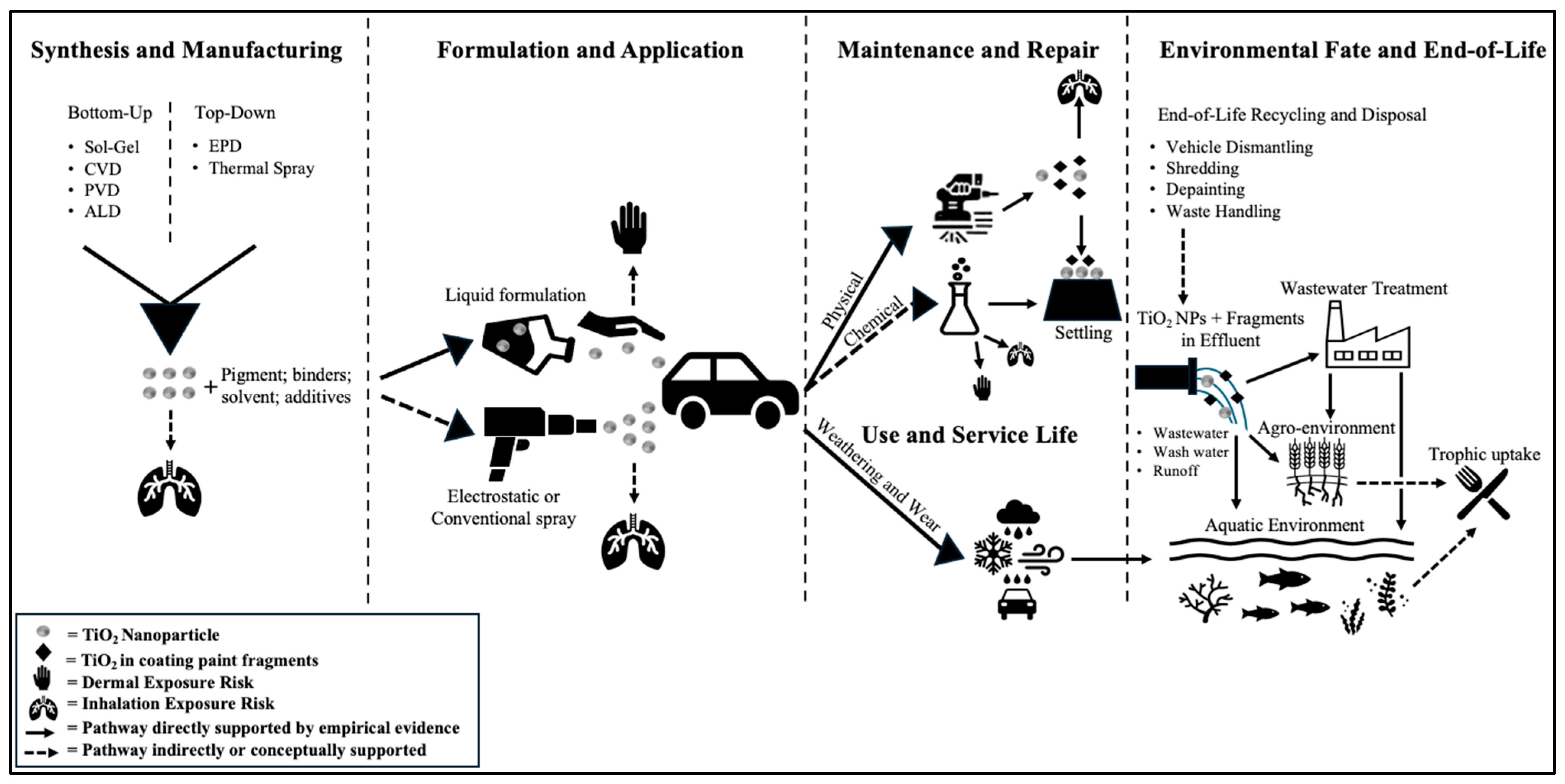
Lifecycle Risks and Environmental Fate of Titanium Dioxide Nanoparticles in Automotive Coatings

Abstract
1. Introduction
1.1. Chemistry and Properties of TiO2 in Coatings
1.2. Toxicological Concerns
- Inhalation: Primary occupational risk during NP manufacturing, spray application, and sanding. Studies link airborne TiO2 NPs to lung inflammation, oxidative stress, and cardiopulmonary effects, with rodent models suggesting tumorigenesis at high doses [20,24,25,26,58,59,60,61,62,63,64,65,66,67,68].
- Ingestion: Possible via incidental occupational exposure or food additives (E171). Historically considered inert, recent findings indicate potential for gut penetration, microbiome disruption, oxidative stress, and the induction of preneoplastic lesions [43,69,70,71,72,73,74,75]. This evidence has led the EU to ban TiO2 in food, though the U.S. FDA still permits ≤1% by weight [69,76].
1.3. Exposure Limits and Current Risk Classifications
1.4. Evolution of Automobile Paints and Composite Coatings
1.5. Nanotechnology in Automotive Coatings: TiO2 Applications
1.6. Purpose and Scope
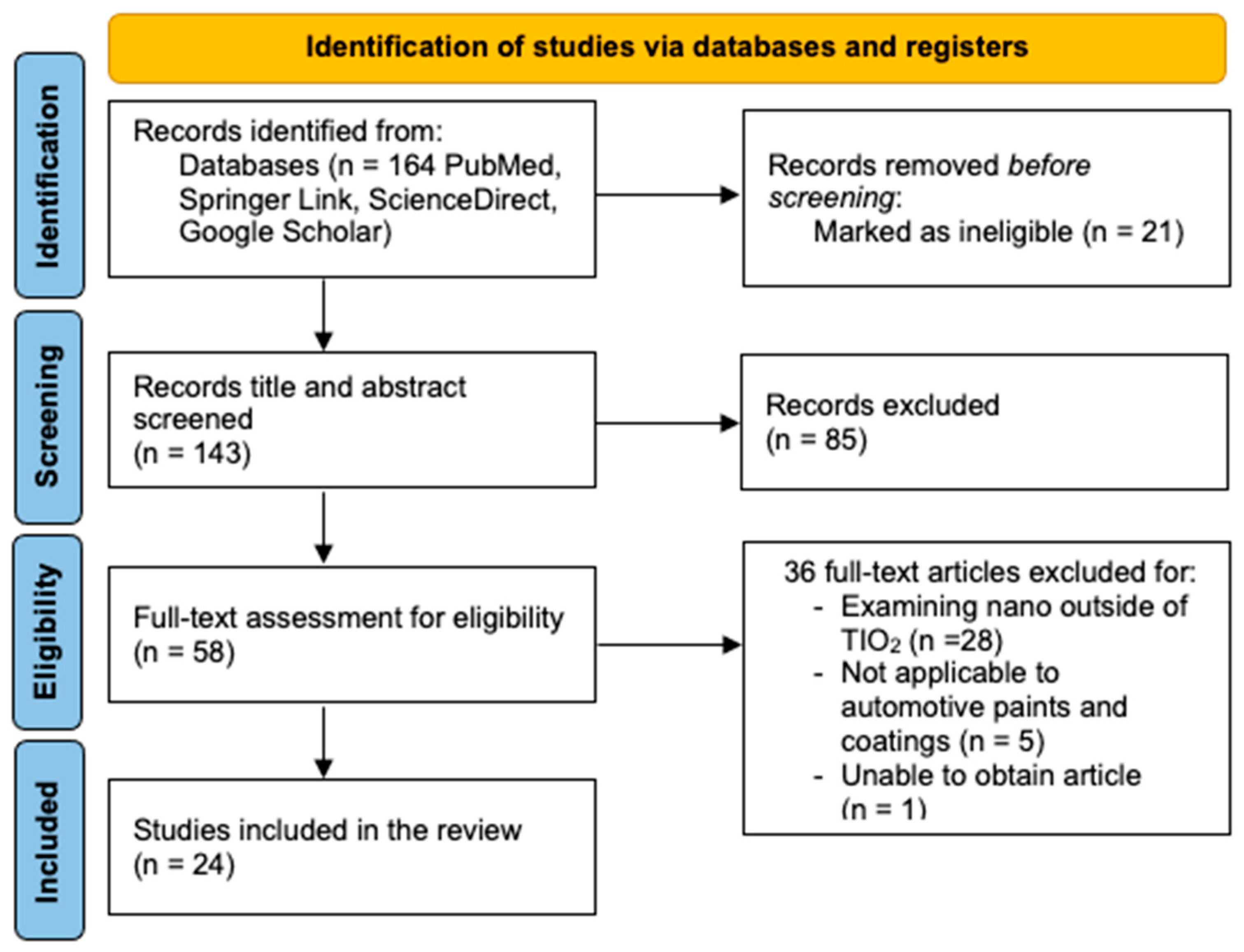
2. Methodology
2.1. Screening Articles
2.2. Data Extraction and Narrative Synthesis
3. Results
3.1. Formulation Stage: Dispersion, Interfacial Control, and Matrix Compatibility
3.2. Dispersion and Agglomeration
3.3. Surface Modification and Functionalization
3.4. Performance Benefits and Trade-Offs in the Use Phase
3.5. Photocatalytic and Self-Cleaning Functionality: Stability Versus Activity
3.6. Repair, Refinishing, and Mechanical Abrasion
3.7. Weathering-Linked Release (Forms and Rate)
3.8. End-of-Life and Environmental Fate: Transformation, Mobility, and Recycling Pathways
4. Discussion
4.1. Lifecycle Interpretation: Performance and Risk Are Co-Determined
4.2. Formulation as an Upstream Determinant of Durability and Later-Life Release
4.3. Use-Phase Performance Gains and Durability Trade-Offs Under Realistic Service Conditions
4.4. Photocatalytic Functions Exemplify Active-Stability Trade-Offs
4.5. Exposure and Release: Evidence Supports Fragment-Dominated Materials and Identifies Maintenance as a Key Hotspot
4.6. Environmental Fate and End-of-Life: Transformations, Partitioning, and Sustainability
4.7. Evidence Gaps and Priorities for Lifecycle-Aware Testing and Risk Governance
5. Conclusions
Author Contributions
Funding
Data Availability Statement
Conflicts of Interest
Abbreviations
| A | application (lifecycle stage code); |
| A3 | confirmed animal carcinogen (ACGIH carcinogenicity category); |
| ACGIH | American Conference of Governmental Industrial Hygienists; |
| APS | 3-aminopropyltriethoxysilane; |
| CC BY | Creative Commons Attribution (license); |
| Corr | corrosion (primary focus code); |
| DNA | deoxyribonucleic acid; |
| DPP | nano-pigment identifier reported in a cited study (not expanded in-text); |
| Dur | durability (primary focus code); |
| E171 | titanium dioxide food additive code; |
| Ecotox | ecotoxicity (primary focus code); |
| Env | environmental fate/transport (lifecycle stage code); |
| EoL | end-of-life (lifecycle stage code); |
| EU | European Union; |
| Exp. | experimental study; |
| F | formulation (lifecycle stage code); |
| Fate | fate/transport (primary focus code); |
| FDA | U.S. Food and Drug Administration; |
| Form/Disp | formulation/dispersion (primary focus code); |
| Form/Mech | formulation/mechanistic reinforcement (primary focus code); |
| Group 2B | possibly carcinogenic to humans (IARC classification); |
| Haz | hazard/toxicology (lifecycle stage code); |
| IARC | International Agency for Research on Cancer; |
| InhExp | inhalation exposure (primary focus code); |
| InhTox | inhalation toxicity (primary focus code); |
| M | maintenance/repair (including refinishing) (lifecycle stage code); |
| MDPI | Multidisciplinary Digital Publishing Institute; |
| NaCl | sodium chloride; |
| NIEHS | National Institute of Environmental Health Sciences; |
| NIOSH | National Institute for Occupational Safety and Health; |
| NM(s) | nanomaterial(s); |
| NP(s) | nanoparticle(s); |
| NPs/L | nanoparticles per liter; |
| OEL(s) | occupational exposure limit(s); |
| OSHA | Occupational Safety and Health Administration; |
| PEL | permissible exposure limit; |
| Perf | performance (primary focus code); |
| Photo | photocatalysis (primary focus code); |
| PM10 | particulate matter with aerodynamic diameter ≤ 10 μm; |
| PRISMA | Preferred Reporting Items for Systematic Reviews and Meta-Analyses; |
| PU | polyurethane; |
| Ra | surface roughness parameter (Ra); |
| Rel | release (primary focus code); |
| REL | recommended exposure limit; |
| ROS | reactive oxygen species; |
| Sust | sustainability (primary focus code); |
| TiO2 | titanium dioxide; |
| TiO2 NPs | titanium dioxide nanoparticles; |
| TLV | Threshold Limit Value; |
| TWA | time-weighted average; |
| U | use/service (lifecycle stage code); |
| U.S. | United States; |
| UV | ultraviolet; |
| VOC | volatile organic compounds; |
| Wa | surface parameter reported alongside Ra (not expanded in-text); |
| X | cross-lifecycle/framework (lifecycle stage code); |
| ZrO2 | zirconium dioxide. |
References
- Navya, P.N.; Daima, H.K. Rational engineering of physicochemical properties of nanomaterials for biomedical applications with nanotoxicological perspectives. Nano Converg. 2016, 3, 1. [Google Scholar] [CrossRef] [PubMed]
- Szczyglewska, P.; Feliczak-Guzik, A.; Nowak, I. Nanotechnology-General Aspects: A Chemical Reduction Approach to the Synthesis of Nanoparticles. Molecules 2023, 28, 4932. [Google Scholar] [CrossRef] [PubMed]
- Modena, M.M.; Rühle, B.; Burg, T.P.; Wuttke, S. Nanoparticle Characterization: What to Measure? Adv. Mater. 2019, 31, 1901556. [Google Scholar] [CrossRef]
- Mekuye, B.; Abera, B. Nanomaterials: An overview of synthesis, classification, characterization, and applications. Nano Sel. 2023, 4, 486–501. [Google Scholar] [CrossRef]
- Vinukonda, A.; Bolledla, N.; Jadi, R.K.; Chinthala, R.; Devadasu, V.R. Synthesis of nanoparticles using advanced techniques. Next Nanotechnol. 2025, 8, 100169. [Google Scholar] [CrossRef]
- Joudeh, N.; Linke, D. Nanoparticle classification, physicochemical properties, characterization, and applications: A comprehensive review for biologists. J. Nanobiotechnol. 2022, 20, 262. [Google Scholar] [CrossRef]
- Shi, H.; Magaye, R.; Castranova, V.; Zhao, J. Titanium dioxide nanoparticles: A review of current toxicological data. Part. Fibre Toxicol. 2013, 10, 15. [Google Scholar] [CrossRef]
- Zhao, X.; Wei, C.; Gai, Z.; Yu, S.; Ren, X. Chemical vapor deposition and its application in surface modification of nanoparticles. Chem. Pap. 2020, 74, 767–778. [Google Scholar] [CrossRef]
- ISO 80004-1:2023; Nanotechnologies—Vocabulary—Part 1: Core Vocabulary. International Organization for Standardization: Geneva, Switzerland, 2023.
- Barhoum, A.; García-Betancourt, M.L.; Jeevanandam, J.; Hussien, E.A.; Mekkawy, S.A.; Mostafa, M.; Omran, M.M.; Abdalla, M.S.; Bechelany, M. Review on Natural, Incidental, Bioinspired, and Engineered Nanomaterials: History, Definitions, Classifications, Synthesis, Properties, Market, Toxicities, Risks, and Regulations. Nanomaterials 2022, 12, 177. [Google Scholar] [CrossRef]
- Matsoukas, T.; Desai, T.; Lee, K. Engineered Nanoparticles and Their Applications. J. Nanomater. 2015, 2015, 651273. [Google Scholar] [CrossRef]
- Wu, X. Applications of Titanium Dioxide Materials; Ali, H.M., Ed.; IntechOpen: London, UK, 2022. [Google Scholar]
- Alothoum Mohd Al, S. A Review of the Synthesis, Structural, and Optical Properties of TiO2 Nanoparticles: Current State of the Art and Potential Applications. Crystals 2025, 15, 944. [Google Scholar] [CrossRef]
- Grande, F.; Tucci, P. Titanium Dioxide Nanoparticles: A Risk for Human Health? Mini Rev. Med. Chem. 2016, 16, 762–769. [Google Scholar] [CrossRef] [PubMed]
- Ali, I.; Suhail, M.; Alothman, Z.A.; Alwarthan, A. Recent advances in syntheses, properties and applications of TiO2 nanostructures. RSC Adv. 2018, 8, 30125–30147. [Google Scholar] [CrossRef]
- Sungur, Ş. Titanium Dioxide Nanoparticles; Springer International Publishing: Berlin/Heidelberg, Germany, 2021; pp. 713–730. [Google Scholar]
- Research, A.M. Nanoparticle Titanium Dioxide Market by Type (Rutile, Anatase, and Combination of Rutile & Anatase) and Application (Paints & Coatings, Pigments, Cosmetics, Plastics, Energy, and Others): Global Opportunity Analysis and Industry Forecast, 2021–2030. Available online: https://www.alliedmarketresearch.com/nanoparticle-titanium-dioxide-market-A11862#:~:text=Nanoparticle%20titanium%20dioxide%20market%20is%20projected%20to%20reach%20$17.3%20billion%20by%202030.&text=Kronos%20Worldwide%2C%20Inc.%2C%20Tayca%20Corporation%2C%20The%20Chemours%20Company%2C (accessed on 2 December 2024).
- Gartner, M.; Szekeres, A.; Stroescu, H.; Mitrea, D.; Covei, M. Advanced nanostructured coatings based on doped TiO2 for various applications. Molecules 2023, 28, 7828. [Google Scholar] [CrossRef]
- Alizadeh Sani, M.; Maleki, M.; Eghbaljoo-Gharehgheshlaghi, H.; Khezerlou, A.; Mohammadian, E.; Liu, Q.; Jafari, S.M. Titanium dioxide nanoparticles as multifunctional surface-active materials for smart/active nanocomposite packaging films. Adv. Colloid Interface Sci. 2022, 300, 102593. [Google Scholar] [CrossRef]
- Shakeel, M.; Jabeen, F.; Shabbir, S.; Asghar, M.S.; Khan, M.S.; Chaudhry, A.S. Toxicity of Nano-Titanium Dioxide (TiO2-NP) Through Various Routes of Exposure: A Review. Biol. Trace Elem. Res. 2016, 172, 1–36. [Google Scholar] [CrossRef]
- Allied Market Research. Nanoparticle Titanium Dioxide Market Size, Share, Competitive Landscape and Trend Analysis Report by Type and Application: Global Opportunity Analysis and Industry Forecast, 2021–2030; A11862; Allied Market Research: Pune, India, 2021; p. 295. [Google Scholar]
- Schincariol, S.; Fonseca, M.; Neto, V. Development of a Nanopaint for Polymeric Auto Components; Springer: Cham, Switzerland, 2017; pp. 157–201. [Google Scholar]
- Nirmal, U.; Musa, M.A.; Yuhazri, M.Y.; Ahmad, M. Development of Car Coating Materials over the Past Decade for Paint Protection Applications—An Overview on the Different Types of Paint Protections. Polymers 2025, 17, 3114. [Google Scholar] [CrossRef]
- National Institute for Occupational Safety and Health. Current Intelligence Bulletin 63: Occupational Exposure to Titanium Dioxide; 2023692304; Department of Health and Human Services, Centers for Disease Control and Prevention, National Institute for Occupational Safety and Health: Cincinnati, OH, USA, 2011. [Google Scholar]
- Praphawatvet, T.; Peters, J.I.; Williams, R.O., 3rd. Inhaled nanoparticles—An updated review. Int. J. Pharm. 2020, 587, 119671. [Google Scholar] [CrossRef] [PubMed]
- Heitbrink, W.A.; Lo, L.M.; Dunn, K.H. Exposure controls for nanomaterials at three manufacturing sites. J. Occup. Env. Hyg. 2015, 12, 16–28. [Google Scholar] [CrossRef]
- Gharanjig, K.; Gharanjig, H.; Imani, H.; Goudarzi, S. Nanopigments in Textiles. In Nanotechnology in Textile Finishing: Advancements and Applications; Bairagi, S., Ahmed, S., Ali, S.W., Eds.; Springer Nature: Singapore, 2024; pp. 123–163. [Google Scholar]
- O’Byrne, M.; Kerzabi, B.; Abbarchi, M.; Lifschitz, A.; Zamora, T.; Malgras, V.; Gourdin, A.; Modaresialam, M.; Grosso, D.; Putero, M. Investigation of the anatase-to-rutile transition for TiO2 sol-gel coatings with refractive index up to 2.7. Thin Solid Film 2024, 790, 140193. [Google Scholar] [CrossRef]
- Lan, Y.; Lu, Y.; Ren, Z. Mini review on photocatalysis of titanium dioxide nanoparticles and their solar applications. Nano Energy 2013, 2, 1031–1045. [Google Scholar] [CrossRef]
- Amano, F.; Yamamoto, A.; Kumagai, J. Highly Active Rutile TiO2 for Photocatalysis under Violet Light Irradiation at 405 nm. Catalysts 2022, 12, 1079. [Google Scholar] [CrossRef]
- Eddy, D.R.; Permana, M.D.; Sakti, L.K.; Sheha, G.A.N.; Solihudin; Hidayat, S.; Takei, T.; Kumada, N.; Rahayu, I. Heterophase Polymorph of TiO2 (Anatase, Rutile, Brookite, TiO2 (B)) for Efficient Photocatalyst: Fabrication and Activity. Nanomaterials 2023, 13, 704. [Google Scholar] [CrossRef] [PubMed]
- Morgunov, V.; Lytovchenko, S.; Chyshkala, V.; Riabchykov, D.; Matviienko, D. Comparison of Anatase and Rutile for Photocatalytic Application: The Short Review. East Eur. J. Phys. 2021, 4, 18–30. [Google Scholar] [CrossRef]
- Muthukrishnan, S.; Vidya, R.; Sjåstad, A.O. Band gap engineering of anatase TiO2 by ambipolar doping: A first principles study. Mater. Chem. Phys. 2023, 299, 127467. [Google Scholar] [CrossRef]
- Godbert, N.; Mastropietro, T.; Poerio, T. Mesoporous TiO2 Thin Films: State of the Art; IntechOpen: London, UK, 2018. [Google Scholar]
- Mulakov, S.P.; Gotovtsev, P.M.; Gainanova, A.A.; Kravchenko, G.V.; Kuz’micheva, G.M.; Podbel’skii, V.V. Generation of the Reactive Oxygen Species on the surface of nanosized titanium(IV) oxides particles under UV-irradiation and their connection with photocatalytic properties. J. Photochem. Photobiol. A Chem. 2020, 393, 112424. [Google Scholar] [CrossRef]
- Tsega, M.; Dejene, F.B. Influence of acidic pH on the formulation of TiO2 nanocrystalline powders with enhanced photoluminescence property. Heliyon 2017, 3, e00246. [Google Scholar] [CrossRef]
- Thompson, C.M.; Suh, M.; Mittal, L.; Wikoff, D.S.; Welsh, B.; Proctor, D.M. Development of linear and threshold no significant risk levels for inhalation exposure to titanium dioxide using systematic review and mode of action considerations. Regul. Toxicol. Pharmacol. 2016, 80, 60–70. [Google Scholar] [CrossRef] [PubMed]
- Murugadoss, S.; Brassinne, F.; Sebaihi, N.; Petry, J.; Cokic, S.M.; Van Landuyt, K.L.; Godderis, L.; Mast, J.; Lison, D.; Hoet, P.H.; et al. Agglomeration of titanium dioxide nanoparticles increases toxicological responses in vitro and in vivo. Part. Fibre Toxicol. 2020, 17, 10. [Google Scholar] [CrossRef]
- Verma, G.; Kaushik, A.; Ghosh, A.K. Nano-interfaces between clay platelets and polyurethane hard segments in spray coated automotive nanocomposites. Prog. Org. Coat. 2016, 99, 282–294. [Google Scholar] [CrossRef]
- Kelarakis, A. In Situ Generation of Nanoparticles on and within Polymeric Materials. Polymers 2024, 16, 1611. [Google Scholar] [CrossRef]
- Kwon, H.-S.; Ryu, M.H.; Carlsten, C. Ultrafine particles: Unique physicochemical properties relevant to health and disease. Exp. Mol. Med. 2020, 52, 318–328. [Google Scholar] [CrossRef]
- Ranpara, A.; LeBouf, R.F.; Nurkiewicz, T.R.; Yi, J.; Cumpston, J.L.; Stefaniak, A.B. Multi-instrument assessment of fine and ultrafine titanium dioxide aerosols. J. Toxicol. Environ. Health Part A 2023, 86, 1–22. [Google Scholar] [CrossRef] [PubMed]
- National Cancer Institute. Bioassay of Titanium Dioxide for Possible Carcinogenicity; National Cancer Institute: Bethesda, MD, USA, 1979; pp. 1–123. [Google Scholar]
- Christensen, F.M.; Johnston, H.J.; Stone, V.; Aitken, R.J.; Hankin, S.; Peters, S.; Aschberger, K. Nano-TiO2-feasibility and challenges for human health risk assessment based on open literature. Nanotoxicology 2011, 5, 110–124. [Google Scholar] [CrossRef] [PubMed]
- Gojznikar, J.; Zdravković, B.; Vidak, M.; Leskošek, B.; Ferk, P. TiO2 Nanoparticles and Their Effects on Eukaryotic Cells: A Double-Edged Sword. Int. J. Mol. Sci. 2022, 23, 12353. [Google Scholar] [CrossRef]
- Hansa, J.; Merzenich, H.; Cascant Ortolano, L.; Klug, S.J.; Blettner, M.; Gianicolo, E. Health risks of titanium dioxide (TiO2) dust exposure in occupational settings—A scoping review. Int. J. Hyg. Environ. Health 2023, 252, 114212. [Google Scholar] [CrossRef]
- Chen, J.L.; Fayerweather, W.E. Epidemiologic study of workers exposed to titanium dioxide. J. Occup. Med. 1988, 30, 937–942. [Google Scholar] [CrossRef]
- Fryzek, J.P.; Chadda, B.; Marano, D.; White, K.; Schweitzer, S.; McLaughlin, J.K.; Blot, W.J. A cohort mortality study among titanium dioxide manufacturing workers in the United States. J. Occup. Environ. Med. 2003, 45, 400–409. [Google Scholar] [CrossRef]
- Boffetta, P.; Gaborieau, V.; Nadon, L.; Parent, M.-E.; Weiderpass, E.; Siemiatycki, J. Exposure to titanium dioxide and risk of lung cancer in a population-based study from Montreal. Scand. J. Work Environ. Health 2001, 27, 227–232. [Google Scholar] [CrossRef] [PubMed]
- Boffetta, P.; Soutar, A.; Cherrie, J.W.; Granath, F.; Andersen, A.; Anttila, A.; Blettner, M.; Gaborieau, V.; Klug, S.J.; Langard, S.; et al. Mortality among workers employed in the titanium dioxide production industry in Europe. Cancer Causes Control 2004, 15, 697–706. [Google Scholar] [CrossRef]
- Ramanakumar, A.V.; Parent, M.E.; Latreille, B.; Siemiatycki, J. Risk of lung cancer following exposure to carbon black, titanium dioxide and talc: Results from two case-control studies in Montreal. Int. J. Cancer 2008, 122, 183–189. [Google Scholar] [CrossRef]
- Zhao, L.; Zhu, Y.; Chen, Z.; Xu, H.; Zhou, J.; Tang, S.; Xu, Z.; Kong, F.; Li, X.; Zhang, Y.; et al. Cardiopulmonary effects induced by occupational exposure to titanium dioxide nanoparticles. Nanotoxicology 2018, 12, 169–184. [Google Scholar] [CrossRef]
- Liao, H.-Y.; Chung, Y.-T.; Lai, C.-H.; Wang, S.-L.; Chiang, H.-C.; Li, L.-A.; Tsou, T.-C.; Li, W.-F.; Lee, H.-L.; Wu, W.-T.; et al. Six-month follow-up study of health markers of nanomaterials among workers handling engineered nanomaterials. Nanotoxicology 2014, 8, 100–110. [Google Scholar] [CrossRef]
- Liou, S.-H.; Wu, W.-T.; Liao, H.-Y.; Chen, C.-Y.; Tsai, C.-Y.; Jung, W.-T.; Lee, H.-L. Global DNA methylation and oxidative stress biomarkers in workers exposed to metal oxide nanoparticles. J. Hazard. Mater. 2017, 331, 329–335. [Google Scholar] [CrossRef]
- Pelclova, D.; Zdimal, V.; Fenclova, Z.; Vlckova, S.; Turci, F.; Corazzari, I.; Kacer, P.; Schwarz, J.; Zikova, N.; Makes, O.; et al. Markers of oxidative damage of nucleic acids and proteins among workers exposed to TiO2 (nano) particles. Occup. Environ. Med. 2016, 73, 110–118. [Google Scholar] [CrossRef]
- Blank-Porat, D.; Amster, E. Effect biomarkers of nanoparticle-exposed workers: A scoping review. Toxicol. Ind. Health 2023, 39, 537–563. [Google Scholar] [CrossRef]
- Zhang, X.; Song, Y.; Gong, H.; Wu, C.; Wang, B.; Chen, W.; Hu, J.; Xiang, H.; Zhang, K.; Sun, M. Neurotoxicity of Titanium Dioxide Nanoparticles: A Comprehensive Review. Int. J. Nanomed. 2023, 18, 7183–7204. [Google Scholar] [CrossRef]
- Leppänen, M.; Korpi, A.; Miettinen, M.; Leskinen, J.; Torvela, T.; Rossi, E.M.; Vanhala, E.; Wolff, H.; Alenius, H.; Kosma, V.M.; et al. Nanosized TiO2 caused minor airflow limitation in the murine airways. Arch. Toxicol. 2011, 85, 827–839. [Google Scholar] [CrossRef]
- Hougaard, K.S.; Jackson, P.; Jensen, K.A.; Sloth, J.J.; Löschner, K.; Larsen, E.H.; Birkedal, R.K.; Vibenholt, A.; Boisen, A.M.; Wallin, H.; et al. Effects of prenatal exposure to surface-coated nanosized titanium dioxide (UV-Titan). A study in mice. Part. Fibre Toxicol. 2010, 7, 16. [Google Scholar] [CrossRef]
- Ma-Hock, L.; Burkhardt, S.; Strauss, V.; Gamer, A.O.; Wiench, K.; van Ravenzwaay, B.; Landsiedel, R. Development of a short-term inhalation test in the rat using nano-titanium dioxide as a model substance. Inhal. Toxicol. 2009, 21, 102–118. [Google Scholar] [CrossRef] [PubMed]
- Rossi, E.M.; Pylkkänen, L.; Koivisto, A.J.; Vippola, M.; Jensen, K.A.; Miettinen, M.; Sirola, K.; Nykäsenoja, H.; Karisola, P.; Stjernvall, T.; et al. Airway exposure to silica-coated TiO2 nanoparticles induces pulmonary neutrophilia in mice. Toxicol. Sci. 2010, 113, 422–433. [Google Scholar] [CrossRef]
- LeBlanc, A.J.; Moseley, A.M.; Chen, B.T.; Frazer, D.; Castranova, V.; Nurkiewicz, T.R. Nanoparticle inhalation impairs coronary microvascular reactivity via a local reactive oxygen species-dependent mechanism. Cardiovasc. Toxicol. 2010, 10, 27–36. [Google Scholar] [CrossRef]
- Nurkiewicz, T.R.; Porter, D.W.; Hubbs, A.F.; Stone, S.; Chen, B.T.; Frazer, D.G.; Boegehold, M.A.; Castranova, V. Pulmonary nanoparticle exposure disrupts systemic microvascular nitric oxide signaling. Toxicol. Sci. 2009, 110, 191–203. [Google Scholar] [CrossRef]
- Scuri, M.; Chen, B.T.; Castranova, V.; Reynolds, J.S.; Johnson, V.J.; Samsell, L.; Walton, C.; Piedimonte, G. Effects of titanium dioxide nanoparticle exposure on neuroimmune responses in rat airways. J. Toxicol. Environ. Health Part A 2010, 73, 1353–1369. [Google Scholar] [CrossRef]
- Hong, F.; Yu, X.; Wu, N.; Zhang, Y.Q. Progress of in vivo studies on the systemic toxicities induced by titanium dioxide nanoparticles. Toxicol. Res. 2017, 6, 115–133. [Google Scholar] [CrossRef]
- Baisch, B.L.; Corson, N.M.; Wade-Mercer, P.; Gelein, R.; Kennell, A.J.; Oberdörster, G.; Elder, A. Equivalent titanium dioxide nanoparticle deposition by intratracheal instillation and whole body inhalation: The effect of dose rate on acute respiratory tract inflammation. Part. Fibre Toxicol. 2014, 11, 5. [Google Scholar] [CrossRef]
- Pujalté, I.; Dieme, D.; Haddad, S.; Serventi, A.M.; Bouchard, M. Toxicokinetics of titanium dioxide (TiO2) nanoparticles after inhalation in rats. Toxicol. Lett. 2017, 265, 77–85. [Google Scholar] [CrossRef]
- Lee, K.P.; Trochimowicz, H.J.; Reinhardt, C.F. Pulmonary response of rats exposed to titanium dioxide (TiO2) by inhalation for two years. Toxicol. Appl. Pharmacol. 1985, 79, 179–192. [Google Scholar] [CrossRef]
- Musial, J.; Krakowiak, R.; Mlynarczyk, D.T.; Goslinski, T.; Stanisz, B.J. Titanium Dioxide Nanoparticles in Food and Personal Care Products—What Do We Know about Their Safety? Nanomaterials 2020, 10, 1110. [Google Scholar] [CrossRef]
- Bettini, S.; Boutet-Robinet, E.; Cartier, C.; Coméra, C.; Gaultier, E.; Dupuy, J.; Naud, N.; Taché, S.; Grysan, P.; Reguer, S.; et al. Food-grade TiO2 impairs intestinal and systemic immune homeostasis, initiates preneoplastic lesions and promotes aberrant crypt development in the rat colon. Sci. Rep. 2017, 7, 40373. [Google Scholar] [CrossRef]
- Proquin, H.; Rodríguez-Ibarra, C.; Moonen, C.G.; Urrutia Ortega, I.M.; Briedé, J.J.; de Kok, T.M.; van Loveren, H.; Chirino, Y.I. Titanium dioxide food additive (E171) induces ROS formation and genotoxicity: Contribution of micro and nano-sized fractions. Mutagenesis 2017, 32, 139–149. [Google Scholar] [CrossRef]
- Grissa, I.; Elghoul, J.; Ezzi, L.; Chakroun, S.; Kerkeni, E.; Hassine, M.; El Mir, L.; Mehdi, M.; Ben Cheikh, H.; Haouas, Z. Anemia and genotoxicity induced by sub-chronic intragastric treatment of rats with titanium dioxide nanoparticles. Mutat. Res. Genet. Toxicol. Environ. Mutagen. 2015, 794, 25–31. [Google Scholar] [CrossRef]
- Talamini, L.; Gimondi, S.; Violatto, M.B.; Fiordaliso, F.; Pedica, F.; Tran, N.L.; Sitia, G.; Aureli, F.; Raggi, A.; Nelissen, I.; et al. Repeated administration of the food additive E171 to mice results in accumulation in intestine and liver and promotes an inflammatory status. Nanotoxicology 2019, 13, 1087–1101. [Google Scholar] [CrossRef]
- Fadda, L.M.; Baky, N.A.A.; Al-Rasheed, N.M.; Al-Rasheed, N.M. Biochemical responses of nanosize titanium dioxide in the heart of rats following administration of idepenone and quercetin. Afr. J. Pharm. Pharmacol. 2013, 7, 2639–2651. [Google Scholar] [CrossRef]
- Pinget, G.; Tan, J.; Janac, B.; Kaakoush, N.O.; Angelatos, A.S.; O’Sullivan, J.; Koay, Y.C.; Sierro, F.; Davis, J.; Divakarla, S.K.; et al. Impact of the Food Additive Titanium Dioxide (E171) on Gut Microbiota-Host Interaction. Front. Nutr. 2019, 6, 446992. [Google Scholar] [CrossRef]
- U.S. Food & Drug Administration. Titanium Dioxide as a Color Additive in Foods. Available online: https://www.fda.gov/industry/color-additives/titanium-dioxide-color-additive-foods#:~:text=Titanium%20dioxide%20(TiO2)%20is,may%20be%20added%20to%20foods (accessed on 2 December 2024).
- Newman, M.D.; Stotland, M.; Ellis, J.I. The safety of nanosized particles in titanium dioxide- and zinc oxide-based sunscreens. J. Am. Acad. Dermatol. 2009, 61, 685–692. [Google Scholar] [CrossRef]
- Filipe, P.; Silva, J.N.; Silva, R.; Cirne De Castro, J.L.; Marques Gomes, M.; Alves, L.C.; Santus, R.; Pinheiro, T. Stratum Corneum Is an Effective Barrier to TiO2 and ZnO Nanoparticle Percutaneous Absorption. Ski. Pharmacol. Physiol. 2009, 22, 266–275. [Google Scholar] [CrossRef]
- Crosera, M.; Prodi, A.; Mauro, M.; Pelin, M.; Florio, C.; Bellomo, F.; Adami, G.; Apostoli, P.; De Palma, G.; Bovenzi, M.; et al. Titanium Dioxide Nanoparticle Penetration into the Skin and Effects on HaCaT Cells. Int. J. Environ. Res. Public Health 2015, 12, 9282–9297. [Google Scholar] [CrossRef]
- Wu, J.; Liu, W.; Xue, C.; Zhou, S.; Lan, F.; Bi, L.; Xu, H.; Yang, X.; Zeng, F.-D. Toxicity and penetration of TiO2 nanoparticles in hairless mice and porcine skin after subchronic dermal exposure. Toxicol. Lett. 2009, 191, 1–8. [Google Scholar] [CrossRef]
- Sadrieh, N.; Wokovich, A.M.; Gopee, N.V.; Zheng, J.; Haines, D.; Parmiter, D.; Siitonen, P.H.; Cozart, C.R.; Patri, A.K.; McNeil, S.E.; et al. Lack of significant dermal penetration of titanium dioxide from sunscreen formulations containing nano-and submicron-size TiO2 particles. Toxicol. Sci. 2010, 115, 156–166. [Google Scholar] [CrossRef]
- Adachi, K.; Yamada, N.; Yamamoto, K.; Yoshida, Y.; Yamamoto, O. In vivoeffect of industrial titanium dioxide nanoparticles experimentally exposed to hairless rat skin. Nanotoxicology 2010, 4, 296–306. [Google Scholar] [CrossRef]
- Yamano, S.; Takeda, T.; Goto, Y.; Hirai, S.; Furukawa, Y.; Kikuchi, Y.; Kasai, T.; Misumi, K.; Suzuki, M.; Takanobu, K.; et al. No evidence for carcinogenicity of titanium dioxide nanoparticles in 26-week inhalation study in rasH2 mouse model. Sci. Rep. 2022, 12, 14969. [Google Scholar] [CrossRef]
- American Conference of Governmental Industrial Hygienists. Titanium Dioxide; American Conference of Governmental Industrial Hygienists: Cincinnati, OH, USA, 2024. [Google Scholar]
- Kawai, S.; Niwano, M.; Sato, M. A risk assessment framework for self-management of poorly soluble low toxic nanomaterials. Heliyon 2019, 5, e02165. [Google Scholar] [CrossRef]
- Hodson, L.; Eastlake, A. Occupational Exposure Sampling for Engineered Nanomaterials; Techical Report; National Institute for Occupational Safety and Health: Washington, DC, USA, 2022; pp. 7–14. [Google Scholar] [CrossRef]
- Kuempel, E.D.; Ruder, A. IARC Monograph 93 Titanium Dioxide (TiO2); World Health Organization: Geneva, Switzerland, 2010. [Google Scholar]
- Akafuah, N.K.; Poozesh, S.; Salaimeh, A.; Patrick, G.; Lawler, K.; Saito, K. Evolution of the Automotive Body Coating Process—A Review. Coatings 2016, 6, 24. [Google Scholar] [CrossRef]
- Pendar, M.-R.; Rodrigues, F.; Páscoa, J.C.; Lima, R. Review of coating and curing processes: Evaluation in automotive industry. Phys. Fluids 2022, 34, 101301. [Google Scholar] [CrossRef]
- Lamb, D.M. A Brief History of Automotive Coatings Technology. Available online: https://www.paint.org/coatingstech-magazine/articles/brief-history-automotive-coatings-technology/ (accessed on 20 June 2023).
- Padmanabhan, N.T.; John, H. Titanium dioxide based self-cleaning smart surfaces: A short review. J. Environ. Chem. Eng. 2020, 8, 104211. [Google Scholar] [CrossRef]
- Moura, J.H.L.; Oliveira, E.M.N.d.; Polkowski, R.; Santana, L.N.; Marçal, J.G.; Kiziltas, A. Current Perspectives on Graphene Polymer Composites as Automotive Coatings. In Proceedings of the Society of Plastics Engineers (SPE) Automotive Composites Conference & Exhibition, Novi, MI, USA, 7–9 September 2022. [Google Scholar]
- Xavier, J.R. Novel multilayer epoxy nanocomposite coatings for superior hydrophobic, mechanical and corrosion protection properties of steel. Diam. Relat. Mater. 2022, 123, 108882. [Google Scholar] [CrossRef]
- Gadow, R.; Kern, F.; Killinger, A. Manufacturing technologies for nanocomposite ceramic structural materials and coatings. Mater. Sci. Eng. B 2008, 148, 58–64. [Google Scholar] [CrossRef]
- Gosselin, C.A. Nanotechnology in the World of Paints and Coatings; CoatingsTech Magazine: Washington, DC, USA, 2022. [Google Scholar]
- Dvorchak, M.J. UV Cure Automotive Refinish: Clearcoats and Primers. CoatingsTech 2022, 19, 24–35. [Google Scholar]
- Park, J.Y. How titanium dioxide cleans itself. Science 2018, 361, 753. [Google Scholar] [CrossRef]
- Syafiq, A.; Balakrishnan, V.; Abd Rahim, N. Durable self-cleaning nano-titanium dioxide superhydrophilic coating with anti-fog property. Pigment Resin Technol. 2022, 53, 261–270. [Google Scholar] [CrossRef]
- Vahl, A.; Veziroglu, S.; Henkel, B.; Strunskus, T.; Polonskyi, O.; Aktas, O.C.; Faupel, F. Pathways to Tailor Photocatalytic Performance of TiO2 Thin Films Deposited by Reactive Magnetron Sputtering. Materials 2019, 12, 2840. [Google Scholar] [CrossRef]
- Nissan. Nissan Creates World’s Cleanest Car: A Zero-Emissions Nissan LEAF with Self-Cleaning Nano-Paint Technology. Available online: https://usa.nissannews.com/en-US/releases/nissan-creates-world-s-cleanest-car-a-zero-emissions-nissan-leaf-with-self-cleaning-nano-paint-technology (accessed on 11 December 2024).
- Jain, P.; Patidar, B.; Bhawsar, J. Potential of Nanoparticles as a Corrosion Inhibitor: A Review. J. Bio- Tribo-Corros. 2020, 6, 43. [Google Scholar] [CrossRef]
- George, J.S.; Suraj, P.R.; Thomas, S.; Poornima, V.P. Chapter 13—Mechanical properties of nanoscale polymer coatings. In Polymer-Based Nanoscale Materials for Surface Coatings; Thomas, S., George, J.S., Eds.; Elsevier: Amsterdam, The Netherlands, 2023; pp. 259–274. [Google Scholar]
- Jabbar, M.A.; Hassan, A.D.; Hamza, Z.A. Organic zinc-rich protective coatings with improved electrochemical properties: The role of nano-powder additions. Cogent Eng. 2021, 8, 1870793. [Google Scholar] [CrossRef]
- Mahović Poljaček, S.; Tomašegović, T.; Leskovšek, M.; Stanković Elesini, U. Effect of SiO2 and TiO2 Nanoparticles on the Performance of UV Visible Fluorescent Coatings. Coatings 2021, 11, 928. [Google Scholar]
- Bhuvaneshwari, B.; Vivekananthan, S.; Sathiyan, G.; Palani, G.S.; Iyer, N.R.; Rai, P.K.; Mondal, K.; Gupta, R.K. Doping engineering of V-TiO2 for its use as corrosion inhibitor. J. Alloys Compd. 2020, 816, 152545. [Google Scholar] [CrossRef]
- Tricco, A.C.; Lillie, E.; Zarin, W.; O’Brien, K.K.; Colquhoun, H.; Levac, D.; Moher, D.; Peters, M.D.J.; Horsley, T.; Weeks, L.; et al. PRISMA Extension for Scoping Reviews (PRISMA-ScR): Checklist and Explanation. Ann. Intern. Med. 2018, 169, 467–473. [Google Scholar] [CrossRef]
- Abidin, S.N.S.Z.; Azmi, W.H.; Zawawi, N.N.M.; Ramadhan, A.I. Comprehensive Review of Nanoparticles Dispersion Technology for Automotive Surfaces. Automot. Exp. 2022, 5, 304–327. [Google Scholar] [CrossRef]
- Arun, K.L.; Udhayakumar, M.; Radhika, N. A Comprehensive Review on Various Ceramic Nanomaterial Coatings over Metallic Substrates: Applications, Challenges and Future Trends. J. Bio- Tribo-Corros. 2022, 9, 11. [Google Scholar] [CrossRef]
- Akinlabi, S.; Ogbonna, O.; Mashinini, P.; Adediran, A.; Fatoba, O.; Akinlabi, E.T. Titanium and epoxy for automobile application: A review. In Proceedings of the Eighth International Conference on Advances in Civil, Structural and Mechanical Engineering, Birmingham City, UK, 23–24 April 2019; pp. 48–58. [Google Scholar]
- Chavan, S.; Dubal, S. Nanotechnology Applications in Automobiles: Comprehensive Review Of Existing Data. Int. J. Mod. Trends Eng. Sci. 2020, 7, 18–22. [Google Scholar]
- Nored, A.W.; Chalbot, M.G.; Kavouras, I.G. Characterization of paint dust aerosol generated from mechanical abrasion of TiO2-containing paints. J. Occup. Environ. Hyg. 2018, 15, 629–640. [Google Scholar] [CrossRef]
- Zahra, Z.; Habib, Z.; Chung, S.; Badshah, M.A. Exposure route of TiO2 NPs from industrial applications to wastewater treatment and their impacts on the agro-environment. Nanomaterials 2020, 10, 1469. [Google Scholar] [CrossRef] [PubMed]
- Shah, V.; Bhaliya, J.; Patel, G.M.; Deshmukh, K. Advances in polymeric nanocomposites for automotive applications: A review. Polym. Adv. Technol. 2022, 33, 3023–3048. [Google Scholar] [CrossRef]
- Mohanty, D.; Kanny, M.K.; Mohanty, S.; Nayak, S.K. Characteristic properties of base coat of automobile paint: Enhancement in scratch and abrasion resistance by nanoscale reinforcement—A review. Polym. Bull. 2023, 80, 185–240. [Google Scholar] [CrossRef]
- Yadav, L.; Sihmar, A.; Kumar, S.; Dhaiya, H.; Vishwakarma, R. Review of nano-based smart coatings for corrosion mitigation: Mechanisms, performance, and future prospects. Environ. Sci. Pollut. Res. 2024, 32, 17032–17058. [Google Scholar] [CrossRef]
- Xavier, J.R. Electrochemical and dynamic mechanical properties of polyurethane nanocomposite reinforced with functionalized TiO2–ZrO2 nanoparticles in automobile industry. Appl. Nanosci. 2022, 12, 1763–1778. [Google Scholar] [CrossRef]
- Seremak, W.; Jasiorski, M.; Baszczuk, A.; Winnicki, M. Preliminary Study on Low-Pressure Cold Spray Process Parameters: Effect on Mechanical and Photocatalytic Properties of TiO2 Coatings. J. Therm. Spray Technol. 2023, 32, 1926–1939. [Google Scholar] [CrossRef]
- Saurabh, A.; Meghana, C.M.; Singh, P.K.; Verma, P.C. Titanium-based materials: Synthesis, properties, and applications. Mater. Today Proc. 2022, 56, 412–419. [Google Scholar] [CrossRef]
- Sandua, X.; Rivero, P.J.; Conde, A.; Esparza, J.; Rodríguez, R. A Comparative Study in the Design of TiO2 Assisted Photocatalytic Coatings Monitored by Controlling Hydrophilic Behavior and Rhodamine B Degradation. Materials 2023, 16, 2589. [Google Scholar] [CrossRef] [PubMed]
- Sakinah, S.; Azmi, W.; Alias, J. Corrosion Performance of Nanopaint for Automotive Application. In Proceedings of the 2nd Energy Security and Chemical Engineering Congress, Pekan, Malaysia, 3–5 November 2021; pp. 299–308. [Google Scholar] [CrossRef]
- Sakinah, S.Z.A.; Azmi, W.H.; Alias, J. Characterization of TiO2 nanopaint for automotive application. IOP Conf. Ser. Mater. Sci. Eng. 2020, 863, 012053. [Google Scholar] [CrossRef]
- Sakib, N.; Iqbal, A. Epoxy Based Nanocomposite Material for Automotive Application—A Short Review. Int. J. Automot. Mech. Eng. 2021, 18, 9127–9140. [Google Scholar] [CrossRef]
- Ruggiero, E.; Vilsmeier, K.; Mueller, P.; Pulbere, S.; Wohlleben, W. Environmental release from automotive coatings are similar for different (nano)forms of pigments. Environ. Sci.-Nano 2019, 6, 3039–3048. [Google Scholar] [CrossRef]
- Nartita, R.; Ionita, D.; Demetrescu, I. Sustainable coatings on metallic alloys as a nowadays challenge. Sustainability 2021, 13, 10217. [Google Scholar] [CrossRef]
- Mittal, K.; Rahim, A.A.; George, S.; Ghoshal, S.; Basu, N. Characterizing the effects of titanium dioxide and silver nanoparticles released from painted surfaces due to weathering on zebrafish (Danio rerio). Nanotoxicology 2021, 15, 527–541. [Google Scholar] [CrossRef]
- Mantilaka, M.M.M.G.P.G.; Wijesinghe, W.P.S.L.; Dissanayake, D.M.S.N.; Mihiri Ekanayake, U.G.; Senthilnathan, A. Current review on the utilization of nanoparticles for ceramic matrix reinforcement. In Interfaces in Particle and Fibre Reinforced Composites; Goh, K.L., Aswathi, M.K., De Silva, R.T., Thomas, S., Eds.; Woodhead Publishing: Cambridge, UK, 2020; pp. 345–367. [Google Scholar]
- Laux, P.; Tentschert, J.; Riebeling, C.; Braeuning, A.; Creutzenberg, O.; Epp, A.; Fessard, V.; Haas, K.-H.; Haase, A.; Hund-Rinke, K.; et al. Nanomaterials: Certain aspects of application, risk assessment and risk communication. Arch. Toxicol. 2018, 92, 121–141. [Google Scholar] [CrossRef]
- Kumar, S.S.A.; Mohammed, N.B.; Alduhaish, O.; Ramesh, K.; Ramesh, S.; Khan, M.; Shaik, B.; Adil, S.F. Anticorrosion, Thermal Degradation, and Hydrophobic Performances of Graphene/TiO2 Nanocomposite Coatings. Polymers 2023, 15, 2428. [Google Scholar] [CrossRef]
- Khatibnezhad, H.; Ambriz-Vargas, F.; Ettouil, F.B.; Moreau, C. An investigation on the photocatalytic activity of sub-stoichiometric TiO2-x coatings produced by suspension plasma spray. J. Eur. Ceram. Soc. 2021, 41, 544–556. [Google Scholar] [CrossRef]
- Halappanavar, S.; Saber, A.T.; Decan, N.; Jensen, K.A.; Wu, D.; Jacobsen, N.R.; Guo, C.; Rogowski, J.; Koponen, I.K.; Levin, M.; et al. Transcriptional profiling identifies physicochemical properties of nanomaterials that are determinants of the in vivo pulmonary response. Environ. Mol. Mutagen. 2015, 56, 245–264. [Google Scholar] [CrossRef] [PubMed]
- Care, E.C. How to Ceramic Coat a Car (2023 Guide). Available online: https://ethoscarcare.com/blogs/diy-car-detailing/how-to-ceramic-coat-a-car#table-of-contents-7 (accessed on 2 December 2024).
- Sweeney, D. How To Remove Ceramic Coating COMPLETELY. Available online: https://www.torquedetail.com/blogs/ceramic-coating/how-to-remove-ceramic-coating (accessed on 2 December 2024).
- Saxena, A.; Sharma, S.; Kulshrestha, U.C.; Srivastava, S.S. Factors affecting alkaline nature of rain water in Agra (India). Environ. Pollut. 1991, 74, 129–138. [Google Scholar] [CrossRef]
- Marolt, T.; Škapin, A.S.; Bernard, J.; Živec, P.; Gaberšček, M. Photocatalytic activity of anatase-containing facade coatings. Surf. Coat. Technol. 2011, 206, 1355–1361. [Google Scholar] [CrossRef]
- Christensen, P.A.; Dilks, A.; Egerton, T.A.; Temperley, J. Infrared spectroscopic evaluation of the photodegradation of paint Part I the UV degradation of acrylic films pigmented with titanium dioxide. J. Mater. Sci. 1999, 34, 5689–5700. [Google Scholar] [CrossRef]
- Ramirez-Arenas, L.; Noyer, R.; Gentile, S.R.; Zimmermann, S.; Perdaems, P.; Ramaciotti, P.; Liu, W.; Stoll, S. Transport and retention of titanium dioxide nanoparticles in a drinking water treatment plant. Effects of coagulation, filtration and raw water properties on the removal efficiency. Colloids Surf. C Environ. Asp. 2025, 3, 100067. [Google Scholar] [CrossRef]


| Route | Study Type | Observed Effects |
|---|---|---|
| Inhalation | Epidemiological | Lung/airway injury & cardiopulmonary disease [53,54,55,56] Oxidative stress & DNA/protein damage [53,54,55,56] No carcinogenicity (particle size not specified) [47,48,49,50,51] |
| Animal | Organ accumulation & inflammation [20,57,58,59,60,62,63,64,65,66,67] Limited evidence of fibrogenicity/carcinogenicity [68,83] | |
| Ingestion | Epidemiological | No carcinogenicity evidence [50,69] |
| Animal | Inflammation, oxidative stress, & organ toxicity [65,70,71,72,73,74] Carcinogenetic effects [65,70,71,72,73,74] | |
| Dermal | Human skin, in vitro | Upper stratum corneum penetration only [77,78,79] |
| Animal | Long-term exposure: skin penetration & pathological changes [80] Acute exposure: no penetration [81,82] |
| Reference | Study Type | Lifecycle Stage(s) | Primary Focus | Contribution to Lifecycle Understanding |
|---|---|---|---|---|
| Abidin (2022) [107] | Review | F | Form/Disp; Perf | Formulation for dispersion and performance |
| Arun (2022) [108] | Review | F; U | Corr; Dur | Design factors affecting corrosion resistance and durability |
| Akinlabi (2019) [109] | Review | F; U | Photo (functional) | Use-phase implications of pollutant-degrading epoxy |
| Chavan (2020) [110] | Review | U | Dur/Perf (overview) | Use-phase application landscape; key gaps |
| Nored (2018) [111] | Exp | M | Rel; InhExp | Repair/refinishing aerosol generation and size characterization |
| Zahra (2020) [112] | Review | Env | Fate | Processes controlling environmental fate after release |
| Shah (2022) [113] | Review | F; U | Dur (UV); Photo risk | UV benefit vs. photocatalysis-related degradation trade-offs |
| Mohanty (2023) [114] | Review | F; A; EoL | Rel/Fate (cross-stage) | Additives linked to application decisions and end-of-life fate |
| Yadav (2024) [115] | Review | U | Corr; Dur | Smart anti-corrosion coatings: degradation drivers summarized |
| Xavier (2022) [116] | Exp | F; U | Corr; Dur | Functionalization controls hydrophobicity and corrosion |
| Seremak (2023) [117] | Exp | U; Env | Dur; Photo; Rel | Durability–photocatalysis trade-offs; release implications |
| Saurabh (2022) [118] | Review | U | Corr | Mechanisms for in-service corrosion protection |
| Sandua (2023) [119] | Exp | U | Photo | Processing/deposition controls photocatalytic function |
| Sakinah (2021) [120] | Exp | F; U | Corr | Formulation optimization for lower corrosion rate |
| Sakinah (2020) [121] | Exp | F; U | Appearance/Surface | Nano effects on gloss/roughness relevant to service |
| Sakib (2021) [122] | Review | F; U | Form/Disp; Dur | Dispersion/filler controls on long-term epoxy properties |
| Ruggiero (2019) [123] | Exp | U; M | Rel | Weathering/abrasion release during use and repair |
| Nartita (2021) [124] | Review | X | Sust | Greener coating pathways in lifecycle framing |
| Mittal (2021) [125] | Exp | U; Env | Rel; Ecotox | Weathering release linked to aquatic effects |
| Mantilaka (2020) [126] | Review | F | Form/Mech | Reinforcement mechanisms: microstructure and properties |
| Laux (2018) [127] | Review | X | Framework (exposure) | Cross-lifecycle exposure pathways; standardization needs |
| Kumar (2023) [128] | Exp | F; U | Dur (hydrophobic); Corr | Multifunctional trade-offs relevant to service design |
| Khatibnezhad (2021) [129] | Exp | U | Photo | Annealing/processing governs visible-light photocatalysis |
| Halappanavar (2015) [130] | In vivo | Haz | InhTox | Inhalation hazard: free vs. embedded nanoparticles |
Disclaimer/Publisher’s Note: The statements, opinions and data contained in all publications are solely those of the individual author(s) and contributor(s) and not of MDPI and/or the editor(s). MDPI and/or the editor(s) disclaim responsibility for any injury to people or property resulting from any ideas, methods, instructions or products referred to in the content. |
© 2026 by the authors. Licensee MDPI, Basel, Switzerland. This article is an open access article distributed under the terms and conditions of the Creative Commons Attribution (CC BY) license.
Share and Cite
Landskroner, E.; Tsai, C.S.-J. Lifecycle Risks and Environmental Fate of Titanium Dioxide Nanoparticles in Automotive Coatings. Environments 2026, 13, 156. https://doi.org/10.3390/environments13030156
Landskroner E, Tsai CS-J. Lifecycle Risks and Environmental Fate of Titanium Dioxide Nanoparticles in Automotive Coatings. Environments. 2026; 13(3):156. https://doi.org/10.3390/environments13030156
Chicago/Turabian StyleLandskroner, Emma, and Candace Su-Jung Tsai. 2026. "Lifecycle Risks and Environmental Fate of Titanium Dioxide Nanoparticles in Automotive Coatings" Environments 13, no. 3: 156. https://doi.org/10.3390/environments13030156
APA StyleLandskroner, E., & Tsai, C. S.-J. (2026). Lifecycle Risks and Environmental Fate of Titanium Dioxide Nanoparticles in Automotive Coatings. Environments, 13(3), 156. https://doi.org/10.3390/environments13030156