
Review

Lifecycle Risks and Environmental Fate of Titanium Dioxide Nanoparticles in Automotive Coatings
by
Emma Landskroner
and
Candace Su-Jung Tsai
*
Department of Environmental Health Sciences, Fielding School of Public Health, University of California, Los Angeles, CA 90095, USA
*
Author to whom correspondence should be addressed.
Environments 2026, 13(3), 156; https://doi.org/10.3390/environments13030156
Submission received: 3 February 2026 / Revised: 3 March 2026 / Accepted: 11 March 2026 / Published: 13 March 2026

Abstract

Titanium dioxide nanoparticles (TiO2 NPs) are incorporated into automotive coatings to enhance durability, corrosion, UV resistance, and, in some formulations, photocatalytic self-cleaning. While the toxicology of pristine TiO2 is well studied, the behavior of TiO2 NPs embedded in polymer matrices and subjected to real-world aging, maintenance, and removal remains poorly characterized. This narrative review synthesizes 24 publications spanning the lifecycle of TiO2 nano-enabled automotive coatings, from synthesis and formulation through application, in-service weathering, repair, refinishing, and end-of-life environmental fate. Upstream properties, such as coating functionality and performance, have been examined as determinants of later-life release, exposure, and fate. Across studies, dispersion state, interfacial compatibility, and surface modification—together with transformations such as agglomeration, photocatalysis, weathering, and eco-corona formation—shape particle stability, release, exposure relevance, and toxicological risk. Evidence indicates that sanding and accelerated weathering predominantly generate matrix-associated, polymer-fragment-dominated aerosols rather than pristine TiO2 NPs, while NP-specific exposure measurements during spray application remain limited. Hazard data suggest matrix embedding may attenuate, but does not eliminate, biological responses relative to pure particles. Wastewater treatment plants and biosolids have been shown to act as sinks with potential for soil accumulation following sludge application. Regulatory frameworks rarely account for aging, transformation, and release, stressing the need for synchronized testing of aged materials and nano-specific exposure metrics to support safer-by-design coatings and risk governance.

1. Introduction

Nanomaterials (NMs) are a diverse class of substances with at least one external dimension measuring <100 nm, exhibiting distinct properties compared to their non-nanoscale counterparts due to their reduced size, increased surface-to-volume ratio, and high concentration of surface atoms [1,2,3,4,5,6]. Together, these factors create surface characteristics that exhibit varying energetic states, electron configurations, and reactivities, resulting in fundamentally different biological interactions [7,8].
Nanoparticles (NPs), the primary components of NMs, are defined by the International Organization for Standardization as nano-objects with all external dimensions in the nanoscale (1–100 nm) [6,9]. They can occur naturally (e.g., volcanic eruptions; forest fires), incidentally (e.g., diesel exhaust; welding fumes), or deliberately, engineered for specific functionalities based on their surface characteristics, size, shape, composition, morphology, and chemistry [6,10,11]. Thus, engineered NPs have been integrated across various industries, including electronics, agriculture, cosmetics, food, and the automotive sector [4,6,8,10,12,13].
Among engineered NPs, titanium dioxide (TiO2) is one of the most extensively produced and applied. Its value derives from semiconducting, photocatalytic, antimicrobial, and UV-blocking properties, as well as low bulk manufacturing cost [14,15,16,17,18,19,20]. In 2020, the global market for TiO2 NPs was valued at $9.7 billion and is projected to reach $17.3 billion by 2030, largely driven by the paint, coatings, and automotive industries [21].
The automotive sector is increasingly incorporating TiO2 NPs into paints and clear coats to enhance scratch resistance, reduce curing times, and provide UV protection, gloss retention, and, in some formulations, self-cleaning or self-healing properties, thereby imparting functional characteristics beyond aesthetics [22,23]. Yet, this integration also introduces new considerations for human and environmental safety. The behavior of TiO2 NPs embedded in polymer coatings differs markedly from that of pristine powders, as synthesis, formulation, and other lifecycle processes—including spraying, curing, weathering, abrasion, and end-of-life removal—can alter particle release, stability, and toxicological potential [7,20,24,25,26].
This review addresses these concerns by presenting a lifecycle-oriented examination of TiO2 NP automotive coatings. By framing risks in a cradle-to-grave perspective, we identify exposure hotspots for workers, consumers, and ecosystems, highlight knowledge gaps, and propose directions for safer-by-design coating strategies and regulatory frameworks.

1.1. Chemistry and Properties of TiO2 in Coatings

TiO2 exists in several crystalline phases, primarily anatase and rutile. Rutile is highly valued in automotive pigments due to its high refractive index (~2.7), which provides exceptional light-scattering and opacity [13,27,28]. When finely dispersed, rutile particles reflect visible light, producing a bright white color that effectively conceals underlying layers [28]. Comparatively, anatase has a slightly lower refractive index (~2.5) but greater photocatalytic activity as a result of its electronic band structure (band-gap absorption <388 nm for anatase, <413 nm for rutile) [28,29,30,31,32,33]. Anatase generates reactive oxygen species (ROS) more readily upon UV exposure, a double-edged sword: breaking down surface organic dirt and microbes (self-cleaning), but risking damaging the paint’s organic binder if not adequately surface-modified or combined with rutile [29,31,34,35]. Manufacturers often combine rutile and anatase or apply surface treatments to balance UV shielding with coating stability [29,30,31,36].
At the nanoscale (<0.1 µm or 100 nm), TiO2 displays additional size-dependent properties relevant to coatings. Bulk “pigment grade” TiO2 particles are typically on the order of 200–300 nm (optimum for visible light scattering), whereas TiO2 NPs are small enough to be transparent in visible light and can therefore be incorporated into clear coatings without adding opacity, functioning as a UV blocker that preserves gloss and underlying color [27,37]. The trade-off is that the increased surface energy and inherent strong van der Waals forces from ultra-fine TiO2 lead to agglomeration, necessitating specialized dispersion techniques and often a passivating surface layer; inadequate dispersion can create weak points that may facilitate particle release from the polymer matrix [38,39,40].
TiO2 NPs’ chemical inertness, thermal stability, and hardness make them ideal additives in automotive finishes. By combining high-refractive-index rutile with controlled amounts of anatase for photocatalytic functionality, manufacturers can tailor automotive coatings that are both protective and, in principle, self-maintaining.

1.2. Toxicological Concerns

While bulk and pigment-grade TiO2 generally exhibit low solubility and minimal toxicity [41,42], nanoscale forms display higher reactivity and biological potency due to increased surface area and altered crystalline properties [7,18,20,36,42]. Toxicological findings remain inconsistent, as many studies fail to distinguish between particle size, aggregation state, or crystalline form [7,43,44,45,46]. Reported outcomes range from oxidative stress, inflammation, neuronal damage, and pulmonary effects to limited or no evidence of carcinogenicity in epidemiological cohorts [46,47,48,49,50,51,52,53,54,55,56,57].
  • Inhalation: Primary occupational risk during NP manufacturing, spray application, and sanding. Studies link airborne TiO2 NPs to lung inflammation, oxidative stress, and cardiopulmonary effects, with rodent models suggesting tumorigenesis at high doses [20,24,25,26,58,59,60,61,62,63,64,65,66,67,68].
  • Ingestion: Possible via incidental occupational exposure or food additives (E171). Historically considered inert, recent findings indicate potential for gut penetration, microbiome disruption, oxidative stress, and the induction of preneoplastic lesions [43,69,70,71,72,73,74,75]. This evidence has led the EU to ban TiO2 in food, though the U.S. FDA still permits ≤1% by weight [69,76].
  • Dermal contact: Minimal penetration through intact skin, with risk limited to compromised skin or long-term exposure. Most studies show TiO2 NPs remain confined to the upper stratum corneum [77,78,79,80,81,82].
For automotive coatings, inhalation during spray application and sanding, along with incidental dust ingestion, pose the greatest concerns. Table 1 summarizes the observed effects of TiO2 NP exposure, based on available toxicological data.

1.3. Exposure Limits and Current Risk Classifications

Current occupational exposure limits (OELs) reflect uncertainty around nano-specific risks, with different agencies recommending disparate limits. The U.S. National Institute for Occupational Safety and Health (NIOSH) proposes a recommended exposure limit (REL) of 0.3 mg/m3 (respirable, 10 h TWA) for ultrafine TiO2, versus 2.4 mg/m3 for fine particles [24,84,85,86]. The American Conference of Governmental Industrial Hygienists (ACGIH) sets an even lower Threshold Limit Value (TLV) of 0.2 mg/m3 (respirable, 8 h TWA), while OSHA still enforces a much higher total dust permissible exposure limit (PEL) (15 mg/m3 for total TiO2 dust) without particle size distinction [24,84,85,86]. Published OELs represent the current lack of understanding of nano-TiO2, classified by ACGIH as a confirmed animal carcinogen (A3) and by IARC as possibly carcinogenic to humans (Group 2B) via inhalation [84,87]. These discrepancies underscore the need for updated nano-specific regulations.

1.4. Evolution of Automobile Paints and Composite Coatings

Automotive coatings have advanced from slow-drying oil enamels in the early 20th century to today’s multi-layer, high-performance systems. Key milestones include nitrocellulose lacquers in the 1920s, synthetic alkyd and acrylic resins in the mid-20th century, and the modern adoption of basecoat/clearcoat systems with UV-stable urethanes [88,89,90]. Environmental regulations in the 1990s further drove the adoption of waterborne basecoats and low-VOC (Volatile Organic Compound) technologies [23,88,90,91].
Today’s automotive coating process is an engineered five-layer system that builds durability and appearance from the metal outward. Each layer in this modern stack serves a specific function: 1. Pretreatment; 2. Electrodeposition; 3. Sealer; 4. Primer; 5. Topcoats (basecoat + clear coat) [23,88,90]. TiO2 NPs are primarily integrated into topcoats, where they enhance gloss retention, scratch resistance, and UV durability [23,39,92,93,94]. This evolution reflects the industry’s balancing act between performance, environmental compliance, and now, nano-enabled functionalization.

1.5. Nanotechnology in Automotive Coatings: TiO2 Applications

TiO2 NPs have expanded the functionality of automotive coatings. Traditional paints are passive protectants, but nano-composite formulations can actively respond to environmental conditions [23,95]. When incorporated into primers or clearcoats, they can impart self-cleaning, antifogging, antimicrobial, and corrosion-inhibiting properties [23,96]. The well-known photocatalytic self-cleaning effect arises from anatase-phase TiO2, which generates ROS under UV irradiation and breaks down organic contaminants on coated surfaces. In addition, UV activation increases surface hydrophilicity, allowing water to sheet across the coating, carrying away loosened debris [19,22,91,97,98]. Laboratory studies and prototype coatings have further demonstrated self-cleaning and antibacterial effects, with TiO2-containing clearcoats shown to break down deposited oil pollutants and kill surface bacteria when exposed to sunlight [22,91,97,98,99]. This “self-cleaning paint” concept has garnered considerable interest, with a notable demonstration on the 2014 Nissan Leaf electric car prototype featuring a TiO2 NP paint that repels water and dirt [100].
Despite successful demonstrations, the adoption of self-cleaning TiO2 coatings on vehicles remains limited. Industry requirements for long-term gloss retention, color stability, and warranty durability are stringent, and experimental self-cleaning coatings often fall short [101]. As a result, TiO2 NPs are used primarily for durability enhancement (UV protection, hardness, gloss retention), while self-cleaning and antifogging formulations are more common in aftermarket applications [91,98].
Beyond clearcoats, TiO2 NPs also enhance primer and corrosion-protection layers. Acting as nano-fillers, they reduce coating porosity and improve adhesion to metal substrates, thereby minimizing penetration of water and salts [102,103,104]. When appropriately doped or surface-modified, TiO2 may further inhibit corrosion through electrochemical mechanisms [105]. These functionalities are under exploration in high-performance industrial coatings and may see expanded use in automotive original equipment manufacturing as costs decrease and durability is validated [95].

1.6. Purpose and Scope

This review adopts a lifecycle perspective to evaluate TiO2-NP-enabled automotive coatings as evolving systems rather than static additives. As much of the available evidence base emphasizes formulation-stage functionality and in-use performance, we identify early attributes as integral to lifecycle risk and fate, insofar as they condition the formation of degradation, release, and exposure-relevant forms over time. Prior reviews have often emphasized either the performance optimization of nano coatings or the toxicology of pristine TiO2 NMs, whereas fewer have examined how formulation decisions, in-service aging, and removal processes jointly shape the exposure-relevant forms of TiO2-containing materials. Accordingly, this review addresses three interrelated questions: (1) which lifecycle stages plausibly represent occupational and environmental exposure hotspots for TiO2-containing coating-derived material, and where direct measurement evidence exists; (2) how coating architecture (e.g., layer placement), dispersion/interfacial design, and service stressors influence durability and release pathways, including the propensity for matrix-associated fragment release; and (3) what available hazard and fate evidence implies for lifecycle-aware risk evaluation and safer-by-design strategies, given identified differences between pristine NPs and coating-derived particulates. By structuring the synthesis around these questions, we aim to ascertain decision-relevant evidence, highlight data gaps, and inform research and governance priorities for TiO2 NP automotive coating technologies.

2. Methodology

A structured multi-database literature search strategy was employed to conduct a literature review using PubMed, Springer Link, ScienceDirect, and Google Scholar. The search terms were carefully selected to pinpoint studies that examine exposure, health, and ecological risks, as well as the behavioral characteristics of TiO2 NPs in a context applicable to automotive coatings. The search utilized the following terms: (“titanium dioxide nanoparticles” OR “TiO2 nanoparticles”) AND (“automotive paint” OR “automotive coatings” OR “composite coatings” OR “paint” OR “coatings”) AND (“health” OR “occupational exposure” OR “consumer safety” OR “environmental impact” OR “aerosol behavior” OR “bonding strength” OR “degradation” OR “durability” OR “toxicity”). The inclusion criteria were: 1. Relevance and applicability to nano-TiO2 automotive paints and composite coatings. 2. Published in peer-reviewed journals. 3. Written or translated in English. 4. Published between 1 May 2014 and 1 May 2025. 5. Discuss one or more aspects: health or ecological hazard, aerosol behavior, bonding strength, degradation properties, occupational exposure, or consumer safety. Studies focused on performance-related properties (e.g., dispersion, durability, corrosion protection, photocatalytic activity, and surface characteristics) were included when these properties informed lifecycle behavior, release potential, exposure, hazard, or performance-risk trade-offs relevant to automotive coatings. Both peer-reviewed experimental studies and peer-reviewed review articles were considered, while opinion pieces, editorials, non-peer-reviewed publications, and those that did not meet the predefined inclusion criteria were excluded.

2.1. Screening Articles

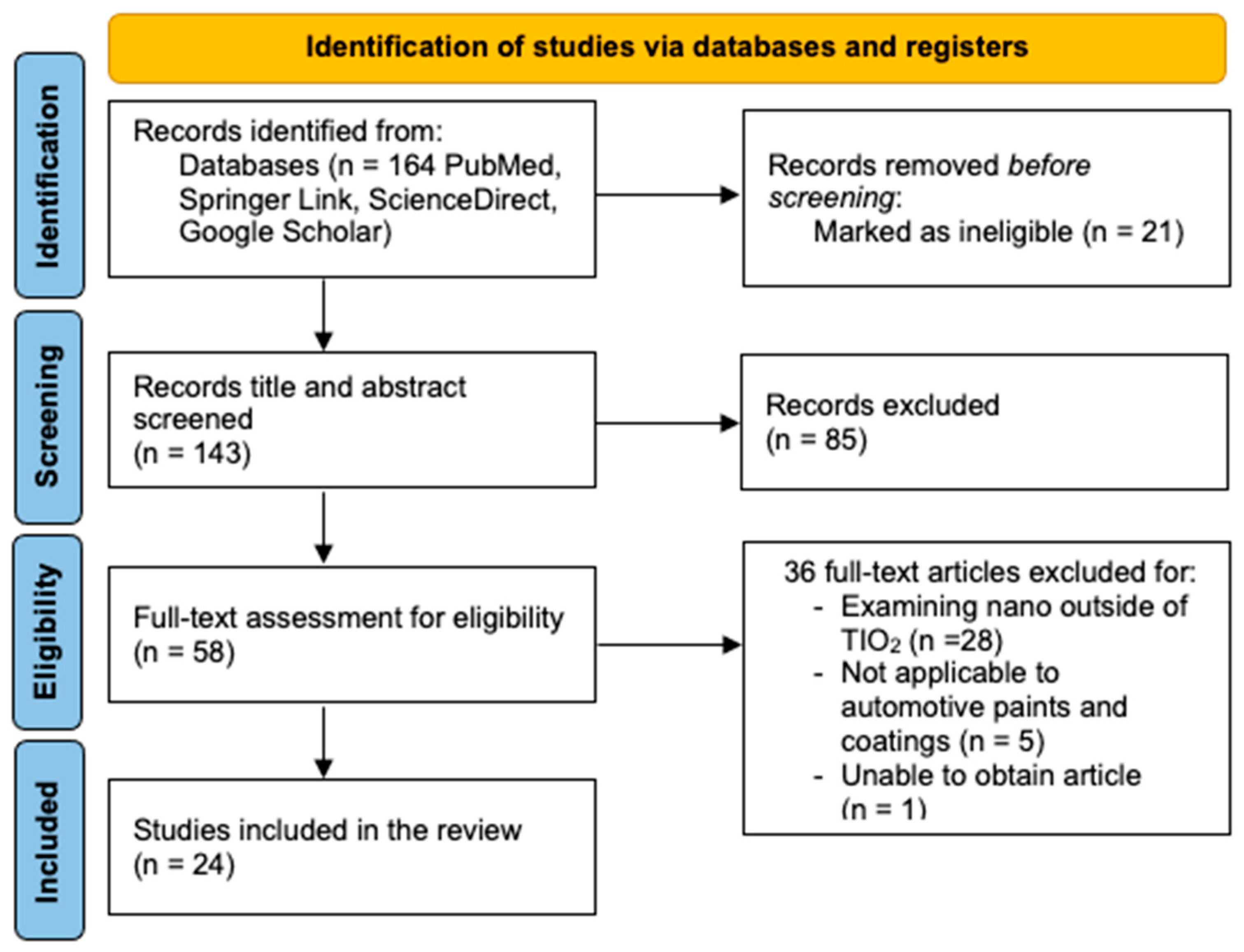
The articles retrieved from the first systematic search were uploaded into EndNote 20.5 (n = 164), and ineligible articles were excluded. No dedicated screening software was implemented. The titles and abstracts of the remaining articles were screened against the specified inclusion and exclusion criteria by one reviewer. Articles that did not fit were eliminated. Articles were then subjected to a full-text review to further refine the selection and verify that they met the established criteria. Eligibility determinations were reviewed and adjudicated by a second author to ensure consistency with the predefined criteria. Articles that did not meet the specified requirements were removed. The final articles satisfied all criteria and were deemed fit to be included in the narrative literature review. Figure 1, presented below, illustrates the screening and selection process using a PRISMA (Preferred Reporting Items for Systematic Reviews and Meta-Analyses) flow diagram [106].

2.2. Data Extraction and Narrative Synthesis

For each included study, we extracted the following: (i) NP identity and physicochemical characteristics (e.g., size, phase, surface functionalization), (ii) coating matrix and architecture (e.g., acrylic, polyurethane (PU), epoxy; basecoat/clearcoat relevance), (iii) loading and dispersion methods, (iv) lifecycle stage(s) addressed (formulation, application, in-use weathering, maintenance/repair abrasion, end-of-life), and (v) outcomes relevant to lifecycle risk (release potential, exposure proxies, toxicity/ecotoxicity, and performance trade-offs). Evidence was synthesized narratively to address lifecycle stages, identify exposure hotspots and transformation processes, while linking performance-driven design choices (e.g., photocatalysis, UV blocking, hydrophobicity, corrosion protection) to potential release and hazard outcomes.

3. Results

Applying the outlined search strategy, 164 articles were initially identified, of which 143 were relevant. Title and abstract screening narrowed these to 58 articles for full-text review. Following the exclusion criteria, 24 articles remained in the final synthesis (13 review articles and 11 experimental studies), all focused on TiO2-NP-containing automotive coatings or closely analogous coating systems. These 24 articles constitute the full eligible evidence base identified by the prespecified search strategy within the defined date, language, and peer-review limits. The included studies span multiple lifecycle stages: formulation and dispersion controls, performance optimization (e.g., scratch and abrasion resistance, corrosion protection, and wettability), photocatalytic/self-cleaning functionality, release during weathering and mechanical abrasion, toxicity, and fate considerations. However, the evidence base is skewed toward formulation and in-use performance, with most papers emphasizing formulation-operation relationships, whereas spray application exposure measurements and end-of-life quantification were comparatively limited. Primary studies were dominated by bench-scale performance testing; only a small subset directly quantified release from weathering or abrasion, aerosol generation during sanding, or biological effects of coating-derived materials. Collectively, this distribution reflects the current maturity and research emphasis of the peer-reviewed literature within this field, as defined by the research scope. Table 2 categorizes the included papers by study type, lifecycle stages discussed, primary focus, and contributions to the overarching lifecycle understanding of TiO2 NP automotive coatings.

3.1. Formulation Stage: Dispersion, Interfacial Control, and Matrix Compatibility

The literature describes automotive coating formulation as pigment-binder-solvent systems in which NPs are incorporated as additives to modify film properties and durability [107,114]. Dispersion quality and interfacial compatibility were repeatedly identified as major determinants of coating performance and stability, with emphasis on agglomeration and control during formulation [107,113,115,122].

3.2. Dispersion and Agglomeration

Dispersion quality and interfacial compatibility emerge as upstream controls that shape both coating performance and downstream release potential. When insufficiently dispersed, TiO2 NPs can agglomerate and create local microstructural defects that act as stress concentrators and initiation sites for UV-assisted binder degradation and mechanical wear, increasing the likelihood that later-life abrasion or weathering generates particle-containing fragments [107,113,115]. Abidin et al. [107] describes commonly used dispersion workflows (e.g., dispersing TiO2 nanopowder into a base fluid followed by agitation/high-shear mixing) intended to deagglomerate and stabilize NPs in solvents and coating matrices. Sakib et al. [122] similarly emphasize that nanofiller dispersion and interfacial compatibility are primary determinants of long-term polymer nanocomposite properties relevant to coating longevity and degradation. Mohanty et al. [114] explores the impact of varying TiO2 NP loading concentrations and dispersal methods, noting that above a threshold, higher concentrations show to undermine uniformity and performance, thereby counteracting the intended benefits and unique properties for which TiO2 NPs are incorporated.
The significance of homogeneous dispersal is illustrated by Kumar et al. [128] who evaluated graphene–TiO2 hybrid fillers in an acrylic–epoxy system (TiO2 at 0.5–3.0 wt% with graphene fixed at 1.0 wt%). Dispersion quality depended strongly on TiO2 loading: uniform TiO2 NP distribution was observed up to 2.0 wt%, whereas 3.0 wt% produced agglomeration and reduced adhesion performance (cross-hatch adhesion decreasing from 5B to 4B; <5% coating detachment) [128]. This non-monotonic pattern supports the concept of an optimal loading window in which reinforcement gains are realized before agglomeration and interfacial defects begin to dominate. Mechanistically, the reinforcement/failure framework synthesized by Mantilaka et al. [126] helps explain why dispersion state and interphase design can determine whether TiO2 NPs improve coating integrity or instead promote cracking and degradation pathways that increase later-life fragment release, noting that weak agglomerated regions serve as preferential sites for degradation and TiO2 NP release, linking microstructure to properties and cross-lifecycle exposure framing [126,127].

3.3. Surface Modification and Functionalization

Surface modification and dispersion aids are repeatedly identified as strategies to improve stability, strengthen polymer–NP interfacial compatibility, and manage TiO2 photoactivity in organic matrices [107,113,114]. Abidin et al. [107] summarize a PU refinishing clearcoat example in which rutile TiO2 NPs (average ~20 nm) were surface-modified with 3-aminopropyltriethoxysilane (APS); incorporating 0.5–1.0 wt% APS-treated TiO2 reduced photocatalytic activity and improved weathering performance, consistent with a mitigation logic that suppresses binder-degrading photoactivity while preserving UV-screening benefits. Shah et al. [113] similarly emphasize the UV-shielding benefit versus the photocatalysis-driven degradation trade-off and discuss surface passivation (e.g., silane coupling) as a risk mitigation strategy. Complementing these, Xavier et al. [116] demonstrate that chemical functionalization (2-aminothiazole) of TiO2-ZrO2 fillers increases coating hydrophobicity and barrier behavior relative to unfunctionalized composites, highlighting the significance of interfacial engineering in corrosion-relevant coating performance, a favorable attribute for automotive-relevant coatings.

3.4. Performance Benefits and Trade-Offs in the Use Phase

Performance enhancement remains the primary driver for TiO2 NPs in auto-coatings. Mohanty et al. [114] summarizes quantitative examples in which titania reinforcement reduced scratch depth from ~1500 to ~550 nm, illustrating the magnitude of potential mechanical-durability gains when dispersion and interphase integrity are well controlled. Across both review and experimental studies, however, these benefits are consistently framed as conditional: agglomeration or weak NP–matrix compatibility can create defects that ultimately reverse performance gains and increase susceptibility to degradation [113,114,122].
In appearance-relevant automotive outcomes, Sakinah et al. [121] reported that adding 1.0 wt% TiO2 to a polyester basecoat nanopaint increased gloss (~26.45% higher than the baseline paint at an 85° incident angle) and reduced surface roughness while maintaining high adhesion. Review papers by Akinlabi et al. [109] and Chavan et al. [110] situate these optical and surface benefits within broader automotive objectives (UV protection and, in some formulations, photocatalytic self-cleaning), emphasizing that TiO2 can function both as a high-refractive-index pigment and as a photoactive catalyst depending on crystalline form, surface chemistry, and embedding efficacy. While Shah et al. [113] emphasizes the design trade-off, that if photoactivity is not managed (e.g., in anatase-rich or unpassivated systems), TiO2 can accelerate binder degradation under UV exposure, potentially undermining durability and increasing fragment release over time, reinforcing the need to co-optimize durability with performance. Findings support the broader reinforcement mechanisms in which NP addition can improve surface and mechanical properties via microstructural densification and altered interfacial interactions, but only within a dispersion/compatibility window that avoids defect formation [126].
Across experimental studies, corrosion mitigation was commonly attributed to barrier densification and increased surface hydrophobicity. In PU matrices, Xavier et al. [116] reported that incorporating a TiO2-ZrO2 composite increased water contact angle from 63.2° (neat PU) to 91.8° (unfunctionalized composite) and 116.9° (2-aminothiazole-functionalized composite), consistent with reduced wetting and improved electrolyte barrier properties [116]. In natural seawater electrochemical testing, the functionalized composite showed substantially lower corrosion current density than neat PU at both early and later timepoints (e.g., 0.12 vs. 9.13 µA/cm2 after 1 h immersion; 0.60 vs. 27.99 µA/cm2 after 360 h), alongside increased coating resistance [116]. In acrylic–epoxy matrices, Kumar et al. [128] reported impedance magnitudes of 0.01 Hz of >1010 Ω/cm2 after one day for TiO2-graphene hybrids (compared with 109–1010 Ω·cm2 for graphene-only) and water contact angles increasing from 105.4° to 120.85° as TiO2 increased from 0.5 to 3.0 wt% [128]. In a polyester basecoat system, Sakinah et al. [120] observed corrosion rate decreases from 1.457 × 10⁻⁶ mm/yr (unfilled control) to 5.539 × 10⁻¹¹ mm/yr at 1.5 wt% TiO2, further supporting the barrier/densification interpretation. Findings emphasize that real-world performance depends on multifactor degradation (moisture, UV, temperature, pH, and chloride exposure) and substrate or pretreatment considerations rather than a single laboratory metric [108,115,118,122].

3.5. Photocatalytic and Self-Cleaning Functionality: Stability Versus Activity

The processing and deposition route dictate photocatalytic performance and wettability. On plasma-electrolytically oxidized aluminum, Sandua et al. [119] showed deposition-dependent Rhodamine B degradation after 10 h of UV exposure (32% uncoated reference; 55% electrosprayed; 85% spray-coated; 80% dip-coated) and distinct initial contact angles (37°, 78°, 90°, and 70°, respectively). Under UV exposure, complete water-drop disappearance occurred in 5 min (electrosprayed), 6 min (spray-coated), and 10 min (dip-coated), consistent with UV-induced wettability changes that can support self-cleaning behavior [119].
For oxygen-deficient TiO2x coatings, Khatibnezhad et al. [129] reported visible-light methylene blue removal after 90 min of 97% for the as-sprayed coating and 79–82% after annealing at 400–450 °C (73% at 500 °C; 71% at 550 °C), with apparent reaction-rate constants decreasing from 3.8 × 10⁻²/min (as-sprayed) to ~1.3–1.8 × 10⁻²/min after heat treatment. Alternatively, using low-pressure cold spray, Seremak et al. [117] described processing-dependent methylene blue decomposition of 14.0–32.0% across TiO2 nanopowder fractions, with coating thicknesses of 80 ± 18 μm to 189 ± 26 μm and surface roughness (Ra) of 2.779–5.159 μm (Wa: 4.399–7.566 μm).
High-surface-area and reactive TiO2 NP exteriors enhance pollutant degradation and superhydrophilicity, but may also compromise polymer stability if photocatalytically generated radicals drive binder degradation [109,110,113]. Seremak et al. [117] links photocatalytic utility to environmental-release concerns by noting that nanopowder handling and incomplete recovery from aqueous suspensions may contribute to aquatic release, framing durable, adherent coating formation as a primary control measure. This durability-activity tension reinforces why surface passivation and careful selection of TiO2 form (e.g., anatase vs. rutile; defect engineering) are recurrently described as design levers for automotive-relevant topcoat systems that seek functionality without accelerating matrix breakdown [107,113,117].
Across the included literature, quantitative occupational exposure measurements during spray application of nano-enabled automotive coatings were scarce; discussions of application were largely conceptual (e.g., spray booth controls, electrostatic guns, and deposition efficiency considerations) rather than measurement-based [107,113,114,127]. Industrial paint applications predominantly rely on electrostatic spray technology, also referred to as airless spray. This method commonly employs rotary bell sprayers, where centrifugal force charges paint particles as they pass through the nozzle, creating an electrostatic field between the charged particles and the grounded substrate [114]. The resulting electrostatic attraction ensures uniform adhesion and thickness in a single pass. In contrast, conventional air spraying technology uses a pressurized air gun to atomize paint particles [126]. This method is user-friendly, with air guns commercially available for at-home applications, making it accessible for smaller-scale projects. In consumer settings, protective ceramic TiO2 NP clear topcoats can be applied manually using a trigger spray bottle and applicator sponge, followed by UV curing [131].

3.6. Repair, Refinishing, and Mechanical Abrasion

Nored et al. [111] generated aerosols from sanding TiO2-containing paint and reported particle number concentrations of 1.47 × 10⁵ to 2.78 × 10⁵ particles/cm3, with count median diameters of 35.6–39.4 nm. PM10 mass concentrations (particles with aerodynamic diameter ≤ 10 μm) ranged from 329 to 5582 μg/m3, with respirable-fraction estimates of 1.8–14.9% and up to ~20% of the respirable fraction within the nanoscale range [111]. Although TiO2 accounted for only 0.01–0.02 wt% of total particle mass, its relative abundance increased in the smallest size fractions—indicating that sanding aerosols are compositionally complex, matrix-associated mixtures rather than freely dispersed “pure” TiO2 NPs [111]. Morphological observations further suggest that TiO2-containing material is often attached to fragment edges or embedded within nanoscale agglomerates, a size regime relevant to deep-lung deposition and potential translocation pathways described in the broader ultrafine-particle literature [111]. Ruggiero et al. [123] extend abrasion- and weathering-focused evaluation by examining nano-pigment release from automotive coatings and framing how mechanical and environmental stressors can support grouping and or read-across concepts for nano-enabled paint systems.

3.7. Weathering-Linked Release (Forms and Rate)

Ruggiero et al. [123] subjected automotive acrylic and polyester–melamine clearcoats containing nano- and non-nano TiO2 pigments to UV and rain aging. They reported UV-dose-dependent release of particle-containing material spanning ~10 nm to 20 μm, with released material dominated by polymer fragments rather than abundant pristine, freely dispersed TiO2 NPs [123]. Using an exposure-intensity framework, up to three months of accelerated exposure was estimated to simulate approximately two years of outdoor exposure. Matrix comparisons further indicated that the same nano-pigment could exhibit markedly different release behaviors across materials; for example, a diketopyrrolopyrrole (DPP) nano-pigment in polypropylene showed a reported release rate of 0.002 mg/MJ, reinforcing strong matrix control of release kinetics [123].
Mittal et al. [125] evaluated leachates generated from weathered paint panels containing nano-TiO2 (10% w/w in paint; nano-Ag also present at 0.003% w/w) and reported that weathered samples—after a 100,000-fold dilution—contained up to ~200,000 particles/mL. Paint-released nano-TiO2 had a reported mean size of 133.0 ± 2.1 nm, compared with 94.8 ± 5.4 nm for the pristine material, consistent with aggregation and or matrix-associated release rather than unchanged primary particles [125]. After three months of outdoor weathering, the nano-TiO2 concentration in the paint supernatant (following sonication) was 56.8 ± 1.5 ppm (≈3% of the total nano-TiO2 in the paint), and released solid content (dry weight) averaged 132 mg from base-paint panels versus 72.5 mg from panels containing nano-TiO2 [125]. Although minimal phenotypic abnormalities were observed in zebrafish (Danio rerio) embryo assays, significant changes were detected in behavior, oxidative-stress biomarkers, and gene expression, evidence that weathered-paint releases can elicit organism-level and molecular effects even when overt morphology endpoints appear negative [125].
Halappanavar et al. [130] provide hazard evidence relevant to coating-derived particulates: mice receiving pulmonary instillation of free TiO2 NPs (10, 20.6, and 38 nm) at 18, 54, and 162 μg exhibited dose- and size-dependent pulmonary transcriptional responses, whereas responses to sanding-generated paint dust containing embedded TiO2 were comparatively attenuated at matched dust masses (54, 162, and 486 μg). Results indicate that matrix incorporation can reduce, but does not eliminate, biological responses (e.g., pulmonary) relative to pristine nanopowders; and that aged, coating-derived particulates should be evaluated as distinct test materials rather than inferred from pristine TiO2 NP toxicology [130].

3.8. End-of-Life and Environmental Fate: Transformation, Mobility, and Recycling Pathways

Zahra et al. [112] synthesize evidence and modeling on environmental fate, noting early reports of TiO2 NP releases from exterior paints (e.g., ~3.5 × 10⁷ NPs/L leaching from façade coatings) and subsequent detections of TiO2 in wastewater treatment plant effluents and sludge. They emphasize that wastewater treatment plants can act as major sinks for TiO2 NPs, shifting the dominant environmental reservoir to biosolids. Modeling estimates presented in the review suggest biosolids concentrations on the order of 263–367 mg/kg (London), 273–342 mg/kg (New York City), and 70–120 mg/kg (Shanghai), with sludge-amended agricultural soils projected to become a long-term accumulation sink [112]. Cumulative TiO2 NP inputs to soils via biosolids sludge application have been estimated to be ~45,000 tons [112]. Sustainability-focused reviews and risk-mitigation discussions reinforce that performance optimization alone is insufficient; exposure pathways extend beyond manufacturing to include maintenance, waste handling, and disposal stages [127], while reviews addressing sustainable coating pathways and NP-reinforced microstructure effects linked early performance-driven design choices to downstream lifecycle and end-of-life behavior [124,126].

4. Discussion

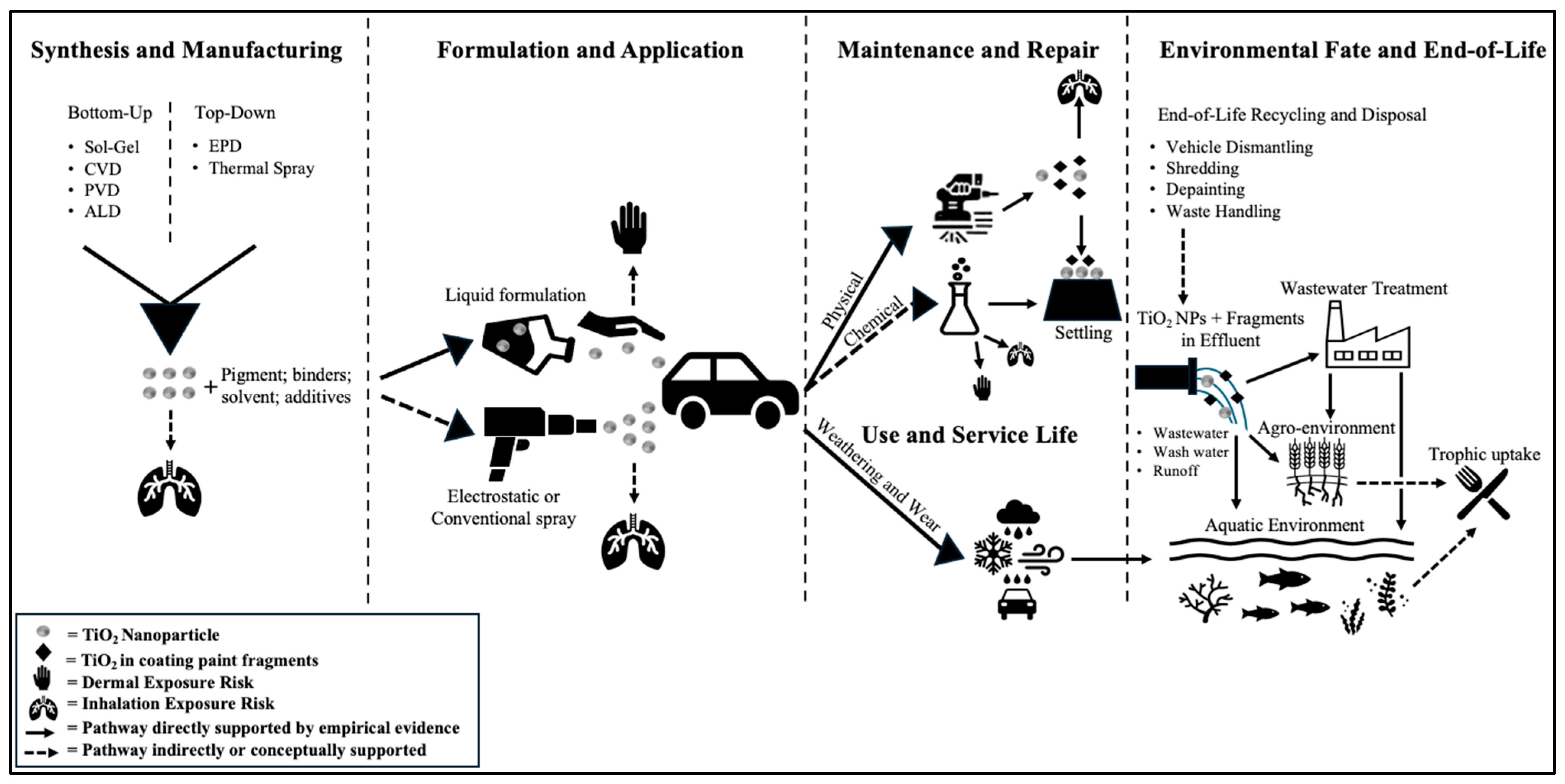
TiO2 NPs embedded in automotive coatings can present hazards that range from negligible to substantial depending on the form that reaches receptors (pristine nanopowder, embedded/coating-derived fragments, or aged/transformed material), the exposure pathway (inhalation, dermal contact, ingestion), and the degree of environmental transformation across lifecycle phases. Therefore, the assessment should be interpreted through a risk lens in which hazard is mediated by exposure and evolves across the coating lifecycle. Particle hazard potentials change across synthesis, formulation, application, service-life-aging, maintenance, and end-of-life handling—a function of particle identity (crystalline phase and surface treatment), dispersion state, matrix chemistry, and stressor history (UV, moisture, temperature fluctuations, chemical exposures, and mechanical wear), determining immobilization or release of TiO2-bearing fragments or transformed NPs. We interpret the synthesized evidence with respect to the strength of lifecycle stage, linking upstream design decisions to downstream release and alteration pathways, and integrating hazard, exposure, and environmental fate considerations to inform safer-by-design priorities and risk management. The lifecycle stages and dominant exposure pathways in this review are summarized conceptually in Figure 2. Evidence strength is uneven across stages. Direct measurements exist for sanding and refinishing aerosols, accelerated weathering/abrasion release, and biological response to coating-derived materials or embedded particles, supporting a fragment-dominated release paradigm. In contrast, NP-specific exposure measurements during spray application, field-weathering, and quantitative end-of-life release evaluation are limited. Accelerated aging provides useful bounding data, but translating results to real-world rates requires careful consideration of matrix-specific degradation pathways and individualistic stressor types.

4.1. Lifecycle Interpretation: Performance and Risk Are Co-Determined

This review was structured around a cradle-to-grave perspective; TiO2-NP-enabled coatings should be evaluated as evolving systems, whose exposure-relevant forms change across their lifetime. Direct evidence for the earliest lifecycle stage—TiO2 NP synthesis and manufacturing are limited in the included automotive-coating literature. Papers, however, do emphasize that synthesis routes (e.g., sol–gel, hydrothermal, and vapor-deposition approaches) control crystalline phase composition, primary particle size distribution, and surface chemistry reactivity, attributes that influence NP dispersion, agglomeration propensity, photocatalytic activity, and matrix interaction, which impact coating durability and behavior down the line [107,113,118]. It is at this stage that TiO2 NP powder handling and transfer represent plausible occupational exposure windows, yet synthesis- and manufacturing-stage exposure characterization is rarely reported for automotive-relevant coating supply chains [127].
TiO2-NP integration in auto coatings remains predominantly driven by performance objectives rather than by frameworks that explicitly couple performance benefits to release, exposure, and hazard endpoints [107,108,114,115,118,122,126]. Design choices that increase hardness, barrier properties, or self-cleaning show a shift in the exposure-relevant form from embedded particles to TiO2-bearing fragments and transformed particles, where there is risk of release during spraying/sanding or into water via runoff and wash-off, before partitioning into sinks such as sludge and filter residuals [112,125]. Correspondingly, only a small subset of included studies directly interrogates lifecycle risk endpoints, including release under weathering or abrasion, aerosol generation during maintenance, or biological effects of coating-derived materials [111,123,125,130]. As a result, the strongest empirical evidence on the relevance of lifecycle risk and exposure is concentrated in a limited number of studies, shedding light on the need for coordinated lifecycle-relevant testing across stages.

4.2. Formulation as an Upstream Determinant of Durability and Later-Life Release

Dispersion quality and interfacial compatibility consistently emerge as early determinants that persist throughout the coating lifecycle, serving as prerequisites for stable immobilization and long-term durability in automotive exteriors expected to resist outdoor weathering and mechanical wear [107,122,126]. When insufficiently formed, weathering and associated chemical degradation may catalyze the release and subsequent biotransformation of TiO2 NPs, altering their surface chemistry, crystallinity, and aggregation behavior. Experimental results support the idea that increasing loading does not monotonically improve performance; instead, systems exhibit narrow loading windows, beyond the optimal threshold, particle agglomeration occurs, and the intended benefits plateau [128]. This is lifecycle-relevant, as poorly dispersed agglomerates and weak interphases serve as stress concentrators, promote microcracking, allow moisture and ions to penetrate, and serve as sites for UV-driven chain scission and binder embrittlement [113,126]. Such effects lead to decreased adhesion and barrier properties, raising the risk of both the generation and release of TiO2-NP-containing coating fragments during maintenance or service. The mechanistic perspective synthesized by Mantilaka et al. [126], linking microstructure to reinforcement and failure, provides a framework for why dispersion state and interfacial design largely determine whether TiO2 NPs improve or undermine the coating’s integrity over time [126].
Surface modification through passivation and coupling agents, therefore, serves a dual, complementary strategy to stabilize dispersion and balance photoactivity and durability, with functionalization demonstrating that interfacial chemistry can meaningfully alter barrier and corrosion outcomes while suppressing undesirable degradation [107,113,116]. From a lifecycle risk perspective, this is a pivotal consideration, as adequate surface modification strengthens the polymer-particle interphase, reduces UV-driven binder attack and moisture ingress, influencing later-life release and hazard relevance. However, while surface modification may slow coating degradation, this protection is also conditional. Once coating-derived materials are released, the original engineered surface may be altered, masked, or partially lost by eco-corona formation and environmentally driven aggregation, sorption, and redox processes [112,127]. Therefore, the lifecycle impact of surface modification lies not only in suppressing photocatalysis in the intact coating, but also in determining whether released materials persist as relatively inert matrix-associated fragments or as transformed particles with altered reactivity and toxicity, depending on the surface modification state [112,125,130].

4.3. Use-Phase Performance Gains and Durability Trade-Offs Under Realistic Service Conditions

TiO2 NPs are primarily integrated to deliver performance advantages, including improved scratch and abrasion resistance and appearance-relevant surface properties [114,121]. Corrosion-focused experiments suggest that densification and hydrophobicity of the TiO2 barrier can improve electrochemical performance metrics, but the magnitude and persistence of these gains depend on dispersion quality, functionalization strategies, and the stressors present during testing [116,120,128]. Other literature substantiates that TiO2 NP performance gains are not intrinsically proportional to loading; rather, they exhibit an optimal “dispersion-loading” window, as illustrated by Kumar et al. [128], where uniform dispersion and strong adhesion persisted up to 2.0 wt% TiO2, but agglomeration and adhesion loss emerged at 3.0 wt% [114,128]. At the use-phase level, Sakinah et al. [121] show that modest TiO2 loadings (1.0 wt%) can improve gloss without degrading adhesion, supporting the broader review-level claim that nanofillers can deliver measurable improvements when compatibilized [114,121].
The same microstructural features that govern long-term performance—porosity, interfacial adhesion, and binder stability—also determine whether later-life disturbance produces predominantly polymeric debris or TiO2-bearing fragments relevant to exposure [111,123,126]. Papers caution that captured bench-scale properties may not translate directly to service performance; corrosion and coating durability are directed by nonlinear multi-factor conditions—substrate and pretreatment quality, damage tolerance, and exposure to moisture, chlorides, UV radiation, and temperature fluctuation [108,111,115,122]. For instance, it is emphasized that ceramic nanocoating on metallic substrates produces dense oxide films that improve hardness, wear, and corrosion resistance; however, it is sensitive to barrier performance when defective or combined with external tribological and electrochemical stressors [108]. Yadav et al. [115] similarly frame nano-based “smart” anti-corrosion coatings as an environmentally motivated alternative to toxic inhibitors, yet stress that durability, adhesion, and real-world deployment conditions determine whether laboratory corrosion-inhibition mechanisms translate to sustained protection [111].
A lifecycle-relevant nuance is that automotive paint systems are multilayered; NP placement (e.g., basecoat versus clearcoat) and layer-specific composition shape durability, and the materials released during subsequent disturbance. The dominant release form across weathering and abrasion is matrix-associated fragments containing TiO2 [104,116,118]. As a result, lifecycle-relevant hazard assessment should increasingly rely on aged, coating-derived test materials rather than pristine TiO2 powders alone [130]. Nored et al. [111] reported that sanding-generated aerosols reflected the heterogeneous composition of paint systems and were distributed across multiple particle size fractions, with TiO2 agglomerates originally embedded in the coating primarily associated with particles <100 nm. Together, these findings shift the central question from whether TiO2 NPs improve specific performance endpoints to whether their supplementation remains durable under realistic aging and whether the same formulation decisions that inadvertently increase particle-containing fragments also release during maintenance and weathering [108,111,115,122].

4.4. Photocatalytic Functions Exemplify Active-Stability Trade-Offs

TiO2-driven self-cleaning and photocatalysis are feasible in automotive-relevant coating concepts, but they intensify a central lifecycle tension: increasing surface reactivity can improve pollutant degradation and wetting transitions, while increasing the potential for matrix degradation if radicals attack organic binders and subsequently release particle-containing fragments under combined UV aging and abrasion [109,110,113]. Reviews position TiO2 as a multifunctional nano-additive with applications spanning self-cleaning and surface functionalization, but also illustrate a heterogeneous deployment landscape that extends beyond automotive coatings [109,110].
Dispersion and passivation, therefore, become both performance and exposure reduction controls. Abidin et al. [107] align coating design with “safer-by-design” thinking by describing how surface treatment (e.g., APS-functionalized TiO2) can decrease photoactivity while maintaining UV shielding, thereby limiting UV-driven polymer damage and potential fragment release [107]. This strategy corresponds with broader review discussions that stress the importance of balancing anatase-driven self-cleaning function with durability [109,110,113]. From a lifecycle standpoint, managing photoactivity is not only an appearance/maintenance issue—it can alter the rate at which the binder embrittles and sheds particulate matter under real outdoor exposure conditions [123]. Experimental work further shows that processing and defect or phase engineering can strongly control photocatalytic behavior, underscoring that “active” TiO2 surfaces are design choices with later-life implications for durability and release potential [117,119,129]. Accordingly, photocatalytic TiO2 systems are best interpreted as inherently trade-off-driven and should be evaluated under aging conditions that more closely approximate service environments, rather than relying on activity endpoints alone [107,113,117,119,129].

4.5. Exposure and Release: Evidence Supports Fragment-Dominated Materials and Identifies Maintenance as a Key Hotspot

Exposure evidence is most significant for maintenance and repair (sanding/refinishing), where particle number and mass concentrations have been directly measured, and TiO2 enrichment in ultrafine fractions has been documented; Nored et al. [111] measured sanding-generated particle number concentrations on the order of 105 particles/cm3 (1.47 × 10⁵ to 2.78 × 10⁵ particles/cm3) with nanoscale count median diameters (~35.6–39.4 nm), while PM10 mass concentrations spanned 329 to 5582 µg/m3 [111]. Aerosolized coating particulates are complex mixtures in which, as reported in this particular study, TiO2 constitutes a small fraction of the total aerosol mass (0.01–0.02 wt% in bulk aerosol mass) but may be relatively enriched in smaller-size fractions; additionally, microscopy indicated that TiO2 was frequently embedded within or attached to paint fragments rather than present as fully liberated primary particles [111].
Research efforts have generally focused on the degradation of nano-enhanced coatings, particularly the leaching of NPs. As of 2008, TiO2 NPs have been reported at concentrations of 3.5 × 10⁷ NPs per L from paint leaching [112]. Environmental stressors such as UV radiation, fluctuating pH, and mechanical stress, combined with uneven dispersal, weaken TiO2 NP coatings over time [111]. Alkaline conditions in natural environments mirror the high-alkaline compounds used in chemical removal processes. Environmental exposure to alkaline dirt, soil, or acidic rain—commonplace in polluted urban areas—can progressively degrade automotive coatings, releasing TiO2 NPs from the protective coating matrix [132,133]. UV radiation plays a dual role in coating degradation. While initial UV exposure enhances coating durability, prolonged exposure may oxidize surface layers, leading to erosion and the release of embedded particles. This “chalking” process results in the continual detachment of NP agglomerates as the matrix deteriorates [134,135].
The majority of weathering studies similarly support a fragment-dominated release model, in which matrix-associated debris spans nano- to micro-scale and release rates depend strongly on matrix architecture and aging conditions, primarily by polymer fragments rather than pristine free TiO2-NPs, and demonstrated that pigment identity alone is insufficient to predict release without accounting for matrix architecture and aging conditions [123]. In contrast, coating spray-application exposure is frequently inferred from process logic (e.g., transfer efficiency, overspray) and from broader paint-aerosol literature rather than NP-resolved measurements specific to TiO2-enabled automotive coatings, leaving a gap in NP-specific airborne concentrations needed for exposure assessment or comparison with nano-TiO2 OELs [107,114,127].
Where overspray and waste streams are discussed, they imply plausible short-duration, high-intensity exposure scenarios for workers and potential releases to booth filters and waste paint. Mohanty et al. [114] describes transfer efficiency values on the order of ~60–90% for certain application methods; overspray generation is intrinsic to spray processes and can influence waste and potential airborne particulate; however, the included literature does not provide automotive-specific NP exposure measurements during application that would be needed to translate these process descriptions into exposure estimates [114]. End-of-life exposure—during vehicle dismantling, shredding, recycling, or incineration—remains the least characterized stage in the included evidence base, despite its clear relevance for population-level environmental loading [112,127].
The limited direct hazard evidence for coating-derived materials further reinforces the need to test realistic release forms. The literature demonstrates that weathered-paint leachates can alter organism behavior and oxidative-stress pathways even when gross morphology endpoints appear negative and pulmonary transcriptional responses depend on dose, primary particle size, and whether TiO2 is present as a free powder versus embedded within paint dust, with embedded forms showing attenuated responses at matched masses [125,130]. Aquatic evidence further shows that weathered paint leachates can contain substantial particle numbers and that paint-released TiO2 differs in size from pristine material, with organism-level and molecular responses observed even when overt phenotypic abnormalities are limited [125]. Together, these findings argue against read-across from pristine powders and support tiered testing that includes pristine NPs for benchmarking and coating-derived, aged fragments and leachates as the primary hazard-relevant materials for both human-health and ecological evaluations [111,123,125,130].

4.6. Environmental Fate and End-of-Life: Transformations, Partitioning, and Sustainability

Once released, environmental fate is governed by aggregation/agglomeration, transformation, and partitioning into engineered and natural sinks. In line with the fragment-dominated releases and particle-containing leachates described above [123,125], evidence suggests that wastewater treatment plants can serve as major sinks for TiO2-containing material, with reported biosolids concentrations in the hundreds of mg/kg range, and modeling suggests long-term accumulation in sludge-amended agricultural soils [112]. Particle sink behavior does not eliminate risk; rather, it can shift material into concentrated residual streams (e.g., sludge, filter media) that require management decisions regarding land application, disposal, or potential recovery. In automotive coating lifecycles, fate assessment therefore depends on linking release characterization to downstream fate-and-transport and residual handling, rather than on release quantities alone. Gaps in mitigation and standardization—metric selection, test materials, and exposure scenarios—complicate consistent risk assessment for engineered NP and nano products [127].
Environmental transformations further determine the exposure-relevant form and hazard profile of coating-derived TiO2. Laux et al. [127] report that adsorption of environmental constituents can produce a dynamic corona on NM surfaces, inducing amorphization, thereby modulating particle reactivity, dispersion behavior, biological interactions, and ecological potency, complicating read-across from pristine TiO2 to aged and environmentally transformed NPs [127]. Free-particle mobility and persistence vary with pH, ionic strength, light, and organic matter via aggregation/agglomeration, deposition, dissolution, and sorption/redox reactions, particularly relevant in agro and aquatic ecosystems, where conditions are continually fluctuating [112]. Such interactions and subsequent particle transformations intersect with hazard because TiO2 is prone to generating ROS, and aged fragments may present different reactive surfaces and co-exposure matrices than pristine NPs, factors that make environmental aging a key modifier for both exposure and response when extrapolating from pristine particle studies to coating-derived materials [112,125].
Within this transformed context, cross-taxa toxicity data inform fate and end-of-life coating outcomes, posing risks to aquatic and terrestrial ecosystems. Aquatic systems are considered the primary recipients of NPs, with many organisms highly sensitive to exposure [112]. Zahra et al. [112] compile developmental malformations in zebrafish exposed to biosynthesized TiO2 NPs (43–56 nm), oxidative stress and DNA damage in red swamp crayfish at 25–250 mg/L, dose-dependent mortality in brine shrimp (Artemia salina) at 500–2000 mg/L, and pulmonary inflammation and liver genotoxicity in Sprague Dawley rats exposed to TiO2 NPs with a primary size of 23 ± 6.8 nm. Aquatic plants such as Spirodela polyrrhiza exhibit altered growth and oxidative stress responses. Although not specific to automotive coatings, these endpoints delineate ecological and health outcomes that become relevant if TiO2 released from coatings reaches water bodies or soils at sufficiently high concentrations, and they highlight that environmental conditions and transformation pathways shape the hazard level. Other studies highlight the relevance of matrix composition and age, factors that have been shown to dampen or redirect responses rather than eliminate them, implying that environmentally conditioned, coating-derived test materials are required for credible risk interpretation [125,130]. For example, zebrafish embryos exposed to weathered paint supernatants with TiO2 NPs showed no changes in viability, mortality, or hatching, but exhibited altered expression of genes related to oxidative stress, metabolism, and cell proliferation—indicating sub-apical effects under realistic weathering conditions [125]. While size- and surface-chemistry-dependent pulmonary responses in mice exposed to rutile TiO2 from abraded alkyd coatings occurred, with persistent inflammation and retention of material in lung tissue—suggesting embedded vs. free and aged vs. pristine TiO2 influence the biological response [130].
End-of-life considerations remain underrepresented in coating-specific studies, but cross-stage reviews emphasize that waste handling, disposal, recycling, and paint-removal operations can alter release and exposure potential and should be integrated into lifecycle management strategies [114,127]. Sustainability-focused work notes that gains in durability or reductions in solvent emissions alone are insufficient to substantiate “green” claims if particle release, downstream fate, and residual management are not incorporated into evaluations [124]. This implies that “safer-by-design” must include fate-aware residual handling (filters, sludge, spent abrasives) rather than assuming that removal equates to elimination [124]. For TiO2-rich ceramic or film coatings, deposition routes can yield durable functional surfaces but also raise distinct lifecycle questions about deposition-stage exposures, end-of-life removal, and the persistence of TiO2-bearing fragments in the environment [108,117,119].

4.7. Evidence Gaps and Priorities for Lifecycle-Aware Testing and Risk Governance

The principal limitation of the current evidence is not a lack of performance studies, but a lack of standardized, lifecycle-relevant exposure and hazard evaluations that reflect how automotive coatings age, fragment, and are removed. Risk frameworks emphasize integrating exposure characterization, communication, and standardization across product lifecycles, particularly important for nano coatings, where particle identity and hazard relevance change over time as embedded efficacy decreases and aging occurs [112,127]. Across included studies, accelerated protocols and bench-scale tests often characterize single stressors or unrealistic environmental conditions, making it difficult to reconcile results or extrapolate to real-world service-life behavior without harmonized reporting of stressor intensity and equivalency.
Several priorities follow from synthesizing the included studies. 1. The literature must more consistently report NP identity (phase, size distribution, surface treatment) and matrix architecture (binder chemistry and layer relevance), because the included systems span distinct chemistries whose release and hazard potential should not be assumed interchangeable [107,116,120,128]. 2. Aging protocols should better represent realistic coupled stressors (UV exposure plus wetting cycles plus abrasion), given that sanding and weathering studies indicate that aged, coating-derived particles and fragments are likely the relevant exposure materials for both inhalation and ecological testing [111,123,125,130]. 3. Occupational exposure characterization necessitates expansion beyond sanding to include spray application under representative controls and tasks, because application-stage exposures remain largely conceptual despite plausibility as an exposure hotspot [107,114,127].
The evidence supports the feasibility of safer-by-design approaches, but these strategies must explicitly combine performance goals with release, exposure, fate, and hazard endpoints. Upstream levers such as dispersion control, loading windows, interfacial coupling, and photoactivity management (e.g., rutile selection, passivation, or surface coatings) can preserve performance while reducing binder-degrading photoactivity and microstructural defect formation that predispose coatings to fragment release [107,113,122,126,128]. Downstream, risk management should prioritize engineering controls and task-based monitoring for sanding and spraying, as well as fate-aware handling (booth filters, sludge, spent abrasives) where removed particles may accumulate [111,112]. Simultaneously, hazard evidence indicates that embedding can diminish biological responses without eliminating them; therefore, regulatory and testing frameworks should treat coating-derived aged particulates as distinct from pristine TiO2 powders and require nano-specific exposure metrics for lifecycle-relevant materials [125,130].

5. Conclusions

TiO2-NP-enabled automotive coatings are best interpreted as lifecycle-dependent systems, in which the exposure-relevant form of TiO2 shifts with integration quality (dispersion, interfacial compatibility, layer placement) and interactions with environmental media, rather than remaining permanently immobilized within the coating matrix. Across the included literature, upstream design choices—including TiO2 identity (phase, size distribution, surface treatment) and coating architecture (binder chemistry, dispersion state, and interfacial engineering)—co-determine functional performance (e.g., UV shielding, hardness, corrosion resistance, and photoactivity) and the TiO2-bearing forms generated under coupled stressors (UV, moisture cycling, heat, chemical exposure, and mechanical wear). Corrosion and sustainable-coating reviews further position these technologies as environmentally motivated (e.g., reducing toxic inhibitors and extending component lifetime), while underscoring that sustainability depends not only on low-VOC or durability gains, but on durability under realistic coupled stressors to manage downstream releases.
Coating hazards are not solely intrinsic to pristine TiO2; they are emergent outcomes shaped by embedding effectiveness, matrix degradation, eco-corona formation, and transformations that determine particle release, mobility, reactivity, and interactions with biological systems. A key implication is that risk evaluation and read-across from pristine powders are frequently misaligned with the materials generated and released. This makes lifecycle assessment frameworks fundamental, as the material most relevant to exposure is frequently not pristine TiO2, but aged, matrix-associated fragments in the nano-to-micro size range, with fluctuating, stage-dependent toxicological profiles that risk human contact and ecological exposure.
Within the uneven evidence base, the strongest lifecycle exposure data are concentrated in a small subset of studies, which most clearly identify maintenance and refinishing abrasion as quantified exposure hotspots, supported by direct aerosol measurements. Sanding produces high concentrations of nanoscale aerosols, dominated by mixed-composition paint fragments, with TiO2 NPs present as embedded or surface-associated material rather than as abundant, fully liberated primary NPs. Accelerated-weathering studies converge, showing that release is matrix-associated, producing polymer-fragment debris and particle-containing leachates that may enter stormwater and wastewater conveyance systems, and that, under test conditions, have shown organism-level and molecular responses in aquatic models. In contrast, TiO2 NP-specific exposure characterization during spray application and quantitative assessments of end-of-life handling (recycling/disposal or waste processing) remain sparse. Although elevated concentrations and episodic high-intensity exposures are plausible and have been reported in isolated contexts, the current evidence does not yet provide robust data on long-term occupational exposure or cumulative environmental loading.
Downstream fate indicates that removal from one compartment often represents redistribution rather than elimination. TiO2 NMs can be transported through wastewater systems, with wastewater treatment plants and biosolids functioning as major sinks (e.g., values on the order of 263–367 mg/kg in one modeled dataset [112]). Importantly, recent pilot-scale drinking-water treatment has achieved 96.3% ± 1.0 removal via sand and granular activated carbon filtration [136]. However, engineered removal may represent a new point of transfer, where particles accumulate in filters, sludge, and biosolids are land-applied or disposed of, potentially concentrating exposure in landfill leachate or incineration emissions, shifting rather than removing risk. This sink-mediated behavior highlights why decision-relevant risk management may hinge as much on residual management as on release rates for end-of-life fate.
This literature review supports the need for lifecycle-aware, industry-specific assessment and governance for TiO2 NP automotive coatings. To address existing gaps and align automotive nanocoating innovation with environmental protection and human health prioritization, future work should implement: (i) synchronized reporting of TiO2 identity and coating architecture using coupled aging protocols (UV + wetting + abrasion); (ii) quantification of release in mass and number terms using coating-derived aged fragments as test materials; (iii) expanded exposure characterization during spray application and end-of-life operations; (iv) precise attention to nanoscale modifications (particle doping, surface coatings, dispersion quality) on emission profiles, environmental mobility, and toxicological potency; and (v) integration of fate-aware management of residual streams into safer-by-design coating development and risk oversight. By examining the totality of TiO2 NP automotive coatings, safer-by-design becomes a bridge between performance and protection, where upstream levers such as dispersion control, interfacial engineering, and photoactivity management can reduce later-life TiO2 NP fragmentation, release, and subsequent exposure, without undermining automotive coating performance objectives.

Author Contributions

Conceptualization, E.L. and C.S.-J.T.; methodology, E.L.; software, E.L.; validation, E.L. and C.S.-J.T.; formal analysis, E.L.; investigation, E.L. and C.S.-J.T.; resources, E.L. and C.S.-J.T.; data curation, E.L. and C.S.-J.T.; writing—original draft preparation, E.L.; writing—review and editing, E.L. and C.S.-J.T.; visualization, E.L.; supervision, C.S.-J.T.; project administration, C.S.-J.T.; funding acquisition, C.S.-J.T. All authors have read and agreed to the published version of the manuscript.

Funding

This research was funded by the National Institutes of Health, National Institute of Environmental Health Sciences (NIEHS), Superfund Research Program, Grant number 1R25ES033043-01.

Data Availability Statement

The datasets analyzed in this review are openly available. Reference information for each is provided in the bibliography section.

Conflicts of Interest

The authors declare no conflicts of interest.

Abbreviations

The following abbreviations are used in this manuscript:
Aapplication (lifecycle stage code);
A3confirmed animal carcinogen (ACGIH carcinogenicity category);
ACGIHAmerican Conference of Governmental Industrial Hygienists;
APS3-aminopropyltriethoxysilane;
CC BYCreative Commons Attribution (license);
Corrcorrosion (primary focus code);
DNAdeoxyribonucleic acid;
DPPnano-pigment identifier reported in a cited study (not expanded in-text);
Durdurability (primary focus code);
E171titanium dioxide food additive code;
Ecotoxecotoxicity (primary focus code);
Envenvironmental fate/transport (lifecycle stage code);
EoLend-of-life (lifecycle stage code);
EUEuropean Union;
Exp.experimental study;
Fformulation (lifecycle stage code);
Fatefate/transport (primary focus code);
FDAU.S. Food and Drug Administration;
Form/Dispformulation/dispersion (primary focus code);
Form/Mechformulation/mechanistic reinforcement (primary focus code);
Group 2Bpossibly carcinogenic to humans (IARC classification);
Hazhazard/toxicology (lifecycle stage code);
IARCInternational Agency for Research on Cancer;
InhExpinhalation exposure (primary focus code);
InhToxinhalation toxicity (primary focus code);
Mmaintenance/repair (including refinishing) (lifecycle stage code);
MDPIMultidisciplinary Digital Publishing Institute;
NaClsodium chloride;
NIEHSNational Institute of Environmental Health Sciences;
NIOSHNational Institute for Occupational Safety and Health;
NM(s)nanomaterial(s);
NP(s)nanoparticle(s);
NPs/Lnanoparticles per liter;
OEL(s)occupational exposure limit(s);
OSHAOccupational Safety and Health Administration;
PELpermissible exposure limit;
Perfperformance (primary focus code);
Photophotocatalysis (primary focus code);
PM10particulate matter with aerodynamic diameter ≤ 10 μm;
PRISMAPreferred Reporting Items for Systematic Reviews and Meta-Analyses;
PUpolyurethane;
Rasurface roughness parameter (Ra);
Relrelease (primary focus code);
RELrecommended exposure limit;
ROSreactive oxygen species;
Sustsustainability (primary focus code);
TiO2titanium dioxide;
TiO2 NPstitanium dioxide nanoparticles;
TLVThreshold Limit Value;
TWAtime-weighted average;
Uuse/service (lifecycle stage code);
U.S.United States;
UVultraviolet;
VOCvolatile organic compounds;
Wasurface parameter reported alongside Ra (not expanded in-text);
Xcross-lifecycle/framework (lifecycle stage code);
ZrO2zirconium dioxide.

References

  1. Navya, P.N.; Daima, H.K. Rational engineering of physicochemical properties of nanomaterials for biomedical applications with nanotoxicological perspectives. Nano Converg. 2016, 3, 1. [Google Scholar] [CrossRef] [PubMed]
  2. Szczyglewska, P.; Feliczak-Guzik, A.; Nowak, I. Nanotechnology-General Aspects: A Chemical Reduction Approach to the Synthesis of Nanoparticles. Molecules 2023, 28, 4932. [Google Scholar] [CrossRef] [PubMed]
  3. Modena, M.M.; Rühle, B.; Burg, T.P.; Wuttke, S. Nanoparticle Characterization: What to Measure? Adv. Mater. 2019, 31, 1901556. [Google Scholar] [CrossRef]
  4. Mekuye, B.; Abera, B. Nanomaterials: An overview of synthesis, classification, characterization, and applications. Nano Sel. 2023, 4, 486–501. [Google Scholar] [CrossRef]
  5. Vinukonda, A.; Bolledla, N.; Jadi, R.K.; Chinthala, R.; Devadasu, V.R. Synthesis of nanoparticles using advanced techniques. Next Nanotechnol. 2025, 8, 100169. [Google Scholar] [CrossRef]
  6. Joudeh, N.; Linke, D. Nanoparticle classification, physicochemical properties, characterization, and applications: A comprehensive review for biologists. J. Nanobiotechnol. 2022, 20, 262. [Google Scholar] [CrossRef]
  7. Shi, H.; Magaye, R.; Castranova, V.; Zhao, J. Titanium dioxide nanoparticles: A review of current toxicological data. Part. Fibre Toxicol. 2013, 10, 15. [Google Scholar] [CrossRef]
  8. Zhao, X.; Wei, C.; Gai, Z.; Yu, S.; Ren, X. Chemical vapor deposition and its application in surface modification of nanoparticles. Chem. Pap. 2020, 74, 767–778. [Google Scholar] [CrossRef]
  9. ISO 80004-1:2023; Nanotechnologies—Vocabulary—Part 1: Core Vocabulary. International Organization for Standardization: Geneva, Switzerland, 2023.
  10. Barhoum, A.; García-Betancourt, M.L.; Jeevanandam, J.; Hussien, E.A.; Mekkawy, S.A.; Mostafa, M.; Omran, M.M.; Abdalla, M.S.; Bechelany, M. Review on Natural, Incidental, Bioinspired, and Engineered Nanomaterials: History, Definitions, Classifications, Synthesis, Properties, Market, Toxicities, Risks, and Regulations. Nanomaterials 2022, 12, 177. [Google Scholar] [CrossRef]
  11. Matsoukas, T.; Desai, T.; Lee, K. Engineered Nanoparticles and Their Applications. J. Nanomater. 2015, 2015, 651273. [Google Scholar] [CrossRef]
  12. Wu, X. Applications of Titanium Dioxide Materials; Ali, H.M., Ed.; IntechOpen: London, UK, 2022. [Google Scholar]
  13. Alothoum Mohd Al, S. A Review of the Synthesis, Structural, and Optical Properties of TiO2 Nanoparticles: Current State of the Art and Potential Applications. Crystals 2025, 15, 944. [Google Scholar] [CrossRef]
  14. Grande, F.; Tucci, P. Titanium Dioxide Nanoparticles: A Risk for Human Health? Mini Rev. Med. Chem. 2016, 16, 762–769. [Google Scholar] [CrossRef] [PubMed]
  15. Ali, I.; Suhail, M.; Alothman, Z.A.; Alwarthan, A. Recent advances in syntheses, properties and applications of TiO2 nanostructures. RSC Adv. 2018, 8, 30125–30147. [Google Scholar] [CrossRef]
  16. Sungur, Ş. Titanium Dioxide Nanoparticles; Springer International Publishing: Berlin/Heidelberg, Germany, 2021; pp. 713–730. [Google Scholar]
  17. Research, A.M. Nanoparticle Titanium Dioxide Market by Type (Rutile, Anatase, and Combination of Rutile & Anatase) and Application (Paints & Coatings, Pigments, Cosmetics, Plastics, Energy, and Others): Global Opportunity Analysis and Industry Forecast, 2021–2030. Available online: https://www.alliedmarketresearch.com/nanoparticle-titanium-dioxide-market-A11862#:~:text=Nanoparticle%20titanium%20dioxide%20market%20is%20projected%20to%20reach%20$17.3%20billion%20by%202030.&text=Kronos%20Worldwide%2C%20Inc.%2C%20Tayca%20Corporation%2C%20The%20Chemours%20Company%2C (accessed on 2 December 2024).
  18. Gartner, M.; Szekeres, A.; Stroescu, H.; Mitrea, D.; Covei, M. Advanced nanostructured coatings based on doped TiO2 for various applications. Molecules 2023, 28, 7828. [Google Scholar] [CrossRef]
  19. Alizadeh Sani, M.; Maleki, M.; Eghbaljoo-Gharehgheshlaghi, H.; Khezerlou, A.; Mohammadian, E.; Liu, Q.; Jafari, S.M. Titanium dioxide nanoparticles as multifunctional surface-active materials for smart/active nanocomposite packaging films. Adv. Colloid Interface Sci. 2022, 300, 102593. [Google Scholar] [CrossRef]
  20. Shakeel, M.; Jabeen, F.; Shabbir, S.; Asghar, M.S.; Khan, M.S.; Chaudhry, A.S. Toxicity of Nano-Titanium Dioxide (TiO2-NP) Through Various Routes of Exposure: A Review. Biol. Trace Elem. Res. 2016, 172, 1–36. [Google Scholar] [CrossRef]
  21. Allied Market Research. Nanoparticle Titanium Dioxide Market Size, Share, Competitive Landscape and Trend Analysis Report by Type and Application: Global Opportunity Analysis and Industry Forecast, 2021–2030; A11862; Allied Market Research: Pune, India, 2021; p. 295. [Google Scholar]
  22. Schincariol, S.; Fonseca, M.; Neto, V. Development of a Nanopaint for Polymeric Auto Components; Springer: Cham, Switzerland, 2017; pp. 157–201. [Google Scholar]
  23. Nirmal, U.; Musa, M.A.; Yuhazri, M.Y.; Ahmad, M. Development of Car Coating Materials over the Past Decade for Paint Protection Applications—An Overview on the Different Types of Paint Protections. Polymers 2025, 17, 3114. [Google Scholar] [CrossRef]
  24. National Institute for Occupational Safety and Health. Current Intelligence Bulletin 63: Occupational Exposure to Titanium Dioxide; 2023692304; Department of Health and Human Services, Centers for Disease Control and Prevention, National Institute for Occupational Safety and Health: Cincinnati, OH, USA, 2011. [Google Scholar]
  25. Praphawatvet, T.; Peters, J.I.; Williams, R.O., 3rd. Inhaled nanoparticles—An updated review. Int. J. Pharm. 2020, 587, 119671. [Google Scholar] [CrossRef] [PubMed]
  26. Heitbrink, W.A.; Lo, L.M.; Dunn, K.H. Exposure controls for nanomaterials at three manufacturing sites. J. Occup. Env. Hyg. 2015, 12, 16–28. [Google Scholar] [CrossRef]
  27. Gharanjig, K.; Gharanjig, H.; Imani, H.; Goudarzi, S. Nanopigments in Textiles. In Nanotechnology in Textile Finishing: Advancements and Applications; Bairagi, S., Ahmed, S., Ali, S.W., Eds.; Springer Nature: Singapore, 2024; pp. 123–163. [Google Scholar]
  28. O’Byrne, M.; Kerzabi, B.; Abbarchi, M.; Lifschitz, A.; Zamora, T.; Malgras, V.; Gourdin, A.; Modaresialam, M.; Grosso, D.; Putero, M. Investigation of the anatase-to-rutile transition for TiO2 sol-gel coatings with refractive index up to 2.7. Thin Solid Film 2024, 790, 140193. [Google Scholar] [CrossRef]
  29. Lan, Y.; Lu, Y.; Ren, Z. Mini review on photocatalysis of titanium dioxide nanoparticles and their solar applications. Nano Energy 2013, 2, 1031–1045. [Google Scholar] [CrossRef]
  30. Amano, F.; Yamamoto, A.; Kumagai, J. Highly Active Rutile TiO2 for Photocatalysis under Violet Light Irradiation at 405 nm. Catalysts 2022, 12, 1079. [Google Scholar] [CrossRef]
  31. Eddy, D.R.; Permana, M.D.; Sakti, L.K.; Sheha, G.A.N.; Solihudin; Hidayat, S.; Takei, T.; Kumada, N.; Rahayu, I. Heterophase Polymorph of TiO2 (Anatase, Rutile, Brookite, TiO2 (B)) for Efficient Photocatalyst: Fabrication and Activity. Nanomaterials 2023, 13, 704. [Google Scholar] [CrossRef] [PubMed]
  32. Morgunov, V.; Lytovchenko, S.; Chyshkala, V.; Riabchykov, D.; Matviienko, D. Comparison of Anatase and Rutile for Photocatalytic Application: The Short Review. East Eur. J. Phys. 2021, 4, 18–30. [Google Scholar] [CrossRef]
  33. Muthukrishnan, S.; Vidya, R.; Sjåstad, A.O. Band gap engineering of anatase TiO2 by ambipolar doping: A first principles study. Mater. Chem. Phys. 2023, 299, 127467. [Google Scholar] [CrossRef]
  34. Godbert, N.; Mastropietro, T.; Poerio, T. Mesoporous TiO2 Thin Films: State of the Art; IntechOpen: London, UK, 2018. [Google Scholar]
  35. Mulakov, S.P.; Gotovtsev, P.M.; Gainanova, A.A.; Kravchenko, G.V.; Kuz’micheva, G.M.; Podbel’skii, V.V. Generation of the Reactive Oxygen Species on the surface of nanosized titanium(IV) oxides particles under UV-irradiation and their connection with photocatalytic properties. J. Photochem. Photobiol. A Chem. 2020, 393, 112424. [Google Scholar] [CrossRef]
  36. Tsega, M.; Dejene, F.B. Influence of acidic pH on the formulation of TiO2 nanocrystalline powders with enhanced photoluminescence property. Heliyon 2017, 3, e00246. [Google Scholar] [CrossRef]
  37. Thompson, C.M.; Suh, M.; Mittal, L.; Wikoff, D.S.; Welsh, B.; Proctor, D.M. Development of linear and threshold no significant risk levels for inhalation exposure to titanium dioxide using systematic review and mode of action considerations. Regul. Toxicol. Pharmacol. 2016, 80, 60–70. [Google Scholar] [CrossRef] [PubMed]
  38. Murugadoss, S.; Brassinne, F.; Sebaihi, N.; Petry, J.; Cokic, S.M.; Van Landuyt, K.L.; Godderis, L.; Mast, J.; Lison, D.; Hoet, P.H.; et al. Agglomeration of titanium dioxide nanoparticles increases toxicological responses in vitro and in vivo. Part. Fibre Toxicol. 2020, 17, 10. [Google Scholar] [CrossRef]
  39. Verma, G.; Kaushik, A.; Ghosh, A.K. Nano-interfaces between clay platelets and polyurethane hard segments in spray coated automotive nanocomposites. Prog. Org. Coat. 2016, 99, 282–294. [Google Scholar] [CrossRef]
  40. Kelarakis, A. In Situ Generation of Nanoparticles on and within Polymeric Materials. Polymers 2024, 16, 1611. [Google Scholar] [CrossRef]
  41. Kwon, H.-S.; Ryu, M.H.; Carlsten, C. Ultrafine particles: Unique physicochemical properties relevant to health and disease. Exp. Mol. Med. 2020, 52, 318–328. [Google Scholar] [CrossRef]
  42. Ranpara, A.; LeBouf, R.F.; Nurkiewicz, T.R.; Yi, J.; Cumpston, J.L.; Stefaniak, A.B. Multi-instrument assessment of fine and ultrafine titanium dioxide aerosols. J. Toxicol. Environ. Health Part A 2023, 86, 1–22. [Google Scholar] [CrossRef] [PubMed]
  43. National Cancer Institute. Bioassay of Titanium Dioxide for Possible Carcinogenicity; National Cancer Institute: Bethesda, MD, USA, 1979; pp. 1–123. [Google Scholar]
  44. Christensen, F.M.; Johnston, H.J.; Stone, V.; Aitken, R.J.; Hankin, S.; Peters, S.; Aschberger, K. Nano-TiO2-feasibility and challenges for human health risk assessment based on open literature. Nanotoxicology 2011, 5, 110–124. [Google Scholar] [CrossRef] [PubMed]
  45. Gojznikar, J.; Zdravković, B.; Vidak, M.; Leskošek, B.; Ferk, P. TiO2 Nanoparticles and Their Effects on Eukaryotic Cells: A Double-Edged Sword. Int. J. Mol. Sci. 2022, 23, 12353. [Google Scholar] [CrossRef]
  46. Hansa, J.; Merzenich, H.; Cascant Ortolano, L.; Klug, S.J.; Blettner, M.; Gianicolo, E. Health risks of titanium dioxide (TiO2) dust exposure in occupational settings—A scoping review. Int. J. Hyg. Environ. Health 2023, 252, 114212. [Google Scholar] [CrossRef]
  47. Chen, J.L.; Fayerweather, W.E. Epidemiologic study of workers exposed to titanium dioxide. J. Occup. Med. 1988, 30, 937–942. [Google Scholar] [CrossRef]
  48. Fryzek, J.P.; Chadda, B.; Marano, D.; White, K.; Schweitzer, S.; McLaughlin, J.K.; Blot, W.J. A cohort mortality study among titanium dioxide manufacturing workers in the United States. J. Occup. Environ. Med. 2003, 45, 400–409. [Google Scholar] [CrossRef]
  49. Boffetta, P.; Gaborieau, V.; Nadon, L.; Parent, M.-E.; Weiderpass, E.; Siemiatycki, J. Exposure to titanium dioxide and risk of lung cancer in a population-based study from Montreal. Scand. J. Work Environ. Health 2001, 27, 227–232. [Google Scholar] [CrossRef] [PubMed]
  50. Boffetta, P.; Soutar, A.; Cherrie, J.W.; Granath, F.; Andersen, A.; Anttila, A.; Blettner, M.; Gaborieau, V.; Klug, S.J.; Langard, S.; et al. Mortality among workers employed in the titanium dioxide production industry in Europe. Cancer Causes Control 2004, 15, 697–706. [Google Scholar] [CrossRef]
  51. Ramanakumar, A.V.; Parent, M.E.; Latreille, B.; Siemiatycki, J. Risk of lung cancer following exposure to carbon black, titanium dioxide and talc: Results from two case-control studies in Montreal. Int. J. Cancer 2008, 122, 183–189. [Google Scholar] [CrossRef]
  52. Zhao, L.; Zhu, Y.; Chen, Z.; Xu, H.; Zhou, J.; Tang, S.; Xu, Z.; Kong, F.; Li, X.; Zhang, Y.; et al. Cardiopulmonary effects induced by occupational exposure to titanium dioxide nanoparticles. Nanotoxicology 2018, 12, 169–184. [Google Scholar] [CrossRef]
  53. Liao, H.-Y.; Chung, Y.-T.; Lai, C.-H.; Wang, S.-L.; Chiang, H.-C.; Li, L.-A.; Tsou, T.-C.; Li, W.-F.; Lee, H.-L.; Wu, W.-T.; et al. Six-month follow-up study of health markers of nanomaterials among workers handling engineered nanomaterials. Nanotoxicology 2014, 8, 100–110. [Google Scholar] [CrossRef]
  54. Liou, S.-H.; Wu, W.-T.; Liao, H.-Y.; Chen, C.-Y.; Tsai, C.-Y.; Jung, W.-T.; Lee, H.-L. Global DNA methylation and oxidative stress biomarkers in workers exposed to metal oxide nanoparticles. J. Hazard. Mater. 2017, 331, 329–335. [Google Scholar] [CrossRef]
  55. Pelclova, D.; Zdimal, V.; Fenclova, Z.; Vlckova, S.; Turci, F.; Corazzari, I.; Kacer, P.; Schwarz, J.; Zikova, N.; Makes, O.; et al. Markers of oxidative damage of nucleic acids and proteins among workers exposed to TiO2 (nano) particles. Occup. Environ. Med. 2016, 73, 110–118. [Google Scholar] [CrossRef]
  56. Blank-Porat, D.; Amster, E. Effect biomarkers of nanoparticle-exposed workers: A scoping review. Toxicol. Ind. Health 2023, 39, 537–563. [Google Scholar] [CrossRef]
  57. Zhang, X.; Song, Y.; Gong, H.; Wu, C.; Wang, B.; Chen, W.; Hu, J.; Xiang, H.; Zhang, K.; Sun, M. Neurotoxicity of Titanium Dioxide Nanoparticles: A Comprehensive Review. Int. J. Nanomed. 2023, 18, 7183–7204. [Google Scholar] [CrossRef]
  58. Leppänen, M.; Korpi, A.; Miettinen, M.; Leskinen, J.; Torvela, T.; Rossi, E.M.; Vanhala, E.; Wolff, H.; Alenius, H.; Kosma, V.M.; et al. Nanosized TiO2 caused minor airflow limitation in the murine airways. Arch. Toxicol. 2011, 85, 827–839. [Google Scholar] [CrossRef]
  59. Hougaard, K.S.; Jackson, P.; Jensen, K.A.; Sloth, J.J.; Löschner, K.; Larsen, E.H.; Birkedal, R.K.; Vibenholt, A.; Boisen, A.M.; Wallin, H.; et al. Effects of prenatal exposure to surface-coated nanosized titanium dioxide (UV-Titan). A study in mice. Part. Fibre Toxicol. 2010, 7, 16. [Google Scholar] [CrossRef]
  60. Ma-Hock, L.; Burkhardt, S.; Strauss, V.; Gamer, A.O.; Wiench, K.; van Ravenzwaay, B.; Landsiedel, R. Development of a short-term inhalation test in the rat using nano-titanium dioxide as a model substance. Inhal. Toxicol. 2009, 21, 102–118. [Google Scholar] [CrossRef] [PubMed]
  61. Rossi, E.M.; Pylkkänen, L.; Koivisto, A.J.; Vippola, M.; Jensen, K.A.; Miettinen, M.; Sirola, K.; Nykäsenoja, H.; Karisola, P.; Stjernvall, T.; et al. Airway exposure to silica-coated TiO2 nanoparticles induces pulmonary neutrophilia in mice. Toxicol. Sci. 2010, 113, 422–433. [Google Scholar] [CrossRef]
  62. LeBlanc, A.J.; Moseley, A.M.; Chen, B.T.; Frazer, D.; Castranova, V.; Nurkiewicz, T.R. Nanoparticle inhalation impairs coronary microvascular reactivity via a local reactive oxygen species-dependent mechanism. Cardiovasc. Toxicol. 2010, 10, 27–36. [Google Scholar] [CrossRef]
  63. Nurkiewicz, T.R.; Porter, D.W.; Hubbs, A.F.; Stone, S.; Chen, B.T.; Frazer, D.G.; Boegehold, M.A.; Castranova, V. Pulmonary nanoparticle exposure disrupts systemic microvascular nitric oxide signaling. Toxicol. Sci. 2009, 110, 191–203. [Google Scholar] [CrossRef]
  64. Scuri, M.; Chen, B.T.; Castranova, V.; Reynolds, J.S.; Johnson, V.J.; Samsell, L.; Walton, C.; Piedimonte, G. Effects of titanium dioxide nanoparticle exposure on neuroimmune responses in rat airways. J. Toxicol. Environ. Health Part A 2010, 73, 1353–1369. [Google Scholar] [CrossRef]
  65. Hong, F.; Yu, X.; Wu, N.; Zhang, Y.Q. Progress of in vivo studies on the systemic toxicities induced by titanium dioxide nanoparticles. Toxicol. Res. 2017, 6, 115–133. [Google Scholar] [CrossRef]
  66. Baisch, B.L.; Corson, N.M.; Wade-Mercer, P.; Gelein, R.; Kennell, A.J.; Oberdörster, G.; Elder, A. Equivalent titanium dioxide nanoparticle deposition by intratracheal instillation and whole body inhalation: The effect of dose rate on acute respiratory tract inflammation. Part. Fibre Toxicol. 2014, 11, 5. [Google Scholar] [CrossRef]
  67. Pujalté, I.; Dieme, D.; Haddad, S.; Serventi, A.M.; Bouchard, M. Toxicokinetics of titanium dioxide (TiO2) nanoparticles after inhalation in rats. Toxicol. Lett. 2017, 265, 77–85. [Google Scholar] [CrossRef]
  68. Lee, K.P.; Trochimowicz, H.J.; Reinhardt, C.F. Pulmonary response of rats exposed to titanium dioxide (TiO2) by inhalation for two years. Toxicol. Appl. Pharmacol. 1985, 79, 179–192. [Google Scholar] [CrossRef]
  69. Musial, J.; Krakowiak, R.; Mlynarczyk, D.T.; Goslinski, T.; Stanisz, B.J. Titanium Dioxide Nanoparticles in Food and Personal Care Products—What Do We Know about Their Safety? Nanomaterials 2020, 10, 1110. [Google Scholar] [CrossRef]
  70. Bettini, S.; Boutet-Robinet, E.; Cartier, C.; Coméra, C.; Gaultier, E.; Dupuy, J.; Naud, N.; Taché, S.; Grysan, P.; Reguer, S.; et al. Food-grade TiO2 impairs intestinal and systemic immune homeostasis, initiates preneoplastic lesions and promotes aberrant crypt development in the rat colon. Sci. Rep. 2017, 7, 40373. [Google Scholar] [CrossRef]
  71. Proquin, H.; Rodríguez-Ibarra, C.; Moonen, C.G.; Urrutia Ortega, I.M.; Briedé, J.J.; de Kok, T.M.; van Loveren, H.; Chirino, Y.I. Titanium dioxide food additive (E171) induces ROS formation and genotoxicity: Contribution of micro and nano-sized fractions. Mutagenesis 2017, 32, 139–149. [Google Scholar] [CrossRef]
  72. Grissa, I.; Elghoul, J.; Ezzi, L.; Chakroun, S.; Kerkeni, E.; Hassine, M.; El Mir, L.; Mehdi, M.; Ben Cheikh, H.; Haouas, Z. Anemia and genotoxicity induced by sub-chronic intragastric treatment of rats with titanium dioxide nanoparticles. Mutat. Res. Genet. Toxicol. Environ. Mutagen. 2015, 794, 25–31. [Google Scholar] [CrossRef]
  73. Talamini, L.; Gimondi, S.; Violatto, M.B.; Fiordaliso, F.; Pedica, F.; Tran, N.L.; Sitia, G.; Aureli, F.; Raggi, A.; Nelissen, I.; et al. Repeated administration of the food additive E171 to mice results in accumulation in intestine and liver and promotes an inflammatory status. Nanotoxicology 2019, 13, 1087–1101. [Google Scholar] [CrossRef]
  74. Fadda, L.M.; Baky, N.A.A.; Al-Rasheed, N.M.; Al-Rasheed, N.M. Biochemical responses of nanosize titanium dioxide in the heart of rats following administration of idepenone and quercetin. Afr. J. Pharm. Pharmacol. 2013, 7, 2639–2651. [Google Scholar] [CrossRef]
  75. Pinget, G.; Tan, J.; Janac, B.; Kaakoush, N.O.; Angelatos, A.S.; O’Sullivan, J.; Koay, Y.C.; Sierro, F.; Davis, J.; Divakarla, S.K.; et al. Impact of the Food Additive Titanium Dioxide (E171) on Gut Microbiota-Host Interaction. Front. Nutr. 2019, 6, 446992. [Google Scholar] [CrossRef]
  76. U.S. Food & Drug Administration. Titanium Dioxide as a Color Additive in Foods. Available online: https://www.fda.gov/industry/color-additives/titanium-dioxide-color-additive-foods#:~:text=Titanium%20dioxide%20(TiO2)%20is,may%20be%20added%20to%20foods (accessed on 2 December 2024).
  77. Newman, M.D.; Stotland, M.; Ellis, J.I. The safety of nanosized particles in titanium dioxide- and zinc oxide-based sunscreens. J. Am. Acad. Dermatol. 2009, 61, 685–692. [Google Scholar] [CrossRef]
  78. Filipe, P.; Silva, J.N.; Silva, R.; Cirne De Castro, J.L.; Marques Gomes, M.; Alves, L.C.; Santus, R.; Pinheiro, T. Stratum Corneum Is an Effective Barrier to TiO2 and ZnO Nanoparticle Percutaneous Absorption. Ski. Pharmacol. Physiol. 2009, 22, 266–275. [Google Scholar] [CrossRef]
  79. Crosera, M.; Prodi, A.; Mauro, M.; Pelin, M.; Florio, C.; Bellomo, F.; Adami, G.; Apostoli, P.; De Palma, G.; Bovenzi, M.; et al. Titanium Dioxide Nanoparticle Penetration into the Skin and Effects on HaCaT Cells. Int. J. Environ. Res. Public Health 2015, 12, 9282–9297. [Google Scholar] [CrossRef]
  80. Wu, J.; Liu, W.; Xue, C.; Zhou, S.; Lan, F.; Bi, L.; Xu, H.; Yang, X.; Zeng, F.-D. Toxicity and penetration of TiO2 nanoparticles in hairless mice and porcine skin after subchronic dermal exposure. Toxicol. Lett. 2009, 191, 1–8. [Google Scholar] [CrossRef]
  81. Sadrieh, N.; Wokovich, A.M.; Gopee, N.V.; Zheng, J.; Haines, D.; Parmiter, D.; Siitonen, P.H.; Cozart, C.R.; Patri, A.K.; McNeil, S.E.; et al. Lack of significant dermal penetration of titanium dioxide from sunscreen formulations containing nano-and submicron-size TiO2 particles. Toxicol. Sci. 2010, 115, 156–166. [Google Scholar] [CrossRef]
  82. Adachi, K.; Yamada, N.; Yamamoto, K.; Yoshida, Y.; Yamamoto, O. In vivoeffect of industrial titanium dioxide nanoparticles experimentally exposed to hairless rat skin. Nanotoxicology 2010, 4, 296–306. [Google Scholar] [CrossRef]
  83. Yamano, S.; Takeda, T.; Goto, Y.; Hirai, S.; Furukawa, Y.; Kikuchi, Y.; Kasai, T.; Misumi, K.; Suzuki, M.; Takanobu, K.; et al. No evidence for carcinogenicity of titanium dioxide nanoparticles in 26-week inhalation study in rasH2 mouse model. Sci. Rep. 2022, 12, 14969. [Google Scholar] [CrossRef]
  84. American Conference of Governmental Industrial Hygienists. Titanium Dioxide; American Conference of Governmental Industrial Hygienists: Cincinnati, OH, USA, 2024. [Google Scholar]
  85. Kawai, S.; Niwano, M.; Sato, M. A risk assessment framework for self-management of poorly soluble low toxic nanomaterials. Heliyon 2019, 5, e02165. [Google Scholar] [CrossRef]
  86. Hodson, L.; Eastlake, A. Occupational Exposure Sampling for Engineered Nanomaterials; Techical Report; National Institute for Occupational Safety and Health: Washington, DC, USA, 2022; pp. 7–14. [Google Scholar] [CrossRef]
  87. Kuempel, E.D.; Ruder, A. IARC Monograph 93 Titanium Dioxide (TiO2); World Health Organization: Geneva, Switzerland, 2010. [Google Scholar]
  88. Akafuah, N.K.; Poozesh, S.; Salaimeh, A.; Patrick, G.; Lawler, K.; Saito, K. Evolution of the Automotive Body Coating Process—A Review. Coatings 2016, 6, 24. [Google Scholar] [CrossRef]
  89. Pendar, M.-R.; Rodrigues, F.; Páscoa, J.C.; Lima, R. Review of coating and curing processes: Evaluation in automotive industry. Phys. Fluids 2022, 34, 101301. [Google Scholar] [CrossRef]
  90. Lamb, D.M. A Brief History of Automotive Coatings Technology. Available online: https://www.paint.org/coatingstech-magazine/articles/brief-history-automotive-coatings-technology/ (accessed on 20 June 2023).
  91. Padmanabhan, N.T.; John, H. Titanium dioxide based self-cleaning smart surfaces: A short review. J. Environ. Chem. Eng. 2020, 8, 104211. [Google Scholar] [CrossRef]
  92. Moura, J.H.L.; Oliveira, E.M.N.d.; Polkowski, R.; Santana, L.N.; Marçal, J.G.; Kiziltas, A. Current Perspectives on Graphene Polymer Composites as Automotive Coatings. In Proceedings of the Society of Plastics Engineers (SPE) Automotive Composites Conference & Exhibition, Novi, MI, USA, 7–9 September 2022. [Google Scholar]
  93. Xavier, J.R. Novel multilayer epoxy nanocomposite coatings for superior hydrophobic, mechanical and corrosion protection properties of steel. Diam. Relat. Mater. 2022, 123, 108882. [Google Scholar] [CrossRef]
  94. Gadow, R.; Kern, F.; Killinger, A. Manufacturing technologies for nanocomposite ceramic structural materials and coatings. Mater. Sci. Eng. B 2008, 148, 58–64. [Google Scholar] [CrossRef]
  95. Gosselin, C.A. Nanotechnology in the World of Paints and Coatings; CoatingsTech Magazine: Washington, DC, USA, 2022. [Google Scholar]
  96. Dvorchak, M.J. UV Cure Automotive Refinish: Clearcoats and Primers. CoatingsTech 2022, 19, 24–35. [Google Scholar]
  97. Park, J.Y. How titanium dioxide cleans itself. Science 2018, 361, 753. [Google Scholar] [CrossRef]
  98. Syafiq, A.; Balakrishnan, V.; Abd Rahim, N. Durable self-cleaning nano-titanium dioxide superhydrophilic coating with anti-fog property. Pigment Resin Technol. 2022, 53, 261–270. [Google Scholar] [CrossRef]
  99. Vahl, A.; Veziroglu, S.; Henkel, B.; Strunskus, T.; Polonskyi, O.; Aktas, O.C.; Faupel, F. Pathways to Tailor Photocatalytic Performance of TiO2 Thin Films Deposited by Reactive Magnetron Sputtering. Materials 2019, 12, 2840. [Google Scholar] [CrossRef]
  100. Nissan. Nissan Creates World’s Cleanest Car: A Zero-Emissions Nissan LEAF with Self-Cleaning Nano-Paint Technology. Available online: https://usa.nissannews.com/en-US/releases/nissan-creates-world-s-cleanest-car-a-zero-emissions-nissan-leaf-with-self-cleaning-nano-paint-technology (accessed on 11 December 2024).
  101. Jain, P.; Patidar, B.; Bhawsar, J. Potential of Nanoparticles as a Corrosion Inhibitor: A Review. J. Bio- Tribo-Corros. 2020, 6, 43. [Google Scholar] [CrossRef]
  102. George, J.S.; Suraj, P.R.; Thomas, S.; Poornima, V.P. Chapter 13—Mechanical properties of nanoscale polymer coatings. In Polymer-Based Nanoscale Materials for Surface Coatings; Thomas, S., George, J.S., Eds.; Elsevier: Amsterdam, The Netherlands, 2023; pp. 259–274. [Google Scholar]
  103. Jabbar, M.A.; Hassan, A.D.; Hamza, Z.A. Organic zinc-rich protective coatings with improved electrochemical properties: The role of nano-powder additions. Cogent Eng. 2021, 8, 1870793. [Google Scholar] [CrossRef]
  104. Mahović Poljaček, S.; Tomašegović, T.; Leskovšek, M.; Stanković Elesini, U. Effect of SiO2 and TiO2 Nanoparticles on the Performance of UV Visible Fluorescent Coatings. Coatings 2021, 11, 928. [Google Scholar]
  105. Bhuvaneshwari, B.; Vivekananthan, S.; Sathiyan, G.; Palani, G.S.; Iyer, N.R.; Rai, P.K.; Mondal, K.; Gupta, R.K. Doping engineering of V-TiO2 for its use as corrosion inhibitor. J. Alloys Compd. 2020, 816, 152545. [Google Scholar] [CrossRef]
  106. Tricco, A.C.; Lillie, E.; Zarin, W.; O’Brien, K.K.; Colquhoun, H.; Levac, D.; Moher, D.; Peters, M.D.J.; Horsley, T.; Weeks, L.; et al. PRISMA Extension for Scoping Reviews (PRISMA-ScR): Checklist and Explanation. Ann. Intern. Med. 2018, 169, 467–473. [Google Scholar] [CrossRef]
  107. Abidin, S.N.S.Z.; Azmi, W.H.; Zawawi, N.N.M.; Ramadhan, A.I. Comprehensive Review of Nanoparticles Dispersion Technology for Automotive Surfaces. Automot. Exp. 2022, 5, 304–327. [Google Scholar] [CrossRef]
  108. Arun, K.L.; Udhayakumar, M.; Radhika, N. A Comprehensive Review on Various Ceramic Nanomaterial Coatings over Metallic Substrates: Applications, Challenges and Future Trends. J. Bio- Tribo-Corros. 2022, 9, 11. [Google Scholar] [CrossRef]
  109. Akinlabi, S.; Ogbonna, O.; Mashinini, P.; Adediran, A.; Fatoba, O.; Akinlabi, E.T. Titanium and epoxy for automobile application: A review. In Proceedings of the Eighth International Conference on Advances in Civil, Structural and Mechanical Engineering, Birmingham City, UK, 23–24 April 2019; pp. 48–58. [Google Scholar]
  110. Chavan, S.; Dubal, S. Nanotechnology Applications in Automobiles: Comprehensive Review Of Existing Data. Int. J. Mod. Trends Eng. Sci. 2020, 7, 18–22. [Google Scholar]
  111. Nored, A.W.; Chalbot, M.G.; Kavouras, I.G. Characterization of paint dust aerosol generated from mechanical abrasion of TiO2-containing paints. J. Occup. Environ. Hyg. 2018, 15, 629–640. [Google Scholar] [CrossRef]
  112. Zahra, Z.; Habib, Z.; Chung, S.; Badshah, M.A. Exposure route of TiO2 NPs from industrial applications to wastewater treatment and their impacts on the agro-environment. Nanomaterials 2020, 10, 1469. [Google Scholar] [CrossRef] [PubMed]
  113. Shah, V.; Bhaliya, J.; Patel, G.M.; Deshmukh, K. Advances in polymeric nanocomposites for automotive applications: A review. Polym. Adv. Technol. 2022, 33, 3023–3048. [Google Scholar] [CrossRef]
  114. Mohanty, D.; Kanny, M.K.; Mohanty, S.; Nayak, S.K. Characteristic properties of base coat of automobile paint: Enhancement in scratch and abrasion resistance by nanoscale reinforcement—A review. Polym. Bull. 2023, 80, 185–240. [Google Scholar] [CrossRef]
  115. Yadav, L.; Sihmar, A.; Kumar, S.; Dhaiya, H.; Vishwakarma, R. Review of nano-based smart coatings for corrosion mitigation: Mechanisms, performance, and future prospects. Environ. Sci. Pollut. Res. 2024, 32, 17032–17058. [Google Scholar] [CrossRef]
  116. Xavier, J.R. Electrochemical and dynamic mechanical properties of polyurethane nanocomposite reinforced with functionalized TiO2–ZrO2 nanoparticles in automobile industry. Appl. Nanosci. 2022, 12, 1763–1778. [Google Scholar] [CrossRef]
  117. Seremak, W.; Jasiorski, M.; Baszczuk, A.; Winnicki, M. Preliminary Study on Low-Pressure Cold Spray Process Parameters: Effect on Mechanical and Photocatalytic Properties of TiO2 Coatings. J. Therm. Spray Technol. 2023, 32, 1926–1939. [Google Scholar] [CrossRef]
  118. Saurabh, A.; Meghana, C.M.; Singh, P.K.; Verma, P.C. Titanium-based materials: Synthesis, properties, and applications. Mater. Today Proc. 2022, 56, 412–419. [Google Scholar] [CrossRef]
  119. Sandua, X.; Rivero, P.J.; Conde, A.; Esparza, J.; Rodríguez, R. A Comparative Study in the Design of TiO2 Assisted Photocatalytic Coatings Monitored by Controlling Hydrophilic Behavior and Rhodamine B Degradation. Materials 2023, 16, 2589. [Google Scholar] [CrossRef] [PubMed]
  120. Sakinah, S.; Azmi, W.; Alias, J. Corrosion Performance of Nanopaint for Automotive Application. In Proceedings of the 2nd Energy Security and Chemical Engineering Congress, Pekan, Malaysia, 3–5 November 2021; pp. 299–308. [Google Scholar] [CrossRef]
  121. Sakinah, S.Z.A.; Azmi, W.H.; Alias, J. Characterization of TiO2 nanopaint for automotive application. IOP Conf. Ser. Mater. Sci. Eng. 2020, 863, 012053. [Google Scholar] [CrossRef]
  122. Sakib, N.; Iqbal, A. Epoxy Based Nanocomposite Material for Automotive Application—A Short Review. Int. J. Automot. Mech. Eng. 2021, 18, 9127–9140. [Google Scholar] [CrossRef]
  123. Ruggiero, E.; Vilsmeier, K.; Mueller, P.; Pulbere, S.; Wohlleben, W. Environmental release from automotive coatings are similar for different (nano)forms of pigments. Environ. Sci.-Nano 2019, 6, 3039–3048. [Google Scholar] [CrossRef]
  124. Nartita, R.; Ionita, D.; Demetrescu, I. Sustainable coatings on metallic alloys as a nowadays challenge. Sustainability 2021, 13, 10217. [Google Scholar] [CrossRef]
  125. Mittal, K.; Rahim, A.A.; George, S.; Ghoshal, S.; Basu, N. Characterizing the effects of titanium dioxide and silver nanoparticles released from painted surfaces due to weathering on zebrafish (Danio rerio). Nanotoxicology 2021, 15, 527–541. [Google Scholar] [CrossRef]
  126. Mantilaka, M.M.M.G.P.G.; Wijesinghe, W.P.S.L.; Dissanayake, D.M.S.N.; Mihiri Ekanayake, U.G.; Senthilnathan, A. Current review on the utilization of nanoparticles for ceramic matrix reinforcement. In Interfaces in Particle and Fibre Reinforced Composites; Goh, K.L., Aswathi, M.K., De Silva, R.T., Thomas, S., Eds.; Woodhead Publishing: Cambridge, UK, 2020; pp. 345–367. [Google Scholar]
  127. Laux, P.; Tentschert, J.; Riebeling, C.; Braeuning, A.; Creutzenberg, O.; Epp, A.; Fessard, V.; Haas, K.-H.; Haase, A.; Hund-Rinke, K.; et al. Nanomaterials: Certain aspects of application, risk assessment and risk communication. Arch. Toxicol. 2018, 92, 121–141. [Google Scholar] [CrossRef]
  128. Kumar, S.S.A.; Mohammed, N.B.; Alduhaish, O.; Ramesh, K.; Ramesh, S.; Khan, M.; Shaik, B.; Adil, S.F. Anticorrosion, Thermal Degradation, and Hydrophobic Performances of Graphene/TiO2 Nanocomposite Coatings. Polymers 2023, 15, 2428. [Google Scholar] [CrossRef]
  129. Khatibnezhad, H.; Ambriz-Vargas, F.; Ettouil, F.B.; Moreau, C. An investigation on the photocatalytic activity of sub-stoichiometric TiO2-x coatings produced by suspension plasma spray. J. Eur. Ceram. Soc. 2021, 41, 544–556. [Google Scholar] [CrossRef]
  130. Halappanavar, S.; Saber, A.T.; Decan, N.; Jensen, K.A.; Wu, D.; Jacobsen, N.R.; Guo, C.; Rogowski, J.; Koponen, I.K.; Levin, M.; et al. Transcriptional profiling identifies physicochemical properties of nanomaterials that are determinants of the in vivo pulmonary response. Environ. Mol. Mutagen. 2015, 56, 245–264. [Google Scholar] [CrossRef] [PubMed]
  131. Care, E.C. How to Ceramic Coat a Car (2023 Guide). Available online: https://ethoscarcare.com/blogs/diy-car-detailing/how-to-ceramic-coat-a-car#table-of-contents-7 (accessed on 2 December 2024).
  132. Sweeney, D. How To Remove Ceramic Coating COMPLETELY. Available online: https://www.torquedetail.com/blogs/ceramic-coating/how-to-remove-ceramic-coating (accessed on 2 December 2024).
  133. Saxena, A.; Sharma, S.; Kulshrestha, U.C.; Srivastava, S.S. Factors affecting alkaline nature of rain water in Agra (India). Environ. Pollut. 1991, 74, 129–138. [Google Scholar] [CrossRef]
  134. Marolt, T.; Škapin, A.S.; Bernard, J.; Živec, P.; Gaberšček, M. Photocatalytic activity of anatase-containing facade coatings. Surf. Coat. Technol. 2011, 206, 1355–1361. [Google Scholar] [CrossRef]
  135. Christensen, P.A.; Dilks, A.; Egerton, T.A.; Temperley, J. Infrared spectroscopic evaluation of the photodegradation of paint Part I the UV degradation of acrylic films pigmented with titanium dioxide. J. Mater. Sci. 1999, 34, 5689–5700. [Google Scholar] [CrossRef]
  136. Ramirez-Arenas, L.; Noyer, R.; Gentile, S.R.; Zimmermann, S.; Perdaems, P.; Ramaciotti, P.; Liu, W.; Stoll, S. Transport and retention of titanium dioxide nanoparticles in a drinking water treatment plant. Effects of coagulation, filtration and raw water properties on the removal efficiency. Colloids Surf. C Environ. Asp. 2025, 3, 100067. [Google Scholar] [CrossRef]
Figure 1. PRISMA flow diagram for the screening and selection of articles.
Environments 13 00156 g001
Figure 2. Lifecycle schematic for TiO2 NPs in automotive coatings, illustrating key life stages (Synthesis and Manufacturing, Formulation and Application, Maintenance and Repair, Use and Service Life, Environmental Fate and End-of-Life) and exposure pathways (inhalation and dermal contact), as well as downstream sinks (wastewater treatment, aquatic ecosystems, and soils). Pathways are based on evidence synthesized across the included studies, with direct empirical support for sanding/abrasion aerosol generation, weathering-driven fragment release, coating-derived aquatic effects, and wastewater/biosolids fate processes. Solid arrows indicate pathways directly supported by empirical evidence in the included studies; dashed arrows indicate pathways supported indirectly or conceptually.
Environments 13 00156 g002
Table 1. Observed effects of TiO2 nanoparticle exposure based on toxicological data.
RouteStudy TypeObserved Effects
InhalationEpidemiologicalLung/airway injury & cardiopulmonary disease [53,54,55,56]
Oxidative stress & DNA/protein damage [53,54,55,56]
No carcinogenicity (particle size not specified) [47,48,49,50,51]
AnimalOrgan accumulation & inflammation [20,57,58,59,60,62,63,64,65,66,67]
Limited evidence of fibrogenicity/carcinogenicity [68,83]
IngestionEpidemiologicalNo carcinogenicity evidence [50,69]
AnimalInflammation, oxidative stress, & organ toxicity [65,70,71,72,73,74]
Carcinogenetic effects [65,70,71,72,73,74]
DermalHuman skin, in vitroUpper stratum corneum penetration only [77,78,79]
AnimalLong-term exposure: skin penetration & pathological changes [80]
Acute exposure: no penetration [81,82]
Table 2. Included studies and primary lifecycle contribution.
ReferenceStudy TypeLifecycle Stage(s)Primary FocusContribution to Lifecycle Understanding
Abidin (2022) [107]ReviewFForm/Disp; PerfFormulation for dispersion and performance
Arun (2022) [108]ReviewF; UCorr; DurDesign factors affecting corrosion resistance and durability
Akinlabi (2019) [109]ReviewF; UPhoto (functional)Use-phase implications of pollutant-degrading epoxy
Chavan (2020) [110]ReviewUDur/Perf (overview)Use-phase application landscape; key gaps
Nored (2018) [111]ExpMRel; InhExpRepair/refinishing aerosol generation and size characterization
Zahra (2020) [112]ReviewEnvFateProcesses controlling environmental fate after release
Shah (2022) [113]ReviewF; UDur (UV); Photo riskUV benefit vs. photocatalysis-related degradation trade-offs
Mohanty (2023) [114]ReviewF; A; EoLRel/Fate (cross-stage)Additives linked to application decisions and end-of-life fate
Yadav (2024) [115]ReviewUCorr; DurSmart anti-corrosion coatings: degradation drivers summarized
Xavier (2022) [116]ExpF; UCorr; DurFunctionalization controls hydrophobicity and corrosion
Seremak (2023) [117]ExpU; EnvDur; Photo; RelDurability–photocatalysis trade-offs; release implications
Saurabh (2022) [118]ReviewUCorrMechanisms for in-service corrosion protection
Sandua (2023) [119]ExpUPhotoProcessing/deposition controls photocatalytic function
Sakinah (2021) [120]ExpF; UCorrFormulation optimization for lower corrosion rate
Sakinah (2020) [121]ExpF; UAppearance/SurfaceNano effects on gloss/roughness relevant to service
Sakib (2021) [122]ReviewF; UForm/Disp; DurDispersion/filler controls on long-term epoxy properties
Ruggiero (2019) [123]ExpU; MRelWeathering/abrasion release during use and repair
Nartita (2021) [124]ReviewXSustGreener coating pathways in lifecycle framing
Mittal (2021) [125]ExpU; EnvRel; EcotoxWeathering release linked to aquatic effects
Mantilaka (2020) [126]ReviewFForm/MechReinforcement mechanisms: microstructure and properties
Laux (2018) [127]ReviewXFramework (exposure)Cross-lifecycle exposure pathways; standardization needs
Kumar (2023) [128]ExpF; UDur (hydrophobic); CorrMultifunctional trade-offs relevant to service design
Khatibnezhad (2021) [129]ExpUPhotoAnnealing/processing governs visible-light photocatalysis
Halappanavar (2015) [130]In vivoHazInhToxInhalation hazard: free vs. embedded nanoparticles
Abbreviations: Exp., experimental study. Lifecycle stage codes: F, formulation; A, application; U, use/service; M, maintenance/repair (including refinishing); EoL, end-of-life; Env, environmental fate/transport; Haz, hazard/toxicology; X, cross-lifecycle/framework. Primary focus codes: Form/Disp, formulation/dispersion; Form/Mech, formulation/mechanistic reinforcement; Perf, performance; Corr, corrosion; Dur, durability; Photo, photocatalysis; Rel, release; Fate, fate/transport; Ecotox, ecotoxicity; InhExp, inhalation exposure; InhTox, inhalation toxicity; Sust, sustainability.
Disclaimer/Publisher’s Note: The statements, opinions and data contained in all publications are solely those of the individual author(s) and contributor(s) and not of MDPI and/or the editor(s). MDPI and/or the editor(s) disclaim responsibility for any injury to people or property resulting from any ideas, methods, instructions or products referred to in the content.