
Article

Integrating Benthic Foraminifera and Heavy Metal Proxies to Evaluate the Environmental Quality of Safaga Bay, Red Sea Coast, Egypt


by
Ramadan M. El-Kahawy
1,
Michael Wagreich
2,
Mostafa M. Sayed
2,3,4,*,
Ibrahim M. Ghandour
5,
Ammar Mannaa
5,
Mazen Alsaddah
5 and
Dina M. Sayed
4
1
Department of Geology, Faculty of Science, Cairo University, Cairo 12613, Egypt
2
Department of Geology, Faculty of Earth Sciences, Geography and Astronomy, University of Vienna, 1090 Vienna, Austria
3
Department of Palaeontology, Faculty of Earth Sciences, Geography and Astronomy, University of Vienna, 1090 Vienna, Austria
4
Geology Department, Faculty of Science, Beni-Suef University, Beni-Suef 62511, Egypt
5
Marine Geology Department, Faculty of Marine Science, King Abdulaziz University, P.O. Box 80200, Jeddah 21589, Saudi Arabia
*
Author to whom correspondence should be addressed.
Environments 2026, 13(3), 143; https://doi.org/10.3390/environments13030143
Submission received: 5 February 2026 / Revised: 27 February 2026 / Accepted: 3 March 2026 / Published: 6 March 2026

Abstract

Coastal ecosystems are increasingly threatened by anthropogenic activities associated with tourism development and maritime traffic. This study evaluates the environmental quality of a coastal sector using an integrated approach combining sediment characteristics, heavy metal concentrations, and benthic foraminiferal assemblages. Nineteen surface sediments were collected and analyzed for trace metals using ICP-MS, while benthic foraminiferal assemblages were quantified, and ecological indices were calculated. Results reveal elevated concentrations of trace metals at coastal stations, closely associated with high TOM and fine-grained sediments, indicating significant anthropogenic inputs. These stations are characterized by low species richness, reduced Shannon diversity, high dominance, low living foraminiferal percentages, high malformed individuals, and markedly low FoRAM values, reflecting stressed environmental conditions. Opportunistic taxa such as Ammonia tepida dominate impacted sites, whereas sensitive carbonate-producing taxa (Quinqueloculina lamarckiana, Coscinospira hemprichii, Elphidium striatopunctatum, Elphidium crispum) prevail at less disturbed stations. Multivariate analyses clearly separate polluted coastal stations from relatively unimpacted offshore sites. The combined geochemical and biological evidence demonstrates that tourism-related activities and ship effluents exert a strong negative influence on benthic ecosystems. Benthic foraminifera, together with heavy metals, provide an effective and sensitive tool for assessing anthropogenic impacts and coral reef health for sustainable coastal management of Safaga Bay.

1. Introduction

Benthic foraminifera are unicellular protists with calcareous or agglutinated tests (shells) that are extremely sensitive to environmental changes [1,2,3,4,5,6]. Their morphological features respond rapidly to chemical and physical stressors, such as heavy metals, organic enrichment, and eutrophication [7,8,9,10,11,12,13]. Numerous studies have documented structural abnormalities such as deformed apertures, extra chambers, and irregular coiling in benthic foraminiferal tests collected from polluted coastal environments worldwide, indicating their utility as reliable indicators of sub-lethal stress in marine ecosystems [1,8,9,14,15,16,17,18]. In the Egyptian Red Sea stretch, nearshore foraminiferal tests collected from sites such as Hurghada exhibited significant morphological deformities correlated with elevated heavy metal levels, suggesting pollutant stress in foraminiferal assemblages [2]. Furthermore, the changes in abundance and species richness reflect both natural gradients and anthropogenic impacts. High diversity and a balanced assemblage typically characterize healthy, stable marine environments, whereas pollution by heavy metals often results in reduced diversity and shifts toward dominance by a few opportunistic, stress-tolerant taxa. The foraminifera in reef assessment and monitoring (FoRAM) index, introduced by Hallock et al. [19], has been widely adopted as a proxy for coral reef health by classifying benthic foraminiferal assemblages according to functional groups with different trophic and ecological roles. Higher FoRAM Index values generally indicate environmental conditions supportive of healthy reef carbonate production, whereas lower values signal environmental degradation linked to pollution, sedimentation, or eutrophication. In the broader Red Sea region, although studies are scarce, applications of the FoRAM Index in near-reef and bay environments have demonstrated its effectiveness in differentiating areas conducive to coral growth from those experiencing stress [2,20].
Heavy metal contamination is widely recognized as a major stressor affecting marine ecosystems, particularly in coastal environments where anthropogenic activities such as tourism development, maritime transport, industrial discharge, and urban runoff are concentrated [21,22,23,24,25]. In bottom sediments, heavy metals tend to accumulate due to their strong affinity for fine-grained particles and organic matter, creating long-term reservoirs of contamination that can directly impact benthic communities [26,27]. Benthic foraminifera are highly sensitive to such contamination because of their short life cycles, direct contact with sediments, and ability to bioaccumulate trace metals, making them reliable sentinels of sub-lethal environmental stress [1,2,7,8,28,29,30,31]. These biological responses reflect physiological disruption at the cellular level [32], including oxidative stress [33] and impaired calcification [34], which ultimately alter community structure and ecosystem functioning [35,36].
Despite the growing number of geochemical and ecological studies conducted along the Red Sea coast, Safaga Bay remains comparatively underexplored for integrated, multi-proxy assessments linking sediment-bound heavy metals to benthic foraminiferal ecology. Previous investigations in the bay have largely focused on heavy metal risk assessment; however, they have rarely been quantitatively combined to evaluate cause–and–effect relationships between anthropogenic contamination and biological response. Accordingly, there is a clear lack of studies that assess how metal-enrichment gradients influence foraminiferal diversity, the dominance of opportunistic taxa, living assemblages, and functional indices such as the FoRAM index. Conceptually, in coastal systems, elevated heavy metal concentrations and altered sediment characteristics may impose sublethal stress on benthic communities, selectively favoring tolerant species while reducing sensitive and symbiont-bearing forms. Benthic foraminifera are particularly suitable for testing this hypothesis due to their rapid response to environmental perturbations and well-documented ecological preferences. This knowledge gap limits the ability to establish ecological thresholds and to use benthic foraminifera as early-warning indicators of coastal degradation in a region experiencing rapid expansion of touristic infrastructure and maritime activities. The present study directly addresses these gaps by integrating high-resolution sediment geochemistry with benthic foraminiferal assemblage analysis and advanced multivariate statistics, thereby providing a comprehensive environmental assessment and a framework for future monitoring of Safaga Bay.
It is crucial to note that Safaga Bay differs markedly from Hurghada Bay in terms of anthropogenic pressure, hydrodynamic regime, and dominant pollution sources. Whereas Hurghada Bay is primarily affected by intensive tourism, sewage discharge, and marina activities, Safaga Bay is mainly influenced by phosphate shipping, bulk cargo handling, and port-related industrial activities. These contrasting environmental stressors generate distinct sedimentological and geochemical conditions, reflected in the structure and distribution of benthic foraminiferal assemblages. Therefore, this work expands the application of benthic foraminifera as bioindicators from tourism-dominated systems to industrial-export harbour environments along the Red Sea coast.
In this regard, the main goal of the present study is to investigate benthic foraminiferal structural deformities, shifts in community diversity, changes in FoRAM index values, and heavy metal concentrations, using a multi-proxy approach capable of delineating pollution gradients and ecological status of the coral reef health in Safaga Bay. This integrative framework enhances environmental monitoring by bridging biological responses with chemical stressors, offering a powerful tool for assessing both local impacts and broader Red Sea coastal health.

2. Study Area

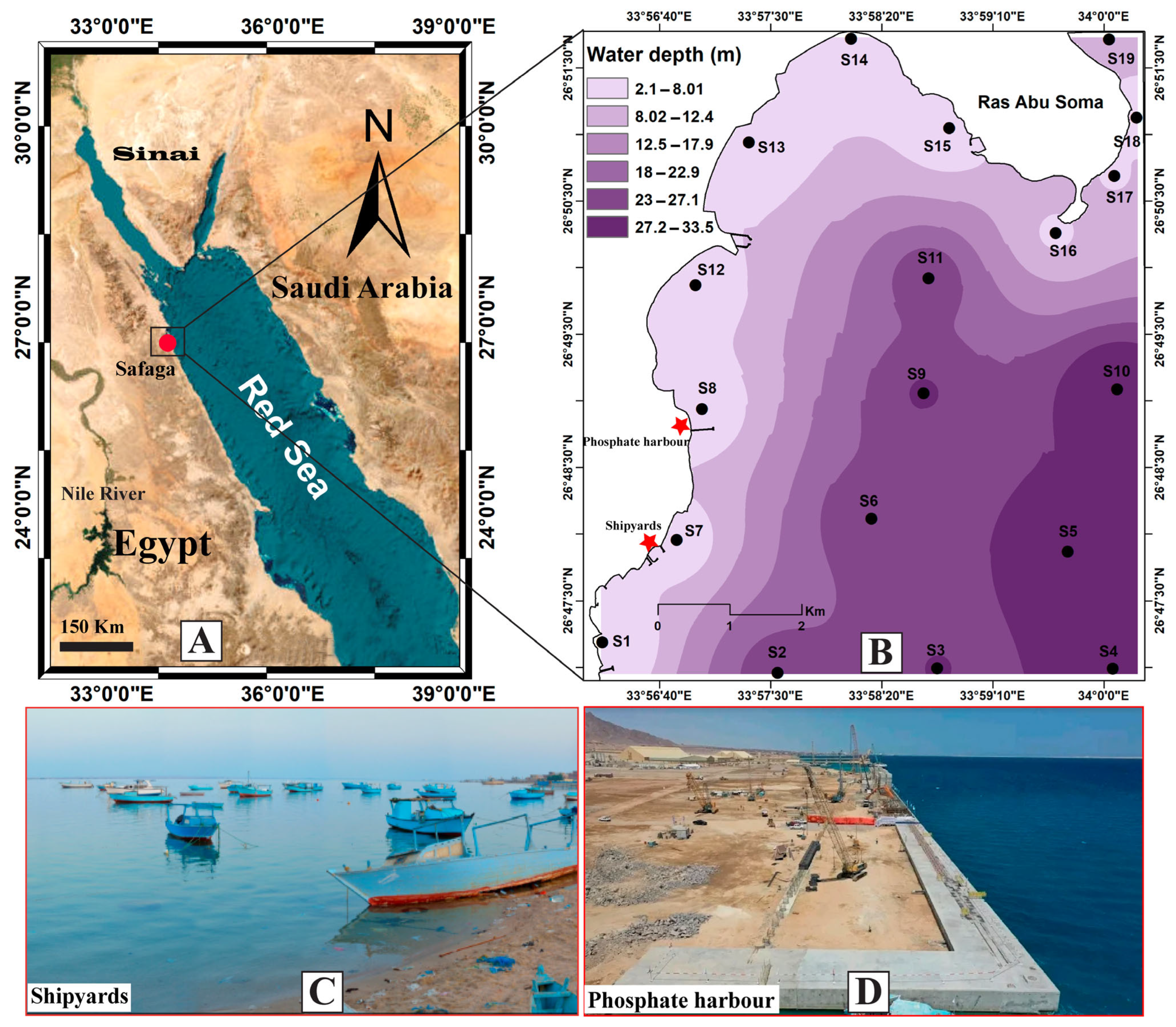
Safaga Bay is located along the central sector of the Egyptian Red Sea coast, approximately 60 km south of Hurghada, extending between latitudes ~26°47′–26°52′ N and longitudes ~33°55′–34°05′ E (Figure 1). The area of study is bordered to the north by Ras Abu Soma, while the central and southern coastal strips are occupied by the phosphate harbour and shipyards, respectively (Figure 1C,D). The bay represents a semi-enclosed coastal embayment opening eastward to the Red Sea and is characterized by a narrow continental shelf and complex shoreline morphology. Water depths within the bay ranged from shallow nearshore areas (<5 m) to more than 30 m toward the offshore zone, reflecting a gently sloping seabed interrupted locally by reefal and sandy patches. The hydrodynamic regime of Safaga Bay is primarily controlled by prevailing northerly winds, weak tidal currents, and limited water exchange, particularly in the inner bay. These conditions promote sediment accumulation and favor the retention of fine-grained materials and associated contaminants. Bottom sediments consist predominantly of sandy silt to silty sand, with variable carbonate content derived from coral reefs, mollusks, and other biogenic sources typical of tropical carbonate platforms.
It is noteworthy that Safaga Bay hosts well-developed coral reef ecosystems, seagrass meadows, and carbonate-producing benthic communities, making it an ecologically significant area within the Red Sea region [37]. However, the bay has been subjected to increasing anthropogenic pressure over recent decades due to rapid coastal development, the expansion of tourist resorts, port facilities, phosphate shipping terminals, and heavy maritime traffic [38,39]. Furthermore, activities related to tourism, recreational boating, and cargo shipping have introduced multiple stressors, including wastewater discharge [40], fuel residues, antifouling paint leachates, and resuspension of contaminated sediments [41,42]. The previous studies [39,41,43,44] have reported localized enrichment of heavy metals and organic matter in nearshore sediments of Safaga Bay, particularly near harbour, resort areas, and shipping lanes, indicating the influence of land-based and maritime pollution sources. The combination of ecological status, semi-restricted circulation, and increasing human activities makes Safaga Bay an ideal natural laboratory for assessing the impacts of anthropogenic pollution on sediment quality and benthic ecosystems using integrated geochemical and biological proxies.

3. Materials and Methods

3.1. Sampling Strategy and Processing

Nineteen Surface sediment samples were collected from Safaga Bay along the Red Sea coast of Egypt to capture spatial variability in benthic foraminiferal assemblages and sediment geochemistry under different environmental and anthropogenic influences (Table 1). Sampling stations were distributed across nearshore, mid-bay, and offshore settings, including areas influenced by port activities and tourism, as well as relatively less disturbed zones (Figure 1B). At each station, surficial bottom sediments (0–1 cm) were collected using a Van Veen grab sampler to ensure recovery of undisturbed surface material representative of recent conditions. To distinguish living from dead benthic foraminifera, the collected sediment samples were stained with Rose Bengal solution (2 g L−1 in ethanol 95%) immediately after sampling, allowing the identification of specimens that were alive at the time of collection based on the presence of stained protoplasm [45].
In the laboratory, sediment samples were air-dried at room temperature and gently disaggregated manually using an agate mortar and rubber pestle to avoid damage to foraminiferal tests. Approximately 60 g of dried sediment was weighed and subsequently soaked in distilled water to ensure complete disaggregation. The samples were then wet-sieved through a 63 µm mesh. The retained fraction was oven-dried at 50 °C and homogenized. Representative aliquots were obtained using a Jones-type microsplitter for quantitative foraminiferal analysis. Additionally, a parallel aliquot was subjected to grain-size analysis by the dry sieving method following the procedure of Folk and Ward [46]. The total organic matter was determined by loss-on-ignition at 550 °C as adopted by Heiri et al. [47].
For benthic foraminiferal analysis, approximately 20 g of dried aliquot was washed through a 63 μm sieve using distilled water to remove fine fractions. The residue was oven-dried at ≤50 °C, weighed, and dry-sieved to obtain the >63 μm fraction. Benthic foraminifera were picked from representative splits (>125 μm) using a binocular stereomicroscope, identified to species level following standard taxonomic classifications [48,49,50,51], and the WORMS database (WoRMS—World Register of Marine Species (https://www.marinespecies.org/aphia.php?p=search accessed on 2 February 2026)). It is noteworthy that about 300 total (living plus dead) specimens were counted to ensure statistically reliable assemblages, and only well-preserved tests were included in quantitative analyses, while broken or heavily altered specimens were excluded. The total number of counted specimens, number of living individuals, and percentage of living foraminifera were calculated for each sample and are presented in Supplementary Materials S1.
To assess the health of the coral reef community in Safaga Bay, the FoRAM index has been computed following Hallock et al. [19]. Notably, the methodological calculation process depends on functional group data used to estimate the FoRAM index, providing an integrated proxy for evaluating environmental conditions and potential coral reef growth suitability within Safaga Bay. Additionally, the foraminiferal abnormality index (FAI) has been calculated using the percentage of abnormal tests per sample, following the adopted method by Frontalini and Coccioni [15].

3.2. Geochemical Analysis

For heavy metal analysis, representative sediment subsamples (0.5 g) were homogenized and ground in an agate mortar to prevent metal contamination. The heavy metal concentrations were determined at Acme Analytical Laboratories (AcmeLabs, Vancouver, BC, Canada) using inductively coupled plasma–mass spectrometry (ICP-MS). Prior to analysis, sediment samples were subjected to total acid digestion following standard protocols, typically involving a multi-acid mixture (HF–HNO3–HClO4) to ensure complete dissolution of silicate and carbonate phases. The analyzed elements included environmentally relevant heavy metals, including Fe, Mn, P, Zn, Cr, Cu, Ni, Pb, Co, and Cd.
The quality control was ensured through the analysis of procedural blanks, certified reference materials, and replicate samples. Accordingly, the detection limits were well below natural background levels, and analytical precision was maintained within acceptable limits (generally <5% relative standard deviation). Heavy metal concentrations were reported in mg kg−1 dry weight.

3.3. Ordination Analysis

Before applying statistical analyses to our dataset, it was standardized and transformed to remove bias arising from high relative abundance in one sample at the expense of another. Thus, the sample (e.g., S12) had fewer than 300 specimens; hence, we avoided statistical misinterpretation by performing a Log (x + 1) transformation before analysis, to reduce the influence of highly dominant taxa, minimize variance heterogeneity among samples, and improve comparability across stations. The data analysis of the benthic foraminifera in the present study has been conducted on total forms to better comprehensively diagnose ecological stress.
To investigate the relationships between heavy metals and benthic foraminifera, cluster analysis was applied in both R-mode and Q-mode to examine associations among variables and sampling stations, respectively. Q-mode cluster analysis was used to classify sampling stations based on similarities in benthic foraminiferal assemblages and associated environmental parameters, whereas R-mode clustering explored relationships among foraminiferal species, diversity indices, and heavy-metal concentrations. Similarity matrices were constructed using the Bray–Curtis similarity index, and hierarchical clustering was performed using the complete linkage (furthest-neighbor) method.
Additionally, redundancy analysis (RDA) was employed to evaluate the relationships between benthic foraminiferal assemblages (response variables) and environmental factors, particularly heavy metal concentrations (explanatory variables). It is noteworthy that prior to RDA, detrended correspondence analysis (DCA) was conducted to assess the first gradient length of the species data and to determine whether a linear (RDA) or unimodal (CCA) ordination approach was more appropriate [52]. Since the first gradient is short (<4 SD), the linear method of constrained aspect is recommended. This constrained ordination method allowed direct assessment of the influence of sediment geochemistry on foraminiferal community structure and facilitated identification of key controlling factors.
Correlation analysis (Pearson’s correlation coefficient) was used to quantify relationships between individual foraminiferal taxa, environmental parameters, and heavy metal concentrations. Statistically significant correlations were interpreted as indicative of potential ecological responses to metal contamination or environmental gradients.
Benthic foraminiferal diversity and community structure were quantified using standard ecological indices. These included species richness (S), Shannon–Wiener diversity index (H′), and Dominance index (D). These indices were used to assess ecological status and compare assemblage complexity among sampling stations. All statistical analyses were computed and performed using PAST software version 5.12 [53].

4. Results

4.1. Oceanographic and Sedimentological Characteristics

The water depth across the investigated stations shows a wide range, reflecting the heterogeneous bathymetry of the study area (Table 1). Water depth varies from 2.1 m at station S1 to 33.5 m at station S10, with an overall mean depth of ~15.14 m. Notably, the shallow-water conditions dominate stations S1 and S7–S19, where depths are generally <10 m, indicating nearshore and lagoonal settings. In contrast, stations S2–S6 and S9–S11 represent deeper offshore environments, with depths commonly exceeding 25 m. This depth gradient provides an important framework for interpreting sediment texture, organic matter accumulation, and carbonate content.
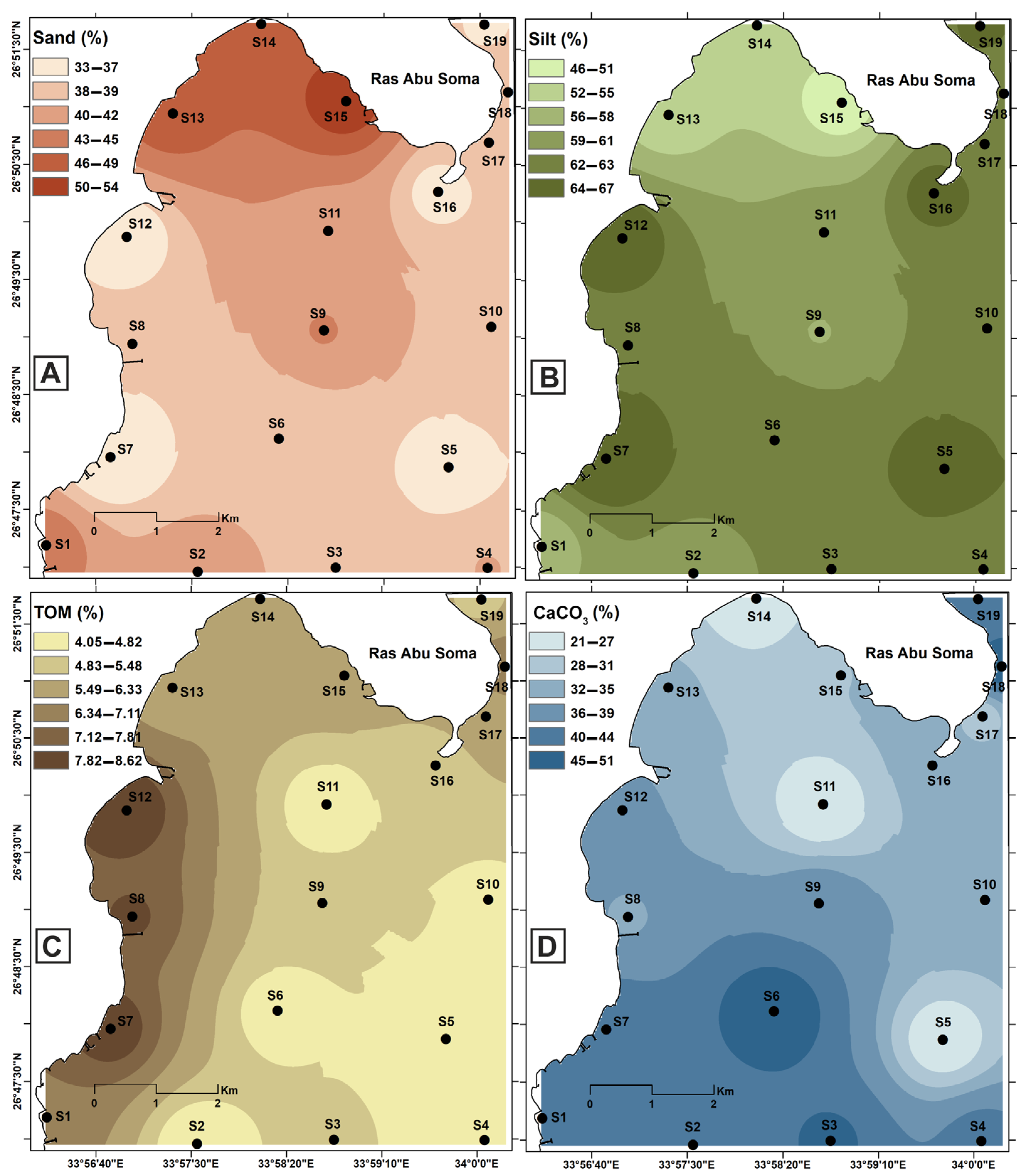
Sediments across all stations are characterized by a dominance of fine-grained material, with silt content consistently exceeding sand, indicating low to moderate hydrodynamic energy conditions. Sand percentages range from a minimum of 33% at station S7 to a maximum of 54% at station S15, with a mean sand content of ~39.74% (Table 1, and Figure 2A). Higher sand proportions are generally associated with shallow stations (e.g., S13–S15), suggesting localized reworking by waves and currents. Silt content varies inversely with sand, ranging from 46% at station S15 to 67% at station S7, with an average value of ~60.26% (Table 1 and Figure 2B). Elevated silt percentages at shallow and semi-enclosed stations (e.g., S7, S12, and S16) indicate reduced water circulation and enhanced fine-particle settling. Accordingly, the sedimentological data indicates predominantly silty substrates with localized sand enrichment in shallow, higher-energy environments.
Total organic matter (TOM) content exhibits notable spatial variability, reflecting differences in hydrodynamic conditions, sediment texture, and proximity to anthropogenic inputs. TOM values range from a minimum of 4.05% at stations S2 and S11 to a maximum of 8.62% at station S12, with an overall mean of ~5.74% (Table 1 and Figure 2C). Higher TOM contents are generally recorded at shallow stations (S1, S7, S8, S12, and S18), where restricted circulation and finer sediments promote organic matter accumulation. In contrast, deeper offshore stations show relatively lower TOM values, likely due to enhanced oxygenation and reduced organic input. This pattern suggests that organic matter enrichment is primarily controlled by local depositional conditions and nearshore influences.
Calcium carbonate content displays considerable variation across the study area, reflecting differences in biogenic input and sediment dilution by terrigenous material. CaCO3 values range from a minimum of 20.77% at station S11 to a maximum of 51.25% at station S6, with a mean value of ~36.13% (Table 1 and Figure 2D). Higher carbonate contents are typically associated with stations influenced by biogenic production, particularly foraminiferal and coral-derived material (e.g., S6, S18, and S19). Conversely, lower CaCO3 percentages at stations S5, S11, and S14 suggest increased terrigenous input or dilution by fine siliciclastic sediments. The observed spatial variability in carbonate content highlights the interplay between biological productivity and sedimentary processes in the bay.

4.2. Heavy Metal Distribution

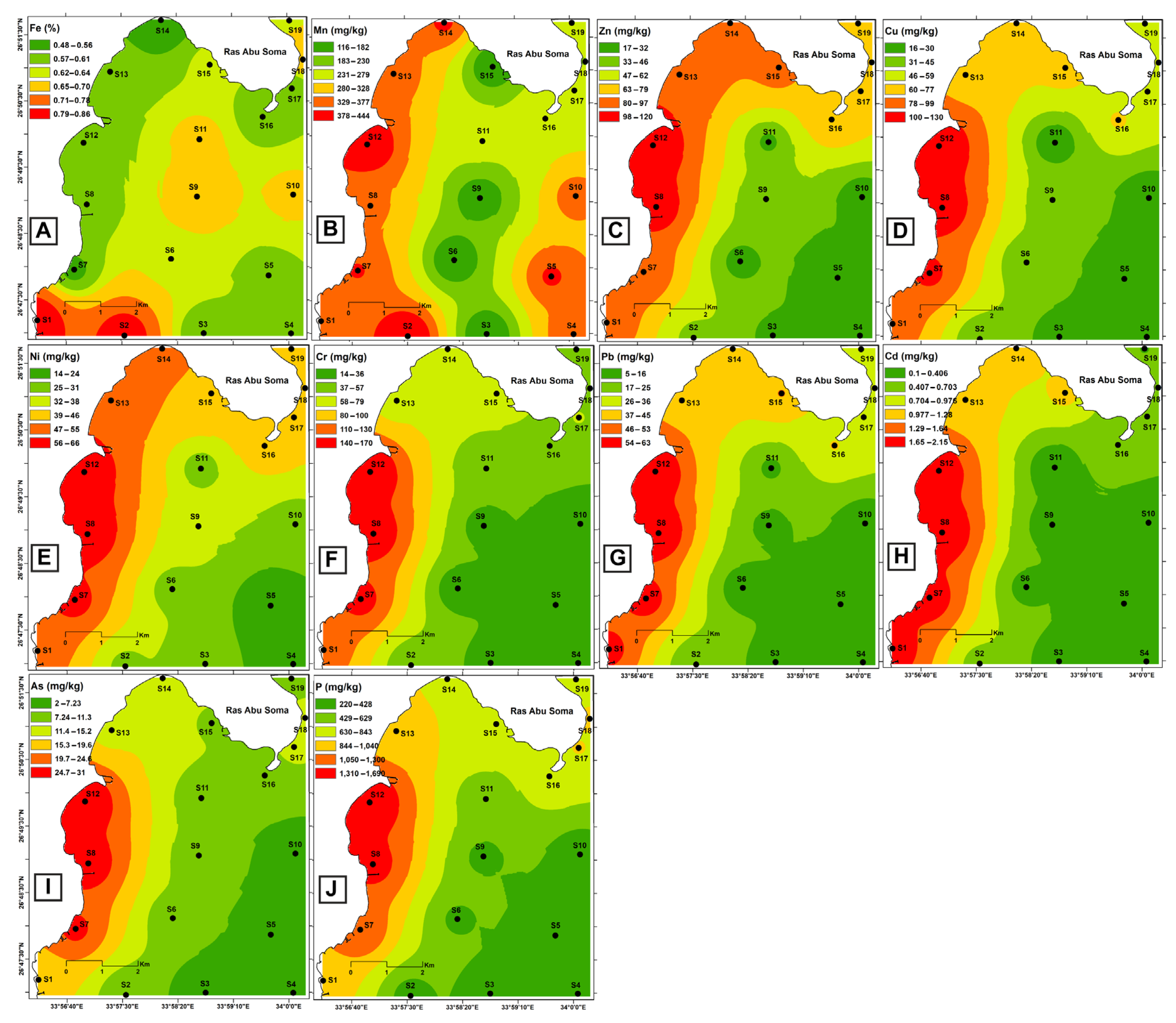
The bottom-sediment geochemistry shows a coherent pattern of metal enrichment across the studied stations, reflecting combined lithogenic and anthropogenic controls. Iron (Fe) concentrations range from 4.8 to 8.6% (mean ≈ 6.27%) (Table 1, and Figure 3A), forming the dominant geochemical background and governing the adsorption behavior of several trace metals. Manganese concentrations ranged from 116 to 444 mg kg−1 with a mean value of 292 mg kg−1 (Table 1, and Figure 3B), further highlighting the role of redox-sensitive processes and fine-grained sediments in trace-metal scavenging. Zinc and copper display similar distribution trends, with Zn ranging from 17 to 119 mg kg−1 (mean ≈ 63.4 mg kg−1) and Cu from 16 to 128 mg kg−1 (mean ≈ 55.2 mg kg−1) (Table 1, and Figure 3C,D, respectively), often co-occurring with elevated Pb and Cd levels, suggesting common pollution sources. Nickel and chromium show moderate variability, with Ni ranging from 14 to 66 mg kg−1 (mean ≈ 40.1 mg kg−1) and Cr from 14 to 167 mg kg−1 (mean ≈ 62.7 mg kg−1) (Table 1, and Figure 3E,F), largely controlled by lithogenic inputs and their association with Fe-rich phases. Lead (Pb) varies widely between 5 and 63 mg kg−1 (mean ≈ 30.9 mg kg−1) (Table 1, and Figure 3G), with pronounced enrichment at selected stations, indicative of localized anthropogenic inputs. Cadmium, although present at lower absolute concentrations (0.10–2.15 mg kg−1, mean ≈ 0.79 mg kg−1) (Table 1, and Figure 3H), exhibits distinct hotspots that coincide with Zn and Cu enrichment, reflecting its high sensitivity to anthropogenic contamination. Arsenic ranges from 2 to 31 mg kg−1 (mean ≈ 12.3 mg kg−1) (Table 1, and Figure 3I), indicating enrichment at stations with higher organic matter content. Phosphorus exhibits the greatest spatial heterogeneity, ranging from 220 to 1690 mg kg−1 (mean ≈ 724 mg kg−1) (Table 1, and Figure 3J), with elevated values at stations impacted by organic enrichment, suggesting nutrient loading from anthropogenic sources. Collectively, the co-enrichment of Pb, Zn, Cu, Cd, and P, coupled with Fe–Mn-controlled distribution of Ni and Cr, underscores a mixed geochemical signature that provides a critical framework for interpreting benthic foraminiferal responses to pollution stress in the study area. Accordingly, the co-enrichment of Pb, Zn, Cu, Cd, and P at specific stations suggests common pollution sources, while the association of Ni, Cr, Fe, and Mn highlights the combined influence of lithogenic input and geochemical scavenging processes.

4.3. Benthic Foraminiferal Assemblage and Composition

The living benthic foraminiferal fauna recorded from the 19 sampled stations is diverse and abundant, comprising a mixed assemblage of larger symbiont-bearing taxa, miliolids, rotaliids, and subordinate agglutinated forms. In total, 46 species were identified, along with their relative abundances (Supplementary Materials S1), reflecting well-oxygenated, shallow-marine conditions with variable substrates and trophic states. The assemblage is numerically dominated by rotaliid, and miliolid taxa, particularly species of Elphidium (23.62%), Quinqueloculina (18.01%) and Ammonia (12.71%). Elphidium striatopunctatum is the most abundant species (9.75%), followed by Ammonia beccarii (8.37%), Elphidium crispum (6.78%), Ammonia tepida (5.34%), Elphidium advenum (4.77%), and Neorotalia calcar (3.92%). While the miliolids is dominated by Coscinospira hemprichii (5.19%), Quinqueloculina lamarckiana (5.1%), Quinqueloculina limbata (4.45%), Amphisorus hemprichii (3.39%) Quinqueloculina costata (3.28%), and Triloculina oblonga (4.03%). The high representation of these taxa suggests tolerant, opportunistic assemblages adapted to fluctuating environmental conditions, moderate nutrient availability, and fine-grained substrates. The dominance of miliolids reflects shallow, warm, and relatively stable salinity conditions, often associated with sandy to carbonate substrates.
Larger benthic foraminifera are also well represented and form a significant component of the assemblage. These include Amphistegina lobifera (3.12%) A. lessonii (2.72%), Heterostigina depressa (1.38%), and Eponides cribrorepandus (2.33%). Their widespread occurrence and relatively high abundances, particularly at stations S2–S6 and S9–S11, indicate clear, shallow waters with sufficient light penetration, favoring symbiont-bearing forms typical of carbonate-rich environments. The other low relative abundance of miliolid taxa include Peneroplis spp., Quinqueloculina seminulum, Quinueloculina crassa, Quinqueloculina pseudoreticulata, Quinqueloculina neostraitula, Cycloforina carinatastriata, Massilina granulocostata, Spiroloculina communis, Triloculina trigonula. Agglutinated taxa such as Textularia agglutinans and T. aegyptica are present at low to moderate abundances, suggesting localized influence of finer sediments or slightly increased terrigenous input.
Spatially, the assemblage composition shows noticeable variation among stations. Stations S2–S6 and S9–S11 are characterized by high abundances of larger benthic foraminifera and miliolids, whereas stations S13–S19 show a relative increase in rotaliid taxa, particularly Ammonia and Elphidium, indicating more stressed or variable environmental conditions. Accordingly, the benthic foraminiferal assemblage reflects a predominantly shallow-marine, warm, and well-oxygenated environment, with local variations in substrate type, energy regime, and nutrient availability controlling the distribution and dominance patterns of individual taxa.
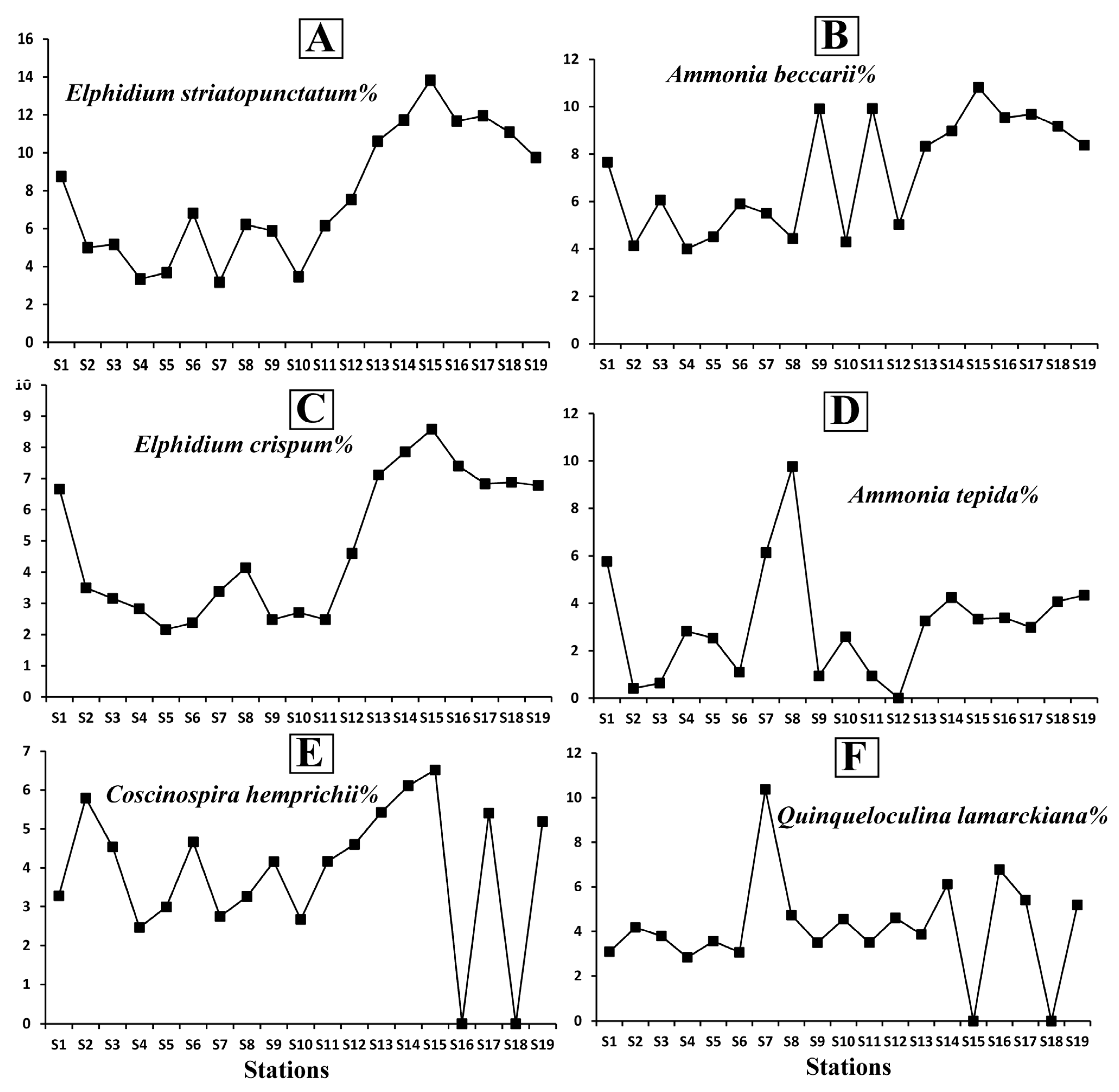
The benthic foraminiferal relative abundance of the top six taxa exhibits clear spatial variability across the investigated stations, reflecting differential environmental conditions and stress gradients (Figure 4). Elphidium striatopunctatum is the most consistently dominant taxon across the study area, ranging from 3.17% at S7 to 13.83% at S15 (Figure 4A), showing a general increase toward the northern stations, which are characterized by shallow, nearshore conditions. Similarly, Ammonia beccarii consistently records high abundances, ranging from 4.01% at S4 to 10.81% at S15 (Figure 4B), indicating sensitivity to low to moderate organic enrichment and metal contamination. Elphidium crispum shows greater resilience, ranging from 2.16% at S5 to 8.59% at S15 (Figure 4C), and shows increased abundances at moderately stressed stations such as S7 and S8. In contrast, the opportunistic taxa Ammonia tepida show marked dominance at several stations, highlighting environmental stress and pollution. A. tepida ranges from 0% at S12 to 9.76% at S8, indicating tolerance to organic enrichment and metal contamination (Figure 4D). Coscinospira hemprichii, a symbiont-bearing and environmentally sensitive taxon, shows highly variable relative abundances ranging from 0% at stations S16 and S18 to 6.52% at S15 (Figure 4E), with generally higher values at relatively less stressed stations, indicating favorable conditions for carbonate production. Quinqueloculina lamarckiana ranges between 0% at S15 and S18 and 10.36% at S7 (Figure 4F), displaying a patchy distribution likely controlled by substrate type and hydrodynamic regime.

4.4. Benthic Foraminiferal Ecological Indices

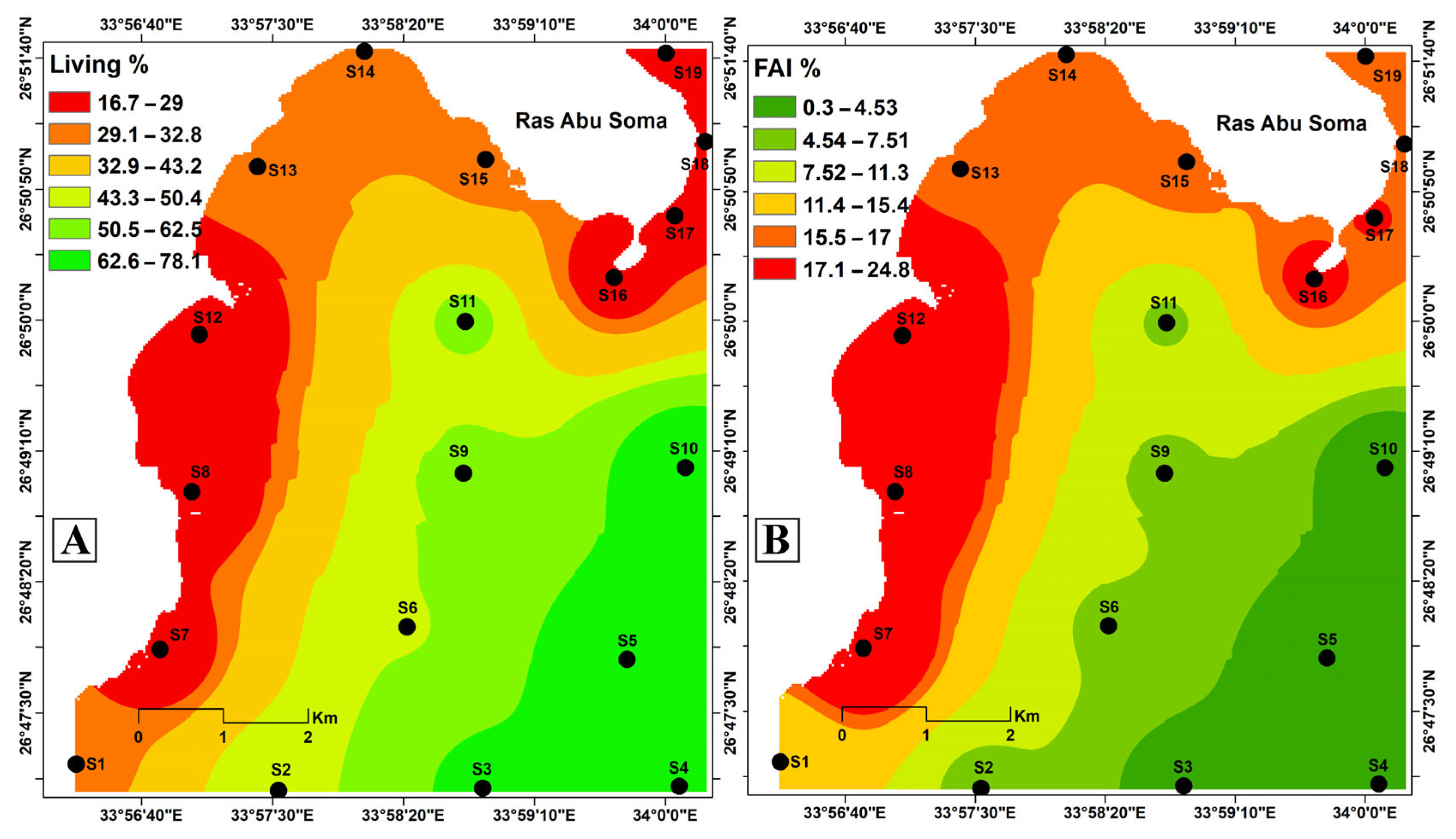
The proportion of living benthic foraminifera shows pronounced spatial variability across the investigated stations, reflecting differences in environmental quality and habitat suitability. Living percentages ranged from 16.67% at station S12 to 78.13% at station S10, with an overall pattern indicating higher proportions of living specimens at deeper, more environmentally stable stations (Figure 5A). Stations S4 (76.92%), S5 (75.19%), and S10 (78.13%) record the highest living percentages, suggesting favorable conditions characterized by better oxygenation, reduced organic stress, and lower contamination levels. Intermediate values are observed at stations S2, S6, S9, and S11, where living proportions cluster around 50–53%, indicating moderately suitable conditions. In contrast, shallow and nearshore stations such as S7, S8, S12, and S16 exhibit markedly low living percentages (≤22.7%), reflecting environmental stress likely associated with organic enrichment, fine-grained sediments, and elevated heavy-metal concentrations. Most remaining shallow stations (S13–S19) show consistently low to moderate living proportions (approximately 24–31%), further supporting a gradient of declining habitat quality toward nearshore settings. Consequently, the distribution of living benthic foraminifera delineates a clear ecological gradient, reinforcing the interpretation that pollution and sedimentary stressors exert strong control on benthic ecosystem vitality in the study area.
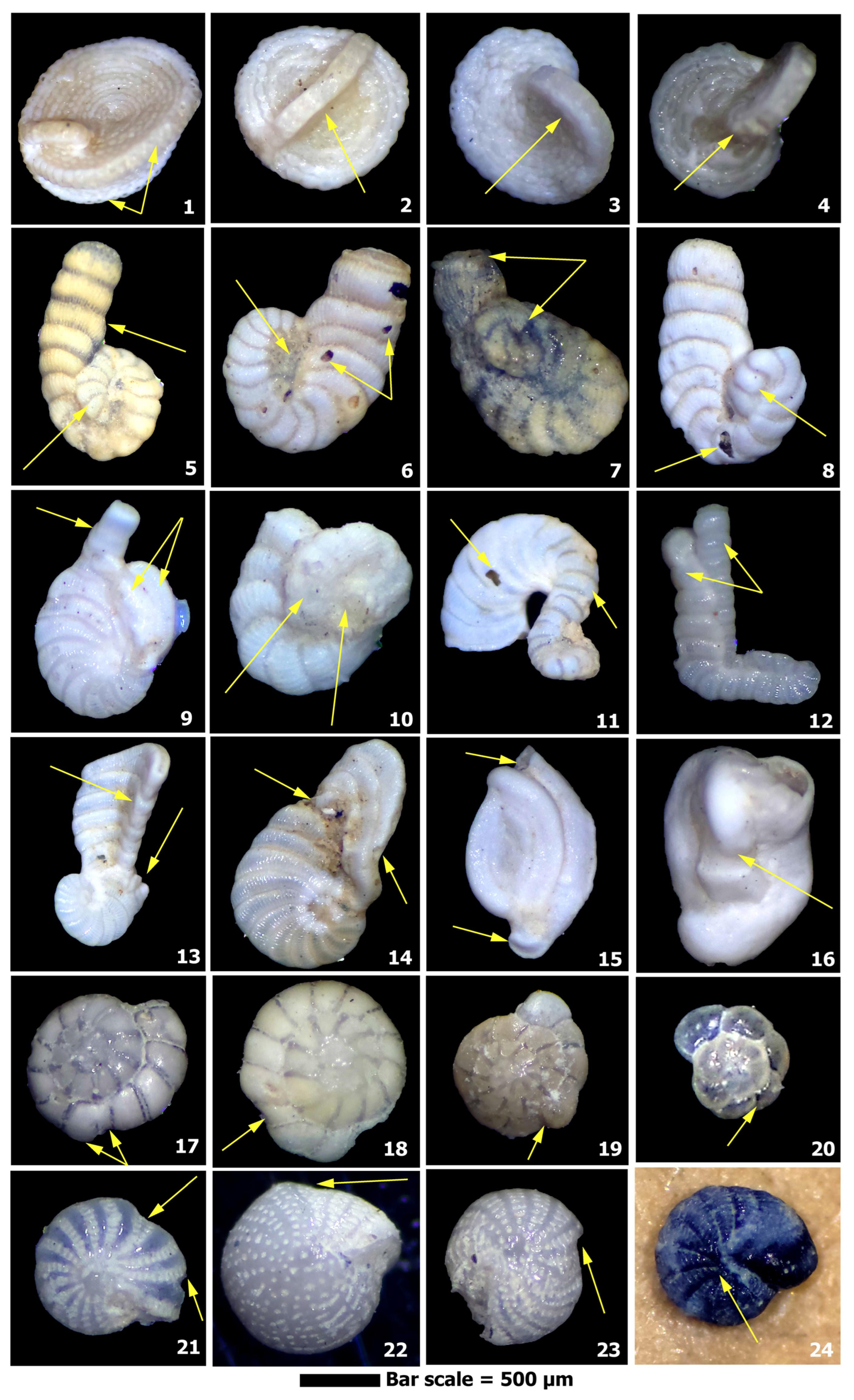
The FAI (Figure 5B) exhibits marked spatial variability among the studied stations, ranging from very low values (0.3–0.9%) to extremely high levels (>20%), reflecting pronounced differences in environmental stress across the area. Stations S4 (0.7%), S5 (0.9%), and S10 (0.3%) show very low FAI values, indicative of environmentally stable conditions with minimal ecological stress. Such low abnormal percentages are characteristic of well-oxygenated settings with limited anthropogenic or natural disturbance, allowing for normal test development. Moderate FAI values are recorded at S3 (2.18%), S2 (6.11%), S6 (6.95%), S9 (6.59%), and S11 (6.72%). These values suggest slight to moderate environmental stress, potentially linked to fluctuating physicochemical conditions, episodic sediment reworking, or mild enrichment in organic matter. Elevated to high FAI values occur at S1 (11.82%), indicating a transition toward stressed environmental conditions. More pronounced abnormalities are observed at S13–S19, where FAI values range from 15.78% to 18.33%, suggesting chronic ecological stress is likely associated with sustained environmental pressure. The highest abnormality levels are documented at S7 (23.67%), S8 (23.20%), and S12 (24.8%), representing severely stressed environments. Such high FAI values are commonly interpreted as responses to strong ecological disturbance, including elevated pollutant concentrations (e.g., heavy metals), increased organic loading, reduced oxygen availability, and fluctuations in salinity and temperature. Furthermore, the foraminiferal abnormalities were observed in several specimens with a range of morphological defects from normal test architecture (Figure 6). Thus, the FAI distribution reveals a clear gradient from low-stress, environmentally stable stations to highly stressed zones, underscoring the sensitivity of benthic foraminifera as bioindicators of environmental degradation and highlighting spatial heterogeneity in ecological quality across the study area.
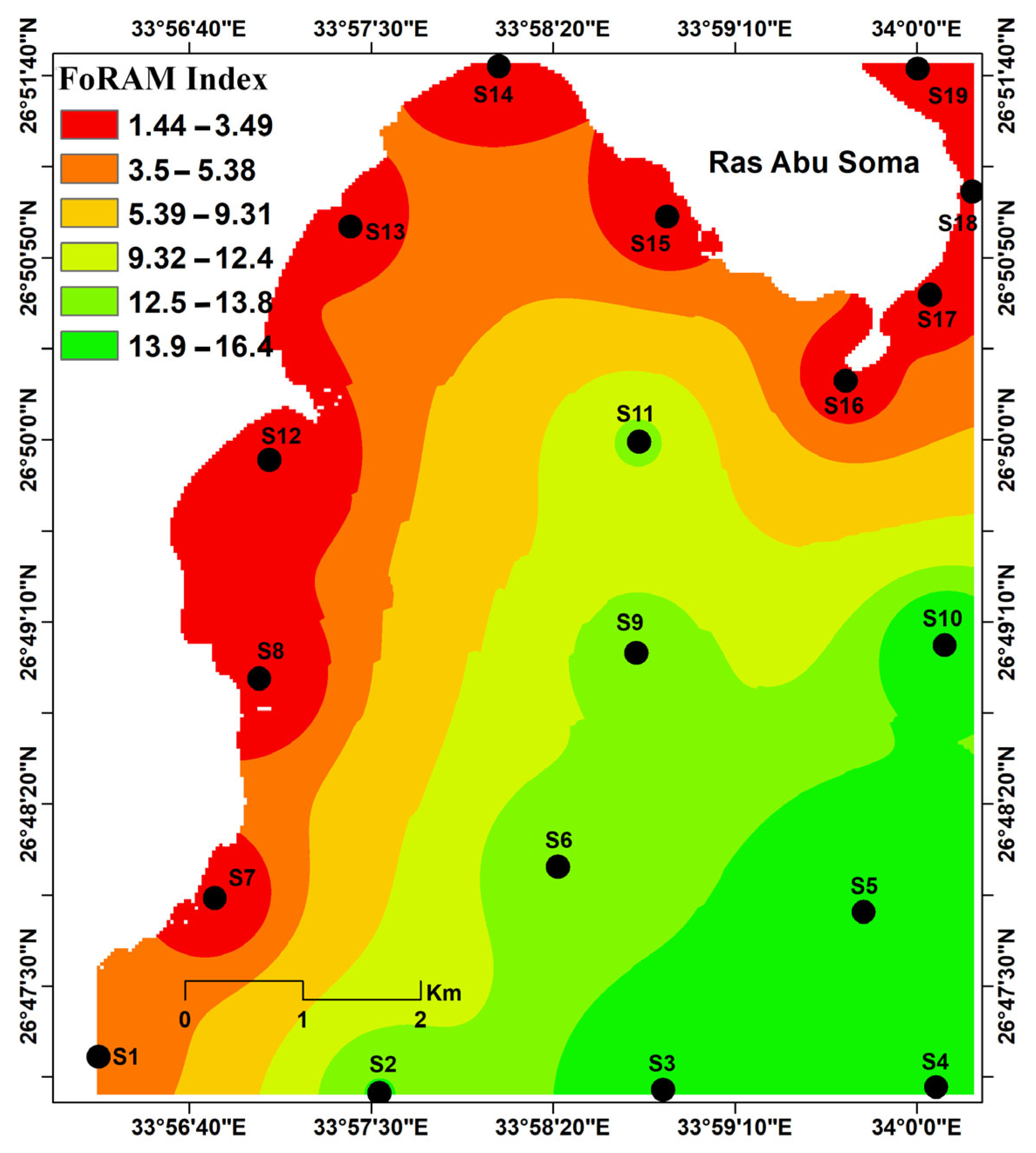
The FoRAM index values display a pronounced spatial gradient across the investigated stations, providing clear insight into reef-related environmental quality and carbonate-producing potential (Figure 7). The FoRAM values ranged from a minimum of 1.44 at station S12 to a maximum of 16.43 at station S4, indicating conditions that vary from environmentally stressed to highly favorable for coral reef growth. The FoRAM values (>10) are recorded at stations S2, S3, S4, S5, S6, S9, S10, and S11, reflecting assemblages dominated by symbiont-bearing and other carbonate-producing benthic foraminifera, and suggesting good water quality, low nutrient enrichment, and limited anthropogenic stress. In contrast, very low FoRAM values (<2) at stations S7, S8, and S12 indicate degraded environmental conditions unsuitable for reef development, likely linked to elevated organic matter and metal contamination in shallow nearshore settings. Moderate to low FoRAM values (~2–4) characterize stations S1 and S13–S19, implying marginal conditions where carbonate production is limited and stress-tolerant taxa are more prevalent. Consequently, the spatial distribution of FoRAM values mirrors the depth- and pollution-controlled gradients identified by diversity indices, reinforcing the interpretation that nearshore areas are environmentally stressed, whereas deeper offshore stations maintain conditions conducive to reef health and carbonate production.

4.5. Benthic Foraminifera Diversity Indices

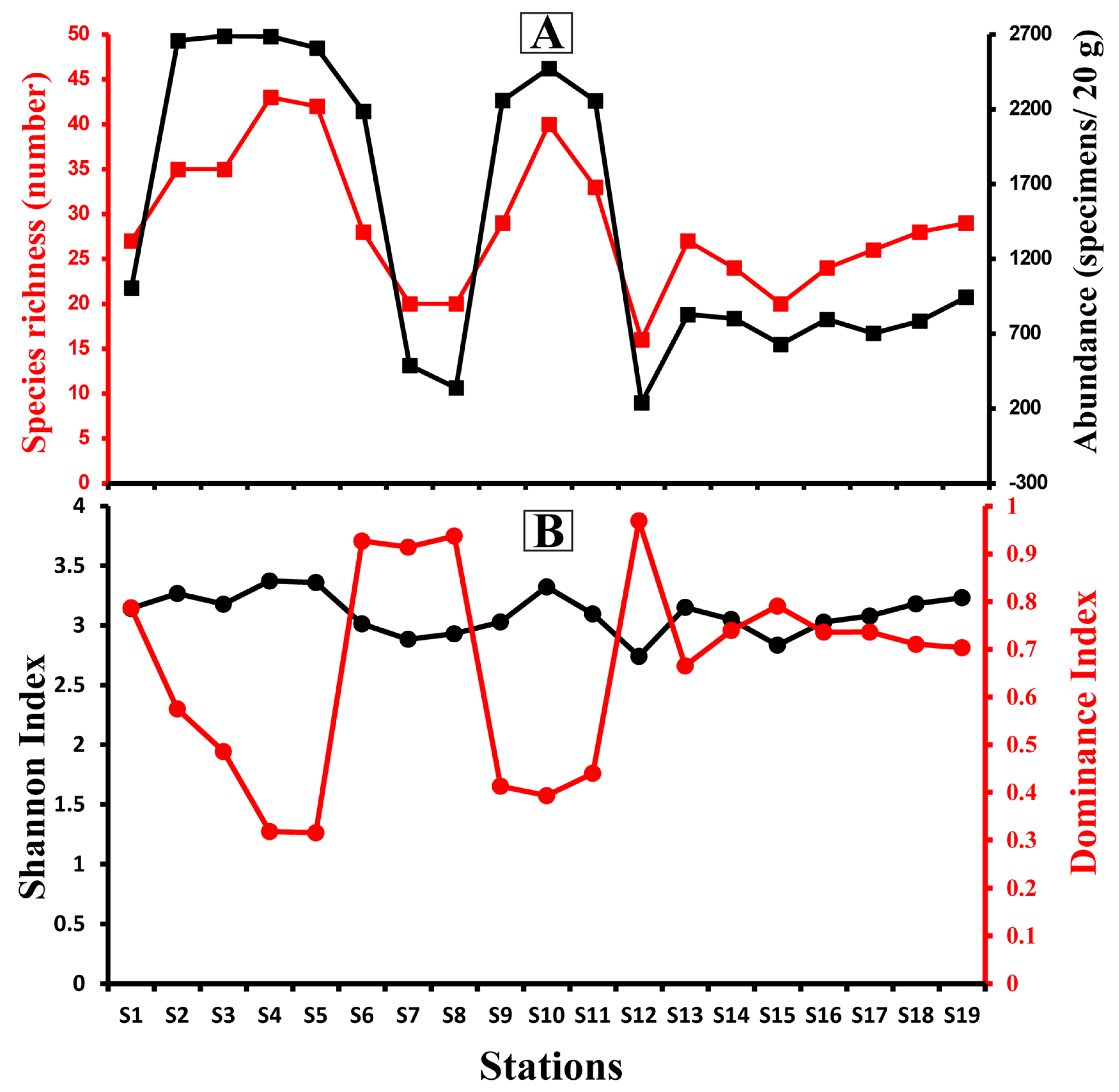
The benthic foraminiferal diversity metrics reveal clear spatial patterns in assemblage structure across the investigated stations, reflecting varying environmental conditions and degrees of stress. The species richness ranged from 16 taxa at station S12 to a maximum of 43 taxa at station S4, with generally higher richness recorded at deeper or less stressed stations (e.g., S4, S5, S10), and reduced richness at shallow, environmentally stressed sites (e.g., S7, S8, S12, and S15) (Figure 8A). The total number of individuals varies markedly, from only 239 at S12 to a maximum of 2690 at S3, indicating substantial differences in population density, likely controlled by sediment stability, organic matter availability, and pollution levels. The Dominance values ranged from 0.31 at S5 to 0.97 at S12, with higher dominance observed at stations with low species richness and reduced individual counts, suggesting assemblages controlled by a few opportunistic taxa under stressed conditions. In contrast, lower dominance values at stations such as S4, S5, S2, and S10 indicate more even and stable communities (Figure 8B). The Shannon diversity index is above 3.0, indicative of moderately high diversity. Reduced Shannon diversity at shallow stations (S7, S8, S12, and S13) corresponds with higher dominance and lower taxa richness, reflecting ecological stress and environmental disturbance. Accordingly, the combined diversity indices demonstrate a clear gradient from diverse, well-structured assemblages at deeper and less impacted stations to simplified, dominance-driven communities in shallow areas affected by organic enrichment and metal contamination, reinforcing the sensitivity of benthic foraminifera as indicators of environmental quality in the study area.

4.6. Statistical Analysis

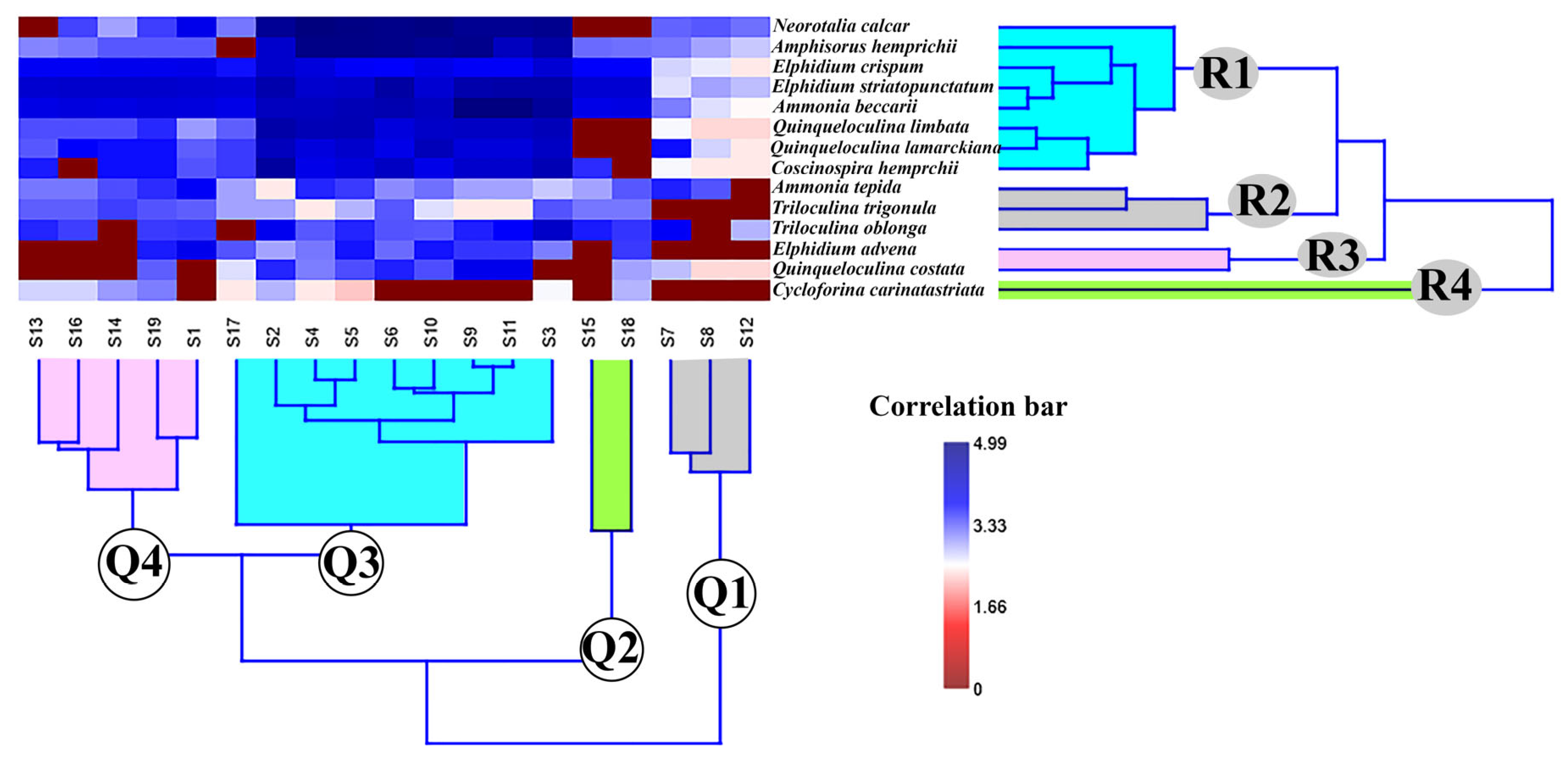
The combined heatmap hierarchical cluster analysis clearly illustrates the coupled structure of benthic foraminiferal assemblages and sampling stations in Safaga Bay (Figure 9). The Q-mode clustering of stations resolved four major groups (Q1–Q4), mirroring the ecological gradients inferred from species clustering, while in R-mode, four distinct benthic foraminifera taxa clusters (R1–R4) were identified, reflecting contrasting ecological preferences and tolerance to environmental conditions. Cluster R1 groups symbiont-bearing and carbonate-affiliated taxa such as Neorotalia calcar, Amphisorus hemprichii, Quinqueloculina limbata, and Q. lamarckiana, together with epifaunal forms Coscinospira hemprichii, indicating well-oxygenated, oligotrophic, and carbonate-rich conditions typical of relatively undisturbed reef-proximal environments. Furthermore, the nominated cluster includes sensitive benthic foraminiferal taxa to environmental stress, such as the Ammonia beccarii, Elphidium crispum, and E. striatopunctatum. Notably, the R1 cluster occupies Q3, comprising stations with the highest environmental quality, dominated by symbiont-bearing and epifaunal foraminifera, high diversity, low FAI values, and minimal anthropogenic influence, such as S10, S5, S6, S9, and S11. These taxa show high abundances mainly in stations characterized by high diversity indices, moderate to elevated FoRAM Index values, and high percentages of living foraminifera. Cluster R2 is dominated by stress-tolerant and opportunistic taxa, including Ammonia tepida, Triloculina trigonula and T. oblonga. These species exhibit strong associations with stations showing elevated heavy-metal concentrations, higher total organic matter, reduced diversity, and increased foraminiferal abnormality indices. It is noteworthy that R2 occupies the Q4 group, the most stressed stations, characterized by low species richness, depressed living foraminiferal percentages, and the highest abnormality indices, indicating chronic environmental stress likely linked to heavy-metal contamination from coastal tourism facilities and maritime activities. Their clustering highlights their ecological resilience and ability to thrive under polluted and organically enriched conditions, consistent with their widespread use as bioindicators of coastal degradation. Cluster R3 includes intermediate miliolid taxa such as Quinqueloculina costata, and Elphidium advena, which display moderate abundances across several stations. These species appear sensitive to changes in sediment texture and carbonate availability rather than direct heavy-metal stress, suggesting transitional environmental conditions. Furthermore, it is represented by Q3, which includes stations subjected to pronounced anthropogenic pressure, where opportunistic taxa dominate, and diversity indices decline markedly. In contrast, cluster R4, represented mainly by Cycloforina carinatastriata, reflects low-abundance, environmentally selective taxa with limited spatial distribution, likely responding to localized sedimentary or hydrodynamic controls. Notably, it is occupied by the Q2 group, moderately impacted stations with mixed assemblages, reflecting transitional conditions influenced by moderate organic enrichment and episodic metal inputs. Accordingly, the heatmap further emphasizes the sharp contrast between environmentally sensitive, symbiont-bearing taxa and pollution-tolerant opportunistic species, confirming the effectiveness of benthic foraminifera as reliable bioindicators of coastal ecosystem health along the Red Sea coast.
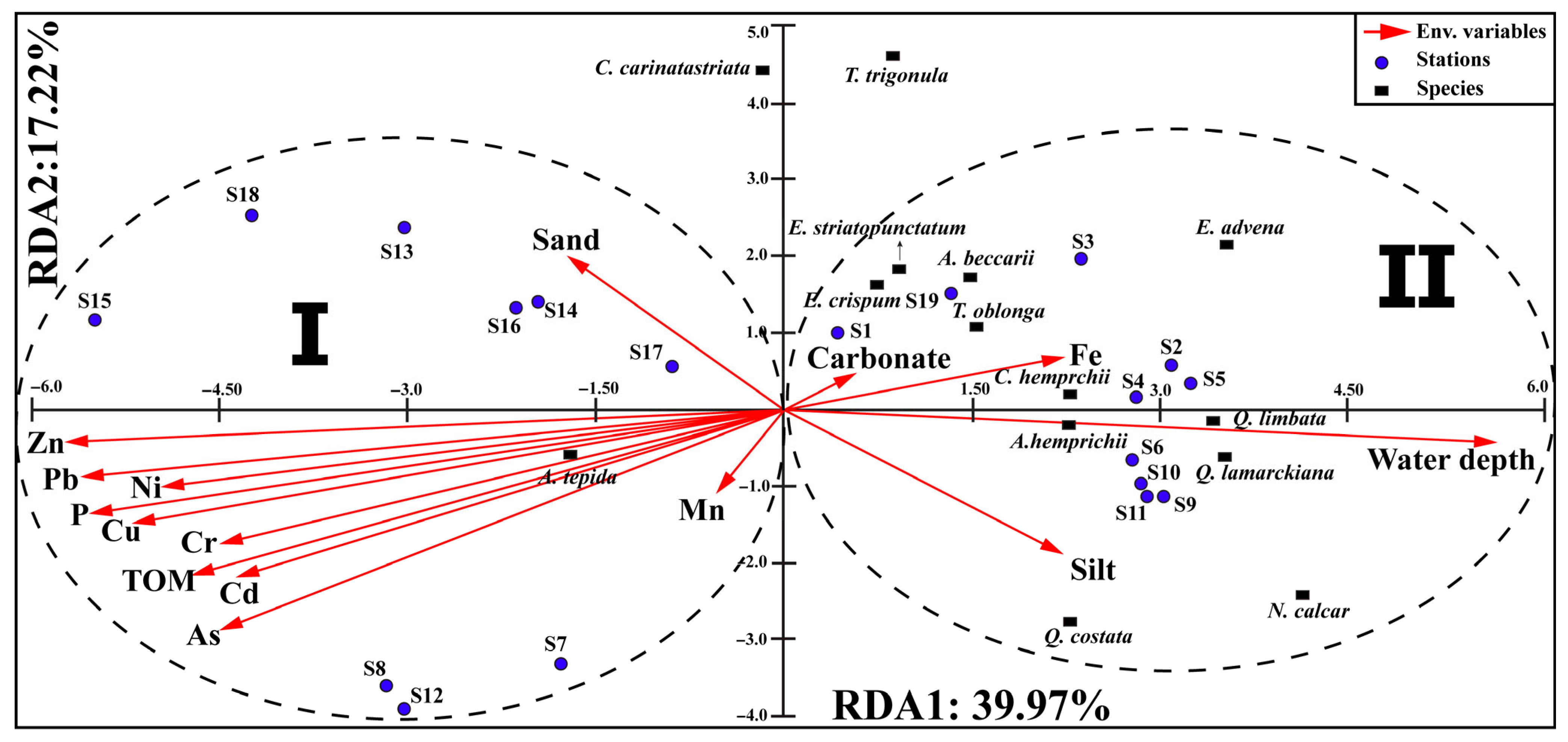
The RDA clearly demonstrates that benthic foraminiferal assemblages in the study area are strongly structured by a pollution–depth gradient, with the first two canonical axes explaining a substantial proportion of the species-environment relationship (Figure 10). Axis 1, accounting for 39.97% of the total variance (R = 0.98), represents the main environmental gradient and is positively associated with water depth and weakly with Fe, while showing strong negative loadings for TOM%, salinity, Pb, Zn, Cu, Cd, Ni, As, Cr, and P, indicating increasing organic and metal pollution toward shallow sites. Along this axis, environmentally sensitive and carbonate-producing taxa such as Q. lamarckiana, Q. limbata, C. hemprichii, A. beccarii, A. hemprichii, and N. calcar display strong positive scores, reflecting their preference for deeper, better-oxygenated, and less contaminated environments. In contrast, stress-tolerant taxa, particularly A. tepida, plot closer to the negative side of Axis 1, indicating association with organically enriched and metal-contaminated sediments. Axis 2, explaining an additional 17.22% of the variance (cumulative 57.19), further differentiates sites based on sediment texture and secondary pollution gradients, with positive loadings for sand and negative loadings for silt and several metals. Site (station) ordination reveals a clear separation between shallow, polluted stations (e.g., S7, S8, S12, and S15), which cluster on the negative side of Axis 1, and deeper, less impacted stations (e.g., S2–S6, S9–S11, and S10), which plot positively and are characterized by higher diversity and dominance of symbiont-bearing taxa. Subsequent axes individually explain smaller proportions of variance but together raise the cumulative explained variance to 87.94% by Axis 6, confirming the robustness of the model. Accordingly, the RDA highlights organic matter and heavy metals as the principal controlling factors shaping benthic foraminiferal distribution, driving a pronounced ecological shift from sensitive, reef-associated taxa under low-stress conditions to opportunistic, pollution-tolerant species in shallow, contaminated environments.
The correlation matrix reveals a strongly structured relationship among sedimentological properties, geochemical variables, and benthic foraminiferal assemblages, highlighting depth- and pollution-driven environmental gradients across the study area (Table 2). Water depth shows strong negative correlations with TOM (r = −0.78) and most trace metals and phosphorus (Pb = −0.91; Zn = −0.94; Cu = −0.82; Cd = −0.77; Ni = −0.89; Cr = −0.74; P = −0.83), indicating that organic matter and metal enrichment are predominantly concentrated in shallow environments. Total organic matter exhibits very strong positive correlations with pollution-related elements (Pb = 0.91; = Zn = 0.87; Cu = 0.93; Cd = 0.89; Ni = 0.89; As = 0.91; Cr = 0.93; P = 0.94), confirming its central role as a carrier and stabilizing phase for trace metals. Sand and silt show perfect inverse correlation (r = −0.99), while CaCO3 displays weak correlations with most metals, suggesting partial dilution effects rather than direct geochemical control. Among metals, Pb, Zn, Cu, Cd, Ni, Cr, and P are highly intercorrelated (r generally > 0.90), indicating a common anthropogenic/sewage source or similar geochemical behavior, whereas Mn shows weaker and more variable correlations, reflecting its redox-sensitive and partially independent behavior. Biologically, stress-tolerant taxa such as A. tepida show positive correlations with TOM and metals (e.g., Ni 0.48; P 0.36), supporting its role as a pollution indicator species. In contrast, symbiont-bearing and environmentally sensitive taxa, Q. lamarckiana, C. hemprichii, E. crispum, and E. striatopunctatum, exhibit strong positive correlations with depth (up to r = 0.87) and pronounced negative correlations with TOM and trace metals (commonly < −0.70), reflecting preference for cleaner, better-oxygenated conditions. Ammonia beccarii shows a similar pattern, correlating positively with depth (r = 0.74) and negatively with metal enrichment, indicating tolerance to moderate but not extreme pollution. Consequently, the correlation structure clearly demonstrates that organic enrichment and heavy-metal contamination are tightly coupled in shallow sediments and exert a strong selective pressure on benthic foraminiferal communities, driving a shift from sensitive, carbonate-producing taxa toward opportunistic, pollution-tolerant species.

5. Discussion

5.1. Environmental Controls on Benthic Foraminifera Assemblage

Benthic foraminifera are widely recognized as sensitive and reliable bio-monitors of environmental quality in coastal marine systems due to their rapid response to physicochemical stressors, including heavy metal contamination, organic enrichment, and sedimentological changes [1,2,8,17,31,54]. The present study integrates sediment characteristics, heavy metal distributions, diversity indices, the FoRAM index, living foraminiferal percentages, and multivariate statistical analyses to elucidate the ecological controls shaping benthic foraminiferal assemblages along the investigated coastal gradient. In particular, the bottom sediment composition shows a clear spatial gradient, with shallow stations dominated by finer sediments (higher silt content) and elevated organic matter, while deeper stations are relatively sandier and less organically enriched. Fine-grained sediments enhance the retention of organic matter and trace metals through adsorption processes, thereby amplifying ecological stress under low-energy conditions [55,56,57]. The strong negative correlation between depth and TOM, coupled with positive relationships between TOM and most trace metals, confirms that nearshore environments act as sinks for contaminants and organic inputs. This sediment–organic matter coupling has been documented in Red Sea coastal systems subjected to anthropogenic pressure [2,54].
The correlation matrix reveals very strong positive intercorrelations among Pb, Zn, Cu, Cd, Ni, Cr, As, and P, indicating a common human-induced source or similar geochemical behavior [58,59,60]. Such associations are typically attributed to anthropogenic inputs, including maritime activities, coastal urbanization, wastewater discharge, and tourism-related development [22,61]. The strong negative correlations between these metals and water depth highlight a pronounced nearshore pollution gradient, consistent with observations from other semi-enclosed or reef-associated coastal [62,63,64,65].
The spatial distribution of heavy metals in coastal sediments, particularly in Safaga Bay, shows an inverse relationship with distance from the shoreline, with higher concentrations in nearshore zones influenced by land-based activities and urban inputs. For example, several studies in Red Sea coastal sediments have documented elevated heavy metal levels closer to the coast, where anthropogenic sources dominate, with concentrations decreasing offshore as hydrodynamic dispersion increases and direct input sources diminish [66,67]. This pattern is frequently linked to proximity to anthropogenic activities, including port operations, wastewater discharge, and coastal development [2,40,68]. Additionally, sediment texture plays a major role in controlling heavy metal distribution, as fine-grained sediments have a much greater specific surface area and adsorption capacity, leading to greater heavy metal accumulation than coarser fractions [69].

5.2. Benthic Foraminiferal Response and Their Ecological Indices

Benthic foraminiferal assemblages respond rapidly to environmental stress, and their ecological indices (e.g., diversity indices, abnormality percentage, FoRAM index, etc.) are widely recognized as sensitive and reliable tools for monitoring coastal pollution and ecosystem degradation [1,2,7,8,16,31,35,54,70]. The diversity indices clearly reflect environmental stress gradients across the study area, particularly stations characterized by higher metal concentrations and elevated TOM exhibit reduced species richness, lower Shannon diversity, and increased dominance by opportunistic taxa, indicating ecological stress conditions. This pattern aligns with classical ecological theory and extensive empirical evidence showing that pollution and organic enrichment favor a limited number of tolerant taxa at the expense of overall community complexity [2,10,24,54]. Conversely, deeper, less contaminated stations (such as S4, S5, S10) exhibit higher diversity and lower dominance, reflecting more stable, favorable environmental conditions [54,71].
The relationships between benthic foraminiferal species and environmental factors, as revealed by the correlation matrix and RDA, highlight clear ecological differentiation among benthic foraminiferal taxa. Pollution-tolerant and opportunistic species, particularly A. tepida, show positive correlations with TOM and heavy metals, confirming their well-documented resilience to hypoxia, metal stress, and organic loading [14,31,54]. In contrast, calcareous, symbiont-bearing and epifaunal taxa such as Q. lamarckiana, C. hemprichii, E. crispum, and E. striatopunctatum exhibit strong negative correlations with metals and TOM and positive relationships with depth. These taxa are widely regarded as sensitive indicators of good environmental quality and stable carbonate conditions [2,30,54].
Since the percentage of living foraminifera provides direct insight into current habitat suitability, low living proportions at nearshore stations coincide with elevated metal concentrations, high TOM, and reduced diversity, indicating active ecological stress and impaired benthic functioning [35,72]. In contrast, a higher living percentage at deeper stations reflects more favorable oxygenation [73], lower contamination levels [8], and greater habitat stability [3,5]. Similar patterns have been reported in polluted coastal environments worldwide, where living assemblages respond more rapidly to environmental deterioration than total assemblages [8,62].
Additionally, the elevated FAI recorded at several stations in Safaga Bay is consistent with patterns documented from polluted coastal environments worldwide, reinforcing the reliability of benthic foraminiferal test deformities as indicators of sub-lethal environmental stress [1,8,9,10,15,18,54]. Notably, the high FAI values (>20%) observed at stations S7, S8, and S12 are comparable to those reported from heavily contaminated coastal settings along the Egyptian Red Sea, particularly Hurghada [2], and worldwide such as the Adriatic Sea (Italy) [74], Gulf of Gabès (Tunisia) [75], Andaman Sea (India) [76], and Santos Estuary (Brazil) [77], where abnormality frequencies commonly exceed 15–30% under elevated heavy-metal loads. The moderate FAI values (<10%) documented at stations S2, S6, S9, and S11 are comparable to those reported from moderately impacted Mediterranean lagoons, industrialized estuaries of Western Europe, and nearshore zones affected by urban runoff, where anthropogenic pressure is intermittent or spatially heterogeneous [8,11,78]. In contrast, stations exhibiting very low FAI values (<1%), such as S4, S5, and S10, fall within the range reported for pristine or minimally disturbed reef-associated environments, including the protected Red Sea localities (Wadi El-Gemal reserve), where normal test morphogenesis predominates, and metal concentrations remain near background levels.
The FoRAM index provides a powerful synthesis of functional benthic foraminiferal responses to environmental stress, especially in the coral reef community [19,79]. The extremely low FoRAM values at polluted coastal stations indicate environments unsuitable for carbonate production and coral reef sustainability [19]. Such low values are typically associated with elevated nutrient levels, organic enrichment, turbidity, and pollution from coastal development and tourism activities [19,80]. The strong negative correlations among symbiont-based foraminifera, heavy metals, and TOM underscore the detrimental impact of anthropogenic inputs on reef-associated benthic ecosystems. In contrast, higher FoRAM values at deeper, less impacted stations suggest relatively favorable conditions for reef growth and carbonate accumulation, highlighting the spatial heterogeneity of anthropogenic influence along the coast. Accordingly, similar FoRAM gradients have been reported from reef systems affected by coastal urbanization and tourism pressure in the Red Sea regions [2,20].

6. Conclusions

This study provides compelling evidence that anthropogenic activities associated with coastal tourism and maritime operations are the dominant factors controlling sediment quality and benthic foraminiferal assemblages in the investigated coastal area. Elevated heavy metal concentrations, particularly Pb, Zn, Cu, Cd, Ni, Cr, and As, coupled with high organic matter content and fine-grained sediments, clearly reflect inputs from sewage discharge, boating activities, antifouling paints, and ship-related effluents concentrated in shallow nearshore environments. The benthic foraminiferal responses strongly mirror these geochemical patterns, where polluted stations exhibit reduced species richness, lower Shannon diversity, higher dominance, depressed living foraminiferal percentages, and consistently low FoRAM Index values, indicating degraded environmental conditions unsuitable for sustained carbonate production and reef development. In contrast, deeper, less impacted stations support more diverse assemblages dominated by sensitive, symbiont-bearing, and epifaunal taxa, reflecting relatively favorable ecological conditions. Multivariate analyses, including cluster analysis and redundancy analysis, robustly confirm the separation between anthropogenically impacted coastal stations and less disturbed offshore sites, with heavy metals and organic enrichment emerging as the primary explanatory variables influencing foraminiferal distribution. Species-specific responses further emphasize the ecological shift from pollution-sensitive taxa to opportunistic, stress-tolerant forms under increasing anthropogenic pressure. These findings highlight the urgent need to improve the management of wastewater disposal, maritime pollution, and tourism development to mitigate further degradation of coastal ecosystems.

Supplementary Materials

The following supporting information can be downloaded at: https://www.mdpi.com/article/10.3390/environments13030143/s1. Supplementary Materials S1. The total benthic foraminiferal abundance and relative proportions, counted specimens (T), number of living specimens (L), number of dead specimens (D), and percentage of living forms for each sample.

Author Contributions

Conceptualization, R.M.E.-K. and M.M.S.; methodology, R.M.E.-K.; validation, M.M.S., D.M.S., I.M.G. and R.M.E.-K.; formal analysis, A.M. and R.M.E.-K.; investigation, M.M.S. and R.M.E.-K.; data cu-ration, R.M.E.-K. and M.A.; writing—original draft preparation, R.M.E.-K., M.W. and M.M.S.; writing—review and editing, R.M.E.-K., M.M.S., I.M.G., D.M.S., A.M. and M.A.; visualization, R.M.E.-K., M.W. and I.M.G. All authors have read and agreed to the published version of the manuscript.

Funding

This research received no external funding.

Institutional Review Board Statement

Not applicable.

Informed Consent Statement

Not applicable.

Data Availability Statement

The original contributions presented in this study are included in the article/Supplementary Materials. Further inquiries can be directed to the corresponding author.

Acknowledgments

The authors express their appreciation to the late Mohamed Abd El-Wahab, for helping during sample collection. Open Access Funding by the University of Vienna. Michael Wagreich and Mostafa M. Sayed also acknowledge the support provided by and UNESCO IGCP 732 LANGUAGE of the Anthropocene.

Conflicts of Interest

The authors declare that they have no conflicts of interest.

References

  1. El-Kahawy, R.; El-Shafeiy, M.; Helal, S.; Aboul-Ela, N.; El-Wahab, M.A. Morphological deformities of benthic foraminifera in response to nearshore pollution of the Red Sea, Egypt. Environ. Monit. Assess. 2018, 190, 312. [Google Scholar] [CrossRef]
  2. El-Kahawy, R.M.; Mabrouk, M.S. Benthic foraminifera as bioindicators for the heavy metals in the severely polluted Hurghada Bay, Red Sea coast, Egypt. Environ. Sci. Pollut. Res. 2023, 30, 70437–70457. [Google Scholar] [CrossRef] [PubMed]
  3. Gooday, A.J. Benthic foraminifera (Protista) as tools in deep-water palaeoceanography: Environmental influences on faunal characteristics. In Advances in Marine Biology; Southward, A.J., Tyler, P.A., Young, C.M., Fuiman, L.A., Eds.; Academic Press: London, UK, 2003; Volume 46, pp. 1–90+352. [Google Scholar]
  4. Murray, J.W. Ecology and Palaeoecology of Benthic Foraminifera; Routledge: Abingdon, UK, 1991; p. 408. [Google Scholar]
  5. Murray, J.W. Ecology and Palaeoecology of Benthic Foraminifera; Routledge: Abingdon, UK, 2006; p. 422. [Google Scholar]
  6. Romano, E.; Bergamin, L.; Parise, M. Benthic foraminifera as environmental indicators in Mediterranean marine caves: A review. Geosciences 2022, 12, 42. [Google Scholar] [CrossRef]
  7. Alve, E. Benthic foraminifera in sediment cores reflecting heavy metal pollution in Sorfjord, western Norway. J. Foraminifer. Res. 1991, 21, 1–19. [Google Scholar] [CrossRef]
  8. Alve, E. Benthic foraminiferal responses to estuarine pollution; a review. J. Foraminifer. Res. 1995, 25, 190–203. [Google Scholar] [CrossRef]
  9. Fares, I.; El-Kahawy, R.M.; Hussein, A.W.; Abu El Ghar, M.S.; Helal, S.A. Benthic Foraminiferal Distribution in the Red Sea Coastal Sediments, Shalateen Area, Egypt: Environmental Biomonitoring Implications. J. King Abdulaziz Univ. Mar. Sci. 2024, 34, 67. [Google Scholar] [CrossRef]
  10. Martínez, L.T.; Marchant, M.; Díaz, R.T.A.; Arrojo, M.Á.; Muñoz, P. Benthic foraminifera as pollution biomarkers: A morphological approach. Microb. Ecol. 2023, 86, 2802–2818. [Google Scholar] [CrossRef]
  11. Romano, E.; Bergamin, L.; Ausili, A.; Pierfranceschi, G.; Maggi, C.; Sesta, G.; Gabellini, M. The impact of the Bagnoli industrial site (Naples, Italy) on sea-bottom environment. Chemical and textural features of sediments and the related response of benthic foraminifera. Mar. Pollut. Bull. 2009, 59, 245–256. [Google Scholar] [CrossRef]
  12. Yanko, V. Benthic foraminifera as indicators of environmental change in the Black Sea in space and time. In Quaternary Foraminifera of the Caspian-Black Sea-Mediterranean Corridors: Volume 1: Ponto-Caspian Foraminifera; Springer: Berlin/Heidelberg, Germany, 2022; pp. 209–222. [Google Scholar]
  13. Yanko, V.; Ahmad, M.; Kaminski, M. Morphological deformities of benthic foraminiferal tests in response to pollution by heavy metals; implications for pollution monitoring. J. Foraminifer. Res. 1998, 28, 177–200. [Google Scholar]
  14. Bergamin, L.; Romano, E.; Finoia, M.G.; Venti, F.; Bianchi, J.; Colasanti, A.; Ausili, A. Benthic foraminifera from the coastal zone of Baia (Naples, Italy): Assemblage distribution and modification as tools for environmental characterisation. Mar. Pollut. Bull. 2009, 59, 234–244. [Google Scholar] [CrossRef]
  15. Frontalini, F.; Coccioni, R. Benthic foraminifera as bioindicators of pollution: A review of Italian research over the last three decades. Rev. Micropaleontol. 2011, 54, 115–127. [Google Scholar] [CrossRef]
  16. Geslin, E.; Debenay, J.-P.; Duleba, W.; Bonetti, C. Morphological abnormalities of foraminiferal tests in Brazilian environments: Comparison between polluted and non-polluted areas. Mar. Micropaleontol. 2002, 45, 151–168. [Google Scholar] [CrossRef]
  17. Samir, A.; El-Din, A. Benthic foraminiferal assemblages and morphological abnormalities as pollution proxies in two Egyptian bays. Mar. Micropaleontol. 2001, 41, 193–227. [Google Scholar] [CrossRef]
  18. Sharifi, A.R.; Croudace, I.W.; Austin, R. Benthic foraminiferids as pollution indicators in Southampton Water, southern England, UK. J. Micropaleontol. 1991, 10, 109–113. [Google Scholar] [CrossRef]
  19. Hallock, P.; Lidz, B.H.; Cockey-Burkhard, E.M.; Donnelly, K.B. Foraminifera as bioindicators in coral reef assessment and monitoring: The FORAM index. Environ. Monit. Assess. 2003, 81, 221–238. [Google Scholar] [CrossRef]
  20. Makled, W.A.; Atiek, S.E. Bio-monitoring of coral reef health based on benthic foraminifera in Soma Bay, Safaga, Red Sea Coast-Egypt: Application of standard FoRam Index. Egypt. J. Pet. 2024, 33, 3. [Google Scholar] [CrossRef]
  21. Bandara, K.R.; Manage, P.M. Heavy metal contamination in the coastal environment and trace level identification. In Marine Pollution-Recent Developments; IntechOpen: London, UK, 2022. [Google Scholar]
  22. El-Sharkawy, M.; Alotaibi, M.O.; Li, J.; Du, D.; Mahmoud, E. Heavy metal pollution in coastal environments: Ecological implications and management strategies: A review. Sustainability 2025, 17, 701. [Google Scholar] [CrossRef]
  23. Jayalath, G.N.T.; Ratnayake, A.S. Overview of Coastal and Marine Pollution: Sources, Impacts, and Challenges. In Coastal and Marine Pollution: Source to Sink, Mitigation and Management; Wiley: Hoboken, NJ, USA, 2025; pp. 1–25. [Google Scholar] [CrossRef]
  24. Shah, S.B. Heavy metals in the marine environment—An overview. In Heavy Metals in Scleractinian Corals; Springer: Cham, Switzerland, 2021; pp. 1–26. [Google Scholar]
  25. Wang, G.; Li, X.; Humphries, M.; Chinni, V.; Uthaipan, K.; Dai, M. Coastal pollution. In Blue Economy: An Ocean Science Perspective; Springer: Berlin/Heidelberg, Germany, 2022; pp. 251–286. [Google Scholar]
  26. Burton, E.D.; Phillips, I.R.; Hawker, D.W. Trace metal distribution and enrichment in benthic, estuarine sediments: Southport Broadwater, Australia. Environ. Geochem. Health 2005, 27, 369–383. [Google Scholar] [CrossRef]
  27. Förstner, U.; Wittmann, G.T. Metal Pollution in the Aquatic Environment; Springer Science & Business Media: Berlin/Heidelberg, Germany, 2012. [Google Scholar]
  28. BadrElDin, A.M.; Hallock, P. Benthic foraminifers in coastal habitats of Ras Mohamed Nature Reserve, southern Sinai, Red Sea, Egypt. J. Micropalaeontol. 2024, 43, 239–267. [Google Scholar] [CrossRef]
  29. Ganugapenta, S.; Badimela, U.; Subbyamoola, P.B.; Madipally, R.; Nadimikeri, J.; Krishnan, K.A. Ecological responses of benthic foraminifera to trace element pollution in the Beypore estuary, Southwest coast of India: Implications for coastal anthropogenic contamination. Mar. Environ. Res. 2025, 205, 107022. [Google Scholar] [CrossRef] [PubMed]
  30. Liu, Z.; He, M.; Han, P.; Dong, S.; Chen, X. Bio-monitoring heavy metal pollution: Insights from benthic foraminiferal assemblages and shell morphology. Front. Mar. Sci. 2025, 12, 1716252. [Google Scholar] [CrossRef]
  31. Yanko, V.; Arnold, A.J.; Parker, W.C. Effects of marine pollution on benthic foraminifera. In Modern Foraminifera; Springer: Berlin/Heidelberg, Germany, 1999; pp. 217–235. [Google Scholar]
  32. Martínez, L.T.; Marchant, M.; Urbina, M. Are physiological responses in foraminifera reliable environmental stress bioindicators? A systematic review. Environ. Res. 2023, 216, 114515. [Google Scholar] [CrossRef] [PubMed]
  33. Ciacci, C.; Betti, M.; Abramovich, S.; Cavaliere, M.; Frontalini, F. Mercury-induced oxidative stress response in benthic foraminifera: An in vivo experiment on Amphistegina lessonii. Biology 2022, 11, 960. [Google Scholar] [CrossRef]
  34. Prazeres, M.; Uthicke, S.; Pandolfi, J.M. Ocean acidification induces biochemical and morphological changes in the calcification process of large benthic foraminifera. Proc. R. Soc. B Biol. Sci. 2015, 282, 20142782. [Google Scholar] [CrossRef]
  35. Dimiza, M.D.; Triantaphyllou, M.V.; Portela, M.; Koukousioura, O.; Karageorgis, A.P. Response of living benthic foraminifera to anthropogenic pollution and metal concentrations in Saronikos Gulf (Greece, Eastern Mediterranean). Minerals 2022, 12, 591. [Google Scholar] [CrossRef]
  36. Boltovskoy, E.; Scott, D.B.; Medioli, F.S. Morphological variations of benthic foraminiferal tests in response to changes in ecological parameters: A review. J. Paleontol. 1991, 65, 175–185. [Google Scholar] [CrossRef]
  37. Ghallab, A.; Hussein, H.N.; Madkour, H.; Osman, A.; Mahdy, A. Status of coral reefs along the Egyptian Red Sea coast. In Coral Reefs and Associated Marine Fauna around the Arabian Peninsula; CRC Press: Boca Raton, FL, USA, 2024; pp. 32–46. [Google Scholar]
  38. El-Maradny, A.; Radwan, I.M.; Amer, M.; Mahmoud, M.G.; Ibrahim, M.I.; Fahmy, M.A.; Mohamed, L.A. Assessment of polycyclic aromatic hydrocarbons (PAHs) in surficial sediments of northern Red Sea ports: Sources, distribution, and ecotoxicological risk. Environ. Sci. Pollut. Res. 2025, 32, 30467–30485. [Google Scholar] [CrossRef]
  39. Mansour, A.M.; Nawar, A.H.; Madkour, H.A. Metal pollution in marine sediments of selected harbours and industrial areas along the Red Sea coast of Egypt. Ann. Naturhistorischen Mus. Wien. Ser. A Mineral. Petrogr. Geol. Paläontol. Anthropol. Prähistorie 2011, 113, 225–244. [Google Scholar]
  40. Ardila, P.A.R.; Alonso, R.Á.; Valsero, J.J.D.; García, R.M.; Cabrera, F.Á.; Cosío, E.L.; Laforet, S.D. Assessment of heavy metal pollution in marine sediments from southwest of Mallorca island, Spain. Environ. Sci. Pollut. Res. 2023, 30, 16852–16866. [Google Scholar] [CrossRef]
  41. Elgendy, A.R.; El Daba, A.E.M.S.; El-Sawy, M.A.; Alprol, A.E.; Zaghloul, G.Y. A comparative study of the risk assessment and heavy metal contamination of coastal sediments in the Red sea, Egypt, between the cities of El-Quseir and Safaga. Geochem. Trans. 2024, 25, 3. [Google Scholar] [CrossRef] [PubMed]
  42. Madkour, H. Detection of damaged areas due to tourism development along the Egyptian Red Sea coast using GIS, remote sensing and foraminifera. In State of the Art, National Institute of Oceanographyand Fisheries, Red Sea Branch; NIOF: Hurghada, Egypt, 2015; 148p. [Google Scholar]
  43. Abd El-Wahab, M.; Melegy, A.; Helal, S. Distribution and enrichment of heavy metals in recent sediments of Safaga Bay, Egypt. Mar. Georesour. Geotechnol. 2011, 29, 364–375. [Google Scholar] [CrossRef]
  44. El-Metwally, M.E.; Madkour, A.G.; Fouad, R.R.; Mohamedein, L.I.; Eldine, H.A.N.; Dar, M.A.; El-Moselhy, K.M. Assessment the leachable heavy metals and ecological risk in the surface sediments inside the Red Sea ports of Egypt. Int. J. Mar. Sci. 2017, 7, 214–228. [Google Scholar] [CrossRef]
  45. Schönfeld, J.; Alve, E.; Geslin, E.; Jorissen, F.; Korsun, S.; Spezzaferri, S. The FOBIMO (FOraminiferal BIo-MOnitoring) initiative—Towards a standardised protocol for soft-bottom benthic foraminiferal monitoring studies. Mar. Micropaleontol. 2012, 94, 1–13. [Google Scholar] [CrossRef]
  46. Folk, R.L.; Ward, W.C. Brazos River bar: A study in the significance of grain size parameters. J. Sediment. Res. 1957, 27, 3–26. [Google Scholar] [CrossRef]
  47. Heiri, O.; Lotter, A.F.; Lemcke, G. Loss on ignition as a method for estimating organic and carbonate content in sediments: Reproducibility and comparability of results. J. Paleolimnol. 2001, 25, 101–110. [Google Scholar] [CrossRef]
  48. Cimerman, F.; Langer, M. Mediterranean Foraminifert. Acad. Sci. Artium Slov. Cl. IV 1991, 30, 118. [Google Scholar]
  49. Hottinger, L.; Halicz, E.; Reiss, Z. Recent Foraminifera from the Gulf of Aqaba, Red Sea. Micropaleontology 1994, 40, 286. [Google Scholar] [CrossRef]
  50. Loeblich, A.R.; Tappan, H. Foraminifera of the Sahul Shelf and Timor Sea; GeoScienceWorld: McLean, VA, USA, 1994. [Google Scholar]
  51. Milker, Y.; Schmiedl, G. A Taxonomic Guide to Modern Benthic Shelf Foraminifera of the Western Mediterranean Sea; Academic Press: Cambridge, MA, USA, 2012. [Google Scholar]
  52. Šmilauer, P.; Lepš, J. Multivariate Analysis of Ecological Data Using CANOCO 5; Cambridge University Press: Cambridge, UK, 2014. [Google Scholar]
  53. Hammer, Ø.; Harper, D.A.; Paul, D.R. Past: Paleontological statistics software package for educaton and data anlysis. Palaeontol. Electron. 2001, 4, 9. [Google Scholar]
  54. Ghandour, I.M.; El-Kahawy, R.M.; Murgulet, D.; Bantan, R.A.; Althagafi, A.A.; Al-Mur, B.A.; Aljahdali, M.H. Benthic foraminifera as ecological quality status biomonitors in Sharm Obhur, red sea Coast, Saudi Arabia. Egypt. J. Aquat. Res. 2025, 51, 57–70. [Google Scholar] [CrossRef]
  55. Bartoszek, L.; Gruca-Rokosz, R.; Pękala, A.; Czarnota, J. Heavy metal accumulation in sediments of small retention reservoirs—Ecological risk and the impact of humic substances distribution. Resources 2022, 11, 113. [Google Scholar] [CrossRef]
  56. Maqsood, A.; Łobos-Moysa, E. Bottom Sediments as Dynamic Arenas for Anthropogenic Pollutants: Profiling Sources, Unraveling Fate Mechanisms, and Assessing Ecological Consequences. Int. J. Mol. Sci. 2025, 26, 10219. [Google Scholar] [CrossRef] [PubMed]
  57. Que, W.; Yi, L.; Wu, Y.; Li, Q. Analysis of heavy metals in sediments with different particle sizes and influencing factors in a mining area in Hunan Province. Sci. Rep. 2024, 14, 20318. [Google Scholar] [CrossRef] [PubMed]
  58. Lin, Y.; Liu, J.; Zou, S.; Wang, J.; Fan, L.; Zhou, C.; Lu, L. Characteristics of heavy metal element content and health risk assessment in groundwater in Zhaojue area, Sichuan Province, China. Sci. Rep. 2025, 15, 31773. [Google Scholar] [CrossRef] [PubMed]
  59. Zhu, L.; Liu, K.; Zhou, J.; Li, L. Analysis of Heavy Metal Sources and Sustainability: Human Health Risk Assessment of Typical Agricultural Soils in Tianjin, North China Plain. Sustainability 2025, 17, 3738. [Google Scholar] [CrossRef]
  60. Rajasekar, A.; Murava, R.T.; Norgbey, E.; Zhu, X. Spatial distribution, risk index, and correlation of heavy metals in the Chuhe River (Yangtze tributary): Preliminary research analysis of surface water and sediment contamination. Appl. Sci. 2024, 14, 904. [Google Scholar] [CrossRef]
  61. Shang, W.; Yang, M.; Han, Z.; Chen, X. Distribution, contamination assessment, and sources of heavy metals in surface sediments from the south of the North Yellow Sea, China. Mar. Pollut. Bull. 2023, 196, 115577. [Google Scholar] [CrossRef]
  62. Burone, L.; Venturini, N.; Sprechmann, P.; Valente, P.; Muniz, P. Foraminiferal responses to polluted sediments in the Montevideo coastal zone, Uruguay. Mar. Pollut. Bull. 2006, 52, 61–73. [Google Scholar] [CrossRef]
  63. Armynot Du Châtelet, E.; Francescangeli, F.; Bouchet, V.; Frontalini, F. Benthic foraminifera in transitional environments in the English Channel and the southern North Sea: A proxy for regional-scale environmental and paleo-environmental characterisations. Mar. Environ. Res. 2018, 137, 37–48. [Google Scholar] [CrossRef]
  64. Li, J. Natural and anthropogenic controls on heavy metal distribution in East China Sea sediments. Front. Mar. Sci. 2025, 12, 1689901. [Google Scholar] [CrossRef]
  65. Zhang, Q.; Ren, F.; Xiong, X.; Gao, H.; Wang, Y.; Sun, W.; Leng, P.; Li, Z.; Bai, Y. Spatial distribution and contamination assessment of heavy metal pollution of sediments in coastal reclamation areas: A case study in Shenzhen Bay, China. Environ. Sci. Eur. 2021, 33, 90. [Google Scholar] [CrossRef]
  66. Aljahdali, M.H.; El-Kahawy, R.M.; Sayed, M.M.; Heinz, P.; Wagreich, M. Ecological Risk Assessment and Environmental Status of Heavy Metals for the Bottom Sediments of Sharm El-Luli, Red Sea Coast, Egypt. J. Mar. Sci. Eng. 2026, 14, 409. [Google Scholar] [CrossRef]
  67. Halawani, R.F.; Wilson, M.E.; Hamilton, K.M.; Aloufi, F.A.; Taleb, M.A.; Al-Zubieri, A.G.; Quicksall, A.N. Spatial distribution of heavy metals in near-shore marine sediments of the Jeddah, Saudi Arabia region: Enrichment and associated risk indices. J. Mar. Sci. Eng. 2022, 10, 614. [Google Scholar] [CrossRef]
  68. Bantan, R.A.; Ghandour, I.M.; El-Kahawy, R.M.; Aljahdali, M.H.; Althagafi, A.A.; Al-Mur, B.A.; Quicksall, A.N. Environmental assessment of toxic heavy metals in bottom sediments of the Sharm Obhur, Jeddah, Saudi Arabia. Mar. Pollut. Bull. 2024, 205, 116675. [Google Scholar] [CrossRef] [PubMed]
  69. Debnath, A.; Singh, P.K.; Sharma, Y.C. Geochemical characterization of heavy metal bearing phases in the sediments of Ganges, India: Analyzing the toxicity status of sedimentary environment. Environ. Monit. Assess. 2025, 197, 958. [Google Scholar] [CrossRef]
  70. Martins, M.V.A.; Hohenegger, J.; Bouchet, V.M.; Damasceno, F.L.; Santos, L.G.C.; Mendonça Filho, J.G.; Pereira, E.; Figueira, R.; Senez-Mello, T.M.; Castelo, W.F.L. Application of benthic foraminiferal indices to infer the ecological quality status in the Sepetiba Bay (SE Brazil). Chemosphere 2024, 366, 143435. [Google Scholar] [CrossRef]
  71. O’Brien, P.A.; Polovodova Asteman, I.; Bouchet, V.M. Benthic foraminiferal indices and environmental quality assessment of transitional waters: A review of current challenges and future research perspectives. Water 2021, 13, 1898. [Google Scholar] [CrossRef]
  72. Plakolm, L.; Balzano, S.; Nagy, M.; Heinz, P.; Gruber, D.; Schmidt, K.; Stockhausen, M.; Hofmann, T.; Lintner, M. Assessment of anthropogenic metal pollution in Bagnoli (Gulf of Naples) through changes in foraminiferal assemblages and shell chemistry. J. Micropaleontol. 2025, 44, 345–363. [Google Scholar] [CrossRef]
  73. Jorissen, F.J.; de Stigter, H.C.; Widmark, J.G. A conceptual model explaining benthic foraminiferal microhabitats. Mar. Micropaleontol. 1995, 26, 3–15. [Google Scholar] [CrossRef]
  74. Frontalini, F.; Coccioni, R. Benthic foraminifera for heavy metal pollution monitoring: A case study from the central Adriatic Sea coast of Italy. Estuar. Coast. Shelf Sci. 2008, 76, 404–417. [Google Scholar] [CrossRef]
  75. El Kateb, A.; Stalder, C.; Martínez-Colón, M.; Mateu-Vicens, G.; Francescangeli, F.; Coletti, G.; Stainbank, S.; Spezzaferri, S. Foraminiferal-based biotic indices to assess the ecological quality status of the Gulf of Gabes (Tunisia): Present limitations and future perspectives. Ecol. Indic. 2020, 111, 105962. [Google Scholar] [CrossRef]
  76. Jayaraju, N.; Sundara Raja Reddy, B.; Reddy, K. Anthropogenic impact on Andaman coast monitoring with benthic foraminifera, Andaman Sea, India. Environ. Earth Sci. 2011, 62, 821–829. [Google Scholar] [CrossRef]
  77. Damasio, B.V.; Timoszczuk, C.T.; Kim, B.S.M.; Sousa, S.H.d.M.e.; Bícego, M.C.; Siegle, E.; Figueira, R.C.L. Impacts of hydrodynamics and pollutants on foraminiferal fauna distribution in the Santos Estuary (SE Brazil). J. Sediment. Environ. 2020, 5, 61–86. [Google Scholar] [CrossRef]
  78. Armynot Du Châtelet, É.; Debenay, J.-P.; Soulard, R. Foraminiferal proxies for pollution monitoring in moderately polluted harbors. Environ. Pollut. 2004, 127, 27–40. [Google Scholar] [CrossRef]
  79. Uthicke, S.; Thompson, A.; Schaffelke, B. Effectiveness of benthic foraminiferal and coral assemblages as water quality indicators on inshore reefs of the Great Barrier Reef, Australia. Coral Reefs 2010, 29, 209–225. [Google Scholar] [CrossRef]
  80. Hallock, P.; Williams, D.; Fisher, E.; Toler, S. Bleaching in Foraminifera with Algal Sybionts: Implications for Reed Monitoring and Risk Assessment. Anu. Inst. Geosci. 2006, 29, 108. [Google Scholar] [CrossRef]
Figure 1. (A). Regional map for the Egyptian Red Sea stretch, (B). Spatial distribution map for the bathymetric (water depth) ranges of collected sediment samples from Safaga Bay, (C,D). Field photos display the shipyards and coastal garbage along the southern coast and the phosphate harbour operations in the central part of the study area.
Environments 13 00143 g001
Figure 2. Spatial distribution maps for the bottom sediments characteristics of the sampled stations at Safaga Bay; (A) Sand%, (B) Silt%, (C) TOM%, and (D) CaCO3%.
Environments 13 00143 g002
Figure 3. Spatial distribution maps of heavy metal concentrations at Safaga Bay stations; (A) Fe%, (B) Mn (mg/kg), (C) Zn (mg/kg), (D) Cu (mg/kg), (E) Ni (mg/kg), (F) Cr (mg/kg), (G) Pb (mg/kg), (H) Cd (mg/kg), (I) As (mg/kg), (J) P (mg/kg).
Environments 13 00143 g003
Figure 4. The distribution of relative abundance for the six highest benthic foraminifera in Safaga stations; (A) Elphidium striatopunctatum, (B) Ammonia beccarii, (C) Elphidium crispum, (D) Ammonia tepida, (E) Coscinospira hemprichii, (F) Quinqueloculina lamarckiana.
Environments 13 00143 g004
Figure 5. Spatial distribution maps showing the living benthic foraminiferal percentages (A), and the foraminiferal abnormality index values (B) in Safaga stations.
Environments 13 00143 g005
Figure 6. Light microscope photos showing different morphological deformities in some benthic foraminifera taxa retrieved from Safaga stations; 1–4. Abnormal growth with the wrong growth coiling in several directions for Amphisorus hemprichii, 5–8. Constriction, and changes in the coiling direction of C. hemprichii, with pitted and partially dissolved tests, 9. Abnormal P. planatus test with bifurcated apertural face and aberrant chambers, 10. Complex distorted form of C. hemprichii involving compression with the wrong direction of coiling, 11. Twisting and strongly bending of the uniserial part of C. hemprichii, 12. Bifurcated the serial whorls of C. hemprichii, 13–14. Abnormal P. planatus test with protuberances and aberrant chambers in the last whorl, as well as wrong direction of coiling, 15. Siamese twin of the apertural face for Spiroloculina sp., 16. Irregular growth of Quinqueloculina sp., 17–19. Aberrant chambers with a reduction in chamber size of A. beccarii, 20. Constriction for spiral view, chambers becoming highly trochospiral with aberrant chamber, 21. Aberrant chambers with reduction in chamber size of the last whorl of E. advena, 22–23. Obliterated and sunken last chambers of E. striatopunctatum, 24. Opaque test appearance of P. pertusus.
Environments 13 00143 g006
Figure 7. Spatial distribution map showing the calculated FoRAM index values in Safaga stations.
Environments 13 00143 g007
Figure 8. Distribution of diversity indices across the Safaga Bay stations. (A) Species richness (number of species) and total abundance (number of specimens per 20 g). (B) Shannon diversity index (H′) and Dominance index (D).
Environments 13 00143 g008
Figure 9. Two-way heatmap dendrograms (R and Q-modes) for the abundant benthic foraminiferal assemblage in the investigated Safaga stations, respectively.
Environments 13 00143 g009
Figure 10. Redundancy analysis (RDA) triplot illustrates the relationships among environmental variables, benthic foraminiferal species, and sampling stations projected onto the first two canonical axes, which explain the highest proportion of variance in the dataset.
Environments 13 00143 g010
Table 1. The measured environmental parameters and analyzed heavy metal concentrations in the Safaga Bay stations. Note that the trace elements are expressed in mg kg−1.
StationDepth (m)Sand%Silt%TOM%CaCO3%Fe%PbZnCuCdNiMnAsCrP
S12.144567.0942.728.65694871.95335917120987
S225.441594.0540.778.51742330.629444839340
S327.238624.945.635.61129210.224116227290
S429.239614.1741.725.9817180.1117364415280
S530.735654.4122.025.8519160.114386414220
S626.537634.2651.256.21027330.328124922390
S75.333678.542.65.458971041.959380261431270
S84.537637.9534.015.6631121182.1566339291571450
S927.542585.0238.346.91333370.232135927370
S1033.538624.6432.726.61024190.128359315300
S1126.440604.0520.776.71429170.127244936440
S125.534668.6235.635.8621191281.9564441311671690
S134.748525.931.725.94397671.1543641469880
S144.549516.1422.024.84189711.15503861364820
S154.354465.9831.256.24588651.05451241168790
S167.335655.0532.65.73678610.7422801056770
S177.837635.9529.015.63469540.45432391257850
S186.738627.0248.346.93272510.55422301355870
S198.536645.2943.346.42970480.444235941740
Table 2. The correlation matrix shows the relationships among environmental parameters, dominated by benthic foraminiferal taxa, and heavy metals. Note, the bold values denote significance at p < 0.05.
DepthSandSiltTOMCaCO3FePbZnCuCdNiMnAsCrPA. b.E. c.E. s.Q. l.C. h.A. t.E. a.
Depth1
Sand−0.231
Silt0.23−0.991
TOM−0.78−0.100.101
CaCO30.02−0.270.270.111
Fe0.160.14−0.14−0.200.331
Pb−0.910.12−0.120.91−0.03−0.141
Zn−0.940.16−0.160.87−0.05−0.180.981
Cu−0.82−0.020.020.930.03−0.190.970.941
Cd−0.770.07−0.070.890.04−0.060.950.900.961
Ni−0.890.10−0.100.890.01−0.160.970.970.950.901
Mn−0.15−0.160.160.29−0.290.060.320.300.350.430.271
As−0.70−0.150.150.910.03−0.160.890.850.960.910.890.371
Cr−0.74−0.100.100.930.03−0.100.940.880.970.970.900.390.971
P−0.83−0.100.100.940.01−0.230.950.940.970.900.950.330.960.951
A. beccarii0.740.09−0.09−0.75−0.070.27−0.79−0.79−0.78−0.74−0.74−0.49−0.68−0.72−0.781
E. crispum0.490.32−0.32−0.780.100.43−0.68−0.63−0.77−0.66−0.69−0.15−0.86−0.77−0.810.541
E. striatopunctatum0.610.25−0.25−0.860.080.35−0.79−0.74−0.82−0.77−0.75−0.52−0.81−0.83−0.850.840.781
Q. lamarckiana0.87−0.240.24−0.74−0.050.17−0.79−0.82−0.73−0.65−0.770.05−0.68−0.66−0.790.640.600.571
C. hempirchii0.770.11−0.11−0.750.070.35−0.74−0.74−0.70−0.60−0.71−0.19−0.63−0.64−0.770.720.660.780.791
A. tepida0.29−0.050.050.38−0.060.050.300.360.340.230.480.260.310.370.360.020.27−0.030.26−0.071
E. advena0.46−0.180.18−0.400.170.58−0.52−0.57−0.55−0.49−0.52−0.17−0.50−0.47−0.510.500.440.450.380.330.491
Disclaimer/Publisher’s Note: The statements, opinions and data contained in all publications are solely those of the individual author(s) and contributor(s) and not of MDPI and/or the editor(s). MDPI and/or the editor(s) disclaim responsibility for any injury to people or property resulting from any ideas, methods, instructions or products referred to in the content.