


Abstract
Understanding nitrogen distribution in spring-fed karst rivers is important for interpreting ecosystem responses in populated Mediterranean landscapes. Nitrogen, in its various forms, is a key physicochemical quality element influencing biological communities and ecological quality of freshwater ecosystems. Elevated nitrogen availability may trigger eutrophication and other processes associated with biodiversity loss, posing risks to both aquatic ecosystem integrity and drinking water quality. However, translating nitrogen measurements into effective monitoring and management strategies remains challenging. Monitoring programs are often resource-intensive and require site-specific adaptation, particularly in heterogeneous systems such as karst catchments. General guideline values may not fully capture local hydrological variability, groundwater–surface water interactions, or combined stressors, including nutrient mixtures and salinity intrusion. These factors introduce uncertainty and complicate the interpretation of nitrogen dynamics. This pilot-scale exploratory study assessed total nitrogen (TN) across four environmental matrices—water and sediments, as well as tissue TN in aquatic bryophytes, and in benthic macroinvertebrates—at four spring-fed sites within the Koiliaris River Basin (Crete, Greece). The Koiliaris Critical Zone Observatory (CZO) is a representative karst watershed with highly permeable carbonate geology and long-term human pressures. TN concentrations were low in water (0.9–1.4 mg/L) and sediments (0.2–1.1 g/kg) but substantially higher in biotic compartments, particularly in macroinvertebrates (29.8–47.1 g/kg), while moss tissue TN ranged between 16.9 and 20.4 g/kg. Spatial variability among sites was observed, with consistently higher TN values at the coastal spring influenced by seawater intrusion. Although the limited sample size precluded formal statistical inference, exploratory analyses indicated positive associations between water TN and tissue TN in mosses and macroinvertebrates. These preliminary findings suggest that dissolved nitrogen may represent an important pathway of nitrogen availability to aquatic biota in this karst system. The study provides an exploratory framework for integrating abiotic and biotic nitrogen measurements and may inform the design of future, larger-scale investigations in Mediterranean spring-fed rivers.
1. Introduction
Nitrogen plays a central role in regulating ecological processes in freshwater ecosystems. Its dissolved and particulate forms influence primary production, community composition, and overall ecosystem functioning. Recent studies have examined sediment–water nitrogen dynamics, highlighting the need to identify the pathways through which nitrogen is transported, stored, and transformed within river networks [1,2]. Understanding these pathways is essential for ecological assessment, because nitrogen enrichment can promote eutrophication, alter biogeochemical fluxes, and reshape aquatic communities, particularly in sensitive or nutrient-limited systems.
Spring-fed rivers in populated landscapes are increasingly exposed to diffuse nitrogen inputs, highlighting the need to identify nitrogen pathways to support conservation and restoration planning. Moreover, karst river basins are particularly complex environments for studying nitrogen dynamics due to pronounced hydrological heterogeneity and strong groundwater–surface water interactions, which often constrain large-scale sampling designs. Rapid infiltration through permeable formations, heterogeneous subsurface flow paths, and variable hydrologic connectivity strongly influence nutrient availability and transport. The Koiliaris Critical Zone Observatory (CZO), located in the Mediterranean region, is a representative karst watershed characterized by highly permeable carbonate geology and long-term human pressures, including agriculture, grazing, and localized groundwater abstraction [3]. The combination of natural and diffuse anthropogenic inputs generates pronounced spatial variability in nitrogen sources and concentrations, making this system well suited for investigating nitrogen pathways under contrasting hydrological and ecological conditions.
Although nitrogen concentrations in water have been widely studied in Mediterranean karst systems, substantially less is known about nitrogen accumulation in sediments and biotic compartments such as aquatic bryophytes and benthic macroinvertebrates. These matrices can provide integrative indicators of nitrogen availability because they reflect longer-term exposure than instantaneous water measurements and capture pathways of storage and trophic transfer. Recent research has highlighted the role of river sediments in regulating nitrogen dynamics at the water–sediment interface, showing that adsorption processes influence the migration and transformation of nitrogen species and affect overall nutrient distribution in lotic environments [4].
Tissue nitrogen content reflects the incorporation of environmentally available nitrogen into nitrogen-rich biomolecules (e.g., amino acids and proteins) and can therefore act as a time-integrated indicator of nitrogen exposure. Aquatic bryophytes have been widely used as biomonitors due to their capacity to take up dissolved nutrients directly from the water column, whereas benthic macroinvertebrates integrate nitrogen through feeding pathways and therefore reflect conditions across multiple trophic levels [1,5]. Tissue elemental composition in aquatic bryophytes, has been shown to respond to nitrate pollution and the characteristics of the water source [6]. In benthic macroinvertebrates, nitrogen signals are incorporated primarily via dietary uptake and trophic transfer, and community stoichiometry can vary with water nutrient concentrations [7]. Therefore, tissue nitrogen may serve as an integrative indicator of longer-term nitrogen exposure and nutrient transfer within aquatic food webs.
Despite their potential, comparative assessments of nitrogen content across abiotic (water, sediments) and biotic (mosses, macroinvertebrates) matrices remain scarce, particularly in pilot-scale studies designed to test indicator applicability in Mediterranean karst river systems. Addressing this gap is important for developing robust ecosystem response indicators and improving our understanding of nitrogen cycling at the river-basin scale. The Koiliaris River Basin CZO provides an ideal natural laboratory for such investigations because it encompasses distinct source areas, including karst springs, agriculturally influenced tributaries, and reaches affected by seawater intrusion. Pilot studies are especially valuable in complex river systems, as they allow evaluation of indicator performance and inform the design of future monitoring programs.
In this pilot-scale study, we characterize and compare total nitrogen (TN) across four environmental matrices—water, sediments, aquatic mosses, and benthic macroinvertebrates—at four sites within the Koiliaris River Basin CZO. Bryophytes and macroinvertebrates were selected because they represent biological quality elements and integrate nitrogen exposure over longer time scales than water chemistry, reflecting both dissolved and trophic pathways. By combining abiotic and biotic measurements, we aim to (i) identify spatial patterns of nitrogen distribution, (ii) explore the potential of bryophytes and macroinvertebrates as indicators of nitrogen exposure, and (iii) provide insights into nitrogen pathways and trophic transfer in a Mediterranean karst watershed. This pilot comparative approach contributes to a more comprehensive understanding of nitrogen cycling and provides a flexible, exploratory framework to inform future ecological assessments, particularly in systems where the implementation of fixed, long-term monitoring programs is not yet feasible or desirable.
2. Materials and Methods
2.1. Study Area and River Sites
The Koiliaris Critical Zone Observatory (CZO) is located in northwestern Crete (near Chania, Greece) and covers a 132 km2 watershed characterized by a Mediterranean semi-arid climate [3]. The catchment is dominated by grazed shrubland and pasture, with substantial agricultural land use (olive and citrus groves, vineyards, and vegetable cultivation) and minor forest patches. The drainage network (44.8 km) includes the Keramianos tributary, ephemeral streams feeding the Anavreti tributary, and two major karst springs (Stylos and Anavreti) that converge to form the main Koiliaris River (Table 1). Karst springs in the basin represent important local freshwater resources, and their water quality is relevant for drinking-water supply and risk assessment. Previous studies in the Koiliaris River Basin CZO describe sediments and soils developed on carbonate sedimentary rocks (limestone and cherty limestone), dominated by calcareous alluvial materials (Fluvisols and Cambisols) with silt loam to sandy loam textures [8]. Owing to strong groundwater–surface water connectivity combined with diffuse agricultural and settlement-related pressures, the basin provides an appropriate setting to trace nitrogen pathways and assess ecosystem response indicators in spring-fed running waters within populated landscapes.
Table 1.
Hydrological characteristics of the studied streams. Legend: * Converted from mean annual flow volumes (Mm3/yr) assuming 31,536,000 s per year.
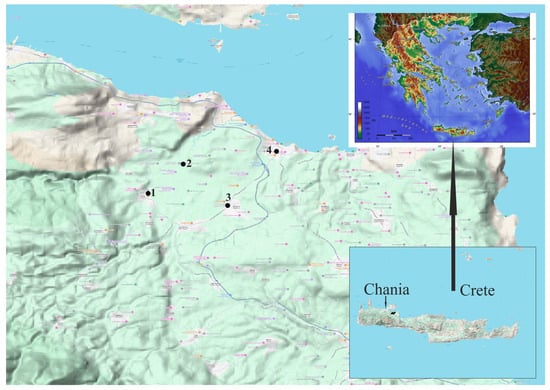
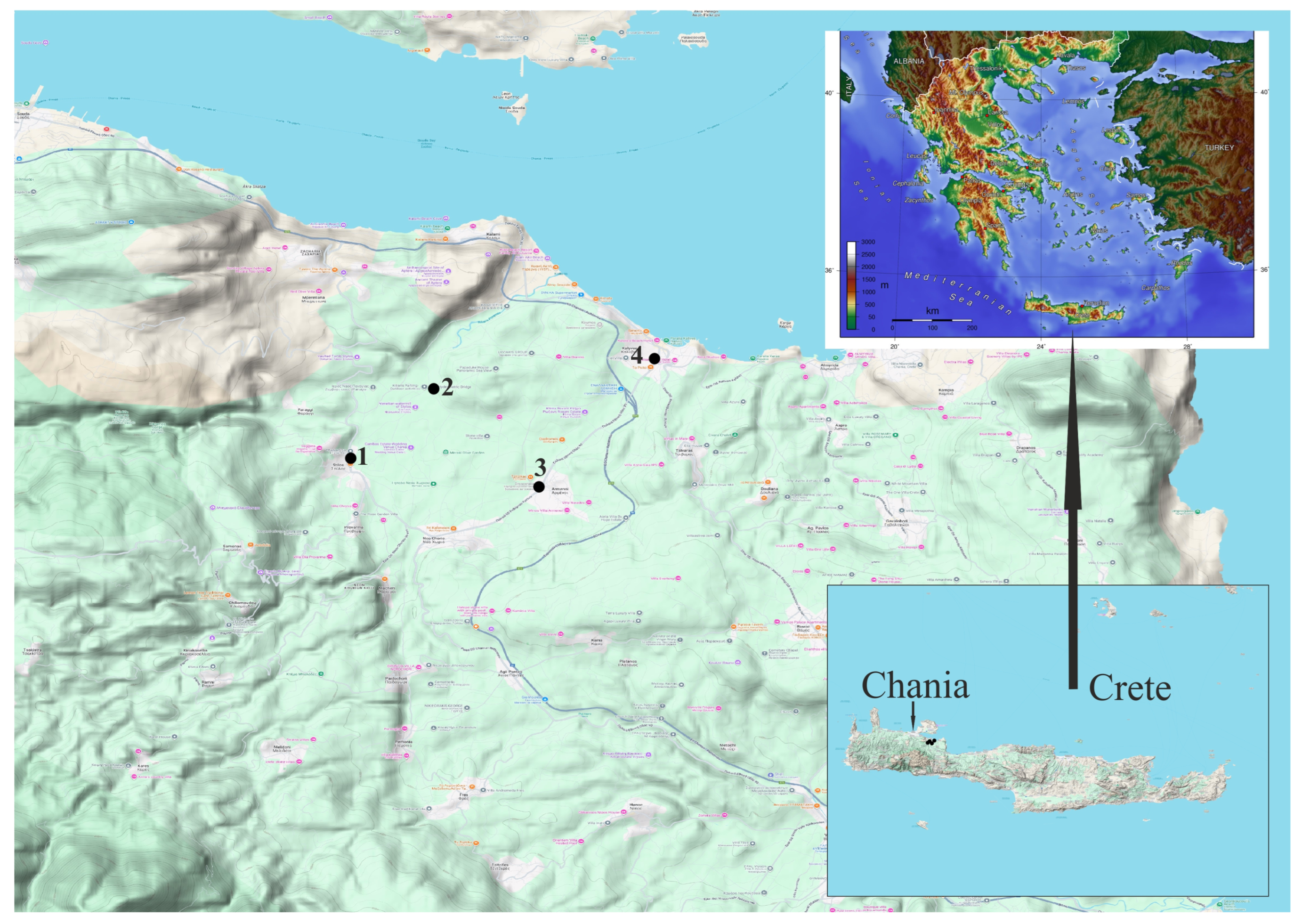
Sampling was conducted in 2025 at four sites within the Koiliaris River Basin CZO, selected to represent contrasting hydrobiological source areas as documented in previous studies (Figure 1). Collectively, the sites capture a gradient from groundwater-dominated spring sources to mixing zones and spring-fed waters within villages, thereby providing an ideal setting for tracing nitrogen pathways (spring source → confluence/mixing point → settlement-influenced spring reaches). Stylos spring is a perennial karst spring providing permanent discharge throughout the year [9] and represents a groundwater-dominated headwater habitat. The spring is also used for drinking-water production, with water bottled under the brand name “Samaria”. Agios Georgios is a hydrological and water-quality monitoring station located at the junction of the Stylos and Keramianos streams and reflects mixing of spring water with tributary inputs. Armeni spring, located near the village of Armeni, is also monitored for water quality and represents another spring-fed reach influenced by surrounding land use. Zourpos spring, situated in the village of Kalives, represents spring-fed waters in a more densely populated setting. This spatial design supports evaluation of bryophytes and benthic macroinvertebrates as ecosystem response indicators and provides evidence relevant to the management of karst spring systems used as drinking-water sources.
Figure 1.
Location of the studied sites: 1—Stylos Spring, Water Quality Station at the center of Stylos village; 2—Agios Georgios, Hydrological/Water Quality Station at the junction of Stylos Karst Springs and Keramianos; 3—Armenoi Spring, Water Quality Station at Armeni village next to the church of the Assumption, 4—Zourpos Spring, Water Quality Station at Kalives village.
2.2. Field Survey and Additional Data Acquisition
The study followed a pilot-scale cross-sectional design. At each of the four sites, one composite sample per environmental matrix (water, sediment, aquatic bryophytes, and macroinvertebrates) was collected in July 2025. The sampling design was exploratory in nature and aimed at identifying potential patterns in nitrogen distribution among matrices rather than testing predefined statistical hypotheses. Thus the sampling campaign was designed to allow direct comparison of total nitrogen (TN) across abiotic (water, sediments) and biotic (mosses, macroinvertebrates) matrices, thereby supporting the tracing of nitrogen pathways and the evaluation of ecosystem response indicators relevant to biodiversity patterns in spring-fed rivers within populated landscapes. Basic physicchemical parameters—water temperature, pH, electrical conductivity, and dissolved oxygen (Table 2)—were measured in situ using a WTW multiparameter meter (Profiline Multi 3320, WTW, Weilheim, Germany).
Table 2.
Coordinates of the sampling site and basic physico-chemical parameters. Legend: T—Temperature; EC—electrical conductivity; DO—Dissolved Oxygen.
2.3. Analysis of Total Nitrogen
Total nitrogen was selected as an integrative metric capturing both dissolved and particulate nitrogen pools relevant for biotic uptake. Water samples were collected in Nalgene bottles (Thermo Fisher Scientific, Waltham, MA, USA), stored at 4 °C, transferred to laboratory and filtered through Whatman® (Cytiva, Marlborough, MA, USA) qualitative grade 4 papers to remove coarse particles and gelatinous precipitates.
Sediment samples were collected as composite surface samples (0–5 cm depth) from multiple points within the dominant depositional area at each site. Approximately 300–500 g of homogenized material per site were placed in clean polyethylene bags and transported to the laboratory for subsequent nitrogen analysis.
Representative bryophyte samples consisting of 5 to 10 subsamples were collected at each site, depending on stream width and the spatial heterogeneity (“patchiness”) of the selected biomonitor assemblages [10]. Bryophytes were identified to species level under a light microscope, and nomenclature followed Hill et al. [11]. In the field, samples were briefly washed in the stream to remove admixtures. In the laboratory, they were further cleaned of mineral and organic particles, oven-dried to constant weight, homogenized, and subsequently analyzed for total nitrogen.
Benthic macroinvertebrates were collected using a hand net (250 μm mesh size) by kick sampling over an area of approximately 1 m2 at each site, following the multi-habitat approach [12,13] and according to the ISO 5667-3:2024 [14]. Sampling effort was proportional to the relative abundance of available microhabitats (e.g., cobbles, gravel, macrophyte patches). Samples were rinsed in situ to remove sediment and coarse debris and preserved in 70% ethanol for laboratory analysis. In the laboratory, individuals were sorted under a stereomicroscope and identified to family or genus level. All collected individuals per site were pooled to obtain a single composite sample for nitrogen analysis.
Total nitrogen was analyzed in water, sediment and biota (aquatic mosses and macroinvertebrates) with a multi N/C 2100S Reactor (N/C elemental analyzer, Analytik Jena, Jena, Germany). In water samples the analyzer converted nitrogen content to nitrogen monoxide (NO) using combustion (800 °C) in the presence of platinum (Pt) catalyst and oxygen (O2). Quantification of nitrogen was achieved with a chemiluminescence detector (CLD) and a calibration curve created with analysis of potassium nitrate (KNO3), ammonium sulfate ((NH4)2SO4) and και ethylenediaminetetraacetic acid (EDTA) over a concentration range of 0.1–10 mg/L. Calibration linearity was high (R2 > 0.99), and the method detection limit for total nitrogen was 0.05 mg/L.
Sediments, aquatic mosses and macroinvertebrates were dried at 75 °C and micronized prior to the analysis in order to remove humidity and increase reaction surface. Combustion was carried out at 650 °C. From each sample 8–15 mg (sediments) or 0.5–2 mg (biota) were weighed inside quartz cups, using a five-figure KERN ABT 120-5DNM balance and loaded into the furnace. Each sample was analyzed as triplicate while every 5 samples (15 runs) a blank was run in order to avoid instrumental drifts. The analytical precision was estimated at 5% relative standard deviation (RSD). The concentrations are presented in g/kg dry weight.
2.4. Statistical Analysis
Exploratory analyses were used to examine potential associations between total nitrogen (TN) concentrations in abiotic (water, sediments) and biotic (mosses, macroinvertebrates) matrices. Ordination analysis using Principal Component Analysis (PCA) was performed in CANOCO 5 [15] as an exploratory approach to visualize patterns in TN distribution across environmental matrices. Prior to analysis, values were standardized. Multiple regression analysis was applied using Statistica 12 software [16]. Mean TN values per site were used as input variables, based on one composite sample per compartment at each site. Given the pilot-scale design and the limited number of independent observations (n = 4 sites), the analysis was intended solely to explore the direction of associations rather than to support statistical inference.
3. Results
3.1. Water Characteristics
The studied running waters were slightly alkaline (pH 7.8–8.2) and generally showed medium electrical conductivity, with the exception of Zourpos, where conductivity was markedly higher (1526 μS/cm). Dissolved oxygen concentrations were consistently high across all sites (9.0–11.1 mg/L) (Table 2).
3.2. Biota Indicators
Hygroamblystegium tenax (Hedw.) Jenn. dominated aquatic macrophyte assemblages at Stylos, Agios Georgios and Armenoi, while Cinclidotus fontinaloides (Hedw.) P.Beauv. was dominant at the Zourpos spring. Across all sites, aquatic mosses were abundant and typical of cold, spring-fed river reaches. Total nitrogen concentrations in moss tissues ranged from 16.9 to 20.4 g/kg. Sites dominated by H. tenax (Stylos, Agios Georgios, Armenoi) showed comparable moss nitrogen levels (16.9–20.4 g/kg), while a similar concentration (20.0 g/kg) was recorded at Zourpos spring, where C. fontinaloides was dominant. Overall, total nitrogen in moss tissues showed limited variation across sites despite differences in nitrogen concentrations in water and sediments.
Macroinvertebrate assemblages showed site-specific differences rather than a clear longitudinal (upstream–downstream) gradient within the Koiliaris River Basin. This reflects the study design, as the sites represent discrete spring-fed sources and mixing zones rather than sequential reaches along a single river continuum. Tissue nitrogen was determined from composite samples including all collected macroinvertebrate taxa at each site. Sensitive EPT taxa (Ephemeroptera, Plecoptera, Trichoptera) occurred mainly at Agios Georgios and Armenoi, where Protonemura sp., Leuctra sp., and Glossosomatidae sp. were recorded together with relatively low tissue nitrogen content (29.8–30.5 g/kg). These sites represent cold, well-oxygenated and relatively undisturbed habitats with low nutrient availability. In contrast, gastropods—particularly Theodoxus sp. (Neritidae) and family Hydrobiidae, together with Gammarus sp. (Amphipoda), were abundant at all sites and formed the structural core of the benthic community. At Stylos, several Trichoptera families (Glossosomatidae, Limnephilidae, Sericostomatidae/Goeridae) were recorded, in addition to abundant Gammarus sp., family Hydrobiidae, and Theodoxus sp., but tissue nitrogen content in biota was elevated (44.5 g/kg). This taxonomic composition is indicative of a stable karstic substrate with moderate nutrient enrichment. In contrast, Zourpos displayed a poorer community dominated by Gammarus sp., Hydrobiidae and Neritidae families, with the absence of sensitive EPT taxa. The highest nitrogen concentration in biota (47.1 g/kg) was registered (Table 3).
Table 3.
Total nitrogen content in four matrices. The values represent mean concentrations; analytical precision was ±5% (RSD). * One composite sample per matrix collected at each site; each sample analyzed in triplicate in the laboratory.
3.3. Comparison Between Matrices
Total nitrogen (TN) concentrations varied among sampling sites and across the four sampled matrices (Table 3). In water, TN levels were relatively low, ranging from 0.9 mg/L at Agios Georgios to 1.4 mg/L at Zourpos. In sediments, TN ranged from 0.2 to 1.1 g/kg, with the highest value recorded at Agios Georgios. TN content in moss tissues showed limited variation among sites (16.9–20.4 g/kg), but was several orders of magnitude higher than dissolved nitrogen in water, while exceeding sediment nitrogen concentrations by approximately one order of magnitude. Macroinvertebrates exhibited the highest TN concentrations overall (29.8 to 47.1 g/kg), with the maximum observed at Zourpos. Nitrogen concentrations in water, moss, and macroinvertebrates were highest at Zourpos, while Stylos showed the second-highest values.
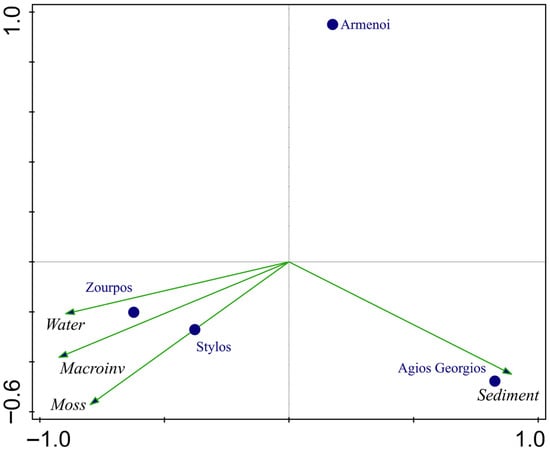
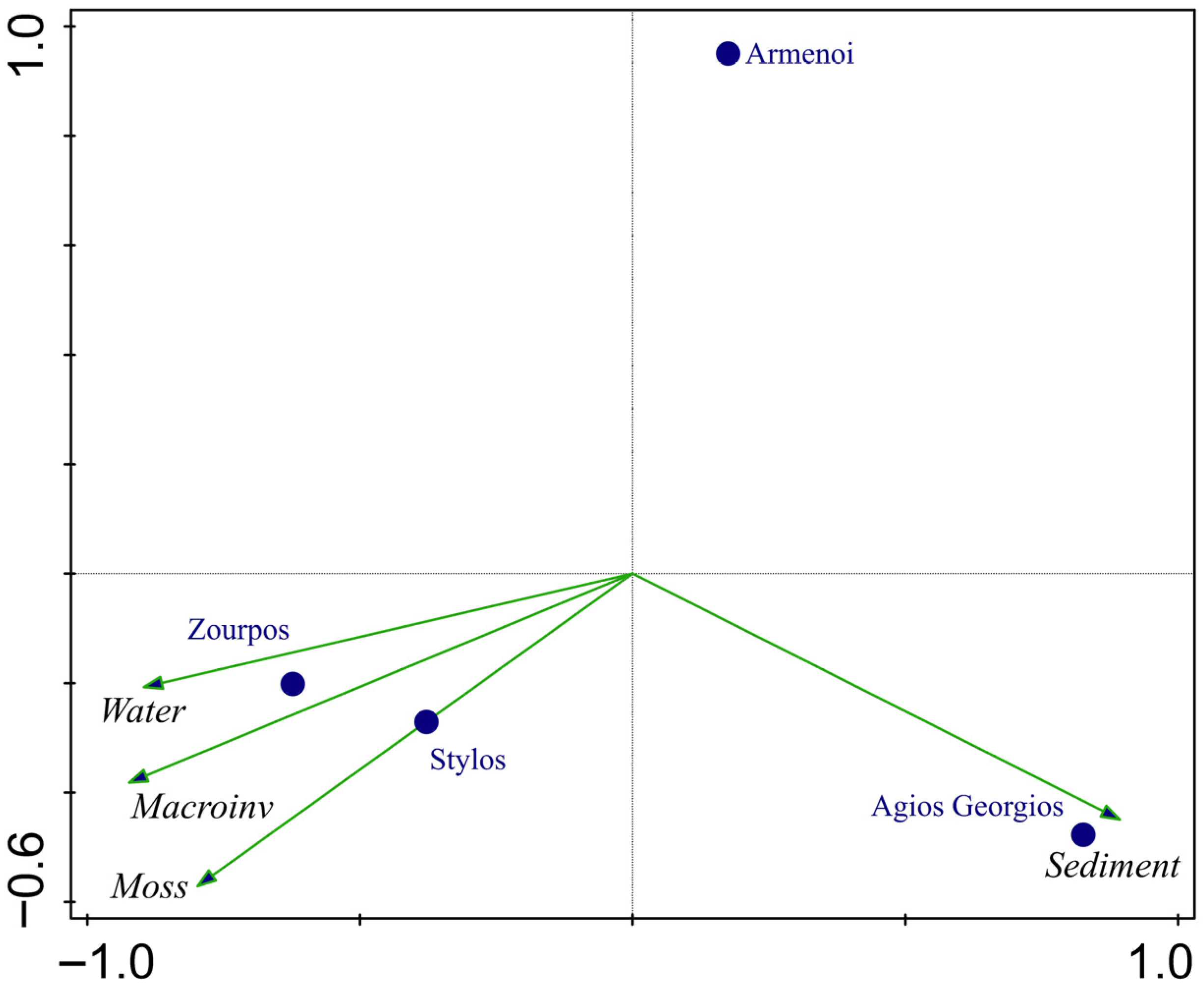
Principal Component Analysis (PCA) based on standardized TN concentrations revealed a clear separation between sediment TN and the other matrices (water, mosses, macroinvertebrates) along the first ordination axis (Figure 2). Water and biotic matrices showed similar orientation, suggesting closer coupling between dissolved nitrogen and tissue nitrogen across sites. Sediment TN displayed a distinct pattern, indicating comparatively weaker alignment with biotic compartments. Site scores reflected spatial variability, with Agios Georgios associated with sediment TN and Armenoi separated primarily along the second axis.
Figure 2.
Principal Component Analysis (PCA) based on standardized total nitrogen (TN) concentrations in water, sediments, aquatic mosses, and benthic macroinvertebrates across four spring-fed sites. Vectors represent TN.
Exploratory regression analyses suggested consistent directional associations between TN in water and biotic matrices, whereas relationships involving sediments were weak or inconsistent Directional alignment was observed between water TN and biotic TN, while no consistent trends were evident for sediment-related associations. None of the relationships were statistically significant.
4. Discussion
Similar average values of pH, electrical conductivity (EC), and dissolved oxygen (DO) for the Koiliaris streams during 2010–2019 were reported by Lilli et al. [3], indicating generally stable hydrochemical conditions over time. Such stability is typical of spring-fed karst systems and provides a useful baseline for interpreting spatial patterns in nitrogen exposure as signals of changing source contributions rather than short-term physicochemical fluctuations. In the present study, the sites formed a coherent hydrochemical group with generally low nutrient concentrations; however, Zourpos Spring deviated from this pattern, showing markedly higher EC due to seawater intrusion. This site therefore represents a distinct hydrochemical end-member within a populated coastal setting, with implications for aquatic habitat conditions and local water quality context.
Our results revealed spatial variability in nitrogen accumulation among sites and differences in TN retention across environmental matrices, providing preliminary evidence of site-specific nitrogen patterns within the basin. Sediments represent an important nitrogen storage compartment, and reported TN values from other river systems (e.g., 0.36 g/kg upstream and 0.48 g/kg downstream in the Wuding River Basin, China [17]) are comparable to those observed at most Koiliaris sites (0.23–0.34 g/kg). In contrast, Agios Georgios (Site 2) exhibited substantially elevated sediment TN (1.14 g/kg), exceeding values reported for sediments in the Taipu River (0.555 g/kg), a system influenced by aquaculture and croplands [18]. The elevated sediment TN at Site 2 points to localized nitrogen inputs and enhanced retention, potentially associated with diffuse agricultural runoff, livestock activity, and/or nitrogen-enriched groundwater inflow at the confluence zone. These findings highlight how hydrological mixing areas within spring-fed river networks can function as nitrogen accumulation hotspots, with potential implications for downstream habitat quality and restoration prioritization.
Hygroamblystegium tenax has been reported from Crete, e.g., [19,20], whereas C. fontinaloides is well documented from mainland Greece [21] but has not, to our knowledge, been previously reported from Crete. Hygroamblystegium tenax typically occurs in calcareous river reaches and has been associated with relatively low nutrient conditions [22]. In contrast, C. fontinaloides exhibits broad ecological tolerance [23], consistent with its occurrence at Zourpos, the site showing highest nitrogen levels in three of the four sampled matrices.
Nitrogen is an essential macronutrient in bryophytes, required for amino acid, chlorophyll, and hormone synthesis, and may stimulate growth under moderate enrichment; however, excessive nitrogen can reduce growth [24]. In the present study, TN concentrations in moss tissues (up to 2.04%) were below the 3.1% reported for Fontinalis antipyretica at an undisturbed reference site [5]. To our knowledge, published data on TN content in tissues of H. tenax or C. fontinaloides are not available. Previous studies have mainly considered these species as indicators along nitrogen or trophic gradients [23,25], typically linking species occurrence to water chemistry rather than to tissue nitrogen concentrations. The mean tissue TN measured here (18.7 g/kg) was comparable to the average value reported for mosses along the Maritsa River, Bulgaria (19.224 g/kg) [26], supporting earlier findings that nitrogen tends to exhibit relatively low variability across bryophyte taxa. This limited variation suggests that tissue TN in aquatic mosses may provide a robust, time-integrated measure of nitrogen exposure across sites, complementing spot water measurements in spring-fed river networks. Therefore, aquatic moss tissue TN can support pathway tracing by integrating dissolved nitrogen exposure over time, offering an ecosystem response indicator relevant for habitat assessment in populated karst spring systems.
Macroinvertebrate community composition was consistent with known biodiversity patterns in karst rivers of Crete. Gammaridae and Hydrobiidae families are widely distributed across the Mediterranean and frequently dominate assemblages in karst streams [27,28]. Small water snails of the genus Theodoxus are typical of hardwater springs and limestone streams, and recent molecular evidence indicates that Cretan populations belong to T. fluviatilis [28]. The occurrence of Protonemura and Leuctra corresponds to the limited distribution of cold-stenothermic Plecoptera taxa in southern Greece [29,30]. In addition, the Trichoptera families recorded here (Glossosomatidae, Limnephilidae, Sericostomatidae/Goeridae) have been documented in western Crete [31] and are typically associated with well-oxygenated, pristine karst headwaters. The presence of these sensitive taxa provides evidence of high habitat quality at spring-fed sites and supports their use as biodiversity-based ecosystem response indicators in karst river networks subject to multiple pressures.
Nitrogen is essential for protein and chitin synthesis in aquatic invertebrates and supports key metabolic processes [32]. Excess nitrogen availability, however, can alter community composition by favoring tolerant taxa. In the present study, macroinvertebrate tissue nitrogen ranged from 29.8 to 47.1 g/kg, with the highest values recorded at Zourpos. Notably, Zourpos also exhibited the lowest taxonomic richness, with benthic community dominated by a small number of tolerant groups and an absence of sensitive Insecta taxa. Beck et al. [33] reported particularly high and variable nitrogen content in insects compared to other taxonomic groups, suggesting that Insecta may be more susceptible to N-limitation and stoichiometrically driven shifts in community structure than other taxa, even under intermediate nutrient conditions [7]. At Zourpos, only three tolerant families were consistently recorded—Gammaridae (Amphipoda), Neritidae, and Hydrobiidae (Gastropoda)—indicating a simplified community structure compared to upstream sites. This pattern is consistent with enhanced nitrogen accumulation within the benthic food web and potential influence of nutrient-enriched groundwater and/or seawater intrusion in the coastal zone. The observed increase in tissue nitrogen content, combined with reduced taxonomic richness, suggests moderate nutrient enrichment and altered habitat conditions that favor tolerant taxa over sensitive assemblages. Similar patterns have been reported from the karstic Loue River (France), where Frossard et al. [2] documented enhanced nitrogen accumulation in water and biota linked to nutrient-rich groundwater and altered trophic transfer. Although nitrogen dynamics in karst rivers have been studied previously [2,27,34,35], most research has focused on water chemistry rather than nitrogen incorporation in benthic organisms. Our findings therefore add evidence of nitrogen accumulation in macroinvertebrates in Mediterranean karst catchments and highlight the close coupling between trophic status and community composition. From a management perspective, the sensitivity of coastal spring-fed sites to nutrient inputs and seawater intrusion underscores the need to integrate biological indicators with water-quality monitoring to support both habitat conservation and drinking-water risk assessment in populated karst landscapes.
The observed patterns are consistent with waterborne nitrogen representing the dominant exposure pathway for aquatic biota in the studied streams. The standardized coefficients suggested positive associations between water TN and TN in moss tissues (b* = 0.78) and macroinvertebrates (b* = 0.83), indicating a potential linkage between dissolved nitrogen and its accumulation in primary producers and consumers. In contrast, coefficients involving sediments were low or negative, suggesting limited alignment between sedimentary nitrogen and nitrogen incorporated into biota at the site scale in this pilot dataset. Nevertheless, recent research has shown that particulate nitrogen associated with sediments can represent a potentially bioavailable nitrogen pool, as solubilization and organic matter mineralization processes may generate dissolved inorganic nitrogen under aquatic certain environmental conditions [36]. None of the relationships were statistically significant (p > 0.05), most likely due to the limited sample size (n = 4); therefore, these results should be interpreted as pilot-scale trends rather than conclusive evidence. However, the consistent direction and magnitude of coefficients supports the hypothesis of dominance of dissolved nitrogen over sedimentary sources in shaping nitrogen transfer within the aquatic food web. This interpretation is supported by previous work on Rhynchostegium riparioides, where the elemental composition of moss tissues was shown to depend strongly on the chemical characteristics of the surrounding water and to follow linear relationships for both intracellular and exchangeable elements [37]. From a management perspective, such patterns highlight the relevance of controlling dissolved nitrogen sources in spring-fed waters draining populated landscapes, with implications for habitat conditions and environmental assessment in populated karst landscapes.
The dominance of tolerant C. fontinaloides and simplified and tolerant macroinvertebrate community observed at Zourpos, together with elevated nitrogen levels and seawater intrusion, highlights the vulnerability of coastal spring-fed reaches in populated landscapes. Such patterns suggest that nitrogen enrichment and salinity-related stressors may co-occur in downstream spring-fed habitats, with implications for biodiversity conservation and the prioritization of restoration actions. Although statistical significance was not achieved due to the limited sample size, the magnitude and direction of standardized coefficients suggest potentially ecologically relevant tendencies, which require validation in larger datasets. These findings emphasize the importance of considering hydrological connectivity and dissolved nutrient pathways when interpreting ecosystem responses in karst river networks, particularly where spring waters are simultaneously key freshwater resources. Understanding how nitrogen influences water quality is important for informing environmental assessment and management discussions [38]. Given the predicted sensitivity of nitrogen dynamics to hydroclimatic variables, improving our understanding of these processes is particularly relevant in the context of global climate change [25].
5. Conclusions
This pilot-scale exploratory study integrated abiotic and biotic measurements to examine nitrogen distribution across spring-fed karst rivers in populated Mediterranean landscapes. Spatial variability in total nitrogen among water, sediments, mosses, and macroinvertebrates revealed site-specific patterns with closer coupling between dissolved nitrogen and biotic compartments, while sedimentary nitrogen showed weaker alignment at the site scale. The presence of sensitive aquatic moss and EPT taxa and lower tissue nitrogen at upstream spring-fed sites was consistent with conditions typically associated with higher ecological quality in spring-fed systems. These preliminary results suggest that aquatic mosses and benthic macroinvertebrates may act as time-integrated indicators of nitrogen exposure, complementing routine water chemistry. Although constrained by limited spatial and temporal replication, the study provides an exploratory framework to guide future investigations aimed at improving the assessment of nitrogen dynamics in karst river systems.
Author Contributions
Conceptualization, G.G. and E.V.; software, G.G.; validation, A.G., V.T. and M.-L.S.; investigation, G.G. and E.V.; resources, N.N.; data curation, S.V., V.T. and G.G.; writing—original draft preparation, G.G. and V.T.; writing—review and editing, E.V., A.G. and N.N.; visualization, G.G.; supervision, E.V., A.G. and N.N.; project administration, G.G. and N.N.; funding acquisition, G.G., E.V. and N.N. All authors have read and agreed to the published version of the manuscript.
Funding
This work has received financial support by the H2020 project eLTER PLUS, GA 871128 and acknowledges support from Technical University of Crete of the site LTSER Platform Koiliaris Critical Zone Observatory, https://deims.org/65d7bf15-841a-4fb7-a36e-6f4d95a8d64e, accessed on 3 March 2026, and by the National Roadmap for Research Infrastructure, coordinated by the Ministry of Education and Science of the Republic of Bulgaria through agreement DO1-320/23.11.2023 (LTER-BG).
Data Availability Statement
The original contributions presented in this study are included in the article. Further inquiries can be directed to the corresponding author.
Conflicts of Interest
The authors declare no conflicts of interest.
Abbreviations
The following abbreviations are used in this manuscript:
| CLD | Chemiluminescence detector |
| CZO | Critical Zone Observatory |
| DO | Dissolved oxygen |
| EC | Electrical conductivity |
| EDTA | Ethylenediaminetetraacetic acid |
| EPT | Ephemeroptera, Plecoptera, Trichoptera |
| ISO | International Organization for Standardization |
| TN | Total nitrogen |
References
- Smucker, N.J.; Kuhn, A.; Cruz-Quinones, C.J.; Serbst, J.R.; Lake, J.L. Stable isotopes of algae and macroinvertebrates in streams respond to watershed urbanization, inform management goals, and indicate food web relationships. Ecol. Indic. 2018, 90, 295–304. [Google Scholar] [CrossRef] [Scilit] [PubMed]
- Frossard, V.; Aleya, L.; Vallet, A.; Henry, P.; Charlier, J.-B. Impacts of nitrogen loads on the water and biota in a karst river (Loue River, France). Hydrobiologia 2020, 847, 2433–2448. [Google Scholar] [CrossRef] [Scilit]
- Lilli, M.A.; Efstathiou, D.; Moraetis, D.; Schuite, J.; Nerantzaki, S.D.; Nikolaidis, N.P. A multi-disciplinary approach to understand hydrologic and geochemical processes at Koiliaris Critical Zone Observatory. Water 2020, 12, 2474. [Google Scholar] [CrossRef] [Scilit]
- Liu, S.; Ma, A.; Hu, Y.; Cao, M.; Deng, Y. Adsorption mechanisms of nitrogen and phosphorus by river sediments: Patterns, differences, and mechanisms of ammonium (NH4+) and phosphate (PO43−) adsorption under the influence of sediment concentration. Environ. Sci. Eur. 2026, 38, 27. [Google Scholar] [CrossRef] [Scilit]
- Carballeira, C.; Carballeira, A.; Aboal, J.R.; Fernández, J.A. Biomonitoring freshwater fish farms by measuring nitrogen concentrations and the δ15N signal in living and devitalized moss transplants. Environ. Pollut. 2019, 245, 1014–1021. [Google Scholar] [CrossRef] [Scilit]
- Martín, A.; Corbera, J.; Cano, O.; Preece, C.; Peñuelas, J.; Sabater, F.; Fernández-Martínez, M. The influence of nitrate pollution on elemental and isotopic composition of aquatic and semi-aquatic bryophytes. Aquat. Bot. 2024, 190, 103710. [Google Scholar] [CrossRef] [Scilit]
- Beck, M.; Billoir, E.; Usseglio-Polatera, P.; Meyer, A.; Gautreau, E.; Danger, M. Effects of water nutrient concentrations on stream macroinvertebrate community stoichiometry: A large-scale study. Peer Community J. 2024, 4, e69. [Google Scholar] [CrossRef] [Scilit]
- Moraetis, D.; Nikolaidis, N.P.; Schnoor, J.L.; Stamati, F.; Paranychianakis, N.; Banwart, S. Hydrological, geochemical and soil characteristics of the Koiliaris River Basin (Crete, Greece) within the SoilTrEC Critical Zone Observatory network. In SoilTrEC: A Review of Critical Zone Research in Europe; Chapter 2; Banwart, S., Menon, M., Bernasconi, S.M., Bloem, J., Blum, W.E.H., de Souza, D.M., Eds.; Springer: Cham, Switzerland, 2015. [Google Scholar]
- Nerantzaki, S.D.; Nikolaidis, N.P. The response of three Mediterranean karst springs to drought and the impact of climate change. J. Hydrol. 2020, 591, 125296. [Google Scholar] [CrossRef] [Scilit]
- Bowden, W.B.; Glime, J.M.; Riis, T. Macrophytes and bryophytes. In Methods in Stream Ecology, 3rd ed.; Hauer, F.R., Lamberti, G.A., Eds.; Academic Press: Cambridge, MA, USA, 2017; Volume 1, pp. 243–271. [Google Scholar]
- Hill, M.O.; Bell, N.; Bruggeman-Nannenga, M.A.; Brugués, M.; Cano, M.J.; Enroth, J.; Flatberg, K.I.; Frahm, J.-P.; Gallego, M.T.; Garilleti, R.; et al. An annotated checklist of the mosses of Europe and Macaronesia. J. Bryol. 2006, 28, 198–267. [Google Scholar] [CrossRef] [Scilit]
- AQEM Consortium. Manual for the Application of the AQEM System: A Comprehensive Method to Assess European Streams Using Benthic Macroinvertebrates, Developed for the Purpose of the Water Framework Directive; Version 1.0; AQEM Consortium: Vienna, Austria, 2002. [Google Scholar]
- Cheshmedjiev, S.; Soufi, R.; Vidinova, Y.; Tyufekchieva, V.; Yaneva, I.; Uzunov, Y.; Varadinova, E. Multi-habitat sampling method for benthic macroinvertebrate communities in different river types in Bulgaria. Water Res. Manag. 2011, 1, 55–58. [Google Scholar]
- ISO 5667-3:2024; Water Quality—Sampling—Part 3: Preservation and Handling of Water Samples. International Organization for Standardization: Geneva, Switzerland, 2024.
- ter Braak, C.J.F.; Šmilauer, P. Canoco Reference Manual and User’s Guide: Software for Ordination (Version 5.0); Microcomputer Power: Ithaca, NY, USA, 2012. [Google Scholar]
- StatSoft Inc. STATISTICA (Data Analysis Software System), Version 12; StatSoft Inc.: Tulsa, OK, USA, 2013.
- Xia, M.; Xue, N.; Hu, B.; Gong, X.; Wang, Z.; Zhao, X. The sources and influencing factors of dissolved organic carbon under high-sediment environments—A case from Wuding River Basin. Front. Environ. Sci. 2025, 13, 1631894. [Google Scholar] [CrossRef] [Scilit]
- Huang, J.; Tian, F.; Huang, Y.; Tao, H.; Li, F. Sediment legacy of aquaculture drives endogenous nitrogen pollution and water quality decline in the Taipu River–Lake system. Water 2025, 17, 2000. [Google Scholar] [CrossRef] [Scilit]
- Euro+Med PlantBase. Euro+Med PlantBase—The Information Resource for Euro-Mediterranean Plant Diversity. Available online: http://www.europlusmed.org (accessed on 15 December 2025).
- Papp, B. Investigation of the bryoflora of some streams in Greece. Stud. Bot. Hung. 1999, 29, 59–67. [Google Scholar]
- Blockeel, T.L. The bryophytes of Greece: New records and observations. J. Bryol. 1991, 16, 629–640. [Google Scholar] [CrossRef] [Scilit]
- Khadija, S.; Francis, R.; Bernard, T. Trend analysis in ecological status and macrophytic characterization of watercourses: Case of the Semois-Chiers Basin, Belgium Wallonia. J. Water Resour. Prot. 2015, 7, 988–1000. [Google Scholar] [CrossRef]
- Rimac, A.; Alegro, A.; Šegota, V.; Vuković, N.; Koletić, N. Ecological preferences and indication potential of freshwater bryophytes—Insights from Croatian watercourses. Plants 2022, 11, 3451. [Google Scholar] [CrossRef] [Scilit]
- Koranda, M.; Kerschbaum, S.; Wanek, W.; Zechmeister, H.A.; Richter, A. Physiological responses of bryophytes Thuidium tamariscinum and Hylocomium splendens to increased nitrogen deposition. Ann. Bot. 2007, 99, 161–169. [Google Scholar] [CrossRef] [Scilit]
- Simmel, J.; Ahrens, M.; Poschlod, P. Ellenberg N values of bryophytes in Central Europe. J. Veg. Sci. 2021, 32, e12957. [Google Scholar] [CrossRef] [Scilit]
- Yurukova, L.; Gecheva, G. Biomonitoring in Maritsa River using aquatic bryophytes. Environ. Prot. Ecol. 2004, 5, 729–735. [Google Scholar]
- Evtimova, V.; Tyufekchieva, V.; Varadinova, E.; Vidinova, Y.; Ihtimanska, M.; Georgieva, G.; Todorov, M.; Soufi, R. Macroinvertebrate communities of sub-Mediterranean intermittent rivers in Bulgaria: Association with environmental parameters and ecological status. Ecol. Balkanica 2021, 4, 49–64. [Google Scholar]
- Georgopoulou, E. An annotated checklist of the freshwater molluscs (Gastropoda, Bivalvia) of Crete, Greece. Folia Malacol. 2025, 33, 47–63. [Google Scholar] [CrossRef] [Scilit]
- Zwick, P. Plecoptera (Stoneflies). In The Aquatic Insects of North Europe: A Taxonomic Handbook; Nilsson, A.N., Ed.; Apollo Books: Stenstrup, Denmark, 1992; Volume 1, pp. 163–200. [Google Scholar]
- Graf, W.; Murphy, J.; Dahl, J.; Zamora-Muñoz, C.; López-Rodríguez, M.J. Distribution and Ecological Preferences of European Freshwater Organisms. Volume 1: Trichoptera; Pensoft Publishers: Sofia, Bulgaria; Moscow, Russia, 2008; 388p. [Google Scholar]
- Malicky, H. Ein kommentiertes Verzeichnis der Köcherfliegen (Trichoptera) Griechenlands. Linzer Biol. Beitr. 2005, 37, 533–596. [Google Scholar]
- Anderson, W.B.; Polis, G.A. Marine subsidies of island communities in the Gulf of California: Evidence from stable carbon and nitrogen isotopes. Oikos 1998, 81, 75–80. [Google Scholar] [CrossRef] [Scilit]
- Beck, M.; Billoir, E.; Felten, V.; Meyer, A.; Usseglio-Polatera, P.; Danger, M. A database of West European headwater macroinvertebrate stoichiometric traits. Glob. Ecol. Biogeogr. 2022, 31, 4–9. [Google Scholar] [CrossRef] [Scilit]
- Bonada, N.; Rieradevall, M.; Prat, N. Macroinvertebrate community structure and biological traits related to flow permanence in a Mediterranean river network. Hydrobiologia 2007, 589, 91–106. [Google Scholar] [CrossRef] [Scilit]
- Varadinova, E.; Gecheva, G.; Tyufekchieva, V.; Milkova, T. Macrophyte- and macrozoobenthic-based assessment in rivers: Specificity of the response to combined physico-chemical stressors. Water 2023, 15, 2282. [Google Scholar] [CrossRef] [Scilit]
- Garzon-Garcia, A.; Burton, J.M.; Ellis, R.; Askildsen, M.; Bloesch, P.; De Hayr, R.; Moody, P. The bioavailability of particulate nitrogen in eroded sediment: Catchment sources and processes. J. Soil Sediments 2024, 24, 1402–1419. [Google Scholar] [CrossRef] [Scilit]
- García-Álvaro, M.A.; Martínez-Abaigar, J.; Núñez-Olivera, E.; Beaucourt, N. Element concentrations and enrichment ratios in the aquatic moss Rhynchostegium riparioides along the River Iregua (La Rioja, Northern Spain). Bryologist 2000, 103, 518–533. [Google Scholar] [CrossRef] [Scilit]
- Basu, N.B.; Van Meter, K.J.; Byrnes, D.K.; Van Cappellen, P.; Brouwer, R.; Jacobsen, B.H.; Jarsjö, J.; Rudolph, D.L.; Cunha, M.C.; Nelson, N.; et al. Managing nitrogen legacies to accelerate water quality improvement. Nat. Geosci. 2022, 15, 97–105. [Google Scholar] [CrossRef] [Scilit]

Disclaimer/Publisher’s Note: The statements, opinions and data contained in all publications are solely those of the individual author(s) and contributor(s) and not of MDPI and/or the editor(s). MDPI and/or the editor(s) disclaim responsibility for any injury to people or property resulting from any ideas, methods, instructions or products referred to in the content. |
© 2026 by the authors. Licensee MDPI, Basel, Switzerland. This article is an open access article distributed under the terms and conditions of the Creative Commons Attribution (CC BY) license.