Article

Sustainable Metal Recovery from Untreated Mining Tailings by Direct Electrodeposition Under Different Current Densities


by
Joaquin Aburto-Hole
1,2,
Pablo I. R. Pincheira
3,
Pablo Acuna
4,
Lina Uribe
5,6,
Diego Contreras Bilbao
7 and
Diógenes Hernández
2,8,*
1
Engineering Doctoral Program, Faculty of Engineering, Universidad de Talca, Curicó 3340000, Chile
2
Environmental Laboratory of Gases and Biofuels (LAGBIO), Universidad de Talca, Curicó 3340000, Chile
3
Department of Physical Sciences, Universidad de La Frontera, Temuco 4780000, Chile
4
Department of Electrical Engineering, Faculty of Engineering, Universidad de Talca, Curicó 3340000, Chile
5
Department of Mining Engineering, Universidad de Talca, Curicó 3340000, Chile
6
Water Resources Center for Agriculture and Mining (CRHIAM), Universidad de Concepción, Concepción 4030000, Chile
7
Facultad de Ingeniería, Universidad de Concepción, Concepción 4030000, Chile
8
Department of Industrial Technologies, Faculty of Engineering, Universidad de Talca, Curicó 3340000, Chile
*
Author to whom correspondence should be addressed.
Environments 2026, 13(3), 135; https://doi.org/10.3390/environments13030135
Submission received: 22 January 2026 / Revised: 18 February 2026 / Accepted: 18 February 2026 / Published: 1 March 2026

Abstract

Mining tailings are waste generated continuously in large quantities and have accumulated over time, posing significant environmental challenges. This study evaluates the influence of low (MinPC) and high (MaxPC) current densities on the recovery of elements from untreated mining tailings obtained from SCM Paicaví by electrodeposition. To define both conditions, tailings were placed in containers with electrodes spaced 3–18 cm apart, and controlled currents of 1–100 mA were applied. Although MaxPC electrodes recovered a greater mass of material (1.51 g) than MinPC (0.22 g), the latter achieved higher enrichment of elements such as Ni and Mn. Under MinPC conditions, Ni exhibited the highest recovery, enrichment (19.3), and selectivity (4.8), whereas under MaxPC, the enrichment and selectivity decreased to 9.6 and 2.0, respectively. Elemental analyses (XRF, AAS, ICP-MS), together with mineralogical characterization (XRD, FT-IR, and SEM-EDS), identified quartz, pyrite, and chlorite as the main phases associated with the recovered elements. Overall, the results demonstrate that direct electrodeposition enables selective metal recovery from untreated tailings without pretreatment, chemical reagents, or additional water consumption, providing a novel and environmentally sustainable route for tailings valorization.

1. Introduction

The presence of valuable elements in mining tailings poses a dual challenge: technological (due to separation difficulties) and environmental (owing to massive waste accumulation). According to the Global Tailings Review [1], over 8500 tailings storage facilities existed globally in 2021, containing more than 282.5 billion metric tons of material. These deposits have an estimated total volume of 217 km3 worldwide, with an estimated annual growth rate of 12.3 km3 [2]. The existence of these tailings has an impact on the environment through the generation of acid waste that alters the chemistry of the subsoil and contaminates groundwater [3]. They also contribute to the dispersion of heavy metals through erosion or wind transmission [4]. In addition, local flora and fauna are affected due to the large site areas occupied by these tailing storage facilities (TSFs), posing social risks when containment failures occur near human settlements [5]. This urgent scenario demands strategies not only to reduce tailings volume but also to repurpose them as secondary resource sources [6,7].
Different methodologies have been explored for metals recovery from tailings, including acid leaching, bioleaching, magnetic separation, and electrochemical processes [8]. Among these, electrochemical methods stand out for their efficient metal recovery capabilities and their contribution to tailings chemical stabilization [9]. Studies such as that by Peelman et al. [10] reported the recovery of up to 70% of rare earth elements (REEs) from tailings through leaching. However, this process required the use of reagents such as HNO3, H3PO4, and kerosene, generating secondary residues including acid solids rich in iron, silicates, and alumina, as well as acidic effluents. Similarly, Tunsu et al. [11] achieved the recovery of approximately 70% of REEs from tailings through leaching, using reagents such as Cyanex and other organophosphate compounds. The use of these reagents poses potential risks to human health through water infiltration, as organophosphates are highly toxic compounds [12,13]. Another reprocessing method that has been investigated is flotation. As reported by Lutandula and Maloba [14], the use of potassium amyl xanthate (KAX or PAX), gasoil, sodium silicate, and sodium hydrosulfide (NaSH) enabled the recovery of 44.8% Cu and 88.3% Co from tailings. Among these reagents, NaSH poses the greatest potential environmental risk, as it releases H2S upon solubilization. Although H2S in solution at low concentrations is generally harmless, when concentrated or volatilized, it produces unpleasant odors and can pose significant health hazards [15,16,17,18,19]. However, through electrodeposition using only physical components such as membranes and mechanical agitation, recoveries of up to 71% of Cu from tailings into the liquid phase can be achieved [20]. This approach requires fewer reagents and minimizes the use of environmentally hazardous agents, representing an improvement over the previously described methods. Furthermore, this technology allows for an even more sustainable evolution through the integration of clean or green energy sources. For instance, Lan et al. [21] enriched granulated tailings using electrodes powered by photovoltaic panels, achieving a 70% increase in the recovery of Cu, Cr, Co, Sb, and Mn, while simultaneously reducing CO2 emissions by 80% due to lower machinery transport and grinding requirements. These findings demonstrate the potential of tailings reprocessing through electrochemical techniques for both stabilization and selective concentration of target elements [20,22,23,24,25,26]. Beyond their technical advantages, these processes offer sustainability benefits by minimizing the use of hazardous reagents, water, and non-renewable energy [27]. Economically, tailings reprocessing proves more efficient than initiating new mining operations [28]. In Chile, the mining sector has adopted environmental and social commitments to valorize waste through cleaner technologies [29].
To our knowledge, no previous electrodeposition study has evaluated the influence of current density on tailings recovery experiments, particularly without prior material treatment. Therefore, this study investigates the effects of applied current and electrode spacing to establish the conditions corresponding to maximum and minimum current densities, and assesses how these parameters influence the recovery of elements directly from untreated tailings. This analysis was complemented by evaluating metallurgical indicators such as selectivity, enrichment, and recovery in an experimental setup designed to simulate the in situ application of electrodeposition to real industrial tailings. Overall, this work provides the first systematic demonstration of direct, reagent-free electrodeposition as a feasible and sustainable strategy for the selective recovery of valuable elements from untreated mining tailings, establishing an environmentally sustainable alternative to conventional reprocessing methods.

2. Materials and Methods

2.1. Materials

The unprocessed tailings used in this research were facilitated by the “SCM Paicaví” mine society. This is a small mine located northwest of Pencahue, Maule Region, Chile. The epithermal deposit of this mine contains mainly gold and silver ores, along with copper sulfides, which are concentrated through flotation processes.
To determine the presence of target metals (gold, silver, and copper), as well as other elements of interest present in the deposit, elemental analyses were conducted using ICP-MS and XRF (see Appendix A.1).
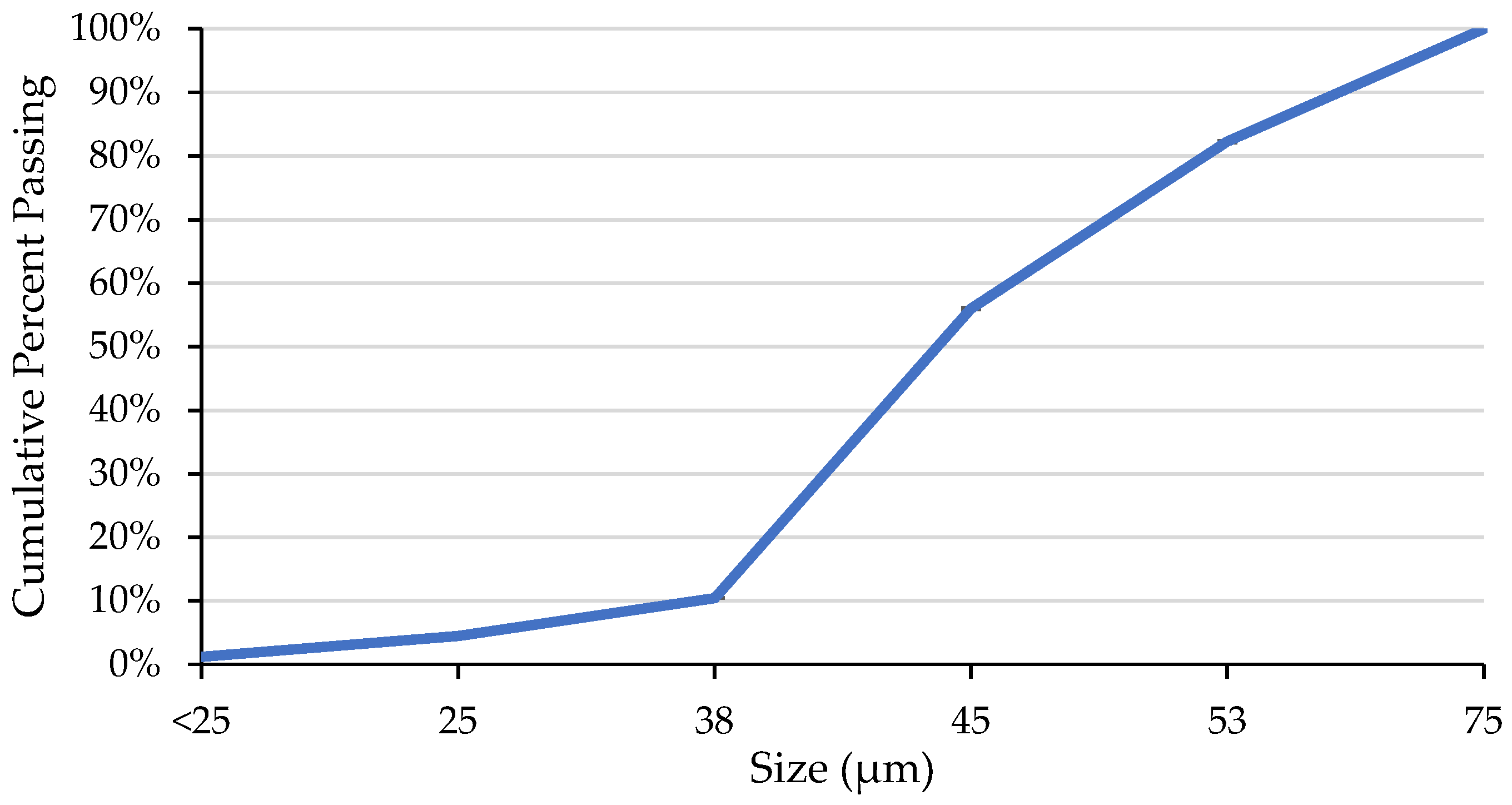
The mining operation employs underground extraction methods, followed by surface processing that includes primary and secondary crushing and subsequent grinding, producing fine particulate material (d80 < 75 µm). While the tailings from the flotation process are below 75 µm. The particle size distribution of the tailings is shown in Figure 1, indicating a d80 of 52.21 µm.
The finely ground material is then processed by froth flotation processed by froth flotation, a long-established and widely used mineral concentration method. The pulp is conditioned with collectors, frothers, and regulators under controlled pH and aeration to render valuable minerals hydrophobic and recover them as concentrate in the froth. The remaining material is classified as tailings and is transported by high-pressure pipeline to a tailings storage facility approximately 1 km from the processing plant.
The waste generated by the flotation process is deposited in a small tailings dam located on the side of a mountain, specifically prepared for its containment. Tailings samples were extracted from different points (50 samples) of the dam using a sampling configuration of 50 cm x 50 cm with a sampling spear (Schaller Messtechnik). The extracted samples were then transported to the laboratory of gases and biofuels (LAGBIO) in University of Talca. The samples were subjected to detailed physicochemical characterization using standardized procedures established by ASTM [30] and ISO [31] protocols. Particle size (gravimetric method—ISO 11277-2020), Density (pycnometer method—ASTM D85) y, Moisture (gravimetric method—ISO 11465:1993), Soluble solids (gravimetric method—ASTM D3987), Total solids (gravimetric method—ASTM D2216), Ash content (gravimetric method—ASTM D3174), Elemental composition (X ray fluorescence and ICP-MS—ISO 13196:2013). Conductivity, pH and oxidation reduction potential (ORP) were measured using sensors from a multiparameter measuring device (EZDO PL-700AL). The physicochemical parameters of the tailings are displayed in Table 1 with the standard error.
Based on Table 1, which describes the physicochemical properties of the tailings, it can be affirmed that this material contains a significant number of strategic elements relevant to the technological industry [32]. Among these, elements such as Al, Mn, and Ti were identified, with concentrations similar to those reported by Rosario-Beltré et al. [33] for tailings in Spain, with values for Al, Mn and Ti of 3.9%, 0.1%, and 0.64%, respectively. Additionally, the tailings contain other economically relevant elements such as Co at 9.7 ppm (0.00097%) and V at 161 ppm (0.0161%), with results that match those reported for other tailings in Chile by [28].

2.2. Processing Condition

Representative homogeneous tailings samples (2000 g, in triplicate) were placed in non-conductive glass trays (40 × 30 cm) to a 3 cm depth. Two cylindrical 316L stainless steel electrodes (10 cm height × 3 cm diameter) were installed perpendicularly, designated as A (anode) and B (cathode), following the procedure established by Martinez & Castellote [34]. The Current behavior (mA) was evaluated using a Potentiostat/Galvanostat (Corrtest Instruments, CS350M, 60 V/5 A, Wuhan, China, software CS Studio6 version 6.5, sensitivity ±1 mV/±1 mA) connected via copper cables and stainless-steel clamps. Applied currents of 1, 5, 10, 50, and 100 mA were tested at electrode spacings of 3, 5, 8, 12, and 18 cm, replicating previous methodologies [9,22,35]. Each current-distance combination was replicated three times for 1 h, with current density recorded every 10 min using a digital multimeter (Fujitel, DT830B, China). Minimum current density parameters (MinPC) and maximum current density parameters (MaxPC) were identified based on system performance.

2.3. Effect of Current on Electrodeposition

In this phase, the electrode material collection capacity was evaluated in triplicate via electrodeposition under both MinPC and MaxPC operating parameters. Throughout the electrodeposition process, the mass adhered to the electrodes was measured at specified intervals (1, 12, 24, 120, 240, 360, 480, and 600 h). Concurrently, tailings pH, ORP, and conductivity were monitored using a multiparameter meter (EZDO, PL-700AL, Taiwán). The deposited material was carefully extracted and washed with 500 mL of HPLC-grade water (Sigma-Aldrich, Molsheim, France), followed by ultrasonication in 250 mL aliquots of the same water for 30 min at 30 °C (Elmasonic, E15H, Singen, Germany) until complete detachment was achieved. Electrodes were then oven-dried at 35 °C (Yihder, DK-600DT, Taiwan) and weighed using an analytical balance (Bel, M214Ai, Italy). The residual liquid was evaporated to constant weight on a hot plate (JSR, JSHS-18A, Gongju, Republic of Korea) to recover dissolved material, which was subsequently weighed, quartered, and riffled down to 10 g [36] before storage in 60 mL plastic containers (Soviquim, Chile) alongside the electrodes for subsequent analysis.

2.4. Chemical Composition Analysis

To determine the content and chemical form of elements in the samples, a comprehensive analytical characterization was performed on all collected materials, including initial tailings, electrode-contact residues, and electrodeposited solids retrieved after each time period.
X-ray fluorescence (XRF) analysis was carried out using an HTEX H500 spectrometer (China). Three representative samples were selected for each condition: raw tailings, electrodeposited material, and processed tailings after each interval. The metallic content in each sample was quantitatively determined to assess the enrichment of elements due to electrodeposition.
Additionally, atomic absorption spectroscopy (AAS) was conducted using an Analytik Jena, Nova 800 spectrometer (software ASpect LS English, version 1.7.0.1, Germany). Approximately 1 g of each sample was analyzed in triplicate. Prior to measurement, samples underwent acid digestion using a solution composed of 7 mL of nitric acid (HNO3, 65% v/v) and 2 mL of hydrogen peroxide (H2O2, 30% v/v), carried out under a fume hood at 60 °C for 8 h using a hot plate (Labtech, EH, Chile). After digestion, samples were diluted to 50 mL with HPLC-grade water. Metal concentrations were determined via both flame atomic absorption (AAS-F) and hydride generation atomic absorption (AAS-H), the latter using an HS 55 system (Analytik Jena) with a 4% NaBH4 solution. All reagents used were of analytical grade, and calibration was performed with certified metal standards from Merck.
X-ray diffraction (XRD) analysis was also performed using a Bruker D2 Phaser diffractometer to identify the crystalline phases and assess the mineralogical forms in which elements are predominantly found. Measurements were conducted using a cobalt (Co) anode operated at 40 kV and 20 mA, with a beam defined by a 0.6° divergence slit, a 0.6 mm receiving slit, and 1° anti-scatter slits. Scans were performed over a 2θ range of 3° to 90°, with a step size of 0.02°.
For Fourier-Transform Infrared spectroscopy with Attenuated Total Reflectance (FT-IR-ATR) (BFRL, model WQF-530A, software MainFTOS Suite system), 0.1 g samples μm were used in the ATR system, and the pressure screw was tightened until the autorotation lock was activated. Infrared spectra from 4000 to 400 cm−1 of the samples were measured for 128 s.
Finally, scanning electron microscopy (SEM) combined with energy-dispersive X-ray spectroscopy (EDS) was employed using a Tescan Vega 3 SB microscope. This technique provided high-resolution imaging of the electrodeposited material and allowed for both qualitative morphological analysis and spatially resolved elemental mapping. SEM imaging was performed with an acceleration voltage of 25 kV under a vacuum pressure of 3 × 10⁻³ Pa, with gun vacuum maintained at 9.99 × 10⁻⁸ Pa. The EDS system was optimized to achieve a dead time between 10% and 30%, ensuring accurate compositional analysis. A standard working distance of 15 mm was used. Specific areas of interest were located using pre-marked indentations, enabling precise correlation between electrodeposition zones and local mineralogical features.

2.5. Metallurgical Indicators

Metallurgical recovery (R%) for each electrode-recovered sample, following electrodeposition and chemical analysis, was determined using Equation (1) according to the method reported by Tunsu et al. [11]. The calculations were performed considering the concentration of the target element at three points: the initial material (f), the material deposited on the electrode (c), and the residual material after the process (t).
R %   = 100 %   · c f · ( f t )   ( c t )
Another important parameter to determine is the enrichment ratio (ER), which provides insight into the increase in the concentration of the target element after the concentration process. The ER was calculated using Equation (2), following the method described by Vinnett et al. [37]. For this calculation, the concentrations of the initial material (f) and the concentrate (c) were considered.
ER   = c f
Finally, the Selectivity Index (SI) was determined for the recovered material, which indicates whether the concentration of the target element effectively increased in each case. This evaluation was carried out using Equation (3), following the methodology described by Sun et al. [38]. For this calculation, the following parameters were considered: the concentration of the target element in the recovered material (Cc), the concentration of the target element in the residual material (Ct), the concentration of non-target elements in the recovered material (Gc), and the concentration of non-target elements in the residual material (Gt).
SI   = Cc   ·   Gt Ct   ·   Gc

3. Results and Discussion

3.1. Amperage Evaluation by Distances

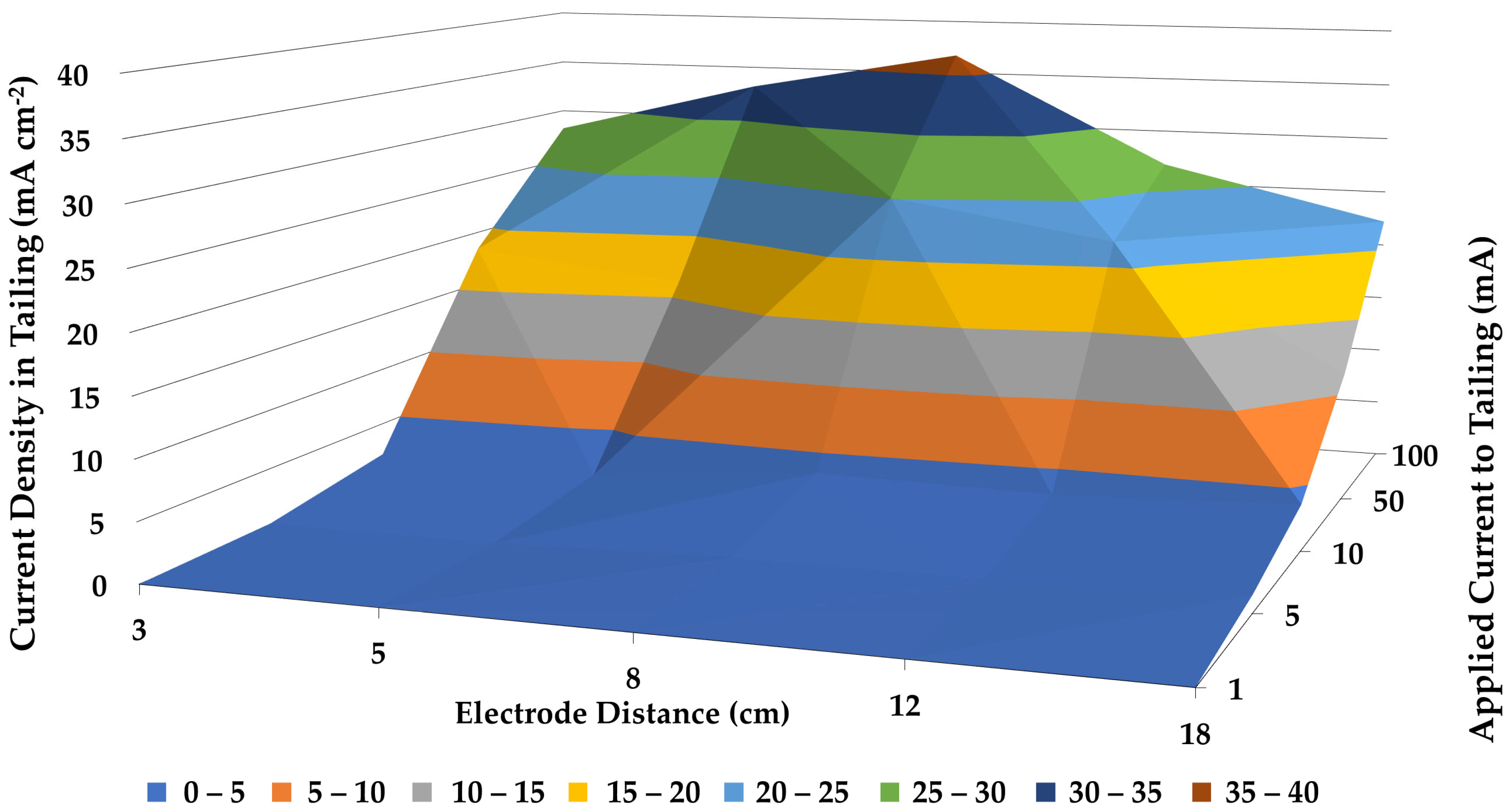
The relationship between applied current and electrode spacing was systematically evaluated to determine its effect on current density, allowing the determination of maximum and minimum current density conditions. Regarding the other distances and currents measured in the tailings, it was observed that the current density in the tailings was highest when 1 mA was applied, this showed in the Figure 2. While the current density in the tailings increased with increasing applied current, this behavior was not observed with increasing distance. This indicated that a linear increase was not observed in all cases, but rather only in relation to the applied current. Additionally, it was observed that a current density in the tailings greater than 5 mA cm−2 was not achieved until 10 mA was applied with the power supply. The maximum current density in tailings (36.7 ± 0.05 mA cm−2) was achieved at an 8 cm inter-electrode distance with an applied current of 100 mA. These findings align with Kadhum et al. [39], who stated an applied current of 40 mA cm−2 in phenolic wastewater treatment using aluminum electrodes at 6 cm spacing. Conversely, the minimum current density (0.006 ± 0.001 mA cm−2) occurred at 3 cm spacing with 1 mA current, consistent with Sonu et al. [40] observations (0.002–0.007 mA cm−2) in textile wastewater using graphite electrodes.
Considering Jin et al. [41], which demonstrates the importance of current density optimization for electrochemical processes, two operating regimes were established: minimum current density conditions, labeled as MinPC (1 mA, 3 cm spacing), and maximum current density conditions, labeled as MaxPC (100 mA, 8 cm spacing).

3.2. Comparative Electrodeposition

The electrochemical parameters monitored during the electrodeposition process, including tailings pH, conductivity, ORP, cathode mass loss, and power supply voltage, are presented in Table 2 for both MinPC and MaxPC operating conditions.
In MinPC conditions, the pH remained stable around 6 until 240 h of operation, gradually decreasing to 5.25 after 600 h. Under MaxPC conditions, the pH showed an abrupt decrease in the first hour, dropping from 5.88 to 4.48, followed by a progressive decline to 3.58 by the end of the experiment (600 h). At 480 h of experimentation, a transient pH increase was observed. As reported by Zhang et al. [20], low (acidic) pH favors higher recovery of Cu. However, it also reduces process selectivity, promoting the deposition of other metals like Zn, Pb, and Cd. Furthermore, the pH-ORP relationship influences the tailings’ chemical stability [42]. Based on this, Nordstrom [43] demonstrated that an ORP greater than zero favors the oxidation of metallic species, intensifying acid drainage formation. In contrast, environments with ORP below zero may induce reducing conditions, promoting metal sulfide precipitation and reducing the mobility of contaminants such as Fe+2 and Cu+2 ions [43].
The ORP under MinPC conditions started at 115.4 mV and remained around 113 ± 2 mV until 120 h. A peak of 116.4 mV was observed at 240 h, decreasing to 86.0 mV after 600 h. Under MaxPC conditions, ORP began at 122.2 mV, abruptly increasing to 209.1 mV in the first hour. Subsequently, it increased from 129.6 to 206.5 mV between 12 h and 600 h. This implies that MinPC conditions trend toward electrochemical stabilization of tailings, while MaxPC conditions favor acid drainage production.
Regarding tailings conductivity during electrodeposition under MinPC and MaxPC conditions: under MaxPC, initial conductivity was 719 μS, reaching a peak of 1716 μS at 240 h and ending at 1378 μS. Under MinPC, conductivity started at 840 μS, with a maximum of 1528 μS at 240 h, and finished at 800 μS. These results again indicate that MinPC reduces conductivity, rendering the material more inert compared to MaxPC. This makes the electrodeposition process for untreated tailings distinct from other methods like flotation reprocessing or solvent extraction. This is due to these methods requiring separation reagents that modify and accumulate in new waste or tailings [44,45], leading to further chemical alterations rather than stabilization.
The power supply voltage recorded under MinPC started at 2.0 V, oscillating between 1.8 and 3.7 V, with a peak at 240 h and a minimum at 480 h. In MaxPC, the initial voltage was 35.1 V, varying between 29.7 and 35.5 V, with a peak at 240 h and the lowest value at 360 h. During the process, the voltage measured in MaxPC was 10 times higher than in MinPC, although the current in MaxPC was 100 times greater than in MinPC. This indicates that the peak energy requirement of the process consumed 0.0037 watts under MinPC and 3.55 watts under MaxPC. By comparison, estimated average energy consumption values for metal flotation in electronic circuits are approximately 1200 kilowatts. This is substantially higher than required for this electrodeposition process. Additionally, anode mass loss was observed in MaxPC, where the anode mass decreased by 1.75% after 600 h, while in MinPC, the loss was 0.04% (wt%). This indicates that the mass loss in MaxPC was 77.06% greater than in MinPC.
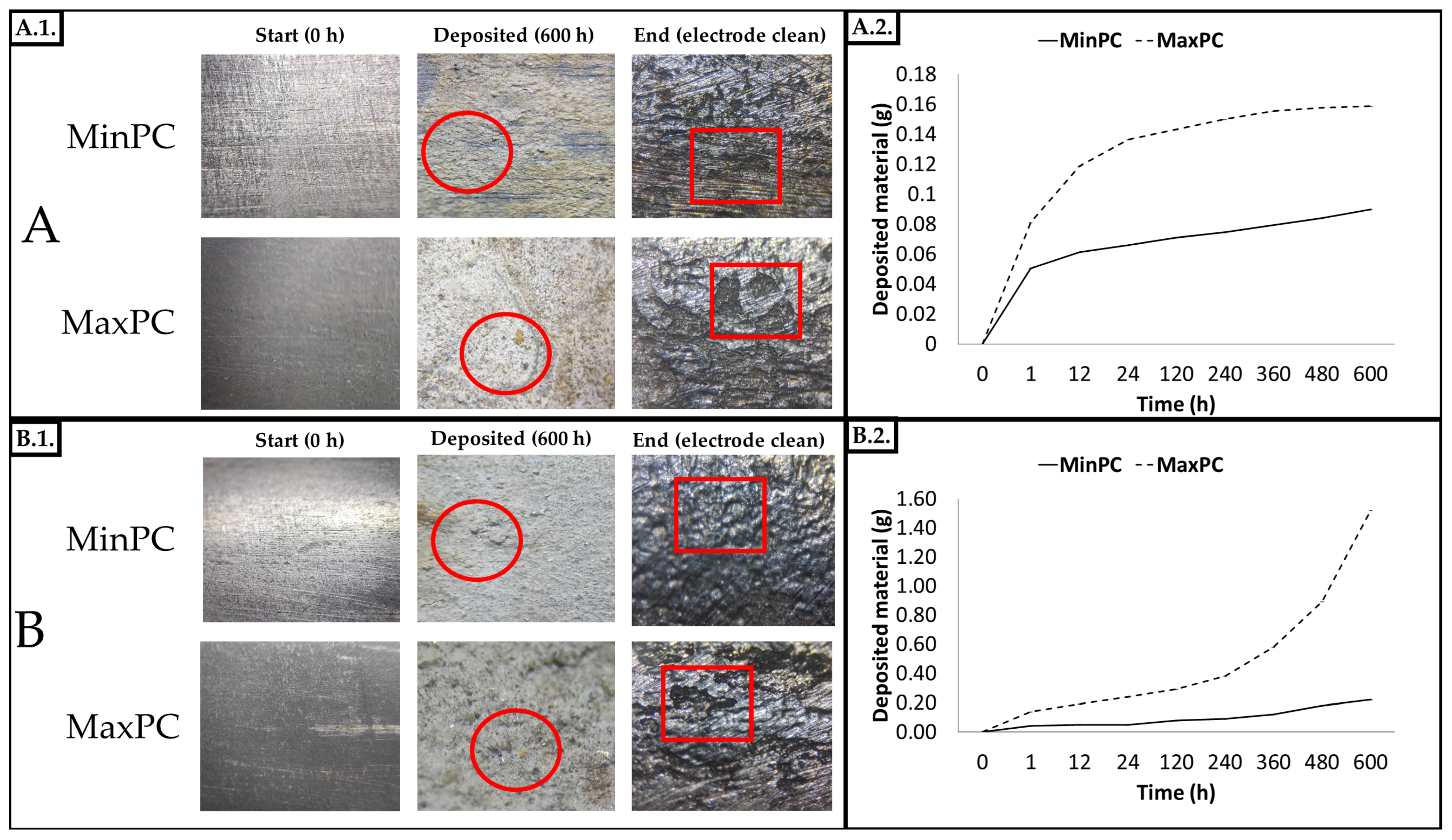
Figure 3 shows microscopic images of the material deposited on the electrodes (A and B) during the electrodeposition process under MinPC and MaxPC conditions.
In sections A.1 and B.1 of Figure 3, at the beginning of the experimental process (0 h), the electrode surfaces appear clean and homogeneous. At the final stage (600 h deposition), a continuous deposited layer is observed on both electrodes under MinPC and MaxPC conditions. Under MinPC, the deposits exhibit a fine and compact morphology, composed mainly of small, uniformly distributed granular particles, suggesting a relatively narrow particle size distribution and homogeneous surface coverage, with greater accumulation on electrode B. In contrast, MaxPC conditions promote the formation of coarser and more irregular structures, characterized by larger agglomerates and heterogeneous clusters, indicating a broader particle size distribution and less uniform growth. These morphological differences are consistent with previous reports (Boukhouiete et al. [46]; Liu et al. [47]), where lower current densities favored smaller and more compact deposits, while higher current densities led to dendritic or rougher morphologies with larger particle sizes. After electrode cleaning, surface corrosion was evident, particularly on electrode A under MaxPC conditions, which showed the greatest mass loss and visual deterioration, as summarized in Table 2.
The material deposition follows a logarithmic behavior for both electrodes under both conditions. For electrode A, 0.0614 g was recovered under MinPC conditions and 0.1187 g under MaxPC conditions in the first 24 h, progressively increasing to reach 0.0898 g and 0.1588 g, respectively. On the other hand, for electrode B (cathode) under MinPC conditions, 0.04 g was deposited in the first 24 h, reaching 0.22 g at 600 h. Additionally, when working under MaxPC conditions, 0.24 g was deposited in the first 24 h, reaching 1.52 g at the end of the experiment. Similar results were reported by Yang & Liu [48], who documented corrosion rates of 5 mm yr−1 for X70 carbon steel electrodes, comparable to the 4.869 mm yr−1 observed under MaxPC, and 0.134 mm yr−1 for 300 stainless steel, comparable to the 0.112 mm yr−1 under MinPC.

3.3. Elemental Chemical Composition

Table 3 presents 37 elements detected in the tailings (tailing start) and at least one of the electrodes (A or B) under MinPC or MaxPC conditions. Among these are elements (Co, Cu, and Ni) detected at similar concentrations in tailings from 1960 in Finland [49]. Furthermore, Gibson et al. [50] note that, although the main global producers of platinum group metals (PGMs: Pt, Pd, Rh, Ir, Ru, Os) are South Africa, North America, Russia, and Zimbabwe, these elements can still be detected in tailings worldwide. This is corroborated by the identification of Rh and Pt in the tailings studied here, along with heavy (Y) and light (Ce, La) rare earth elements (REEs).
The information reported in Table 3 shows that for four elements (Ca, Hf, Pb, and Zn), the concentration found in the untreated tailings (Tailings start) is higher than that reported in MinPC or MaxPC samples. Conversely, Ni and Mn concentrations increased significantly under one or more of the conditions. Under MinPC conditions, electrode B exhibited Mn concentrations of 24,801 ± 5 ppm and Ni concentrations of 20,065 ± 5 ppm, higher than the 2040 ± 5 ppm (Mn) and 1040 ± 5 ppm (Ni) of the Tailings start. The Ni concentration was approximately 20 times higher than the initial value, exceeding the results reported by Alajoki et al. [49], who achieved only a twofold increase (from 0.06 wt% to 0.12 wt%) after tailing leaching processes. In a similar way, Wang et al. [51] increased the concentration of Ni from 0.71 wt% to 1.10 wt% through tailings flotation, representing less than a twofold improvement. In contrast, Hf exhibited the lowest concentration of all the elements studied, reaching levels below the equipment’s detection limit (Hf < 1 ppm) in both electrodes (A and B) under MaxPC conditions.
On the other hand, focusing on the electrodes, Rh was the most concentrated element in electrode A, reaching 34 ± 2 ppm out of the 3.5 ± 0.3 ppm found in the tailings. Meanwhile, Mn predominated in electrode B with 24,801.0 ± 5 ppm. Regarding content, Si was the most prevalent in all samples (Tailing start, MinPC, and MaxPC in electrodes A and B). In the case of Mn, its concentration was comparable to that reported by Tala and Huang [52], who observed an increase from 88.99 ppm to 1230.45 ppm through the leaching of coal samples. Under MaxPC conditions, Al remained the most concentrated element in electrode A with 14,971.0 ± 5 ppm, while Ni exhibited the highest concentration in electrode B (9997.0 ± 5 ppm). The presence of Co, Nb, Sc, and La is noteworthy; these elements have been identified by other studies as relevant for tailings valorization [53]. Additionally, it was observed that the detected rare earth elements (Y, Ce, La, and Sc) increased their concentrations at electrode B when operating under MinPC. This could imply a sustainable concentration method that does not involve the use of strong acids that could impact the environment, avoiding processes such as those applied by Peelman et al. [10]. Most of the elements that increased their concentration were found under MinPC at electrode B (MinPC B). Meanwhile, in most cases, the lowest concentrations were found under MaxPC at electrode A (MaxPC A).
To ensure data reliability and highlight the results between conditions and electrodes, an ANOVA analysis was performed for each element, followed by a Tukey HSD post hoc analysis. The ANOVA was performed using the data obtained from the triplicates in both columns (difference between the Tailing, MinPC A, MinPC B, MaxPC A, and MaxPC B samples) and rows (between experimental replicates). This showed that there were no significant differences between the replicates, p-value > 3 (in general), while there were differences between the columns. For this reason, Table 4 only shows the results of the ANOVA by element between the columns.
Table 4 shows that almost all elements presented significant differences between the different samples (Tailing, MinPC A, MinPC B, MaxPC A, and MaxPC B). The exception of Hf, Ga, Ge, Y and La, which have a relatively low “non-significance” (F calc./crit. F < 3 and/or p-value > 0.05). This suggests that the results corresponding to these five elements have low or no confidence for differentiation between samples for further analysis.
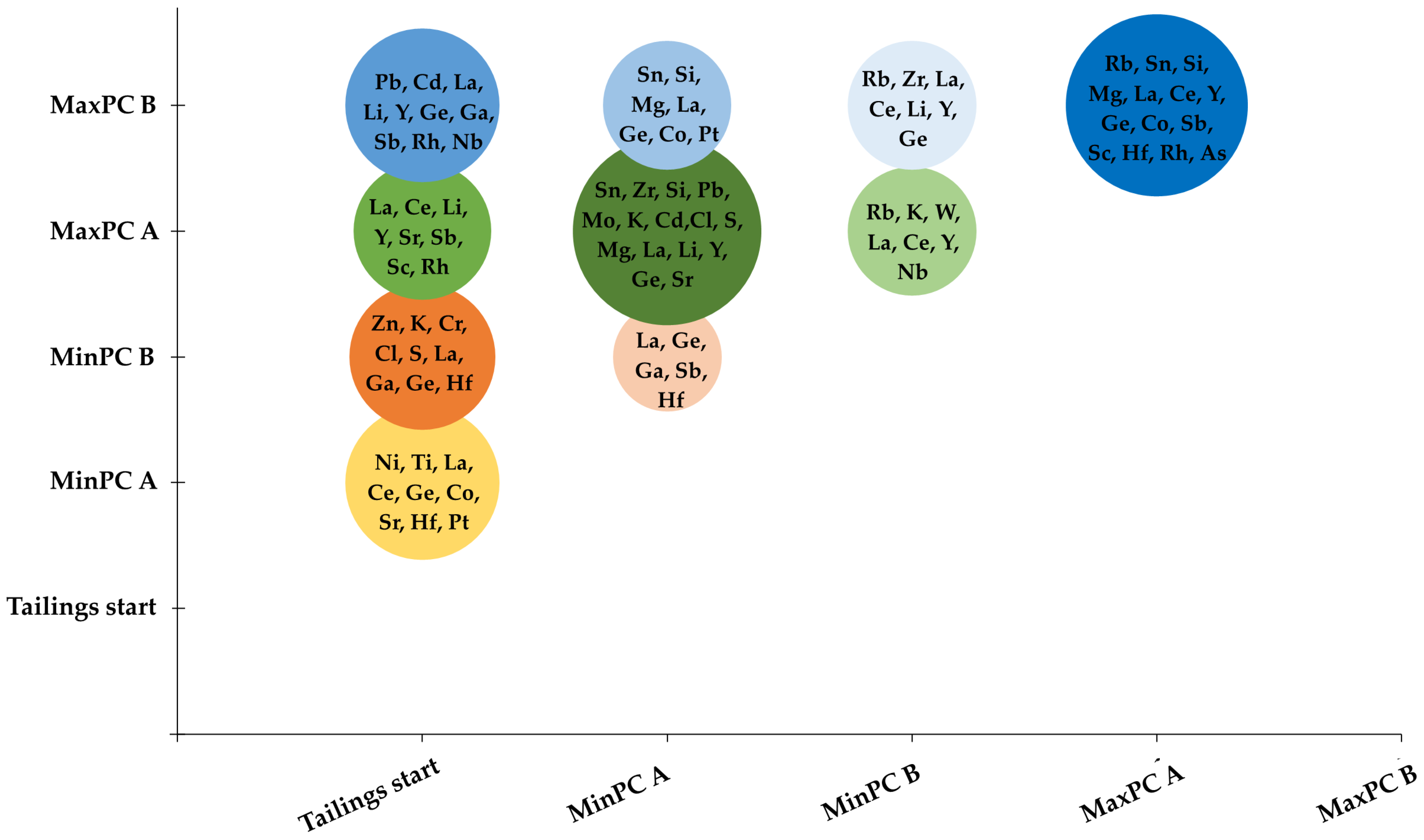
On the other hand, the Tukey HSD analysis indicated that there is a significant difference between most of the samples for each element. Therefore, only those with a low or zero difference (p-value Tukey > 0.1) were plotted (Figure 4).
Among the concentrations obtained in each of the samples (Tailing, MinPC A, MinPC B, MaxPC A, and MaxPC B), those that show the greatest similarity in different elements were MinPC A vs. MaxPC A, which share a low significant difference in 15 elements. This is followed by MaxPC A vs. MinPC A with 14 elements, where there is no significant difference. In contrast, MinPC A vs. MinPC B has the lowest number of elements with 5, which are Sb, La, Ga, Ge, and Hf. Additionally, it should be noted that MinPC B showed the highest significance when compared to each of the other samples in the rest of the elements, with a p-value < 5 E-13. It stands out as the condition with the most notable results compared to the rest. Therefore, it has been decided to exclude Y, Sb, Ge, Ga, La, and Hf from the metallurgical analysis. This indicates that, in reality, of the 37 elements detected during the electrodeposition process, only 31 elements were actually influenced when applying MinPC or MaxPC conductions.
Table 5 presents the metallurgical indicators of the electrodeposition process under MinPC and MaxPC conditions. These indicators include the enrichment ratio (ER), recovery percentage (R%), and selectivity index (SI), calculated based on Equations (1)–(3).
According to the data presented in Table 5, the highest ER value for electrode A under MinPC conditions corresponded to Rh, with a value of 9.7, resulting from an increase in its concentration from 3.5 ppm in the tailings to 34.0 ppm in the adhered material. On electrode B, also under MinPC conditions, Ni recorded the highest ER value of 19.3, increasing its concentration from 1040 ppm to 24,801 ppm. Under MaxPC conditions, Ni exhibited the highest ER value on electrode A, with a value of 6.3, as its concentration increased from 1040 ppm in the tailings to 6514 ppm in the adhered material. These ER values for Ni are considerably higher than those reported by Ortiz-Soto et al. [54], who achieved a value of 1.3 in tailings subjected to leaching and electrodeposition processes. Meanwhile, Sr reached the highest ER on electrode B under MaxPC conditions, with a value of 9.9, resulting from an increase in its concentration from 11.1 ppm to 110 ppm. Regarding R%, the highest recoveries were observed for the elements Cd (65.7%), Fe (56.7%), Ti (53.7%), Ni (53.1%), and Sc (52.9%). The Ni recovery measured in this study was approximately twice as high as the 22.9% recovery reported by Karppinen et al. [55], who achieved this result through leaching applied to mining tailings. On the other hand, the lowest recovery values corresponded to W, with 10.0%, and Hf, for which the R% could not be calculated due to its low concentration in the adhered material. Meanwhile, Ismail et al. [56] achieved a recovery (R%) of 85.8% through a membrane extraction process applied to Zr crystals that had been previously leached. Of the 31 elements identified under MinPC and MaxPC conditions, Ni exhibited the highest SI, with a value of 22.4, obtained on electrode B under MinPC conditions. Additionally, other elements such as Mn, Rh, and Sr stand out with high SI values (SI > 3), reporting values of 16.8, 9.7, and 8.3, respectively. These elements show a strong affinity for the electrodeposition process. In contrast, elements such as As, Pt, Hf, Sb, Al, Co, Li, Ce, Mg, and Ti exhibited intermediate (SI < 3) or low (SI < 1.5) selectivity indices. However, processes such as flotation have reported SI values greater than 5 [38,57]. After analyzing the contrast between the indicators obtained with MinPC and those obtained with MaxPC, it is clear that, in general, enrichment, concentration, and selectivity are higher in MinPC, with specific exceptions.

3.4. Determination of Structure and Composition by XRD and SEM

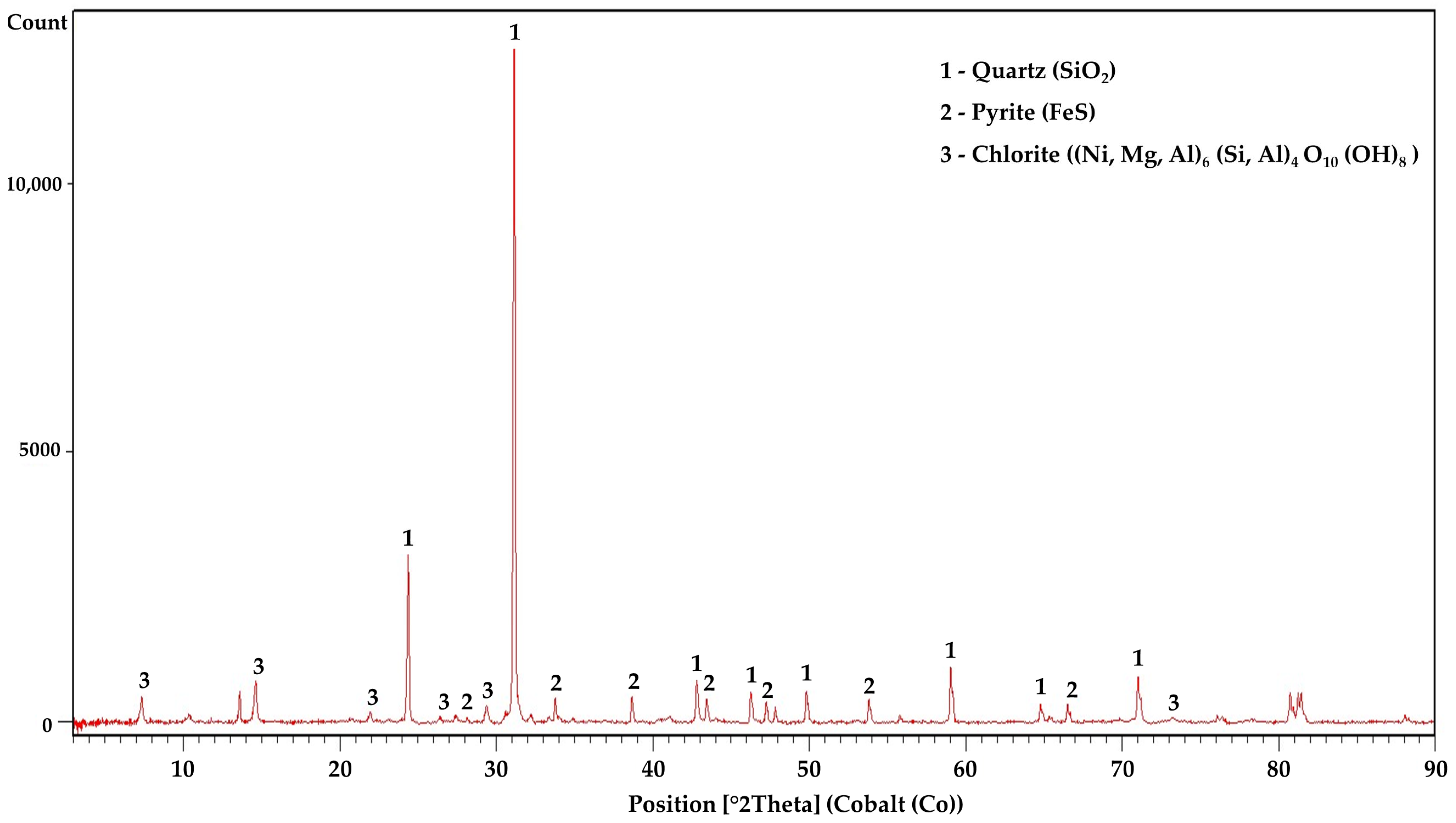
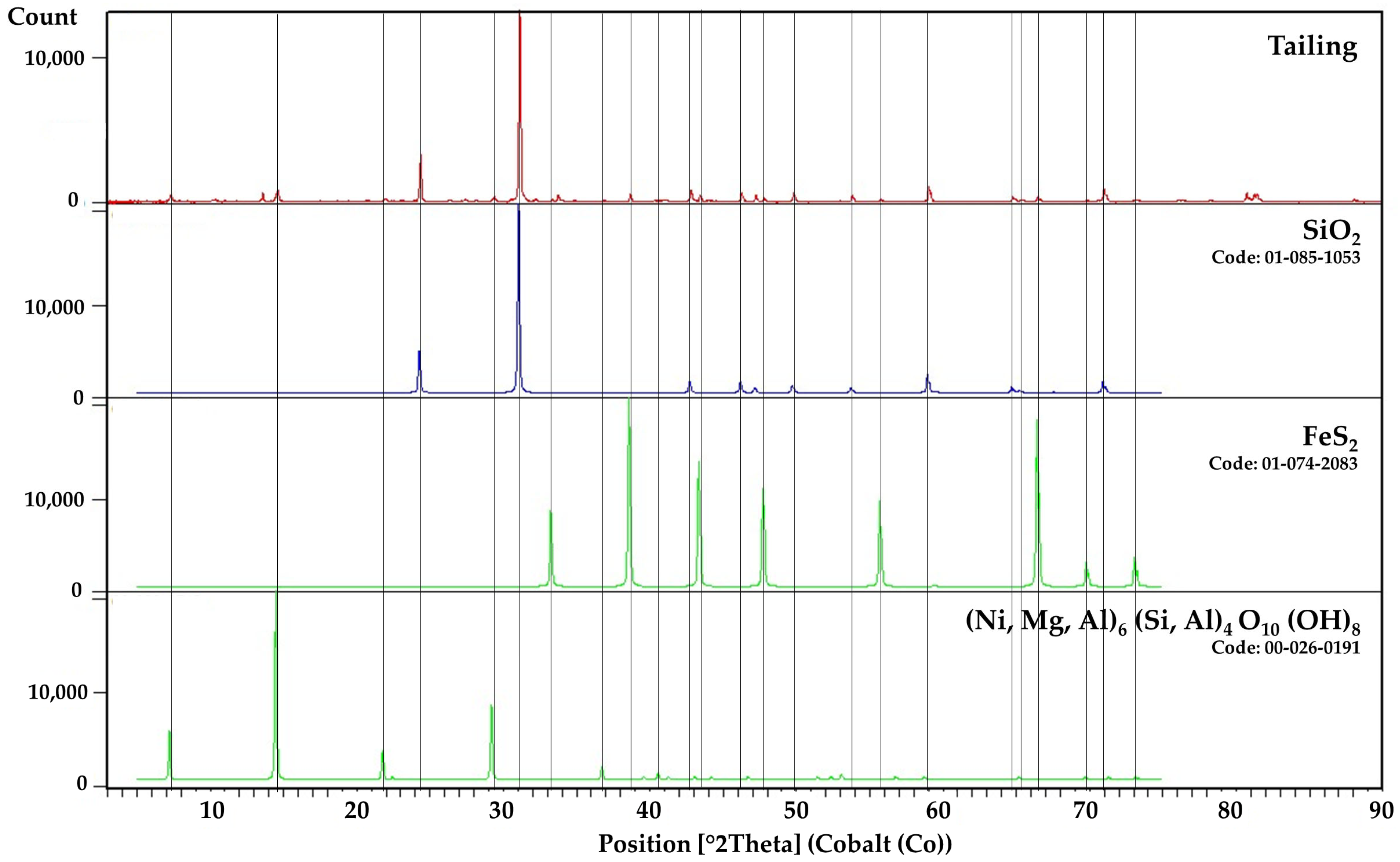
Figure 5 shows the relevant and predominant crystal structures in the tailings detected by XRD. The peak matching graph is found in Appendix A.2.
For the XRD analysis, only the most relevant peaks were analyzed to determine the structures of the most relevant compounds, which are shown in Table 3. Three different predominant mineral phases were identified in this analysis. Quartz, due to the high presence of Si in the tailings, as shown in Table 3. Pyrite, due to its high Fe content, as well as Si, and chlorite, a characteristic mineral of epithermal deposits like the one used in this study [58]. The presence of chlorite provides a better understanding of the Ni, Mg, and Al contents, among others. Additionally, rare earth elements are commonly found as traces in this mineral, as well as in pyrite [5,8,9,56,59]. Additionally, it has been observed that chlorite may contain traces of Sr, Ca, K, Ra, Pb, REEs, Fe, Cu, Zn, Ag, Ni, Hg, and V [60,61]. In addition to REEs, quartzes have been found to indicate enrichment of traces of Ga, Sc, Cu, Zn, Zr, Hf, and Ti [62]. This provides some explanation for the detection of elements by AAS in the tailings studied, whose main mineral was not detected by XRD. This technique is not capable of detecting them easily unless they are very pure substances or are present in high abundance, such as a standard.
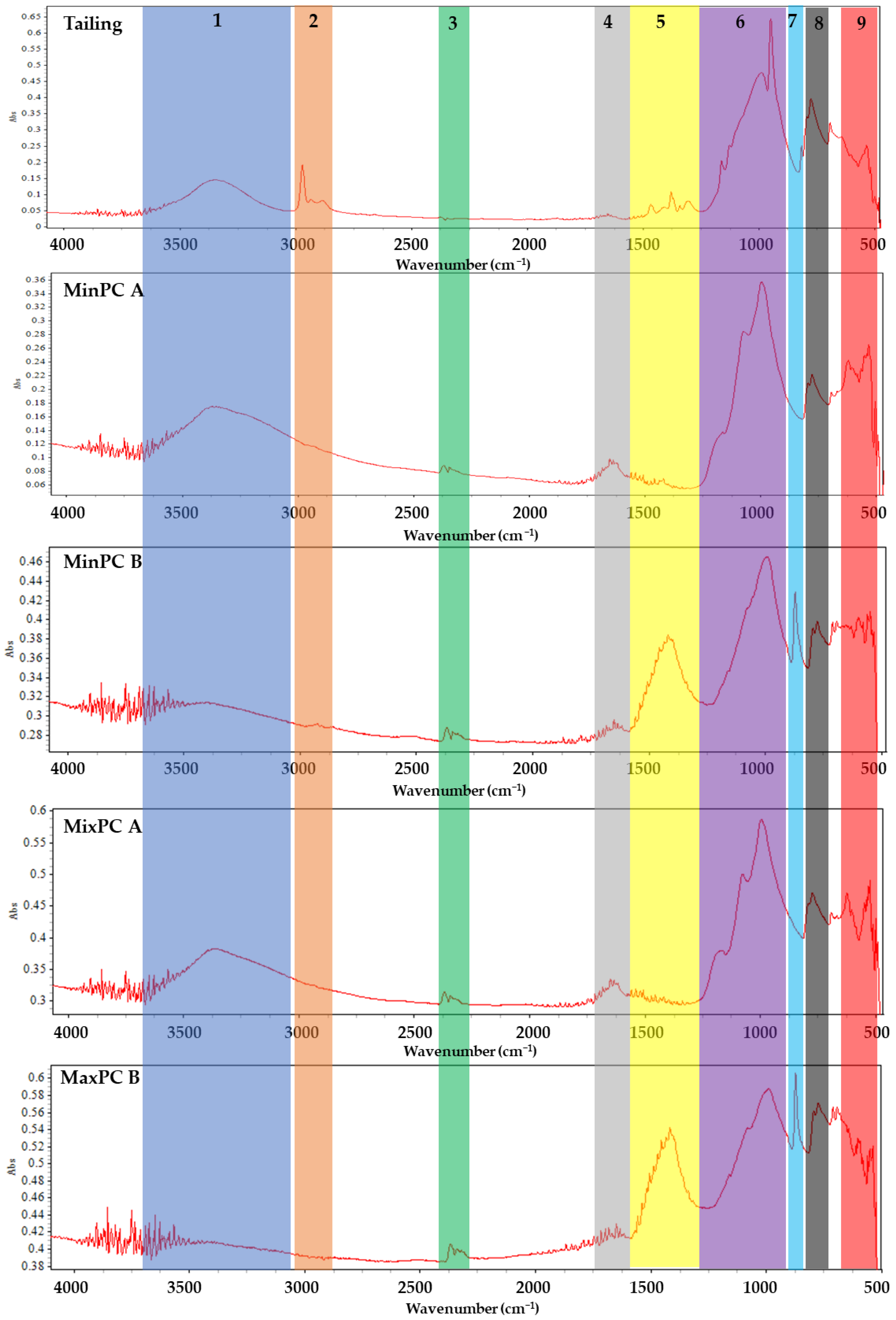
To verify the crystal systems identified by X-ray diffraction (XRD), an FT-IR analysis was performed. The results can be seen in Figure 6.
The FT-IR analysis reported here (Figure 6) was used to verify the bonds of the crystalline systems identified by XRD (Figure 5) and to report on possible changes in the functional groups belonging to the residues. Given that electrodeposition in an aqueous medium could have caused changes in some of the minerals mentioned here. The relevance of band 3 (2300–2450 cm−1) is ruled out for the study, given that it is mainly associated with CO2 present in the air and not associated with minerals. Band 1 (3000–3700 cm−1) is assigned to O–H stretching vibrations from adsorbed water or structural water. This feature is typical of clay minerals, chlorites group, hydrated sulfates, or minerals containing residual moisture. This partially coincides with band 4 (1450–1700 cm−1) associated with the H-O-H bond. This supports the idea that there is surface moisture present in the sample or as part of the crystalline structure. On the other hand, band 2 (2800–3000 cm−1) is only noticeable in the tailings sample. This band is associated with the C-H bond, common in organics and uncommon in minerals, but associated with the 1.63 wt% of organic matter found in the tailings (Table 1). Bands 5 to 9 are directly related to the mineral. Band 5 (1350–1600 cm−1) is clearly marked in samples MaxPC B and MinPC B. This band is associated with carbonates (CO3−2) that were not identified by XRD analysis. Band 6 (950–1200 cm−1) can be associated with both sulfates (SO4−2) or S−2, how the pyrite and silicates (Si-O), neither of which can be ruled out, given the nature of the material and the minerals detected by XRD (SiO2). In addition, bands 7 (850–950 cm−1) and 8 (800–850 cm−1) are associated with bonds with Si, where band 7 supports the presence of chlorite, while band 8 supports the presence of quartz. Finally, the twin peaks in band 9 (500–650 cm−1) are related to metal oxides (M-O), such as ilmenite and pyrolusite, detected by XRD. These results support the mineral identification performed by XRD and also contribute to the detection of previously unrecorded CO3−2. It should be noted that FT-IR analysis of a polymetallic material such as tailings prevents the specific identification of metals bound to functional groups such as silicates, SO4−2, or M-O. It confirms the existence of these metals but does not allow for the exact identification of the metal to which they are bound.
Other studies have shown that electrochemical processes are primarily governed by the behavior of amorphous or poorly crystalline phases, such as Fe–Mn (oxyhydr)oxides and disordered aluminosilicates, which exhibit high surface reactivity and strong metal sorption capacity despite being poorly detected by XRD [63,64]. In this context, chlorite, pyrite and quartz are frequently associated with exchangeable or surface-complexed sites on clays, oxides, and alteration products, which can undergo rapid mobilization under electric fields due to changes in pH, redox potential, and electrostatic gradients [65,66]. In addition, soluble or neo-formed phases such as sulfates and carbonates, generated during flotation, weathering, or electrochemical treatment, can act as transient metal carriers, further enhancing element mobility despite their limited crystallinity or detectability [63,65]. Consequently, the mobility and recovery of different elements are better explained by their association with surface-bound, weakly coordinated, or metastable phases rather than by their incorporation into well-ordered crystal lattices, highlighting the dominant role of surface chemistry and phase reactivity over bulk mineralogy in electrochemical systems [61,63,67].
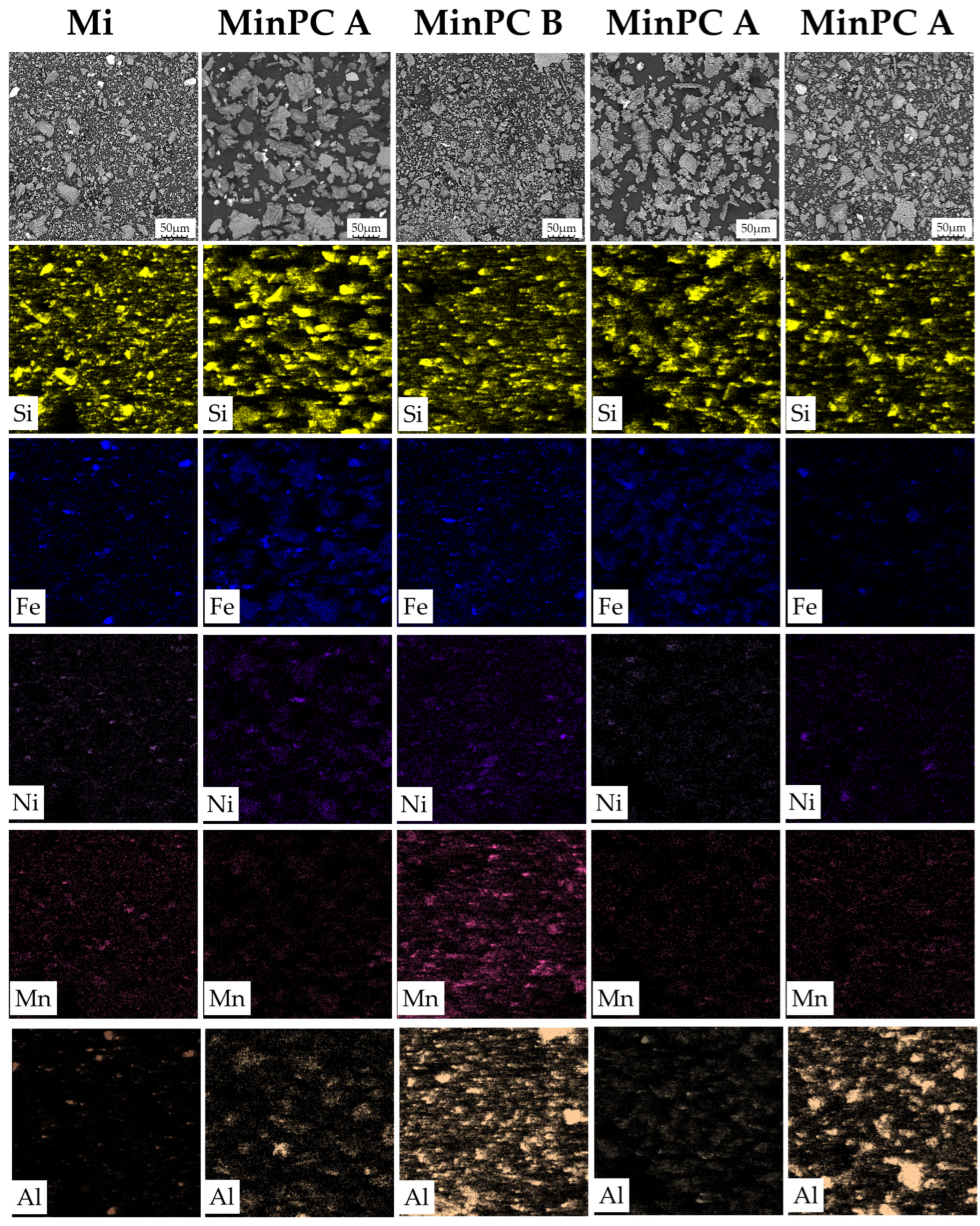
To complement the mineralogical and elemental characterization, SEM-EDS analyses were performed on samples obtained after the electrodeposition processes. Figure 7 presents, in its upper section, images obtained by scanning electron microscopy (SEM) corresponding to the tailings samples before the electrodeposition process (Mi), as well as the materials deposited on electrodes A and B under MinPC and MaxPC conditions (MinPC A, MinPC B, MaxPC A, MaxPC B). The central section includes the elemental distribution maps obtained using energy dispersive X-ray spectroscopy (EDS) for each sample. The minerals have been extrapolated based on the color composition obtained and XRD. The lower section of the figure shows the elements associated with these minerals as observed in the EDS maps.
SEM-EDS analysis showed the most abundant elements detected from those listed in Table 3 in untreated tailings and material deposited on the electrodes under MinPC and MaxPC conditions. From this figure (Figure 7), a predominant composition of the elements that make up the crystalline systems is shown in Figure 5. As mentioned in Section 3.2, a higher homogeneity in the particle size deposited on electrode B under MinPC conditions was observed, compared to that observed under MaxPC conditions. In the Mi sample, a high concentration of Si is highlighted, with larger particles (~25 µm). While the small fragments (< 5 µm) showed a visible increase in concentration in MinPC B. In contrast, larger particles (~50 µm) can be observed in MinPC A, MaxPC A, and MaxPC B. Additionally, a marked contrast in the insensitivity and/or presence of Al, Mn, and Ni can be observed in MinPC B, compared to the rest. In contrast, as mentioned in Section 3.2, Si shows a similar visualization across all samples.
The results obtained throughout this study indicated and demonstrated that electrodeposition is a method capable of separating, concentrating, and recovering various elements from tailings without the use of water or additional chemical reagents. Furthermore, the effect of current density on electrodeposition results was observed. This is especially noticeable under low-current conditions (MinPC), which not only yielded the highest enrichment levels but also resulted in low energy consumption. Meanwhile, the conductivity and ORP of the tailings were reduced, promoting their electrochemical stability. This makes it a more sustainable concentration process, given current energy demands. In addition, the low-current conditions resulted in low electrode corrosion.

4. Conclusions

This study demonstrated that electrodeposition is an environmentally acceptable and sustainable strategy for the valorization of untreated mining tailings. By enabling the selective recovery of valuable elements directly from the solid matrix without chemical pretreatment, the process contributes to the reduction in potentially toxic metals remaining in the tailings, thereby decreasing the risk of soil, water, and air contamination. In addition, converting tailings into secondary resources promotes sustainable waste management and reduces the need for primary mineral extraction, lowering the overall environmental footprint of mining activities.
To this end, a novel analysis of the current density produced in the tailings during electrodeposition was performed. This revealed that the electrode distance and applied current exhibit a non-linear relationship with the resulting current density. Additionally, it was demonstrated that performing the electrodeposition process with low (MinPC) and high (MaxPC) densities yielded different experimental results. This was observed in terms of recovered mass, concentrations, and metallurgical indicators. Statistical analysis (ANOVA-Tukey HDS) identified a low degree of differentiation between the concentrations obtained with MinPC A and MaxPC A, as well as between MaxPC A and MaxPC B. Finally, the effectiveness of this method under MinPC was highlighted, particularly when focusing on elements such as Ni and Mn. These elements are understood to originate primarily from chlorite detected in the tailings by XRD, and their presence is further confirmed by the bonds observed in the FT-IR analysis.
These results for the detected elements were corroborated and quantified using AAS, ICP-MS, XRF, XRD, FT-IR, and SEM-EDS techniques. The electrodeposition findings presented here demonstrate a sustainable alternative for the separation, concentration, and recovery of elements that could lead to future tailings valorization without pretreatment. Based on a comparison of metallurgical indices in the literature, we can affirm that this technology achieved a selectivity of 3.7 without generating additional waste, consuming chemical reagents, or using water resources. Conversely, conventional technologies, such as flotation and leaching, may have better metallurgical index values, but they have a high environmental impact, including high water consumption and the use of chemical reagents such as H2SO4, HNO3, H3PO3 and NaSH.
This study aims to contribute to the development of new concentration methods that align with environmental awareness and production in mining. It proposes improvements to this process in future work through research into specific operating parameters for a given element or the use/development of specialized electrodes.

Author Contributions

Conceptualization: J.A.-H.; Validation: D.H.; Investigation: J.A.-H.; Resources: D.H., P.I.R.P. and P.A.; writing—original draft preparation: J.A.-H.; writing—review and editing: All authors; visualization: P.I.R.P., P.A. and L.U.; supervision: D.H.; All authors have read and agreed to the published version of the manuscript.

Funding

This research received no external funding.

Data Availability Statement

The raw data supporting the conclusions of this article will be made available by the authors on request.

Acknowledgments

The authors thank Fernando Gattas and Juan Marchant of SCM Paicaví for allowing access to the tailings, allowing the extraction of material, and providing key data on the processes preceding tailings generation. The authors also thank the Advanced Microscopy Center, CMA BIO-BIO, PIA-ANID Project ECM-12 for their support with microscopy data analysis. Hernández D. acknowledges support from FONDECYT, Chile (Project N°. 1240819). Pablo I. R. Pincheira acknowledges support from FONDECYT (Project N° 11231075). Acknowledgements to the University of Talca’s energy conversion technology center. The authors acknowledge Project InES I+D INID210014 for providing the potentiostat/galvanostat (Corrtest CS350M) used in this research.

Conflicts of Interest

The authors declare that they have no known competing financial interests or personal relationships that could have appeared to influence the work reported in this paper.

Abbreviations

The following abbreviations are used in this manuscript:
REERare earth elements
ORPOxidation-Reduction Potential
AASAtomic Absorption Spectroscopy
SEMScanning electron microscopy
XRDX-Ray Diffraction

Appendix A

Appendix A.1

This appendix contains the elemental analysis by ICP-MS performed in duplicate on ore from the SCM Paicaví mine. This ore is used to obtain and concentrate gold, copper, and silver by flotation and is known as “feed material.” After processing, two materials are produced: concentrate and tailings.
Table A1. Elemental analysis of feed material by ICP-MS.
MethodAnalyteUnitSample
12
Sample Wt.Gravimetrickg0.210.21
BXRF%<0.1<0.1
PXRF%0.110.08
SXRF%>10.0>10.0
AuICP-MSppm4.274.64
AgICP-MSppm19.2516.9
AlICP-MSppm50005600
AsICP-MSppm717471
BaICP-MSppm1010
BeICP-MSppm<0.05<0.05
BiICP-MSppm41.136.9
CaICP-MSppm500400
CdICP-MSppm15.7560.2
CeICP-MSppm2.472.8
CoICP-MSppm57.840.1
CrICP-MSppm1318
CsICP-MSppm0.320.29
CuICP-MSppm8501795
FeICP-MSppm264,000177,500
GaICP-MSppm3.814.81
GeICP-MSppm0.290.19
HfICP-MSppm0.040.04
HgICP-MSppm0.360.36
InICP-MSppm0.1610.203
KICP-MSppm900800
LaICP-MSppm11.2
LiICP-MSppm1.92.7
MgICP-MSppm23002900
MnICP-MSppm524649
MoICP-MSppm23.115.6
NaICP-MSppm100<1
NbICP-MSppm0.10.08
NiICP-MSppm4.83
PbICP-MSppm>10,0004840
PtICP-MSppm9.79.9
RbICP-MSppm33.1
ReICP-MSppm0.0080.005
SbICP-MSppm11.156.88
ScICP-MSppm0.91
SeICP-MSppm34.823.6
SiICP-MSppm33,475.6030,288.00
SnICP-MSppm20.5
SrICP-MSppm1.41.1
TaICP-MSppm<0.01<0.01
TeICP-MSppm4.892.8
ThICP-MSppm<0.2<0.2
TiICP-MSppm<0.5<0.5
TlICP-MSppm0.80.55
UICP-MSppm<0.05<0.05
VICP-MSppm1919
WICP-MSppm12.458.75
YICP-MSppm1.161
ZnICP-MSppm3050>10,000

Appendix A.2

Figure comparing XRD tailings peaks list with HighScore Plus software references version 5.3.1.
Table A2. XRS Peak list.
No.Height [cts]Pos. [°2Th.]No.Height [cts]Pos. [°2Th.]
1418.377.361420761.4642.7871
2125.6510.349921428.1543.4469
3553.5613.618422562.3446.2506
4740.8414.637423334.4547.261
536.2520.781824232.0647.8152
6163.9221.960425597.9349.8105
73205.9124.372526395.7953.8091
885.4326.425427120.2255.7552
9100.7227.3698281022.6859.0293
1080.5328.136629304.7964.7503
11298.2729.392930237.2166.5477
1213,166.2231.124931829.6071.0057
13133.5132.22783267.7773.2366
14114.4733.35463371.7476.2665
15445.6333.76083436.8478.26
1657.2834.901735558.6880.7213
1749.1636.889436490.3981.2241
18469.3038.65483768.5188.1088
1996.9841.0652
Figure A1. Comparing XRD tailings peaks with spectrum references.
Environments 13 00135 g0a1

References

  1. Global Tailings Review. 2020. Available online: https://globaltailingsreview.org (accessed on 20 December 2023).
  2. LePan, N. Visualizing the Size of MineTailings. 2021. Available online: https://elements.visualcapitalist.com/visualizing-the-size-of-mine-tailings/ (accessed on 20 December 2023).
  3. Mafra, C.; Bouzahzah, H.; Stamenov, L.; Gaydardzhiev, S. An integrated management strategy for acid mine drainage control of sulfidic tailings. Miner. Eng. 2022, 185, 107709. [Google Scholar] [CrossRef]
  4. Puy-Alquiza, M.J.; Puy, M.Y.M.; Miranda-Avilés, R.; Kshirsagar, P.V.; Sanchez, C.D.M. Agronomic Evaluation of Compost Formulations Based on Mining Tailings and Microbial Mats from Geothermal Sources. Recycling 2025, 10, 156. [Google Scholar] [CrossRef]
  5. Cacciuttolo, C.; Cano, D. Environmental Impact Assessment of Mine Tailings Spill Considering Metallurgical Processes of Gold and Copper Mining: Case Studies in the Andean Countries of Chile and Peru. Water 2022, 14, 3057. [Google Scholar] [CrossRef]
  6. Tabelin, C.B.; Dallas, J.; Casanova, S.; Pelech, T.; Bournival, G.; Saydam, S.; Canbulat, I. Towards a low-carbon society: A review of lithium resource availability, challenges and innovations in mining, extraction and recycling, and future perspectives. Miner. Eng. 2021, 163, 106743. [Google Scholar] [CrossRef]
  7. Tabelin, C.B.; Yoo, K.; Li, J. Editorial for special issue ‘novel and emerging strategies for sustainable mine tailings and acid mine drainage management’. Minerals 2021, 11, 902. [Google Scholar] [CrossRef]
  8. Lorenzo-Tallafigo, J.; Iglesias-González, N.; Romero-García, A.; Mazuelos, A.; del Amo, P.R.; Romero, R.; Carranza, F. The reprocessing of hydrometallurgical sulphidic tailings by bioleaching: The extraction of metals and the use of biogenic liquors. Miner. Eng. 2022, 176, 107343. [Google Scholar] [CrossRef]
  9. Hansen, H.K.; Lamas, V.; Gutierrez, C.; Nuñez, P.; Rojo, A.; Cameselle, C.; Ottosen, L.M. Electro-remediation of copper mine tailings. Comparing copper removal efficiencies for two tailings of different age. Miner. Eng. 2013, 41, 1–8. [Google Scholar] [CrossRef]
  10. Peelman, S.; Kooijman, D.; Sietsma, J.; Yang, Y. Hydrometallurgical Recovery of Rare Earth Elements from Mine Tailings and WEEE. J. Sustain. Metall. 2018, 4, 367–377. [Google Scholar] [CrossRef]
  11. Tunsu, C.; Menard, Y.; Eriksen, D.Ø.; Ekberg, C.; Petranikova, M. Recovery of critical materials from mine tailings: A comparative study of the solvent extraction of rare earths using acidic, solvating and mixed extractant systems. J. Clean. Prod. 2019, 218, 425–437. [Google Scholar] [CrossRef]
  12. Patel, A.; Chavan, G.; Nagpal, A.K. Navigating the Neurological Abyss: A Comprehensive Review of Organophosphate Poisoning Complications. Cureus 2024, 16, e54422. [Google Scholar] [CrossRef]
  13. Du, Z.; Ruan, Y.; Chen, J.; Fang, J.; Xiao, S.; Shi, Y.; Zheng, W. Global Trends and Hotspots in Research on the Health Risks of Organophosphate Flame Retardants: A Bibliometric and Visual Analysis. Toxics 2024, 12, 391. [Google Scholar] [CrossRef] [PubMed]
  14. Lutandula, M.S.; Maloba, B. Recovery of cobalt and copper through reprocessing of tailings from flotation of oxidised ores. J. Environ. Chem. Eng. 2013, 1, 1085–1090. [Google Scholar] [CrossRef]
  15. Muñoz-Vargas, M.A.; González-Gordo, S.; Palma, J.M.; Corpas, F.J. H2S in Horticultural Plants: Endogenous Detection by an Electrochemical Sensor, Emission by a Gas Detector, and Its Correlation with L-Cysteine Desulfhydrase (LCD) Activity. Int. J. Mol. Sci. 2022, 23, 5648. [Google Scholar] [CrossRef]
  16. Hamoda, M.F.; Alshalahi, S.F. Assessment of hydrogen sulfide emission in a wastewater pumping station. Environ. Monit. Assess. 2021, 193, 352. [Google Scholar] [CrossRef] [PubMed]
  17. Wang, K.; Li, Y.; Wang, X.; Zhang, Z.; Cao, L.; Fan, X.; Wan, B.; Liu, F.; Zhang, X.; He, Z.; et al. Gas therapy potentiates aggregation-induced emission luminogen-based photoimmunotherapy of poorly immunogenic tumors through cGAS-STING pathway activation. Nat. Commun. 2023, 14, 2950. [Google Scholar] [CrossRef]
  18. Batterman, S.; Grant-Alfieri, A.; Seo, S.H. Low level exposure to hydrogen sulfide: A review of emissions, community exposure, health effects, and exposure guidelines. Crit. Rev. Toxicol. 2023, 53, 244–295. [Google Scholar] [CrossRef]
  19. Buret, A.G.; Allain, T.; Motta, J.P.; Wallace, J.L. Effects of Hydrogen Sulfide on the Microbiome: From Toxicity to Therapy. Antioxid. Redox Signal. 2022, 36, 211–219. [Google Scholar] [CrossRef]
  20. Zhang, Z.; Ottosen, L.M.; Wu, T.; Jensen, P.E. Electro-remediation of tailings from a multi-metal sulphide mine: Comparing removal efficiencies of Pb, Zn, Cu and Cd. Chem. Ecol. 2019, 35, 54–68. [Google Scholar] [CrossRef]
  21. Lan, J.; Sun, Y.; Yin, H.; Hou, H.; Dai, J. Sustainable electro-enrichment recovery of valuable metals from typical bulk tailings. Water Res. 2025, 284, 123895. [Google Scholar] [CrossRef]
  22. Kalumba, D.; Mudenge, S. Review of the potential role of electrokinetics technology in tailings dewatering and minerals recovery. In Proceedings of the 22nd International Conference on Paste, Thickened and Filtered Tailings, Cape Town, South Africa, 8–10 May 2019; pp. 259–274. [Google Scholar] [CrossRef]
  23. Chandrasekhar, K.; Kumar, G.; Mohan, S.V.; Pandey, A.; Jeon, B.H.; Jang, M.; Kim, S.H. Microbial Electro-Remediation (MER) of Hazardous Waste in Aid of Sustainable Energy Generation and Resource Recovery; Elsevier B.V.: Amsterdam, The Netherlands, 2020; Volume 19. [Google Scholar] [CrossRef]
  24. Magro, C.; Almeida, J.; Paz-Garcia, J.M.; Mateus, E.P.; Ribeiro, A.B. Exploring hydrogen production for self-energy generation in electroremediation: A proof of concept. Appl. Energy 2019, 255, 113839. [Google Scholar] [CrossRef]
  25. Sailesh, A.R.A.M.; Ramakrishna, C.H.; Kumar, K.S. A review on application of electroremediation technique in different environmental samples. Pollut. Res. 2021, 40, 948–954. Available online: http://www.envirobiotechjournals.com/article_abstract.php?aid=11713&iid=336&jid=4 (accessed on 10 December 2024).
  26. Villen-Guzman, M.; Garcia-Rubio, A.; Paz-Garcia, J.M.; Vereda-Alonso, C.; Gomez-Lahoz, C.; Rodriguez-Maroto, J.M. Aging effects on the mobility of Pb in soil: Influence on the energy requirements in electroremediation. Chemosphere 2018, 213, 351–357. [Google Scholar] [CrossRef] [PubMed]
  27. Beylot, A.; Bodénan, F.; Guezennec, A.G.; Muller, S. LCA as a support to more sustainable tailings management: Critical review, lessons learnt and potential way forward. Resour. Conserv. Recycl. 2022, 183, 106347. [Google Scholar] [CrossRef]
  28. Araya, N.; Kraslawski, A.; Cisternas, L.A. Towards mine tailings valorization: Recovery of critical materials from Chilean mine tailings. J. Clean. Prod. 2020, 263, 121555. [Google Scholar] [CrossRef]
  29. Compromiso Minero. 2022. Available online: https://compromisominero.cl (accessed on 28 April 2023).
  30. American Society for Testing and Materials. 2025. Available online: https://www.astm.org (accessed on 20 March 2025).
  31. International Organization for Standardization. 2025. Available online: https://www.iso.org (accessed on 22 March 2025).
  32. Sarker, S.K.; Haque, N.; Bhuiyan, M.; Bruckard, W.; Pramanik, B.K. Recovery of strategically important critical minerals from mine tailings. J. Environ. Chem. Eng. 2022, 10, 107622. [Google Scholar] [CrossRef]
  33. Martinez, I.; Castellote, M. Preliminary study of the influence of supplementary cementitious materials on the application of electro remediation processes. Materials 2021, 14, 6126. [Google Scholar] [CrossRef]
  34. Pous, N.; Balaguer, M.D.; Colprim, J.; Puig, S. Opportunities for groundwater microbial electro-remediation. Microb. Biotechnol. 2018, 11, 119–135. [Google Scholar] [CrossRef]
  35. Motasim, M.; Agacayak, T.; Fathalrhman, M.; Elhadi, E.; El-GAK, A.; Awdekarim, A.; Sadeek SEIFELNASR, A.A. The potential of Sudanese Refractory Gold Ores Characterization and Pre- The potential of Sudanese Refractory Gold Ores Characterization and Pre-treatment in Ariab Mines ( VMS ) in Red Sea (Sudan). Acta Montan. Slovaca 2023, 28. [Google Scholar] [CrossRef]
  36. Vinnett, L.; da Silva, G.R.; Marion, C.; Carrasco, C.; Waters, K.E. The use of enrichment ratios to support kinetic studies in flotation. Miner. Eng. 2019, 144, 106054. [Google Scholar] [CrossRef]
  37. Sun, N.; Wang, G.; Ge, P.; Sun, W.; Xu, L.; Tang, H.; Wang, L. Selective flotation of quartz from feldspar using hydroxypropyl starch as depressant. Miner. Eng. 2023, 195, 108022. [Google Scholar] [CrossRef]
  38. Kadhum, S.T.; Alkindi, G.Y.; Albayati, T.M. Remediation of phenolic wastewater implementing nano zerovalent iron as a granular third electrode in an electrochemical reactor. Int. J. Environ. Sci. Technol. 2022, 19, 1383–1392. [Google Scholar] [CrossRef]
  39. Sonu, K.; Sogani, M.; Syed, Z.; Dongre, A.; Sharma, G. Effect of Corncob Derived Biochar on Microbial Electroremediation of Dye Wastewater and Bioenergy Generation. ChemistrySelect 2020, 5, 9793–9798. [Google Scholar] [CrossRef]
  40. Jin, M.; Zhang, X.; Niu, S.; Wang, Q.; Huang, R.; Ling, R.; Huang, J.; Shi, R.; Amini, A.; Cheng, C. Strategies for Designing High-Performance Hydrogen Evolution Reaction Electrocatalysts at Large Current Densities above 1000 mA cm−2. ACS Nano 2022, 16, 11577–11597. [Google Scholar] [CrossRef] [PubMed]
  41. Dube, V.; Phiri, Z.; Tawanda, A.; Bhekie, K.; Mamba, B.; Ann, L. Exploring acid mine drainage treatment through adsorption: A bibliometric analysis. Environ. Sci. Pollut. Res. 2024, 31, 59659–59680. [Google Scholar] [CrossRef]
  42. Nordstrom, D.K. Acid rock drainage and climate change. J. Geochem. Explor. 2009, 100, 97–104. [Google Scholar] [CrossRef]
  43. Johnson, D.B.; Hallberg, K.B. Acid mine drainage remediation options: A review. Sci. Total Environ. 2005, 338, 3–14. [Google Scholar] [CrossRef]
  44. Derhy, M.; Taha, Y.; Ait-Khouia, Y.; Elghali, A.; Hakkou, R.; Benzaazoua, M. Assessment of selective quartz flotation in phosphate beneficiation: A waste-to-product solution for tailings valorization. Sep. Purif. Technol. 2025, 359, 130528. [Google Scholar] [CrossRef]
  45. Hussaini, S.; Tita, A.M.; Kursunoglu, S.; Top, S.; Ichlas, Z.T.; Kar, U.; Kaya, M. Pb-Zn recovery from a malic leach solution of a carbonate type ore flotation tailing by precipitation and solvent extraction. Sep. Purif. Technol. 2021, 272, 118963. [Google Scholar] [CrossRef]
  46. Boukhouiete, A.; Boumendjel, S.; Sobhi, N.E.H. Effect of current density on the microstructure and morphology of the electrodeposited nickel coatings. Turkish J. Chem. 2021, 45, 1599–1608. [Google Scholar] [CrossRef]
  47. Liu, Y.; Xu, X.; Sadd, M.; Kapitanova, O.O.; Krivchenko, V.A.; Ban, J.; Wang, J.; Jiao, X.; Song, Z.; Song, J.; et al. Insight into the Critical Role of Exchange Current Density on Electrodeposition Behavior of Lithium Metal. Adv. Sci. 2021, 8, 1–11. [Google Scholar] [CrossRef]
  48. Yang, M.; Liu, J. In Situ Monitoring of Corrosion under Insulation Using Electrochemical and Mass Loss Measurements. Int. J. Corros. 2022, 2022, 6681008. [Google Scholar] [CrossRef]
  49. Alajoki, J.; Karppinen, A.; Rinne, T.; Serna-guerrero, R.; Lundstr, M. Leaching strategies for the recovery of Co, Ni, Cu and Zn from historical tailings. Miner. Eng. 2024, 217, 108967. [Google Scholar] [CrossRef]
  50. Gibson, B.A.K.K.; Nwaila, G.; Manzi, M.; Ghorbani, Y.; Ndlovu, S. The valorisation of platinum group metals from flotation tailings: A review of challenges and opportunities. Miner. Eng. 2023, 201, 108216. [Google Scholar] [CrossRef]
  51. Wang, P.; Yvon, M.; Parkes, S.; Galvin, K.P. Improving flotation hydrodynamics to maximize nickel recovery from tailings. Miner. Eng. 2024, 216, 108880. [Google Scholar] [CrossRef]
  52. Tala, D.; Huang, Q. A review study of rare Earth, Cobalt, Lithium, and Manganese in Coal-based sources and process development for their recovery. Miner. Eng. 2022, 189, 107897. [Google Scholar] [CrossRef]
  53. Araya, N.; Ramírez, Y.; Kraslawski, A.; Cisternas, L.A. Feasibility of re-processing mine tailings to obtain critical raw materials using real options analysis. J. Environ. Manag. 2021, 284, 112060. [Google Scholar] [CrossRef]
  54. Ortiz-Soto, R.; Leal, D.; Gutierrez, C.; Aracena, A.; León, M.; Lazo, A.; Lazo, P.; Ottosen, L.; Hansen, H. Incidence of Electric Field and Sulfuric Acid Concentration in Electrokinetic Remediation of Cobalt, Copper, and Nickel in Fresh Copper Mine Tailings. Processes 2023, 11, 108. [Google Scholar] [CrossRef]
  55. Karppinen, A.; Seisko, S.; Lundstr, M. Atmospheric leaching of Ni, Co, Cu, and Zn from sulfide tailings using various oxidants. Miner. Eng. 2024, 207, 108576. [Google Scholar] [CrossRef]
  56. Ismail, Z.H.; Rizk, S.E.; Elgoud, E.M.A.; Aly, H.F. Separation of hafnium from zircon leach solution using anion-exchange resin and production of high-purity zirconia for nuclear applications. Hydrometallurgy 2025, 231, 106411. [Google Scholar] [CrossRef]
  57. Li, W.; Li, Y.; Wang, Z.; Yang, X.; Chen, W. Selective flotation of chalcopyrite from pyrite via seawater oxidation pretreatment. Int. J. Min. Sci. Technol. 2023, 33, 1289–1300. [Google Scholar] [CrossRef]
  58. Jang, Y.D.; Naslund, H.R. Major and trace element variation in ilmenite in the Skaergaard Intrusion: Petrologic implications. Chem. Geol. 2003, 193, 109–125. [Google Scholar] [CrossRef]
  59. DeWitt, E.; Thorson, J.P.; Smith, R.C.; Whipple, J.W.; Saunders, J.A. “Epithermal Gold Deposits PART II,” U.S. Government Printing Office, 1991. Available online: https://books.google.cl/books?id=KCna2vxSaUIC (accessed on 12 November 2024).
  60. Griggith, E.; Paytan, A. Barite in the ocean – occurrence, geochemistry and palaeoceanographic applications. Sedimentology 2012, 59, 1817–1835. [Google Scholar] [CrossRef]
  61. Mindata, “Fersmite,” 2021. Available online: https://www.mindat.org/min-1539.html (accessed on 10 February 2025).
  62. Bédard, J.H. Trace element partitioning in plagioclase feldspar. Geochim. Cosmochim. Acta 2006, 70, 3717–3742. [Google Scholar] [CrossRef]
  63. Wang, Y.; Li, J.; Zhang, X.; Wang, L. Electrokinetic remediation of heavy metal–contaminated soils: Mechanisms, influencing factors, and engineering applications. Chemosphere 2020, 253, 126742. [Google Scholar] [CrossRef]
  64. Lê, Q.T.; Ly, N.H.; Kim, M.-K.; Lim, S.H.; Son, S.J.; Zoh, K.-D.; Joo, S.-W. Nanostructured Raman substrates for the sensitive detection of submicrometer-sized plastic pollutants in water. J. Hazard. Mater. 2021, 402, 123499. [Google Scholar] [CrossRef] [PubMed]
  65. Chen, M.; Zhou, Y.; Liu, Y.; Huang, Z. Remediation of heavy metal contaminated soil by enhanced electrokinetic technology: A review. Arab. J. Chem. 2021, 14, 102969. [Google Scholar] [CrossRef]
  66. Sun, Z.; Geng, J.; Zhang, C.; Du, Q. Electrokinetic Remediation of Cu- and Zn-Contaminated Soft Clay with Electrolytes Situated above Soil Surfaces. Toxics 2024, 12, 563. [Google Scholar] [CrossRef] [PubMed]
  67. Chowdhury, M.A.R.; Singer, D.M. Complex Speciation and Distribution of Iron, Sulfur, and Trace Metals in Coal Mine Soils Reflect Grain- and Sub-Grain-Scale Heterogeneity during Pyrite Oxidative Dissolution. Soil Syst. 2024, 8, 2. [Google Scholar] [CrossRef]
Figure 1. Percentage distribution of tailings particle size.
Environments 13 00135 g001
Figure 2. Amperage applied to the tailings at different distances and working current levels.
Environments 13 00135 g002
Figure 3. Panels (A.1) and (B.1) display the visual conditions of electrodes A and B, during the electrodeposition process under MinPC and MaxPC conditions. Red circles highlight differences in deposited particle size, while red squares indicate corrosion marks. Panels (A.2) and (B.2) present the mass loss experienced by each electrode.
Environments 13 00135 g003
Figure 4. Tukey HSD analysis for statistical similarity (p-value Tukey > 0.1) of results between electrodeposition conditions MinPC, MaxPC, and untreated tailings (tailings start).
Environments 13 00135 g004
Figure 5. XRD resulting from the analysis of the untreated tailing.
Environments 13 00135 g005
Figure 6. FT-IR comparison between samples of untreated tailings material and material deposited on the electrodes after electrodeposition under MinPC and MaxPC conditions. The bands numbered 1: O-H, 2: C-H, 3: CO2, 4: H-O-H, 5: CO3−2, 6: SO4−2 and Si-O, 7: Si–O–Al, 8: Si-O-X, 9: M-O.
Environments 13 00135 g006
Figure 7. SEM-EDS analysis of untreated tailings material and material deposited on the electrodes after electrodeposition under MinPC and MaxPC conditions.
Environments 13 00135 g007
Table 1. Properties of tailings with their standard error (±).
PropertiesMethodUnitValuesPropertiesMethodUnitValues
Particle size °Gravimetricµm62.81 ± 0.1InICP-MSppm<1
Density *Gravimetricg cm−31.91 ± 0.07KICP-MSppm14,870 ± 210
Moisture *Gravimetric% w w−115.29 ± 0.2LaICP-MSppm5.8 ± 0.1
Soluble solids *Gravimetric% w w−11.44 ± 0.15LiICP-MSppm7.3 ± 0.1
Total solids *Gravimetric% w w−184.71 ± 0.02MgICP-MSppm10,542.0 ± 105
Ash **Gravimetric% w w−198.37± 0.02MnICP-MSppm2040.0 ± 133
pH *Sensor-5.78 ± 0.36MoICP-MSppm60 ± 1
ORP Eh *SensormV113 ± 6NaICP-MSppm2 ± 0.7
Conductivity *SensorµS831 ± 29NbICP-MSppm9.8 ± 0.1
BXRF% w w−1<0.1NiICP-MSppm1040.0 ± 12
PXRF% w w−10.1 ± 0.06PbICP-MSppm290 ± 3
SXRF% w w−13.6 ± 0.04PtICP-MSppm10.8 ± 0.1
ClXRF% w w−10.7 ± 0.01Rb ICP-MSppm20 ± 1
AuICP-MSppm<0.1ReICP-MSppm<5
AgICP-MSppm<2RhICP-MSppm3.5 ± 0.3
AlICP-MSppm11,967.0 ± 131SbICP-MSppm1.2 ± 0.01
AsICP-MSppm70.0 ± 1ScICP-MSppm3.5 ± 0.04
BaICP-MSppm284 ± 3SiICP-MSppm96,956.0 ± 886
BeICP-MSppm<5SeICP-MSppm<0.2
BiICP-MSppm<1SnICP-MSppm<0.1
CaICP-MSppm94,086 ± 2440SrICP-MSppm11.1 ± 0.2
CdICP-MSppm22 ± 0.2TaICP-MSppm<0.1
CeICP-MSppm12.8 ± 0.2TeICP-MSppm<0.1
CoICP-MSppm9.7 ± 0.1ThICP-MSppm<0.5
CrICP-MSppm1056 ± 10TiICP-MSppm1689.0 ± 17
CsICP-MSppm<1TlICP-MSppm<0.1
CuICP-MSppm668.0 ± 7UICP-MSppm<0.1
FeICP-MSppm56,830.0 ± 620VICP-MSppm161.0 ± 1.6
GaICP-MSppm6.6 ± 0.1WICP-MSppm81.0 ± 1
GeICP-MSppm1.1 ± 0.1YICP-MSppm4.3 ± 0.1
HfICP-MSppm1.0 ± 0.1Zn ICP-MSppm966 ± 12
HgICP-MSppm<1ZrICP-MSppm23 ± 4
° 80% passing (P80); * Aqueous state; ** Dry state.
Table 2. Parallel measurements of the electrodeposition process under MinPC and MaxPC conditions with their standard errors.
Voltage (V)pHConductivity (µS)ORP (mV)Anode Mass Variation
(% w w−1)
Time (h)MinPCMaxPCMinPCMaxPCMinPCMaxPCMinPCMaxPCMinPCMaxPC
02.0 ± 0.135.1 ± 0.15.93 ± 0.055.88 ± 0.01841 ± 10719 ± 12115.4 ± 0.7122.2 ± 0.10.000 ± 0.0000.000 ± 0.000
12.4 ± 0.430.0 ± 0.46.02 ± 0.034.48 ± 0.05807 ± 9909 ± 10111.7 ± 0.6209.1 ± 1.20.002 ± 0.000−0.070 ± 0.012
122.7 ± 0.231.3 ± 0.36.07 ± 0.014.49 ± 0.05821 ± 13989 ± 10112.1 ± 0.1129.7 ± 0.30.003 ± 0.002−0.130 ± 0.009
243.3 ± 0.231.8 ± 0.16.05 ± 0.054.37 ± 0.07814 ± 101008 ± 9114.9 ± 0.1130.2 ± 0.2−0.002 ± 0.001−0.161 ± 0.010
1203.0 ± 0.230.2 ± 0.35.94 ± 0.024.31 ± 0.04839 ± 101022 ± 9110.3 ± 0.4130.7 ± 0.2−0.012 ± 0.003−0.494 ± 0.017
2403.7 ± 0.335.5 ± 0.26.10 ± 0.033.61 ± 0.031528 ± 91716 ± 10116.4 ± 0.3157.6 ± 0.9−0.028 ± 0.003−0.743 ± 0.021
3602.7 ± 0.229.7 ± 0.15.88 ± 0.033.61 ± 0.01650 ± 51378 ± 9110.6 ± 0.2167.1 ± 0.9−0.029 ± 0.004−0.959 ± 0.010
4801.8 ± 0.231.0 ± 0.25.70 ± 0.014.20 ± 0.04870 ± 101620 ± 1490.2 ± 0.1109.0 ± 0.3−0.034 ± 0.002−1.470 ± 0.007
6002.4 ± 0.130.5 ± 0.15.25 ± 0.053.58 ± 0.01800 ± 141378 ± 1186.0 ± 0.1206.5 ± 0.5−0.040 ± 0.001−1.748 ± 0.016
Table 3. Characterization of elements by AAS in tailings samples before the electrodeposition process (Tailings start) and in the material attached to each electrode (A/B) under MinPC and MaxPC conditions with their standard errors.
ElementUnitTailings Start ElectrodesTailings End
(After 600 h)
MinPCMaxPC
ABAB
Cl% w w−10.7 ± 0.011.5 ± 0.10.7 ± 0.11.6 ± 0.20.2 ± 0.030.69 ± 0.02
S% w w−13.6 ± 0.0412.5 ± 0.12.9 ± 0.311.9 ± 0.21.7 ± 0.23.5 ± 0.1
Asppm70 ± 194 ± 0.94110 ± 236 ± 2<266 ± 4
Bappm284 ± 3465 ± 5283 ± 4356 ± 5630 ± 30280 ± 7
Cappm94,086 ± 244013,763 ± 1381876 ± 201853 ± 201180 ± 1289,840 ± 1209
Crppm1056 ± 101837 ± 105166 ± 2176 ± 71520 ± 25951 ± 15
Cdppm22 ± 0.2<1.528 ± 3<1.526 ± 117 ± 1
Mnppm2040 ± 1334058 ± 3924,801 ± 2601612 ± 267433 ± 751510 ± 98
Nbppm9.8 ± 0.137 ± 221 ± 220 ± 19.1 ± 0.28.9 ± 0.6
Rhppm3.5 ± 0.334 ± 223 ± 15.1 ± 0.13.1 ± 0.13.5 ± 0.1
Ptppm10.8 ± 0.18.6 ± 0.322 ± 21.2 ± 0.17.3 ± 0.210.2 ± 0.3
Hfppm1 ± 0.11.1 ± 0.11.5 ± 0.1<1< 11 ± 0.1
Scppm3.5 ± 0.0410 ± 0.117 ± 0.23.7 ± 0.45.4 ± 0.23.3 ± 0.1
Sbppm1.2 ± 0.012.1 ± 0.22.4 ± 0.21 ± 0.11 ± 0.11.1 ± 0.1
Srppm11.1 ± 0.29.4 ± 0.591 ± 210 ± 0.2110 ± 510.9 ± 0.3
Vppm161 ± 1.6480 ± 7297 ± 3262 ± 5130 ± 2151 ± 5
Alppm11,967 ± 13117,566 ± 16010,393 ± 11014,971 ± 1508560 ± 9010,970 ± 176
Coppm9.7 ± 0.17.8 ± 0.214.8 ± 0.55.5 ± 0.66.9 ± 0.29.0 ± 0.2
Gappm6.6 ± 0.18.1 ± 0.38.3 ± 0.31.3 ± 0.16.7 ± 0.36.5 ± 0.1
Geppm1.1 ± 0.12.6 ± 0.21.6 ± 0.23.7 ± 0.22 ± 0.11.1 ± 0.1
Yppm4.3 ± 0.17.1 ± 0.24.2 ± 0.15.2 ± 0.23.2 ± 0.24.2 ± 0.3
Lippm7.3 ± 0.14.4 ± 0.210.6 ± 0.25.6 ± 0.68.8 ± 0.97.1 ± 0.2
Ceppm12.8 ± 0.214.2 ± 0.47.7 ± 0.810.1 ± 0.27 ± 0.412.2 ± 1
Lappm5.8 ± 0.18.3 ± 0.54.8 ± 0.56.2 ± 0.23.5 ± 0.45.8 ± 0.4
Mgppm10,542 ± 105120 ± 1021,813 ± 23098 ± 8171 ± 59540 ± 136
Cuppm668 ± 73481 ± 42994 ± 101210 ± 151759 ± 211608 ± 19
Tippm1689 ± 171713 ± 194096 ± 491212 ± 1086 ± 0.51004 ± 48
Wppm81 ± 1382 ± 36199 ± 3220 ± 1233 ± 0.578 ± 2
Nippm1040 ± 121187 ± 13320,065 ± 2026514 ± 509997 ± 187912 ± 31
Feppm56,830 ± 620107,003 ± 156663,913 ± 70463,606 ± 56065,940 ± 70249,870 ± 449
Kppm14,870 ± 21016,646 ± 18413,993 ± 15413,840 ± 20012,280 ± 13414,560 ± 163
Moppm60 ± 1189 ± 1020 ± 120 ± 1160 ± 1040 ± 4
Pbppm290 ± 3133 ± 2230 ± 5240 ± 5230 ± 20260 ± 7
Rbppm20 ± 1<0.733 ± 430 ± 230 ± 518 ± 2
Sippm96,956 ± 886202,370 ± 2104229,550 ± 1983228,143 ± 2008220,120 ± 250792,884 ± 899
Znppm966 ± 12413 ± 20933 ± 17903 ± 11660 ± 19830 ± 30
Zrppm23 ± 4<1.540 ± 340 ± 230 ± 620 ± 2
Table 4. ANOVA of elemental concentration by experimental condition: Tailings, MinPC A/B, MaxPC A/B.
ElementsClSAlAsBaCaCdCeCoCuCrFeGa
F Calc./Crit. F2526945025615,51628961722263929571
p-Value9 × 10−88 × 10−136 × 10−141 × 10−78 × 10−51 × 10−216 × 10−136 × 10−56 × 10−72 × 10−79 × 10−185 × 10−183 × 10−3
ElementsGeHfKLaLiMgMnMoNbNiPbPtRb
F Calc./Crit. F21961520,14342437692913115517
p-Value1 × 10−21 × 10−11 × 10−102 × 10−21 × 10−43 × 10−228 × 10−194 × 10−101 × 10−55 × 10−186 × 10−62 × 10−96 × 10−7
ElementsRhSbScSiSnSrTiVWYZnZr
F Calc./Crit. F4386336438720038118686215836
p-Value7 × 10−92 × 10−51 × 10−92 × 10−131 × 10−134 × 10−121 × 10−135 × 10−122 × 10−103 × 10−31 × 10−112 × 10−8
Table 5. Metallurgical index of the elements obtained in each electrode under MinPC and MaxPC electrodeposition conditions.
ElementEnrichment RatioRecovery (wt%)Selectivity Index
MinPCMaxPCMinPCMaxPCMinPCMaxPC
ABABABABABAB
Cl2.11.02.30.32.6-2.5-2.21.02.30.3
S3.50.83.30.53.9-3.9-3.90.83.70.5
As1.31.60.5-19.214.3--1.41.70.5-
Ba1.61.01.32.23.5-6.62.51.71.01.32.3
Ca0.1-------0.1---
Cr1.70.20.21.420.6--26.61.90.20.21.6
Cd-1.3-1.2-57.9-65.7-1.6-1.5
Mn2.012.20.83.641.427.7-32.62.716.81.15.0
Nb3.82.12.00.912.115.916.5-4.22.42.21.0
Rh9.76.61.50.9----9.76.61.50.9
Pt0.82.00.10.7-10.4--0.82.20.10.7
Sc2.94.91.11.58.57.152.914.73.05.21.11.6
Sr0.88.20.99.9-2.0-2.00.98.30.910.1
V3.01.81.60.89.112.614.7-3.22.01.70.9
Al1.50.91.30.722.2-31.2-1.60.91.40.8
Co0.81.50.60.7-18.4--0.91.60.60.8
Li0.61.50.81.2-8.3-14.20.61.50.81.2
Ce1.10.60.80.533.3---1.20.60.80.6
Mg-2.1---16.9---2.3--
Cu5.21.51.82.610.923.118.113.75.71.62.02.9
Ti1.02.40.70.1-53.7--1.74.11.20.1
W4.72.52.70.44.76.15.7-4.92.62.80.4
Ni1.119.36.39.653.112.914.313.51.322.47.211.1
Fe1.91.11.11.222.955.756.750.32.31.31.31.3
K1.10.90.90.816.6---1.11.00.90.8
Mo3.20.30.32.742.3--44.44.70.50.54.0
Pb0.50.80.80.8----0.50.90.90.9
Rb-1.71.51.5-22.025.025.0 1.81.71.7
Si2.12.42.42.37.87.17.17.32.52.92.92.8
Zn0.41.00.90.7----0.51.11.10.8
Zr-1.71.71.3-26.126.139.1 2.02.01.5
Disclaimer/Publisher’s Note: The statements, opinions and data contained in all publications are solely those of the individual author(s) and contributor(s) and not of MDPI and/or the editor(s). MDPI and/or the editor(s) disclaim responsibility for any injury to people or property resulting from any ideas, methods, instructions or products referred to in the content.