Article

Scenario-Based Life Cycle Assessment of Municipal Waste GHG Emissions and Mitigation Potential in Sri Lanka


by
Dasuni T. Bandaranayaka
1,2,
Yuansong Wei
1,2,3,*,
Ajith de Alwis
4,*,
Maheshi Danthurebandara
5,
Gemunu Herath
6 and
Pradeep Gajanayake
7
1
Laboratory of Water Pollution Control Technology, Research Centre for Eco-Environmental Sciences, Chinese Academy of Sciences, Beijing 100085, China
2
University of Chinese Academy of Sciences, Beijing 100049, China
3
State Key Laboratory of Regional Environment and Sustainability, Research Centre for Eco-Environmental Sciences, Chinese Academy of Sciences, Beijing 100085, China
4
Department of Chemical and Process Engineering, University of Moratuwa, Moratuwa 10400, Sri Lanka
5
School of Science, Constructor University (Formerly Jacobs University Bremen), 28759 Bremen, Germany
6
Department of Civil Engineering, Faculty of Engineering, University of Peradeniya, Peradeniya 20400, Sri Lanka
7
Department of Biosystems Technology, Faculty of Technology, University of Sri Jayewardenepura, Pitipana, Homagama 10200, Sri Lanka
*
Authors to whom correspondence should be addressed.
Environments 2026, 13(3), 130; https://doi.org/10.3390/environments13030130
Submission received: 16 January 2026 / Revised: 23 February 2026 / Accepted: 24 February 2026 / Published: 27 February 2026

Abstract

The municipal solid waste management sector is a nationally significant greenhouse gas source in Sri Lanka, yet decision makers lack comprehensive, city-level life-cycle assessment of full waste management chains. This study quantifies and compares greenhouse gas emissions and mitigation potential of alternative waste management scenarios for Colombo and Kandy, supporting nationally determined contributions (NDC) 3.0. Using IPCC 2021 GWP100 V1.03 as the impact assessment method, six scenarios were assessed, including business-as-usual, recycling, composting, confined cover windrow composting, anaerobic digestion, refuse-derived fuel production, incineration, pyrolysis, co-processing in cement kilns, open dumping, and sanitary landfilling. The business-as-usual scenario, dominated by open dumping, resulted in the highest greenhouse gas emissions in both Colombo and Kandy. In contrast, the integrated waste management approach (Scenario 3), combining anaerobic digestion, confined cover windrow composting, refuse-derived fuel production, and enhanced recycling, converted both cities from net emitters to net carbon sinks. Over the projection period of 2026–2035, this transition is expected to deliver substantial cumulative emission reductions, contributing significantly toward achieving NDC 3.0 waste sector targets in Sri Lanka despite the relatively small share of national baseline emissions in the sector. These findings highlight the strong mitigation potential of integrated waste management systems for advancing low-carbon urban strategies.

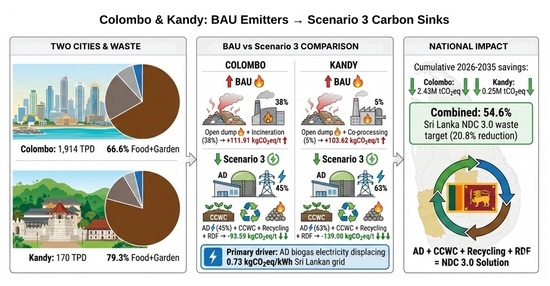
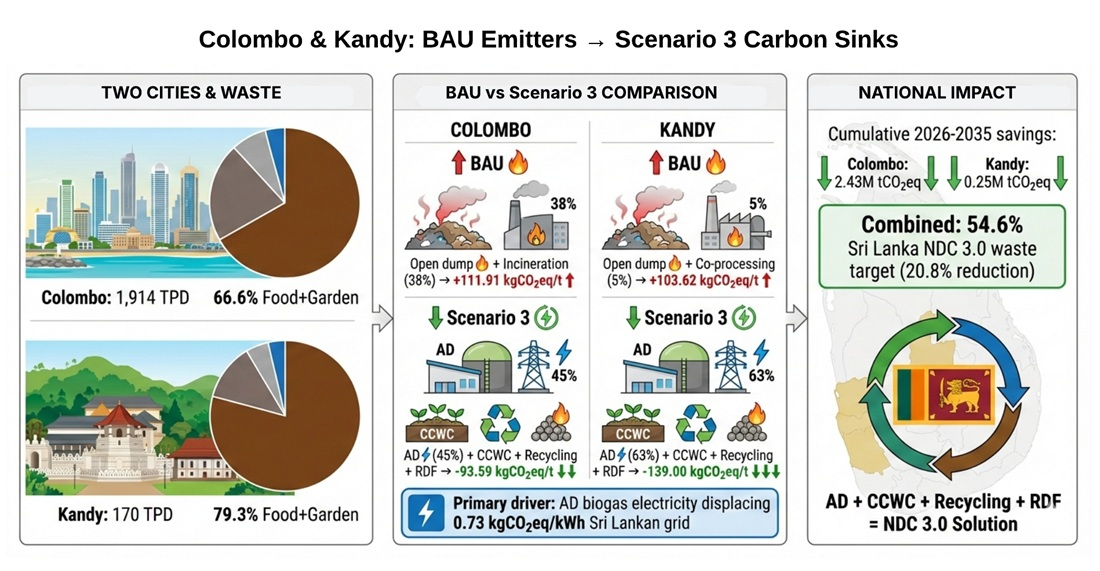
Graphical Abstract

1. Introduction

Globally, municipal solid waste (MSW) management has become a growing issue with increased waste generation influenced by rapid urbanization and economic growth, and this trend can be seen in most developing countries presently [1]. MSW quantity and composition (especially its carbon-containing fraction), together with the technologies applied for the management, play a crucial role in determining the overall greenhouse gas (GHG) emissions from MSW systems [2]. The increasing emissions of GHGs like methane (CH4), carbon monoxide (CO), carbon dioxide (CO2), chlorofluorocarbons (CFCs), and nitrous oxide (N2O) in the air can lead to climate change, which can affect the ecosystem [3]. Hence, improper waste management considerably contributes to climate change, while well-designed waste management systems potentially lower emissions and enable resource recovery [4]. In response to these challenges, many countries have introduced legislation that prioritizes waste prevention, reduction, reuse, and recycling, and a range of treatment options (e.g., landfilling, composting, incineration, and recycling), and have been compared internationally using systematic tools such as life-cycle assessment (LCA) [4,5,6,7,8,9].
Sri Lanka is presently experiencing substantial MSW challenges. National MSW generation has reached 8141 tons per day (t/day), with an average per-capita generation of 0.60 kg/person/day across local authorities [10,11]. The country still relies heavily on open dumping and uncontrolled burning, e.g., 300 open dumping sites, accounting for roughly 85% of disposal practices in many areas [12,13,14,15]. These outcomes are reinforced by a low municipal collection rate (approx. 47%) and limited public participation in formal waste programs [15]. MSW management in Sri Lanka is further constrained by rapid urbanization, population growth, limited adoption of cost-effective technologies, and shortcomings in policy implementation [3,16,17,18].
Sri Lanka identifies the waste sector as one of six mitigation sectors in its nationally determined contributions 3.0 (NDC), with a 20.8% emission reduction target for waste (8.6% unconditional; 12.2% conditional) [11]. Whereas the updated NDC and the 2021–2030 implementation plan focus on achieving a 14.5% reduction by 2030 [19], NDC 3.0 re-calibrates the period of 2026–2035 and places stronger emphasis on systemic interventions such as circular-economy and low-carbon urban systems, which depend heavily on MSW decisions [11]. Despite being named as a key mitigation sector with explicit quantitative targets, the NDC and Implementation Plan of waste sector in Sri Lanka rely largely on aggregated activity data and technology level assumptions, with many co-benefits and alternative MSW management configurations not fully assessed due to data and MRV (measurement, reporting, and verification) limitations. As a result, national and local decision makers lack robust, LCA-based GHG quantification for the full MSW management life cycle, from generation and collection through treatment, recovery, and final disposal, and they have limited evidence on which low-carbon practices best support NDC 3.0 trajectories in Sri Lanka.
Despite the clear national importance of improved MSW systems, detailed, city-level quantification of GHG emissions and reduction across complete waste management chains remains limited in Sri Lanka. To produce transferable insights, Colombo and Kandy were selected through a systematic two-stage process: (1) targeting Western (3732 t/day) and Central Provinces (1585 t/day), highest waste-generating provinces contributing >65% national MSW in Sri Lanka [15,19,20,21]; and (2) within these, selecting their principal urban centers with highest per-capita generation and contrasting baseline systems (Colombo: 1914 t/day, centralized incineration/open dumping; Kandy: 170 t/day, decentralized/co-processing/open dumping) to maximize policy transferability.
LCA is adopted here as the core analytical method because it systematically identifies, quantifies, and evaluates environmental burdens across the full life cycle of a product, process, or system by accounting for energy and material inputs, as well as emissions and wastes to the environment [22,23,24,25]. In the MSW context, LCA moves beyond a narrow focus on direct landfill emissions to capture upstream and downstream flows (collection, transport, treatment, recovery, and disposal), enabling a holistic comparison of alternative management scenarios. LCA has been widely used internationally to compare landfilling, incineration, composting, recycling, and resource-recovery options [5,6,8,24,25].
Although prior LCA work in Sri Lanka has examined components such as open dumping versus sanitary landfilling, full-scale composting, assessment of open waste dump mining, and selected emission impact categories [26,27,28,29], there is still no comprehensive and quantitative LCA that evaluates the GHG emission and reduction potential of the entire existing MSW management system together with alternative scenarios for major urban cities in Sri Lanka. Therefore, this study would like to fill that gap by using LCA to quantify and compare GHG emission and reduction from alternative MSW management scenarios for Colombo and Kandy. Then, the study aims to identify MSW management strategies with low GHG emissions that minimize global-warming potential and that are transferable across Sri Lanka, providing support for the policy and investment decisions at regional and national scales.

2. Materials and Methods

2.1. Study Region and MSW Composition

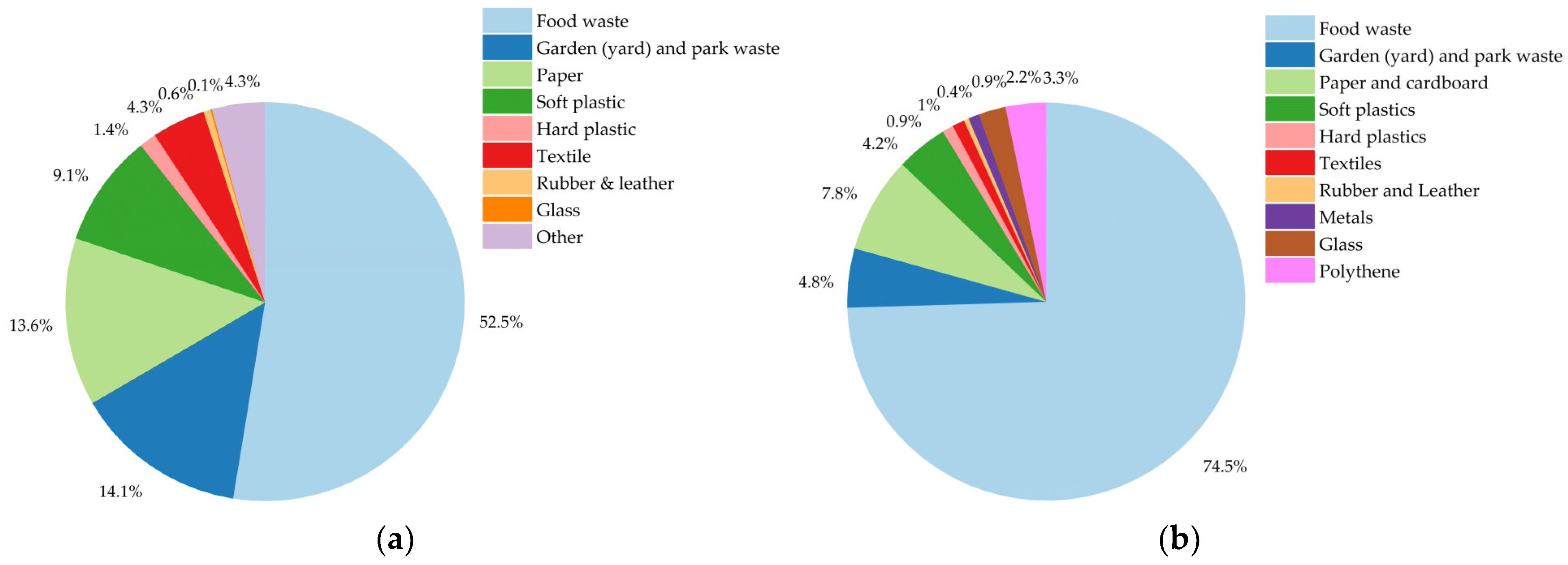
Colombo, the capital of Sri Lanka, is situated in the southwest of the country, while Kandy, the cultural and commercial city of the Central Province, is situated in the central hills. The study area covers 37.2 km2 in Colombo and 28.53 km2 in Kandy, with estimated populations of 647,557 and 111,701 in Colombo and Kandy, respectively [30], which generate around 1914 t/day and 170 t/day of MSW in Colombo and Kandy, respectively, with an average waste generation amount of 0.75 kg/person/day by a municipal council [21,31,32]. The composition of the study areas is illustrated in Figure 1. Colombo consists of 52.5% food waste, 14.1% garden (yard) and park waste, 13.6% paper, and 9.1% soft plastics, and Kandy consists of 74.5% food waste, 4.8% garden (yard) and park waste, 7.8% paper and cardboard, and 4.2% soft plastics. The moisture content of the waste is approximately 70–80%, and the calorific value is 600 to 1000 kJ/kg [17,33]. These compositions and characteristics indicate that the major portion of waste in both Colombo and Kandy is organic in nature, and hence the implementation of biological treatment techniques, such as composting and anaerobic digestion (AD), would be most appropriate for the study area.

2.2. Life-Cycle Assessment

In this study, the proposed LCA has been carried out following the framework designed by the International Organization for Standardization (ISO) 14,040:2006 methodology [34]. LCA includes four steps, comprising the goal and scope of the study, life-cycle inventory (LCI), life-cycle impact assessment (LCIA), and the interpretation of the results [35,36].

2.3. Goal and Scope of the Study

This study aims to (1) quantify GHG emissions from the current MSW management systems in the Colombo and Kandy cities using an LCA framework, and (2) to assess the mitigation potential of alternative MSW management strategies through scenario analysis. The results are intended to support local authorities, policymakers, and stakeholders by providing actionable, evidence-based guidance to improve MSW practices, promote circular-economy principles, and enhance the overall environmental performance of MSW management in Sri Lanka.
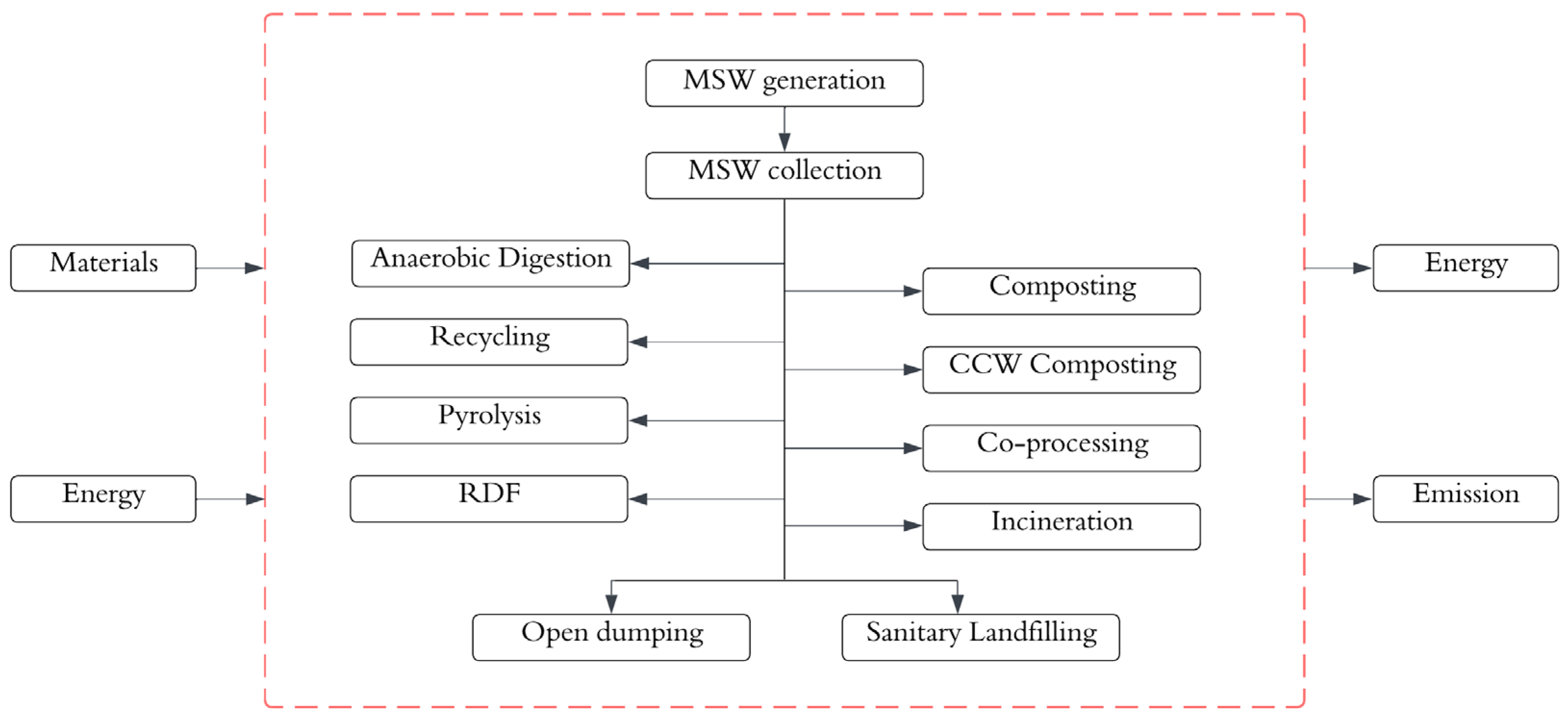
The life-cycle system boundary for this study is defined to capture the formal treatment pathways of MSW in the Colombo and Kandy cities, which focus on waste that is collected through municipal councils and does not include waste that bypasses the formal collection (e.g., backyard composting, informal collection, and direct household-level recycling to the informal sector). The boundary includes recycling, windrow composting, confined cover windrow composting (CCWC), AD, refuse-derived fuel (RDF) production, pyrolysis, incineration, co-processing in cement kilns, open dumping, and sanitary landfilling, together with the associated material, energy flows, and emissions (Figure 2). Within this framework, 51% (623 t/day) of the collected waste in Colombo and 46% (65 t/day) in Kandy are entered into formal treatment. Transportation is excluded from detailed modeling because reliable local data on vehicle types, fuel efficiencies, and route variability are inconsistent or unavailable. This exclusion was adopted to focus the LCA on stages with the highest expected environmental significance and data quality. The defined boundary follows recognized LCA conventions, explicitly noting the included processes and justified exclusions, thus ensuring both transparency and comparability in interpretation.

2.3.1. Functional Unit (FU)

The FU, which serves as the basis for comparison in a life-cycle inventory, is defined in this study as the management of 1 ton of collected MSW entering the formal system. All emissions, energy consumption, and material flows are reported and calculated with respect to this FU.

2.3.2. Scenarios

This study developed six MSW management scenarios, including a BAU scenario for each city. The BAU scenarios for Colombo and Kandy represent their existing MSW management systems. The remaining five alternatives use the same set of structural options for both cities but vary in the allocation of waste streams according to the respective MSW compositions in both cities. Figures S1 and S2 show the scenarios developed in this study for Colombo and Kandy. The analyses for all scenarios used waste diversion strategies on the collected waste stream. Scenario 1 diverted 55% of biodegradable waste to CCWC, sending 45% to the sanitary landfill. Scenario 2 increased the biodegradable waste fraction to 75% for CCWC and 25% for the sanitary landfill. For Scenarios 3 to 5, the diversion of biodegradable waste was 85% to AD and 15% to CCWC and incineration. In the formal system, 99.9% of identified recyclable materials are transferred to recycling, and 100% of non-recyclable waste is sent to sanitary landfill, incineration, RDF, or pyrolysis. Table 1 provides a representation of each scenario in this study.

2.4. Life-Cycle Inventory and Assumptions

Life-cycle Inventory consists of all inputs (energy and raw material) and outputs (material emissions, energy, and products) of a process or product within the considered system boundary [37]. Data used for developing the model were obtained from the National Solid Waste Management Support Centre (NSWMSC), Kandy Municipal Council, Colombo Municipal Council, site visits, previously published research articles, and the databases available in SimaPro 10.2.0.1. The following assumptions were made: (1) Short-cycle biogenic CO2 emissions are considered to be “carbon-neutral”, i.e., not contributing to global warming, and are therefore omitted from the inventory. Biogenic C released as CH4, however, is included. (2) GHG; CO2, N2O, and CH4 are included. Other GHGs are hardly emitted from the MSW management system and therefore ignored. The inventories used in this LCA model are presented in Table 2.
In this study, a country-specific grid emission factor was developed to represent the Sri Lankan electricity mix. The emission factor was derived using data from the Ceylon Electricity Board Sales and Generation Data Book 2023 [38], which provides detailed information on national electricity generation and sales. The life-cycle impact assessment was conducted using the IPCC 2021 GWP100 V1.03 method, with the functional unit defined as 1 kWh of electricity delivered. The calculated grid emission factor was 0.73 kg CO2 eq/kWh. This value was applied to estimate avoided electricity credits in scenarios where displaced grid electricity was considered.
Table 2. LCI database on the FU of the present study.
ProcessInputs/OutputUnitsValue
Open dumpingDiesel (excavator machines and dump operations)L/t2.12 × 100
CH4kg/t2.80 × 100
CO2kg/t7.70 × 100
CompostingWaterkg/t3.50 × 101
ElectricitykWh/t3.70 × 101
DieselL/t2.29 × 101
NH3kg/t6.80 × 100
CH4kg/t3.40 × 10−1
N2Okg/t1.40 × 10−1
Confined cover windrow compostingElectricitykWh/t6.50 × 101
DieselL/t9.00 × 100
Waterkg/t2.00 × 101
NH3kg/t2.20 × 10−2
VOC (process emissions)kg/t7.30 × 100
Anaerobic digestionElectricity (Pre-treatment + reactor)kWh/t1.38 × 101
Electricity generated (CHP at 35%)kWh/t3.31 × 102
CH4 (fugitive)kg/t3.43 × 10−1
CO2 (fossil)kg/t6.90 × 100
IncinerationProcess fuel oilkg/t8.70 × 100
Electricity for ash managementkWh/t1.24 × 100
Diesel for ash managementL/t1.10 × 100
Net electricity outputkWh/t2.25 × 102
CO2-fossilkg/t3.32 × 102
COkg/t3.00 × 10−2
SO2kg/t2.00 × 10−3
NOxkg/t2.10 × 10−1
RDFTotal electricitykWh/t1.38 × 101
Diesel consumptionL/t3.31 × 102
Total heat MJ/t4.36 × 101
Hard coal (avoided product)kg/t1.32 × 102
RDF (pellets)kg/t1.10 × 102
CO2 kg/t9.08 × 100
Sanitary landfillIronkg/t1.48 × 10−3
Concretem3/t1.31 × 10−4
Excavation hydraulic diggerm3/t3.88 × 10−1
Extrusion plastic pipeskg/t8.50 × 10−2
Gravelkg/t1.60 × 102
Pitchkg/t2.39 × 100
Polythene, high-densitykg/t2.69 × 10−1
Polypropylenes granulatekg/t2.24 × 10−4
Polyvinylchloridekg/t8.72 × 10−3
Steelkg/t8.72 × 10−3
Sandkg/t6.69 × 10−2
Steel chromium kg/t3.04 × 10−3
Synthetic rubberkg/t8.95 × 10−5
Waterkg/t1.86 × 100
Diesel MJ/t4.84 × 101
ElectricitykWh/t1.50 × 10−2
Heat MJ/t1.61 × 100
CO2 kg/t8.63 × 100
CH4kg/t3.14 × 100
Leachate m3/t2.01 × 100
Co-processingLimestone and clayt/t1.56 × 100
Iron ore, 46% Fet/t2.90 × 10−2
Excavation, skid-steer loaderm3/t7.52 × 10−1
Electricity (raw meal)kWh/t3.86 × 101
Electricity (cement plant)kWh/t3.72 × 101
Petroleum coke, at the plantkg/t8.32 × 101
RDF plastic (at plant)kg/t7.81 × 101
RDF textile (at plant)kg/t2.66 × 101
RDF rubber (at plant)kg/t4.00 × 101
Refractory, fireclay, packedkg/t7.23 × 100
CO2kg/t8.55 × 102
SO2kg/t3.24 × 10−1
N2Okg/t6.66 × 10−1
PyrolysisElectricity, net imported to process kWh/t4.62 × 101
Natural gas kg/t1.87 × 102
Diesel for ash managementkg/t3.25 × 100
Net electricity outputkWh/t1.97 × 102
Solid residueskg/t1.20 × 102
APC residueskg/t3.59 × 101
Metalskg/t5.85 × 101
CO2 (fossil)kg/t7.91 × 101
COkg/t1.32 × 10−2
SO2kg/t9.90 × 10−3
NOXkg/t2.05 × 10−1
Source: NSWMSC, Kandy Municipal Council; Colombo Municipal Council, [39,40,41,42,43]; Simapro 10.2.0.1 database.

2.5. Life-Cycle Impact Assessment

Life-cycle impact assessment is the third stage of the process that associates all the inputs and outputs with environmental impact categories [44], using the global-warming potential (GWP) for a 100-year time horizon of global-warming potential (GWP100) as its characterization factor. The impact assessment was carried out using the LCA software Simapro 10.2.0.1, a widely used ISO-compatible LCA software that provides access to ecoinvent and other peer-reviewed databases. SimaPro was used to build process networks, manage inventory data, and apply the IPCC 2021 GWP100 V1.03 characterization method [45] for all scenarios.
The selected impact category is used mainly to align directly with NDC 3.0 in Sri Lanka, which establishes mitigation targets in terms of GHG reductions only. However, previous MSW management LCAs report that incineration and pyrolysis can exhibit higher acidification, eutrophication, toxicity, and particulate matter impacts than recycling and digestion-oriented systems, even when their net GWP is favorable [46,47,48]. Accordingly, the present scenarios should be interpreted primarily as optimal climate mitigation configurations, rather than as comprehensive indicators of overall environmental performance.

2.6. Sensitivity Analysis

2.6.1. Treatment Technology Efficiency and Biodegradable Waste Diversion Rate

A one-at-a-time (OAT) sensitivity analysis was conducted to evaluate the robustness of the MSW management system to uncertainty in key operational and behavioral parameters. Consistent with recommendations for parameter screening in LCA, individual parameters were perturbed within empirically supported ranges, while all other model inputs were held constant, and the resulting changes in GHG emission were quantified through repeated full LCA calculations in SimaPro. Two parameter groups were considered: (1) treatment technology energy efficiencies (±20%) and (ii) biodegradable waste diversion rates (±10%).
The chosen ±20% range is consistent with common practice in the LCA and techno-economic assessments, where foreground parameters such as process yields, recovery efficiencies, and emission factors are often perturbed by ±10–30% in OAT sensitivity analysis when detailed statistical characterization is not available. This magnitude of variation is generally regarded as sufficient to capture realistic uncertainty in technology performance and has been applied in waste-management LCAs that combine OAT perturbations of technology parameters with broader global sensitivity analysis. On this basis, a symmetric ±20% variation in treatment technology energy efficiencies was adopted here as a methodologically standard and empirically defensible representation of operational variability in the treatment system [49].
Biodegradable waste diversion rates for organics (around 55%, 75%, and 85%) were varied by ±10% to reflect behavioral and operational variability. Because developing-country source-separation and collection programs commonly exhibit change of several tens of percentage points in capture and diversion rates between seasons [50,51], neighborhoods, or program phases [52], a ±10% band is therefore a conservative, local variation (roughly half of observed change) that is used to test robustness around each scenario rather than to create new policy regimes.
For each parameter change, full LCA runs were repeated, and a normalized sensitivity index was calculated as the average absolute change in GWP divided by the parameter change (%), giving kg CO2 eq per 1% change. This normalized metric is standard in LCA for comparing the influence of heterogeneous parameters on overall results.

2.6.2. Transportation

To address the potential influence of transportation on overall system performance, a sensitivity analysis was conducted. Although transportation was excluded from the baseline modeling due to the absence of consistent local vehicle and route data, this supplementary assessment employs the ecoinvent v3.11 dataset (“transport, freight, lorry 16–32 t, fleet average”) to represent haul distances of 20 km, 30 km, and 50 km between waste collection centers and centralized AD facilities. This simplified approach provides a quantitative indication of how transport-related emissions might alter total system impacts, ensuring that the analysis remains transparent despite data limitations.

2.6.3. Grid Decarbonization Scenarios

A sensitivity analysis was performed to evaluate the influence of potential grid decarbonization on the outcomes of the study. The baseline grid emission factor of 0.73 kg CO2 eq/kWh was systematically reduced by 20%, 30%, and 50% to simulate future scenarios with lower carbon intensity due to increased renewable energy integration. These adjusted emission factor values were applied to the same AD scenarios to assess variations in avoided emissions results. The analysis helped determine the robustness of the environmental benefits of the system under evolving electricity grid conditions.

3. Results and Discussion

3.1. GHG Emission and Mitigation Potential of the MSW Management

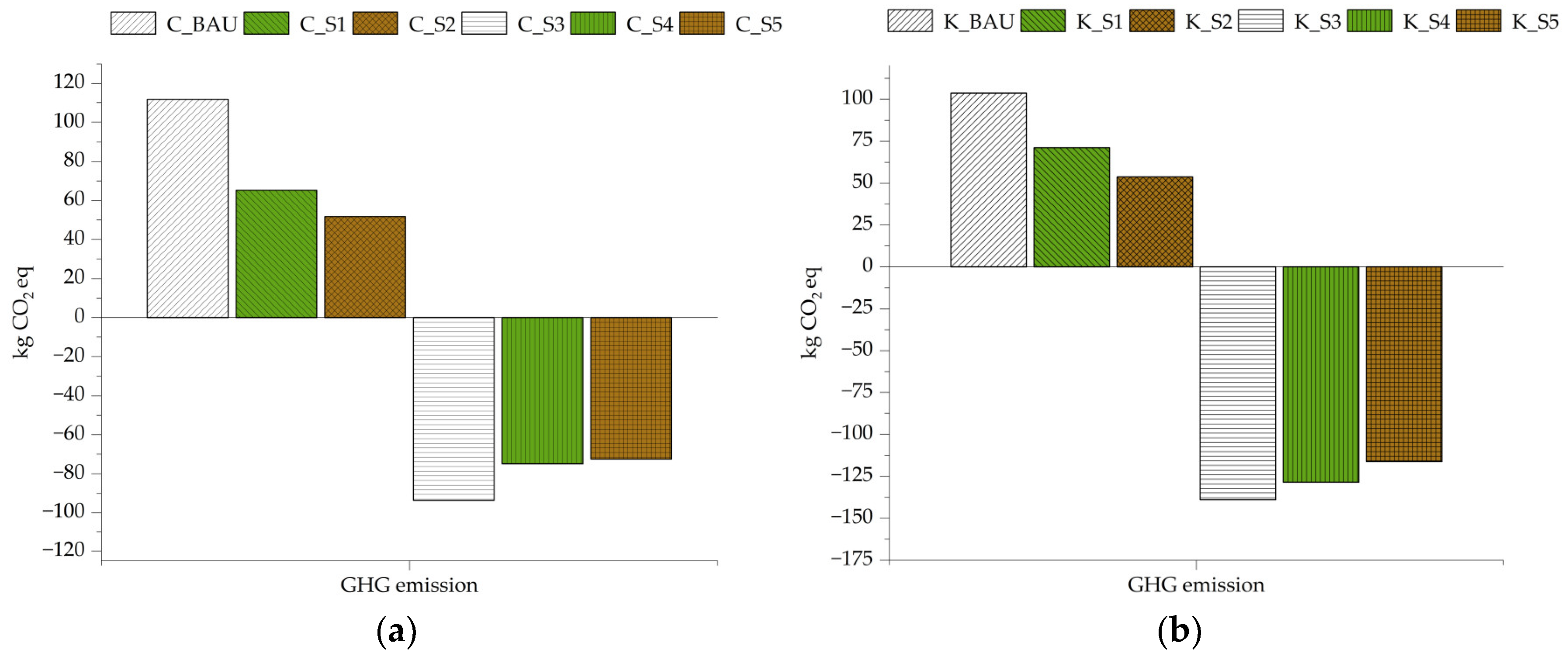
In this study, GHG emission was calculated for both Colombo and Kandy cities. Results demonstrate that integrating AD and CCWC with recycling transforms both Colombo and Kandy cities from net GHG emitters under BAU to net sinks under several alternative scenarios (Figure 3). In Colombo, emissions decrease from 111.91 kg CO2 eq per ton in BAU to −93.59 kg CO2 eq per ton in Scenario 3, corresponding to a reduction of 205.50 kg CO2 eq per ton relative to BAU. In Kandy, this shift is even more evident, from 103.62 kg CO2 eq per ton to −139.00 kg CO2 eq per ton in Scenario 3, representing a reduction of 242.62 kg CO2 eq per ton in relative to BAU.

3.1.1. GHG Emission Under BAU

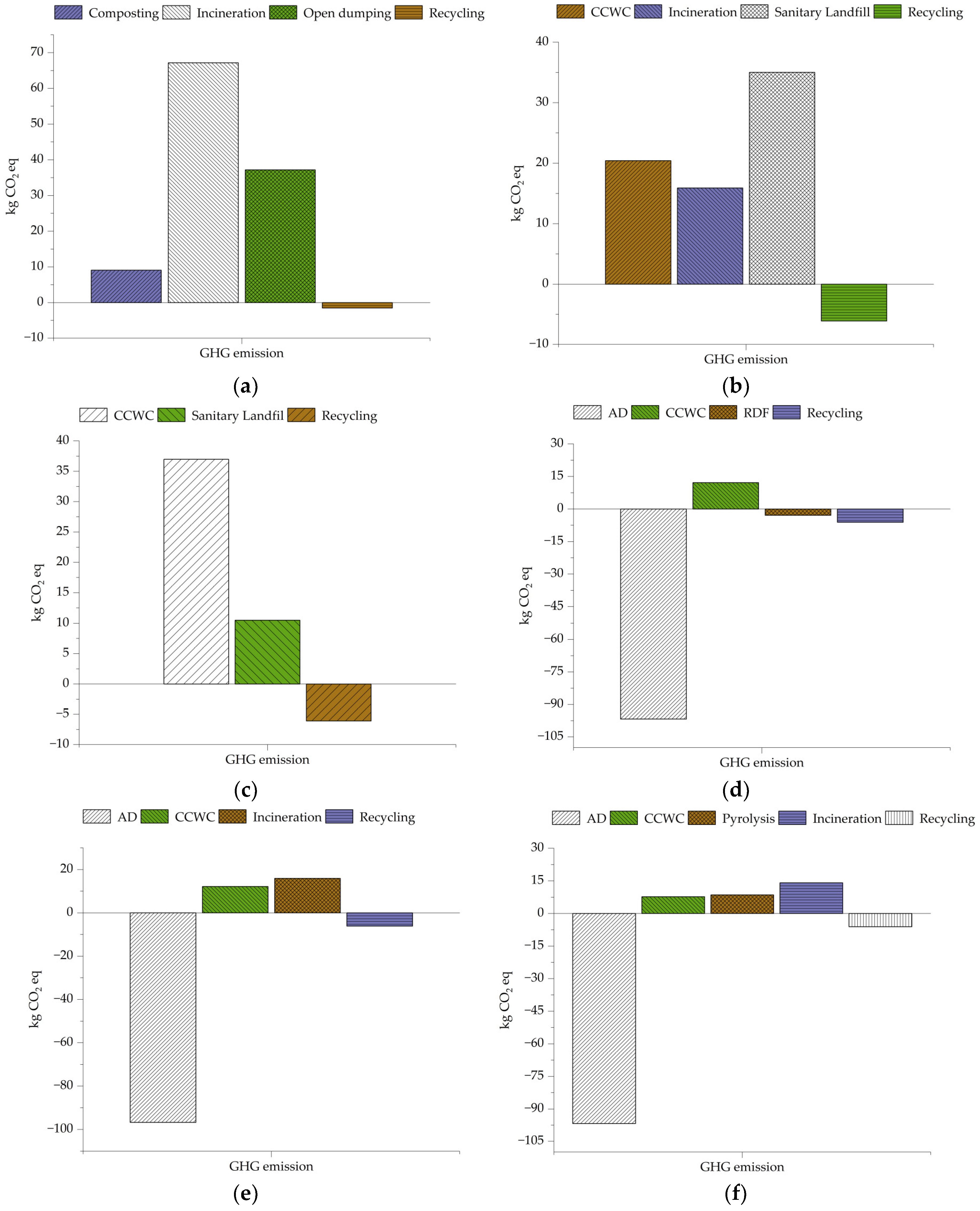
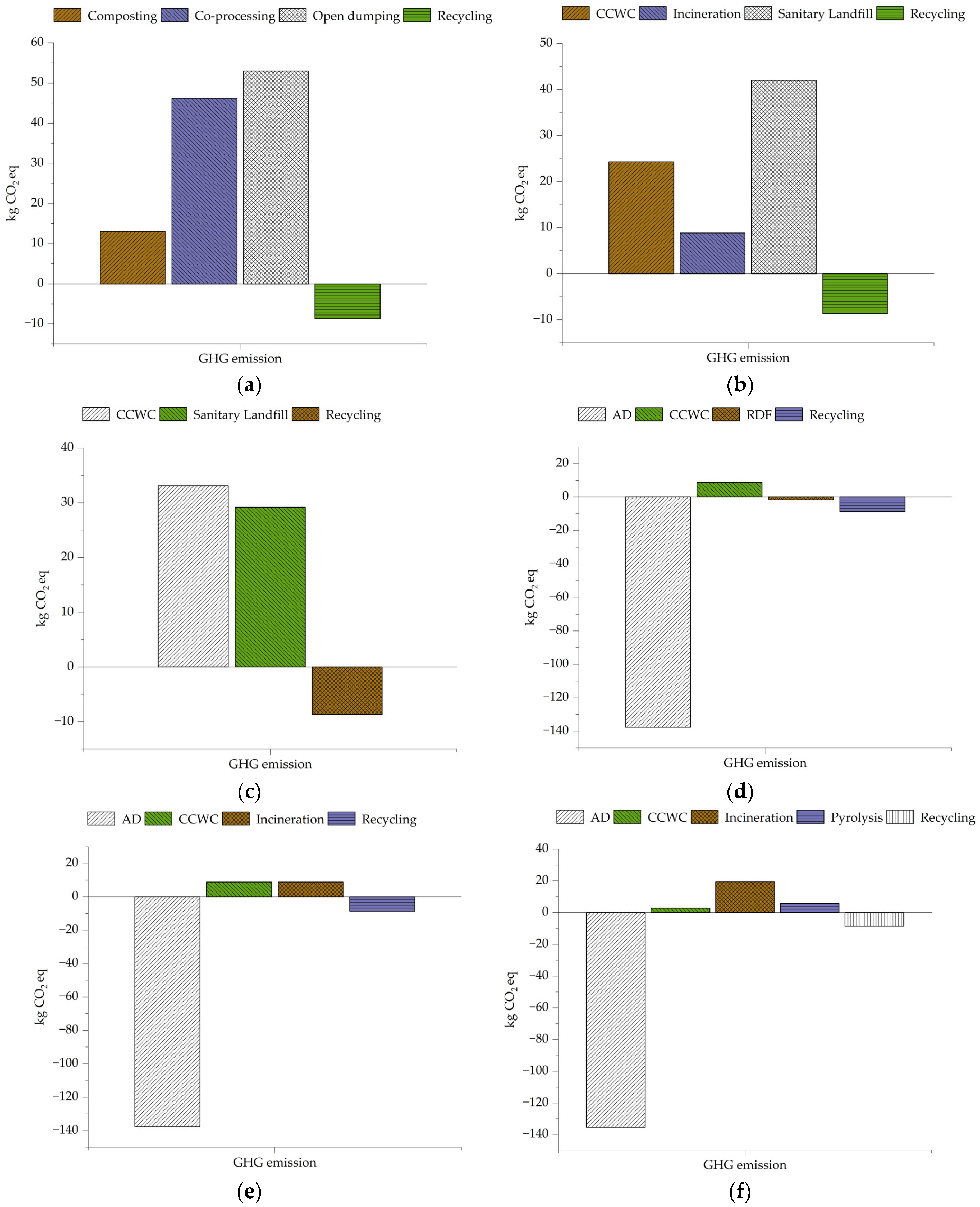
The BAU scenarios represent the current MSW management practices in Colombo and Kandy. These cities exhibit distinct emission profiles shaped by differences in waste composition, baseline management practices, and scenario implementation. Although Colombo and Kandy show similar qualitative trends across scenarios, the magnitude of GHG mitigation differs. In Colombo, BAU produces 111.91 kg CO2 eq per ton of MSW (Figure 4a), driven primarily by incineration (67.17 kg CO2 eq per ton of MSW) and open dumping (37.18 kg CO2 eq per ton of MSW). High emissions are produced through incineration from combusting fossil-derived waste without efficient energy recovery, while open dumping releases methane from anaerobic decomposition of organic matter under uncontrolled conditions. Composting contributes 9.08 kg CO2 eq per ton of MSW, reflecting process emissions from aerobic degradation, and recycling provides a modest credit of −1.53 kg CO2 eq per ton of MSW by avoiding virgin material production (Figure 4a). The Kandy BAU yield is 103.62 kg CO2 eq per ton MSW (Figure 5a). Open dumping (52.98 kg CO2 eq per ton of MSW) and co-processing in cement kilns (46.23 kg CO2 eq per ton of MSW) are the dominant emission sources, while recycling provides a larger credit (−8.65 kg CO2 eq per ton of MSW) than in Colombo due to higher baseline recycling rate at Kandy. Co-processing in cement kilns displaces fossil fuels but does not fully offset the emissions from other pathways in the BAU scenario. Comparing both cities, GHG emissions are slightly higher in Colombo than in Kandy (Figure 3b). BAU in both cities relies heavily on environmentally problematic practices, such as open dumping and inefficient thermal treatments, which fail to capture energy or material value, resulting in net-positive GHG emissions and missed opportunities for resource recovery.
The GHG emissions in both Colombo and Kandy are substantially lower than those reported for several South Asian cities dominated by open dumping and low recovery, yet they remain clearly climate positive. For example, Dangi et al. [37] reported GHG emission 1.02 × 10⁸ kg CO2 eq per ton of MSW landfilled per year in Kathmandu under incomplete data conditions, while Mandpe et al. [3] estimated around 2.94 × 10⁵ kg CO2 eq per day of MSW for Delhi depending on landfill gas management and diversion assumptions [3,37]. Islam [53] has reported 420.88 kg CO2 eq emission from current waste management system in Bangladesh. Gautam and Agrawal [54] reported a 3.20 × 10⁷ kg CO2 eq per day emission in India [53,54]. These discrepancies are possibly explained by methodological differences, including the use of updated ecoinvent v3.11 backgrounds, the application of the IPCC 2021 GWP100 method, the exclusion of transport, and an FU restricted to waste entering the formal system, in contrast to broader system boundaries in this study. Consequently, while the absolute BAU values appear comparatively low, they still indicate that continued reliance on open dumping, limited biological treatment, and modest recycling is inconsistent with NDC-aligned trajectories in Sri Lanka and should be considered a minimum baseline for rapid policy intervention.

3.1.2. GHG Mitigation Potential Under Different Scenarios

Scenario 1 represents an intermediate improvement, eliminating open dumping and incineration in favor of sanitary landfilling, CCWC (55% biodegradable diversion), and enhanced recycling (24% in Colombo, 15% in Kandy). In Colombo, emissions drop to 65.24 kg CO2 eq per ton of MSW (Figure 3a), with sanitary landfilling (35.01 kg CO2 eq per ton of MSW) and CCWC (20.42 kg CO2 eq per ton of MSW) as primary contributors (Figure 4b). Recycling credit expands to −6.10 kg CO2 eq per ton of MSW. In Kandy, emissions fall to 71.15 kg CO2 eq per ton of MSW (Figure 3b), with CCWC (24.28 kg CO2-eq per ton of MSW) and sanitary landfilling (42.01 kg CO2 eq per ton of MSW) as main sources (Figure 5b). The recycling shows −8.65 kg CO2 eq per ton of MSW. Scenario 1 demonstrates that phasing out open dumping and adopting controlled sanitary landfilling can substantially reduce emissions, though the system remains net-positive due to limited energy recovery, and this phasing out with engineered sanitary landfilling equipped with effective gas management systems can significantly reduce GHG emissions compared to current practices [55]. Numerous studies have similarly reported the emission reduction benefits achieved by transitioning from open dumping to sanitary landfills [53,54,56]. Cristóbal et al. [57] highlighted that 24 most critical open dumpsites in Peru will add 4.4 Mt CO2 eq from 2019 to 2028.
Scenario 2 increases biodegradable waste diversion to 75% for CCWC, with 25% to sanitary landfilling and no incineration. Colombo achieves 51.84 kg CO2 eq per ton of MSW (Figure 3a), with CCWC emissions rising to 36.98 kg CO2 eq per ton of MSW due to higher throughput but sanitary landfilling decreasing to 10.50 kg CO2 eq per ton of MSW. Recycling maintains −6.10 kg CO2 eq per ton of MSW (Figure 4c). Kandy reaches 53.64 kg CO2 eq per ton of MSW (Figure 3b), with CCWC at 33.11 kg CO2 eq per ton of MSW and sanitary landfilling at 29.18 kg CO2 eq per ton of MSW (Figure 5c). While Scenario 2 further reduces emissions relative to BAU and Scenario 1, it remains net-positive, as composting does not generate energy credits to offset process emissions and residual landfill methane. These shifts confirm that, while sanitary landfilling and CCWC are preferable to open dumping from a climate perspective, they are not climate-neutral and must be complemented by high-performing recovery processes such as AD.
From Scenario 3 onward (Figure 4 and Figure 5), AD becomes the defining process. In both cities, AD produces large negative GHG contributions (−96.73 kg CO2-eq per ton in Colombo; −137.57 kg CO2 eq per ton in Kandy), consistent with the avoided-burden assumptions of AD-produced electricity displacing Sri Lankan grid mix and fossil fuels and potentially avoiding other resource-intensive products. These credits incorporate a conservative methane slip fraction of 0.5%, as reported by IPCC 2019 [58] and Buivydas et al. [59], reflecting realistic fugitive CH4 emissions during AD operations. RDF further enhances credits (e.g., −2.91 kg CO2 eq per ton in Colombo; −1.61 kg CO2 eq per ton in Kandy Scenario 3) by substituting coal and petroleum coke in the industry. In Scenario 3 (Figure 3), Kandy achieves more negative GHG emission values than Colombo, reflecting its higher AD allocation fractions and the larger per-ton AD credit. The higher AD fraction in Kandy, combined with a more negative AD unit credit, drives stronger net mitigation. The large negative GHG credits from AD in Scenario 3 fall toward the optimistic end of ranges reported for organic fraction of MSW (OFMSW) treatment in low–middle income countries and Sri Lanka, where net benefits typically depend on grid emission factors and CHP (combined heat and power) performance. Rasangika and Babel found that full-scale composting of OFMSW in Sri Lanka remained a net GHG source, while AD reduced total environmental load by 68.3% when electricity displaced grid power, qualitatively consistent with the strong credits observed here [29]. Several studies have identified AD as one of the most effective strategies for managing organic waste and reducing GHG emissions. DiStefano and Belenky [60] suggested that diverting MSW from landfills to AD systems could achieve substantial annual GHG emission reductions, estimated at 146 million tons by decreasing landfill activity and utilizing biogenic methane for electricity generation in place of fossil fuels. Similarly, Ardolino et al. [61] demonstrated the environmental sustainability of biomethane production through AD of the organic fraction of MSW, showing a 79% improvement in GWP for the biowaste-to-biomethane pathway compared to the biowaste-to-energy scenario. Supporting these findings, Slorach et al. [62] evaluated the life-cycle environmental performance of energy and fertilizer recovery from household food waste in the UK via AD and found that treating one ton of food waste through AD results in net-negative GHG emissions (−39 kg CO2 eq t−1) and yields lower overall environmental impacts than both incineration and landfilling, largely due to the displacement of grid electricity and mineral fertilizers. International guidance and recent reviews emphasize that AD climate performance is highly sensitive to biogas capture efficiency, fugitive CH4 control, and the carbon intensity of marginal electricity, with credits shrinking as power systems decarbonize [22,63].
Scenario 4 remains net-negative, and its emissions are higher than Scenario 3 by 18.81 kg CO2 eq per ton of MSW (Colombo; Figure 4e) and 10.45 kg CO2-eq per ton of MSW (Kandy; Figure 5e), primarily due to fossil carbon emissions in incineration offsetting some of benefits of AD. This trade-off suggests that RDF, which earns avoided-burden credits by substituting coal or petroleum coke, is preferable to direct incineration from a GHG perspective.
In Scenario 5, emissions are even slightly higher than Scenario 3 (by 21.18 kg CO2 eq per ton of MSW in Colombo (Figure 4f), and by 22.83 kg CO2 eq per ton of MSW in Kandy (Figure 5f)), indicating that pyrolysis, while offering potential for biochar production and waste volume reduction, does not generate sufficient avoided-burden credits to match the synergy of AD and RDF in Scenario 3. Pyrolysis remains a promising technology for residual waste valorization but requires further efficiency gains or co-product utilization to optimize GHG performance. Incineration is a continued presence in Scenario 5, although at reduced allocation, further hindering the net-negative potential by releasing fossil-derived CO2 without displacing equivalent external energy sources, unlike in AD.
The prioritizing of biological routes and high material recovery (Scenario 3) yields stronger mitigation (−93.59 and −139.00 kg CO2 eq per ton in Colombo and Kandy; Figure 3) than increasing reliance on incineration or pyrolysis (Scenarios 4–5), which raises emissions from −74.78 to −72.41 kg CO2 eq per ton in Colombo and from −128.55 to −116.17 kg CO2 eq per ton in Kandy. This is consistent with comparative LCAs showing that, under typical European and Asian conditions, mass burn incineration and pyrolysis often remain net GHG sources once stack CO2 and realistic heat utilization are considered, and they only outperform biological options when displacing highly carbon intensive electricity or heat [41,64]. In contrast, AD of high-moisture OFMSW usually achieves greater GHG savings in systems with fossil-dominated power mixes, provided digestate management avoids excessive N2O emissions [28,63]. From a circular-economy perspective, the present study explicitly recognizes AD by-product (digestate) utilization as a critical component of Scenarios 3, 4, and 5. However, it is important to note that digestate handling was not explicitly modeled in this present study, and inclusion of this life cycle could alter both emissions and resource-use outcomes. Evidence from recent studies indicates that digestate utilization as a bio-fertilizer, including options such as direct spreading, centrifugation, and advanced post-treatment systems (centrifugation, drying, membrane filtration, and reverse osmosis), can offer sustainable solutions for managing excess nutrients in agricultural areas [65], support circular nutrient management, and partially replace conventional nitrogen removal processes as a circular-economy pathway for AD by-products [66]. At the same time, Caiardi et al. [67] identified that land application of liquid digestates can introduce substantial burdens in particulate matter formation, acidification, and terrestrial eutrophication impact categories, underscoring that digestate management pathways may introduce important trade-offs. These findings suggest that the omission of digestate handling in the present assessment represents a relevant limitation and that the net benefits of AD could be either enhanced or partially offset depending on the chosen digestate management strategy. However, AD has been identified to be a triple benefit technology [68,69] thus positioning it as one of the most important circular-economy technology models available.
Thermal processes in Scenarios 4 and 5 introduce additional trade-offs. Incineration in Colombo Scenario 4 contributes 15.91 kg CO2 eq per ton (Figure 4e), and in Kandy Scenario 4, it contributes 8.84 kg CO2 eq per ton (Figure 5e). Pyrolysis in Scenario 5 produces 8.55 kg CO2 eq per ton of MSW in Colombo (Figure 4f) and 5.70 kg CO2 eq per ton of MSW in Kandy (Figure 5f). Although these technologies may recover energy and reduce landfill demand, their net fossil GHG contributions are positive under the adopted inventories, making them less favorable than AD when the goal is maximal GHG mitigation.
Recycling behaves consistently as a net sink across most scenarios, with small differences between cities. In Colombo Scenarios 1 to 5 (Figure 4), recycling yields −6.10 kg CO2 eq per ton of MSW, while in Kandy, it provides −8.65 kg CO2 eq per ton of MSW (Figure 5). Overall, AD and recycling, supported by RDF, offer strong climate benefits under the avoided-burden approach, whereas incineration, pyrolysis, and sanitary landfilling remain net GHG sources. Strategic scenario design thus hinges on maximizing flows to AD and recycling, while minimizing high-emission disposal and thermal processes.

3.2. Sensitivity Analysis

The sensitivity analysis tested system robustness across two parameters, treatment technology energy efficiency (±20%) and biodegradable waste diversion rates (±10%). Results demonstrate that scenario rankings remain stable across these variations, though certain parameters, particularly AD energy efficiency and biodegradable diversion rates, apply substantial influence on absolute GHG performance. All AD-based scenarios (Scenarios 3–5) maintained net-negative emissions across the full tested ranges in both cities, confirming their viability as climate mitigation strategies even under conservative operational assumptions.
For energy efficiency, composting and incineration in BAU exhibit low-to-moderate sensitivity in both cities, and lower than AD in later scenarios. In Colombo BAU with composting and incineration (112 kg CO2 eq per ton), ±20% energy efficiency in composting shifts GHG emission to 111 or 113 kg CO2 eq per ton (sensitivity index 0.05), and energy efficiency in incineration shift to 124 or 99.50 kg CO2 eq per ton (sensitivity index 0.05; Table S1). In Kandy BAU with composting and co-processing in cement kilns (104 kg CO2 eq per ton), composting shifts GHG emissions to 102 or 105 kg CO2 eq per ton (sensitivity index 0.05) and co-processing in cement kilns shift to 103 or 104 kg CO2 eq per ton (sensitivity index 0.03; Table S1). AD exhibits the highest sensitivity in both cities. In Colombo Scenario 3, a ±20% change in AD energy efficiency shifts the GHG emission from −93.59 kg CO2 eq per ton to −72.70 or −114.00 kg CO2 eq per ton, with a sensitivity index of 1.03 kg CO2 eq per 1% change (Table S1). In Kandy Scenario 3, the equivalent shift is from −137.57 kg CO2 eq per ton to −109 or −169 kg CO2 eq per ton, with a sensitivity index of 1.50 (Table S1). Despite this variability, the sign of the impact remains negative across the full ±20% range, confirming that AD retains its status as a net GHG mitigation option even under conservative energy-efficiency assumptions. Incineration and CCWC show moderate sensitivity. For instance, incineration in Colombo BAU has an average absolute change of 12.00 kg CO2 eq per ton (sensitivity index, 0.61) for a ±20% efficiency change, while CCWC in Colombo Scenario 2 has an average change of 4.75 kg CO2 eq per ton (sensitivity index, 0.24). In Kandy, CCWC in Scenario 2 shows a similar magnitude (5.70 kg CO2 eq per ton; sensitivity index, 0.29; Table S1). Furthermore, decreasing efficiency intensifies their emissions; meanwhile improving the efficiency of these processes can reduce emissions, but it cannot eliminate the positive contribution to the system.
Biodegradable waste diversion sensitivity emphasizes the importance of stable and high biodegradable waste capture. Scenarios with 85% diversion to AD (Scenarios 3–5) are especially sensitive (Table S2). In Colombo Scenario 4, a −10% reduction in biodegradable diversion raises GHG emission from −74.78 to −26.5 kg CO2 eq per ton, while a +10% improvement increases mitigation to −85.6 kg CO2 eq per ton, with a sensitivity index of 3.0. In Kandy Scenario 5, similar ±10% diversion changes produce an average absolute difference of 24.6 kg CO2 eq per ton (sensitivity index, 2.5). Nevertheless, for all cases for Scenarios 3 to 5, impacts remain negative across the ±10% range, indicating that these scenarios are robust choices for climate mitigation if diversion rates remain high (Table S2).
The sensitivity results, therefore, suggest two key policy levers: (1) ensuring high and stable biodegradable waste diversion to AD (e.g., through source separation programs, regulatory mandates, and infrastructure investment); and (2) maintaining and improving energy efficiency in AD plants and energy recovery components, including generators and heat utilization systems.
The sensitivity results of transportation confirm that transport distance exerts a measurable but not dominant effect on the life-cycle outcomes, adding 3.8 to 9.6 kg CO2 eq as haul length increases from 20 km to 50 km. Scenario 3 maintained the most favorable environmental outcome across both Colombo and Kandy, with total emissions changing moderately (e.g., −93.59 to −89.28 kg CO2 eq for Colombo and −139.00 to −132.87 kg CO2 eq for Kandy). This finding supports the conclusion that transportation, while non-negligible, does not alter scenario rankings (Table S3). However, it is important to note that these results can be subjective since the transportation data were adapted from the ecoinvent database rather than real data due to data limitation. This acknowledgement underscores the indicative nature of the screening assessment, highlighting areas where future work could incorporate local route data or randomized modeling to reduce uncertainty and further validate comparative conclusions.
The sensitivity analysis of grid decarbonization scenarios reveals that the AD scenarios maintain substantial net-negative environmental performance even under aggressive grid decarbonization pathways projected toward 2035. Specifically, Scenario 3 remains net-negative across both Colombo (–47.20 kg CO2 eq/ton MSW) and Kandy (–68.90 kg CO2 eq/ton MSW) when the grid emission factor is reduced by 50% to 0.36 kg CO2 eq/kWh (Table S4), representing a conservative estimate of NDC-aligned renewable energy expansion of Sri Lanka. These findings align with energy transition targets in Sri Lanka, including a 70% renewable energy share by 2030, as outlined in the National Energy Policy, ensuring the long-term viability of AD systems amidst evolving grid conditions [70]. The linear sensitivity observed across 20–50% emission factor reductions further validates the conservative nature of baseline credits, enhancing confidence in the projections for NDC compliance of the study.

3.3. Pathways to Achieving NDC 3.0 Targets

3.3.1. Future Projection

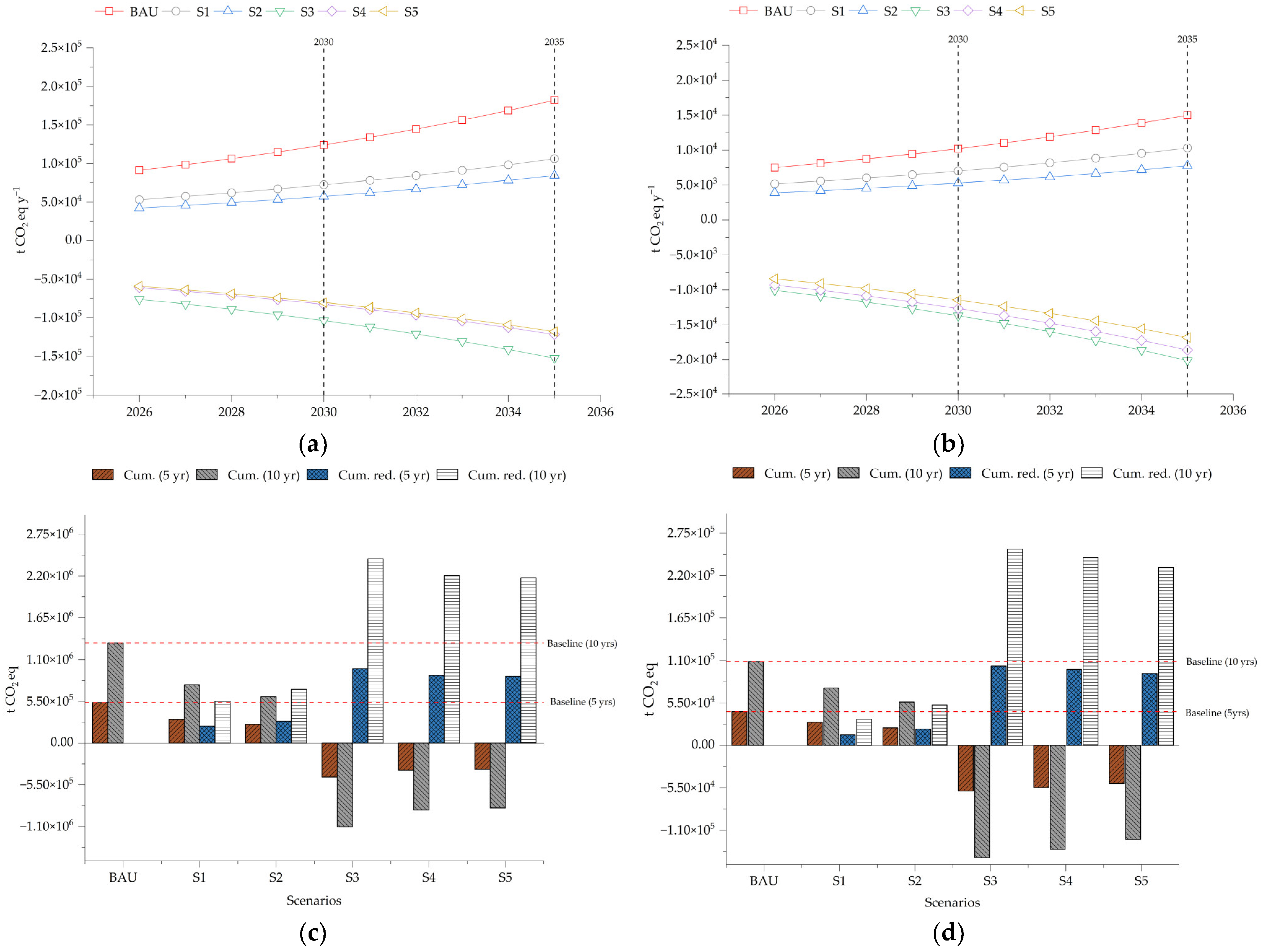
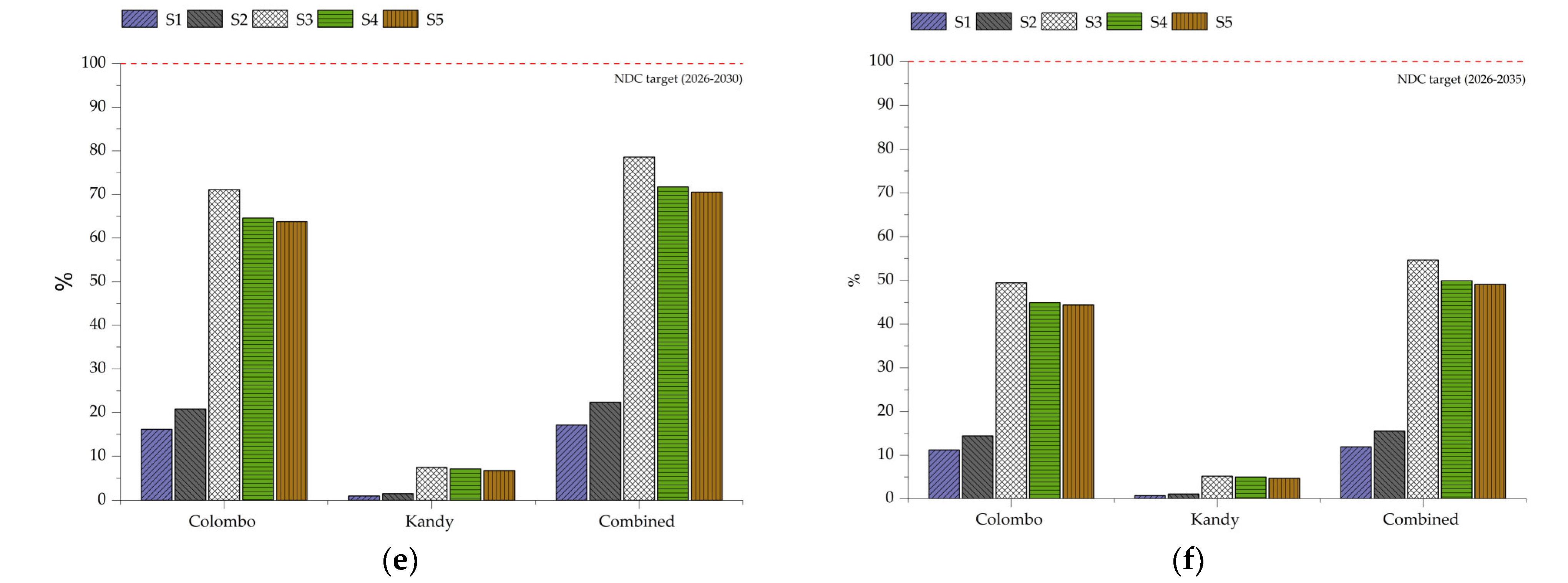
Projected GHG emissions for Colombo (Figure 6a) and Kandy (Figure 6b) rise steadily under BAU but shift to substantial net-negatives under all high-recovery scenarios, with Scenario 3 consistently delivering the greatest mitigation. In Colombo, BAU annual emissions increase from 9.11 × 10⁴ t CO2 eq per year in 2026 to 1.82 × 10⁵ t CO2 eq per year in 2035 (Figure 6a). Meanwhile, in Kandy, they increase from 6.94 × 10³ t CO2 eq per year in 2026 to 1.50 × 10⁴ t CO2 eq per year in 2035 (Figure 6b). At this city scale, the future emission projections show that full adoption of Scenario 3 across 2026–2035 produces large cumulative reductions of 2.43 × 10⁶ t CO2 eq for Colombo (Figure 6c) and 2.54 × 10⁵ t CO2 eq for Kandy (Figure 6c) relative to BAU. These values contribute 54.66% (Figure 6f) to the 10-year national reduction target under the NDC 3.0 framework and 78.55% (Figure 6e) to the 5-year NDC 3.0 reduction target in Sri Lanka, even though the two cities together account for only 6.07% of national BAU emissions over 10 years in the NDC 3.0 framework.
The NDC comparison in this study focuses exclusively on the waste sector, aligning with the NDC 3.0 target of a 20.8% reduction of Sri Lanka relative to BAU. Baseline and mitigation estimate for Colombo and Kandy were developed using the same methodological approach as the national waste inventory (2006 IPCC Guidelines, first-order decay, and consistent activity data) [71], ensuring comparability with national estimates. Electricity and fuel-substitution benefits from AD and RDF are treated as avoided burdens within the waste-system boundary to prevent cross-sector double counting [72]. Under these parameters, the finding that the two cities representing 6.07% of national waste-sector BAU could deliver over half of the NDC waste-sector mitigation target refers specifically to the 20.8% reduction goal, not to total national NDC commitments.
Differences in future projections also reflect the city scale. BAU cumulative emissions in Colombo (Figure 6c) for 2026–2035 (1.32 × 10⁶ t CO2 eq) are an order of magnitude higher than Kandy (0.10 × 10⁶ t CO2 eq; Figure 5d), consistent with higher MSW generation (e.g., 1.63 × 10⁶ ton per year in 2035 for Colombo vs. 0.14 × 10⁶ ton per year in Kandy, where generation amount is based on the compound average growth rate of 0.08) [19,73]. However, scenario-induced reductions scale similarly, so that both cities together contribute prominently to national targets despite their modest share of national BAU emissions.
Overall, the projections show that without structural change in both cities, BAU emissions will continue to grow, whereas adopting Scenario 3, 4-type systems in both cities (Figure 6) can not only outweigh all projected MSW-related fossil GHG emissions but also generate substantial net-negative contributions to national mitigation goals in Sri Lanka.
Despite larger absolute waste generation in Colombo (1914 t/day vs. 170 t/day), which translates to higher cumulative emission reductions (e.g., Colombo contributes 2.43 × 10⁶ t CO2 eq over 2026–2035 in Scenario 3 vs. Kandy 2.54 × 10⁵ t CO2 eq), per-ton mitigation efficiency in Kandy is higher. This finding suggests that both large urban centers and smaller cities can contribute meaningfully to national climate goals, provided interventions are tailored to local waste characteristics.

3.3.2. Pathways

NDC 3.0 of Sri Lanka commits to a 20.8% emissions reduction in the waste sector over 2026–2035, with specific targets of 4.9 × 10⁶ t CO2 eq reduction (2026–2035) and 1.4 × 10⁶ t CO2 eq (2026–2030) [11]. Projection analysis in the study demonstrates that implementing advanced MSW management scenarios in Colombo and Kandy alone can contribute significantly and, in some cases, disproportionately to these national waste sector targets.
All large-scale MSW technologies face commissioning delays, financial constraints, and institutional barriers in Sri Lanka. The Western Province solid waste management tender (2021) illustrates this: despite allowing all technology options (AD, thermal, etc.) to bid, no functional project materialized, demonstrating how technology-agnostic approaches yield unproductive outcomes in developing economies [74]. Hence, Scenario 3 focuses narrowly on AD from the start, supporting collection/segregation systems to minimize complexity and risk.
To realize these scenarios, the study proposes a phased implementation plan aligned with NDC 3.0 timelines.
  • Phase 1 (2026–2028): Foundation building—(1) Eliminate open dumping in Colombo and Kandy through sanitary landfilling with engineered gas capture (target: Scenario 1 outcomes). (2) Expand formal recycling collection to 24% (Colombo) and maintain 15% (Kandy) through partnerships with informal sector collectors and establishment of material recovery facilities. (3) Pilot confined cover windrow composting at 55% biodegradable diversion to demonstrate controlled biological treatment. (4) Conduct feasibility studies and secure financing for centralized AD facilities.
  • Phase 2 (2029–2031): Advanced treatment deployment—(1) Commission large-scale AD facilities in both cities, targeting 45% (Colombo) and 64% (Kandy) biodegradable diversion. (2) Integrate biogas-to-energy systems to displace grid electricity and fossil heat, earning avoided-burden credits. (3) Establish RDF production lines for high-calorific non-recyclables, securing off-take agreements with cement kilns. (4) Achieve Scenario-3 performance benchmarks (net-negative emissions in both cities).
  • Phase 3 (2032–2035): Optimization and replication—(1) Optimize AD energy efficiency through process monitoring, fugitive methane control, and digestate valorization. (2) Explore pyrolysis for residual waste streams, evaluating biochar co-benefits. (3) Replicate proven models to other high-waste-generating cities to scale national mitigation. (4) Integrate waste management into broader circular-economy and low-carbon urban-planning frameworks per NDC 3.0 priorities.
Achieving these scenarios requires coordinated action across multiple levels of governance. Municipal councils must expand collection coverage beyond current rates (51% Colombo; 46% Kandy) to capture more waste in formal systems. National-level policy support is essential to establish performance standards, mandate organic waste diversion, and phase out open dumping. Financial mechanisms, including climate finance, green bonds, and public–private partnerships will be critical to fund capital-intensive AD and recycling infrastructure. The sensitivity analysis indicates that operational performance (energy efficiency and biodegradable diversion rates) significantly impacts outcomes, necessitating robust monitoring, reporting, and verification (MRV) systems to track progress and adjust strategies.
This implementation plan, grounded in the scenario outcomes and projection data, provides a concrete pathway for Sri Lanka to meet its NDC 3.0 waste sector targets through evidence-based MSW management transformation.

3.4. Policy Implications for MSWM Sri Lanka

The quantitative results indicate that transitioning Colombo and Kandy from BAU to integrated AD, RDF, and recycling systems (particularly Scenario 3) would significantly advance national GHG mitigation goals in Sri Lanka. Combined BAU emissions from these two cities account for 5.26% (5 years) and 6.07% (10 years) of national BAU totals in NDC 3.0, yet Scenario 3 alone could deliver 78.55% (Figure 6e) to the national waste sector reduction target over 5 years and 54.66% (Figure 6f) over 10 years. Even Scenarios 4 and 5, which introduce more thermal treatment, contribute 71.72% and 70.52% of the 5-year reduction target and approximately 49–50% of the 10-year target, respectively.
At the municipal level, these findings support several policy directions: (1) prioritize AD as the central technology for biodegradable waste treatment, especially the food waste, supported by CCWC, to handle remaining organic fractions that are not suitable for AD; (2) strengthen formal recycling systems to achieve high diversion of recyclables, giving consistent credits from avoided virgin product production; (3) phase out open dumping and progressively reduce dependence on sanitary landfilling and stand-alone incineration, reserving thermal treatment primarily for residual waste streams not amenable to biological or material recovery; and (4) expand RDF to replace coal and petroleum coke, making full use of RDF-related credits where residual fractions must be thermally treated.
The system boundary in this study excludes transport, which simplifies interpretation and emphasizes treatment and disposal processes. This exclusion implies that policy discussions should consider transport-related emissions separately when designing integrated strategies, but given typical magnitudes in MSW systems, the dominance of treatment-related emissions and credits is unlikely to be overturned.
Institutionally, implementing Scenario 3-type systems in Colombo and Kandy requires coordinated investments in AD and CCWC facilities, reliable source-separation programs, and long-term contracts with cement kilns for RDF. Operational continuity is essential to maintain high energy efficiency and diversion rates, which are the most sensitive parameters in the model.

4. Conclusions

This study used a scenario-based LCA to quantify GHG emissions from existing MSW management systems in Colombo and Kandy and to evaluate the mitigation potential of alternative scenarios, addressing the lack of comprehensive, city-level evidence for major urban centers in Sri Lanka. By modeling BAU and five alternative scenarios per city with detailed process inventories, the analysis supports national and municipal decision makers in aligning MSW management with NDC 3.0 mitigation targets.
The first key finding is that current BAU systems in both cities are net GHG sources dominated by open dumping and high-emission treatment routes. BAU emissions reach 111.91 kg CO2 eq per ton in Colombo and 103.62 kg CO2 eq per ton in Kandy, with incineration (67.17 kg CO2 eq per ton) and open dumping (37.18 kg CO2 eq per ton) in Colombo and co-processing in cement kilns (46.23 kg CO2 eq per ton) plus open dumping (52.98 kg CO2 eq per ton) in Kandy as major contributors.
Second, integrating biological treatment and material recovery can transform both systems from net emitters to net sinks. Scenario 3, which combines high diversion of biodegradable waste to AD and CCWC with enhanced recycling and RDF, achieves −93.59 kg CO2 eq per ton in Colombo and −139.00 kg CO2 eq per ton in Kandy, corresponding to reductions of 205.50 and 242.62 kg CO2 eq per ton relative to BAU, respectively.
Third, process-level analysis highlights AD as the dominant mitigation lever. Under Scenario 3, AD provides credits of −96.73 kg CO2 eq per ton in Colombo and −137.57 kg CO2 eq per ton in Kandy, supported by recycling credits (e.g., −6.10 and −8.65 kg CO2 eq per ton) and RDF credits (−2.91 and −1.61 kg CO2 eq per ton), which together outweigh positive emissions from sanitary landfilling, CCWC, and thermal processes.
Fourth, future projections demonstrate that these configuration changes scale to national relevance. Full implementation of Scenario 3 from 2026 to 2035 yields cumulative reductions of 2.43 × 10⁶ t CO2 eq in Colombo and 2.54 × 10⁵ t CO2 eq in Kandy compared with BAU, delivering 54.66% of the 10-year NDC 3.0 waste sector reduction target and 78.55% of the 5-year target.
The findings indicate that prioritizing AD as the primary treatment for high-moisture biodegradable waste, complemented by CCWC for remaining organics, expanded formal recycling, and RDF production, offers the strongest, scalable GHG mitigation potential. For policy and practice, Colombo and Kandy should implement source separation to reach at least 85% diversion of biodegradable waste to AD (as in Scenarios 3–5), secure utilization pathways for AD-generated energy, and strengthen recycling infrastructure to capture stable negative GHG emission contributions. Open dumping should be rapidly phased out, with residuals sent first to AD/CCWC and only then to sanitary landfills or efficient thermal plants, while national NDC 3.0 roadmaps should adopt Scenario 3-type MSW strategies in key cities to obtain a large share of required GHG reductions from a relatively small portion of the national waste stream. Future research directions include extending the system boundaries to include digestate treatment and utilization pathways, with particular attention to bio-fertilizer use and advanced nutrient recovery options, conducting a future multi-impact LCA (e.g., including acidification, eutrophication, human toxicity, and ecotoxicity) to ensure that shifting burdens from climate change to other environmental endpoints are avoided during implementation, and integrating seasonal waste composition data specific to Colombo/Kandy to better capture tropical variability in organic fractions.

Supplementary Materials

The following supporting information can be downloaded at https://www.mdpi.com/article/10.3390/environments13030130/s1, Figure S1: The allocation of 1 ton of MSW for each treatment and disposal technology in Colombo; Figure S2: The allocation of 1 ton of MSW for each treatment and disposal technology in Kandy; Table S1: Energy efficiency sensitivity analysis in Colombo and Kandy; Table S2: Biodegradable waste diversion sensitivity in Colombo and Kandy; Table S3: Sensitivity analysis for transportation; Table S4: Grid Decarbonization Scenario Sensitivity Analysis. References [22,23,35,58,71,75,76,77,78] are cited in the Supplementary Materials.

Author Contributions

D.T.B., Conceptualization, methodology, software (SimaPro modeling), formal analysis, investigation, visualization, and writing—original draft; Y.W., conceptualization, validation, resources (data access and lab support), supervision, writing—review and editing, and funding acquisition; A.d.A., investigation, data curation, validation, supervision, and writing—review and editing; M.D., methodology (LCA modeling), software assistance, and writing—review and editing; G.H., investigation assistance, software assistance, and writing—review and editing; P.G., investigation assistance, data curation, validation, and writing—review and editing. All authors have read and agreed to the published version of the manuscript.

Funding

This research was funded by the Alliance of International Science Organizations Strategic Consulting Project (ANSO-SBA-2023-01); the International Partnership Program of Chinese Academy of Sciences (059GJHZ2023104MI); the China–Sri Lanka Joint Research and Demonstration Centre for Water Technology; the China–Sri Lanka Joint Centre for Education and Research, CAS; and the Chinese Government Scholarship Program (CSC No. 2023GBJ001443).

Data Availability Statement

The original data presented in the study are openly available in the manuscript and the Supplementary Materials.

Acknowledgments

The authors gratefully acknowledge the Department of Chemical and Process Engineering, University of Peradeniya, for granting access to the SimaPro LCA software license, which was essential for the modeling and data processing reported in this manuscript.

Conflicts of Interest

The authors declare no conflicts of interest.

Abbreviations

The following abbreviations are used in this manuscript:
ADanaerobic digestion
BAUbusiness-as-usual
CCWCconfined cover windrow composting
CHPcombined heat and power
FUfunctional unit
GHGgreenhouse gas
GWPglobal-warming potential
IPCCIntergovernmental Panel on Climate Change
ISOInternational Organization for Standardization
LCAlife-cycle assessment
LCIlife-cycle inventory
LCIAlife-cycle impact assessment
MSWmunicipal solid waste
NDCnationally determined contributions
NSWMSCNational Solid Waste Management Support Centre
OATone at a time
OFMSWOrganic Fraction of Municipal Solid Waste
RDFrefuse-derived fuel

References

  1. Kaza, S.; Yao, L.; Bhada-Tata, P.; Van Woerden, F. What a Waste 2.0: A Global Snapshot of Solid Waste Management to 2050; International Bank for Reconstruction and Development: Washington, DC, USA, 2018. [Google Scholar] [CrossRef]
  2. Maria, C.; Góis, J.; Leitão, A. Challenges and perspectives of greenhouse gases emissions from municipal solid waste management in Angola. Energy Rep. 2020, 6, 364–369. [Google Scholar] [CrossRef]
  3. Mandpe, A.; Bhattacharya, A.; Paliya, S.; Pratap, V.; Hussain, A.; Kumar, S. Life-cycle assessment approach for municipal solid waste management system of Delhi city. Environ. Res. 2022, 212, 113424. [Google Scholar] [CrossRef] [PubMed]
  4. Khandelwal, H.; Thalla, A.K.; Kumar, S.; Kumar, R. Life cycle assessment of municipal solid waste management options for India. Bioresour. Technol. 2019, 288, 121515. [Google Scholar] [CrossRef] [PubMed]
  5. Arena, U.; Mastellone, M.L.; Perugini, F. The environmental performance of alternative solid waste management options: A life cycle assessment study. Chem. Eng. J. 2003, 96, 207–222. [Google Scholar] [CrossRef]
  6. Cherubini, F.; Bargigli, S.; Ulgiati, S. Life cycle assessment (LCA) of waste management strategies: Landfilling, sorting plant and incineration. Energy 2009, 34, 2116–2123. [Google Scholar] [CrossRef]
  7. Dastjerdi, B.; Strezov, V.; Kumar, R.; He, J.; Behnia, M. Comparative life cycle assessment of system solution scenarios for residual municipal solid waste management in NSW, Australia. Sci. Total Environ. 2021, 767, 144355. [Google Scholar] [CrossRef]
  8. Fernández-Nava, Y.; Del Río, J.; Rodríguez-Iglesias, J.; Castrillón, L.; Marañón, E. Life cycle assessment of different municipal solid waste management options: A case study of Asturias (Spain). J. Clean. Prod. 2014, 81, 178–189. [Google Scholar] [CrossRef]
  9. Gao, C.; Bian, R.; Yin, C.; Du, X.; Han, H.; Niu, Y.; Sun, Y.; Wang, Y. Towards sustainable municipal solid waste treatment: Life cycle environmental-economic analysis under waste sorting. J. Environ. Sci. 2025, 162, 612–620. [Google Scholar] [CrossRef]
  10. Hemali, N.A.; De Alwis, A.A.P. Waste generation and recovery in a developing country: A case study of Western Province, Sri Lanka. Nat. Environ. Pollut. Technol. 2024, 23, 1623–1629. [Google Scholar] [CrossRef]
  11. Ministry of Environment. Nationally Determined Contributions 3.0 (2026–2035) Sri Lanka; Ministry of Environment: Battaramulla, Sri Lanka, 2025. [Google Scholar]
  12. Ministry of Environment. National Action Plan on Plastic Waste Management 2021–2030; Ministry of Environment: Battaramulla, Sri Lanka, 2021.
  13. Jayaweera, M.; Gunawardana, B.; Gunawardana, M.; Karunawardena, A.; Dias, V.; Premasiri, S.; Dissanayake, J.; Manatunge, J.; Wijerathne, N.; Karunarathne, D.; et al. Management of municipal solid waste open dumps immediately after the collapse: An integrated approach from Meethotamulla open dump, Sri Lanka. Waste Manag. 2019, 95, 227–240. [Google Scholar] [CrossRef]
  14. Ministry of Environment. Guidelines for Safe Closure and Rehabilitation of Municipal Solid Waste Dumpsites in Sri Lanka; Ministry of Environment: Battaramulla, Sri Lanka, 2021. [Google Scholar]
  15. Democratic Socialist Republic of Sri Lanka; Japan International Cooperation Agency. Western Province Solid Waste Management Master Plan in Sri Lanka; Japan International Cooperation Agency: Colombo, Sri Lanka, 2023. [Google Scholar]
  16. Fernando, C.J.; Tsuji, M. Assessment of municipal solid waste management systems of Sri Lanka and Japan in terms of knowledge sharing: A comparative study. J. Mater. Cycles Waste Manag. 2024, 26, 1819–1839. [Google Scholar] [CrossRef]
  17. Liyanage, B.C.; Gurusinghe, R.; Herat, S.; Tateda, M. Case study: Finding better solutions for municipal solid waste management in a semi local authority in Sri Lanka. Open J Civ Eng. 2015, 5, 63–73. [Google Scholar] [CrossRef]
  18. Saja, A.M.A.; Zimar, A.M.Z.; Junaideen, S.M. Municipal solid waste management practices and challenges in the southeastern coastal cities of Sri Lanka. Sustainability 2021, 13, 4556. [Google Scholar] [CrossRef]
  19. Ministry of Environment. Nationally Determined Contributions Implementation Plan (2021–2030); Ministry of Environment: Battaramulla, Sri Lanka, 2023. [Google Scholar]
  20. Madushika, K.T. (National Solid Waste Management Support Center, Colombo, Sri Lanka). Personal communication, 2025.
  21. Dissanayake, N.D. Master plan for the Kandy Municipal Council Solid Waste Management Division (Year 2014–2024); Kandy Municipal Council: Kandy, Sri Lanka, 2023. [Google Scholar]
  22. Guinée, J.; Heijungs, R. Introduction to life cycle assessment. In Springer Series in Supply Chain Management, Sustainable Supply Chains; Bouchery, Y., Corbett, C.J., Fransoo, J.C., Tan, T., Eds.; Springer: Berlin/Heidelberg, Germany, 2017; Volume 4, pp. 15–41. [Google Scholar] [CrossRef]
  23. Hauschild, M.Z.; Rosenbaum, R.K.; Olsen, S.I. (Eds.) Life cycle interpretation. In Life Cycle Assessment; Springer: Berlin/Heidelberg, Germany, 2018; pp. 324–334. [Google Scholar] [CrossRef]
  24. Björklund, A.; Finnveden, G. Recycling revisited—Life cycle comparisons of global warming impact and total energy use of waste management strategies. Resour. Conserv. Recycl. 2005, 44, 309–317. [Google Scholar] [CrossRef]
  25. den Boer, J.; den Boer, E.; Jager, J. LCA-IWM: A decision support tool for sustainability assessment of waste management systems. Waste Manag. 2007, 27, 1032–1045. [Google Scholar] [CrossRef]
  26. Maheshi, D.; Steven, V.P.; Karel, V.A. Environmental and economic assessment of ‘open waste dump’ mining in Sri Lanka. Resour. Conserv. Recycl. 2015, 102, 67–79. [Google Scholar] [CrossRef]
  27. Menikpura, S.N.M.; Bonnet, S.; Gheewala, S.H. Environmental assessment of municipal solid waste management in Sri Lanka and India in a life cycle perspective. In Proceedings of the 17th Symposium on the Use of Renewable Energy Sources and Hydrogen Technology (Klimaschutzkongress M-V), Stralsund, Germany, 4–6 November 2010. [Google Scholar]
  28. Rasangika, W.T.T. Environmental Life Cycle Assessment of Organic Fraction of Municipal Solid Waste Treatment by Composting and Anaerobic Digestion: A Case Study in Sri Lanka. Master’s Thesis, Thammasat University, Bangkok, Thailand, 2 December 2020. [Google Scholar]
  29. Rasangika, W.T.T.; Babel, S. Assessment of the environmental sustainability of municipal solid waste valorization by anaerobic digestion and by composting in Sri Lanka. Environ. Technol. 2022, 1–14. [Google Scholar] [CrossRef]
  30. Ministry of Finance, Planning & Economic Development. Census of Population and Housing 2024 Enumeration Stage; Department of Census and Statistics: Battaramulla, Sri Lanka, 2024. [Google Scholar]
  31. Democratic Socialist Republic of Sri Lanka; Japan International Cooperation Agency. Data Collection Survey on Solid Waste Management in Democratic Socialist Republic of Sri Lanka; Japan International Cooperation Agency: Colombo, Sri Lanka, 2016. [Google Scholar]
  32. National Solid Waste Management Centre. Waste generation of Colombo [data set]; National Solid Waste Management Support Center: Colombo, Sri Lanka, 2024. [Google Scholar]
  33. Madusanka, K.H.P.; Matsuto, T.; Tojo, Y.; Hwang, I.H. Questionnaire and onsite survey on municipal solid waste composting in Sri Lanka. J. Mater. Cycles Waste Manag. 2017, 19, 804–814. [Google Scholar] [CrossRef]
  34. International Organization for Standardization. Environmental Management—Life Cycle Assessment—Principles and Framework; International Organization for Standardization (ISO): Geneva, Switzerland, 2006. [Google Scholar]
  35. Lee, K.-M.; Inaba, A. Life Cycle Assessment Best Practices of ISO 14040 Series; Center for Ecodesign and LCA (CEL), Ajou University: Suwon, Republic of Korea, 2004. [Google Scholar]
  36. Mulya, K.S.; Zhou, J.; Phuang, Z.X.; Laner, D.; Woon, K.S. A systematic review of life cycle assessment of solid waste management: Methodological trends and prospects. Sci. Total Environ. 2022, 831, 154903. [Google Scholar] [CrossRef]
  37. Dangi, M.B.; Malla, O.B.; Cohen, R.R.H.; Khatiwada, N.R.; Budhathoki, S. Life cycle assessment of municipal solid waste management in Kathmandu city, Nepal—An impact of an incomplete data set. Habitat Int. 2023, 139, 102895. [Google Scholar] [CrossRef]
  38. Chittampalam, A.; Ceylon Electricity Board. Sales and Generation Data Book; Ceylon Electricity Board: Colombo, Sri Lanka, 2023. [Google Scholar]
  39. Cadena, E.; Colón, J.; Artola, A.; Sánchez, A.; Font, X. Environmental impact of two aerobic composting technologies using life cycle assessment. Int. J. Life Cycle Assess. 2009, 14, 401–410. [Google Scholar] [CrossRef]
  40. Cheela, V.R.S.; John, M.; Biswas, W.K.; Dubey, B. Environmental impact evaluation of current municipal solid waste treatments in India using life cycle assessment. Energies 2021, 14, 3133. [Google Scholar] [CrossRef]
  41. Dong, J.; Tang, Y.; Nzihou, A.; Chi, Y.; Weiss-Hortala, E.; Ni, M. Life cycle assessment of pyrolysis, gasification and incineration waste-to-energy technologies: Theoretical analysis and case study of commercial plants. Sci. Total Environ. 2018, 626, 744–753. [Google Scholar] [CrossRef] [PubMed]
  42. Güereca, L.P.; Torres, N.; Juárez-López, C.R. The co-processing of municipal waste in a cement kiln in Mexico. A life-cycle assessment approach. J. Clean. Prod. 2015, 107, 741–748. [Google Scholar] [CrossRef]
  43. Silva, V.; Contreras, F.; Bortoleto, A.P. Life-cycle assessment of municipal solid waste management options: A case study of refuse derived fuel production in the city of Brasilia, Brazil. J. Clean. Prod. 2021, 279, 123696. [Google Scholar] [CrossRef]
  44. Rajaeifar, M.A.; Tabatabaei, M.; Ghanavati, H.; Khoshnevisan, B.; Rafiee, S. Comparative life cycle assessment of different municipal solid waste management scenarios in Iran. Renew. Sustain. Energy Rev. 2015, 51, 886–898. [Google Scholar] [CrossRef]
  45. PRé Sustainability. SimaPro, version 10.2.0.1; PRé Sustainability: Amersfoort, The Netherlands, 2023. Available online: https://network.simapro.com/pre/ (accessed on 15 August 2025).
  46. Luo, Y.; Ye, M.; Zhou, Y.; Su, R.; Huang, S.; Wang, H.; Dai, X. Assessing the environmental impact of municipal waste on energy incineration technology for power generation using life cycle assessment methodology. Toxics 2024, 12, 786. [Google Scholar] [CrossRef]
  47. Ouedraogo, A.S.; Kumar, A.; Frazier, R.; Sallam, K.A. Comparative life cycle assessment of landfilling with sustainable waste management methods for municipal solid wastes. Environments 2024, 11, 248. [Google Scholar] [CrossRef]
  48. Wijayatunga, P.D.C.; Siriwardena, K.; Fernando, W.J.L.S.; Shrestha, R.M.; Attalage, R.A. Strategies to overcome barriers for cleaner generation technologies in small developing power systems: Sri Lanka case study. Energy Convers. Manag. 2006, 47, 1179–1191. [Google Scholar] [CrossRef]
  49. Baaqel, H.A.; Bernardi, A.; Hallett, J.P.; Guillén-Gosálbez, G.; Chachuat, B. Global sensitivity analysis in life-cycle assessment of early-stage technology using detailed process simulation: Application to dialkylimidazolium ionic liquid production. ACS Sustain. Chem. Eng. 2023, 11, 7157–7169. [Google Scholar] [CrossRef]
  50. Cheela, V.R.S.; Goel, S.; John, M.; Dubey, B. Characterization of municipal solid waste based on seasonal variations, source and socio-economic aspects. Waste Disposal Sustain. Energy 2021, 3, 275–288. [Google Scholar] [CrossRef]
  51. Sethi, S.; Kothiyal, N.C.; Nema, A.K.; Kaushik, M.K. Characterization of municipal solid waste in Jalandhar city, Punjab, India. J. Hazard. Toxic Radioact. Waste 2012, 17, 97–106. [Google Scholar] [CrossRef]
  52. Maalouf, A.; Agamuthu, P. Waste management evolution in the last five decades in developing countries—A review. Waste Manag. Res. 2023, 41, 1420–1434. [Google Scholar] [CrossRef] [PubMed]
  53. Islam, K.M.N. Greenhouse gas footprint and the carbon flow associated with different solid waste management strategy for urban metabolism in Bangladesh. Sci. Total Environ. 2017, 580, 755–769. [Google Scholar] [CrossRef]
  54. Gautam, M.; Agrawal, M. Greenhouse gas emissions from municipal solid waste management: A review of global scenario. In Environmental Footprints and Eco-Design of Products and Processes; Springer: Berlin/Heidelberg, Germany, 2021; pp. 123–160. [Google Scholar] [CrossRef]
  55. Tayyeba, O.; Olsson, M.; Brandt, N. The best MSW treatment option by considering greenhouse gas emissions reduction: A case study in Georgia. Waste Manag. Res. 2011, 29, 823–833. [Google Scholar] [CrossRef]
  56. Nanda, S.; Berruti, F. Municipal solid waste management and landfilling technologies: A review. Environ. Chem. Lett. 2020, 19, 1433–1456. [Google Scholar] [CrossRef]
  57. Cristóbal, J.; Vázquez-Rowe, I.; Margallo, M.; Ita-Nagy, D.; Ziegler-Rodriguez, K.; Laso, J.; Ruiz-Salmón, I.; Kahhat, R.; Aldaco, R. Climate change mitigation potential of transitioning from open dumpsters in Peru: Evaluation of mitigation strategies in critical dumpsites. Sci. Total Environ. 2022, 846, 157295. [Google Scholar] [CrossRef]
  58. IPCC. 2019 Refinement to the 2006 IPCC Guidelines for National Greenhouse Gas Inventories; Calvo Buendia, E., Tanabe, K., Kranjc, A., Baasansuren, J., Fukuda, M., Ngarize, S., Osako, A., Pyrozhenko, Y., Shermanau, P., Federici, S., Eds.; IPCC: Geneva, Switzerland, 2019. [Google Scholar]
  59. Buivydas, E.; Navickas, K.; Venslauskas, K. A Life Cycle Assessment of Methane Slip in Biogas Upgrading Based on Permeable Membrane Technology with Variable Methane Concentration in Raw Biogas. Sustainability 2024, 16, 3323. [Google Scholar] [CrossRef]
  60. DiStefano, T.D.; Belenky, L.G. Life-cycle analysis of energy and greenhouse gas emissions from anaerobic biodegradation of municipal solid waste. J. Environ. Eng. 2009, 135, 1097–1105. [Google Scholar] [CrossRef]
  61. Ardolino, F.; Parrillo, F.; Arena, U. Biowaste-to-biomethane or biowaste-to-energy? an LCA study on anaerobic digestion of organic waste. J. Clean. Prod. 2018, 174, 462–476. [Google Scholar] [CrossRef]
  62. Slorach, P.C.; Jeswani, H.K.; Cuéllar-Franca, R.; Azapagic, A. Environmental sustainability of anaerobic digestion of household food waste. J. Environ. Manage. 2019, 236, 798–814. [Google Scholar] [CrossRef] [PubMed]
  63. Scarlat, N.; Dallemand, J.F.; Monforti-Ferrario, F.; Banja, M.; Motola, V. Renewable energy policy framework and bioenergy contribution in the European Union—An overview from national renewable energy action plans and progress reports. Renew. Sustain. Energy Rev. 2015, 51, 969–985. [Google Scholar] [CrossRef]
  64. Astrup, T.F.; Tonini, D.; Turconi, R.; Boldrin, A. Life cycle assessment of thermal waste-to-energy technologies: Review and recommendations. Waste Manag. 2015, 37, 104–115. [Google Scholar] [CrossRef] [PubMed]
  65. Angouria-Tsorochidou, E.; Seghetta, M.; Trémier, A.; Thomsen, M. Life cycle assessment of digestate post-treatment and utilization. Sci. Total Environ. 2022, 815, 152764. [Google Scholar] [CrossRef]
  66. Kiskira, K.; Plakantonaki, S.; Gerolimos, N.; Kalkanis, K.; Sfyroera, E.; Coelho, F.; Priniotakis, G. Life cycle optimization of circular industrial processes: Advances in by-product recovery for renewable energy applications. Clean Technol. 2026, 8, 5. [Google Scholar] [CrossRef]
  67. Caiardi, F.; Belaud, J.P.; Vialle, C.; Monlau, F.; Tayibi, S.; Barakat, A.; Oukarroum, A.; Zeroual, Y.; Sablayrolles, C. Waste-to-energy innovative system: Assessment of integrating anaerobic digestion and pyrolysis technologies. Sustain. Prod. Consum. 2022, 31, 657–669. [Google Scholar] [CrossRef]
  68. Pathfinder. Sri Lanka’s Transformation to Clean Energy and Net Zero Targets by 2050. Pathfiner Foundation: Wattala, Sri Lanka, 2025; Available online: https://pathfinderfoundation.org/images/publications/policy%20papers%20and%20reports/2025/Energy%20Report.pdf (accessed on 16 February 2026).
  69. De Alwis, A. A Tool for Sustainability: A Case for Biogas in Sri Lanka. JTFE 2012, 2, 1–9. [Google Scholar] [CrossRef]
  70. Democratic Socialist Republic of Sri Lanka. National Energy Policy and Strategies of Sri Lanka, Gazette Extraordinary No. 1553/1. 2019. Available online: https://data.worldbank.org/country/sri-lanka (accessed on 10 January 2025).
  71. IPCC. 2006 IPCC Guidelines for National Greenhouse Gas Inventories; Prepared by the National Greenhouse Gas Inventories Programme; Eggleston, H.S., Buendia, L., Miwa, K., Ngara, T., Tanabe, K., Eds.; IGES: Hayama, Japan, 2006. [Google Scholar]
  72. Schneider, L.; Kollmuss, A.; Lazarus, M. Addressing the risk of double counting emission reductions under the UNFCCC. Clim. Change 2015, 131, 473–486. [Google Scholar] [CrossRef]
  73. Democratic Socialist Republic of Sri Lanka. Third National Communication of Climate Change in Sri Lanka; Ministry of Environment: Battaramulla, Sri Lanka, 2022. [Google Scholar]
  74. AitkenSpence. Available online: https://aitkenspence.com/aitken-spence-s-western-power-company-launches-sri-lanka-s-first-waste-to-energy-power-plant (accessed on 15 February 2026).
  75. Rigamonti, L.; Grosso, M.; Sunseri, M.C. Influence of assumptions about selection and recycling efficiencies on the LCA of integrated waste management systems. Int. J. Life Cycle Assess. 2009, 14, 411–419. [Google Scholar] [CrossRef]
  76. Menikpura, S.N.M.; Sang-Arun, J.; Bengtsson, M. Integrated Solid Waste Management: An approach for enhancing climate co-benefits through resource recovery. J. Clean. Prod. 2013, 58, 34–42. [Google Scholar] [CrossRef]
  77. European Commission; Joint Research Centre; Institute for Environment and Sustainability. International Reference Life Cycle Data System (ILCD) Handbook—General guide for Life Cycle Assessment—Detailed guidance, 1st ed.; EUR 24708 EN; Publications Office of the European Union: Luxembourg, 2010. [Google Scholar]
  78. Laurent, A.; Ioannis, B.; Julie, C.; Anna, B.; Monia, N.; Emmanuel, G.; Michael, Z.H.; Thomas, H.C. Review of LCA studies of solid waste management systems—Part I: Lessons learned and perspectives. Waste Manag. 2014, 3, 573–588. [Google Scholar] [CrossRef]
Figure 1. MSW composition in the study areas: (a) Colombo and (b) Kandy. Values are shown as a percentage of the mass, and the categories are given in the legend.
Environments 13 00130 g001
Figure 2. The system boundary, which includes all waste treatment and disposal, associated material/energy, and emissions pathways.
Environments 13 00130 g002
Figure 3. GHG emission per ton of MSW in the study areas. The bar chart illustrates the GHG emission for BAU and Scenarios 1–5 for Colombo (a) and Kandy (b).
Environments 13 00130 g003
Figure 4. GHG contributions per t of MSW in Colombo across processes and scenarios. BAU, business-as-usual (a); Scenario 1 (b); Scenarios 2 (c); Scenario 3 (d); Scenario 4 (e); and Scenario 5 (f).
Environments 13 00130 g004
Figure 5. GHG contributions per t of MSW in Kandy across processes and scenarios. BAU, business-as-usual (a); Scenario 1 (b); Scenarios 2 (c); Scenario 3 (d); Scenario 4 (e); and Scenario 5 (f).
Environments 13 00130 g005
Figure 6. Future emission projection: City-level cumulative GHG emissions, cumulative emission reductions relative to the BAU baseline; and scenario contribution to national NDC targets. GHG emissions from 2026–2035 in Colombo (a) and Kandy (b). Cumulative GHG emissions and cumulative emission reduction relative to the BAU for 5-year and 10-year periods in Colombo (c) and Kandy (d). The contribution of each scenario expressed as a percentage for the national NDC target in 2026–2030 (100% = the national target of 12.6% in NDC 3.0) (e) and for 2026–2035 (100% = the national target of 20.8% in NDC 3.0) (f).
Environments 13 00130 g006aEnvironments 13 00130 g006b
Table 1. Description of the scenarios considered in this study and their corresponding treatment methods and technology shares.
ScenarioStudy Area
ColomboKandy
BAU16% composting + 6% recycling + 38% incineration + 40% OD23% composting + 15% recycling + 5% co-processing + 57% OD
S137% CCWC + 24% recycling + 9% incineration + 30% SLF44% CCWC + 15% recycling + 5% incineration + 36% SLF
S250% CCWC + 24% recycling + 26% SLF60% CCWC + 15% recycling + 20% SLF
S345% AD + 22% CCWC + 24% recycling + 9% RDF64% AD + 16% CCWC + 15% recycling + 5% RDF
S445% AD + 22% CCWC + 24% recycling + 9% incineration64% AD + 16% CCWC + 15% recycling + 25% incineration
S545% AD + 14% CCWC + 24% recycling + 9% pyrolysis + 8% incineration64% AD + 5% CCWC+ 15% recycling + 5% pyrolysis + 11% incineration
AD, anaerobic digestion; OD, open dumping; CCWC, confined cover windrow composting; SLF, sanitary landfill.
Disclaimer/Publisher’s Note: The statements, opinions and data contained in all publications are solely those of the individual author(s) and contributor(s) and not of MDPI and/or the editor(s). MDPI and/or the editor(s) disclaim responsibility for any injury to people or property resulting from any ideas, methods, instructions or products referred to in the content.