Review

Seabed and Beach Sediments as Dynamic Genetic Interfaces

by
Antonia Mataragka
Laboratory of Anatomy and Physiology of Farm Animals, Department of Animal Science, School of Animal Biosciences, Agricultural University of Athens, 75 Iera Odos Str., 11855 Athens, Greece
Environments 2026, 13(3), 129; https://doi.org/10.3390/environments13030129
Submission received: 21 January 2026 / Revised: 17 February 2026 / Accepted: 24 February 2026 / Published: 25 February 2026
(This article belongs to the Special Issue Environmental Risk Assessment of Aquatic Environments, 2nd Edition)

Abstract

Coastal marine sediments and beach sands receive microbial and genetic inputs from wastewater discharge, urban runoff, aquaculture, wildlife, and recreational activity, yet their role as coupled microbial–genetic interfaces linking environmental processes and human exposure remains incompletely synthesized. This review integrates quantitative evidence from culture-based studies, qPCR surveys, metagenomic analyses, and multi-year monitoring investigations focused on coastal sediments and sands. Reported antibiotic resistance gene (ARG) concentrations in coastal sediments reach 2.2 × 10⁹ copies g−1 (wet weight) for sul1 in wastewater-impacted systems, with total ARG abundances commonly ranging from 1.59 × 10⁷ to 2.88 × 10⁸ copies g−1 in effluent-receiving zones and tetM reported at 1.43 × 10⁷ copies g−1. Beach sands contain measurable resistance markers, including intI1 at 9–3823 copies g−1 and blaTEM up to 14 copies g−1 in wet sand. Viable fecal indicator bacteria and pathogens have been cultured directly from sands, including Staphylococcus aureus at 0–8710 CFU g−1 and methicillin-resistant S. aureus at 0–605 CFU g−1. Collectively, the evidence indicates that coastal sediments and sands function as structured microbial and genetic reservoirs requiring integrated assessment of benthic retention, hydrodynamic redistribution, and exposure-relevant interpretation.

1. Introduction

Coastal marine sediments and beach sands are depositional environments that integrate microbial and genetic inputs from wastewater discharge, urban runoff, aquaculture activities, wildlife, and recreational use. Unlike the overlying water column, these matrices retain particle-associated microorganisms, extracellular DNA, and mobile genetic elements over extended time scales. Field investigations demonstrate sustained microbial signals in both sediments and sands, including elevated fecal indicator bacteria in supratidal and debris-associated zones [1,2] and persistent detection of viable Escherichia coli in urban coastal sediments [3]. These findings indicate that benthic and intertidal compartments function as structured microbial habitats rather than transient repositories of contamination.
Antibiotic resistance genes (ARGs) are increasingly documented in marine and estuarine sediments. Sulfonamide and tetracycline resistance genes have been reported in wastewater-influenced coastal systems [4,5], and high ARG burdens occur in effluent-receiving zones [6]. Beach sands similarly contain integron-associated resistance markers, including class 1 integron integrase and β-lactamase genes [7]. Spatial gradients are consistently observed, with elevated ARG abundances in semi-enclosed embayments and anthropogenically influenced estuaries relative to more open marine settings [5,6,8], and resistance determinants detectable across connected water–sediment systems at continental scales [9]. Metagenomic analyses further reveal diverse assemblages of ARGs and mobile genetic elements in offshore sediments [10], while intertidal biofilms exhibit enrichment relative to adjacent matrices [11], underscoring the organized structure of sediment-associated mobilomes.
Recreational beach environments provide additional evidence that viable pathogens and resistance markers coexist within direct-contact sand matrices. Staphylococcus aureus and methicillin-resistant S. aureus (MRSA) have been cultured from beach sands at measurable concentrations [12], supratidal or debris-associated zones consistently show elevated fecal indicator densities [2,13], and integron markers have been quantified directly in sand [7]. Together, these findings demonstrate that beach sands represent documented exposure interfaces where environmental persistence and human contact intersect.
Previous reviews have addressed environmental antibiotic resistance in wastewater and surface waters [14,15,16] and have examined microbial contamination and health implications of beach sands [1,17]. However, ecological persistence, mobilome architecture, sediment–water exchange processes, and exposure-relevant interpretation are often synthesized separately. Sedimentary compartments are frequently characterized as reservoirs or sinks, yet the dynamic coupling among retention, hydrodynamic redistribution, and human exposure remains insufficiently integrated within a unified coastal framework.
Interpretation of environmental resistance data further requires careful distinction among levels of evidence. Molecular detection of ARGs does not establish viability, gene expression, transfer frequency, or clinical relevance, whereas culture-based recovery of resistant organisms does not define exposure dose or transmission probability. Class 1 integrons have been identified in estuarine systems [18] and beach sands [7], but direct in situ quantification of horizontal gene transfer (HGT) within coastal sediments remains limited. Reviews of environmental antibiotic resistance have emphasized the need to differentiate detection from risk [14,15,16], yet this distinction has not been systematically applied to coastal sedimentary environments.
In this review, coastal sediments and beach sands are conceptualized as dynamic microbial–genetic interfaces. Within this framework, an interface is defined as an environmental matrix that (i) accumulates and retains microorganisms and mobile genetic elements; (ii) supports conditions conducive to genetic persistence or exchange; (iii) participates in bidirectional flux with adjacent water compartments; and (iv) intersects with documented human exposure pathways. Evidence from resuspension studies [19], groundwater-mediated transport [20], storm-driven redistribution [21], and documented pathogen persistence in sands [12,22] indicates that these criteria are met across diverse coastal settings.
By integrating quantitative ARG measurements, mobilome context, sediment–water exchange mechanisms, and epidemiological observations within a narrative evidentiary framework distinguishing genetic signal, viable carrier presence, and exposure-relevant association, this review provides a consolidated assessment of coastal sediments and beach sands within the broader environmental AMR landscape. Through this synthesis, sedimentary and intertidal matrices are evaluated not only as environmental reservoirs, but as active components of interconnected ecological and public health systems.

2. Review Strategy and Literature Search

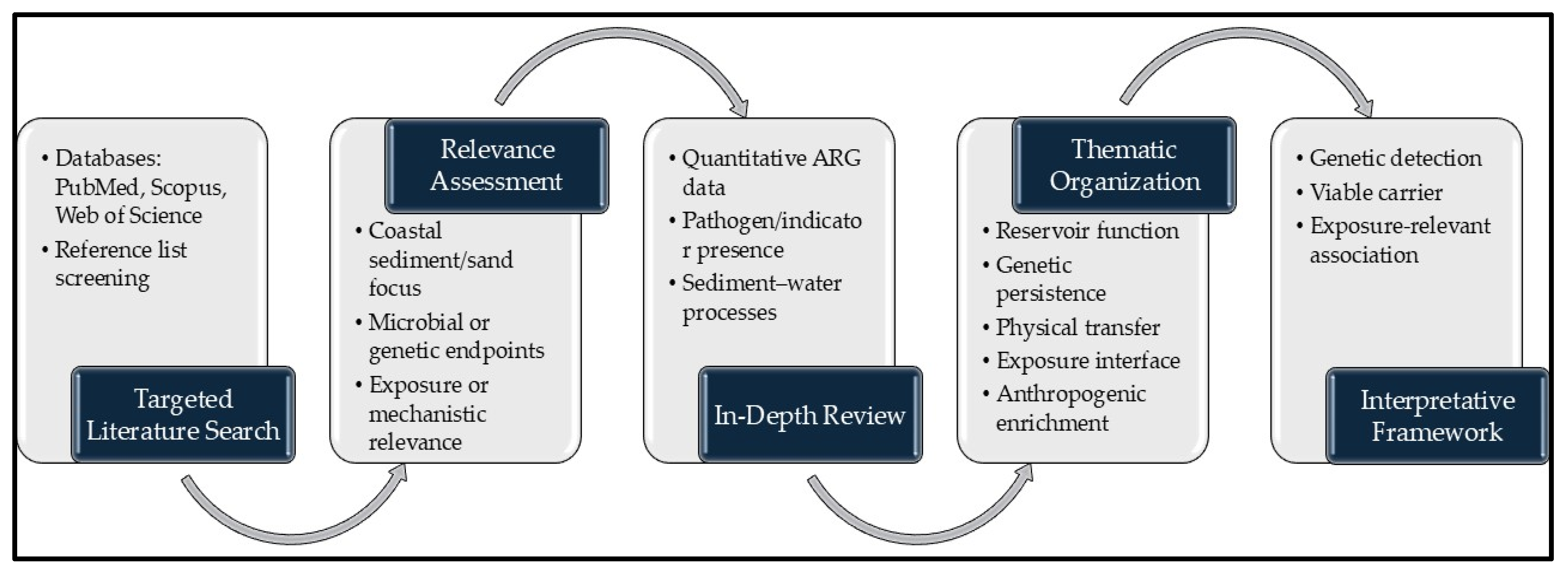
This review was conducted as a structured narrative synthesis integrating mechanistic, ecological, and exposure-relevant evidence on coastal marine sediments and beach sands as microbial–genetic interfaces (Figure 1). The objective was to examine how these matrices function as reservoirs of microorganisms and resistance determinants, how microbial and genetic material are mobilized across sediment–water boundaries, and how these processes intersect with human exposure.
Literature searches were performed in PubMed, Web of Science, and Scopus using combinations of controlled vocabulary (where applicable) and free-text terms across four conceptual domains: (i) coastal and marine matrices (e.g., marine sediment, estuarine sediment, beach sand, intertidal sand); (ii) genetic entities and processes (e.g., antibiotic resistance genes (ARGs), resistomes, integrons, plasmids, mobile genetic elements (MGEs), horizontal gene transfer (HGT), extracellular DNA); (iii) microbial hazards (e.g., fecal indicator bacteria, Enterococcus, Escherichia coli, Vibrio spp., Staphylococcus aureus, MRSA, enteric viruses, fungi); and (iv) exposure and health relevance (e.g., recreational exposure, gastrointestinal illness, wound infection, One Health). The most recent search was completed in February 2026.
Eligible studies were limited to peer-reviewed articles published in English. Emphasis was placed on studies published from 2000 onward to reflect contemporary analytical approaches, while earlier method-defining or foundational studies were included when directly relevant. Studies were included if they addressed ARGs or MGEs in coastal sediments or beach sands; mechanisms of microbial or gene exchange across sediment–water interfaces; quantitative evidence of pathogen or indicator persistence in sediments or sands; or documented links between sediment or sand contamination and human exposure or health outcomes. Studies focused exclusively on freshwater systems without coastal relevance, chemical contaminants without microbial or genetic endpoints, or descriptive microbiome surveys lacking resistance or hazard context were excluded.
Records retrieved from all databases were combined, de-duplicated, and screened by title, abstract, and full text for eligibility. For each included study, information was extracted on matrix type, microbial and genetic targets, analytical methods, and relevant environmental context. Findings were synthesized thematically and interpreted using the three-level framework distinguishing genetic detection, viable carrier presence, and exposure-relevant association, with conclusions aligned to the strongest level of available evidence (Table 1).
The resulting synthesis integrates quantitative measurements, mechanistic observations, and exposure-related findings to evaluate the role of coastal sediments and beach sands within broader environmental and public health contexts.

3. Sediments and Beach Sands as Microbial and Genetic Reservoirs

Coastal marine sediments and beach sands function as depositional matrices that integrate microbial and genetic inputs from wastewater discharge, urban runoff, aquaculture activities, wildlife, and recreational use. Ecological assessment frameworks recognize sediments as long-term integrators of environmental stressors in estuarine and coastal systems [23], and anthropogenic perturbations are known to restructure marine microbial communities at multiple trophic and functional levels [24]. Beach sands are similarly recognized as distinct microbial habitats with implications for coastal water quality and bather health [1,17]. These perspectives support interpretation of benthic and intertidal matrices as structured environmental reservoirs.

3.1. Microbial Retention in Sands

Field measurements consistently demonstrate enrichment of fecal indicator bacteria (FIB) in sands relative to adjacent waters. In South Florida, fecal coliform densities were 2–23-fold higher in wet sand and 30–460-fold higher in dry sand compared with seawater [13]. Enterococci reached 1.9 × 10² CFU per 100 g in wet sand and 2.429 × 10³ CFU per 100 g in dry sand [1]. Debris- and wrack-associated sands exhibited total coliform concentrations ranging from 2.8 × 10³ to 1.7 × 10⁷ CFU per 100 g and enterococci between 8.3 × 10³ and 5.0 × 10⁵ CFU per 100 g [2]. Mediterranean monitoring documented persistent bacterial loads in sand homogenates across multiple sampling days [25].
Viable pathogens are also recoverable directly from sand matrices. Multi-beach surveys detected S. aureus in 53% of sand samples and MRSA in 2.7% [26], with concentrations in Hawaiian sands reaching 8710 CFU g−1 for S. aureus and 605 CFU g−1 for MRSA [12]. Seasonal variability has been observed, with higher detection frequencies during summer [27], and MRSA occurrence has been documented in both freshwater and marine recreational beaches [28]. Experimental studies demonstrate survival of S. aureus, Pseudomonas aeruginosa, and Clostridium perfringens under sandy beach conditions [22], and correlations between indicator microbes and pathogenic bacteria, yeasts, and helminths indicate taxonomically diverse sand-associated hazards [29].
Temperature-sensitive Vibrio spp. have also been documented in beach sediments, with sediment concentrations up to 103-fold higher than overlying waters in North Sea beaches [30] and climate-linked expansion patterns reported in coastal systems [31,32]. Wildlife vectors and debris-associated zones further contribute to microbial loading and retention [33,34,35,36], while enteroviruses may occur independently of bacterial indicators [37].
Collectively, these findings support classification of sands at the viable carrier level of evidence, demonstrating persistence of intact microorganisms within intertidal matrices.

3.2. Sediment-Associated Resistance Determinants

Coastal sediments retain measurable ARG burdens across diverse systems. Effluent-receiving coastal sediments have contained total ARG abundances between 1.59 × 10⁷ and 2.88 × 10⁸ copies g−1 [6], while tetM reached 1.43 × 10⁷ copies g−1 in Bohai Sea sediments [5]. Sulfonamide and tetracycline resistance genes are widely distributed in Bohai Bay sediments at relative abundances of 10−5–10−2 copies per 16S rRNA gene [38]. Continental-scale estuarine surveys detected 248 ARGs, with 18 present in all samples [39], and surveys along the Chinese coastline reported ARG concentrations between 8.89 × 101 and 4.58 × 10⁵ copies mL−1 in adjacent coastal waters [9].
In large estuarine systems, sediment-associated ARG burdens commonly range from 104 to 106 copies g−1. In the Yangtze Estuary, tetA and tetW ranged between 2.45 × 10⁴ and 4.70 × 10⁴ copies g−1, while aac(6′)-Ib reached 6.94 × 10⁶ copies g−1 [40]. Co-occurrence of fluoroquinolone residues (7.75–355.78 ng g−1) demonstrates co-occurrence of antibiotics and resistance determinants within sediment matrices [40]. Wastewater discharge represents a major input source, with sul1 reported up to 2.2 × 10⁹ copies g−1 (wet weight) in lake sediments [4].
Urban marine sediments exhibit persistent fecal indicators and sewage-associated taxa under multi-year monitoring [3]. Whole-genome analysis of sediment-derived E. coli isolates demonstrated virulence gene carriage and plasmid-mediated tetracycline resistance [41]. Integron markers have also been detected in estuarine sediments and wet beach sands [7,42], further confirming anthropogenically influenced resistance signatures. Microbial source tracking confirms fecal contamination within sand matrices [43], and resistance profiling has been used to distinguish contamination sources [44].
Within the three-level framework, most sedimentary ARG data fall within the genetic signal category, documenting presence and magnitude of resistance determinants. In some cases, recovery of resistant isolates supports progression to the viable carrier level [41]; however, the majority of available evidence reflects detection rather than demonstrated functional transfer. Representative quantitative measurements of microbial indicator densities and ARG abundances in beach sands and coastal sediments are summarized in Table 2.

3.3. Reservoir Stability and Turnover

Reservoir function reflects a balance between input, retention, and decay. ARG signals associated with wastewater particle deposition can decrease over time in natural river sediments [47], indicating that persistence is dynamic rather than permanent.
Across systems, quantitative indicator densities, viable pathogens, and ARG abundances consistently demonstrate sustained microbial and genetic retention within benthic and intertidal matrices. Although normalization approaches vary across studies (e.g., wet weight, dry weight, or 16S rRNA gene-based metrics), convergent evidence supports interpretation of coastal sediments and beach sands as structured environmental reservoirs at both the genetic signal and viable carrier levels of evidence.

4. Genetic Persistence and Potential for Horizontal Gene Transfer in Sediments and Beach Sands

While the occurrence and magnitude of resistance determinants in coastal sediments and sands are established (Section 3), their ecological significance depends on the genetic architectures in which they are embedded. Detection of integron integrase genes and other MGEs indicates that many sediment-associated ARGs occur within mobilizable genetic contexts rather than as isolated loci.
Integrons, particularly class 1 integrons, function as gene cassette acquisition systems and are widely recognized as central drivers of anthropogenic resistance dissemination [48,49]. The integrase gene intI1 has been proposed as a proxy indicator of anthropogenic pollution because of its strong association with human-impacted environments [50]. Integron-associated resistance determinants are recurrently detected in estuarine and coastal matrices. For example, intI1 has been identified in Enterobacteriaceae and Aeromonas isolates from estuarine systems [18], and sulfonamide resistance genes (sul1, sul2) frequently co-occur with integron markers in Bohai Bay sediments [38] and East China Sea bay sediments [46]. Integron-associated resistance genes have also been documented in estuarine sediments influenced by anthropogenic discharge [42]. These observations indicate that sedimentary ARGs are commonly linked to genetic elements capable of recombination and cassette acquisition.
Beyond integrons, coastal sediment metagenomes reveal diverse plasmids, insertion sequences, and other MGEs co-occurring with ARG subtypes [10,51]. Network analyses demonstrate non-random co-occurrence patterns among ARG classes and mobile elements [52], suggesting structured mobilome organization rather than stochastic distribution. Comparative analyses of soil resistomes demonstrate phylogenetically structured ARG distributions across habitats [53], indicating that resistance assemblages are constrained by ecological and host-associated factors rather than randomly distributed. Although derived from terrestrial systems, these findings support the interpretation that similar ecological structuring likely influences resistance organization in coastal sediments. Such genetic linkage increases the potential for co-selection under environmental selection pressures.
Anthropogenic inputs influence not only ARG abundance (Section 3) but also mobilome composition and ARG–antibiotic relationships in wastewater- and aquaculture-influenced coastal systems [4,6,8,42,54]. Strong correlations between upstream human activities and sul1 relative abundance have been reported in riverine systems (R2 = 0.94; p = 0.0058) [55], and positive relationships between sulfonamide residues and sul genes have been observed in Laizhou Bay sediments [8]. These quantitative associations suggest that environmental selection pressures may reinforce maintenance of resistance determinants within sedimentary mobilomes.
Genetic persistence in sediments is not restricted to intact microbial hosts. Experimental work in riverine sediments demonstrates that extracellular ARG-containing DNA can persist and remain available for uptake even in the absence of viable donor cells [56]. Differential responses of integrons and resistance genes under sludge digestion and varying environmental stress conditions [57] further indicate that mobilome composition reflects both environmental selection and intrinsic genetic stability. These findings support the interpretation that sedimentary resistomes include both cellular and extracellular genetic reservoirs.
Vertical structuring further contributes to mobilome organization. Sediment core analyses demonstrate system-specific ARG distributions, with some systems showing limited differences between surface and deeper strata despite gradients in antibiotic and metal concentrations [58]. In effluent-receiving systems, surface sediments frequently exhibit higher relative ARG signals compared with deeper layers [6], consistent with more recent anthropogenic inputs. This vertical heterogeneity reflects depositional history and environmental gradients that shape sedimentary genetic composition.
Biofilm-associated assemblages within sediments may represent localized niches of intensified genetic interaction. In the Yangtze Estuary, biofilm-associated ARG abundances were significantly higher than those measured in adjacent sediment and water compartments [11], indicating microhabitat-level enrichment within structured microbial communities. The physical proximity of cells within biofilms and the presence of extracellular polymeric matrices create conditions compatible with gene exchange processes, although in situ transfer rates under coastal conditions remain insufficiently quantified.
Despite widespread detection of integrons, plasmids, and other MGEs, direct measurement of HGT rates within coastal sediments and beach sands remains limited. Reviews of environmental antibiotic resistance emphasize ongoing uncertainties regarding transfer dynamics, selective thresholds, and translation to clinically relevant outcomes [14,15,16]. Detection of mobilizable genetic elements establishes structural potential for gene exchange; however, mobilization frequency under environmentally realistic coastal conditions is not yet well constrained.
Within the three-level evidentiary framework applied in this review, the findings summarized here primarily support structural capacity for genetic persistence and potential mobilization. Evidence for demonstrated in situ HGT in coastal sedimentary systems remains comparatively sparse. Coastal sediments and beach sands therefore represent environments in which mobilome organization and environmental selection create conditions compatible with gene exchange, while functional transfer rates and exposure-relevant consequences require further quantitative investigation.

5. Mechanisms of Microbial and Gene Transfer Across Sediment–Water Interfaces

Exchange between sedimentary reservoirs and the overlying water column is governed by hydrodynamic forcing, groundwater advection, watershed inputs, and episodic disturbance. Early foreshore investigations demonstrated that beach sand functions as a source of E. coli to nearshore waters, with wave-driven resuspension mobilizing sand-associated bacteria into the surf zone [19]. Submarine groundwater discharge has similarly been shown to explain a measurable fraction of fecal indicator variability in coastal systems, linking subsurface reservoirs to the water column [20]. These observations establish that sediment–water exchange is dynamic and bidirectional rather than a static boundary.
Mechanical disturbance enhances short-term microbial flux across this interface. Experimental agitation of beach sand increases enterococci concentrations in overlying water relative to undisturbed conditions [13], and predictive modeling identifies intertidal sand as a primary contributor to microbial counts under specific hydrodynamic states [59]. Such findings indicate that physical perturbation governs episodic mobilization of particle-associated microbial populations.
Stormwater and watershed inputs reinforce this coupling at broader spatial scales. Water-quality forecasting studies at marine recreational beaches demonstrate that runoff and baseflow conditions significantly influence microbial concentrations [60]. Extreme precipitation events are associated with increased pathogen and ARG loads in storm drain discharges to coastal waters [61]. Following a 43 mm rainfall event (67.5 mm cumulative rainfall), sewage-associated markers and ARGs were detected up to 1000 m offshore, with a single stormwater drain contributing up to 50% of the adjacent seawater bacterial community during peak discharge [21]. These observations illustrate the magnitude with which episodic inputs can restructure nearshore microbial composition.
Fecal pollution markers and resistance determinants have been detected concurrently in receiving waters influenced by human wastewater inputs [62,63], confirming that terrestrial loading and sediment retention operate as interconnected components of coastal microbial transport. The degree of ARG transfer from land to receiving waters varies with treatment infrastructure. Biogas digesters reduce ARG relative abundance by approximately 80%, small-scale wastewater treatment plants by ~60%, and constructed wetlands by 73–94%, whereas advanced urban wastewater treatment plants can reach 89–100% removal under optimized conditions. Conventional septic tanks show negligible removal and may elevate ARG abundance [64]. Microbial source tracking further attributes 15–22% of ARG loads in rural receiving waters to septic tanks and biogas digesters, with sediments functioning as depositional compartments within this transport continuum [64].
Spatial gradients further illustrate transport-mediated structuring. In semi-enclosed systems such as Laizhou Bay, ARG abundances decrease from inner estuarine regions toward more open coastal waters, consistent with dilution and hydrodynamic redistribution processes [8]. Such gradients indicate that sedimentary ARG burdens are influenced not only by local deposition but also by advective transport and mixing dynamics.
Particle-associated biofilms introduce an additional mechanism of redistribution. Microplastics in mariculture sediments have been shown to enrich host bacteria and increase ARG prevalence [65]. Controlled microcosm experiments demonstrate that polystyrene and polyvinyl chloride microplastics increase ARG relative abundance by approximately 1.4–2.8-fold and stimulate plasmid-mediated conjugation [65]. Because these particles are readily resuspended under hydrodynamic disturbance, plastisphere-associated communities and resistance determinants may be redistributed across sediment–water interfaces.
Source-tracking analyses further confirm cross-compartment connectivity. Microbial source markers and pathogenic bacteria have been quantified simultaneously in sediments and overlying waters within riverine systems discharging to coastal basins [66]. Associations among fecal indicators, host-specific markers, and resistance genes in impacted coastal waters demonstrate that sedimentary retention and water-column concentrations are mechanistically linked rather than independent phenomena [67].
Collectively, these findings define sediment–water exchange as a multi-mechanism process driven by (i) physical resuspension, (ii) groundwater advection, (iii) watershed loading, and (iv) particle-associated transport. These processes mobilize viable microorganisms and resistance determinants between depositional and aqueous compartments and operate across temporal scales ranging from tidal cycles to extreme precipitation events. Coastal sediments and beach sands therefore function within an actively coupled transport network rather than as isolated environmental compartments. Synthesis of the continuum between beach water and sand further emphasizes that microbial dynamics are shaped by this bidirectional exchange [68]. Key redistribution processes are summarized in Table 3.

6. Beach Sands as a Human Exposure Interface

Direct human interaction with beach sand occurs through dermal contact, incidental ingestion, hand-to-mouth transfer, and contact with sand adhering to skin, towels, toys, or personal items. Syntheses of microbial communities in beach sands emphasize that sand represents a distinct microbial habitat with public health relevance independent of the overlying water column [17]. Reviews of microbial hazards in recreational beach sand further identify direct sand contact as an exposure pathway not fully captured by conventional water-quality monitoring frameworks [69,70].
Viable pathogenic bacteria have been recovered directly from beach sands, confirming that contact may involve exposure to intact organisms. S. aureus and MRSA have been detected in sand at recreational beaches [12,26,27], and culture-based studies document survival of clinically relevant bacteria under sandy beach conditions [22]. Associations between fecal indicator organisms and pathogenic bacteria, yeasts, and helminths in sand environments indicate potential co-occurrence of indicator and non-indicator hazards within direct-contact matrices [29].
Temperature-sensitive Vibrio species represent an additional exposure consideration in warming coastal systems. Recreational beach monitoring has documented spatial and temporal variability in potentially pathogenic Vibrio spp. [30], and climate-linked expansion of Vibrio-associated risk has been reported at higher latitudes [31,32]. Beach-associated wrack can function as a habitat for fecal indicators and Vibrio spp. [33], extending potential contact beyond unvegetated sand surfaces.
Human health associations linked specifically to sand contact have been reported. Cohort analyses of beachgoers demonstrate increased risk of gastrointestinal illness among individuals reporting sand contact behaviors [71]. More broadly, recreational water epidemiology consistently links fecal indicator exposure to self-reported gastrointestinal outcomes in swimmers [72,73,74]. However, viral pathogens such as enteroviruses may not correlate strongly with bacterial indicators [37,75], underscoring limitations of using fecal indicator bacteria alone as proxies for infection risk.
Fungal communities represent an additional exposure dimension. Long-term monitoring of urban beach sands identified 43 fungal genera comprising 64 species, with Aspergillus spp. reaching average abundances of 376 CFU g−1 [76]. Amphotericin B resistance observed in A. niger isolates exceeded epidemiological cut-off values (>1 µg mL−1) [76], indicating that antimicrobial resistance concerns in sand environments are not limited to bacterial determinants.
Within the evidentiary framework applied in this review, exposure-related findings fall into three non-equivalent categories: (i) genetic detection, (ii) viable organism recovery, and (iii) epidemiological association. Molecular detection of resistance genes in sand [7] indicates the presence of resistance determinants but does not establish infective dose, transmission efficiency, or clinical outcome. Culture-based studies confirm the presence of viable pathogenic or resistant organisms in direct-contact matrices [12,45]. Epidemiological investigations demonstrate associations between sand-related behaviors and illness outcomes [71], but do not attribute specific genes or strains as causal agents.
Quantitative linkage among environmental concentration, transfer efficiency, host susceptibility, and clinical outcome remains incompletely resolved. As a result, current evidence supports recognition of beach sands as a direct-contact exposure interface where microbial and resistance determinants may be encountered during routine recreational activity, while causal pathways from environmental detection to clinical infection require further clarification. Recognition of sand as an exposure matrix distinct from water refines interpretation of microbial risk in coastal recreational settings and highlights gaps in monitoring frameworks that focus exclusively on the water column [17,69].

7. Anthropogenic Enrichment and Spatial Distribution of ARGs

ARG abundance in coastal sediments exhibits consistent spatial structuring across gradients of anthropogenic influence, hydrodynamic confinement, and sediment characteristics. Ecological assessment frameworks for estuarine and coastal systems recognize spatial heterogeneity as a diagnostic feature of environmental perturbation [23]. Anthropogenic activities including wastewater discharge, urban runoff, and aquaculture are associated with measurable shifts in marine microbial community composition and functional gene distributions [24]. Community assembly in marine sediments reflects the combined influence of dispersal, environmental selection, and stochastic processes [77], resulting in resistome patterns that track anthropogenic gradients.

7.1. Horizontal Source-to-Offshore Gradients

Comparative metagenomic analyses demonstrate elevated ARG representation in human-impacted estuarine sediments relative to offshore or deep-ocean environments [78]. Although ARGs are detectable in deep-sea sediments [79], impacted nearshore systems consistently exhibit higher abundance and diversity. Continental-scale estuarine surveys confirm widespread ARG occurrence in systems receiving anthropogenic inputs [39], and global ocean surveys reveal regional variability linked to intensity of human activity [80].
Within individual basins, clear horizontal gradients are frequently observed. In Bohai Sea sediments, tetracycline resistance genes such as tetM occur at higher abundances in enclosed or semi-enclosed bays compared with more open marine areas [5]. In Laizhou Bay, sulfonamide and quinolone resistance genes decline from inner estuarine regions toward offshore zones [8]. Targeted gene-indicator approaches in the Pearl River Estuary further differentiate anthropogenic influence on ARG profiles across connected freshwater–marine systems [81]. Similar enrichment patterns have been documented in mariculture-impacted sediments [82,83], and coastal systems subject to rapid urbanization display distinct ARG signatures relative to less impacted environments [84].
Together, these findings support a general source-to-open-system gradient in which ARG abundance and diversity decrease with increasing distance from concentrated anthropogenic inputs, consistent with dilution and dispersal processes at basin scales.

7.2. Vertical Distribution Within Sediments

Vertical stratification adds an additional spatial dimension. Sediment core analyses reveal system-specific ARG depth profiles that correlate with metals, antibiotics, and environmental parameters [58]. In some estuarine systems, surface layers exhibit higher relative ARG signals compared with deeper strata, consistent with recent anthropogenic inputs [6], whereas other systems show limited depth differentiation [58], reflecting depositional history and local geochemical conditions.
Environmental variables including temperature, moisture, and nutrient concentrations have been associated with seasonal shifts in sediment ARG composition [40]. Mesocosm experiments demonstrate dynamic coupling between bacterial community composition and ARG abundance under antibiotic selection pressure [85], and interconnected river–lake systems exhibit source-dependent ARG signatures in depositional sediments [86]. These observations indicate that vertical structuring reflects both contemporary inputs and historical accumulation processes.

7.3. Sediment Type and Microhabitat Contrast

Sediment characteristics further modulate ARG retention and distribution. Fine-grained, organic-rich sediments generally exhibit greater ARG retention and higher integron prevalence relative to permeable beach sands, consistent with enhanced particle-associated microbial activity and reduced flushing potential [5,6,8]. In contrast, coarse, permeable sands are more strongly influenced by advective exchange, often exhibiting lower relative ARG signals.
At micro-scale resolution, particle-associated habitats may function as localized enrichment zones. Microplastics in mariculture sediments enhance ARG prevalence by enriching host bacteria and facilitating gene exchange [65], and plastisphere communities in beach sands have been identified as potential ARG hotspots [87]. Distinct microbial assemblages in geochemically unique sediments, such as thermogenic gas hydrate–bearing systems, further illustrate that microhabitat conditions shape resistome composition independently of direct anthropogenic loading [88].

7.4. Integrated Interpretation

Across horizontal, vertical, and sediment-type contrasts, ARG abundance varies systematically with proximity to anthropogenic inputs, hydrodynamic restriction, and matrix properties. Correlations between upstream human activities and downstream ARG levels further reinforce anthropogenic drivers of resistome structuring [55]. Coastal ecosystems under intense urbanization exhibit altered ecological status indicators alongside modified microbial signatures [89], and environmental monitoring frameworks increasingly incorporate resistome analysis within broader ecological assessments [90].
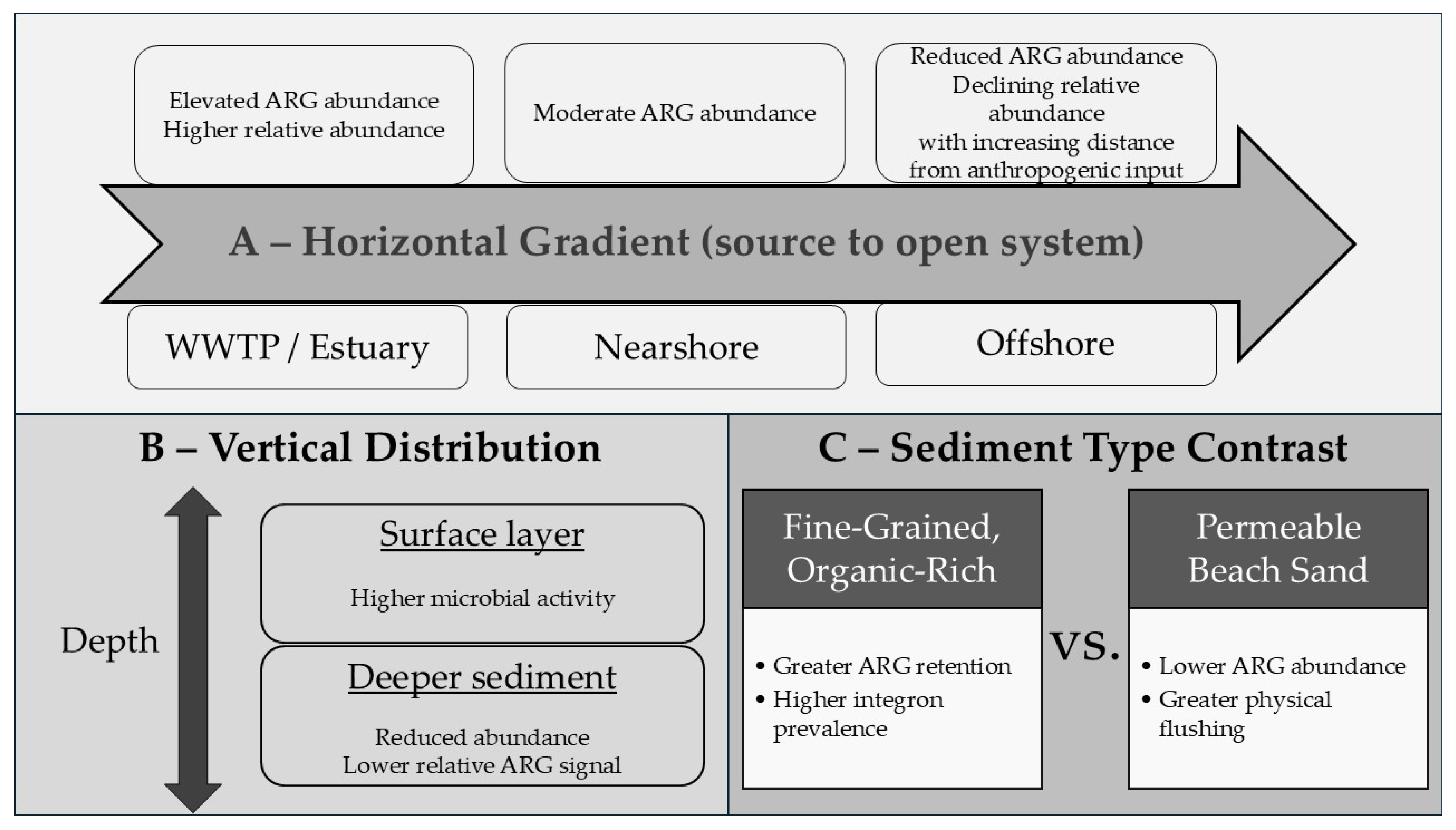
The spatial structuring summarized in Figure 2 illustrates three recurring patterns: (i) declining ARG abundance along source-to-offshore gradients, (ii) depth-dependent stratification within sediment columns, and (iii) differential retention between fine-grained organic-rich sediments and permeable beach sands. These spatial patterns integrate depositional processes, environmental selection, and anthropogenic loading, providing a geographic and sedimentological context for the reservoir, mobilome, transport, and exposure processes described in preceding sections.

8. Exposure Pathways and Public Health Relevance

The evidence synthesized in preceding sections demonstrates that coastal sediments and beach sands can contain fecal indicator bacteria, viable pathogens, ARGs, and integron markers under anthropogenic influence.
However, environmental detection and public health risk are not equivalent. Molecular detection of ARGs documents the presence of resistance determinants but does not establish viable host carriage, transfer frequency, infective dose, or transmission probability. Studies documenting integron prevalence and ARG co-occurrence in wastewater-impacted estuarine systems [39,42] characterize environmental gene pools rather than confirmed transmission events. Experimental evidence indicates that extracellular DNA can persist in sediments [56], and gene cassettes may reorganize under selective pressure [49], yet in situ quantification of HGT in coastal recreational settings remains limited.
Epidemiological data provide a complementary but distinct line of evidence. Cohort analyses report increased gastrointestinal illness among beachgoers engaging in sand contact behaviors [71], and swimmer studies consistently demonstrate associations between fecal indicator exposure and illness in recreational waters [72,74]. Although these findings confirm that microbial exposure can occur during routine beach use, direct attribution of illness to specific sediment-associated resistance genes has not been demonstrated.
Current recreational water monitoring frameworks are primarily based on fecal indicator bacteria measured in the water column [74]. Sand matrices may contain microbial and genetic signals that are not fully reflected in water-based monitoring metrics [68]. Consequently, compliance with water-quality criteria does not necessarily imply absence of viable pathogens or resistance determinants in adjacent sand environments.
Environmental antibiotic resistance is widely documented across aquatic systems [14,91], and coastal zones receive sustained inputs from wastewater discharge, stormwater runoff, aquaculture activities, and diffuse anthropogenic sources [24,92]. The persistence of ARGs and integron markers in coastal sediments therefore represents environmental retention of resistance determinants within human-impacted ecosystems. Yet quantitative linkage among environmental concentration, exposure dose, host susceptibility, and clinical outcome remains insufficiently resolved.
From a public health perspective, beach sands should be recognized as a direct-contact environmental matrix where microbial hazards and resistance determinants may be encountered during recreational activity. At the same time, environmental detection should not be equated with infection probability. Refinement of risk assessment frameworks will require integration of environmental concentration data, transfer dynamics, host factors, and epidemiological evidence to better resolve the relationship between environmental resistomes and health outcomes.

9. Conclusions, Challenges, and Future Directions

The evidence synthesized in this review indicates that coastal marine sediments and beach sands function as structured microbial and genetic compartments within anthropogenically influenced coastal systems. Across diverse geographic settings, these matrices harbor fecal indicator bacteria, viable pathogens, ARGs, and integron-associated markers. Their distribution reflects spatial gradients, sediment characteristics, and episodic physical disturbance, reinforcing the interpretation that benthic and intertidal zones participate actively in coastal microbial dynamics rather than serving as passive sinks.
While environmental detection confirms retention of resistance determinants, quantitative linkage among environmental concentration, transfer dynamics, host susceptibility, and clinical outcome remains insufficiently resolved. Integron-associated markers and ARGs demonstrate structural capacity for persistence and mobilization, yet direct measurement of in situ HGT and attribution to clinically relevant strains remain limited. Strengthening causal inference will require integrated approaches that distinguish extracellular DNA from viable resistant hosts and transferable loci, combining culture-based methods, genomic characterization, and functional assays under environmentally realistic conditions.
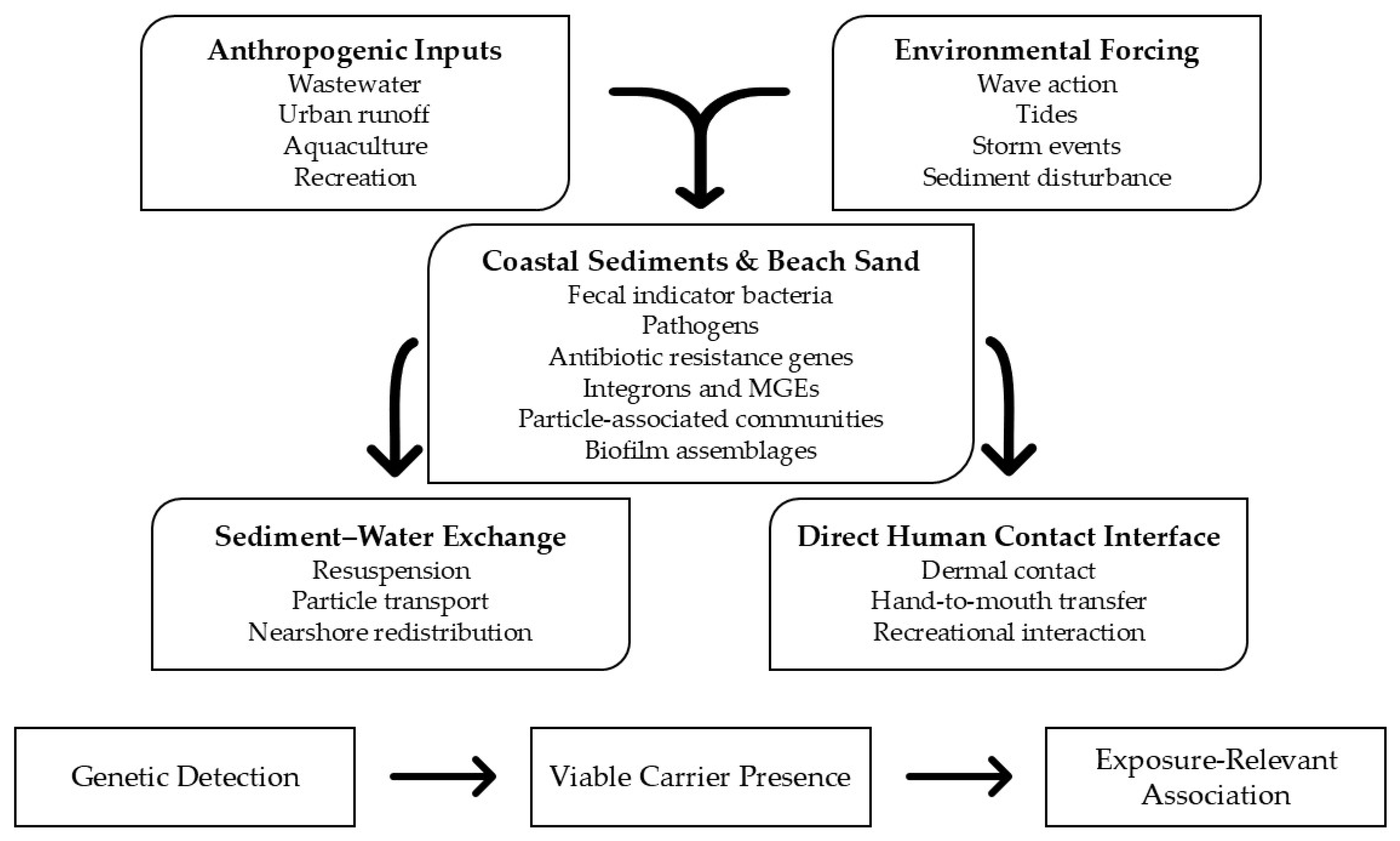
The framework developed here integrates anthropogenic loading, environmental forcing, sedimentary retention, redistribution processes, and exposure inference into a single conceptual model (Figure 3). This synthesis highlights how spatial structuring, hydrodynamic exchange, and direct human interaction intersect within sedimentary systems. By situating coastal sediments and beach sands within this coupled ecological–exposure continuum, the review clarifies the distinction between environmental signal and exposure-relevant association.
Future research priorities include standardized sediment and sand sampling protocols; harmonized reporting units to enable cross-system comparison; longitudinal designs capable of distinguishing persistent reservoirs from episodic inputs; and experimental systems that directly quantify transfer dynamics under representative sediment and hydrodynamic conditions. Integration of environmental resistome surveillance with clinical and epidemiological data in adjacent communities would further refine public health interpretation.
Collectively, the available evidence indicates that coastal sediments and beach sands operate as dynamic microbial–genetic interfaces embedded within anthropogenically influenced coastal ecosystems. Advancing from environmental characterization to exposure-relevant assessment will depend on coordinated investigation of benthic ecology, mobilome structure, hydrodynamic processes, and human behavior within a unified analytical framework.

Funding

This research received no external funding.

Institutional Review Board Statement

Not applicable.

Data Availability Statement

No new data were created or analyzed in this study. Data sharing is not applicable to this article.

Acknowledgments

The author used a generative AI language model (ChatGPT-5.1, OpenAI) solely for assistance with English-language editing, including grammar, spelling, and sentence clarity. The tool was not used for generating scientific content, data analysis, interpretation of results, experimental design, or references. All scientific content, conclusions, and citations are the sole responsibility of the author.

Conflicts of Interest

The author declares no conflicts of interest.

References

  1. Halliday, E.; Gast, R.J. Bacteria in beach sands: An emerging challenge in protecting coastal water quality and bather health. Environ. Sci. Technol. 2011, 45, 370–379. [Google Scholar] [CrossRef] [PubMed]
  2. Cholewińska, P.; Wojnarowski, K.; Szeligowska, N.; Pokorny, P.; Hussein, W.; Hasegawa, Y.; Dobicki, W.; Palić, D. Presence of microplastic particles increased abundance of pathogens and antimicrobial resistance genes in microbial communities from the Oder river water and sediment. Sci. Rep. 2025, 15, 16338. [Google Scholar] [CrossRef] [PubMed]
  3. Frank, E.M.; Suarez, C.; Erb, I.K.; Jephson, T.; Lindberg, E.; Paul, C.J. Microbial contamination in urban marine sediments: Source identification using microbial community analysis and fecal indicator bacteria. Microorganisms 2025, 13, 983. [Google Scholar] [CrossRef] [PubMed]
  4. Czekalski, N.; Gascon Díez, E.; Bürgmann, H. Wastewater as a point source of antibiotic-resistance genes in the sediment of a freshwater lake. ISME J. 2014, 8, 1381–1390. [Google Scholar] [CrossRef]
  5. Wen, L.; Dai, J.; Song, J.; Ma, J.; Li, X.; Yuan, H.; Duan, L.; Wang, Q. Antibiotic resistance genes (ARGs) and their eco-environmental response in the Bohai Sea sediments. Mar. Pollut. Bull. 2024, 208, 116979. [Google Scholar] [CrossRef]
  6. Chen, J.; Zhang, Z.; Lei, Z.; Shimizu, K.; Yao, P.; Su, Z.; Wen, D. Occurrence and distribution of antibiotic resistance genes in the coastal sediments of effluent-receiving areas of WWTPs, China. Bioresour. Technol. Rep. 2020, 11, 100511. [Google Scholar] [CrossRef]
  7. Toubiana, M.; Salles, C.; Tournoud, M.G.; Licznar-Fajardo, P.; Zorgniotti, I.; Trémélo, M.L.; Jumas-Bilak, E.; Robert, S.; Monfort, P. Monitoring urban beach quality on a summer day: Determination of the origin of fecal indicator bacteria and anti-microbial resistance at Prophète Beach, Marseille (France). Front. Microbiol. 2021, 12, 710346. [Google Scholar] [CrossRef]
  8. Li, Q.; Na, G.; Zhang, L.; Lu, Z.; Gao, H.; Li, R.; Jin, S. Effects of corresponding and non-corresponding contaminants on the fate of sulfonamide and quinolone resistance genes in the Laizhou Bay, China. Mar. Pollut. Bull. 2018, 128, 475–482. [Google Scholar] [CrossRef]
  9. Lu, J.; Zhang, Y.; Wu, J. Continental-scale spatio-temporal distribution of antibiotic resistance genes in coastal waters along coastline of China. Chemosphere 2020, 247, 125908. [Google Scholar] [CrossRef]
  10. Habibi, N.; Uddin, S.; Al Sarawi, H.; Aldhameer, A.; Behbehani, M.; Fakhraldeen, S.; Al-Zekri, W.; Abdulrazzack, N.; Zakir, F.; Shajan, A. Metagenomic insights into pathogenic bacteria and antimicrobial resistance in offshore coastal sediments—An example from Gulf waters. Environ. Chall. 2025, 18, 101099. [Google Scholar] [CrossRef]
  11. Guo, X.; Yang, Y.; Lu, D.; Niu, Z.; Feng, J.; Chen, Y.; Tou, F.; Garner, E.; Xu, J.; Liu, M.; et al. Biofilms as a sink for antibiotic resistance genes (ARGs) in the Yangtze Estuary. Water Res. 2018, 129, 277–286. [Google Scholar] [CrossRef] [PubMed]
  12. Steadmon, M.; Takakusagi, M.; Wiegner, T.N.; Jones, M.; Economy, L.M.; Panelo, J.; Morrison, L.A.; Medeiros, M.C.I.; Frank, K.L. Detection and modeling of Staphylococcus aureus and fecal bacteria in Hawaiian coastal waters and sands. Water Environ. Res. 2024, 96, e11037. [Google Scholar] [CrossRef] [PubMed]
  13. Bonilla, T.D.; Nowosielski, K.; Cuvelier, M.; Hartz, A.; Green, M.; Esiobu, N.; McCorquodale, D.S.; Fleisher, J.M.; Rogerson, A. Prevalence and distribution of fecal indicator organisms in South Florida beach sand and preliminary assessment of health effects associated with beach sand exposure. Mar. Pollut. Bull. 2007, 54, 1472–1482. [Google Scholar] [CrossRef] [PubMed]
  14. Sanderson, H.; Fricker, C.; Brown, R.S.; Majury, A.; Liss, S.N. Antibiotic resistance genes as an emerging environmental contaminant. Environ. Rev. 2016, 24, 205–218. [Google Scholar] [CrossRef]
  15. Berendonk, T.U.; Manaia, C.M.; Merlin, C.; Fatta-Kassinos, D.; Cytryn, E.; Walsh, F.; Bürgmann, H.; Sørum, H.; Norström, M.; Pons, M.N.; et al. Tackling antibiotic resistance: The environmental framework. Nat. Rev. Microbiol. 2015, 13, 310–317. [Google Scholar] [CrossRef]
  16. Larsson, D.G.J.; Andremont, A.; Bengtsson-Palme, J.; Brandt, K.K.; de Roda Husman, A.M.; Fagerstedt, P.; Fick, J.; Flach, C.F.; Gaze, W.H.; Kuroda, M.; et al. Critical knowledge gaps and research needs related to the environmental dimensions of antibiotic resistance. Environ. Int. 2018, 117, 132–138. [Google Scholar] [CrossRef]
  17. Whitman, R.; Harwood, V.J.; Edge, T.A.; Nevers, M.; Byappanahalli, M.; Vijayavel, K.; Brandão, J.; Sadowsky, M.J.; Alm, E.W.; Crowe, A.; et al. Microbes in beach sands: Integrating environment, ecology and public health. Rev. Environ. Sci. Biotechnol. 2014, 13, 329–368. [Google Scholar] [CrossRef]
  18. Henriques, I.S.; Fonseca, F.; Alves, A.; Saavedra, M.J.; Correia, A. Occurrence and diversity of integrons and beta-lactamase genes among ampicillin-resistant isolates from estuarine waters. Res. Microbiol. 2006, 157, 938–947. [Google Scholar] [CrossRef]
  19. Whitman, R.L.; Nevers, M.B. Foreshore sand as a source of Escherichia coli in nearshore water of a Lake Michigan beach. Appl. Environ. Microbiol. 2003, 69, 5555–5562. [Google Scholar] [CrossRef]
  20. Boehm, A.B.; Shellenbarger, G.G.; Paytan, A. Groundwater discharge: Potential association with fecal indicator bacteria in the surf zone. Environ. Sci. Technol. 2004, 38, 3558–3566. [Google Scholar] [CrossRef]
  21. Williams, N.L.R.; Siboni, N.; Potts, J.; Campey, M.; Johnson, C.; Rao, S.; Bramucci, A.; Scanes, P.; Seymour, J.R. Molecular microbiological approaches reduce ambiguity about the sources of faecal pollution and identify microbial hazards within an urbanised coastal environment. Water Res. 2022, 218, 118534. [Google Scholar] [CrossRef]
  22. Mohammed, R.L.; Echeverry, A.; Stinson, C.M.; Green, M.; Bonilla, T.D.; Hartz, A.; McCorquodale, D.S.; Rogerson, A.; Esiobu, N. Survival trends of Staphylococcus aureus, Pseudomonas aeruginosa, and Clostridium perfringens in a sandy South Florida beach. Mar. Pollut. Bull. 2012, 64, 1201–1209. [Google Scholar] [CrossRef] [PubMed]
  23. Borja, A.; Bricker, S.B.; Dauer, D.M.; Demetriades, N.T.; Ferreira, J.G.; Forbes, A.T.; Hutchings, P.; Jia, X.; Kenchington, R.; Marques, J.C.; et al. Overview of integrative tools and methods in assessing ecological integrity in estuarine and coastal systems worldwide. Mar. Pollut. Bull. 2008, 56, 1519–1537. [Google Scholar] [CrossRef] [PubMed]
  24. Nogales, B.; Lanfranconi, M.P.; Piña-Villalonga, J.M.; Bosch, R. Anthropogenic perturbations in marine microbial communities. FEMS Microbiol. Rev. 2011, 35, 275–298. [Google Scholar] [CrossRef] [PubMed]
  25. Papadakis, J.A.; Mavridou, A.; Richardson, S.C.; Lampiri, M.; Marcelou, U. Bather-related microbial and yeast populations in sand and seawater. Water Res. 1997, 31, 799–804. [Google Scholar] [CrossRef]
  26. Goodwin, K.D.; McNay, M.; Cao, Y.; Ebentier, D.; Madison, M.; Griffith, J.F. A multi-beach study of Staphylococcus aureus, MRSA, and enterococci in seawater and beach sand. Water Res. 2012, 46, 4195–4207. [Google Scholar] [CrossRef]
  27. Thapaliya, D.; Hellwig, E.J.; Kadariya, J.; Grenier, D.; Jefferson, A.J.; Dalman, M.; Kennedy, K.; DiPerna, M.; Orihill, A.; Taha, M.; et al. Prevalence and characterization of Staphylococcus aureus and methicillin-resistant Staphylococcus aureus on public recreational beaches in Northeast Ohio. GeoHealth 2017, 1, 320–332. [Google Scholar] [CrossRef]
  28. Levin-Edens, E.; Soge, O.O.; No, D.; Stiffarm, A.; Meschke, J.S.; Roberts, M.C. Methicillin-resistant Staphylococcus aureus from Northwest marine and freshwater recreational beaches. FEMS Microbiol. Ecol. 2012, 79, 412–420. [Google Scholar] [CrossRef]
  29. Shah, A.H.; Abdelzaher, A.M.; Phillips, M.; Hernandez, R.; Solo-Gabriele, H.M.; Kish, J.; Scorzetti, G.; Fell, J.W.; Diaz, M.R.; Scott, T.M.; et al. Indicator microbes correlate with pathogenic bacteria, yeasts and helminthes in sand at a subtropical recreational beach site. J. Appl. Microbiol. 2011, 110, 1571–1583. [Google Scholar] [CrossRef]
  30. Böer, S.I.; Heinemeyer, E.A.; Luden, K.; Erler, R.; Gerdts, G.; Janssen, F.; Brennholt, N. Temporal and spatial distribution patterns of potentially pathogenic Vibrio spp. at recreational beaches of the German North Sea. Microb. Ecol. 2013, 65, 1052–1067. [Google Scholar] [CrossRef]
  31. Baker-Austin, C.; Trinanes, J.A.; Taylor, N.G.H.; Hartnell, R.; Siitonen, A.; Martinez-Urtaza, J. Emerging Vibrio risk at high latitudes in response to ocean warming. Nat. Clim. Change 2013, 3, 73–77. [Google Scholar] [CrossRef]
  32. Vezzulli, L.; Grande, C.; Reid, P.C.; Hélaouët, P.; Edwards, M.; Höfle, M.G.; Brettar, I.; Colwell, R.R.; Pruzzo, C. Climate influence on Vibrio and associated human diseases during the past half-century in the coastal North Atlantic. Proc. Natl. Acad. Sci. USA 2016, 113, E5062–E5071. [Google Scholar] [CrossRef] [PubMed]
  33. Kalvaitienė, G.; Vaičiūtė, D.; Bučas, M.; Gyraitė, G.; Kataržytė, M. Macrophytes and their wrack as a habitat for faecal indicator bacteria and Vibrio in coastal marine environments. Mar. Pollut. Bull. 2023, 194, 115325. [Google Scholar] [CrossRef] [PubMed]
  34. Suzuki, Y.; Shimizu, H.; Kuroda, T.; Takada, Y.; Nukazawa, K. Plant debris are hotbeds for pathogenic bacteria on recreational sandy beaches. Sci. Rep. 2021, 11, 11496. [Google Scholar] [CrossRef]
  35. Alm, E.W.; Daniels-Witt, Q.R.; Learman, D.R.; Ryu, H.; Jordan, D.W.; Gehring, T.M.; Santo Domingo, J.W. Potential for gulls to transport bacteria from human waste sites to beaches. Sci. Total Environ. 2018, 615, 123–130. [Google Scholar] [CrossRef]
  36. Tsagbey, S.; Mensah, A.; Nunoo, F. Influence of tourist pressure on beach litter and microbial quality—Case study of two beach resorts in Ghana. West Afr. J. Appl. Ecol. 2010, 15, 9–16. [Google Scholar] [CrossRef][Green Version]
  37. Noble, R.T.; Fuhrman, J.A. Enteroviruses detected by reverse transcriptase polymerase chain reaction from the coastal waters of Santa Monica Bay, California: Low correlation to bacterial indicator levels. Hydrobiologia 2001, 460, 175–184. [Google Scholar] [CrossRef]
  38. Niu, Z.G.; Zhang, K.; Zhang, Y. Occurrence and distribution of antibiotic resistance genes in the coastal area of the Bohai Bay, China. Mar. Pollut. Bull. 2016, 107, 245–250. [Google Scholar] [CrossRef]
  39. Zhu, Y.G.; Zhao, Y.; Li, B.; Huang, C.L.; Zhang, S.Y.; Yu, S.; Chen, Y.S.; Zhang, T.; Gillings, M.R.; Su, J.Q. Continental-scale pollution of estuaries with antibiotic resistance genes. Nat. Microbiol. 2017, 2, 16270. [Google Scholar] [CrossRef]
  40. Guo, X.; Liu, L.; Chang, W.; Qi, Y.; Liu, X.; Wang, Z.; Yang, J.; Chen, Y.; Yang, Y. Seasonal and spatial distribution of antibiotic resistance genes in the sediments along the Yangtze Estuary, China. Environ. Pollut. 2018, 242, 576–584. [Google Scholar] [CrossRef]
  41. Erb, I.K.; Suarez, C.; Frank, E.M.; Bengtsson-Palme, J.; Lindberg, E.; Paul, C.J. Escherichia coli in urban marine sediments: Interpreting virulence, biofilm formation, halotolerance, and antibiotic resistance to infer contamination or naturalization. FEMS Microbes 2024, 5, xtae024. [Google Scholar] [CrossRef]
  42. Chen, B.; Liang, X.; Nie, X.; Huang, X.; Zou, S.; Li, X. The role of class I integrons in the dissemination of sulfonamide resistance genes in the Pearl River and Pearl River Estuary, South China. J. Hazard. Mater. 2015, 282, 61–67. [Google Scholar] [CrossRef] [PubMed]
  43. Valério, E.; Santos, M.L.; Teixeira, P.; Matias, R.; Mendonça, J.; Ahmed, W.; Brandão, J. Microbial source tracking as a method of determination of beach sand contamination. Int. J. Environ. Res. Public Health 2022, 19, 7934. [Google Scholar] [CrossRef] [PubMed]
  44. Choi, S.; Chu, W.; Brown, J.; Becker, S.J.; Harwood, V.J.; Jiang, S. Application of enterococci antibiotic resistance patterns for contamination source identification at Huntington Beach, California. Mar. Pollut. Bull. 2003, 46, 748–755. [Google Scholar] [CrossRef] [PubMed]
  45. Soffritti, I.; D’Accolti, M.; Bini, F.; Mazziga, E.; Volta, A.; Bisi, M.; Rossi, S.; Viroli, F.; Balzani, M.; Petitta, M.; et al. Characterization of the pathogenic potential of the beach sand microbiome and assessment of quicklime as a remediation tool. Microorganisms 2023, 11, 2031. [Google Scholar] [CrossRef]
  46. Chen, J.; Su, Z.; Dai, T.; Huang, B.; Mu, Q.; Zhang, Y.; Wen, D. Occurrence and distribution of antibiotic resistance genes in the sediments of the East China Sea bays. J. Environ. Sci. 2019, 81, 156–167. [Google Scholar] [CrossRef]
  47. Brown, P.C.; Borowska, E.; Peschke, R.; Schwartz, T.; Horn, H. Decay of elevated antibiotic resistance genes in natural river sediments after sedimentation of wastewater particles. Sci. Total Environ. 2020, 705, 135861. [Google Scholar] [CrossRef]
  48. Gillings, M.R. Integrons: Past, present, and future. Microbiol. Mol. Biol. Rev. 2014, 78, 257–277. [Google Scholar] [CrossRef]
  49. Partridge, S.R.; Tsafnat, G.; Coiera, E.; Iredell, J.R. Gene cassettes and cassette arrays in mobile resistance integrons. FEMS Microbiol. Rev. 2009, 33, 757–784. [Google Scholar] [CrossRef]
  50. Gillings, M.R.; Gaze, W.H.; Pruden, A.; Smalla, K.; Tiedje, J.M.; Zhu, Y.G. Using the class 1 integron-integrase gene as a proxy for anthropogenic pollution. ISME J. 2015, 9, 1269–1279. [Google Scholar] [CrossRef]
  51. Habibi, N.; Uddin, S.; Al-Sarawi, H.; Aldhameer, A.; Shajan, A.; Zakir, F.; Abdul Razzack, N.; Alam, F. Metagenomes from coastal sediments of Kuwait: Insights into the microbiome, metabolic functions and resistome. Microorganisms 2023, 11, 531. [Google Scholar] [CrossRef]
  52. Li, B.; Yang, Y.; Ma, L.; Ju, F.; Guo, F.; Tiedje, J.M.; Zhang, T. Metagenomic and network analysis reveal wide distribution and co-occurrence of environmental antibiotic resistance genes. ISME J. 2015, 9, 2490–2502. [Google Scholar] [CrossRef]
  53. Forsberg, K.J.; Patel, S.; Gibson, M.K.; Lauber, C.L.; Knight, R.; Fierer, N.; Dantas, G. Bacterial phylogeny structures soil resistomes across habitats. Nature 2014, 509, 612–616. [Google Scholar] [CrossRef] [PubMed]
  54. Cui, G.; Liu, Z.; Xu, W.; Gao, Y.; Yang, S.; Grossart, H.P.; Li, M.; Luo, Z. Metagenomic exploration of antibiotic resistance genes and their hosts in aquaculture waters of the semi-closed Dongshan Bay (China). Sci. Total Environ. 2022, 838, 155784. [Google Scholar] [CrossRef] [PubMed]
  55. Pruden, A.; Arabi, M.; Storteboom, H.N. Correlation between upstream human activities and riverine antibiotic resistance genes. Environ. Sci. Technol. 2012, 46, 11541–11549. [Google Scholar] [CrossRef] [PubMed]
  56. Mao, D.; Luo, Y.; Mathieu, J.; Wang, Q.; Feng, L.; Mu, Q.; Feng, C.; Alvarez, P.J.J. Persistence of extracellular DNA in river sediment facilitates antibiotic resistance gene propagation. Environ. Sci. Technol. 2014, 48, 71–78. [Google Scholar] [CrossRef]
  57. Ma, Y.; Wilson, C.A.; Novak, J.T.; Riffat, R.; Aynur, S.; Murthy, S.; Pruden, A. Effect of various sludge digestion conditions on sulfonamide, macrolide, and tetracycline resistance genes and class I integrons. Environ. Sci. Technol. 2011, 45, 7855–7861. [Google Scholar] [CrossRef]
  58. Ohore, O.E.; Addo, F.G.; Han, N.; Li, X.; Zhang, S. Profiles of ARGs and their relationships with antibiotics, metals and environmental parameters in vertical sediment layers of three lakes in China. J. Environ. Manag. 2020, 255, 109583. [Google Scholar] [CrossRef]
  59. Feng, Z.; Reniers, A.; Haus, B.K.; Solo-Gabriele, H.M.; Wang, J.D.; Fleming, L.E. A predictive model for microbial counts on beaches where intertidal sand is the primary source. Mar. Pollut. Bull. 2015, 94, 37–47. [Google Scholar] [CrossRef]
  60. He, L.M.; He, Z.L. Water quality prediction of marine recreational beaches receiving watershed baseflow and stormwater runoff in southern California, USA. Water Res. 2008, 42, 2563–2573. [Google Scholar] [CrossRef]
  61. Ahmed, W.; Zhang, Q.; Lobos, A.; Senkbeil, J.; Sadowsky, M.J.; Harwood, V.J.; Saeidi, N.; Marinoni, O.; Ishii, S. Precipitation influences pathogenic bacteria and antibiotic resistance gene abundance in storm drain outfalls in coastal sub-tropical waters. Environ. Int. 2018, 116, 308–318. [Google Scholar] [CrossRef] [PubMed]
  62. Chen, Z.; Duan, Y.; Yin, L.; Chen, Y.; Xue, Y.; Wang, X.; Mao, D.; Luo, Y. Unraveling the influence of human fecal pollution on antibiotic resistance gene levels in different receiving water bodies using crAssphage indicator gene. J. Hazard. Mater. 2023, 442, 130005. [Google Scholar] [CrossRef] [PubMed]
  63. Damashek, J.; Westrich, J.R.; McDonald, J.M.B.; Teachey, M.E.; Jackson, C.R.; Frye, J.G.; Lipp, E.K.; Capps, K.A.; Ottesen, E.A. Non-point source fecal contamination from aging wastewater infrastructure is a primary driver of antibiotic resistance in surface waters. Water Res. 2022, 222, 118853. [Google Scholar] [CrossRef] [PubMed]
  64. Ma, D.; Chen, H.; Feng, Q.; Zhang, X.; Wu, D.; Feng, J.; Cheng, S.; Wang, D.; Liu, Z.; Zhong, Q.; et al. Dissemination of antibiotic resistance genes through fecal sewage treatment facilities to the ecosystem in rural area. J. Environ. Manag. 2023, 333, 117439. [Google Scholar] [CrossRef]
  65. Liu, Y.; Liu, L.; Wang, X.; Shao, M.; Wei, Z.; Wang, L.; Li, B.; Li, C.; Luo, X.; Li, F.; et al. Microplastics enhance the prevalence of antibiotic resistance genes in mariculture sediments by enriching host bacteria and promoting horizontal gene transfer. Eco-Environ. Health 2025, 4, 100136. [Google Scholar] [CrossRef]
  66. Vadde, K.K.; McCarthy, A.J.; Rong, R.; Sekar, R. Quantification of microbial source tracking and pathogenic bacterial markers in water and sediments of Tiaoxi River (Taihu Watershed). Front. Microbiol. 2019, 10, 699. [Google Scholar] [CrossRef]
  67. González-Fernández, A.; Symonds, E.M.; Gallard-Gongora, J.F.; Mull, B.; Lukasik, J.O.; Rivera Navarro, P.; Badilla Aguilar, A.; Peraud, J.; Brown, M.L.; Mora Alvarado, D.; et al. Relationships among microbial indicators of fecal pollution, microbial source tracking markers, and pathogens in Costa Rican coastal waters. Water Res. 2021, 188, 116507. [Google Scholar] [CrossRef]
  68. Weiskerger, C.J.; Brandão, J.; Ahmed, W.; Aslan, A.; Avolio, L.; Badgley, B.D.; Boehm, A.B.; Edge, T.A.; Fleisher, J.M.; Heaney, C.D.; et al. Impacts of a changing earth on microbial dynamics and human health risks in the continuum between beach water and sand. Water Res. 2019, 162, 456–470. [Google Scholar] [CrossRef]
  69. King, N.; Leonard, M. A review of the human health risks from microbial hazards in recreational beach sand. Int. J. Environ. Res. Public Health 2025, 22, 1537. [Google Scholar] [CrossRef]
  70. Gopinathan, S.; Suthindhiran, K. Microbial contamination in the marine recreational sites and its impact on public health. Ocean Coast. Manag. 2025, 267, 107757. [Google Scholar] [CrossRef]
  71. Heaney, C.D.; Sams, E.; Wing, S.; Marshall, S.; Brenner, K.; Dufour, A.P.; Wade, T.J. Contact with beach sand among beachgoers and risk of illness. Am. J. Epidemiol. 2009, 170, 164–172. [Google Scholar] [CrossRef] [PubMed]
  72. Napier, M.D.; Haugland, R.; Poole, C.; Dufour, A.P.; Stewart, J.R.; Weber, D.J.; Varma, M.; Lavender, J.S.; Wade, T.J. Exposure to human-associated fecal indicators and self-reported illness among swimmers at recreational beaches: A cohort study. Environ. Health 2017, 16, 103. [Google Scholar] [CrossRef] [PubMed]
  73. Kauppinen, A.; Al-Hello, H.; Zacheus, O.; Kilponen, J.; Maunula, L.; Huusko, S.; Lappalainen, M.; Miettinen, I.; Blomqvist, S.; Rimhanen-Finne, R. Increase in outbreaks of gastroenteritis linked to bathing water in Finland in summer 2014. Eurosurveillance 2017, 22, 30470. [Google Scholar] [CrossRef] [PubMed]
  74. Fewtrell, L.; Kay, D. Recreational water and infection: A review of recent findings. Curr. Environ. Health Rep. 2015, 2, 85–94. [Google Scholar] [CrossRef]
  75. Griffin, D.W.; Donaldson, K.A.; Paul, J.H.; Rose, J.B. Pathogenic human viruses in coastal waters. Clin. Microbiol. Rev. 2003, 16, 129–143. [Google Scholar] [CrossRef]
  76. Novak Babič, M.; Gunde-Cimerman, N.; Breskvar, M.; Džeroski, S.; Brandão, J. Occurrence, diversity and anti-fungal resistance of fungi in sand of an urban beach in Slovenia—Environmental monitoring with possible health risk implications. J. Fungi 2022, 8, 860. [Google Scholar] [CrossRef]
  77. Duque-Castaño, D.C.; Paula, F.S.; Bohannan, B.J.M.; de Moura Emilio, A.; Moreira, J.C.F.; Figueiredo, A.G., Jr.; Carreira, R.S.; Brandini, F.P.; Moreira, D.L.; Jonck, C.R.; et al. Drift, dispersal limitation, and homogeneous selection as key processes shaping prokaryotic community assembly in marine sediments. ISME Commun. 2025, 5, ycaf189. [Google Scholar] [CrossRef]
  78. Chen, B.; Yang, Y.; Liang, X.; Yu, K.; Zhang, T.; Li, X. Metagenomic profiles of antibiotic resistance genes (ARGs) between human impacted estuary and deep ocean sediments. Environ. Sci. Technol. 2013, 47, 12753–12760. [Google Scholar] [CrossRef]
  79. Zhang, H.; Wang, Y.; Liu, P.; Sun, Y.; Dong, X.; Hu, X. Unveiling the occurrence, hosts and mobility potential of antibiotic resistance genes in the deep ocean. Sci. Total Environ. 2022, 816, 151539. [Google Scholar] [CrossRef]
  80. Bonanno Ferraro, G.; Brandtner, D.; Franco, A.; Iaconelli, M.; Mancini, P.; Veneri, C.; Briancesco, R.; Coccia, A.M.; Suffredini, E.; Muratore, A.; et al. Global quantification and distribution of antibiotic resistance genes in oceans and seas: Anthropogenic impacts and regional variability. Sci. Total Environ. 2024, 955, 176765. [Google Scholar] [CrossRef]
  81. Chen, B.; Liang, X.; Huang, X.; Zhang, T.; Li, X. Differentiating anthropogenic impacts on ARGs in the Pearl River Estuary by using suitable gene indicators. Water Res. 2013, 47, 2811–2820. [Google Scholar] [CrossRef]
  82. Gao, Q.; Li, Y.; Qi, Z.; Yue, Y.; Min, M.; Peng, S.; Shi, Z.; Gao, Y. Diverse and abundant antibiotic resistance genes from mariculture sites of China’s coastline. Sci. Total Environ. 2018, 630, 117–125. [Google Scholar] [CrossRef]
  83. Chelossi, E.; Vezzulli, L.; Milano, A.; Branzoni, M.; Fabiano, M.; Riccardi, G.; Banat, I.M. Antibiotic resistance of benthic bacteria in fish-farm and control sediments of the Western Mediterranean. Aquaculture 2003, 219, 83–97. [Google Scholar] [CrossRef]
  84. Lu, X.; Yu, S.; Zhang, L.; Liu, S.; Lu, H. Microbial signatures and ARGs profiles in two coastal ecosystems of Shenzhen under distinct anthropogenic influences. iScience 2025, 28, 113133. [Google Scholar] [CrossRef] [PubMed]
  85. Deng, C.; Liu, X.; Li, L.; Shi, J.; Guo, W.; Xue, J. Temporal dynamics of antibiotic resistant genes and their association with the bacterial community in a water–sediment mesocosm under selection by 14 antibiotics. Environ. Int. 2020, 137, 105554. [Google Scholar] [CrossRef] [PubMed]
  86. Chen, H.; Li, Y.; Sun, W.; Song, L.; Zuo, R.; Teng, Y. Characterization and source identification of antibiotic resistance genes in the sediments of an interconnected river-lake system. Environ. Int. 2020, 137, 105538. [Google Scholar] [CrossRef]
  87. Magalhães, E.A.; de Jesus, H.E.; Pereira, P.H.F.; Gomes, A.S.; Santos, H.F.D. Beach sand plastispheres are hotspots for antibiotic resistance genes and potentially pathogenic bacteria even in beaches with good water quality. Environ. Pollut. 2024, 344, 123237. [Google Scholar] [CrossRef]
  88. Liu, S.; Yu, S.; Lu, X.; Yang, H.; Li, Y.; Xu, X.; Lu, H.; Fang, Y. Microbial communities associated with thermogenic gas hydrate-bearing marine sediments in Qiongdongnan Basin, South China Sea. Front. Microbiol. 2022, 13, 1032851. [Google Scholar] [CrossRef]
  89. Yi, L.; Chen, J.; Jin, Z.; Quan, Y.; Han, P.; Guan, S.; Jiang, X. Impacts of human activities on coastal ecological environment during the rapid urbanization process in Shenzhen, China. Ocean Coast. Manag. 2018, 154, 121–132. [Google Scholar] [CrossRef]
  90. Chen, M.; Wang, G.; Ma, B.; Musat, N.; Shen, P.; Wei, Z.; Wei, Y.; Richnow, H.H.; Zhang, J. Deciphering the transfer of antimicrobial resistance genes in the urban water cycle from water source to reuse: A review. Environ. Int. 2025, 201, 109584. [Google Scholar] [CrossRef]
  91. Finley, R.L.; Collignon, P.; Larsson, D.G.; McEwen, S.A.; Li, X.Z.; Gaze, W.H.; Reid-Smith, R.; Timinouni, M.; Graham, D.W.; Topp, E. The scourge of antibiotic resistance: The important role of the environment. Clin. Infect. Dis. 2013, 57, 704–710. [Google Scholar] [CrossRef]
  92. Heberer, T. Occurrence, fate, and removal of pharmaceutical residues in the aquatic environment: A review of recent research data. Toxicol. Lett. 2002, 131, 5–17. [Google Scholar] [CrossRef]
Figure 1. Conceptual workflow guiding literature identification and thematic synthesis. Arrows indicate the sequential progression of the review process; curved connectors represent iterative refinement during screening and thematic consolidation.
Environments 13 00129 g001
Figure 2. Conceptual–quantitative summary of spatial structuring of antibiotic resistance genes (ARGs) in coastal sedimentary systems. (A) Horizontal gradient from anthropogenic source-influenced zones (e.g., wastewater-influenced estuaries) to offshore environments, illustrating generally elevated ARG abundance near inputs and declining abundance and relative ARG signal with increasing distance from source. (B) Vertical distribution within sediments, showing higher ARG abundance in surface layers relative to deeper strata. (C) Sediment type contrast, indicating greater ARG retention in fine-grained, organic-rich sediments compared with permeable beach sands.
Environments 13 00129 g002
Figure 3. Conceptual framework linking anthropogenic inputs, environmental forcing, sedimentary microbial–genetic reservoirs, redistribution pathways, and exposure inference in coastal marine sediments and beach sands. Upper arrows indicate external drivers (anthropogenic inputs and physical forcing) influencing sedimentary systems; lateral arrows denote transport and exposure pathways; lower arrows represent an inferential hierarchy from genetic detection to viable carrier presence and exposure-relevant association.
Environments 13 00129 g003
Table 1. Interpretive framework for microbial and genetic evidence in coastal sediments and beach sands.
Evidence LevelDetection FocusTypical MethodsSupported InterpretationNot Resolved
Genetic signalARGs, integrons, virulence-associated genes, plasmid markersqPCR, metagenomics, amplicon sequencingPresence and relative abundance of genetic determinants; identification of sediments and sands as genetic reservoirsViability, gene expression, transfer frequency, infection, clinical impact
Viable carrierIntact microorganisms harboring resistance or virulence determinantsCulture-based methods, viability-PCR, microscopyPersistence of viable organisms within sediments or sandsExposure dose, transmission probability, disease outcome
Exposure-relevant associationAssociations between environmental contact and health outcomesEpidemiological studies, exposure assessmentsEvidence of exposure pathways linking sand or sediment contact to illnessAttribution of specific genes or strains as causal agents
Table 2. Quantitative occurrence of bacteria and antibiotic resistance determinants in beach sands and coastal marine sediments across included studies.
TargetMatrixQuantitative ObservationUnits 1Reference(s)
E. coliBeach sands (submerged and dry)Submerged sand 7.2 × 10² CFU/100 g
Dry sand 4.0 × 10³ CFU/100 g
CFU/100 g[1]
Enterococcus spp.Beach sands (wet and dry)Wet sand 1.9 × 10² CFU/100 g
Dry sand 2.429 × 10³ CFU/100 g
CFU/100 g[1]
Enterococcus spp.Coastal sand (wet and dry)Wet sand 3.35 × 10² CFU/100 g
Dry sand 4.5 × 10³ CFU/100 g
CFU/100 g[1]
Enterococcus spp.Beach sandRange: 0–5553 MPN/g; Highest mean: 187 ± 252 MPN/g; Lowest mean: 2 ± 30 MPN/gMPN/g[12]
S. aureusBeach sand Range: 0–8710 CFU/g; Highest mean: 241 ± 350 CFU/g; Lowest mean: 5 ± 4 CFU/gCFU/g[12]
MRSABeach sandRange: 0–605 CFU/g; Highest mean: 20 ± 11 CFU/g CFU/g[12]
C. perfringensBeach sandRange: 0–147 CFU/g; Maximum observed: 147 CFU/gCFU/g[12]
Fecal coliformsBeach sand (wet and dry)Wet sand 2–23 fold higher than water
Dry sand 30–460 fold higher than water
Fold difference[13]
EnterococciBeach sand (wet and dry)Wet sand (mean) 1900 ± 1088 CFU/100 g
Dry sand below detection limit
CFU/100 g[13]
MRSABeach sand (wet and dry)Wet sand 14% (6/43 samples)
Dry sand 1.9% (1/53 samples)
% positive[28]
V. alginolyticusSea beaches (water and sediment)Detected year-round; sediment concentrations up to three orders of magnitude higher than waterFold difference[30]
V. parahaemolyticusSea beaches (water and sediment)Detected year-round; sediment concentrations up to three orders of magnitude higher than waterFold difference[30]
Pseudomonas spp.Beach sand1.6 × 105 ± 1.1 × 10³ CFU/gCFU/g[45]
Staphylococcus spp.Beach sand1.9 × 104 ± 6.7 × 10² CFU/gCFU/g[45]
Enterococcus spp.Beach sand1.1 × 103 ± 1.9 × 10² CFU/gCFU/g[45]
EnterobacteriaceaeBeach sand4.4 × 103 ± 2.2 × 10² CFU/gCFU/g[45]
Clostridium spp.Beach sand1.5 × 104 ± 1.3 × 10² CFU/gCFU/g[45]
Total microbesBeach sand>104 CFU/gCFU/g[45]
sul1Subtidal estuarine/coastal marine surface sediments1.74 × 105–2.65 × 10⁵ copies/gcopies/g[5]
sul2Subtidal estuarine/coastal marine surface sediments2.37 × 105–7.80 × 10⁶ copies/gcopies/g[5]
sul3Subtidal estuarine/coastal marine surface sediments8.35 × 101–8.43 × 10² copies/gcopies/g[5]
intI1Wet beach sand3823 (8 a.m.); 9 (midday); 853 (5 p.m.)GC/g[7]
intI2Wet beach sand<10 GC/gGC/g[7]
intI3Wet beach sand<10 GC/gGC/g[7]
blaTEMWet beach sand14 (8 a.m.); <10 GC/g rest of dayGC/g[7]
blaCTX-MWet beach sand<10 GC/gGC/g[7]
blaSHVWet beach sand<10 GC/gGC/g[7]
sul1Surface marine sediment2.90 × 10−5–1.39 × 10⁻² GC per 16S copyGC per 16S copy[8]
sul2Surface marine sediment5.62 × 105–1.25 × 10⁷ copies/gcopies/g[46]
dfrA13Surface marine sediment4.70 × 106–1.73 × 10⁷ copies/gcopies/g[46]
tetWSurface marine sediment6.02 × 105–1.18 × 10⁷ copies/gcopies/g[46]
1 Values are reported as originally presented in source studies. Units include culture-based counts (CFU, MPN), fold differences relative to water, percent-positive samples, absolute gene copies per gram (copies g−1; GC g−1), and relative gene abundance normalized to 16S rRNA gene copies (GC per 16S copy). Units are not directly comparable across studies.
Table 3. Key processes linking coastal sediment and beach sand reservoirs to microbial and genetic redistribution.
Process CategoryProcessEffect on Microbes and GenesDocumented Relevance
PhysicalWave action and tidal disturbanceResuspension of particle-associated microorganisms and genetic materialRelease of sand-associated bacteria during agitation events
PhysicalStorm events and debris accumulationConcentration and redistribution of microbial loads within beach zones10–103-fold indicator increases in debris-associated sand
PhysicalSediment resuspensionTransfer of retained microbial signals to overlying watersPersistent sediment signals despite water variability
BiologicalParticle attachmentRetention of microbes and extracellular DNA within sediment matrixConcentration of microbial and genetic signals in particulate fractions
BiologicalBiofilm formationStructural aggregation of cells and nucleic acidsCo-location of ARGs and microbial hosts
AnthropogenicWastewater influenceIntroduction of fecal bacteria and resistance markersPersistent sewage-associated taxa in urban sediments
AnthropogenicAquaculture activityLocalized enrichment of resistance determinantsElevated ARG burdens in farming-influenced sediments
AnthropogenicRecreational activityRecurrent biological loading and short-term variabilityDiurnal fluctuations in sand-associated indicators
Disclaimer/Publisher’s Note: The statements, opinions and data contained in all publications are solely those of the individual author(s) and contributor(s) and not of MDPI and/or the editor(s). MDPI and/or the editor(s) disclaim responsibility for any injury to people or property resulting from any ideas, methods, instructions or products referred to in the content.