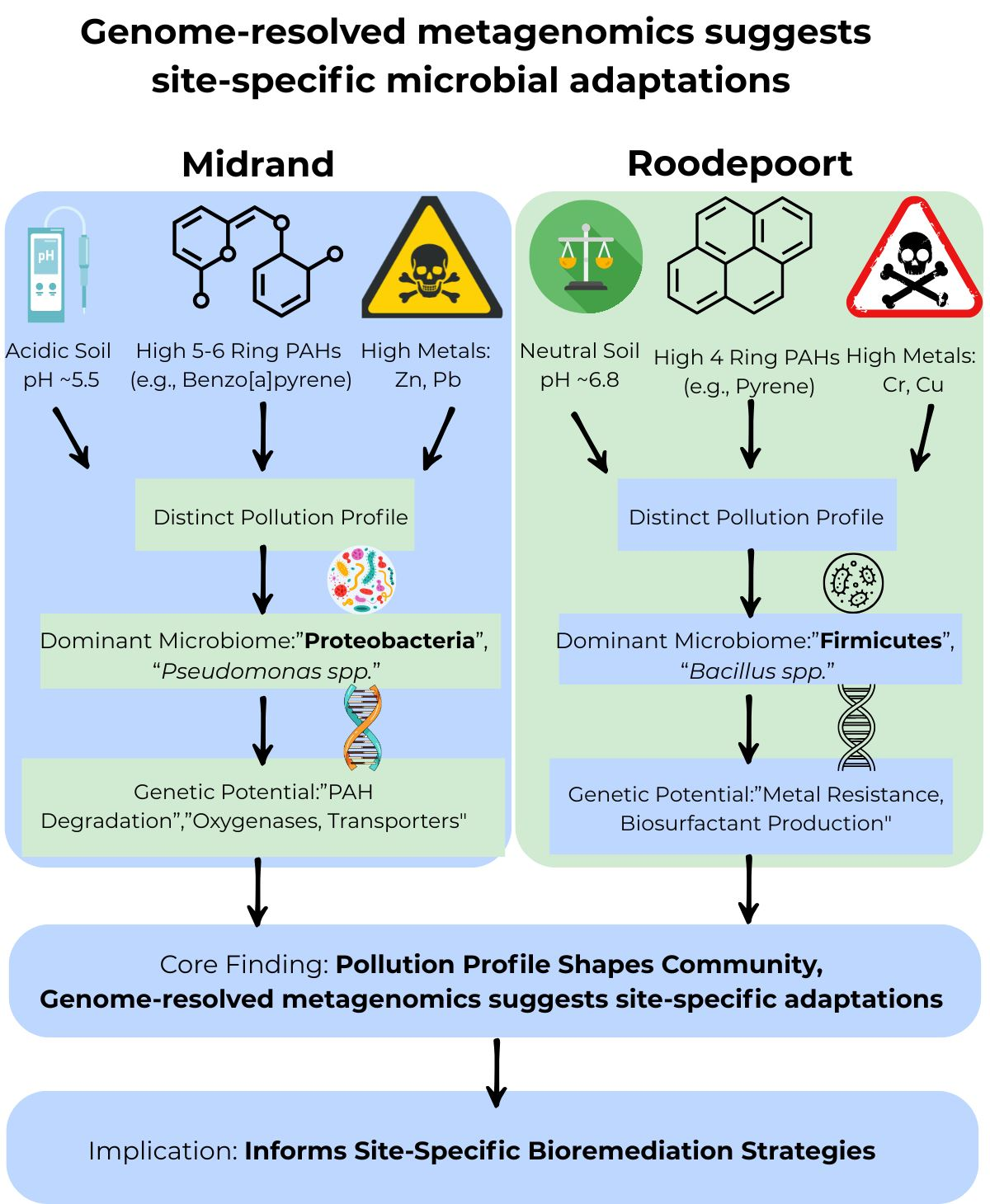

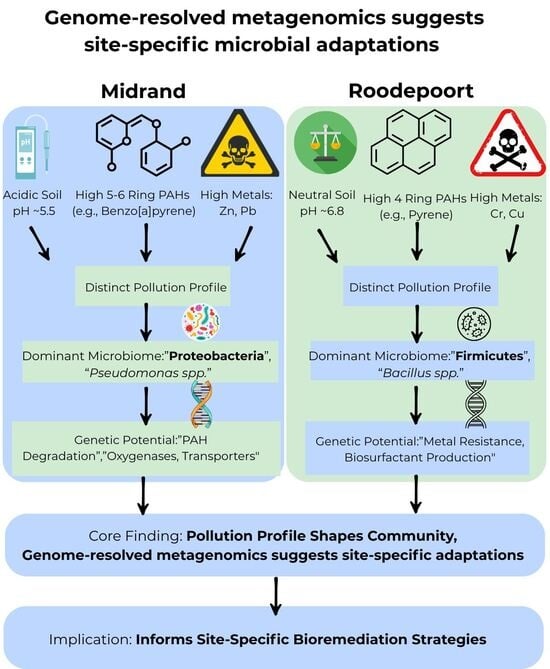
Genome-Resolved Metagenomics Suggests Site-Specific Microbial Adaptations in Urban Soils Co-Contaminated with Hydrocarbons and Heavy Metals



Abstract
1. Introduction
2. Materials and Methods
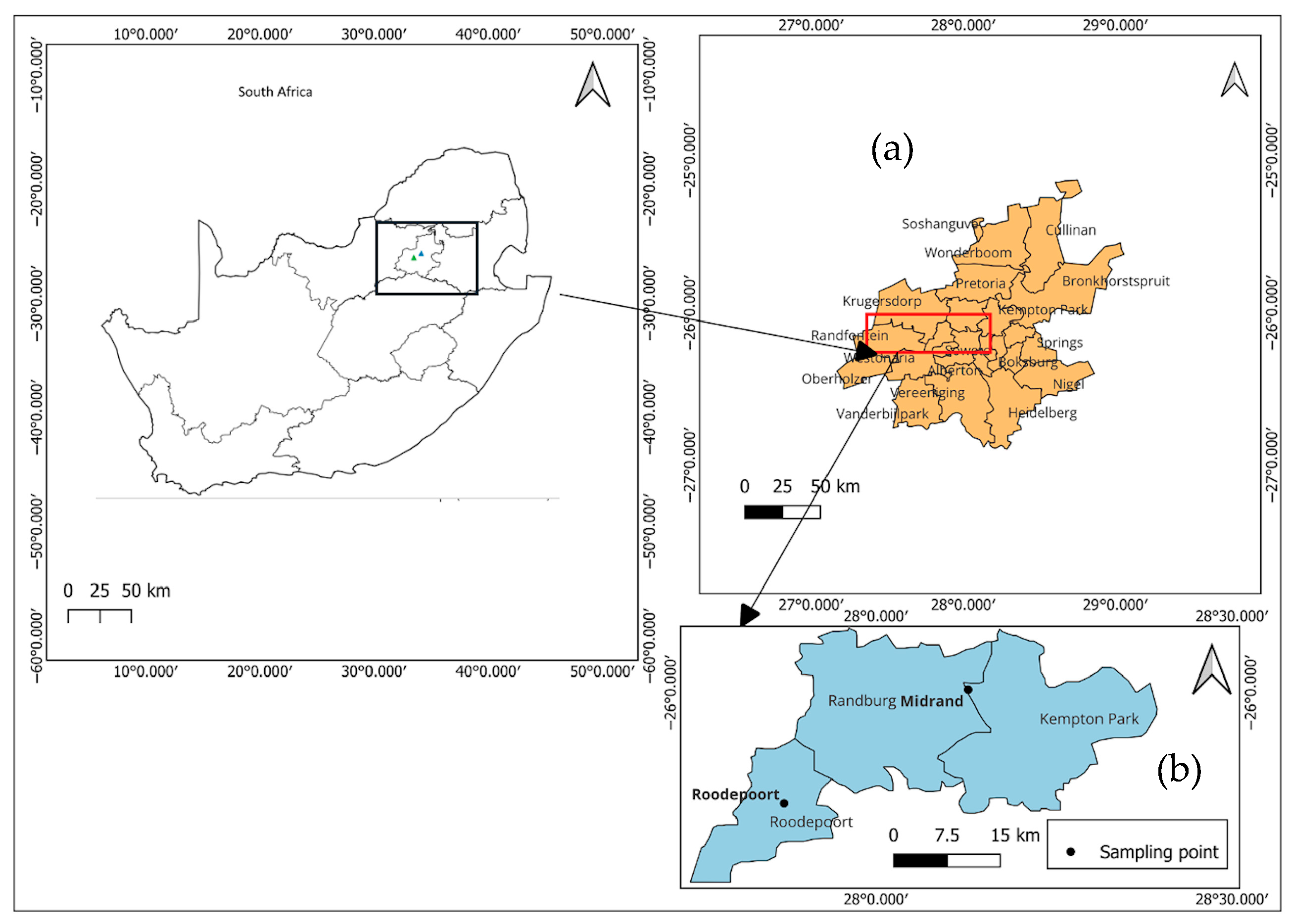
2.1. Site Description and Soil Sampling
2.2. Physicochemical Analysis of Soil Samples
2.3. CHNS Analysis of the Soil Samples
2.4. Metal Analysis
2.5. Polycyclic Aromatic Hydrocarbons (PAHs) in the Soil and Analysis
2.6. Whole-Genome Shotgun Metagenome Profiling
2.6.1. DNA Extraction and Sequencing
2.6.2. Bioinformatics
2.6.3. Statistical Analysis
3. Results and Discussion
3.1. Physico-Chemical Characterization and Its Impact on Soil Ecosystems
3.1.1. Sampling and pH Profiles of Oil-Contaminated Soils
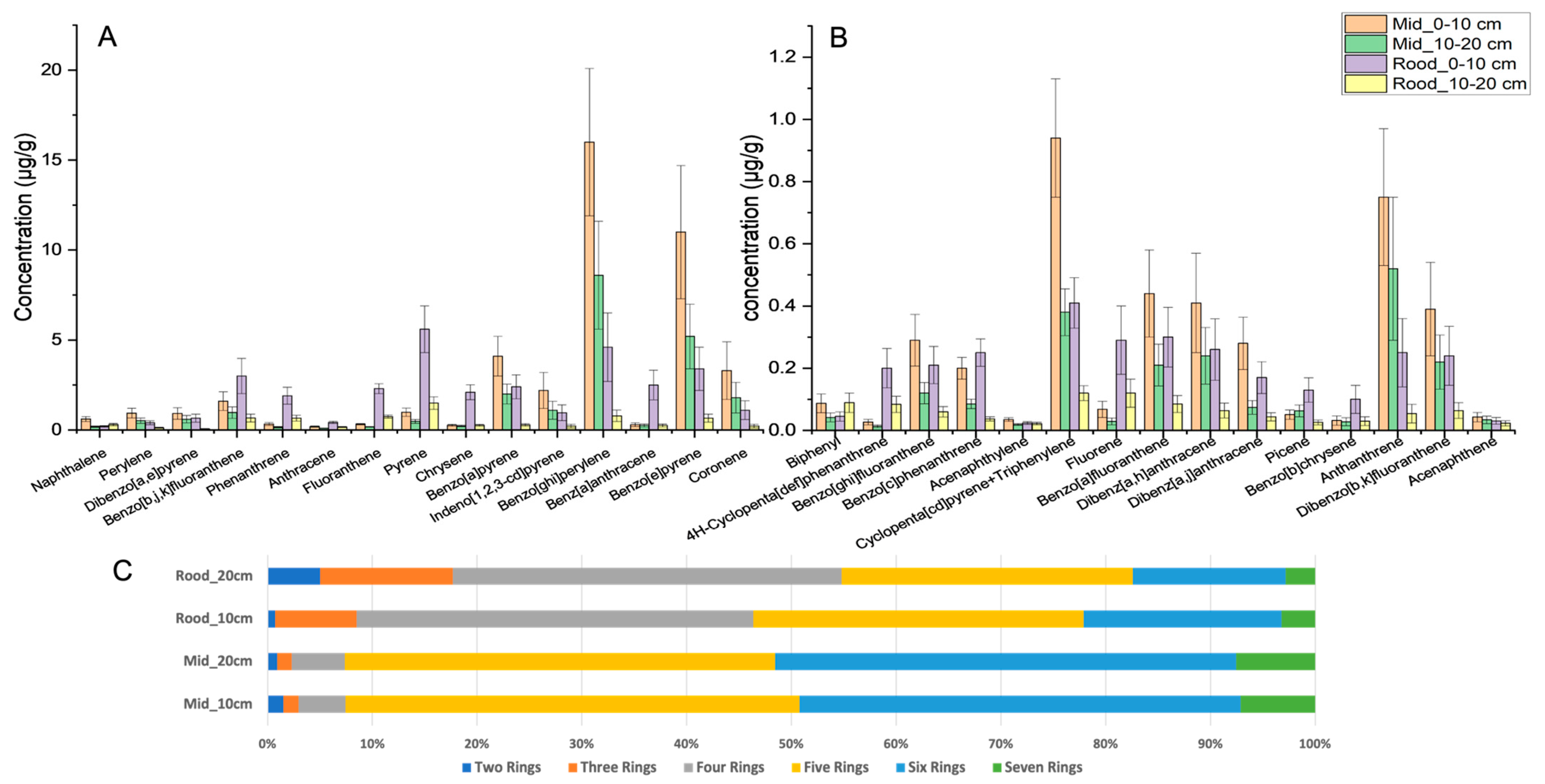
3.1.2. Polycyclic Aromatic Hydrocarbon Analysis and Quantification
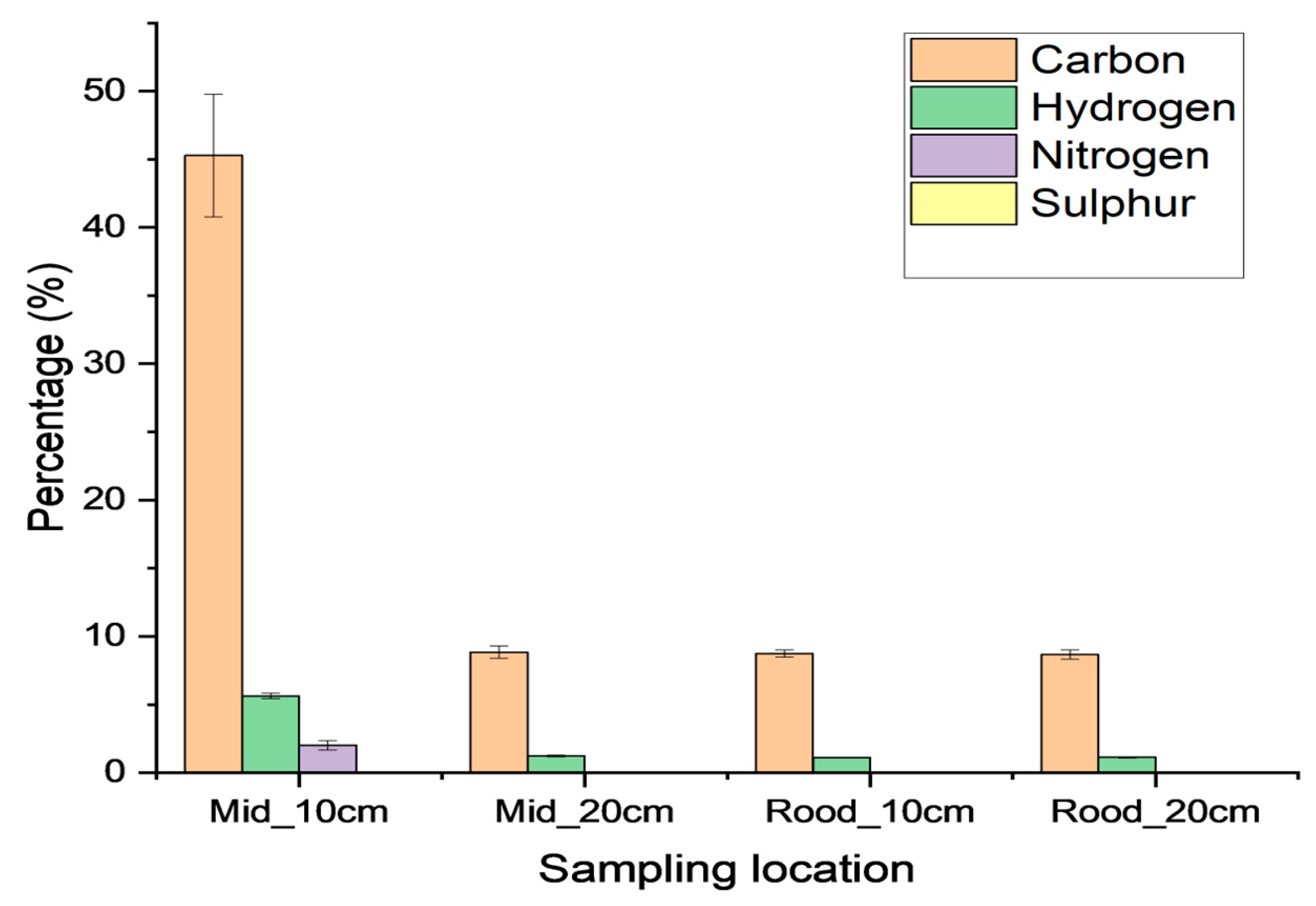
3.1.3. Elemental Composition (C, H, N, S) in Oil-Contaminated Soils
3.1.4. Heavy Metal Analysis and Comparison to International Standards
3.1.5. Integrated Environmental Interpretation
3.2. Metagenome Assembly and MAG Recovery
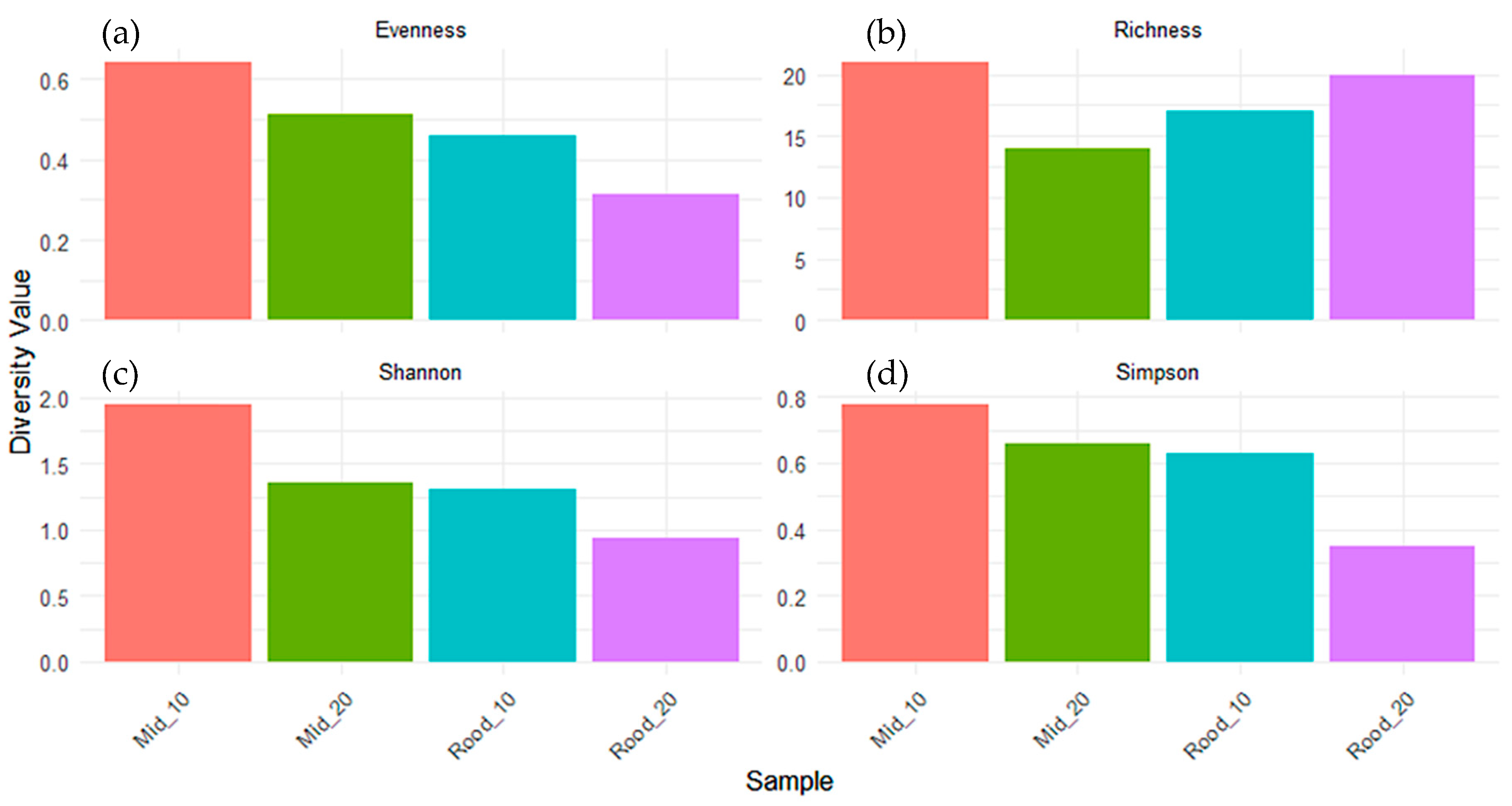
3.3. Microbial Community Structure and Profiling
3.4. Observed Patterns Between Soil Properties and Microbial Communities: Ecological Insights
3.4.1. Observed Negative Trend
3.4.2. Observed Positive Trends
3.5. Functional Potential and Bioremediation Implications
3.5.1. Genomic Insights into Hydrocarbon Degradation and Bioremediation Potential
3.5.2. Functional Potential and Stress Adaptation
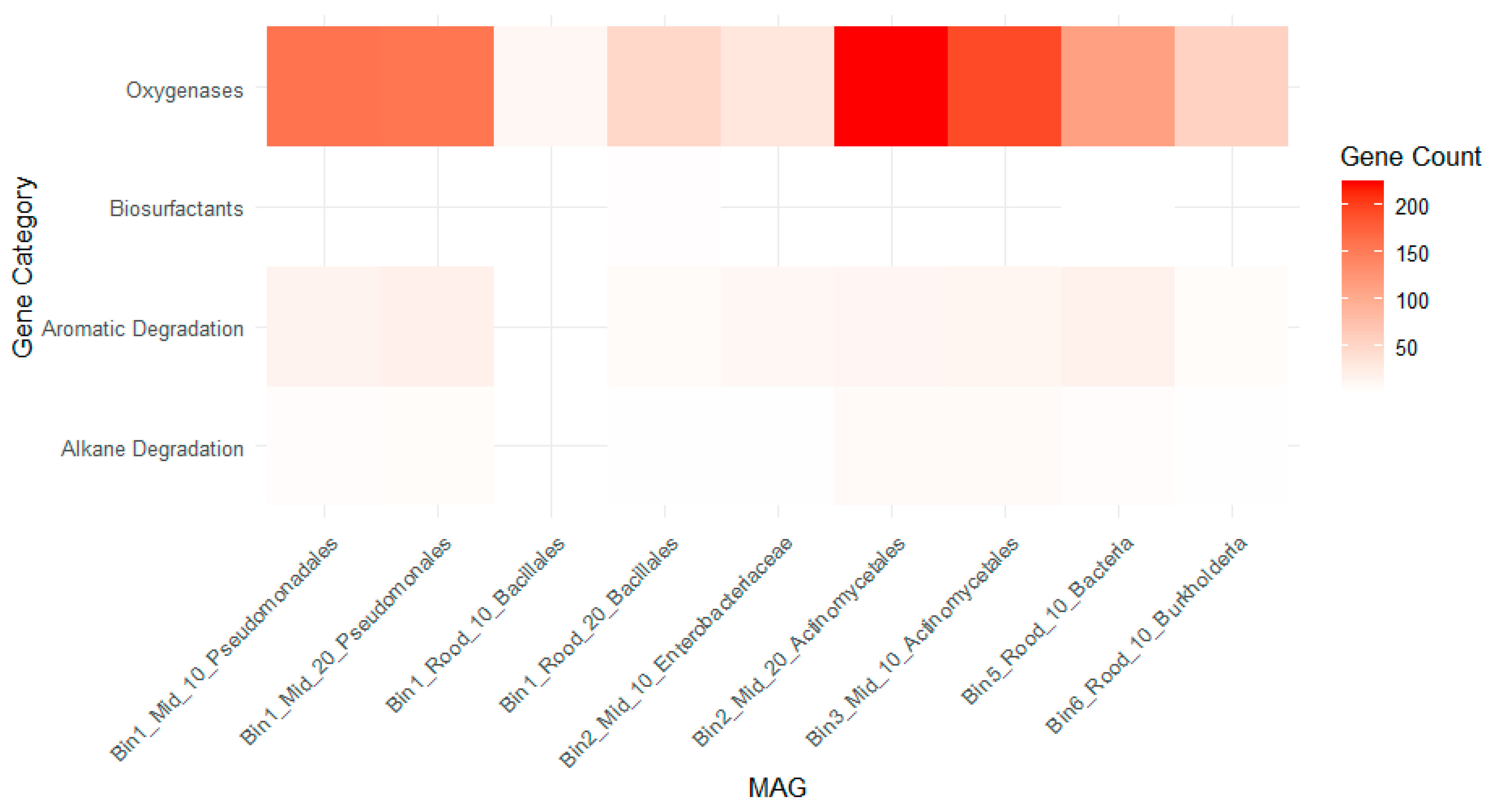
3.5.3. Distribution of High-Value Petroleum Degradation Genes
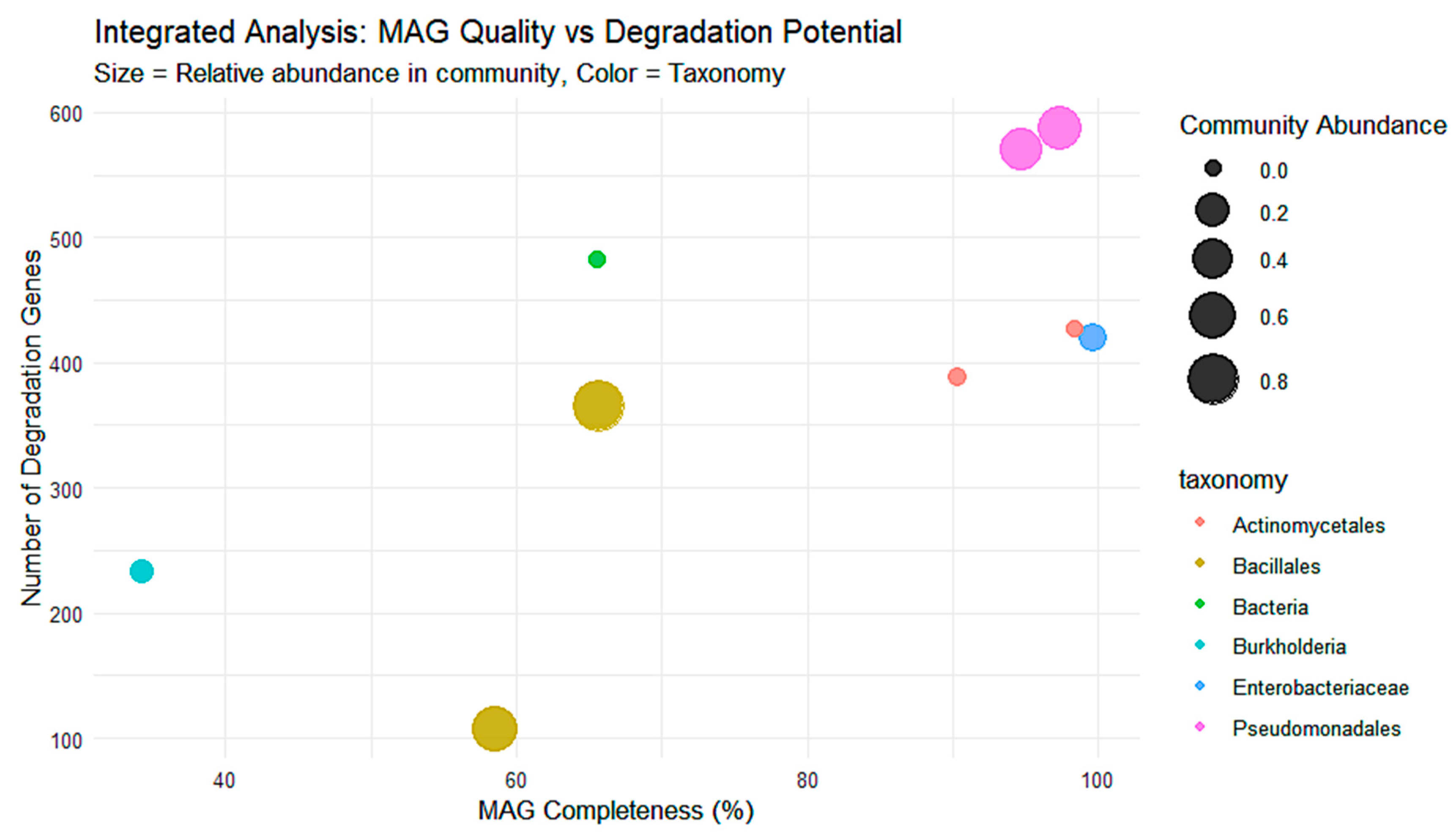
3.5.4. Integration of Genomic Features (MAG Completeness, Gene Load, and Abundance)
4. Limitations and Future Perspectives
5. Conclusions
Supplementary Materials
Author Contributions
Funding
Data Availability Statement
Acknowledgments
Conflicts of Interest
References
- da Gama, J.T. The Role of Soils in Sustainability, Climate Change, and Ecosystem Services: Challenges and Opportunities. Ecologies 2023, 4, 552–567. [Google Scholar] [CrossRef] [Scilit]
- Adhikari, K.; Hartemink, A.E. Linking soils to ecosystem services—A global review. Geoderma 2016, 262, 101–111. [Google Scholar] [CrossRef] [Scilit]
- Delgado-Baquerizo, M.; Reich, P.B.; Trivedi, C.; Eldridge, D.J.; Abades, S.; Alfaro, F.D.; Bastida, F.; Berhe, A.A.; Cutler, N.A.; Gallardo, A.; et al. Multiple elements of soil biodiversity drive ecosystem functions across biomes. Nat. Ecol. Evol. 2020, 4, 210–220. [Google Scholar] [CrossRef] [Scilit] [PubMed]
- PKopittke, M.; Menzies, N.W.; Wang, P.; McKenna, B.A.; Lombi, E. Soil and the intensification of agriculture for global food security. Environ. Int. 2019, 132, 105078. [Google Scholar] [CrossRef] [Scilit]
- Anikwe, M.A.N.; Ife, K. The role of soil ecosystem services in the circular bioeconomy. Front. Soil Sci. 2023, 3, 1209100. [Google Scholar] [CrossRef] [Scilit]
- Delgado-Baquerizo, M.; Eldridge, D.J.; Liu, Y.R.; Liu, Z.W.; Coleine, C.; Trivedi, P. Soil biodiversity and function under global change. PLoS Biol. 2025, 23, e3003093. [Google Scholar] [CrossRef] [Scilit]
- Navarro-Pedreño, J.; Almendro-Candel, M.B.; Zorpas, A.A. The Increase of Soil Organic Matter Reduces Global Warming, Myth or Reality? Sci 2021, 3, 18. [Google Scholar] [CrossRef] [Scilit]
- Silver, W.L.; Perez, T.; Mayer, A.; Jones, A.R. The role of soil in the contribution of food and feed. Philos. Trans. R. Soc. B Biol. Sci. 2021, 376, 20200181. [Google Scholar] [CrossRef] [Scilit]
- Das, N.; Bhuyan, B.; Pandey, P. Correlation of soil microbiome with crude oil contamination drives detection of hydrocarbon degrading genes which are independent to quantity and type of contaminants. Environ. Res. 2022, 215, 114185. [Google Scholar] [CrossRef] [Scilit]
- Abena, M.T.B.; Chen, G.; Chen, Z.; Zheng, X.; Li, S.; Li, T.; Zhong, W. Microbial diversity changes and enrichment of potential petroleum hydrocarbon degraders in crude oil-, diesel-, and gasoline-contaminated soil. 3 Biotech 2020, 10, 42. [Google Scholar] [CrossRef] [Scilit]
- Li, S.; Lian, W.-H.; Han, J.-R.; Ali, M.; Lin, Z.-L.; Liu, Y.-H.; Li, L.; Zhang, D.-Y.; Jiang, X.-Z.; Li, W.-J.; et al. Capturing the microbial dark matter in desert soils using culturomics-based metagenomics and high-resolution analysis. NPJ Biofilms Microbiomes 2023, 9, 67. [Google Scholar] [CrossRef] [Scilit]
- Alteio, L.V.; Schulz, F.; Seshadri, R.; Varghese, N.; Rodriguez-Reillo, W.; Ryan, E.; Goudeau, D.; Eichorst, S.A.; Malmstrom, R.R.; Bowers, R.M.; et al. Complementary Metagenomic Approaches Improve Reconstruction of Microbial Diversity in a Forest Soil. mSystems 2020, 5, e00768-19. [Google Scholar] [CrossRef] [Scilit]
- Garg, D.; Patel, N.; Rawat, A.; Rosado, A.S. Cutting edge tools in the field of soil microbiology. Curr. Res. Microb. Sci. 2024, 6, 100226. [Google Scholar] [CrossRef] [Scilit]
- Chettri, D.; Verma, A.K.; Chirania, M.; Verma, A.K. Metagenomic approaches in bioremediation of environmental pollutants. Environ. Pollut. 2024, 363, 125297. [Google Scholar] [CrossRef] [Scilit]
- Panigrahi, S.; Velraj, P.; Rao, T.S. Functional Microbial Diversity in Contaminated Environment and Application in Bioremediation. In Microbial Diversity in the Genomic Era; Elsevier: Amsterdam, The Netherlands, 2019; pp. 359–385. [Google Scholar] [CrossRef] [Scilit]
- Hidalgo, K.J.; Centurion, V.B.; Lemos, L.N.; Soriano, A.U.; Valoni, E.; Baessa, M.P.; Richnow, H.H.; Vogt, C.; Oliveira, V.M. Disentangling the microbial genomic traits associated with aromatic hydrocarbon degradation in a jet fuel-contaminated aquifer. Biodegradation 2025, 36, 7. [Google Scholar] [CrossRef] [Scilit] [PubMed]
- Mukherjee, A.; Chettri, B.; Langpoklakpam, J.S.; Basak, P.; Prasad, A.; Mukherjee, A.K.; Bhattacharyya, M.; Singh, A.K.; Chattopadhyay, D. Bioinformatic Approaches Including Predictive Metagenomic Profiling Reveal Characteristics of Bacterial Response to Petroleum Hydrocarbon Contamination in Diverse Environments. Sci. Rep. 2017, 7, 1108. [Google Scholar] [CrossRef] [Scilit] [PubMed]
- Liu, S.-H.; Zeng, G.-M.; Niu, Q.-Y.; Liu, Y.; Zhou, L.; Jiang, L.-H.; Tan, X.-F.; Xu, P.; Zhang, C.; Cheng, M. Bioremediation mechanisms of combined pollution of PAHs and heavy metals by bacteria and fungi: A mini review. Biores. Technol. 2017, 24, 25–33. [Google Scholar] [CrossRef] [Scilit]
- Zhang, Y.; Qian, F.; Bao, Y. Variations of microbiota and metabolites in rhizosphere soil of Carmona microphylla at the co-contaminated site with polycyclic aromatic hydrocarbons and heavy metals. Ecotoxicol. Environ. Saf. 2025, 290, 117734. [Google Scholar] [CrossRef] [Scilit]
- Song, X.; Ding, D.; Wang, Q.; Zhang, Z.; Tang, Z. Bioremediation of PAHs and heavy metals co-contaminated soils: Challenges and enhancement strategies. Environ. Pollut. 2022, 295, 118686. [Google Scholar] [CrossRef] [Scilit]
- Crampon, M.; Bodilis, J.; Portet-Koltalo, F.; Crampon, M.; Portet-Koltalo, F. Linking initial soil bacterial diversity and polycyclic aromatic hydrocarbons (PAHs) degradation potential. J. Hazard. Mater. 2018, 359, 500–509. [Google Scholar] [CrossRef] [Scilit] [PubMed]
- Chikere, C.B.; Mordi, I.J.; Chikere, B.O.; Selvarajan, R.; Ashafa, T.O.; Obieze, C.C. Comparative metagenomics and functional profiling of crude oil-polluted soils in Bodo West Community, Ogoni, with other sites of varying pollution history. Ann. Microbiol. 2019, 69, 495–513. [Google Scholar] [CrossRef] [Scilit]
- Yang, Z.N.; Liu, Z.S.; Wang, K.H.; Liang, Z.L.; Abdugheni, R.; Huang, Y.; Wang, R.H.; Ma, H.L.; Wang, X.K.; Yang, M.L.; et al. Soil microbiomes divergently respond to heavy metals and polycyclic aromatic hydrocarbons in contaminated industrial sites. Environ. Sci. Ecotechnology 2022, 10, 100169. [Google Scholar] [CrossRef] [Scilit] [PubMed]
- Pawlowski, J.; Bruce, K.; Panksep, K.; Aguirre, F.; Amalfitano, S.; Apothéloz-Perret-Gentil, L.; Baussant, T.; Bouchez, A.; Carugati, L.; Cermakova, K.; et al. Environmental DNA metabarcoding for benthic monitoring: A review of sediment sampling and DNA extraction methods. Sci. Total Environ. 2022, 818, 151783. [Google Scholar] [CrossRef] [Scilit]
- Sato, H.; Sogo, Y.; Doi, H.; Yamanaka, H. Usefulness and limitations of sample pooling for environmental DNA metabarcoding of freshwater fish communities. Sci. Rep. 2017, 7, 14860. [Google Scholar] [CrossRef] [Scilit]
- Anderson, E.C.; Skaug, H.J.; Barshis, D.J. Next-generation sequencing for molecular ecology: A caveat regarding pooled samples. Mol. Ecol. 2014, 23, 502–512. [Google Scholar] [CrossRef] [Scilit]
- ISO 10390:2021; Soil, Treated Biowaste and Sludge-Determination of pH. International Organization for Standardization: Geneva, Switzerland, 2021.
- Pospí, L.; Horáková, E.; Fi, M.; Jerzykiewicz, M.; Men, L. Effect of selected organic materials on soil humic acids chemical properties. Environ. Res. 2020, 187, 109663. [Google Scholar] [CrossRef] [Scilit]
- Alvarado, T.R.; Lee, A.C.; Tomlin, B.; Schwab, P. Evaluation of internal standards for inductively coupled plasma—Mass spectrometric analysis of arsenic in soils. J. Environ. Qual. 2022, 51, 765–773. [Google Scholar] [CrossRef] [Scilit]
- Osman, R.; Saim, N. Selective accelerated solvent extraction for the analysis of soil selective accelerated solvent extraction for the analysis of soil polycyclic aromatic hydrocarbons and sterols. Malays. J. Anal. Sci. 2008, 12, 352–356. [Google Scholar]
- Ailijiang, N.; Zhong, N.; Zhou, X.; Mamat, A.; Chang, J.; Cao, S.; Hua, Z.; Li, N. Levels, sources, and risk assessment of PAHs residues in soil and plants in urban parks of Northwest China. Sci. Rep. 2022, 12, 21448. [Google Scholar] [CrossRef] [Scilit] [PubMed]
- Tao, Z.; Gao, H.; Luo, Y. Source and distribution characteristics of polycyclic aromatic hydrocarbons in agricultural soils in Beijing suburbs. Environ. Chem. 2013, 32, 874–880. [Google Scholar]
- Bolger, A.M.; Lohse, M.; Usadel, B. Genome analysis Trimmomatic: A flexible trimmer for Illumina sequence data. Bioinformatics 2014, 30, 2114–2120. [Google Scholar] [CrossRef] [Scilit]
- Del Fabbro, C.; Scalabrin, S.; Morgante, M.; Giorgi, F.M. An extensive evaluation of read trimming effects on illumina NGS data analysis. PLoS ONE 2013, 8, e85024. [Google Scholar] [CrossRef] [Scilit]
- Sewe, S.O.; Silva, G.; Sicat, P.; Seal, S.E.; Visendi, P. Visendi, Trimming and Validation of Illumina Short Reads Using Trimmomatic, Trinity Assembly, and Assessment of RNA-Seq Data; Springer: New York, NY, USA, 2022; p. 2443. [Google Scholar] [CrossRef] [Scilit]
- Brown, C.L.; Keenum, I.M.; Dai, D.; Zhang, L.; Vikesland, P.J.; Pruden, A. Critical evaluation of short, long, and hybrid assembly for contextual analysis of antibiotic resistance genes in complex environmental metagenomes. Sci. Rep. 2021, 11, 3753. [Google Scholar] [CrossRef] [Scilit]
- Li, D.; Liu, C.M.; Luo, R.; Sadakane, K.; Lam, T.W. MEGAHIT: An ultra-fast single-node solution for large and complex metagenomics assembly via succinct de Bruijn graph. Bioinformatics 2015, 31, 1674–1676. [Google Scholar] [CrossRef] [Scilit] [PubMed]
- van der Walt, A.J.; van Goethem, M.W.; Ramond, J.B.; Makhalanyane, T.P.; Reva, O.; Cowan, D.A. Assembling metagenomes, one community at a time. BMC Genom. 2017, 18, 521. [Google Scholar] [CrossRef] [Scilit] [PubMed]
- Mikheenko, A.; Saveliev, V.; Gurevich, A. MetaQUAST: Evaluation of metagenome assemblies. Bioinformatics 2016, 32, 1088–1090. [Google Scholar] [CrossRef] [Scilit]
- Brettin, T.; Davis, J.J.; Disz, T.; Edwards, R.A.; Gerdes, S.; Olsen, G.J.; Olson, R.; Overbeek, R.; Parrello, B.; Pusch, G.D.; et al. RASTtk: A modular and extensible implementation of the RAST algorithm for building custom annotation pipelines and annotating batches of genomes. Sci. Rep. 2015, 5, 8365. [Google Scholar] [CrossRef] [Scilit]
- Overbeek, R.; Olson, R.; Pusch, G.D.; Olsen, G.J.; Davis, J.J.; Disz, T.; Edwards, R.A.; Gerdes, S.; Parrello, B.; Shukla, M.; et al. The SEED and the Rapid Annotation of microbial genomes using Subsystems Technology (RAST). Nucleic Acids Res. 2014, 42, D206–D214. [Google Scholar] [CrossRef] [Scilit]
- Shaffer, M.; A Borton, M.; McGivern, B.B.; A Zayed, A.; La Rosa, S.L.; Solden, L.M.; Liu, P.; Narrowe, A.B.; Rodríguez-Ramos, J.; Bolduc, B.; et al. DRAM for distilling microbial metabolism to automate the curation of microbiome function. Nucleic Acids Res. 2020, 48, 8883–8900. [Google Scholar] [CrossRef] [Scilit] [PubMed]
- Maguire, F.; Jia, B.; Gray, K.; Lau, W.Y.V.; Beiko, R.G.; Brinkman, F.S.L. Metagenome-Assembled Genome Binning Methods with Short Reads Disproportionately Fail for Plasmids and Genomic Islands. Microb. Genom. 2020, 6, e000436. [Google Scholar] [CrossRef] [Scilit]
- Wu, Y.W.; Simmons, B.A.; Singer, S.W. MaxBin 2.0: An automated binning algorithm to recover genomes from multiple metagenomic datasets. Bioinformatics 2016, 32, 605–607. [Google Scholar] [CrossRef] [Scilit]
- Bowers, R.M.; Kyrpides, N.C.; Stepanauskas, R.; Harmon-Smith, M.; Doud, D.; Reddy, T.B.K.; Schulz, F.; Jarett, J.; Rivers, A.R.; Eloe-Fadrosh, E.A.; et al. Minimum information about a single amplified genome (MISAG) and a metagenome-assembled genome (MIMAG) of bacteria and archaea. Nat. Biotechnol. 2017, 35, 725–731. [Google Scholar] [CrossRef] [Scilit]
- Portik, D.M.; Brown, C.T.; Pierce-Ward, N.T. Evaluation of taxonomic classification and profiling methods for long-read shotgun metagenomic sequencing datasets. BMC Bioinform. 2022, 23, 541. [Google Scholar] [CrossRef] [Scilit]
- Nasko, D.J.; Koren, S.; Phillippy, A.M.; Treangen, T.J. RefSeq database growth influences the accuracy of k-mer-based lowest common ancestor species identification. Genome Biol. 2018, 19, 165. [Google Scholar] [CrossRef] [Scilit]
- Kers, J.G.; Saccenti, E. The Power of Microbiome Studies: Some Considerations on Which Alpha and Beta Metrics to Use and How to Report Results. Front. Microbiol. 2022, 12, 796025. [Google Scholar] [CrossRef] [Scilit] [PubMed]
- Hauptfeld, E.; Pappas, N.; van Iwaarden, S.; Snoek, B.L.; Aldas-Vargas, A.; Dutilh, B.E.; von Meijenfeldt, F.A.B. Integrating taxonomic signals from MAGs and contigs improves read annotation and taxonomic profiling of metagenomes. Nat. Commun. 2024, 15, 3373. [Google Scholar] [CrossRef] [Scilit] [PubMed]
- Ren, M.; Zheng, L.; Hu, J.; Chen, X.; Zhang, Y.; Dong, X.; Wei, X.; Cheng, H. Characterization of polycyclic aromatic hydrocarbons in soil in a coal mining area, East China: Spatial distribution, sources, and carcinogenic risk assessment. Earth Sci. 2022, 10, 1035792. [Google Scholar] [CrossRef] [Scilit]
- Mali, M.; Ragone, R.; Dell’Anna, M.M.; Romanazzi, G.; Damiani, L.; Mastrorilli, P. Improved identification of pollution source attribution by using PAH ratios combined with multivariate statistics. Sci. Rep. 2022, 12, 19298. [Google Scholar] [CrossRef] [Scilit] [PubMed]
- Wang, C.; Wu, S.; Zhou, S.; Shi, Y.; Song, J. Characteristics and Source Identification of Polycyclic Aromatic Hydrocarbons (PAHs) in Urban Soils: A Review. Pedosphere 2017, 27, 17–26. [Google Scholar] [CrossRef] [Scilit]
- Tobiszewski, M.; Namieśnik, J. PAH diagnostic ratios for the identification of pollution emission sources. Environ. Pollut. 2012, 162, 110–119. [Google Scholar] [CrossRef] [Scilit]
- Biache, C.; Mansuy-Huault, L.; Faure, P. Impact of oxidation and biodegradation on the most commonly used polycyclic aromatic hydrocarbon (PAH) diagnostic ratios: Implications for the source identifications. J. Hazard. Mater. 2014, 267, 31–39. [Google Scholar] [CrossRef] [Scilit]
- Narayan, O.P.; Kumar, P.; Yadav, B.; Dua, M.; Johri, A.K. Sulfur nutrition and its role in plant growth and development. Plant Signal. Behav. 2023, 18, 2030082. [Google Scholar] [CrossRef] [Scilit]
- Fathi, A. Role of nitrogen (N) in plant growth, photosynthesis pigments, and N use efficiency: A review. Agrisost 2022, 28, 1–8. [Google Scholar] [CrossRef]
- Alegbeleye, O.O.; Opeolu, B.O.; Jackson, V.A. Polycyclic Aromatic Hydrocarbons: A Critical Review of Environmental Occurrence and Bioremediation. Environ. Manag. 2017, 60, 758–783. [Google Scholar] [CrossRef] [Scilit] [PubMed]
- Passow, U.; Overton, E.B. The Complexity of Spills: The Fate of the Deepwater Horizon Oil. Annu. Rev. Mar. Sci. 2021, 13, 109–136. [Google Scholar] [CrossRef] [Scilit]
- Briffa, J.A.; Sinagra, E.; Blundell, R. Heavy metal pollution in the environment and their toxicological effects on humans. Heliyon 2020, 6, e04691. [Google Scholar] [CrossRef] [Scilit]
- Barsova, N.; Yakimenko, O.; Tolpeshta, I.; Motuzova, G. Current state and dynamics of heavy metal soil pollution in Russian Federation—A review. Environ. Pollut. 2019, 249, 200–207. [Google Scholar] [CrossRef] [Scilit]
- Wuana, R.A.; Okieimen, F.E. Heavy Metals in Contaminated Soils: A Review of Sources, Chemistry, Risks and Best Available Strategies for Remediation. Int. Sch. Res. Not. 2011, 2011, 402647. [Google Scholar] [CrossRef] [Scilit]
- Amlinger, F.; Pollack, M.; Favoino, E. Heavy Metals and Organic Compounds from Wastes Used as Organic Fertilisers. Final Report for ENV. A. 2./ETU/2001/0024. 2004. Available online: https://ec.europa.eu/environment/pdf/waste/compost/hm_finalreport.pdf (accessed on 5 February 2026).
- World Health Organization (WHO). Permissible Limits of Heavy Metals in Soil and Plants; World Health Organization (WHO): Geneva, Switzerland, 1996. [Google Scholar]
- Sakshi; Singh, S.K.; Haritash, A.K. Polycyclic aromatic hydrocarbons: Soil pollution and remediation. Int. J. Environ. Sci. Technol. 2019, 16, 6489–6512. [Google Scholar] [CrossRef] [Scilit]
- Das, N.; Kumar, V.; Chaure, K.; Pandey, P. Environmental restoration of polyaromatic hydrocarbon-contaminated soil through sustainable rhizoremediation: Insights into bioeconomy and high-throughput systematic analysis. Environ. Sci. Adv. 2025, 4, 842–883. [Google Scholar] [CrossRef] [Scilit]
- Kicińska, A.; Pomykała, R.; Izquierdo-Diaz, M. Changes in soil pH and mobility of heavy metals in contaminated soils. Eur. J. Soil. Sci. 2022, 73, e13203. [Google Scholar] [CrossRef] [Scilit]
- Jabbarov, Z.; Abdrakhmanov, T.; Pulatov, A.; Kováčik, P.; Pirmatov, K. Change in the parameters of soils contaminated by oil and oil products. Agriculture (Pol’nohospodárstvo) 2019, 65, 88–98. [Google Scholar] [CrossRef] [Scilit]
- Tang, B.; Xu, H.; Song, F.; Ge, H.; Yue, S. Effects of heavy metals on microorganisms and enzymes in soils of lead–zinc tailing ponds. Environ. Res. 2022, 207, 112174. [Google Scholar] [CrossRef] [Scilit]
- Kiran; Bharti, R.; Sharma, R. Effect of heavy metals: An overview. Mater. Today Proc. 2021, 51, 880–885. [Google Scholar] [CrossRef] [Scilit]
- Aka, R.J.N.; Babalola, O.O. Effect of bacterial inoculation of strains of pseudomonas aeruginosa, alcaligenes feacalis and Bacillus subtilis on germination, growth and heavy metal (cd, cr, and ni) uptake of brassica juncea. Int. J. Phytoremediation 2016, 18, 200–209. [Google Scholar] [CrossRef] [Scilit]
- Fakhar, A.; Gul, B.; Gurmani, A.R.; Khan, S.M.; Ali, S.; Sultan, T.; Chaudhary, H.J.; Rafique, M.; Rizwan, M. Heavy metal remediation and resistance mechanism of Aeromonas, Bacillus, and Pseudomonas: A review. Crit. Rev. Environ. Sci. Technol. 2020, 52, 1868–1914. [Google Scholar] [CrossRef] [Scilit]
- Ng, C.W.W.; Yan, W.H.; Tsim, K.W.K.; So, P.S.; Xia, Y.T.; To, C.T. Effects of Bacillus subtilis and Pseudomonas fluorescens as the soil amendment. Heliyon 2022, 8, e11674. [Google Scholar] [CrossRef] [Scilit] [PubMed]
- Gao, H.; Wu, M.; Liu, H.; Xu, Y.; Liu, Z. Effect of petroleum hydrocarbon pollution levels on the soil microecosystem and ecological function. Environ. Pollut. 2022, 293, 118511. [Google Scholar] [CrossRef] [Scilit] [PubMed]
- Stepanova, A.Y.; Gladkov, E.A.; Osipova, E.S.; Gladkova, O.V.; Tereshonok, D.V. Bioremediation of Soil from Petroleum Contamination. Processes 2022, 10, 1224. [Google Scholar] [CrossRef] [Scilit]
- Al Disi, Z.; Al-Ghouti, M.A.; Zouari, N. Investigating the simultaneous removal of hydrocarbons and heavy metals by highly adapted Bacillus and Pseudomonas strains. Environ. Technol. Innov. 2022, 27, 102513. [Google Scholar] [CrossRef] [Scilit]
- Mandree, P.; Masika, W.; Naicker, J.; Moonsamy, G.; Ramchuran, S.; Lalloo, R. Bioremediation of polycyclic aromatic hydrocarbons from industry contaminated soil using indigenous Bacillus spp. Processes 2021, 9, 1606. [Google Scholar] [CrossRef] [Scilit]
- Mansoor, S.; Ali, A.; Kour, N.; Bornhorst, J.; AlHarbi, K.; Rinklebe, J.; El Moneim, D.A.; Ahmad, P.; Chung, Y.S. Heavy Metal Induced Oxidative Stress Mitigation and ROS Scavenging in Plants. Plants 2023, 12, 3003. [Google Scholar] [CrossRef] [Scilit]
- Kumar, K.; Srivastava, S. Plant Metal and Metalloid Transporters; Springer: Durham, NC, USA, 2022. [Google Scholar] [CrossRef] [Scilit]
- Henao, S.G.; Ghneim-Herrera, T. Heavy Metals in Soils and the Remediation Potential of Bacteria Associated With the Plant Microbiome. Front. Environ. Sci. 2021, 9, 604216. [Google Scholar] [CrossRef] [Scilit]
- Naz, M.; Dai, Z.; Hussain, S.; Tariq, M.; Danish, S.; Khan, I.U.; Qi, S.; Du, D. The soil pH and heavy metals revealed their impact on soil microbial community. J. Environ. Manag. 2022, 321, 115770. [Google Scholar] [CrossRef] [Scilit] [PubMed]
- Iniaghe, P.O.; Kpomah, E.D. A Comparative Analysis on the Concentration and Potential Risk of Polycyclic Aromatic Hydrocarbons in Surface Water, Sediment and Soil from a Non-crude Oil and a Crude Oil Explosion Site in the Niger Delta, Nigeria. Chem. Afr. 2023, 6, 1633–1653. [Google Scholar] [CrossRef] [Scilit]
- Ilić, P.; Ilić, S.; Markić, D.N.; Bjelić, L.S.; Farooqi, Z.U.R.; Sole, B.; Adimalla, N. Source Identification and Ecological Risk of Polycyclic Aromatic Hydrocarbons in Soils and Groundwater. Ecol. Chem. Eng. 2021, 28, 355–363. [Google Scholar] [CrossRef] [Scilit]
- Kebede, G.; Tafese, T.; Abda, E.M.; Kamaraj, M.; Assefa, F. Factors Influencing the Bacterial Bioremediation of Hydrocarbon Contaminants in the Soil: Mechanisms and Impacts. J. Chem. 2021, 2021, 9823362. [Google Scholar] [CrossRef] [Scilit]
- Xu, K.; Zhang, Y.; Zheng, J.; Wang, C.; Chen, R. Comparative Toxicity of 3–5 Ringed Polycyclic Aromatic Hydrocarbons to Skeletal Development in Zebrafish Embryos and the Possible Reason. Bull. Environ. Contam. Toxicol. 2023, 110, 8. [Google Scholar] [CrossRef] [Scilit]
- Dhar, K.; Panneerselvan, L.; Venkateswarlu, K.; Megharaj, M. Efficient bioremediation of PAHs-contaminated soils by a methylotrophic enrichment culture. Biodegradation 2022, 33, 575–591. [Google Scholar] [CrossRef] [Scilit] [PubMed]
- Ehis-Eriakha, C.B.; Chikere, C.B.; Akaranta, O.; Akemu, S.E. A comparative assesment of biostimulants in microbiome-based ecorestoration of polycyclic aromatic hydrocarbon polluted soil. Braz. J. Microbiol. 2024, 56, 203–224. [Google Scholar] [CrossRef] [Scilit]
- Mawad, A.M.M.; Aldaby, E.S.E.; Madany, M.M.Y.; Dawood, M.F.A. The application of PAHs-Degrading Pseudomonas aeruginosa to mitigate the phytotoxic impact of pyrene on barley (Hordeum vulgare L.) and broad bean (Vicia faba L.) plants. Plant Physiol. Biochem. 2024, 215, 108959. [Google Scholar] [CrossRef] [Scilit]
- Fahrenfeld, N.; Cozzarelli, I.M.; Bailey, Z.; Pruden, A. Insights into Biodegradation Through Depth-Resolved Microbial Community Functional and Structural Profiling of a Crude-Oil Contaminant Plume. Microb. Ecol. 2014, 68, 453–462. [Google Scholar] [CrossRef] [Scilit]
- Ubani, O.; Atagana, H.I.; Selvarajan, R.; Ogola, H.J. Unravelling the genetic and functional diversity of dominant bacterial communities involved in manure co-composting bioremediation of complex crude oil waste sludge. Heliyon 2022, 8, e08945. [Google Scholar] [CrossRef] [Scilit]
- Kuppusamy, S.; Thavamani, P.; Megharaj, M.; Lee, Y.B.; Naidu, R. Isolation and characterization of polycyclic aromatic hydrocarbons (PAHs) degrading, pH tolerant, N-fixing and P-solubilizing novel bacteria from manufactured gas plant (MGP) site soils. Environ. Technol. Innov. 2016, 6, 204–219. [Google Scholar] [CrossRef] [Scilit]
- Giddings, L.A.; Chlipala, G.; Kunstman, K.; Green, S.; Morillo, K.; Bhave, K.; Peterson, H.; Driscoll, H.; Maienschein-Cline, M. Characterization of an acid rock drainage microbiome and transcriptome at the Ely Copper Mine Superfund site. PLoS ONE 2020, 15, e0237599. [Google Scholar] [CrossRef] [Scilit] [PubMed]
- Huang, Q.; Huang, Y.; Li, B.; Li, X.; Guo, Y.; Jiang, Z.; Liu, X.; Yang, Z.; Ning, Z.; Xiao, T.; et al. Metagenomic analysis characterizes resistomes of an acidic, multimetal(loid)-enriched coal source mine drainage treatment system. J. Hazard. Mater. 2023, 448, 130898. [Google Scholar] [CrossRef] [Scilit]
- Gutiérrez, E.J.; Abraham, M.D.R.; Baltazar, J.C.; Vázquez, G.; Delgadillo, E.; Tirado, D. Pseudomonas fluorescens: A bioaugmentation strategy for oil-contaminated and nutrient-poor soil. Int. J. Environ. Res. Public Health 2020, 17, 6959. [Google Scholar] [CrossRef] [Scilit]
- Ibrahim, H.M.M. Characterization of biosurfactants produced by novel strains of Ochrobactrum anthropi HM-1 and Citrobacter freundii HM-2 from used engine oil-contaminated soil. Egypt. J. Pet. 2018, 27, 21–29. [Google Scholar] [CrossRef] [Scilit]
- Balíková, K.; Vojtková, H.; Duborská, E.; Kim, H.; Matúš, P.; Urík, M. Role of Exopolysaccharides of Pseudomonas in Heavy Metal Removal and Other Remediation Strategies. Polymers 2022, 14, 4253. [Google Scholar] [CrossRef] [Scilit]
- Muriel-Millán, L.F.; Rodríguez-Mejía, J.L.; Godoy-Lozano, E.E.; Rivera-Gómez, N.; Gutierrez-Rios, R.-M.; Morales-Guzmán, D.; Trejo-Hernández, M.R.; Estradas-Romero, A.; Pardo-López, L. Functional and Genomic Characterization of a Pseudomonas aeruginosa Strain Isolated From the Southwestern Gulf of Mexico Reveals an Enhanced Adaptation for Long-Chain Alkane Degradation. Front. Mar. Sci. 2019, 6, 572. [Google Scholar] [CrossRef] [Scilit]
- Zhang, L.; Zhang, C.; Cheng, Z.; Yao, Y.; Chen, J. Biodegradation of benzene, toluene, ethylbenzene, and o-xylene by the bacterium Mycobacterium cosmeticum byf-4. Chemosphere 2013, 90, 1340–1347. [Google Scholar] [CrossRef] [Scilit]
- Eskandari, S.; Hoodaji, M.; Tahmourespour, A.; Abdollahi, A.; Baghi, T.M.; Eslamian, S.; Ostad-Ali-Askari, K. Bioremediation of Polycyclic Aromatic Hydrocarbons by Bacillus Licheniformis ATHE9 and Bacillus Mojavensis ATHE13 as Newly Strains Isolated from Oil-Contaminated Soil. J. Geogr. Environ. Earth Sci. Int. 2017, 11, 35447. [Google Scholar] [CrossRef] [Scilit]
- Foght, J. Anaerobic biodegradation of aromatic hydrocarbons: Pathways and prospects. J. Mol. Microbiol. Biotechnol. 2008, 15, 93–120. [Google Scholar] [CrossRef] [Scilit]
- Ramos, L.R.; Vollú, R.E.; Jurelevicius, D.; Rosado, A.S.; Seldin, L. Firmicutes in different soils of Admiralty Bay, King George Island, Antarctica. Polar Biol. 2019, 42, 2219–2226. [Google Scholar] [CrossRef] [Scilit]
- Liu, H.; Gao, H.; Wu, M.; Ma, C.; Wu, J.; Ye, X. Distribution Characteristics of Bacterial Communities and Hydrocarbon Degradation Dynamics During the Remediation of Petroleum-Contaminated Soil by Enhancing Moisture Content. Microb. Ecol. 2020, 80, 202–211. [Google Scholar] [CrossRef] [Scilit]
- Liao, J.; Wang, J.; Huang, Y. Bacterial Community Features Are Shaped by Geographic Location, Physicochemical Properties, and Oil Contamination of Soil in Main Oil Fields of China. Microb. Ecol. 2015, 70, 380–389. [Google Scholar] [CrossRef] [Scilit] [PubMed]
- Jiao, S.; Liu, Z.; Lin, Y.; Yang, J.; Chen, W.; Wei, G. Bacterial communities in oil contaminated soils: Biogeography and co-occurrence patterns. Soil Biol. Biochem. 2016, 98, 64–73. [Google Scholar] [CrossRef] [Scilit]
- Al-Kaabi, N.; Al-Ghouti, M.A.; Oualha, M.; Mohammad, M.Y.; Al-Naemi, A.; Sølling, T.I.; Al-Shamari, N.; Zouari, N. A MALDI-TOF study of bio-remediation in highly weathered oil contaminated soils. J. Pet. Sci. Eng. 2018, 168, 569–576. [Google Scholar] [CrossRef] [Scilit]
- Deng, Z.; Jiang, Y.; Chen, K.; Gao, F.; Liu, X. Petroleum Depletion Property and Microbial Community Shift After Bioremediation Using Bacillus halotolerans T-04 and Bacillus cereus 1-1. Front. Microbiol. 2020, 11, 353. [Google Scholar] [CrossRef] [Scilit] [PubMed]
- Huang, L.; Ye, J.; Jiang, K.; Wang, Y.; Li, Y. Oil contamination drives the transformation of soil microbial communities: Co-occurrence pattern, metabolic enzymes and culturable hydrocarbon-degrading bacteria. Ecotoxicol. Environ. Saf. 2021, 225, 112740. [Google Scholar] [CrossRef] [Scilit]
- Bekele, G.K.; Gebrie, S.A.; Mekonen, E.; Fida, T.T.; Woldesemayat, A.A.; Abda, E.M.; Tafesse, M.; Assefa, F. Isolation and Characterization of Diesel-Degrading Bacteria from Hydrocarbon-Contaminated Sites, Flower Farms, and Soda Lakes. Int. J. Microbiol. 2022, 2022, 17–21. [Google Scholar] [CrossRef] [Scilit]
- Khan, M.; Ijaz, M.; Chotana, G.A.; Murtaza, G.; Malik, A.; Shamim, S. Bacillus altitudinis MT422188: A potential agent for zinc bioremediation. Bioremediat J. 2022, 26, 228–248. [Google Scholar] [CrossRef] [Scilit]
- Wróbel, M.; Śliwakowski, W.; Kowalczyk, P.; Kramkowski, K.; Dobrzyński, J. Bioremediation of Heavy Metals by the Genus Bacillus. Int. J. Environ. Res. Public Health 2023, 20, 4964. [Google Scholar] [CrossRef] [Scilit]
- Adhikary, S.; Saha, J.; Dutta, P.; Pal, A. Bacterial Homeostasis and Tolerance to Potentially Toxic Metals and Metalloids through Diverse Transporters: Metal-Specific Insights. Geomicrobiol. J. 2024, 41, 496–518. [Google Scholar] [CrossRef] [Scilit]
- Elenga-Wilson, P.S.; Kayath, C.A.; Mokemiabeka, N.S.; Nzaou, S.A.E.; Nguimbi, E.; Ahombo, G. Profiling of Indigenous Biosurfactant-Producing Bacillus Isolates in the Bioremediation of Soil Contaminated by Petroleum Products and Olive Oil. Int. J. Microbiol. 2021, 2021, 9565930. [Google Scholar] [CrossRef] [Scilit] [PubMed]
- Qi, Y.; Wu, Y.; Zhi, Q.; Zhang, Z.; Zhao, Y.; Fu, G. Effects of Polycyclic Aromatic Hydrocarbons on the Composition of the Soil Bacterial Communities in the Tidal Flat Wetlands of the Yellow River Delta of China. Microorganisms 2024, 12, 141. [Google Scholar] [CrossRef] [Scilit] [PubMed]
- Yang, L.; Han, D.; Jin, D.; Zhang, J.; Shan, Y.; Wan, M.; Hu, Y.; Jiao, W. Soil physiochemical properties and bacterial community changes under long-term polycyclic aromatic hydrocarbon stress in situ steel plant soils. Chemosphere 2023, 334, 138926. [Google Scholar] [CrossRef] [Scilit]
- Du, J.; Liu, J.; Jia, T.; Chai, B. The relationships between soil physicochemical properties, bacterial communities and polycyclic aromatic hydrocarbon concentrations in soils proximal to coking plants. Environ. Pollut. 2022, 298, 118823. [Google Scholar] [CrossRef] [Scilit]
- Hassen, A.; Saidi, N.; Cherifh, M.; Boudabous, A. Effects of Heavy Metals on Pseudomonas aeruginosa and Bacillus thvrlngiensis. Bioresour. Technol. 1998, 65, 73–82. [Google Scholar] [CrossRef] [Scilit]
- Amor, L.; Kennes, C.; Veiga, M.C. Kinetics of inhibition in the biodegradation of monoaromatic hydrocarbons in presence of heavy metals. Bioresour. Technol. 2001, 78, 181–185. [Google Scholar] [CrossRef] [Scilit]
- Wu, Y.; Xi, B.; Fang, F.; Kou, B.; Gang, C.; Tang, J.; Tan, W.; Yuan, Y.; Yu, T. Insights into relationships between polycyclic aromatic hydrocarbon concentration, bacterial communities and organic matter composition in coal gangue site. Environ. Res. 2023, 236, 116502. [Google Scholar] [CrossRef] [Scilit] [PubMed]
- Sharma, B.; Shukla, P. Lead bioaccumulation mediated by Bacillus cereus BPS-9 from an industrial waste contaminated site encoding heavy metal resistant genes and their transporters. J. Hazard. Mater. 2021, 401, 123285. [Google Scholar] [CrossRef] [Scilit]
- Çolak, F.; Atar, N.; Yazicioĝlu, D.; Olgun, A. Biosorption of lead from aqueous solutions by Bacillus strains possessing heavy-metal resistance. Chem. Eng. J. 2011, 173, 422–428. [Google Scholar] [CrossRef] [Scilit]
- Wang, Q.; Hou, J.; Peng, L.; Liu, W.; Luo, Y. Dynamic responses in bioaugmentation of petroleum-contaminated soils using thermophilic degrading consortium HT: Hydrocarbons, microbial communities, and functional genes. J. Hazard. Mater. 2025, 487, 137222. [Google Scholar] [CrossRef] [Scilit]
- Zenebe, A.; Hailemichael, F.; Beshah, A.; Giray, R.; Oner, E.T.; Tesfaw, A. The nitrogen-fixing strains of Enterobacter cloacae isolated from mung bean (Vigna radiata L.) enhance mung bean nodulation and growth. Discov. Appl. Sci. 2025, 7, 329. [Google Scholar] [CrossRef] [Scilit]
- Ji, C.; Liu, Z.; Hao, L.; Song, X.; Wang, C.; Liu, Y.; Li, H.; Li, C.; Gao, Q.; Liu, X. Effects of Enterobacter cloacae HG-1 on the Nitrogen-Fixing Community Structure of Wheat Rhizosphere Soil and on Salt Tolerance. Front. Plant Sci. 2020, 11, 1094. [Google Scholar] [CrossRef] [Scilit] [PubMed]
- Padhi, S.K.; Tripathy, S.; Mohanty, S.; Maiti, N.K. Aerobic and heterotrophic nitrogen removal by Enterobacter cloacae CF-S27 with efficient utilization of hydroxylamine. Bioresour. Technol. 2017, 232, 285–296. [Google Scholar] [CrossRef] [Scilit] [PubMed]
- Liu, X.; Liu, Y.; Liu, P.; Tang, H.; Zhang, A.; Liu, Z.; Li, Z. Optimization and regulation effects of microbial community on the efficient degradation of aromatic hydrocarbons. J. Water Process Eng. 2024, 59, 105020. [Google Scholar] [CrossRef] [Scilit]
- Nieto, E.E.; Ghanem, N.; Cammarata, R.V.; Corrêa, F.B.; Coppotelli, B.M.; Chatzinotas, A. Effects of a novel Paraburkholderia phage IPK on the phenanthrene degradation efficiency of the PAH-degrading strain Paraburkholderia caledonica Bk. Biodegradation 2025, 36, 86. [Google Scholar] [CrossRef] [Scilit]
- González-Sánchez, A.; Lozano-Aguirre, L.; Jiménez-Flores, G.; López-Sámano, M.; Santos, A.G.-D.L.; Cevallos, M.A.; Le Borgne, S. Physiology, Heavy Metal Resistance, and Genome Analysis of Two Cupriavidus gilardii Strains Isolated from the Naica Mine (Mexico). Microorganisms 2025, 13, 809. [Google Scholar] [CrossRef] [Scilit]
- Zhang, Y.; Peng, J.; Wang, Z.; Zhou, F.; Yu, J.; Chi, R.; Xiao, C. Metagenomic analysis revealed the bioremediation mechanism of lead and cadmium contamination by modified biochar synergized with Bacillus cereus PSB-2 in phosphate mining wasteland. Front. Microbiol. 2025, 16, 1529784. [Google Scholar] [CrossRef] [Scilit]
- Roslund, M.I.; Rantala, S.; Oikarinen, S.; Puhakka, R.; Hui, N.; Parajuli, A.; Laitinen, O.H.; Hyöty, H.; Rantalainen, A.-L.; Sinkkonen, A.; et al. Endocrine disruption and commensal bacteria alteration associated with gaseous and soil PAH contamination among daycare children. Environ. Int. 2019, 130, 104894. [Google Scholar] [CrossRef] [Scilit] [PubMed]
- Hossain, M.S.; Iken, B.; Iyer, R. Whole genome analysis of 26 bacterial strains reveals aromatic and hydrocarbon degrading enzymes from diverse environmental soil samples. Sci. Rep. 2024, 14, 30685. [Google Scholar] [CrossRef] [Scilit] [PubMed]
- Bayatian, M.; Pourbabaee, A.A.; Amoozegar, M.A. Revealing the composition of bacterial communities in various oil-contaminated soils and investigating their intrinsic traits in hydrocarbon degradation. Sci. Rep. 2025, 15, 22016. [Google Scholar] [CrossRef] [Scilit] [PubMed]
- Garrido-Sanz, D.; Redondo-Nieto, M.; Guirado, M.; Jiménez, O.P.; Millán, R.; Martin, M.; Rivilla, R. Metagenomic insights into the bacterial functions of a diesel-degrading consortium for the rhizoremediation of diesel-polluted soil. Genes 2019, 10, 456. [Google Scholar] [CrossRef] [Scilit]
- Onyena, A.P.; Manohar, C.S.; Irudayarajan, L.; Nkwoji, J.A.; Chukwu, L.O. Baseline oxidative stress responses and cytochrome P450 gene expression in Tympanotonos fuscatus from PAH-contaminated ecosystem in the Niger Delta, Nigeria. Environ. Monit. Assess. 2025, 197, 717. [Google Scholar] [CrossRef] [Scilit]
- Ren, L.; Zhang, J.; Geng, B.; Zhao, J.; Jia, W.; Cheng, L. Ecological Shifts and Functional Adaptations of Soil Microbial Communities Under Petroleum Hydrocarbon Contamination. Water 2025, 17, 1216. [Google Scholar] [CrossRef] [Scilit]
- Silva-Portela, R.d.C.B.; Minnicelli, C.F.; Freitas, J.F.; Fonseca, M.M.B.; Silva, D.F.d.L.; Silva-Barbalho, K.K.; Falcão, R.M.; Bruce, T.; Cavalcante, J.V.F.; Dalmolin, R.J.S.; et al. Unlocking the transcriptional profiles of an oily waste-degrading bacterial consortium. J. Hazard. Mater. 2025, 485, 136866. [Google Scholar] [CrossRef] [Scilit]
- Tian, G.; Zhang, R.; Zhao, M.; Ye, Z.; Dai, T.; Chen, D.; Zeng, Y.; Yang, Y.; Zhou, J.; Zhang, B.; et al. Biogeochemical stratification governs microbial hydrocarbon degradation potential in a petrochemical contaminated site. Environ. Res. 2025, 285, 122286. [Google Scholar] [CrossRef] [Scilit]
- Fuentes, S.; Méndez, V.; Aguila, P.; Seeger, M. Bioremediation of petroleum hydrocarbons: Catabolic genes, microbial communities, and applications. Appl. Microbiol. Biotechnol. 2014, 98, 4781–4794. [Google Scholar] [CrossRef] [Scilit]
- Liang, Y.; Van Nostrand, J.D.; Deng, Y.; He, Z.; Wu, L.; Zhang, X.; Li, G.; Zhou, J. Functional gene diversity of soil microbial communities from five oil-contaminated fields in China. ISME J. 2011, 5, 403–413. [Google Scholar] [CrossRef] [Scilit]
- Li, Y.Q.; Xin, Y.; Li, C.; Liu, J.; Huang, T. Metagenomics-metabolomics analysis of microbial function and metabolism in petroleum-contaminated soil. Braz. J. Microbiol. 2023, 54, 935–947. [Google Scholar] [CrossRef] [Scilit]
- Salam, L.B. Metagenomic Insights into the Adaptive Responses of the Microbiome of a Spent Engine Oil-Perturbed Agricultural Soil to Iron Stress. Geomicrobiol. J. 2023, 40, 264–276. [Google Scholar] [CrossRef] [Scilit]
- Padilla-Garfias, F.; Poot-Hernández, A.C.; Araiza-Villanueva, M.; Calahorra, M.; Sánchez, N.S.; Peña, A. Transcriptomic profiling of Debaryomyces hansenii reveals detoxification and stress responses to benzo(a)pyrene exposure. Appl. Environ. Microbiol. 2025, 91, e0155725. [Google Scholar] [CrossRef] [Scilit] [PubMed]
- Pagé, A.P.; Yergeau, É.; Greer, C.W. Salix purpurea stimulates the expression of specific bacterial xenobiotic degradation genes in a soil contaminated with hydrocarbons. PLoS ONE 2015, 10, e0132062. [Google Scholar] [CrossRef] [Scilit]
- Li, M.; Shi, M.; Hu, T.; Liu, W.; Mao, Y.; Yu, Y.; Yu, H.; Xu, A.; Yang, W.; Xing, X.; et al. Geochemical characteristics and behaviors of polycyclic aromatic hydrocarbons (PAHs) in soil, water, and sediment near a typical nonferrous smelter. J. Soils Sediments 2023, 23, 2258–2272. [Google Scholar] [CrossRef] [Scilit]
- Zhang, D.; Hu, Q.; Wang, B.; Wang, J.; Li, C.; You, P.; Zhou, R.; Zeng, W.; Liu, X.; Li, Q. Effects of single and combined contamination of total petroleum hydrocarbons and heavy metals on soil microecosystems: Insights into bacterial diversity, assembly, and ecological function. Chemosphere 2023, 345, 140288. [Google Scholar] [CrossRef] [Scilit]
- Sharma, R.; Singh, J.; Verma, N. Production, characterization and environmental applications of biosurfactants from Bacillus amyloliquefaciens and Bacillus subtilis. Biocatal. Agric. Biotechnol. 2018, 16, 132–139. [Google Scholar] [CrossRef] [Scilit]
- Wu, B.; Xiu, J.; Yu, L.; Huang, L.; Yi, L.; Ma, Y. Biosurfactant production by Bacillus subtilis SL and its potential for enhanced oil recovery in low permeability reservoirs. Sci. Rep. 2022, 12, 7785. [Google Scholar] [CrossRef] [Scilit]
- Pérez-Pantoja, D.; Donoso, R.; Agulló, L.; Córdova, M.; Seeger, M.; Pieper, D.H.; González, B. Genomic analysis of the potential for aromatic compounds biodegradation in Burkholderiales. Environ. Microbiol. 2012, 14, 1091–1117. [Google Scholar] [CrossRef] [Scilit]
- Lu, H.; Wang, W.; Li, F.; Zhu, L. Mixed-surfactant-enhanced phytoremediation of PAHs in soil: Bioavailability of PAHs and responses of microbial community structure. Sci. Total Environ. 2019, 653, 658–666. [Google Scholar] [CrossRef] [Scilit]
- Miao, L.L.; Qu, J.; Liu, Z.P. Hydroxylation at Multiple Positions Initiated the Biodegradation of Indeno[1,2,3-cd]Pyrene in Rhodococcus aetherivorans IcdP1. Front. Microbiol. 2020, 11, 568381. [Google Scholar] [CrossRef] [Scilit] [PubMed]
- Liang, C.; Huang, Y.; Wang, Y.; Ye, Q.; Zhang, Z.; Wang, H. Distribution of bacterial polycyclic aromatic hydrocarbon (PAH) ring-hydroxylating dioxygenases genes in oilfield soils and mangrove sediments explored by gene-targeted metagenomics. Appl. Microbiol. Biotechnol. 2019, 103, 2427–2440. [Google Scholar] [CrossRef] [Scilit] [PubMed]
- Brzeszcz, J.; Steliga, T.; Ryszka, P.; Kaszycki, P.; Kapusta, P. Bacteria degrading both n-alkanes and aromatic hydrocarbons are prevalent in soils. Environ. Sci. Pollut. Res. Int. 2024, 31, 5668–5683. [Google Scholar] [CrossRef] [Scilit]
- Wu, T.; Xu, J.; Xie, W.; Yao, Z.; Yang, H.; Sun, C.; Li, X. Pseudomonas aeruginosa L10: A hydrocarbon-degrading, biosurfactant-producing, and plant-growth-promoting endophytic bacterium isolated from a Reed (Phragmites australis). Front. Microbiol. 2018, 9, 1087. [Google Scholar] [CrossRef] [Scilit] [PubMed]
- Zhang, S.; Hu, Z.; Wang, H. Metagenomic analysis exhibited the co-metabolism of polycyclic aromatic hydrocarbons by bacterial community from estuarine sediment. Environ. Int. 2019, 129, 308–319. [Google Scholar] [CrossRef] [Scilit]
- Dell’Anno, F.; van Zyl, L.J.; Trindade, M.; Buschi, E.; Cannavacciuolo, A.; Pepi, M.; Sansone, C.; Brunet, C.; Ianora, A.; de Pascale, D.; et al. Microbiome enrichment from contaminated marine sediments unveils novel bacterial strains for petroleum hydrocarbon and heavy metal bioremediation. Environ. Pollut. 2023, 317, 120772. [Google Scholar] [CrossRef] [Scilit]
- Storey, S.; Ashaari, M.M.; Clipson, N.; Doyle, E.; De Menezes, A.B. Opportunistic bacteria dominate the soil microbiome response to phenanthrene in a microcosm-based study. Front. Microbiol. 2018, 9, 2815. [Google Scholar] [CrossRef] [Scilit]
- Pandolfo, E.; Durán-Wendt, D.; Martínez-Cuesta, R.; Montoya, M.; Carrera-Ruiz, L.; Vazquez-Arias, D.; Blanco-Romero, E.; Garrido-Sanz, D.; Redondo-Nieto, M.; Martin, M.; et al. Metagenomic analyses of a consortium for the bioremediation of hydrocarbons polluted soils. AMB Express 2024, 14, 105. [Google Scholar] [CrossRef] [Scilit]
- Serrana, J.M.; Dessirier, B.; Nascimento, F.J.A.; Broman, E.; Posselt, M. Microbial hydrocarbon degradation potential of the Baltic Sea ecosystem. Microbiome 2025, 13, 204. [Google Scholar] [CrossRef] [Scilit]
- Huang, Y.; Li, L.; Yin, X.; Zhang, T. Polycyclic aromatic hydrocarbon (PAH) biodegradation capacity revealed by a genome-function relationship approach. Environ. Microbiome 2023, 18, 39. [Google Scholar] [CrossRef] [Scilit] [PubMed]
- Jiménez-Volkerink, S.N.; Jordán, M.; Singleton, D.R.; Grifoll, M.; Vila, J. Bacterial benz(a)anthracene catabolic networks in contaminated soils and their modulation by other co-occurring HMW-PAHs. Environ. Pollut. 2023, 328, 121624. [Google Scholar] [CrossRef] [Scilit] [PubMed]
- Thomas, F.; Corre, E.; Cébron, A. Stable isotope probing and metagenomics highlight the effect of plants on uncultured phenanthrene-degrading bacterial consortium in polluted soil. ISME J. 2019, 13, 1814–1830. [Google Scholar] [CrossRef] [Scilit] [PubMed]


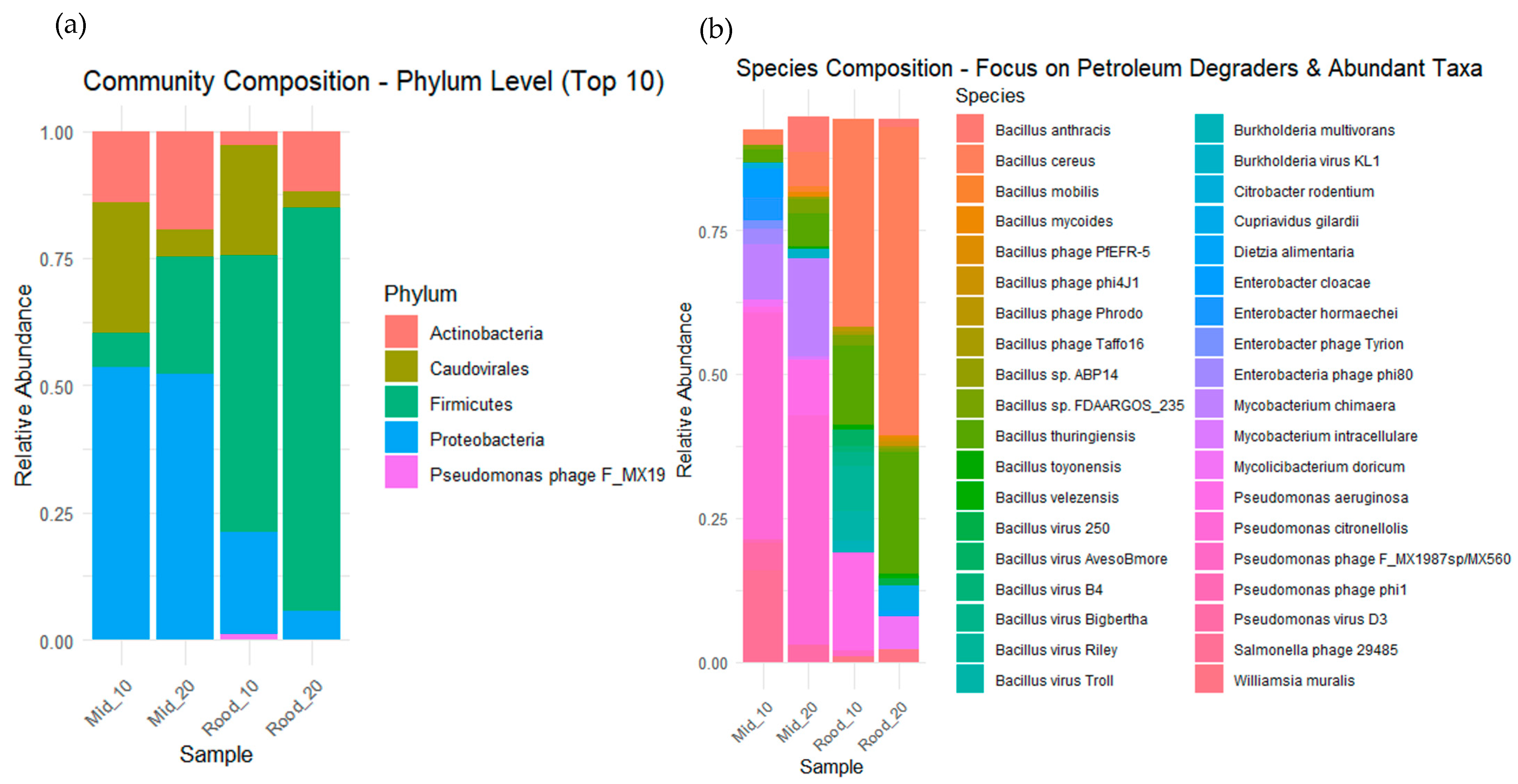


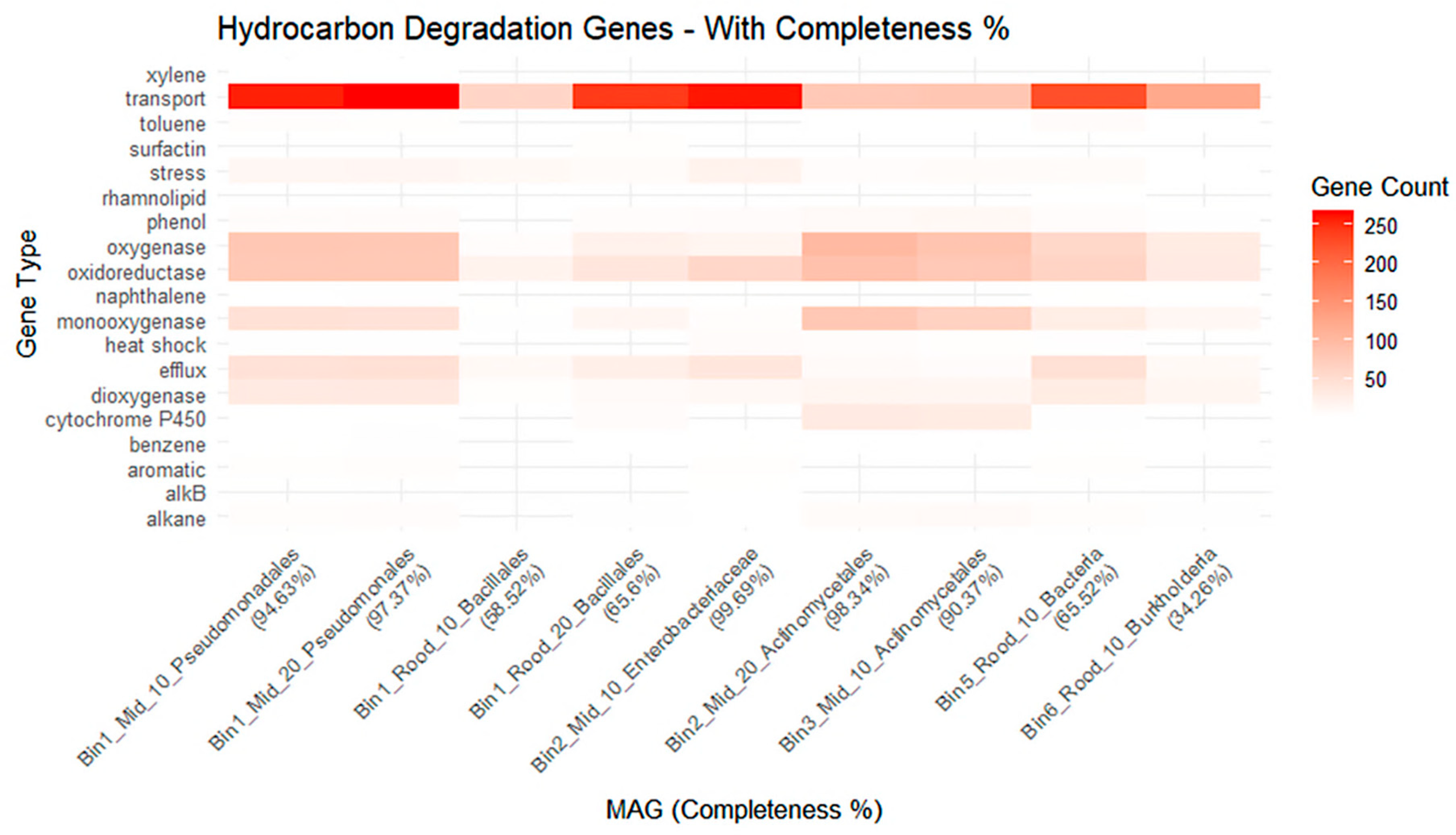



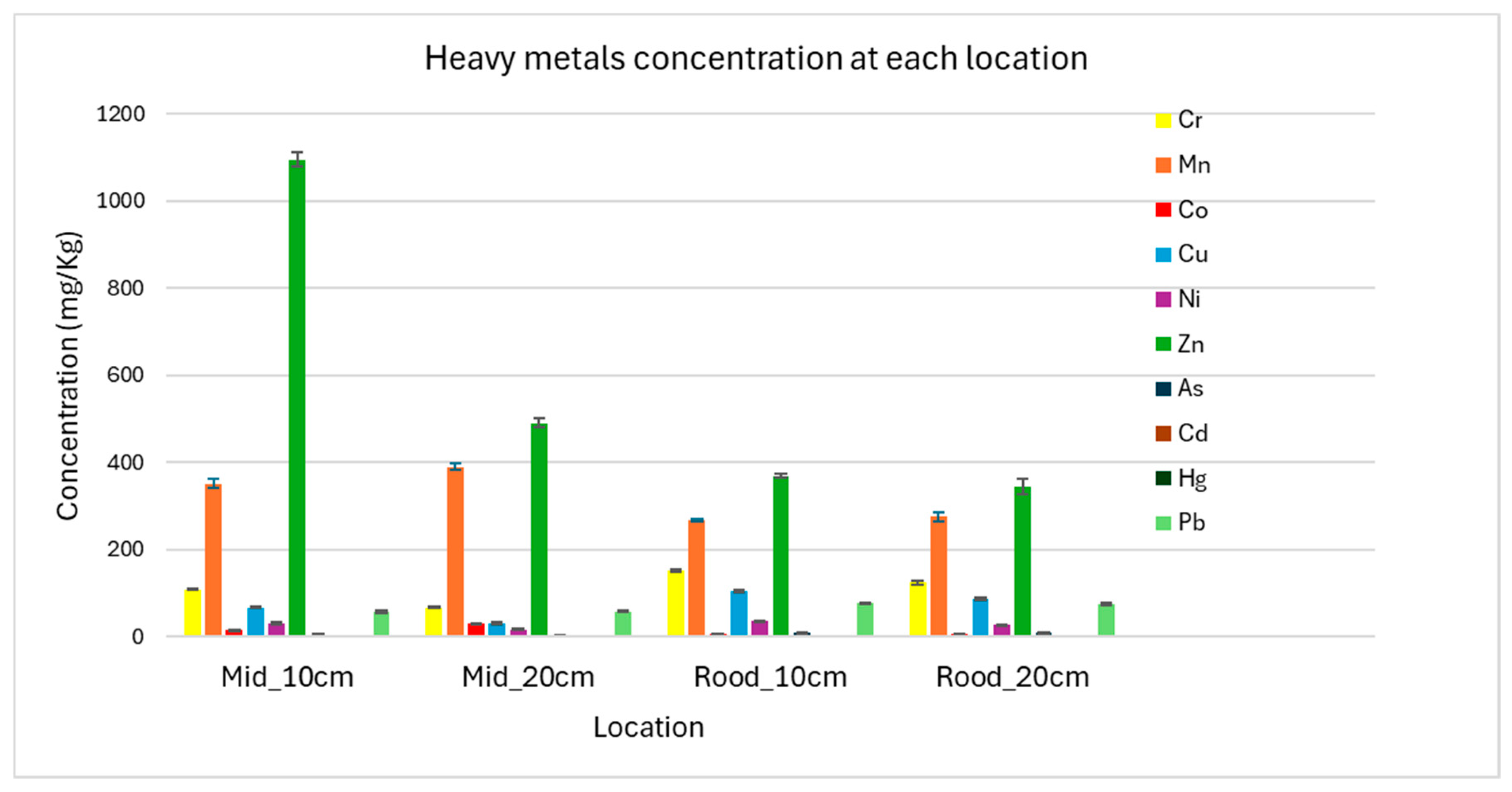
| Mid-10 cm | Mid-20 cm | Rood-10 cm | Rood-20 cm | ** WHO | * Sweden | * United Kingdom | |
| Cadmium (Cd) | 0.51 | 0.29 | 0.33 | 0.28 | 0.31 | 0.4 | 3 |
| Chromium (Cr) | 108.33 | 67.31 | 151.67 | 124.67 | 8 | 60 | 400 |
| Copper (Cu) | 67.43 | 30.74 | 104.77 | 86.31 | 0.5 | 40 | 135 |
| Nickel (Ni) | 30.39 | 16.39 | 34.9 | 27.61 | 20 | 30 | 75 |
| Lead (Pb) | 56.22 | 57.95 | 77.57 | 74.86 | 13.0 | 40 | 300 |
| Zinc | 1095 | 491 | 369 | 345 | 1.5 | _ | _ |
Disclaimer/Publisher’s Note: The statements, opinions and data contained in all publications are solely those of the individual author(s) and contributor(s) and not of MDPI and/or the editor(s). MDPI and/or the editor(s) disclaim responsibility for any injury to people or property resulting from any ideas, methods, instructions or products referred to in the content. |
© 2026 by the authors. Licensee MDPI, Basel, Switzerland. This article is an open access article distributed under the terms and conditions of the Creative Commons Attribution (CC BY) license.
Share and Cite
Mokoena, M.I.; Nkuna, R.; Matambo, T.S. Genome-Resolved Metagenomics Suggests Site-Specific Microbial Adaptations in Urban Soils Co-Contaminated with Hydrocarbons and Heavy Metals. Environments 2026, 13, 125. https://doi.org/10.3390/environments13030125
Mokoena MI, Nkuna R, Matambo TS. Genome-Resolved Metagenomics Suggests Site-Specific Microbial Adaptations in Urban Soils Co-Contaminated with Hydrocarbons and Heavy Metals. Environments. 2026; 13(3):125. https://doi.org/10.3390/environments13030125
Chicago/Turabian StyleMokoena, Morena India, Rosina Nkuna, and Tonderayi Sylvester Matambo. 2026. "Genome-Resolved Metagenomics Suggests Site-Specific Microbial Adaptations in Urban Soils Co-Contaminated with Hydrocarbons and Heavy Metals" Environments 13, no. 3: 125. https://doi.org/10.3390/environments13030125
APA StyleMokoena, M. I., Nkuna, R., & Matambo, T. S. (2026). Genome-Resolved Metagenomics Suggests Site-Specific Microbial Adaptations in Urban Soils Co-Contaminated with Hydrocarbons and Heavy Metals. Environments, 13(3), 125. https://doi.org/10.3390/environments13030125