
Next Article in Journal
Turning Waste into Treatment: Sugarcane Bagasse Biochar for Sustainable Removal of Pharmaceuticals and Illicit Drugs from Wastewater
Next Article in Special Issue
Modification of the Polyphenolic Profile and Enhancement of Antioxidant Activity of Waste Orange Peel Extracts Using Alkali-Catalyzed Ethanol Organosolv Treatment
Previous Article in Journal
Histological Evidence of Thyroid Disruption in Wild Mice from Conventional and Organic Farming Environments
 
 
Due to scheduled maintenance work on our servers, there may be short service disruptions on this website between 11:00 and 12:00 CEST on March 28th.
Article

Microbiological and Chemical Insights into Plasma-Assisted Disinfection of Liquid Digestate from Wastewater Treatment Plant “Kubratovo”


1
Faculty of Biology, Sofia University “St. Kliment Ohridski”, 8 Dragan Tzankov Blvd., 1164 Sofia, Bulgaria
2
Center of Competence “Clean Technologies for Sustainable Environment—Water, Waste, Energy for Circular Economy”, 1a James Bourchier Blvd., 1164 Sofia, Bulgaria
3
“Sofiyska Voda” JSC, 1000 Sofia, Bulgaria
4
Faculty of Forest Industry, University of Forestry, 10 Kliment Ohridsky Blvd., 1756 Sofia, Bulgaria
*
Author to whom correspondence should be addressed.
Environments 2026, 13(2), 67; https://doi.org/10.3390/environments13020067
Submission received: 11 December 2025 / Revised: 20 January 2026 / Accepted: 20 January 2026 / Published: 24 January 2026

Abstract

Liquid digestate, a by-product of excess sludge in wastewater treatment plants (WWTPs), contains high concentrations of organic matter and essential nutrients that could promote plant growth. However, it also contains a significant number of pathogenic and opportunistic pathogenic microorganisms, which present major challenges in terms of its safe application. A sample taken from WWTP “Kubratovo” was treated using plasma devices. The aim was to evaluate the effect of treatment by two types of plasma sources on the content of pathogenic bacteria as well as the chemical composition of the liquid digestate. The Surfaguide plasma source demonstrated a higher disinfection effectiveness (100% for E. coli, Clostridium sp.; over 99% for fecal and total coliforms; 98% for Salmonella sp.). The β-device effectively removed (100%) the following groups: E. coli and Clostridium sp. However, its effectiveness was significantly lower for the other groups. The obtained results show that plasma treatment induces the transformation of nitrogen and phosphorus compounds, resulting in increased nitrite and phosphate concentrations. The application of cold atmospheric plasma disinfection significantly improved the sanitary and compositional characteristics of the liquid digestate. The Surfaguide achieved significantly better results than the β-device, confirming its suitability for sustainable resource recovery and safe agricultural use.

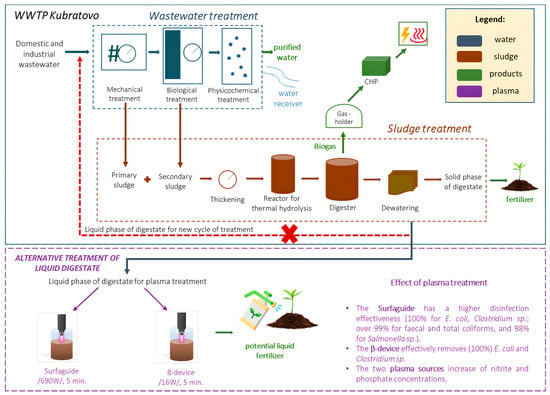
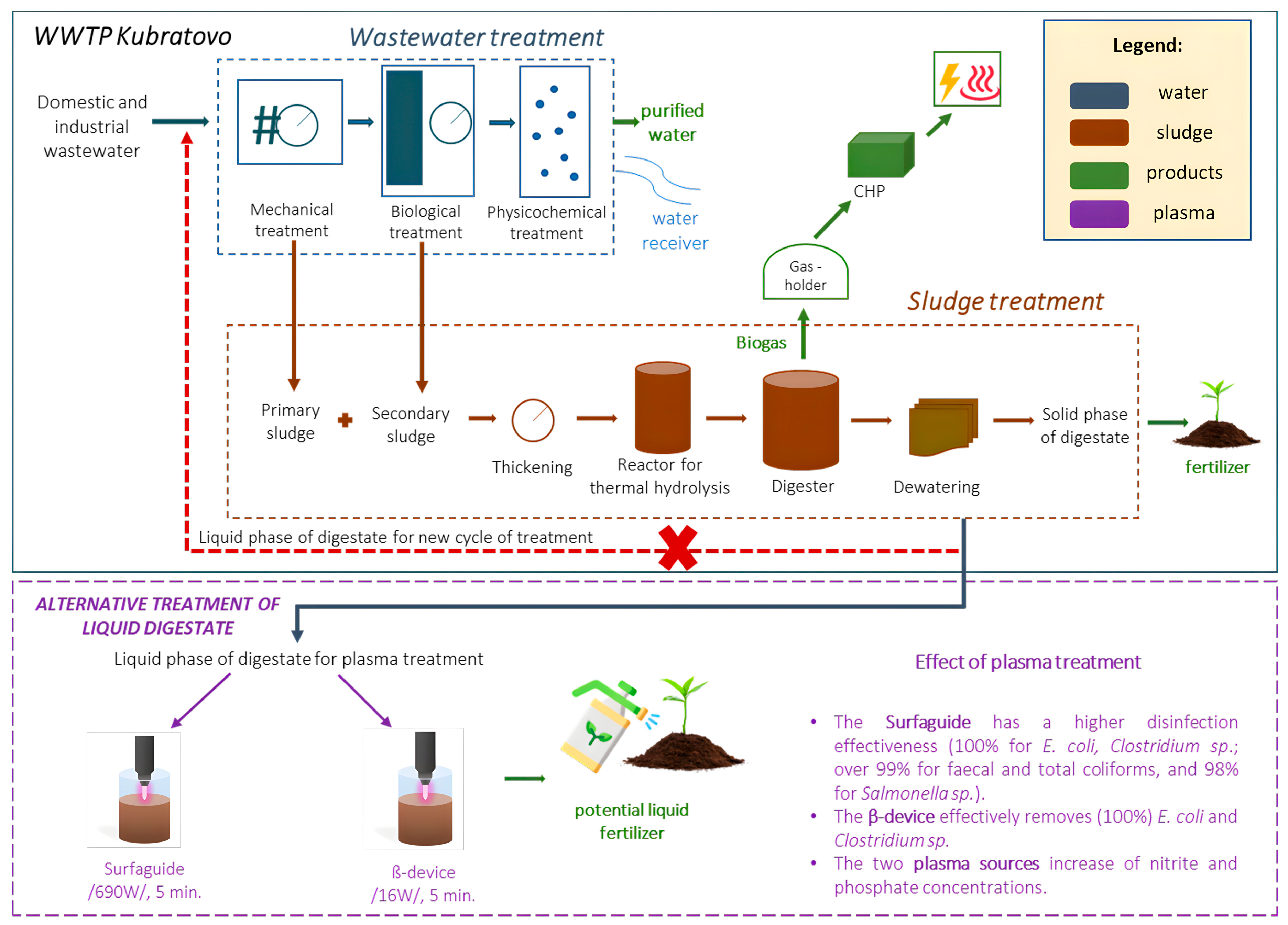
Graphical Abstract

1. Introduction

Circular solutions in wastewater treatment technologies focus on identifying key and critical challenges for which innovative approaches can lead to environmental, economic, and social benefits. These solutions aim to achieve complete neutralization and reutilization of treated wastewater, raw wastewater, and solid waste, including various types of primary and secondary sludge. In classical wastewater treatment technologies, the generated primary and secondary sludge is processed in anaerobic digesters to produce biogas, which is a valuable energy source. However, biogas technologies are not waste-free. Their residual product, the digestate, presents a significant challenge in terms of its integration into circular use. Digestate is separated into a solid and a liquid phase. The solid phase contains valuable mineral and organic substances and, after biological and chemical monitoring for pathogens and residual trace pollutants, can be used in agriculture as fertilizer [1].
A critical problem is the utilization of the liquid phase of the digestate. It is returned to the inlet of the wastewater treatment plants (WWTPs), where it further affects the treatment process by introducing a diverse range of microorganisms, including pathogens, and micro-pollutants with significant impacts on water treatment, such as pesticides, antibiotics, microplastics, perfluoroalkyl substances, polycyclic aromatic hydrocarbons, petroleum derivatives, steroid hormones, etc. [2]. Finding and applying innovative approaches for treating this liquid digestate is an important scientific task with potential applications for improving the technological processes of wastewater and sludge treatment, while generating new value-added products. It is known that liquid digestate contains organic matter and valuable nutrients, as well as complex microbial communities with a high relative share of pathogenic microorganisms. It is therefore relevant to consider the possibility of using the liquid phase of digestate as a liquid fertilizer to enhance soil fertility, but only after prior treatment to eliminate pathogenic microorganisms while, if possible, preserving beneficial microbial cultures that have a positive effect on soils.
Traditional treatment methods (physicochemical and biological) have limitations and do not always succeed in removing micro-pollutants or emerging contaminants. They often require chemical reagents and high-energy inputs, may produce secondary pollutants, and frequently fail to eliminate antibiotic-resistant microorganisms [2]. An important scientific direction is the search for and application of innovative methods for the destruction of pathogenic bacteria, ideally combined with a detoxification effect on residual micro-pollutants in liquid digestate.
Plasma treatment is a promising new method of inactivating pathogenic microorganisms while allowing the recovery of valuable nutrients such as phosphorus and nitrogen in the form of ammonium ions, nitrites, nitrates, etc. Using plasma treatment on by-products reduces the need for artificial fertilizers. Plasma is an ionized gas containing charged particles (electrons and ions), reactive chemical substances (neutral molecules, atoms, and radicals), and ultraviolet (UV) radiation. During plasma generation, radiation is observed in the UV, visible, and near-infrared regions [3].
Since Larousse [4] first documented plasma as a sterilization method in 1996, it has been used to treat various pathogenic and opportunistic pathogenic microorganisms, including Escherichia coli, Enterococcus faecalis, Pseudomonas sp., Staphylococcus aureus, and Streptococcus pyogenes [4]. These studies tested various gas discharge sources, including air, oxygen (O2), argon (Ar), nitrogen (N2), helium (He), and various gas mixtures, in order to alter the plasma chemistry and evaluate bacterial inactivation [5]. When plasma interacts with water or organic substances, it generates highly reactive species, such as hydroxyl radicals (strong oxidants), ozone (O3), nitrites, nitrates, high-energy electrons, and UV radiation. These reactive species oxidize complex organic compounds to CO2, thereby damaging the cell structures of living organisms. Among the various components of plasma, reactive oxygen and nitrogen species (RONS) are considered to be the main sterilization agents [6]. In addition to producing these reactive species, plasma sources can generate temperatures of up to several thousand Kelvin, thermally decompose compounds, emit UV and visible light, and generate shock waves capable of inducing cavitation [7].
Two types of plasma products remain in the treated water and spread in the aqueous phase. The first type is short-lived species (with lifetimes of fractions of a second), such as hydroxyl radicals (OH•), nitric oxide (NO•), superoxide (O2•−), peroxynitrate (O2NOO•), and peroxynitrite (ONOO•). These plasma-generated reactive chemical species transported in plasma-activated water (PAW) play a crucial role in its various biological applications [8]. The second type of residual species from plasma treatment is long-lived species (nitrites, nitrates, hydrogen peroxide), which remain in the treated water for months or even years and have a lasting influence on the processes occurring in it. The residual plasma forms in the water create PAW. PAW and RONS in the water have significant potential for application in environmental protection, including in the activation of water treatment processes as well as in the sanitation of water [9]. The complex of diverse species resulting from plasma treatment has a proven effect in reducing the overall toxicity of polluted water, as well as an effect in eliminating pathogenic microorganisms. In other words, two important outcomes are achieved simultaneously—detoxification and disinfection [10,11].
Using plasma-treated water in agriculture could offer dual benefits: purifying the water and potentially supporting crop growth. Methods of integrating plasma-treated water into agriculture include fertigation, which combines irrigation and fertilization, and drip irrigation, which is the preferred method for supplying reused water [12]. Studies have shown that plasma-treated water can positively impact seed germination and plant growth [13]. Reactive species act on the surface of the seed coat. They are thought to cause microscopic changes or slight abrasion that increases the permeability of the seed coat to water and also affects the inactivation of pathogenic microorganisms on the surface of the seed [14].
Various plasma sources are used to treat and achieve highly effective disinfection and purification of wastewater—for example, glow discharge plasma (GDP) shows promising results [15]. The continuous recirculation of water through the plasma zone via recirculation significantly increases the concentration of active species, particularly nitrogen species, thereby enhancing the antibacterial effect. Studies have also investigated the use of low-temperature plasma (LTP), with a gas temperature from room temperature to a few hundred degrees Celsius, to produce PAW, which has a variety of applications in environmental technologies [16]. A representative of this group of sources is the Surfaguide device used in this study. Cold atmospheric plasma (CAP) is frequently employed in research projects involving biological systems or living organisms via devices such as the argon plasma jet, β-device, and others in which gas temperature does not exceed 45 °C.
Table 1 shows the effectiveness of cold atmospheric plasma in disinfecting various Gram-positive and Gram-negative microorganisms. The disinfection effectiveness of plasma treatment with CAP for 120 s was found to be 100% for E. coli NCTC 12900, Salmonella enterica typhimurium ATCC 14028, and Listeria monocytogenes NCTC 1199 [17]. Disinfection effectiveness decreased with decreasing treatment time in a study conducted on E. coli and Bacillus subtilis [18]. B. subtilis showed lower resistance than E. coli, with a resistance coefficient of 2.2 s for B. subtilis and 5.5 s for E. coli. In a study on E. coli M17, it was found that, after treatment for 60 s, clearly pronounced zones of inactivation could be observed, though partial recovery of growth occurred after a one-hour incubation period [19]. Comparing B. subtilis samples before and after treatment revealed that the cells had decreased in size and undergone structural changes, though they generally retained their cellular morphology [18]. This indicates that the species exhibits significant resistance to a 20 W power output at an exposure distance of 1.5 cm for 10 s, suggesting that longer or more intensive treatment is necessary for complete inactivation. Experiments with Ps. aeruginosa and St. aureus found that the latter was less resistant than Ps. aeruginosa at a frequency of 13.56 MHz [20].
The results for Ps. aeruginosa at the same frequency of 13.56 MHz show a logarithmic reduction in cell number by 4.2 units for 90 s treatment. The effectiveness is highest in the discharge zone, while outside the zone it decreases significantly, indicating a dependence on the exposure distance. In the treatment of endospores from Bacillus atrophaeus ATCC 9372, a disinfection effectiveness of up to 99.8% was reported after 60 s at a power output of 2–130 W [21]. Studies on E. coli, St. aureus, and Candida albicans observed a significant reduction in cell population within the first 30 s [22]. The reduction was 96.7% for E. coli, 92.8% for S. aureus, and 95.5% for C. albicans, demonstrating extremely effective inactivation achieved in a short treatment time. When treated with a cold plasma torch generated in argon, the achieved elimination of the bacterial strains Pseudomonas aureofaciens AP-9 and Brevibacillus laterosporus BT-271 was 99%, again in very short times (less than 1 min) and with low microwave power [11].
The studies on plasma disinfection discussed above were conducted on juices and on microbiological media, while in the present study, samples were taken from the liquid phase of digestate obtained after mesophilic treatment of excess sludge from a real wastewater treatment plant. The aim was to evaluate the effect of treatment by two types of plasma sources (β-device and Surfaguide) on the content of pathogenic bacteria as well as on the chemical composition of the liquid digestate from WWTP “Kubratovo”.

2. Materials and Methods

2.1. Experimental Design

The samples used in the study were kindly provided by WWTP “Kubratovo”, which treats municipal and industrial wastewater in Sofia City, Bulgaria. A mixed sample was taken from five full-scale digesters treating primary and secondary excess sludge generated by the wastewater purification in the plant. The products of this anaerobic stabilization are as follows: (i) biogas, used for co-generation for the facility’s energy needs; (ii) solid digestate, used as a solid fertilizer in agriculture after mechanical dewatering and air-drying; (iii) liquid digestate, produced as a by-product. This third product is a type of wastewater containing high concentrations of organic matter and nutrients, as well as potentially harmful bacteria. At the treatment plant, it is returned to the inlet to begin a new treatment cycle. In our study, we treat it with plasma to determine if it can be processed and used as a target product at the plant in the future. The β-device and Surfaguide plasma sources were used as potential disinfection devices to eliminate any microorganisms in the liquid digestate.
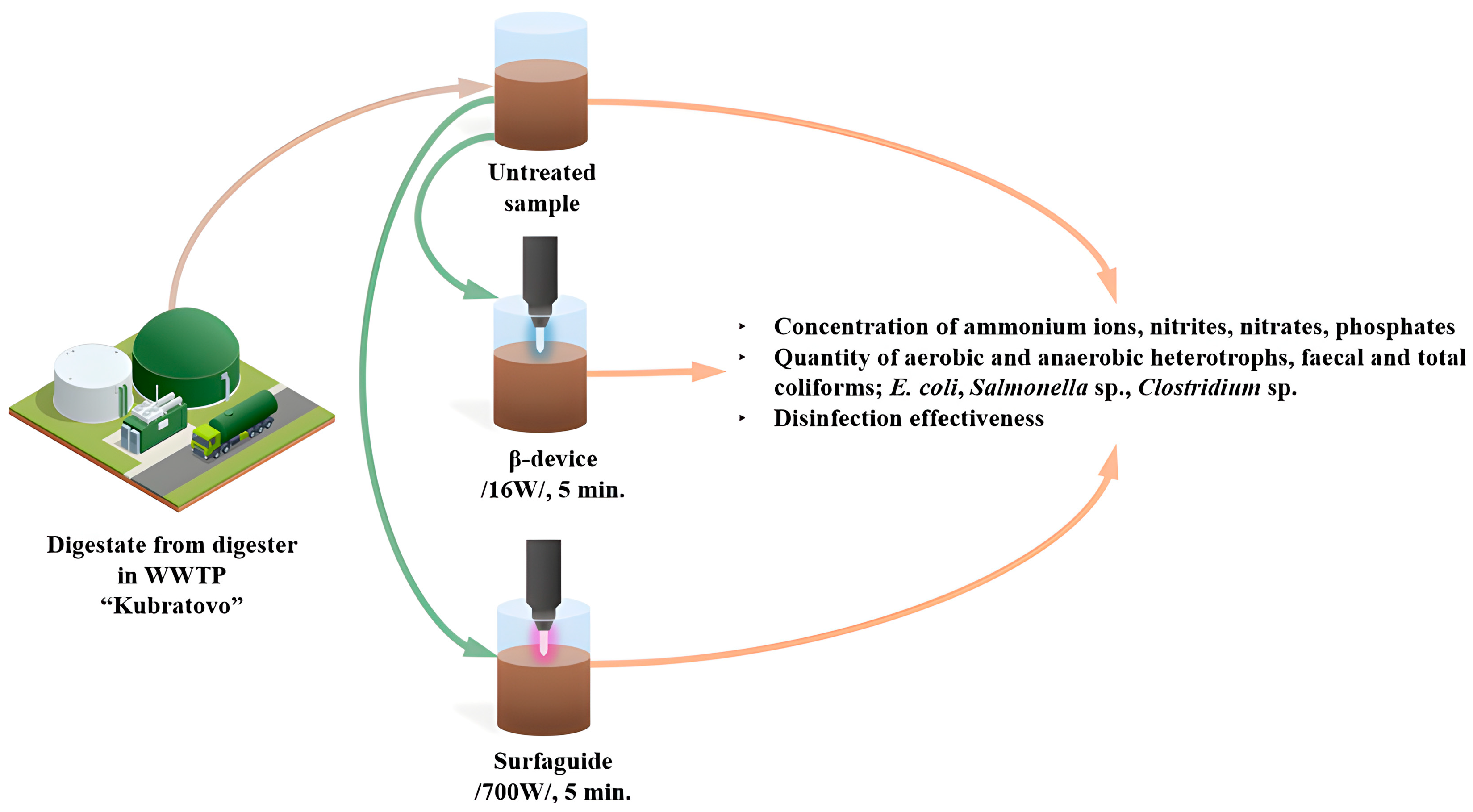
Figure 1 shows the experimental design of the study. The sample from WWTP “Kubratovo” was further filtered through a blue band filter. Then, the sample was surface-treated with plasma sources for 5 min. Key chemical (concentration of ammonium ions, nitrites, nitrates and phosphates) and microbiological (amount of aerobic and anaerobic heterotrophs, total and fecal coliforms, E. coli, Salmonella sp., Clostridium sp.) indicators were examined in the samples before (control) and after plasma treatment.

2.2. Plasma Devices and Treatment Modes

2.2.1. β-Device

The β-device was designed and manufactured in the lab by 3D printing technology from PLA material. The antenna in the applicator is connected by a coaxial cable to the solid-state microwave generator (SAIREM, Décines-Charpieu, France), operating at 2.45 GHz. The working gas is high-purity argon (99.999%), with the gas flow rate set to 5 L/min in these experiments. The plasma torch was produced outside the open end of the resonator and, depending on the microwave power (fixed to 16 W in these experiments), can have a length of about 5–10 mm. The plasma torch corresponds to the active plasma region (not afterglow) with short- and long-living active particles, electrons, ions, and UV radiation, but with low plasma temperature below 45 °C. The liquid samples in these experiments were treated in surface mode when the plasma torch was in contact with the surface of the liquid.

2.2.2. Surfaguide

The Surfaguide (SAIREM, Décines-Charpieu, France) is a resonant structure allowing operation at much higher microwave power [26]. It was connected to a magnetron microwave generator (2.45 GHz, 3 kW, also from SAIREM, France). The plasma is produced in a quartz tube (outer diameter 8 mm and an inner diameter 4 mm) by an electromagnetic wave travelling along the plasma–dielectric interface (surface-wave discharge, SWD). At the end of the tube the wave continues its propagation along the plasma–air boundary, forming a plasma torch with a length of 10–15 mm in the open space at microwave power of ~700 W (reflected power is controlled to remain below 10 W). The working gas is argon (99.999%), with a gas flow rate of 5 L/min. Under these discharge conditions the plasma temperature (the temperature of the heavy particles) is higher than 45 °C, and the thermal component plays important role in addition to the active particles and UV radiation. The treatment of the liquid samples was also in surface mode as the plasma torch was in direct contact with the surface of the liquid.
The treatment conditions (mode, microwave power, and treatment time) were selected based on a summary of the literature data in Table 1 and our previous studies [11,13,27,28]. The treatment time of 5 min was chosen, based on previous studies, and the aim was to achieve an optimal balance between treatment time and energy input in order to maximize efficiency [11]. The treated volume was 60 mL. The additional investigation of the active particle production and pH after treatment of deionized water with these two plasma sources shows higher concentrations of H2O2, NO2, and NO3 and a lower pH for the Surfaguide (Table 2).

2.3. Microbiological Indicators and Research Methods

Pre-prepared culture media were used to investigate microbial groups in accordance with the manufacturers’ instructions (Table 3). All groups of microorganisms were examined using standard cultivation methods on the culture media under the cultivation conditions shown in Table 3. To differentiate between representatives of the family Enterobacteriaceae and other Gram-negative bacteria with a non-fermentative metabolism (e.g., Pseudomonas sp., Acinetobacter sp., Aeromonas sp., Neisseria sp.), we performed a cytochrome oxidase test on the Endo medium. The oxidase reagent N,N-dimethyl-p-phenylenediamine-2-HCl was applied directly to the colonies on the Petri dish. Colonies that gave a positive reaction (i.e., Gram-negative bacteria with a non-fermentative metabolism) turned blue, whereas colonies showing a negative reaction (i.e., members of the family Enterobacteriaceae) did not change colour. To identify E. coli among other coliform bacteria grown on Chromogenic Coliform agar, Kovács reagent was used. The reagent was applied to the dark blue-to-violet colonies that had formed. The formation of a cherry-red colour indicated the production of indole and confirmed the presence of E. coli.
The microbial communities in the liquid digestate were examined before and after plasma treatment using the r- and K-distribution of microorganisms according to their growth rates. The cultivation method described by De Leij [29] was used. The method was applied to groups of both aerobic and anaerobic heterotrophs. Microorganisms that formed visible colonies on Nutrient agar within 24 h at 28 ± 2 °C for aerobic heterotrophs and within 48 h for anaerobic heterotrophs were defined as fast-growing (r-strategists). K-strategists, which grow more slowly, formed the majority of visible colonies on Nutrient agar at 28 ± 2 °C, after 24 h for aerobic microorganisms and after 48 h for anaerobic microorganisms. The number of colonies appearing on a given day was expressed as a percentage of the total colony count. For enumeration, Petri dishes containing between 30 and 300 colonies were used.

2.4. Calculation of Disinfection Effectiveness

The disinfection effectiveness of plasma sources was calculated using the following formula:
E f f = C t 1 C t 2 C t 1 100
where Ct1 is the number of microorganisms before plasma treatment (control) and Ct2 is the number of microorganisms after plasma treatment.

2.5. Chemical Indicators and Analysis Methods

The concentrations of ammonium ions, nitrites, nitrates, and phosphates were examined before and after plasma treatment using spectrophotometric methods in accordance with the Bulgarian National Standard and ISO standards [30,31,32,33].

3. Results and Discussion

The analyzed indicators provide insight into the chemical and microbiological state of the liquid phase of the digestate sample, as well as its potential for application as an alternative to synthetic fertilizers. The liquid phase of the digestate contains microorganisms that were once part of the activated sludge communities in wastewater treatment plants but are now excess biomass. The activated sludge community has adapted to stressful environmental conditions, which is why it is important to monitor the effect of plasma on such biological systems. The microorganisms within the activated sludge complex are exposed to numerous xenobiotic substances and have developed alternative pathways to neutralize these various xenobiotics that damage cell components. It is likely that such adapted microorganisms have a more flexible and highly reactive metabolism, making them more resistant to other stress factors.

3.1. Disinfection Effectiveness and Microbiological Indicators

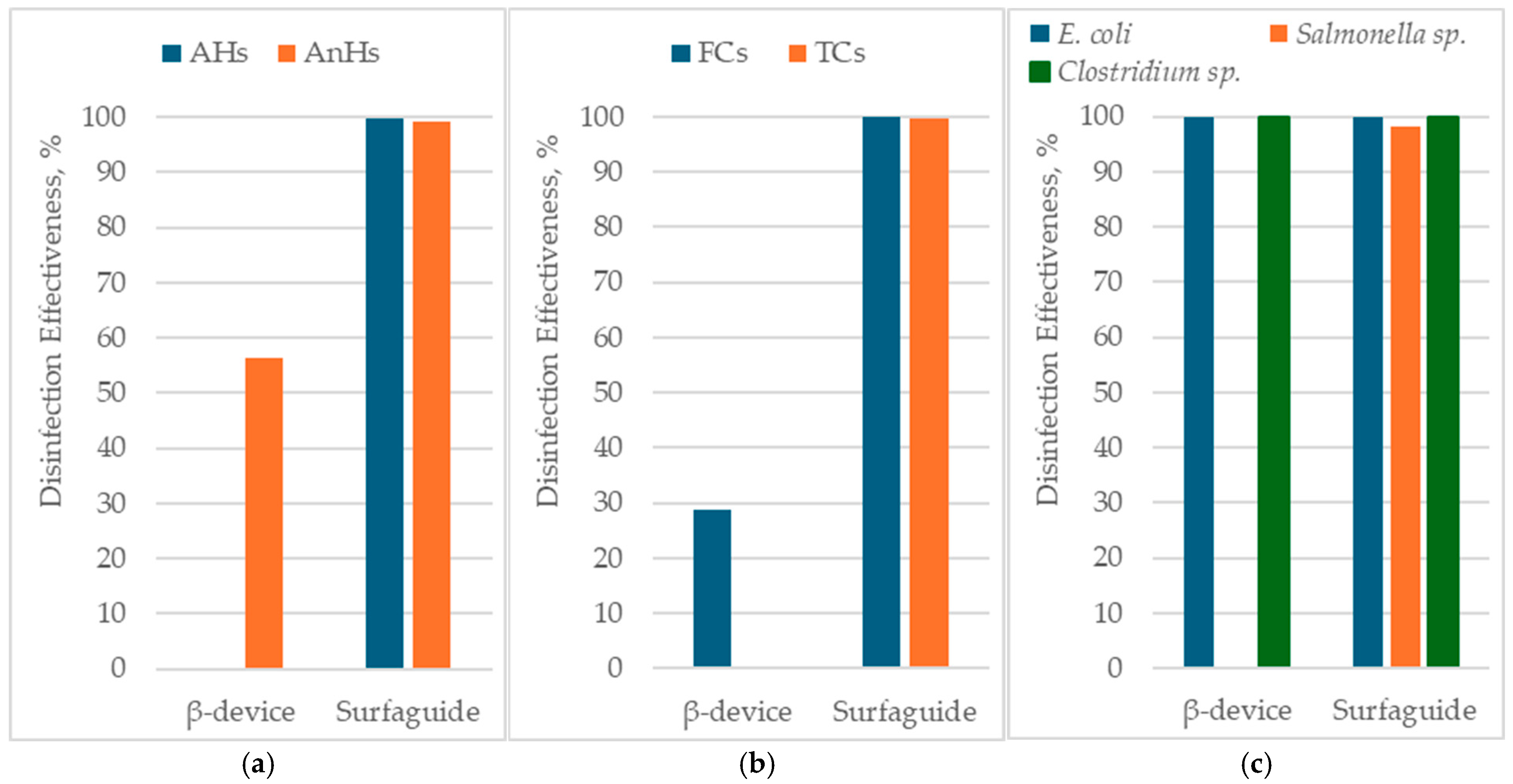
Examining the disinfection effectiveness of plasma (Figure 2) revealed a significantly higher effect of the Surfaguide compared to the β-device. It is assumed that these results are mainly due to the different temperatures of the treated water reached by the two plasma sources: respectively, 20 °C for the β-device and 60 °C for the Surfaguide. Moreover, due to the higher power of Surfaguide operation, the concentration of the produced RONS is higher than those produced by the β-device [27], and, consequently, the disinfection effectiveness of the Surfaguide is higher. This is also confirmed by the characteristics of the two studied plasma sources, presented in Table 2. The concentration of hydrogen peroxide is about 3 times higher, and that of nitrites and nitrates is about 2 times higher in deionized water treated with the Surfaguide compared to that treated with the β-device. In addition, produced RONS negatively affect living organisms by damaging cell structures via various mechanisms, such as the destruction of the cell walls, damage to the DNA structure, the inhibition of vital enzymes, a decrease in redox potential, inhibition of metabolism, etc. [6]. Hydrogen peroxide, on the other hand, is used as a disinfectant. It is also a strong oxidizer, capable of converting into water and oxygen, affecting the concentration of reactive oxygen species (ROS).
Figure 2a shows that the anaerobic heterotrophs (AnHs) are eliminated more effectively than the aerobic heterotrophs (AHs), for both plasma sources. This may be due to the oxidizing effect of the plasma resulting from the release of nitrites, nitrates, hydroxyl radicals, ozone, hydrogen peroxide, etc. Anaerobic microorganisms are more sensitive to the action of oxygen and other oxidizing agents due to changes in redox potential and the destruction of their cell structures under the influence of ROS. An increased redox potential inhibits the metabolism of strict anaerobes, resulting in a decrease in the growth rate or its complete inhibition. In contrast, facultative anaerobes are more adaptable due to their ability to switch metabolic pathways from anaerobic to aerobic, and vice versa, depending on the redox potential. The β-device showed lower disinfection effectiveness against the groups of aerobic and anaerobic heterotrophs, as well as total and fecal coliforms (Figure 2a,b). However, it eliminated E. coli and Clostridium sp. with a similar percentage of effectiveness (Figure 2c).
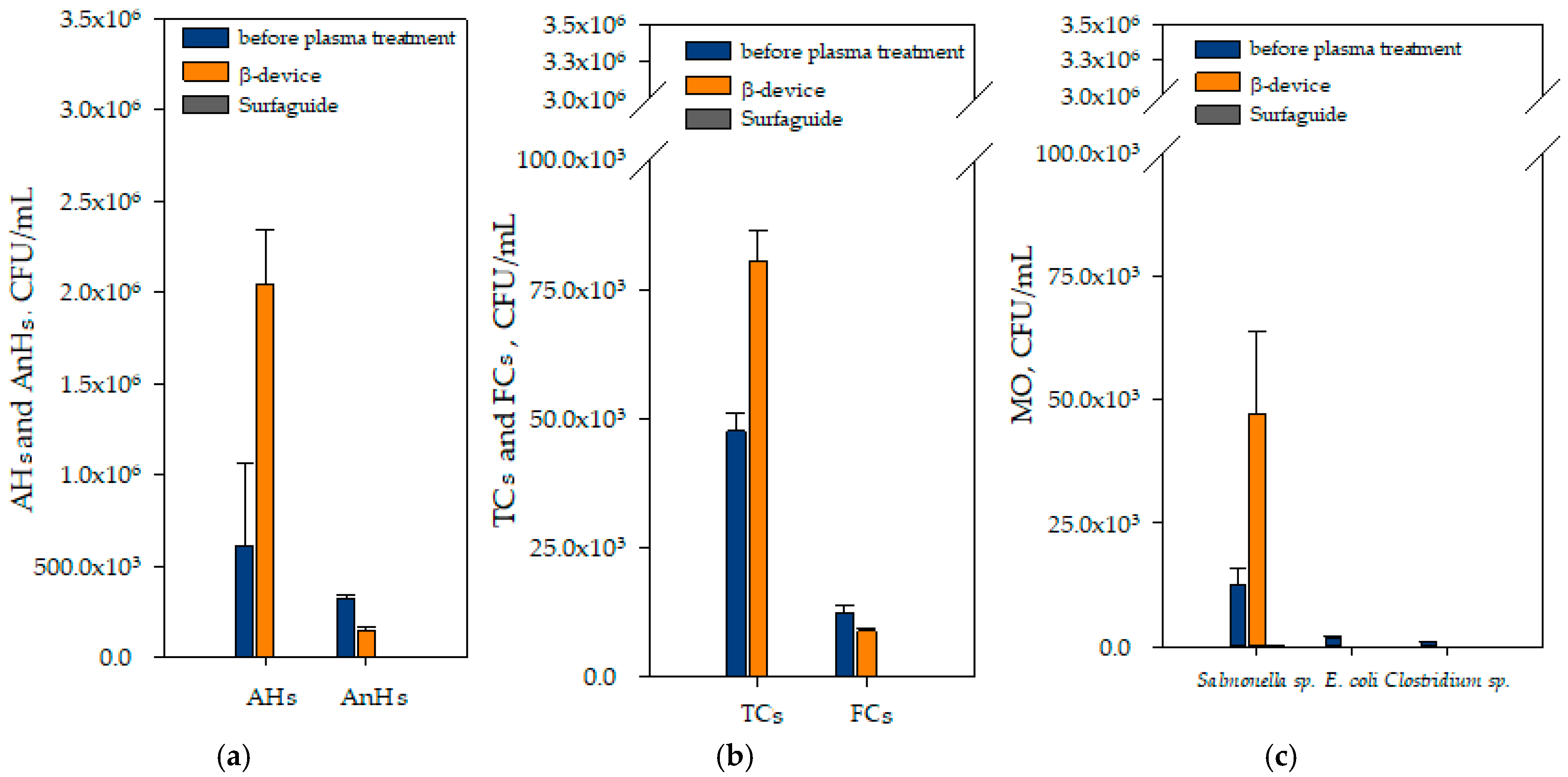
Figure 3 shows the number of microorganisms in the three studied water variants. Compared to the Surfaguide, the lower disinfection effectiveness of the β-device is again evident, especially when considering the AHs group (Figure 3a). It is possible that the reactive species produced by this type of plasma are present at lower concentrations, which explains why there is no such negative effect of the β-device on this group compared to the Surfaguide. Notably, compared to the control, the number of aerobic heterotrophs, total coliforms, and Salmonella sp. increases after treatment with the β-device. This shows that the produced reactive forms have a positive, stimulating effect on their growth. On the one hand, reactive forms in low concentrations do not have an inhibitory effect that can lead to the destruction of cell structures or the inhibition of enzyme systems. On the other hand, the oxidized forms stimulate the growth of aerobic and facultative anaerobic microorganisms, which utilize them in oxidation–reduction processes, thereby stimulating aerobic metabolism, associated with the processes of oxidative phosphorylation, nitrification, and so on. The increased concentrations of nitrogen and phosphorous in the absence of inhibitory conditions, positively affect the growth of microorganisms since these nutrients are fundamental components in the synthesis of biomass.
Although Gram-negative bacteria should be more sensitive to plasma due to their thinner cell walls (e.g., E. coli and Salmonella sp.), and Gram-positive bacteria should be more resistant to the effects of plasma (e.g., Clostridium sp.), some of the latter are spore-forming, and representatives of both groups are strongly negatively affected by plasma treatment (Figure 3c), especially after treatment with the Surfaguide. Similar results have been reported in other studies [34].

3.2. Tracking the Dynamics of the Groups of r/K-Strategists Before and After Plasma Treatment

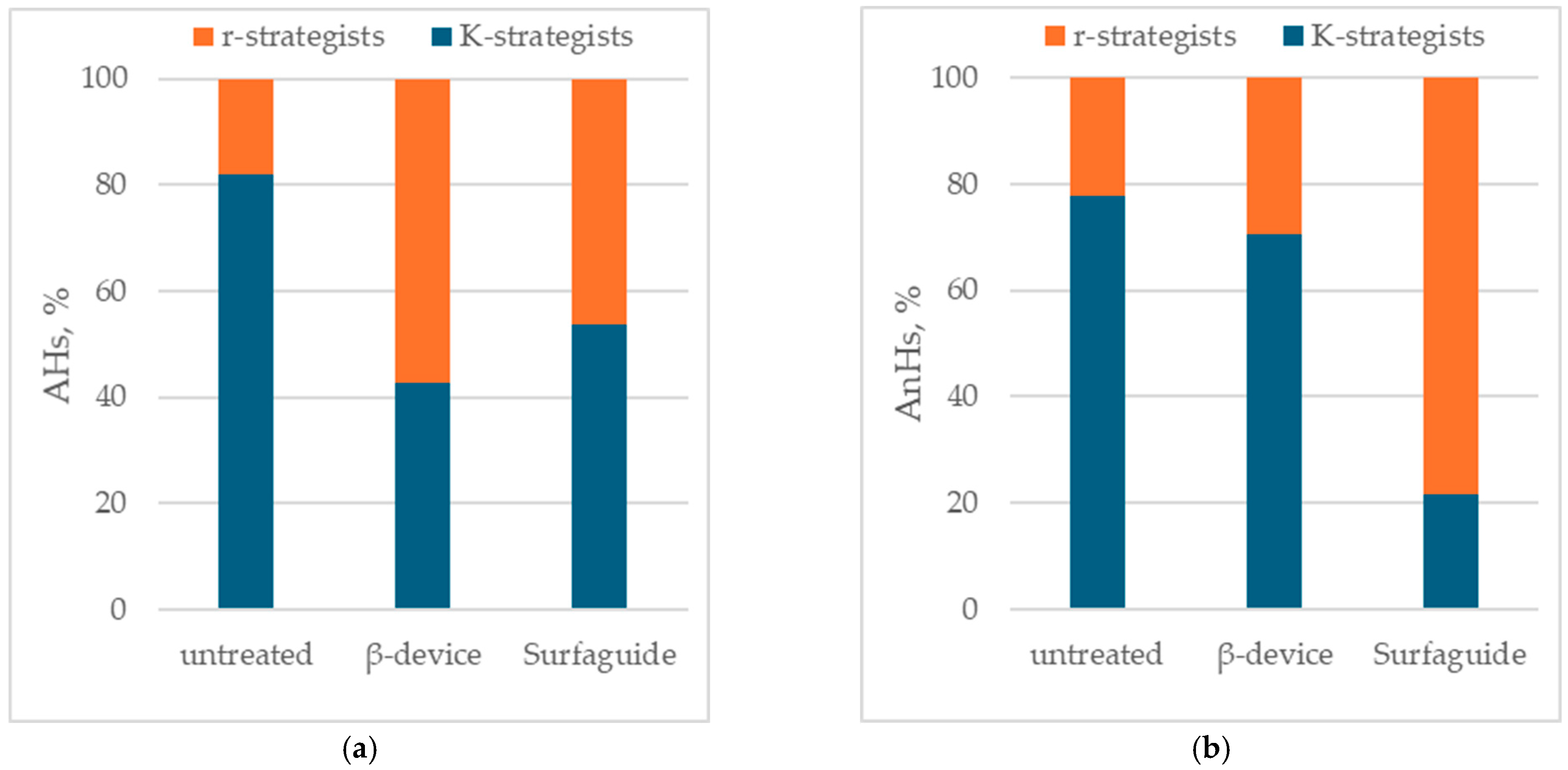
The change in the microbial community was studied using the ecological theory of r/K-strategists. The AHs and AnHs physiological groups were studied before and after plasma treatment (Figure 4). K-strategists dominated the control for both physiological groups (82% for AHs and 78% for AnHs). Following plasma treatment, the proportion of slow-growing (K-strategists) aerobic heterotrophs decreased, with this trend being more pronounced for the β-device variant (43%). In the Surfaguide variant, although the proportion of fast-growing aerobic heterotrophs increased, the community was still dominated by K-strategists, which occupied 54% of the total number of AHs. The increased proportion of fast-growing microorganisms from the AHs group indicates that the reactive particles released during plasma treatment induced chemical transformations of organic matter and nutrients. This created an environment with accessible substrates that supported the growth of microorganisms. The β-device variant shows environmental conditions that are more favourable, and the AHs community is dominated by r-strategists (57%). These more conducive conditions, as mentioned above, are associated with a higher redox potential, higher concentrations of nitrogen and phosphorus, and simpler organic compounds after the initial chemical transformations.
In the group of anaerobic heterotrophs, it is observed that the community is dominated by slow-growing, environmentally stress-resistant species in both the control variant (78%) and in the variant after treatment with the β-device (70%) (Figure 4b). Following treatment with the Surfaguide, the slow-growing anaerobic heterotrophs were replaced by fast-growing microorganisms, whose share reaches 78%. It is presumed that more concentrated reactive particles are released during Surfaguide plasma treatment, and that the higher temperature during treatment accelerates chemical oxidation processes. Some of these processes are also associated with the hydrolysis of polymers and an increase in the concentration of monomers (amino acids, glucose, fatty acids and glycerol), which are quickly absorbed by fermenting microorganisms. Thus, after treatment with the Surfaguide in a sparsely populated environment, facultative anaerobic microorganisms with a fermentative metabolism begin to dominate due to the high availability and accessibility of organic matter and nutrients.
This effect of plasma treatment on the liquid digestate must be emphasized. The observed shift towards a higher proportion of r-strategists, coupled with a reduction in overall toxicity, further enhances the functional value of the liquid fertilizer. Plasma treatment introduces microbial communities into the soil with increased biodegradation potential, while simultaneously supplying nutrients in a form associated with lower toxicity. Moreover, the residual plasma-generated species remaining in the treated liquid can stimulate additional detoxification processes within the soil environment. Taken together, these effects suggest that plasma-treated digestate could serve as both a nutrient source and a biologically active amendment, capable of promoting accelerated biodegradation and improved soil health [10,11].

3.3. Chemical Indicators

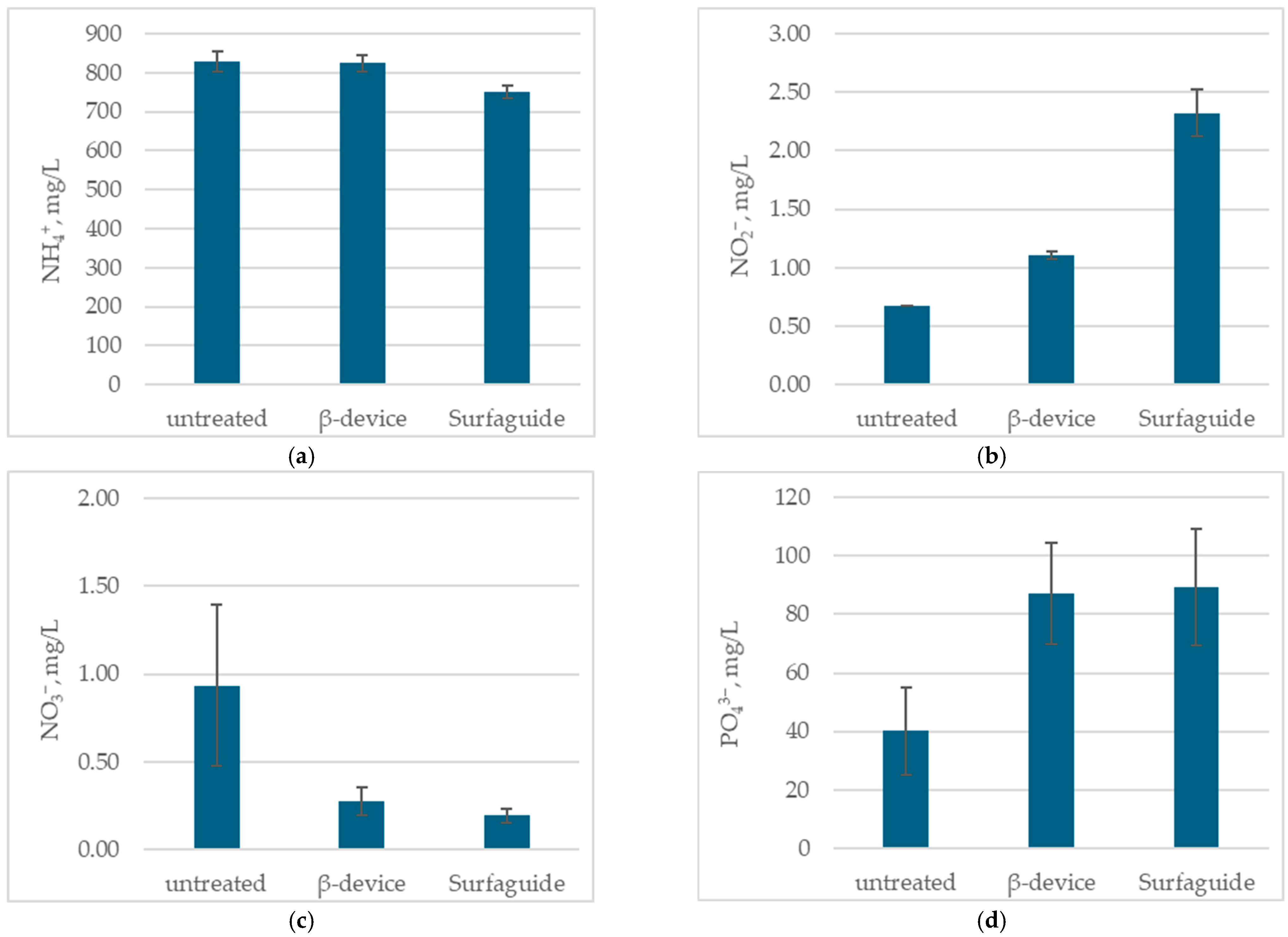
The obtained results show that plasma treatment significantly affects the concentration of the most common forms of nitrogen and phosphorus in the liquid phase of the digestate (Figure 5).
The concentration of ammonium ions (Figure 5a) remains almost unchanged after treatment with the β-device, whereas a slight decrease is observed after treatment with the Surfaguide. As can be seen from Figure 5a,b, the Surfaguide is more effective in the oxidation of ammonium ions to nitrites. This difference can be explained by the higher power of the Surfaguide plasma source, which leads to a higher production of RONS and, accordingly, to a higher concentration of nitrites [35].
The nitrite concentration increases with both plasma sources, rising from 0.67 mg/L in the untreated sample to 1.10 mg/L after treatment with the β-device and reaching up to 2.32 mg/L after treatment with Surfaguide plasma. A review of previous studies shows that plasma processes often lead to the accumulation of nitrites as intermediate products of the oxidation of ammonium ions [36]. Unlike complete nitrification, which is carried out by various genera of bacteria and results in the production of nitrate as the final product, the conditions here do not allow for complete oxidation. Various factors, such as reducing surface action, a local low redox potential, and the availability of electrons/radicals, can reduce nitrates back to nitrites [37].
However, the nitrate concentration decreases after treatment, falling from 0.94 mg/L in the untreated sample to 0.28 mg/L after treatment with the β-device and 0.19 mg/L after treatment with the Surfaguide. This suggests that the plasma treatment involves reduction processes that convert nitrate back into nitrite or other nitrogen species. Similar mechanisms involving competitive redox reactions have been reported in other atmospheric plasma systems [38].
The most significant change was observed in the phosphate concentration, which doubled from 40.1 mg/L in the untreated sample to approximately 86.94 mg/L after treatment with the β-device and 89.23 mg/L after treatment with the Surfaguide. This increase is due to the mineralization of organically bound phosphorus from cellular structures (phospholipids, nucleotides, etc.) and the degradation of other complex compounds under the action of strong oxidizing agents and UV radiation generated by the plasma [39]. Similar observations have been reported in the plasma transformation of organophosphorus pollutants, where inorganic phosphates are released [40].
The results indicate that plasma treatment exerts a substantial influence on the microbiological and chemical properties of the liquid phase of the digestate. The observed differences in performance between the two plasma sources, the β-device and the Surfaguide, are due to variations in their treatment parameters and in the concentrations of the reactive oxygen and nitrogen species they generate. The Surfaguide demonstrates significantly higher disinfection effectiveness across all examined physiological and taxonomic groups of microorganisms. Chemical analyses confirm that plasma exposure induces transformations among the various forms of nutrients. These transformations highlight the potential to enhance both the type and availability of nutrients in the liquid digestate, thus rendering it a promising alternative to synthetic fertilizers.
The energy efficiencies of these plasma sources in the current experiments are 24 kJ/L for the β-device and 1000 kJ/L for the Surfaguide. Since the plasma parameters and the energy efficiency do not linearly increase with upscaling of the plasma systems, further investigations are needed in this direction.
The application of plasma-based treatment to liquid digestate facilitates its conversion into a high-value liquid biofertilizer, an effective alternative to synthetic fertilizers, characterized by multifaceted benefits for soil fertility and plant development. These benefits include enhanced soil moisture retention, improved nutrient supply, and the introduction of activated microbial communities. Among these activated microorganisms, r-strategists predominate, thereby accelerating key soil transformation processes.
Simultaneously, the liquid digestate may exhibit reduced combined toxicity, resulting from residual pesticides and other xenobiotics that have passed through aerobic and anaerobic degradation stages, yet remain only partially decomposed. The long-lived plasma-generated species retained within the liquid fertilizer preserve their ability to stimulate soil transformation and detoxification pathways through the physical modulation of the soil’s redox metabolic processes.

4. Conclusions

In conclusion, plasma treatment of liquid digestate, under the applied power settings and treatment durations, represents a reliable approach for microbiological disinfection and chemical modification of its composition. Subsequent research in this field will focus on developing an integrated technological framework for plasma-based liquid digestate treatment, a by-product of biogas production. This will require the systematic optimization of process parameters within existing technological concepts, including the implementation of dedicated equipment, well-defined operational parameters and advanced control strategies. Furthermore, sequential pilot-scale and full-scale investigations will be required, complemented by comprehensive techno-economic analyses.
Nevertheless, it can unequivocally be stated that the plasma-based treatment of highly contaminated wastewaters, such as liquid digestate, is an innovative way of converting them into a safe, agriculturally beneficial, multifunctional products. These products have valuable ecological, chemical, and microbiological properties that enhance soil fertility.

Author Contributions

I.S., N.D., and Y.T. (Yana Topalova) contributed to the study’s conceptualization; I.S., N.D., Y.T. (Yana Topalova), and E.B.: to methodology; L.G., P.I., and I.S. to formal analysis; all authors to investigation; L.G., P.I., and I.S. to writing—original draft preparation; I.S., Y.T. (Yovana Todorova), E.B., and Y.T. (Yana Topalova) to writing—review and editing; L.G. and P.I. to visualization; I.S., Y.T. (Yovana Todorova), E.B., and Y.T. (Yana Topalova) to supervision; I.S. and Y.T. (Yana Topalova) to funding acquisition. All authors have read and agreed to the published version of the manuscript.

Funding

This study was funded by the following projects: (i) Innovative solutions for energy and chemicals production from the utilization of biodegradable waste (contract KP-06-IP-China/4 from 16 December 2024), which was financed by the National Science Fund of the Bulgarian Ministry of Education and Science. (ii) №BG16RFPR002-1.014-0015: Center of Competence “Clean Technologies for Sustainable Environment—Water, Waste, Energy for Circular Economy”, which is financed by the European Regional Development Fund through the Bulgarian program “Research, Innovation and Digitalisation for Smart Transformation”.

Data Availability Statement

The data presented in this study are available on request from the corresponding author.

Conflicts of Interest

Author Margita Aleksova was employed by the company “Sofiyska Voda” JSC. The remaining authors declare that the research was conducted in the absence of any commercial or financial relationships that could be construed as a potential conflict of interest.

Abbreviations

AHsaerobic heterotrophs
AnHsanaerobic heterotrophs
ACPatmospheric cold plasma
APCPJatmospheric-pressure cold plasma jet
APPJcold argon plasma jet at atmospheric pressure
CAPcold atmospheric plasma
GDPdischarge plasma
LTPlow-temperature plasma
PAWplasma-activated water
RONSreactive oxygen and nitrogen species
ROSreactive oxygen species
UVultraviolet
WWTPswastewater treatment plants

References

  1. Reuland, G.; Sigurnjak, I.; Dekker, H.; Michels, E.; Meers, E. The potential of digestate and the liquid fraction of digestate as chemical fertiliser substitutes under the RENURE criteria. Agronomy 2021, 11, 1374. [Google Scholar] [CrossRef]
  2. Meradji, S.; Basher, N.S.; Sassi, A.; Ibrahim, N.A.; Idres, T.; Touati, A. The role of water as a reservoir for antibiotic-resistant bacteria. Antibiotics 2025, 14, 763. [Google Scholar] [CrossRef]
  3. Sakudo, A.; Yagyu, Y.; Onodera, T. Disinfection and sterilization using plasma technology: Fundamentals and future perspectives for biological applications. Int. J. Mol. Sci. 2019, 20, 5216. [Google Scholar] [CrossRef]
  4. Laroussi, M. Sterilization of contaminated matter with an atmospheric pressure plasma. IEEE Trans. Plasma Sci. 1996, 24, 1188–1191. [Google Scholar] [CrossRef]
  5. Triantaphyllidou, I.-E.; Aggelopoulos, C.A. Insights on bacteria inactivation in water by cold plasma: Effect of water matrix and pulsed plasmas waveform on physicochemical water properties, species formation and inactivation efficiency of Escherichia coli. Environ. Res. 2025, 266, 120467. [Google Scholar] [CrossRef] [PubMed]
  6. Xu, H.; Ma, R.; Zhu, Y.; Du, M.; Zhang, H.; Jiao, Z. A systematic study of the antimicrobial mechanisms of cold atmospheric-pressure plasma for water disinfection. Sci. Total. Environ. 2020, 703, 134965. [Google Scholar] [CrossRef] [PubMed]
  7. Stratton, G.R.; Bellona, C.L.; Dai, F.; Holsen, T.M.; Thagard, S.M. Plasma-based water treatment: Conception and application of a new general principle for reactor design. Chem. Eng. J. 2015, 273, 543–550. [Google Scholar] [CrossRef]
  8. Harley, J.C.; Suchowerska, N.; McKenzie, D.R. Cancer treatment with gas plasma and with gas plasma-activated liquid: Positives, potentials and problems of clinical translation. Biophys. Rev. 2020, 12, 989–1006. [Google Scholar] [CrossRef]
  9. Gao, Y.; Francis, K.; Zhang, X. Review on formation of cold plasma activated water (PAW) and the applications in food and agriculture. Food Res. Int. 2022, 157, 111246. [Google Scholar] [CrossRef]
  10. Kirilova, M.; Todorova, Y.; Marinova, P.; Bogdanov, T.; Yotinov, I.; Schneider, I.; Dinova, N.; Topalova, Y.; Benova, E. Plasma-assisted reduction of toxicity of landfill leachate, spiked with PFOA. J. Water Process Eng. 2025, 76, 108190. [Google Scholar] [CrossRef]
  11. Todorova, Y.; Benova, E.; Marinova, P.; Yotinov, I.; Bogdanov, T.; Topalova, Y. Non-thermal atmospheric plasma for microbial decontamination and removal of hazardous chemicals: An overview in the circular economy context with data for test applications of microwave plasma torch. Processes 2022, 10, 554. [Google Scholar] [CrossRef]
  12. Çetin, Ö.; Akalp, E. Efficient use of water and fertilizers in irrigated agriculture: Drip irrigation and fertigation. Acta Hortic. Et Regiotect. 2019, 22, 97–102. [Google Scholar] [CrossRef]
  13. Cechová, L.; Marinova, P.; Benova, E.; Topalova, Y.; Yotinov, I.; Todorova, Y.; Šimoníková, L.; Novotný, K.; Buday, J.; Modlitbová, P.; et al. Plasma treatment of water and wastewater as a promising approach to promote plant growth. J. Phys. D Appl. Phys. 2025, 58, 115204. [Google Scholar] [CrossRef]
  14. Chen, C.-H.; Lai, T.; Hsu, S.-Y.; Chen, P.-Y.; Duh, J.-G. Effect of plasma-activated water (PAW) generated with various N2/O2 mixtures on soybean seed germination and seedling growth. IEEE Trans. Plasma Sci. 2023, 51, 3518–3530. [Google Scholar] [CrossRef]
  15. Wang, X.; Zhou, M.; Jin, X. Application of glow discharge plasma for wastewater treatment. Electrochim. Acta 2012, 83, 501–512. [Google Scholar] [CrossRef]
  16. Tan, Y.; Bian, Y.; Fu, R.; Niu, H.; Chen, G.; Li, S.; Chen, Y. Potential use of plasma-activated water on Escherichia coli for sterilization: Efficacy and mechanism. Plasma Processes Polym. 2023, 21, 2300095. [Google Scholar] [CrossRef]
  17. Ziuzina, D.; Patil, S.; Cullen, P.J.; Keener, K.M.; Bourke, P. Atmospheric cold plasma inactivation of Escherichia coli, Salmonella enterica serovar Typhimurium and Listeria monocytogenes inoculated on fresh produce. Food Microbiol. 2014, 42, 109–116. [Google Scholar] [CrossRef]
  18. Cheng, C.; Liu, P.; Xu, L.; Zhang, L.-Y.; Zhan, R.-J.; Zhang, W.-R. Development of a new atmospheric pressure cold plasma jet generator and application in sterilization. Chin. Phys. 2006, 15, 1544. [Google Scholar] [CrossRef]
  19. Baldanov, B.B.; Ranzhurov, T.V.; Semenov, A.P.; Gomboeva, S.V. Cold atmospheric argon plasma jet source and its application for bacterial inactivation. J. Theor. Appl. Phys. 2019, 13, 95–99. [Google Scholar] [CrossRef]
  20. Tipa, R.S.; Boekema, B.; Middelkoop, E.; Kroesen, G.M.W. Cold plasma for bacterial inactivation. In Proceedings of the 20th International Symposium on Plasma Chemistry, Philadelphia, PA, USA, 24–29 July 2011; Volume 20. Available online: https://www.researchgate.net/publication/268286078_Cold_plasma_for_bacterial_inactivation (accessed on 30 July 2011).
  21. Uhm, H.S.; Hong, Y.C. Various microplasma jets and their sterilization of microbes. Thin Solid Film. 2011, 519, 6974–6980. [Google Scholar] [CrossRef]
  22. Younis, W.O.; Berekaa, M.M.; Ellbban, M.A.; Gadallah, A.-S.S.; Almarashi, J.Q.; Mohamed, A.-A.H. Potential enhancement of microbial disinfection using oxygen enriched cold atmospheric-pressure argon (Ar/O2) plasma jet. Karbala Int. J. Mod. Sci. 2024, 10, 211–221. [Google Scholar] [CrossRef]
  23. Uhm, H.S.; Choi, E.H.; Cho, G.S.; Hong, Y.C. Sterilization of microbes by using various plasma jets. J. Korean Phys. Soc. 2012, 60, 897–902. [Google Scholar] [CrossRef]
  24. Lin, Z.-H.; Tobias Tschang, C.-Y.; Liao, K.-C.; Su, C.-F.; Wu, J.-S.; Ho, M.-T. Ar/O2 Argon-based round atmospheric-pressure plasma jet on sterilizing bacteria and endospores. IEEE Trans. Plasma Sci. 2016, 44, 3140–3147. [Google Scholar] [CrossRef]
  25. Yang, L.; Chen, J.; Gao, J. Low temperature argon plasma sterilization effect on Pseudomonas aeruginosa and its mechanisms. J. Electrost. 2009, 67, 646–651. [Google Scholar] [CrossRef]
  26. Fleisch, T.; Kabouzi, Y.; Moisan, M.; Pollak, J.; Castanos-Martınez, E.; Nowakowska, H.; Zakrzewski, Z. Designing an efficient microwave-plasma source, independent of operating conditions, at atmospheric pressure. Plasma Sources Sci. Technol. 2007, 16, 73–182. [Google Scholar] [CrossRef]
  27. Sofronieva, Y.; Schneider, I.; Todorova, Y.; Dinova, N.; Bogdanova, M.; Yotinov, I.; Bogdanov, T.; Benova, E.; Topalova, Y. Plasma-assisted valorization of liquid digestate from the Ravda Wastewater Treatment Plant: Microbiological and chemical aspects. Environments 2026, 13, 15. [Google Scholar] [CrossRef]
  28. Bogdanova, M.; Yotinov, I.; Topalova, Y.; Dinova, N.; Kirilova, M.; Bogdanov, T.; Marinova, P.; Benova, E. Cold plasma as an innovative tool for wastewater pre-treatment and post-treatment at Ravda WWTP: Bioindication by means of microbial metabolic potential. Environments 2026, 13, 12. [Google Scholar] [CrossRef]
  29. De Leij, F.A.A.M.; Whipps, J.M.; Lynch, J.M. The use of colony development for the characterization of bacterial communities in soil and on roots. Microb. Ecol. 1994, 27, 81–97. [Google Scholar] [CrossRef]
  30. BNS EN 26777; Water Quality—Determination of Nitrite—Molecular Absorption Spectrometric Method. BNS Bulgarian Institute for Standardization: Sofia, Bulgaria, 1997.
  31. BNS ISO 7890-3; Water Quality—Determination of Nitrate—Part 3: Spectrometric Method Using Sulfosalicylic Acid. BNS Bulgarian Institute for Standardization: Sofia, Bulgaria, 1998.
  32. BNS ISO 7150-1; Water Quality—Determination of Ammonium—Part 1: Manual Spectrometric Method. BNS Bulgarian Institute for Standardization: Sofia, Bulgaria, 2002.
  33. BNS ISO 6878; Water Quality—Determination of Phosphorus—Ammonium Molybdate Spectrometric Method. BNS Bulgarian Institute for Standardization: Sofia, Bulgaria, 2004.
  34. Huang, M.; Zhuang, H.; Zhao, J.; Wang, J.; Yan, W.; Zhang, J. Differences in cellular damage induced by dielectric barrier discharge plasma between Salmonella typhimurium and Staphylococcus aureus. Bioelectrochemistry 2020, 132, 107445. [Google Scholar] [CrossRef]
  35. Chen, H.; Yuan, D.; Wu, A.; Lin, X.; Li, X. Review of low-temperature plasma nitrogen fixation technology. Waste Dispos. Sustain. Energy 2021, 3, 201–217. [Google Scholar] [CrossRef]
  36. Baharlounezhad, F.; Mohammadi, M.A. Nitrite manipulation in water by structure change of plasma electrolysis reactor. Sci. Rep. 2024, 14, 23175. [Google Scholar] [CrossRef]
  37. Andrade, P.E.; Savi, P.J.; Almeida, F.S.; Carciofi, B.A.; Pace, A.; Zou, Y.; Eylands, N.; Annor, G.; Mattson, N.; Nansen, C. Plasma-activated water as a sustainable nitrogen source: Supporting the UN sustainable development goals (SDGs) in controlled environment agriculture. Crops 2025, 5, 35. [Google Scholar] [CrossRef]
  38. Zheng, Z.; Chang, D.; Liang, J.; Lu, K.; Cui, X.; Li, Y.; Yang, D. Ammonia nitrogen removal by gas–liquid discharge plasma: Investigating the voltage effect and plasma action mechanisms. Water 2023, 15, 3827. [Google Scholar] [CrossRef]
  39. Rodriguez, E.E.; Tarpeh, W.A.; Wigginton, K.R.; Love, N.G. Application of plasma for the removal of pharmaceuticals in synthetic urine. Environ. Sci. Water Res. Technol. 2022, 8, 523–533. [Google Scholar] [CrossRef]
  40. Pascal, S.; Moussa, D.; Hnatiuc, E.; Brisset, J.-L. Plasma chemical degradation of phosphorous-containing warfare agents simulants. J. Hazard. Mater. 2010, 175, 1037–1041. [Google Scholar] [CrossRef]
Figure 1. Experimental design of the study.
Environments 13 00067 g001
Figure 2. Disinfection effectiveness of the two plasma sources for microorganisms from the following groups: (a) aerobic (AHs) and anaerobic heterotrophs (AnHs); (b) total (TCs) and fecal coliforms (FCs); (c) other taxonomic groups.
Environments 13 00067 g002
Figure 3. Quantities of different physiological and taxonomical groups: (a) aerobic (AHs) and anaerobic heterotrophs (AnHs); (b) total (TCs) and fecal coliforms (FCs); and (c) other taxonomic groups (MO) before and after plasma treatment.
Environments 13 00067 g003
Figure 4. Share of r/K-strategists isolated from the groups of (a) aerobic heterotrophs (AHs) and (b) anaerobic heterotrophs (AnHs) before and after plasma treatment.
Environments 13 00067 g004
Figure 5. Hydrochemical indicators of the liquid digestate before and after plasma treatment: (a) ammonium ions; (b) nitrites; (c) nitrates; (d) phosphates.
Environments 13 00067 g005
Table 1. Disinfection effectiveness of cold atmospheric plasma (CAP) for different groups of microorganisms.
Plasma SourceTreatment ConditionsMicroorganismsMediaDisinfection EffectivenessReference
Cold atmospheric argon plasma torch2.45 GHz, 20 WBrevibacillus
laterosporus
BT-271
Nutrient Broth99% for <1 min[11]
Pseudomonas
aureofaciens AP-9
Atmospheric cold plasma (ACP) Escherichia coli NCTC
12900
Cherry
Tomato
100% for 120 s[17]
70 kV RMS in air and at atmospheric pressureSalmonella enterica typhimurium ATCC 14028
Listeria monocytogenes NCTC 1199
Atmospheric-pressure cold plasma jet (APCPJ)14–20 W
6–20 kHz
E. colin.d.*100%[18]
Bacillus subtilis99% for 10 min
Cold argon plasma jet at atmospheric pressure (APPJ)0.85 W 25 KHzE. coli M17Nutrient Media74% for 40 s[19]
Plasma needle/micro-jet13.56 MHz Pseudomonas
aeruginosa
LB Agar100% for 30 s[20]
Staphylococcus
aureus
100% for 45 s
Rf plasma jet
Pencil-type microplasma jet
Needle-injection plasma system
2–130 W
25 kHz
Endospores of Bacillus atrophaeus ATCC 9372n.d.*100% for 60 s[21]
Cold atmospheric-pressure plasma jet25 kHzE. coliLysogeny Broth Medium97% for 30 s[22]
St. aureus93% for 30 s
Candida albicans96% for 30 s
Microplasma jet2–70 WEndospores of
B. atrophaeus ATCC 9372
Tryptic Soy Agar (TSA)90%[23]
Argon-based nonthermal atmospheric-pressure plasma jet (APPJ)20 kHzE. coliTryptic Soy Broth (TSB)100%[24]
B. atrophaeusTryptic Soy Agar (TSA)100%
Gas plasma generator30–120 W 13.56 MHzPseudomonas
aeruginosa
Nutrient Broth100% for 60 s[25]
* n.d.—no data.
Table 2. Characteristics of the two investigated plasma sources.
Measured Characteristics\Plasma Source β-DeviceSurfaguide
H2O2, mg/L1.925.62
NO2, mg/L0.260.61
NO3, mg/L1.573.81
pH7.945.44
Table 3. Studied groups of microorganisms, nutrient media, cultivation conditions, and morphology of the observed colonies.
Targeted Microorganism/
Group of Microorganisms
MediaIncubation TemperatureIncubation PeriodColour and
Morphology
Total aerobic heterotrophsNutrient Agar
(Fluka Analytical)
28 ± 2 °CUp to 48 hAll types
Total anaerobic heterotrophs under anaerobic conditionsNutrient Agar
(Fluka Analytical)
28 ± 2 °CUp to 168 h in anaerobic jarAll types
Salmonella sp.Salmonella Differential Agar, Modified (HIMEDIA)36 ± 2 °C 48 hPink to red colonies
Clostridium sp. under anaerobic conditionsModified Iron Sulphite Agar Base (HIMEDIA)36 ± 2 °C Up to 168 h in anaerobic jarBlack colonies with dark areola
Total coliforms
Fecal coliforms
Endo Agar
(Fluka Analytical)
36 ± 2 °C—total
coliforms
24 hDifferent shades of pink; green or colourless; with or without metal sheen
44 °C—fecal coliforms
Escherichia coli
Total coliforms
Chromogenic Coliform Agar (CCA)—HIMEDIA36 ± 2 °C 24 hDeep blue to purple colouring
Pink to red colouring or colourless
Disclaimer/Publisher’s Note: The statements, opinions and data contained in all publications are solely those of the individual author(s) and contributor(s) and not of MDPI and/or the editor(s). MDPI and/or the editor(s) disclaim responsibility for any injury to people or property resulting from any ideas, methods, instructions or products referred to in the content.