
Char Produced from Waste and Biomass Blended Pellets: Comprehensive Thermochemical Behavior Assessment




Abstract
1. Introduction
2. Materials and Methods
2.1. Feedstock
2.2. Biochar Production
2.3. Process Performance Assessment
2.4. Char Characterization
2.4.1. Chemical Characterization
2.4.2. Functional Group Analysis
2.4.3. Thermal Decomposition and Combustion Behavior
2.4.4. Ash Behavior and Fouling/Slagging Potential
3. Results
3.1. Process Performance Assessment
3.2. Char Characterization
3.2.1. Chemical Characterization
3.2.2. FT–IR Analysis
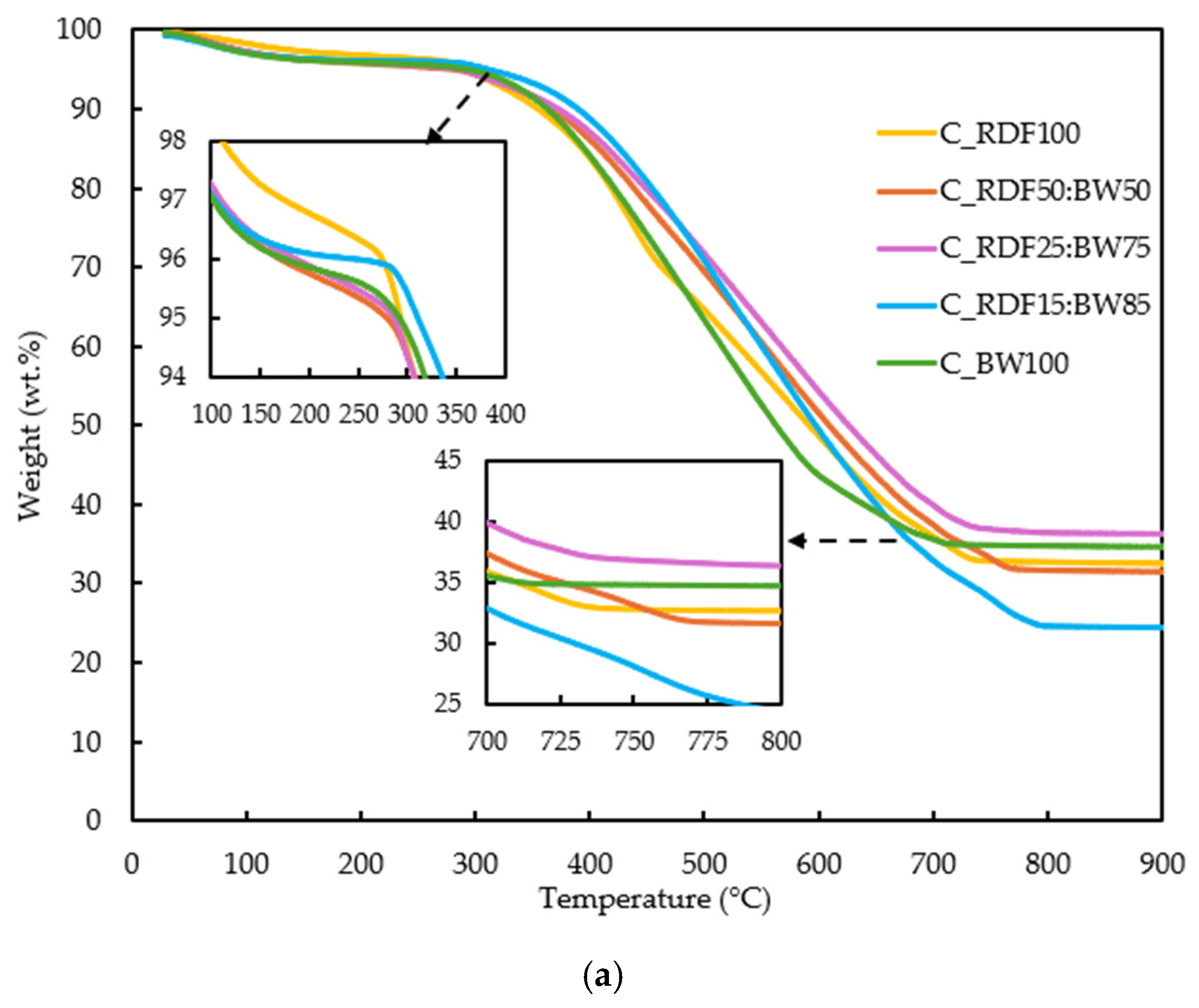
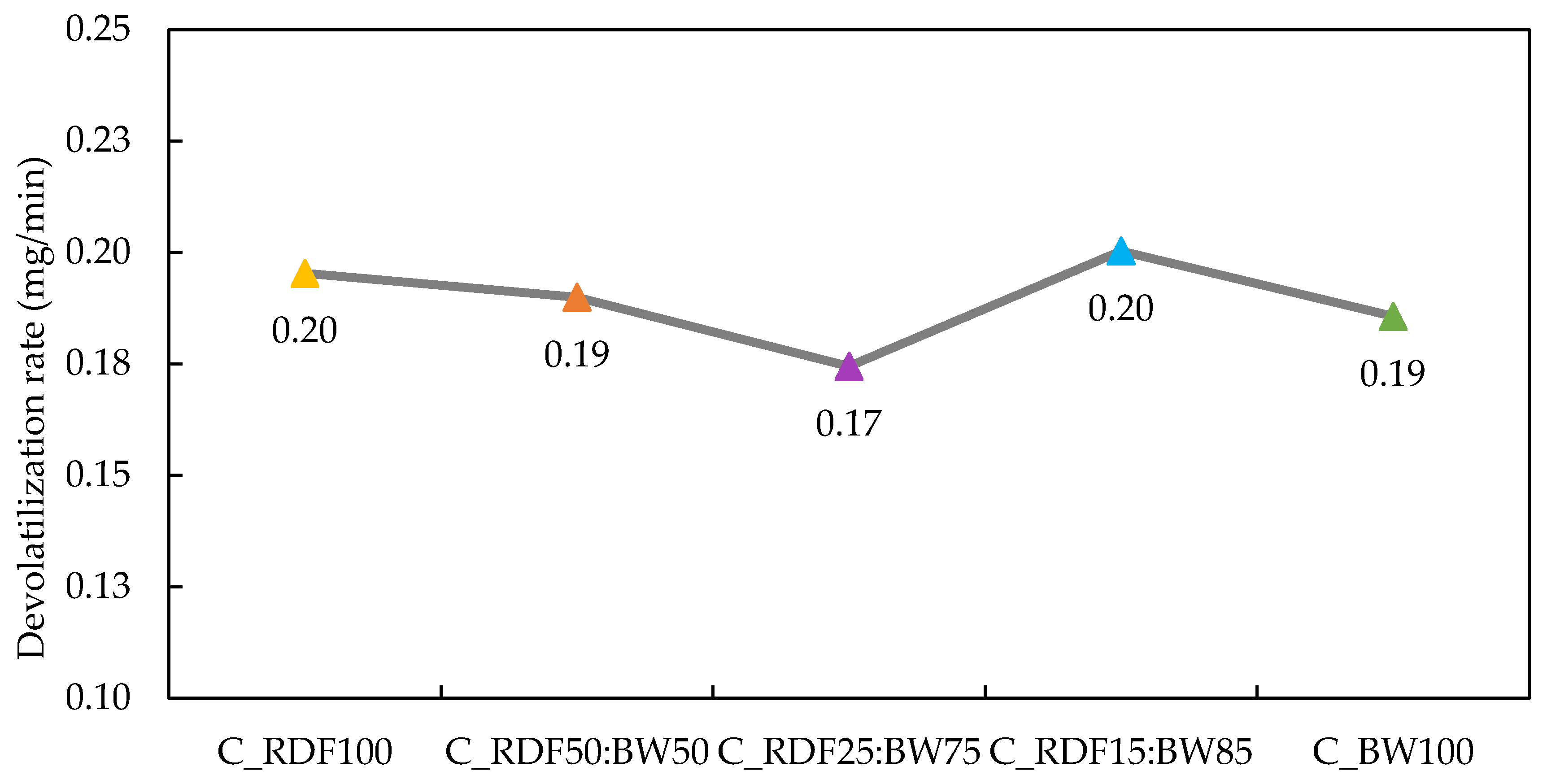
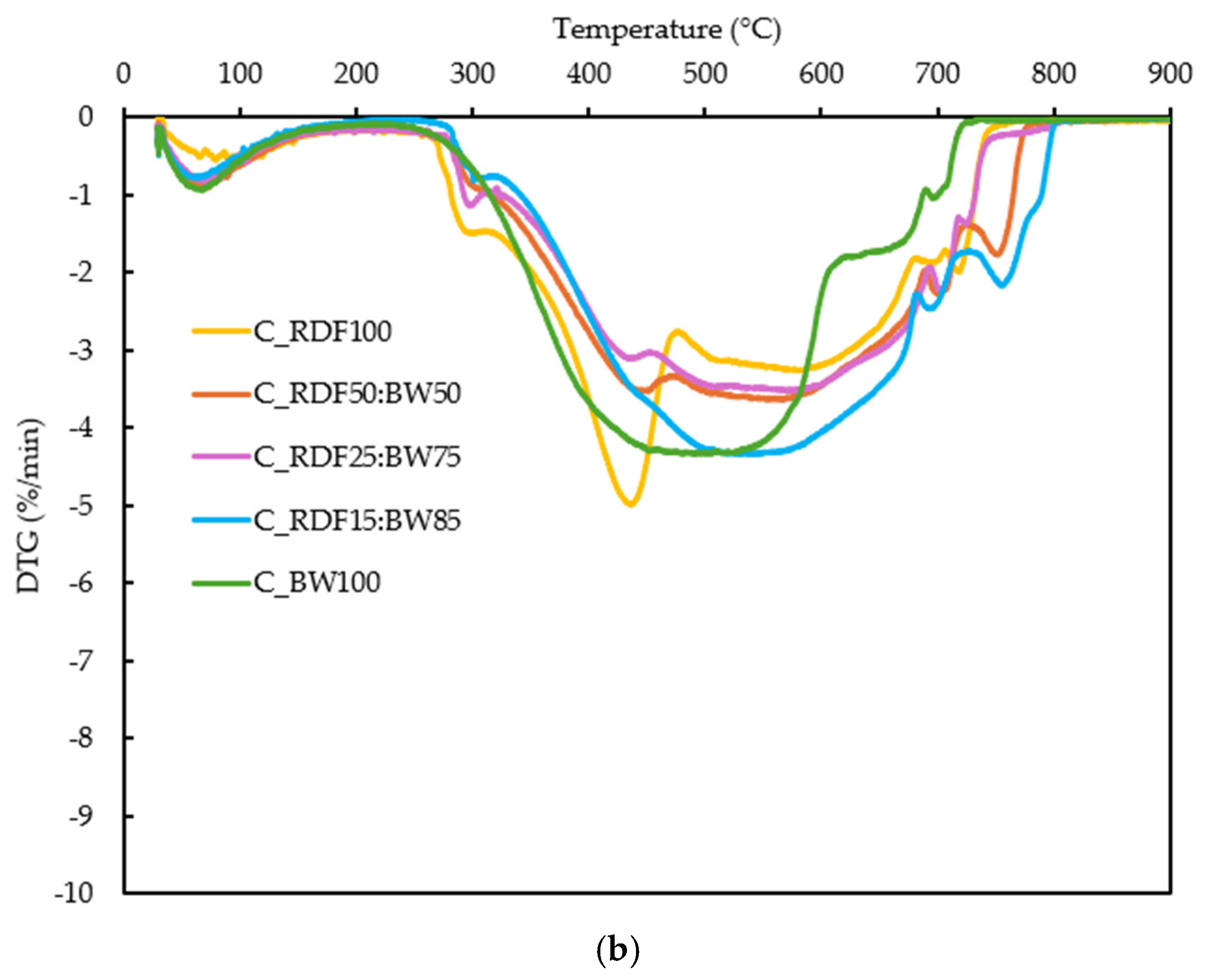
3.2.3. Thermogravimetric Analysis
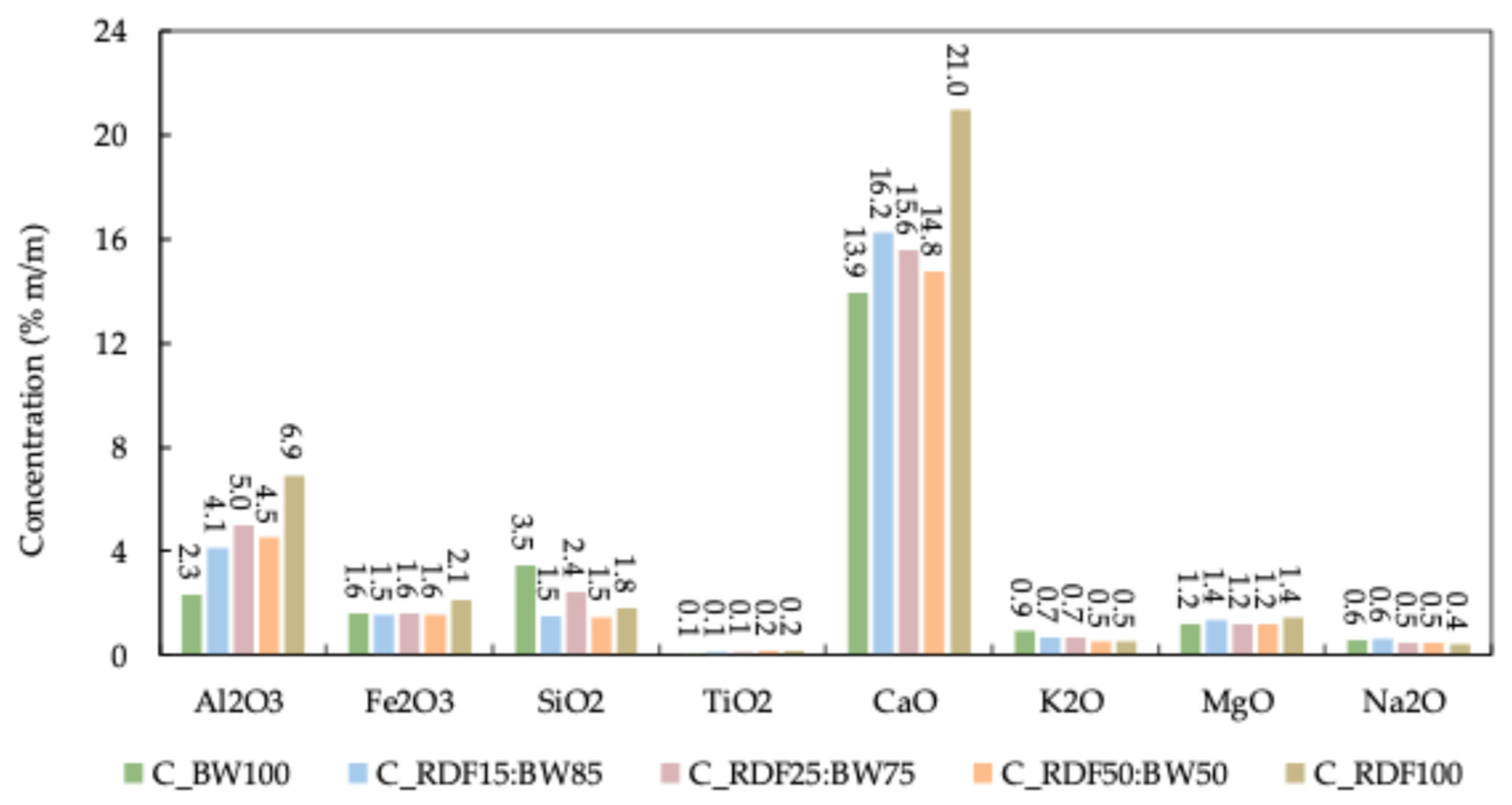
3.2.4. XRF Analysis and ICP–AES: Ash Behavior Assessment
4. Conclusions
Author Contributions
Funding
Data Availability Statement
Conflicts of Interest
Abbreviations
| RDF | Refuse-derived fuel |
| BW | Biomass waste |
| MSW | Municipal solid waste |
| MBT | Mechanical–biological treatment |
| GHG | Greenhouse gas |
| LCA | Life cycle assessment |
| HHV | High heating value |
| ar | As received basis |
| db | Dry basis |
| daf | Dry ash free basis |
| TG | Thermogravimetric analysis |
| DTG | Derivative thermogravimetric analysis |
| FT–IR | Fourier-transform infrared spectrometer |
| Tmax | Temperature of maximum mass-loss rate |
| Ti | The ignition temperature |
| Tf | The burnout temperature |
| Di | Ignition index |
| C | Flammability index |
| B/A | The base-to-acid ratio |
| Sr | Slag viscosity index |
| Fu | Fouling index |
| Al | Alkali index |
| BAI | Agglomeration index |
| WtE | Waste-to-energy |
| WtG | Waste-to-gas |
References
- Chen, B.; Xiong, R.; Li, H.; Sun, Q.; Yang, J. Pathways for sustainable energy transition. J. Clean. Prod. 2019, 228, 1564–1571. [Google Scholar] [CrossRef]
- Shah, A.V.; Srivastava, V.K.; Mohanty, S.S.; Varjani, S. Municipal solid waste as a sustainable resource for energy production: State-of-the-art review. J. Environ. Chem. Eng. 2021, 9, 105717. [Google Scholar] [CrossRef]
- Khan, A.H.; López-Maldonado, E.A.; Khan, N.A.; Villarreal-Gómez, L.J.; Munshi, F.M.; Alsabhan, A.H.; Perveen, K. Current solid waste management strategies and energy recovery in developing countries—State of art review. Chemosphere 2022, 291, 133088. [Google Scholar] [CrossRef]
- Kibria, M.G.; Masuk, N.I.; Safayet, R.; Nguyen, H.Q.; Mourshed, M. Plastic Waste: Challenges and Opportunities to Mitigate Pollution and Effective Management. Int. J. Environ. Res. 2023, 17, 20. [Google Scholar] [CrossRef] [PubMed]
- Vanaraj, R.; Suresh Kumar, S.M.; Kim, S.C.; Santhamoorthy, M. A Review on Sustainable Upcycling of Plastic Waste Through Depolymerization into High-Value Monomer. Processes 2025, 13, 2431. [Google Scholar] [CrossRef]
- Santos, S.M.; Gonçalves, M.; Brito, P.; Nobre, C. Waste-Derived Chars: A Comprehensive Review. Waste 2024, 2, 13. [Google Scholar] [CrossRef]
- Longo, A.; Alves, O.; Sen, A.U.; Nobre, C.; Brito, P.; Gonçalves, M. Dry and Hydrothermal Co-Carbonization of Mixed Refuse-Derived Fuel (RDF) for Solid Fuel Production. Reactions 2024, 5, 77–97. [Google Scholar] [CrossRef]
- Alves, O.; Nobre, C.; Durão, L.; Monteiro, E.; Brito, P.; Gonçalves, M. Effects of dry and hydrothermal carbonisation on the properties of solid recovered fuels from construction and municipal solid wastes. Energy Convers. Manag. 2021, 237, 114101. [Google Scholar] [CrossRef]
- Bhatt, M.; Wagh, S.; Chakinala, A.G.; Pant, K.K.; Sharma, T.; Joshi, J.B.; Shah, K.; Sharma, A. Conversion of refuse derived fuel from municipal solid waste into valuable chemicals using advanced thermo-chemical process. J. Clean. Prod. 2021, 329, 129653. [Google Scholar] [CrossRef]
- Chen, D.; Yin, L.; Wang, H.; He, P. Pyrolysis technologies for municipal solid waste: A review. Waste Manag. 2014, 34, 2466–2486. [Google Scholar] [CrossRef]
- Nandhini, R.; Berslin, D.; Sivaprakash, B.; Rajamohan, N.; Vo, D.V.N. Thermochemical conversion of municipal solid waste into energy and hydrogen: A review. Environ. Chem. Lett. 2022, 20, 1645–1669. [Google Scholar] [CrossRef] [PubMed]
- Iacovidou, E.; Hahladakis, J.; Deans, I.; Velis, C.; Purnell, P. Technical properties of biomass and solid recovered fuel (SRF) co-fired with coal: Impact on multi-dimensional resource recovery value. Waste Manag. 2018, 73, 535–545. [Google Scholar] [CrossRef]
- Adeleke, A.A.; Ikubanni, P.P.; Emmanuel, S.S.; Fajobi, M.O.; Nwachukwu, P.; Adesibikan, A.A.; Odusote, J.K.; Adeyemi, E.O.; Abioye, O.M.; Okolie, J.A. A comprehensive review on the similarity and disparity of torrefied biomass and coal properties. Renew. Sustain. Energy Rev. 2024, 199, 114502. [Google Scholar] [CrossRef]
- Haykiri-Acma, H.; Kurt, G.; Yaman, S. Properties of Biochars Obtained from RDF by Carbonization: Influences of Devolatilization Severity. Waste Biomass Valorization 2017, 8, 539–547. [Google Scholar] [CrossRef]
- Miskolczi, N.; Gao, N.; Quan, C.; Laszlo, A.T. CO2 reduction by chars obtained by pyrolysis of real wastes: Low temperature adsorption and high temperature CO2 capture. Carbon Capture Sci. Technol. 2025, 14, 100332. [Google Scholar] [CrossRef]
- Cheng, F.; Luo, H.; Colosi, L.M. Slow pyrolysis as a platform for negative emissions technology: An integration of machine learning models, life cycle assessment, and economic analysis. Energy Convers. Manag. 2020, 223, 113258. [Google Scholar] [CrossRef]
- Soka, O.; Oyekola, O. A feasibility assessment of the production of char using the slow pyrolysis process. Heliyon 2020, 6, e04346. [Google Scholar] [CrossRef]
- Lin, B.; Zhou, J.; Qin, Q.; Xie, C.; Luo, Z. Physicochemical characteristics of biomass-coal blend char: The role of co-pyrolysis synergy. Energy Sci. Eng. 2021, 9, 1249–1262. [Google Scholar] [CrossRef]
- Magdziarz, A.; Jerzak, W.; Wądrzyk, M.; Sieradzka, M. Benefits from co-pyrolysis of biomass and refuse derived fuel for biofuels production: Experimental investigations. Renew. Energy 2024, 230, 120808. [Google Scholar] [CrossRef]
- Jerzak, W.; Mlonka-Mędrala, A.; Gao, N.; Magdziarz, A. Potential of products from high-temperature pyrolysis of biomass and refuse-derived fuel pellets. Biomass Bioenergy 2024, 183, 107159. [Google Scholar] [CrossRef]
- Alam, M.T.; Dai, B.; Wu, X.; Hoadley, A.; Zhang, L. A critical review of ash slagging mechanisms and viscosity measurement for low-rank coal and bio-slags. Front. Energy 2021, 15, 46–67. [Google Scholar] [CrossRef]
- Santos, S.M.; Souza, P.; Nobre, C.; Rijo, B.; Gonçalves, M.; Engvall, K.; Brito, P. RDF Co-processing through CO2 Gasification Using Waste-based Catalysts. In Proceedings of the 32nd European Biomass Conference and Exhibition, Marseille, France, 24–27 June 2024; pp. 118–120. [Google Scholar]
- Rashwan, S.S.; Boulet, M.; Moreau, S. Catalyzing Refuse-Derived Fuel Understanding: Quantified Insights From Thermogravimetric Analysis. J. Energy Resour. Technol. 2024, 146, 091203. [Google Scholar] [CrossRef]
- Zahra, N.L.; Septiariva, I.Y.; Sarwono, A.; Qonitan, F.D.; Sari, M.M.; Gaina, P.C.; Ummatin, K.K.; Arifianti, Q.A.M.O.; Faria, N.; Lim, J.-W.; et al. Substitution of Garden and Polyethylene Terephthalate (PET) Plastic Waste as Refused Derived Fuel (RDF). Int. J. Renew. Energy Dev. 2022, 11, 523–532. [Google Scholar] [CrossRef]
- Manyà, J.J.; García-Ceballos, F.; Azuara, M.; Latorre, N.; Royo, C. Pyrolysis and char reactivity of a poor-quality refuse-derived fuel (RDF) from municipal solid waste. Fuel Process. Technol. 2015, 140, 276–284. [Google Scholar] [CrossRef]
- Syguła, E.; Świechowski, K.; Stępień, P.; Koziel, J.A.; Białowiec, A. The prediction of calorific value of carbonized solid fuel produced from refuse-derived fuel in the low-temperature pyrolysis in CO2. Materials 2021, 14, 49. [Google Scholar] [CrossRef]
- Nobre, C.; Vilarinho, C.; Alves, O.; Mendes, B.; Gonçalves, M. Upgrading of refuse derived fuel through torrefaction and carbonization: Evaluation of RDF char fuel properties. Energy 2019, 181, 66–76. [Google Scholar] [CrossRef]
- ASTM E949-88; Standard Test Method for Total Moisture in a Refuse-Derived Fuel. ASTM International: West Conshohocken, PA, USA, 2004.
- ASTM E897-88; Standard Test Method for Volatile Matter in the Analysis Sample of Refuse-Derived Fuel. ASTM International: West Conshohocken, PA, USA, 2004.
- ASTM E830-87; Standard Test Method for Ash in the Analysis Sample of Refuse-Derived Fuel. ASTM International: West Conshohocken, PA, USA, 2004.
- Vyazovkin, S.; Burnham, A.K.; Criado, J.M.; Pérez-Maqueda, L.A.; Popescu, C.; Sbirrazzuoli, N. ICTAC Kinetics Committee recommendations for performing kinetic computations on thermal analysis data. Thermochim. Acta 2011, 520, 1–19. [Google Scholar] [CrossRef]
- Jia, G. Combustion characteristics and kinetic analysis of biomass pellet fuel using thermogravimetric analysis. Processes 2021, 9, 868. [Google Scholar] [CrossRef]
- Wzorek, M.; Junga, R.; Yilmaz, E.; Bozhenko, B. Thermal decomposition of olive-mill byproducts: A TG-FTIR approach. Energies 2021, 14, 4123. [Google Scholar] [CrossRef]
- Wnorowska, J.; Ciukaj, S.; Kalisz, S. Thermogravimetric analysis of solid biofuels with additive under air atmosphere. Energies 2021, 14, 2257. [Google Scholar] [CrossRef]
- Marangwanda, G.T.; Madyira, D.M.; Ndungu, P.G.; Chihobo, C.H. Combustion characterisation of bituminous coal and pinus sawdust blends by use of thermo-gravimetric analysis. Energies 2021, 14, 7547. [Google Scholar] [CrossRef]
- Lachman, J.; Baláš, M.; Lisý, M.; Lisá, H.; Milčák, P.; Elbl, P. An overview of slagging and fouling indicators and their applicability to biomass fuels. Fuel Process. Technol. 2021, 217, 106804. [Google Scholar] [CrossRef]
- Sun, X.; Shan, R.; Li, X.; Pan, J.; Liu, X.; Deng, R.; Song, J. Characterization of 60 types of Chinese biomass waste and resultant biochars in terms of their candidacy for soil application. GCB Bioenergy 2017, 9, 1423–1435. [Google Scholar] [CrossRef]
- Xing, B.; Hu, Y.; Wang, S. Study of synergistic effects in co-pyrolysis of biomass and plastics from the perspective of phase reactions. J. Anal. Appl. Pyrolysis 2025, 186, 106951. [Google Scholar] [CrossRef]
- Wang, Z.; Burra, K.G.; Lei, T.; Gupta, A.K. Co-pyrolysis of waste plastic and solid biomass for synergistic production of biofuels and chemicals—A review. Prog. Energy Combust. Sci. 2021, 84, 100899. [Google Scholar] [CrossRef]
- Longo, A.; Pacheco, N.; Panizio, R.; Vilarinho, C.; Brito, P.; Gonçalves, M. Carbonization of Refuse-Derived Fuel Pellets with Biomass Incorporation to Solid Fuel Production. Fuels 2024, 5, 41. [Google Scholar] [CrossRef]
- Chen, H.; Wang, J.; Rocha, L.A.; Zhang, H.; Zhang, S.; Zhang, H. Insights into the char-production mechanism during co-pyrolysis of biomass and plastic wastes. Energy 2024, 312, 133642. [Google Scholar] [CrossRef]
- Sbrolini Tiburcio, R.; Malpeli Junior, M.; Tófano de Campos Leite, J.; Minoru Yamaji, F.; Pereira Neto, A.M. Physicochemical and thermophysical characterization of rejected waste and evaluation of their use as refuse-derived fuel. Fuel 2021, 293, 120359. [Google Scholar] [CrossRef]
- Santos, S.M.; Longo, A.; Gonçalves, M.; Nobre, C.; Calado, L.; Brito, P. Refuse derived fuel pellets as feedstock for energy production. In WASTES: Solutions, Treatments and Opportunities IV, 1st ed.; Vilarinho, C., Castro, F., Quina, M., Eds.; CRC Press: Boca Raton, FL, USA, 2023. [Google Scholar] [CrossRef]
- Taherymoosavi, S.; Verheyen, V.; Munroe, P.; Joseph, S.; Reynolds, A. Characterization of organic compounds in biochars derived from municipal solid waste. Waste Manag. 2017, 67, 131–142. [Google Scholar] [CrossRef]
- Nandiyanto, A.B.D.; Oktiani, R.; Ragadhita, R. How to read and interpret ftir spectroscope of organic material. Indones. J. Sci. Technol. 2019, 4, 97–118. [Google Scholar] [CrossRef]
- InstaNANO FTIR Functional Group Database Table with Search-InstaNANO. InstaNano 2024. Available online: https://instanano.com/all/characterization/ftir/ftir-functional-group-search/ (accessed on 17 December 2025).
- He, X.; Liu, X.; Nie, B.; Song, D. FTIR and Raman spectroscopy characterization of functional groups in various rank coals. Fuel 2017, 206, 555–563. [Google Scholar] [CrossRef]
- Pereira, A.K.S.; Júnior, D.L.; da Silva, Á.M.; Cupertino, G.F.M.; de Souza, E.C.; Delatorre, F.M.; Ucella-Filho, J.G.M.; de Oliveira, P.R.S.; Rodrigues, B.P.; Júnior, A.F.D. How pyrolysis conditions shape the structural and functional properties of charcoal? A study of tropical dry forest biomass. Renew. Energy 2025, 243, 122575. [Google Scholar] [CrossRef]
- Çepelioǧullar, Ö.; Pütün, A.E. Thermal and kinetic behaviors of biomass and plastic wastes in co-pyrolysis. Energy Convers Manag. 2013, 75, 263–270. [Google Scholar] [CrossRef]
- Sustainability Directory. Biochar Stability. Sustainability Directory 2025. Available online: https://climate.sustainability-directory.com/term/biochar-stability/ (accessed on 16 December 2025).
- Burra, K.G.; Gupta, A.K. Kinetics of synergistic effects in co-pyrolysis of biomass with plastic wastes. Appl. Energy 2018, 220, 408–418. [Google Scholar] [CrossRef]
- Chhabra, V.; Bhattacharya, S.; Shastri, Y. Pyrolysis of mixed municipal solid waste: Characterisation, interaction effect and kinetic modelling using the thermogravimetric approach. Waste Manag. 2019, 90, 152–167. [Google Scholar] [CrossRef] [PubMed]
- Guo, M.; Wang, K.; Bing, X.; Cheng, J.; Zhang, Y.; Sun, X.; Guan, B.; Yu, J. Pyrolysis of plastics-free refuse derived fuel derived from municipal solid waste and combustion of the char products in lab and pilot scales: A comparative study. Fuel 2024, 359, 130335. [Google Scholar] [CrossRef]
- Kaniowski, W.; Taler, J.; Wang, X.; Kalemba-Rec, I.; Gajek, M.; Mlonka-Mędrala, A.; Nowak-Woźny, D.; Magdziarz, A. Investigation of biomass, RDF and coal ash-related problems: Impact on metallic heat exchanger surfaces of boilers. Fuel 2022, 326, 125122. [Google Scholar] [CrossRef]
- Degereji, M.U.; Ingham, D.B.; Ma, L.; Pourkashanian, M.; Williams, A. Prediction of ash slagging propensity in a pulverized coal combustion furnace. Fuel 2012, 101, 171–178. [Google Scholar] [CrossRef]
- Rizvi, T.; Xing, P.; Pourkashanian, M.; Darvell, L.I.; Jones, J.M.; Nimmo, W. Prediction of biomass ash fusion behaviour by the use of detailed characterisation methods coupled with thermodynamic analysis. Fuel 2015, 141, 275–284. [Google Scholar] [CrossRef]





| Parameters | Units | C_RDF100 | C_RDF50: BW50 | C_RDF25: BW75 | C_RDF15: BW85 | C_BW100 |
|---|---|---|---|---|---|---|
| Moisture | wt.%, ar | 0.24 ± 0.02 | 0.23 ± 0.06 | 2.43 ± 0.03 | 1.33 ± 0.06 | 4.34 ± 0.11 |
| Volatile matter | wt.%, db | 42.66 ± 1.30 | 35.14 ± 1.12 | 31.08 ± 0.19 | 31.22 ± 2.10 | 37.44 ± 2.51 |
| Fixed carbon | 19.79 ± 2.63 | 29.70 ± 2.41 | 33.35 ± 0.46 | 37.32 ± 3.61 | 22.39 ± 2.73 | |
| Ash | 37.55 ± 2.19 | 35.16 ± 2.28 | 35.58 ± 0.49 | 31.46 ± 1.84 | 40.17 ± 0.42 | |
| C | wt.%, daf | 85.67 ± 0.27 | 75.56 ± 1.19 | 72.56 ± 1.66 | 66.88 ± 1.74 | 74.36 ± 2.29 |
| H | 8.24 ± 0.28 | 5.31 ± 0.15 | 4.03 ± 0.09 | 3.29 ± 0.06 | 2.92 ± 0.04 | |
| N | 2.22 ± 0.15 | 1.85 ± 0.07 | 1.71 ± 0.04 | 1.55 ± 0.02 | 1.69 ± 0.00 | |
| S | 0.14 ± 0.00 | 0.20 ± 0.19 | 0.23 ± 0.28 | 0.23 ± 0.30 | 0.28 ± 0.40 | |
| O | 3.73 ± 0.14 | 17.07 ± 0.92 | 21.46 ± 1.33 | 28.04 ± 1.40 | 20.75 ± 1.86 | |
| Cl | wt. %, ar | 2.52 ± 0.00 | 1.46 ± 0.00 | 1.11 ± 0.00 | 1.30 ± 0.00 | 0.86 ± 0.00 |
| HHV | MJ/kg, db | 22.84 ± 0.02 | 19.17 ± 0.36 | 18.39 ± 0.60 | 19.38 ± 0.20 | 15.39 ± 0.35 |
| Sample | DTGmax (%/min) | Tmax (°C) | Ti (°C) | Tf (°C) | Di | C |
|---|---|---|---|---|---|---|
| C_RDF100 | 4.99 | 435.19 | 264.42 | 714.91 | 9.39 × 10⁻⁶ | 1.73 × 10⁻⁵ |
| C_RDF50:BW50 | 3.64 | 566.58 | 150.01 | 746.22 | 8.44 × 10⁻⁶ | 2.03 × 10⁻⁵ |
| C_RDF25:BW75 | 3.53 | 574.95 | 150.04 | 715.94 | 8.42 × 10⁻⁶ | 1.97 × 10⁻⁵ |
| C_RDF15:BW85 | 4.35 | 538.04 | 282.95 | 766.34 | 7.52 × 10⁻⁶ | 1.41 × 10⁻⁵ |
| C_BW100 | 4.34 | 481.57 | 264.44 | 679.92 | 8.47 × 10⁻⁶ | 1.50 × 10⁻⁵ |
| C_RDF100 | C_RDF50: BW50 | C_RDF25: BW75 | C_RDF15: BW85 | C_BW100 | |
|---|---|---|---|---|---|
| B/A | 2.85 (S) | 3.00 (S) | 2.58 (S) | 3.58 (S) | 3.11 (S) |
| Sr | 233.2 (L) | 175.0 (L) | 180.2 (L) | 172.2 (L) | 175.7 (L) |
| Fu | 2.6 (H) | 2.9 (H) | 3.0 (H) | 4.8 (H) | 4.6 (H) |
| Al | 0.0015 (L) | 0.0018 (L) | 0.0023 (L) | 0.0022 (L) | 0.0039 (L) |
| BAI | 5.6 (L) | 3.9 (L) | 4.1 (L) | 3.0 (L) | 3.7 (L) |
Disclaimer/Publisher’s Note: The statements, opinions and data contained in all publications are solely those of the individual author(s) and contributor(s) and not of MDPI and/or the editor(s). MDPI and/or the editor(s) disclaim responsibility for any injury to people or property resulting from any ideas, methods, instructions or products referred to in the content. |
© 2026 by the authors. Licensee MDPI, Basel, Switzerland. This article is an open access article distributed under the terms and conditions of the Creative Commons Attribution (CC BY) license.
Share and Cite
Santos, S.M.; Gonçalves, M.; Brito, P.; Nobre, C. Char Produced from Waste and Biomass Blended Pellets: Comprehensive Thermochemical Behavior Assessment. Environments 2026, 13, 119. https://doi.org/10.3390/environments13020119
Santos SM, Gonçalves M, Brito P, Nobre C. Char Produced from Waste and Biomass Blended Pellets: Comprehensive Thermochemical Behavior Assessment. Environments. 2026; 13(2):119. https://doi.org/10.3390/environments13020119
Chicago/Turabian StyleSantos, Santa Margarida, Margarida Gonçalves, Paulo Brito, and Catarina Nobre. 2026. "Char Produced from Waste and Biomass Blended Pellets: Comprehensive Thermochemical Behavior Assessment" Environments 13, no. 2: 119. https://doi.org/10.3390/environments13020119
APA StyleSantos, S. M., Gonçalves, M., Brito, P., & Nobre, C. (2026). Char Produced from Waste and Biomass Blended Pellets: Comprehensive Thermochemical Behavior Assessment. Environments, 13(2), 119. https://doi.org/10.3390/environments13020119