
Skip to Content
EnvironmentsEnvironments
  • Article
  • Open Access

20 December 2025

Seasonal and Cross-Shore Characterization of Sediments Along the Ferrara Coastal Area (NW Adriatic Sea, Italy)


,
,
and
Department of Environmental and Prevention Sciences, University of Ferrara, Via Saragat 1, 44122 Ferrara, Italy
*
Authors to whom correspondence should be addressed.

Abstract

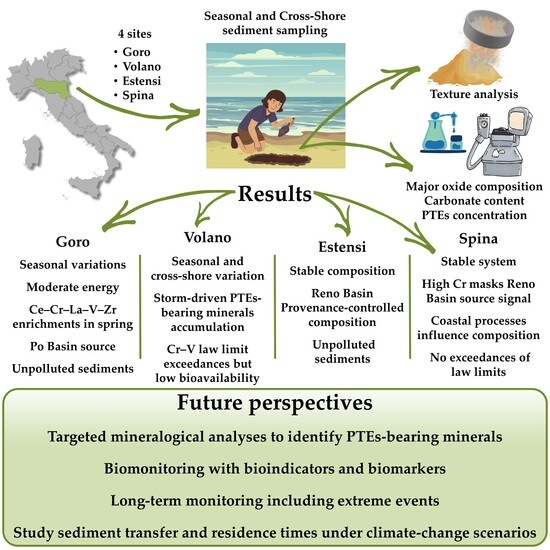
This study provides a seasonal and cross-shore characterization of sediments along the Ferrara coastal area (Italy). Four sites (Goro, Volano, Estensi, and Spina) were investigated through an integrated approach including textural and geochemical analyses. Surface sediments were sampled seasonally from summer 2023 to summer 2024 and analyzed to determine granulometry, major oxides composition, carbonate content, and potentially toxic element (PTE) contents. Results revealed that both grain-size and geochemistry vary seasonally and along the cross-shore profile, reflecting the combined effects of hydrodynamic forcing, sediment transport, and fluvial inputs. Elevated contents of Ce, Cr, La, V, and Zr were detected at various sites, seasons, and geomorphological zones. In some cases, the environmental quality indices applied allowed the sediments to be classified as polluted. Furthermore, some exceedances of the legal limits for Cr and V contents were observed at Goro and Volano. These pollution levels are attributable to the presence of PTE-bearing minerals originating from the source basins (geogenic sources). Overall, the results highlight the interplay between hydrodynamics and sediment provenance, emphasizing the dominance of geogenic contributions along the northern Adriatic coast, providing updated geochemical data for future monitoring and environmental management of coastal systems.

1. Introduction

Coastal zones are transitional environments at the land/sea interface and represent natural ecosystems of high ecological, social, and economic value [1,2,3,4,5]. Preserving their health is essential for shoreline stabilization, protection, and regulation of erosional processes [6,7,8,9].
Recent studies documented an intensification of natural drivers and climate change impacts along coastlines, including erosion, subsidence, flooding, storm surges, sea-level rise, and an increase in extreme events [10,11,12,13,14,15,16,17,18]. At the same time, coasts are increasingly subject to anthropogenic pressures, resulting in higher environmental loads of nutrients, contaminants, pollutants, and potentially toxic elements (PTEs) [18,19,20,21,22,23,24,25]. This study focuses specifically on these latter aspects.
Understanding the origin of sedimentary deposits is fundamental for clarifying processes and pathways of formation, transport, and deposition [26]. The chemical and mineralogical composition of sediments is influenced by multiple factors including bedrock composition, climatic conditions, catchment length, transport energy, redox conditions, and grain size [27,28]. Coastal zones are highly dynamic environments that may act as permanent or temporary sinks for pollutants and contaminants, which are often delivered from inland areas via river networks [29,30,31,32,33,34,35].
The presence of PTEs with ecological toxicity remains a growing concern. PTEs in coastal sediments are particularly alarming because they can be adsorbed, desorbed, mobilized, and transported across terrestrial, fluvial, coastal, and marine environments, with the potential for bioaccumulation and biomagnification within living organisms [20,29,36,37,38,39,40]. In line with the European Green Deal strategy, ambitious environmental protection targets have been set for 2050, including zero pollution and the conservation and restoration of coastal ecosystems [41]. Monitoring environmental levels of contaminants and PTEs is therefore of critical importance.
Despite the numerous investigations carried out in the Po Delta area, the seasonal-scale variability of sedimentological and geochemical features along cross-shore profiles remains poorly constrained. This study provides a comprehensive, process-oriented assessment of coastal sediments collected at four sites along the Ferrara coast (Goro, Volano, Estensi, and Spina) on the Italian coast of the northern Adriatic Sea.
Within this framework, the main objectives of this work are to (i) provide an updated characterization of surface sediments; (ii) evaluate seasonal and cross-shore patterns in textural and geochemical signatures; (iii) interpret the environmental processes controlling these patterns, including sediment supply from the Po and Reno rivers, hydrodynamic forcing, and nearshore redistribution; (iv) assess the occurrence and magnitude of PTE enrichments; and (v) identify local criticalities and potential vulnerabilities associated with recent sediment deposition. Through this integrated approach, the study aims to provide insights relevant for coastal monitoring, environmental assessment, and management strategies in this highly dynamic sector of the Adriatic coast.

2. Study Area

The investigated area is located in the province of Ferrara, along the Italian coast of the northern Adriatic Sea, between the mouths of the Po and Reno rivers. It has been described in detail in a recent study [42]. It lies in the southeastern sector of the Po Delta and represents the terminal portion of the Po Plain. This is an extensively urbanized and industrialized alluvial plain drained by the Po River catchment. The Po Plain is predominantly devoted to agriculture and intensive livestock farming; it is also intersected by rivers, canals, and lagoons, some of which support shellfish farming activities [18,22,43,44,45,46]. The Po Delta is recognized as a UNESCO World Heritage Site and as a Man and the Biosphere Reserve. It is also protected under the Ramsar Convention, designated as part of the Emilia-Romagna Regional Park of the Po Delta. Furthermore, it is classified as containing Sites of Community Importance (SCIs) and Special Protection Areas (SPA) within the Natura 2000 network, established under the EU Birds and Habitats Directives [18,42]. Despite these protections, the area is subject to significant anthropogenic pressures from recreational and professional activities, including tourism, hunting, and fishing. A survey conducted in 1989–1990 reported low to moderate contamination of the Po Delta waters by PTEs and micro-pollutants, along with high nutrient loads that accumulated in deltaic and coastal sediments [47].
The regional geological framework and paleogeographic evolution have been extensively documented [46,47,48,49,50,51,52,53,54,55,56]. The modern geomorphological evolution of the study area has also been the subject of numerous investigations [16,24,47,55,57,58,59,60,61,62]. In addition, the geochemistry of soils and subsurface sediments has been analyzed to establish local background values [22,27,45,46,53,63,64,65,66,67,68,69,70]. Indeed, interpreting geochemical results requires correlation with the chemical properties of the parent lithologies that characterize the natural reference system [43,71].
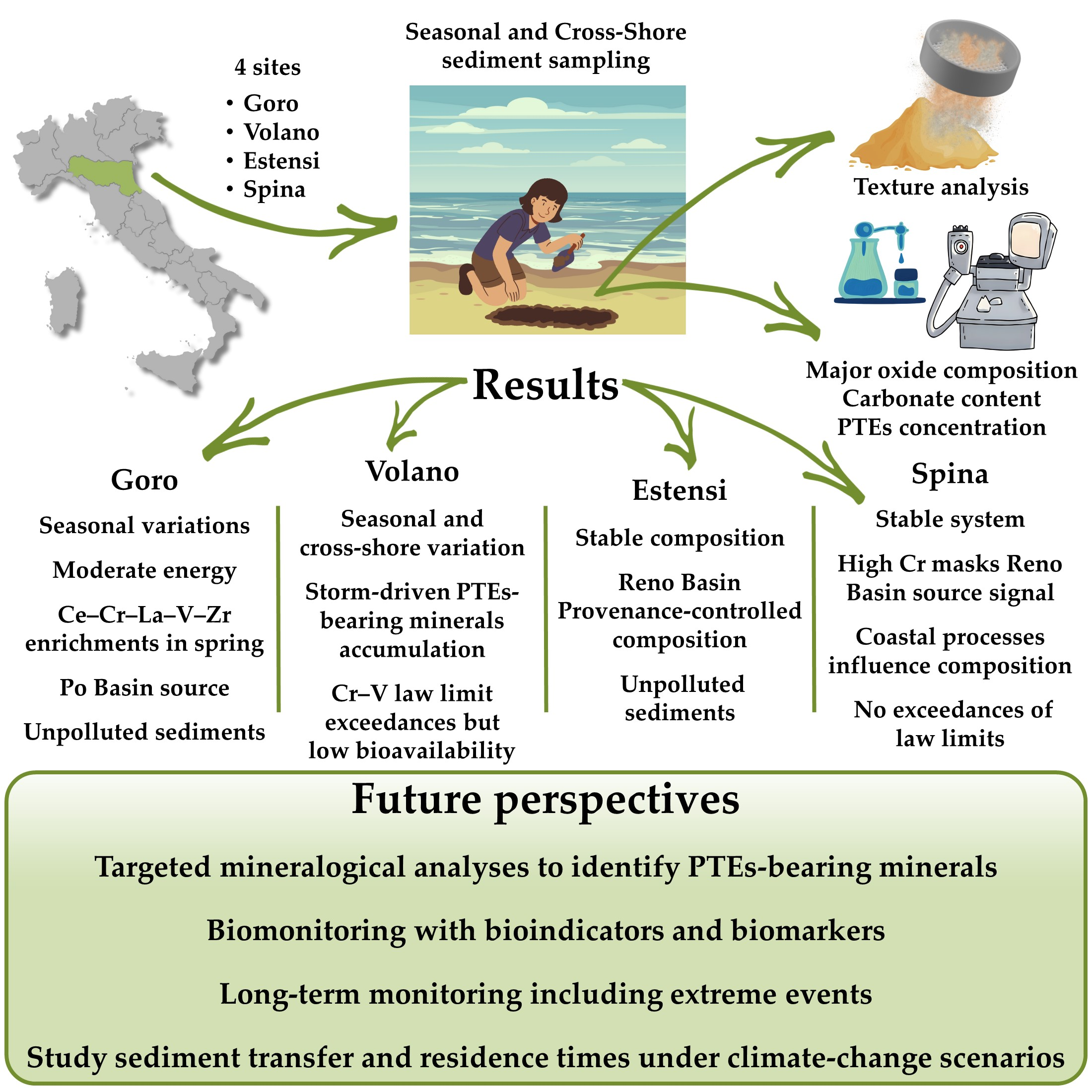
Within the study area, four sampling sites were selected: Goro, Volano, Estensi, and Spina (Figure 1). These sites have been further described by Buoninsegni and colleagues [42].
Figure 1. Overview of the study area (central map) and detailed views of the four sampling sites in the insets: (a) Goro; (b) Volano; (c) Estensi; (d) Spina.

3. Materials and Methods

At each of the four study sites (Goro, Volano, Estensi, and Spina), sampling was carried out according to local geomorphological features, which depend on the width and slope gradients of the cross-shore profile [72]. The identified geomorphological zones were classified according to Buoninsegni et al. [42] (Figure 1): swash zone (SZ), lower backshore (LB), upper backshore (UB), dune foot (DF) and dune crest (DC). At Goro, only the SZ was present due to the site’s geomorphological configuration, while all geomorphological zones were present at Volano, Estensi, and Spina. Sampling coordinates were acquired using a GS16 dGPS (Leica Geosystems SpA, Muzza di Cornegliano Laudense, Lodi, Italia) and georeferenced to the WGS 84 UTM 32N system (Table A1). These stations were sampled seasonally from summer 2023 to summer 2024. At Goro, Volano, and Estensi, sampling was performed in summer and autumn 2023, and in winter and spring 2024. At Spina, the initially selected beach was inaccessible in autumn 2023. Therefore, sampling was carried out between autumn 2023 and summer 2024.
In each seasonal survey, 500 mL of surface sediment per geomorphological zones was collected and stored in labeled glass jars. In the laboratory, samples were quartered using the method of coning and quartering to ensure representativeness [73,74]. Between samples, all tools and containers were thoroughly cleaned with compressed air, denatured alcohol, and distilled water to prevent cross-contamination. Quartered samples were split into subsamples for textural and geochemical analyses.

3.1. Textural Analyses

To remove organic matter, each subsample was oxidized with 16% v/v H2O2 solution (Carlo Erba Reagents S.r.l., Cornaredo, Milano, Italy). After effervescence ceased, samples were wet-sieved through a 63 µm mesh to separate the sandy fraction from the pelitic fraction.
The sandy fraction was dried in an oven (VWR Dry-Line 115, International Srl, Milano, Italy) at 105 °C overnight and subsequently quartered using precision sample splitters (IG/12-Autom., Giuliani, Torino, Italy) to obtain 3.0 ± 0.2 g for analysis with the sedimentation balance (Thalassia Sas di Mauro Pagan and C., Trieste, Italy). Data processing was performed using Sedim-Cole© software (v1.06, Department of Physics and Earth Sciences, University of Ferrara, Ferrara, Italy; Institute of Marine Geology—CNR, Bologna, Italy).
Textural results, expressed in logarithmic phi units (Φ) [75], were used to classify sediments according to the following statistical parameters [76,77,78]: (i) mean grain size; (ii) sorting; (iii) skewness; (iv) kurtosis.

3.2. Geochemical Analyses

Each subsample for geochemical analysis was subjected to multiple rinsing cycles with deionized water (18.2 MΩ∙cm), obtained through an Arium® Mini UV-purification system (Sartorius Lab Instruments GmbH and Co. KG, Göttingen, Germany) until conductivity reached values ≤ 400 µS/cm. The supernatant was subsequently aspirated, and the sediment subsamples were dried in an oven at 50 °C until complete removal of the interstitial water. The sediments were then homogenized by grinding in an agate mortar (Laarmann® LMMG-100, Laarmann Group BV, Roermond, The Netherlands) until a fine, powdery consistency was achieved. The powdered subsamples were further quartered into separate aliquots for the subsequent analytical procedures.
As part of quality assurance and quality control (QA/QC) methods and to prevent cross-contamination during these operations, at the end of the grinding process of each sample, all parts of the equipment were cleaned as follows: the pestle and the grinding jar were removed. Any dust residues inside the grinding chamber were first eliminated using compressed air, then the entire assembly was cleaned with denatured ethyl alcohol, followed by a final step with compressed air. The pestle and the mortar were first washed with tap water, then dried with absorbent paper, and any remaining moisture was removed using compressed air. The surfaces were finally wiped with denatured ethyl alcohol. Before starting a new grinding cycle, the equipment was conditioned with an aliquot of the sample to be processed.

3.2.1. Determination of the Volatile Fraction by Loss on Ignition (LOI)

For each subsample, an aliquot of 0.60 ± 0.05 g was weighed using a precision balance (Denver Instrument® GmbH, Göttingen, Germany) into a ceramic crucible. The crucibles were then heated in a muffle furnace (FM 13, FALC Instruments srl, Treviglio, Bergamo, Italy) at 1000 °C, with a heating rate of 3 °C/min and a holding time of 8 h. Samples were then weighed and LOI was calculated to determine the samples volatile fraction, including structural water, organic matter and carbon dioxide [79]. The results obtained from this procedure were integrated with the major oxides composition, as described below. QA/QC methods: The ceramic crucibles were pre-fired in a muffle furnace at 550 °C for 60 min to remove any residual contaminants, and then they were labeled and weighed. For each new sample, the spatula used to collect the material was thoroughly cleaned with denatured ethyl alcohol to prevent possible cross-contamination. To avoid possible absorption of atmospheric moisture, the crucibles containing the sample aliquots were first allowed to cool slowly inside the furnace down to approximately 180 °C and then placed in a desiccator containing silica gel until room temperature was reached.

3.2.2. Determination of Carbonate Content by Calcimetry

The carbonate content was determined by calcimetry using a volumetric gas electronic calcimeter (RCS, Toulouse, France). In a closed system, an aliquot of 0.50 ± 0.05 g of each powdered subsample was reacted with 5 mL of 10% v/v HCl (Carlo Erba Reagents srl, Val-de-Reuil, France). The CO2 produced during the reaction was recorded at three-time intervals: t1 = 90 s, t2 = 180 s, and t3 = 900 s. The calcimeter was calibrated using 0.50 ± 0.05 g of pure CaCO3 powder (99.95%, Alfa Aesar, ThermoFisher GmbH, Kandel, Germany) and 5 mL of 10% v/v HCl. QA/QC methods: To ensure proper instrument performance and to prevent potential variations in atmospheric pressure from affecting the analytical results, calibration was repeated after every ten analyses. To avoid possible cross-contamination, the calcimetric apparatus was thoroughly cleaned at the end of each sample analysis by rinsing with distilled water, drying with absorbent paper, washing with denatured ethyl alcohol, and finally removing any residual moisture with compressed air.

3.2.3. Wavelength Dispersive X-Ray Fluorescence Spectrometry (WD-XRF) Analysis

An aliquot (4.0 ± 0.5 g) of each powdered subsample was used to prepare boric acid-bound pellets (P.C.M., Ferrara, Italy) using a benchtop hydraulic press (PP25, Retsch GmbH, Haan, Germany). QA/QC methods: during the preparation of the boric acid–bound pellets, all tools used in the process were thoroughly cleaned with denatured ethyl alcohol and compressed air at the end of each sample preparation. In addition, each boric acid–bound pellet was placed in a sealed plastic bag to prevent contamination from dust possibly generated during the preparation of other samples.
The pellets were analyzed by wavelength dispersive X-ray fluorescence spectrometry (ARL Advant’XP+, Thermo Fisher Scientific Inc., Waltham, MA, USA). This analytical approach allowed the determination of the major oxides, expressed as weight percent (wt%): SiO2, TiO2, Al2O3, Fe2O3, MnO, MgO, CaO, Na2O, K2O, and P2O5. Trace elements were quantified as parts per million (ppm), including Ba, Ce, Co, Cr, Cu, La, Nb, Ni, Pb, Rb, Sr, Y, Zn, and Zr. The accuracy and precision of the analyses were assessed by performing triplicate measurements on the following certified reference materials: river sediment samples JSd-2 and JSd-3 (Geological Survey of Japan, Higashi, Tsukuba, Ibaraki, Japan), and the sandstone GSR-4 (National Research Center of Geoanalysis, Beijing, China). The results are reported in the Supplementary Materials (Tables S1–S4). Detection limits were previously evaluated on the same used instrument by Barbero et al. [80] and Saccani et al. [81]. Peak intensity processing and matrix effect corrections were performed following the method of Lachance and Traill [82].
The trace element contents obtained via WD-XRF were used for the calculation of the following environmental quality indices, as described by Aquilano et al. [19]:
  • The Geoaccumulation Index (Igeo) provides a quantitative measure of metal enrichment in sediments by comparing present-day contents with pre-industrial baseline values. It is determined using the following formula [83,84]:
Igeo = log2[Ci/(1.5Cri)]
In this formula, Ci denotes the content of element i in the sediment, Cri represents its corresponding background or reference value, and the constant 1.5 accounts for potential variations in natural lithogenic contributions.
2.
The Contamination Factor (CF) expresses the degree of enrichment of a given element by dividing its measured content by the pre-industrial level characteristic of the study area. It is determined using the following formula [85,86]:
CF = Ci/Cri
In this formula, Ci refers to the content of the element under investigation, while Cri indicates the pre-industrial reference value.
3.
The Pollution Load Index (PLI) serves as an integrative indicator of overall sediment quality. It is determined using the following formula [87,88]:
PLI = (CF1 × CF2 × CFn)1/n
In this formula, CF1, CF2, and CFn correspond to the Contamination Factors of elements 1, 2, and n, respectively.
The local background levels derived from Migani et al. [22] were used as reference values for calculating the indices.

3.2.4. Determination of PTE Contents by Inductively Coupled Plasma Mass Spectrometry (ICP-MS)

An aliquot of 0.20 ± 0.05 g of each powdered subsample was subjected to acid digestion using a Multiwave 5000 microwave reaction system (Anton Paar GmbH, Graz, Austria) with a mixture of 6 mL of 40% v/v HF Suprapur® and 3 mL of 65% v/v HNO3 Suprapur® (Supelco, Merck KGaA, Darmstadt, Germany). A procedural blank was included in each analytical batch, prepared by replacing the subsample with deionized water and using the same contents of reagents. After digestion, samples were transferred to PTFE beakers and heated on a hot plate (Harry Gestigkeit GmbH, Düsseldorf, Germany) at 195 °C until near dryness, then allowed to cool to room temperature. The residues were re-dissolved in 2 mL of 65% v/v HNO3 Suprapur®, transferred to 100 mL translucent polypropylene volumetric flasks (Kartell™, Thermo Fisher Scientific Inc., Waltham, MA, USA), and brought to volume with deionized water. The resulting dissolutions were analyzed by ICP-MS using an iCAP-TQ spectrometer (Thermo Fisher Scientific Inc., Waltham, MA, USA) to determine the contents of As, Be, Cd, Co, Cr, Cu, Ni, Pb, Tl, V, and Zn.
QA/QC methods: During the weighing procedures, for each new sample, the spatula used to collect the powdered material was thoroughly cleaned with denatured ethyl alcohol to avoid possible cross-contamination. A total of twelve procedural blanks were prepared and subjected to the same analytical procedures. To prevent possible contamination from previous acid digestions, the PTFE vessels used during microwave digestion were cleaned by applying a washing cycle with 6 mL of 65% v/v HNO3 Suprapur® and 4 mL of deionized water, followed by a microwave heating cycle. The vessels were then thoroughly rinsed with deionized water. These cleaning operations were carried out at the end of each digestion procedure, corresponding to a maximum batch of twelve samples. Before each use, the PTFE beakers were cleaned with 2 mL of 65% v/v HNO3 Suprapur® and 30 mL of deionized water and heated on a hot plate at 195 °C until boiling. The PTFE beakers were then further rinsed with deionized water. Each polypropylene volumetric flask was pre-cleaned using a washing solution consisting of 2 L of deionized water and 25 mL of Extran® AP22 acidic concentrate (Supelco, Merck KGaA, Darmstadt, Germany). The flasks were then rinsed with deionized water until the washing solution was completely removed. All procedures described above were performed in a fume hood (Thalassi, Castelbelforte, Mantova, Italy). Finally, for every six samples subjected to ICP-MS analysis, three instrument rinsing cycles were performed using deionized water.
The accuracy and precision of the analyses were assessed by performing triplicate measurements on the following certified reference materials: the granite GSR-1 (Nation-al Research Center of Geoanalysis, Beijing, China), the sandstone GSR-4 (National Research Center of Geoanalysis, Beijing, China) and the micaschist SDC-1 (U.S. Geological Survey, Denver, CO, USA). The results are reported in the Supplementary Materials (Tables S5–S8). The limit of quantification (LOQ) for each element was estimated by calculating the standard deviation of replicate analyses of the procedural blanks and multiplying it by 10 (10σ) [89]. This information is reported in the Supplementary Materials (Table S8). Contents measured in the procedural blanks were subtracted from those of the samples. The obtained element contents were compared with the regulatory limits established by Italian legislation on the environment (Legislative Decree 152/06, Annex 5).

3.3. Pearson’s Correlation Coefficients

To investigate the locally observed phenomena, Pearson’s correlation coefficients were calculated between (i) pairs of chemical species obtained from WD-XRF analyses, including oxide/oxide, oxide/trace element, and trace element/trace element combinations and (ii) chemical species and grain-size classes (at 0.25 Φ intervals).
These correlation coefficients were computed for the entire dataset of each study site, except for Goro, where data were limited to a single geomorphological zone.
All statistical analyses were performed using GraphPad Prism software (version 10.6.1; GraphPad Software, Inc., Boston, MA, USA) [90].

4. Results and Discussion

4.1. Textural Features of Sediments

At the study sites, sediment textures show some seasonal variability and consistent cross-shore patterns. Complete grain-size distributions, Folk and Ward statistical parameters [76], and detailed seasonal values for each geomorphological zone at all sites are provided in the Supplementary Materials (Figures S1–S4 and Table S9).
Grain size is a key parameter for interpreting depositional environments: fine-grained sediments generally indicate low-energy environments, while coarser textures are associated with higher-energy contexts [91,92]. Overall, the sediments of Goro and Spina are mainly characterized by medium sands, while those of Volano and Estensi show a predominance of fine sands. The mud component is consistently less than 4%. However, sporadic increases in coarse sands are observed at SZ and LB (never exceeding 18%) and very fine sands (never exceeding 21%) at the landward zones (UB, DF, DC). These observations can be explained by typical coastal dynamics, as sediment deposition along the coast is influenced by various natural factors, including the presence and discharge of rivers and the action of waves, tides, and coastal currents, as well as the composition of the source sediments [93,94].
The investigated sites are located near the mouths of the Po and Reno rivers, which can release larger sediments during flood events. In fact, Goro is located closer to the mouth of the Po than Volano, and Spina is closer to the mouth of the Reno than Estensi [42]. This consideration partly explains the macroscopic textural variations observed. The minor increases in coarser sediments at SZ and LB can be attributed to a variation in hydrodynamics [95,96] due to wave motion or the occurrence of episodic marine weather events (e.g., storms, storm surges) capable of mobilizing coarser material. Incoming waves, characterized by greater energy, can transport coarser particles beyond the SZ, while weaker backwash waves are mainly capable of transporting finer sediments [97]. Furthermore, these increases in coarser sediments are mainly observed in autumn and winter, reflecting generally more intense dynamics during these seasons. For example, along the beaches of New Hampshire (USA), winter storms erode surface sands, exposing gravel and pebbles, while calmer summer conditions favor the deposition of fine to medium sands [98]. Although the sites investigated are less exposed than the New Hampshire coast, comparable erosion deposition mechanisms could occur, despite being less intense. The size variations typically observed in landward zones (UB, DF, DC) show a gradual transition to lower-energy environments, typical of environments dominated by wind processes [99,100]. In particular, increases in fine sands and very fine sands were observed at DC, and the retention of slightly coarser sediments was observed at DF.
In general, the sediments analyzed can be classified as well sorted and very well sorted. Furthermore, the predominance of positive skewness and mesokurtic distribution confirms that the sites investigated can be considered low-energy depositional environments [101,102,103].
In Goro, sediments are always well sorted across different seasons. This observation, combined with the predominance of medium and fine sands, suggests that Goro can be considered a relatively stable coastal system. As noted by other authors, hydrodynamic processes effectively select and redistribute sediment grains [95]. Similarly, asymmetry and kurtosis values do not reveal variations during the seasons: all samples display positively asymmetric and mesokurtic distributions, indicating a low-energy depositional environment dominated by a single transport mechanism [101,102,103].
In Volano, in the summer, at the SZ, the sediments are well sorted and show a nearly symmetrical asymmetry. These characteristics are indicative of low wave intensity, slight tidal variations, and reduced seasonal input of detrital materials [104]. The platykurtic distribution of sediments suggests a low-energy depositional environment [105]. At LB, sediments are well sorted and positively skewed with a mesokurtic distribution, confirming a low-energy depositional environment dominated by a homogeneous hydrodynamic regime [101,102,103]. At the UB and DF, the sediments are very well sorted, and at the DC, they are well sorted. Even in the landward zones, the sediments are positively skewed with mesokurtic distribution, characteristics consistent with sedimentation dominated by a single transport mechanism [101,102,103]. Even in autumn, the cross-shore sediments sampled are mostly very well sorted and positively skewed with a mesokurtic distribution, confirming that the context is typical of a stable, low-energy depositional environment [101,102,103,104,105]. In winter, stable conditions are confirmed at SZ and LB with well-sorted sediments, positively skewed, and with a mesokurtic distribution. The UB acts as a transition zone with very well sorted sediments. Sediments are also very well sorted at the DF, but skewness is nearly symmetrical and the distribution is platykurtic, characteristics that indicate limited storm activity in low-energy environmental contexts [104,105]. In spring, the distribution of cross-shore sediments is always mesokurtic, despite the fact that at the SZ the sediments are moderately sorted with nearly symmetrical skewness, reflecting reduced efficiency of swash and backwash processes in the absence of extreme conditions [104]. At the UB and DC, however, sediments are very well sorted and positively skewed, and at the DF, sediments are well sorted with nearly symmetrical skewness, highlighting the role of wind in the sorting and redistribution of sediments [101,102,103].
In Estensi, in the summer, sediments at the SZ are moderately sorted, reflecting the limited effectiveness of waves in sorting sediments. The leptokurtic distribution suggests a continuous supply of finer and coarser material due to screening and preservation of the original structural characteristics. However, the nearly symmetrical skewness indicates the absence of extreme hydrodynamic conditions [104]. In the remaining zones, sediments are well sorted with mesokurtic distribution and nearly symmetrical skewness, except for UB where sediments are positively skewed, suggesting a low-energy environment in which wind is the main depositional agent [101,102,103]. In autumn, the distribution among the cross-shore sediments sampled is always mesokurtic, indicating a homogeneous energy regime [102]. Sediments are well sorted in all areas except at UB, where they are very well sorted, and skewness is mostly positively skewed except at SZ, where it is nearly symmetrical. These features indicate an increase in hydrodynamic energy compared to summer [96], leading to coarser textures and better sorting process. In winter, characteristics typical of low-energy depositional contexts are confirmed [101,105]. In particular, sediments are predominantly well sorted (very well sorted at LB), positively skewed (nearly symmetrical at UB and DC) with a mesokurtic distribution (platykurtic at LB). In spring, in all areas, the distributions are mesokurtic, indicating a uniform energy regime [102]. The sediments are generally well sorted and very well sorted at LB, characteristics typical of low-energy contexts [101,102,103]. The skewness is positively skewed at LB, UB, and DC, and nearly symmetrical at SZ and DF, suggesting the absence of extreme hydrodynamic events [104].
In Spina, in all seasons and geomorphological zones investigated, the distribution is mesokurtic, and the skewness is positively skewed, except for DC in winter, where it is nearly symmetrical. Furthermore, sediments are generally well sorted or very well sorted (in autumn at UB and DF, and in winter at SZ, LB, and UB). Therefore, these characteristics reflect a general low-energy context and indicate the absence of extreme events [104]. From the samples analyzed, the Spina site can clearly be considered a low-energy environment. The landward zones (UB, DF, DC) are mainly dominated by a single transport process [101,102,103], where wind acts as the main mechanism for selective sediment deposition.

4.2. Geochemistry of Sediments

The complete datasets on major oxide composition, carbonate content and trace element contents are provided in the Supplementary Materials (Tables S10 and S11). These data obtained from WD-XRF analysis were used to implement this section.
The sediments at the four study sites are predominantly silicate in nature, with SiO2 averaging 63.53 wt% at Goro, 49.29 wt% at Volano, 54.76 wt% at Estensi, and 52.98 wt% at Spina. The carbonate content averages 3.88 wt% in Goro and Volano, and 21.40 wt% in Estensi and Spina. In the investigated sites the carbonate material is likely attributable to both fluvial inputs and biogenic fragment residues.
Goro shows limited compositional variations between seasons. In particular, scarce Fe2O3 contents are observed in summer, autumn, and winter (1.87–3.49 wt%), and a substantial increase in spring (13.65 wt%). A similar behavior is observed for TiO2 (≤0.75 wt%) and MnO (≤0.11 wt%) but reach their maximum in spring (3.51 wt% and 0.38 wt% respectively). These spring enrichments also correspond to enrichments in Cr, V, and Zn.
It is well established that sediments derived from the Po River system are enriched in metallic elements [44,64,106]. The Po drainage basin includes 140 tributaries of both Alpine and Apennine origin. These tributaries transport sediments from the northern Alps (calcareous, arenaceous, and felsic intrusive rocks) and from the western Alps and northern Apennines (metamorphic and ophiolitic units) [46]. Elevated Cr contents are typically linked to Cr-spinels such as chromite, Mg-chromite, and Cr-magnetite [107]. Fragments of serpentinite have also been identified in the Po River mouth sands, contributing to high Cr and Ni contents in coastal sediments [108], together with PTE-bearing minerals such as garnet, epidote, hornblende, glaucophane, orthopyroxene, and forsterite [109]. Spring samples display a distinct enrichment in trace elements (as Cr, V, Zn, Ce, La), exceeding average contents in Po River sediments by up to one order of magnitude [44]. Additionally, Ce (260 ppm in spring, <55 ppm otherwise) and Zr (927 ppm in spring, <168 ppm otherwise) are considerably elevated. These results likely reflect higher hydrodynamic energy and the consequent accumulation of PTE-bearing minerals, even in the absence of major storm events [110]. Although textural data suggest lower-energy conditions in spring, several storm events were recorded in the study area between April and May 2024, including one occurring the day before sampling [111]. During these events, the high-energy wave activity may explain the observed PTE-bearing mineral enrichment [112]. The increased the Po River discharge between March and June 2024 [111] may also have contributed, as both the Canal Bianco and Po di Volano discharge into the Goro Lagoon near the investigated site.
Volano exhibits the most pronounced seasonal and cross-shore geochemical gradients. Although Volano also has a predominantly silicate composition, occasional increases in Fe2O3 are observed in summer and spring, occasionally becoming the dominant oxide in autumn and winter. The high Fe2O3 contents are accompanied by increases in TiO2 and MnO, and by enrichments of Ce, Cr, V, and Zr.
The summer increases in Fe2O3, TiO2, and MnO at the UB indicate a moderate accumulation of PTE-bearing minerals. Minerals such as epidotes, spinels, and zircons have been found along the investigated coasts [107,108,109]. The high Ce, Cr, V, and Zr contents detected in the Volano sediments can be attributed to an accumulation of these minerals. This interpretation is consistent with high-energy depositional events, even in the absence of major storm events [110].
In autumn the Fe2O3 content reaches high values in DF (40.59 wt%), UB (40.09 wt%), and LB (25.56 wt%), coinciding with maximum TiO2 and MnO contents. Trace elements such as Ce (700–1000 ppm), Cr (2760–5220 ppm), V (>200 ppm), and Zr (1760–4830 ppm) also exhibit high contents. The increase in PTE-bearing minerals from LB to DF likely reflects storm-driven waves capable of transporting heavy minerals to landward zones. Indeed, three storm events were recorded between September and October 2023 [113].
In winter, Fe2O3 content reaches 59.08 wt% in the DF and 1.98 wt% in the SZ (DF > DC > UB > LB > SZ), with TiO2 and MnO also peaking in the DF (12.93 wt% and 0.88 wt%). It should be noted that due to the extremely high Fe2O3 content in the DF sample, the sum of all oxides was 138%. Therefore, these data have been re-normalized, and the resulting values should only be considered qualitatively. The data suggest redistribution of PTE-bearing minerals toward DF and DC by intense storm activity. Six major storms recorded between November 2023 and February 2024 [111,113] may have remobilized previously accumulated minerals, transporting them landward.
In spring, Fe2O3, TiO2, and MnO contents reach maximum values in UB (22.81 wt%, 6.57 wt%, and 0.58 wt%, respectively). These patterns suggest a transitional phase toward summer conditions, characterized by reduced storm frequency. The enrichment of PTE-bearing minerals in the UB likely results from moderate hydrodynamic reworking rather than storm activity [110]. Lower Fe2O3 in DF (16.91 wt%) may reflect aeolian transport covering older PTE-bearing minerals layers with lighter minerals.
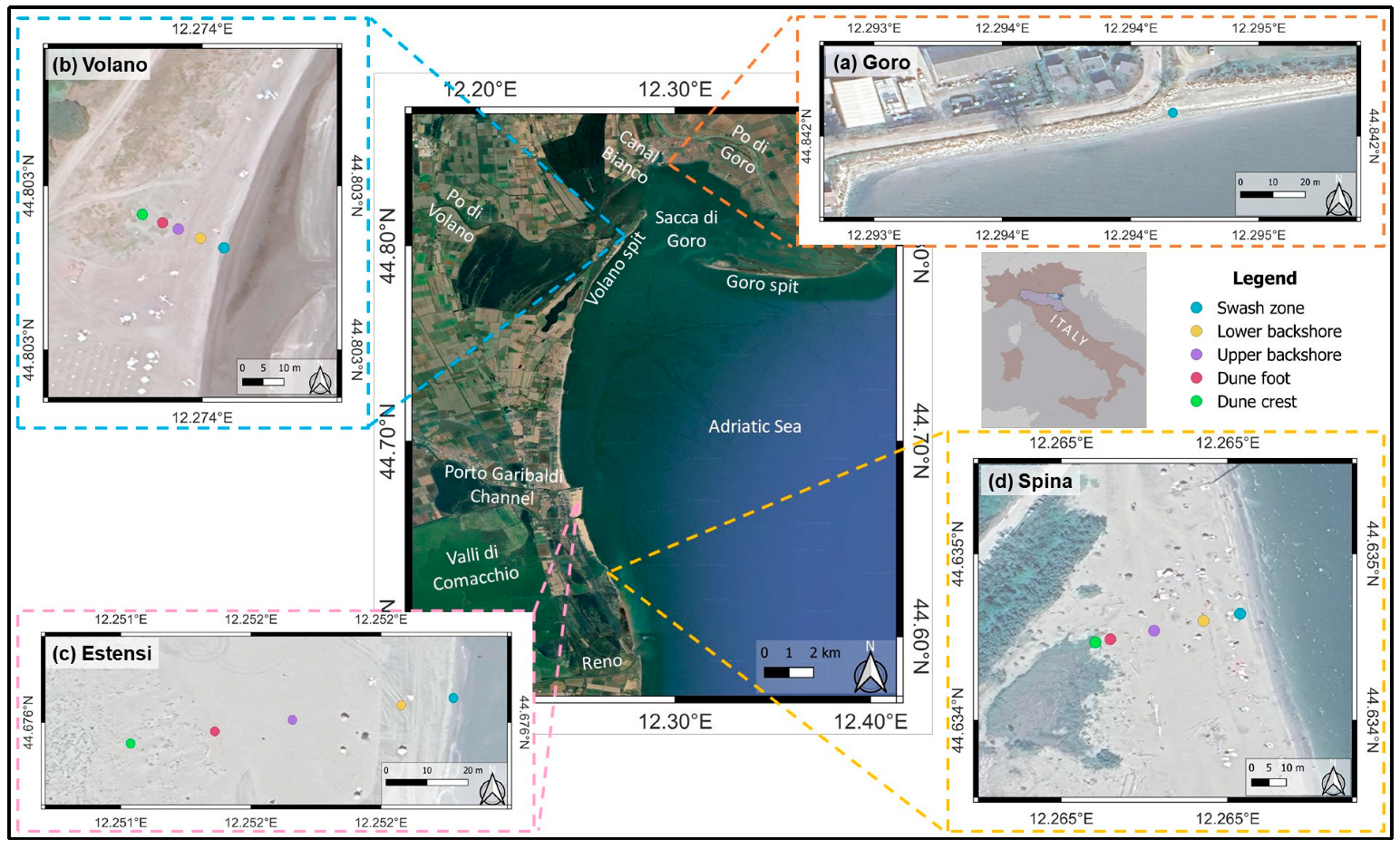
Volano lies in a sedimentary convergence zone where longshore drift from the SE-NW (Reno River) mixes with material transported from the E-NE by Po River [62,114]. Reno-derived sediments are typically characterized by Cr < 140 ppm and Ni < 80 ppm, while Po sediments are richer in Cr (>135 ppm) and Ni (>78 ppm) [44,63]. The mean Ni content (114 ± 78 ppm) of Volano sediments is comparable to the Po River sediments. However, Cr contents are much higher (1823 ± 2265 ppm) than those typically found in the Po sediments (Figure 2). These data suggest that Volano acts as a “natural trap” for PTE-bearing minerals characteristic of the Po basin [107,108,109]. At Volano, field observations between UB and DF revealed dark sediment bands parallel to the shoreline, corresponding to PTE-bearing mineral enrichments. These features varied in location and abundance seasonally. Similar placer-like accumulations have been reported along the Po Delta beaches, attributed to localized spinel enrichment [63]. According to Da Silva [112], three main mechanisms explain PTE-bearing mineral accumulation on beaches: (i) storm surges and/or spring tides pushing sediments to the landward; (ii) continuous reworking within overflow pools or berm-top channels; (iii) wind erosion on the backshore surface, removing finer grains and leaving a dark, surfaced layer of minerals.
Figure 2. Cr and Ni contents (ppm) in the Volano sediments compared with reference values for the Po and Reno River sediments [44,63]. Abbreviations: Sum—Summer; Aut—autumn; Win—winter; Spr—spring; SZ—swash zone; LB—lower backshore; UB—upper backshore; DF—dune foot; DC—dune crest.
At Estensi, the SiO2 content reaches its maximum in winter at UB (60.17 wt%) and its minimum in autumn at DF (47.46 wt%). Estensi has the most homogeneous composition, consistent with a dominant Apennine sedimentary contribution. Overall, only slight seasonal and cross-shore variations in composition are observed. No statistically significant correlations between chemical species and grain size classes are found.
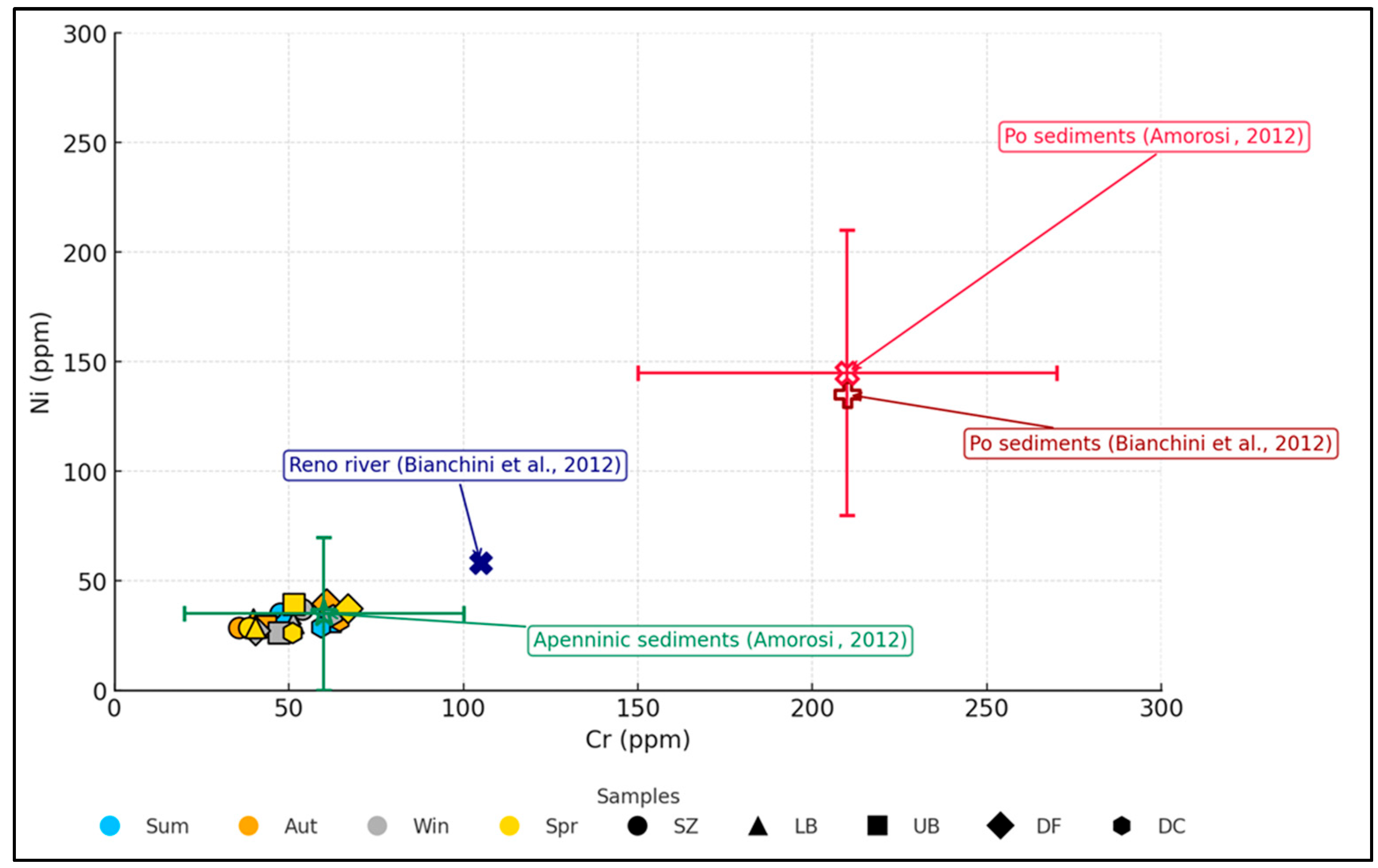
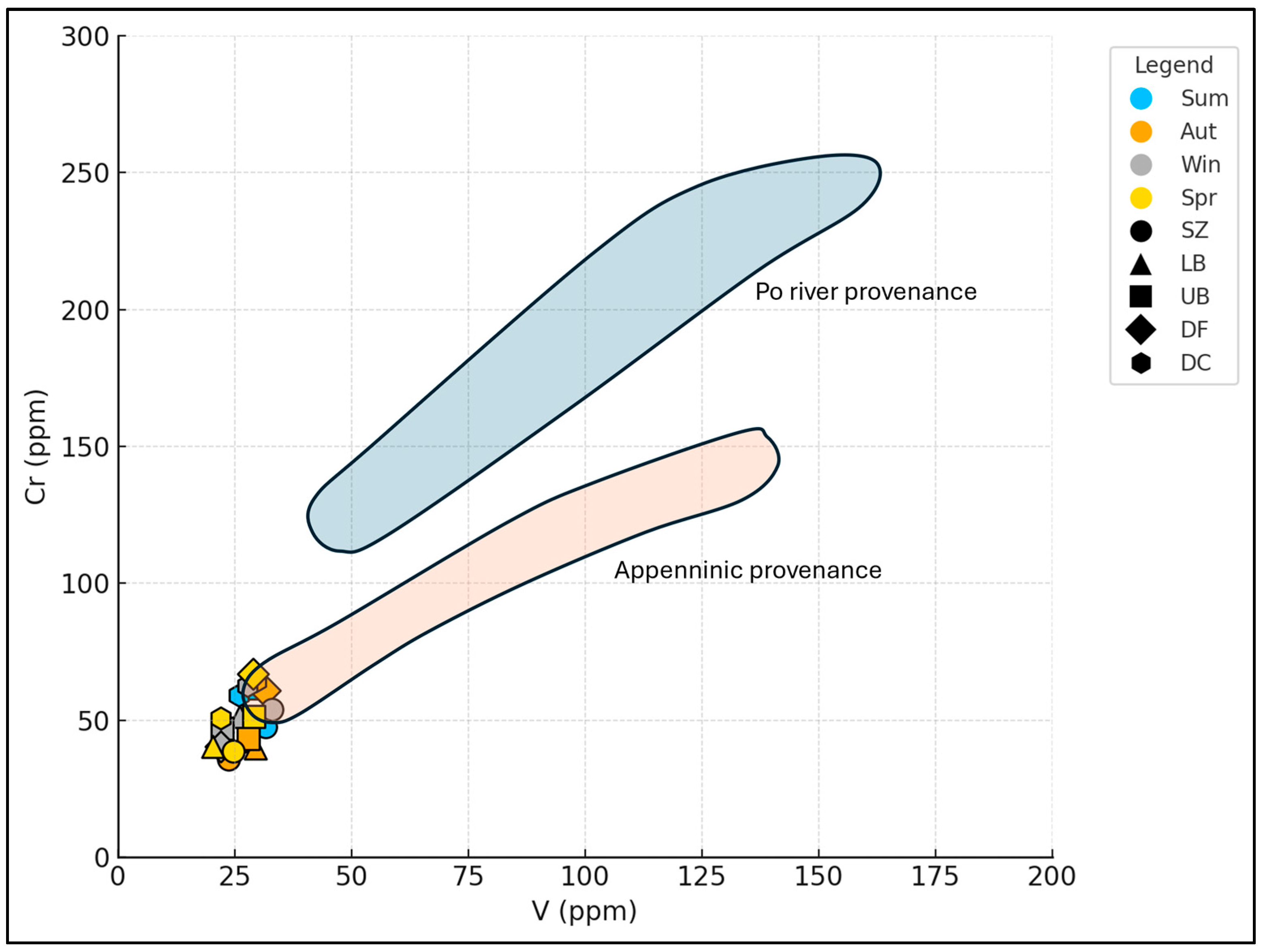
In general, grain size and composition in clastic sediments are closely related [27,115], as particle size, shape, and density influence chemical and mineralogical variations [27]. These effects are particularly evident in high-energy depositional systems such as rivers and beaches, especially for elements such as Ce, Cr, P, V, Ti, Y and Zr [116]. The Reno River, with a coastal transport from SE to NW, is the main source of sediments for the coastal stretch that includes the Estensi site [117]. The Reno basin differs from the Po in being entirely within the Apennine domain, which is dominated by siliciclastic turbidites and lacks significant ultramafic contributions [69,118,119]. Apennine-derived sediments are distinguished from those of the Po Plain by their lower Cr and Ni contents [44,63,64]. The Cr (36–67 ppm) and Ni (26–39 ppm) contents measured in Estensi sediments are consistent with those of the sediments of the Reno River (Figure 3). Further evidence is provided by Cr and V contents, consistent with Apennine source sediments [64,67]. Similarly, mean MgO/Al2O3 (0.23) and Ni/Al2O3 (3.9) ratios on Estensi sediments align to typical Apennine values reported by Greggio et al. [46], confirming their provenance (Figure 4).
Figure 3. Cr and Ni contents (ppm) in the Estensi sediments compared with reference values for the Po and Reno River sediments [44,63]. Abbreviations: Sum—Summer; Aut—autumn; Win—winter; Spr—spring; SZ—swash zone; LB—lower backshore; UB—upper backshore; DF—dune foot; DC—dune crest.
Figure 4. Cr and V contents (ppm) in the Estensi sediments compared with reference values for the Po and Reno River sediments [64,67]. Abbreviations: Sum—Summer; Aut—autumn; Win—winter; Spr—spring; SZ—swash zone; LB—lower backshore; UB—upper backshore; DF—dune foot; DC—dune crest.
At Spina, the SiO2 content reaches its maximum in summer at SZ (61.47 wt%) and its minimum in autumn at DF (44.94 wt%). There is a clear correlation between the increase in grain size (Supplementary Materials Figure S4) and the siliciclastic fraction (quartz and feldspars) represented by high SiO2, Na2O, and K2O contents (Table 1). The carbonate component, derived partly from biogenic shells and partly from river sediments transported by the Reno River [115], shows slight variations between the areas. Carbonates are more abundant at DF (25%) and less represented at LB (18%), following the sequence DF > UB = DC > SZ > LB. These variations reflect the trends indicated by Pearson’s correlation coefficients (Table 1). The carbonate content and related species (CaO and LOI) are most commonly associated with fine sands, which are more represented at UB, DF, and DC.
Table 1. Pearson’s correlation coefficients between chemical species and grain-size classes in sediments collected at the Spina site.
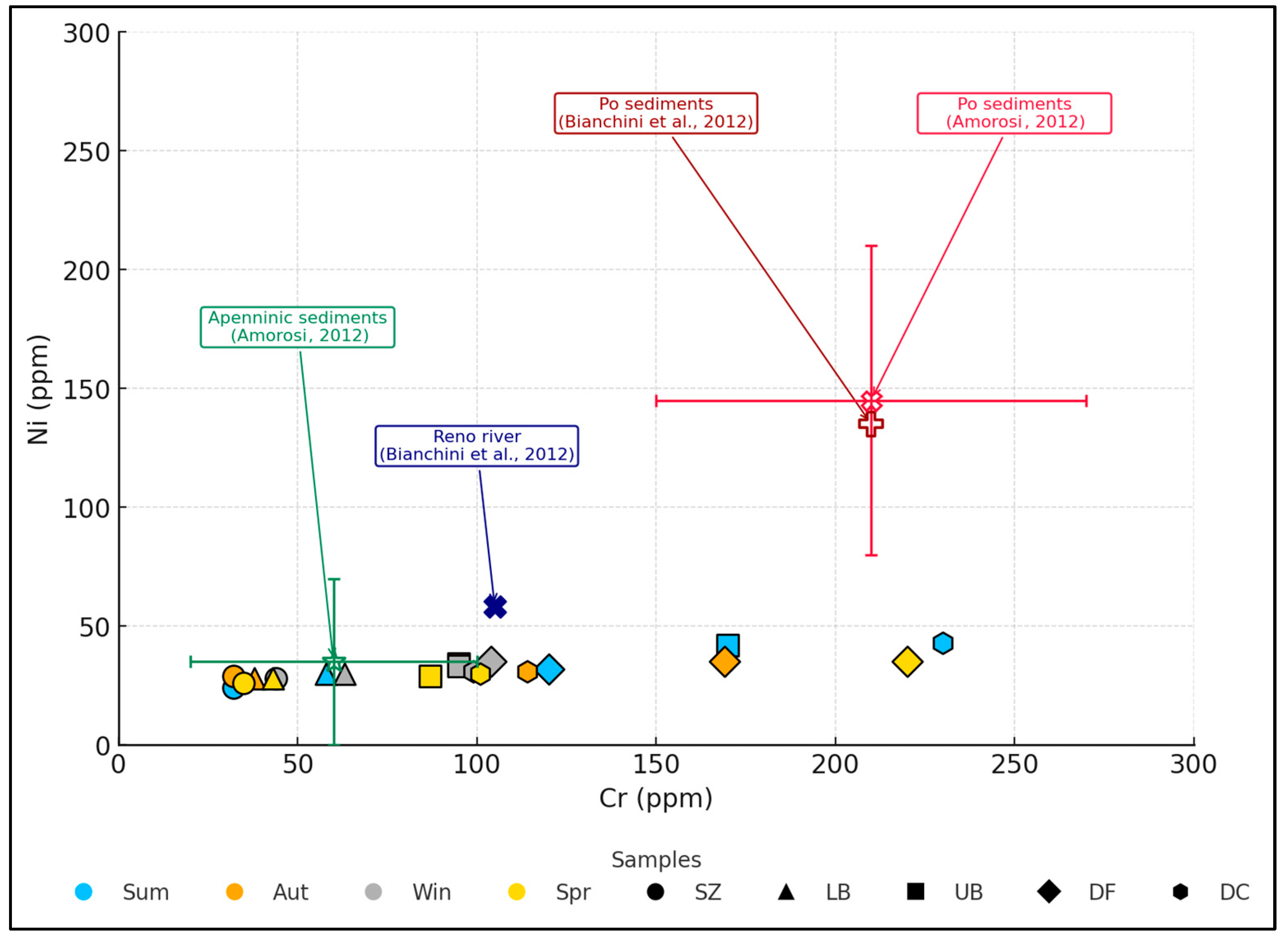
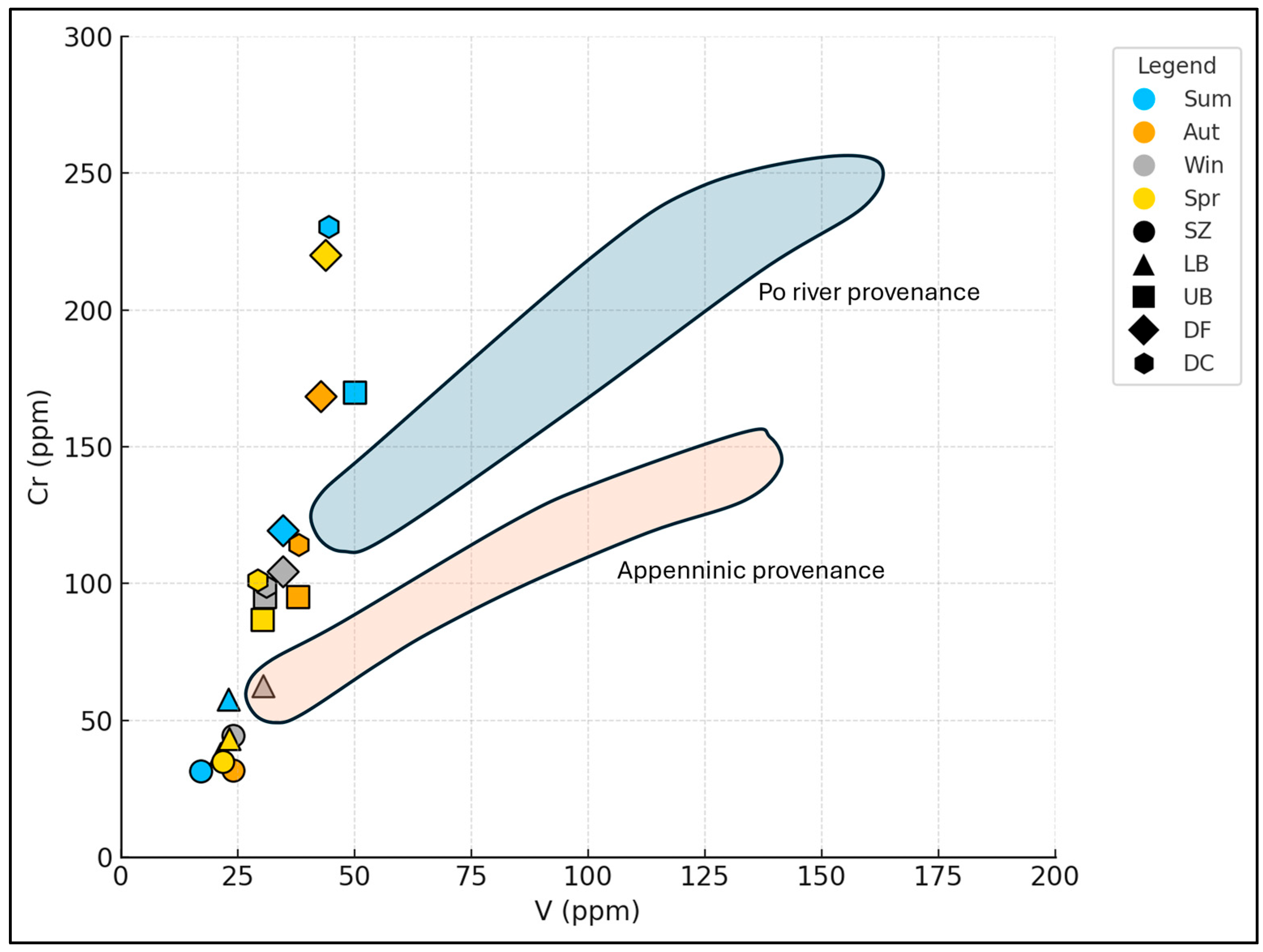
Compared to Estensi, the Spina site lies farther south and closer to the mouth of the Reno River. Consequently, it should represent the first coastal stretch directly influenced by the Reno River inputs. However, the geochemical features that clearly link the Estensi sediments to the Reno source are less distinct at Spina. Examination of the Cr/Ni (Figure 5) and Cr/V (Figure 6) ratios reveals that only some samples can be unequivocally attributed to an Apennine origin. This discrepancy is primarily due to elevated Cr contents in UB, DF, and DC sediments (summer, autumn, and spring). The high Cr contents at this site are unexpected. Pearson’s correlation coefficients (Table 1) indicate a certain dependence between major oxide composition and grain size classes. This suggests that coastal processes affect the sediment composition. However, no statistically significant relationships (p > 0.05) were found between grain-size and most trace elements, including Cr. Given its proximity to the Reno River mouth, the Spina site may act as a “sediment trap” for Cr-bearing minerals, similar to the role played by Volano for Po-derived sediments. The scale of this process is smaller, as the Reno basin supplies fewer Cr-bearing minerals than the Po system. This configuration may explain localized Cr enrichment at Spina and the lower Cr contents at Estensi.
Figure 5. Cr and Ni contents (ppm) in the Spina sediments compared with reference values for the Po and Reno River sediments [44,63]. Abbreviations: Sum—Summer; Aut—autumn; Win—winter; Spr—spring; SZ—swash zone; LB—lower backshore; UB—upper backshore; DF—dune foot; DC—dune crest.
Figure 6. Cr and V contents (ppm) in the Spina sediments compared with reference values for the Po and Reno River sediments [64,67]. Abbreviations: Sum—Summer; Aut—autumn; Win—winter; Spr—spring; SZ—swash zone; LB—lower backshore; UB—upper backshore; DF—dune foot; DC—dune crest.

4.3. Environmental Quality Indices and Comparison of Legal Limits

The Igeo and CF values calculated for each site, season, and geomorphological zone are provided in the Supplementary Materials (Tables S12–S18). Data obtained from WD-XRF analysis were used to calculate the environmental quality indices (Igeo, CF, and PLI).
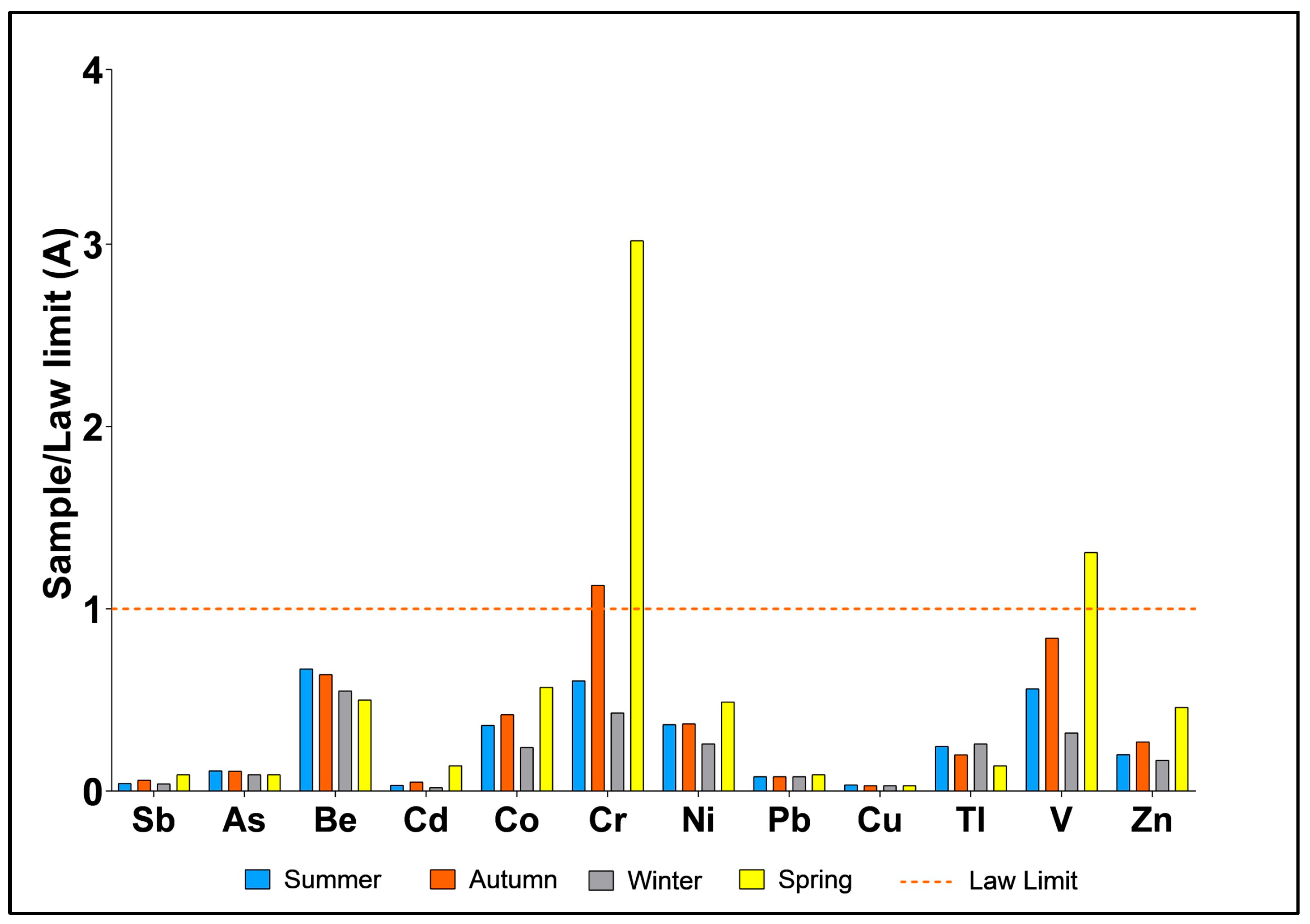
According to the Igeo values (Supplementary Materials Table S12), Goro sediments are generally classified as “unpolluted”, except in spring, when they fall into the “unpolluted to moderately polluted” category for Cr, La, and Zr. Similarly, according to the CF values (Supplementary Materials Table S13), the Goro sediments are classified as “low contamination” for all elements in summer, autumn, and winter (except for La in autumn). In spring, “moderate contamination” levels were recorded for Nb, Y, and Zn; “considerable contamination” for Ce, La, and Zr; and “very high contamination” for Cr. The minor enrichment levels, identified through Igeo and CF, likely reflect the natural redistribution of Po-derived sediments by waves and currents at the study site. Accordingly, the PLI indicates that Goro sediments can be classified as “not polluted”. Results of ICP-MS analyses revealed that contents of some trace elements exceeded the thresholds established by Italian Legislative Decree (D. Lgs.) 152/2006 at Goro (Figure 7). Specifically, Cr exceeded the limit A (for green, private, and residential use) in autumn and spring, reaching approximately three times the legal threshold. V contents also exceeded limit A in spring. None of the analyzed elements exceeded limit B (for commercial and industrial use), which is higher than limit A.
Figure 7. Contents of potentially toxic elements (PTE) in sediments collected at the Goro site, normalized to the regulatory thresholds. Orange line: limit A defined by Italian D. Lgs. 152/06.
However, Italian legal limits do not take into account local geological backgrounds, which can sometimes naturally exceed these limits. As already noted by Amorosi and Sammartino [67], sediments in the Po Plain are characterized by natural contents of Cr and Ni that exceed Italian limits, given the presence of ultramafic and ferromagnesian minerals. In agreement with these authors, it is considered that regulatory limits should account for the local geological background. This approach helps prevent the misattribution of threshold exceedances to anthropogenic pollution and the resulting socio-economic implications. Furthermore, these Cr and Ni enrichments in the investigated site are unlikely to pose ecological risks in terms of bioavailability. As indicated by Sammartino, [120] in the southeastern Po Plain, high Cr and Ni linked to mineral phases, display limited bioavailability due to strong mineral binding, a condition also reported for Cu, Pb, and Zn. A similar behavior is expected for rare earth elements (REEs) such as Ce, La, and Y. Consequently, the metal enrichments observed in the Goro sediments are unlikely to represent a significant environmental concern. However, to further elucidate these processes, long-term biomonitoring and detailed mineralogical/geochemical investigations are recommended, particularly in connection with extreme meteorological events.
At Volano the Igeo values indicate variable degrees of enrichment depending on season, geomorphological zone, and element (Supplementary Materials Table S14). Therefore, sediments can be classified as follows:
  • “Unpolluted to moderately polluted”: In summer at SZ (Ce, Cr, La, Y, Zr), DF (Ce, Cr, La, Nb, Y, Zr), and DC (La, Nb, Y, Zr); in autumn at SZ (La, Nb, Y), LB (Zn), UB (Cr, Pb, Zn), DF (Pb and Zn), DC (Cr, La, Nb, Y); in winter at UB (Nb, Y, Zr), DF (Cr and Ni), and DC (Zn); in spring at LB (La), UB (Cr and Zn) and DC (Ce, La, Nb, Y)
  • “Moderately polluted”: In summer at UB (Ce, Cr, La, Nb, Y, Zr); in autumn at LB (Nb and Y), DF (La), and DC (Zr); in winter at UB (La), DF (Zn), and DC (Nb and Y); in spring at UB (Nb and Y), DF (Ce, La, Nb, Y) and DC (Cr and Zr)
  • “Moderately polluted to strongly polluted”: In autumn at LB (La and Zr), UB (La, Nb, Y), and DF (Nb and Y); in winter at DF (Nb and Y), and DC (La and Zr); in spring at UB (La) and DF (Cr and Zr)
  • “Strongly polluted”: In autumn at UB (Zr); in winter at DF (La); in spring at UB (Zr)
  • “Strongly polluted to extremely polluted”: In autumn at DF (Zr)
  • “Extremely polluted”: In winter at DF (Zr)
In the absence of explicit mention, sediments can be classified as “unpolluted”.
Similarly, at Volano the CF values reveal contamination levels varying seasonally and spatially (Supplementary Materials Table S15). Therefore, sediments can be classified as follows:
  • “Moderate contamination”: In summer at SZ (Ce, Cr, La, Nb, Sr, Y, Zr), LB (La), UB (Zn) and DF and DC (Ce, Cr, La, Nb, Y, Zr); in autumn at SZ (Ce, Cr, La, Nb, St, Y), LB (Zn), UB and DF (Ni and Zn) and DC (Ce, La, Nb, Y); in winter at LB (La), UB (Ce, Nb, Y, Zr), DF (Co and Ni), and DC (Zn); in spring at LB (Cr, La, Y, Zr), UB (Ni and Zn), DF (Zn) and DC (Ce, La, Nb, Y)
  • “Considerable contamination”: In summer at UB (Ce, La, Nb, Y, Zr); in autumn at LB (Nb and Y), DF (La), and DC (Cr and Zr); in winter at UB (Cr and La), DF (Zn), and DC (Nb and Y); in spring at UB (Nb and Y), DF (Ce, La, Nb, Y) and DC (Cr e Zr)
  • “Very high contamination”: In summer at UB (Cr); in autumn at LB (Ce, Cr, La, Zr), UB (Ce, Cr, La, Nb, Y, Zr), and DF (Ce, Cr, Nb, Y, Zr); in winter at DF (Ce, Cr, La, Nb, Y, Zr) and DC (Ce, Cr, La, Zr); in spring at UB (Ce, Cr, La, Zr) and DF (Cr e Zr)
In the absence of explicit mention, sediments can be attributed to the “low contamination” class.
The PLI allows Volano sediments to be classified as follows:
  • “Not polluted”: In summer at SZ, LB, DF, and DC; autumn at SZ; winter at SZ, LB, and UB; spring at SZ, LB, and DC;
  • “Polluted”: In summer at UB; autumn at LB, UB, DF, and DC; winter at DF and DC; spring at UB and DF.
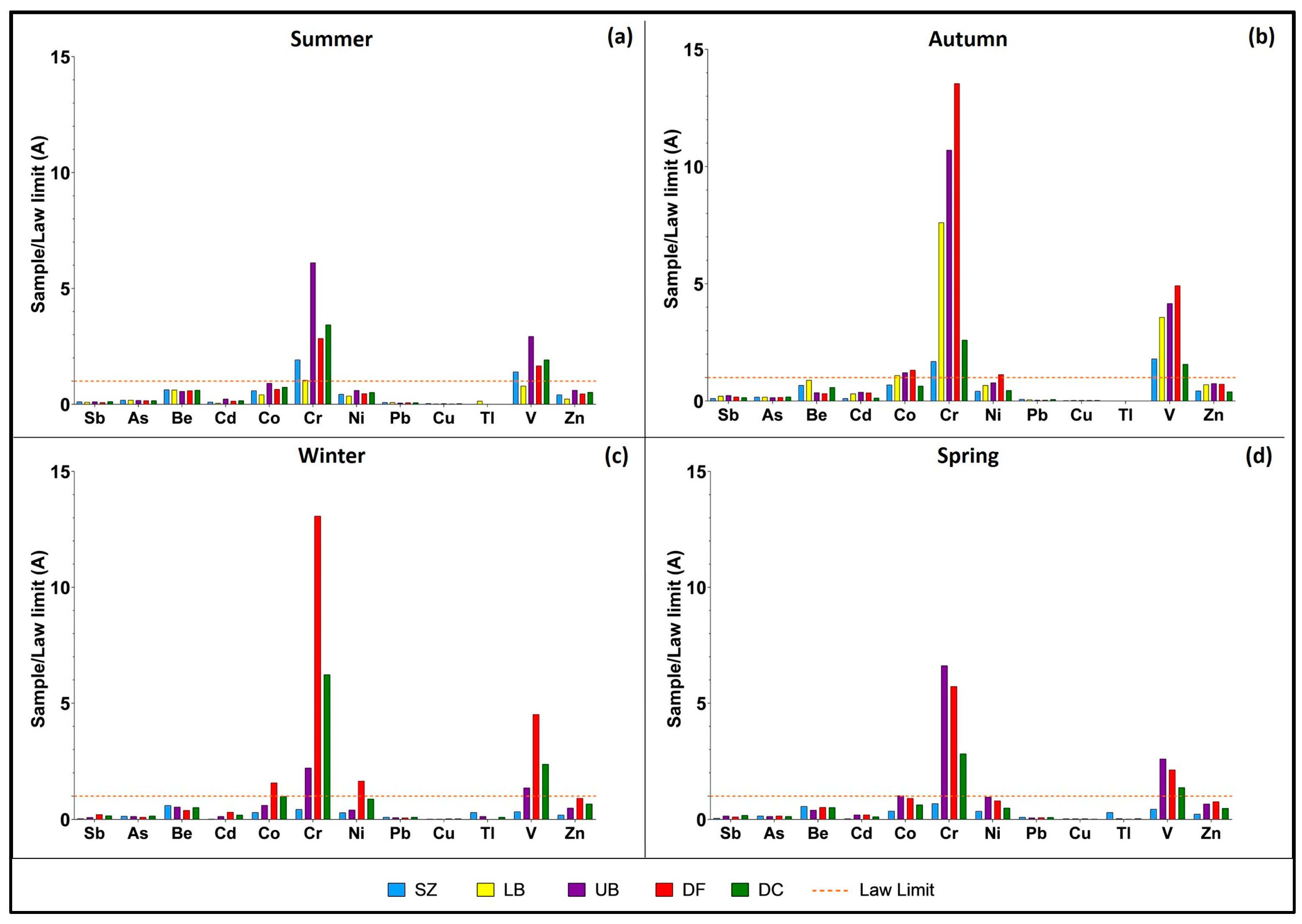
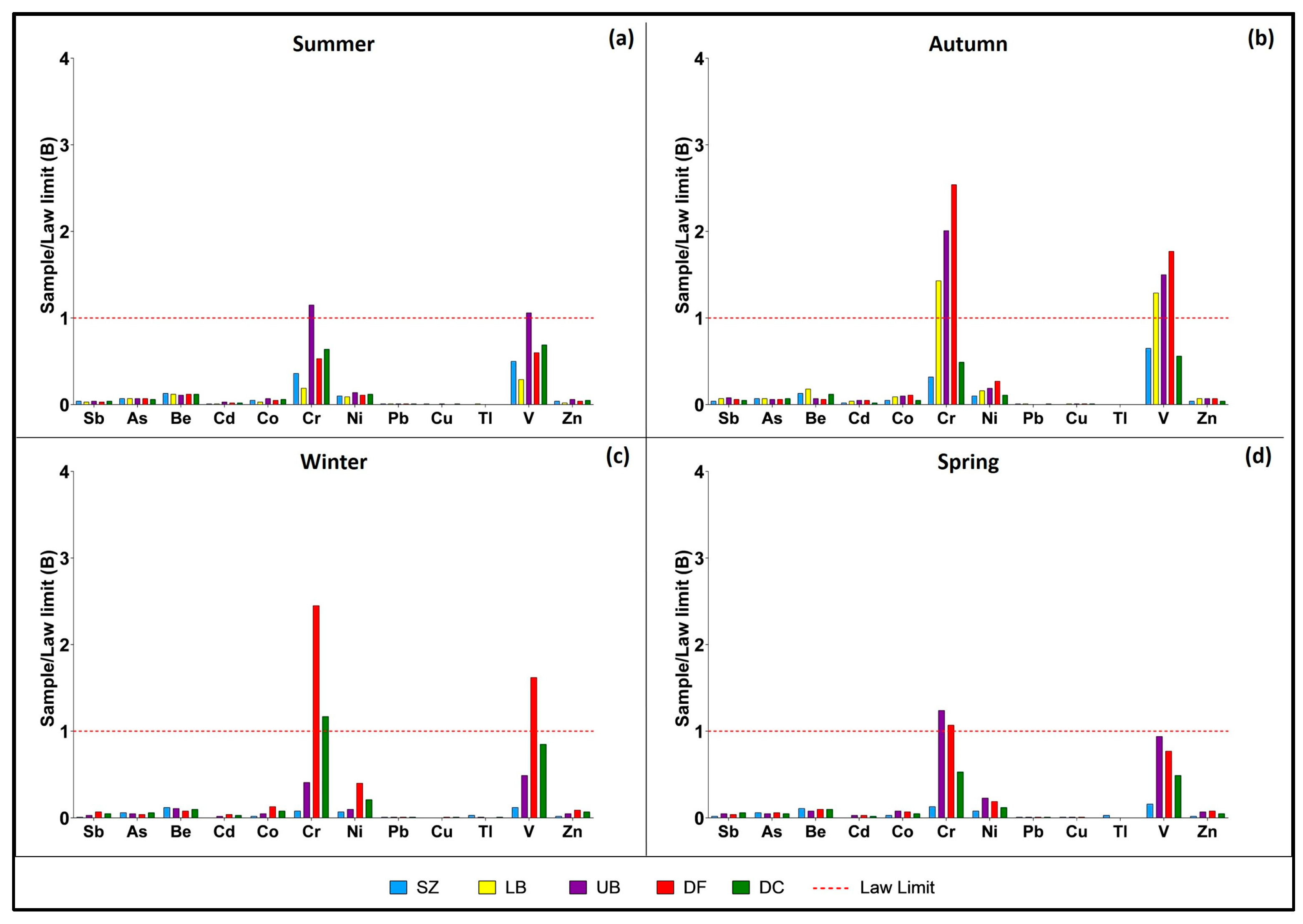
Results of ICP-MS analyses (Figure 8 and Figure 9) reveal multiple exceedances of Italian regulatory thresholds (D. Lgs. 152/2006). In summer, Cr exceeds limit A in all zones and limit B at the UB; V generally exceeds limit A (except in LB), and it exceeds limit B at the UB. Similar exceedances occur in autumn and winter, particularly for Cr, V, Co, and Ni in the UB, DF, and DC. In spring, Cr and Ni exceed limit A in UB, DF, and DC, and Cr exceeds limit B in UB and DF. Pearson’s correlation coefficients among trace elements (Ce, Cr, Co, La, Nb, Y, Zr) indicate positive correlations statistically significant (p < 0.01), suggesting common sources [19,121,122] and also indicating common accumulation mechanisms. These relationships confirm that the observed anomalies are geogenic rather than anthropogenic. The considerations regarding the thresholds exceeded for PTE contents and their bioavailability discussed for Goro also apply to Volano. Targeted biomonitoring and detailed mineralogical investigations are recommended to further assess long-term sediment dynamics and potential ecological impacts.
Figure 8. Contents of potentially toxic elements (PTE) in sediments collected at the Volano site, normalized to the regulatory thresholds. Investigated season: (a) summer; (b) autumn; (c) winter; (d) spring. Orange line: Limit A defined by Italian D. Lgs. 152/06.
Figure 9. Contents of potentially toxic elements (PTEs) in sediments collected at the Volano site, normalized to the regulatory thresholds. Investigated season: (a) summer; (b) autumn; (c) winter; (d) spring. Red line: Limit B defined by Italian D. Lgs. 152/06.
Applying Igeo to the Estensi sediments, no environmental contamination was detected for the analyzed elements (Ba, Ce, Co, Cr, Cu, La, Nb, Ni, Pb, Rb, Sr, Y, Zn, Zr). In winter and spring, the Ce contents were below detection limits, so the Igeo was not calculated. All sediments are classified as “unpolluted”, confirming the absence of anomalous enrichments related to the local geochemical background. Similarly, at Estensi the CF values (Supplementary Materials Table S16) indicate “low contamination” for most elements. However, “moderate contamination” levels were identified for the following:
  • Ba: In summer and winter at the UB, DF, and DC; in autumn and spring at the DF and DC;
  • La: In summer and spring at the DF;
  • Sr: Throughout all seasons and geomorphological zones, except the UB and DF in summer and winter, and the DC in spring.
The enrichment in Ba may be associated with feldspar-rich fractions, as Ba can substitute for K in feldspar lattices [22]. Supporting this hypothesis, Ba contents display a significant negative correlation with K2O (p < 0.01). Sr enrichments likely reflect the presence of aragonitic shell fragments from invertebrates, since aragonite typically contains higher Sr contents than calcite [123,124].
PLI values indicate that the sediments can be classified as “not polluted” at Estensi.
Finally, the results of ICP-MS analyses confirm that none of the investigated PTEs exceed the regulatory thresholds established by D. Lgs. 152/2006. At Estensi site no evidence of contamination or potential environmental risk was detected under current legislative criteria.
Application of the Igeo (Supplementary Materials Table S17) indicates that nearly all Spina sediments are “unpolluted” for most analyzed elements. A notable exception is Ba, which classifies DF and DC sediments as “unpolluted to moderately polluted” and “moderately polluted” across all seasons. Considering the significant correlation between Ba and Cr (p < 0.01), Ba enrichment may be linked to the same processes responsible for higher Cr-bearing mineral abundance. In spring, DF sediments also reveal anomalies for La and Zr, falling within the “unpolluted to moderately polluted” class.
The CF results (Supplementary Materials Table S18) reveal that Spina sediments are generally characterized by “moderate contamination” for Sr across all seasons and geomorphological zones. As observed at Estensi, at Spina the Sr enrichment is likely associated with the presence of aragonitic shell fragments. Throughout the year, Ba levels observed at UB, DF, and DC place the sediments in the “moderate contamination” and “considerable contamination” classes. “Moderate contamination” levels are also recorded for La in autumn (UB, DF, DC), summer (UB, DC), winter (UB, DC), and spring (DF). In summer, DC sediments indicate “moderate contamination” for Cr, Y (also at UB), and Zr. This latter also exhibits “moderate contamination” at the DF in spring. The significant positive correlations (p < 0.01) between Cr, La, Y, and Zr suggest a common source [19,121,122] and similar accumulation mechanisms for PTE-bearing minerals.
Despite these localized enrichments, the PLI classifies all Spina sediments as “not polluted”.
Finally, the results of ICP-MS analyses confirm that none of the elements exceed the regulatory thresholds established by D. Lgs. 152/2006 at Spina. Despite minor localized enrichments, the sediments do not exhibit levels of enrichment that would pose an environmental risk under current legislation.

5. Conclusions and Future Perspectives

This study represents one of the few investigations to conduct an integrated, seasonal, and cross-shore analysis of sediments along the Ferrara coastal area (Northern Italy). The applied approach combines the textural and compositional investigation of sediments and provides insight into the spatial-temporal dynamics that control sediment distribution. The results highlight that weather-marine conditions, sediment input from the Po and Reno rivers, and long-shore drift control sediment composition and contents of potentially toxic elements. The environmental quality indices (Igeo, CF, PLI) were applied to determine specific environmental risk conditions. In addition, the contents of potentially toxic elements were compared with the regulatory thresholds established by Italian environmental legislation.
The sediments of Goro are dominated by well sorted, medium to fine sands, indicative of a moderately energetic environment. Seasonal textural variations reflect more dynamic conditions in autumn and winter, characterized by an increase in coarser fractions, while spring samples reveal anomalous enrichments in Ce, Cr, La, V, and Zr. These findings are mainly attributed to physical sorting processes and the natural geogenic contribution of the Po Basin. The environmental quality indices confirm that the site is overall unpolluted, despite positive anomalies in Ce, Cr, La, V, and Zr. The high contents of potentially toxic elements are attributable to a geogenic origin. These elements are assumed to be poorly bioavailable.
The Volano site displays pronounced seasonal and cross-shore variability, with elevated Fe2O3, TiO2, Ce, Cr, La, Y and Zr contents associated with enrichments in PTEs-bearing minerals (e.g., spinels, zircons, allanites). The occurrence of enrichment bands, particularly within the dune foot and upper backshore, is likely linked to storm surges activity. Environmental quality indices indicate localized enrichments. These findings are likely caused by natural sediment content mechanisms rather than anthropogenic pollution. The potentially toxic element contents frequently exceed regulatory thresholds (e.g., Cr and V in the upper backshore and dune foot). However, these metals are likely bound to mineral phases that limit their bioavailability, raising few environmental concerns.
At the Estensi site, the chemical composition remains stable both spatially and temporally. Grain size and chemical species contents are not significantly correlated, indicating that sediment provenance plays a greater role than coastal processes to determine the sediments composition. Indeed, compositional features allow to clearly identify the Reno basin as the sedimentary source. Environmental quality indices classify the sediments as unpolluted, and potentially toxic element contents fall within regulatory limits, reflecting the natural geochemical background of the Reno basin, with no evidence of contamination.
The Spina site is characterized by stable and well-organized depositional system along the cross-shore profile, dominated by well-sorted medium sands and a gradual fining trend toward the dune crest. Despite the proximity to the Reno mouth, compositional features do not allow a clear identification of the Reno basin as the sedimentary source, due to high Cr contents. Contrary to the Estensi site, at Spina the coastal processes affect the sediment composition across the coastal profile. Environmental quality indices reveal positive anomalies in Cr, Zr and La attributable to natural fluvial inputs. The absence of regulatory exceedances indicates an overall good environmental status.
This research was conducted with an exploratory aim to support future applications. In forthcoming studies the sediment geochemistry (seasonally and geomorphologically based) should be implemented by (i) targeted mineralogical analyses, aimed at confirming the presence of PTE-bearing minerals and assessing their bioavailability; (ii) the assessment of sediment-water exchange processes; and (iii) biomonitoring studies, employing biomarkers and bioindicator organisms to evaluate the potential ecotoxicological effects of short-, medium-, and long-term exposure to high contaminant contents (e.g., [44,46,125,126,127]).
To gain a deeper understanding of the processes governing coastal sediment dynamics, long-term monitoring programs should be implemented, including targeted sampling during extreme events (e.g., storm surges, high-energy wave events, and river floods). Such investigations would help assess how hydrodynamic and meteorological conditions influence sediment composition, particularly focused on PTE-bearing minerals. This is important considering the increase in frequency of extreme events under global climate change. Furthermore, studying the residence and transfer times of sediments from river basins to coastal areas under different conditions is crucial for identifying the dominant factors controlling sediment supply. This information is also important to understand the morphological and geochemical evolution of the coastal environments.
The present study focused on the inorganic geochemical characteristics of sediments. However, integrating future assessments with investigations of organic pollutants would provide a more comprehensive understanding of the environmental pressures affecting the Ferrara coastal system. This interdisciplinary approach could provide valuable insights into combined contaminant pathways and cumulative ecosystem risks. This would enhance the applicability of similar research for environmental management and policy development.

Supplementary Materials

The following supporting information can be downloaded at https://www.mdpi.com/article/10.3390/environments13010004/s1. Table S1: Results of WD-XRF analyses performed in triplicate on certified reference material JSd-2 (river sediment, Geological Survey of Japan). The average values, standard deviations (SDs), relative standard deviations (RSDs), consensus values, absolute error (Eabs), and relative error (Erel) are reported. Table S2: Results of WD-XRF analyses performed in triplicate on certified reference material JSd-3 (river sediment, Geological Survey of Japan). The average values, standard deviations (SDs), relative standard deviations (RSDs), consensus values, absolute error (Eabs), and relative error (Erel) are reported. Table S3: Results of WD-XRF analyses performed in triplicate on certified reference material GSR-4 (sandstone, National Research Center of Geoanalysis, Beijing, China). The average values, standard deviations (SDs), relative standard deviations (RSDs), consensus values, absolute error (Eabs), and relative error (Erel) are reported. Table S4: Average values of relative standard deviation (RSD) and relative error (Erel) referring to analyses on certified reference materials JSd-2, JSd-3, and GSR-4. Table S5: Results of ICP-MS analyses performed in triplicate on certified reference material GSR-1 (granite, National Research Center of Geoanalysis, Beijing, China). The average values, standard deviations (SDs), relative standard deviations (RSDs), consensus values, and recovery percentages are reported. Table S6: Results of ICP-MS analyses performed in triplicate on certified reference material GSR-4 (sandstone, National Research Center of Geoanalysis, Beijing, China). The average values, standard deviations (SDs), relative standard deviations (RSDs), consensus values, and recovery percentages are reported. Table S7: Results of ICP-MS analyses performed in triplicate on certified reference material SDC-1 (micaschist, U.S. Geological Survey). The average values, standard deviations (SDs), relative standard deviations (RSD), consensus values, and recovery percentages are reported. Table S8: Average values of relative standard deviation (RSD) and recovery on certified reference materials GSR-1, GSR-4, and SDC-1. Furthermore, the limit of quantification (LOQ) for each estimated element. Table S9: Folk and Ward parameters calculated from textural analyses of sediments collected at each site, season and geomorphological zones. Table S10: Major oxide composition and carbonate content of sediments collected at each site, season and geomorphological zones. Table S11: Trace element contents of sediments collected at each site, season and geomorphological zones. Table S12: Geoaccumulation Index (Igeo) values calculated from trace element contents in sediments collected at the Goro site. A color scale was applied to facilitate the interpretation of Igeo classes: (I) Igeo ≤ 0, unpolluted (light blue); (II) 0 ≤ Igeo ≤ 1, unpolluted to moderately polluted (blue). Table S13: Contamination Factor (CF) values calculated from trace element contents in sediments collected at the Goro site. A color scale was applied to facilitate the interpretation of CF classes: (I) CF ≤ 1, low contamination (green); (II) 1 ≤ CF ≤ 3, moderate contamination (yellow); (III) 3 ≤ CF ≤ 6, considerable contamination (orange); (IV) CF > 6, very high contamination (red). Table S14: Geoaccumulation Index (Igeo) values calculated from trace element contents in sediments collected at the Volano site. A color scale was applied to facilitate the interpretation of Igeo classes: (I) Igeo ≤ 0, unpolluted (light blue); (II) 0 ≤ Igeo ≤ 1, unpolluted to moderately polluted (blue); (III) 1 ≤ Igeo ≤ 2, moderately polluted (green); (IV) 2 ≤ Igeo ≤ 3, moderately to strongly polluted (yellow); (V) 3 ≤ Igeo ≤ 4, strongly polluted (orange); (VI) 4 ≤ Igeo ≤ 5, strongly to extremely polluted (red); (VII) Igeo > 5, extremely polluted (purple). Table S15: Contamination Factor (CF) values calculated from trace element contents in sediments collected at the Volano site. A color scale was applied to facilitate the interpretation of CF classes: (I) CF ≤ 1, low contamination (green); (II) 1 ≤ CF ≤ 3, moderate contamination (yellow); (III) 3 ≤ CF ≤ 6, considerable contamination (orange); (IV) CF > 6, very high contamination (red). Table S16: Contamination Factor (CF) values calculated from trace element contents in sediments collected at the Estensi site. A color scale was applied to facilitate the interpretation of CF classes: (I) CF ≤ 1, low contamination (green); (II) 1 ≤ CF ≤ 3, moderate contamination (yellow). Table S17: Geoaccumulation Index (Igeo) values calculated from trace element contents in sediments collected at the Spina site. A color scale was applied to facilitate the interpretation of Igeo classes: (I) Igeo ≤ 0, unpolluted (light blue); (II) 0 ≤ Igeo ≤ 1, unpolluted to moderately polluted (blue); (III) 1 ≤ Igeo ≤ 2, moderately polluted (green). Table S18: Contamination Factor (CF) values calculated from trace element contents in sediments collected at the Spina site. A color scale was applied to facilitate the interpretation of CF classes: (I) CF ≤ 1, low contamination (green); (II) 1 ≤ CF ≤ 3, moderate contamination (yellow); (III) 3 ≤ CF ≤ 6, considerable contamination (orange). Figure S1: Grain-size distribution in sediments collected at the Goro site. Figure S2: Grain-size distribution in sediments collected at the Volano site in each season and geomorphological zones: (a) summer; (b) autumn; (c) winter; (d) spring. Figure S3: Grain-size distribution in sediments collected at the Estensi site in each season and geomorphological zones: (a) summer; (b) autumn; (c) winter; (d) spring. Figure S4: Grain-size distribution in sediments collected at the Spina site in each season and geomorphological zones: (a) summer; (b) autumn; (c) winter; (d) spring.

Author Contributions

Conceptualization, J.B. and A.A.; methodology, J.B. and A.A.; software, A.A.; validation, J.B., A.A., E.M. and C.V.; formal analysis, J.B. and A.A.; investigation, J.B.; resources, C.V.; data curation, A.A.; writing—original draft preparation, J.B. and A.A.; writing—review and editing, J.B. and A.A.; visualization, J.B.; supervision, E.M.; project administration, J.B.; funding acquisition, C.V., J.B. and A.A. contributed equally to this paper. All authors have read and agreed to the published version of the manuscript.

Funding

This research was funded by the National Recovery and Resilience Plan (NRRP), Mission 04 Component 2 Investment 1.5—NextGenerationEU, call for tender n. 3277 dated 30 December 2021, Award Number: 0001052 dated 23 June 2022.

Data Availability Statement

Data is contained within the article or Supplementary Material.

Acknowledgments

The authors gratefully acknowledge the anonymous reviewers for their feedback and constructive comments. Special thanks go to Umberto Tessari, Renzo Tassinari, Enrico Corbia and Ruggero Evangelista for their analytical support.

Conflicts of Interest

The authors declare no conflicts of interest. The funders had no role in the design of the study; in the collection, analyses, or interpretation of data; in the writing of the manuscript; or in the decision to publish the results.

Abbreviations

The following abbreviations are used in this manuscript:
Al2O3Aluminum Oxide
AsArsenic
AutAutumn
BaBarium
BeBeryllium
CaCO3Calcium Carbonate
CdCadmium
CeCerium
CFContamination Factor
CoCobalt
CO2Carbon dioxide
CrChromium
CuCopper
DCDune Crest
DFDune Foot
D.Lgs.Italian Legislative Decree
E-NEEast–northeast
Fe2O3Iron(III) Oxide
GPSGlobal Positioning System
H2O2Hydrogen Peroxide
HClHydrochloric Acid
HFHydrofluoric Acid
HNO3Nitric Acid
ICP-MSInductively Coupled Plasma Mass Spectrometry
IgeoGeoaccumulation Index
KPotassium
K2OPotassium Oxide
LaLanthanum
LBLower Backshore
LOILoss On Ignition
LOQLimit Of Quantification
MgOMagnesium Oxide
MnOManganese(II) Oxide
Na2OSodium Oxide
NbNiobium
NiNickel
NWNorthwest
P2O5Phosphorus Pentoxide
PbLead
PLIPollution Load Index
PTEsPotentially Toxic Elements
PTFEPolytetrafluoroethylene
QAQuality Assurance
QCQuality Control
REERare Earth Elements
SCISite of Community Importance
SDStandard Deviation
SESoutheast
SiO2Silicon Dioxide
SPASpecial Protection Area
SprSpring
SrStrontium
SumSummer
SZSwash Zone
TiO2Titanium Dioxide
TlThallium
UBUpper Backshore
UTMUniversal Transverse Mercator
VVanadium
YYttrium
WinWinter
WD-XRFWavelength Dispersive X-Ray Fluorescence Spectrometry
WGSWorld Geodetic System
wt%Weight Percent
ZnZinc
ZrZirconium

Appendix A

Table A1 contains the pairs of coordinates of the sampling stations (decimal degrees).
Table A1. Coordinates of the sampling stations.
SiteZone 1Latitude—NorthLongitude—East
GoroSZ44.841591812.2941654
VolanoSZ44.802811112.273566
LB44.802840112.2734944
UB44.802868312.2734267
DF44.802887912.2733785
DC44.80291312.273317
EstensiSZ44.675675412.252223
LB44.675653112.252063
UB44.67560812.2517277
DF44.675572712.2514891
DC44.675535612.2512299
SpinaSZ44.634384312.2652453
LB44.634358612.2651129
UB44.634323212.2649351
DF44.634292312.2647773
DC44.63428112.2647232
1 Abbreviations: SZ—Swash zone; LB—lower backshore; UB—upper backshore; DF—dune foot; DC—dune crest.

References

  1. Anfuso, G.; Loureiro, C.; Taaouati, M.; Smyth, T.; Jackson, D. Spatial Variability of Beach Impact from Post-Tropical Cyclone Katia (2011) on Northern Ireland’s North Coast. Water 2020, 12, 1380. [Google Scholar] [CrossRef]
  2. European Commission. Eurosion Project—Living with Coastal Erosion in Europe. In Results from the Eurosion Study; Doody, P., Ferreira, M., Lombardo, S., Lucius, I., Misdorp, R., Niesing, H., Salman, A., Smallegange, M., Eds.; European Commission: Luxembourg, 2005; pp. 1–57. [Google Scholar]
  3. Finkl, C.W. The Last Beach by Orrin H. Pilkey and J. Andrew Cooper. J. Coast. Res. 2016, 32, 225. [Google Scholar] [CrossRef]
  4. Goldenberg, S.B.; Landsea, C.W.; Mestas-Nuñez, A.M.; Gray, W.M. The Recent Increase in Atlantic Hurricane Activity: Causes and Implications. Science 2001, 293, 474–479. [Google Scholar] [CrossRef]
  5. Millennium Ecosystem Assessment. Ecosystems and Human Well-Being: Synthesis; Island Press: Washington, DC, USA, 2005; pp. 1–155. [Google Scholar]
  6. Barbier, E.B.; Hacker, S.D.; Kennedy, C.; Koch, E.W.; Stier, A.C.; Silliman, B.R. The Value of Estuarine and Coastal Ecosystem Services. Ecol. Monogr. 2011, 81, 169–193. [Google Scholar] [CrossRef]
  7. Braatz, S.M. Coastal Protection in the Aftermath of the Indian Ocean Tsunami: What Role for Forests and Trees? In Proceedings of the Regional Technical Workshop, Khao Lak, Thailand, 28–31 August 2006; Food and Agriculture Organization of the United Nations, Regional Office for Asia and the Pacific: Bangkok, Thailand, 2007. ISBN 978-974-7946-95-6. [Google Scholar]
  8. Cochard, R.; Ranamukhaarachchi, S.L.; Shivakoti, G.P.; Shipin, O.V.; Edwards, P.J.; Seeland, K.T. The 2004 Tsunami in Aceh and Southern Thailand: A Review on Coastal Ecosystems, Wave Hazards and Vulnerability. Perspect. Plant Ecol. Evol. Syst. 2008, 10, 3–40. [Google Scholar] [CrossRef]
  9. Koch, E.W.; Barbier, E.B.; Silliman, B.R.; Reed, D.J.; Perillo, G.M.; Hacker, S.D.; Granek, E.F.; Primavera, J.H.; Muthiga, N.; Polasky, S.; et al. Non-linearity in Ecosystem Services: Temporal and Spatial Variability in Coastal Protection. Front. Ecol. Environ. 2009, 7, 29–37. [Google Scholar] [CrossRef]
  10. Antonioli, F.; De Falco, G.; Lo Presti, V.; Moretti, L.; Scardino, G.; Anzidei, M.; Bonaldo, D.; Carniel, S.; Leoni, G.; Furlani, S.; et al. Relative Sea-Level Rise and Potential Submersion Risk for 2100 on 16 Coastal Plains of the Mediterranean Sea. Water 2020, 12, 2173. [Google Scholar] [CrossRef]
  11. Buoninsegni, J.; Olivo, E.; Paletta, M.G.; Vaccaro, C.; Corbau, C. Marine Litter Surveys on Boccasette Beach (Rovigo, Italy). In Ninth International Symposium “Monitoring of Mediterranean Coastal Areas: Problems and Measurement Techniques”; Bonora, L., Carboni, D., De Vincenzi, M., Matteucci, G., Eds.; Firenze University Press: Florence, Italy, 2022; pp. 156–164. [Google Scholar]
  12. Corbau, C.; Munari, C.; Mistri, M.; Lovo, S.; Simeoni, U. Application of the Principles of ICZM for Restoring the Goro Lagoon. Coast. Manag. 2016, 44, 350–365. [Google Scholar] [CrossRef]
  13. Criado-Aldeanueva, F.; Del Río Vera, J.; García-Lafuente, J. Steric and Mass-Induced Mediterranean Sea Level Trends from 14 Years of Altimetry Data. Glob. Planet. Change 2008, 60, 563–575. [Google Scholar] [CrossRef]
  14. Perini, L.; Calabrese, L.; Salerno, G.; Ciavola, P.; Armaroli, C. Evaluation of Coastal Vulnerability to Flooding: Comparison of Two Different Methodologies Adopted by the Emilia-Romagna Region (Italy). Nat. Hazards Earth Syst. Sci. 2016, 16, 181–194. [Google Scholar] [CrossRef]
  15. Sekovski, I.; Armaroli, C.; Calabrese, L.; Mancini, F.; Stecchi, F.; Perini, L. Coupling Scenarios of Urban Growth and Flood Hazards along the Emilia-Romagna Coast (Italy). Nat. Hazards Earth Syst. Sci. 2015, 15, 2331–2346. [Google Scholar] [CrossRef]
  16. Simeoni, U.; Corbau, C. A Review of the Delta Po Evolution (Italy) Related to Climatic Changes and Human Impacts. Geomorphology 2009, 107, 64–71. [Google Scholar] [CrossRef]
  17. Tsimplis, M.; Spada, G.; Marcos, M.; Flemming, N. Multi-Decadal Sea Level Trends and Land Movements in the Mediterranean Sea with Estimates of Factors Perturbing Tide Gauge Data and Cumulative Uncertainties. Glob. Planet. Change 2011, 76, 63–76. [Google Scholar] [CrossRef]
  18. Zonta, R.; Cassin, D.; Pini, R.; Dominik, J. Assessment of Heavy Metal and As Contamination in the Surface Sediments of Po Delta Lagoons (Italy). Estuar. Coast. Shelf Sci. 2019, 225, 106235. [Google Scholar] [CrossRef]
  19. Aquilano, A.; Marrocchino, E.; Paletta, M.G.; Tessari, U.; Vaccaro, C. Geochemical Characterization of Sediments from the Bibione Coastal Area (Northeast Italy): Details on Bulk Composition and Particle Size Distribution. J. Mar. Sci. Eng. 2023, 11, 1650. [Google Scholar] [CrossRef]
  20. Gao, L.; Huang, X.; Wang, P.; Chen, Z.; Hao, Q.; Bai, S.; Tang, S.; Li, C.; Qin, D. Concentrations and Health Risk Assessment of 24 Residual Heavy Metals in Chinese Mitten Crab (Eriocheir Sinensis). Qual. Assur. Saf. Crops Foods 2022, 14, 82–91. [Google Scholar] [CrossRef]
  21. Lotze, H.K.; Lenihan, H.S.; Bourque, B.J.; Bradbury, R.H.; Cooke, R.G.; Kay, M.C.; Kidwell, S.M.; Kirby, M.X.; Peterson, C.H.; Jackson, J.B.C. Depletion, Degradation, and Recovery Potential of Estuaries and Coastal Seas. Science 2006, 312, 1806–1809. [Google Scholar] [CrossRef]
  22. Migani, F.; Borghesi, F.; Dinelli, E. Geochemical Characterization of Surface Sediments from the Northern Adriatic Wetlands around the Po River Delta. Part I: Bulk Composition and Relation to Local Background. J. Geochem. Explor. 2015, 156, 72–88. [Google Scholar] [CrossRef]
  23. Neumann, B.; Vafeidis, A.T.; Zimmermann, J.; Nicholls, R.J. Future Coastal Population Growth and Exposure to Sea-Level Rise and Coastal Flooding—A Global Assessment. PLoS ONE 2015, 10, e0118571. [Google Scholar] [CrossRef]
  24. Simeoni, U.; Bondesan, M. The Role and Responsibility of Man in the Evolution of the Italian Adriatic Coast. In Transformations and Evolution of the Mediterranean Coastline; Bulletin de l’Institut Oceanographique, Monaco, N° Special 18; Universita di Ferrara: Ferrara, Italy, 1997; pp. 111–132. [Google Scholar]
  25. Yamamuro, M.; Kanai, Y. A 200-Year Record of Natural and Anthropogenic Changes in Water Quality from Coastal Lagoon Sediments of Lake Shinji, Japan. Chem. Geol. 2005, 218, 51–61. [Google Scholar] [CrossRef]
  26. Yang, Y.; Fan, J.; Wang, A.; Zhang, L.; Xu, C.; Wang, X.; Hu, Z.; Liu, X.; Xu, F. Geochemical Zoning of Surface Sediments and Its Environmental Implications in the Qizhou Island Sea Area, Northwest South China Sea. Environ. Monit. Assess. 2025, 197, 909. [Google Scholar] [CrossRef]
  27. Dinelli, E.; Tateo, F.; Summa, V. Geochemical and Mineralogical Proxies for Grain Size in Mudstones and Siltstones from the Pleistocene and Holocene of the Po River Alluvial Plain, Italy. In Sedimentary Provenance and Petrogenesis: Perspectives from Petrography and Geochemistry; Arribas, J., Johnsson, M.J., Critelli, S., Eds.; Geological Society of America: Boulder, CO, USA, 2007; pp. 25–36. [Google Scholar]
  28. Dypvik, H.; Harris, N.B. Geochemical Facies Analysis of Fine-Grained Siliciclastics Using Th/U, Zr/Rb and (Zr+Rb)/Sr Ratios. Chem. Geol. 2001, 181, 131–146. [Google Scholar] [CrossRef]
  29. Akoto, O.; Bruce, T.N.; Darko, G. Heavy Metals Pollution Profiles in Streams Serving the Owabi Reservoir. Afr. J. Environ. Sci. Technol. 2008, 2, 354–359. [Google Scholar]
  30. Armstrong-Altrin, J.S.; Machain-Castillo, M.L.; Rosales-Hoz, L.; Carranza-Edwards, A.; Sanchez-Cabeza, J.-A.; Ruíz-Fernández, A.C. Provenance and Depositional History of Continental Slope Sediments in the Southwestern Gulf of Mexico Unraveled by Geochemical Analysis. Cont. Shelf Res. 2015, 95, 15–26. [Google Scholar] [CrossRef]
  31. da Silva, M.R.; Lamotte, M.; Donard, O.F.X.; Soriano-Sierra, E.J.; Robert, M. Metal Contamination in Surface Sediments of Mangroves, Lagoons and Southern Bay in Florianopolis Island. Environ. Technol. 1996, 17, 1035–1046. [Google Scholar] [CrossRef]
  32. Debnath, A.; Singh, P.K.; Sharma, Y.C. Geochemical Characterization of Heavy Metal Bearing Phases in the Sediments of Ganges, India: Analyzing the Toxicity Status of Sedimentary Environment. Environ. Monit. Assess. 2025, 197, 958. [Google Scholar] [CrossRef]
  33. Klavinš, M.; Briede, A.; Rodinov, V.; Kokorite, I.; Parele, E.; Klavina, I. Heavy Metals in Rivers of Latvia. Sci. Total Environ. 2000, 262, 175–183. [Google Scholar] [CrossRef]
  34. Nabi Bidhendi, G.R.; Karbassi, A.R.; Nasrabadi, T.; Hoveidi, H. Influence of Copper Mine on Surface Water Quality. Int. J. Environ. Sci. Technol. 2007, 4, 85–91. [Google Scholar] [CrossRef]
  35. Teuchies, J.; Vandenbruwaene, W.; Carpentier, R.; Bervoets, L.; Temmerman, S.; Wang, C.; Maris, T.; Cox, T.J.S.; Van Braeckel, A.; Meire, P. Estuaries as Filters: The Role of Tidal Marshes in Trace Metal Removal. PLoS ONE 2013, 8, e70381. [Google Scholar] [CrossRef] [PubMed]
  36. Abdelaal, A.; Lasheen, E.S.R.; Mansour, A.M.; Mohamed, A.W.; Osman, M.R.; Khaleal, F.M.; Tahoon, M.A.; Al-Mur, B.A. Assessing the Ecological and Health Risks Associated with Heavy Metal Pollution Levels in Sediments of Big Giftun and Abu Minqar Islands, East Hurghada, Red Sea, Egypt. Mar. Pollut. Bull. 2024, 198, 115930. [Google Scholar] [CrossRef]
  37. Arnason, J.G.; Fletcher, B.A. A 40+ Year Record of Cd, Hg, Pb, and U Deposition in Sediments of Patroon Reservoir, Albany County, NY, USA. Environ. Pollut. 2003, 123, 383–391. [Google Scholar] [CrossRef] [PubMed]
  38. Karbassi, A.R.; Monavari, S.M.; Nabi Bidhendi, G.R.; Nouri, J.; Nematpour, K. Metal Pollution Assessment of Sediment and Water in the Shur River. Environ. Monit. Assess. 2008, 147, 107–116. [Google Scholar] [CrossRef]
  39. Li, C.; Wang, H.; Liao, X.; Xiao, R.; Liu, K.; Bai, J.; Li, B.; He, Q. Heavy Metal Pollution in Coastal Wetlands: A Systematic Review of Studies Globally over the Past Three Decades. J. Hazard. Mater. 2022, 424, 127312. [Google Scholar] [CrossRef]
  40. Salomons, W.; Förstner, U. Metals in the Hydrocycle; Illustrated; Springer Science & Business Media: Berlin/Heidelberg, Germany, 2012. [Google Scholar]
  41. European Commission. Secretariat-General Communication from the Commission to the European Parliament, the European Council, the Council, the European Economic and Social Committee and the Committee of the Regions—The European Green Deal; European Commission: Brussels, Belgium, 2019; pp. 1–24. [Google Scholar]
  42. Buoninsegni, J.; Anfuso, G.; Asensio-Montesinos, F.; Marrocchino, E.; Vaccaro, C. The Seasonal and Cross-Shore Distribution of Beach Litter Along Four Sites on the Northern Adriatic Coast (Ferrara, Italy). Water 2025, 17, 2173. [Google Scholar] [CrossRef]
  43. Bianchini, G.; Laviano, R.; Lovo, S.; Vaccaro, C. Chemical–Mineralogical Characterisation of Clay Sediments around Ferrara (Italy): A Tool for an Environmental Analysis. Appl. Clay Sci. 2002, 21, 165–176. [Google Scholar] [CrossRef]
  44. Bianchini, G.; Natali, C.; Di Giuseppe, D.; Beccaluva, L. Heavy Metals in Soils and Sedimentary Deposits of the Padanian Plain (Ferrara, Northern Italy): Characterisation and Biomonitoring. J. Soils Sediments 2012, 12, 1145–1153. [Google Scholar] [CrossRef]
  45. Borghesi, F.; Migani, F.; Dinelli, E. Geochemical Characterization of Surface Sediments from the Northern Adriatic Wetlands around the Po River Delta. Part II: Aqua Regia Results. J. Geochem. Explor. 2016, 169, 13–29. [Google Scholar] [CrossRef]
  46. Greggio, N.; Giambastiani, B.M.S.; Campo, B.; Dinelli, E.; Amorosi, A. Sediment Composition, Provenance, and Holocene Paleoenvironmental Evolution of the Southern Po River Coastal Plain (Italy). Geol. J. 2018, 53, 914–928. [Google Scholar] [CrossRef]
  47. Provini, A.; Binelli, A. Environmental Quality of the Po River Delta. In Estuaries; Wangersky, P.J., Ed.; The Handbook of Environmental Chemistry; Springer: Berlin/Heidelberg, Germany, 2006; Volume 5, pp. 175–195. [Google Scholar]
  48. Amorosi; Colalongo; Pasini; Preti. Sedimentary Response to Late Quaternary Sea-level Changes in the Romagna Coastal Plain (Northern Italy). Sedimentology 1999, 46, 99–121. [Google Scholar] [CrossRef]
  49. Amorosi, A.; Colalongo, M.L.; Fusco, F.; Pasini, G.; Fiorini, F. Glacio-Eustatic Control of Continental–Shallow Marine Cyclicity from Late Quaternary Deposits of the Southeastern Po Plain, Northern Italy. Quat. Res. 1999, 52, 1–13. [Google Scholar] [CrossRef]
  50. Amorosi, A.; Centineo, M.C.; Colalongo, M.L.; Pasini, G.; Sarti, G.; Vaiani, S.C. Facies Architecture and Latest Pleistocene–Holocene Depositional History of the Po Delta (Comacchio Area), Italy. J. Geol. 2003, 111, 39–56. [Google Scholar] [CrossRef]
  51. Amorosi, A.; Colalongo, M.L.; Fiorini, F.; Fusco, F.; Pasini, G.; Vaiani, S.C.; Sarti, G. Palaeogeographic and Palaeoclimatic Evolution of the Po Plain from 150-Ky Core Records. Glob. Planet. Change 2004, 40, 55–78. [Google Scholar] [CrossRef]
  52. Amorosi, A.; Centineo, M.C.; Colalongo, M.L.; Fiorini, F. Millennial-Scale Depositional Cycles from the Holocene of the Po Plain, Italy. Mar. Geol. 2005, 222–223, 7–18. [Google Scholar] [CrossRef]
  53. Amorosi, A.; Dinelli, E.; Rossi, V.; Vaiani, S.C.; Sacchetto, M. Late Quaternary Palaeoenvironmental Evolution of the Adriatic Coastal Plain and the Onset of Po River Delta. Palaeogeogr. Palaeoclimatol. Palaeoecol. 2008, 268, 80–90. [Google Scholar] [CrossRef]
  54. Amorosi, A.; Bruno, L.; Rossi, V.; Severi, P.; Hajdas, I. Paleosol Architecture of a Late Quaternary Basin–Margin Sequence and Its Implications for High-Resolution, Non-Marine Sequence Stratigraphy. Glob. Planet. Change 2014, 112, 12–25. [Google Scholar] [CrossRef]
  55. Amorosi, A.; Bruno, L.; Campo, B.; Morelli, A.; Rossi, V.; Scarponi, D.; Hong, W.; Bohacs, K.M.; Drexler, T.M. Global Sea-Level Control on Local Parasequence Architecture from the Holocene Record of the Po Plain, Italy. Mar. Pet. Geol. 2017, 87, 99–111. [Google Scholar] [CrossRef]
  56. Stefani, M.; Vincenzi, S. The Interplay of Eustasy, Climate and Human Activity in the Late Quaternary Depositional Evolution and Sedimentary Architecture of the Po Delta System. Mar. Geol. 2005, 222–223, 19–48. [Google Scholar] [CrossRef]
  57. Ciabatti, M. Ricerche sull’evoluzione del Delta Padano. G. Di Geol. 1967, 34, 381–406. [Google Scholar]
  58. Nelson, B.W. Hydrography, Sediment Dispersal, and Recent Historical Development of the Po River Delta, Italy. In Deltaic Sedimentation, Modern and Ancient; Morgan, J.P., Shaver, R.H., Eds.; SEPM Society for Sedimentary Geology: Tulsa, OK, USA, 1970; Volume 15. [Google Scholar]
  59. Dal Cin, R. I Litorali Del Delta Del Po e Alle Fois Dell’ Adige e Del Brenta; Caratteri Tessiturali e Dispersione Dei Sedimenti, Cause Dell’arretramento e Perisioni Sull’ Evoluzione Futura. Ital. J. Geosci. 1983, 102, 9–56. [Google Scholar]
  60. Dal Cin, R.; Simeoni, U. Variazioni Volumetriche Del Delta Padano Nell’ultimo Secolo, Distribuzione Dei Sedimenti Nei Rami Deltizi e Caratteri Granulometrici Dei Materiali Cavati Nel Basso Po. In Proceedings of the Atti del 2° Convegno di Idraulica Padana, Parma, Italy, 15–16 June 1984; pp. 255–279. [Google Scholar]
  61. Bondesan, M.; Castiglioni, G.B.; Elmi, C.; Gabbianelli, G.; Pirazzoli, P.A.; Tomasin, A. Coastal Areas at Risk from Storm Surges and Sea-Level Rise in Northeastern Italy. J. Coast. Res. 1995, 11, 1354–1379. [Google Scholar]
  62. Simeoni, U.; Fontolan, G.; Ciavola, P. Morfodinamica delle bocche lagunari della Sacca di Goro. Studi Costieri 2000, 2, 123–138. [Google Scholar]
  63. Amorosi, A. Chromium and Nickel as Indicators of Source-to-Sink Sediment Transfer in a Holocene Alluvial and Coastal System (Po Plain, Italy). Sediment. Geol. 2012, 280, 260–269. [Google Scholar] [CrossRef]
  64. Amorosi, A.; Centineo, M.C.; Dinelli, E.; Lucchini, F.; Tateo, F. Geochemical and Mineralogical Variations as Indicators of Provenance Changes in Late Quaternary Deposits of SE Po Plain. Sediment. Geol. 2002, 151, 273–292. [Google Scholar] [CrossRef]
  65. Amorosi, A.; Colalongo, M.L.; Dinelli, E.; Lucchini, F.; Vaiani, S.C. Cyclic Variations in Sediment Provenance from Late Pleistocene Deposits of the Eastern Po Plain, Italy. In Sedimentary Provenance and Petrogenesis: Perspectives from Petrography and Geochemistry; Arribas, J., Johnsson, M.J., Critelli, S., Eds.; Geological Society of America: Boulder, CO, USA, 2007; pp. 13–24. [Google Scholar]
  66. Amorosi, A.; Sammartino, I.; Dinelli, E.; Campo, B.; Guercia, T.; Trincardi, F.; Pellegrini, C. Provenance and Sediment Dispersal in the Po-Adriatic Source-to-Sink System Unraveled by Bulk-Sediment Geochemistry and Its Linkage to Catchment Geology. Earth-Sci. Rev. 2022, 234, 104202. [Google Scholar] [CrossRef]
  67. Amorosi, A.; Sammartino, I. Influence of Sediment Provenance on Background Values of Potentially Toxic Metals from Near-Surface Sediments of Po Coastal Plain (Italy). Int. J. Earth Sci. (Geol. Rundsch.) 2007, 96, 389–396. [Google Scholar] [CrossRef]
  68. Curzi, P.V.; Dinelli, E.; Lucchi, M.R.; Vaiani, S.C. Palaeoenvironmental Control on Sediment Composition and Provenance in the Late Quaternary Deltaic Successions: A Case Study from the Po Delta Area (Northern Italy). Geol. J. 2006, 41, 591–612. [Google Scholar] [CrossRef]
  69. Dinelli, E.; Ghosh, A.; Rossi, V.; Vaiani, S.C. Multiproxy Reconstruction of Late Pleistocene-Holocene Environmental Changes in Coastal Successions: Microfossil and Geochemical Evidences from the Po Plain (Northern Italy). Stratigraphy 2012, 9, 153–168. [Google Scholar] [CrossRef]
  70. Ravaioli, M.; Alvisi, F.; Vitturi, L.M. Dolomite as a Tracer for Sediment Transport and Deposition on the Northwestern Adriatic Continental Shelf (Adriatic Sea, Italy). Cont. Shelf Res. 2003, 23, 1359–1377. [Google Scholar] [CrossRef]
  71. Lima, A. Chapter 7—Evaluation of Geochemical Background at Regional and Local Scales by Fractal Filtering Technique: Case Studies in Selected Italian Areas. In Environmental Geochemistry, 2nd ed.; De Vivo, B., Belkin, H.E., Lima, A., Eds.; Elsevier: Amsterdam, The Netherlands, 2018; pp. 115–132. ISBN 978-0-444-63763-5. [Google Scholar]
  72. Marshak, S. Earth: Portrait of a Planet: 5th International Student Edition; WW Norton & Company: New York, NY, USA, 2015. [Google Scholar]
  73. Adomat, Y.; Kahl, M.; Musche, F.; Grischek, T. Evaluation of Microplastics Sediment Sampling Techniques—Efficiency of Common Methods and New Approaches. Micropl. Nanopl. 2022, 2, 27. [Google Scholar] [CrossRef]
  74. Dubé, J.-S.; Boudreault, J.-P.; Bost, R.; Sona, M.; Duhaime, F.; Éthier, Y. Representativeness of Laboratory Sampling Procedures for the Analysis of Trace Metals in Soil. Environ. Sci. Pollut. Res. 2015, 22, 11862–11876. [Google Scholar] [CrossRef] [PubMed]
  75. Krumbein, W.C. Size Frequency Distributions of Sediments. J. Sediment. Res. 1934, 4, 65–77. [Google Scholar] [CrossRef]
  76. Folk, R.L.; Ward, W.C. Brazos River Bar [Texas]; a Study in the Significance of Grain Size Parameters. J. Sediment. Res. 1957, 27, 3–26. [Google Scholar] [CrossRef]
  77. Groeneveld, R.A.; Meeden, G. Measuring Skewness and Kurtosis. J. R. Stat. Soc. Ser. D Stat. 1984, 33, 391–399. [Google Scholar] [CrossRef]
  78. Wentworth, C.K. A Scale of Grade and Class Terms for Clastic Sediments. J. Geol. 1922, 30, 377–392. [Google Scholar] [CrossRef]
  79. Heiri, O.; Lotter, A.F.; Lemcke, G. Loss on Ignition as a Method for Estimating Organic and Carbonate Content in Sediments: Reproducibility and Comparability of Results. J. Paleolimnol. 2001, 25, 101–110. [Google Scholar] [CrossRef]
  80. Barbero, E.; Zaccarini, F.; Delavari, M.; Dolati, A.; Saccani, E.; Marroni, M.; Pandolfi, L. New Evidence for Late Cretaceous Plume-Related Seamounts in the Middle East Sector of the Neo-Tethys: Constraints from Geochemistry, Petrology, and Mineral Chemistry of the Magmatic Rocks from the Western Durkan Complex (Makran Accretionary Prism, SE Iran). Lithos 2021, 396–397, 106228. [Google Scholar] [CrossRef]
  81. Saccani, E.; Delavari, M.; Dolati, A.; Pandolfi, L.; Barbero, E.; Tassinari, R.; Marroni, M. Geochemistry of Basaltic Blueschists from the Deyader Metamorphic Complex (Makran Accretionary Prism, SE Iran): New Constraints for Magma Generation in the Makran Sector of the Neo-Tethys. J. Asian Earth Sci. 2022, 228, 105141. [Google Scholar] [CrossRef]
  82. Lachance, G.R.; Traill, R.J. Practical Solution to the Matrix Problem in X-Ray Analysis. Can. Spectrosc. 1966, 11, 43–48. [Google Scholar]
  83. Banat, K.M.; Howari, F.M.; Al-Hamad, A.A. Heavy Metals in Urban Soils of Central Jordan: Should We Worry about Their Environmental Risks? Environ. Res. 2005, 97, 258–273. [Google Scholar] [CrossRef] [PubMed]
  84. Buccolieri, A.; Buccolieri, G.; Cardellicchio, N.; Dell’Atti, A.; Di Leo, A.; Maci, A. Heavy Metals in Marine Sediments of Taranto Gulf (Ionian Sea, Southern Italy). Mar. Chem. 2006, 99, 227–235. [Google Scholar] [CrossRef]
  85. Hakanson, L. An Ecological Risk Index for Aquatic Pollution Control: A Sedimentological Approach. Water Res. 1980, 14, 975–1001. [Google Scholar] [CrossRef]
  86. Loska, K.; Wiechuła, D.; Korus, I. Metal Contamination of Farming Soils Affected by Industry. Environ. Int. 2004, 30, 159–165. [Google Scholar] [CrossRef] [PubMed]
  87. Ferreira, S.L.C.; Da Silva, J.B.; Dos Santos, I.F.; De Oliveira, O.M.C.; Cerda, V.; Queiroz, A.F.S. Use of Pollution Indices and Ecological Risk in the Assessment of Contamination from Chemical Elements in Soils and Sediments—Practical Aspects. Trends Environ. Anal. Chem. 2022, 35, e00169. [Google Scholar] [CrossRef]
  88. Tomlinson, D.L.; Wilson, J.G.; Harris, C.R.; Jeffrey, D.W. Problems in the Assessment of Heavy-Metal Levels in Estuaries and the Formation of a Pollution Index. Helgol. Meeresunters 1980, 33, 566–575. [Google Scholar] [CrossRef]
  89. AOAC International. Standard Format and Guidance for AOAC Standard Method Performance Requirement (SMPR) Documents; AOAC International: Rockville, MD, USA, 2011. [Google Scholar]
  90. GraphPad Prism, version 10.6.1; GraphPad: San Diego, CA, USA, 2025.
  91. Bhattacharya, S.; Carr, T.R.; Pal, M. Comparison of Supervised and Unsupervised Approaches for Mudstone Lithofacies Classification: Case Studies from the Bakken and Mahantango-Marcellus Shale, USA. J. Nat. Gas Sci. Eng. 2016, 33, 1119–1133. [Google Scholar] [CrossRef]
  92. Saengsupavanich, C.; Pranzini, E.; Ariffin, E.H.; Yun, L.S. Jeopardizing the Environment with Beach Nourishment. Sci. Total Environ. 2023, 868, 161485. [Google Scholar] [CrossRef]
  93. Mohanty, S.; Adikaram, M.; Sengupta, D.; Madhubashini, N.; Wijesiri, C.; Adak, S.; Bera, B. Geochemical, Mineralogical and Textural Nature of Beach Placers, North-East Sri Lanka: Implications for Provenance and Potential Resource. Int. J. Sediment Res. 2023, 38, 279–293. [Google Scholar] [CrossRef]
  94. Venkatramanan, S.; Ramkumar, T.; Anithamary, I.; Ramesh, G. Variations in Texture of Beach Sediments in the Vicinity of the Tirumalairajanar River Mouth of India. Int. J. Sediment Res. 2011, 26, 460–470. [Google Scholar] [CrossRef]
  95. Nmiss, M.; Amyay, M.; Atiki, N.; Ouammou, A.; Benbih, M.; Nait-Si, H. Seasonal Morphological Changes and Grain Size Distribution Mapping on the Massa Beaches Using a Tachometer and GIS. Int. J. Eng. Geosci. 2025, 10, 272–289. [Google Scholar] [CrossRef]
  96. Sharma, S.; Kumar, V.S.; Gowthaman, R. Textural Characteristics and Morphosedimentary Environment of Foreshore Zone along Ganpatipule, Maharashtra, India. Mar. Georesources Geotechnol. 2017, 35, 887–894. [Google Scholar] [CrossRef]
  97. Martins, L.R. Significance of Skewness and Kurtosis in Environmental Interpretation. J. Sediment. Res. 1965, 35, 768–770. [Google Scholar] [CrossRef]
  98. Ward, L.G.; Corcoran, N.W.; McAvoy, Z.S.; Morrison, R.C. Seasonal Changes in Sediment Grain Size of New Hampshire Atlantic Beaches; Bureau of Ocean Energy Management: Washington, DC, USA, 2021.
  99. Gallagher, E.; Wadman, H.; McNinch, J.; Reniers, A.; Koktas, M. A Conceptual Model for Spatial Grain Size Variability on the Surface of and within Beaches. J. Mar. Sci. Eng. 2016, 4, 38. [Google Scholar] [CrossRef]
  100. Lamy, A.; Robin, N.; Smyth, T.A.G.; Hesp, P.A.; René, C.; Feyssat, P.; Raynal, O.; Hebert, B. Impact of Temporal Beach Grain Size Variability on Aeolian Sediment Transport and Topographic Evolution in a Microtidal Environment. Geomorphology 2024, 453, 109126. [Google Scholar] [CrossRef]
  101. A Elsherif, E.; Badawi, A.; Abdelkader, T. Grain Size Distribution and Environmental Implications of Rosetta Beach, Mediterranean Sea Coast, Egypt. Egypt. J. Aquat. Biol. Fish. 2020, 24, 349–370. [Google Scholar] [CrossRef]
  102. Bramha, S.; Mohanty, A.; Samantara, M.; Panigrahi, S.; Satpathy, K. Textural Characteristics of Beach Sediments along Kalpakkam, South East Coast of India. Indian J. Geo-Mar. Sci. 2017, 46, 1562–1574. [Google Scholar]
  103. Friedman, G.M. Dynamic Processes and Statistical Parameters Compared for Size Frequency Distribution of Beach and River Sands. J. Sediment. Res. 1967, 37, 327–354. [Google Scholar] [CrossRef]
  104. Selvaraj, K.; Mohan, V.R. Textural Variation and Depositional Environments of Innershelf Sediments, off Kalpakkam, Southeast Coast of India. J. Geol. Soc. India 2003, 61, 449–462. [Google Scholar] [CrossRef]
  105. Dora, G.U.; Kumar, V.S.; Philip, C.S.; Johnson, G.; Vinayaraj, P.; Gowthaman, R. Textural Characteristics of Foreshore Sediments along Karnataka Shoreline, West Coast of India. Int. J. Sediment Res. 2011, 26, 364–377. [Google Scholar] [CrossRef]
  106. Picone, S.; Alvisi, F.; Dinelli, E.; Morigi, C.; Negri, A.; Ravaioli, M.; Vaccaro, C. New Insights on Late Quaternary Palaeogeographic Setting in the Northern Adriatic Sea (Italy). J. Quat. Sci. Publ. Quat. Res. Assoc. 2008, 23, 489–501. [Google Scholar] [CrossRef]
  107. Bonifacio, E.; Falsone, G.; Piazza, S. Linking Ni and Cr Concentrations to Soil Mineralogy: Does It Help to Assess Metal Contamination When the Natural Background Is High? J. Soils Sediments 2010, 10, 1475–1486. [Google Scholar] [CrossRef]
  108. Gazzi, P.; Zuffa, G.G. Le Arenarie Paleogeniche Dell’Appennino Emiliano. Miner. Petrogr. Acta 1970, 16, 97–137. [Google Scholar]
  109. Gazzi, P.; Zuffa, G.G.; Gandolfi, G.; Paganelli, L. Provenienza e Dispersione Litoranea Delle Sabbie Delle Spiagge Adriatiche Fra Le Foci Dell’Isonzo e Del Foglia: Inquadramento Regionale. Mem. Della Soc. Geol. Ital. 1973, 12, 1–37. [Google Scholar]
  110. Pupienis, D.; Buynevich, I.V.; Bitinas, A. Distribution and Significance of Heavy-Mineral Concentrations along the Southeast Baltic Sea Coast. J. Coast. Res. 2011, 64, 1984–1988. [Google Scholar]
  111. ARPAE. Rapporto IdroMeteoClima Emilia-Romagna; Osservatorio Clima di ARPAE: Bologna, Italy, 2025; p. 167.
  112. Da Silva, M.A.M. Provenance of Heavy Minerals in Beach Sands, Southeastern Brazil: From Rio Grande to Chui (Rio Grande Do Sul State). Sediment. Geol. 1979, 24, 133–148. [Google Scholar] [CrossRef]
  113. ARPAE. Rapporto IdroMeteoClima Emilia-Romagna; Osservatorio Clima di ARPAE: Bologna, Italy, 2024; p. 152.
  114. Simeoni, U.; Fontolan, G.; Tessari, U.; Corbau, C. Domains of Spit Evolution in the Goro Area, Po Delta, Italy. Geomorphology 2007, 86, 332–348. [Google Scholar] [CrossRef]
  115. Bloemsma, M.R.; Zabel, M.; Stuut, J.B.W.; Tjallingii, R.; Collins, J.A.; Weltje, G.J. Modelling the Joint Variability of Grain Size and Chemical Composition in Sediments. Sediment. Geol. 2012, 280, 135–148. [Google Scholar] [CrossRef]
  116. Garcia, D.; Ravenne, C.; Maréchal, B.; Moutte, J. Geochemical Variability Induced by Entrainment Sorting: Quantified Signals for Provenance Analysis. Sediment. Geol. 2004, 171, 113–128. [Google Scholar] [CrossRef]
  117. Bertoni, D.; Armaroli, C.; Ciavola, P. Fast Retreat of a Barrier System Due to Reduced Sediment Supply (Bellocchio, Northern Adriatic Sea, Italy). In Proceedings of the Edition 3, Ferrara, Italy, 25–27 November 2015; pp. 7–10. [Google Scholar]
  118. Dinelli, E.; Lucchini, F. Element Dispersion Patterns in the Reno River Valley (Northern Italy) by Means of Stream Sediment Geochemistry. Mineral. Petrogr. Acta 1998, 41, 145–162. [Google Scholar]
  119. Lancianese, V.; Dinelli, E. Different Spatial Methods in Regional Geochemical Mapping at High Density Sampling: An Application on Stream Sediment of Romagna Apennines, Northern Italy. J. Geochem. Explor. 2015, 154, 143–155. [Google Scholar] [CrossRef]
  120. Sammartino, I. Heavy-Metal Anomalies and Bioavailability from Soils of Southeastern Po Plain. GeoActa 2004, 3, 35–42. [Google Scholar]
  121. Jørgensen, N.; Laursen, J.; Viksna, A.; Pind, N.; Holm, P.E. Multi-Elemental EDXRF Mapping of Polluted Soil from Former Horticultural Land. Environ. Int. 2005, 31, 43–52. [Google Scholar] [CrossRef]
  122. Ma, L.; Yang, Z.; Li, L.; Wang, L. Source Identification and Risk Assessment of Heavy Metal Contaminations in Urban Soils of Changsha, a Mine-Impacted City in Southern China. Environ. Sci. Pollut. Res. 2016, 23, 17058–17066. [Google Scholar] [CrossRef]
  123. Kinsman, D.J.; Holland, H.D. The Co-Precipitation of Cations with CaCO3—IV. The Co-Precipitation of Sr2+ with Aragonite between 16 and 96 C. Geochim. Cosmochim. Acta 1969, 33, 1–17. [Google Scholar] [CrossRef]
  124. Tesoriero, A.J.; Pankow, J.F. Solid Solution Partitioning of Sr2+, Ba2+, and Cd2+ to Calcite. Geochim. Cosmochim. Acta 1996, 60, 1053–1063. [Google Scholar] [CrossRef]
  125. Gorbi, S.; Virno Lamberti, C.; Notti, A.; Benedetti, M.; Fattorini, D.; Moltedo, G.; Regoli, F. An Ecotoxicological Protocol with Caged Mussels, Mytilus Galloprovincialis, for Monitoring the Impact of an Offshore Platform in the Adriatic Sea. Mar. Environ. Res. 2008, 65, 34–49. [Google Scholar] [CrossRef] [PubMed]
  126. Regoli, F.; Gorbi, S.; Fattorini, D.; Tedesco, S.; Notti, A.; Machella, N.; Bocchetti, R.; Benedetti, M.; Piva, F. Use of the Land Snail Helix Aspersa as Sentinel Organism for Monitoring Ecotoxicologic Effects of Urban Pollution: An Integrated Approach. Environ. Health Perspect. 2006, 114, 63–69. [Google Scholar] [CrossRef]
  127. Regoli, F.; Pellegrini, D.; Cicero, A.M.; Nigro, M.; Benedetti, M.; Gorbi, S.; Fattorini, D.; D’Errico, G.; Di Carlo, M.; Nardi, A.; et al. A Multidisciplinary Weight of Evidence Approach for Environmental Risk Assessment at the Costa Concordia Wreck: Integrative Indices from Mussel Watch. Mar. Environ. Res. 2014, 96, 92–104. [Google Scholar] [CrossRef] [PubMed]
Disclaimer/Publisher’s Note: The statements, opinions and data contained in all publications are solely those of the individual author(s) and contributor(s) and not of MDPI and/or the editor(s). MDPI and/or the editor(s) disclaim responsibility for any injury to people or property resulting from any ideas, methods, instructions or products referred to in the content.

Article Metrics

Citations

Article Access Statistics

Multiple requests from the same IP address are counted as one view.