
Article

Three Years Later: Landfill Proximity Alters Biomarker Dynamics in White Stork (Ciconia ciconia) Nestlings

1
Department of Biology, Josip Juraj Strossmayer University of Osijek, Cara Hadrijana 8/A, 31000 Osijek, Croatia
2
Poultry Centre, Croatian Veterinary Institute, Vjekoslava Heinzela 55, 10000 Zagreb, Croatia
*
Author to whom correspondence should be addressed.
Environments 2026, 13(1), 34; https://doi.org/10.3390/environments13010034
Submission received: 5 November 2025 / Revised: 17 December 2025 / Accepted: 24 December 2025 / Published: 3 January 2026
(This article belongs to the Special Issue Biomonitoring of Environmental Pollutants)

Abstract

Landfills represent increasingly common anthropogenic habitats that provide food resources but also expose wildlife to complex chemical mixtures. White Storks (Ciconia ciconia) have recently expanded breeding near such sites, yet little is known about the physiological consequences of landfill dependence across time. In 2025, we assessed biomarker responses in White Stork (Ciconia ciconia) nestlings from the Jakuševec landfill (Zagreb, Croatia), a post-remediated site still in partial operation, three years after the initial studies conducted in 2021 and 2022. Activities of acetylcholinesterase (AChE), carboxylesterase (CES), glutathione S-transferase (GST) and glutathione reductase (GR), as well as levels of reduced glutathione (GSH) and reactive oxygen species (ROS), were quantified in extracellular (plasma) and intracellular (post-mitochondrial S9) blood fractions. Neurotoxicity biomarkers (AChE, CES) showed small increases in 2022, followed by significant declines in 2025, indicating potential changes in exposure to neuroactive compounds. Oxidative-stress biomarkers displayed contrasting patterns: GST and GR decreased progressively, whereas ROS rose and GSH shifted in opposite directions between fractions, together suggesting rising oxidative challenge and altered redox balance. The combined biomarker response suggests continuing low-level exposure to neurotoxic and redox-active compounds despite landfill remediation. Our findings highlight that urban landfills, even in post-closure phases, remain physiologically active systems influencing wildlife health and should be incorporated into long-term ecotoxicological and conservation monitoring frameworks. While independent long-term monitoring shows that the Jakuševec White Stork colony has continued to grow over the past decade, the physiological responses detected in nestlings highlight the importance of assessing how chronic low-level exposure might influence population health in the long term.

1. Introduction

Landfills have become one of the most specific human-made habitats of the Anthropocene [1]. As urbanisation expands and consumption intensifies, waste disposal sites now cover extensive areas and function as persistent ecological islands embedded in metropolitan landscapes [2,3]. Beyond their role in waste management, landfills alter local food webs, soil chemistry, and hydrology, creating artificial ecosystems that attract scavengers, opportunists, and even top predators [4]. These environments can provide abundant, predictable food but also expose wildlife to complex mixtures of metals, organic pollutants, and pharmaceuticals that may persist long after official remediation [5,6,7].
Among the species that have adapted most visibly to landfill environments is the White Stork (Ciconia ciconia), a long-lived, partly synanthropic species [8,9]. The continuous food availability has facilitated year-round nest use, affecting movement and breeding success [10,11] but can also involve chronic exposure to neurotoxic and redox-active compounds, as documented in landfill-feeding colonies across Spain and Croatia [12,13,14]. Nestlings are particularly informative bioindicators as they depend entirely on locally foraged prey and therefore can integrate short-term pollutant exposure within a defined spatial radius of the colony [14,15]; adult White Storks can fly up to a maximum of 28.10 km to a landfill during breeding [10].
Biochemical biomarkers have been widely applied to assess the physiological consequences of landfill foraging [16]. Previous work on White Stork feeding at landfills demonstrated altered antioxidant responses and evidence of pro-oxidant challenge or hormesis, reflected in changes in methaemoglobin and redox-related indicators [17], while Pineda-Pampliega et al. [18] suggest that the use of landfills as a food resource has a consistently positive effect on the nutritional status and is linked to climatic conditions and differential landfill exposure. On the other hand, inhibition of cholinesterases was associated with pollutants from landfill leachate, while glutathione-related responses and reactive oxygen species production suggested oxidative imbalance [14,15]. In other bird species, landfill-associated shifts in physiological state were recorded in Kelp Gulls (Larus dominicanus), where individuals showed reduced triglycerides, total proteins, plasma enzymatic activity and leukocyte counts, indicating weaker nutritional and immunological status [19].
Although several studies have characterised landfill use by White Storks, these evaluations span only one or two breeding seasons and emphasise clinical/nutritional indicators (e.g., triglycerides, total proteins, leukocytes). Here we report preliminary three-season fluctuations (2021, 2022, 2025) in biomarker responses directly associated with pollutant exposure: acetylcholinesterase (AChE) and carboxylesterase (CES) as neurotoxicity-linked esterases sensitive to organophosphate and carbamate pesticides (with CES also responsive to broader xenobiotic loads) [20,21]; glutathione S-transferase (GST) and glutathione reductase (GR) as a phase-II conjugation enzymes typically induced by electrophilic metabolites of hydrocarbons and pesticides [22,23]; reactive oxygen species (ROS) were included as an integrative indicator of pro-oxidant burden from mixed pollutants (e.g., metals, hydrocarbons, redox-active organic compounds), with both their levels and presence being biologically relevant. While ROS participate in normal physiological signalling, only ~5% fulfil essential regulatory functions; elevated ROS levels reflect a shift toward oxidative challenge and potential toxicity [24,25,26], and reduced glutathione (GSH) is a key cellular antioxidant whose depletion signals oxidative stress and detoxification [27,28]. To obtain a more comprehensive view of exposure and response dynamics, we quantified biomarker responses in two blood matrices: plasma and a blood-cell homogenate (S9). Plasma provides an insight into circulating enzyme activities, whereas the cellular S9 fraction, containing cytosolic and microsomal enzymes, reflects biotransformation capacity and a more integrated, medium-term signal of pollutant metabolism within blood cells [29].
Continuous tracking of biomarker responses across multiple breeding seasons, particularly at a landfill transitioning from active operation toward post-remediation [30], has not been reported. Although the results from the blood analyses of White Stork nestlings collected during the 2021–2022 breeding seasons were previously included in a broader multi-spatial assessment of White Storks as a model species in ecotoxicological research [14,15], they have not yet been specifically compared for the Jakuševec landfill. The present study, therefore, focuses exclusively on the Jakuševec landfill population. It expands upon data from 2021 [14] and 2022 [15] by incorporating data from 2025, providing the first site-specific, temporal analysis spanning three breeding seasons at a landfill. This study represents the first multi-year assessment of landfill-associated physiological responses in White Storks, focusing on biomarker patterns that reflect potential exposure to neuroactive and redox-active pollutants. Although we did not directly quantify pollutants in the blood, the interpretation of biomarker changes is informed by known pollutant profiles of Croatian landfill leachates, surface waters, and regional geochemical maps, as well as published ecotoxicological evidence from similar sites.
The Jakuševec landfill (Zagreb, Croatia), formally remediated and now partially closed yet still supporting a breeding colony, presents an ideal setting to examine how redox and esterase endpoints fluctuate with hydrological and operational changes over time, setting the stage for targeted hypotheses and monitoring design in post-remediation contexts. We aimed to evaluate how breeding at landfill Jakuševec influences the temporal trends of biomarker responses in White Stork nestlings between 2021, 2022 and 2025. Specifically, we tested the following hypotheses:
(I)
Biomarker responses would vary significantly among years, reflecting changes in environmental pollutant exposure over time;
(II)
Extracellular (plasma) and intracellular (S9) fractions would exhibit distinct patterns reflecting their different biochemistry: plasma represents circulating, extracellular processes, whereas the S9 fraction contains intracellular enzymes and substrates. Due to different biomarker activity or concentration, availability, and cell regulation, analysing both fractions allows detection of complementary physiological responses;
(III)
We expected that the landfill would continue to impose detectable neurotoxic and oxidative challenges on nestlings, consistent with previous reports from partially remediated landfills, although evaluating long-term trends was beyond the scope of this dataset.
By integrating temporally spaced biomarker datasets with fraction-specific analyses, this study evaluates whether physiological patterns in White Stork nestlings indicate temporal shifts since previous monitoring at a post-remediated urban landfill. The findings contribute to understanding the persistence of anthropogenic influences on avian physiology.

2. Materials and Methods

2.1. Study Site

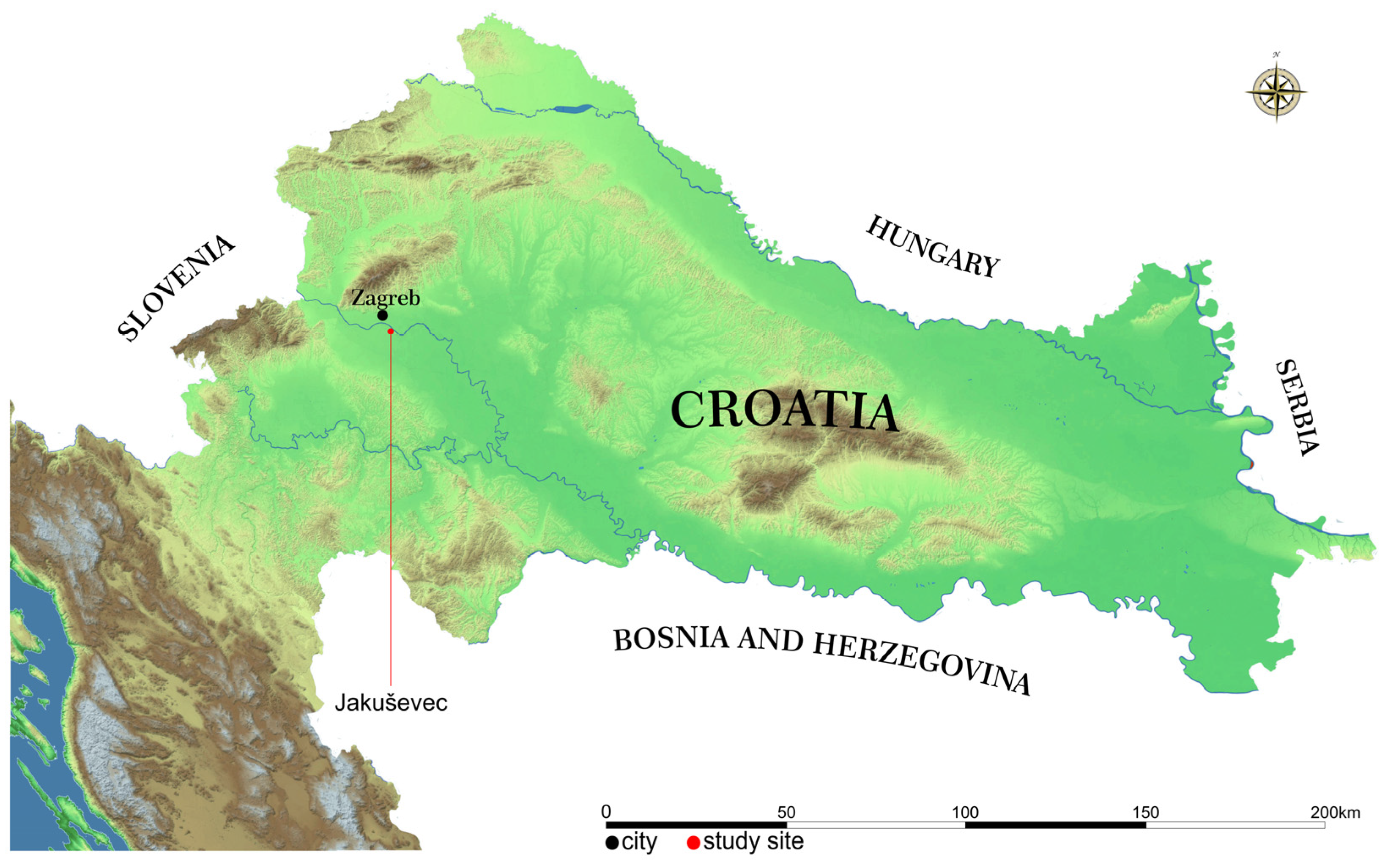
Blood sampling was conducted at the Jakuševec municipal landfill and the surrounding area in eastern Zagreb, Croatia, where a breeding colony of White Storks has been established since 2012, and adults forage locally (L. Jurinović, pers. obs.); nestlings were sampled on-site (Figure 1). The landfill Jakuševec lies on the right (south) bank of the River Sava, ~5 km SE of Zagreb’s centre and ~400 m from the settlement of Jakuševec, aligned NW–SE along the Sava flood levee and separated from the embankment by a local road. Historically, uncontrolled dumping began in 1965; by 1995, the footprint reached ~80 ha, with ~8 million m3 of waste deposited by 2000 [31]. Remediation converting the site to a sanitary landfill was completed at the end of 2003, after which engineered controls for leachate and gas were installed, although legacy pollution in soil beneath the landfill remains a potential source [30]. Hydrogeologically, the site is underlain by highly permeable gravel–sand alluvium; low-permeability clay layers occur deeply (≈50 m depth, increasing to ≈90 m eastward). The phreatic surface is shallow (≈5–7 m below ground), and the landfill historically sat only ≈2–4 m above the water table. Groundwater flow directions vary with Sava river stage; under average conditions, flow is towards the Črnkovec well-field area, with typical velocities around 5 m day−1 and locally up to 23 m day−1, conditions that favour lateral migration of dissolved pollutants. Multiple investigations have documented the landfill as a diffuse pollution source affecting groundwater downgradient (eastward towards Mičevec), with leachate rich in dissolved organic carbon, ammonium, and a suite of anthropogenic organics (e.g., petroleum hydrocarbons, chlorinated hydrocarbons, phthalates, alkylphenols/detergent residues, and pharmaceutical intermediates) [30,31,32]. These loads, together with elevated iron/manganese and other metals in monitoring wells near the perimeter, underline the site’s long-term environmental pressure despite remediation. In this context, Jakuševec provides a rare natural laboratory where landfill-foraging storks breed adjacent to a managed but historically polluted waste facility, enabling repeated sampling of nestlings to evaluate temporal dynamics of exposure-linked biomarkers within a well-characterised hydrological and pollution setting.

2.2. Field Work and Blood Sampling

Fieldwork was conducted at the Jakuševec White Stork colony (Zagreb, Croatia), where 6–8 week old nestlings were sampled during the 2025 breeding season under licence issued by the Ministry of Environmental Protection and Green Transition of the Republic of Croatia (UP/I-352-04/25-08/85; Ed. No. 517-05-1-2-25-2). Sampling procedures for the 2021 and 2022 seasons followed identical field protocols previously described in Bjedov et al. [14,15]. In 2025, 11 nestlings from 9 nests were sampled. Blood (~4 mL) was drawn from the brachial vein using a 0.80 mm needle and a 5 mL heparinised syringe. Samples were cooled and protected from light until processing (6–8 h). Blood samples in all three sampling years (2021, 2022, and 2025) were collected following a strict standardised protocol between 08:00 and 12:00 h to minimise circadian variation, handling stress, and disturbance to feeding behaviour. Plasma was separated by centrifugation (3000× g, 10 min, 4 °C), and 200 μL aliquots were transferred to sterile tubes for subsequent biochemical analyses. The remaining cellular fraction (S9) was prepared by resuspending the pellet in 5 mL phosphate buffer (0.10 M, pH 7.20), sonicating, and centrifuging (9000× g, 20 min, 4 °C) following Bjedov et al. [29] protocol. Both plasma and S9 fractions were frozen at −80 °C until biomarker assays.

2.3. Chemicals

All reagents used for biomarker analyses were of analytical grade. The following compounds and standards were employed: 5,5′-dithiobis (2-nitrobenzoic acid) (DTNB; C14H8N2O8S2, CAS 69-78-3), 2-mercaptoethyl trimethylammonium iodide acetate (acetylthiocholine iodide; C7H16INO2S, CAS 1866-15-5), and p-nitrophenyl acetate (C8H7NO4, CAS 62-44-2) for esterase activity assays. For oxidative stress markers, the following were used: reduced nicotinamide adenine dinucleotide phosphate (NADPH; C21H29N7O17P3, CAS 2646-71-1), β-Nicotinamide adenine dinucleotide 2′-phosphate reduced tetrasodium salt hydrate (β-NADPH) (C21H26N7Na4O17P3 x H2O, CAS 2646-71-1 (anhydrous)), oxidized glutathione (GSSG; C20H32N6O12S2, CAS 27025-41-8), reduced glutathione (GSH; C10H17N3O6S, CAS 70-18-8), and 1-chloro-2,4-dinitrobenzene (CDNB; C6H3ClN2O4, CAS 97-00-7). Dimethyl sulfoxide (DMSO; C2H6OS, CAS 67-68-5) was used as a solvent, and sodium phosphate buffer solutions were prepared using analytical-grade sodium dihydrogen phosphate (NaH2PO4, CAS 7558-80-7) and disodium hydrogen phosphate (Na2HPO4, CAS 7558-79-4). Reduced glutathione was detected using CellTracker™ Green CMFDA Dye (C25H17ClO7, CAS 136832-63-8) (ThermoFisher Scientific, Waltham, MA, USA), and reactive oxygen species were detected using CM-H2DCFDA (C24H25Cl2NO5, CAS 4646-56-8; Thermo Fisher Scientific, Waltham, MA, USA).

2.4. Esterase Activity

Esterase activity measurements were performed on a Tecan Spark 10 M microplate reader in triplicate. Enzyme activities were expressed as specific activities, defined as enzyme activity per amount of total protein (total enzyme activity/total protein).
The specific AChE activity in both plasma and S9 fractions was assessed following the colourimetric procedure originally described by Ellman et al. [33], with matrix-specific adjustments. For plasma, the reaction mixture consisted of 5 µL of 5× diluted sample (in 0.10 M sodium phosphate buffer, pH 7.20), was combined with 180 µL of the same sodium phosphate buffer, 10 µL of 1.60 mM DTNB (prepared in 0.10 M sodium phosphate buffer, pH 7.20), and 10 µL of 156 mM acetylthiocholine iodide (prepared in dH2O). The change in absorbance at 412 nm was continuously recorded for 5 min. For the S9 homogenates, 25 µL of 10× diluted sample (in 0.10 M sodium phosphate buffer, pH 7.20) was combined with 180 µL of sodium phosphate buffer, 10 µL of 1.60 mM DTNB, and 10 µL of 156 mM acetylthiocholine iodide. The change in absorbance was monitored for 10 min at 412 nm. Corresponding blanks for both sample types were prepared in parallel, containing 180 µL sodium phosphate buffer, 10 µL acetylthiocholine iodide and 10 µL DTNB, prepared as described above. The specific AChE activity was calculated using an extinction coefficient (ε) of 13.6 × 10³ M−1 cm−1.
The specific CES activity in both fractions was quantified using the spectrophotometric method of Hosokawa and Satoh [34], with matrix-specific adjustments. For plasma, the reaction mixture comprised 10 µL of sample and 1 mM 150 µL of p-nitrophenyl acetate (stock dissolved in acetonitrile and diluted with dH2O). The change in absorbance at 405 nm was recorded for 4 min. For S9 homogenates, 20 µL of the sample diluted 10× in 0.10 M sodium phosphate buffer (pH 7.20) was mixed with 150 µL of 1 mM p-nitrophenyl acetate, and the change in absorbance was monitored for 5 min at 405 nm. Blanks were run in parallel and consisted of 150 µL of p-nitrophenyl acetate. The specific CES activity was calculated using ε = 16.4 × 10³ M−1 cm−1.

2.5. Oxidative Stress Biomarkers

Oxidative stress measurements were performed on a Tecan Spark 10 M microplate reader in triplicate. Enzyme activities were expressed as specific activities, defined as enzyme activity per amount of total protein (total enzyme activity/total protein).
The specific GST activity in both fractions was quantified according to Habig and Jakoby [35], with matrix-specific adjustments. For plasma assays, the reaction mixture comprised 5 µL of sample, 160 µL of 1 mM CDNB (dissolved in 96% EtOH and brought to volume with 0.10 M sodium phosphate buffer, pH 7.20), and 40 µL of 25 mM GSH (prepared in dH2O). The change in absorbance at 340 nm was recorded for 2 min. For S9 homogenates, 20 µL of sample (diluted 10× in 0.10 M sodium phosphate buffer, pH 7.20) was combined with 160 µL of 1 mM CDNB and 40 µL of 25 mM GSH. Parallel blanks for both matrices contained 160 µL 1 mM CDNB and 40 µL 25 mM GSH. For S9, absorbance was monitored for 5 min at 340 nm. Specific activity was calculated using ε = 9.6 × 10³ M−1 cm−1.
The specific GR activity in both fractions was quantified according to Habig and Jakoby [35], with matrix-specific adjustments. For plasma assays, the reaction mixture comprised 20 µL of sample, 100 µL of 0.1 M phosphate buffer (pH 7.20), 100 µL of 2 mM GSSG (prepared in 0.10 M phosphate buffer, pH 7.20), and 10 µL of 1 mM β-NADPH (prepared in 0.10 M phosphate buffer, pH 7.20). For S9 homogenates, 10 µL of the sample was combined with 100 µL of 0.10 M phosphate buffer (pH 7.20), 100 µL of 2 mM GSSG, and 10 µL of 1 mM reduced β-NADPH. Parallel blanks for both matrices contained 100 µL sodium phosphate buffer, 100 µL GSSG, and 10 µL β-NADPH. The change in absorbance at 340 nm was recorded for 10 min for both matrices. Specific GR activity was calculated using ε = 6.22 × 10³ M−1 cm−1.
Fluorometric detection of GSH and ROS followed a Bjedov et al. [29] protocol. Measurements were performed on a Tecan Spark 10 M microplate reader with excitation, emission and gain set at 485 nm, 530 nm, and 50, respectively. CellTracker™ Green CMFDA dye was used for GSH detection. For plasma, the reaction mixture contained 2 µL plasma, 90 µL of 0.10 M sodium phosphate buffer (pH 7.20), and 5 µL 9.78 µM CellTracker™ Green CMFDA (prepared in DMSO). For S9, the same volumes and reagents were used (2 µL S9, 90 µL buffer, 5 µL dye). Fluorescence was recorded every 5 min over 15 min. Blanks comprised 90 µL sodium phosphate buffer and 5 µL dye.
CM-H2DCFDA dye was used for ROS detection. For plasma, reactions contained 10 µL plasma, 90 µL of 0.10 M sodium phosphate buffer (pH 7.20), and 10 µL CM-H2DCFDA (7.87 µM in DMSO). For S9, mixtures contained 10 µL S9, 90 µL 0.10 M sodium phosphate buffer (pH 7.20), and 5 µL 7.87 µM CM-H2DCFDA (prepared in DMSO), read every 5 min for 15 min. Blanks consisted of 90 µL sodium phosphate buffer and 5 µL dye. For both matrices, the first 15 min, corresponding to the optimal linear phase, were used for calculations.
Total protein was determined using the Pierce™ BCA Protein Assay Kit on a Tecan Spark 10 M microplate reader. The working reagent was prepared per the manufacturer’s protocol, with bovine serum albumin (BSA) as the standard. All plasma, S9, blank, and standard wells were run in parallel. For plasma, 2.50 µL of sample (pre-diluted 5× in 0.10 M sodium phosphate buffer, pH 7.20) was mixed with 22.50 µL buffer and 200 µL working reagent. For S9, 2.50 µL of sample (pre-diluted 10× in the same buffer) was mixed with 22.50 µL buffer and 200 µL working reagent. Microplates were shaken for 30 s in the reader, incubated at room temperature for 2 h, and absorbance was read at 562 nm to derive protein concentrations.

2.6. Data Analysis

All statistical analyses were performed in R version 4.5.1 [36]. Prior to modelling, all datasets were visually explored for their distributional properties, which were evaluated using histograms, quantile–quantile (QQ) plots, and the Shapiro–Wilk test. Normality of residuals and homogeneity of variances were visually confirmed for each biomarker (AChE, CES, GST, GR, ROS, GSH), and log-transformations were applied.
Because multiple nestlings were sampled within the same nest (introducing non-independence), linear mixed-effects models (LMMs) were fitted using the lmer() function from the lme4 package, with Nest included as a random effect [37]. For each biomarker, two models were constructed: one treating Year as a categorical variable (to test for inter-annual differences) and another with Year as a continuous covariate (to test for a linear temporal trend).
Type III ANOVA tables were obtained using the anova() function from the lmerTest package, applying the Satterthwaite method for denominator degrees of freedom. Post-hoc pairwise comparisons of estimated marginal means were performed with the emmeans() and pairs() functions from the emmeans package, with p-values adjusted using the Benjamini–Hochberg correction [38].
Predicted means, 95% confidence intervals, and prediction intervals were extracted from the emmeans output and back-transformed to the original scale for graphical representation. All visualisation was performed in ggplot2, where model-derived ribbons, regression lines, and observed data points were overlaid on log-scaled y-axes.

3. Results

We summarised biomarker responses for 2021, 2022, and 2025 using standard descriptive statistics (n, min–max, quartiles, median, mean, SD, SE) and the coefficient of variation (CV) in Table 1. Data for 2021 and 2022 were taken from [14,15], while 2025 data were newly obtained in this study. Statistics were stratified by matrix (plasma vs. S9) to compare central tendency and dispersion across years and tissues.
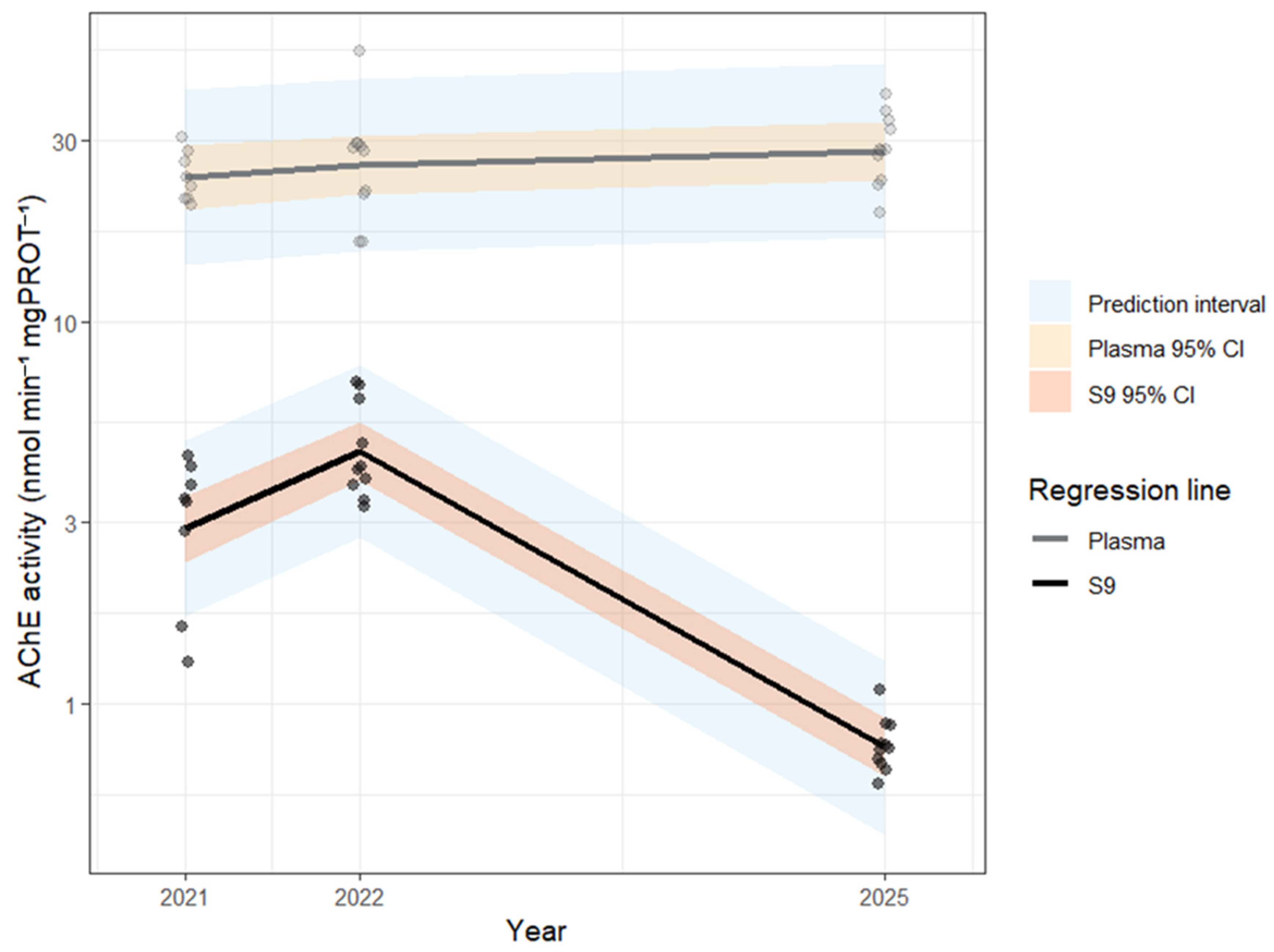
Regarding the AChE activity in the continuous-year model, all effects were significant, Year (p = 0.0001), Fraction (p < 0.0001), and Year × Fraction (p = 0.0001), indicating that the time trend differs by fraction: plasma shows a small, but non-significant linear increase, while S9 shows an overall decrease driven by a sharp drop by 2025 (Figure 2). In plasma, yearly differences were small (≤0.16 log-units, <5% change), reflecting minimal biological variation across years. In contrast, S9 values changed markedly: the estimated mean increased by ~0.46 log-units from 2021 to 2022 (~44% increase) but then fell by ~1.32 units by 2025 (>120% decrease relative to 2021).
Consistently, the categorical-year model also found Year (p = 0.0001), Fraction (p = 0.0001), and Year × Fraction (p = 0.0001) significant. Within fractions, plasma did not differ between years (p > 0.05), confirming a stable trend, whereas S9 showed significant changes for all pairwise comparisons (2021 vs. 2022: p < 0.0001; 2021 vs. 2025: p < 0.0001; 2022 vs. 2025: p < 0.0001), i.e., an increase from 2021 to 2022 followed by a large decline by 2025 to below 2021 levels (Figure 2). These quantitative differences illustrate the strong interaction: S9 activity rose substantially between 2021 and 2022 and then dropped sharply by 2025, whereas plasma remained stable throughout.
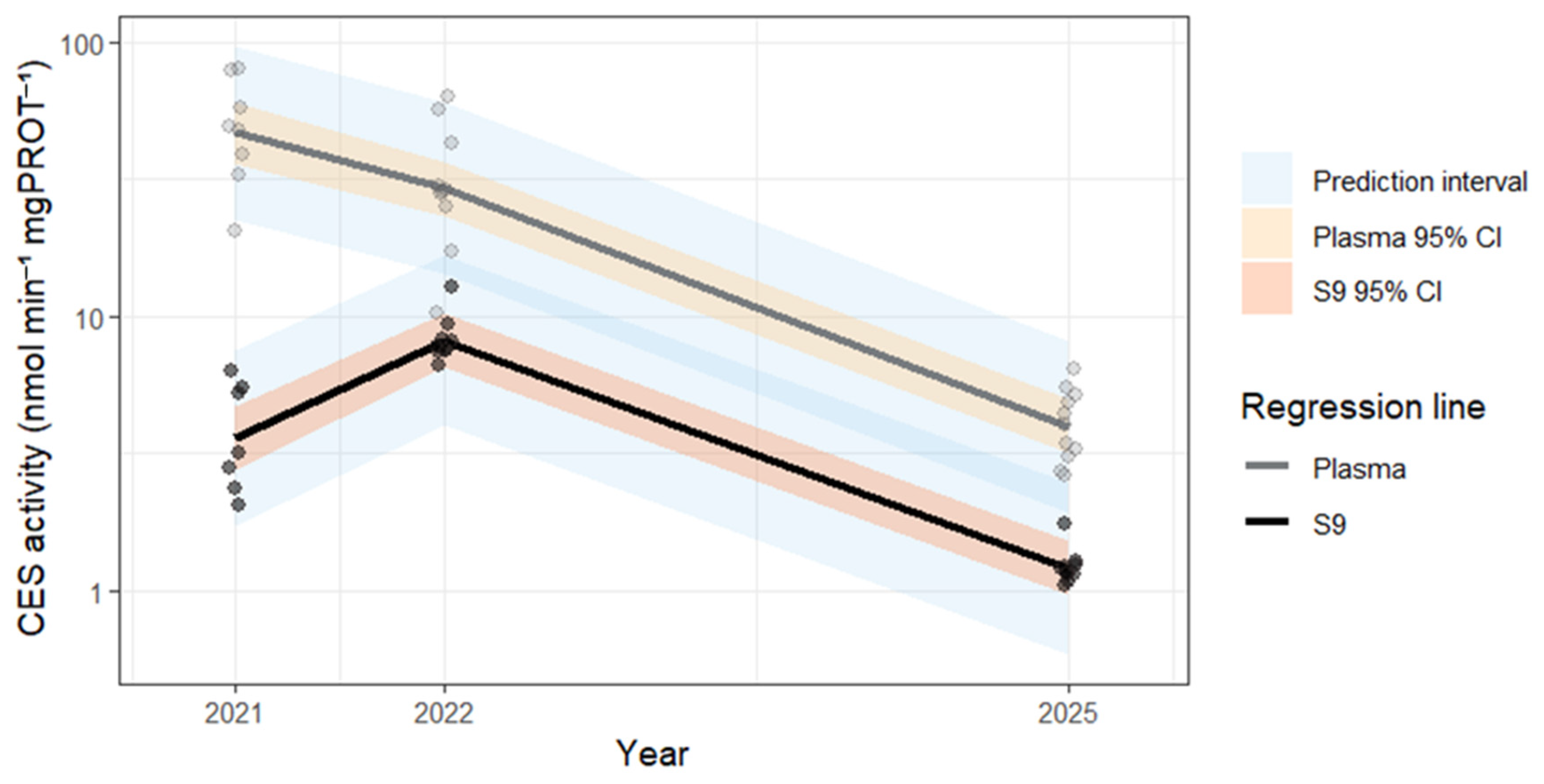
In the continuous-year model for CES activity, all effects were significant, Year (p < 0.0001), Fraction (p < 0.0001), and Year × Fraction (p = 0.0017), indicating that the time trend differs by fraction: plasma shows a clear decline across years, while S9 shows a non-monotonic pattern with an overall decline driven by a sharp drop by 2025 (Figure 3). To illustrate the magnitude of these changes, plasma CES activity decreased from an estimated mean of 3.84 log-units in 2021 to 3.37 log-units in 2022 (≈12% decline) and further to 1.38 log-units in 2025 (≈64% decline relative to 2021). In S9, CES activity increased from 1.28 log-units in 2021 to 2.10 log-units in 2022 (≈64% increase), followed by a marked reduction to 0.19 in 2025 (>85% decrease relative to 2022).
Consistently, the categorical-year model also found Year (p < 0.0001), Fraction (p < 0.0001), and Year × Fraction (p < 0.0001) significant. Within fractions, plasma CES activity decreased over time (2021 vs. 2022, p = 0.0082; 2021 vs. 2025, p < 0.0001; 2022 vs. 2025, p < 0.0001), whereas the S9 CES activity increased from 2021 to 2022 and then fell sharply by 2025 (2022 vs. 2021, p < 0.0001; 2021 vs. 2025, p < 0.0001; 2022 vs. 2025, p < 0.0001), placing 2025 below both earlier years (Figure 3). These quantitative differences clarify the strong interaction observed between Year and Fraction.
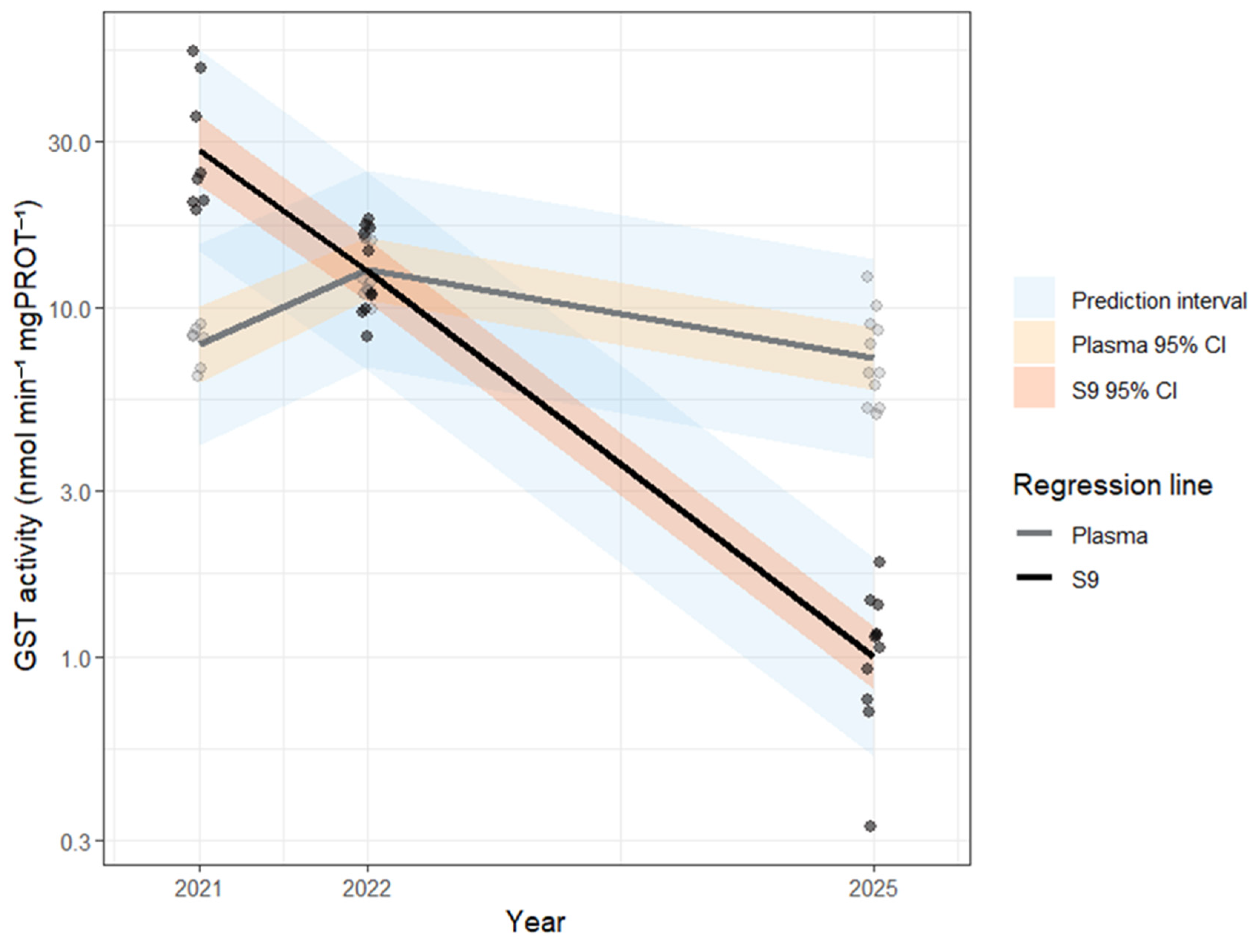
For GST activity, all effects were significant in the continuous-year model, Year (p < 0.0001), Fraction (p < 0.0001), and Year × Fraction (p < 0.0001), indicating fraction-specific temporal patterns: plasma GST activity showed a rise from 2021 to 2022 followed by a decline by 2025, while S9 GST activity exhibited a strong overall decrease, reaching its lowest values by 2025 (Figure 4). Specifically, plasma GST activity increased from an estimated mean of 2.06 log-units in 2021 to 2.56 log-units in 2022 (≈24% increase) and then returned to 1.97 log-units by 2025 (≈3% below 2021). In S9, GST activity declined sharply: from 3.34 log-units in 2021 to 2.55 log-units in 2022 (≈24% decrease) and further in 2025 (>99% decrease relative to 2021).
The categorical-year model also found Year (p < 0.0001), Fraction (p = 0.0066), and Year × Fraction (p < 0.0001) significant. Within fractions, plasma differed between years (2021 vs. 2022: p = 0.0047, increase; 2021 vs. 2025: p > 0.05; 2022 vs. 2025: p = 0.0005, decrease), confirming a temporary 2022 peak that returned near 2021 levels by 2025. In contrast, S9 GST activity changed significantly across all years (2021 vs. 2022, 2021 vs. 2025, 2022 vs. 2025: all p < 0.0001), showing a consistent downward trend that culminated in a pronounced reduction by 2025 (Figure 4). The quantitative patterns emphasise the strong fraction-specific dynamics, with S9 showing particularly large declines.
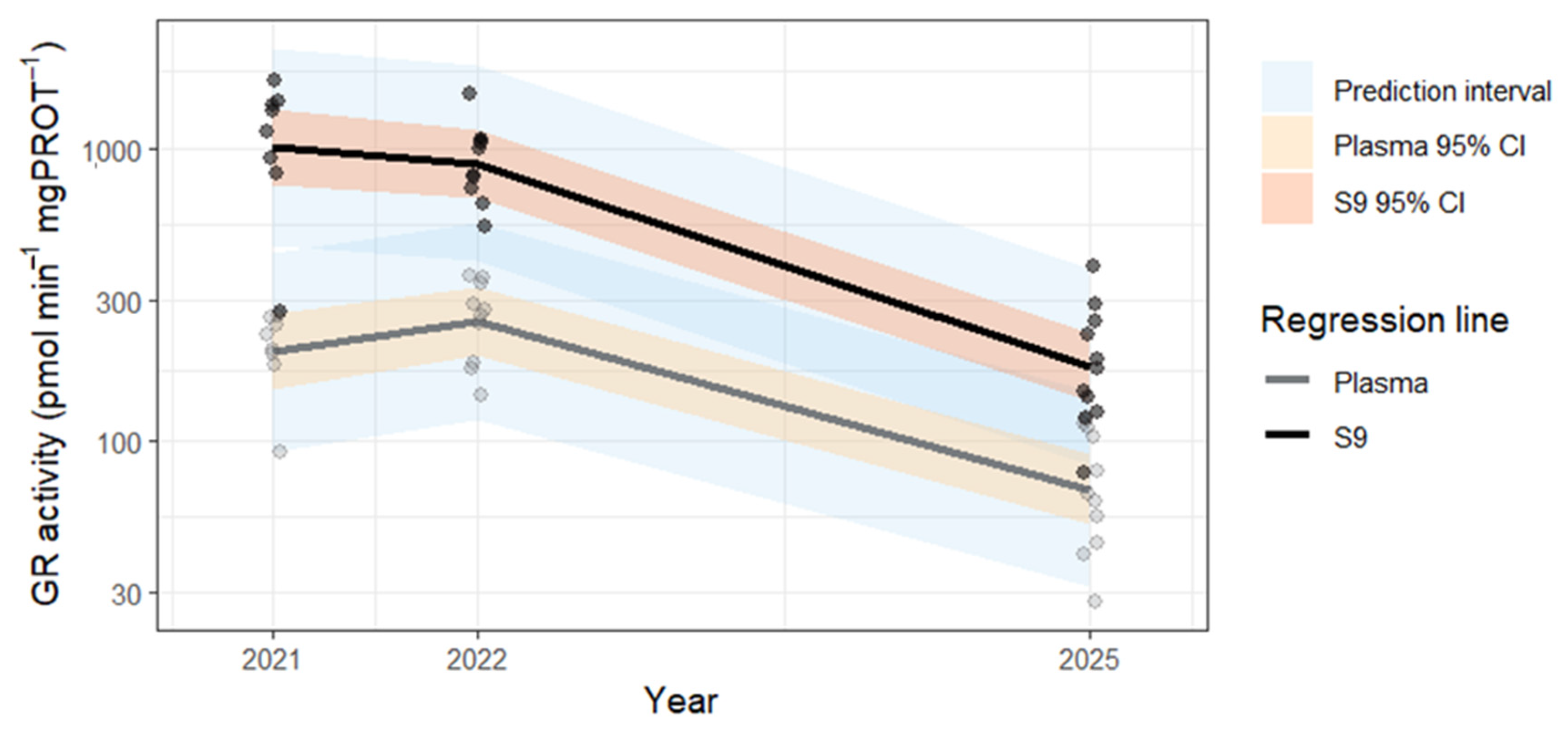
In the continuous-year model for GR activity, all effects were significant: Year (p < 0.0001), Fraction (p < 0.0001), and Year × Fraction (p = 0.016). The time trend differed by fraction: plasma GR activity showed a non-monotonic pattern with an overall decrease over time, driven by a sharp decline by 2025, whereas S9 activity declined more gradually with a pronounced drop in 2025 (Figure 5). The magnitude of these changes, pairwise contrasts indicated that plasma GR activity in 2025 was approximately 1.08 log-units lower than in 2021 and 1.32 log-units lower than in 2022 (both p < 0.0001), while S9 GR activity showed an even stronger decline, with 2025 values 1.61–1.74 log-units lower than earlier years (both p < 0.0001).
Consistently, the categorical-year model also detected significant effects of Year (p < 0.0001), Fraction (p < 0.0001), and their interaction (Year × Fraction, p = 0.034). Within fractions, both plasma and S9 GR activities remained stable between 2021 and 2022 (2021 vs. 2022, p > 0.05) and then decreased significantly by 2025 to values below those in earlier years (2021 vs. 2025, p < 0.0001; 2022 vs. 2025, p < 0.0001; Figure 5). These values confirm that the strongest year-to-year differences occurred between 2022 and 2025, consistent with the significant interaction term.
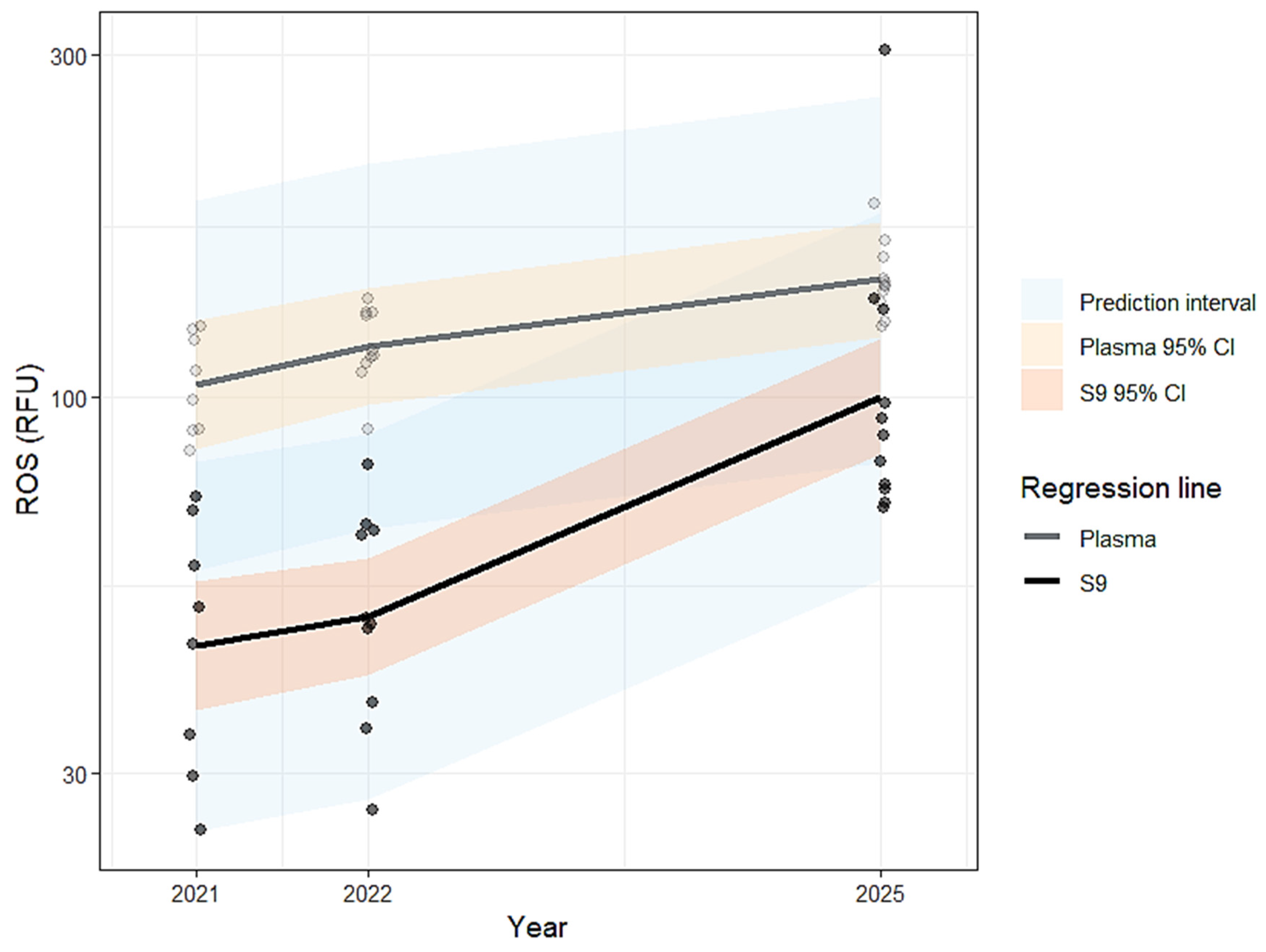
For ROS concentration, the continuous-year model showed significant effects of Year (p < 0.0001), Fraction (p < 0.0001), and their interaction (p = 0.0037), indicating fraction-specific time trends: both fractions rose across years, but the increase was modest and non-significant in plasma while pronounced in S9 (driven by higher values in 2025; Figure 6). This means that plasma ROS concentration increased slightly from 4.65 log-units in 2021 to 4.77 log-units in 2022 (~3% increase) before rising further to 4.98 log-units in 2025 (~7% above 2021), although these differences were not statistically significant (p > 0.05). In S9, ROS concentration showed a similar modest increase from 3.81 log-units in 2021 to 3.90 log-units in 2022 (~2% increase), followed by a substantial rise to 4.61 log-units in 2025 (~21% above 2021). Although 2025 values are higher, the significant interaction reflects the fraction-specific rates of change rather than uniform increases across fractions.
Consistently, the categorical-year model also found Year (p < 0.0001), Fraction (p < 0.0001), and Year × Fraction (p = 0.0096) significant. Within fractions, plasma did not differ between years (2021 vs. 2022: p > 0.05; 2021 vs. 2025: p > 0.05; 2022 vs. 2025: p > 0.05), confirming a modest, but insignificant increasing trend, whereas S9 differed across years, with 2025 higher than both 2021 and 2022 (2021 vs. 2025: p < 0.0001; 2022 vs. 2025: p < 0.0001), and no difference between 2021 and 2022 (p > 0.05; Figure 6). This pattern is consistent with the estimated means: for plasma, 2025 exceeded the earlier years only modestly, whereas in S9, the 2025 increase was markedly larger, driving the significant interaction term.
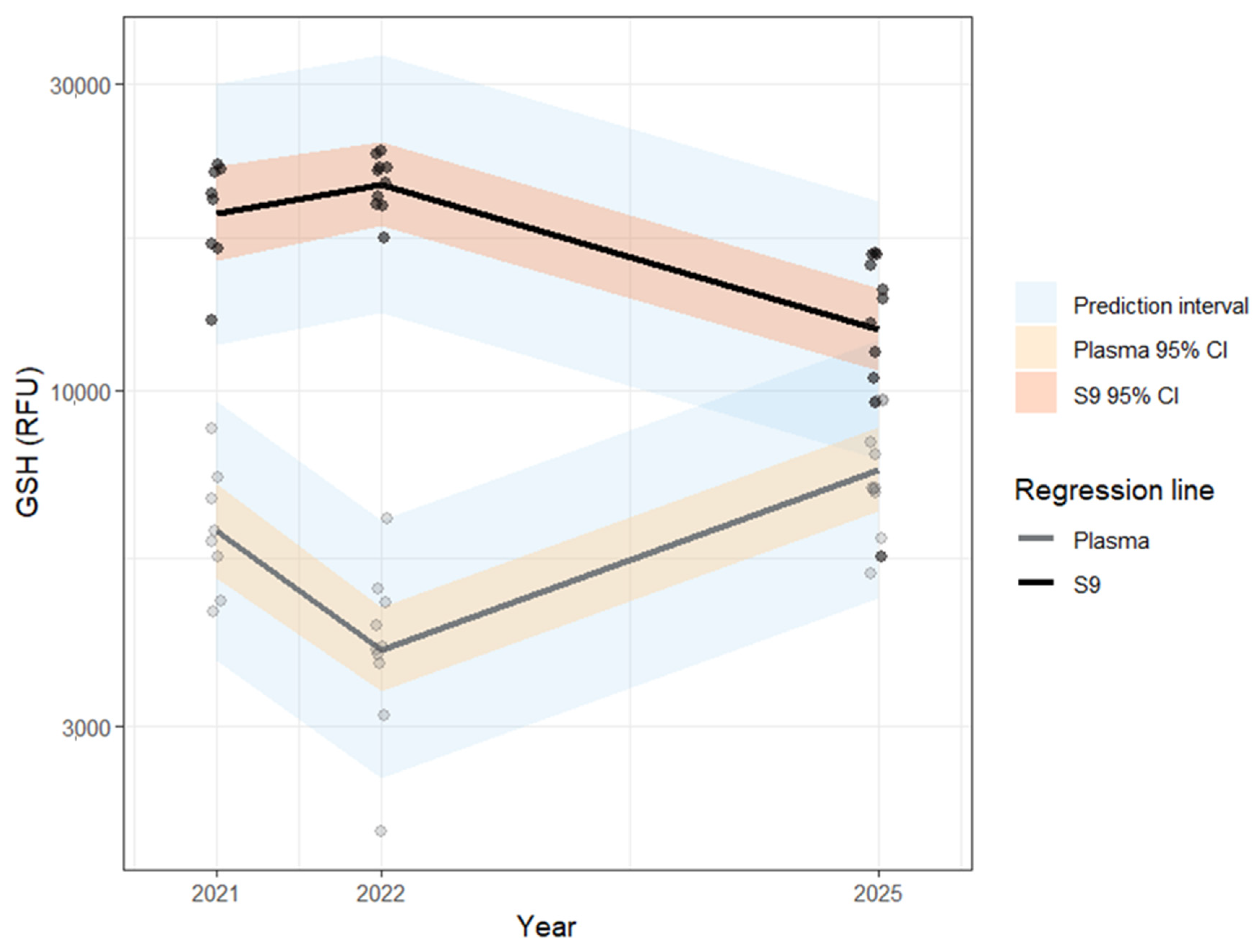
For concentration of GSH, the continuous-year model showed Fraction (p < 0.0001) and Year × Fraction (p < 0.0001) effects, while Year itself was not significant (p > 0.05), indicating fraction-specific patterns rather than a single linear trend (Figure 7). Specifically, in plasma, yearly differences showed a modest pattern: values decreased from 8.71 log-units in 2021 to 8.28 log-units in 2022 (~5% decline) and then increased to 8.93 log-units in 2025 relative to 2021 (~3% increase). In contrast, S9 GSH concentration was stable between 2021 and 2022 (~1% increase) but declined to 9.43 log-units in 2025 (~4% decrease; ~5% decrease, respectively).
Consistently, the categorical-year model found Fraction (p < 0.0001) and Year × Fraction (p < 0.0001) significant, with Year not significant (p > 0.05). Within fractions, plasma GSH concentrations declined in 2022 relative to 2021 (p = 0.0006) and then increased in 2025 (2021 vs. 2025: p > 0.05; 2022 vs. 2025: p < 0.0001), i.e., a U-shaped pattern. In contrast, S9 GSH concentration was stable between 2021 and 2022 (p > 0.05) but decreased by 2025 (2021 vs. 2025: p = 0.0008; 2022 vs. 2025: p < 0.0001; Figure 7). These quantitative differences demonstrate that temporal changes were driven by opposite trends in the two fractions: plasma dipped and recovered, whereas S9 declined only in the final year.

4. Discussion

Temporal variation in biomarker activity in White Stork nestlings reflects fraction-specific physiological responses to changing pollutant and nutritional conditions at the Jakuševec landfill. Although remediation was completed in 2003 and the site functioned as a controlled landfill until 2017 [39], earlier studies confirmed that soil and groundwater still exhibit elevated metals and organic compounds [30,31,32]. The persistence of these compounds provides a plausible mechanistic link to the alterations in biomarker responses observed in the present. Since all sampling occurred within a fixed morning time window, circadian variation is unlikely to confound the observed inter-annual patterns. To visualise interannual patterns, Table 2 summarises relative changes in mean biomarker activities (%) across sampling years in White Stork (Ciconia ciconia) nestlings from the landfill-adjacent colony at Jakuševec (Zagreb, Croatia), highlighting contrasting trajectories between enzymatic and oxidative endpoints.
AChE and CES are key enzymes in the regulation of neural and metabolic homeostasis, both serving as sensitive biomarkers of neurotoxic and xenobiotic exposure in birds. AChE, which hydrolyses the neurotransmitter acetylcholine, is primarily localised in the central and peripheral nervous systems and muscle tissue [40]. CES, a ubiquitous enzyme involved in the hydrolysis of carboxylic acid esters into their corresponding acids and alcohols, plays an essential role in the detoxification of organophosphate and carbamate compounds as well as other environmental pollutants [41,42]. Both enzymes have been extensively used in avian biomonitoring to detect exposure to neurotoxic agents and to assess the physiological consequences of pollutant stress [20,43,44]. Previous research has characterised plasma cholinesterases and CES activities in several bird species, including gulls, pigeons, and raptors, establishing baseline ranges and demonstrating their responsiveness to environmental pollution [45,46,47,48,49,50,51,52]. Together, AChE and CES provide complementary insights into the neurotoxic and detoxification status of birds inhabiting polluted habitats, making them particularly informative indicators for assessing pollution pressure in landfill-associated ecosystems. Significant interannual variation in AChE and CES indicates fluctuating exposure to neuroactive and xenobiotic substances. The decline in 2025 following an increase in 2022 suggests episodic pulses of pollution rather than a linear recovery (Table 2). These irregular intervals are consistent with hydrogeochemical evidence for remobilisation of neurotoxic pollutants during high groundwater flow [31]. Organophosphate or carbamate inputs remain probable, as cholinesterase inhibition is a recognised effect in exposed bird species [53,54].
The GST is a phase II detoxification enzyme that catalyses the conjugation of GSH with electrophilic xenobiotic substrates, facilitating their biotransformation and elimination [55,56]. In birds, GST plays a crucial role in maintaining cellular redox homeostasis and protecting tissues from oxidative damage. In the present study, specific GST activity was comparable between plasma and S9 fractions of White Stork nestlings, consistent with the enzyme’s presence in both intra- and extracellular fractions [57]. Plasma GST activity largely reflects de novo synthesis in the liver and therefore serves as an indirect indicator of hepatic detoxification potential [58]. Previous avian studies have used GST activity to assess oxidative stress linked to exposure to metals, persistent organic pollutants, and other environmental stressors [46,59,60,61,62,63,64,65,66,67,68]. Across sampling years, GST activity in White Stork nestlings from the Jakuševec landfill colony exhibited a transient elevation in 2022, followed by a sharp decline in 2025 (Table 2). This pattern indicates that the initial rise in GST activity may represent a short-term adaptive response to increased contaminant mobilisation or physiological stress, whereas the subsequent drop suggests enzyme inhibition or depletion of antioxidant capacity under continued exposure. The decline was more pronounced in the S9 fraction, implying a stronger cytosolic response to oxidative pressure, while plasma GST levels remained relatively stable. GR catalyses the NADPH-dependent reduction in oxidised glutathione (GSSG) to its reduced form (GSH), a key reaction for maintaining intracellular redox balance and supporting detoxification processes [27,28]. In birds, GR activity has been measured to assess antioxidant defences and physiological responses to environmental pollution, as well as the effects of dietary factors such as oxidised fats and selenium [46,61,62,65,67,69,70,71,72,73]. In this study, GR activity followed a temporal trend similar to GST activity, showing an increase in 2022 and a sharp decline by 2025. The early rise could likely reflect short-term activation of the glutathione system under moderate oxidative stress, whereas the subsequent drop suggests reduced enzyme efficiency or depletion of redox capacity under high oxidative stress. The decline was more pronounced in the S9 fraction than in plasma, consistent with GR’s role as a cytosolic enzyme concentrated in regions of high electron flux and ROS production.
The decline in GST and GR activity, concurrent with elevated ROS levels and the 2025 decrease in GSH levels, indicates oxidative disequilibrium and exhaustion of antioxidant defences. Similar redox patterns were reported in White Stork nestlings foraging on Spanish landfills, where GSH levels increased under moderate pollutant exposure [17]. That study interpreted higher GSH levels as a hormetic response, a transient over-activation of antioxidant systems. Our data extend that interpretation, as the 2025 oxidative stress surge at Jakuševec might reflect the tipping point to potential oxidative damage, which may also be linked to annual climatic variability and food quality in landfill-fed White Storks [18]. Elevated ROS levels in the S9 fraction suggest a cytosolic origin of oxidative imbalance. The S9 biomarkers displayed stronger interannual variation than plasma, emphasising their higher metabolic reactivity. Fraction-specific sensitivity has been observed in seabirds feeding at landfills, where hepatic metabolism amplifies responses to mixed pollutants [19]. The combined decrease in the activities of AChE, CES, and GST in our dataset therefore indicates overlapping neurotoxic and redox pathways, potentially driven by metals such as lead (Pb), cadmium (Cd), and mercury (Hg), elements previously documented in White Stork nestlings whose parents forage in landfill-proximate locations [12,14].
Landfill leachate, a complex mixture of dissolved organic and inorganic pollutants formed as water percolates through decomposing waste, represents one of the main ecological pathways through which landfill pollution exerts toxic effects [74]. In essence, leachate acts as the liquid vector of landfill toxicity, mobilising pollutants that can enter food webs and accumulate across trophic levels. In this context, landfill-foraging birds serve as bioindicators of how far such toxicity radiates into the living world. To further build up on this, physiological and biochemical alterations have been reported in different vertebrate taxa exposed to landfill leachates. Experimental and field data in small mammals demonstrate that landfill-derived pollutants induce pronounced hepatic and renal alterations consistent with chronic exposure. In wild, omnivorous and insectivorous small mammals inhabiting the Garraf landfill (NE Spain), Sánchez-Chardi et al. [75] reported severe hepatic histopathology, including cell cycle arrest, necrosis, and tubular degeneration in wood mouse (Apodemus sylvaticus) and greater white-toothed shrew (Crocidura russula). These lesions were accompanied by signs of renal toxicity, suggesting that long-term exposure to leachate-derived metals alters tissue integrity even in partially remediated sites [75]. Similar oxidative and enzymatic disturbances were recorded in controlled exposures of laboratory rodents. Li et al. [76] demonstrated that mice exposed to landfill leachate exhibited increased levels of thiobarbituric acid-reactive substances (TBARS) and altered antioxidant enzyme activities, copper/zinc superoxide dismutase (Cu/Zn-SOD), glutathione peroxidase (GPx), and catalase (CAT) in liver, kidney, and spleen, suggesting systemic oxidative stress. Alimba et al. [77] observed concentration-dependent hepatic and renal dysfunction in Wistar rats, manifested as increased aminotransferase activity and histopathological degeneration of hepatocytes and renal tubules. Similarly, Farombi et al. [78] documented hepatotoxicity and redox imbalance in rats exposed to leachates from the Olusosun landfill (Nigeria), where decreased GSH levels and GST activities, combined with elevated lipid peroxidation, pointed to oxidative injury. These patterns correspond closely to the trends found in White Stork nestlings from Jakuševec, where the combination of depleted GSH levels and a decrease in GST and GR activity, with elevated ROS levels, could indicate oxidative disequilibrium. At higher levels of biological organisation, Pastor et al. [79] demonstrated that landfill leachates reduced growth in plants and altered physiology in brown rats (Rattus norvegicus) while Alimba and Bakare [80] found micronuclei and nuclear abnormalities in erythrocytes of fish, quail, and rats exposed to leachates from multiple landfills, suggesting genotoxic potential across trophic levels. Together, these studies show that landfill-derived pollution consistently provokes oxidative, cytotoxic, and genotoxic outcomes across different taxa.
In contrast to most previous work conducted under laboratory or semi-controlled settings, the present study provides a rare multi-year in situ assessment of biomarker dynamics in a free-living bird species breeding directly and surrounding a remediated landfill. The observed fraction-specific inhibition of AChE, CES, GST and GR activity, coupled with increased ROS production, indicates that the physiological mechanisms of oxidative and neurotoxic stress, previously documented in mammals and fish, are also active in landfill-foraging birds. Spatial context further supports mixed-pathway exposure. Jakuševec lies within a wetland–urban mosaic where adult White Storks forage both inside and around the landfill, bringing polluted prey (invertebrates, amphibians, small mammals) to nestlings [10,81]. This pattern mirrors Iberian studies showing that proximity to landfills predicts physiological differences even when diet quantity improves [17,18]. In our case, the biomarker trends imply that while nutritional availability may be sufficient, the biochemical cost of exposure remains significant. Such trade-offs were also detected in Kelp Gulls using urban landfills, where individuals displayed lower protein, enzyme activity, and body condition than conspecifics at natural sites [19]. Moreover, the temporal variability observed at Jakuševec suggests that such stressors remain episodically mobilised even after site remediation, extending the evidence base for sublethal pollutant effects from experimental vertebrate models to a sentinel avian species with direct conservation relevance.
Several limitations should be considered when interpreting these findings. First, sample sizes were modest and differed among years (n = 8, 10, and 11 nestlings in 2021, 2022, and 2025, respectively), which reduces statistical power for detecting subtle effects and increases uncertainty around year-specific estimates, particularly within fractions. Second, temporal resolution was coarse: sampling occurred in three breeding seasons that were not consecutive. Consequently, we cannot reconstruct within-season dynamics or determine precisely when shifts in exposure occurred, and the observed non-monotonic patterns may reflect short-term pulses rather than gradual recovery. Third, as in any field-based biomonitoring study, interannual differences may be influenced by unmeasured confounders, including hydrological variability (rainfall and groundwater level changes affecting leachate mobilisation), variation in diet composition and prey availability, and other environmental stressors acting in parallel with landfill exposure. Finally, we did not quantify pollutants directly in nestling blood or prey, so causal attribution of biomarker changes to specific pollutants remains inferential. For that purpose, in future research, chemical analyses of blood and prey should be incorporated to strengthen causal links between biomarker responses and specific pollutants. Seasonal variation in food availability and rainfall intensity may further confound interannual patterns, as shown by Pineda-Pampliega et al. [18]. Future integration of biomarker results with direct chemical analyses of blood and prey, coupled with isotopic tracers (δ13C, δ15N), will clarify whether observed physiological stress originates from pollutant mixtures, dietary shifts, or both. Continued biomonitoring of White Stork colonies following frameworks proposed [12,14,17,18] remains essential to evaluate whether urban landfills continue to exert subtle but measurable ecological effects. Furthermore, the integration of chemical and isotopic analyses with biomarker responses is needed to quantify exposure pathways. Longitudinal sampling across full breeding seasons would clarify the role of hydrological events in pollutant leaching. Comparative sampling of colonies at varying distances from the landfill could potentially show spatial gradients of exposure. Finally, combining biomarker monitoring with microbial and antibiotic-resistance assays would extend assessment from biochemical stress to potential public-health interfaces. Collectively, the trends of AChE, CES, GST, GR activities, as well as GSH and ROS concentrations between 2021, 2022 and 2025 indicate that the post-remediation Jakuševec system has not yet achieved ecotoxicological stability.

5. Conclusions

The multi-year biomarker assessment in White Stork nestlings demonstrates clear interannual differences in biomarker responses (supporting H1) and shows that the Jakuševec landfill, despite formal remediation, continues to exert a measurable physiological effect on local wildlife. Consistent with H2, plasma and S9 fractions showed distinct biomarker trends, reflecting the complementary information provided by extracellular and intracellular matrices. These biochemical responses suggest that the site remains ecotoxicologically active, functioning as a residual source of pollution. The combined biomarker responses point toward a duality typical of anthropogenic feeding sites: nutritional predictability and energetic gain offset by chronic sublethal stress. Temporal fluctuations in cholinesterase and detoxification enzymes, coupled with oxidative stress responses, reveal ongoing pollutant exposure acting through both neurotoxic and redox pathways (H3). Specifically, the oxidative imbalance recorded in 2025 indicates that the landfill’s post-closure phase has entered a new equilibrium characterised by reduced detoxification capacity and increased redox activity. In this sense, Jakuševec reflects broader European patterns reported for White storks and other opportunistic species exploiting landfills, short-term energetic benefits accompanied by long-term physiological costs. From a conservation and management standpoint, the results underline the need to treat landfills as dynamic biogeochemical systems still interacting with wildlife. Integrating biomarker monitoring into routine environmental monitoring could provide an early-warning tool for latent pollution. Continued tracking of White Stork colonies, combined with isotopic and pollutant analyses, could help distinguish exposure routes and inform adaptive management of urban waste sites within biodiversity frameworks.

Author Contributions

Conceptualization, D.B., L.J., A.M. and M.V.; methodology, D.B., A.M. and L.J.; software, D.B. and S.A.; validation, D.B., I.L., S.A., A.M., M.V. and S.E.; formal analysis, D.B., I.L. and S.A.; investigation, all; resources, A.M., M.V., S.E., L.J. and B.J.; data curation, D.B., I.L. and S.A.; writing—original draft preparation, D.B., I.L. and S.A.; writing—review and editing, all; visualization, D.B. and S.A.; supervision, D.B., A.M. and M.V.; funding acquisition, D.B., A.M., M.V., S.E. and L.J. All authors have read and agreed to the published version of the manuscript.

Funding

This research was funded by the European Union–NextGenerationEU (project Pollutants as stressors in aquatic and terrestrial ecosystems—ZASTEK; funding source 581-UNIOS-97).

Institutional Review Board Statement

Samples and data were collected according to the Institute of Ornithology, Croatian Academy of Science, protocols, under the supervision of a certified ringer/researcher. All procedures were conducted in accordance with the Croatian Nature Protection Act (Official Gazette no. 80/13, 15/18 and 14/19) and approved by Croatian Ministry of Economy and Sustainable Development; permit for years 2021 and 2022: Classification code: UP/I-612-07/20-48/130; Registry number: 517-05-1-1-20-4; permit for year 2025: Classification code: UP/I-352-04/25-08/85; Ref. No: 517-06-1-2-25-2, 27.

Data Availability Statement

The data supporting the findings of this study are available from the corresponding author upon reasonable request.

Conflicts of Interest

The authors declare no conflicts of interest.

References

  1. Zalasiewicz, J.; Waters, C.N.; Wolfe, A.P.; Barnosky, A.D.; Cearreta, A.; Edgeworth, M.; Ellis, E.C.; Fairchild, I.J.; Gradstein, F.M.; Grinevald, J.; et al. Making the Case for a Formal Anthropocene Epoch: An Analysis of Ongoing Critiques. Newsl. Strat. 2017, 50, 205–226. [Google Scholar] [CrossRef]
  2. Ramankutty, N.; Graumlich, L.; Achard, F.; Alves, D.; Chhabra, A.; DeFries, R.S.; Foley, J.A.; Geist, H.; Houghton, R.A.; Goldewijk, K.K.; et al. Global Land-Cover Change: Recent Progress, Remaining Challenges; Springer: Berlin/Heidelberg, Germany, 2006; pp. 9–39. [Google Scholar]
  3. Weissman, D. Landfill Urbanism: Opportunistic Ecologies, Wasted Landscapes. Detritus 2020, 11, 19–34. [Google Scholar] [CrossRef]
  4. Noreen, Z. A Global Modification in Avifaunal Behavior by Use of Waste Disposal Sites (Waste Dumps/Rubbish Dumps): A Review Paper. Pure Appl. Biol. 2021, 10, 603–616. [Google Scholar] [CrossRef]
  5. Beasley, J.C.; Olson, Z.H.; Selva, N.; DeVault, T.L. Ecological Functions of Vertebrate Scavenging; Springer: Cham, Switzerland, 2019; pp. 125–157. [Google Scholar]
  6. Iravanian, A.; O Ravari, S. Types of Contamination in Landfills and Effects on The Environment: A Review Study. IOP Conf. Ser. Earth Environ. Sci. 2020, 614, 012083. [Google Scholar] [CrossRef]
  7. Kheswa, N.; Gokul, A.; Obame-Nkoghe, J.; Dube, N. Arthropod Assemblages in Municipal Solid Waste Landfills: Decomposers or Hidden Hazards? Integr. Environ. Assess. Manag. 2025, 21, 1186–1198. [Google Scholar] [CrossRef]
  8. Bjedov, D.; Mikuška, A.; Velki, M. From Wetlands to Landfills: White Stork (Ciconia ciconia L., 1758) as a Reliable Bioindicator of Ecosystem Health. Arch. Ind. Hyg. Toxicol. 2025, 76, 1–15. [Google Scholar] [CrossRef]
  9. Catry, I.; Franco, A.M.A.; Acácio, M. Where Have All the Storks Gone? Impact of Landfill Use on White Stork Behaviour and Population Dynamics. Waterbirds 2025, 47, 1–7. [Google Scholar] [CrossRef]
  10. Gilbert, N.I.; Correia, R.A.; Silva, J.P.; Pacheco, C.; Catry, I.; Atkinson, P.W.; Gill, J.A.; Franco, A.M.A. Are White Storks Addicted to Junk Food? Impacts of Landfill Use on the Movement and Behaviour of Resident White Storks (Ciconia ciconia) from a Partially Migratory Population. Mov. Ecol. 2016, 4, 7. [Google Scholar] [CrossRef]
  11. Arizaga, J.; Resano-Mayor, J.; Villanúa, D.; Alonso, D.; Barbarin, J.M.; Herrero, A.; Lekuona, J.M.; Rodríguez, R. Importance of Artificial Stopover Sites Through Avian Migration Flyways: A Landfill-Based Assessment with the White Stork Ciconia ciconia. Ibis 2018, 160, 542–553. [Google Scholar] [CrossRef]
  12. de la Casa-Resino, I.; Hernández-Moreno, D.; Castellano, A.; Pérez-López, M.; Soler, F. Breeding near a Landfill May Influence Blood Metals (Cd, Pb, Hg, Fe, Zn) and Metalloids (Se, As) in White Stork (Ciconia ciconia) Nestlings. Ecotoxicology 2014, 23, 1377–1386. [Google Scholar] [CrossRef]
  13. Blanco, G.; Gómez-Ramírez, P.; Espín, S.; Sánchez-Virosta, P.; Frías, Ó.; García-Fernández, A.J. Domestic Waste and Wastewaters as Potential Sources of Pharmaceuticals in Nestling White Storks (Ciconia ciconia). Antibiotics 2023, 12, 520. [Google Scholar] [CrossRef]
  14. Bjedov, D.; Velki, M.; Toth, L.; Filipović Marijić, V.; Mikuška, T.; Jurinović, L.; Ečimović, S.; Turić, N.; Lončarić, Z.; Šariri, S.; et al. Heavy Metal(loid) Effect on Multi-Biomarker Responses in Apex Predator: Novel Assays in the Monitoring of White Stork Nestlings. Environ. Pollut. 2023, 324, 121398. [Google Scholar] [CrossRef]
  15. Bjedov, D.; Velki, M.; Kovačić, L.S.; Begović, L.; Lešić, I.; Jurinović, L.; Mikuska, T.; Sudarić Bogojević, M.; Ečimović, S.; Mikuška, A. White Stork (Ciconia ciconia) Nestlings Affected by Agricultural Practices? Assessment of Integrated Biomarker Responses. Agriculture 2023, 13, 1045. [Google Scholar] [CrossRef]

  16. Vaverková, M.D.; Paleologos, E.K.; Goli, V.S.N.S.; Koda, E.; Mohammad, A.; Podlasek, A.; Winkler, J.; Jakimiuk, A.; Černý, M.; Singh, D.N. Environmental Impacts of Landfills: Perspectives on Bio-Monitoring. Environ. Geotech. 2025, 12, 76–85. [Google Scholar] [CrossRef]
  17. Pineda-Pampliega, J.; Ramiro, Y.; Herrera-Dueñas, A.; Martinez-Haro, M.; Hernández, J.M.; Aguirre, J.I.; Höfle, U. A Multidisciplinary Approach to the Evaluation of the Effects of Foraging on Landfills on White Stork Nestlings. Sci. Total. Environ. 2021, 775, 145197. [Google Scholar] [CrossRef]
  18. Pineda-Pampliega, J.; Herrera-Dueñas, A.; de la Puente, J.; Aguirre, J.I.; Camarero, P.; Höfle, U. Influence of Climatic Conditions on the Link between Oxidative Stress Balance and Landfill Utilisation as a Food Resource by White Storks. Sci. Total. Environ. 2023, 903, 166116. [Google Scholar] [CrossRef] [PubMed]
  19. Adami, M.A.; Bertellotti, M.; Agüero, M.L.; Frixione, M.G.; D’Amico, V.L. Assessing the Impact of Urban Landfills as Feeding Sites on Physiological Parameters of a Generalist Seabird Species. Mar. Pollut. Bull. 2024, 202, 116327. [Google Scholar] [CrossRef]
  20. Sogorb, M.A.; Ganga, R.; Vilanova, E.; Soler, F. Plasma Phenylacetate and 1-Naphthyl acetate Hydrolyzing Activities of Wild Birds as Possible Non-Invasive Biomarkers of Exposure to Organophosphorus and Carbamate Insecticides. Toxicol. Lett. 2007, 168, 278–285. [Google Scholar] [CrossRef]
  21. Oropesa, A.-L.; Gravato, C.; Sánchez, S.; Soler, F. Characterization of Plasma Cholinesterase from the White stork (Ciconia ciconia) and Its in Vitro Inhibition by Anticholinesterase Pesticides. Ecotoxicol. Environ. Saf. 2013, 97, 131–138. [Google Scholar] [CrossRef]
  22. Higgins, L.G.; Hayes, J.D. Mechanisms of Induction of Cytosolic and Microsomal Glutathione Transferase (GST) Genes by Xenobiotics and Pro-Inflammatory Agents. Drug Metab. Rev. 2011, 43, 92–137. [Google Scholar] [CrossRef]
  23. Dasari, S.; Ganjayi, M.S.; Yellanurkonda, P.; Basha, S.; Meriga, B. Role of Glutathione S-Transferases in Detoxification of a Polycyclic Aromatic Hydrocarbon, Methylcholanthrene. Chem.-Biol. Interact. 2018, 294, 81–90. [Google Scholar] [CrossRef] [PubMed]
  24. Abbasi, N.A.; Arukwe, A.; Jaspers, V.L.; Eulaers, I.; Mennilo, E.; Ibor, O.R.; Frantz, A.; Covaci, A.; Malik, R.N. Oxidative Stress Responses in Relationship to Persistent Organic Pollutant Levels in Feathers and Blood of Two Predatory Bird Species from Pakistan. Sci. Total. Environ. 2017, 580, 26–33. [Google Scholar] [CrossRef]
  25. Faraguna, S.; Tur, S.M.; Sobočanec, S.; Pinterić, M.; Belić, M. Assessment of Oxidative Stress and Associated Biomarkers in Wild Avian Species. Animals 2025, 15, 1203. [Google Scholar] [CrossRef]
  26. Mikuška, A.; Alić, S.; Levak, I.; Bernal-Alviz, J.; Velki, M.; Nekić, R.; Ečimović, S.; Bjedov, D. Bayesian Structure Learning Reveals Disconnected Correlation Patterns Between Morphometric Traits and Blood Biomarkers in White Stork Nestlings. Birds 2025, 6, 51. [Google Scholar] [CrossRef]
  27. Koivula, M.J.; Eeva, T. Metal-Related Oxidative Stress in Birds. Environ. Pollut. 2010, 158, 2359–2370. [Google Scholar] [CrossRef]
  28. Surai, P.F.; Kochish, I.I.; Fisinin, V.I.; Kidd, M.T. Antioxidant Defence Systems and Oxidative Stress in Poultry Biology: An Update. Antioxidants 2019, 8, 235. [Google Scholar] [CrossRef]
  29. Bjedov, D.; Mikuška, A.; Lackmann, C.; Begović, L.; Mikuška, T.; Velki, M. Application of Non-Destructive Methods: Biomarker Assays in Blood of White Stork (Ciconia ciconia) Nestlings. Animals 2021, 11, 2341. [Google Scholar] [CrossRef]
  30. Barčić, D.; Ivančić, V. Impact of the Prudinec/Jakuševec Landfill on Environment Pollution. Sumar List. 2010, 137, 347–358. [Google Scholar]
  31. Nakić, Z.; Prce, M.; Posavec, K. Utjecaj Odlagališta Otpada Jakuševec-Prudinec Na Kakvoću Podzemne Vode. Rud. Zb. 2007, 19, 34–45. [Google Scholar]
  32. Ahel, M.; Terzić, S.; Tepić, N. Organska Onečišćenja u Odlagalištu Otpada Jakuševec i Njihov Utjecaj Na Podzemne Vode. Arh Hig. Rada. Toksikol. 2006, 57, 307–315. [Google Scholar]
  33. Ellman, G.L.; Courtney, K.D.; Andres, V., Jr.; Featherstone, R.M. A New and Rapid Colorimetric Determination of Acetylcholinesterase Activity. Biochem. Pharmacol. 1961, 7, 88–95. [Google Scholar] [CrossRef]
  34. Hosokawa, M.; Satoh, T. Measurement of Carboxylesterase (CES) Activities. Curr. Protoc. Toxicol. 2001, 10, 4.7.1–4.7.14. [Google Scholar] [CrossRef] [PubMed]
  35. Habig, W.H.; Jakoby, W.B. Assays for Differentiation of Glutathione S-Transferases. In Methods in Enzymology; Elsevier: Amsterdam, The Netherlands, 1981; pp. 398–405. [Google Scholar] [CrossRef]
  36. R Core Team. R: A Language and Environment for Statistical Computing, Version 4.5.1; R Foundation for Statistical Computing: Vienna, Austria, 2025; Available online: https://www.R-project.org (accessed on 1 October 2025).
  37. Lenth, R.; Singmann, H.; Love, J.; Buerkner, P.; Herve, M. Emmeans: Estimated Marginal Means, Aka Least-Squares Means (Version 1.3.4). Emmeans Estim Marg Means Aka Least-Sq Means 2019, 4. [Google Scholar]
  38. Searle, S.R.; Speed, F.M.; Milliken, G.A. Population Marginal Means in the Linear Model: An Alternative to Least Squares Means. Am. Stat. 1980, 34, 216–221. [Google Scholar] [CrossRef]
  39. Vasiljević, R. Identifikacija Utjecaja Odlagališta Jakuševec—Prudinec Na Podzemne Vode Zagrebačkog Vodonosnika; University of Zagreb: Zagreb, Croatia, 2012. [Google Scholar]
  40. Quinn, D.M. Acetylcholinesterase: Enzyme Structure, Reaction Dynamics, and Virtual Transition States. Chem. Rev. 1987, 87, 955–979. [Google Scholar] [CrossRef]
  41. Potter, P.; Wadkins, R. Carboxylesterases—Detoxifying Enzymes and Targets for Drug Therapy. Curr. Med. Chem. 2006, 13, 1045–1054. [Google Scholar] [CrossRef]
  42. Redinbo, M.R.; Potter, P.M. Mammalian Carboxylesterases: From Drug Targets to Protein Therapeutics. Drug Discov. Today 2005, 10, 313–325. [Google Scholar] [CrossRef] [PubMed]
  43. Morcillo, S.M.; Perego, M.C.; Vizuete, J.; Caloni, F.; Cortinovis, C.; Fidalgo, L.E.; López-Beceiro, A.; Míguez, M.P.; Soler, F.; Pérez-López, M. Reference Intervals for B-Esterases in gull, Larus michahellis (Nauman, 1840) from Northwest Spain: Influence of Age, Gender, and Tissue. Environ. Sci. Pollut. Res. 2018, 25, 1533–1542. [Google Scholar] [CrossRef]
  44. A Meharg, A.; Pain, D.J.; Ellam, R.M.; Baos, R.; Olive, V.; Joyson, A.; Powell, N.; Green, A.J.; Hiraldo, F. Isotopic Identification of the Sources of Lead Contamination for White Storks (Ciconia ciconia) in a Marshland Ecosystem (Doñana, S.W. Spain). Sci. Total. Environ. 2002, 300, 81–86. [Google Scholar] [CrossRef] [PubMed]
  45. Bartkowiak, D.J.; Wilson, B.W. Avian Plasma Carboxylesterase Activity as a Potential Biomarker of Organophosphate Pesticide Exposure. Environ. Toxicol. Chem. 1995, 14, 2149–2153. [Google Scholar] [CrossRef]
  46. Oropesa, A.-L.; Gravato, C.; Guilhermino, L.; Soler, F. Antioxidant Defences and Lipid Peroxidation in Wild White Storks, Ciconia ciconia, from Spain. J. Ornithol. 2013, 154, 971–976. [Google Scholar] [CrossRef]
  47. Gard, N.W.; Hooper, M.J. Age-Dependent Changes in Plasma and Brain Cholinesterase Activities of Eastern Bluebirds and European Starlings. J. Wildl. Dis. 1993, 29, 1–7. [Google Scholar] [CrossRef]
  48. Dubé, L.; Parent, A. The Monoamine-Containing Neurons in Avian Brain: I. A Study of the Brain Stem of the Chicken (Gallus domesticus) by Means of Fluorescence and Acetylcholinesterase Histochemistry. J. Comp. Neurol. 1981, 196, 695–708. [Google Scholar] [CrossRef]
  49. Russell, D.H. Acetylcholinesterase in the Hypothalamo-Hypophyseal Axis of the White-Crowned Sparrow, Zonotrichia leucophrys gambelii. Gen. Comp. Endocrinol. 1968, 11, 51–63. [Google Scholar] [CrossRef]
  50. Tully, T.N.; Osofsky, A.; Jowett, P.L.H.; Hosgood, G. Acetylcholinesterase Concentrations in Heparinized Blood of Hispaniolan Amazon Parrots (Amazona ventralis). J. Zoo Wildl. Med. 2003, 34, 411–413. [Google Scholar] [CrossRef]
  51. Westlake, G.E.; Bunyan, P.J.; Martin, A.D.; Stanley, P.I.; Steed, L.C. Carbamate Poisoning. Effects of Selected Carbamate Pesticides on Plasma Enzymes and Brain Esterases of Japanese Quail (Coturnix coturnix japonica). J. Agric. Food Chem. 1981, 29, 779–785. [Google Scholar] [CrossRef] [PubMed]
  52. Santos, C.S.A.; Monteiro, M.S.; Soares, A.M.V.M.; Loureiro, S. Characterization of Cholinesterases in Plasma of Three Portuguese Native Bird Species: Application to Biomonitoring. PLoS ONE 2012, 7, e33975. [Google Scholar] [CrossRef] [PubMed]
  53. Fossi, M.C.; Leonzio, C.; Massi, A.; Lari, L.; Casini, S. Serum Esterase Inhibition in Birds: A Nondestructive Biomarker to Assess Organophosphorus and Carbamate Contamination. Arch. Environ. Contam. Toxicol. 1992, 23, 99–104. [Google Scholar] [CrossRef] [PubMed]
  54. Corson, M.S.; A Mora, M.; E Grant, W. Simulating Cholinesterase Inhibition in Birds Caused by Dietary Insecticide Exposure. Ecol. Model. 1998, 105, 299–323. [Google Scholar] [CrossRef]
  55. Isaksson, C.; Sturve, J.; Almroth, B.; Andersson, S. The Impact of Urban Environment on Oxidative Damage (TBARS) and Antioxidant Systems in Lungs and Liver of Great Tits, Parus major. Environ. Res. 2009, 109, 46–50. [Google Scholar] [CrossRef]
  56. Leaver, M.; George, S. A Piscine Glutathione S-Transferase Which Efficiently Conjugates the End-Products of Lipid Peroxidation. Mar. Environ. Res. 1998, 46, 71–74. [Google Scholar] [CrossRef]
  57. Hayes, J.D.; Pulford, D.J. The Glutathione S-Transferase Supergene Family: Regulation of GST and the Contribution of the lsoenzymes to Cancer Chemoprotection and Drug Resistance Part I. Crit. Rev. Biochem. Mol. Biol. 1995, 30, 445–520. [Google Scholar] [CrossRef] [PubMed]
  58. Nijhoff, W.A.; Mulder, T.P.; Verhagen, H.; van Poppel, G.; Peters, W.H. Effects of Consumption of Brussels Sprouts on Plasma and Urinary Glutathione S-Transferase Class-α and -π in Humans. Carcinog. 1995, 16, 955–957. [Google Scholar] [CrossRef]
  59. Abbasi, N.A.; Eulaers, I.; Jaspers, V.L.B.; Pauw, J. Oxidative Stress Responses in Relationship to Persistent Organic Pollutant Levels in Feathers and Blood of Two Predatory Bird Species from Pakistan. Environ. Pollut. 2017, 231, 1073–1081. [Google Scholar] [CrossRef] [PubMed]
  60. Sánchez-Virosta, P.; Espín, S.; Ruiz, S.; Panda, B.; Ilmonen, P.; Schultz, S.L.; Karouna-Renier, N.; García-Fernández, A.J.; Eeva, T. Arsenic-Related Oxidative Stress in Experimentally-Dosed Wild Great Tit Nestlings. Environ. Pollut. 2020, 259, 113813. [Google Scholar] [CrossRef] [PubMed]
  61. Berglund, Å.; Sturve, J.; Förlin, L.; Nyholm, N. Oxidative Stress in Pied Flycatcher (Ficedula hypoleuca) Nestlings from Metal Contaminated Environments in Northern Sweden. Environ. Res. 2007, 105, 330–339. [Google Scholar] [CrossRef]
  62. Berglund, Å.M.M.; Rainio, M.J.; Kanerva, M.; Nikinmaa, M.; Eeva, T. Antioxidant Status in Relation to Age, Condition, Reproductive Performance and Pollution in Three Passerine Species. J. Avian Biol. 2014, 45, 235–246. [Google Scholar] [CrossRef]
  63. De la Casa-Resino, I.; Hernández-Moreno, D.; Castellano, A.; Soler Rodríguez, F.; Pérez-López, M. Biomarkers of oxidative status associated with metal pollution in the blood of the white stork (Ciconia ciconia) in Spain. Environ. Toxicol. Chem. 2015, 97(5), 588–598. [Google Scholar] [CrossRef]
  64. Espín, S.; Martínez-López, E.; León-Ortega, M.; Martínez, J.E.; García-Fernández, A.J. Oxidative Stress Biomarkers in Eurasian Eagle Owls (Bubo bubo) in Three Different Scenarios of Heavy Metal Exposure. Environ. Res. 2014, 131, 134–144. [Google Scholar] [CrossRef]
  65. Hoffman, D.J.; Spalding, M.G.; Frederick, P.C. Subchronic Effects of Methylmercury on Plasma and Organ Biochemistries in Great Egret Nestlings. Environ. Toxicol. Chem. 2005, 24, 3078–3084. [Google Scholar] [CrossRef]
  66. Espín, S.; Martínez-López, E.; Jiménez, P.; María-Mojica, P.; García-Fernández, A.J. Effects of Heavy Metals on Biomarkers for Oxidative Stress in Griffon Vulture (Gyps fulvus). Environ. Res. 2014, 129, 59–68. [Google Scholar] [CrossRef]
  67. Koivula, M.J.; Kanerva, M.; Salminen, J.-P.; Nikinmaa, M.; Eeva, T. Metal Pollution Indirectly Increases Oxidative Stress in Great tit (Parus major) Nestlings. Environ. Res. 2011, 111, 362–370. [Google Scholar] [CrossRef]
  68. Rainio, M.J.; Kanerva, M.; Salminen, J.-P.; Nikinmaa, M.; Eeva, T. Oxidative Status in Nestlings of Three Small Passerine Species Exposed to Metal Pollution. Sci. Total. Environ. 2013, 454–455, 466–473. [Google Scholar] [CrossRef]
  69. Kamiński, P.; Kurhalyuk, N.; Jerzak, L.; Kasprzak, M.; Tkachenko, H.; Klawe, J.J.; Szady-Grad, M.; Koim, B.; Wiśniewska, E. Ecophysiological Determinations of Antioxidant Enzymes and Lipoperoxidation in the Blood of White Stork Ciconia ciconia from Poland. Environ. Res. 2009, 109, 29–39. [Google Scholar] [CrossRef]
  70. Kamiński, P.; Kurhalyuk, N.; Kasprzak, M.; Jerzak, L.; Tkachenko, H.; Szady-Grad, M.; Klawe, J.J.; Koim, B. The Impact of Element–Element Interactions on Antioxidant Enzymatic Activity in the Blood of White Stork (Ciconia ciconia) Chicks. Arch. Environ. Contam. Toxicol. 2009, 56, 325–337. [Google Scholar] [CrossRef]
  71. Moreno-Rueda, G.; Redondo, T.; E Trenzado, C.; Sanz, A.; Zúñiga, J.M. Oxidative Stress Mediates Physiological Costs of Begging in Magpie (Pica pica) Nestlings. PLoS ONE 2012, 7, e40367. [Google Scholar] [CrossRef]
  72. Tkachenko, H.; Kurhaluk, N. Blood Oxidative Stress and Antioxidant Defense Profile of White Stork Ciconia ciconia Chicks Reflect the Degree of Environmental Pollution. Ecol. Quest. 2014, 18, 79. [Google Scholar] [CrossRef]
  73. Upton, J.R.; Edens, F.W.; Ferket, P.R. The Effects of Dietary Oxidized Fat and Selenium Source on Performance, Glutathione Peroxidase, and Glutathione Reductase Activity in Broiler Chickens. J. Appl. Poult. Res. 2009, 18, 193–202. [Google Scholar] [CrossRef]
  74. Abdel-Shafy, H.I.; Ibrahim, A.M.; Al-Sulaiman, A.M.; Okasha, R.A. Landfill Leachate: Sources, Nature, Organic Composition, and Treatment: An Environmental Overview. Ain Shams Eng. J. 2024, 15, 102293. [Google Scholar] [CrossRef]
  75. Sánchez-Chardi, A.; Peñarroja-Matutano, C.; Borrás, M.; Nadal, J. Bioaccumulation of Metals and Effects of a Landfill in Small Mammals Part III: Structural Alterations. Environ. Res. 2009, 109, 960–967. [Google Scholar] [CrossRef] [PubMed]
  76. Li, G.; Sang, N.; Guo, D. Oxidative Damage Induced in Hearts, Kidneys and Spleens of Mice by Landfill Leachate. Chemosphere 2006, 65, 1058–1063. [Google Scholar] [CrossRef]
  77. Alimba, C.G.; Bakare, A.A.; Aina, O.O. Liver and Kidney Dysfunction in Wistar Rats Exposed to Municipal Landfill Leachate. Resour. Environ. 2012, 2, 150–163. [Google Scholar] [CrossRef]
  78. Farombi, E.O.; Akintunde, J.K.; Nzute, N.; Adedara, I.A.; Arojojoye, O. Municipal Landfill Leachate Induces Hepatotoxicity and Oxidative Stress in Rats. Toxicol. Ind. Health 2012, 28, 532–541. [Google Scholar] [CrossRef]
  79. Pastor, J.; Alia, M.; Hernández, A.J.; Adarve, M.J.; Urcelay, A.; Antón, F.A. Ecotoxicological Studies on Effects of Landfill Leachates on Plants and Animals in Central Spain. Sci. Total. Environ. 1993, 134, 127–134. [Google Scholar] [CrossRef]
  80. Alimba, C.G.; Bakare, A.A. In Vivo Micronucleus Test in the Assessment of Cytogenotoxicity of Landfill Leachates in Three Animal Models from Various Ecological Habitats. Ecotoxicology 2016, 25, 310–319. [Google Scholar] [CrossRef] [PubMed]
  81. López-García, A.; Sanz-Aguilar, A.; Aguirre, J.I. The Trade-Offs of Foraging at Landfills: Landfill Use Enhances Hatching Success but Decrease the Juvenile Survival of Their Offspring on White Storks (Ciconia ciconia). Sci. Total. Environ. 2021, 778, 146217. [Google Scholar] [CrossRef] [PubMed]
Figure 1. Sampling location (red), Jakuševec landfill study site, of White Stork (C. ciconia) nestlings during the 2021, 2022, and 2025 breeding seasons. The site lies approximately 5 km southeast of Zagreb. The map was produced in QGIS 3.34, and the final layout was prepared in CorelDRAW Graphics Suite 2018.
Environments 13 00034 g001
Figure 2. Specific acetylcholinesterase (AChE) activity (nmol min−1 mg PROT−1) in White Stork (C. ciconia) nestlings sampled at the Jakuševec landfill site in 2021, 2022, and 2025. Grey and black circles represent observed individual values in plasma and S9 fractions, respectively. The grey and black regression lines depict model-estimated mean AChE activity (±95% confidence intervals; beige for plasma and orange for S9) obtained from linear mixed-effects models with Nest as a random effect. The light-blue shaded band indicates the 95% prediction interval, showing the expected range of individual observations around the modelled means. Only the y-axis is displayed on a log10 scale to aid visualisation and comparability between fractions; all values are shown on their original scale, and model estimates were back-transformed for plotting.
Environments 13 00034 g002
Figure 3. Specific carboxylesterase (CES) activity (nmol min−1 mg PROT−1) in White Stork (C. ciconia) nestlings sampled at the Jakuševec landfill site in 2021, 2022, and 2025. Grey and black circles represent observed individual values in plasma and S9 fractions, respectively. The grey and black regression lines depict model-estimated mean CES activity (±95% confidence intervals; beige for plasma and orange for S9) obtained from linear mixed-effects models with Nest as a random effect. The light-blue shaded band indicates the 95% prediction interval, showing the expected range of individual observations around the modelled means. Only the y-axis is displayed on a log10 scale to aid visualisation and comparability between fractions; all values are shown on their original scale, and model estimates were back-transformed for plotting.
Environments 13 00034 g003
Figure 4. Specific glutathione S-transferase (GST) activity (nmol min−1 mg PROT−1) in White Stork (C. ciconia) nestlings sampled at the Jakuševec landfill site in 2021, 2022, and 2025. Grey and black circles represent observed individual values in plasma and S9 fractions, respectively. The grey and black regression lines depict model-estimated mean GST activity (±95% confidence intervals; beige for plasma and orange for S9) obtained from linear mixed-effects models with Nest as a random effect. The light-blue shaded band indicates the 95% prediction interval, showing the expected range of individual observations around the modelled means. Only the y-axis is displayed on a log10 scale to aid visualisation and comparability between fractions; all values are shown on their original scale, and model estimates were back-transformed for plotting.
Environments 13 00034 g004
Figure 5. Specific glutathione reductase (GR) activity (pmol min−1 mg PROT−1) in White Stork (C. ciconia) nestlings sampled at the Jakuševec landfill site in 2021, 2022, and 2025. Grey and black circles represent observed individual values in plasma and S9 fractions, respectively. The grey and black regression lines depict model-estimated mean GST activity (±95% confidence intervals; beige for plasma and orange for S9) obtained from linear mixed-effects models with Nest as a random effect. The light-blue shaded band indicates the 95% prediction interval, showing the expected range of individual observations around the modelled means. Only the y-axis is displayed on a log10 scale to aid visualisation and comparability between fractions; all values are shown on their original scale, and model estimates were back-transformed for plotting.
Environments 13 00034 g005
Figure 6. Relative reactive oxygen species (ROS) fluorescence (RFU) in White Stork (C. ciconia) nestlings sampled at the Jakuševec landfill site in 2021, 2022, and 2025. Grey and black circles represent observed individual values in plasma and S9 fractions, respectively. The grey and black regression lines depict model-estimated mean ROS fluorescence (±95% confidence intervals; beige for plasma and orange for S9) obtained from linear mixed-effects models with Nest as a random effect. The light-blue shaded band indicates the 95% prediction interval, showing the expected range of individual observations around the modelled means. Only the y-axis is displayed on a log10 scale to aid visualisation and comparability between fractions; all values are shown on their original scale, and model estimates were back-transformed for plotting.
Environments 13 00034 g006
Figure 7. Relative glutathione (GSH) fluorescence (RFU) in White Stork (C. ciconia) nestlings sampled at the Jakuševec landfill site in 2021, 2022, and 2025. Grey and black circles represent observed individual values in plasma and S9 fractions, respectively. The grey and black regression lines depict model-estimated mean GSH fluorescence (±95% confidence intervals; beige for plasma and orange for S9) obtained from linear mixed-effects models with Nest as a random effect. The light-blue shaded band indicates the 95% prediction interval, showing the expected range of individual observations around the modelled means. Only the y-axis is displayed on a log10 scale to aid visualisation and comparability between fractions; all values are shown on their original scale, and model estimates were back-transformed for plotting.
Environments 13 00034 g007
Table 1. Descriptive statistics (n, minimum, 25th percentile, median, 75th percentile, maximum, mean, standard deviation, SD, standard error, SE, and coefficient of variation, CV) of biomarker responses measured in plasma and S9 blood fractions of White Stork (C. ciconia) nestlings sampled at the Jakuševec landfill across three breeding seasons (2021, 2022, and 2025).
BiomarkerUnitYearFractionn (individual)n (nest)Min25%Median75%MaxRangeMeanSDSECV
AChE(nmol min−1 mgPROT−1)2025Plasma111119.4523.6128.4133.9539.7920.3429.126.011.8120.62%
CES(nmol min−1 mgPROT−1)2.633.073.985.186.413.784.131.240.3730.03%
GST(nmol min−1 mgPROT−1)4.975.166.539.0112.217.247.472.340.7131.31%
GR(pmol min−1 mgPROT−1)27.7449.5865.32106.24118.1290.3874.2632.259.7243.43%
ROS(RFU)1261361441571866014717.135.1711.65%
GSH(RFU)51986936705696029693449576661524459.619.89%
AChE(nmol min−1 mgPROT−1)S90.610.690.760.881.080.470.780.130.0416.46%
CES(nmol min−1 mgPROT−1)1.041.141.161.231.760.721.220.190.0615.73%
GST(nmol min−1 mgPROT−1)0.330.761.141.411.861.531.090.410.1238.07%
GR(pmol min−1 mgPROT−1)77.36132.39174.68241.64393.69316.33194.3991.6827.6447.16%
ROS(RFU)707589133304234111.6067.8620.4660.79%
GSH(RFU)549710,42913,85916,25616,40910,91212,9573460104326.70%
AChE(nmol min−1 mgPROT−1)2022Plasma101016.2220.3628.5229.5551.5135.2927.3110.023.1736.68%
CES(nmol min−1 mgPROT−1)10.2223.0028.6845.9962.7752.5532.8916.435.2049.95%
GST(nmol min−1 mgPROT−1)9.8711.1311.9415.8217.227.3513.172.640.8320.01%
GR(pmol min−1 mgPROT−1)141.47200.60273.86331.96364.71223.24266.2979.1625.0329.73%
ROS(RFU)90111115.513113747118.4014.104.4611.91%
GSH(RFU)2062360139744731630642444097111635327.24%
AChE(nmol min−1 mgPROT−1)S93.293.664.146.447.003.714.761.420.4529.93%
CES(nmol min−1 mgPROT−1)6.667.497.778.4712.846.188.311.730.5520.80%
GST(nmol min−1 mgPROT−1)8.309.8912.7116.9317.909.6013.253.641.1527.51%
GR(pmol min−1 mgPROT−1)535.42742.04907.151055.891533.64998.22923.05285.1790.1830.89%
ROS(RFU)2737.2548.565.5815452.2016.775.3032.12%
GSH(RFU)17,29419,45021,53622,53423,564627021,06619876289.433%
AChE(nmol min−1 mgPROT−1)2021Plasma8820.3921.1423.4527.8330.5710.1824.363.731.3215.31%
CES(nmol min−1 mgPROT−1)20.4734.3748.4472.8779.1058.6350.4520.637.3040.90%
GST(nmol min−1 mgPROT−1)6.356.678.308.668.982.637.931.010.3812.74%
GR(pmol min−1 mgPROT−1)91.13192.85216.71251.06267.71176.58209.8757.3520.2827.33%
ROS(RFU)849010412312642105.3016.775.9315.94%
GSH(RFU)4535489959387179874142066180139949522.64%
AChE(nmol min−1 mgPROT−1)S91.281.913.414.094.463.183.121.150.4136.98%
CES(nmol min−1 mgPROT−1)2.052.343.175.496.314.263.921.720.6544.01%
GST(nmol min−1 mgPROT−1)18.9820.0523.8045.2054.4235.4430.6313.934.9345.48%
GR(pmol min−1 mgPROT−1)275.21894.251235.131416.041711.371436.161130.33451.59159.6639.95%
ROSRFU(RFU)25314867734848.2518.036.3737.37%
GSH(RFU)12,83416,73420,04422,05122,434960019,1223373119317.64%
AChE—acetylcholinesterase; CES—carboxylesterase; GST—glutathione S-transferase; GR—glutathione reductase; ROS—reactive oxygen species; and GSH—reduced glutathione.
Table 2. Interannual trends in arithmetic mean biomarker activities expressed as relative change (%) in plasma and S9 fractions of White Stork (Ciconia ciconia) nestlings. For each biomarker and fraction, the arithmetic mean value calculated from individual nestlings in 2021 was set as the reference (100%), and values for 2022 and 2025 are expressed as relative differences (Δ) compared to 2021. Means were calculated from individual nestlings (n = 8, 10, and 11 in 2021, 2022, and 2025, respectively). Arrows indicate the direction (↑ increase, ↓ decrease) and magnitude of change relative to the 2021 reference year. Original biomarker activities were measured in their respective analytical units (nmol min−1 mgPROT−1 for AChE, CES and GST; pmol min−1 mgPROT−1 for GR; RFU for ROS and GSH) but are presented here on a percentage scale to facilitate interannual comparison. This table is intended as a descriptive summary to aid interpretation; statistical significance of inter-annual differences was assessed using LMMs on individual-level data (see Statistical analysis section and model-based results).
Biomarker ResponseFraction2021 (Ref.)2022 (Δ vs. 2021)2025 (Δ vs. 2021)
Relative AChE activityPlasma100↑ +12%↑ +20%
S9100↑ +53%↓ −75%
Relative CES activityPlasma100↓ −35%↓ −92%
S9100↑ +112%↓ −69%
Relative GST activityPlasma100↑ +66%↓ −6%
S9100↓ −57%↓ −96%
Relative GR activityPlasma100↑ +27%↓ –65%
S9100↓ –18%↓ –83%
Relative ROS fluorescencePlasma100↑ +12%↑ +40%
S9100↑ +8%↑ +131%
Relative GSH fluorescencePlasma100↓ −34%↑ +24%
S9100↑ +10%↓ −32%
Disclaimer/Publisher’s Note: The statements, opinions and data contained in all publications are solely those of the individual author(s) and contributor(s) and not of MDPI and/or the editor(s). MDPI and/or the editor(s) disclaim responsibility for any injury to people or property resulting from any ideas, methods, instructions or products referred to in the content.