

Evaluating the Social Value of a Marine Plastics Upcycling Project in Japan

Abstract
1. Introduction
2. Materials
2.1. Study Site and Project Background
2.2. Project Overview
2.2.1. Acquisition of Marine Plastic
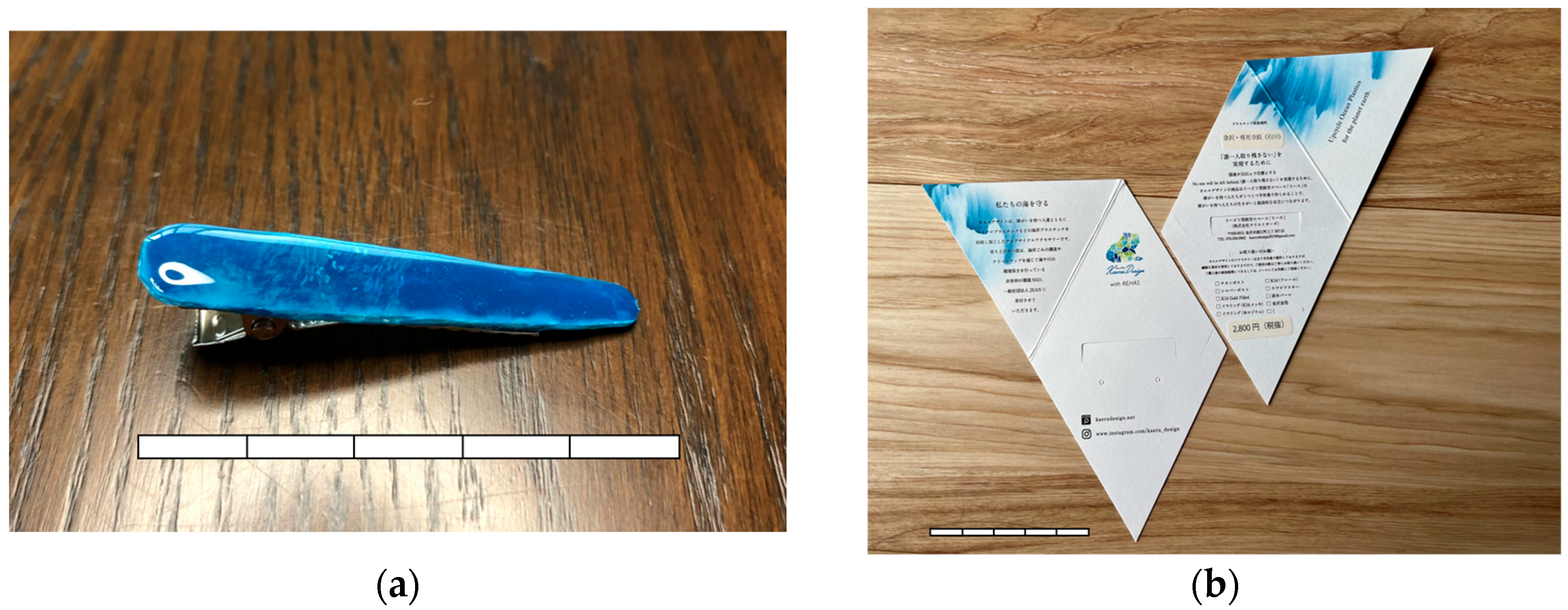
2.2.2. Accessory Production
2.2.3. Sales of Accessories
2.3. SROI Procedure
- Defining the scope and identifying key stakeholders;
- Mapping outcomes (creating an impact map);
- Evidencing outcomes and assigning values;
- Verifying the impact of activities;
- Calculating the SROI ratio;
- Reporting findings and drawing conclusions.
3. Results
3.1. Identifying Stakeholders
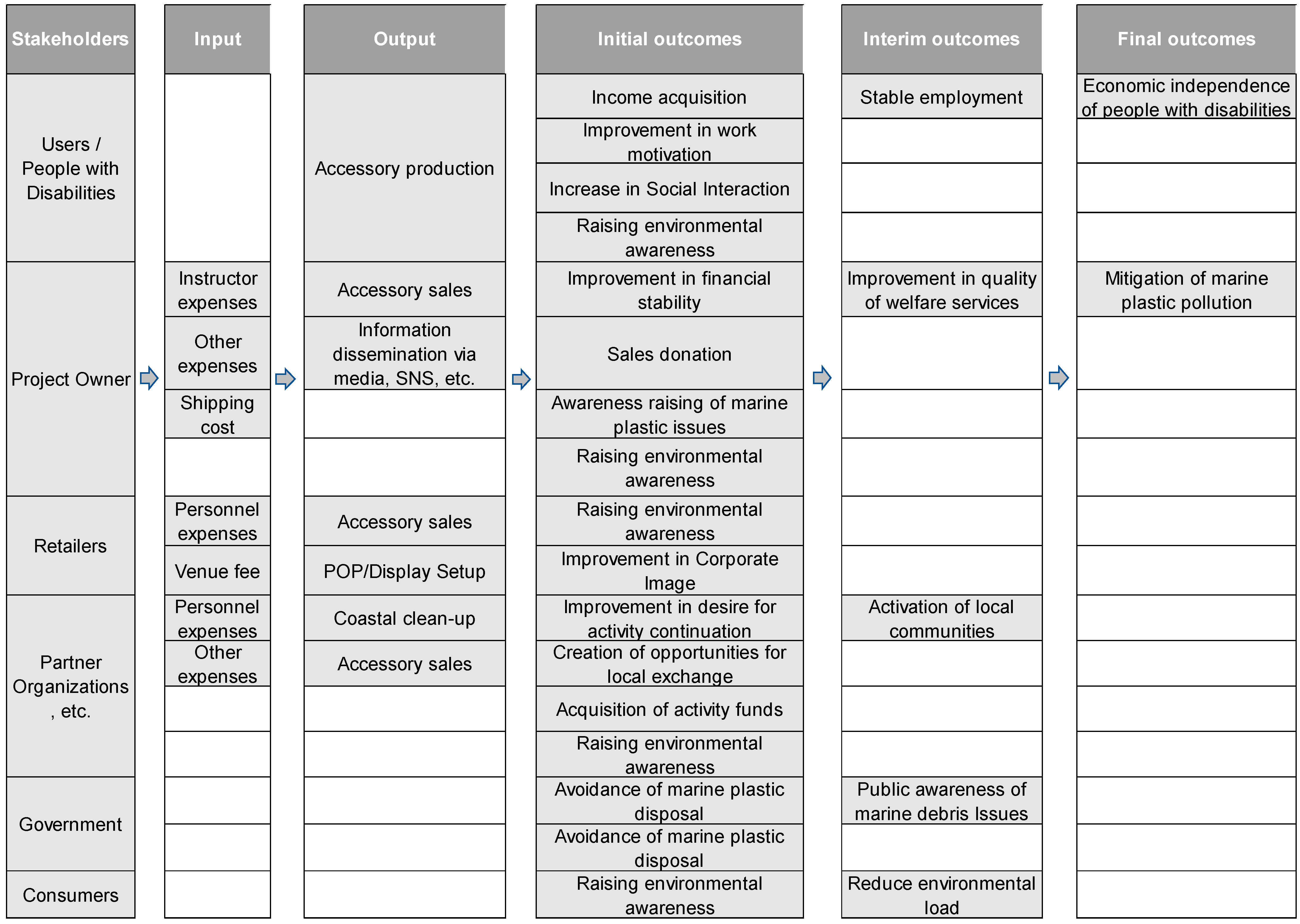
3.2. Mapping Outcomes
3.3. Evidencing Outcomes
3.4. Verification of the Impact of Activities
- Attribution: The project’s outcomes—particularly employment creation for PwDs and marine plastic upcycling—were unique to this initiative. Therefore, attribution was set at 100%, assuming these impacts would not have occurred otherwise.
- Deadweight: For environmental awareness outcomes, national-level policy effects (such as the 2020 plastic bag charge) were considered as deadweight. The proportion attributable to such policies was deducted from total impact values (ranging from 8% to 32%, depending on stakeholder group).
- Displacement: Since the project does not replace existing economic activities but creates new value in both welfare and environmental domains, displacement was assumed to be 0%.
3.5. Inputs
3.6. The SROI Calculation
3.7. Sensitivity Analysis
4. Discussion
5. Conclusions
Author Contributions
Funding
Institutional Review Board Statement
Informed Consent Statement
Data Availability Statement
Acknowledgments
Conflicts of Interest
Abbreviations
| SROI | Social Return on Investment |
| PwDs | People with Disabilities |
| KD | Kaeru Design |
Appendix A

| Survey Name | Target Stakeholders | Number of Respondents | Collection Period | Method | Purpose |
|---|---|---|---|---|---|
| User survey | Users | 15 | Feb.–Mar. 2021 | Questionnaire survey | Type of work, social interaction, work motivation, health impact, and environmental awareness change |
| User interview | Users | 2 | Mar. 2021 | Semi-structured telephone interview | Type of work, social interaction, work motivation, health impact, and environmental awareness change |
| Staff survey | Staff | 7 | Feb.–Mar. 2021 | Questionnaire survey | Type of work, work motivation, health impact, and environmental awareness change |
| Retailer survey | Retail staff | 10 | May 2021 | Questionnaire survey | Reason to sell KD marine plastic accessories, a place to sell, and environmental awareness change |
| Partner org. survey | Partner org. | 3 | Feb. 2021 | Questionnaire survey | Frequency of beach cleanups, environmental awareness change |
| Partner org. interview | 3 org. (Shonan, Chigasaki, Wakasa) | 3 | Mar. 2021 | Semi-structured Zoom interviews | Activity overview, outcomes, and challenges |
| Volunteer survey | Participants of Shonan beach cleanup | 8 | Mar. 2021 | Questionnaire survey | Recognition of KD marine plastic accessories, environmental awareness change |
| Beach cleanup activity | Participants of Shonan beach cleanup | - | Apr. 2021 | Participant observation | Gathering information through the experience of participating in actual beach clean-ups. |
| Purchaser survey | Purchaser | 85 | Feb.–Mar. 2021 | Questionnaire survey | Reason for purchase, quantity, satisfaction level, and environmental awareness change |
Appendix B
- Refrain from using plastic straws or disposable plastic spoons (Q1-1);
- Carry a reusable bottle and avoid using disposable beverage containers (such as PET bottles) as much as possible (Q1-2);
- Refuse plastic carrier bags (carry your own bag) (Q1-3);
- Refrain from using plastic bags for portioning food at supermarkets, etc. (Q1-4);
- Choose and purchase products that generate less plastic waste, such as refillable items (Q1-5);
- Refrain as much as possible from purchasing food or goods using plastic containers or packaging (Q1-6).
| (a) User | ||||||||||||
| Q1-1 | Q1-2 | Q1-3 | Q1-4 | Q1-5 | Q1-6 | |||||||
| Pre | Post | Pre | Post | Pre | Post | Pre | Post | Pre | Post | Pre | Post | |
| 0% | 2 | 1 | 3 | 3 | 2 | 0 | 2 | 1 | 0 | 0 | 2 | 1 |
| 20% | 10 | 7 | 8 | 5 | 5 | 2 | 7 | 9 | 4 | 3 | 12 | 8 |
| 50% | 1 | 5 | 3 | 4 | 4 | 7 | 4 | 2 | 6 | 6 | 1 | 6 |
| 80% | 2 | 2 | 1 | 3 | 4 | 6 | 2 | 3 | 5 | 6 | 0 | 0 |
| Total | 15 | 15 | 15 | 15 | 15 | 15 | 15 | 15 | 15 | 15 | 15 | 15 |
| 27.3% | 36.7% | 26.0% | 36.0% | 41.3% | 58.0% | 33.3% | 34.7% | 52.0% | 56.0% | 19.3% | 30.7% | |
| 9.3% | 10.0% | 16.7% | 1.3% | 4.0% | 11.3% | |||||||
| (b) Staff | ||||||||||||
| Q1-1 | Q1-2 | Q1-3 | Q1-4 | Q1-5 | Q1-6 | |||||||
| Pre | Post | Pre | Post | Pre | Post | Pre | Post | Pre | Post | Pre | Post | |
| 1 | 3 | 0 | 2 | 0 | 1 | 0 | 2 | 1 | 0 | 0 | 4 | 1 |
| 2 | 4 | 1 | 3 | 2 | 2 | 0 | 3 | 2 | 2 | 2 | 2 | 3 |
| 3 | 0 | 3 | 0 | 2 | 2 | 1 | 1 | 2 | 3 | 3 | 0 | 2 |
| 4 | 0 | 3 | 2 | 3 | 2 | 6 | 1 | 2 | 2 | 2 | 1 | 1 |
| Total | 7 | 7 | 7 | 7 | 7 | 7 | 7 | 7 | 7 | 7 | 7 | 7 |
| 11.4% | 58.6% | 31.4% | 54.3% | 42.9% | 75.7% | 27.1% | 42.9% | 50.0% | 50.0% | 17.1% | 34.3% | |
| 47.1% | 22.9% | 32.9% | 15.7% | 0.0% | 17.1% | |||||||
| (c) Retailer | ||||||||||||
| Q1-1 | Q1-2 | Q1-3 | Q1-4 | Q1-5 | Q1-6 | |||||||
| Pre | Post | Pre | Post | Pre | Post | Pre | Post | Pre | Post | Pre | Post | |
| 1 | 1 | 0 | 0 | 0 | 0 | 0 | 1 | 0 | 1 | 0 | 2 | 0 |
| 2 | 5 | 0 | 3 | 1 | 2 | 0 | 4 | 2 | 4 | 0 | 5 | 3 |
| 3 | 2 | 6 | 4 | 1 | 1 | 0 | 4 | 0 | 2 | 4 | 1 | 5 |
| 4 | 2 | 4 | 3 | 8 | 7 | 10 | 1 | 8 | 3 | 6 | 2 | 2 |
| Total | 10 | 10 | 10 | 10 | 10 | 10 | 10 | 10 | 10 | 10 | 10 | 10 |
| 36.0% | 62.0% | 50.0% | 71.0% | 65.0% | 80.0% | 36.0% | 68.0% | 42.0% | 68.0% | 31.0% | 47.0% | |
| 26.0% | 21.0% | 15.0% | 32.0% | 26.0% | 16.0% | |||||||
| (d) Volunteer | ||||||||||||
| Q1-1 | Q1-2 | Q1-3 | Q1-4 | Q1-5 | Q1-6 | |||||||
| Pre | Post | Pre | Post | Pre | Post | Pre | Post | Pre | Post | Pre | Post | |
| 1 | 0 | 0 | 1 | 0 | 0 | 0 | 0 | 0 | 0 | 0 | 0 | 0 |
| 2 | 2 | 1 | 2 | 1 | 0 | 0 | 2 | 2 | 1 | 2 | 5 | 4 |
| 3 | 1 | 2 | 0 | 2 | 1 | 1 | 3 | 4 | 2 | 3 | 1 | 1 |
| 4 | 5 | 5 | 5 | 5 | 7 | 7 | 3 | 2 | 5 | 3 | 2 | 3 |
| Total | 8 | 8 | 8 | 8 | 8 | 8 | 8 | 8 | 8 | 8 | 8 | 8 |
| 61.3% | 65.0% | 55.0% | 65.0% | 76.3% | 76.3% | 53.8% | 50.0% | 65.0% | 53.8% | 38.8% | 46.3% | |
| 3.8% | 10.0% | 0.0% | −3.8% | −11.3% | 7.5% | |||||||
| (e) Consumer | ||||||||||||
| Q1-1 | Q1-2 | Q1-3 | Q1-4 | Q1-5 | Q1-6 | |||||||
| BF | AF | BF | AF | BF | AF | BF | AF | BF | AF | BF | AF | |
| 1 | 7 | 2 | 5 | 2 | 4 | 1 | 13 | 3 | 1 | 1 | 15 | 5 |
| 2 | 30 | 17 | 23 | 8 | 12 | 2 | 19 | 7 | 14 | 6 | 33 | 18 |
| 3 | 21 | 21 | 17 | 17 | 15 | 8 | 23 | 28 | 26 | 24 | 19 | 32 |
| 4 | 16 | 34 | 29 | 47 | 43 | 63 | 19 | 36 | 33 | 43 | 7 | 19 |
| Total | 74 | 74 | 74 | 74 | 74 | 74 | 74 | 74 | 74 | 74 | 74 | 74 |
| 39.6% | 55.5% | 49.1% | 64.5% | 59.9% | 74.1% | 41.2% | 59.7% | 57.0% | 64.3% | 29.3% | 47.0% | |
| 15.9% | 15.4% | 14.2% | 18.5% | 7.3% | 17.7% | |||||||
| User | Staff | Retailer | Volunteer | Consumer | |
|---|---|---|---|---|---|
| Q1-1 | 9% | 47% | 26% | 4% | 16% |
| Q1-2 | 10% | 23% | 21% | 10% | 15% |
| Q1-3 | 17% | 33% | 15% | 0% | 14% |
| Q1-4 | 1% | 16% | 32% | −4% | 19% |
| Q1-5 | 4% | 0% | 26% | −11% | 7% |
| Q1-6 | 11% | 17% | 16% | 8% | 18% |
| n= | 26 | 10 | 10 | 200 | 500 |
| Products Subject to Reduction | Annual Consumptions (kg/Person Year) | CO2 Value Equivalent (JPY) | |
|---|---|---|---|
| Q1-1 | Other/non-container packaging | 6.96 | 54 |
| Q1-2 | PET bottles for beverages | 2.76 | 21 |
| Q1-3 | Film/shopping bags | 1.28 | 10 |
| Q1-4 | Film/container packaging (excluding shopping bags) | 7.00 | 54 |
| Q1-5 | Other bottles | 1.84 | 14 |
| Q1-6 | Packs and cups | 4.22 | 33 |
| Products Subject to Reduction | User | Staff | Retailer | Volunteer | Consumer | |
|---|---|---|---|---|---|---|
| Q1-1 | Other/non-container packaging | 131 | 254 | 140 | 405 | 4301 |
| Q1-2 | PET bottles for beverages | 56 | 49 | 45 | 429 | 1650 |
| Q1-3 | Film/Shopping bags | 43 | 33 | 15 | 0 | 703 |
| Q1-4 | Film/Container packaging (excluding shopping bags) | 19 | 85 | 174 | −407 | 5028 |
| Q1-5 | Other bottles | 15 | 0 | 37 | −320 | 519 |
| Q1-6 | Packs and cups | 96 | 56 | 52 | 490 | 2894 |
| Total | 360 | 477 | 463 | 596 | 15,096 |
Appendix C
| Deadweight (%) | Adjusted Value (JPY 1000) | Resulting SROI |
|---|---|---|
| 50% | 5720 | 3.50 |
| 80% | 2288 | 2.86 |
| 100% | 0 | 2.44 |
References
- Jambeck, J.R.; Geyer, R.; Wilcox, C.; Siegler, T.R.; Perryman, M.; Andrady, A.; Narayan, R.; Law, K.L. Plastic waste inputs from land into the ocean. Science 2015, 347, 768–771. [Google Scholar] [CrossRef]
- World Economic Forum. The New Plastics Economy: Rethinking the Future of Plastics. 2016. Available online: https://jp.weforum.org/publications/the-new-plastics-economy-rethinking-the-future-of-plastics/ (accessed on 22 December 2025).
- Wilcox, C.; Van Sebille, E.; Hardesty, B.D. Threat of plastic pollution to seabirds is global, pervasive, and increasing. Proc. Natl. Acad. Sci. USA 2015, 112, 11899–11904. [Google Scholar] [CrossRef]
- Schuyler, Q.A.; Hardesty, B.D.; Wilcox, C.; Townsend, K. Global analysis of anthropogenic debris ingestion by sea turtles. Conserv. Biol. 2014, 28, 129–139. [Google Scholar] [CrossRef]
- United Nations Environment Programme (UNEP). Valuing Plastic: The Business Case for Measuring, Managing and Disclosing Plastic Use in the Consumer Goods Industry. 2014. Available online: https://www.unep.org/resources/report/valuing-plastic-business-case-measuring-managing-and-disclosing-plastic-use (accessed on 22 December 2025).
- Ritchie, H.; Samborska, V.; Roser, M. Plastic Pollution. 2023. Available online: https://ourworldindata.org/plastic-pollution (accessed on 22 December 2025).
- Lou, X.; Sui, Y.; Fang, C.; Tang, Y.; Huang, D.; Guo, Y. Bibliometric analysis for global marine microplastic pollution control from 2013 to 2022. Front. Environ. Sci. 2023, 11, 1215317. [Google Scholar] [CrossRef]
- Parvez, M.; Ullah, H.; Faruk, O.; Simon, E.; Czédli, H. Role of Microplastics in Global Warming and Climate Change: A Review. Water Air Soil Pollut. 2024, 235, 201. [Google Scholar] [CrossRef]
- Lau, W.W.Y.; Shiran, Y.; Bailey, R.M.; Cook, E.; Stuchtey, M.R.; Koskella, J.; Velis, C.A.; Godfrey, L.; Boucher, J.; Murphy, M.B.; et al. Evaluating scenarios toward zero plastic pollution. Science 2020, 369, 1455–1461. [Google Scholar] [CrossRef] [PubMed]
- Borrelle, S.B.; Ringma, J.; Law, K.L.; Monnahan, C.C.; Lebreton, L.; McGivern, A.; Murphy, E.; Jambeck, J.; Leonard, G.H.; Hilleary, M.A.; et al. Predicted growth in plastic waste exceeds mitigation capacity. Science 2020, 369, 1515–1518. [Google Scholar] [CrossRef]
- Ministry of the Environment of Japan. Recent Developments Regarding Marine Litter. 2018. Available online: https://www.env.go.jp/content/900543475.pdf (accessed on 22 December 2025). (In Japanese)
- Bhullar, N.K.; Prabhakar, A. Plastic Waste to Value-Added Products via Recycling and Upcycling. In Energy Materials: A Circular Economy Approach, 1st ed.; Singh, S., Sundaramurthy, S., Ibhadon, A., Khan, F., Kumar Kansal, S., Mehta, S.K., Eds.; CRC Press: Boca Raton, FL, USA, 2024; pp. 36–54. [Google Scholar]
- Râpă, M.; Cârstea, E.M.; Șăulean, A.A.; Popa, C.L.; Matei, E.; Predescu, A.M.; Predescu, C.; Donțu, S.I.; Dincă, A.G. An Overview of the Current Trends in Marine Plastic Litter Management for a Sustainable Development. Recycling 2024, 9, 30. [Google Scholar] [CrossRef]
- Kirchherr, J.; Reike, D.; Hekkert, M. Conceptualizing the circular economy: An analysis of 114 definitions. Resour. Conserv. Recycl. 2017, 127, 221–232. [Google Scholar] [CrossRef]
- Bocken, N.M.P.; de Pauw, I.; Bakker, C.; van der Grinten, B. Product design and business model strategies for a circular economy. J. Ind. Prod. Eng. 2016, 33, 308–320. [Google Scholar] [CrossRef]
- Blomsma, F.; Brennan, G. The emergence of circular economy: A New Framing Around Prolonging Resource Productivity. J. Ind. Ecol. 2017, 21, 603–614. [Google Scholar] [CrossRef]
- Dijkstra, H.; van Beukering, P.; Brouwer, R. In the business of dirty oceans: Overview of startups and entrepreneurs managing marine plastic. Mar. Pollut. Bull. 2021, 162, 111880. [Google Scholar] [CrossRef] [PubMed]
- Dijkstra, H.; van Beukering, P.; Brouwer, R. Marine plastic entrepreneurship; Exploring drivers, barriers and value creation in the blue economy. Sustain. Technol. Entrep. 2022, 1, 100018. [Google Scholar] [CrossRef]
- Triwa. Available online: https://triwa.com/en-jp (accessed on 22 December 2025).
- #tide Ocean Material. Available online: https://www.tide.earth/en/ (accessed on 22 December 2025).
- ECOALF. Available online: https://ecoalf.com/en-int (accessed on 22 December 2025).
- Sanyo Shokai. Available online: https://www.sanyo-shokai.co.jp/news/2021/03/23-517.html (accessed on 22 December 2025). (In Japanese).
- Daimaru Kyoto. Available online: https://shopblog.dmdepart.jp/kyoto/detail/?cd=131433&scd=000147 (accessed on 22 December 2025). (In Japanese).
- FamilyMart. Shopping Baskets Made from Upcycled Marine Plastic Waste Introduced at 24 FamilyMart Stores Nationwide!! 2021. Available online: https://www.family.co.jp/company/news_releases/2021/20211020_01.html (accessed on 22 December 2025). (In Japanese).
- Kaeru Design. Available online: https://kaerudesign.net/ (accessed on 22 December 2025). (In Japanese).
- The Global Steering Group for Impact Investment. Measuring Impact. 2014. Available online: https://www.gsgimpact.org/resources/gsg-impact-publications-reports/measuring-impact/ (accessed on 22 December 2025).
- GSG Domestic Advisory Committee, Social Impact Assessment Working Group. Social Impact Assessment Toolkit Practical Manual. 2017. Available online: https://simi.or.jp/wp-content/uploads/2020/06/NAB_manual_ver2.pdf (accessed on 22 December 2025). (In Japanese).
- Amita Corporation. MEGURU STATION® and Social Impact Assessment. Available online: https://www.amita-oshiete.jp/column/entry/016458.php (accessed on 22 December 2025). (In Japanese).
- Sompo Institute Plus Inc. Trends in Domestic Impact Investing. 2025. Available online: https://www.sompo-ri.co.jp/2025/01/30/15997/ (accessed on 22 December 2025). (In Japanese).
- Waithaka, A.; Plakantonaki, S.; Kiskira, K.; Mburu, A.W.; Chronis, I.; Zakynthinos, G.; Githaiga, J.; Priniotakis, G. Cellulose-Based Biopolymers from Banana Pseudostem Waste: Innovations for Sustainable Bioplastics. Waste 2025, 3, 37. [Google Scholar] [CrossRef]
- Atanasovska, I.; Choudhary, S.; Koh, L.; Ketikidis, P.H.; Solomon, A. Research gaps and future directions on social value stemming from circular economy practices in agri-food industrial parks: Insights from a systematic literature review. J. Clean. Prod. 2022, 354, 131753. [Google Scholar] [CrossRef]
- Rawhouser, H.; Cummings, M.; Newbert, S.L. Social impact measurement: Current approaches and future directions for social entrepreneurship research. Entrep. Theory Pract. 2019, 43, 82–115. [Google Scholar] [CrossRef]
- Ebrahim, A.; Rangan, V.K. What impact? A framework for measuring the scale and scope of social performance. Calif. Manag. Rev. 2014, 56, 118–141. [Google Scholar] [CrossRef]
- Sridan, P.; Surapolchai, P.; Plainlaor, T.; Tanyaim, A.; Hounnaklang, N.; Zongram, O.; Hawangchu, Y. Social Return on Investment (SROI) from the Community Waste Bank Implementation under the Learning Center of Systematic Waste Management Innovation According to the Circular Economy Concept. Appl. Environ. Res. 2024, 46(1), 011. [Google Scholar] [CrossRef]
- The SROI Network. A Guide to Social Return on Investment. 2012. Available online: https://socialvalueuk.org/resources/a-guide-to-social-return-on-investment-2012/ (accessed on 22 December 2025).
- Millar, R.; Hall, K. Social return on investment (SROI) and performance measurement. Public Manag. Rev. 2013, 15, 923–941. [Google Scholar] [CrossRef]
- Yonemura, S.; Yokoyama, K. Policy evaluation of sports policy—From the perspective of “Social Impact” evaluation. Doshisha J. Health Sports Sci. 2020, 12, 37–48. (In Japanese) [Google Scholar] [CrossRef]
- Ministry of the Environment of Japan. Calculation Method for 3R Unit Values. Available online: https://www.env.go.jp/press/files/jp/19747.pdf (accessed on 22 December 2025). (In Japanese)
- The J-Credit Scheme. Credit Bidding Sales. Available online: https://japancredit.go.jp/tender/ (accessed on 22 December 2025). (In Japanese).
- Ministry of the Environment of Japan. Coastal Drift Waste Regional Countermeasures Promotion Project. Available online: https://www.env.go.jp/content/900543491.pdf (accessed on 22 December 2025). (In Japanese)
- Kokoku-Direct. Newspaper Advertisement Unit Price. Available online: https://www.kokoku-direct.jp/massmedia/newspaper/ (accessed on 22 December 2025). (In Japanese).
- Kokoku-Direct. Television Commercial Fee. Available online: https://www.kokoku-direct.jp/massmedia/tvcm/ (accessed on 22 December 2025). (In Japanese).
- Adell. Advertisement Fee Market Rates. Available online: https://adell-media.com/native-advertising-30medias-price/#1 (accessed on 22 December 2025). (In Japanese).
- General Incorporated Association National Federation of Blue Tax Return Associations. 2020 Minimum Wage. Available online: https://www.zenaoirobr.jp/sp/_tmp/contents/2020/202010/index03690000.html (accessed on 22 December 2025). (In Japanese).
- UNEP. Single-Use Plastics: A Roadmap for Sustainability. 2018. Available online: https://www.unep.org/ietc/ja/node/53?%2Fresources%2Fpublication%2Fsingle-use-plastics-roadmap-sustainability= (accessed on 22 December 2025).
- Farr, M.; Cressey, P.; Milner, S.E.; Abercrombie, N.; Jaynes, B. Proving the Value of Advice: A Study of the Advice Service of Bath and North East Somerset Citizens Advice Bureau; South West Forum: Exeter, UK, 2014. [Google Scholar]
- Power to Change. An Economic Framework to define and measure Social Value in Community Asset Transfers. 2024. Available online: https://www.dtni.org.uk/wp-content/uploads/2024/06/The-Economics-of-CATs-Power-to-Change.pdf (accessed on 22 December 2025).
- Furniture Bank. SROI Case Study. 2017. Available online: https://www.furniturebank.org/wp-content/uploads/2017-SimPACT-SROI-Study-Furniture-Bank.pdf?utm_source=chatgpt.com (accessed on 22 December 2025).
- End Furniture Poverty. Social Return on Investment Study into the Provision of Essential Furniture Items. 2021. Available online: https://endfurniturepoverty.org/wp-content/uploads/2022/10/SROI-of-Furniture-Provision-2021.pdf?utm_source=chatgpt.com (accessed on 22 December 2025).
- Recycling Lives Charity. Social Return on Investment Report: Recycling Lives Charity and Social Enterprise. 2021. Available online: https://www.recyclinglives.org/wp-content/uploads/2022/03/SROI-Report_by-LynchPin-Support_for-Recycling-Lives-Charity.pdf?utm_source=chatgpt.com (accessed on 22 December 2025).
- Fujiyama, A.; Iwahashi, M.; Matsumoto, T. Comprehensive evaluation of the on-site paper cycle system based on social return on investment (SROI). J. Jpn. Soc. Civ. Eng. Ser. G (Environ. Res.) 2021, 77, II_13–II_21. (In Japanese) [Google Scholar] [CrossRef]
- Vicente-Molina, M.A.; Fernández-Sainz, A.; Izagirre-Olaizola, J. Does gender make a difference in pro-environmental behavior? The case of the Basque Country University students. J. Clean. Prod. 2018, 176, 89–98. [Google Scholar] [CrossRef]
- Li, Y.; Wang, B.; Saechang, O. Is Female a More Pro-Environmental Gender? Evidence from China. Int. J. Environ. Res. Public Health 2022, 19, 8002. [Google Scholar] [CrossRef] [PubMed] [PubMed Central]
- Mandarić, D.; Hunjet, A. Gender Disparities in Pro-Environmental Attitudes: Implications for Sustainable Business Practices in Croatia. J. Bus. Econ. Rev. 2024, 9, 73–84. [Google Scholar] [CrossRef]
- Ricket, A.L.; Goodspeed, T. Impact measurement for social enterprises: Social return on investment and subjective well-being valuation in the United States. J. Int. Counc. Small Bus. 2025, 1–23, in press. [Google Scholar] [CrossRef]
- Urmanavičienė, A.; Butkevičienė, E. The Role of Work Integration Social Enterprises in Achieving Sustainable Development Goals during the COVID-19 Pandemic: The Case Study of Lithuania. Sustainability 2023, 15, 4324. [Google Scholar] [CrossRef]


| Stakeholder | No. | Outcome | Indicator | No. of People Affected | Monetary Value (JPY 1000/Year) | Basis for Calculation |
|---|---|---|---|---|---|---|
| Users | 1 | Gaining income | Amount of wage payment | 6 | 4798 | Based on interviews: number of people × hourly wage (JPY 833) × 4 h/day × 240 working days/year. |
| Users | 2 | Increased motivation to work | Attendance rate | 26 | 1455 | Improvement in attendance (from 87.5% in 2019 to 94.5% in 2020 = 7%) × average daily wage (JPY 833 × 4 h) × 240 days × number of people. |
| Users | 3 | More social interaction | Frequency of social activities | 26 | 156 | Based on survey: 50% increase in social interaction × 2 café visits/month × JPY 500 [37] each. |
| Users | 4 | Increased environmental awareness | Reduced single-use plastic amount | 26 | 0.4 | Reduction rate of single-use plastic (from user survey) × CO2 emission factor (5.0 kg-CO2/kg) [38] × J-Credit average price (JPY 1473/t-CO2) [39]. |
| Project operator | 5 | Improved financial stability | Sales revenue | - | 3444 | Based on sales of 518 items (online) + 694 (consignment), average price JPY 3316, profit rate 75%. |
| Project operator | 6 | Environmental contribution through donation to JEAN | Pollution avoided | - | 2.0 | Actual donation JPY 36,185 × 37% used for activities × marine waste collected (0.001 kg/JPY) × avoided disposal cost (JPY 150/kg) [40]. |
| Project operator | 7 | Raised awareness of marine plastic issues | Number of media coverages | - | 11,440 | 11 local newspapers × JPY 600,000 + 2 national papers × JPY 1647,000 + 2 TV reports × JPY 320,000 + 3 web articles (10,000 page views × JPY 30) [41,42,43]. |
| Project operator | 8 | Increased environmental awareness | Reduced single-use plastic amount | 10 | 0.5 | Reduction rate (from staff survey) × CO2 emission factor × J-Credit price (same as above). |
| Retailers | 9 | Increased environmental awareness | Reduced single-use plastic amount | 10 | 0.5 | Reduction rate (from retailer survey) × CO2 emission factor × J-Credit price (same as above). |
| Partner Orgs, etc. | 10 | Sustained motivation for activities | Annual activity hours | 200 | 4330 | Voluntary work hours: 200 people × 24 h/year × JPY 902/h (national weighted average minimum wage, FY2020) [44]. |
| Partner Orgs, etc. | 11 | Secured funding for activities | Sales commission income | - | 166 | 200 items sold × Sales commission rate 25%× average price JPY 3316. |
| Partner Orgs, etc. | 12 | Increased environmental awareness | Reduced single-use plastic amount | 200 | 0.6 | Voluntary work hours: 200 people × 24 h/year × JPY 902/h (national weighted average minimum wage, FY2020). |
| Government | 13 | Avoided damage from marine plastic | Amount of collected marine plastic | - | 8.5 | Based on global marine plastic outflow (8 million t) and economic loss (USD 13 billion), converted to damage per 50 kg of marine plastic [45]. |
| Government | 14 | Reduced waste treatment cost | Amount of collected marine plastic | - | 7.5 | 50 kg of plastic × avoided administrative disposal cost (JPY 150/kg). |
| Consumers | 15 | Increased environmental awareness | Reduced single-use plastic amount | - | 15 | Reduction rate (from buyer survey) × CO2 emission factor × J-Credit price (same as above). |
| Total | 25,824 |
| No. | Outcome | Monetary Value (JPY 1000) | Deadweight (%) | Adjusted Value (JPY 1000) | Basis for Calculation |
|---|---|---|---|---|---|
| 1 | Gaining income | 4798 | 0% | 4798 | |
| 2 | Increased motivation to work | 1455 | 30% | 1019 | Based on comparison with similar welfare-type workplaces (Type A). Deadweight was assumed to be 30%. |
| 3 | More social interaction | 156 | 20% | 125 | Assumed that 20% of the participants would have similar opportunities for interaction through other products or activities. |
| 4 | Increased environmental awareness | 0.4 | 22% | 0.3 | Deadweight was estimated based on the proportion of users’ plastic bag reduction behavior attributable to national plastic bag charging policy (32% × 70%). |
| 5 | Improved financial stability | 3444 | 0% | 3444 | |
| 6 | Environmental contribution through donation to JEAN | 2.0 | 0% | 2.0 | |
| 7 | Raised awareness of marine plastic issues | 11,440 | 50% | 5720 | Deadweight (50%) applied to account for broader societal influences. |
| 8 | Increased environmental awareness | 0.5 | 17% | 0.4 | Deadweight estimated from staff’s share in overall plastic reduction (24%) × proportion attributable to national policy (70%). |
| 9 | Increased environmental awareness | 0.5 | 8% | 0.4 | Deadweight estimated from retailers’ share in overall plastic reduction (11%) × proportion attributable to national policy (70%). |
| 10 | Sustained motivation for activities | 4330 | 20% | 3464 | Assumed that 20% of volunteers would continue activities even without the marine-plastic jewelry project |
| 11 | Secured funding for activities | 166 | 0% | 166 | |
| 12 | Increased environmental awareness | 0.6 | 0% | 0.6 | Deadweight was set at 0% since the volunteers’ share in total reduction effect was negligible (0%). |
| 13 | Avoided damage from marine plastic | 8.5 | 0% | 8.5 | |
| 14 | Reduced waste treatment cost | 7.5 | 0% | 7.5 | |
| 15 | Increased environmental awareness | 15 | 11% | 13 | Deadweight estimated from consumers’ share in total plastic reduction (16%) × proportion attributable to national policy (70%). |
| 6, 11, 13, 14 | Outcomes for the Marine Environment | 3648 | |||
| 1, 2, 3, 5 | Outcomes for Persons with Disabilities and Facilities | 9385 | |||
| 4, 7, 8, 9, 12, 15 | Outcomes for Civil Society | 5734 | |||
| Total | 25,824 | 18,768 |
| Stakeholder | No. | Input | Measurement Indicator | Input Amount (JPY 1000/Year) |
|---|---|---|---|---|
| Users | 1 | Personnel costs | Instructor salaries (JPY 140,000/month × 12 months) | 1680 |
| Users | 2 | Other expenses | Material costs (hardware), equipment costs, packaging materials, online shop server operation fees, and credit card payment system | 387 |
| Users | 3 | Shipping costs | Actual shipping costs from regional organizations to Kanazawa (JPY 600 × 24 occasions) | 14 |
| Retailers | 4 | Personnel Costs | Sales staff wages (2 staff per day × 8 h × 7 days × Fukuoka Prefecture minimum wage JPY 842; 2 staff per day × 8 h × 7 days × Tokyo Metropolis minimum wage JPY 1013) | 208 |
| Retailers | 5 | Venue costs | Department store stall fee (JPY 100,000 × 7 days × 2 times) | 1400 |
| Partner Orgs, etc. | 6 | Personnel costs | Beach clean-up volunteer working hours (2000 h × Kanazawa City minimum wage JPY 833) | 1666 |
| Total | 5355 |
| Item | Monetary Value | Unit |
|---|---|---|
| Total Present Value | 18,768 | JPY |
| Total Investment | 5355 | JPY |
| Social Return on Investment | 3.50 | Ratio |
Disclaimer/Publisher’s Note: The statements, opinions and data contained in all publications are solely those of the individual author(s) and contributor(s) and not of MDPI and/or the editor(s). MDPI and/or the editor(s) disclaim responsibility for any injury to people or property resulting from any ideas, methods, instructions or products referred to in the content. |
© 2026 by the authors. Licensee MDPI, Basel, Switzerland. This article is an open access article distributed under the terms and conditions of the Creative Commons Attribution (CC BY) license.
Share and Cite
Yoshida, A.; Hosoi, Y.; Hagiwara, M.; Kanezawa, S.; Kayama, T. Evaluating the Social Value of a Marine Plastics Upcycling Project in Japan. Environments 2026, 13, 29. https://doi.org/10.3390/environments13010029
Yoshida A, Hosoi Y, Hagiwara M, Kanezawa S, Kayama T. Evaluating the Social Value of a Marine Plastics Upcycling Project in Japan. Environments. 2026; 13(1):29. https://doi.org/10.3390/environments13010029
Chicago/Turabian StyleYoshida, Aya, Yamato Hosoi, Masafumi Hagiwara, Shingo Kanezawa, and Toshiya Kayama. 2026. "Evaluating the Social Value of a Marine Plastics Upcycling Project in Japan" Environments 13, no. 1: 29. https://doi.org/10.3390/environments13010029
APA StyleYoshida, A., Hosoi, Y., Hagiwara, M., Kanezawa, S., & Kayama, T. (2026). Evaluating the Social Value of a Marine Plastics Upcycling Project in Japan. Environments, 13(1), 29. https://doi.org/10.3390/environments13010029