Article

Presence of Pesticides and Transformation Products and Associated Risk Assessment in Groundwater of a Region with an Intensive Agricultural Activity


by
Eliseo Herrero-Hernández
1,2,*,
José Manuel Ordax
1,
Jesús M. Marín-Benito
1,
Miguel del Nogal Sánchez
2 and
María Sonia Rodríguez-Cruz
1
1
Institute of Natural Resources and Agrobiology of Salamanca (IRNASA-CSIC), Cordel de Merinas 40-52, 37008 Salamanca, Spain
2
Department of Analytical Chemistry, Nutrition and Food Science, University of Salamanca, Plaza de LosCaídos s/n, 37008 Salamanca, Spain
*
Author to whom correspondence should be addressed.
Environments 2026, 13(1), 27; https://doi.org/10.3390/environments13010027
Submission received: 19 November 2025 / Revised: 16 December 2025 / Accepted: 18 December 2025 / Published: 1 January 2026

Abstract

The protection of natural resources, particularly groundwater, is essential for the sustainability of rural environments, especially when urban centers rely on this water for consumption. The objective of this study was to evaluate the occurrence, seasonal distribution, and associated risk of pesticide residues in groundwater in a region of intensive farming in the Duero river basin (Spain). A total of 40 pesticides and 7 degradation products were analyzed at 20 sampling points over four campaigns conducted in 2018. Overall, twenty-one compounds were detected, including three insecticides, three fungicides, ten herbicides, and five degradation products. Concentrations of eight compounds (one fungicide, five herbicides, and two degradation products) exceeded the limits established by the European Union (EU) for drinking water. Herbicides were the most frequently detected pesticides and were present at the highest concentrations (up to 3.416 μg L−1) across all sampling campaigns. Metolachlor, prosulfocarb, metribuzin, and metolachlor degradation products (ethanesulfonic acid (ESA)– and oxanilic acid (OA)–metolachlor) were detected in concentrations over 1.0 µg L−1. The sum of Toxic Units (∑Tui) showed that none of samples posed a high risk. None of compounds presented a high risk for the three aquatic organismstested; only prosulfocarb for algae and Daphnia magna; pendimethalin for algae and fish; and metribuzin, chlorotoluron, and desethyl-terbuthylazine (DETbz) for algae posed high risks.

1. Introduction

The main factor contributing to chemical pollution in aquatic ecosystems within agricultural areas is the extensive use of pesticides, which are necessary to control pests and protect crops. Pesticides applied in agriculture can reach water bodies through surface runoff or by vertical movement through the soil profile (leaching). Groundwater in areas of intensive agriculture is particularly vulnerable to pesticide contamination, a concern that becomes more serious when the water is intended for human consumption [1].
Sustainability is a central tenet of the European agricultural model, in which agricultural production serves as one of the main pillars [2]. This model relies, among other factors, on agrochemical inputs. The application of these compounds is driven by the need to ensure crop yields of sufficient quantity and quality to meet the population nutritional demands. Contemporary agricultural systems are largely oriented toward maximizing productivity and economic return. To achieve these goals, conventional agricultural practices often employ intensive agronomic interventions, frequently without adequate consideration of their long-term environmental or ecological consequences [3].
European legislation regulates the concentration of these compounds in water intended for human consumption through several directives to protect the quality of water for human consumption and groundwater from pollution and deterioration [4]. Revised Directive 2006/118/EC [5] establishes individual threshold for pesticides (0.1 μg L−1) and a maximum total pesticide concentration (0.5 μg L−1) permitted in water. Other European guidelines also consider the risks that pesticide residues pose to aquatic organisms [6,7]. Indicators such as Toxic Units (TUs) and Risk Quotients (RQs) for evaluating ecological and exposure effects of pesticides at different trophic levels have been identified as useful for assessing the biological risks of these compounds [8].
Sources of surface and groundwater contamination by pesticides from agricultural activities may be diffuse (such as inadequate application or the use of doses exceeding recommendations) or point sources (leaks from application equipment, spills or washing of application machinery). The impact of diffuse contamination depends on the extent of adsorption, mobility and degradation processes that pesticides undergo in the unsaturated soil zone. The agricultural sector accounts for approximately one-third of Europe’s total freshwater consumption, with even higher proportions in countries such as Spain. Agricultural activities affect not only the availability of water resources but also water quality, limiting its suitability for alternative uses. In several regions of Europe, contamination from agrochemicals—particularly pesticides and fertilizers—represents one of the primary sources of water quality degradation [9].
According to Eurostat (https://ec.europa.eu/eurostat/), pesticide sales in the EU reached approximately 333,000 tons in 2019 [10], representing a 6% decrease compared with 2018. The principal categories (fungicides, herbicides, and insecticides) accounted for about 86% of the total. In Spain, 75,397 tons of pesticides were sold, placing the country among the leading consumers in the EU, along with France, Germany, and Italy [11]. The use of such agrochemicals poses potential risks to soil and water systems, which may in turn affect human and animal health and contribute to biodiversity loss. Water is a fundamental component of agricultural systems and a key determinant of crop productivity. However, reliance on groundwater for human consumption becomes particularly concerning when leaching processes facilitate the transport of pesticides and fertilizers into aquifers [12].
Globally, the United States, China, and Spain have produced the largest number of studies on pesticide contamination in surface freshwater. Some economically less developed countries with intensive agricultural practices have also contributed to this research field. Among the pesticides evaluated, atrazine was the most frequently studied and detected compound up to 2021, and it remains one of the substances found at the highest concentrations in aquatic environments [13]. In recent years, several studies have reported the presence of pesticides and other substances in surface waters of different Spanish river basins, including the Ebro [8], Júcar and Turia [14], Júcar [15], Turia [16], Llobregat [17], Guadalquivir [18,19], and Miño [20], as well as in the Mediterranean coastal waters [21] and natural protected areas [22]. However, no studies have included the Duero river basin, and only a limited number of investigations have analyzed large datasets of groundwater samples [23,24,25,26].
The protection of natural resources, including soil and water, plays a fundamental role in the sustainability of rural environments. Groundwater preservation is of particular importance, especially considering that many urban centers in Spain rely on this resource. Although groundwater is generally less vulnerable than surface water, it is still subject to significant degradation risks, and its recovery is considerably more difficult once contaminated. According to the Duero Hydrographic Confederation (CHDuero, https://www.chduero.es/), the chemical quality of groundwater in the basin is generally good; however, in some areas, aquifers are overexploited, and exhibit low water levels [27].
In certain cases, pesticide concentrations exceeding the legal limits have been detected in drinking water supplied to some municipalities in the region. This is the case for S-metolachlor, which has been used in Spain since 1998 [28] and has been detected in both surface and ground water in several European countries, including Greece [29], Hungary [30], Poland [31] and Italy [32]. In recent years, groundwater contamination has been reported in the Castilla-León region of Spain, primarily associated with intensive potato and maize cultivation, where S-metolachlor is widely applied [27]. Moreover, the degradation products of S-metolachlor—ethane sulfonic acid (ESA-metolachlor)—and oxanilic acid (OA-metolachlor)—have been detected in groundwater due to their high mobility and persistence in the environment [33,34].
These findings support the need to evaluate groundwater levels of the main pesticides used in irrigated areas of the province of Salamanca, where potato and maize cultivation predominates, in order to obtain an environmental diagnosis of contamination by these compounds.
The objectives of this study were: (i) to monitor natural water bodies in an agricultural area dominated by potato and crop cultivation in order to determine the presence of pesticides and their transformation products in groundwater samples, and (ii) to assess the potential ecotoxicological risk to aquatic organisms (algae, Daphnia magna, and fish) by calculating Toxic Units (TUs) and Risk Quotients (RQs) in the Duero river basin (Spain). To the best of our knowledge, this is the first study in the region to simultaneously evaluate pesticide occurrence, their degradation products, and their associated ecotoxicological risks in an intensively impacted agricultural area.

2. Materials and Methods

2.1. The Study Area

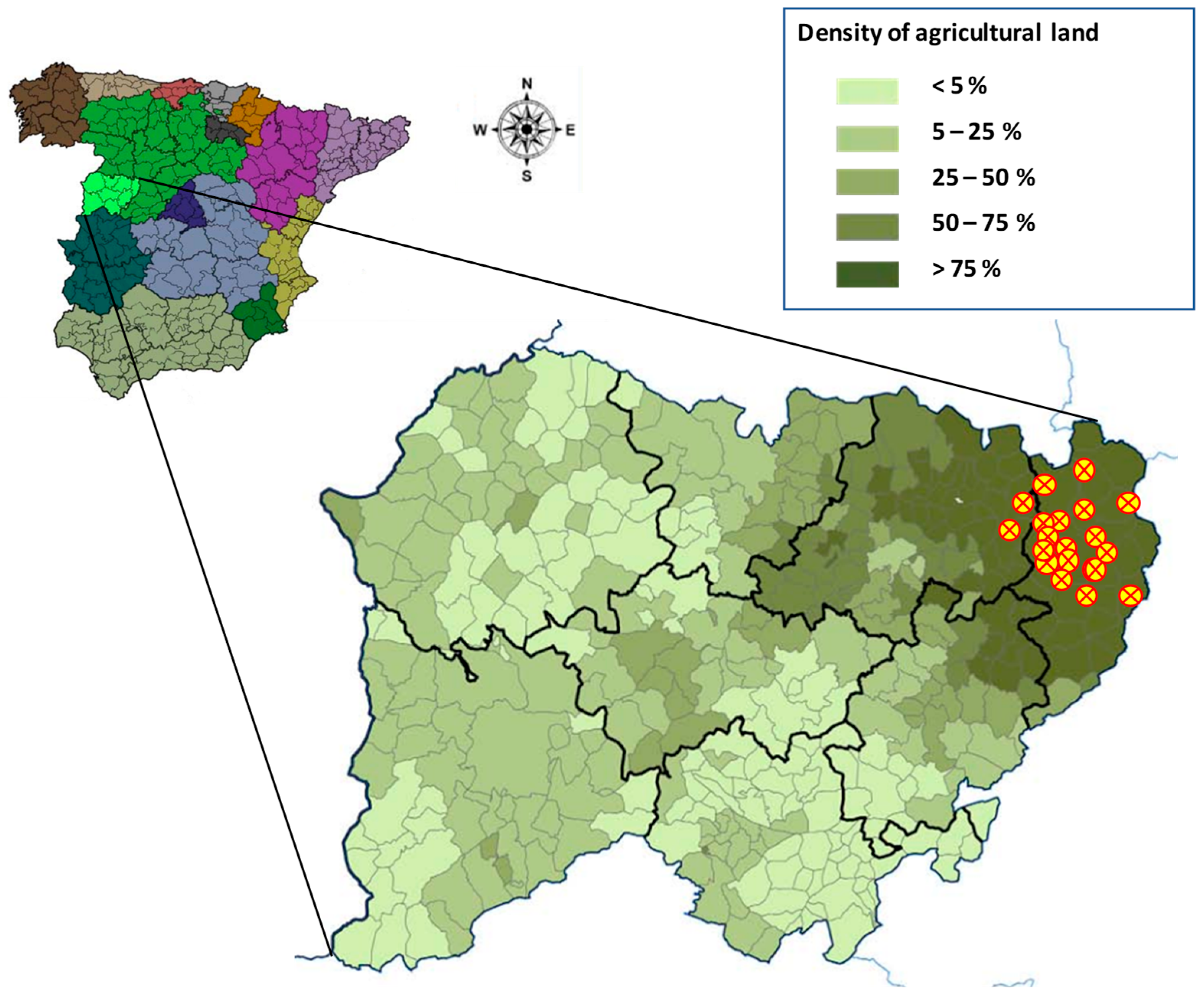
The area selected is located in the northeast of the province of Salamanca, the region with the highest density of land dedicated to agricultural use in the province (>75%). It includes extensive potato, maize, cereal and beet crops, where different commercial formulations containing different pesticides are applied. Irrigated potato cultivation requires intensive pesticide use, particularly herbicides and insecticides, with several active principles recommended to manage the different diseases affecting these crops.
The groundwater in the study area belongs to the “Tierra del Vino” water body, as defined in the Hydrological Plan of the Duero River Basin District, approved in June 2013 [27]. It is classified as overexploited (“at risk of not achieving a satisfactory quantitative status”) due to the large number of wells and boreholes in the area. Irrigation water in this area is obtained from wells and boreholes and two irrigation canals. There are approximately 1000 wells and boreholes in the area. The water level is quite shallow, and most wells share similar characteristics, with an average depth of 10–15 m.
The aquifer lithology consists of continental detrital sediments of Tertiary age (sand-gravel assemblages, arkosic materials and local clay intercalations) resulting in moderate permeability. Groundwater recharge mainly takes place through rainfall infiltration at higher elevations and through surface water–groundwater interactions along the Tormes River and its tributaries (IGN, https://www.ign.es/) [35].

2.2. Sampling Network and Pesticides Selected

Twenty wells and boreholes were selected for groundwater sampling close to potato- and cereal-growing areas with different soil types (Figure 1). Most sampling points correspond to hand-dug wells of various depths, while 3 samples were taken from boreholes ranging from 17 to 160 m in depth. These water sources are mainly used for irrigation and drinking water supply, and one sample was collected from a public fountain (Table 1).
Four sampling campaigns were conducted in April (before the planting period), June (start of the potato campaign, and after herbicide application), July (intermediate period in the potato campaign, and after insecticide application), and October (after finishing the potato recollection) of 2018. It is important to note that the April and June sampling campaigns were carried out following heavy rainfall events during March and May of that year.
Water samples were collected manually or by pumping and transported to the laboratory in amber glass bottles in iceboxes. Samples were stored in the dark in a refrigerated chamber at 4 °C until analysis, after filtration through 0.45 μm membranes, following established procedures. Extracts were analyzed within two weeks of sample collection. The general characteristics of water samples are shown in Table 1.
Based on data provided by the local cooperative (Cantalpino, Spain) responsible for supplying phytosanitary products, together with information obtained from regional farmers, a total of 40 compounds were selected for analysis. These included 21 herbicides, 5 insecticides, 6 fungicides, and 8 known degradation products, chosen from among the substances most commonly used in the area in recent years. In addition, several banned pesticides previously detected in other regions were included to broaden the scope of the study and provide a more comprehensive assessment of environmental contamination. The selected compounds, representing multiple chemical classes (herbicides, fungicides, and insecticides), are listed in Table S1 (Supplementary Materials). Analytical standards for the target pesticides and selected degradation products (minimum purity > 98%) were obtained from Sigma Aldrich Química S.A. (Madrid, Spain) and Dr. Ehrenstorfer (Augsburg, Germany).

2.3. Analytical Determination of Pesticides and Inorganic Anions

Pesticide concentrations in the aqueous phase were determined in water samples previously pre-concentrated using a slightly modified version of the multi-residue method developed by Herrero-Hernández et al. [36], in order to incorporate newly applied pesticides specific to the study area. Solid-phase extraction (SPE) was performed using Oasis HLB cartridges as sorbents. A volume of 500 mL of water was pre-concentrated. Elution was performed with 4 mL of acetone and 4 mL of acetonitrile. The solvent was evaporated to dryness, and the residue was re-dissolved in 500 µL of methanol/water mixture (1:1) for analysis by LC-MS using a Waters system (Milford, MA, USA) equipped with an electrospray ionization (ESI) interface.
Quantification was performed by external calibration using matrix-matched standards, which were managed in a similar way to collected water samples. The proposed methodology was validated for each of the compounds by studying different analytical parameters such as the accuracy (average recovery), precision (reproducibility and repeatability) at the level of concentration established by EU legislation, the linearity parameters, and the limits of detection (LOD) and quantification (LOQ) of the complete method estimated as the analyte concentration with a signal-to-noise ratio of 3 and 10, respectively.
Detailed procedures for sample pre-concentration and analytical conditions are provided in the Supplementary Materials and summarized in Table S2.

2.4. Environmental Risk Assessment

Ecotoxicological risk assessment of detected compounds in water samples was conducted using Toxic Units (TUs), following European regulatory guidelines [6]. TUs were determined for at least three representative taxa covering different trophic levels: algae, Daphnia magna, and fish. The Toxic Unit for each compound (TUi) was calculated by dividing its measured environmental concentration (MECi) by its corresponding median effective concentration (EC50i) or median lethal concentration (LC50i), as follows: TUi (algae; Daphnia magna; fish) = MECi/EC50i or LC50i. The cumulative toxic pressure at each sampling site (TUsite) was then estimated by summing all individual TUi values for compounds detected at that location [8].
Risk Quotients (RQs) were also calculated to assess potential ecological risk, defined as the ratio between the measured environmental concentration (MEC) and the predicted no-effect concentration (PNEC): RQ = MEC/PNEC. To derive PNEC values, an assessment factor (AF) was applied to account for uncertainties in toxicity data, as recommended by the European Commission [6]. When chronic (long-term) toxicity data were available, a default AF of 100 was used, typically based on the lowest no-observed-effect concentration (NOEC). When only acute (short-term) data were available (i.e., EC50 or LC50 values), a more conservative AF of 1000 was applied [31]. This factor compensates for uncertainties inherent in extrapolating laboratory toxicity data to environmental conditions. Four risk categories were defined based on RQ values: minimal risk: RQ < 0.01, low risk: 0.01 ≤ RQ < 0.1, medium risk: 0.1 ≤ RQ < 1 and high risk: RQ ≥ 1 [37].
Acute toxicity endpoints included the 48 h EC50 for Daphnia magna, the 72 h EC50 for algae, and the 96 h LC50 for fish. Chronic toxicity endpoints were based on the 96 h NOEC for algae and the 21-day NOEC values for both Daphnia magna and fish. These data were obtained from the Pesticide Properties DataBase (PPDB) [28], which defines EC50 values according to Daphnia magna immobilization, algal growth inhibition (species not specified), and fish survival, typically in Oncorhynchus mykiss (rainbow trout).

2.5. Statistical Analysis

Principal component analysis (PCA) was used to extract valuable insights from the data, allowing for the examination of multivariate correlations among the concentrations of various pesticides. The Unscrambler® X software (v 10.5, CAMO Software AS., Oslo, Norway, 2017) was used for the PCA. Prior to the analysis, the data were pretreated by row normalization. To prevent averaging based on a significant number of unquantified values and facilitate statistical analysis, concentrations below LOD were set to 0 (estimated as null), and those between LOD and LOQ were set to LOQ/2 when needed. This data transformation mitigated the impact of zero values while still incorporating low levels in the calculation of the average.
The potential connections among pesticide occurrences throughout all the sites were assessed by conducting pairwise correlations through Spearman’s rank test, setting a significance level of 0.01.

3. Results and Discussion

3.1. Characterization of Groundwater Samples and Pesticide Monitoring

Physicochemical parameters of water samples were analyzed, and the results from the June sampling campaign are shown in Table 1. The pH values were above 4.5, and conductivity values were below 2500 μS cm−1 in all cases, indicating that the waters were neither aggressive nor encrusting [6]. Chloride concentrations were <250 mg L−1 in all cases. Sulfate concentrations were generally below 250 mg L−1, except for water 1, which slightly exceeded the legal limit established for water intended for human consumption [6]. Nitrate concentrations exceeded the regulatory limit of 50 mg L−1 in most samples, with the exception of samples 2, 6, 8, 12, 14, 15, 16, and 17, which remained below the legal limit in some or all of the sampling campaigns [6].
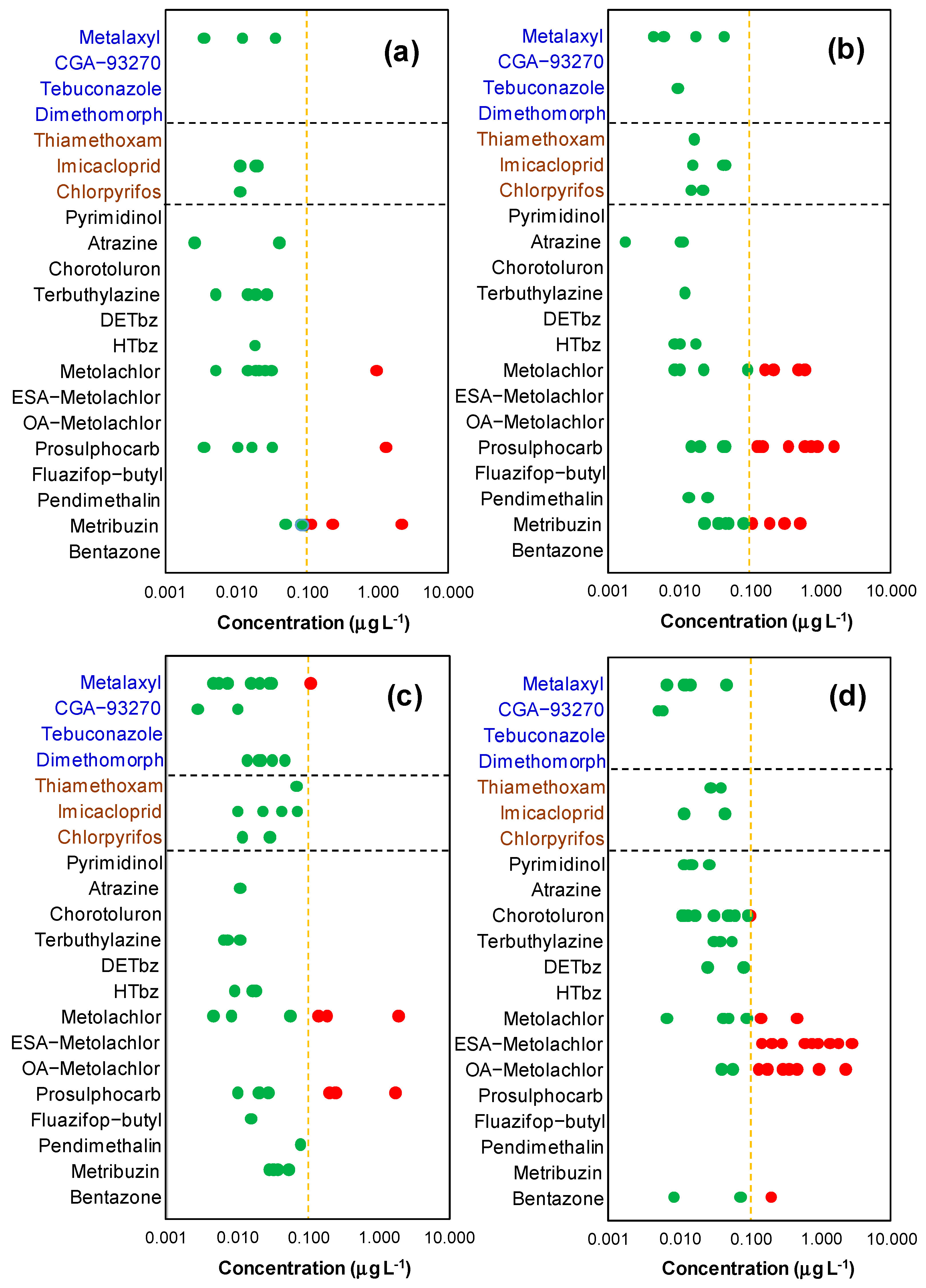
Pesticide concentrations detected in groundwater, and percentage of positive samples with concentrations below and over 0.1 µg L−1 and average and maximum concentrations for the pesticides detected in the samples analyzed through the four sampling campaigns are included in Figure 2 and Table 2, respectively.
Although fungicides are the most widely sold compounds in Spain, only 3 out of 6 fungicides included and one of their degradation products were detected at least once. This result is consistent with the fact that fungicides are rarely used in potato or cereal crops. Only two samples (sample GW-4 and -5) presented two fungicides simultaneously, metalaxyl and dimethomorph, both at very low concentrations (<0.024 μg L−1). Metalaxyl was detected in all sampling campaigns but exceeded 0.1 μg L−1 only in sample GW-6 in July (0.120 μg L−1). Its degradation product CGA-92370 was detected in several samples at very low concentrations (<0.011 μg L−1), appearing simultaneously with metalaxyl only in GW-6 (July and October) and GW-13 (October).
Only three insecticides were detected in the study area: thiamethoxan and imidacloprid are widely used in potato crops, and chlorpyrifos, used in maize. All of them are currently banned in EU. Imidacloprid was detected in several samples across all campaigns (three in April and June, four in July and two in October) always below 0.1 μg L−1 (Cmax 0.077 μg L−1). Thiamethoxam, commonly used to control the Colorado potato beetle, was detected in three sampling campaigns (sample GW-8 in October and sample GW-13 in June, July and October). Chlorpyrifos was detected in three sampling campaigns, April, June and July with a Cmax of 0.032 μg L−1 in four samples (GW-2 in July, GW-4 in April, GW-12 in June and GW-17 in June and July). Only two samples presented two insecticides simultaneously: GW-4 (imidachloprid and chlorpyrifos) and GW-13 (imidachloprid and tiamethoxam in July). These three insecticides have also been detected in groundwater and surface waters in other regions of Spain, sometimes at much higher concentrations, up to 10.44 µg L−1 in groundwater from the Canary Islands [26], and in other countries, including Greece [29,38], India [39], Tunisia [40], Argentina [41] and Costa Rica [42].
Herbicides were the most ubiquitous pesticide group, with ten herbicides and four of their degradation products detected. Metolachlor, prosulfocarb, and metribuzin were the more frequently detected compounds, present in over 40% of the samples in one or more campaigns (Figure S1). These herbicides also showed the highest concentration in each campaign: metribuzin with Cmax 2.504 μg L−1 in April, prosulfocarb with Cmax 1.065 μg L−1 in June, metolachlor with Cmax 2.086 μg L−1 in July and ESA-metolachlor with Cmax 3.416 μg L−1 in October, representing the highest concentration observed in this study.
It is noteworthy that several of the pesticide concentrations detected in the analyzed groundwater samples exceed the maximum limits established by EU drinking water standards [4], in some cases by an order of magnitude. These exceedances underscore the potential implications for human health and the importance of continued monitoring. Highlighting these findings provides context for both regulatory compliance and the need for sustainable agricultural practices to minimize contamination of groundwater resources.
Special mention should be given to metolachlor and its degradation products. Metolachlor degrades primarily into polar metabolites, ESA-metolachlor and OA-metolachlor, which exhibit higher chemical stability and water solubility than the parent compound, increasing their mobility in the environment. Due to their lower affinity for soil organic matter and reduced potential for volatilization, ESA-metolachlor and OA-metolachlor are more persistent in aquatic systems [28]. Consequently, these metabolites may contribute to long-term contamination and should be included in environmental monitoring and risk assessment programs. These compounds were detected in all samples except GW-16, GW-17 and GW-19. In eleven sampling points, the maximum concentration corresponded to one of these compounds. This contamination may originate from prior soil residues of metolachlor or its continued application. Given the generally sandy soils in the area, leaching may facilitate the transport of these compounds into groundwater [1].
These findings align with previous market surveys in the same region, confirming that the most frequently detected compounds correspond to those most intensively applied in local agricultural practices. The presence of metolachlor and/or its degradation products has been previously reported in the study area [43], elsewhere in Spain [21,22,44], and in other countries including Germany [45,46], France [47], Greece [29,38], Italy [32], Poland [31], USA [48], Argentina [41] and China [49]. Concentrations of metolachlor and its degradation products observed in this study were generally higher than those reported in previous works, except in the studies by Jurado et al. [44] and one conducted in the USA [48], which reported comparable levels.
The Groundwater Ubiquity Score (GUS) index was used to evaluate the leaching potential of the detected pesticides into groundwater. This index allows compounds to be classified as leachable (GUS > 2.8), non-leachable (GUS < 1.8), or exhibiting intermediate behavior (1.8 < GUS < 2.8). Most pesticides detected at concentrations > 0.1 μg L−1 showed GUS values ranging from medium (metribuzin, bentazone, chlorotoluron and metalaxyl) to high (metolachlor and its degradation products) only prosulfocarb presented a low GUS index [28]. Despite its low GUS index, prosulfocarb was consistently detected at concentrations above 0.1 μg/L. This may be explained by repeated or recent applications in the area, as well as preferential transport pathways such as macropore flow, soil fissures, or direct leaks from irrigation systems, which can facilitate rapid movement to groundwater and bypass normal sorption processes [50].
Other detected compounds were also classified as leachable, including the insecticides thiamethoxam and imidacloprid, and the herbicides pyrimidinol, atrazine, terbuthylazine and its degradation products. Fungicides such as metalaxyl, dimethomorph, and tebuconazole were classified as transition compounds [28]. These results suggest that the occurrence of certain pesticides in groundwater can be largely explained by their GUS classifications, highlighting the relevance of this index as a predictive tool for assessing pesticide mobility through the soil profile.
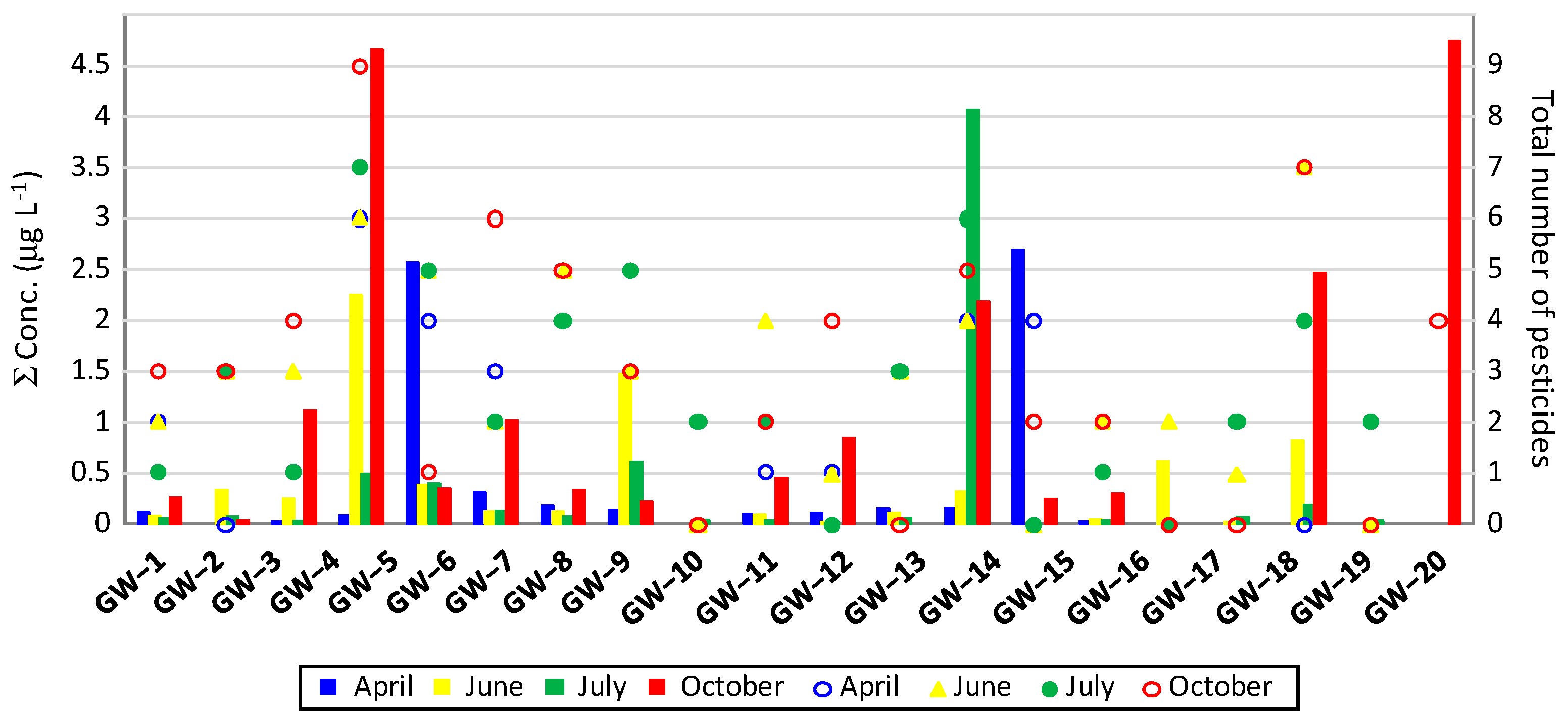
Five or more pesticides were detected in seven samples in one or more sampling campaigns (Figure 3). Samples GW-4, GW-18, GW-13 and GW-6 contained the highest number of pesticides, with nine, seven, six, and six compounds, respectively. Special mention should be given to sample GW-4 in which nine, seven, six and six pesticides were detected in October, July, June and April campaigns, respectively. No significant correlation was observed between the number of detected pesticides and groundwater depth. The occurrence of pesticides in deeper groundwater layers is likely attributable to the predominantly sandy or sandy loam soil textures characteristic of the study area, which facilitate vertical leaching [1].
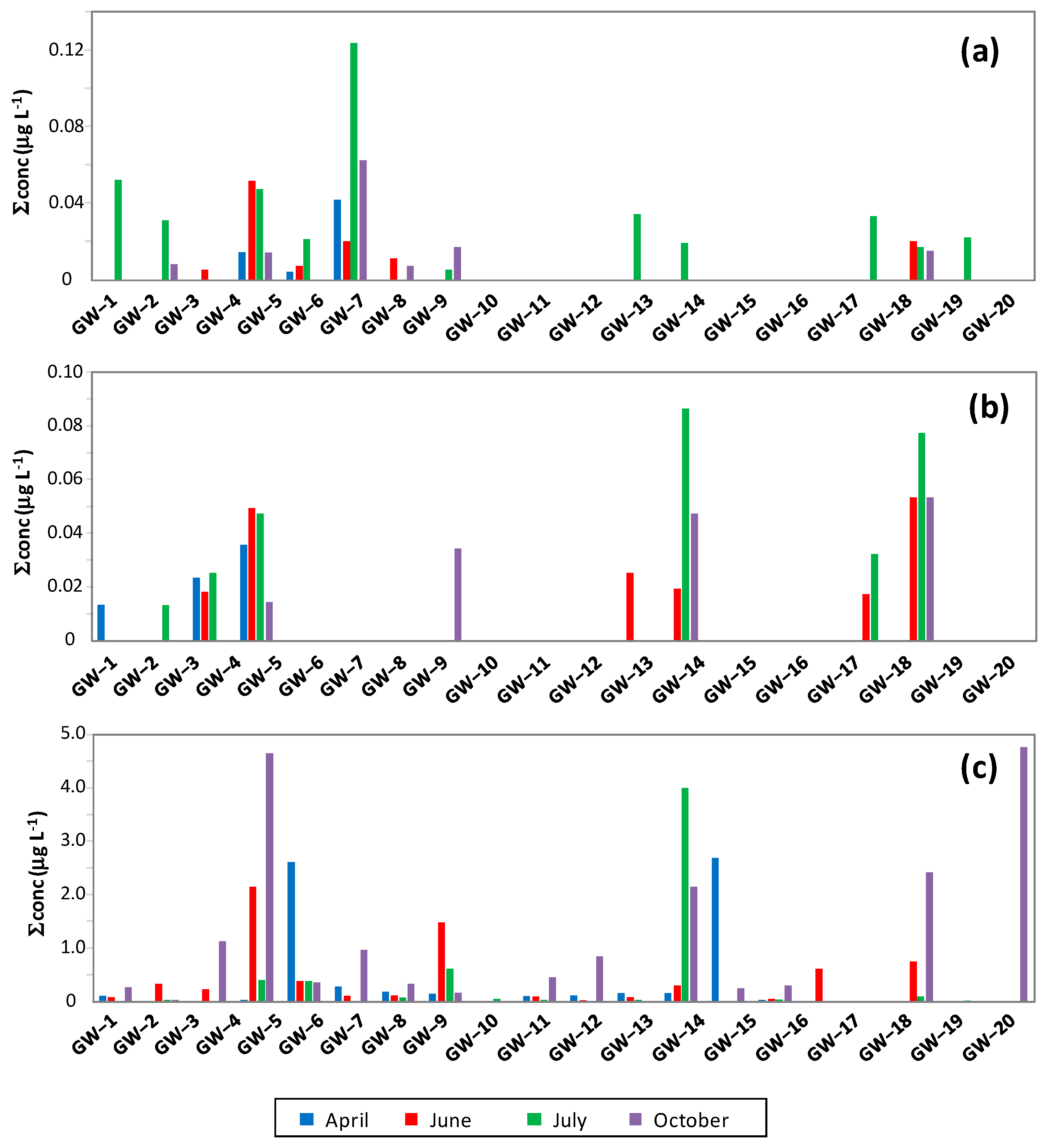
As previously noted, herbicides were the most frequently detected class of pesticides, accounting for 74% of all detections (147 above the limit of detection), and exhibiting the highest cumulative concentration in the area (4.747 µg L−1) (Figure 4). In contrast, fungicides were detected 31 times (15% of total detections), with concentrations up to 0.123 µg L−1, while insecticides were the least frequently detected group, with 21 occurrences (11%) and the lowest cumulative concentration (0.086 µg L−1) (Figure 4). These findings differ from those reported in other Spanish Designations of Origin (DO) regions, such as Rioja [24], where fungicides were the predominant pesticide group in both surface and groundwater, and Jumilla [36], where insecticides were the most commonly detected compounds. However, these results are consistent with studies conducted in several European countries, including Poland [31], France [47], Greece [29,38], England [51], and Germany [46].

3.2. Seasonal Evolution of Pesticide Residues in Natural Waters

The total concentration of pesticides (Figure 3), as well as the concentrations of fungicides, insecticides and herbicides (Figure 4a–c) was determined in groundwaters for each sampling period (April, June, July and October). The temporal evolution of total pesticide concentrations was evaluated to assess the chemical status of groundwater in accordance with the European Directive 2006/118/EC [5], which sets a threshold of 0.5 µg L−1 for the sum of all pesticide concentrations in water intended for human consumption. The results showed that eleven samples (55%) exceeded this threshold in at least one sampling campaign. Four samples (GW-04, GW-08, GW-13 and GW-18) exceeded 0.5 μg L−1 in two sampling campaigns.
By pesticide type, fungicides (Figure 4a) reached the highest total concentrations in July for most samples, reaching values > 0.12 μg L−1. July was also the sampling campaign in which three of the four detected fungicides were present in the highest proportion of samples, with metalaxyl detected above 0.1 μg L−1 in one sample (Figure S1c). Insecticides (Figure 4b) reached values above 0.08 μg L−1, with smaller differences observed between June, July and October campaigns. Herbicides (Figure 4c) showed the highest total concentrations in October, with two samples (GW-4 and GW-20) exceeding 4.5 μg L−1. This campaign also had the highest number of herbicides found in concentrations above 0.1 μg L−1, with four of the eight herbicides exceeding this value (Figure S1d). Seasonal variations in pesticide concentrations may be attributed to several factors including crop-specific application patterns, climatic conditions, and the chemical stability of the compounds.
No significant statistical correlations were observed between nitrate concentration and the sum of herbicide and fungicide concentrations. Spearman’s rank correlation coefficient indicated a single statistically significant association was found (ρ = 0.2542; p = 0.0229) in the case of insecticides. Similarly, no significant correlations were found between sampling depth and the sum of herbicide, fungicide, or insecticide concentrations.
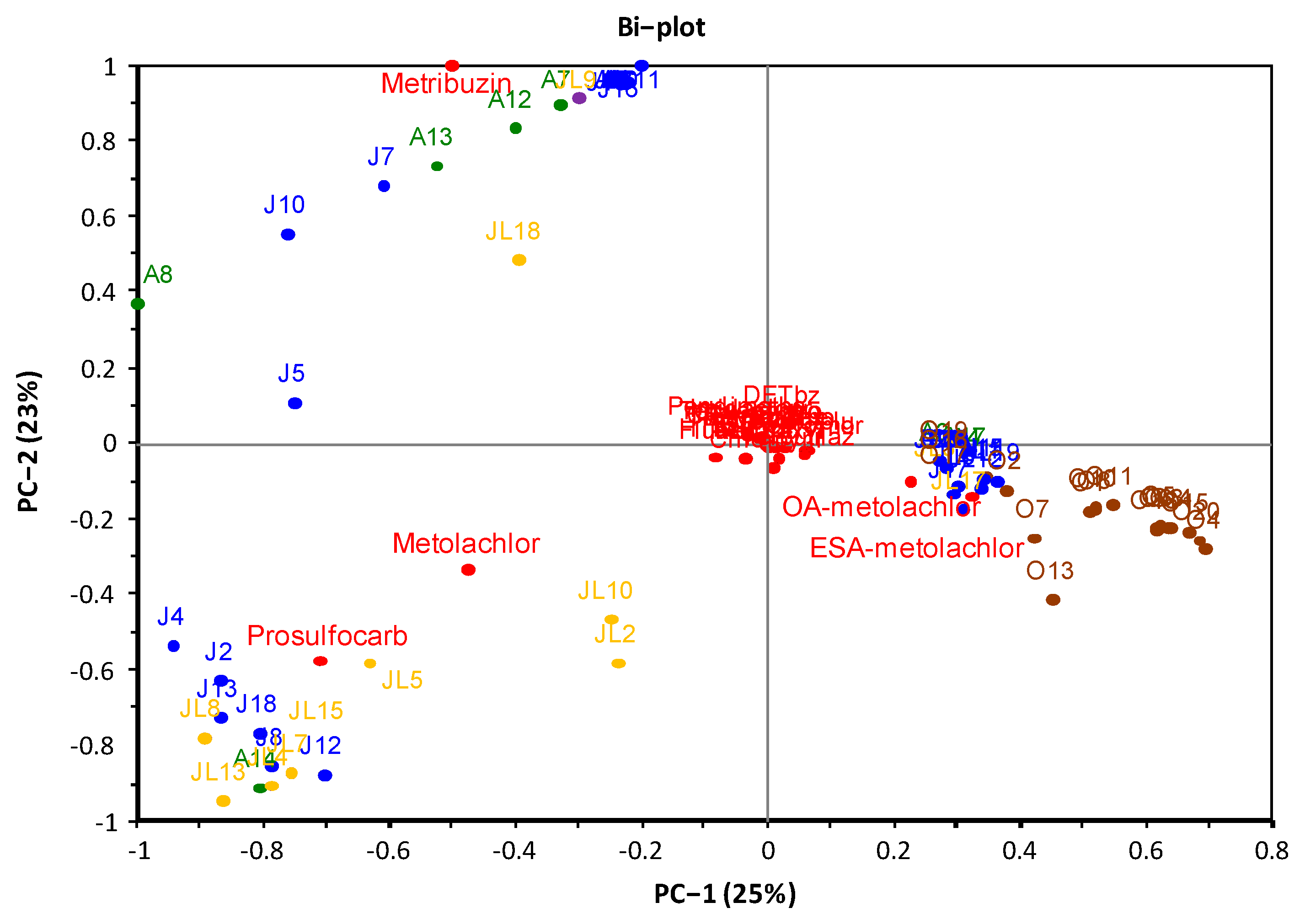
A multivariate analysis (PCA) was performed using the 80 available samples and their corresponding concentrations. The first two principal components explained 25% and 23% of the total data variance, respectively. Although the first two principal components together explain only about 50% of the total variance (approximately 25% each), this result is consistent with the substantial variability and multidimensional structure of the dataset. When observations are highly dispersed, the variance tends to be spread across several orthogonal directions, which limits the proportion captured by the first principal components. The relatively low percentage of explained variance does not reflect a weakness of the PCA itself, but rather the inherent complexity of the system under study. The resulting biplot (scores and loadings) is shown in Figure 5, where three sample groups with slight differences can be distinguished. Samples located in the upper-left region (negative values for the PC1 and positive values for the PC2) exhibited higher concentrations of metribuzin compared to the rest of the samples and mainly corresponded to the April and June campaigns. Samples with negative values for both components showed higher concentrations of metolachlor and prosulfocarb and were associated with the June and July campaigns. Samples on the right side of the plot had higher concentrations of OA-metolachlor and ESA-metolachlor, predominantly in the October campaign and, to a lesser extent, in July. Samples closer to the origin displayed intermediate concentrations of the remaining analytes.
The sharp increase in metolachlor metabolite concentrations observed in October can be attributed to multiple factors. Seasonal dynamics, including autumn groundwater level rise, may enhance the mobilization of residues accumulated in the soil during the growing season. Additionally, cumulative application of metolachlor over time and microbial transformation processes could contribute to a higher metabolite formation during this period [1]. These potential mechanisms are consistent with the data presented.

3.3. Ecotoxicological Risk Assessment

Ecotoxicological risk assessment for aquatic environments was conducted using Toxic Units (TUs) and Risk Quotients (RQs) to evaluate potential acute and chronic effects at the different sampling sites. The cumulative toxic unit (∑TUi) at each site was calculated, results are presented in Table 3. None of the sampling sites exhibited TU_site values exceeding 1, which would indicate high ecological risk, for any of the aquatic organisms across the four sampling campaigns. Only six sites recorded values > 0.1 (five for Daphnia magna and one for algae), primarily during the June and July campaigns. These results highlight the sensitivity of Daphnia magna, representing aquatic insects and other zooplanktonic invertebrates, to the combined pesticide mixtures compared to algae or fish. Despite relatively high concentrations of certain individual pesticides, acute toxicity thresholds were not exceeded.
For a more accurate assessment of chronic ecological risk, passive samplers or other continuous, real-time monitoring techniques are recommended, as they provide more representative exposure data. Chronic exposure can also be approximated using the risk quotient (RQ), calculated based on the maximum detected concentrations (RQ_max) as a conservative, worst-case scenario. Table 4 summarizes the predicted no-effect concentrations (PNECs) and corresponding RQ_max values for algae, Daphnia magna, and fish during each sampling campaign. Wherever available, NOEC (No Observed Effect Concentration) values were prioritized over EC (Effect Concentration) values in deriving PNECs.
Overall, fungicides exhibited lower RQ values compared to insecticides, while herbicides showed the highest RQs. None of the detected fungicides posed an unacceptable ecological risk (RQ > 1) for the three aquatic organisms, which is likely attributable to their relatively low environmental concentrations. Only tebuconazole showed medium risk (0.1 < RQs < 1) for Daphnia magna and fish and low risk (0.01 < RQs < 0.1) for algae in June. Among insecticides, two compounds presented minimal risk (RQs < 0.01) for all organisms, whereas chlorpyrifos presented high risk for fish, medium for Daphnia magna and low for algae during April, June and July.
Herbicides recorded the highest RQ risk value, with OA-metolachlor reaching 179.6 and the highest number of unacceptable RQ values for Daphnia magna and algae in April, June and July. Metribuzin exceeded acceptable levels for algae in June and July. While pendimethalin recorded RQs higher than 1 in July for algae and fish. Chlorotoluron and the degradation product of terbuthylazine, DETbz, also exceeded RQ= 1 in one sample for algae. Herbicides with minimal or low risk (RQs < 0.01 or 0.01 < RQs < 0.1) included pyrimidinol and bentazone (minimal) and atrazine and the degradation products HTbz and OA-metolachlor (low or minimal).
Overall, the chronic risk values in this study were comparable to those reported in Greece [38], where the groundwater wells were considered safe. These values were lower than those observed in groundwater of Romania [52], where several pesticides exhibited RQ > 10, and Morocco [53], where most pesticides exceeded RQ = 1. The RQ values were also lower than those reported for surface waters in France [47] and in England [51], where high risks were observed.
Although no acute risk was identified, some herbicides may pose chronic risks under repeated or long-term exposure. This highlights the need for environmental management strategies beyond acute toxicity criteria. Our results suggest that continuous monitoring of sublethal concentrations and consideration of cumulative or subchronic effects should be incorporated into risk assessment frameworks. Current pesticide regulations, largely based on acute toxicity thresholds, may not adequately address chronic exposure risks, particularly in areas of intensive use or persistent compounds. Therefore, these findings support incorporating chronic risk criteria in regulatory assessments and promoting the use of less persistent, lower-toxicity compounds within integrated pest management programs.

4. Conclusions

This study provides an integrated evaluation of pesticide occurrence, distribution, and ecological risks in groundwater of the Duero River basin, an area strongly influenced by intensive agricultural practices, mainly focused on potato and maize cultivation. The results show that groundwater is impacted by a diverse mixture of pesticides and their degradation products, reflecting current agrochemical use patterns in the region. Metolachlor and its transformation products were consistently the predominant contaminants, underscoring the connection between local application practices and groundwater pollution in agricultural areas.
Although no acute ecological risks were identified, several herbicides—particularly transformation products—showed indications of chronic risk for sensitive aquatic organisms. These findings highlight the relevance of including both parent compounds and metabolites in groundwater monitoring and risk assessment frameworks.
Overall, this study underscores the persistence and environmental significance of certain herbicides and their degradation products in groundwater from intensively agricultural regions. The findings highlight the importance of integrating groundwater monitoring into broader water management and pesticide regulation frameworks, particularly in areas with intensive agricultural activity.
Future research should focus on long-term monitoring of pesticide residues and their metabolites in groundwater, considering seasonal variability and the influence of changing agricultural practices. In addition, modeling studies assessing the transport and persistence of these compounds in the subsurface environments, as well as investigations into alternative lower impact pest management strategies are recommended. Such approaches will contribute to improved risk assessment and more sustainable pesticide use in vulnerable aquifer systems across Europe.

Supplementary Materials

The following supporting information can be downloaded at: https://www.mdpi.com/article/10.3390/environments13010027/s1, Table S1. Common names and physicochemical properties of pesticides selected for the study (data taken from PPDB, 2019). Chemicals with letters in brackets correspond to degradation compounds of parent compounds with the same letter as superscripts; Table S2. Quality control parameters of the SPE-LC-MS method applied to the analysis of pesticides in groundwaters; Figure S1. Concentrations of fungicides, insecticides and herbicides detected in the surface and groundwater samples (logarithmic scale).

Author Contributions

Conceptualization, E.H.-H., J.M.M.-B. and M.S.R.-C.; Data curation, E.H.-H.; Formal analysis, E.H.-H., J.M.M.-B., M.d.N.S. and M.S.R.-C.; Investigation E.H.-H. and J.M.O.; Methodology, E.H.-H. and J.M.O.; Supervision, M.S.R.-C.; Validation, E.H.-H., J.M.M.-B. and M.S.R.-C.; Writing—original draft, E.H.-H.; Writing—review and editing, E.H.-H., J.M.M.-B. and M.S.R.-C. All authors have read and agreed to the published version of the manuscript.

Funding

This work was funded by the Provincial Council of Salamanca (Ref. ACAM: 2017020066).

Data Availability Statement

Some or all data, models or codes that support the findings of this study are available from the corresponding author upon reasonable request.

Acknowledgments

The authors thank Arampino Cooperative for their collaboration to determine the main active formulations used in the region, as well as Project “CLU-2025-2-02—Unit of Excellence IRNASA_CSIC”, funded by the Junta Castilla y León and co-funded by the European Union (FEDER “Europe boosts our growth”), and Project “DEEP-MaX-2024_IRNASA” funded by CSIC.

Conflicts of Interest

The authors declare no conflicts of interest.

References

  1. Marín-Benito, J.M.; Herrero-Hernández, E.; Ordax, J.M.; Sánchez-Martín, M.J.; Rodríguez-Cruz, M.S. The role of two organic amendments to modify the environmental fate of S-metolachlor in agricultural soils. Environ. Res. 2021, 195, 110871. [Google Scholar] [CrossRef]
  2. Scherer, L.A.; Verburg, P.H.; Schulp, C.J.E. Opportunities for sustainable intensification in European agriculture. Glob. Environ. Change 2018, 48, 43–55. [Google Scholar]
  3. Bullock, D.S.; Boerngen, M.; Tao, H.; Maxwell, B.; Luck, J.D.; Shiratsuchi, L.; Puntel, L.; Martin, N.F. The Data-Intensive Farm Management Project: Changing Agronomic Research Through On-Farm Precision Experimentation. Agron. J. 2019, 111, 2736–2746. [Google Scholar] [CrossRef]
  4. European Commission. Directive 98/83/EC of the Council of 3 November 1998 on the quality of water intended for human consumption. Off. J. Eur. Union. 1998, L330/32, 1–23. [Google Scholar]
  5. European Commission. Directive 2006/118/EC of the European Parliament and of the Council of 12 December 2006 on the protection of groundwater against pollution and deterioration. Off. J. Eur. Commun. 2006, L372/19, 19–31. [Google Scholar]
  6. European Commission. Part II: Environmental Risk Assessment. In Technical Guidance Document on Risk Assessment in Support of Commission Directive 93/67/EEC on Risk Assessment for New Notified Substances, Commission Regulation No 1488/94 on Risk Assessment for Existing Substances, and Directive 98/8/EC of the European Parliament and of the Council Concerning the Placing of Biocidal Products on the Market; Office for Official Publications of the European Communities: Luxembourg, 1996. [Google Scholar]
  7. European Commission. Common Implementation Strategy for the Water Framework Directive (2000/60/EC). Guidance Document No. 27, Technical Guidance for Deriving Environmental Quality Standards. Tech. Rep. 2011, 27, 55. [Google Scholar]
  8. Ccanccapa, A.; Masiá, A.; Navarro-Ortega, A.; Picó, Y.; Barceló, D. Pesticides in the Ebro River basin: Occurrence and risk assessment. Environ. Pollut. 2016, 211, 414–424. [Google Scholar] [CrossRef]
  9. EEA. European Waters Assessment of Status and Pressures. 2018. Available online: https://www.eea.europa.eu/en/analysis/publications/state-of-water (accessed on 4 December 2019).
  10. Eurostat. Available online: https://ec.europa.eu/eurostat/cache/metadata/en/aei_fm_salpest09_esms.htm (accessed on 20 March 2024).
  11. MAPA. Available online: https://www.mapa.gob.es/es/estadistica/temas/estadisticas-agrarias/agricultura/estadisticas-medios-produccion/fitosanitarios (accessed on 17 December 2025).
  12. Pérez-Lucas, G.; Vela, N.; El Aatik, A.; Navarro, S. Environmental Risk of Groundwater Pollution by Pesticide Leaching through the Soil Profile, Pesticides. In Use and Misuse and Their Impact in the Environment; Larramendy, M., Soloneski, S., Eds.; IntechOpen: London, UK, 2018; Available online: https://www.intechopen.com/books/pesticides-use-and-misuse-and-their-impact-in-the-environment/environmental-risk-of-groundwater-pollution-by-pesticide-leaching-through-the-soil-profile (accessed on 10 October 2020).
  13. Pereira de Araújo, E.; Dutra Caldas, E.; Oliveira-Filho, E.C. Pesticides in surfacefreshwater: A criticalreview. Environ. Monit. Assess. 2022, 194, 452. [Google Scholar]
  14. Ccanccapa, A.; Masiá, A.; Andreu, V.; Picó, Y. Spatio-temporal patterns of pesticide residues in the Turia and Júcar Rivers (Spain). Sci. Total Environ. 2016, 540, 200–210. [Google Scholar]
  15. Pascual Aguilar, J.A.; Andreu, V.; Campo, J.; Picó, Y.; Masiá, A. Pesticide occurrence in the waters of Júcar River, Spain from different farming landscapes. Sci. Total Environ. 2017, 607–608, 752–760. [Google Scholar] [CrossRef]
  16. Carmona, E.; Andreu, V.; Picó, Y. Multi-residue determination of 47 organic compounds in water, soil, sediment and fish. Turia River as case study. J. Pharm. Biomed. Anal. 2019, 146, 117–125. [Google Scholar] [CrossRef]
  17. Quintana, J.; de la Cal, A.; Boleda, M.R. Monitoring the complex occurrence of pesticides in the Llobregat basin, natural and drinking waters in Barcelona metropolitan area (Catalonia, NE Spain) by a validated multi-residue online analytical method. Sci. Total Environ. 2019, 692, 952–965. [Google Scholar] [CrossRef] [PubMed]
  18. Masiá, A.; Campo, J.; Vázquez-Roig, P.; Blasco, C.; Picó, Y. Screening of currently used pesticides in water, sediments and biota of the Guadalquivir River Basin (Spain). J. Hazard. Mater. 2013, 263, 95–104. [Google Scholar] [CrossRef] [PubMed]
  19. Fernández_García, A.; Martínez-Piernas, A.B.; Moreno-González, D.; Gilbert-López, B.; Molina-Díaz, A.; García-Reyes, J.F. Ocurrence and risk assessment of pesticides and their transformation products related to olive groves in surface waters of the Guadalquivir river basin. Chemosphere 2024, 357, 142075. [Google Scholar] [CrossRef]
  20. Dagnac, T.; García-Chao, M.; Fernández-Álvarez, M.; Castro-Insua, J.; García-Pomar, M.I.; Llompart, M. Study of the presence of priority pesticides in surface water of river basins located in two areas of intensive dairy farming in the NW Spain (Galicia). Intern. J. Environ. Anal. Chem. 2012, 92, 995–1011. [Google Scholar] [CrossRef]
  21. Köck-Schulmeyer, M.; Postigo, C.; Farre, M.; Barceló, D.; López de Alda, M. Medium to highly polar pesticides in seawater: Analysis and fate in coastal areas of Catalonia (NE Spain). Chemosphere 2019, 215, 515–523. [Google Scholar] [CrossRef]
  22. Peris, A.; Soriano, Y.; Picó, Y.; Bravo, M.A.; Blanco, G.; Eljarrat, E. Pesticides in water and sediments from natural protected areas of Spain and their associated ecological risk. Chemosphere 2024, 362, 142628. [Google Scholar] [CrossRef]
  23. Hildebrandt, A.; Guillamón, M.; Lacorte, S.; Tauller, R.; Barceló, D. Impact of pesticides used in agriculture and vineyards to surface and groundwater quality (North Spain). Water Res. 2008, 42, 3315–3326. [Google Scholar] [CrossRef]
  24. Herrero-Hernández, E.; Andrades, M.S.; Álvarez-Martín, A.; Pose-Juan, E.; Rodríguez-Cruz, M.S.; Sánchez-Martín, M.J. Occurrence of pesticides and some of their degradation products in waters in a Spanish wine region. J. Hydrol. 2013, 486, 234–245. [Google Scholar] [CrossRef]
  25. Herrero-Hernández, E.; Pose-Juan, E.; Sánchez-Martín, M.J.; Andrades, M.S.; Rodríguez-Cruz, M.S. Intra-annual trends of fungicide residues in waters from vineyard areas in La Rioja region of northern Spain. Environ. Sci. Pollut. Res. 2016, 23, 22924–22936. [Google Scholar] [CrossRef]
  26. GascoCavero, S.; Santamarta, J.C.; Cruz-Pérez, N.; Laspidou, C.; Díaz-Cruz, S.; Contreras-Llin, A.; Quintana, G.; García-Gil, A. Comparative study of emerging pollutants of interest in the groundwater of the volcanic islands of La Palma and El Hierro (Canary Islands). Sci. Total Environ. 2024, 927, 172026. [Google Scholar]
  27. CHDuero, Duero Hydrographic Confederation. Available online: https://www.chduero.es/documents/20126/1883851/PHD22-27_082_01_EstadoMasas_IndicadoresSp-v02.pdf (accessed on 18 October 2019).
  28. PPDB (Pesticide Properties DataBase). Agriculture & Environment Research Unit (AERU). University of Hertfordshire. Available online: https://sitem.herts.ac.uk/aeru/ppdb/en/ (accessed on 23 September 2020).
  29. Kapsi, M.; Tsoutsi, C.; Paschalidou, A.; Albanis, T. Environmental monitoring and risk assessment of pesticide residues in surface waters of the Louros River (N.W. Greece). Sci. Total Environ. 2019, 650, 2188–2198. [Google Scholar] [CrossRef]
  30. Tóth, G.; Háhn, J.; Szoboszlay, S.; Harkal, P.; Farkas, M.; Radó, J.; Göbölös, B.; Kaszab, E.; Szabó, I.; Urbányi, B.; et al. Spatio temporal analysis of multi-pesticide residues in the largest Central European shallow lake, Lake Balaton, and its sub-catchment area. Environ. Sci. Eur. 2022, 34, 50. [Google Scholar] [CrossRef]
  31. Kruć-Fijałkowska, R.; Dragon, K.; Drożdżyński, D.; Górski, J. Seasonal variation of pesticides in surface water and drinking water wells in the annual cycle in western Poland, and potential health risk assessment. Sci. Rep. 2022, 12, 3317. [Google Scholar] [CrossRef] [PubMed]
  32. Zambito Marsala, R.; Capri, E.; Russo, E.; Bisagni, M.; Colla, R.; Lucini, L.; Gallo, A.; Alina Suciu, N. First evaluation of pesticides occurrence in groundwater of Tidone Valley, an area with intensive viticulture. Sci. Total Environ. 2020, 736, 139730. [Google Scholar] [CrossRef]
  33. Sidoli, P.; Lassabatere, L.; Angulo-Jaramillo, R.; Baran, N. Experimental and modeling of the unsaturated transports of S-metolachlor and its metabolites in glaciofluvial vadose zone solids. J. Contam. Hydrol. 2016, 190, 1–14. [Google Scholar] [CrossRef]
  34. Chen, Z.; Chen, Y.; Vymazal, J.; Kule, L.; Kŏzeluh, M. Dynamics of chloroacetanilide herbicides in various types of mesocosm wetlands. Sci. Total Environ. 2017, 577, 386–394. [Google Scholar] [CrossRef]
  35. IGN (National Geographic Institute). Available online: https://info.igme.es/cartografiadigital/datos/Hidrogeologico200/jpgs/Editado_Hidrogeologico200_37.jpg (accessed on 4 November 2025).
  36. Herrero-Hernández, E.; Simón-Egea, A.B.; Sánchez-Martín, M.J.; Rodríguez-Cruz, M.S.; Andrades, M.S. Monitoring and environmental risk assessment of pesticide residues and some of their degradation products in natural waters of the Spanish vineyard region included in the Denomination of Origin Jumilla. Environ. Pollut. 2020, 264, 114666. [Google Scholar] [CrossRef] [PubMed]
  37. Liu, W.R.; Zhao, J.L.; Liu, Y.S.; Chen, Z.F.; Yang, Y.Y.; Zhang, Q.Q.; Ying, G.G. Biocides in the Yangtze River of China: Spatiotemporal distribution, mass load and risk assessment. Environ. Pollut. 2015, 200, 53–63. [Google Scholar] [CrossRef] [PubMed]
  38. Parlakidis, P.; Rodriguez, M.S.; Gikas, J.D.; Alexoudis, C.; Perez-Rojas, G.; Perez-Villanueva, M.; Perez Carrera, A.; Fernández-Cirelli, A.; Vryzas, Z. Occurrence of banned and currently used herbicides, in groundwater of northern Greece: A human health risk assessment approach. Int. J. Environ. Res. Public Health 2022, 19, 8877. [Google Scholar] [CrossRef]
  39. Bhattacharyya, S.; Poi, R.; Mandal, S.; Baskey Sen, M.; Kumar Hazra, D.; Saha, S.; Karmakar, R. Method development, validation, monitoring, seasonal effect and risk assessment of multiclass multi pesticide residues in surface and ground water of new alluvial zone in eastern India. Environ. Sci. Pollut. Res. 2022, 29, 17174–17187. [Google Scholar] [CrossRef]
  40. Khezami, F.; Gómez-Navarro, O.; Barbieri, M.V.; Khiari, N.; Chkirbene, A.; Chiron, S.; Khadhar, S.; Pérez, S. Occurrence of contaminants of emerging concern and pesticides and relative risk assessment in Tunisian groundwater. Sci. Total Environ. 2024, 906, 167319. [Google Scholar] [CrossRef]
  41. Perez, D.J.; Iturburu, F.C.; Calderon, G.; Oyesquí, L.A.E.; De Gerónino, E.; Aparicio, V.C. Ecological risk assessment of current-use pesticides and biocides in soils, sediments and surface water of a mixed land-use basin of the Pampas region, Argentina. Chemosphere 2021, 263, 128061. [Google Scholar] [CrossRef]
  42. Cajas-Salazar, A.; Pérez-Rojas, G.; Vega-Guzmán, I.; Alfaro-Arrieta, E.; Beita-Sandí, W.; González-Pujol, M.; Rodríguez-Rodríguez, C.E.; Méndez-Rivera, M.; Castro-Gutiérrez, V. Occurrence and environmental risk assessment of pesticides in urban waste water in Costa Rica. Environ. Poll. 2025, 385, 127172. [Google Scholar] [CrossRef] [PubMed]
  43. Sánchez-González, S.; Pose-Juan, E.; Herrero-Henández, E.; Álvarez-Martín, A.; Sánchez-Martín, M.J.; Rodríguez-Cruz, M.S. Pesticide residues in groundwaters and soils of agricultural areas in the Águeda River Basin from Spain and Portugal. Intern. J. Environ. Anal. Chem. 2013, 93, 1585–1601. [Google Scholar] [CrossRef]
  44. Jurado, A.; Vázquez-Suñé, E.; Carrera, J.; López de Alda, M.; Pujades, E.; Barceló, D. Emerging organic contaminants in groundwater in Spain: A review of sources, recent occurrence and fate in a European context. Sci. Total Environ. 2012, 440, 82–94. [Google Scholar] [CrossRef]
  45. Reemtsma, T.; Alder, L.; Banasiak, U. Emerging pesticide metabolites in groundwater and surface water as determined by the application of a multimethod for 150 pesticide metabolites. Water Res. 2013, 47, 5535–5545. [Google Scholar] [CrossRef] [PubMed]
  46. Lorenz, S.; Trau, F.N.; Ruf, L.C.; Meinikmann, K.; Fisch, K.; Stähler, M.; Schenke, D.; Blevins, H.L.; Heinz, M. Pesticide contamination of small standing water bodies in the agricultural landscape of northeast Germany. Sci. Total Environ. 2025, 975, 179250. [Google Scholar] [CrossRef]
  47. Conseil, G.; Milla, S.; Cardoso, O.; Pasquini, L.; Rosin, C.; Banas, D. Occurrence, dispersal, and associated environmental risk assessment of pesticides and their transformation products in small water bodies of Northeastern France. Environ. Sci. Poll. Res. 2024, 31, 66643–66666. [Google Scholar] [CrossRef]
  48. Fisher, I.J.; Phillips, P.J.; Bayraktar, B.N.; Chen, S.; McCarthy, B.A.; Sandstrom, M.W. Pesticides and their degradates in groundwater reflect past use and current management strategies, Long Island, New York, USA. Sci. Total Environ. 2021, 752, 141895. [Google Scholar] [CrossRef]
  49. Guo, S.; Zhang, S.; Zhang, J.; Lei, J.; Chen, H. Ocurrence, residue level, distribution and risk assessment of pesticides in the typical polder areas of Lake Dongting. J. Hazard. Mater. 2025, 496, 139530. [Google Scholar] [CrossRef]
  50. Marín-Benito, J.M.; Barba, V.; Ordax, J.M.; Sánchez-Martín, M.J.; Rodríguez-Cruz, M.S. Recycling organic residues in soils as amendments: Effect on the mobility of two herbicides under different management practices. J. Environ. Manag. 2018, 224, 172–181. [Google Scholar] [CrossRef] [PubMed]
  51. Ramage, C.I.; Alfama Lopes dos Santos, R.; Yon, L.; Johnson, M.F.; Vane, C.H. Widespread pesticide pollution in two English river catchments of contrasting land-use: From sediments to fish. Environ. Poll. 2025, 375, 126371. [Google Scholar] [CrossRef]
  52. Dumitrescu, C.; Stihi, C.; Costinel, D.; Geana, E.I.; Ciucure, C.T.; Popescu, D.I.; Tanislav, D.; Bretcan, P. Assessment of pesticide contamination of groundwater from Titu-Sarata plain, Romania. Appl. Sci. 2025, 15, 5880. [Google Scholar] [CrossRef]
  53. Bagayou, A.; Hamdache, A.; Diane, Y.; Ezziyyani, M. Health and ecological risks associated with pesticides in the groundwater of the Loukkos area (Larache, Morocco). Environ. Sci. Poll. Res. 2025, 1–16. [Google Scholar] [CrossRef] [PubMed]
Figure 1. Map of the studied zone (“Tierra del Vino” water body, Duero river basin, Salamanca, Spain) indicating the sampling points and the density of agricultural land.
Environments 13 00027 g001
Figure 2. Concentrations of pesticides detected in the groundwater samples in the sampling campaign of (a) April, (b) June, (c) July and (d) October of 2018 (logarithmic scale).
Environments 13 00027 g002
Figure 3. Total concentration (bars) and number of pesticides detected in each groundwater (GW) sampling point in the sampling campaign of April, June, July and October of 2018.
Environments 13 00027 g003
Figure 4. Total concentration detected in each groundwater sampling point at the different sampling campaigns (April, June, July and October 2018) of (a) fungicides, (b) insecticides, and (c) herbicides.
Environments 13 00027 g004
Figure 5. Score plots of PC1 vs. PC2 illustrating the distribution of pesticides and metabolites and sampling campaigns (A—April, J—June, JL—July, O—October 2018).
Environments 13 00027 g005
Table 1. Characteristics and physicochemical parameters of the groundwater (GW) sampling points monitored in the sampling campaign of June.
Sampling PointWater Depth (m)Use of WaterpHConductivity
(μS cm−1)
NO3 (mg L−1)PO43− (mg L−1)SO42− (mg L−1)
GW-15Watering6.9217683851.03252.1
GW-217Watering6.886151525.6651.57
GW-33Watering8.078792170.31104.1
GW-45Filling tanks6.7912942140.3272.79
GW-530Supply7.283851040.7031.18
GW-65Watering7.204471180.6837.73
GW-71Watering7.3018924073.78217.2
GW-82Watering8.5312583452.46162.9
GW-92Watering8.2811092640.65141.8
GW-102Watering7.5114501340.78116.8
GW-112Watering7.969021780.58111.4
GW-126Watering7.9719654.02.6919.46
GW-133Watering7.8412612731.44123.4
GW-14-Watering6.614869.750.3638.48
GW-15-Watering7.204471180.6837.73
GW-1680Spring7.5837814.70.043.77
GW-17160Watering7.4829915.90.108.78
GW-182Watering6.789042630.2886.03
GW-1917Watering7.074791410.7942.08
GW-203Watering7.238541751.4556.24
Table 2. Percentage of positive groundwater samples with concentrations below and over 0.1 μg L−1 and average and maximum concentrations for the pesticides detected in the samples analyzed in the four sampling campaigns (April, June, July and October 2018).
PesticideAprilJuneJulyOctober
Positive SamplesConc. (μg L−1)Positive SamplesConc. (μg L−1)Positive SamplesConc. (μg L−1)Positive SamplesConc. (μg L−1)
C < 0.1C > 0.1Average ± SDCmaxC < 0.1C > 0.1Average ± SDCmaxC < 0.1C > 0.1Average ± SDCmaxC < 0.1C > 0.1Average ± SDCmax
Fungicides
Metalaxyl3-0.020 ± 0.0190.0415-0.021 ± 0.0180.051710.030 ± 0.0380.1205-0.022 ± 0.0190.056
CGA-92370--------2-<LOQ-2-<LOQ-
Tebuconazole----1-<LOQ-0-------
Dimethomorph--------5-<LOQ-----
Insecticides
Thiamethoxam----1-0.0190.0191-0.0750.0752-0.041 ± 0.0090.047
Imidacloprid3-0.019 ± 0.0060.0233-0.040 ± 0.0190.0534-0.040 ± 0.0290.0772-0.034 ± 0.0280.053
Chlorpyrifos1-0.0130.0132-0.021 ± 0.0060.0252-0.022 ± 0.0130.032----
Herbicides
Pyrimidinol------------4-0.020 ± 0.0080.032
Atrazine3-<LOQ-3-<LOQ-1-<LOQ-----
Chlorotoluron------------920.049 ± 0.0400.121
Terbuthylazine4-<LOQ-1-<LOQ-3-<LOQ-3-0.064 ± 0.0490.099
DETbz---- -------2-0.068 ± 0.0080.073
HTbz1-<LOQ-4-<LOQ-3-<LOQ-----
Metolachlor610.178 ± 0.4101.108360.220 ± 0.2510.697330.420 ± 0.8202.086430.137 ± 0.1930.554
ESA-metolachlor------------181.200 ± 1.0633.416
OA-metolachlor------------370.592 ± 0.8072.694
Prosulfocarb410.317 ± 0.6691.514450.314 ± 0.3921.065440.341 ± 0.6321.879----
Fluazifop-butyl--------1-<LOQ-----
Pendimethalin----2-<LOQ-1-0.0870.087----
Metribuzin450.385 ± 0.7972.504940.596 ± 0.1320.1705-<LOQ-----
Bentazone------------210.113 ± 0.1160.239
Table 3. Sum of Toxic Units (∑TUi) for all detected pesticides in the different groundwater sampling points for different aquatic organisms in each sampling campaign (April, June, July and October 2018).
SampleAprilJuneJulyOctober
AlgaeDaphnia magnaFishAlgaeDaphnia magnaFishAlgaeDaphnia magnaFishAlgaeDaphnia magnaFish
GW-10.0036--0.0022-----0.0009--
GW-20.00980.00000.00000.00310.00040.00020.00030.13010.00060.0002--
GW-3---0.0083-----0.0015--
GW-40.00260.13000.00060.02290.00210.00150.00240.00040.00030.00770.00020.0001
GW-50.09490.00010.00010.00530.00010.00010.00380.00050.0003---
GW-60.0102--0.0037--0.0003-0.00010.0003-0.0001
GW-70.0051--0.0021--0.00020.00010.00010.0020--
GW-80.00250.00010.00010.00830.00170.00120.25400.00110.00080.0004--
GW-9------0.0013-----
GW-100.0035--0.00180.0001-0.0001--0.0011--
GW-110.0041--0.0005-----0.0053-0.0001
GW-120.0044--0.00050.25010.00110.0004-----
GW-130.0040--0.00230.00030.00020.01570.00380.00280.00080.00010.0002
GW-140.01370.00300.0021------0.0008--
GW-150.0008--0.00500.00010.00010.0012--0.0001--
GW-16---0.0226--------
GW-170.0007---0.17000.00070.00010.32000.0013---
GW-18---0.01230.0100.00070.00250.00010.00010.0012-0.0001
GW-19------0.0003-----
GW-20---------0.00330.00010.0001
Table 4. Predicted No-Effect Concentration (PNEC) values in mgL−1 and Risk Quotients (RQmax) for the three aquatic organisms calculated with the maximum concentrations for each detected pesticide in the study area for each sampling campaign (April, June, July and October 2018).
AnalyteAlgaeDaphnia magnaFish
PNEC aRQmaxPNEC bRQmaxPNEC cRQmax
AprilJuneJulyOctoberAprilJuneJulyOctoberAprilJuneJulyOctober
Fungicides
Metalaxyl2000.00020.00030.00060.0003100.00410.00510.01200.0056300.00140.00170.00400.0019
CGA-92370
Dimethomorph27.3--0.0002-2.2--0.0236-0.56--0.0929-
Tebuconazole1.0-0.0110--0.1-0.1100--0.1-0.1100--
Insecticides
Thiamethoxam100-0.00020.00080.00051000--0.0001-200-0.00010.00040.0002
Imidacloprid1000-0.00010.00010.0001180.00130.00290.00430.002990.20.00030.00060.00090.0006
Chlorpyrifos0.430.03020.05810.0744-0.0460.28260.54350.6957-0.00149.28617.8622.86-
Herbicides
Pyrimidinol100---0.0003100---0.0003100---0.0003
Atrazine1.00.04700.01300.0120-2.50.01880.00520.0048-200.00240.00070.0006-
Chlorotoluron0.0082---1.476112---0.00114---0.0303
Terbuthylazine3.180.00970.00440.00380.02110.190.16320.07370.06320.35260.90.03440.01560.01330.0744
DETbz0.145.214--0.7071420.0174--0.0024180.0406--0.0055
HTbz3.80.00550.00530.0053-2.80.00750.00710.0071-2.50.00840.00570.0044-
Metolachlor300.0370.02320.06950.01857.070.15670.09860.29500.0784100.11080.06970.20860.0554
ESA-metolachlor100---0.0342100---0.034243---0.0743
OA-metolachlor0.015---179.616.6---0.1623100---0.2690
Prosulfocarb0.1212.628.87515.66-0.453.3642.3674.176-3.10.48840.34350.6061-
Fluazifop-butyl-----1.0--0.0170-2.38--0.0071-
Pendimethalin0.03-0.96672.900-0.145-0.20000.6000-0.06-0.48331.450-
Metribuzin1.913.183.1370.3053-3.050.82100.19540.0190-560.04470.01060.0010-
Bentazone257---0.00091010---0.0002480---0.0005
a Calculated with the chronic 96/72h NOEC in algae; b Calculated with the chronic 96/72h NOEC in Daphnia magna; c Calculated with the chronic 21 days NOEC in fish. Values obtained from PPDB database [28].
Disclaimer/Publisher’s Note: The statements, opinions and data contained in all publications are solely those of the individual author(s) and contributor(s) and not of MDPI and/or the editor(s). MDPI and/or the editor(s) disclaim responsibility for any injury to people or property resulting from any ideas, methods, instructions or products referred to in the content.