Abstract
Marine plastic pollution poses severe ecological and economic threats, while people with disabilities (PwDs) often face limited meaningful employment opportunities. This study evaluated a unique social enterprise in Japan that addresses both challenges through upcycling marine plastic waste into accessories while providing employment for PwDs. Using the Social Return on Investment (SROI) methodology, we assessed the project’s social and environmental impacts over one year (2020). Data was collected through stakeholder surveys, interviews, and operational records. The analysis identified 15 outcomes across six stakeholder groups, including income generation, environmental awareness-raising, and sustained volunteer engagement. The project achieved an SROI ratio of 3.50, indicating that every JPY 1 invested generated JPY 3.50 in social value. Media exposure (30.5%), employment income (25.6%), and volunteer motivation (18.5%) comprised 74% of the total value. Despite processing only 50 kg of marine plastic annually, the project demonstrated significant symbolic impact through behavior change and public awareness. Key challenges include limited production capacity, wage constraints, and gender-biased consumer demographics. This case illustrates how small-scale, community-based upcycling initiatives can generate multidimensional social value by integrating environmental conservation with social inclusion objectives.
1. Introduction
Marine plastic pollution has become a global issue over the last decade. It is estimated that approximately 8 million t of plastic waste flow into the ocean annually [1]. More than 150 million t of plastic waste currently accumulate in the world’s oceans. At this trajectory, the total mass of ocean plastics will exceed that of all fish in the sea by 2050 [2]. The persistence of plastics—materials engineered for durability and resistance to degradation—has transformed them from convenient commodities into agents of ecological disruption. The consequences are far-reaching: marine ecosystems suffer as seabirds, sea turtles, and seals ingest plastic debris or become entangled in fishing nets and lines, resulting in significant mortality rates [3,4]. Beyond ecological impacts, marine plastic pollution imposes substantial economic burdens through degraded tourism from spoiled coastal scenery, contaminated fishery products, and escalating costs for waste collection and disposal [5]. In recent years, academic research on marine plastic and microplastic pollution has grown rapidly. Large-scale data syntheses and bibliometric analyses highlight increasing scholarly attention to the sources, impacts, and mitigation of plastic pollution, including its emerging links with climate change [6,7,8]. However, recent scenario-based assessments indicate that marine plastic pollution is likely to continue increasing without systemic interventions [9,10].
In Japan, the composition of marine plastic debris differs depending on the measurement perspective. National beach-litter monitoring by the Ministry of the Environment has found that fishing gear (e.g., nets, ropes, and floats) dominates by weight, whereas beverage bottles and containers constitute the majority by item count [11]. This suggests that lightweight plastic waste items such as bottles and containers are numerically the most common form of marine plastic debris reaching shorelines, supporting the relevance of targeting such items for upcycling initiatives. In this context, given the dual nature of plastics as both stable materials and environmental pollutants, upcycling strategies that transform marine plastic waste into value-added products represent a promising approach to mitigate this crisis while creating economic incentives for ocean cleanup efforts [12,13].
From a circular economy perspective, upcycling can be understood as a value-retention strategy that emphasizes quality, durability, and symbolic value rather than material throughput [14,15,16]. In recent years, numerous collaborative projects or products have been dedicated to the issue of marine plastic pollution [17,18]. The Swedish brand TRIWA has been selling the world’s first recycled watch, “TIME FOR OCEANS”, made from upcycled marine plastic waste since 2020 [19]. This product was developed in collaboration with the Swiss company #tide ocean material. A wide range of products has been launched, made from #tide ocean material to textiles (e.g., bags, belts, huts, caps), consumer products (e.g., mugs, clamps, sunglasses) [20]. ECOALF is a European sustainable fashion brand based in Spain that implements the “Upcycling the Oceans (UTO)” project [21]. The initiative collects marine debris, particularly PET bottles, retrieved by fishing activities in the Mediterranean Sea. The initiative expanded in Thailand and Japan. These plastics are sorted, recycled into fibers, and transformed into new apparel products (e.g., sneakers, bags, T-shirts) [22,23]. TerraCycle Japan procured marine plastic waste collected in Tsushima City, Nagasaki Prefecture. It collaborated with ITOCHU Corporation to manufacture shopping baskets that are now in use at the major convenience store chain FamilyMart [24]. In Japan, the Sea of Japan coast receives significant marine debris influxes driven by ocean currents and seasonal winds. While the collection and effective utilization of beach plastic waste is crucial not only for the landscape but also for preventing microplastic generation, most collected plastics are incinerated or landfilled. Against this backdrop, Kaeru Design (KD) in Kanazawa City has developed a unique model that addresses both environmental and social challenges simultaneously [25]. The project upcycles marine plastics into accessories, providing employment opportunities for people with disabilities (PwDs) while integrating social welfare objectives directly into its operational framework.
The evaluation of corporate social activities has gained momentum, particularly accelerated since the adoption of the United Nations Sustainable Development Goals (SDGs) in 2015. Several frameworks have emerged to quantify social impacts beyond traditional financial metrics [26,27]. There are several corporate case studies that focus on environmental effects and visualize the value generated. For instance, AMITA Corporation’s “MEGURU STATION” project, which operates resource circulation hubs across Japan, has employed social impact assessment methodologies to measure benefits including CO2 emission reductions, community engagement, and educational outcomes [28]. Similarly, Mercari, Japan’s leading online marketplace platform, has quantified the environmental and social value generated through product reuse, estimating annual CO2 reductions and economic benefits to users [29]. Recent research on upcycling agricultural waste into value-added biopolymers has further demonstrated that low-volume, low-tech upcycling of waste materials can generate environmental and social value beyond conventional recycling pathways [30]. However, despite growing interest in upcycling as a waste management strategy that creates products of higher quality or value than the original materials, social impact evaluations of upcycling initiatives remain scarce in academic literature. A recent systematic review of circular economy practices further indicates that social value generated through day-to-day business operations is substantially under-researched [31]. Prior studies on social enterprises further emphasize that small-scale, community-based initiatives may generate disproportionate social value relative to their economic scale, particularly in terms of social inclusion, well-being, and community engagement [32,33]. In particular, some small-scale, community-based projects that integrate social welfare objectives may generate disproportionate social returns, yet they often lack the resources or frameworks to systematically document their impacts. For example, Sridan et al. [34] conducted a Social Return on Investment (SROI) analysis of a community-based waste bank initiative in Thailand that captured economic, environmental, and social benefits under a circular economy framework and reported a positive return (SROI = 2.65).
This study aims to evaluate the social value and impact of the KD project through SROI analysis. The first objective is to quantify the multidimensional benefits generated by KD’s upcycling activities, including environmental conservation, employment creation for PwDs, and community engagement. The second objective is to assess the project’s viability and scalability as a sustainable business model. This paper is structured as follows: Section 2 describes the KD project background, project overview, and SROI analytical procedures; Section 3 presents the results of impact measurement and SROI calculations; Section 4 discusses the significance of findings, limitations, and policy implications; Section 5 concludes with recommendations for future research and practice. This study contributes to the literature by (1) applying SROI to marine plastic upcycling initiatives, (2) explicitly integrating social inclusion outcomes, and (3) testing the robustness of media-related impact valuation through sensitivity analysis.
2. Materials
2.1. Study Site and Project Background
The project was launched in fall 2019 through a partnership between Kaeru Design, a creative team of three professionals, and Rehas, a Type-A continuous employment support facility operated by Creators Co., Ltd. in Kanazawa City, Ishikawa Prefecture, Japan. Type-A facilities provide formal employment contracts for PwDs within Japan’s welfare employment system, where participants are regarded as workers and paid at least the minimum wage. The facilities offer adapted work environments for individuals who have difficulty accessing regular employment, with the aim of eventually supporting their transition to jobs in the open labor market. Despite these objectives, many such facilities, including Rehas, face challenges with low-wage simple tasks (such as light assembly work), making it difficult for users to earn sufficient income for independent living. Rehas operates both a design division and a cleaning division. Within the design division, it undertakes the production and sale of its own products, as well as the design of leaflets, flyers, and similar materials. Rehas had been producing local souvenirs using Noto cypress wood (e.g., postcards and bookmarks) and leather goods, but struggled with unstable revenues.
To address this issue, Rehas hired a creative director from Kaeru Design in June 2019 to develop new business ventures. Drawing on his long-standing interest in environmental issues, he focused on the marine plastic pollution problem. In summer 2019, he organized a beach cleanup at Senkouji Beach in Kanazawa with Rehas users, where they collected large amounts of diverse plastic waste. Accessories were chosen as the product category for several reasons: the team included an accessory designer, they required minimal capital investment, and, as wearable items, they could spark conversations about environmental issues in daily life. Prototype accessories received positive feedback, leading to the official project launch in October 2019 and sales beginning in December. In May 2021, they established a limited liability company. Beyond marine plastic accessories, KD has expanded to other upcycled products, including accessories made from discarded flowers and dishcloths made from coffee bean sacks.
2.2. Project Overview
2.2.1. Acquisition of Marine Plastic
The project initially began with Rehas staff and users collecting marine plastic waste from local beaches as raw materials. As the production and sales activities gained visibility through Instagram and Facebook posts, people from across Japan who had collected plastic waste during their own beach cleanup activities began sending their collected plastic waste to the project, asking for their plastic waste to be upcycled into accessories.
Accepted materials are limited to plastics thin enough to be cut with scissors and small enough to fit in one cardboard box. At the time of our interview (July 2020), plastics had been sent from around 30 locations, including Chigasaki (Kanagawa), Shonan (Kanagawa), Suma (Kobe), Kikaijima (Kagoshima), and Obama (Fukui), with the network expanding to regions such as Kyoto and Okinawa. The collection period and methods vary by organization. For this project, approximately 50 kg of marine plastic waste was collected from Kanazawa and other regions across Japan and used as raw material for upcycling activities.
In Chigasaki, the organizer hosts a regular collection week event, and some environmentally conscious shops in the coastal area have permanent collection boxes in their stores. This permanent collection box fosters communication between those who bring marine plastics and shopkeepers, which may also lead to economic benefits. In Shonan, since August 2020, the organizer has held monthly beach cleanup events and sends suitable accessories to KD once a sufficient quantity has accumulated. The organizer in Obama has long been tackling marine litter, providing the collected plastic to KD and other upcycling organizations.
2.2.2. Accessory Production
Collected or shipped marine plastics are first cleaned with baking soda and water to remove dust, such as stones, and then sorted by color after drying. The sorted materials are blended, heat-pressed with an iron into flat sheets, cut into accessory shapes, and coated with resin before being assembled into finished accessories. Initially, the product line consisted only of earrings and necklaces, but has since expanded to include hair clips, tie pins, and pin badges. No specialized equipment is required, and all work is conducted within the Rehas facility.
Production occurs daily for approximately four hours. Consistently, 2–5 users are engaged in marine plastic accessory production, and about half of the users participated when including tasks such as cleaning, processing, and packaging. The work has had significant positive psychological impacts on users, providing a sense of purpose and fulfillment through the creative process and social significance. The number of PwDs at Rehas fluctuates monthly, but there are approximately 24 to 27 users. Approximately half have mental health conditions (such as schizophrenia, bipolar disorder, or depression), 20% have physical disabilities, another 20% have developmental disabilities, and the remaining 10% have intellectual disabilities.
2.2.3. Sales of Accessories
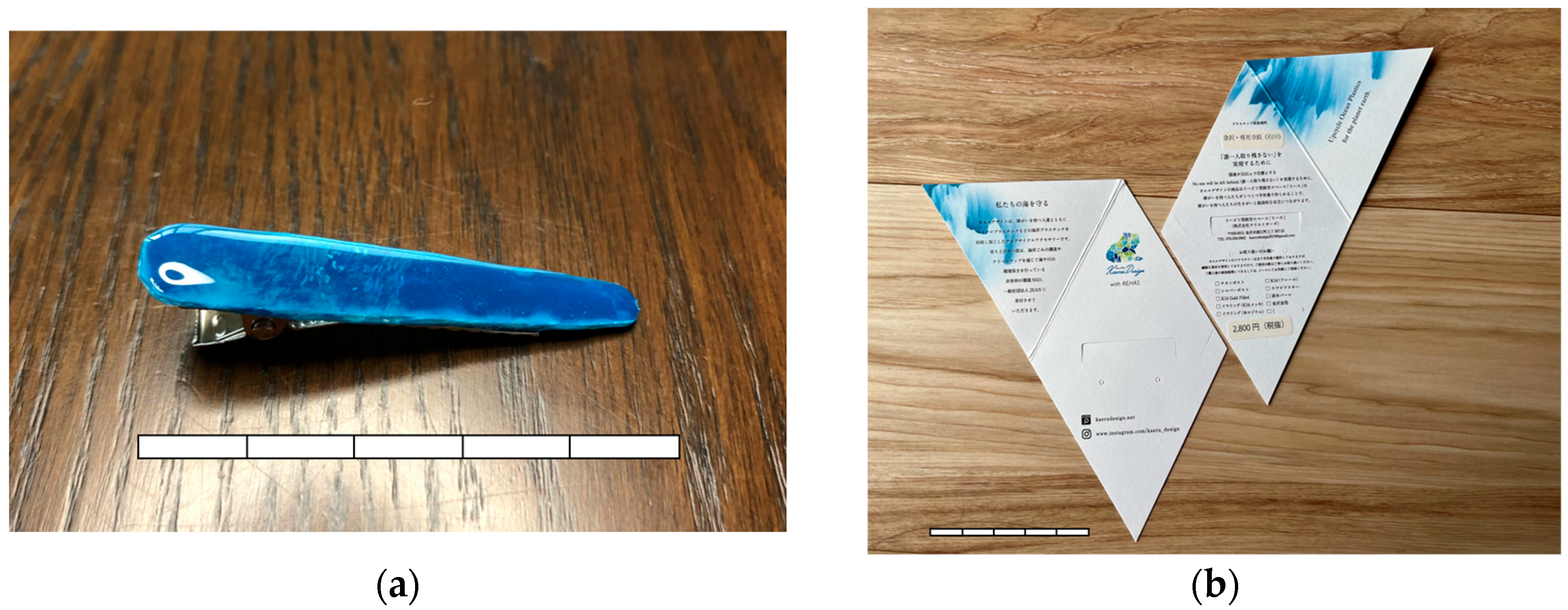
Sales are primarily conducted through the KD’s online shop. Since each piece of jewelry is unique, they cannot be sold in batches; each item must be individually photographed, listed on the website, and packaged upon sale. Each accessory includes information about its origin (e.g., “Made from plastics from XX location”) printed on the backing card (Figure 1), serving as a conversation starter about ocean conservation even for those not initially interested in marine issues.
Figure 1.
Marine plastic accessory: (a) hairpin and (b) front and backside of backing card. Note: scale bar = 5 cm.
Products are also sold through consignment at 17 fair trade and ethical shops within and outside the prefecture. Some stores carry products year-round, while others feature them during special events. Additionally, the project participates in irregular pop-up shops at major department stores and returns accessories to donor organizations for sale at their locations. Retail displays feature product information alongside samples of collected marine plastic waste.
Most items are priced at JPY 3000–4000. During the evaluation period, 518 units were sold via the online shop, and 694 units were sold via consignment sales. A portion of sales proceeds is donated to the Japan Environmental Action Network (JEAN), an organization conducting marine litter surveys and cleanup activities supporting ocean conservation efforts.
2.3. SROI Procedure
This study follows the Social Return on Investment (SROI) methodology as outlined in established guidelines [35], which has also been widely discussed and critically examined in the academic literature as a tool for capturing social value beyond conventional financial metrics [36].
We followed the methodology outlined in the SROI Guide [35] and employed a six-step process:
- Defining the scope and identifying key stakeholders;
- Mapping outcomes (creating an impact map);
- Evidencing outcomes and assigning values;
- Verifying the impact of activities;
- Calculating the SROI ratio;
- Reporting findings and drawing conclusions.
Step 1 involved conducting online interviews with KD and Rehas representatives in July and October 2020 via Zoom (Zoom Video Communications, San Jose, CA, USA). This session helped define the scope of their activities and identify key stakeholders.
Step 2 focused on developing an impact map by identifying the inputs (time, funding, and materials) contributed by each stakeholder, outlining project activities (outputs), and defining the resulting changes (outcomes) experienced by stakeholders.
Step 3 involved evaluating and assigning monetary values to these outcomes. We conducted additional data collection through questionnaires and qualitative interviews. The timing and measurement content of each survey are detailed in Appendix A. The sample size for each stakeholder group was limited because the analysis comprised a single case study of one Type-A facility and its immediate partner organizations. For KD users and staff, the survey targeted all eligible participants within the facility, and the response numbers therefore reflect the actual size of the organization rather than a subsample drawn from a larger population. For partner organizations and volunteers, the number of respondents corresponds to the full set of individuals directly involved in KD’s marine plastic activities during the evaluation year, rather than a randomly selected sample. No formal statistical tests were applied to pre- and post-survey responses due to the small sample size and the exploratory nature of the study; instead, changes are interpreted descriptively and in combination with qualitative evidence.
In Step 4, impacts are verified by determining the extent to which observed changes can be attributed to the project. This verification applies three adjustment factors—deadweight, attribution, and displacement—to ensure that only outcomes genuinely caused by the project are included in the impact calculation. In Step 5, the SROI ratio was calculated using Equation (1):
For example, an SROI ratio of 3 indicates that every JPY 1 invested in the project generated JPY 3 in social and environmental value.
Step 6 involved reporting the SROI calculation results to KD in April 2021 and exchanging ideas and possible recommendations to improve and expand the project.
3. Results
3.1. Identifying Stakeholders
This study focused specifically on KD’s marine plastic accessories project over a one-year period from December 2019.
Based on our initial analysis, six key stakeholder groups were identified: PwD employees (users of Rehas), KD staff, retailers, support persons/organizations, government, and consumers.
3.2. Mapping Outcomes
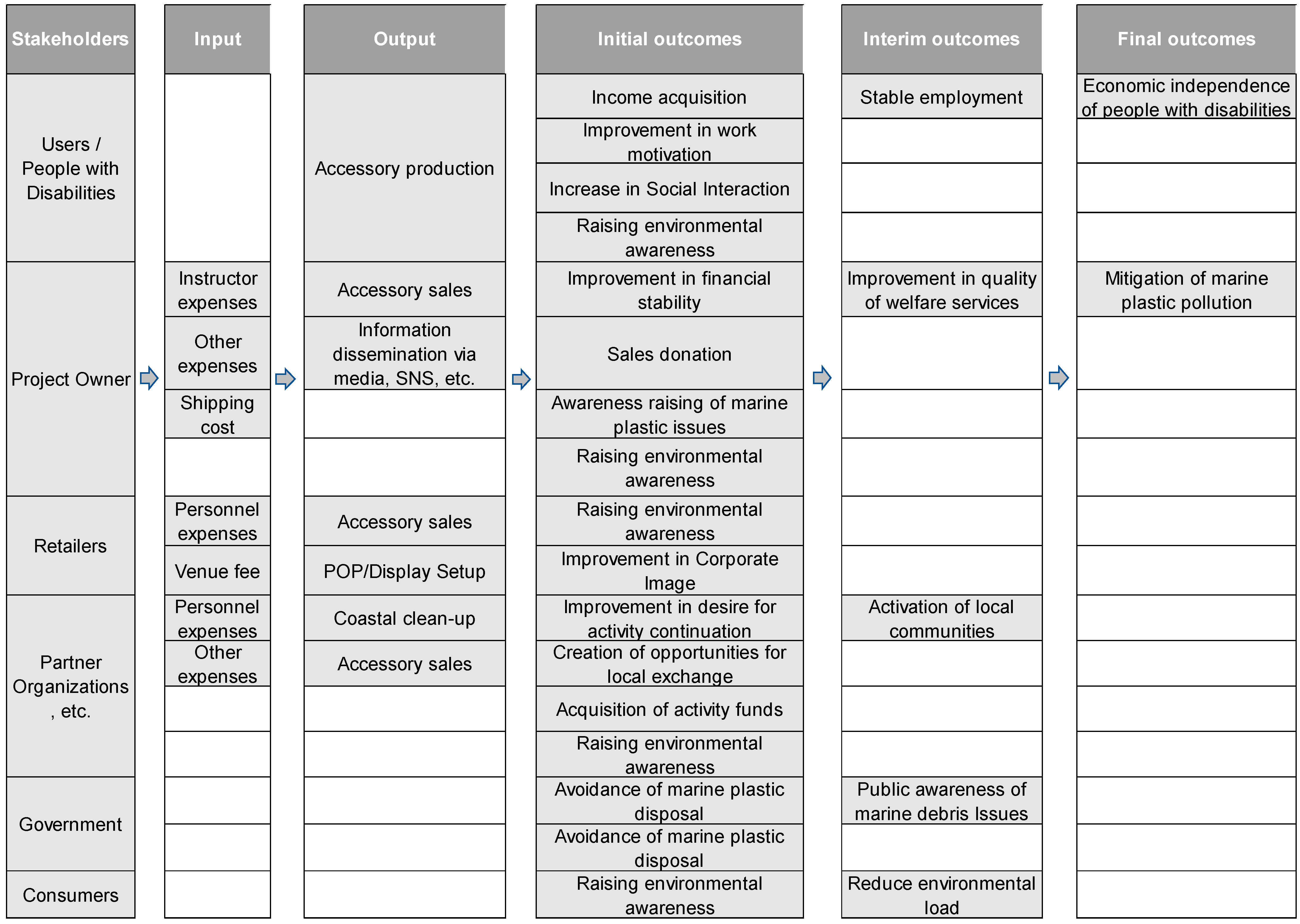
An impact map (logic model) was developed to visualize the relationship between inputs, activities, outputs, and expected outcomes for each stakeholder (Figure 2). The project provided stable employment for PwDs, enabling them to gain income (Outcome 1) and increase motivation to work (Outcome 2). Participants expressed pride in their work, leading to a decline in absenteeism rates. Some users shared their experiences with family and friends or purchased accessories for themselves, thereby fostering a sense of social participation and belonging (Outcome 3). In our interview, several participants reported behavioral changes, such as carrying reusable bottles instead of buying bottled drinks, indicating greater environmental awareness (Outcome 4). At the intermediate outcome level, these changes contributed to enhanced work engagement and stable income, which are stepping-stones toward economic independence. For the project operator, stable sales improved financial sustainability (Outcome 5) and the quality of welfare services.
Figure 2.
Logic model of the marine plastic accessory project.
The project also had clear environmental impacts. By transforming collected marine plastic waste into accessories, it contributed to raising public awareness of marine plastic issues and encouraging waste reduction behaviors (Outcome 15). Partner organizations that collaborated in beach cleanings or consignment sales reported higher motivation to continue environmental activities (Outcome 10) and were able to secure operational funding through sales commissions (Outcome 11). These intermediate outcomes—such as strengthened community engagement and pro-environmental behaviors—contributed to broader outcomes like reduced waste treatment costs (Outcome 14) and improvement in the coastal ecosystem through reduced marine litter (Outcome 13). The ultimate long-term outcome is the mitigation of marine plastic pollution.
3.3. Evidencing Outcomes
Each outcome was quantified and monetized following the SROI framework. Table 1 summarizes the 15 outcomes and their estimated annual social value.
Table 1.
Financial proxies for outcome evaluation.
Gaining income: As mentioned earlier, 2 to 5 users are primarily involved in accessory production, though when including tasks such as packaging, around half of the workforce may be engaged. We assumed that this outcome reflects the financial benefit for six users who gained income through project employment. The amount was calculated using the number of users, the minimum wage in Kanazawa at that time (JPY 833), multiplied by four working hours per day and 240 working days per year. The total monetary value was estimated at JPY 4,798,000.
Increased motivation to work: This was evidenced by a significant 7% increase in the attendance rate, rising from 87.5% (Nov. 2019–Mar. 2020) to 94.5% (Nov. 2020–Mar. 2021) among 24–27 participants. The corresponding benefit was calculated by multiplying the minimum wage (JPY 833 × 4 h) by the number of working days, resulting in a total value of JPY 1,455,000.
More Social Interaction: According to survey results, users’ frequency of social interactions increased by approximately 50%, equivalent to two café visits per month (JPY 500 each) [37]. This improvement in social connection was monetized by equating the emotional benefit to the cost of such activities, yielding a total value of JPY 156,000.
Increased environmental awareness (Users): Using estimated data on the annual consumption and reduction rates of single-use plastic (see Appendix B for detailed calculation), CO2 emission factor (5.09 kg CO2/kg) [38], and J-Credit carbon price (1473 JPY/t-CO2, Jan. 2020) [39], we estimated that the total monetary value was JPY 360.
Improved Financial Stability (Project Operator): The project operator’s sales revenue increased through online sales (518 items) and with a profit rate of 75% for consignment sales (694 items) at an average price of JPY 3316. The annual financial benefit is JPY 3,444,000.
Environmental Contribution through Donation: The project donated JPY 36,185 to a marine conservation NGO (JEAN). Based on the proportion used for beach cleaning activities and the avoided disposal cost (150 JPY/kg) [40], we estimate the environmental contribution value is approximately JPY 2000.
Raised Awareness of Marine Plastic Issues: Media exposure—comprising 11 local newspaper articles, two national newspaper articles, two television reports, and three web articles—was used as a proxy for public awareness. Using advertising equivalency rates (JPY 30 per 10,000 page views and JPY 320,000–1,647,000 for mass media) [41,42,43], we estimate the total media value is JPY 11,440,000.
Increased Environmental Awareness (Project Operator): From staff survey data, the project’s efforts led to measurable reductions in single-use plastic. Based on annual consumption, CO2 emission reductions, and J-Credit prices, we estimated that the total monetary value was JPY 477.
Increased Environmental Awareness (Retailers): Retailers participating in the project reduced their use of single-use plastics through improved awareness and practice. Based on annual consumption, CO2 emission reductions, and J-Credit prices, we estimated that the total monetary value was JPY 463.
Sustained Motivation for Activities (Partner Organizations): This outcome represents the unpaid time spent by approximately 200 volunteers engaged in beach-cleaning-related activities. Using the national weighted average minimum wage (JPY 902/h) [44] for 24 h per year, the total value was estimated at JPY 4,330,000.
Secured Funding for Activities: Partner organizations benefited from commission income on 200 items sold through the project’s sales platform. Applying a 25% commission rate to the average sales price (JPY 3316), the total annual benefit amounted to JPY 166,000.
Increased Environmental Awareness (Partner Organizations): For volunteers and partner organizations, plastic-use reduction was also monetized based on CO2 reductions and J-Credit prices, yielding a small benefit of JPY 596.
Avoided Damage from Marine Plastic (Government): The project’s collection of marine plastic contributed to avoided economic losses, based on global estimates of 13 billion USD in annual damages from marine debris [45]. Scaled to the project’s contribution of 50 kg, the benefit was valued at JPY 6825.
Reduced Waste Treatment Cost (Government): By collecting 50 kg of marine plastic, the project reduced administrative disposal costs, estimated at 150 JPY/kg, leading to savings of 600 JPY.
Increased Environmental Awareness (Consumers): Consumer surveys indicated reductions in single-use plastic use, valued using CO2 emission factors and J-Credit prices, with a total benefit of 15,096 JPY.
While other positive effects, such as enhancing the corporate image of retailers, revitalizing local communities through the collection of marine plastics, were observed, they were excluded from the calculation due to a lack of benchmark data.
3.4. Verification of the Impact of Activities
To ensure the reliability of the valuation, three key adjustment factors were applied in accordance with SROI principles:
- Attribution: The project’s outcomes—particularly employment creation for PwDs and marine plastic upcycling—were unique to this initiative. Therefore, attribution was set at 100%, assuming these impacts would not have occurred otherwise.
- Deadweight: For environmental awareness outcomes, national-level policy effects (such as the 2020 plastic bag charge) were considered as deadweight. The proportion attributable to such policies was deducted from total impact values (ranging from 8% to 32%, depending on stakeholder group).
- Displacement: Since the project does not replace existing economic activities but creates new value in both welfare and environmental domains, displacement was assumed to be 0%.
Attribution was also set at 100% for awareness- and participation-related outcomes because the analysis focuses on changes observed among individuals directly engaged in the KD activities. These changes are considered to be primarily triggered by project participation rather than by broader societal trends. The influence of external factors, such as existing environmental awareness, social norms, and policy contexts, was addressed through the deadweight assumption for each outcome, which was also used as an additional safeguard against potential overlap and double-counting across outcomes. In particular, for media-related awareness (Outcome 7), a conservative deadweight of 50% was applied to account for broader societal attention to plastic pollution and the influence of external campaigns beyond the project itself [46,47]. After adjusting for these factors, the total present value of benefits amounted to JPY 18,768,000 (Table 2).
Table 2.
Adjusted monetary valuation of project outcomes.
3.5. Inputs
Financial and in-kind inputs required to implement the project, including personnel costs, operational expenses, and supporting resources, constitute the investment component used as the denominator in the SROI calculation. The project’s total input was valued at 5.4 million JPY (Table 3). Inputs included instructors’ salaries (JPY 1,680,000), minor material purchases (JPY 387,000), the shipping cost of marine plastics (JPY 14,000), personnel and venue costs at department stores (JPY 1,608,000), and the implicit value of volunteer labor (JPY 1,666,000). Cleaning activities using minimal cleaning agents were conducted as part of routine work by users; therefore, no additional costs were separately allocated. Transportation costs were included for plastics shipped from outside the Kanazawa area, but locally collected materials did not incur additional shipping expenses. National subsidies for welfare-type businesses (Type A) were not counted as inputs since they are part of the base operation and are not specific to this project.
Table 3.
Inputs of KD project.
3.6. The SROI Calculation
The total monetized benefit was calculated as JPY 18,768,000. The total investment was JPY 5,306,623. The SROI ratio was calculated by dividing total benefit by total investment:
Table 4 summarizes the total investment, total present value of benefits, and the resulting SROI ratio. This ratio indicates that every JPY 1 invested in the project generated approximately JPY 3.50 of social value in combined welfare and environmental outcomes. Although this SROI ratio is moderate compared to other reuse and recycling projects (2.65–11.77) [48,49,50,51], it clearly represents a positive and meaningful return, demonstrating that the project generated more value than the resources invested. Three outcomes dominated the total quantified value: media exposure (30.5%), employment income for PwDs (25.6%), and sustained volunteer motivation (18.5%), collectively representing approximately 74% of social value created.
Table 4.
Summary of SROI results.
3.7. Sensitivity Analysis
To examine the robustness of the SROI results, we conducted sensitivity analyses focusing on media-related awareness outcomes, which account for a substantial share of the total social value. In addition to the base case, two conservative scenarios were tested: (1) an 80% reduction in the monetized value of media exposure, and (2) setting the deadweight to 100%, effectively excluding media exposure from the SROI calculation. The resulting SROI values were 2.86 and 2.44, respectively (see Appendix C for detailed calculation). In all scenarios, the resulting SROI ratios remained above 1, indicating that the overall conclusions are robust and not driven solely by media-related outcomes.
4. Discussion
The project began with simple beach cleanup activities, gradually evolving into a circular initiative that transforms collected marine plastic into accessories. Through this process, users (PwDs) experienced a strong sense of purpose and social contribution. Many users reported greater motivation to work, reflected in a notable decrease in absenteeism and increased continuity of employment. The activities also provided opportunities for outdoor engagement and communication with family and friends, contributing to improved well-being and social inclusion.
Although the actual amount of marine plastic incorporated into accessories is minimal (50 kg annually), its symbolic value is substantial. Wearing and sharing these accessories increases public awareness of marine litter issues and encourages broader behavioral change. The project’s extensive media exposure—including coverage in newspapers, television programs, and online media—generated the highest monetary value among all outcomes, underscoring the significance of awareness-raising as a social impact pathway. Furthermore, the project has created a motivational loop among partner organizations and volunteers. Through our observation and interview with the organization in Shonan, we found a stronger sense of fulfillment when their cleanup activities resulted in upcycled products and created employment for PwDs.
Despite these positive impacts, several managerial and structural challenges remain. First, both production capacity and sales capacity are limited. While more PwDs wish to work at KD, the Type-A facilities restrict the number of employees per facility, preventing expansion despite high demand. Second, although the product unit price has risen with improved craftsmanship and design, these gains have not yet translated into higher user wages. Although the welfare service system is the primary cause, balancing production volume, fair wages, and appropriate levels remains a key management issue.
With regard to Outcome 1 (wage improvement), higher earnings for PwDs could theoretically be achieved through increased product sales, higher unit prices supported by ethical premiums, or expanded market reach. In practice, however, Type-A welfare facilities face structural constraints, including limited capacity, fixed staffing arrangements, and regulatory frameworks, that make rapid wage increases or workforce expansion difficult. Accordingly, the primary contribution of the model lies in providing stable employment and promoting social inclusion rather than pursuing rapid wage growth or market sales expansion.
From a market perspective, the project’s main customers are women who may have already been environmentally conscious—a pattern consistent with prior research indicating that women tend to show stronger pro-environmental attitudes [52,53,54]. Since the current products are primarily accessories, the consumer base has a somewhat gender-biased composition. To achieve broader social impact and contribute more substantially to the mitigation of marine plastic pollution, it will be important to diversify upcycled products beyond accessories. Potential future product lines may include stationery, daily use items, or art objects that appeal to broader demographics, including men and younger audiences. Strategic communication targeting those who are less aware or less engaged in environmental issues will also be essential.
This study has several limitations. First, the evaluation period (2020) coincided with the COVID-19 pandemic, during which numerous unusual external factors may have influenced the results. Online sales of accessories may have been temporarily boosted due to increased e-commerce activity during periods of restricted mobility. Conversely, volunteer participation may have been constrained by public health measures, potentially leading to an underestimation of community engagement outcomes. At the same time, changes in consumption patterns during the pandemic—including increased reliance on single-use plastics—may have influenced public awareness and attitudes toward plastic waste. These contextual factors should be considered when interpreting the results. Second, the data collection period was limited to one year. It is difficult to project longer-term effects for more robust estimation of sustained outcomes. Third, some outcomes have been excluded or underestimated due to insufficient data. The monetization of media exposure using advertising equivalency rates, while standard practice, may overestimate the actual environmental awareness change impact. The sensitivity analysis addresses key uncertainties associated with media valuation and demonstrates that the overall findings remain robust under conservative assumptions. Beyond this, several positive outcomes—such as enhanced corporate image for retailers and strengthened community cohesion—were excluded due to a lack of reliable proxies, suggesting the total social value may be underestimated. Comparable data from other Type A welfare service providers were unavailable, making it difficult to estimate a precise deadweight rate. Consequently, the deadweight assumptions used in this study may lack accuracy, posing a limitation to the rigor of the impact estimation. Collection from partner organizations was limited to three groups (two in Kanagawa Prefecture and one in Obama City), and volunteer data were obtained from only eight participants in the Shonan area. Thus, the sample may not fully represent the diversity of collaborators/volunteers. Future research should address these limitations by collecting longitudinal data across multiple years and applying repeated SROI calculations, which will allow for more reliable estimation of counterfactual effects and enhance the precision of SROI calculations.
5. Conclusions
This study demonstrates that even small-scale marine plastic upcycling initiatives can generate substantial social value when evaluated through an SROI framework, particularly when environmental action is integrated with employment support for PwDs. The analysis identified 15 outcomes across 6 stakeholder groups, including income generation, environmental awareness-raising, and sustained volunteer engagement. Overall, the analysis indicated that the project generated an SROI of 3.50, demonstrating substantial social and environmental value relative to the initial investment. Media exposure (30.5%), employment income (25.6%), and volunteer motivation (18.5%) comprised 74% of the total value. Despite processing only 50 kg of marine plastic annually, the project demonstrated significant symbolic impact through behavior change and public awareness.
The project not only enhances public awareness of marine plastic pollution but also encourages concrete behavioral changes among citizens, such as reducing single-use plastics and participating in coastal cleanup activities. The products created from marine plastics serve as tangible reminders of the environmental issue, transforming discarded materials into items of value and spreading the concept of “upcycling” as an approach to sustainable resource use. From the perspective of social inclusion, the initiative provides participants with a sense of purpose and social connection by engaging them in work that is both meaningful and visible to the community. The improvement in attendance rates and job retention among employees with disabilities suggests that involvement in environmentally and socially beneficial activities can strengthen motivation and workplace stability.
If this model proves economically viable and scalable, it could serve as a valuable reference for other Type A continuous employment support facilities in Japan, many of which struggle with chronic deficits. However, the pursuit of “scaling up” the production and sales of marine plastic accessories raises a potential paradox; while growth may improve financial sustainability, excessive production could contradict the goal of sustainability itself. Future efforts should therefore focus on balancing social, environmental, and economic objectives—perhaps by expanding into other upcycled product categories (e.g., stationery, household items, or art objects) that can engage a broader demographic.
Like other single-case SROI studies, this analysis has methodological limitations. The one-year evaluation period and the small sample sizes limit the generalizability of the quantitative findings, meaning that the results should be interpreted as indicative rather than statistically representative. These constraints were mitigated through triangulation of survey responses, interview data, and operational records, as well as sensitivity analysis to test key outcome assumptions.
This case study illustrates how an inclusive, community-based upcycling initiative can ultimately generate multidimensional social value. To ensure its long-term sustainability, continued evaluation of both environmental and social outcomes, alongside adaptive management of production and outreach strategies, will be essential. Recent studies on social enterprises and work integration initiatives [55,56] similarly emphasize that the value of inclusive employment should be understood in multidimensional terms rather than solely through financial performance indicators. Prior research applying SROI and related impact measurement approaches has highlighted the importance of capturing well-being, social participation, and community-level effects, particularly under constrained economic or crisis conditions [55,56]. In this respect, this study contributes to the growing literature by demonstrating how an environmentally oriented upcycling initiative can also function as a platform for social inclusion and meaningful work.
Author Contributions
Conceptualization, A.Y. and Y.H.; methodology, A.Y., Y.H. and M.H.; investigation, A.Y., Y.H., M.H. and T.K.; data curation, A.Y., Y.H. and S.K.; writing—original draft preparation, A.Y.; writing—review and editing, A.Y. and Y.H.; supervision, T.K.; project administration, A.Y. and T.K. All authors have read and agreed to the published version of the manuscript.
Funding
This research was funded by internal research funds of the National Institute for Environmental Studies. This research received no external funding.
Institutional Review Board Statement
Ethical review and approval were not required for this study because the research was initiated in July 2020, prior to the establishment of the institutional ethical review regulations in March 2021. At the time of data collection, no formal ethical review process was in place at the authors’ institution for this type of non-invasive, anonymized social survey research.
Informed Consent Statement
Informed consent was obtained from all participants involved in the study. For questionnaire surveys, participants were informed of the purpose of the study, the voluntary nature of participation, and anonymity through the survey invitation, and consent was implied by their voluntary completion of the questionnaire. For interviews, informed consent was obtained verbally prior to data collection. Written consent was not collected because interviews were conducted remotely (via Zoom or telephone) during the COVID-19 period. All interview data were anonymized during analysis and reporting.
Data Availability Statement
The data presented in this study are available on request from the corresponding author. The data are not publicly available due to privacy and ethical restrictions, as they contain sensitive information about individuals with disabilities and small organizations that could compromise participant confidentiality.
Acknowledgments
We sincerely thank the former representative of Kaeru Design and the former director of Rehas for their cooperation in data collection and insightful discussions throughout this research. We also express our gratitude to all participants who took part in surveys and interviews, and to the partner organizations involved in beach cleanup activities. During the preparation of this manuscript/study, the authors used Claude Sonnet 4.5 for English language editing and proofreading. The authors have reviewed and edited the output and take full responsibility for the content of this publication. All scientific content and conclusions are the authors’ original work.
Conflicts of Interest
Author Yamato Hosoi, Masafumi Hagiwara, Shingo Kanezawa, and Toshiya Kayama were employed by Mitsubishi UFJ Research and Consulting. The remaining authors declare that the research was conducted in the absence of any commercial or financial relationships that could be construed as a potential conflict of interest.
Abbreviations
The following abbreviations are used in this manuscript:
| SROI | Social Return on Investment |
| PwDs | People with Disabilities |
| KD | Kaeru Design |
Appendix A

Table A1 shows a list of key data collection sources and methods that formed the basis for the monetary conversion logic and qualitative analysis in this social impact assessment.
Table A1.
Data collection sources and methodology.
Table A1.
Data collection sources and methodology.
| Survey Name | Target Stakeholders | Number of Respondents | Collection Period | Method | Purpose |
|---|---|---|---|---|---|
| User survey | Users | 15 | Feb.–Mar. 2021 | Questionnaire survey | Type of work, social interaction, work motivation, health impact, and environmental awareness change |
| User interview | Users | 2 | Mar. 2021 | Semi-structured telephone interview | Type of work, social interaction, work motivation, health impact, and environmental awareness change |
| Staff survey | Staff | 7 | Feb.–Mar. 2021 | Questionnaire survey | Type of work, work motivation, health impact, and environmental awareness change |
| Retailer survey | Retail staff | 10 | May 2021 | Questionnaire survey | Reason to sell KD marine plastic accessories, a place to sell, and environmental awareness change |
| Partner org. survey | Partner org. | 3 | Feb. 2021 | Questionnaire survey | Frequency of beach cleanups, environmental awareness change |
| Partner org. interview | 3 org. (Shonan, Chigasaki, Wakasa) | 3 | Mar. 2021 | Semi-structured Zoom interviews | Activity overview, outcomes, and challenges |
| Volunteer survey | Participants of Shonan beach cleanup | 8 | Mar. 2021 | Questionnaire survey | Recognition of KD marine plastic accessories, environmental awareness change |
| Beach cleanup activity | Participants of Shonan beach cleanup | - | Apr. 2021 | Participant observation | Gathering information through the experience of participating in actual beach clean-ups. |
| Purchaser survey | Purchaser | 85 | Feb.–Mar. 2021 | Questionnaire survey | Reason for purchase, quantity, satisfaction level, and environmental awareness change |
Appendix B
This Appendix details the methodology and data sources used to quantify the monetary value of plastic reduction volume for measuring improved environmental awareness (Outcomes 3, 7, 9, 12, 15).
The physical volume of plastic reduction for each stakeholder group was quantified using survey responses combined with national average consumption data. The degree of participants’ change in single-use plastic usage was quantified using a weighted average score derived from survey responses.
The following six items were presented regarding the intent of participants to reduce consumption both before and after the sales of marine plastic accessories:
- Refrain from using plastic straws or disposable plastic spoons (Q1-1);
- Carry a reusable bottle and avoid using disposable beverage containers (such as PET bottles) as much as possible (Q1-2);
- Refuse plastic carrier bags (carry your own bag) (Q1-3);
- Refrain from using plastic bags for portioning food at supermarkets, etc. (Q1-4);
- Choose and purchase products that generate less plastic waste, such as refillable items (Q1-5);
- Refrain as much as possible from purchasing food or goods using plastic containers or packaging (Q1-6).
There were four answer choices. “Actively implementing (60%+ reduction)” was weighted at 80% (0.80); “Implementing (40–60% reduction)” was weighted at 50% (0.50); “Occasionally implementing (0–40% reduction)” was weighted at 20% (0.20); and “Not implementing (0%)” was weighted at 0% (0.00).
The degree of participants’ change in disposable plastic usage (six specific actions) was quantified using a weighted average score, based on the following scale:
Table A2.
Raw data of survey responses for plastic reduction score.
Table A2.
Raw data of survey responses for plastic reduction score.
| (a) User | ||||||||||||
| Q1-1 | Q1-2 | Q1-3 | Q1-4 | Q1-5 | Q1-6 | |||||||
| Pre | Post | Pre | Post | Pre | Post | Pre | Post | Pre | Post | Pre | Post | |
| 0% | 2 | 1 | 3 | 3 | 2 | 0 | 2 | 1 | 0 | 0 | 2 | 1 |
| 20% | 10 | 7 | 8 | 5 | 5 | 2 | 7 | 9 | 4 | 3 | 12 | 8 |
| 50% | 1 | 5 | 3 | 4 | 4 | 7 | 4 | 2 | 6 | 6 | 1 | 6 |
| 80% | 2 | 2 | 1 | 3 | 4 | 6 | 2 | 3 | 5 | 6 | 0 | 0 |
| Total | 15 | 15 | 15 | 15 | 15 | 15 | 15 | 15 | 15 | 15 | 15 | 15 |
| 27.3% | 36.7% | 26.0% | 36.0% | 41.3% | 58.0% | 33.3% | 34.7% | 52.0% | 56.0% | 19.3% | 30.7% | |
| 9.3% | 10.0% | 16.7% | 1.3% | 4.0% | 11.3% | |||||||
| (b) Staff | ||||||||||||
| Q1-1 | Q1-2 | Q1-3 | Q1-4 | Q1-5 | Q1-6 | |||||||
| Pre | Post | Pre | Post | Pre | Post | Pre | Post | Pre | Post | Pre | Post | |
| 1 | 3 | 0 | 2 | 0 | 1 | 0 | 2 | 1 | 0 | 0 | 4 | 1 |
| 2 | 4 | 1 | 3 | 2 | 2 | 0 | 3 | 2 | 2 | 2 | 2 | 3 |
| 3 | 0 | 3 | 0 | 2 | 2 | 1 | 1 | 2 | 3 | 3 | 0 | 2 |
| 4 | 0 | 3 | 2 | 3 | 2 | 6 | 1 | 2 | 2 | 2 | 1 | 1 |
| Total | 7 | 7 | 7 | 7 | 7 | 7 | 7 | 7 | 7 | 7 | 7 | 7 |
| 11.4% | 58.6% | 31.4% | 54.3% | 42.9% | 75.7% | 27.1% | 42.9% | 50.0% | 50.0% | 17.1% | 34.3% | |
| 47.1% | 22.9% | 32.9% | 15.7% | 0.0% | 17.1% | |||||||
| (c) Retailer | ||||||||||||
| Q1-1 | Q1-2 | Q1-3 | Q1-4 | Q1-5 | Q1-6 | |||||||
| Pre | Post | Pre | Post | Pre | Post | Pre | Post | Pre | Post | Pre | Post | |
| 1 | 1 | 0 | 0 | 0 | 0 | 0 | 1 | 0 | 1 | 0 | 2 | 0 |
| 2 | 5 | 0 | 3 | 1 | 2 | 0 | 4 | 2 | 4 | 0 | 5 | 3 |
| 3 | 2 | 6 | 4 | 1 | 1 | 0 | 4 | 0 | 2 | 4 | 1 | 5 |
| 4 | 2 | 4 | 3 | 8 | 7 | 10 | 1 | 8 | 3 | 6 | 2 | 2 |
| Total | 10 | 10 | 10 | 10 | 10 | 10 | 10 | 10 | 10 | 10 | 10 | 10 |
| 36.0% | 62.0% | 50.0% | 71.0% | 65.0% | 80.0% | 36.0% | 68.0% | 42.0% | 68.0% | 31.0% | 47.0% | |
| 26.0% | 21.0% | 15.0% | 32.0% | 26.0% | 16.0% | |||||||
| (d) Volunteer | ||||||||||||
| Q1-1 | Q1-2 | Q1-3 | Q1-4 | Q1-5 | Q1-6 | |||||||
| Pre | Post | Pre | Post | Pre | Post | Pre | Post | Pre | Post | Pre | Post | |
| 1 | 0 | 0 | 1 | 0 | 0 | 0 | 0 | 0 | 0 | 0 | 0 | 0 |
| 2 | 2 | 1 | 2 | 1 | 0 | 0 | 2 | 2 | 1 | 2 | 5 | 4 |
| 3 | 1 | 2 | 0 | 2 | 1 | 1 | 3 | 4 | 2 | 3 | 1 | 1 |
| 4 | 5 | 5 | 5 | 5 | 7 | 7 | 3 | 2 | 5 | 3 | 2 | 3 |
| Total | 8 | 8 | 8 | 8 | 8 | 8 | 8 | 8 | 8 | 8 | 8 | 8 |
| 61.3% | 65.0% | 55.0% | 65.0% | 76.3% | 76.3% | 53.8% | 50.0% | 65.0% | 53.8% | 38.8% | 46.3% | |
| 3.8% | 10.0% | 0.0% | −3.8% | −11.3% | 7.5% | |||||||
| (e) Consumer | ||||||||||||
| Q1-1 | Q1-2 | Q1-3 | Q1-4 | Q1-5 | Q1-6 | |||||||
| BF | AF | BF | AF | BF | AF | BF | AF | BF | AF | BF | AF | |
| 1 | 7 | 2 | 5 | 2 | 4 | 1 | 13 | 3 | 1 | 1 | 15 | 5 |
| 2 | 30 | 17 | 23 | 8 | 12 | 2 | 19 | 7 | 14 | 6 | 33 | 18 |
| 3 | 21 | 21 | 17 | 17 | 15 | 8 | 23 | 28 | 26 | 24 | 19 | 32 |
| 4 | 16 | 34 | 29 | 47 | 43 | 63 | 19 | 36 | 33 | 43 | 7 | 19 |
| Total | 74 | 74 | 74 | 74 | 74 | 74 | 74 | 74 | 74 | 74 | 74 | 74 |
| 39.6% | 55.5% | 49.1% | 64.5% | 59.9% | 74.1% | 41.2% | 59.7% | 57.0% | 64.3% | 29.3% | 47.0% | |
| 15.9% | 15.4% | 14.2% | 18.5% | 7.3% | 17.7% | |||||||
Table A3.
Calculated reduction rate of single-use plastic.
Table A3.
Calculated reduction rate of single-use plastic.
| User | Staff | Retailer | Volunteer | Consumer | |
|---|---|---|---|---|---|
| Q1-1 | 9% | 47% | 26% | 4% | 16% |
| Q1-2 | 10% | 23% | 21% | 10% | 15% |
| Q1-3 | 17% | 33% | 15% | 0% | 14% |
| Q1-4 | 1% | 16% | 32% | −4% | 19% |
| Q1-5 | 4% | 0% | 26% | −11% | 7% |
| Q1-6 | 11% | 17% | 16% | 8% | 18% |
| n= | 26 | 10 | 10 | 200 | 500 |
The annual reduction volume (kg) for each action was calculated by multiplying the average change score for that action by the average annual consumption volume for the corresponding plastic item.
where
: Annual Consumption (kg/person/year).
: CO2 Emission Factor (kg-CO2/kg-plastic).
: CO2 Unit Price (JPY/kg-CO2).
N: Number of people (people).
Table A4.
Average consumption.
Table A4.
Average consumption.
| Products Subject to Reduction | Annual Consumptions (kg/Person Year) | CO2 Value Equivalent (JPY) | |
|---|---|---|---|
| Q1-1 | Other/non-container packaging | 6.96 | 54 |
| Q1-2 | PET bottles for beverages | 2.76 | 21 |
| Q1-3 | Film/shopping bags | 1.28 | 10 |
| Q1-4 | Film/container packaging (excluding shopping bags) | 7.00 | 54 |
| Q1-5 | Other bottles | 1.84 | 14 |
| Q1-6 | Packs and cups | 4.22 | 33 |
Note: National average consumption volumes for disposable items (plastic bags, straws, PET bottles, etc.) were referenced from the Ministry of the Environment, Japan [38].
Table A5.
Monetary value of plastic reduction.
Table A5.
Monetary value of plastic reduction.
| Products Subject to Reduction | User | Staff | Retailer | Volunteer | Consumer | |
|---|---|---|---|---|---|---|
| Q1-1 | Other/non-container packaging | 131 | 254 | 140 | 405 | 4301 |
| Q1-2 | PET bottles for beverages | 56 | 49 | 45 | 429 | 1650 |
| Q1-3 | Film/Shopping bags | 43 | 33 | 15 | 0 | 703 |
| Q1-4 | Film/Container packaging (excluding shopping bags) | 19 | 85 | 174 | −407 | 5028 |
| Q1-5 | Other bottles | 15 | 0 | 37 | −320 | 519 |
| Q1-6 | Packs and cups | 96 | 56 | 52 | 490 | 2894 |
| Total | 360 | 477 | 463 | 596 | 15,096 |
Appendix C
Table A6.
Sensitivity analysis for Outcome 7 (raised awareness of marine plastic issues), varying the deadweight assumption.
Table A6.
Sensitivity analysis for Outcome 7 (raised awareness of marine plastic issues), varying the deadweight assumption.
| Deadweight (%) | Adjusted Value (JPY 1000) | Resulting SROI |
|---|---|---|
| 50% | 5720 | 3.50 |
| 80% | 2288 | 2.86 |
| 100% | 0 | 2.44 |
References
- Jambeck, J.R.; Geyer, R.; Wilcox, C.; Siegler, T.R.; Perryman, M.; Andrady, A.; Narayan, R.; Law, K.L. Plastic waste inputs from land into the ocean. Science 2015, 347, 768–771. [Google Scholar] [CrossRef]
- World Economic Forum. The New Plastics Economy: Rethinking the Future of Plastics. 2016. Available online: https://jp.weforum.org/publications/the-new-plastics-economy-rethinking-the-future-of-plastics/ (accessed on 22 December 2025).
- Wilcox, C.; Van Sebille, E.; Hardesty, B.D. Threat of plastic pollution to seabirds is global, pervasive, and increasing. Proc. Natl. Acad. Sci. USA 2015, 112, 11899–11904. [Google Scholar] [CrossRef]
- Schuyler, Q.A.; Hardesty, B.D.; Wilcox, C.; Townsend, K. Global analysis of anthropogenic debris ingestion by sea turtles. Conserv. Biol. 2014, 28, 129–139. [Google Scholar] [CrossRef]
- United Nations Environment Programme (UNEP). Valuing Plastic: The Business Case for Measuring, Managing and Disclosing Plastic Use in the Consumer Goods Industry. 2014. Available online: https://www.unep.org/resources/report/valuing-plastic-business-case-measuring-managing-and-disclosing-plastic-use (accessed on 22 December 2025).
- Ritchie, H.; Samborska, V.; Roser, M. Plastic Pollution. 2023. Available online: https://ourworldindata.org/plastic-pollution (accessed on 22 December 2025).
- Lou, X.; Sui, Y.; Fang, C.; Tang, Y.; Huang, D.; Guo, Y. Bibliometric analysis for global marine microplastic pollution control from 2013 to 2022. Front. Environ. Sci. 2023, 11, 1215317. [Google Scholar] [CrossRef]
- Parvez, M.; Ullah, H.; Faruk, O.; Simon, E.; Czédli, H. Role of Microplastics in Global Warming and Climate Change: A Review. Water Air Soil Pollut. 2024, 235, 201. [Google Scholar] [CrossRef]
- Lau, W.W.Y.; Shiran, Y.; Bailey, R.M.; Cook, E.; Stuchtey, M.R.; Koskella, J.; Velis, C.A.; Godfrey, L.; Boucher, J.; Murphy, M.B.; et al. Evaluating scenarios toward zero plastic pollution. Science 2020, 369, 1455–1461. [Google Scholar] [CrossRef] [PubMed]
- Borrelle, S.B.; Ringma, J.; Law, K.L.; Monnahan, C.C.; Lebreton, L.; McGivern, A.; Murphy, E.; Jambeck, J.; Leonard, G.H.; Hilleary, M.A.; et al. Predicted growth in plastic waste exceeds mitigation capacity. Science 2020, 369, 1515–1518. [Google Scholar] [CrossRef]
- Ministry of the Environment of Japan. Recent Developments Regarding Marine Litter. 2018. Available online: https://www.env.go.jp/content/900543475.pdf (accessed on 22 December 2025). (In Japanese)
- Bhullar, N.K.; Prabhakar, A. Plastic Waste to Value-Added Products via Recycling and Upcycling. In Energy Materials: A Circular Economy Approach, 1st ed.; Singh, S., Sundaramurthy, S., Ibhadon, A., Khan, F., Kumar Kansal, S., Mehta, S.K., Eds.; CRC Press: Boca Raton, FL, USA, 2024; pp. 36–54. [Google Scholar]
- Râpă, M.; Cârstea, E.M.; Șăulean, A.A.; Popa, C.L.; Matei, E.; Predescu, A.M.; Predescu, C.; Donțu, S.I.; Dincă, A.G. An Overview of the Current Trends in Marine Plastic Litter Management for a Sustainable Development. Recycling 2024, 9, 30. [Google Scholar] [CrossRef]
- Kirchherr, J.; Reike, D.; Hekkert, M. Conceptualizing the circular economy: An analysis of 114 definitions. Resour. Conserv. Recycl. 2017, 127, 221–232. [Google Scholar] [CrossRef]
- Bocken, N.M.P.; de Pauw, I.; Bakker, C.; van der Grinten, B. Product design and business model strategies for a circular economy. J. Ind. Prod. Eng. 2016, 33, 308–320. [Google Scholar] [CrossRef]
- Blomsma, F.; Brennan, G. The emergence of circular economy: A New Framing Around Prolonging Resource Productivity. J. Ind. Ecol. 2017, 21, 603–614. [Google Scholar] [CrossRef]
- Dijkstra, H.; van Beukering, P.; Brouwer, R. In the business of dirty oceans: Overview of startups and entrepreneurs managing marine plastic. Mar. Pollut. Bull. 2021, 162, 111880. [Google Scholar] [CrossRef] [PubMed]
- Dijkstra, H.; van Beukering, P.; Brouwer, R. Marine plastic entrepreneurship; Exploring drivers, barriers and value creation in the blue economy. Sustain. Technol. Entrep. 2022, 1, 100018. [Google Scholar] [CrossRef]
- Triwa. Available online: https://triwa.com/en-jp (accessed on 22 December 2025).
- #tide Ocean Material. Available online: https://www.tide.earth/en/ (accessed on 22 December 2025).
- ECOALF. Available online: https://ecoalf.com/en-int (accessed on 22 December 2025).
- Sanyo Shokai. Available online: https://www.sanyo-shokai.co.jp/news/2021/03/23-517.html (accessed on 22 December 2025). (In Japanese).
- Daimaru Kyoto. Available online: https://shopblog.dmdepart.jp/kyoto/detail/?cd=131433&scd=000147 (accessed on 22 December 2025). (In Japanese).
- FamilyMart. Shopping Baskets Made from Upcycled Marine Plastic Waste Introduced at 24 FamilyMart Stores Nationwide!! 2021. Available online: https://www.family.co.jp/company/news_releases/2021/20211020_01.html (accessed on 22 December 2025). (In Japanese).
- Kaeru Design. Available online: https://kaerudesign.net/ (accessed on 22 December 2025). (In Japanese).
- The Global Steering Group for Impact Investment. Measuring Impact. 2014. Available online: https://www.gsgimpact.org/resources/gsg-impact-publications-reports/measuring-impact/ (accessed on 22 December 2025).
- GSG Domestic Advisory Committee, Social Impact Assessment Working Group. Social Impact Assessment Toolkit Practical Manual. 2017. Available online: https://simi.or.jp/wp-content/uploads/2020/06/NAB_manual_ver2.pdf (accessed on 22 December 2025). (In Japanese).
- Amita Corporation. MEGURU STATION® and Social Impact Assessment. Available online: https://www.amita-oshiete.jp/column/entry/016458.php (accessed on 22 December 2025). (In Japanese).
- Sompo Institute Plus Inc. Trends in Domestic Impact Investing. 2025. Available online: https://www.sompo-ri.co.jp/2025/01/30/15997/ (accessed on 22 December 2025). (In Japanese).
- Waithaka, A.; Plakantonaki, S.; Kiskira, K.; Mburu, A.W.; Chronis, I.; Zakynthinos, G.; Githaiga, J.; Priniotakis, G. Cellulose-Based Biopolymers from Banana Pseudostem Waste: Innovations for Sustainable Bioplastics. Waste 2025, 3, 37. [Google Scholar] [CrossRef]
- Atanasovska, I.; Choudhary, S.; Koh, L.; Ketikidis, P.H.; Solomon, A. Research gaps and future directions on social value stemming from circular economy practices in agri-food industrial parks: Insights from a systematic literature review. J. Clean. Prod. 2022, 354, 131753. [Google Scholar] [CrossRef]
- Rawhouser, H.; Cummings, M.; Newbert, S.L. Social impact measurement: Current approaches and future directions for social entrepreneurship research. Entrep. Theory Pract. 2019, 43, 82–115. [Google Scholar] [CrossRef]
- Ebrahim, A.; Rangan, V.K. What impact? A framework for measuring the scale and scope of social performance. Calif. Manag. Rev. 2014, 56, 118–141. [Google Scholar] [CrossRef]
- Sridan, P.; Surapolchai, P.; Plainlaor, T.; Tanyaim, A.; Hounnaklang, N.; Zongram, O.; Hawangchu, Y. Social Return on Investment (SROI) from the Community Waste Bank Implementation under the Learning Center of Systematic Waste Management Innovation According to the Circular Economy Concept. Appl. Environ. Res. 2024, 46(1), 011. [Google Scholar] [CrossRef]
- The SROI Network. A Guide to Social Return on Investment. 2012. Available online: https://socialvalueuk.org/resources/a-guide-to-social-return-on-investment-2012/ (accessed on 22 December 2025).
- Millar, R.; Hall, K. Social return on investment (SROI) and performance measurement. Public Manag. Rev. 2013, 15, 923–941. [Google Scholar] [CrossRef]
- Yonemura, S.; Yokoyama, K. Policy evaluation of sports policy—From the perspective of “Social Impact” evaluation. Doshisha J. Health Sports Sci. 2020, 12, 37–48. (In Japanese) [Google Scholar] [CrossRef]
- Ministry of the Environment of Japan. Calculation Method for 3R Unit Values. Available online: https://www.env.go.jp/press/files/jp/19747.pdf (accessed on 22 December 2025). (In Japanese)
- The J-Credit Scheme. Credit Bidding Sales. Available online: https://japancredit.go.jp/tender/ (accessed on 22 December 2025). (In Japanese).
- Ministry of the Environment of Japan. Coastal Drift Waste Regional Countermeasures Promotion Project. Available online: https://www.env.go.jp/content/900543491.pdf (accessed on 22 December 2025). (In Japanese)
- Kokoku-Direct. Newspaper Advertisement Unit Price. Available online: https://www.kokoku-direct.jp/massmedia/newspaper/ (accessed on 22 December 2025). (In Japanese).
- Kokoku-Direct. Television Commercial Fee. Available online: https://www.kokoku-direct.jp/massmedia/tvcm/ (accessed on 22 December 2025). (In Japanese).
- Adell. Advertisement Fee Market Rates. Available online: https://adell-media.com/native-advertising-30medias-price/#1 (accessed on 22 December 2025). (In Japanese).
- General Incorporated Association National Federation of Blue Tax Return Associations. 2020 Minimum Wage. Available online: https://www.zenaoirobr.jp/sp/_tmp/contents/2020/202010/index03690000.html (accessed on 22 December 2025). (In Japanese).
- UNEP. Single-Use Plastics: A Roadmap for Sustainability. 2018. Available online: https://www.unep.org/ietc/ja/node/53?%2Fresources%2Fpublication%2Fsingle-use-plastics-roadmap-sustainability= (accessed on 22 December 2025).
- Farr, M.; Cressey, P.; Milner, S.E.; Abercrombie, N.; Jaynes, B. Proving the Value of Advice: A Study of the Advice Service of Bath and North East Somerset Citizens Advice Bureau; South West Forum: Exeter, UK, 2014. [Google Scholar]
- Power to Change. An Economic Framework to define and measure Social Value in Community Asset Transfers. 2024. Available online: https://www.dtni.org.uk/wp-content/uploads/2024/06/The-Economics-of-CATs-Power-to-Change.pdf (accessed on 22 December 2025).
- Furniture Bank. SROI Case Study. 2017. Available online: https://www.furniturebank.org/wp-content/uploads/2017-SimPACT-SROI-Study-Furniture-Bank.pdf?utm_source=chatgpt.com (accessed on 22 December 2025).
- End Furniture Poverty. Social Return on Investment Study into the Provision of Essential Furniture Items. 2021. Available online: https://endfurniturepoverty.org/wp-content/uploads/2022/10/SROI-of-Furniture-Provision-2021.pdf?utm_source=chatgpt.com (accessed on 22 December 2025).
- Recycling Lives Charity. Social Return on Investment Report: Recycling Lives Charity and Social Enterprise. 2021. Available online: https://www.recyclinglives.org/wp-content/uploads/2022/03/SROI-Report_by-LynchPin-Support_for-Recycling-Lives-Charity.pdf?utm_source=chatgpt.com (accessed on 22 December 2025).
- Fujiyama, A.; Iwahashi, M.; Matsumoto, T. Comprehensive evaluation of the on-site paper cycle system based on social return on investment (SROI). J. Jpn. Soc. Civ. Eng. Ser. G (Environ. Res.) 2021, 77, II_13–II_21. (In Japanese) [Google Scholar] [CrossRef]
- Vicente-Molina, M.A.; Fernández-Sainz, A.; Izagirre-Olaizola, J. Does gender make a difference in pro-environmental behavior? The case of the Basque Country University students. J. Clean. Prod. 2018, 176, 89–98. [Google Scholar] [CrossRef]
- Li, Y.; Wang, B.; Saechang, O. Is Female a More Pro-Environmental Gender? Evidence from China. Int. J. Environ. Res. Public Health 2022, 19, 8002. [Google Scholar] [CrossRef] [PubMed] [PubMed Central]
- Mandarić, D.; Hunjet, A. Gender Disparities in Pro-Environmental Attitudes: Implications for Sustainable Business Practices in Croatia. J. Bus. Econ. Rev. 2024, 9, 73–84. [Google Scholar] [CrossRef]
- Ricket, A.L.; Goodspeed, T. Impact measurement for social enterprises: Social return on investment and subjective well-being valuation in the United States. J. Int. Counc. Small Bus. 2025, 1–23, in press. [Google Scholar] [CrossRef]
- Urmanavičienė, A.; Butkevičienė, E. The Role of Work Integration Social Enterprises in Achieving Sustainable Development Goals during the COVID-19 Pandemic: The Case Study of Lithuania. Sustainability 2023, 15, 4324. [Google Scholar] [CrossRef]
Disclaimer/Publisher’s Note: The statements, opinions and data contained in all publications are solely those of the individual author(s) and contributor(s) and not of MDPI and/or the editor(s). MDPI and/or the editor(s) disclaim responsibility for any injury to people or property resulting from any ideas, methods, instructions or products referred to in the content. |
© 2026 by the authors. Licensee MDPI, Basel, Switzerland. This article is an open access article distributed under the terms and conditions of the Creative Commons Attribution (CC BY) license.