
Article

Spatial and Multivariate Analysis of Groundwater Hydrochemistry in the Solana Aquifer, SE Spain

by
Víctor Sala-Sala
1,*,
José Miguel Andreu
2,
Ana Pérez-Gimeno
1,
Manuel M. Jordán
1,
Jose Navarro-Pedreño
1 and
María Belén Almendro-Candel
1,*
1
Department of Agrochemistry and Environment, University Miguel Hernández of Elche, 03202 Elche, Spain
2
Department of Environment and Earth, University of Alicante, 03690 San Vicente del Raspeig, Spain
*
Authors to whom correspondence should be addressed.
Environments 2025, 12(9), 323; https://doi.org/10.3390/environments12090323
Submission received: 25 July 2025 / Revised: 9 September 2025 / Accepted: 10 September 2025 / Published: 12 September 2025
(This article belongs to the Special Issue Research Progress in Groundwater Contamination and Treatment)

Abstract

The Solana aquifer is located in the South-East of the Iberian Peninsula and forms part of the Villena-Benejama groundwater body. It is a limestone and dolomite aquifer that has historically been considered overexploited due to intensive agriculture and urban use. Despite this, the quality of the water has remained stable over time. This study analyses the spatial and temporal variability within the aquifer and identifies the controlling processes. Chemical analyses were conducted on samples taken from 26 wells in July 2024 and February 2025. The results reveal a predominant calcium carbonate facies with minimal seasonal variation. However, sulphate-chloride water was found in the South-Western sector, which is associated with the dissolution of evaporitic materials from the Triassic Keuper. Principal Component Analysis (PCA) and Hierarchical Cluster Analysis (HCA) identified two processes: a salinity gradient linked to lithology, and a second process related to bicarbonates and nitrates, indicating potential nitrate inputs in the eastern half of the aquifer. HCA differentiates four clusters: one highly mineralised group located in the south-western sector near Triassic outcrops, two intermediate groups with slight differences in composition and distribution, and a fourth group with the lowest mineralisation located on the Southern flank of the Solana range.

1. Introduction

The quality of groundwater is not just an environmental concern, it is also directly tied to farming, drinking water and the survival of ecosystems that depend on it. Almost all the planet’s liquid freshwater, around 99%, is stored in soils and underground. The use of groundwater has increased due to technological and scientific improvements, which makes it possible to identify areas with greater resources and ways to access and extract them. Around half of the world’s population relies on groundwater on a daily basis. In agriculture, between a third and a quarter of irrigation comes straight from this source. In fact, this accounts for around 70% of all groundwater extracted globally. This fact alone demonstrates its importance for global water security. UNESCO, in its World Water Development Report (2024), notes that poor handling of groundwater could have serious knock-on effects [1]. Efforts to reduce poverty could falter, food production could be at risk, and many communities would find it harder to cope with the effects of climate change [1,2,3].
One of the main factors behind this increase in groundwater use is its good quality, especially in carbonate aquifers, which allows it to be suitable for multiple uses. However, being located underground, where it is often perceived as stable and protected, groundwater is still exposed to processes that can reduce its quantity and quality. The most significant threats include overexploitation, marine intrusion in coastal areas and diffuse or point-source pollution resulting from agricultural, urban or industrial activities [4,5,6]. Excessive pumping may also facilitate the infiltration of pollutants accumulated in soils, while in certain contexts, natural contamination can also occur through the dissolution of highly soluble geological formations. These factors often act together, progressively deteriorating the quality of groundwater to the point where it can no longer be used [7,8], and affecting the health of the ecosystems that depend on it in some cases. Furthermore, extreme weather events such as prolonged droughts and heavy rainfall are altering the recharge patterns of many aquifers, thereby reducing the available groundwater resources.
In semi-arid regions such as South-Eastern Spain, reliance on groundwater is particularly pronounced due to the limited availability of surface water resources. This reliance has often resulted in intensive exploitation and subsequent problems of over-abstraction and chemical deterioration. Several studies have reported a steady intensification of extraction, which has been associated with marked declines in piezometric levels. This has led to the abandonment of wells, either because the water table has dropped to impractical depths or because the quality of the water has deteriorated [9,10,11,12,13,14]. Cases in nearby aquifers, including those in Crevillente, Cid and Quibas, illustrate how prolonged overexploitation can trigger higher salinity levels by dissolving evaporitic materials. This process has reduced the availability of water suitable for irrigation and domestic use to some extent [15,16].
In this context, this study focuses on the Solana aquifer, also known as the Villena–Benejama aquifer, situated in the North of the province of Alicante, Spain. This Cretaceous aquifer [17] plays a key socio-economic role in supplying water to urban areas and agriculture. This aquifer has historically been considered overexploited due to major agricultural transformations in the area during the 20th century, which saw a shift towards high-yield crops dependent on groundwater usage [18]. In addition to this, a significant proportion of the extracted water is used for urban supply within and outside the basin, including transfers to the coastal area of the province of Alicante. Over the years, this exploitation has led to problems such as spring depletion, ecosystem deterioration and well abandonment. In the past decades, groundwater levels have fallen by almost 180 m, from the elevation of the former springs (=505 m a.s.l.) down to the historical minimum reached in 2018 (=326 m a.s.l.). Since then, a partial recovery of more than 30 m has been observed, with current levels close to 360 m a.s.l. (Figure S1).
Although the decline in the piezometric level has been evident for decades, it was not until 2020 that the Jucar Hydrographic Confederation officially declared that the groundwater body did not meet the criteria for good quantitative status [19]. Following the official declaration, plans have been established for the gradual reduction in extraction. According to the agreed guidelines, the exploitation of wells intended for agricultural use must be reduced each year so that groundwater is reserved exclusively for human consumption. Meanwhile, water for irrigation will come from external sources (Jucar-Vinalopó water transfer). This change is mainly focused on improving the quantitative status of the water body and it is also relevant from a hydrochemical point of view, given that water intended for human consumption is subject to stricter quality criteria and requires more rigorous control.
Nevertheless, recent hydrochemical studies of the Solana aquifer are scarce and were conducted decades ago [20], failing to address the spatial and temporal variability of its chemical composition. Although routine analyses are carried out by irrigation communities and mixed companies responsible for supplying water to humans, these results remain fragmented and are not publicly available, which prevents a comprehensive understanding of the hydrochemical conditions of the aquifer.
For these reasons, the present study aims to provide a general hydrochemical assessment of the Solana aquifer, offering an overview of its spatial and temporal quality. To achieve this, the groundwater of the Solana aquifer was studied during two periods with contrasting climatic characteristics. The main parameters were analysed using descriptive and multivariate statistical techniques, and the gradients were represented through interpolation. Interpreting the results in relation to geology, land use and possible anthropogenic effects enables us to recognise the main processes controlling water composition. Consequently, this work not only contributes to increasing hydrogeological knowledge of this complex system located in South-Eastern Spain, but also provides a chemical basis for the management of a strategic resource in other Mediterranean regions.

2. Materials and Methods

2.1. Study Area Overview

The Solana aquifer is located in the South-East of the Iberian Peninsula, most of it in the province of Alicante, though it also extends into the provinces of Valencia and Albacete. Forming part of the Villena-Benejama groundwater body, it covers an area of approximately 280 km2. Altitudes range from 500 to 1050 m a.s.l., with a slope running from the higher-altitude Eastern town of Banyeres de Mariola to the lower-altitude Western town of Villena.

2.1.1. Climate and Recharge Processes

The aquifer is located in a typically Mediterranean area with an average annual rainfall of around 500 mm, mostly concentrated in autumn and spring. The average temperature is around 15 °C, with hot summers and often cold winters due to continental influences [21].
The Solana aquifer’s main recharge occurs through the infiltration of rainwater into permeable materials (approximately 18 hm3/year). According to the official data from the Jucar Hydrographic Confederation, average annual extraction is 26.3 hm3/year and available resources are estimated at 15 hm3/year [19]. There are no known hidden inflows or outflows, and the springs associated with this aquifer dried up at the beginning of the 20th century.
An important hydrographic feature of the region is the presence of the Vinalopó river, whose course runs on the study area. This river plays a significant role in the recharge of the aquifer [22]. However, the river flow within the aquifer boundaries is limited as most of its water is abstracted and diverted for crop irrigation in the upper basin. The remaining flow continues along the river basin and eventually infiltrates the Quaternary soils and the Cretaceous aquifer. The river only carries flow after significant rainfall, which is quite frequent in autumn.

2.1.2. Geology

From a geological point of view, the aquifer is characterised by a mountainous landscape with significant reliefs (such as the Solana and La Villa ranges), which are aligned with the NE-SW orientation of the Betic structural range (NE-SW). These mountains are primarily composed of limestones, dolomites and marly dolomites, with a total thickness exceeding 400 m, while the valleys below, where the area’s agriculture thrives, are filled with detrital material and Miocene marls [17] (Figure 1). The basal impermeable layer is made up of the clayey marls and sands of the Utrillas Formation. The Northern and Southern boundaries are defined by thrusts with NW vergence, which bring the aquifer into contact with impermeable materials of the Lower Cretaceous and Miocene (mainly marls). The North-Eastern boundary is considered open, but it is marked by a piezometric threshold that separates the Solana aquifer from the Volcadores aquifer [17]. Finally, the South-Western boundary is open to flow, and there may be flows from the Quaternary aquifer, made up of gravels, sands and silts. However, the precise relationship between these two aquifers is currently unknown, due to the reduced number of water points in the Quaternary aquifer, resulting from the abandonment of these wells because of sand entrainment, low yields, and increased salinity [23].

2.2. Sample Collection and Analysis

The hydrochemical data used in this document were collected in July 2024 (summer) and February 2025 (winter) in the Solana aquifer exploitation wells. Wells chosen where that which captured water from the permeable Cretaceous unit and, the selection process was implemented based on two key criteria: the well and the availability of data regarding its structural and lithological column. Additionally, wells were chosen to provide the best possible spatial distribution, allowing an accurate determination of the hydrochemical characteristics of each aquifer sector. Access to the wells was obtained with consent from the well owners, primarily town councils, the Alto Vinalopó General Users’ Community, irrigation communities, and drinking water supply companies.
Sampling was carried out early in the morning because of the electricity tariffs contracted by the owners of the wells. This methodology ensured that water representative of the aquifer was obtained and avoided collecting stagnant water in the well column after prolonged periods of time without pumping [24,25].
Samples were collected in polyethylene containers and refrigerated at 6 ± 2 °C (temperatures were recorded using a mini T datalogger to ensure the traceability of the readings). They were transported to the analytical laboratories within a maximum period of 48 h. Analysis began within 24 h of their reception at both the Agrochemistry and Environment laboratory at the University Miguel Hernández of Elche (UMH) and the laboratory of the Hydrogeology Centre at the University of Málaga (CEHIUMA). To meet the preservation requirements outlined in section 1060 C of the Standard Methods [24], a portion of each sample was acidified with nitric acid. This preserved subsample was subsequently sent to a laboratory in Málaga. The pH of the samples was determined according to electrometric method 4500-H+ B of the Standard Methods [24] with a pH-meter CRISON GLP 21. The analysis of bicarbonates, carbonates and alkalinity was determined immediately according to potentiometric method 2320 [24] in the laboratories of the UMH. In the laboratory of CEHIUMA, a complete analysis was carried out using ion chromategraphy (Metrohm 881 Compact IC Pro for anions and Metrohm 930 Compact IC for cations, both with detection limits <1 µg/L and analytical precision of ±2%). Temperature and electrical conductivity (EC) were measured in situ using a sensION+ EC5 (precision: ±0.2 °C for temperature and ≤0.5% for EC). All laboratory analyses were performed following APHA standard procedures and the analytical method for ion chromatography was based on the EN ISO 10304-1 [24,26]. All samples had an absolute ionic balance error ≤5%, within the acceptable range for hydrochemical studies [27].

2.3. Data Analysis

The hydrochemical data were subjected to statistical analysis in order to characterise the water of the Solana aquifer and to understand the variability. Descriptive statistics were applied (mean, minimum, maximum and standard deviation) to provide an overview of the main parameters and their dispersion.
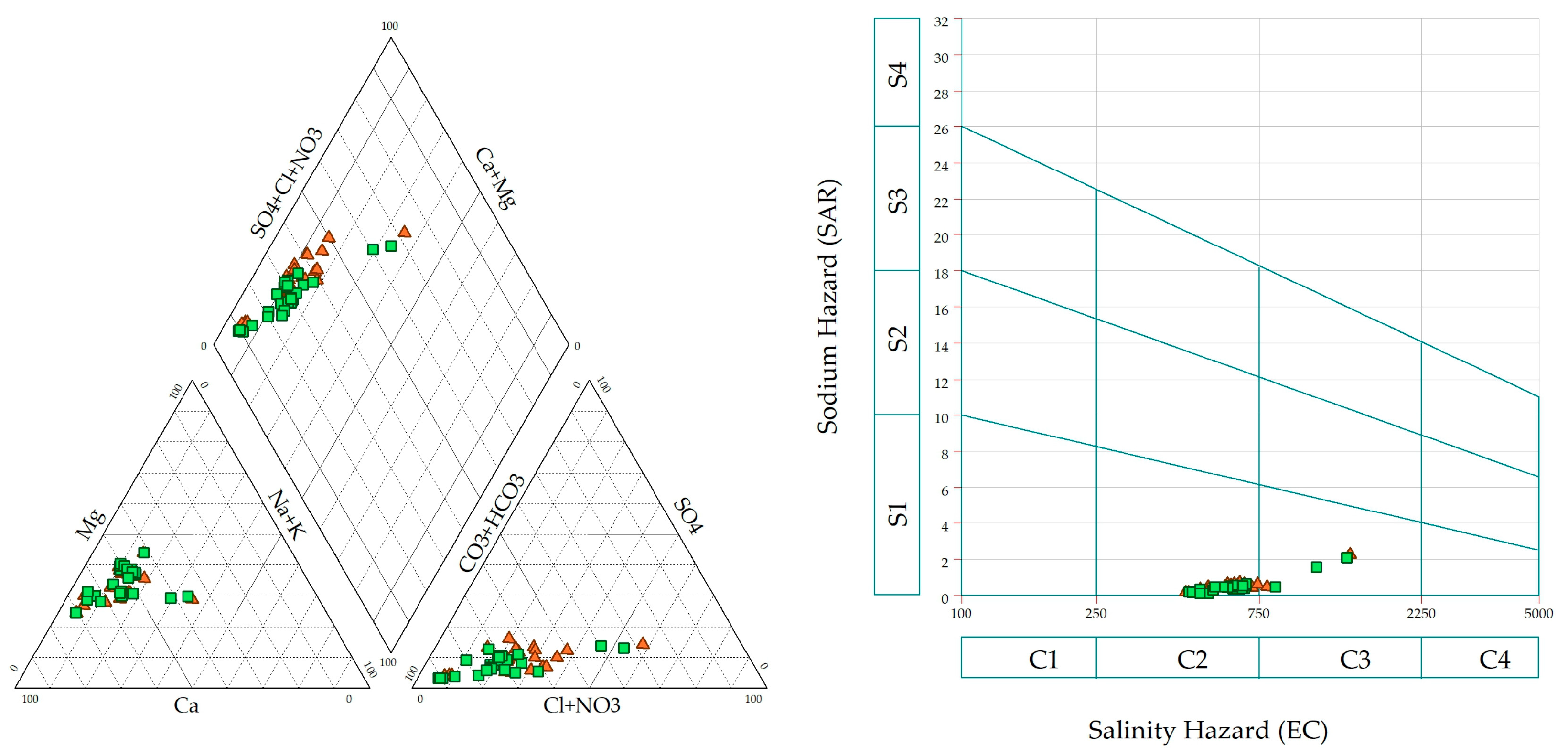
The results were plotted on a Piper diagram [28], using the software Diagrammes [29], which is used to classify the samples according to their hydrochemical facies. The diagram allows the simultaneous interpretation of the relative concentrations of the main cations (Na+, K+, Mg2+, Ca2+) and anions (Cl, NO3, SO42−, HCO3), and the detection of possible trends. The results were also plotted on a Wilcox diagram [30,31], which makes it possible to assess the suitability of water for irrigation on the basis of the percentage of sodium and salinity. It has been demonstrated that high sodium concentrations can lead to losses in permeability and soil structure, and high electrical conductivity can hinder water uptake by plants. In addition, the Irrigation Water Quality Index (IWQI) was calculated, which integrates nine parameters traditionally used: electrical conductivity (EC), sodium adsorption ratio (SAR), residual sodium carbonate (RSC), Kelly’s ratio (KR), soluble sodium percentage (SSP), magnesium adsorption ratio (MAR), permeability index (PI), total hardness (TH), and fluoride (F). Each parameter was classified into five quality categories (from excellent to very poor), scored from 5 to 1, and added together to obtain the IWQI (range from 9 to 45). This provides a simple complementary assessment to Wilcox’s [32]. Likewise, the Water Quality Index (WQI) for human consumption was calculated following World Health Organization (WHO) guidelines.
For optimal results of statistical methods, univariate and multivariate normality were first assessed using the Shapiro–Wilk and Royston tests. Non-normal variables were transformed using the Yeo–Johnson method, and all variables were standardised to z-scores. With the data already transformed, a two-tailed Pearson correlation matrix was calculated (significance threshold p < 0.05) to observe significant associations (|r| ≥ 0.8), allowing the study of linear correlations between the parameters.
To visualise spatial variability, the spatial distribution of the analysed parameters and PCA scores was performed using the Inverse Distance Weighted (IDW) interpolation method within the boundaries of the Solana aquifer for both dates. For the interpolation, a grid resolution of 500 × 500 m was used, with a power parameter of p = 2 and k = 5 nearest neighbours. The reliability of the interpolation was assessed using Leave-One-Out Cross-Validation (LOOCV). The resulting relative RMSE values show that the interpolation is adequate and falls within the ‘good’ category [33].
The suitability of the transformed dataset for multivariate analysis was confirmed through the Kaiser–Meyer–Olkin (KMO) index (>0.7) [34] and Bartlett’s sphericity test (p < 0.001) [35]. Analyses were performed in Python v3.13 using scikit-learn for PCA and HCA, and SciPy/pingouin for statistical tests. The PCA serves to understand the patterns of variability between the points analysed and thus reduce the complexity of the system [36,37]. This statistical technique transforms the analysed parameters (Na+, K+, Mg2+, Ca2+, Cl, NO3, SO42−, HCO3, EC, pH and temperature) into a coordinate system, formed by principal components (PCs). Therefore, each principal component is the linear combination of the original variables. The PCs are ordered according to the variance they explain [37], so that the first principal component (PC1) concentrates most of the variability among the sampled points, while the following components (PC2 and later) contribute smaller variances.
To complete the analysis, a Hierarchical Cluster Analysis (HCA) was performed with the same parameters used in the PCA, to identify different groups of waters. The analysis was carried out using the Ward method [38], which minimises the total variance within clusters, and the Euclidean distance as a measure of similarity between wells [39,40]. The number of clusters was determined using the elbow method [41], which identifies the maximum number at which adding new groups would provide only a marginal improvement in the explained variance.

3. Results

3.1. Hydrochemical Characteristics of Groundwater

In July 2024, groundwater extracted from 26 wells was analysed (Table 1). The average electrical conductivity (EC) was 659.5 ± 190.8 μS/cm (≈429 mg/L Total Dissolved Solids, TDS), classifying the water as good according to WHO [42], with pH values ranging between 7.7 and 8.1. The main anion was bicarbonate (HCO3), with an average concentration of 270.4 mg/L, a maximum of 324.7 mg/L and a minimum of 239.4 mg/L. Chlorides (Cl) had a mean value of 43.7 mg/L, although with high variability, with maximum values reaching 223.7 mg/L and minimum values of no more than 9.0 mg/L. Sulphate (SO42−) concentrations ranged between 7.7 and 79.7 mg/L, with a mean value of 26.0 mg/L in July. Regarding the main cations, calcium (Ca2+) and magnesium (Mg2+), stood out with average values of 66.5 and 27.5 mg/L, respectively. The mean value for sodium (Na+) was 21.7 mg/L, with maximum and minimum values of 100.6 and 5.6 mg/L. Regarding nitrogen species, only nitrate (NO3) has been detected, but without exceeding 50.0 mg/L at any point.
With respect to 2025 winter campaign, 22 wells were analysed on this occasion (Table 1) due to the lack of demand for irrigation during this period of the year. The average EC was 648.2 ± 187.6 μS/cm (≈421 mg/L TDS), classifying the water as good according to WHO [42], and pH values ranged between 7.6 and 8.0. In general, the analyses show again that the majority anion was HCO3 with an average value of 226.2 mg/L, slightly lower than that reported in summer. Chlorides continued to show high variability, with a maximum value of 248.2 mg/L, a minimum of 10.0 mg/L and an average of 48.8 mg/L. Sulphate concentrations were slightly higher, with a mean value of 29.1 mg/L. The dominant cation was Ca2+ (mean 70.8 mg/L), followed by Mg2+ (mean 28.9 mg/L) and Na+ (mean 22.1 mg/L). The mean NO3 value was 19.8 mg/L, with a minimum value of 3.5 mg/L and a maximum of 53.4 mg/L, exceeding the WHO guideline for drinking water (50 mg/L) [42].

3.2. Hydrochemical Classification and Water Quality Assessment

Hydrochemical classification and water quality assessment was performed mainly considering human consumption and irrigation. The Piper diagram is a hydrochemical tool used to determine the chemical composition of waters [27,28,43,44]. It consists of two triangles showing the relative concentrations of the major cations and anions (calcium, magnesium, sodium plus potassium, sulphates, chlorides, carbonate plus hydrogen carbonate). The result displayed in the central diamond is the projection of the two preceding triangles.
The hydrochemical facies of the Solana aquifer are predominantly calcium bicarbonate, typical of carbonate aquifers. Approximately 95% of the samples fall into this facies group and no major seasonal differences are observed, and the remaining percentage is classified as mixed facies (Figure 2). This pattern suggests high hydrochemical stability and indicates that most samples are derived from the dissolution of carbonate rocks. Only a few wells, specifically those located at the south-western boundary of the aquifer, exhibit a shift towards mixed or calcium-sulphate facies, which could indicate an interaction with Triassic Keuper outcrops [16,45].
The suitability of groundwater for agriculture was assessed using two complementary methodologies that produced consistent results. The Wilcox diagram [30,31], where samples from both the July and February campaigns are plotted, classifies irrigation water quality according to salinity (EC) and sodium hazard. Salinity classes are defined as C1 (<250 µS/cm), C2 (250–750 µS/cm), C3 (750–2250 µS/cm), and C4 (>2250 µS/cm), while sodium hazard classes are defined as S1 (SAR < 10), S2 (10–18), S3 (18–26), and S4 (>26). Most samples are plotted within the C2-S1 and C3-S1 fields, corresponding to good to moderate water quality, whereas wells identified as S-18 and S-21 fall in C3-S2, indicating a slightly higher sodium influence, possibly related to the dissolution of Triassic Keuper evaporites.
The irrigation water quality index (IWQI) [32] was applied as a complementary assessment tool. This index integrates nine of the classical parameters used to assess irrigation water quality, including electrical conductivity (EC) and the sodium adsorption ratio (SAR). Each parameter is rated on a scale from very poor (1) to excellent (5), giving a total score between 9 and 45. According to this methodology, IWQI values are grouped into three categories: very poor (0–15), poor (16–30), and good (31–45). Based on this classification, all samples fall within the “good” category in both campaigns, with values ranging from 35 to 42.
To assess the suitability of groundwater for human consumption, the Water Quality Index (WQI) has been calculated according to WHO guidelines [42]. Most samples are classified as “excellent” in both campaigns (96% in July 2024 and 95% in February 2025), with only one well classified as “good” (S-21). The best quality is found in well S-42, located next to the Cretaceous outcrops of the Solana range, and the worst in well S-21, located near the evaporite outcrops. However, although the S-71 well is classified as “excellent” in both campaigns, the nitrate concentrations measured in this well exceed the established maximum (50 mg/L) in February 2025 (53.4 mg/L), making it unsuitable for this use without prior treatment.

3.3. Spatial Distribution of the Hydrochemical Parameters

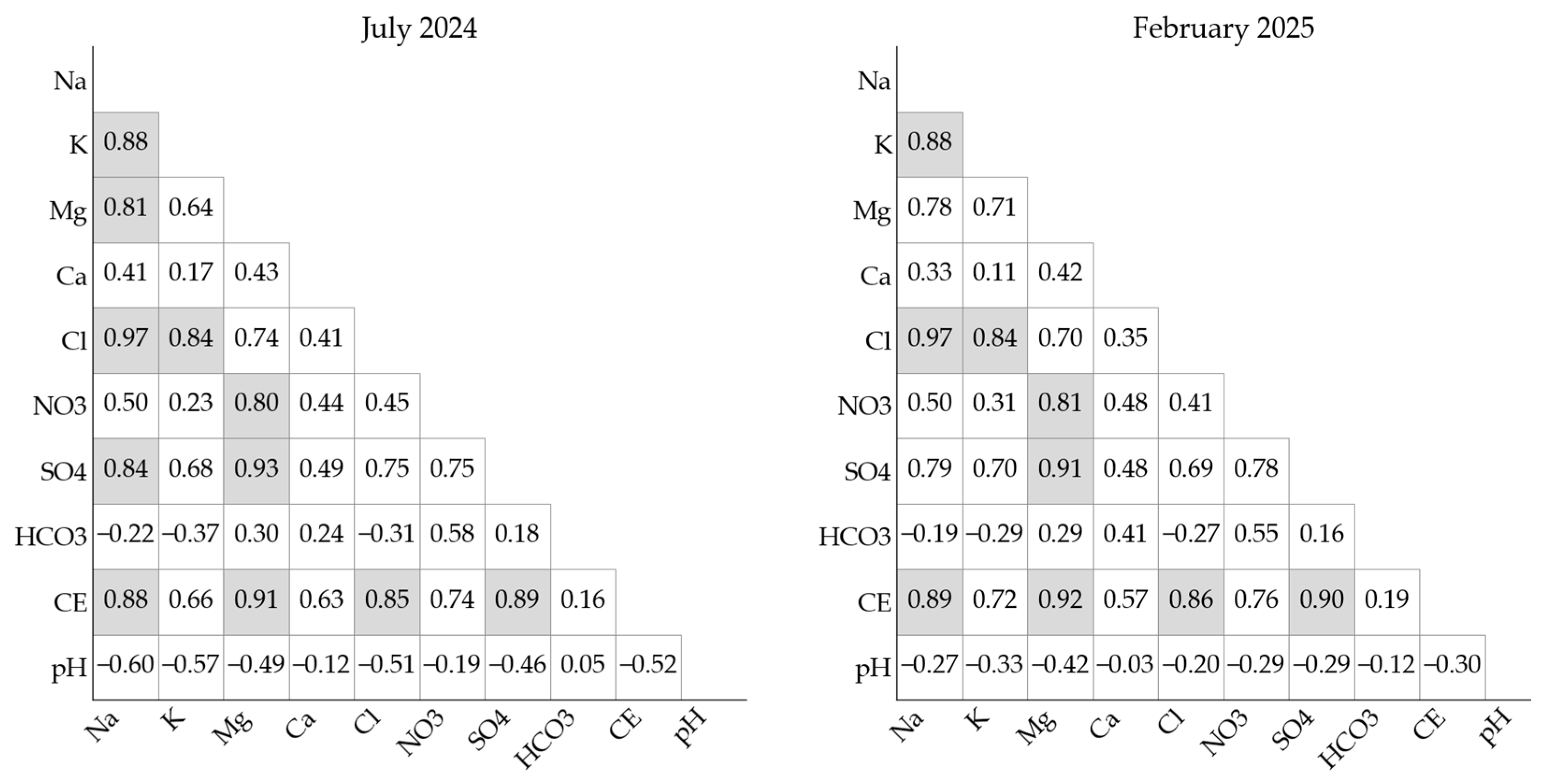
As a preliminary step to the spatial analysis of the parameters, a correlation matrix was generated for the results of the two field campaigns (Figure 3). The aim was to identify significant statistical relationships and to detect possible hydrogeochemical processes. In both campaigns, strong positive correlations were observed between sodium (Na+), potassium (K+) chlorides (Cl), sulphates (SO42−) and electrical conductivity (EC), suggesting similar spatial behaviour [46], which is consistent with the dissolution of Triassic evaporites, mainly gypsum (CaSO4.2H2O) and halite (NaCl). In contrast, the correlations of nitrates (NO3) and bicarbonates (HCO3) with other parameters were weak, and pH showed moderate negative correlations (r = −0.30 to −0.50) with most of the ions. The Jennrich test indicated statistically significant differences between the July and the February correlation matrices. However, these variations are minor (mean Δr = −0.03; mean |Δr| = 0.07; range −0.32 to +0.18), and no relevant hydrogeological differences are observed.
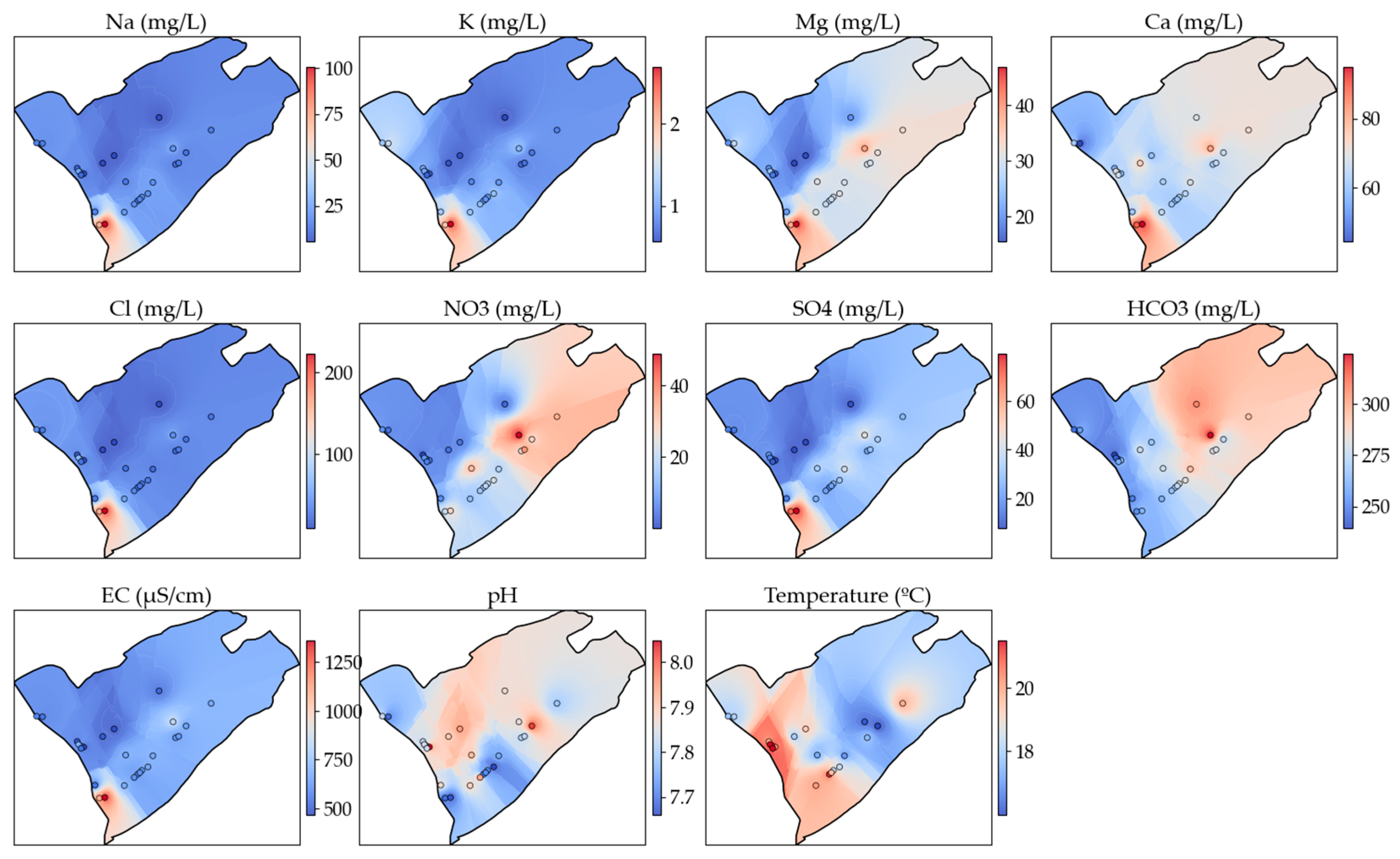
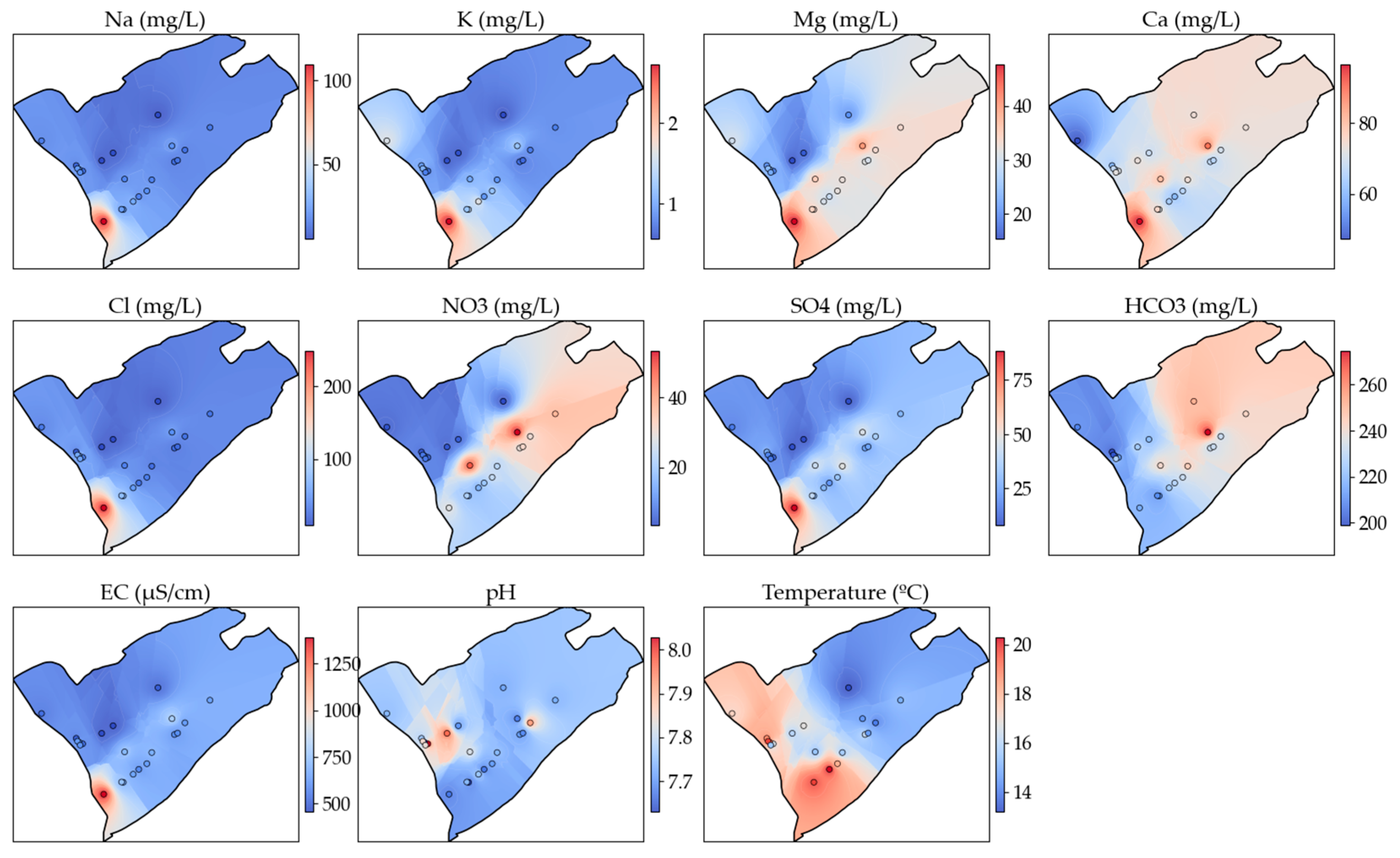
Figure 4 and Figure 5 were produced using the IDW interpolation method, with the aim of visualising the spatial distribution of the main hydrogeological parameters measured in groundwater during the field campaigns of July 2024 and February 2025.
As can be seen, the distribution of SO42−, Cl, Na+ and K+ shows a similar pattern in both campaigns. The highest concentrations are located in the south-western sector of the Solana aquifer, where the analysed parameters also show the greatest spatial variability (CV based on original concentration data = 43–106%).
The distribution of calcium and magnesium exhibited greater homogeneity, with CV of 15% and 27% in July, and 14% and 27% in February, respectively. The highest concentrations were located in the Western half, and no major seasonal differences are observed. On the other hand, higher concentrations of bicarbonates were observed towards the North-East of the aquifer in both seasons, showing the lowest spatial variability among all parameters (CV = 7–8%).
Nitrate concentrations were similar in both field campaigns (CV = 73%). While there were no significant changes between the sampling dates, some wells showed higher concentrations at specific times. One well’s concentration slightly exceeded the 50 mg/L limit (53.4 mg/L, S-71).
With respect to physicochemical parameters, the electrical conductivity (EC) exhibits the same pattern as the major ions, particularly chlorides and sodium, with a CV of 29%. The pH is slightly more alkaline in July but remains within the typical range for bicarbonate-type groundwater (CV < 1.5%). Temperature reflects the expected seasonal variability, with higher values in July, especially at the western edge (CV = 9–13%).

3.4. Hydrochemical Variability Analysis Using PCA and HCA

In order to identify the main sources of variability in the hydrochemical composition, a Principal Component Analysis (PCA) was carried out for the different field campaigns. This analysis reduces the dimensionality of the hydrochemical information and facilitates interpretation by grouping correlated variables [36,47,48].
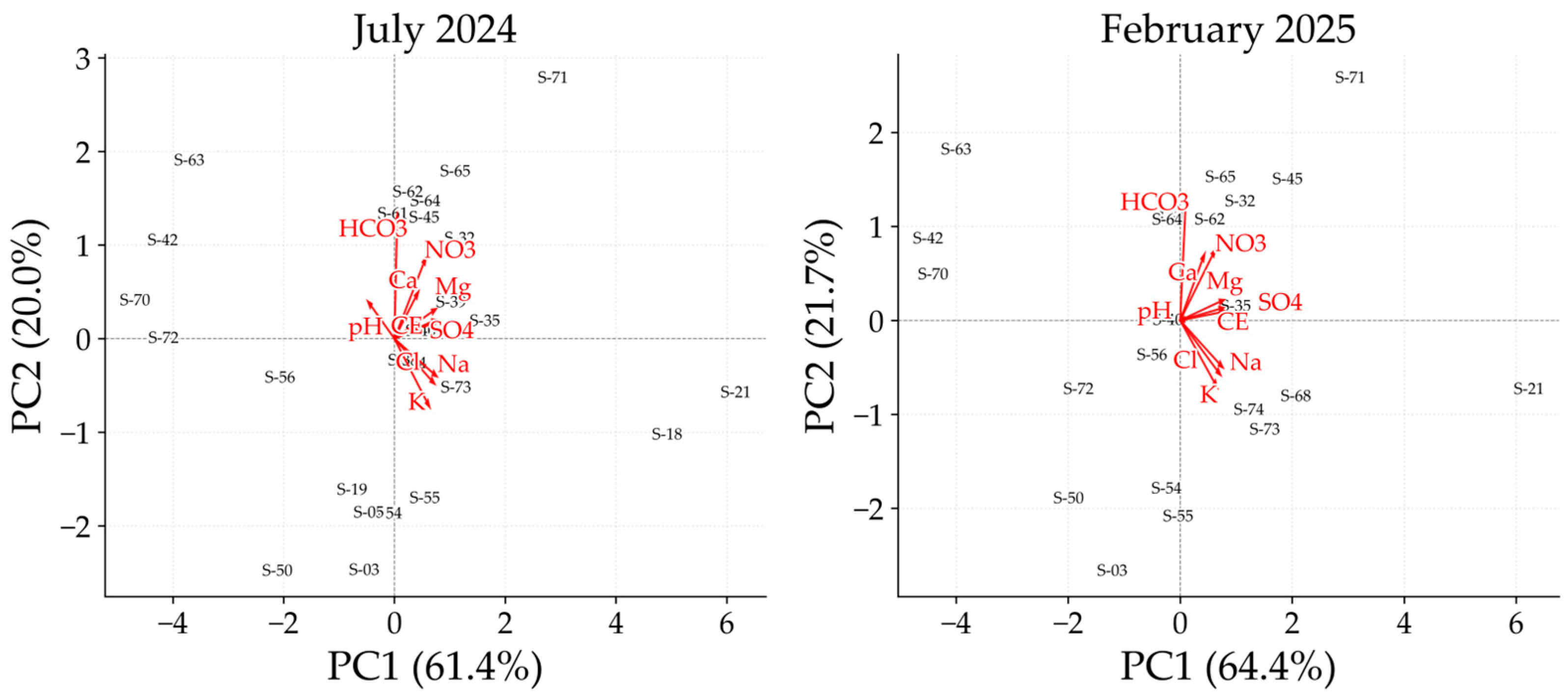
In both cases, the principal components (PC1 and PC2) explained 81.4% of the variance in July and 86.1% in February (Figure 6). According to Kaiser’s criterion, which re-commends retaining components with eigenvalues greater than 1 [49,50], two principal components are sufficient to explain the variability in both cases. The third component (7.5–8.2% of variance) had an eigenvalue <1 and did not reveal a clear hydrogeochemical process, so it was not interpreted.
For both campaigns, the main component (PC1) appears to be associated with a water mineralisation gradient, with high positive loadings on most ions and EC [51,52]. The second principal axis (PC2) is represented by bicarbonates and nitrates, which could be associated with recharge processes and potential external nitrogen inputs [53,54].
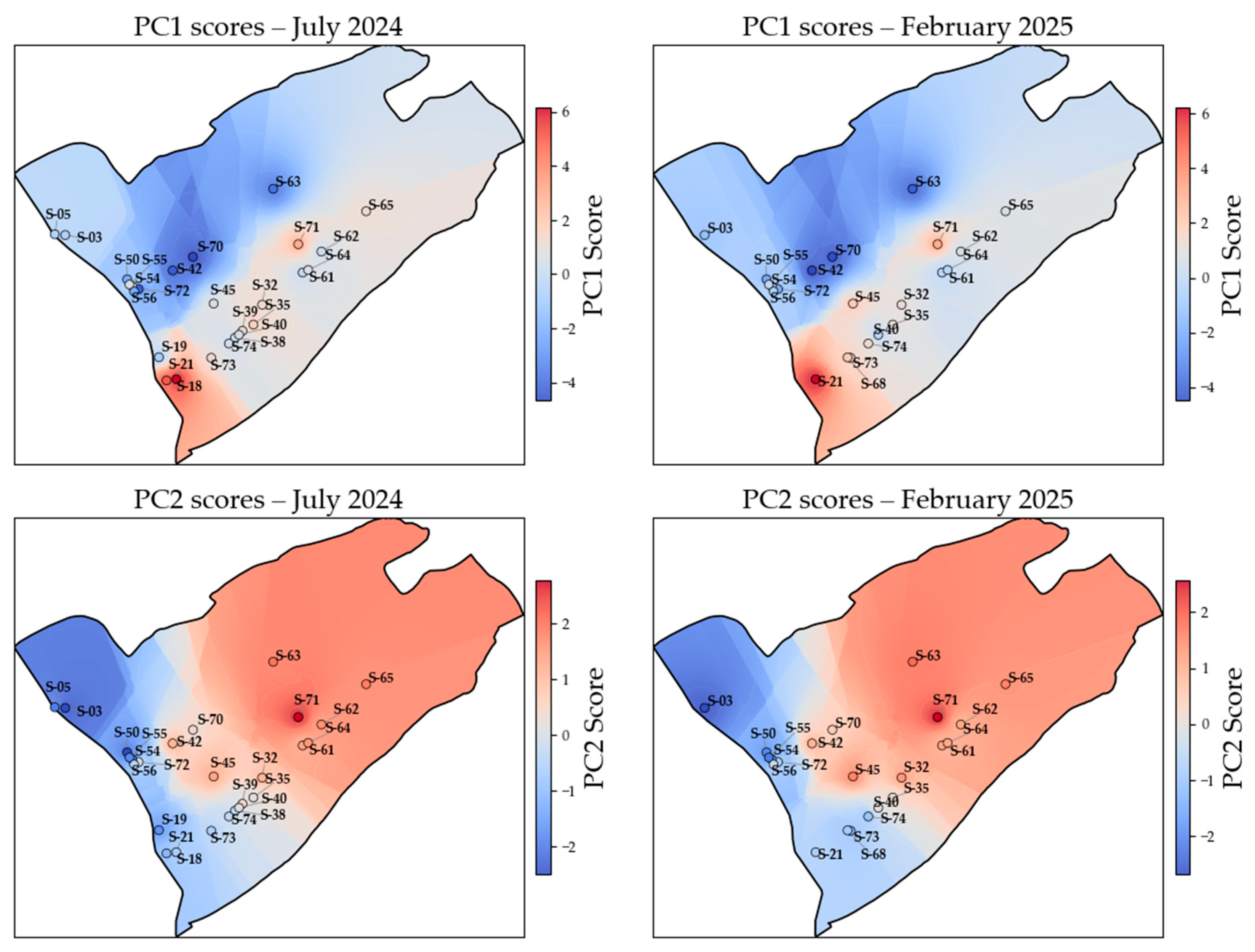
The scores of the first two principal components (PC1 and PC2) were interpolated using the IDW method (p = 2, k = 5, grid 500 × 500 m), to visualise their spatial distribution and to identify the areas most influenced by the hydrochemical processes represented by PC1 and PC2 (Figure 7).
The values of the first principal component (PC1) are clearly concentrated in the south-western sector of the aquifer, near the wells identified as S-18 and S-21. The area had previously been identified as the most saline due to the high concentrations of major ions such as Na+, K+, SO42− and Cl (Figure 4 and Figure 5). Towards the North and North-east, lower PC1 scores are observed.
The results of the second principal component (PC2), which is interpreted as an indicator of possible recharge zones and anthropogenic inputs, show an inverse spatial distribution to that of PC1. The highest values are located in the eastern half of the aquifer, especially around the wells named as S-63, S-65 and S-71. This pattern is consistent with recharge occurring predominantly in the eastern half of the Solana range. In contrast, the lowest values are found in the western part, reinforcing the idea that this sector is less affected by recent recharge.
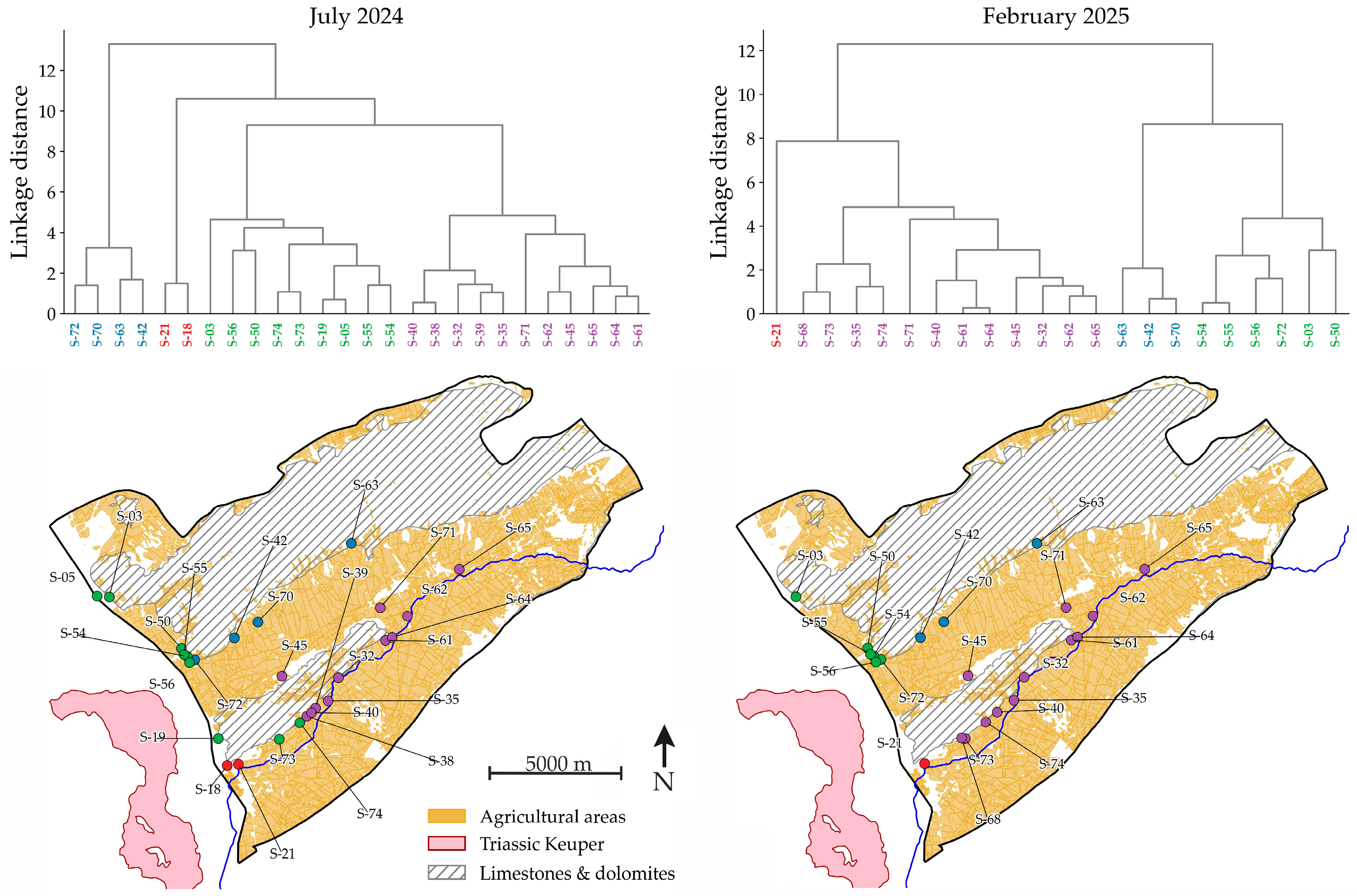
To complete the Principal Component Analysis, an HCA (Figure 8) was performed using Ward’s method and Euclidean distance to group the wells according to their hydrochemical similarity [40,55,56]. The number of clusters was set at four (red, blue, green and purple), determined using the elbow method [41], which identifies the point after which adding further clusters no longer substantially improves clustering quality (Figure S2).
In July 2024, the first cluster (blue) included wells with lower mineralisation (Na+ = 11.0 mg/L, Cl = 18.6 mg/L, SO42− = 13.2 mg/L, EC = 522.3 µS/cm), corresponding to calcium bicarbonate waters. These wells were located along the southern flank of the Solana range. The second cluster (red) grouped the wells: S-18 and S-21, characterised by the highest concentrations (Na+ = 85.8 mg/L, Cl = 191.8 mg/L, SO42− = 74.6 mg/L, EC = 1234.0 µS/cm). The third cluster (green) showed intermediate values (Na+ = 15.2 mg/L, Cl = 32.7 mg/L, SO42− = 20.6 mg/L, EC = 611.3 µS/cm). Finally, the fourth cluster (purple) had a similar composition to the green cluster but with higher nitrate (NO3 = 18.2 mg/L) and sulphate (SO42− = 26.1 mg/L) concentrations. The wells in this last group were located in cultivated valleys.
In February 2025, the blue cluster again contained the least mineralised waters (Na+ = 13.4 mg/L, Cl = 27.2 mg/L, SO42− = 14.7 mg/L, EC = 529.7 µS/cm). The green cluster maintained intermediate compositions (Na+ = 20.0 mg/L, CL = 44.7 mg/L, SO42− = 28.3 mg/L, EC = 629.5 µS/cm), with wells grouped in the North-Western sector. The red cluster continued to include the most mineralised waters, with higher values than in July (Na+ = 109.6 mg/L, Cl = 248.2 mg/L, SO42− = 88.5 mg/L, EC = 1392.0 µS/cm). The purple cluster was characterised by moderate mineralisation with elevated nitrate values (NO3 = 21.5 mg/L, EC = 615.4 µS/cm).
When comparing both campaigns, the four clusters remained relatively stable. In February, the compositional differences between clusters were reduced (Table 2), and some wells shifted from the blue cluster to the green cluster, and others from the green cluster to the purple cluster.

4. Discussion

The chemical characteristics and quality of groundwater depend on a combination of natural factors, such as water-rock interaction and residence time [57,58], and anthropogenic influences, like agricultural practices, urbanization, and groundwater abstraction [8,27,59]. Moreover, in the case of karst aquifers such as the Solana aquifer, other factors are inherent to this type of environment, such as lithological heterogeneity [60,61,62,63,64].
According to the analytical results of the Solana aquifer, the waters are mainly calcium bicarbonate, consistent with the nature of the permeable geological formations (limestone and dolomite) that make up the aquifer. Therefore, the predominant process in the aquifer seems to be the dissolution of these carbonates, a pattern that is consistent with the hydrochemical facies already described more than a decade ago [20], indicating long-term stability of groundwater composition.
However, in the South-Western sector, waters of mixed SO42− and Cl facies were found in several wells (S-18, S-21), where concentrations of both ions are markedly higher than in the rest of the aquifer (SO42− > 70 mg/L and Cl > 160 mg/L) together with EC values of approximately 1300 μS/cm. This situation could be explained by the dissolution of gypsum and halite from the Triassic Keuper, whose outcrops are located a short distance from this area (about 2500 m) a process commonly associated with chloride and sulphate rich facies in wells and reported both within and outside the Vinalopó basin [16,45,65].
However, contrasting patterns are observed in adjacent well (S-19), close to those catalogued as more mineralised (S-18, S-21), which shows purely calcium bicarbonate facies and an EC of around 550 μS/cm. These differences could be due to the structural complexity of the Triassic Keuper, whose geometry and extent beneath the Quaternary deposits are not precisely known and which, in many cases, lacks detailed studies due to its chaotic nature. In addition to the structural complexity, these variations can also be attributed to the inherent heterogeneity of Karst aquifers [66,67,68], to differences in well construction (e.g., screen depth), or even the exploitation regimes, since some wells may capture water that has been in contact with the Triassic, while others receive better quality inputs from within the aquifer.
There are no significant differences between the concentrations observed in both campaigns (paired t-tests on transformed data, mean difference = 0.06 SD across parameters), despite >200 mm of accumulated rainfall between campaigns and a 1 m rise in the piezometric level. At the basin scale, carbonate equilibrium buffers the major-ion chemistry: field pH, temperature, alkalinity and Ca yield stability indices indicating waters close to calcite saturation (median Ryznar 6.82, IEB 0.16). This near-equilibrium state explains the limited temporal variability of Ca, Mg and bicarbonate under seasonal recharge and pumping. The slight winter decrease in bicarbonate likely reflects modest dilution by recent recharge, with the aquifer’s large storage damping short-term fluctuations, consistent with longer-term records for this system [20].
Regarding the correlation analysis between parameters, very strong relationships (|r| > 0.8) have been observed between SO42−, Cl, K+, Na+ and EC, which supports the interpretation of the common origin of all these ions, related to the dissolution of the evaporite materials of the Keuper Triassic (gypsum and halite).
According to the PCA, the first two principal components account for more than 80% of the total variance in both campaigns, indicating that only a few processes control the chemical characteristics of the Solana aquifer [36]. On the one hand, PC1 shows strong positive loadings for most ions and electrical conductivity, except for bicarbonates and nitrates. This suggests that PC1 may represent the salinity gradient within the aquifer. The spatial distribution of PC1 scores aligns with the spatial patterns of these parameters, showing higher values near the Triassic evaporite outcrops. On the other hand, PC2 is positively correlated with bicarbonates and nitrates, with its highest scores found in the eastern half of the aquifer. The maximum bicarbonate concentrations, located in the NE sector, may reflect recharge processes through carbonate outcrops, particularly where Upper Cretaceous limestones and dolomites crop out and the highest rainfall values of the area are recorded (470 mm/year), conditions that enhance carbonate dissolution. Similarly, the occurrence of high nitrate concentrations is consistent with anthropogenic contamination from agriculture, livestock farming, and wastewater. This is especially relevant in the associated valley, the widest in the region, which is extensively occupied by cultivated land (Figure 4, Figure 5 and Figure 8), thereby increasing the likelihood of anthropogenic inputs [69]. Slightly higher nitrate concentrations at certain points in February may reflect localized recharge events that mobilize nitrates from agricultural soils, or alternatively vertical leakages through poorly sealed wells, which allow the entry of nitrate-rich shallow groundwater into the aquifer [70]. Nevertheless, the relationship between PC2, recharge zones, and nitrogen inputs should be confirmed through specific studies based on isotopes and land use.
These nitrate concentrations are surprising given the conceptual model of the aquifer. In this sector, the greatest thicknesses of Miocene marls are found (over 300 m in the centre of the valley), which would theoretically make it less vulnerable. One possible hypothesis is that the nitrates come from agriculture and that the recharge takes place along the edges of the alluvial fans and in a more concentrated form in the areas where the detrital deposits rest directly on the Cretaceous limestones. In order to evaluate this interpretation and determine its chemical composition, water samples from the Quaternary aquifer and the Vinalopó River were collected during both field campaigns in the vicinity of well S-65. The Quaternary showed EC = 676 µS/cm (≈439 mg/L TDS), HCO3 = 242 mg/L, Cl = 43 mg/L, SO42− = 34 mg/L, Ca2+ = 71 mg/L and NO3 = 35 mg/L, while the river sample presented EC = 832 µS/cm (≈540 mg/L TDS), HCO3 = 270 mg/L, Cl = 69 mg/L, SO42− = 54 mg/L, Ca2+ = 86 mg/L and NO3 = 8 mg/L. These results show that the quality of these waters is similar to the average of the wells, even showing lower nitrate concentration values than those observed in the wells of the eastern sector. This suggests that this contribution from higher levels does not seem to be the only cause of this nitrate enrichment in this sector.
Another possible source of nitrates could be the infiltration of urban wastewater from nearby urban sites. This hypothesis has the same hydrogeological limitation as the previous one, as the impermeable fill would prevent infiltration from the surface. However, it should be noted that the municipalities in the area, due to their size, do not have their own water treatment plants, so their wastewater is channelled to the Villena wastewater treatment plant, located in the western sector. Although in theory the sewage networks are closed systems, there may be leaks that could reach the Cretaceous limestone.
In any case, the concentration of nitrates is relatively low, and the 50 mg/L limit established by the Water Framework Directive (WFD) and WHO for water intended for human consumption is not reached [42,71], except in February in well S-71, where a concentration of 53.4 mg/L was measured, thus exceeding this threshold, which renders the water unsuitable for human consumption without prior treatment. The lower concentration in the Western part of the aquifer does not seem to be due to natural denitrification processes but rather to higher recharge rates and better water quality in this part of the aquifer compared to the Eastern part.
As for the dendrograms (Figure 8), four groups of water were identified in the aquifer, differentiated mainly by their mineralisation and nitrate concentration. The least mineralised waters (blue and green groups) are located in the Northern and North-Western sectors of the aquifer, near the carbonate outcrops of the Solana range. It is possible that these wells capture younger waters, although this should be verified through specific studies. In contrast, the red group is clearly associated with the Triassic Keuper, reinforcing the strong lithological control on groundwater mineralisation, which becomes even more evident in February. Finally, the purple group is consistently marked by agricultural influence, with an enrichment in nitrates and sulphates that indicates the persistence of anthropogenic inputs in cultivated valleys. Overall, no major differences are observed between campaigns, although some wells with intermediate mineralisation (green and purple clusters) are the most likely to shift from one group to another due to small variations in chemistry possibly linked to recharge processes and nitrate mobilisation.

5. Conclusions

This study provides an integrated diagnosis of the hydrochemical behaviour of the Solana aquifer in two contrasting seasons. Using descriptive and multivariate techniques together with spatial interpolation maps, the relative weights of lithological control and anthropogenic pressures on groundwater quality have been identified.
The PCA reveals two main axes, which explain more than 80% of the variability in both campaigns, suggesting that few hydrochemical processes largely explain the chemistry of the system. The first axis, associated with salinity (PC1), concentrates most of the variance and aligns with a NE–SW gradient and with the influence of Triassic Keuper evaporite outcrops in the south-western sector of the aquifer. The second axis (PC2), related to recharge and anthropogenic influence, reflects both recharge in the Solana range and agricultural influence in the valley floor.
The HCA distinguishes four recurrent hydrochemical groups in both seasons. The least mineralised waters (blue cluster) occur on the southern edge of the Solana range, reflecting recent recharge, while the most mineralised group (red cluster) appears in the south-west near evaporite outcrops, evidencing lithological control. The remaining two clusters (green and purple) show intermediate compositions, differing mainly in nitrate concentration, higher in cultivated valleys. There are no major changes between clusters across seasons, and their spatial distribution remains stable.
The use of PCA and HCA has been particularly useful to identify the main factors controlling groundwater quality in the Solana aquifer. Its chemistry is controlled partly by the lithology, with the dissolution of evaporites raising the concentrations of EC, Na+, Cl and SO42− in the south-west, and partly by land use, with nitrate enrichment in the wells in the centre of the valley. The spatial patterns are consistent between the methods used (PCA, HCA, interpolated parameters) and across seasons.
The results also suggest that this is an aquifer with hydrochemical resilience, although with minor seasonal adjustments. Despite differences in exploitation between the summer and winter months, and recharge occurring between dates, the aquifer has a stable hydrochemical signature. This stability is reinforced by the buffering capacity of CaCO3 equilibrium, which maintains waters close to calcite saturation and dampens fluctuations. Statistical tests indicate differences between the correlation matrices, but from a hydrogeological point of view these differences are minor. In general, winter convergence between groups is observed, together with a clearer delimitation of the valley group characterised by nitrates. Despite this, both the dominant processes and the spatial position of the groups remain unchanged.
These contributions also offer practical insights in the context of groundwater-use reorganisation. Firstly, wells supplying water for human consumption should be located within the blue or green zones, avoiding the red zone, where suitability may be compromised by high mineralisation. Wells in the centre of the valley require more thorough nitrate control. In this area, management should focus on identifying contamination sources and pathways into the Cretaceous aquifer. Secondly, this study makes it possible to establish a monitoring network aligned NE–SW, which will enable the hydrochemical evolution of the system to be effectively tracked.
However, the study also has limitations. The analysis is based on two field campaigns separated by one season. Studies with longer data series would be necessary to identify trends and atypical years. Similarly, specific studies are also needed to corroborate the attribution of nitrates to agricultural sources through isotopic analyses (δ15N–NO3, δ18O–NO3). All of this reinforces the need for data integration among well owners, so that routine and isolated analyses can be transformed into open and useful products for groundwater management.

Supplementary Materials

The following supporting information can be downloaded at: https://www.mdpi.com/article/10.3390/environments12090323/s1, Figure S1: Evolution of piezometric levels, Figure S2: Elbow method results.

Author Contributions

Conceptualization, V.S.-S., J.M.A. and J.N.-P.; methodology, V.S.-S.; software, V.S.-S.; validation, J.M.A. and J.N.-P.; formal analysis, V.S.-S.; investigation, V.S.-S. and J.M.A.; resources, A.P.-G., M.B.A.-C. and J.M.A.; data curation, V.S.-S.; writing—original draft preparation, V.S.-S.; writing—review and editing, J.M.A., J.N.-P., A.P.-G., M.B.A.-C. and M.M.J.; visualization, V.S.-S.; supervision, J.M.A.; project administration, M.B.A.-C. All authors have read and agreed to the published version of the manuscript.

Funding

This work was carried out within the framework of the REVOKER project (PID2023-151910OB-I00), funded by the Ministry of Science and Innovation.

Data Availability Statement

The original contributions presented in this study are included in the article/Supplementary Materials. Further inquiries can be directed to the corresponding authors.

Acknowledgments

We would like to thank the water supply companies AMAEM and Hidraqua; the General Community of Users of the Alto Vinalopó and the irrigation communities of Huerta y Partidas and Villena; as well as the municipalities of Benejama and Campo de Mirra for the support provided in the completion of this work.

Conflicts of Interest

The authors declare no conflict of interest.

References

  1. UNESCO. The United Nations World Water Development Report 2024: Water for Prosperity and Peace; UNESCO: Paris, France, 2024; ISBN 978-92-3-100657-9. Available online: https://unesdoc.unesco.org/ark:/48223/pf0000388948 (accessed on 5 August 2025).
  2. UNESCO. The United Nations World Water Development Report 2022: Groundwater: Making the Invisible Visible; UNESCO: Paris, France, 2022; ISBN 978-92-3-100507-7. Available online: https://unesdoc.unesco.org/ark:/48223/pf0000380721 (accessed on 5 August 2025).
  3. Food and Agriculture Organization of the United Nations (FAO). The State of Food and Agriculture 2023—Revealing the True Cost of Food to Transform Agrifood Systems; FAO: Rome, Italy, 2023. [Google Scholar] [CrossRef]
  4. Mastrocicco, M.; Colombani, N. The issue of groundwater salinization in coastal areas of the Mediterranean region: A review. Water 2021, 13, 90. [Google Scholar] [CrossRef]
  5. Campanale, C.; Losacco, D.; Triozzi, M.; Massarelli, C.; Uricchio, V.F. An overall perspective for the study of emerging contaminants in karst aquifers. Resources 2022, 11, 105. [Google Scholar] [CrossRef]
  6. Alexakis, D.E.; Kiskira, K.; Gamvroula, D.; Emmanouil, C.; Psomopoulos, C.S. Evaluating toxic element contamination sources in groundwater bodies of two Mediterranean sites. Environ. Sci. Pollut. Res. 2021, 28, 34400–34409. [Google Scholar] [CrossRef] [PubMed]
  7. Custodio, E. Groundwater pollution in Spain: General aspects. J. Inst. Water Environ. Manag. 1992, 6, 452–458. [Google Scholar] [CrossRef]
  8. Al Haj, R.; Merheb, M.; Halwani, J.; Ouddane, B. Hydrogeochemical characteristics of groundwater in the Mediterranean region: A meta-analysis. Phys. Chem. Earth. 2023, 129, 103351. [Google Scholar] [CrossRef]
  9. Pulido-Bosch, A.; Vallejos, A.; Martín-Rosales, W.; Molina, L.; Andreu Rodes, J.M.; Calaforra, J.M. La surexploitation dans certains aquifères du sud-est espagnol. In Proceedings of the International Conference on World Water Resources at the Beginning of the 21st Century, Paris, France, 3–6 June 1998. [Google Scholar]
  10. Custodio, E. Aquifer overexploitation: What does it mean? Hydrogeol. J. 2002, 10, 254–277. [Google Scholar] [CrossRef]
  11. Custodio, E.; Andreu-Rodes, J.M.; Aragón, R.; Estrela, T.; Ferrer, J.; García-Aróstegui, J.L.; Manzano, M.; Rodríguez-Hernández, L.; Sahuquillo, A.; del Villar, A. Groundwater intensive use and mining in south-eastern peninsular Spain: Hydrogeological, economic and social aspects. Sci. Total Environ. 2016, 559, 302–316. [Google Scholar] [CrossRef]
  12. Sahuquillo, A. La explotación intensa de los acuíferos en la cuenca baja del Segura y en la cuenca del Vinalopó. Ing. Agua 2016, 20, 13–26. [Google Scholar] [CrossRef][Green Version]
  13. Mammadova, L.; Negri, S. Understanding the impacts of overexploitation on the Salento aquifer: A comprehensive review through well data analysis. Sustain. Futures 2024, 1, 100188. [Google Scholar] [CrossRef]
  14. Taheri, K.; Taheri, M.; Parise, M. Impact of intensive groundwater exploitation on an unprotected covered karst aquifer: A case study in Kermanshah Province, western Iran. Environ. Earth Sci. 2016, 75, 1221. [Google Scholar] [CrossRef]
  15. Andreu Rodes, J.M. Contribución de la Sobreexplotación al Conocimiento de los Acuíferos Kársticos de Crevillente, Cid y Cabeçó d’Or (Provincia de Alicante). Doctoral Thesis, Universidad de Alicante, Alicante, Spain, 6 June 1997. Available online: https://rua.ua.es/dspace/handle/10045/3196 (accessed on 3 August 2025).
  16. Andreu, J.M.; Pulido-Bosch, A.; Llamas, M.R.; Bru, C.; Martínez-Santos, P.; García-Sánchez, E.; Villacampa, L. Overexploitation and water quality in the Crevillente aquifer (Alicante, SE Spain). WIT Trans. Ecol. Environ. 2008, 111, 67–77. [Google Scholar] [CrossRef]
  17. Instituto Geológico y Minero de España; Diputación Provincial de Alicante. Desarrollos Metodológicos en Geología del Subsuelo para la Caracterización de Recursos Hidrogeológicos Profundos de la Provincia de ALICANTE (HIDROPROAL): Modelo Geológico 3D del Acuífero de Solana–Onteniente–Volcadores y Evaluación de las Reservas Totales de Agua Subterránea; Instituto Geológico y Minero de España: Madrid, Spain, 2013; ISBN 978-84-96979-40-6. [Google Scholar]
  18. Diputación Provincial de Alicante. Mapa del Agua. Provincia de Alicante, 2nd ed.; Diputación Provincial de Alicante: Alicante, Spain, 2007.
  19. Ministerio para la Transición Ecológica y el Reto Demográfico. Anuncio de la Confederación Hidrográfica del Júcar sobre declaración en riesgo de no alcanzar el buen estado cuantitativo de la masa de agua subterránea 080.160 Villena-Benejama. Boletín Oficial Del Estado 2020, 266, 45583–45586. Available online: https://www.boe.es/boe/dias/2020/10/08/pdfs/BOE-B-2020-34158.pdf (accessed on 1 August 2025).
  20. Pérez Bielsa, C.; Lambán Jiménez, L.J. Caracterización hidrogeoquímica e isotópica de las aguas subterráneas en el acuífero carbonatado Solana (Alicante). Bol. Geol. Min. 2006, 117, 589–592. [Google Scholar]
  21. Olcina Cantos, J.; Moltó Mantero, E. Climas y Tiempos del País Valenciano; Publicacions Universitat d’Alacant: Alicante, Spain, 2019; ISBN 978-84-9717-659-0. [Google Scholar]
  22. Instituto Geológico y Minero de España; Diputación Provincial de Alicante—Ciclo Hídrico. Atlas Hidrogeológico de la Provincia de Alicante; IGME–DPA: Madrid/Alicante, Spain, 2015; ISBN 978-84-7840-959-4. [Google Scholar]
  23. Cantos Conejero, J.M. Estudio hidrogeológico del acuífero detrítico del entorno de Caudete-Villena. Rev. Estud. Albacetenses 2001, 2, 5–43. [Google Scholar]
  24. American Public Health Association. Standard Methods for the Examination of Water and Wastewater, 23rd ed.; American Public Health Association: Washington, DC, USA, 2017; ISBN 978-0-87553-047-5. [Google Scholar]
  25. Chapman, D. Water Quality Assessments: A Guide to the Use of Biota, Sediments and Water in Environmental Monitoring, 2nd ed.; Chapman, D., Ed.; CRC Press (Taylor & Francis Group): London, UK, 1996. [Google Scholar] [CrossRef]
  26. ISO 10304-1; Water Quality—Determination of Dissolved Anions by Liquid Chromatography of Ions—Part 1: Determination of Bromide, Chloride, Fluoride, Nitrate, Nitrite, Phosphate and Sulfate. International Organization for Standardization: Geneva, Switzerland, 2007.
  27. Freeze, R.A.; Cherry, J.A. Groundwater; Prentice Hall: Englewood Cliffs, NJ, USA, 1979; ISBN 978-0-13-365312-0. [Google Scholar]
  28. Piper, A.M. A graphic procedure in the geochemical interpretation of water-analyses. Trans. AGU 1944, 25, 914–928. [Google Scholar] [CrossRef]
  29. Simler, R. DIAGRAMMES: Logiciel D’hydrochimie Multilangage [software], Version 9.3; Université d’Avignon: Avignon, France, 2025.
  30. Wilcox, L.V. Classification and Use of Irrigation Waters; U.S. Geological Survey: Washington, DC, USA, 1955; Circular 969.
  31. U.S. Salinity Laboratory Staff. Diagnosis and Improvement of Saline and Alkali Soils; United States Department of Agriculture: Washington, DC, USA, 1954. Available online: https://www.ars.usda.gov/ARSUserFiles/20360500/hb60_pdf/hb60complete.pdf (accessed on 17 August 2025).
  32. Thapa, R.; Gupta, S.; Kaur, H. Introducing an irrigation water quality index (IWQI) based on the case study of the Dwarka River basin, Birbhum, West Bengal, India. Sustain. Water Resour. Manag. 2020, 6, 86. [Google Scholar] [CrossRef]
  33. Jamieson, P.D.; Porter, J.R.; Wilson, D.R. A test of the computer simulation model ARCWHEAT1 on wheat crops grown in New Zealand. Field Crops Res. 1991, 27, 337–350. [Google Scholar] [CrossRef]
  34. Kaiser, H.F. An index of factorial simplicity. Psychometrika 1974, 39, 31–36. [Google Scholar] [CrossRef]
  35. Bartlett, M.S. A note on the multiplying factors for various χ2 approximations. J. R. Stat. Soc. Ser. B 1954, 16, 296–298. [Google Scholar] [CrossRef]
  36. Jolliffe, I.T. Principal Component Analysis, 2nd ed.; Springer: New York, NY, USA, 2002; ISBN 978-0387954424. [Google Scholar]
  37. Abdi, H.; Williams, L.J. Principal component analysis. Wiley Interdiscip. Rev. Comput. Stat. 2001, 2, 433–459. [Google Scholar] [CrossRef]
  38. Ward, J.H. Hierarchical grouping to optimize an objective function. J. Am. Stat. Assoc. 1963, 58, 236–244. [Google Scholar] [CrossRef]
  39. Johnson, R.A.; Wichern, D.W. Applied Multivariate Statistical Analysis, 6th ed.; Pearson Prentice Hall: Upper Saddle River, NJ, USA, 2007; ISBN 978-0131877153. [Google Scholar]
  40. Otto, M. Chemometrics: Statistics and Computer Application in Analytical Chemistry, 3rd ed.; Wiley-VCH: Weinheim, Germany, 2017; ISBN 978-3-527-34097-2. [Google Scholar]
  41. Thorndike, R.L. Who belongs in the family? Psychometrika 1953, 18, 267–276. [Google Scholar] [CrossRef]
  42. World Health Organization. Guidelines for Drinking-Water Quality, 4th ed.; World Health Organization: Geneva, Switzerland, 2017; ISBN 978-92-4-154995-0. [Google Scholar]
  43. Helsel, D.R.; Hirsch, R.M. Graphical data analysis. In Statistical Methods in Water Resources; United States Geological Survey: Reston, VA, USA, 2020. [Google Scholar] [CrossRef]
  44. Sánchez, D.; Barberá, J.A.; Mudarra, M.; Andreo, B. Hydrogeochemical tools applied to the study of carbonate aquifers: Examples from some karst systems of Southern Spain. Environ. Earth Sci. 2015, 74, 199–215. [Google Scholar] [CrossRef]
  45. Gil-Márquez, J.M.; Barberá, J.A.; Andreo, B.; Mudarra, M. Geochemical evolution of groundwater in an evaporite karst system: Brujuelo area (Jaén, S Spain). Procedia Earth Planet. Sci. 2017, 17, 336–339. [Google Scholar] [CrossRef]
  46. Hounslow, A.W. Water Quality Data: Analysis and Interpretation; CRC Press: Boca Raton, FL, USA, 1995; ISBN 0-8493-9090-2. [Google Scholar]
  47. Güler, C.; Thyne, G.D.; Mccray, J.E.; Turner, K.A. Evaluation of graphical and multivariate statistical methods for classifcation of water chemistry data. Hydrogeol. J. 2002, 10, 455–474. [Google Scholar] [CrossRef]
  48. Huang, F.; Vasic, L.; Wu, X.; Cao, J.; Milanovic, S. Hydrochemical features and their controlling factors in the Kucaj-Beljanica Massif, Serbia. Environ. Earth Sci. 2019, 78, 498. [Google Scholar] [CrossRef]
  49. Kaiser, H.F. The application of electronic computers to factor analysis. Educ. Psychol. Measur. 1960, 20, 141–151. [Google Scholar] [CrossRef]
  50. Davis, J.C.; Sampson, R.J. Statistics and Data analysis in Geology, 3rd ed.; Wiley: New York, NY, USA, 2002; ISBN 978-0471172758. [Google Scholar]
  51. Helena, B.; Pardo, R.; Vega, M.; Barrado, E.; Fernández, J.M.; Fernández, L. Temporal evolution of groundwater composition in an alluvial aquifer (Pisuerga River, Spain) by principal component analysis. Water Res. 2000, 34, 807–816. [Google Scholar] [CrossRef]
  52. Aydoğan, D.; Şen, Z.; Öztürk, T. Assessment of Groundwater Quality through Hydrochemistry Using Principal Component Analysis in the Kızılırmak Delta (Turkey). Water 2024, 16, 1570. [Google Scholar] [CrossRef]
  53. Domenico, P.A.; Schwartz, F.W. Physical and Chemical Hydrogeology, 2nd ed.; Wiley: New York, NY, USA, 1998; ISBN 978-0471597629. [Google Scholar]
  54. Appelo, C.A.J.; Postma, D. Geochemistry, Groundwater and Pollution, 2nd ed.; CRC Press/Balkema: Leiden, The Netherlands, 2005. [Google Scholar] [CrossRef]
  55. Adams, M.J. Chemometrics in Analytical Spectroscopy; Royal Society of Chemistry: Cambridge, UK, 1998; ISBN 978-0-85404-555-6. [Google Scholar]
  56. Everitt, B.S.; Landau, S.; Leese, M.; Stahl, D. Cluster Analysis, 5th ed.; Wiley: Chichester, UK, 2011; ISBN 978-0-470-74991-3. [Google Scholar]
  57. Elango, L.; Kannan, R. Rock–water interaction and its control on chemical composition of groundwater. In Developments in Environmental Science; Sarkar, D., Datta, R., Hannigan, R., Eds.; Elsevier: Amsterdam, The Netherlands, 2007; Volume 5, pp. 229–243. [Google Scholar] [CrossRef]
  58. Salvadori, M.; Pennisi, M.; Masciale, R.; Fidelibus, M.D.; Frollini, E.; Ghergo, S.; Parrone, D.; Preziosi, E.; Passarella, G. Isotopic study for evaluating complex groundwater circulation patterns, hydrogeological zoning, and water-rock interaction in a Mediterranean coastal karst environment. Sci. Total Environ. 2024, 955, 176850. [Google Scholar] [CrossRef]
  59. Leduc, C.; Pulido-Bosch, A.; Remini, B. Anthropization of groundwater resources in the Mediterranean region: Processes and challenges. Hydrogeol. J. 2017, 25, 1529–1547. [Google Scholar] [CrossRef]
  60. Bakalowicz, M. Karst groundwater: A challenge for new resources. Hydrogeol. J. 2005, 13, 148–160. [Google Scholar] [CrossRef]
  61. Mudry, J. Apport du Traçage Physico–Chimique Naturel à la Connaissance Hydrocinématique des Aquifères Carbonatés. Doctoral Thesis, Université de Franche-Comté, Besançon, France, May 1987. Available online: https://theses.hal.science/tel-00654518 (accessed on 20 August 2025).
  62. Ford, D.C.; Williams, P.W. Karst Hydrogeology and Geomorphology, 2nd ed.; John Wiley & Sons Ltd.: Chichester, UK, 2007. [Google Scholar] [CrossRef]
  63. Goldscheider, N.; Drew, D.P. (Eds.) Methods in Karst Hydrogeology; CRC Press: London, UK, 2007. [Google Scholar] [CrossRef]
  64. Narany, T.S.; Bittner, D.; Disse, M.; Chiogna, G. Spatial and temporal variability in hydrochemistry of a small-scale dolomite karst environment. Environ. Earth Sci. 2019, 78, 273. [Google Scholar] [CrossRef]
  65. Andreu Rodes, J.M.; García Sánchez, E.; Pulido Bosch, A.; Jorreto, S.; Francés, I. Influence of Triassic deposits on water quality of some karstic aquifers to the south of Alicante (Spain). Estud. Geol. 2010, 66, 131–138. [Google Scholar] [CrossRef]
  66. Jiménez-Gavilán, P. Caracterización Hidrogeológica de Acuíferos Carbonáticos del sur de España a Partir de sus Respuestas Naturales. Ph.D. Thesis, Universidad de Granada, Granada, España, 12 July 2010. Available online: https://digibug.ugr.es/handle/10481/5641 (accessed on 7 August 2025).
  67. Pardo-Igúzquiza, E.; Durán, J.J.; Robledo-Ardila, P.A. A Three-Dimensional Karst Aquifer Model: The Sierra de Las Nieves Case (Málaga, Spain). In Hydrogeological and Environmental Investigations in Karst Systems. Environmental Earth Sciences; Andreo, B., Carrasco, F., Durán, J., Jiménez, P., LaMoreaux, J., Eds.; Springer: Berlin/Heidelberg, Germany, 2015; pp. 285–291. [Google Scholar] [CrossRef]
  68. Pulido-Bosch, A. Investigación y exploración de acuíferos kársticos. Bol. Geol. Min. 2001, 112, 25–42. [Google Scholar]
  69. Foster, S.S.D.; Chilton, P.J. Groundwater: The processes and global significance of aquifer pollution. Philos. Trans. R. Soc. Lond. B. Biol. Sci. 2003, 358, 1957–1972. [Google Scholar] [CrossRef] [PubMed]
  70. Koh, D.C.; Kim, Y.-C.; Lee, J.-Y.; Ko, K.-S.; Lee, S.-G.; Kim, K.-M.; Kim, T.-Y.; Lee, H.-J.; Kim, C.-W.; Kim, D.-Y.; et al. Impact of leaky wells on nitrate cross-contamination in a layered aquifer system: Methodology for and demonstration of quantitative assessment and prediction. J. Hydrol. 2016, 540, 1068–1082. [Google Scholar] [CrossRef]
  71. European Commission. Directive 2000/60/EC of the European Parliament and of the Council establishing a framework for Community action in the field of water policy. Off. J. Eur. Communities 2000, L327, 1–73. Available online: https://eur-lex.europa.eu/legal-content/EN/TXT/?uri=CELEX%3A32000L0060 (accessed on 4 August 2025).
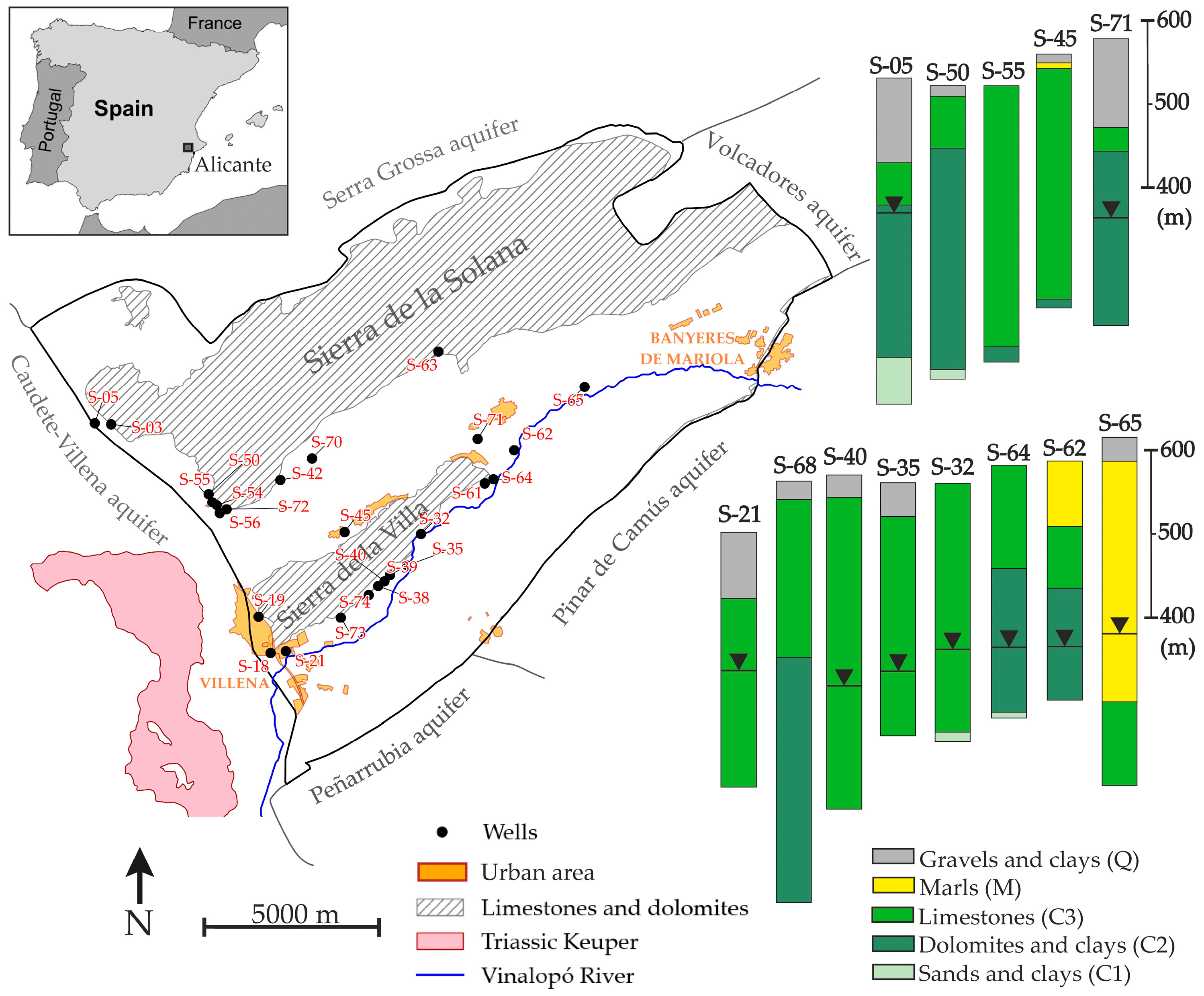
Figure 1. Geological and geographical situation of the Solana aquifer. Lithologic logs of selected wells (black lines indicate the piezometric level in 2022). C1: Sands and clays of the Lower Cretaceous (Utrillas Formation), C2: Dolomites and marly dolomites of the Upper Cretaceous, C3: Limestones of the Upper Cretaceous, M: Marls of the Miocene (Tap facies), Q: Undifferentiated Quaternary.
Environments 12 00323 g001
Figure 2. Piper Diagram (left) and Wilcox diagram (right) of Groundwater Samples—July 2024 (green) and February 2025 (orange).
Environments 12 00323 g002
Figure 3. Pearson Correlation Matrices of Hydrochemical Parameters—July 2024 and February 2025.
Environments 12 00323 g003
Figure 4. Spatial Distribution of Groundwater Hydrochemical Parameters—July 2024.
Environments 12 00323 g004
Figure 5. Spatial Distribution of Groundwater Hydrochemical Parameters—February 2025.
Environments 12 00323 g005
Figure 6. Principal Component Analysis (PCA) of Groundwater Hydrochemistry—July 2024 and February 2025.
Environments 12 00323 g006
Figure 7. Spatial Distribution of PCA Scores for Groundwater Samples—July 2024 and February 2025.
Environments 12 00323 g007
Figure 8. Hierarchical Cluster Analysis (HCA) of Groundwater Samples—July 2024 and February 2025.
Environments 12 00323 g008
Table 1. Raw analytical results—July 2024 and February 2025. All values are in mg/L except EC (μS/cm at 25 °C), pH, and T (°C).
July 2024February 2025
MeanMinMaxSDMeanMinMaxSD
Na+21.75.6100.620.122.15.6109.620.6
K+1.10.62.70.51.10.62.70.5
Mg2+27.515.547.07.528.915.447.77.7
Ca2+66.544.695.09.970.847.496.69.5
Cl43.79.0223.746.648.810.0248.248.7
NO317.00.048.912.419.83.553.414.4
SO42−26.07.779.717.429.18.288.518.0
HCO3270.4239.4324.720.3226.2198.9274.717.9
EC659.5467.01363.0190.8648.2458.01392.0187.6
pH7.87.78.10.17.87.68.00.1
T 19.016.021.51.716.713.220.32.1
Table 2. Mean values of major hydrochemical parameters, pH, and electrical conductivity by cluster–July 2024 and February 2025. All values are in mg/L except EC (μS/cm at 25 °C) and pH.
July 2024February 2025
C1C2C3C4C1C2C3C4
Na+11.085.815.218.5109.620.013.417.3
K+0.72.30.81.02.71.20.80.9
Mg2+20.742.425.828.247.728.422.028.1
Ca2+59.591.866.465.096.672.067.270.9
Cl18.6191.832.731.5248.244.727.238.4
NO39.724.416.618.228.221.110.821.5
SO42−13.274.620.626.188.528.314.725.6
HCO3268.2257.7269.3276.0217.0226.0221.2229.6
EC522.31234.0611.3634.01392.0629.5529.7615.4
pH7.97.77.87.87.77.87.87.8
Note: Colours indicate HCA groups; the same scheme as in Figure 8.
Disclaimer/Publisher’s Note: The statements, opinions and data contained in all publications are solely those of the individual author(s) and contributor(s) and not of MDPI and/or the editor(s). MDPI and/or the editor(s) disclaim responsibility for any injury to people or property resulting from any ideas, methods, instructions or products referred to in the content.