Article

Long-Term Investigation (1968–2023) of 137Cs in Apples

1
Division of Radiation Protection, Institute for Medical Research and Occupational Health, Ksaverska cesta 2, HR-10000 Zagreb, Croatia
2
Faculty of Dental Medicine and Health, Josip Juraj Strossmayer University of Osijek, Crkvena 21, HR-31000 Osijek, Croatia
*
Author to whom correspondence should be addressed.
Environments 2024, 11(11), 249; https://doi.org/10.3390/environments11110249

Submission received: 2 October 2024 / Revised: 6 November 2024 / Accepted: 8 November 2024 / Published: 12 November 2024

Abstract

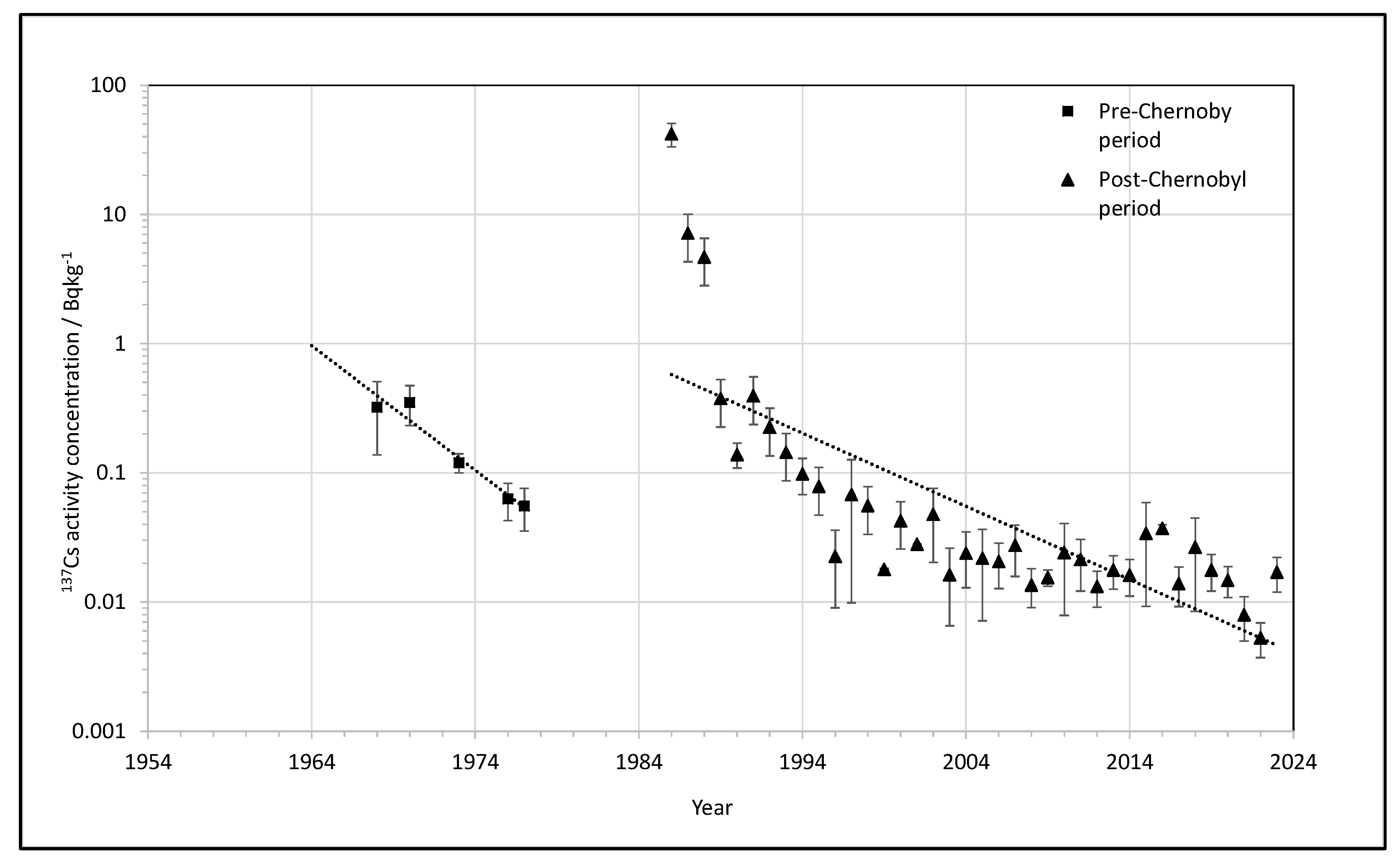
Due to the consequences of nuclear and/or radiological accidents in the past (Chernobyl, Fukushima, etc.), and potential future events of that kind, the constant monitoring of environmental radioactivity is important. There are different pathways of the transfer of radionuclides from environment to humans (ingestion, inhalation and external). Food ingestion greatly contributes to the total effective dose; hence, it is of great importance to investigate exposure to radionuclides through food. This paper presents the results of a long-term investigation of 137Cs activity concentration in apples in northwestern Croatia for the period 1968–2023. The highest 137Cs activity concentration in apples was measured in 1986, decreasing exponentially ever since. The Fukushima-Daiichi accident in 2011 did not cause a significant increase in 137Cs activity concentration, although the presence of the consequent fallout was detected via the appearance of 134Cs in some parts of the environment. The observed residence time for 137Cs in apples was estimated to be 4.5 and 3.9 years for the pre-Chernobyl and post-Chernobyl periods, respectively. The correlation between 137Cs in fallout and apples is very good, the correlation coefficients being 0.99, which indicates that fallout is the main source of contamination. The estimated effective dose received by adult members of the Croatian public due to intake of radiocaesium from apples over the overall observed period is 6.4 µSv. Therefore, the consumption of apples was not a critical pathway for the transfer of radiocaesium to humans.
Keywords: apples; ecological half-life; residence time; ionizing radiation; monitoring of radioactivity; 137Cs; effective dose apples; ecological half-life; residence time; ionizing radiation; monitoring of radioactivity; 137Cs; effective dose