Promoting Mathematics Learning in Young Children Through the Use of Embodied Mathematics Teaching Modules

Abstract
1. Introduction
1.1. The Importance of Early Mathematics Knowledge
1.2. Embodied Mathematics Cognition and Learning for Young Children
1.3. Embodied Mathematics Learning Task Design
1.4. Embodied Mathematics Learning Assessment
1.5. The Current Study
1.5.1. Linking Theoretical Framework and Research Gap to the Current Study
1.5.2. Research Purposes and Questions
- Are there statistically significant differences in the mathematics learning gains between the two groups of young children after the intervention?
- (1)
- Hypothesis I (between-group baseline comparison, pre-test):There will be no significant difference between the two groups of young children in their mathematics learning before the intervention.
- (2)
- Hypothesis II (between-group post-intervention analysis, post-test):There will be significant differences between the two groups of young children in their mathematics learning after the intervention.
- (3)
- Hypothesis III (within-group gains, experimental intervention implementation):There will be significant gains in mathematics learning among young children in the experimental group after the intervention.
- For young children in the experimental group, what are the exploratory descriptions of young children’s mathematics learning, as evidenced by changes in their performance levels on the embodied mathematics learning assessment from pre-test to post-test?
2. Materials and Methods
2.1. Methodology and Participants
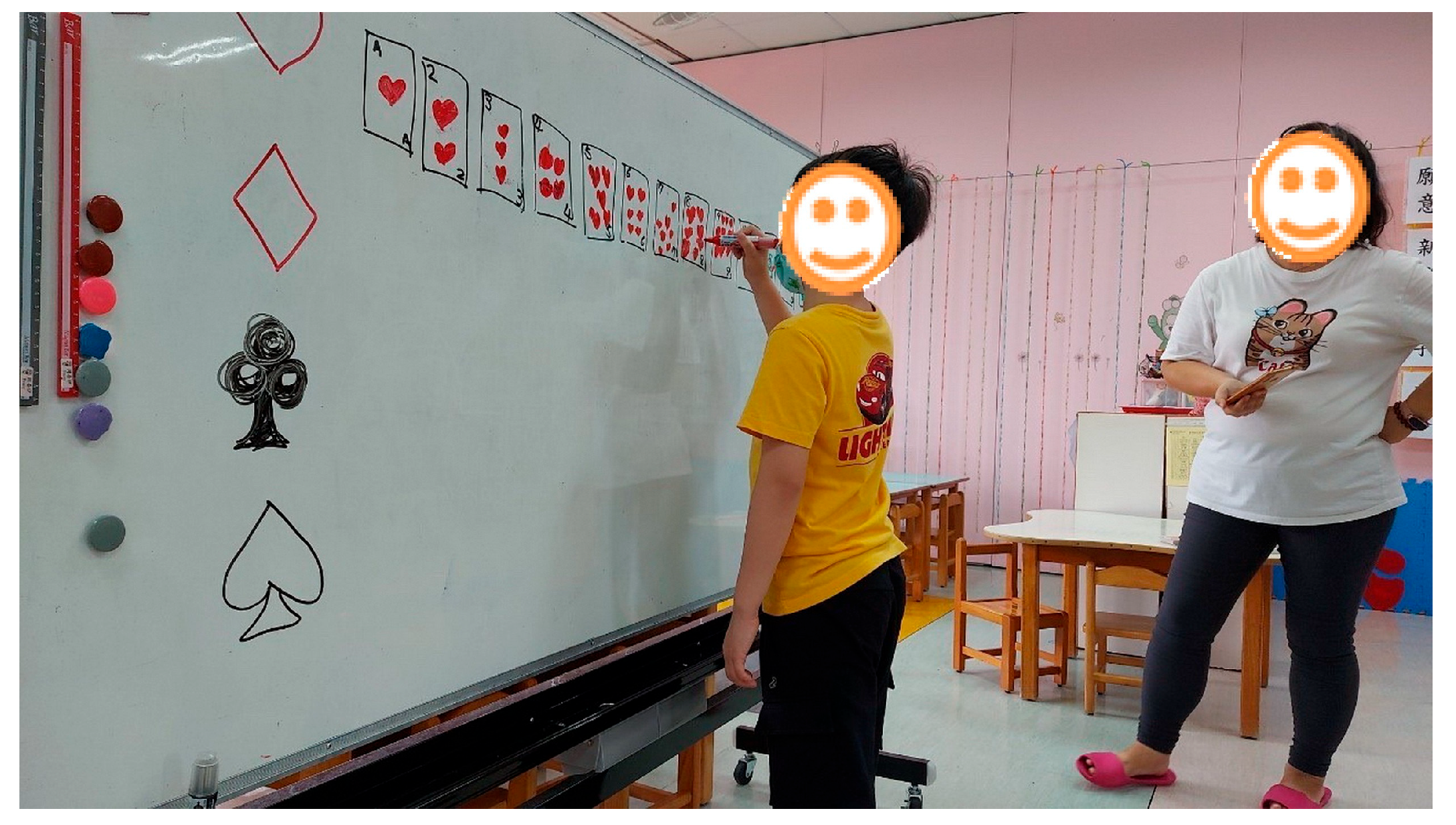
2.2. Experimental Embodied Mathematics Teaching Modules
2.2.1. Previous Studies—Original Embodied Mathematics Teaching Modules
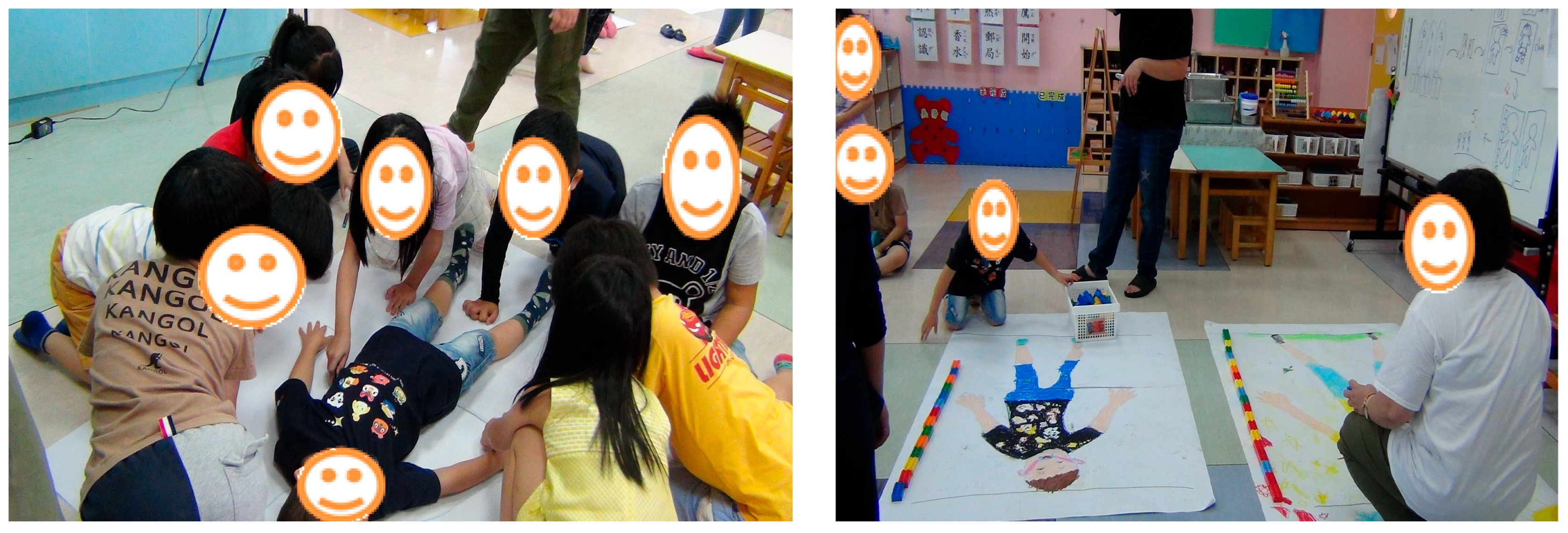
- Designing learning tasks reflecting real-life situations: Embodied mathematics learning tasks are designed and implemented as coherently as possible in young children’s daily lives in order to provide abundant opportunities for them to learn and perform in a real-life situation. For example, when teaching number concepts, the learning context is designed to emphasize representing, connecting, and manipulating integers. By providing concrete objects or teaching aids, young children can obtain more hands-on experience that connects them to real-world situations. This kind of embodied learning context also allows them to learn in a “perception–action cycle” (Tran et al., 2017), where these hands-on movements help produce changes in external (e.g., manipulatives) and internal (e.g., children’s interest or motive) environments that, in turn, affect later actions in a cyclical process. This cycle, which embraces the interaction among perception, environment, and behavioral action, is key to a child’s embodied learning (Chang et al., 2024).
- Using pictures, images, manipulatives, and embodied operations to promote thinking: Instead of imparting young children with fixed knowledge, requiring them to memorize formulas, or having them perform technical calculations in a traditional mode, embodied mathematics teaching focuses on promoting their robust understanding of mathematical concepts by using multiple representations and providing diverse perspectives. These pedagogical practices allow young children to think and discuss during the “learning by doing” process and then solve real-life mathematical problems within the designated embodied learning tasks (Chang et al., 2024).
- Several embodied mathematics teaching strategies, corresponding to the two basic principles, have been employed and were found to be effective in establishing active learning habits in the studied young children. For example, various inquiry and problem-solving tasks were designed to engage young children in an active, collaborative learning environment. These tasks also promote the interaction of the children’s previous and new experiences, which is essential for constructing a new mathematical concept and learning all concepts in unity. Furthermore, young children should be given ample time and a variety of learning materials (e.g., manipulatives, teaching aids) so they can explore the essence of mathematics. Many embodied mathematics learning tasks are designed so that young children can understand the relationships and connections among quantities by using embodied mathematical tools in a real-life context through, for example, counting, sorting, measuring, recording, and calculating. These embodied learning experiences allow “teachers and their children to act spontaneously, which, in turn, helps them to become active learners who can collaboratively interact with the environment and others” (Chang et al., 2024, p. 15).
2.2.2. Current Study—Revised Embodied Mathematics Teaching Modules
2.3. Embodied Mathematics Learning Assessment Tool
- (1)
- Translating all items into traditional Chinese. The item description, core competency, and level of thinking in the learning trajectory of all 19 items were translated by the research team.
- (2)
- Adding clear instructions to each item. In order to administer the assessment in a standardized manner, along with the scoring criteria, clear instructions were added to each item.
- (3)
- Selecting appropriate concrete objects or teaching aids for each item. Concrete objects or teaching aids for each item were carefully chosen based on the targeted young children’s backgrounds and real-life experiences.
- (4)
- Designing the scoring criteria for each item aligned with the core concept. According to the item description, core competency, and level of thinking in the learning trajectory of all items, a three-level rubric (10 points per item) was employed, where the score criteria for each item were added. The scoring process of the embodied mathematics assessment was administered through clinical interviews, in which young children’s behaviors were observed.
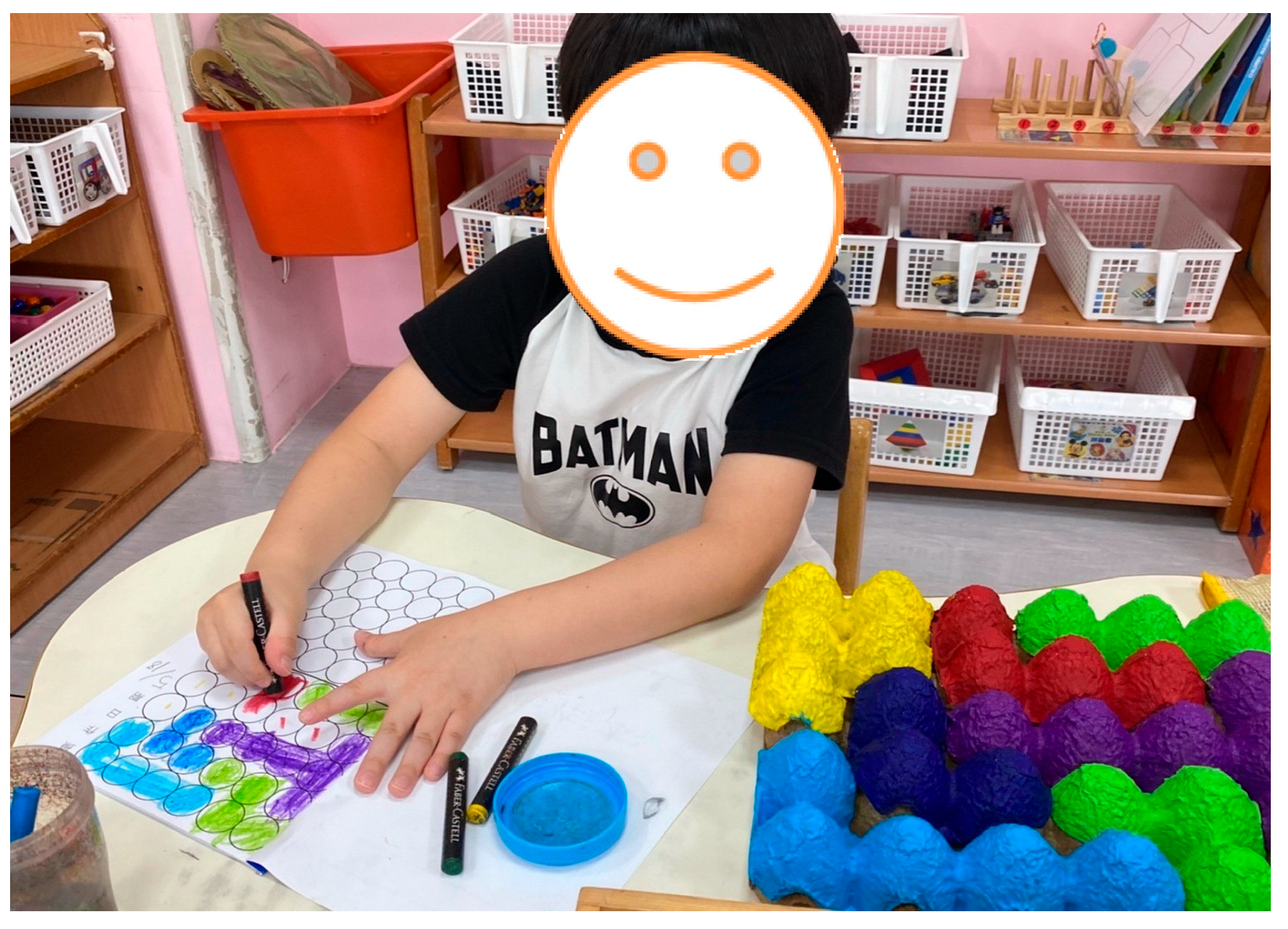
- In the “numeracy” category: (1) For task 1 of item 1, the child needs to count small balls within the basket (20 balls in total). In task 2, the child is asked to divide a large lump of clay into 20 small pieces (similar in size to the small ball), which is particularly sophisticated as it requires dual-task monitoring. That is, the child must coordinate fine-motor control (pinching clay) with mental counting (counting to 20), so that their ability to allocate cognitive resources under physical load (i.e., a hands-on activity) can be assessed. (2) For task 1 of item 4, the child needs to count how many times the instructor claps in a regular pattern. In task 2, the child is asked to count “rhythmic claps (i.e., ‘slow–fast–fast’ rhythm)” to challenge their auditory working memory. Unlike visual counting, where objects serve as spatial markers, auditory counting requires the child to maintain a temporal sequence in their mind without external visual cues. (3) Item 6 requires the child to arrange blocks in rows of five to assess their ability to see “five” as a single entity or unit. (4) Item 11 is a classic test for the “Counting-on from N” strategy (i.e., adding 5 to 7 hidden blocks), indicating a critical milestone where children move beyond counting all to more efficient arithmetic logic.
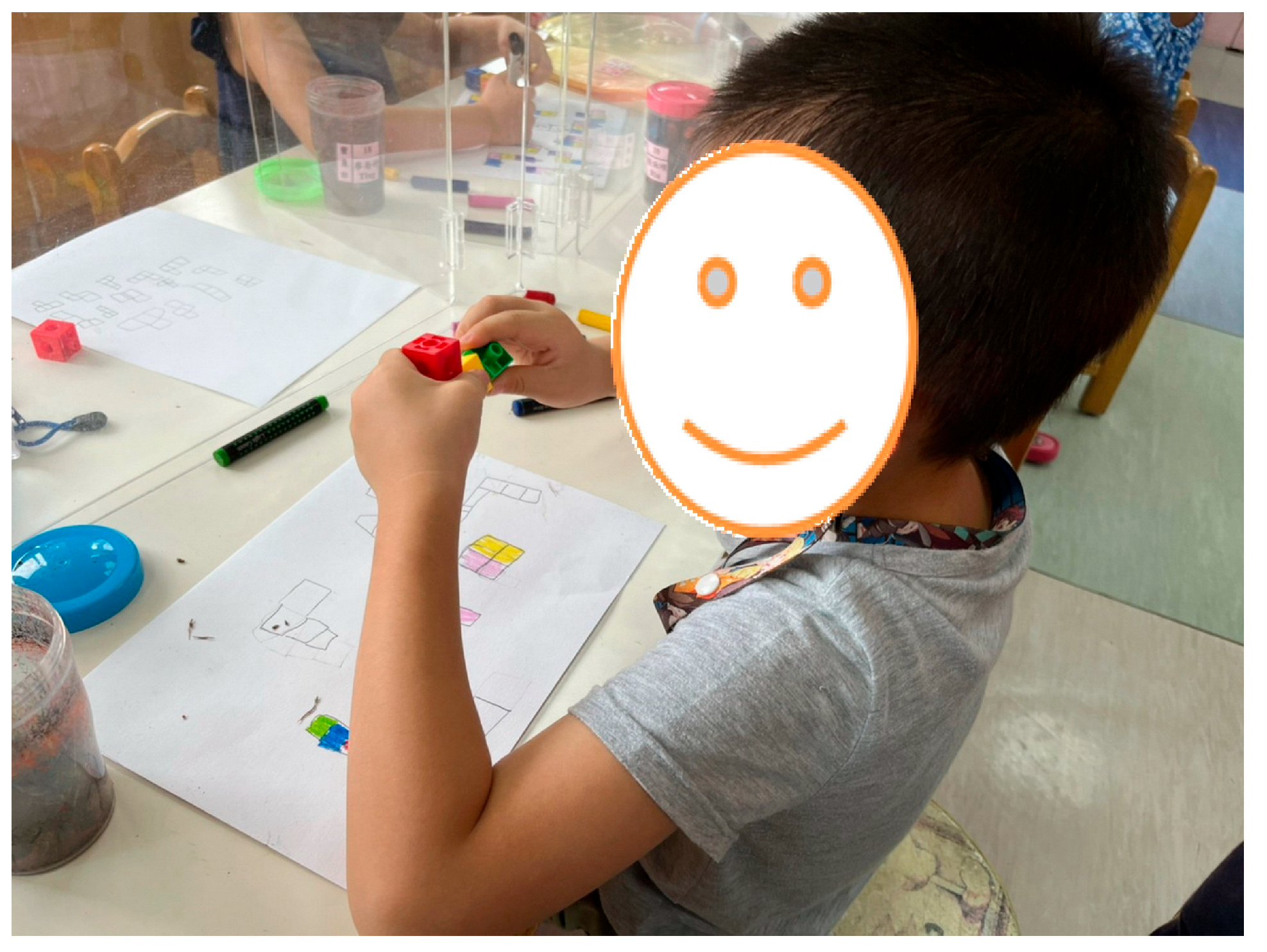
- In the “geometry” category: (1) Items 13 and 14 aim to assess the child’s ability to move from naming a shape to describing its differences (e.g., triangles have “three sides”), which marks the transition from the visual level to the descriptive–analytic level of the Van Hiele hierarchy. Item 16 requires the child to differentiate a pentagon from quadrilaterals, which requires higher-level property analysis. (2) The child needs to construct a triangle by using geometric buckle strips in item 15, which involves an understanding of closed shapes and side-length conservation. Successful completion of this task shows that the child understands that the physical properties of the strips must match the geometric requirements of the shape. (3) Item 17 requires the child to first sort a group of different shapes (three types: triangle, square, circle) and then to put them into the sequence as required (i.e., ▲●▲■●). This task requires the child to detect a complex pattern and maintain a repetitive rule in working memory across multiple iterations. (4) For task 1 of item 19, the child needs to form a large triangle from four smaller ones. The child is then asked to take away a triangle from a hexagon and identify the remaining shape with other shapes (i.e., point out that it is like a trapezoid or a rhombus), indicating an advanced ability to perceive embedded geometric figures.
3. Results
3.1. Analysis of Differences in Children’s Embodied Mathematical Learning
3.1.1. Between-Group Baseline Comparison (Pre-Test)
3.1.2. Between-Group Post-Intervention Analysis
3.1.3. Experimental Intervention Implementation and Within-Group Gains
3.2. Exploratory Description of Clinical Interviews Within the Experimental Group
- 1
- “Numeracy”
- 2
- “Geometry”
4. Discussions
4.1. Rethinking the Embodied Approach for Accelerating Young Children’s Mathematical Power
4.2. TEMA-SF Can Serve as a Comprehensive Yet Developmentally Appropriate Assessment Tool for Measuring Young Children’s Mathematics Learning Performance
4.3. Limitations and Future Studies
4.3.1. Limitations
4.3.2. Future Studies
5. Conclusions
5.1. There Are Statistically Significant Differences in the Mathematics Learning Gains Between the Two Groups of Young Children After the Intervention
5.2. Exploratory Description of Clinical Interviews Showed Improvements in Children’s Mathematics Performance Within the Experimental Group
Author Contributions
Funding
Institutional Review Board Statement
Informed Consent Statement
Data Availability Statement
Acknowledgments
Conflicts of Interest
Abbreviations
| REMA | Research-Based Early Mathematics Assessment |
| REMA-SF | Research-Based Early Mathematics Assessment—Short Form |
| TEMA-SF | Taiwanese Embodied Mathematics Assessment—Short Form |
| PD | Professional Development |
References
- Abrahamson, D. (2009). Embodied design: Constructing means for constructing meaning. Educational Studies in Mathematics, 70(1), 27–47. [Google Scholar] [CrossRef] [Scilit]
- Abrahamson, D. (2014). Building educational activities for understanding: An elaboration on the embodied-design framework and its epistemic grounds. International Journal of Child-Computer Interaction, 2(1), 1–16. [Google Scholar] [CrossRef] [Scilit]
- Abrahamson, D. (2017). Embodiment and mathematics learning. In K. Peppler (Ed.), The SAGE encyclopedia of out-of-school learning (pp. 247–252). SAGE. [Google Scholar]
- Abrahamson, D. (2024). Enactivist learning: Grounding mathematics concepts in emergent perception for action. Intellectica, 80(1), 149–174. [Google Scholar]
- Abrahamson, D., & Lindgren, R. (2014). Embodied design. In R. K. Sawyer (Ed.), The Cambridge handbook of the learning sciences (2nd ed., pp. 358–376). Cambridge University Press. [Google Scholar] [CrossRef] [Scilit]
- Abrahamson, D., Nathan, M. J., Williams-Pierce, C., Walkington, C., Ottmar, E. R., Landy, D., & Lindgren, R. (2020). The future of embodied design for mathematics education. International Journal of Child-Computer Interaction, 24, 100147. [Google Scholar]
- Abrahamson, D., & Sánchez-García, R. (2016). Learning is moving in new ways: The ecological dynamics of mathematics education. The Journal of the Learning Sciences, 25(2), 203–239. [Google Scholar] [CrossRef] [Scilit]
- Abrahamson, D., & Shulman, A. (2019). Co-constructing movement in mathematics and dance: An interdisciplinary pedagogical dialogue on subjectivity and awareness. Feldenkrais Research Journal, 6, 1–24. [Google Scholar]
- Alibali, M. W., & Nathan, M. J. (2012). Embodiment in mathematics teaching and learning: Evidence from learners’ and teachers’ gestures. The Journal of the Learning Sciences, 21(2), 247–286. [Google Scholar] [CrossRef] [Scilit]
- Amit, M., & Fried, M. N. (2021). Embodied argumentation in early childhood mathematical problem solving. Education Sciences, 11(9), 514. [Google Scholar] [CrossRef] [Scilit]
- Aunola, K., Leskinen, E., Lerkkanen, M. K., & Nurmi, J. E. (2004). Developmental dynamics of math performance from preschool to Grade 2. Journal of Educational Psychology, 96(4), 699–713. [Google Scholar] [CrossRef] [Scilit]
- Barsalou, L. W. (2008). Grounded cognition. Annual Review of Psychology, 59, 617–645. [Google Scholar] [CrossRef] [Scilit]
- Björklund, C., van den Heuvel-Panhuizen, M., & Kullberg, A. (2020). Research on early childhood mathematics education: A survey of the field. ZDM—Mathematics Education, 52(4), 607–622. [Google Scholar] [CrossRef] [Scilit]
- Boaler, J. (2016). Mathematical mindsets: Unleashing students’ potential through creative math, inspiring messages, and innovative teaching. Jossey-Bass. [Google Scholar]
- Bodovski, K., & Youn, M.-J. (2011). The long term effects of early acquired skills and behaviors on young children’s achievement in literacy and mathematics. Journal of Early Childhood Research, 9(1), 4–19. [Google Scholar] [CrossRef] [Scilit]
- Chang, C. F., Wu, S. C., Chang, Y. L., & Chang, L. A. (2024). Designing and implementing sustainable professional development programs: Embodied curriculum and instruction for kindergarten teachers. Sustainability, 16(17), 7327. [Google Scholar] [CrossRef] [Scilit]
- Charlesworth, R. (2005). Math and science for young children (5th ed.). Delmar Learning. [Google Scholar]
- Chiu, C.-H., & Ko, H.-W. (2015). A review of research on young children’s scientific and numerical concept development. Journal of Applied Psychology, 61, 153–202. [Google Scholar]
- Clements, D. H. (2007). Curriculum, focal points, and learning trajectories: Play and mathematics. Young Children, 62(3), 36–44. [Google Scholar]
- Clements, D. H., & Sarama, J. (2004). Learning trajectories in mathematics education. Mathematical Thinking and Learning, 6(2), 81–89. [Google Scholar] [CrossRef] [Scilit]
- Clements, D. H., & Sarama, J. (2007). Early childhood mathematics learning. In F. K. Lester Jr. (Ed.), Second handbook of research on mathematics teaching and learning (pp. 461–555). Information Age Publishing. [Google Scholar]
- Clements, D. H., & Sarama, J. (2021). Learning and teaching early math: The learning trajectories approach (3rd ed.). Routledge. [Google Scholar]
- Clements, D. H., Sarama, J., & Liu, X. (2008). Development of a measure of early mathematics proficiency. The Elementary School Journal, 108(4), 311–330. [Google Scholar] [CrossRef] [Scilit]
- Common Core State Standards Initiative. (2023). Common core state standards for mathematics. Common Core State Standards Initiative. Available online: https://corestandards.org/wp-content/uploads/2023/09/Math_Standards1.pdf (accessed on 21 April 2024).
- Duncan, G. J., Dowsett, C. J., Claessens, A., Magnuson, K., Huston, A. C., Klebanov, P., Pagani, L. S., Feinstein, L., Engel, M., Brooks-Gunn, J., Sexton, H., Duckworth, K., & Japel, C. (2007). School readiness and later achievement. Developmental Psychology, 43(6), 1428–1446. [Google Scholar] [CrossRef] [Scilit]
- Fischer, U., Moeller, K., Bientzle, M., Cress, U., & Nuerk, H. C. (2011). Improving numerical skills by embodied training. Cognitive Processing, 12(3), 261–265. [Google Scholar] [CrossRef] [Scilit]
- Foster, M. E., Anthony, J. L., Clements, D. H., & Sarama, J. H. (2015). Processes in the development of mathematics in kindergarten children from title 1 schools. Journal of Experimental Child Psychology, 140, 56–73. [Google Scholar] [CrossRef] [Scilit]
- Gelman, R., & Brenneman, K. (2004). Science learning pathways for young children. Early Childhood Research Quarterly, 19(1), 150–158. [Google Scholar] [CrossRef] [Scilit]
- Ginsburg, H. P. (2009). Early mathematics education and how to do it. In O. Barbarin, & B. Wasik (Eds.), Handbook of child development and early education (pp. 403–428). Guilford Press. [Google Scholar]
- Ginsburg, H. P., Lee, J. S., & Boyd, J. S. (2008). Mathematics education for young children: What it is and how to promote it. Social Policy Report, 22(1), 1–24. [Google Scholar] [CrossRef] [Scilit]
- Glenberg, A. M. (2010). Embodiment as a unifying perspective for psychology. Wiley Interdisciplinary Reviews: Cognitive Science, 1(4), 586–596. [Google Scholar] [CrossRef] [Scilit] [PubMed]
- Hutto, D. D., Kirchhoff, M. D., & Abrahamson, D. (2015). The enactive roots of STEM. Educational Psychology Review, 27(3), 371–389. [Google Scholar] [CrossRef] [Scilit]
- Jaworski, B. (2006). Theory and practice in mathematics teaching development: Critical inquiry as a mode of learning in teaching. Journal of Mathematics Teacher Education, 9(2), 187–211. [Google Scholar] [CrossRef] [Scilit]
- Jordan, N. C., & Devlin, B. L. (2023). Early predictors of mathematics achievement. In R. E. Tremblay, M. Boivin, & R. DeV Peters (Eds.), Encyclopedia on early childhood development (pp. 1–9). Centre of Excellence for Early Childhood Development. [Google Scholar]
- Koo, T. K., & Li, M. Y. (2016). A guideline of selecting and reporting intraclass correlation coefficients for reliability research. Journal of Chiropractic Medicine, 15(2), 155–163. [Google Scholar] [CrossRef] [Scilit] [PubMed]
- Krenger, M., & Thevenot, C. (2026). The role of children’s finger counting history on their addition skills. Developmental Psychology, 62(4), 791–801. [Google Scholar] [CrossRef] [Scilit]
- Lai, M. L., Chen, Y. C., Chang, J. W., & Chien, W. J. (2022). The effects of age and schooling on the mathematical development of children in Taiwan. Journal of Early Childhood Care and Education, 25, 1–32. [Google Scholar]
- Lenz Taguchi, H., Palmer, A., & Gustafsson, L. (2022). Embodied and material encounters in early childhood mathematics education: A posthumanist approach. Mathematics Education Research Journal, 34(1), 13–33. [Google Scholar] [CrossRef] [Scilit]
- Lin, C.-H. (2023). Developing digital number line games to improve young children’s number sense and basic arithmetic abilities. Journal of Research in Education Sciences, 68(2), 73–101. [Google Scholar]
- Mavilidi, M. F., Okely, A. D., Chandler, P., Cliff, D. P., & Paas, F. (2022). Physical activity and numeracy learning in early childhood: A randomized controlled trial. Journal of Experimental Child Psychology, 216, 105342. [Google Scholar] [CrossRef] [Scilit]
- Ministry of Education, Taiwan. (2016). Early childhood education and care curriculum framework. Ministry of Education, Taiwan. [Google Scholar]
- Nathan, M. J., & Walkington, C. (2017). Grounded and embodied mathematical cognition: Promoting mathematical insight and learning, for everyone. Cognitive Research: Principles and Implications, 2(1), 9. [Google Scholar] [CrossRef] [Scilit]
- National Association for the Education of Young Children & National Council of Teachers of Mathematics. (2010). Early childhood mathematics: Promoting good beginnings (joint position statement). Available online: https://www.naeyc.org/sites/default/files/globally-shared/downloads/PDFs/resources/position-statements/psmath.pdf (accessed on 26 August 2017).
- National Council of Teachers of Mathematics. (2000). Principles and standards for school mathematics. National Council of Teachers of Mathematics. [Google Scholar]
- Naylor, M., & Cowan, K. (2023). The role of movement in young children’s developing spatial experiences. Mathematics Education Research Journal, 35, 287–315. [Google Scholar] [CrossRef] [Scilit]
- Paniagua, A., & Istance, D. (2018). Teachers as designers of learning environments: The importance of innovative pedagogies. OECD Publishing. [Google Scholar] [CrossRef] [Scilit]
- Piaget, J. (1952). The origins of intelligence in children. International Universities Press. [Google Scholar]
- Purpura, D. J., & Lonigan, C. J. (2015). Early numeracy assessment: The development of the preschool early numeracy scales. Early Education and Development, 26(2), 286–313. [Google Scholar] [CrossRef] [Scilit]
- Romano, E., Babchishin, L., Pagani, L. S., & Kohen, D. (2010). School readiness and later achievement: Comparison of French- and English-speaking children in Canada. Developmental Psychology, 46(4), 995–1007. [Google Scholar] [CrossRef] [Scilit]
- Sarama, J., & Clements, D. H. (2009). Early childhood mathematics education research: Learning trajectories for young children. Routledge. [Google Scholar]
- Shoval, E. (2011). Using mindful movement in learning angles. Instructional Science, 39(4), 453–466. [Google Scholar] [CrossRef] [Scilit]
- Stevenson, H. W., & Newman, R. S. (1986). Long-term prediction of achievement and attitudes in mathematics and reading. Child Development, 57, 646–659. [Google Scholar] [CrossRef]
- Tran, C., Smith, B., & Buschkuehl, M. (2017). Support of mathematical thinking through embodied cognition: Nondigital and digital approaches. Cognitive Research: Principles and Implications, 2, 16. [Google Scholar] [CrossRef] [Scilit] [PubMed]
- Van de Walle, J. A., Karp, K. S., & Bay-Williams, J. M. (2022). Elementary and middle school mathematics: Teaching developmentally (11th ed.). Pearson. [Google Scholar]
- van’t Noordende, J. E., Volman, M. C. J. M., Leseman, P. P. M., & Kroesbergen, E. H. (2017). An embodiment perspective on number–space mapping in 3.5-year-old Dutch children. Infant and Child Development, 26(3), e1995. [Google Scholar] [CrossRef] [Scilit]
- Watts, T. W., Duncan, G. J., Siegler, R. S., & Davis-Kean, P. E. (2014). What’s past is prologue: Relations between early mathematics knowledge and high school achievement. Educational Researcher, 43(7), 352–360. [Google Scholar] [CrossRef] [Scilit] [PubMed]
- Way, J., & Cartwright, K. (2025). Supporting pre-school children’s number learning through embodied representation. Education Sciences, 15(9), 1170. [Google Scholar] [CrossRef] [Scilit]
- Way, J., & Ginns, P. (2024). Embodied learning in early mathematics. Education Sciences, 14(7), 742. [Google Scholar] [CrossRef] [Scilit]
- Weiland, C., Wolfe, C. B., Hurwitz, M. D., Clements, D. H., Sarama, J. H., & Yoshikawa, H. (2012). Early mathematics assessment: Validation of the short form of a universal screener for preschool mathematics. Educational Psychology, 32(3), 311–333. [Google Scholar] [CrossRef] [Scilit]
- Wilson, M. (2002). Six views of embodied cognition. Psychonomic Bulletin & Review, 9(4), 625–636. [Google Scholar] [CrossRef] [Scilit]
- Wu, S. C., & Chang, Y. L. (2022, July 12–15). A study of kindergarten teachers’ understanding and implementation of the theory of embodied mathematics cognition for young children. The 20th International Conference on Education and Information Systems, Technologies and Applications (EISTA 2022), Orlando, FL, USA. [Google Scholar]
- Wu, S. C., & Chang, Y. L. (2025, June 23–25). Kindergarten teachers’ professional development on implementing the theory of embodied mathematics learning cognition for young children. The 2025 Mathematics-Classroom Teaching for All Students (M-CTRAS) Conference, Linz, Austria. [Google Scholar]




| CCSS | 1 | 2 | 3 | 4 | 5 | 6 | 7 | 8 | 9 | 10 |
|---|---|---|---|---|---|---|---|---|---|---|
| Counting and Cardinality | V | V | V | V | V | V | ||||
| Operations and Algebraic Thinking | V | V | V | |||||||
| Number and Operations in Base Ten | V | V | ||||||||
| Geometry | V | V | V | V | V | |||||
| Measurement and Data | V | V | V |
| NCTM | 1 | 2 | 3 | 4 | 5 | 6 | 7 | 8 | 9 | 10 |
|---|---|---|---|---|---|---|---|---|---|---|
| Problem-Solving | V | V | V | V | V | V | V | V | ||
| Reasoning and Proof | V | V | V | V | V | V | V | V | V | V |
| Communication | V | V | V | V | ||||||
| Connections | V | V | V | V | V | V | ||||
| Representation | V | V | V | V | V | V | V | V | V | V |
| Category | Original Module | Revised Module |
|---|---|---|
| Mathematical Concepts | Number, quantity, shape, space, measurement | |
| Learning Content | Counting numbers, units of measurement, informal measurement, and formal measurement | |
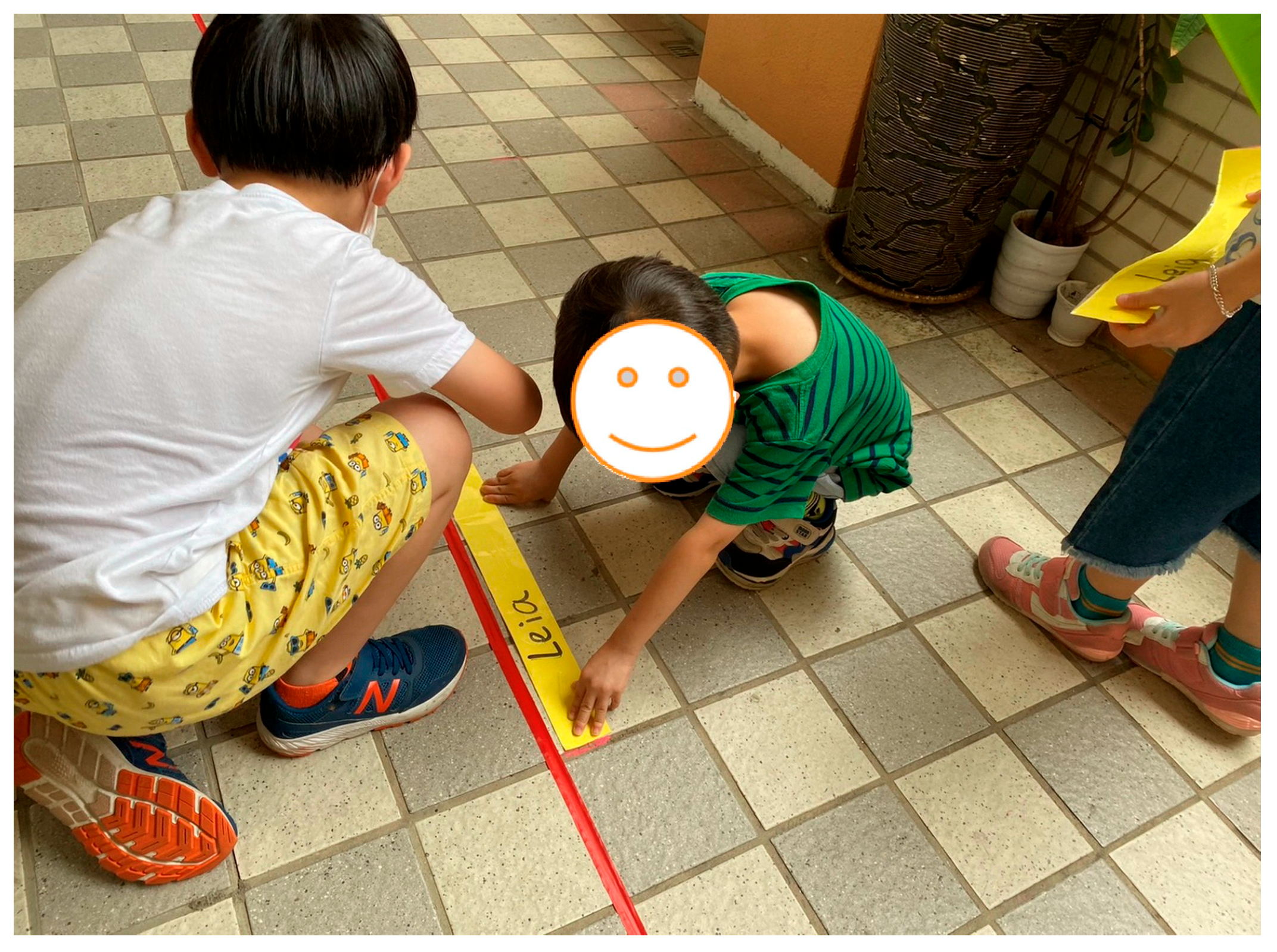
| Teaching Resources | Balloons, kite strings (made of different materials), a camera, and poster papers | Cloth ruler and plastic rope, children’s hands and feet, unit blocks, and poster papers |
| Target for Measurement | Height of the mama tree (outside of the classroom, free play zone) | Distance to teacher’s office (on the same floor as the children’s classroom) |
| Category | Group | n | M | SD | t | p |
|---|---|---|---|---|---|---|
| Numeracy | Experimental—Kindergarten A | 25 | 103.40 | 10.45 | 0.484 n.s. | 0.631 |
| Control—Kindergarten B | 26 | 101.62 | 15.32 | |||
| Geometry | Experimental—Kindergarten A | 25 | 55.40 | 11.05 | −0.212 n.s. | 0.833 |
| Control—Kindergarten B | 26 | 56.08 | 11.74 | |||
| Total Score | Experimental—Kindergarten A | 25 | 158.80 | 18.84 | 0.180 n.s. | 0.858 |
| Control—Kindergarten B | 26 | 157.69 | 24.51 |
| Category | Group | n | M | SD | t | p |
|---|---|---|---|---|---|---|
| Numeracy | Experimental—Kindergarten A | 25 | 108.60 | 10.96 | 1.531 n.s. | 0.132 |
| Control—Kindergarten B | 26 | 103.19 | 14.02 | |||
| Geometry | Experimental—Kindergarten A | 25 | 64.32 | 6.96 | 3.057 ** | 0.004 |
| Control—Kindergarten B | 26 | 56.73 | 10.37 | |||
| Total Score | Experimental—Kindergarten A | 25 | 172.92 | 14.09 | 2.446 * | 0.018 |
| Control—Kindergarten B | 26 | 159.92 | 22.69 |
| Category | Assessment | n | M | SD | t | p |
|---|---|---|---|---|---|---|
| Numeracy | Pre-test | 25 | 103.40 | 10.45 | −2.205 * | 0.037 |
| Post-test | 25 | 108.60 | 10.96 | |||
| Geometry | Pre-test | 25 | 55.40 | 11.05 | −4.188 *** | 0.000 |
| Post-test | 25 | 64.32 | 6.96 | |||
| Total Score | Pre-test | 25 | 158.80 | 18.84 | −3.965 ** | 0.001 |
| Post-test | 25 | 172.92 | 14.09 |
| Category | Assessment | n | M | SD | t | p |
|---|---|---|---|---|---|---|
| Numeracy | Pre-test | 26 | 101.62 | 15.32 | −0.767 n.s. | 0.450 |
| Post-test | 26 | 103.19 | 14.02 | |||
| Geometry | Pre-test | 26 | 56.08 | 11.74 | −0.357 n.s. | 0.724 |
| Post-test | 26 | 56.73 | 10.37 | |||
| Total Score | Pre-test | 26 | 157.69 | 24.51 | −0.763 n.s. | 0.453 |
| Post-test | 26 | 159.92 | 22.69 |
Disclaimer/Publisher’s Note: The statements, opinions and data contained in all publications are solely those of the individual author(s) and contributor(s) and not of MDPI and/or the editor(s). MDPI and/or the editor(s) disclaim responsibility for any injury to people or property resulting from any ideas, methods, instructions or products referred to in the content. |
© 2026 by the authors. Licensee MDPI, Basel, Switzerland. This article is an open access article distributed under the terms and conditions of the Creative Commons Attribution (CC BY) license.
Share and Cite
Chen, Y.-Y.; Wu, S.-C.; Chang, Y.-L.; Chang, L.A. Promoting Mathematics Learning in Young Children Through the Use of Embodied Mathematics Teaching Modules. Behav. Sci. 2026, 16, 875. https://doi.org/10.3390/bs16060875
Chen Y-Y, Wu S-C, Chang Y-L, Chang LA. Promoting Mathematics Learning in Young Children Through the Use of Embodied Mathematics Teaching Modules. Behavioral Sciences. 2026; 16(6):875. https://doi.org/10.3390/bs16060875
Chicago/Turabian StyleChen, Yin-Yin, Su-Chiao Wu, Yu-Liang Chang, and Lancelote Andy Chang. 2026. "Promoting Mathematics Learning in Young Children Through the Use of Embodied Mathematics Teaching Modules" Behavioral Sciences 16, no. 6: 875. https://doi.org/10.3390/bs16060875
APA StyleChen, Y.-Y., Wu, S.-C., Chang, Y.-L., & Chang, L. A. (2026). Promoting Mathematics Learning in Young Children Through the Use of Embodied Mathematics Teaching Modules. Behavioral Sciences, 16(6), 875. https://doi.org/10.3390/bs16060875