Psychometric Validation of the Spanish Version of the Luxembourg Workplace Mobbing Scale (LWMS): Structural Equation Modeling, and Item Response Theory Evidence

 ,
,  ,
, 
Abstract
1. Introduction
2. Materials and Methods
2.1. Participants
2.2. Measures
2.2.1. Demographic Information
2.2.2. Luxembourg Workplace Mobbing Scale (LWMS)
2.2.3. Frequency of Suicidal Ideation Inventory (FSII)
2.2.4. Patient Health Questionnaire-2 (PHQ-2)
2.2.5. Generalized Anxiety Disorder-2 (GAD-2)
2.3. Procedure
2.4. Statistical Analysis
2.5. Ethical Considerations
3. Results
3.1. Evidence Based on Content
3.2. Descriptive Analysis
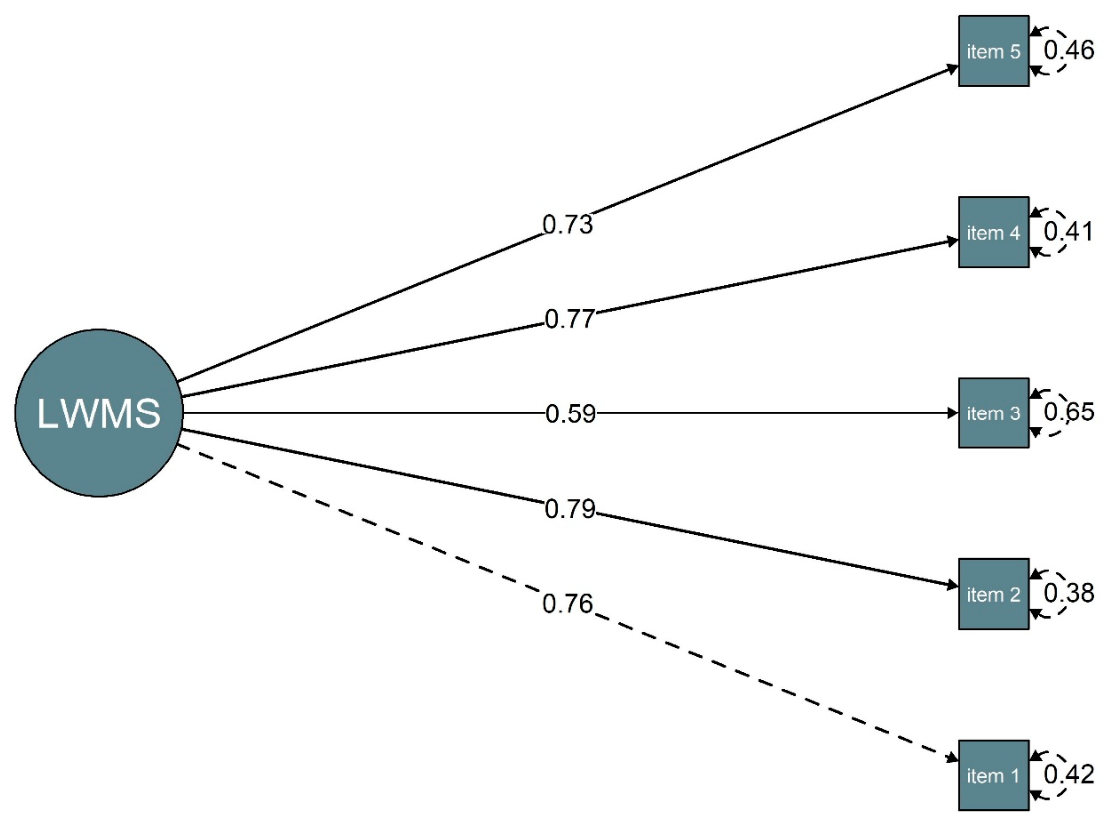
3.3. Evidence Based on Internal Structure
3.4. Reliability
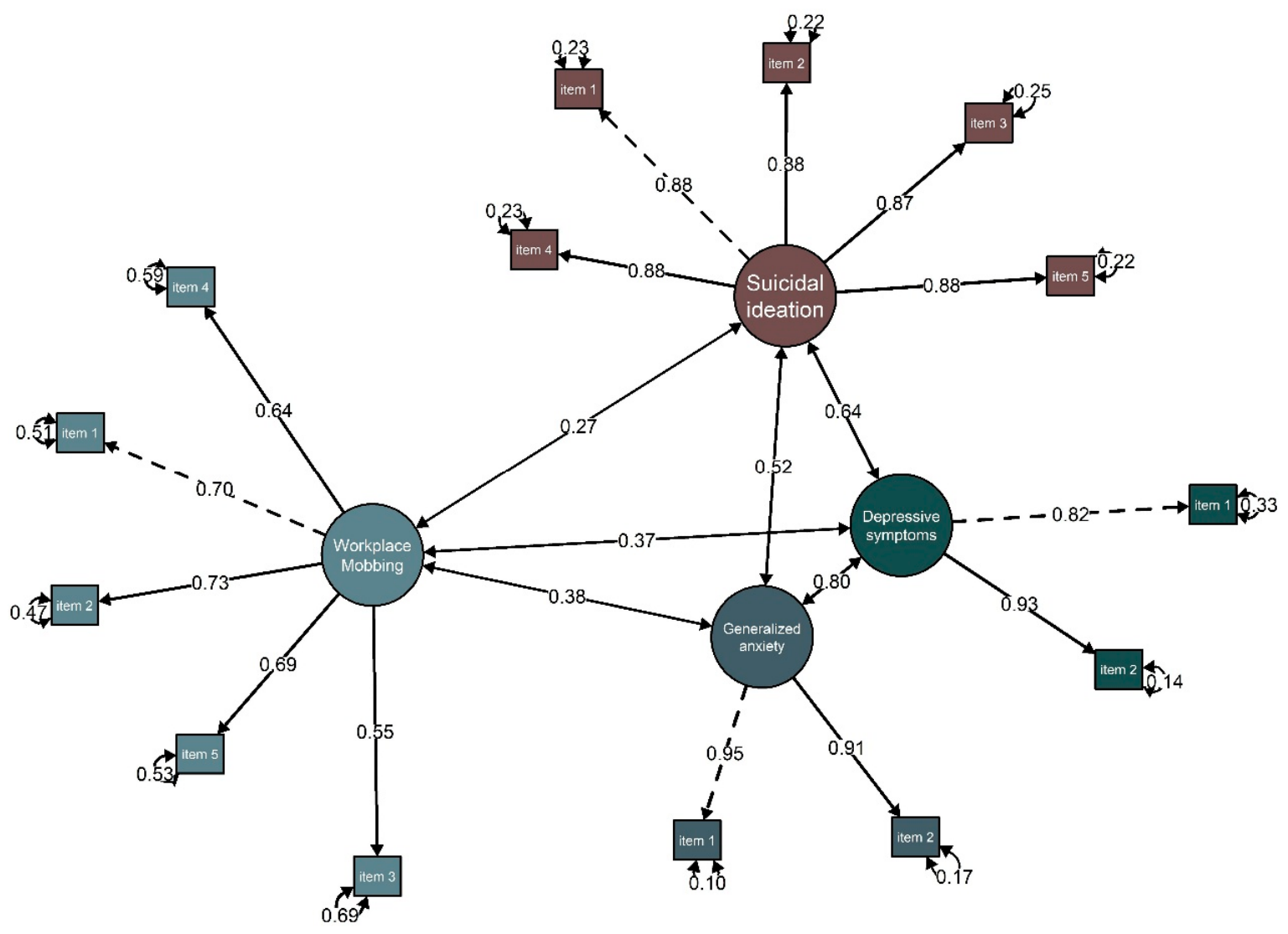
3.5. Evidence Based on the Relationship with Other Variables
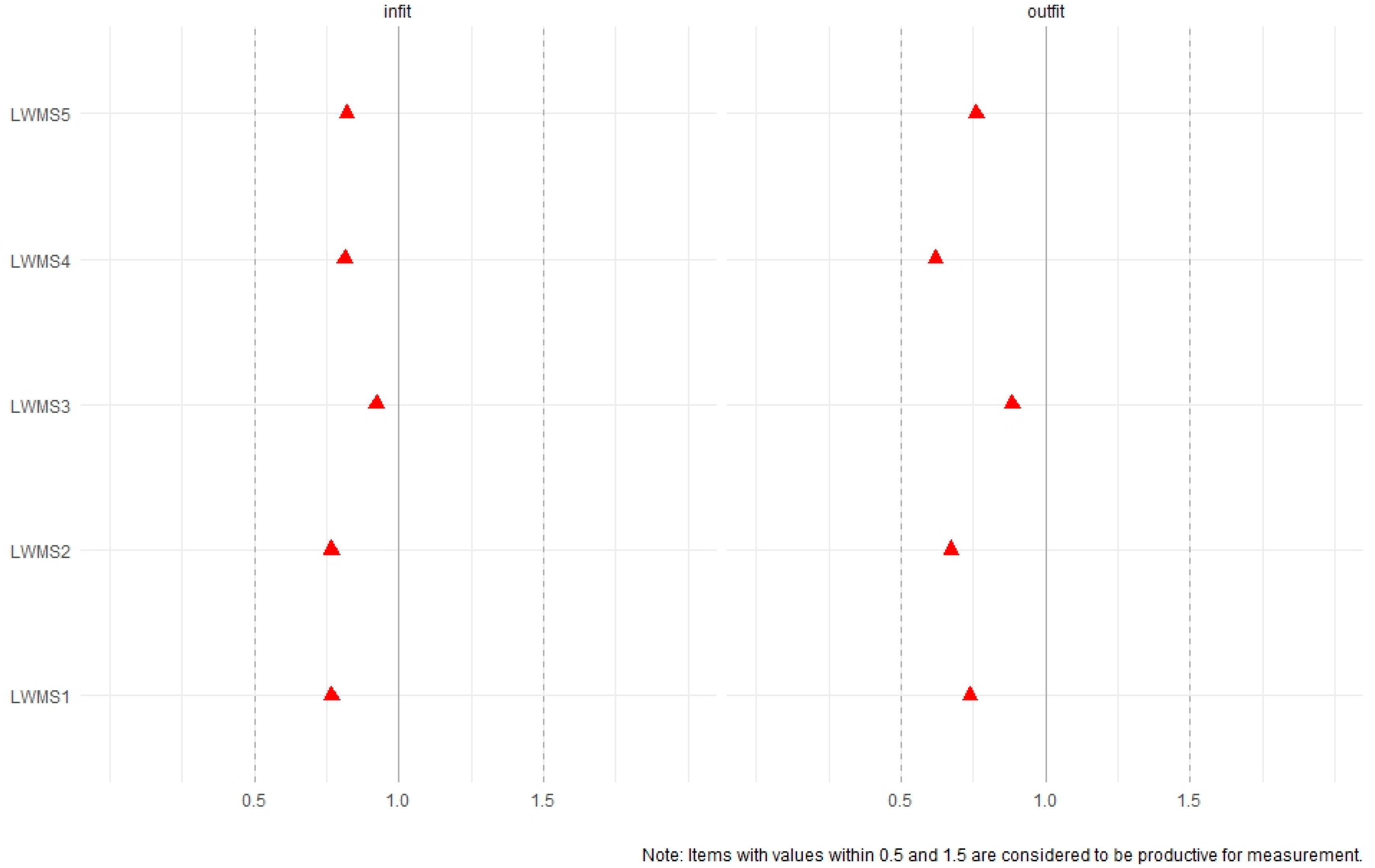
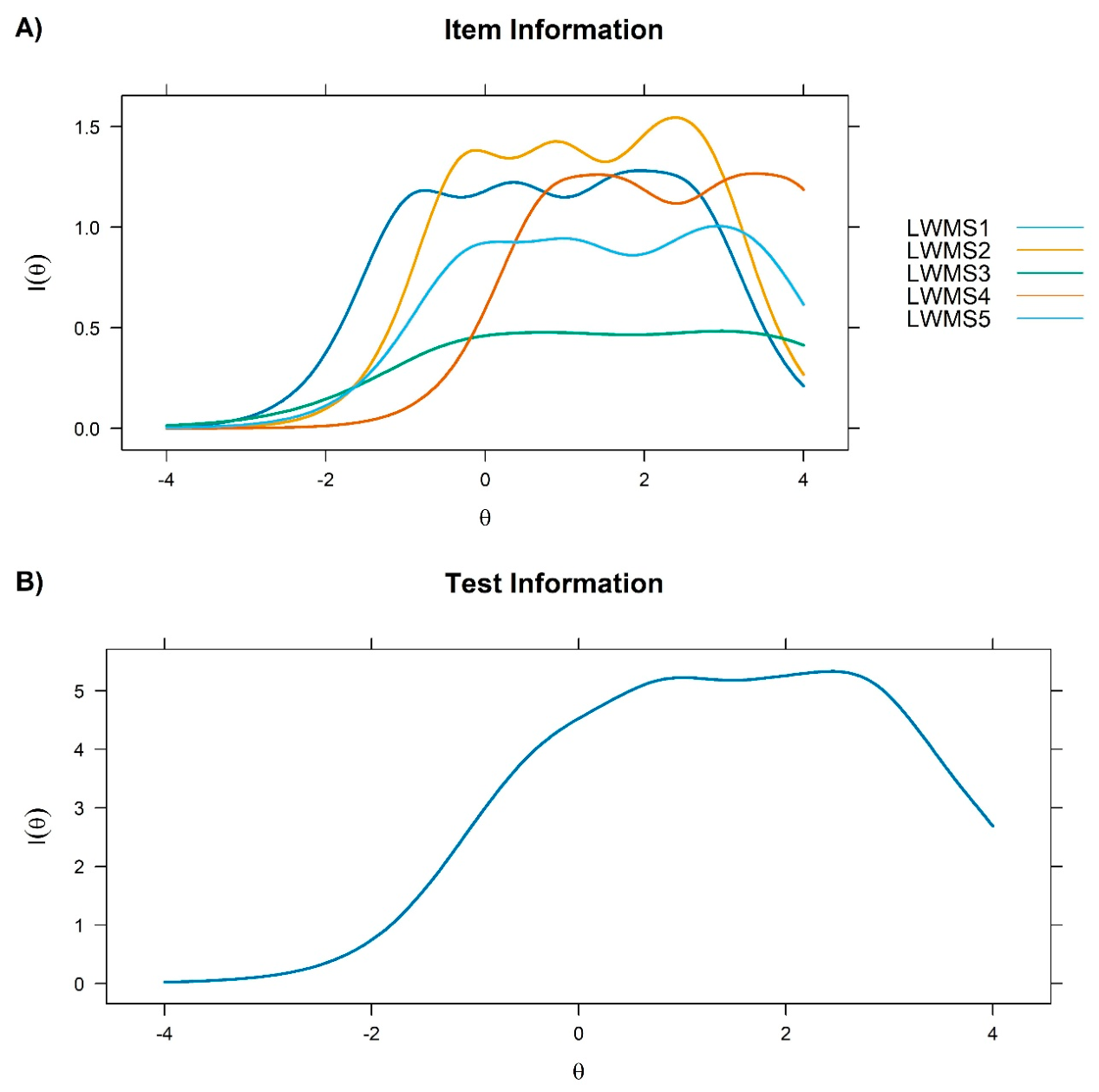
3.6. Item Response Theory
4. Discussion
5. Conclusions
Author Contributions
Funding
Institutional Review Board Statement
Informed Consent Statement
Data Availability Statement
Conflicts of Interest
References
- Astorima Huanca, K. D. (2024). El mobbing en Perú: Análisis multidimensional y propuestas de reforma normativa [Academic paper for the second specialization degree in labor law and social security, pontificia universidad católica del perú]. Available online: http://hdl.handle.net/20.500.12404/32779 (accessed on 15 January 2026).
- Ayala-Burboa, M. O., García-Flores, R., Sotelo-Quiñonez, T. I., & Acosta-Quiroz, C. O. (2024). Violencia laboral como predictor de ideación suicida en médicos internos de pregrado. Revista médica del Instituto Mexicano del Seguro Social, 62(6), 1–6. [Google Scholar] [CrossRef] [Scilit]
- Baker, F. B., & Kim, S. H. (2017). The basics of item response theory using R. Springer. [Google Scholar]
- Baños-Chaparro, J., & Caycho-Rodríguez, T. (2024). Coeficiente omega bayesiano: Aplicaciones en ciencias de la salud. Medicina Clínica y Social, 8(2), 244–247. [Google Scholar] [CrossRef] [Scilit]
- Baños-Chaparro, J., Ynquillay-Lima, P., Lamas-Delgado, F., & Fuster-Guillen, F. G. (2021). Inventario de frecuencia de ideación suicida: Evidencias psicométricas en adultos peruanos. Revista de Información Científica, 100(4), e3507. Available online: https://revinfcientifica.sld.cu/index.php/ric/article/view/3507 (accessed on 15 January 2026).
- Bean, G. J., & Bowen, N. K. (2021). Item response theory and confirmatory factor analysis: Complementary approaches for scale development. Journal of Evidence-Based Social Work, 18(6), 597–618. [Google Scholar] [CrossRef] [Scilit]
- Cai, L., Chung, S. W., & Lee, T. (2023). Incremental model fit assessment in the case of categorical data: Tucker–lewis index for item response theory modeling. Prevention Science, 24, 455–466. [Google Scholar] [CrossRef] [Scilit]
- Chirilă, T., & Constantin, T. (2013). Understanding workplace bullying phenomenon through its concepts: A literature review. Procedia-Social and Behavioral Sciences, 84, 1175–1179. [Google Scholar] [CrossRef] [Scilit]
- Ciby, M., & Raya, R. P. (2015). Workplace bullying: A review of the defining features, measurement methods and prevalence across continents. IIM Kozhikode Society & Management Review, 4(1), 38–47. [Google Scholar] [CrossRef] [Scilit]
- Cohen, J. (1988). Statistical power analysis for the behavioral sciences (2nd ed.). Routledge. [Google Scholar]
- Córdova Campaña, E. R., Rodríguez Vásconez, A. I., Suasnavas Bermúdez, P. R., & Vilaret Serpa, A. (2022). Instrumentos de identificación del mobbing o acoso laboral en Iberoamérica: Una mirada desde el riesgo psicosocial. Revista Conecta Libertad, 6(3), 57–76. Available online: https://revistaitsl.itslibertad.edu.ec/index.php/ITSL/article/view/297 (accessed on 15 January 2026).
- Crawshaw, L. (2009). Workplace bullying? Mobbing? Harassment? Distraction by a thousand definitions. Consulting Psychology Journal: Practice and Research, 61(3), 263–267. [Google Scholar] [CrossRef] [Scilit]
- Espinoza Escobar, J. H., Baños-Chaparro, J., Caycho-Rodríguez, T., & Saldivar Celis, F. C. (2026). Network analysis of workplace mobbing, work-family conflict, and mental health in adults from the general population. Frontiers in Sociology, 10, 1704409. [Google Scholar] [CrossRef] [Scilit]
- Franco-Jimenez, R. A., & Nuñez-Magallanes, A. (2022). Propiedades psicométricas del GAD-7, GAD-2 y GAD-Mini en universitarios peruanos. Propósitos y Representaciones, 10(1), e1437. [Google Scholar] [CrossRef] [Scilit]
- Gosling, S., & Mason, W. (2015). Internet research in psychology. Annual Review of Psychology, 66(2015), 877–902. [Google Scholar] [CrossRef] [Scilit] [PubMed]
- Grotto-de-Souza, J., Pohl, H. H., & Aguiar-Ribeiro, D. (2023). Mobbing as a source of psychological harm in workers. Revista Brasileira de Medicina do Trabalho: Publicacao Oficial da Associacao Nacional de Medicina do Trabalho-ANAMT, 20(4), 670–675. [Google Scholar] [CrossRef] [Scilit] [PubMed]
- Gunnell, K. E. (2020). Validity and reliability. In E. D. Hackfort, & R. Schinke (Eds.), The routledge international encyclopedia of sport and exercise psychology (pp. 632–645). Routledge. [Google Scholar]
- Hilbig, B. E., Thielmann, I., & Böhm, R. (2022). Bending our ethics code: Avoidable deception and its justification in psychological research. European Psychologist, 27(1), 62–70. [Google Scholar] [CrossRef] [Scilit]
- Instituto Peruano de Economía. (2025, May 1). El 70% de trabajadores en Perú es informal. Available online: https://ipe.org.pe/el-70-de-trabajadores-en-peru-es-informal/ (accessed on 16 January 2026).
- International Labour Organization. (2022). Experiences of violence and harassment at work: A first global survey. Available online: https://www.ilo.org/resource/news/violence-and-harassment-work-has-affected-more-one-five-people (accessed on 16 January 2026).
- International Labour Organization. (2024). 2024 labour overview of Latin America and the Caribbean. Available online: https://www.ilo.org/publications/2024-labour-overview-latin-america-and-caribbean (accessed on 16 January 2026).
- Jordan Muiños, F. M. (2021). Valor de corte de los índices de ajuste en el análisis factorial confirmatorio. Psocial, 7(1), 1–5. Available online: https://publicaciones.sociales.uba.ar/index.php/psicologiasocial/article/view/6764/579 (accessed on 17 January 2026).
- Kang, T., & Chen, T. T. (2008). Performance of the generalized S-X2 item fit index for polytomous IRT models. Journal of Educational Measurement, 45(4), 391–406. [Google Scholar] [CrossRef] [Scilit]
- Kline, R. B. (2023). Principles and practice of structural equation modeling (5th ed.). The Guilford Press. [Google Scholar]
- Leymann, H. (1996). The content and development of mobbing at work. European Journal of Work and Organizational Psychology, 5(2), 165–184. [Google Scholar] [CrossRef] [Scilit]
- López, V. D., & González-Trijueque, D. (2022). Revisión de Instrumentos en Español para Medir el Acoso Laboral: Su Utilidad en la Evaluación Pericial. Anuario de Psicología Jurídica, 32(1), 11–21. [Google Scholar] [CrossRef] [Scilit]
- Lubbe, D., & Schuster, C. (2019). A graded response model framework for questionnaires with uniform response formats. Applied Psychological Measurement, 43(4), 290–302. [Google Scholar] [CrossRef] [Scilit]
- Machado, I. C. K., Bernardes, J. W., Monteiro, J. K., & Marin, A. H. (2021). Stress, anxiety and depression among gastronomes: Association with workplace mobbing and work-family interaction. International Archives of Occupational and Environmental Health, 94(8), 1797–1807. [Google Scholar] [CrossRef] [Scilit]
- Marsh, H. W., Nagengast, B., Morin, A. J. S., Parada, R. H., Craven, R. G., & Hamilton, L. R. (2011). Construct validity of the multidimensional structure of bullying and victimization: An application of exploratory structural equation modeling. Journal of Educational Psychology, 103(3), 701–732. [Google Scholar] [CrossRef] [Scilit]
- Maydeu-Olivares, A., & Joe, H. (2014). Assessing approximate fit in categorical data analysis. Multivariate Behavioral Research, 49(4), 305–328. [Google Scholar] [CrossRef] [Scilit] [PubMed]
- Meng, Q. (2025). Workplace mobbing vs. workplace bullying: Understanding the distinction. Journal of Workplace Mobbing, 1(1), 9–32. [Google Scholar] [CrossRef] [Scilit]
- Monroe, S., & Cai, L. (2015). Evaluating structural equation models for categorical outcomes: A new test statistic and a practical challenge of interpretation. Multivariate Behavioral Research, 50(6), 569–583. [Google Scholar] [CrossRef] [Scilit]
- Pfadt, J. M., van den Bergh, D., Sijtsma, K., Moshagen, M., & Wagenmakers, E. J. (2022). Bayesian estimation of single-test reliability coefficients. Multivariate Behavioral Research, 57(4), 620–641. [Google Scholar] [CrossRef] [Scilit]
- Pompili, M., Lester, D., Innamorati, M., De Pisa, E., Iliceto, P., Puccinno, M., Fiori Nastro, P., Tatarelli, R., & Girardi, P. (2008). Suicide risk and exposure to mobbing. Work, 31(2), 237–243. [Google Scholar] [CrossRef]
- Rincon-Hoyos, H. G., Figueroa-Paz, R., Cardozo-Rengifo, M. M., Gil-González, D., Zúñiga-Martinez, J. F., Arias-Valderrama, O., & Gempeler, A. (2025). Understanding the burden of mental illness induced by workplace mobbing: A scoping review. Actas Españolas de Psiquiatria, 53(5), 1104–1121. [Google Scholar] [CrossRef] [Scilit]
- Roebianto, A., Savitri, S. I., Aulia, I., Suciyana, A., & Mubarokah, L. (2023). Content validity: Definition and procedure of content validation in psychological research. Testing, Psychometrics, Methodology in Applied Psychology, 30(1), 5–18. [Google Scholar] [CrossRef]
- Salin, D., Cowan, R., Adewumi, O., Apospori, E., Bochantin, J., D’Cruz, P., Djurkovic, N., Durniat, K., Escartín, J., Guo, J., Išik, I., Koeszegi, S. T., McCormack, D., Monserrat, S. I., & Zedlacher, E. (2019). Workplace bullying across the globe: A cross-cultural comparison. Personnel Review, 48(1), 204–219. [Google Scholar] [CrossRef] [Scilit]
- Sijtsma, K., & van der Ark, A. L. (2017). A tutorial on how to do a Mokken scale analysis on your test and questionnaire data. The British Psychological Society, 70(1), 137–158. [Google Scholar] [CrossRef] [Scilit]
- Steffgen, G., Sischka, P., Schmidt, A. F., Kohl, D., & Happ, C. (2019). The Luxembourg workplace mobbing scale: Psychometric properties of a short instrument in three different languages. European Journal of Psychological Assessment, 35, 164–171. [Google Scholar] [CrossRef] [Scilit]
- Stover, A. M., McLeod, L. D., Langer, M. M., Chen, W. H., & Reeve, B. B. (2019). State of the psychometric methods: Patient-reported outcome measure development and refinement using item response theory. Journal of Patient-Reported Outcomes, 3(1), 50. [Google Scholar] [CrossRef] [Scilit]
- Tatar, Z. B., & Yüksel, Ş. (2019). Mobbing at workplace -psychological trauma and documentation of psychiatric symptoms. Noro Psikiyatri Arsivi, 56(1), 57–62. [Google Scholar] [CrossRef] [Scilit]
- Villarreal-Zegarra, D., Barrera-Begazo, J., Otazú-Alfaro, S., Mayo-Puchoc, N., Bazo-Alvarez, J. C., & Huarcaya-Victoria, J. (2023). Sensitivity and specificity of the patient health questionnaire (PHQ-9, PHQ-8, PHQ-2) and general anxiety disorder scale (GAD-7, GAD-2) for depression and anxiety diagnosis: A cross-sectional study in a Peruvian hospital population. BMJ Open, 13, e076193. [Google Scholar] [CrossRef] [Scilit]
- Wright, B. D., & Linacre, J. M. (1994). Reasonable mean-square fit values. Rasch Measurement Transactions, 8, 370–371. [Google Scholar]



| Items | Original Version in English | Spanish Version |
|---|---|---|
| 1 | How often is your work being criticized by your colleagues or your superior? | ¿Con qué frecuencia sus colegas o superiores critican su trabajo? |
| 2 | How often are you being ignored by your colleagues or your superior? | ¿Con qué frecuencia sus colegas o su superior le ignoran? |
| 3 | How often are you being assigned absurd duties by your superior? | ¿Con qué frecuencia su superior le asigna tareas absurdas? |
| 4 | How often are you being ridiculed by your colleagues or your superior in front of others? | ¿Con qué frecuencia sus colegas o superiores se burlan de usted delante de otras personas? |
| 5 | How often do you have conflicts with your colleagues or your superior? | ¿Con qué frecuencia tiene conflictos con sus colegas o con su superior? |
| Items | Relevance (n = 5) | Representativeness (n = 5) | Clarity (n = 5) | |||
|---|---|---|---|---|---|---|
| V | CI 95% | V | CI 95% | V | CI 95% | |
| 1 | 0.93 | 0.75, 0.99 | 0.73 | 0.52, 0.87 | 0.73 | 0.52, 0.87 |
| 2 | 0.87 | 0.67, 0.95 | 0.93 | 0.75, 0.99 | 0.87 | 0.67, 0.95 |
| 3 | 0.73 | 0.52, 0.87 | 0.87 | 0.67, 0.95 | 0.93 | 0.75, 0.99 |
| 4 | 0.93 | 0.75, 0.99 | 0.73 | 0.52, 0.87 | 0.73 | 0.52, 0.87 |
| 5 | 0.87 | 0.67, 0.95 | 0.93 | 0.75, 0.99 | 0.87 | 0.67, 0.95 |
| Items | M | SD | g1 | g2 | rit | Polychoric Correlation Matrix | ||||
|---|---|---|---|---|---|---|---|---|---|---|
| 1 | 2.28 | 0.99 | 0.52 | −0.11 | 0.61 | - | ||||
| 2 | 1.88 | 0.93 | 0.97 | 0.70 | 0.62 | 0.62 | - | |||
| 3 | 1.90 | 0.99 | 0.95 | 0.39 | 0.49 | 0.44 | 0.47 | - | ||
| 4 | 1.37 | 0.69 | 1.97 | 3.79 | 0.55 | 0.52 | 0.61 | 0.46 | - | |
| 5 | 1.80 | 0.88 | 0.98 | 0.76 | 0.60 | 0.57 | 0.53 | 0.44 | 0.61 | - |
| Items | Item Parameters | Item Fit | |||||
|---|---|---|---|---|---|---|---|
| a | β1 | β2 | β3 | β4 | S-X2 (gl) | RMSEA.S-X2 | |
| 1 | 2.10 | −0.922 | 0.362 | 1.659 | 2.599 | 18.133 (14) | 0.029 |
| 2 | 2.27 | −0.271 | 0.915 | 2.145 | 2.747 | 16.669 (13) | 0.029 |
| 3 | 1.26 | −0.269 | 1.060 | 2.708 | 3.723 | 10.166 (17) | 0.001 |
| 4 | 2.08 | 0.788 | 1.734 | 3.072 | 3.992 | 14.608 (12) | 0.025 |
| 5 | 1.83 | −0.186 | 1.104 | 2.637 | 3.359 | 5.635 (12) | 0.001 |
Disclaimer/Publisher’s Note: The statements, opinions and data contained in all publications are solely those of the individual author(s) and contributor(s) and not of MDPI and/or the editor(s). MDPI and/or the editor(s) disclaim responsibility for any injury to people or property resulting from any ideas, methods, instructions or products referred to in the content. |
© 2026 by the authors. Licensee MDPI, Basel, Switzerland. This article is an open access article distributed under the terms and conditions of the Creative Commons Attribution (CC BY) license.
Share and Cite
Baños-Chaparro, J.; Franco-Jimenez, A.; Espinoza Escobar, J.H.; Caycho-Rodríguez, T.; Saldivar Celis, F.C. Psychometric Validation of the Spanish Version of the Luxembourg Workplace Mobbing Scale (LWMS): Structural Equation Modeling, and Item Response Theory Evidence. Behav. Sci. 2026, 16, 615. https://doi.org/10.3390/bs16040615
Baños-Chaparro J, Franco-Jimenez A, Espinoza Escobar JH, Caycho-Rodríguez T, Saldivar Celis FC. Psychometric Validation of the Spanish Version of the Luxembourg Workplace Mobbing Scale (LWMS): Structural Equation Modeling, and Item Response Theory Evidence. Behavioral Sciences. 2026; 16(4):615. https://doi.org/10.3390/bs16040615
Chicago/Turabian StyleBaños-Chaparro, Jonatan, Andrei Franco-Jimenez, Javier Hildebrando Espinoza Escobar, Tomás Caycho-Rodríguez, and Fabio Cesar Saldivar Celis. 2026. "Psychometric Validation of the Spanish Version of the Luxembourg Workplace Mobbing Scale (LWMS): Structural Equation Modeling, and Item Response Theory Evidence" Behavioral Sciences 16, no. 4: 615. https://doi.org/10.3390/bs16040615
APA StyleBaños-Chaparro, J., Franco-Jimenez, A., Espinoza Escobar, J. H., Caycho-Rodríguez, T., & Saldivar Celis, F. C. (2026). Psychometric Validation of the Spanish Version of the Luxembourg Workplace Mobbing Scale (LWMS): Structural Equation Modeling, and Item Response Theory Evidence. Behavioral Sciences, 16(4), 615. https://doi.org/10.3390/bs16040615