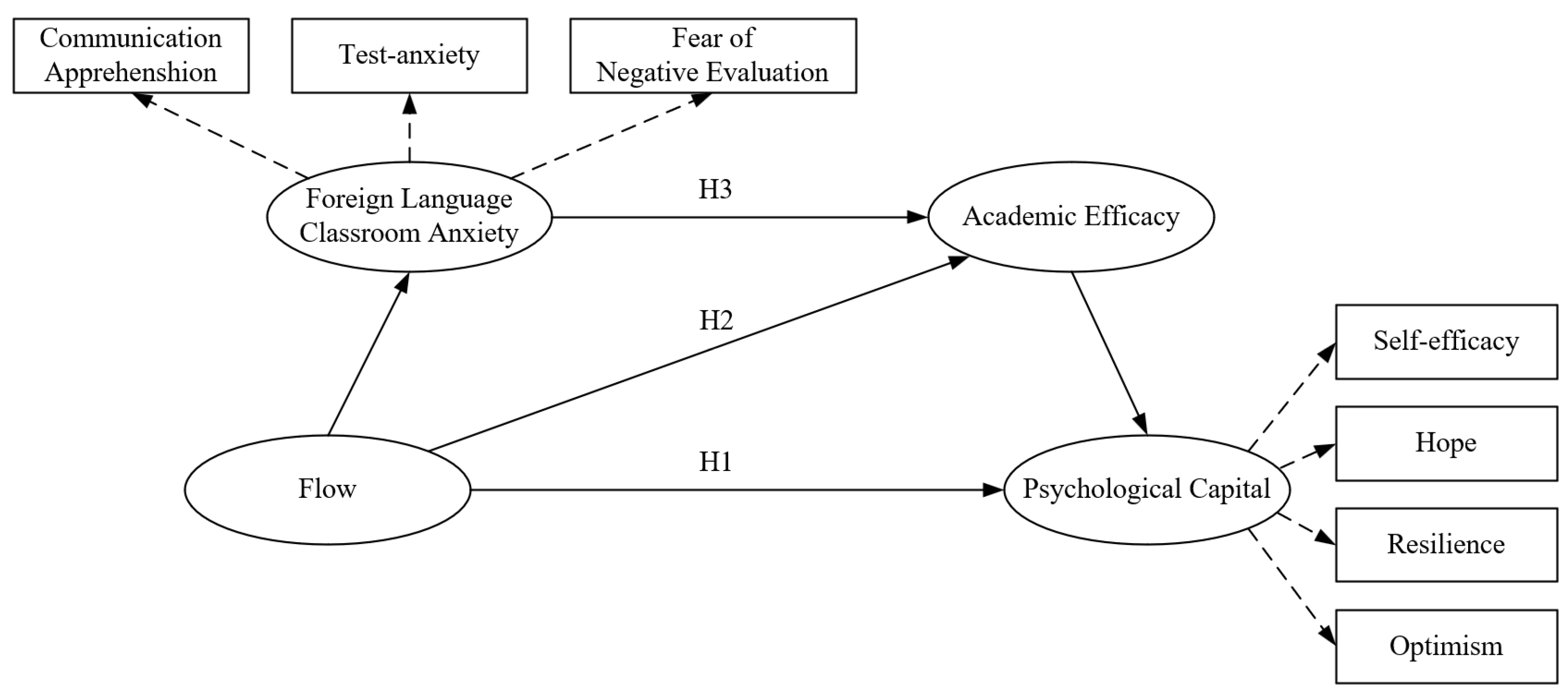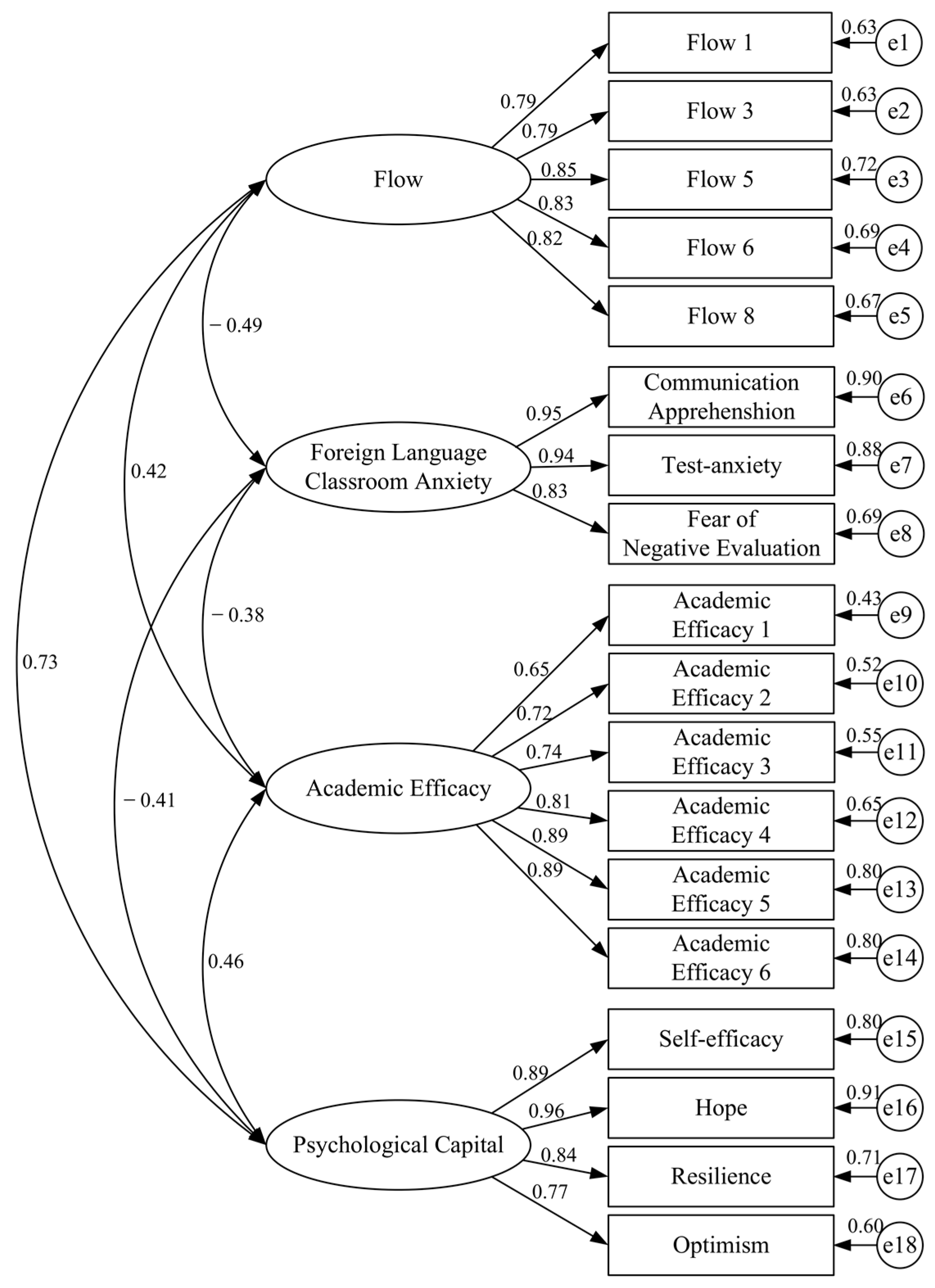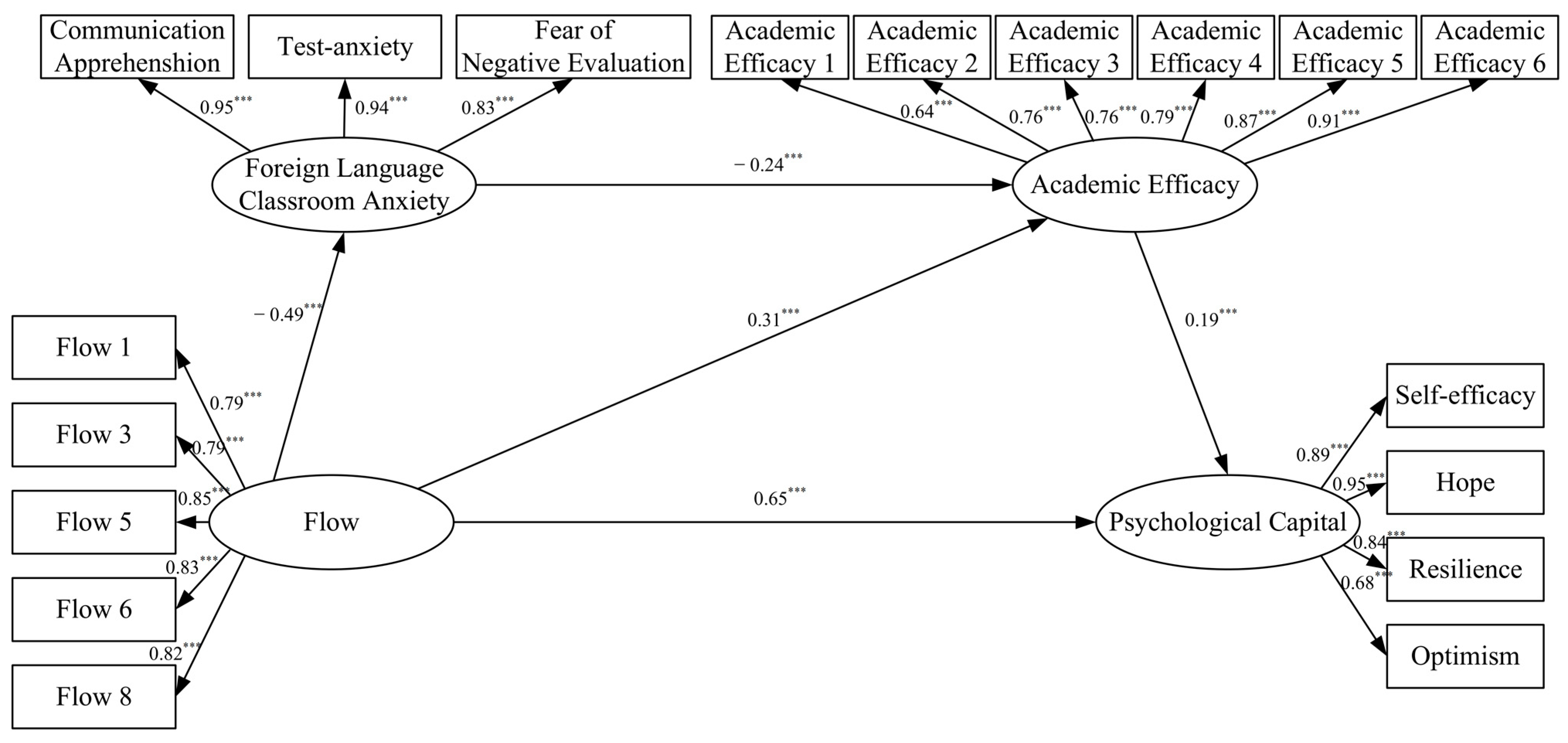

The Impact of Flow on University EFL Learners’ Psychological Capital: Insights from Positive Psychology


Abstract
1. Introduction
2. Conceptual and Theoretical Framework, Literature Review, and Hypotheses
2.1. Theoretical Foundation
2.2. Constructs and Related Studies
2.2.1. Flow
2.2.2. Psychological Capital (PsyCap)
2.2.3. Academic Efficacy
2.2.4. Foreign Language Classroom Anxiety (FLCA)
2.3. The Relationship Between Flow and PsyCap
2.4. Path Mediation of Academic Efficacy Between Flow and PsyCap
2.5. The Role of FLCA and Academic Efficacy in the Relationship Between Flow and PsyCap
3. Methods
3.1. Participants and Procedure
3.2. Instruments
3.2.1. Flow Scale (State)
3.2.2. Foreign Language Classroom Anxiety Scale (FLCAS)
3.2.3. Academic Efficacy Scale
3.2.4. Psychological Capital Questionnaire
3.3. Data Analysis
4. Results
4.1. Common Method Bias
4.2. Descriptive Statistics and Correlations Among Study Variables
4.3. Test of Our Measurement Model
4.4. Test of the Mediation Model via Structural Equation Modeling
5. Discussion
5.1. The Direct Predictive Effect of Flow on PsyCap
5.2. The Mediating Role of Academic Efficacy
5.3. The Chain Mediation Effect of FLCA and Academic Efficacy
5.4. Limitations and Future Research
6. Conclusions
Author Contributions
Funding
Institutional Review Board Statement
Informed Consent Statement
Data Availability Statement
Acknowledgments
Conflicts of Interest
References
- Abdolrezapour, P., Jahanbakhsh Ganjeh, S., & Ghanbari, N. (2023). Self-efficacy and resilience as predictors of students’ academic motivation in online education. PLoS ONE, 18(5), e0285984. [Google Scholar] [CrossRef]
- Al-Abyadh, M. H. A., & Abdel Azeem, H. A. H. (2022). Academic achievement: Influences of university students’ self-management and perceived self-efficacy. Journal of Intelligence, 10(3), 55. [Google Scholar] [CrossRef] [PubMed]
- Alessandri, G., Borgogni, L., Consiglio, C., & Mitidieri, G. (2015). Psychometric properties of the Italian version of the psychological capital questionnaire. International Journal of Selection and Assessment, 23(2), 149–159. [Google Scholar] [CrossRef]
- Al-khresheh, M. H., & Alkursheh, T. O. (2024). An integrated model exploring the relationship between self-efficacy, technology integration via Blackboard, English proficiency, and Saudi EFL students’ academic achievement. Humanities and Social Sciences Communications, 11(1), 287. [Google Scholar] [CrossRef]
- Al-Shboul, M. M., Ahmad, I. S., Nordin, M. S., & Rahman, Z. A. (2013). Foreign language anxiety and achievement: Systematic review. International Journal of English Linguistics, 3(2), 32. [Google Scholar] [CrossRef]
- Artino, A. R., Jr. (2012). Academic self-efficacy: From educational theory to instructional practice. Perspectives on Medical Education, 1(2), 76–85. [Google Scholar] [CrossRef]
- Aubrey, S. (2017). Measuring flow in the EFL classroom: Learners’ perceptions of inter-and intra-cultural task-based interactions. TESOL Quarterly, 51(3), 661–692. [Google Scholar] [CrossRef]
- Bassi, M., Steca, P., Monzani, D., Greco, A., & Delle Fave, A. (2014). Personality and optimal experience in adolescence: Implications for well-being and development. Journal of Happiness Studies, 15(4), 829–843. [Google Scholar] [CrossRef]
- Beard, K. L. S. (2008). An exploratory study of academic optimism and flow of elementary school teachers. The Ohio State University. [Google Scholar]
- Bembenutty, H., Kitsantas, A., DiBenedetto, M. K., Wigfield, A., Greene, J. A., Usher, E. L., Bong, M., Cleary, T. J., Panadero, E., Mullen, C. A., & Chen, P. P. (2024). Harnessing motivation, self-efficacy, and self-regulation: Dale H. Schunk’s enduring influence. Educational Psychology Review, 36(4), 139. [Google Scholar] [CrossRef]
- Bonaiuto, M., Mao, Y., Roberts, S., Psalti, A., Ariccio, S., Ganucci Cancellieri, U., & Csikszentmihalyi, M. (2016). Optimal experience and personal growth: Flow and the consolidation of place identity. Frontiers in Psychology, 7, 1654. [Google Scholar] [CrossRef]
- Chen, Q., Wen, Z., Kong, Y., Niu, J., & Hau, K.-T. (2017). Influence of leaders’ psychological capital on their followers: Multilevel mediation effect of organizational identification. Frontiers in Psychology, 8, 1776. [Google Scholar] [CrossRef]
- Csikszentmihalyi, M. (1975). Beyond boredom and anxiety. Jossey-Bass. [Google Scholar]
- Csikszentmihalyi, M. (1988). The flow experience and its significance for human psychology. Optimal Experience: Psychological Studies of Flow in Consciousness, 2, 15–35. [Google Scholar] [CrossRef]
- Csikszentmihalyi, M. (1990). Flow: The psychology of optimal experience (Vol. 1990, p. 1). Harper & Row. [Google Scholar]
- Csikszentmihalyi, M., & LeFevre, J. (1989). Optimal experience in work and leisure. Journal of Personality and Social Psychology, 56(5), 815. [Google Scholar] [CrossRef]
- Csikszentmihalyi, M., Nakamura, J., & Csikszentmihalyi, M. (2014). The concept of flow. In Flow and the foundations of positive psychology: The collected works of Mihaly Csikszentmihalyi (pp. 239–263). Springer. [Google Scholar]
- Deci, E. L., & Ryan, R. M. (2000). The “what” and “why” of goal pursuits: Human needs and the self-determination of behavior. Psychological Inquiry, 11(4), 227–268. [Google Scholar] [CrossRef]
- Derakhshan, A., & Noughabi, M. A. (2024). A self-determination perspective on the relationships between EFL learners’ foreign language peace of mind, foreign language enjoyment, psychological capital, and academic engagement. Learning and Motivation, 87, 102025. [Google Scholar] [CrossRef]
- Dewaele, J. M., Chen, X., Padilla, A. M., & Lake, J. (2019). The flowering of positive psychology in foreign language teaching and acquisition research. Frontiers in Psychology, 10, 2128. [Google Scholar] [CrossRef]
- Dewaele, J. M., & Li, C. (2021). Teacher enthusiasm and students’ social-behavioral learning engagement: The mediating role of student enjoyment and boredom in Chinese EFL classes. Language Teaching Research, 25(6), 922–945. [Google Scholar] [CrossRef]
- Du, X. (2009). The affective filter in second language teaching. Asian Social Science, 5(8), 162–165. [Google Scholar] [CrossRef]
- Egbert, J. (2003). A study of flow theory in the foreign language classroom. The Modern Language Journal, 87(4), 499–518. [Google Scholar] [CrossRef]
- Fredrickson, B. L. (2001). The role of positive emotions in positive psychology: The broaden-and-build theory of positive emotions. American Psychologist, 56(3), 218. [Google Scholar] [CrossRef]
- Fredrickson, B. L. (2013). Positive emotions broaden and build. In Advances in experimental social psychology (Vol. 47, pp. 1–53). Academic Press. [Google Scholar]
- Fredrickson, B. L., & Joiner, T. (2018). Reflections on positive emotions and upward spirals. Perspectives on Psychological Science, 13(2), 194–199. [Google Scholar] [CrossRef]
- Fullagar, C. J., Knight, P. A., & Sovern, H. S. (2013). Challenge/skill balance, flow, and performance anxiety. Applied Psychology, 62(2), 236–259. [Google Scholar] [CrossRef]
- Gao, Y., Wang, X., & Reynolds, B. L. (2025). The mediating roles of resilience and flow in linking basic psychological needs to tertiary EFL learners’ engagement in the informal digital learning of English: A mixed-methods study. Behavioral Sciences, 15(1), 85. [Google Scholar] [CrossRef]
- George, D., & Mallery, P. (2003). SPSS for Windows step by step: A simple guide and reference, 11.0 update (4th ed.). Allyn & Bacon. [Google Scholar]
- Gordani, Y., & Sadeghzadeh, M. (2023). Mindfulness and the mediating role of psychological capital in predicting the foreign language anxiety. Journal of Psycholinguistic Research, 52(5), 1785–1797. [Google Scholar] [CrossRef] [PubMed]
- Gu, C., Jin, F., & Li, Y. (2024). The mediating role of psychological capital in the relationship between foreign language anxiety and learning burnout among college students with different language environments. System, 126, 103499. [Google Scholar] [CrossRef]
- Hair, J. F., Black, W. C., Babin, B. J., & Anderson, R. E. (2010). Multivariate data analysis (7th ed.). Prentice Hall. [Google Scholar]
- Hayat, A. A., Shateri, K., Amini, M., & Shokrpour, N. (2020). Relationships between academic self-efficacy, learning-related emotions, and metacognitive learning strategies with academic performance in medical students: A structural equation model. BMC Medical Education, 20(1), 76. [Google Scholar] [CrossRef] [PubMed]
- Hobfoll, S. E. (2002). Social and psychological resources and adaptation. Review of General Psychology, 6(4), 307–324. [Google Scholar] [CrossRef]
- Horwitz, E. K., Horwitz, M. B., & Cope, J. (1986). Foreign language classroom anxiety. The Modern Language Journal, 70(2), 125–132. [Google Scholar] [CrossRef]
- Jia, F., Meng, J., Ma, Y., & Mao, Y. (2024). Flow experience and self-efficacy in undergraduates’ English learning: A weekly diary investigation with cross-lagged panel modeling approach. System, 123, 103312. [Google Scholar] [CrossRef]
- Jia, F., Meng, J., & Yu, A. (2025). Understanding EFL learners’ flow: The development and validation of English learning flow scale. Acta Psychologica, 259, 105424. [Google Scholar] [CrossRef]
- Jin, F., Gu, C., & Li, Y. (2024). Trait emotional intelligence and foreign language performance: Associations with academic self-efficacy and foreign language anxiety. Frontiers in Education, 9, 1419328. [Google Scholar] [CrossRef]
- Jin, Y., Dewaele, J. M., & MacIntyre, P. D. (2021). Reducing anxiety in the foreign language classroom: A positive psychology approach. System, 101, 102604. [Google Scholar] [CrossRef]
- Khajavy, G. H., Makiabadi, H., & Navokhi, S. A. (2019). The role of psychological capital in language learners’ willingness to communicate, motivation, and achievement. Eurasian Journal of Applied Linguistics, 5(3), 495–513. [Google Scholar] [CrossRef]
- King, R. B., & Caleon, I. S. (2021). School psychological capital: Instrument development, validation, and prediction. Child Indicators Research, 14(1), 341–367. [Google Scholar] [CrossRef]
- Kline, R. B. (2023). Principles and practice of structural equation modeling. Guilford publications. [Google Scholar]
- Landers, R. N., & Behrend, T. S. (2015). An inconvenient truth: Arbitrary distinctions between organizational, Mechanical Turk, and other convenience samples. Industrial and Organizational Psychology, 8(2), 142–164. [Google Scholar] [CrossRef]
- Li, R., Che Hassan, N., & Saharuddin, N. (2023). Psychological capital related to academic outcomes among university students: A systematic literature review. Psychology Research and Behavior Management, 16, 3739–3763. [Google Scholar] [CrossRef]
- Lin, Y. T. (2020). The interrelationship among psychological capital, mindful learning, and English learning engagement of university students in Taiwan. Sage Open, 10(1), 2158244020901603. [Google Scholar] [CrossRef]
- Liu, P., Zhang, Y., & Liu, D. (2022). Flow experience in foreign language writing: Its effect on students’ writing process and writing performance. Frontiers in Psychology, 13, 952044. [Google Scholar] [CrossRef]
- Luthans, F., Avolio, B. J., Avey, J. B., & Norman, S. M. (2007). Positive psychological capital: Measurement and relationship with performance and satisfaction. Personnel Psychology, 60(3), 541–572. [Google Scholar] [CrossRef]
- Mao, Y., Luo, X., Wang, S., Mao, Z., Xie, M., & Bonaiuto, M. (2024). Flow experience fosters university students’ well-being through psychological resilience: A longitudinal design with cross-lagged analysis. British Journal of Educational Psychology, 94(2), 518–538. [Google Scholar] [CrossRef] [PubMed]
- Mao, Y., Roberts, S., Pagliaro, S., Csikszentmihalyi, M., & Bonaiuto, M. (2016). Optimal experience and optimal identity: A multinational study of the associations between flow and social identity. Frontiers in Psychology, 7, 67. [Google Scholar] [CrossRef] [PubMed]
- Mao, Y., Yang, R., Bonaiuto, M., Ma, J., & Harmat, L. (2020). Can flow alleviate anxiety? The roles of academic selfefficacy and selfesteem in building psychological sustainability and resilience. Sustainability, 12(7), 2987. [Google Scholar] [CrossRef]
- Miao, J., Tian, X., Zhang, L., Zhang, B., & Ma, L. (2025). An analysis of the empirical research on SL/FL teaching and learning based on positive psychology: A systematic literature review. BMC Psychology, 13(1), 319. [Google Scholar] [CrossRef]
- Mosing, M. A., Butkovic, A., & Ullen, F. (2018). Can flow experiences be protective of work-related depressive symptoms and burnout? A genetically informative approach. Journal of Affective Disorders, 226, 6–11. [Google Scholar] [CrossRef]
- Newman, A., Ucbasaran, D., Zhu, F. E. I., & Hirst, G. (2014). Psychological capital: A review and synthesis. Journal of Organizational Behavior, 35(S1), S120–S138. [Google Scholar] [CrossRef]
- Ozsaker, E., Aykut, Z., Doruker, N. C., Koze, B. S., & Gecit, S. (2025). The relationship between the academic self-efficacy and perceived stressors among nursing students in clinical settings: A cross-sectional study. BMC Nursing, 24(1), 216. [Google Scholar] [CrossRef]
- Pajares, F., & Schunk, D. H. (2001). Self-beliefs and school success: Self-efficacy, self-concept, and and school achievement. In R. J. Riding, & S. G. Rayner (Eds.), Self perception (pp. 239–265). Ablex Publishing. [Google Scholar]
- Papi, M., & Khajavy, H. (2023). Second language anxiety: Construct, effects, and sources. Annual Review of Applied Linguistics, 43, 127–139. [Google Scholar] [CrossRef]
- Piniel, K., & Albert, Á. (2017). L2 motivation and self-efficacy’s link to language learners’ flow and anti-flow experiences in the classroom. UZRT 2016: Empirical Studies in Applied Linguistics, 3, 90–103. [Google Scholar] [CrossRef]
- Podsakoff, P. M., Podsakoff, N. P., Williams, L. J., Huang, C., & Yang, J. (2024). Common method bias: It’s bad, it’s complex, it’s widespread, and it’s not easy to fix. Annual Review of Organizational Psychology and Organizational Behavior, 11(1), 17–61. [Google Scholar] [CrossRef]
- Ren, H., Wen, Z., Chen, Q., & Ye, B. (2013). The impact mechanism of work team leaders’ psychological capital on followers’ organizational citizenship behavior: A multilevel model. Acta Psychologica Sinica, 45(1), 82. [Google Scholar] [CrossRef]
- Rogatko, T. P. (2009). The influence of flow on positive affect in college students. Journal of Happiness Studies, 10, 133–148. [Google Scholar] [CrossRef]
- Round, H., Yamao, S., Shao, B., Klonek, F., Sekiguchi, T., & Newman, A. (2024). Fostering psychological capital self-efficacy in emerging female leaders: Practical insights from an international leadership development program. Organizational Dynamics, 53(4), 101085. [Google Scholar] [CrossRef]
- Sathyanarayana, S., & Mohanasundaram, T. (2024). Fit indices in structural equation modeling and confirmatory factor analysis: Reporting guidelines. Asian Journal of Economics, Business and Accounting, 24(7), 561–577. [Google Scholar] [CrossRef]
- Schaufeli, W. B., Martínez, I. M., Pinto, A. M., Salanova, M., & Bakker, A. B. (2002). Burnout and engagement in university students: A cross-national study. Journal of Cross-Cultural Psychology, 33(5), 464–481. [Google Scholar] [CrossRef]
- Schunk, D. H., & DiBenedetto, M. K. (2022). Academic self-efficacy. In Handbook of positive psychology in schools (pp. 268–282). Routledge. [Google Scholar]
- Shahian, L., Pishghadam, R., & Khajavy, G. H. (2017). Flow and reading comprehension: Testing the mediating role of emotioncy. Issues in Educational Research, 27(3), 427–549. [Google Scholar] [CrossRef]
- Shang, Y., & Ma, L. (2024). Classroom anxiety, learning motivation, and English achievement of Chinese college students: The mediating role of self-efficacy. Acta Psychologica, 251, 104550. [Google Scholar] [CrossRef]
- Shen, X., Yang, Y.-L., Wang, Y., Liu, L., Wang, S., & Wang, L. (2014). The association between occupational stress and depressive symptoms and the mediating role of psychological capital among Chinese university teachers: A cross-sectional study. BMC Psychiatry, 14(1), 329. [Google Scholar] [CrossRef] [PubMed]
- Teimouri, Y., Goetze, J., & Plonsky, L. (2019). Second language anxiety and achievement: A meta-analysis. Studies in Second Language Acquisition, 41(2), 363–387. [Google Scholar] [CrossRef]
- Ulrich, M., Keller, J., & Grön, G. (2016). Neural signatures of experimentally induced flow experiences identified in a typical fMRI block design with BOLD imaging. Social Cognitive and Affective Neuroscience, 11(3), 496–507. [Google Scholar] [CrossRef] [PubMed]
- Ulrich, M., Keller, J., Hoenig, K., Waller, C., & Grön, G. (2014). Neural correlates of experimentally induced flow experiences. Neuroimage, 86, 194–202. [Google Scholar] [CrossRef] [PubMed]
- Waterman, A. S., Schwartz, S. J., & Conti, R. (2008). The implications of two conceptions of happiness (hedonic enjoyment and eudaimonia) for the understanding of intrinsic motivation. Journal of Happiness Studies, 9(1), 41–79. [Google Scholar] [CrossRef]
- Wheaton, B., Muthen, B., Alwin, D. F., & Summers, G. F. (1977). Assessing reliability and stability in panel models. Sociological Methodology, 8, 84–136. [Google Scholar] [CrossRef]
- Wu, Y., & Kang, X. (2025). Conceptualisation, measurement, and prediction of foreign language learning psychological capital among Chinese EFL students. Journal of Multilingual and Multicultural Development, 46(3), 654–667. [Google Scholar] [CrossRef]
- Xu, Y., & Xie, Z. (2024). Exploring the predictors of foreign language anxiety: The roles of language proficiency, language exposure, and cognitive control. Frontiers in Psychiatry, 15, 1492701. [Google Scholar] [CrossRef]
- Yokoyama, S. (2024). Impact of academic self-efficacy on online learning outcomes: A recent literature review. EXCLI Journal, 23, 960–966. [Google Scholar] [CrossRef] [PubMed]
- Yu, Q. (2024). Foreign language anxiety research in system between 2004 and 2023: Looking back and looking forward. Frontiers in Psychology, 15, 1373290. [Google Scholar] [CrossRef] [PubMed]
- Zeidner, M. (1998). Test anxiety: The state of the art. Plenum Press. [Google Scholar]
- Zhang, S., & Lai, C. (2024). Investigation of factors underlying foreign language classroom anxiety in Chinese university English majors. Applied Linguistics Review, 15(5), 1939–1963. [Google Scholar] [CrossRef]
- Zimmerman, B. J. (2000). Self-efficacy: An essential motive to learn. Contemporary Educational Psychology, 25(1), 82–91. [Google Scholar] [CrossRef] [PubMed]
- Zuniga, M. (2023). The correlates of flow in the L2 classroom: Linking basic L2 task features to learner flow experiences. The Modern Language Journal, 107(3), 650–668. [Google Scholar] [CrossRef]



| M | SD | 1 | 2 | 3 | 4 | |
|---|---|---|---|---|---|---|
| 1. Flow | 21.986 | 5.148 | 1 | |||
| 2. FLCA | 98.700 | 18.297 | −0.456 *** | 1 | ||
| 3. Academic efficacy | 27.350 | 8.279 | 0.405 *** | −0.370 *** | 1 | |
| 4. PsyCap | 82.270 | 12.987 | 0.672 *** | −0.396 *** | 0.456 *** | 1 |
| Paths | Effect Value | SE | 95%CI | p | |
|---|---|---|---|---|---|
| Lower | Upper | ||||
| Flow → PsyCap (direct effect) | 0.648 | 0.039 | 0.569 | 0.722 | 0.000 |
| Flow→Academic Efficacy → PsyCap | 0.059 | 0.012 | 0.036 | 0.084 | 0.000 |
| Flow→FLCA→ Academic Efficacy→PsyCap | 0.023 | 0.005 | 0.014 | 0.034 | 0.000 |
| Total indirect effect | 0.081 | 0.015 | 0.053 | 0.111 | 0.000 |
| Total effect | 0.729 | 0.029 | 0.668 | 0.784 | 0.000 |
Disclaimer/Publisher’s Note: The statements, opinions and data contained in all publications are solely those of the individual author(s) and contributor(s) and not of MDPI and/or the editor(s). MDPI and/or the editor(s) disclaim responsibility for any injury to people or property resulting from any ideas, methods, instructions or products referred to in the content. |
© 2025 by the authors. Licensee MDPI, Basel, Switzerland. This article is an open access article distributed under the terms and conditions of the Creative Commons Attribution (CC BY) license (https://creativecommons.org/licenses/by/4.0/).
Share and Cite
Jia, F.; Wang, X.; Ding, C.; Wang, S.; Wang, X.; Mao, Y. The Impact of Flow on University EFL Learners’ Psychological Capital: Insights from Positive Psychology. Behav. Sci. 2025, 15, 1703. https://doi.org/10.3390/bs15121703
Jia F, Wang X, Ding C, Wang S, Wang X, Mao Y. The Impact of Flow on University EFL Learners’ Psychological Capital: Insights from Positive Psychology. Behavioral Sciences. 2025; 15(12):1703. https://doi.org/10.3390/bs15121703
Chicago/Turabian StyleJia, Fan, Xihong Wang, Chunjie Ding, Shujun Wang, Xiaorong Wang, and Yanhui Mao. 2025. "The Impact of Flow on University EFL Learners’ Psychological Capital: Insights from Positive Psychology" Behavioral Sciences 15, no. 12: 1703. https://doi.org/10.3390/bs15121703
APA StyleJia, F., Wang, X., Ding, C., Wang, S., Wang, X., & Mao, Y. (2025). The Impact of Flow on University EFL Learners’ Psychological Capital: Insights from Positive Psychology. Behavioral Sciences, 15(12), 1703. https://doi.org/10.3390/bs15121703