Case Report

The Trajectory of Depression through Disenfranchised Grief in Young Widows in Times of COVID-19: A Case Report from Rural India

by
Shagufta Nasir
1 and
Lydia Giménez-Llort
1,2,*
1
Department of Psychiatry and Forensic Medicine, School of Medicine, Universitat Autònoma de Barcelona, 08193 Barcelona, Spain
2
Institut de Neurociències, Universitat Autònoma de Barcelona, 08193 Barcelona, Spain
*
Author to whom correspondence should be addressed.
Behav. Sci. 2023, 13(8), 653; https://doi.org/10.3390/bs13080653
Submission received: 14 April 2023 / Revised: 26 July 2023 / Accepted: 31 July 2023 / Published: 4 August 2023

Abstract

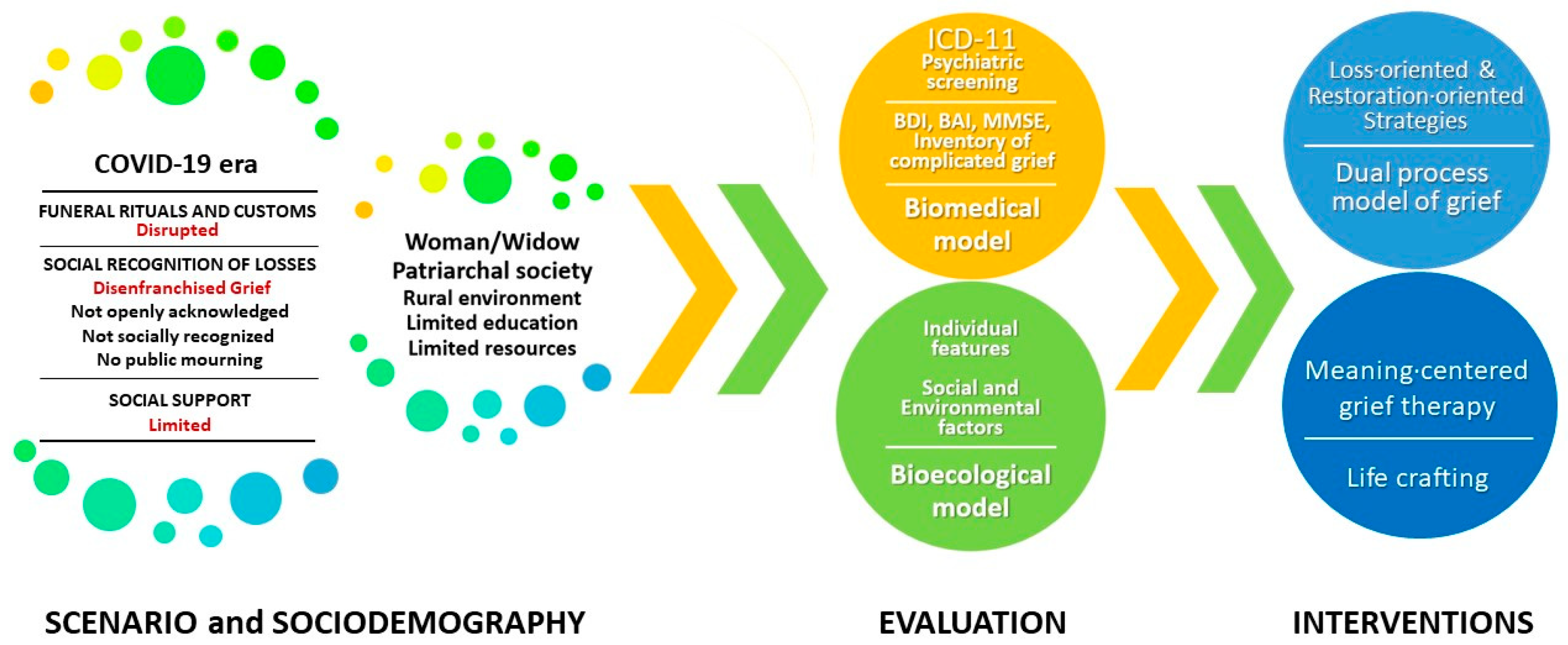
The COVID-19 pandemic was one of this century’s deadliest and most widespread viral outbreaks, with higher mortality rates in men than women. Disruptions in funeral rituals and customs, no social recognition of the losses, and limited social support have complicated the grieving process and are linked to disenfranchised (not openly acknowledged, socially recognized, or publicly mourned) grief. Depression is also highly comorbid with complicated grief. Losing a spouse can be devastating, and this is more severe for women with limited or no resources, who are vulnerable because of the patriarchal society. In the current COVID-19 era, increased uncertainty and disenfranchised grief can worsen the clinical scenario and hamper interventions, as highlighted by the present case report on disenfranchised grief with depressive symptoms in a 30-year-old woman from rural India who, after a year of marriage, lost her husband due to COVID-19. This case study emphasizes the impact of multiple types of disadvantages due to sociodemographic and cultural determinants that can complicate the grieving process in the current context. The bioecological model of grief recovery considers individual features and societal/environmental factors to postulate the appropriate intervention. Finding meaning and purpose in life and restoration-oriented coping were successful for the clinical management of the patient.
Keywords: disenfranchised grief; widowhood; rural India; COVID-19 pandemic; bioecological model; coping disenfranchised grief; widowhood; rural India; COVID-19 pandemic; bioecological model; coping