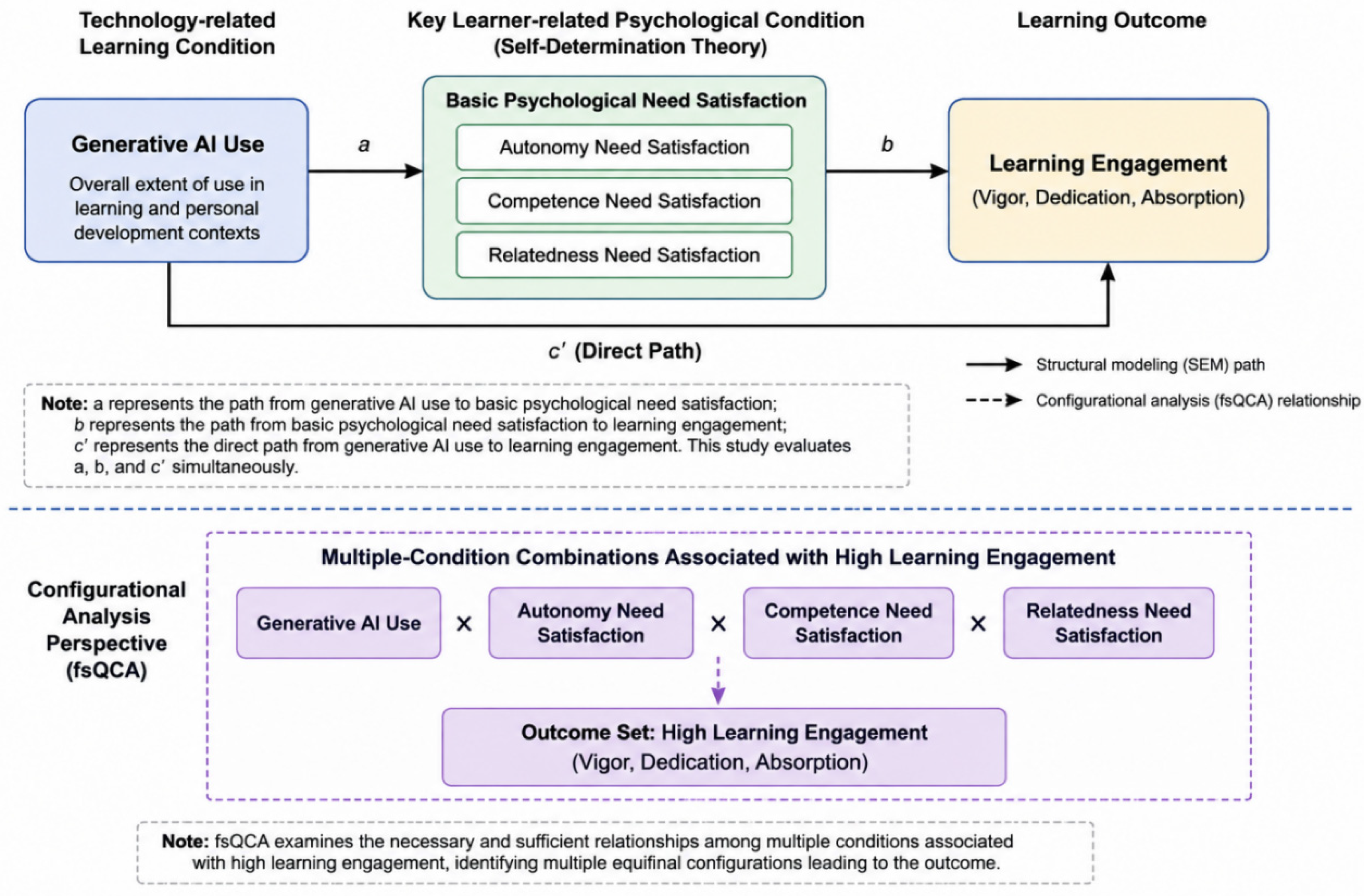
Generative Artificial Intelligence Use and Learning Engagement Among Medical Undergraduates: Statistical Indirect and Configurational Associations Involving Basic Psychological Need Satisfaction

Abstract
Share and Cite
He, Q.; Chang, G.; Su, N.; Yang, Y.; Ma, J. Generative Artificial Intelligence Use and Learning Engagement Among Medical Undergraduates: Statistical Indirect and Configurational Associations Involving Basic Psychological Need Satisfaction. Behav. Sci. 2026, 16, 1694. https://doi.org/10.3390/bs16091694
He Q, Chang G, Su N, Yang Y, Ma J. Generative Artificial Intelligence Use and Learning Engagement Among Medical Undergraduates: Statistical Indirect and Configurational Associations Involving Basic Psychological Need Satisfaction. Behavioral Sciences. 2026; 16(9):1694. https://doi.org/10.3390/bs16091694
Chicago/Turabian StyleHe, Qian, Guanglei Chang, Ning Su, Yingying Yang, and Jun Ma. 2026. "Generative Artificial Intelligence Use and Learning Engagement Among Medical Undergraduates: Statistical Indirect and Configurational Associations Involving Basic Psychological Need Satisfaction" Behavioral Sciences 16, no. 9: 1694. https://doi.org/10.3390/bs16091694
APA StyleHe, Q., Chang, G., Su, N., Yang, Y., & Ma, J. (2026). Generative Artificial Intelligence Use and Learning Engagement Among Medical Undergraduates: Statistical Indirect and Configurational Associations Involving Basic Psychological Need Satisfaction. Behavioral Sciences, 16(9), 1694. https://doi.org/10.3390/bs16091694