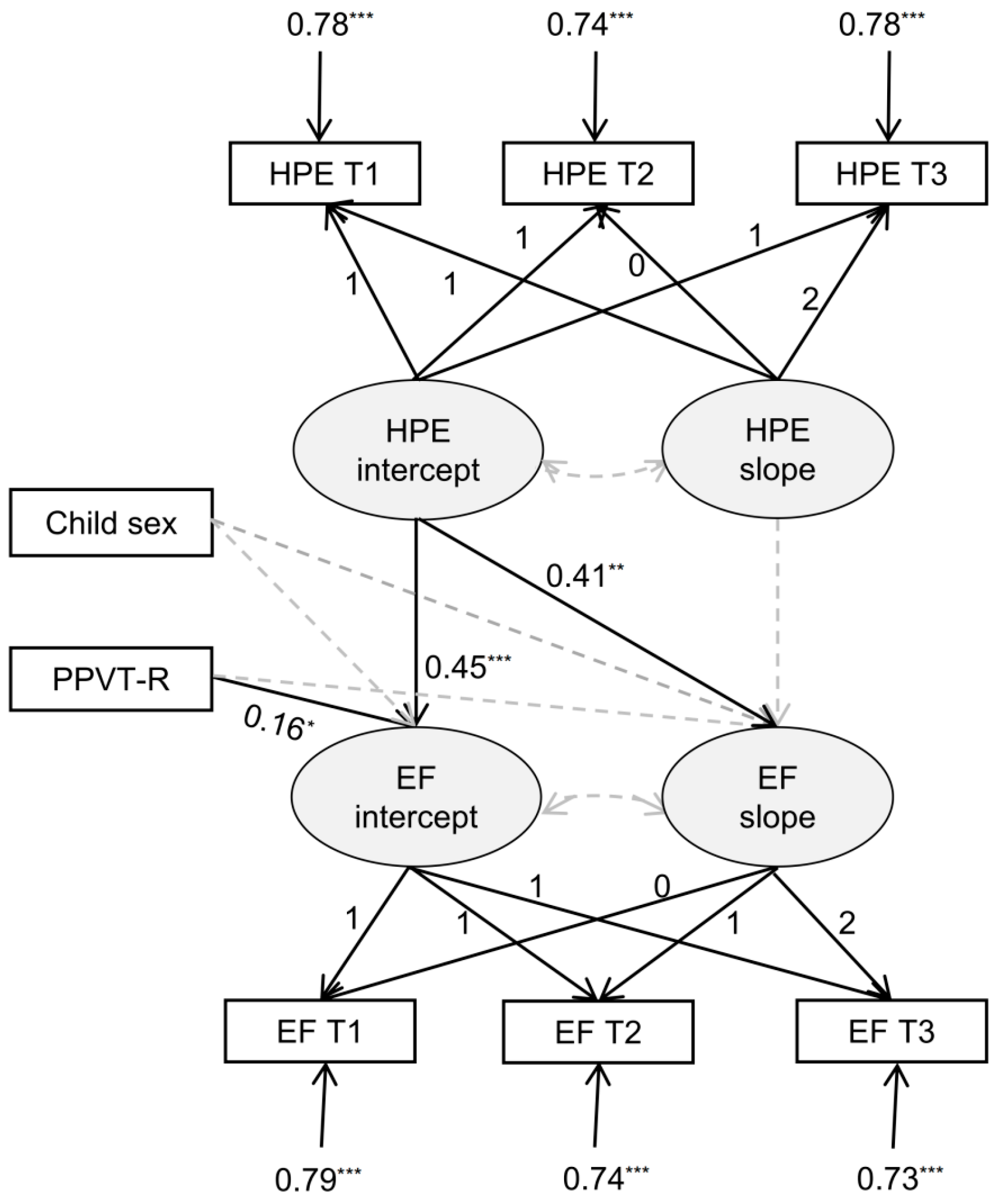


Home Parenting Environment and Executive Function Development in 5- to 6-Year-Old Children: A Three-Wave Longitudinal Study Using Multivariate Latent Growth Modeling

Abstract
1. Introduction
1.1. Conceptualization and Development of Executive Function
1.2. Conceptualization and Relative Stability of the Home Parenting Environment
1.3. Home Parenting Environment and Executive Function in 5- to 6-Year-Old Children
1.4. Child-Level Covariates: Sex and Language Ability
1.5. Developmental Significance of Ages 5 to 6 Years
1.6. The Present Study
2. Materials and Methods
2.1. Participants and Procedure
2.2. Measures
2.2.1. Executive Function
2.2.2. Home Parenting Environment
2.2.3. Baseline Language Ability
2.3. Data Analysis
3. Results
3.1. Assessment of Common Method Bias
3.2. Descriptive Statistics
3.3. Unconditional Latent Growth Model for Executive Function
3.4. Unconditional Latent Growth Model for the Home Parenting Environment
3.5. Conditional Latent Growth Model for Executive Function: Roles of Sex and Baseline Language Ability
3.6. Associations Between Executive Function Trajectories and the Initial Level of the Home Parenting Environment
4. Discussion
4.1. Developmental Trajectory of Executive Function in 5- to 6-Year-Old Children
4.2. Home Parenting Environment and Children’s Executive Function Trajectories
4.3. Roles of Baseline Language Ability and Child Sex
4.4. Practical Implications of the Findings
4.5. Strengths, Limitations, and Future Directions
5. Conclusions
Author Contributions
Funding
Institutional Review Board Statement
Informed Consent Statement
Data Availability Statement
Acknowledgments
Conflicts of Interest
References
- Andrews, K., Dunn, J. R., Prime, H., Duku, E., Atkinson, L., Tiwari, A., & Gonzalez, A. (2021). Effects of household chaos and parental responsiveness on child executive functions: A novel, multi-method approach. BMC Psychology, 9, 147. [Google Scholar] [CrossRef] [Scilit] [PubMed]
- Boise, C., & Knoche, L. L. (2024). Social–emotional competence for children with identified developmental concerns: The impact of parenting and executive function. Behavioral Sciences, 14(12), 1232. [Google Scholar] [CrossRef] [Scilit] [PubMed]
- Bronfenbrenner, U., & Morris, P. A. (2006). The bioecological model of human development. In R. M. Lerner, & W. Damon (Eds.), Handbook of child psychology: Vol. 1. Theoretical models of human development (6th ed., pp. 793–828). Wiley. [Google Scholar] [CrossRef] [Scilit]
- Bruce, M., Savla, J., & Bell, M. A. (2023). From terrible twos to sassy sixes: The development of vocabulary and executive functioning across early childhood. Developmental Science, 26(6), e13396. [Google Scholar] [CrossRef] [Scilit] [PubMed]
- Carolus, A. E., McLaughlin, K. A., Lengua, L. J., Rowe, M. L., Sheridan, M. A., Zalewski, M., Moran, L., & Romeo, R. R. (2024). Conversation disruptions in early childhood predict executive functioning development: A longitudinal study. Developmental Science, 27(1), e13414. [Google Scholar] [CrossRef] [Scilit] [PubMed]
- Castellanos-Ryan, N., Parent, S., Chaput-Langlois, S., Rioux, C., Jacques, S., Simard, C., Tremblay, R. E., Séguin, J. R., & Zelazo, P. D. (2023). Modelling executive function across early childhood: Longitudinal invariance, development from 3.5 to 7 years and later academic performance. Cognitive Development, 68, 101365. [Google Scholar] [CrossRef] [Scilit]
- Castelo, R. J., Meuwissen, A. S., Distefano, R., McClelland, M. M., Galinsky, E., Zelazo, P. D., & Carlson, S. M. (2022). Parent provision of choice is a key component of autonomy support in predicting child executive function skills. Frontiers in Psychology, 12, 773492. [Google Scholar] [CrossRef] [Scilit] [PubMed]
- Cheng, C. H., Tein, J.-Y., Shaw, D. S., Wilson, M. N., & Lemery-Chalfant, K. (2025). Predictors of stability/change in observed parenting patterns across early childhood: A latent transition approach. Early Childhood Research Quarterly, 70, 91–101. [Google Scholar] [CrossRef] [Scilit] [PubMed]
- Chu, L., & Joseph, G. E. (2024). The development of executive function among monolingual English-speaking and dual language learning children in early childhood settings. International Journal of Bilingual Education and Bilingualism, 27(8), 1036–1052. [Google Scholar] [CrossRef] [Scilit]
- Cumming, M. M., Poling, D. V., Patwardhan, I., & Ozenbaugh, I. C. (2022). Executive function in kindergarten and development of behavioral competence: The moderating role of positive parenting practices. Early Childhood Research Quarterly, 60, 161–172. [Google Scholar] [CrossRef] [Scilit] [PubMed]
- Čepukienė, V., & Janulevičė, J. (2025). Parental discipline and self-regulation in children aged 2 to 5: A meta-analysis of research conducted from 2000 to 2022. Child & Youth Care Forum, 54(4), 999–1023. [Google Scholar] [CrossRef] [Scilit]
- Dallaire, D. H., & Weinraub, M. (2005). The stability of parenting behaviors over the first 6 years of life. Early Childhood Research Quarterly, 20(2), 201–219. [Google Scholar] [CrossRef] [Scilit]
- Diamond, A. (2013). Executive functions. Annual Review of Psychology, 64, 135–168. [Google Scholar] [CrossRef] [Scilit] [PubMed]
- Distefano, R., Nelson, K. M., Palmer, A. R., Masten, A. S., & Carlson, S. M. (2024). The role of parenting in autonomy and executive function development among young children experiencing homelessness. Children and Youth Services Review, 166, 107997. [Google Scholar] [CrossRef] [Scilit]
- Draper, C. E., Yousafzai, A. K., McCoy, D. C., Cuartas, J., Obradović, J., Bhopal, S., Fisher, J., Jeong, J., Klingberg, S., Milner, K., Pisani, L., Roy, A., Seiden, J., Sudfeld, C. R., Wrottesley, S. V., Fink, G., Nores, M., Tremblay, M. S., & Okely, A. D. (2024). The next 1000 days: Building on early investments for the health and development of young children. The Lancet, 404(10467), 2094–2116. [Google Scholar] [CrossRef] [Scilit] [PubMed]
- Ernst, J., & Stelley, H. (2024). Supporting young children’s self-regulation through nature-based practices in preschool. Behavioral Sciences, 14(11), 1013. [Google Scholar] [CrossRef] [Scilit] [PubMed]
- Fan, L., Qing, W., Wang, Y., & Zhan, M. (2022). Family socioeconomic status and attention deficit/hyperactivity disorder in preschool children: The mediating role of executive function. International Journal of Environmental Research and Public Health, 19(18), 11608. [Google Scholar] [CrossRef] [Scilit] [PubMed]
- Filipe, M. G., Veloso, A. S., & Frota, S. (2023). Executive functions and language skills in preschool children: The unique contribution of verbal working memory and cognitive flexibility. Brain Sciences, 13(3), 470. [Google Scholar] [CrossRef] [Scilit] [PubMed]
- Foley, J. E., Olino, T. M., & Weinraub, M. (2025). On the broader significance of maternal sensitivity: Mothers’ early and later sensitive parenting matter to children’s language, executive function, academics, and self-reliance. Developmental Science, 28(1), e13594. [Google Scholar] [CrossRef] [Scilit] [PubMed]
- Fung, W. K., Chung, K. K. H., & Lam, C. B. (2023). The longitudinal associations of household economic pressure and home chaos with children’s executive functioning, word reading, and school readiness. Child & Youth Care Forum, 52(6), 1299–1321. [Google Scholar] [CrossRef] [Scilit]
- Gioia, G. A., Espy, K. A., & Isquith, P. K. (2003). Behavior rating inventory of executive function–preschool version (BRIEF-P). Psychological Assessment Resources. [Google Scholar]
- Gooch, D., Thompson, P., Nash, H. M., Snowling, M. J., & Hulme, C. (2016). The development of executive function and language skills in the early school years. Journal of Child Psychology and Psychiatry, 57(2), 180–187. [Google Scholar] [CrossRef] [Scilit] [PubMed]
- Gregoriadis, A., & Evangelou, M. (2022). Revisiting the home learning environment: Introducing the home learning ecosystem. Australasian Journal of Early Childhood, 47(3), 206–218. [Google Scholar] [CrossRef] [Scilit]
- Grissom, N. M., & Reyes, T. M. (2019). Let’s call the whole thing off: Evaluating gender and sex differences in executive function. Neuropsychopharmacology, 44(1), 86–96. [Google Scholar] [CrossRef] [Scilit] [PubMed]
- Hanlin, P., & Zhou, Q. (2024). A unified framework of parental socialization of executive function development. Developmental Review, 73, 101149. [Google Scholar] [CrossRef] [Scilit]
- He, S.-S. (2008). Development and validation of the early childhood home parenting environment scale [Doctoral dissertation, Shandong University]. (In Chinese) [Google Scholar]
- Heeman, E. J., Forslund, T., Frick, M. A., Frick, A., Jónsdóttir, L. K., & Brocki, K. C. (2024). Predicting emotion regulation in typically developing toddlers: Insights into the joint and unique influences of various contextual predictors. International Journal of Behavioral Development, 48(5), 398–410. [Google Scholar] [CrossRef] [Scilit]
- Heinze, H., Daseking, M., Gawrilow, C., Karbach, J., & Kerner auch Koerner, J. (2025). Self-regulation in preschool: Are executive function and effortful control overlapping constructs? Developmental Science, 28(1), e13595. [Google Scholar] [CrossRef] [Scilit] [PubMed]
- Hughes, C., & Devine, R. T. (2019). For better or for worse? Positive and negative parental influences on young children’s executive function. Child Development, 90(2), 593–609. [Google Scholar] [CrossRef] [Scilit] [PubMed]
- Isdahl-Troye, A., Villar, P., Álvarez-Voces, M., & Romero, E. (2025). Unraveling the dynamics of emotional regulation and parental warmth across early childhood: Prediction of later behavioral problems. Scientific Reports, 15, 23294. [Google Scholar] [CrossRef] [Scilit] [PubMed]
- Jiang, C., Li, X., Du, B.-C., Huang, J., Li, Y., Zhang, Y., Wei, M., Xu, X., Yang, Y., & Jiang, H. (2024). Role of home nurturing environment on early childhood neurodevelopment: A community-based survey in Shanghai, China. BMC Pediatrics, 24, 721. [Google Scholar] [CrossRef] [Scilit] [PubMed]
- Karimi, A., Poznanski, B., Hart, K. C., & Nelson, E. L. (2025). Fine motor skills, executive function, and school readiness in preschoolers with externalizing behavior problems. Behavioral Sciences, 15(5), 708. [Google Scholar] [CrossRef] [Scilit] [PubMed]
- Koşkulu-Sancar, S., van de Weijer-Bergsma, E., Mulder, H., & Blom, E. (2023). Examining the role of parents and teachers in executive function development in early and middle childhood: A systematic review. Developmental Review, 67, 101063. [Google Scholar] [CrossRef] [Scilit]
- Ku, S., & Blair, C. (2023). Profiles of early family environments and the growth of executive function: Maternal sensitivity as a protective factor. Development and Psychopathology, 35(1), 314–331. [Google Scholar] [CrossRef] [Scilit] [PubMed]
- Lohndorf, R., Vermeer, H. J., De la Harpe, C., & Mesman, J. (2021). Socioeconomic status, parental beliefs, and parenting practices as predictors of preschoolers’ school readiness and executive functions. Early Childhood Research Quarterly, 57, 61–74. [Google Scholar] [CrossRef] [Scilit]
- Lu, T.-F., Shuai, L., Zhang, J.-S., Wang, Y.-F., Qian, Y., Zhang, H.-F., Xia, W.-P., Wang, Z.-Y., & Tan, X. (2017). Reliability and validity of the Chinese version of the Behavior Rating Inventory of Executive Function–Preschool Version parent form. Chinese Mental Health Journal, 31(2), 138–143. (In Chinese) [Google Scholar] [CrossRef]
- Memba, G. V., & Ostrov, J. M. (2025). Executive functioning across the transition to kindergarten: Links with social and academic outcomes in early childhood. Social Development, 34(1), e12788. [Google Scholar] [CrossRef] [Scilit]
- Merculief, A., Tsethlikai, M., & Muniz, F. (2024). Applying an Indigenous connectedness framework to examine environmental risk and protective factors for urban American Indian children’s executive function development. Behavioral Sciences, 14(12), 1202. [Google Scholar] [CrossRef] [Scilit] [PubMed]
- Merz, E. C., Landry, S. H., Montroy, J. J., & Williams, J. M. (2017). Bidirectional associations between parental responsiveness and executive function during early childhood. Social Development, 26(3), 591–609. [Google Scholar] [CrossRef] [Scilit] [PubMed]
- Murphy, Y. E., Zhang, X., & Gatzke-Kopp, L. (2022). Early executive and school functioning: Protective roles of home environment by income. Journal of Applied Developmental Psychology, 78, 101369. [Google Scholar] [CrossRef] [Scilit] [PubMed]
- Pitta, A. (2026). Executive functions in research and practice: A multimethod review of behavioral, subjective, and neurobiological assessment tools. Frontiers in Psychology, 17, 1713652. [Google Scholar] [CrossRef] [Scilit] [PubMed]
- Prime, H., Andrews, K., Markwell, A., Gonzalez, A., Janus, M., Tricco, A. C., Bennett, T., & Atkinson, L. (2023). Positive parenting and early childhood cognition: A systematic review and meta-analysis of randomized controlled trials. Clinical Child and Family Psychology Review, 26(2), 362–400. [Google Scholar] [CrossRef] [Scilit] [PubMed]
- Reilly, S. E., Downer, J. T., & Grimm, K. J. (2022). Developmental trajectories of executive functions from preschool to kindergarten. Developmental Science, 25(5), e13236. [Google Scholar] [CrossRef] [Scilit] [PubMed]
- Rungsattatharm, L., Tasingha, P., Trairatvorakul, P., & Chonchaiya, W. (2025). Longitudinal associations between executive function and positive parenting during early childhood and resilience, self-regulation, and behavioral problems in school-age children. Child and Adolescent Psychiatry and Mental Health, 19(1), 19. [Google Scholar] [CrossRef] [Scilit] [PubMed]
- Sang, B., & Miao, X.-C. (1990). Revision of the Shanghai urban trial norms for the peabody picture vocabulary test–revised. Psychological Science Communications, 13(5), 22–27, 65–67. (In Chinese) [Google Scholar] [CrossRef]
- Selman, S. B., Distefano, R., Dilworth-Bart, J. E., & Brooks-Gunn, J. (2026). Child routines across preschool and associations with socioemotional adjustment. Journal of Family Psychology, 40(1), 25–36. [Google Scholar] [CrossRef] [Scilit] [PubMed]
- Silverman, I. W. (2021). Gender differences in inhibitory control as assessed on simple delay tasks in early childhood: A meta-analysis. International Journal of Behavioral Development, 45(6), 533–544. [Google Scholar] [CrossRef] [Scilit]
- Stucke, N. J., & Doebel, S. (2024). Early childhood executive function predicts concurrent and later social and behavioral outcomes: A review and meta-analysis. Psychological Bulletin, 150(10), 1178–1206. [Google Scholar] [CrossRef] [Scilit] [PubMed]
- Turnbull, K. L. P., DeCoster, J., Downer, J. T., & Williford, A. P. (2024). Elucidating linkages of executive functioning to school readiness skill gains: The mediating role of behavioral engagement in the PreK classroom. Early Childhood Research Quarterly, 69, 38–48. [Google Scholar] [CrossRef] [Scilit] [PubMed]
- Vanhala, A., Lee, K., Korhonen, J., & Aunio, P. (2023). Dimensionality of executive functions and processing speed in preschoolers. Learning and Individual Differences, 107, 102361. [Google Scholar] [CrossRef] [Scilit]
- Venkadasalam, V. P., Jenkins, J. M., Ganea, P. A., & Wade, M. (2022). Linking early maternal input during shared reading to later theory of mind through receptive language and executive function: A within- and between-family design. Journal of Experimental Child Psychology, 223, 105469. [Google Scholar] [CrossRef] [Scilit] [PubMed]
- Wang, S., & Gai, X. (2024). Bidirectional relationship between positive parenting behavior and children’s self-regulation: A three-wave longitudinal study. Behavioral Sciences, 14(1), 38. [Google Scholar] [CrossRef] [Scilit] [PubMed]
- Werchan, D. M., Ku, S., Berry, D., & Blair, C. (2023). Sensitive caregiving and reward responsivity: A novel mechanism linking parenting and executive functions development in early childhood. Developmental Science, 26(2), e13293. [Google Scholar] [CrossRef] [Scilit] [PubMed]
- Xing, X., Wei, Y., & Wang, M. (2022). Reciprocal relation between executive function and receptive vocabulary in Chinese preschoolers: Evidence from a two-year longitudinal study. Developmental Psychology, 58(1), 83–95. [Google Scholar] [CrossRef] [Scilit] [PubMed]
- Yang, Y., Shields, G. S., Zhang, Y., Wu, H., Chen, H., & Romer, A. L. (2022). Child executive function and future externalizing and internalizing problems: A meta-analysis of prospective longitudinal studies. Clinical Psychology Review, 97, 102194. [Google Scholar] [CrossRef] [Scilit] [PubMed]
- Zakharova, M. N., Machinskaya, R. I., & Agris, A. R. (2022). Brain executive functions and learning readiness in senior preschool age. Cultural-Historical Psychology, 18(3), 81–91. [Google Scholar] [CrossRef] [Scilit]
- Zhan, S., & Guo, J. (2023). How household chaos affects social withdrawal of rural children: The indirect role of executive function and receptive language ability. Frontiers in Psychology, 14, 1212426. [Google Scholar] [CrossRef] [Scilit] [PubMed]


| M | SD | 1 | 2 | 3 | 4 | 5 | 6 | 7 | 8 | |
|---|---|---|---|---|---|---|---|---|---|---|
| 1. Child sex | 1.45 | 0.50 | 1.00 | |||||||
| 2. PPVT-R | 57.17 | 16.30 | 0.05 | 1.00 | ||||||
| 3. EF T1 | 2.35 | 0.34 | 0.03 | 0.22 *** | 1.00 | |||||
| 4. EF T2 | 2.43 | 0.36 | 0.09 | 0.25 *** | 0.54 *** | 1.00 | ||||
| 5. EF T3 | 2.49 | 0.36 | 0.09 | 0.29 *** | 0.55 *** | 0.71 *** | 1.00 | |||
| 6. HPE T1 | 3.85 | 0.56 | 0.07 | 0.13 * | 0.29 *** | 0.31 *** | 0.32 *** | 1.00 | ||
| 7. HPE T2 | 3.89 | 0.54 | 0.08 | 0.19 ** | 0.32 *** | 0.44 *** | 0.34 *** | 0.61 *** | 1.00 | |
| 8. HPE T3 | 3.89 | 0.57 | 0.03 | 0.18 ** | 0.25 *** | 0.32 *** | 0.42 *** | 0.58 *** | 0.58 *** | 1.00 |
| Construct | Model | χ2(df) | p | CFI | TLI | RMSEA (90% CI) | SRMR |
|---|---|---|---|---|---|---|---|
| Home parenting environment | Unconditional growth model | 0.85(3) | 0.84 | 1.00 | 1.00 | 0.00 [0.00, 0.06] | 0.04 |
| Executive function | Unconditional growth model | 0.53(1) | 0.47 | 1.00 | 1.01 | 0.00 [0.00, 0.15] | 0.01 |
| Executive function | Conditional growth model | 0.92(3) | 0.82 | 1.00 | 1.03 | 0.00 [0.00, 0.06] | 0.01 |
| Predictor | Outcome | B (SE) | β | 95% CI | p |
|---|---|---|---|---|---|
| Home parenting environment intercept | Executive function intercept | 0.304 (0.057) | 0.446 | [0.191, 0.417] | <0.001 |
| Home parenting environment intercept | Executive function slope | 0.082 (0.028) | 0.409 | [0.027, 0.138] | 0.004 |
| PPVT-R | Executive function intercept | 0.003 (0.001) | 0.162 | [0.001, 0.005] | 0.032 |
| PPVT-R | Executive function slope | 0.001 (0.001) | 0.132 | [−0.001, 0.002] | 0.196 |
| Child sex | Executive function intercept | 0.022 (0.038) | 0.043 | [−0.052, 0.097] | 0.554 |
| Child sex | Executive function slope | 0.013 (0.019) | 0.087 | [−0.024, 0.050] | 0.477 |
Disclaimer/Publisher’s Note: The statements, opinions and data contained in all publications are solely those of the individual author(s) and contributor(s) and not of MDPI and/or the editor(s). MDPI and/or the editor(s) disclaim responsibility for any injury to people or property resulting from any ideas, methods, instructions or products referred to in the content. |
© 2026 by the authors. Licensee MDPI, Basel, Switzerland. This article is an open access article distributed under the terms and conditions of the Creative Commons Attribution (CC BY) license.
Share and Cite
Shi, S.; Guan, M.; Yu, M.; Wang, J. Home Parenting Environment and Executive Function Development in 5- to 6-Year-Old Children: A Three-Wave Longitudinal Study Using Multivariate Latent Growth Modeling. Behav. Sci. 2026, 16, 1415. https://doi.org/10.3390/bs16081415
Shi S, Guan M, Yu M, Wang J. Home Parenting Environment and Executive Function Development in 5- to 6-Year-Old Children: A Three-Wave Longitudinal Study Using Multivariate Latent Growth Modeling. Behavioral Sciences. 2026; 16(8):1415. https://doi.org/10.3390/bs16081415
Chicago/Turabian StyleShi, Song, Mengqi Guan, Mengyao Yu, and Jiaman Wang. 2026. "Home Parenting Environment and Executive Function Development in 5- to 6-Year-Old Children: A Three-Wave Longitudinal Study Using Multivariate Latent Growth Modeling" Behavioral Sciences 16, no. 8: 1415. https://doi.org/10.3390/bs16081415
APA StyleShi, S., Guan, M., Yu, M., & Wang, J. (2026). Home Parenting Environment and Executive Function Development in 5- to 6-Year-Old Children: A Three-Wave Longitudinal Study Using Multivariate Latent Growth Modeling. Behavioral Sciences, 16(8), 1415. https://doi.org/10.3390/bs16081415