1. Introduction
Across sectors, technological advancement, including artificial intelligence and automation, is reshaping how organizations manage their workforce. However, in long-term care, the relational nature of care work means that technology is more likely to complement care workers than to replace them (
OECD, 2020). Therefore, ensuring care quality and retaining a stable workforce depend heavily on human resource management (HRM), including training, improved working conditions, and support for motivation (
OECD, 2020).
The shortage of long-term care workers driven by the rapid population aging is a challenge across advanced economies. In response, many countries have implemented policies centered primarily on financial incentives, such as wage increases (
OECD, 2020). Japan is no exception, with the national government continuously implementing treatment improvement measures (
Ministry of Health, Labour and Welfare, 2015,
2017). Although such measures have merit, they are insufficient for reducing turnover and sustaining motivation, and multifaceted approaches (e.g., improvements in the work environment and investment in training and development) are necessary (
OECD, 2020). A review of Japan’s long-term care sector by
Takeda (
2023) identified workplace interpersonal relationships as a key predictor of turnover intention.
Previous research in healthcare and social welfare has examined high-commitment human resource management (HCHRM), grounded in ability–motivation–opportunity (AMO) theory, as a framework for improving outcomes through employee commitment, with evidence supporting its effectiveness (e.g.,
Renkema et al., 2021;
Schopman et al., 2015). In long-term care,
Hasenfeld (
1983,
2010), who established the foundational framework of human services organizations, argued that care quantity and quality depend not only on knowledge, skills, and motivation but also on empowerment through on-the-ground discretion and mutual adjustment, making AMO theory well suited to this sector.
However, several research gaps remain. First, much of the HCHRM literature relies on single-level analysis, leaving underexplored how organizational practices interact with individual experiences and workplace relationships (
Harley et al., 2007;
Renkema et al., 2021;
Rondeau & Wagar, 2001;
Schopman et al., 2015). Although HRM practices are implemented at the organizational level, their effects materialize through employees’ perceptions and behaviors (
Wright & Nishii, 2006). Data reflecting this organizational–individual hierarchy and analyses that separate these levels are therefore essential. Second, many studies treat AMO components as a bundled construct, without adequately examining the effects of individual practices. Particularly, opportunity-enhancing practices (i.e., environmental conditions that enable ability and motivation to be realized) remain underexamined in terms of content and mechanisms. Third, most HCHRM studies emphasize performance improvement, with limited attention to “sustainable careers”—a perspective that foregrounds the long-term continuity of the employment relationship and workers’ capacity to sustain and adapt their careers over time (
De Vos et al., 2020;
Van der Heijden & De Vos, 2015). Fourth, despite the consistent emphasis on leadership and teamwork in long-term care (
de Bruin et al., 2022;
Harley et al., 2007;
Renkema et al., 2021;
Rondeau & Wagar, 2001;
Schopman et al., 2015), research integrating workplace relationship quality, including leader–member exchange (LMX) and coworker exchange (CWX), into HCHRM models remains limited. Notably, studies incorporating CWX are largely absent, and the moderating role of opportunity-enhancing practices in these relationships remains unexplored.
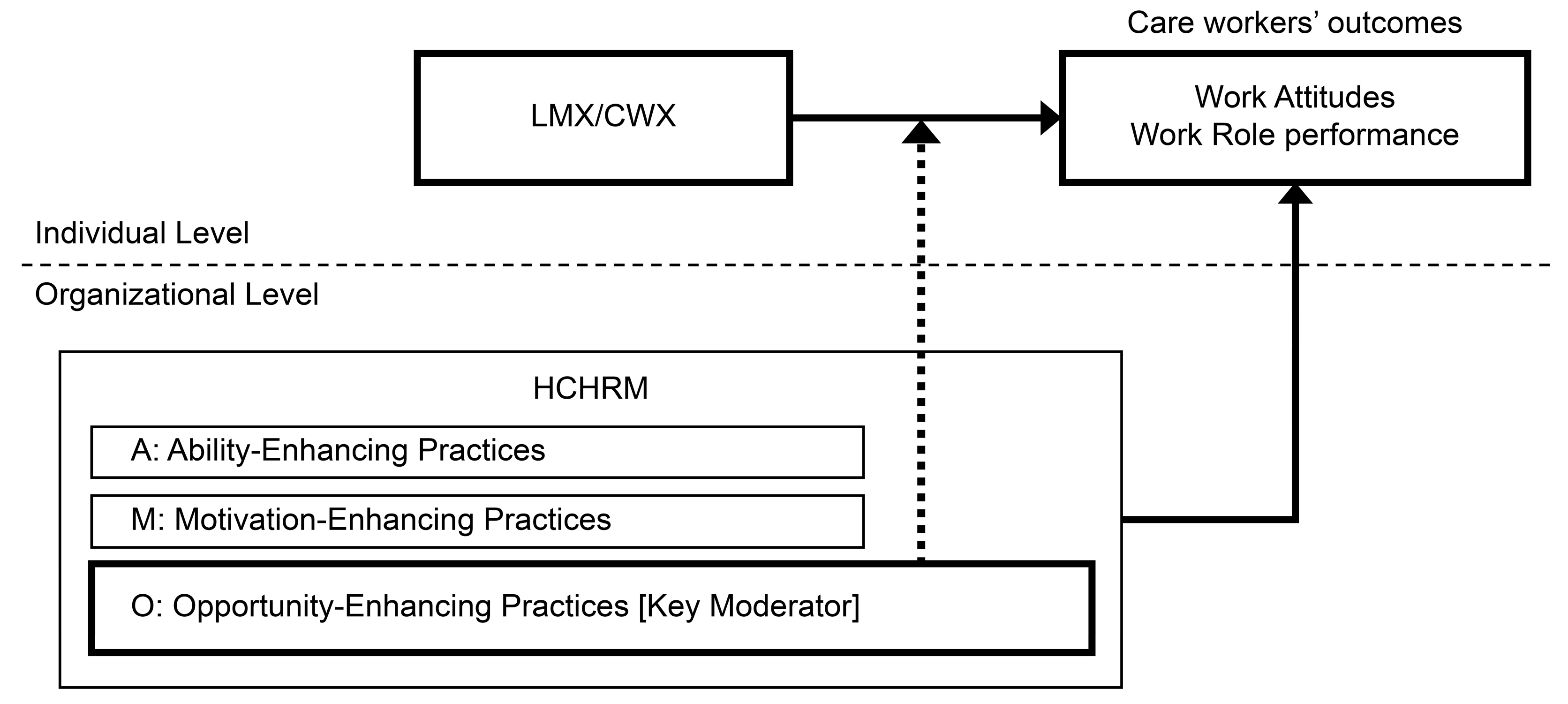
Accordingly, this study aims to examine how AMO theory-grounded HCHRM relates to work attitudes and work role performance among long-term care workers, through a sustainable-careers lens. Multilevel analysis is employed to statistically disentangle organizational- and individual-level variables and examine cross-level effects between the two. Among AMO-based HCHRM practices, work–life balance (WLB) support is incorporated as an opportunity-enhancing factor alongside the autonomy and discretion examined in previous research, as a means of supporting care workers’ sustainable careers. This study examines both the direct associations of WLB support and its cross-level moderating role in relation to social resources (LMX and CWX). In this framework, LMX and CWX represent individual-level social resources, while opportunity-enhancing practices function as organizational conditions that enable these resources to translate into outcomes.
This study makes two important contributions. First, it examines HCHRM through a sustainable-careers lens and its associations with care workers’ work attitudes and work role performance using hierarchically structured data across organizational and individual levels. Accordingly, it extends HCHRM research beyond performance toward long-term employment sustainability and adaptability. Second, by positioning WLB support as an opportunity-enhancing practice and empirically examining its direct associations and moderating role in relation to LMX and CWX, it provides practical implications for the design of HR practices aimed at workforce retention and development in long-term care settings.
5. Discussion
This study examines, using multilevel analysis, how organizational HRM practices relate to work attitudes and work role performance among long-term care workers, viewed through a sustainable-careers lens, with HCHRM grounded in AMO theory as the framework.
5.1. RQ1: Main Effects of HCHRM
The findings for RQ1 indicate that opportunity-enhancing practices and individual-level social resources are associated with care workers’ outcomes, though the specific associations varied across practices and outcomes, as detailed below. First, opportunity-enhancing practices (O: autonomous team management and WLB support) and individual incentives (M) were positively associated with affective commitment, consistent with the findings of a meta-analysis by
Jiang et al. (
2012). The association of WLB support (O) with affective commitment suggests that opportunities for resource recovery and perceived control support sustained organizational attachment (
Batt & Valcour, 2003;
Hobfoll et al., 2018). Given that care workers often face irregular schedules and high task uncertainty requiring judgment without clear solutions, they may find it difficult to manage work–life boundaries. Organizational WLB support may therefore play a particularly important role in sustaining their affective commitment. However, notably, WLB support was associated with affective commitment but not directly with turnover intention or work role performance; as discussed in
Section 5.2, its association with lower turnover emerged in conjunction with social resources rather than as a direct effect. The positive associations of autonomous team management and training and development with proficiency behavior align with
Sugano’s (
2020) and
Jiang et al.’s (
2012) findings.
Second, organizational-level associations were more pronounced for work attitudes, whereas individual-level associations were more prominent for work role performance. The absence of direct organizational associations with adaptive-proactive behavior suggests that these higher-order behaviors depend more on individual factors such as experience and role. In long-term care, workers must often respond flexibly within multidisciplinary teams to varying care needs and family expectations. This suggests that their judgment abilities may develop primarily through accumulated experience and ongoing coworker interactions. Relatedly, organizational-level practices were associated with affective commitment—an attitude possibly shared within establishments—but not directly with the more distal outcome of turnover intention. This gradient may suggest that organizational-level influences reach distal outcomes such as turnover intention indirectly, through more proximal and collectively shared attitudes such as affective commitment. I did not test such mediation directly, and this interpretation awaits future research using designs suited to estimating indirect effects.
Third, organizational incentives showed limited associations with the outcomes, including a weak negative association with turnover intention, no significant association with affective commitment, and a weak negative association with proficiency behavior. These associations were small in magnitude, and the measure captured workers’ perceptions of incentive practices rather than objective compensation levels or policy-level financial incentives. Therefore, I have refrained from an unnecessarily stringent and strong interpretation; although the pattern is consistent with a possible crowding-out of intrinsic motivation by extrinsic rewards (
Frey & Jegen, 2001), this mechanism was not directly tested and remains a question for future research. Nonetheless, the limited associations of organizational incentives, together with the more consistent associations of opportunity-enhancing practices, are consistent with the broader argument that approaches relying primarily on government-led wage measures may be insufficient on their own.
5.2. RQ2: Cross-Level Interactions Between Opportunity-Enhancing Practices and Social Resources
The analyses addressing RQ2 indicated that the associations involving horizontal CWX were stronger under higher levels of organizational opportunity provision for work attitudes and work role performance among long-term care workers. First, CWX showed significant associations across outcomes, whereas LMX associations were more limited. This finding diverges from those in the study by
Sherony and Green (
2002), who reported stronger effects for LMX. Although this result may partly reflect the collectivistic characteristics of Japanese society, it more directly implies the distinctive nature of long-term care work. Specifically, the 24-h shift system creates temporal and physical separation between supervisors and subordinates, limiting direct supervisory support, while the extremely high task interdependence among workers requires close coworker coordination. This can explain why CWX, reflecting relationships with proximate and psychologically connected coworkers, emerged as a stronger predictor of attitudes and behavior, potentially reflecting the structural characteristics of long-term care work.
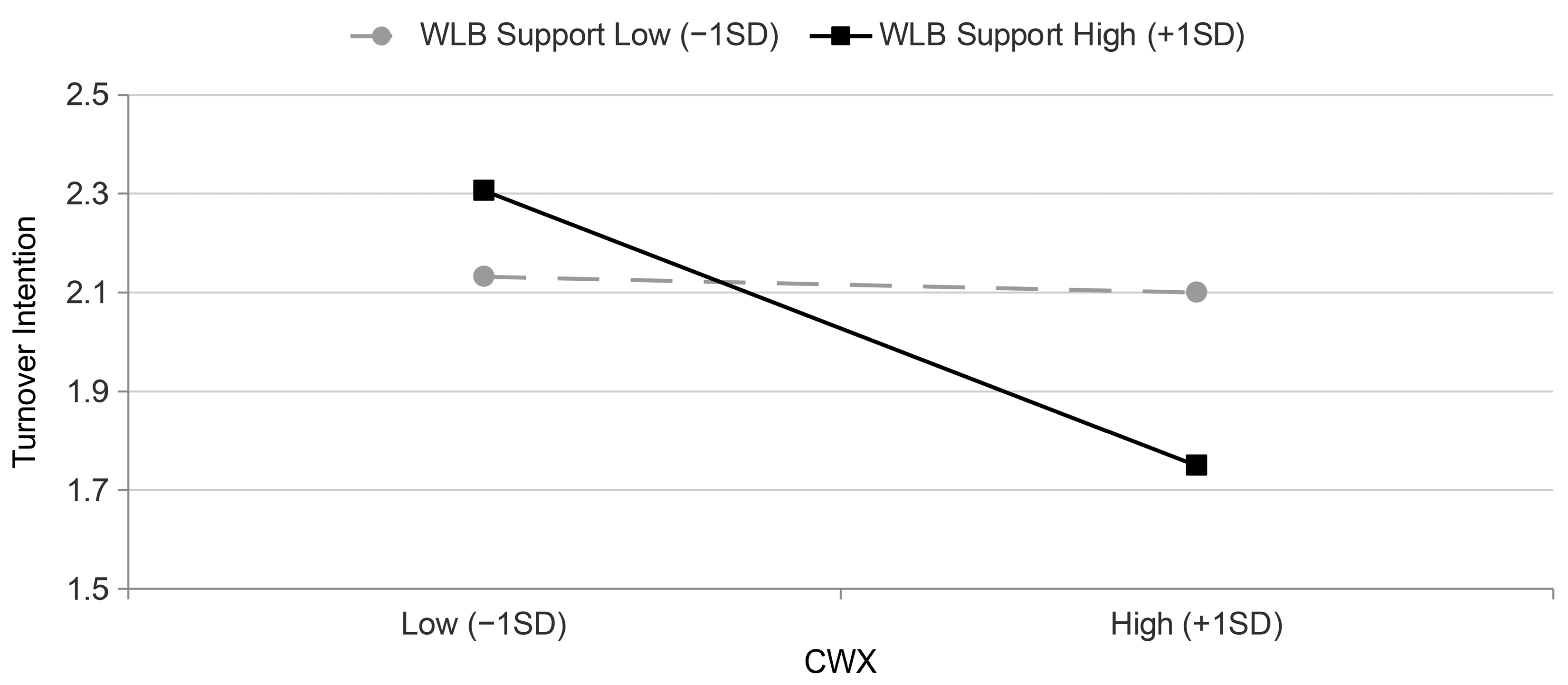
Second, the associations involving social resources were stronger under higher levels of opportunity-enhancing practices, and the pattern differed by outcome. These findings support AMO theory, which posits that opportunity-enhancing practices (O) function as conditions that moderate the contribution of individual ability and motivation (
Blumberg & Pringle, 1982;
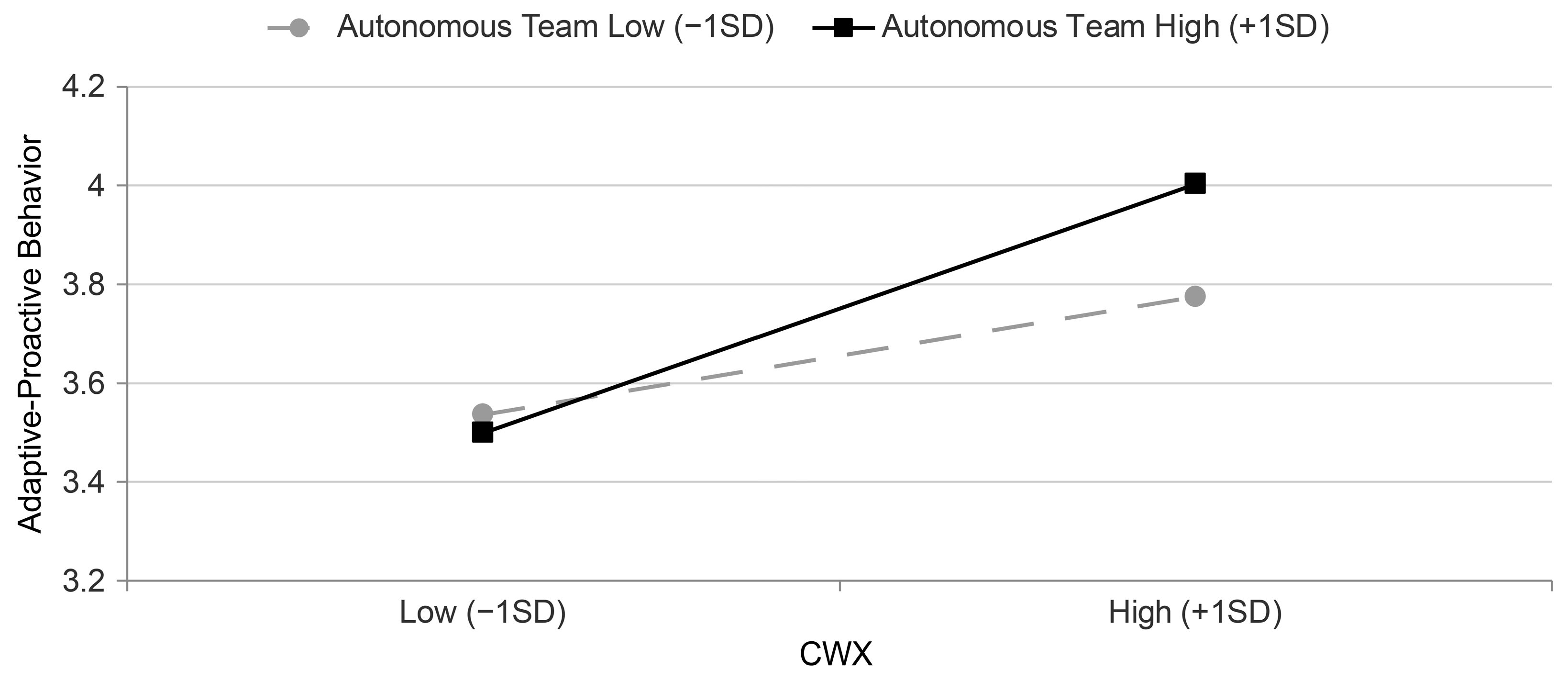
Bos-Nehles et al., 2023). Regarding turnover intention, WLB support moderated the associations of both LMX and CWX, indicating that opportunities for resource recovery may strengthen the retention-related benefits of supportive workplace relationships in general, whether vertical or horizontal. Regarding work role performance, by contrast, the moderating associations were confined to CWX: higher WLB support was associated with a partially stronger link between CWX and proficiency behavior, and higher autonomous team management with a partially stronger link between CWX and adaptive-proactive behavior. This contrast implies that, whereas resource recovery may broadly reinforce the relational basis of retention, the activation of higher work role performance appears to depend more specifically on horizontal coworker relationships in team-based care. These patterns are consistent with the idea that, in team-based care, WLB support may generate psychological capacity that workers can direct toward coworker relationships (
Hobfoll et al., 2018). These patterns, interpreted through a sustainable-careers lens, can be understood as relating to the core elements emphasized in that literature: long-term employment continuity and adaptive engagement with change.
I have further noted that WLB support was associated with affective commitment—and, through cross-level interactions, with retention- and performance-related outcomes—even though men were partially overrepresented in the present sample relative to the predominantly female care workforce. Because WLB needs are sometimes assumed to be more salient among women, who more often carry domestic and caregiving responsibilities, the emergence of these associations in a comparatively male-skewed sample may indicate that the relevance of WLB support is not confined to a particular gender group. However, this interpretation remains tentative as the study did not test gender differences in these associations directly.
5.3. Theoretical and Practical Implications
This study makes three main theoretical contributions. First, it applies multilevel analysis to the long-term care sector, where empirical HRM research remains limited, and clarifies how organizational-level HCHRM relates to care workers’ outcomes. Second, the study positions WLB support as an opportunity component within AMO theory and examines its moderating role in relation to CWX. This contributes to sustainable HRM research (
De Vos & Van der Heijden, 2017) by implying that resource recovery and autonomy may strengthen the role of interpersonal resources. Third, it highlights the central role of CWX in long-term care settings.
Three practical implications follow from these findings. First, organizations should introduce and promote WLB support practices, such as reducing excessive working hours, encouraging paid leave use, and supporting the balance of work and family responsibilities. These practices may be particularly effective in combination with supportive coworker relationships, as indicated by the cross-level patterns observed here, making it essential to cultivate an organizational climate where they are actively utilized. Second, promoting autonomous team management, such as through delegation of authority and support for team-level decision-making, is recommended. This approach was associated with proactive work behavior—particularly in combination with strong coworker relationships—but requires a shift away from top-down organizational cultures. Third, alongside these structural supports, organizations should foster a workplace climate that nurtures positive coworker relationships. Given the interpersonal demands of long-term care work, where stress and conflict are prone to arise, organizations should not rely solely on individual effort but instead create supportive environments through structured practices such as facilitating open dialogue, conducting regular check-ins, and improving information sharing and team meetings.
5.4. Limitations and Future Directions
Several limitations should be noted. First, because the analyses were based on cross-sectional data, causal relationships cannot be established, and reverse causality cannot be ruled out. For example, workers with higher affective commitment may evaluate HRM practices more favorably, so the observed associations may partly operate in the opposite direction. Longitudinal research is needed to enable causal inferences. Relatedly, this study analyzed each outcome separately and did not test mediation; as discussed in
Section 5.1, whether organizational-level practices reach distal outcomes indirectly through more proximal shared attitudes remains an important direction for future research using designs suited to estimating indirect effects. Second, data were collected exclusively from long-term care establishments in Japan, limiting generalizability. Additionally, because the sample was obtained through purposive rather than probability sampling, classical sampling error cannot be quantified, and the sample may not be representative of the broader long-term care workforce; therefore, these features represent threats to external validity, and the findings should be generalized carefully.
Third, the use of self-reported measures at a single time point means that common method bias cannot be entirely ruled out. Furthermore, as perceptions of HRM practices vary across individuals, perceptual bias may have been present. Fourth, the statistical results should be interpreted carefully. The proportion of variance explained varied across outcomes (marginal R2 ≈ 0.12–0.40), and the incremental variance explained by the cross-level interactions was modest; therefore, the interaction findings should be interpreted as indicating the presence of moderation rather than as accounting for a large share of variance. In addition, although ICC(1), ICC(2), and rwg(j) jointly supported aggregation, some ICC(2) values were modest and the average group size was small (kavg = 6.7); the establishment-level estimates should therefore be treated with corresponding caution. More generally, regarding statistical conclusion validity, the reliance on single-source, single-time-point data and the testing of multiple interaction terms without formal correction may affect the robustness of certain estimates. The cross-level interaction findings are therefore best regarded as suggestive rather than definitive, and replication with confirmatory designs is needed.
Fifth, some limitations relate to measurement. Regarding CWX, the original conceptualization by
Sherony and Green (
2002) refers to dyadic relationships with specific coworkers, whereas this study broadens the referent to coworkers within the establishment to reflect team-based care. Although this modification improved contextual fit, it may have affected construct validity given its departure from the original conceptualization. Accordingly, findings involving CWX should be understood as pertaining to perceived coworker relationship quality at the establishment level, rather than to dyadic coworker exchange as originally conceptualized. Despite acceptable CFA results (CR = 0.90, AVE = 0.75), further validation in other contexts is warranted. Similarly, the HCHRM scale was adapted to Japanese long-term care practice, and its generalizability to other settings requires caution. Lastly, exploratory factor analysis indicated that adaptive and proactive behavior converged onto a single factor, which warrants further investigation.
6. Conclusions
In Japan, a super-aged society, supporting sustainable careers among long-term care workers is an urgent priority. Using multilevel analysis, this study highlights the relevance of organizational opportunity provision for related goals. To support sustainable careers, organizations should provide opportunities for resource recovery and perceived control through WLB support, discretionary opportunities through autonomous team management, and should cultivate environments where these practices operate jointly with workplace relationships. The findings indicate that opportunity-enhancing practices may be associated with care workers’ affective commitment and, combined with the quality of workplace relationships, may further relate to lower turnover intention and more proactive behavior at work.