Revisiting the Watching-Eyes Effect in the Ultimatum Game: The Role of Public Self-Awareness


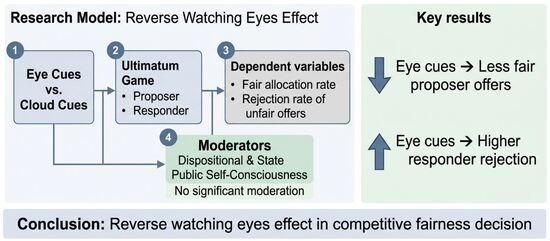
Abstract
1. Introduction
2. Study 1: The Effects of Dispositional Public Self-Awareness and Cue Type on Fair Decision-Making
2.1. Method
2.1.1. Participants
2.1.2. Design
2.1.3. Materials
Types of Cues
Dispositional Public Self-Awareness Scale
Ultimatum Game
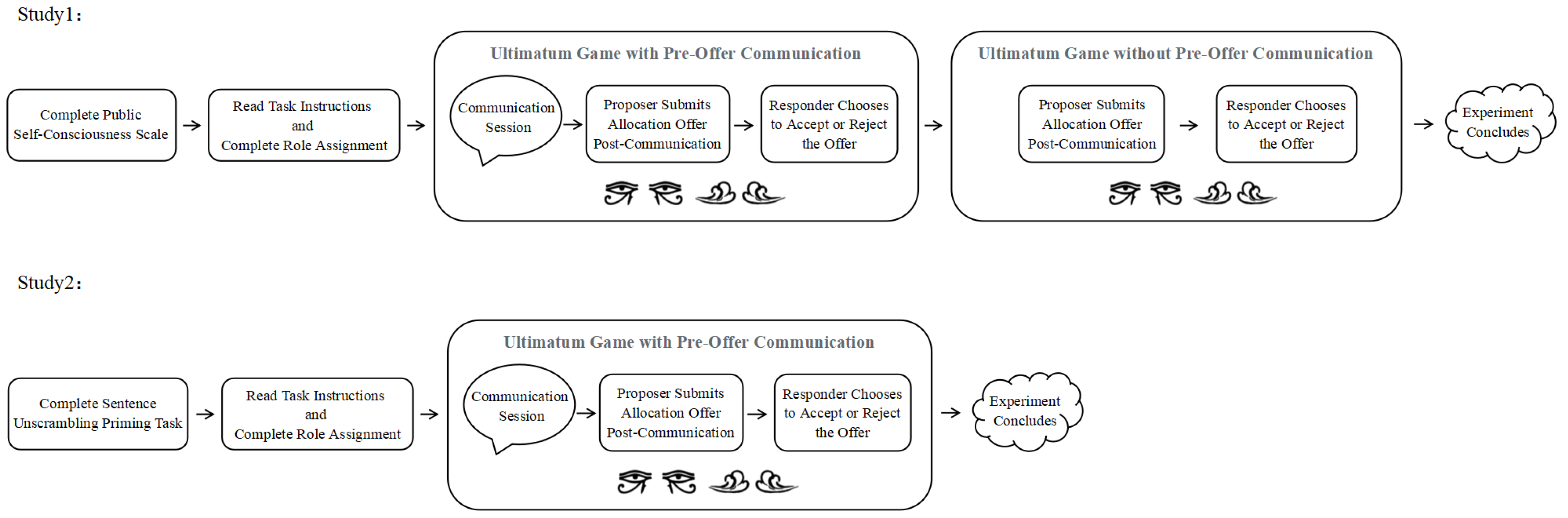
2.1.4. Procedure
2.1.5. AI Tools Declaration
2.2. Results
2.2.1. Manipulation Check for Dispositional Public Self-Awareness Grouping
2.2.2. Effects on Proposers’ Mean Allocation Amount
2.2.3. Effects on Proposers’ Strict 5:5 Allocation Offers
2.2.4. Effects on Responders’ Rejection of Non-5:5 Offers
2.3. Discussion
3. Study 2: The Effects of State Public Self-Awareness and Cue Type on Fair Decision-Making
3.1. Method
3.1.1. Participants
3.1.2. Design
3.1.3. Materials
3.1.4. Procedure
3.2. Results
3.2.1. Manipulation Check for State Public Self-Awareness
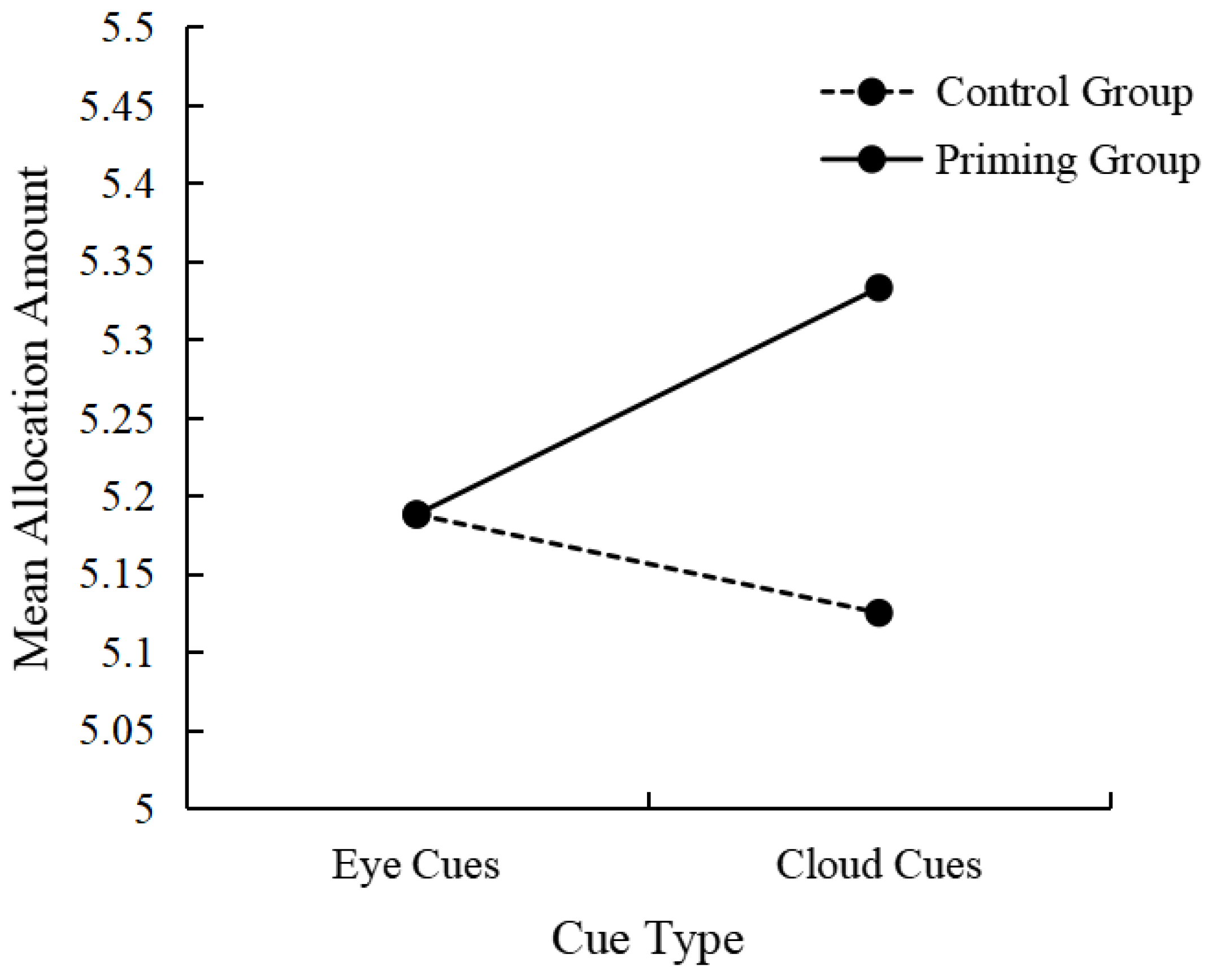
3.2.2. Effects on Proposers’ Mean Allocation Amount
3.2.3. Effects on Proposers’ Strict 5:5 Allocation Offers
3.2.4. Effects on Responders’ Rejection of Non-5:5 Offers
3.2.5. Multiplicity Assessment and Logistic Robustness Check
3.3. Discussion
4. General Discussion
4.1. The Watching-Eyes Effect
4.2. Role of Public Self-Awareness
4.3. Theoretical and Practical Implications
4.4. Limitations and Future Directions
5. Conclusions
Supplementary Materials
Author Contributions
Funding
Institutional Review Board Statement
Informed Consent Statement
Data Availability Statement
Acknowledgments
Conflicts of Interest
References
- Baillon, A., Selim, A., & van Dolder, D. (2013). On the social nature of eyes: The effect of social cues in interaction and individual choice tasks. Evolution and Human Behavior, 34(2), 146–154. [Google Scholar] [CrossRef] [Scilit]
- Bateson, M., Callow, L., Holmes, J. R., Redmond Roche, M. L., & Nettle, D. (2013). Do images of ‘watching eyes’ induce behaviour that is more pro-social or more normative? A field experiment on littering. PLoS ONE, 8(12), e82055. [Google Scholar] [CrossRef] [Scilit] [PubMed]
- Bateson, M., Nettle, D., & Roberts, G. (2006). Cues of being watched enhance cooperation in a real-world setting. Biology Letters, 2(3), 412–414. [Google Scholar] [CrossRef] [Scilit] [PubMed]
- Brockner, J., Altman, S., & Chalek, H. (1982). Self-focused attention, timing, and helping behavior: A field study. Personality and Social Psychology Bulletin, 8(4), 678–684. [Google Scholar] [CrossRef] [Scilit]
- Burnham, T. C., & Hare, B. (2007). Engineering human cooperation: Does involuntary neural activation increase public goods contributions? Human Nature, 18(2), 88–108. [Google Scholar] [CrossRef] [Scilit] [PubMed]
- Camerer, C. F. (2003). Behavioural studies of strategic thinking in games. Trends in Cognitive Sciences, 7(5), 225–231. [Google Scholar] [CrossRef] [Scilit] [PubMed]
- Chen, D. L., Schonger, M., & Wickens, C. (2016). oTree—An open-source platform for laboratory, online, and field experiments. Journal of Behavioral and Experimental Finance, 9, 88–97. [Google Scholar] [CrossRef] [Scilit]
- Dear, K., Dutton, K., & Fox, E. (2019). Do ‘watching eyes’ influence antisocial behavior? A systematic review & meta-analysis. Evolution and Human Behavior, 40(3), 269–280. [Google Scholar] [CrossRef] [Scilit]
- Ding, Z. (2014). The influence of unethical experiences and public self-awareness on unethical behavior [Master’s thesis, Central China Normal University]. [Google Scholar]
- Ernest-Jones, M., Nettle, D., & Bateson, M. (2011). Effects of eye images on everyday cooperative behavior: A field experiment. Evolution and Human Behavior, 32(3), 172–178. [Google Scholar] [CrossRef] [Scilit]
- Faul, F., Erdfelder, E., Lang, A.-G., & Buchner, A. (2007). G* Power 3: A flexible statistical power analysis program for the social, behavioral, and biomedical sciences. Behavior Research Methods, 39(2), 175–191. [Google Scholar] [CrossRef] [Scilit] [PubMed]
- Fehr, E., & Schneider, F. (2010). Eyes are on us, but nobody cares: Are eye cues relevant for strong reciprocity? Proceedings of the Royal Society B: Biological Sciences, 277(1686), 1315–1323. [Google Scholar] [CrossRef] [Scilit] [PubMed]
- Fenigstein, A., Scheier, M. F., & Buss, A. H. (1975). Public and private self-consciousness: Assessment and theory. Journal of Consulting and Clinical Psychology, 43(4), 522. [Google Scholar] [CrossRef] [Scilit]
- Francey, D., & Bergmüller, R. (2012). Images of eyes enhance investments in a real-life public good. PLoS ONE, 7(5), e37397. [Google Scholar] [CrossRef] [Scilit] [PubMed]
- Froming, W. J., Walker, G. R., & Lopyan, K. J. (1982). Public and private self-awareness: When personal attitudes conflict with societal expectations. Journal of Experimental Social Psychology, 18(5), 476–487. [Google Scholar] [CrossRef] [Scilit]
- Gervais, W. M., & Norenzayan, A. (2012). Like a camera in the sky? Thinking about God increases public self-awareness and socially desirable responding. Journal of Experimental Social Psychology, 48(1), 298–302. [Google Scholar] [CrossRef] [Scilit]
- Güth, W., Schmittberger, R., & Schwarze, B. (1982). An experimental analysis of ultimatum bargaining. Journal of Economic Behavior & Organization, 3(4), 367–388. [Google Scholar] [CrossRef] [Scilit]
- Haley, K. J., & Fessler, D. M. (2005). Nobody’s watching?: Subtle cues affect generosity in an anonymous economic game. Evolution and Human Behavior, 26(3), 245–256. [Google Scholar] [CrossRef] [Scilit]
- Ikuse, D., Tani, M., Itahashi, T., Yamada, H., Ohta, H., Morita, T., Arai, G., Saga, N., Tokumasu, T., Ohta, M., & Sato, A. (2018). The effect of visual cues on performance in the ultimatum game in individuals with autism spectrum disorder. Psychiatry Research, 259, 176–183. [Google Scholar] [CrossRef] [Scilit] [PubMed]
- Keller, J., & Pfattheicher, S. (2011). Vigilant self–regulation, cues of being watched and cooperativeness. European Journal of Personality, 25(5), 363–372. [Google Scholar] [CrossRef] [Scilit]
- Lamba, S., & Mace, R. (2010). People recognise when they are really anonymous in an economic game. Evolution and Human Behavior, 31(4), 271–278. [Google Scholar] [CrossRef] [Scilit]
- Mifune, N., Hashimoto, H., & Yamagishi, T. (2010). Altruism toward in-group members as a reputation mechanism. Evolution and Human Behavior, 31(2), 109–117. [Google Scholar] [CrossRef] [Scilit]
- Nettle, D., Harper, Z., Kidson, A., Stone, R., Penton-Voak, I. S., & Bateson, M. (2013). The watching eyes effect in the dictator game: It’s not how much you give, it’s being seen to give something. Evolution and Human Behavior, 34(1), 35–40. [Google Scholar] [CrossRef] [Scilit]
- Nettle, D., Nott, K., & Bateson, M. (2012). ‘Cycle thieves, we are watching you’: Impact of a simple signage intervention against bicycle theft. PLoS ONE, 7(12), e51738. [Google Scholar] [CrossRef] [Scilit] [PubMed]
- Northover, S. B., Pedersen, W. C., Cohen, A. B., & Andrews, P. W. (2017a). Artificial surveillance cues do not increase generosity: Two meta-analyses. Evolution and Human Behavior, 38(1), 144–153. [Google Scholar] [CrossRef] [Scilit]
- Northover, S. B., Pedersen, W. C., Cohen, A. B., & Andrews, P. W. (2017b). Effect of artificial surveillance cues on reported moral judgment: Experimental failures to replicate and two meta-analyses. Evolution and Human Behavior, 38(5), 561–571. [Google Scholar] [CrossRef] [Scilit]
- Oda, R. (2019). Is the watching-eye effect a fluke? Letters on Evolutionary Behavioral Science, 10(1), 4–6. [Google Scholar] [CrossRef] [Scilit]
- Oosterbeek, H., Sloof, R., & Van De Kuilen, G. (2004). Cultural differences in ultimatum game experiments: Evidence from a meta-analysis. Experimental Economics, 7(2), 171–188. [Google Scholar] [CrossRef] [Scilit]
- Pfattheicher, S., & Keller, J. (2015). The watching eyes phenomenon: The role of a sense of being seen and public self-awareness. European Journal of Social Psychology, 45(5), 560–566. [Google Scholar] [CrossRef] [Scilit]
- Prentice-Dunn, S., & Rogers, R. W. (1982). Effects of public and private self-awareness on deindividuation and aggression. Journal of Personality and Social Psychology, 43(3), 503. [Google Scholar] [CrossRef]
- Rigdon, M., Ishii, K., Watabe, M., & Kitayama, S. (2009). Minimal social cues in the dictator game. Journal of Economic Psychology, 30(3), 358–367. [Google Scholar] [CrossRef] [Scilit]
- Rotella, A., Sparks, A. M., Mishra, S., & Barclay, P. (2021). No effect of ‘watching eyes’: An attempted replication and extension investigating individual differences. PLoS ONE, 16(10), e0255531. [Google Scholar] [CrossRef] [Scilit] [PubMed]
- Sanfey, A. G., Rilling, J. K., Aronson, J. A., Nystrom, L. E., & Cohen, J. D. (2003). The neural basis of economic decision-making in the ultimatum game. Science, 300(5626), 1755–1758. [Google Scholar] [CrossRef] [Scilit] [PubMed]
- Sparks, A., & Barclay, P. (2013). Eye images increase generosity, but not for long: The limited effect of a false cue. Evolution and Human Behavior, 34(5), 317–322. [Google Scholar] [CrossRef] [Scilit]
- Sparks, A., & Barclay, P. (2015). No effect on condemnation of short or long exposure to eye images. Letters on Evolutionary Behavioral Science, 6(2), 13–16. [Google Scholar] [CrossRef] [Scilit]
- Sun, C., Zhao, C., & Wang, S. (2020). The influence of public self-awareness priming on altruistic behavior under eye cues. Psychological Development and Education, 36(3), 283–288. [Google Scholar] [CrossRef]
- Tane, K., & Takezawa, M. (2011). Perception of human face does not induce cooperation in darkness. Letters on Evolutionary Behavioral Science, 2(2), 24–27. [Google Scholar] [CrossRef]
- Thaler, R. H. (1988). Anomalies: The ultimatum game. Journal of Economic Perspectives, 2(4), 195–206. [Google Scholar] [CrossRef] [Scilit]
- Van Bommel, M., Van Prooijen, J.-W., Elffers, H., & Van Lange, P. A. (2012). Be aware to care: Public self-awareness leads to a reversal of the bystander effect. Journal of Experimental Social Psychology, 48(4), 926–930. [Google Scholar] [CrossRef] [Scilit]


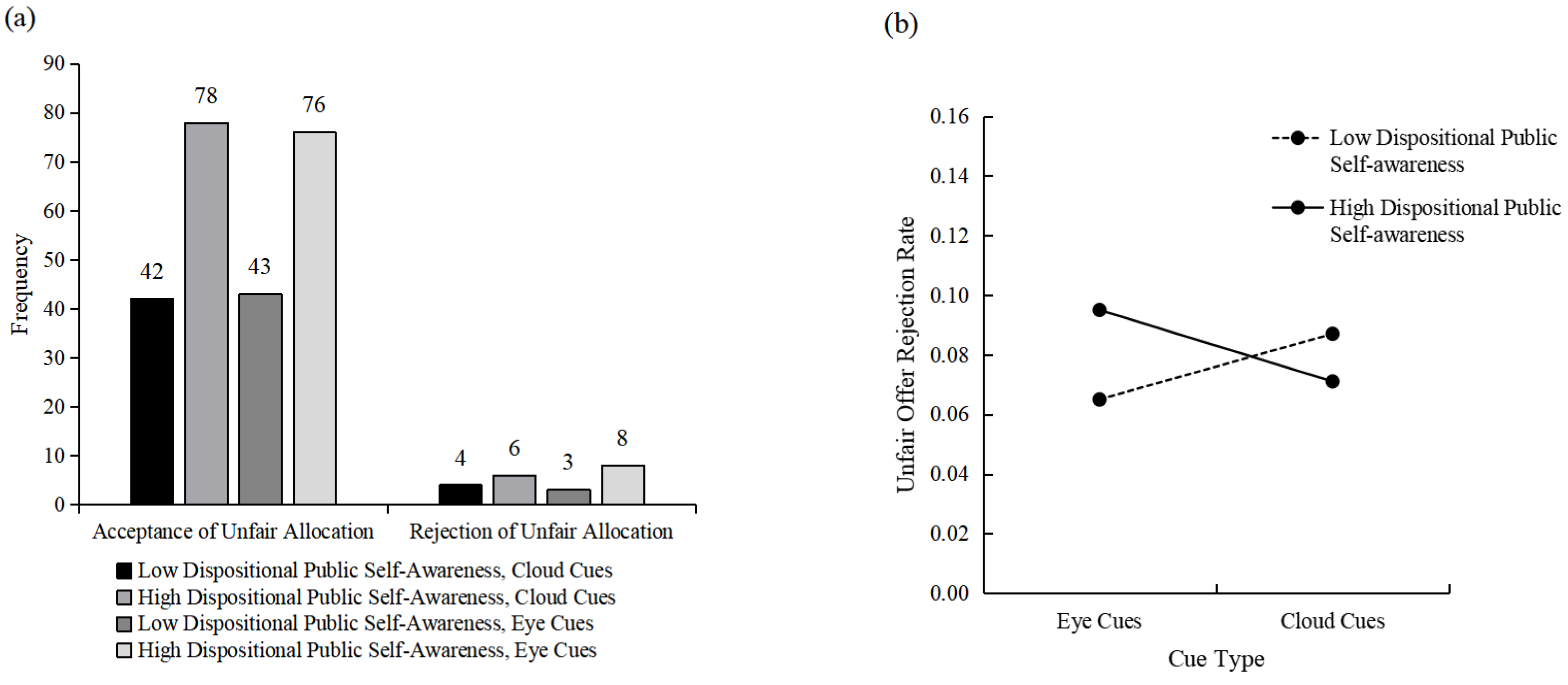



| Round | Cue Type | Trait Public Self-Awareness | Proposer | Responder | |||||
|---|---|---|---|---|---|---|---|---|---|
| n | Allocation | Strict 5:5 Trials/Total n | Strict 5:5 Proportion | n | Rejection Trials/Total n | Rejection Rate | |||
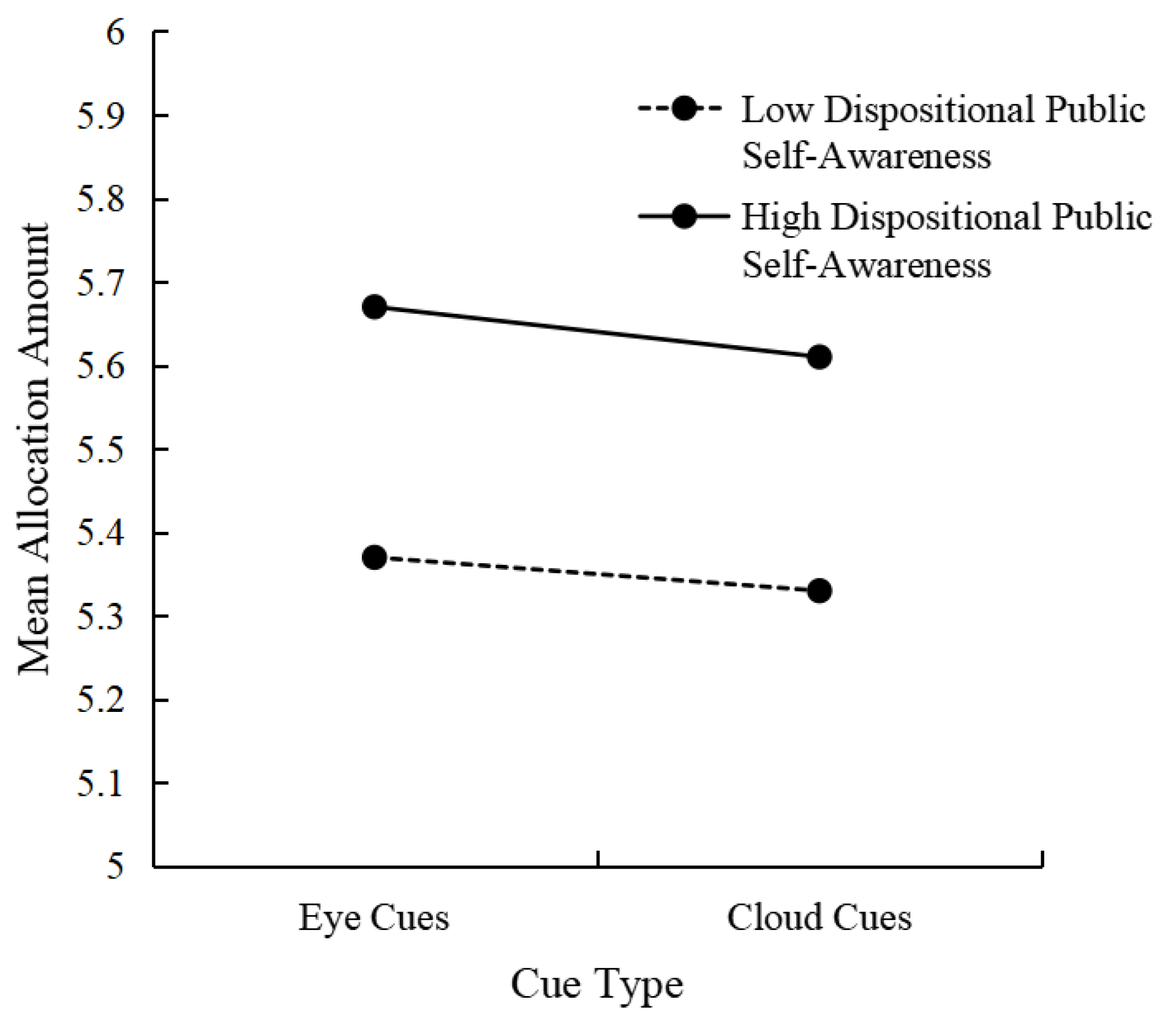
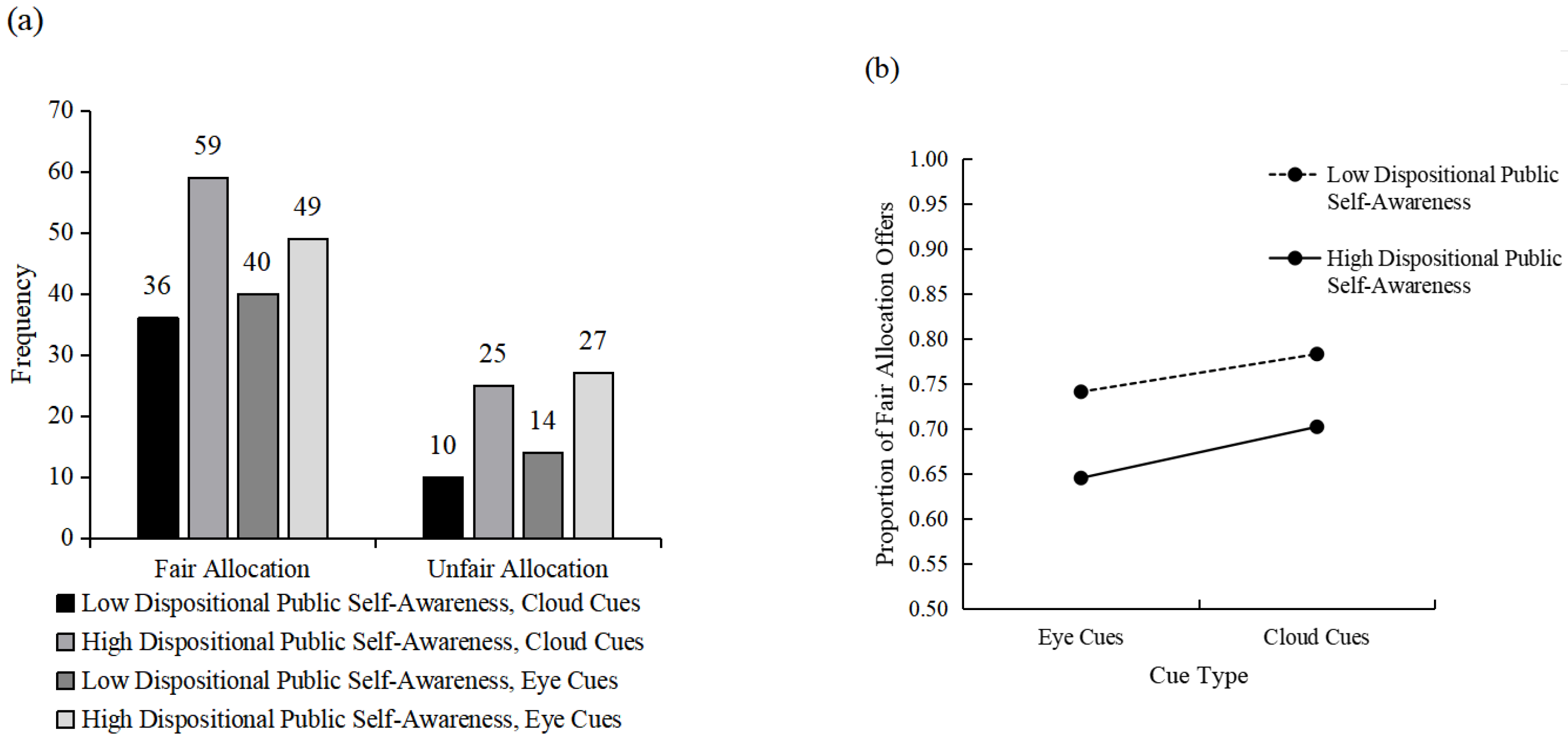
| R1 | Cloud | Low | 23 | 5.43 (0.90) | 18/23 | 0.78 (0.42) | 23 | 3/23 | 0.13 (0.34) |
| R1 | Cloud | High | 42 | 5.57 (1.29) | 28/42 | 0.67 (0.48) | 42 | 3/42 | 0.07 (0.26) |
| R1 | Eye | Low | 27 | 5.48 (1.40) | 19/27 | 0.70 (0.47) | 23 | 2/23 | 0.09 (0.29) |
| R1 | Eye | High | 38 | 5.84 (1.39) | 23/38 | 0.61 (0.50) | 42 | 5/42 | 0.12 (0.33) |
| R2 | Cloud | Low | 23 | 5.17 (0.78) | 18/23 | 0.78 (0.42) | 23 | 1/23 | 0.04 (0.21) |
| R2 | Cloud | High | 42 | 5.71 (1.50) | 31/42 | 0.74 (0.45) | 42 | 3/42 | 0.07 (0.26) |
| R2 | Eye | Low | 27 | 5.19 (1.24) | 21/27 | 0.78 (0.42) | 23 | 1/23 | 0.04 (0.21) |
| R2 | Eye | High | 38 | 5.61 (1.70) | 26/38 | 0.68 (0.47) | 42 | 3/42 | 0.07 (0.26) |
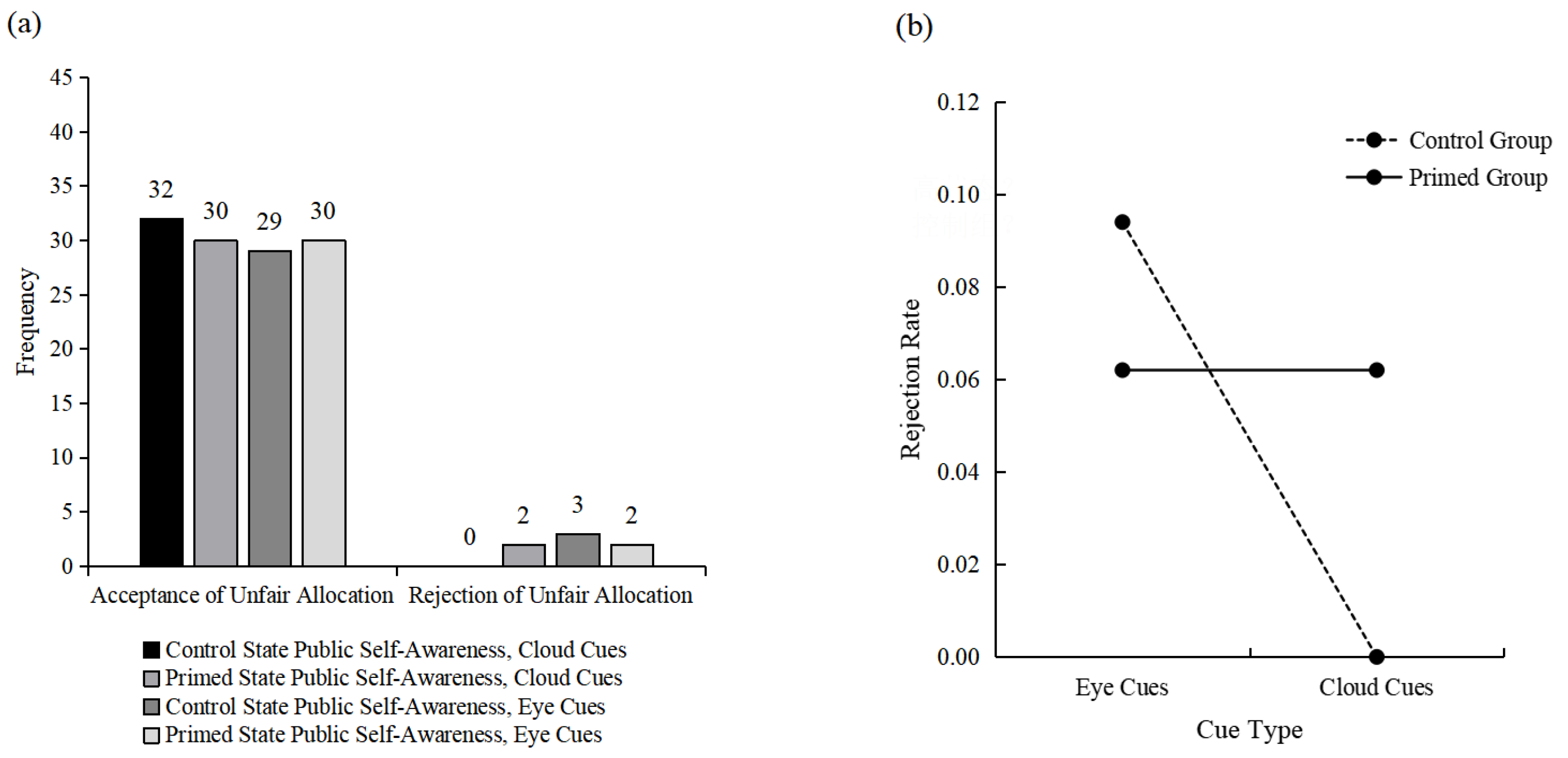
| Cue Type | State Public Self-Awareness | Proposer | Responder | |||||
|---|---|---|---|---|---|---|---|---|
| n | Allocation | Strict 5:5 Trials/Total n | Strict 5:5 Proportion | n | Rejection Trials/Total n | Rejection Rate | ||
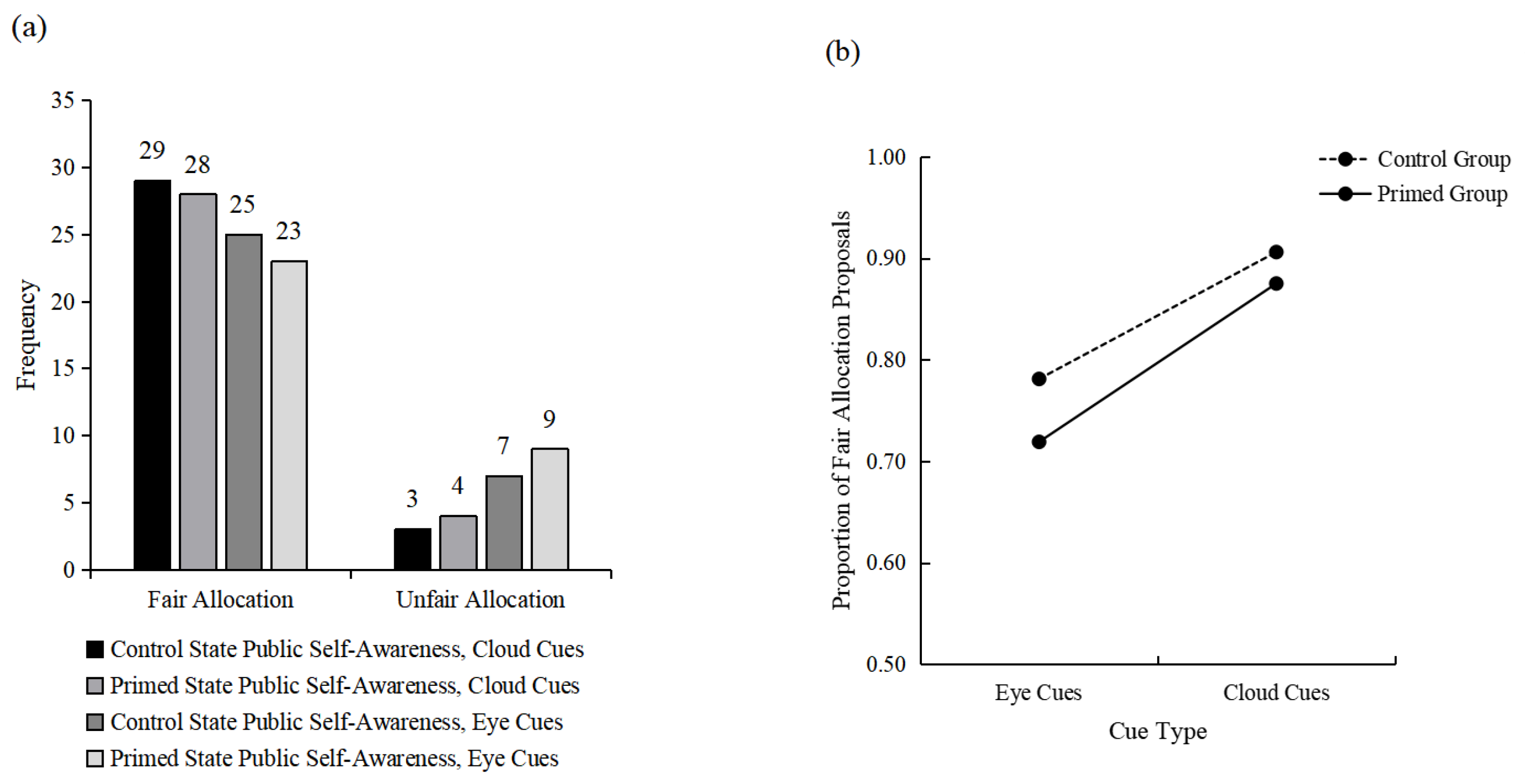
| Cloud | Control | 32 | 5.12 (0.42) | 29/32 | 0.91 (0.30) | 32 | 0/32 | 0.00 (0.00) |
| Cloud | Prime | 32 | 5.33 (0.95) | 28/32 | 0.88 (0.34) | 32 | 2/32 | 0.06 (0.25) |
| Eye | Control | 32 | 5.19 (1.06) | 25/32 | 0.78 (0.42) | 32 | 3/32 | 0.09 (0.30) |
| Eye | Prime | 32 | 5.19 (0.93) | 23/32 | 0.72 (0.46) | 32 | 2/32 | 0.06 (0.25) |
Disclaimer/Publisher’s Note: The statements, opinions and data contained in all publications are solely those of the individual author(s) and contributor(s) and not of MDPI and/or the editor(s). MDPI and/or the editor(s) disclaim responsibility for any injury to people or property resulting from any ideas, methods, instructions or products referred to in the content. |
© 2026 by the authors. Licensee MDPI, Basel, Switzerland. This article is an open access article distributed under the terms and conditions of the Creative Commons Attribution (CC BY) license.
Share and Cite
Lv, J.; Zhang, J.; Zhang, C.; Zhang, Y. Revisiting the Watching-Eyes Effect in the Ultimatum Game: The Role of Public Self-Awareness. Behav. Sci. 2026, 16, 1177. https://doi.org/10.3390/bs16071177
Lv J, Zhang J, Zhang C, Zhang Y. Revisiting the Watching-Eyes Effect in the Ultimatum Game: The Role of Public Self-Awareness. Behavioral Sciences. 2026; 16(7):1177. https://doi.org/10.3390/bs16071177
Chicago/Turabian StyleLv, Jieyu, Jinghan Zhang, Chujian Zhang, and Yingjun Zhang. 2026. "Revisiting the Watching-Eyes Effect in the Ultimatum Game: The Role of Public Self-Awareness" Behavioral Sciences 16, no. 7: 1177. https://doi.org/10.3390/bs16071177
APA StyleLv, J., Zhang, J., Zhang, C., & Zhang, Y. (2026). Revisiting the Watching-Eyes Effect in the Ultimatum Game: The Role of Public Self-Awareness. Behavioral Sciences, 16(7), 1177. https://doi.org/10.3390/bs16071177