Resource Barrier Versus Resource Drain: Adult Attachment Differentially Moderates the Impact of Social Support on Well-Being Through Need Satisfaction

Abstract
1. Introduction
1.1. Perceived Social Support and Subjective Well-Being
1.2. The Mediating Role of Basic Psychological Need Satisfaction
1.3. The Moderating Role of Adult Attachment
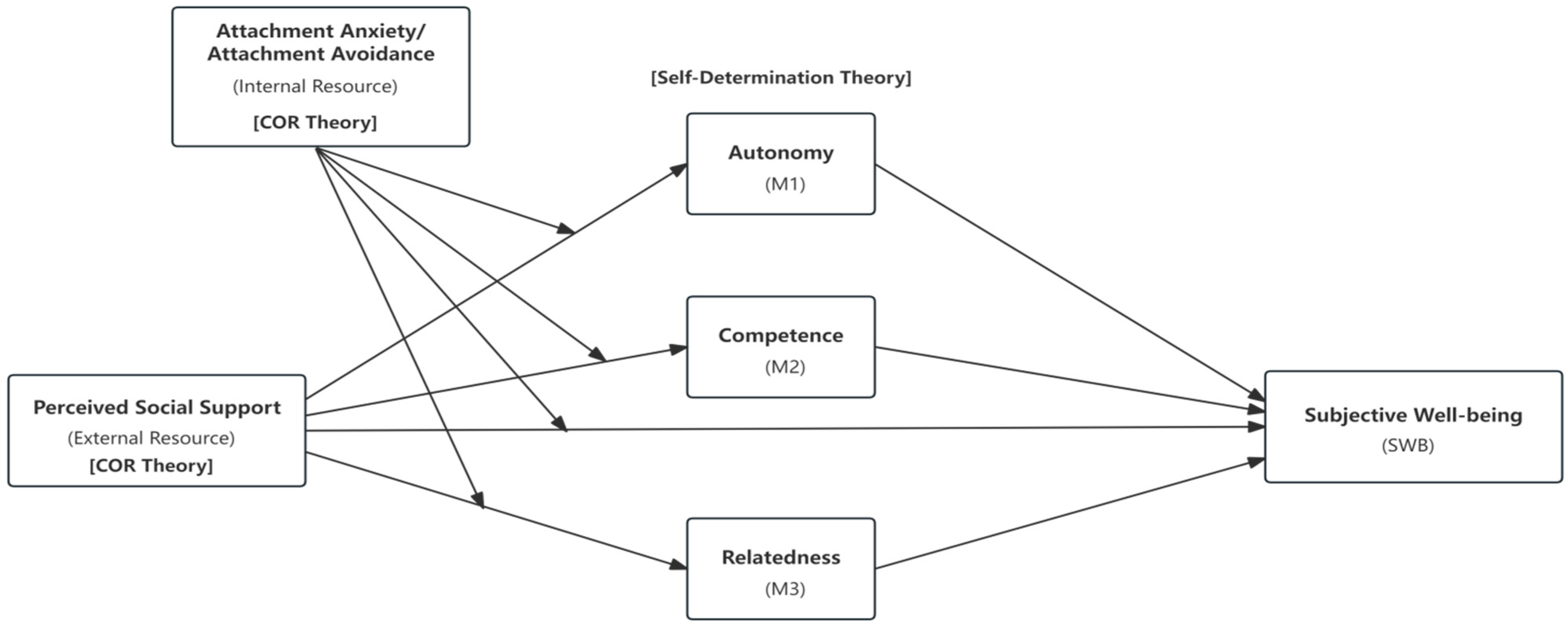
1.4. Theoretical Integration
2. Materials and Methods
2.1. Participants and Procedure
2.2. Measures
2.2.1. Perceived Social Support
2.2.2. Adult Attachment
2.2.3. Basic Psychological Need Satisfaction
2.2.4. Subjective Well-Being
2.3. Data Analysis
3. Results
3.1. Measurement Model and Common Method Bias Test
3.2. Descriptive Statistics and Correlations
3.3. Testing Moderated Mediation Models
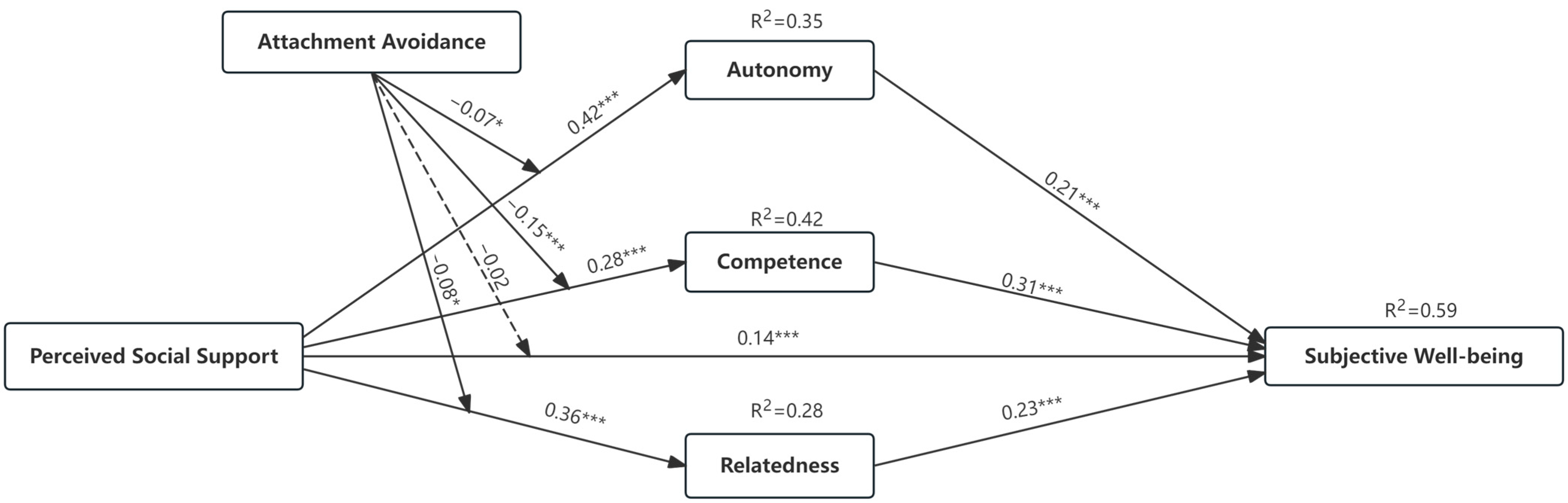
3.3.1. Testing the Mediation Effect
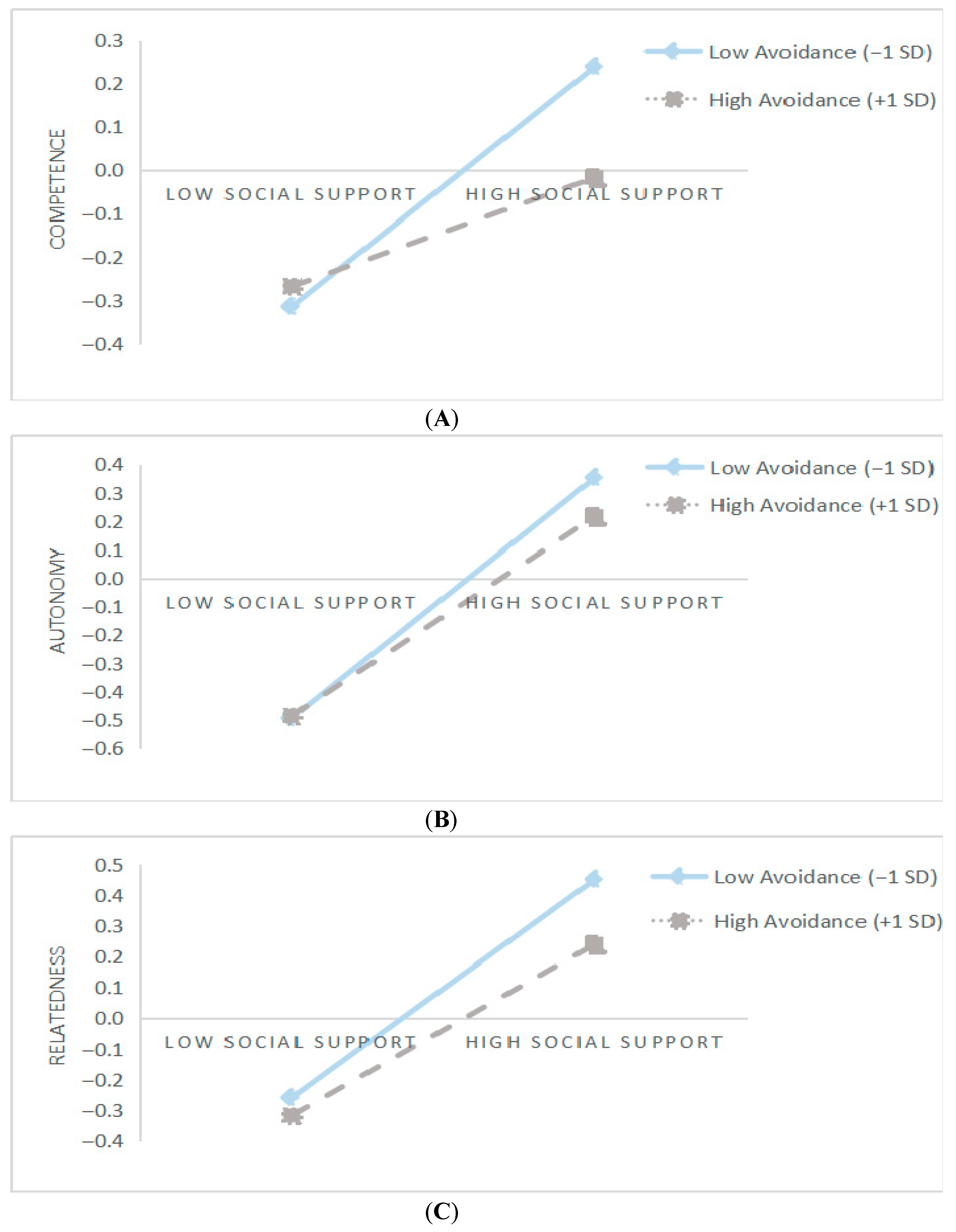
3.3.2. The Moderating Role of Attachment Avoidance
3.3.3. The Moderating Role of Attachment Anxiety
4. Discussion
4.1. The Mediating Role of Basic Psychological Need Satisfaction
4.2. The Differential Moderating Roles of Attachment Avoidance and Attachment Anxiety
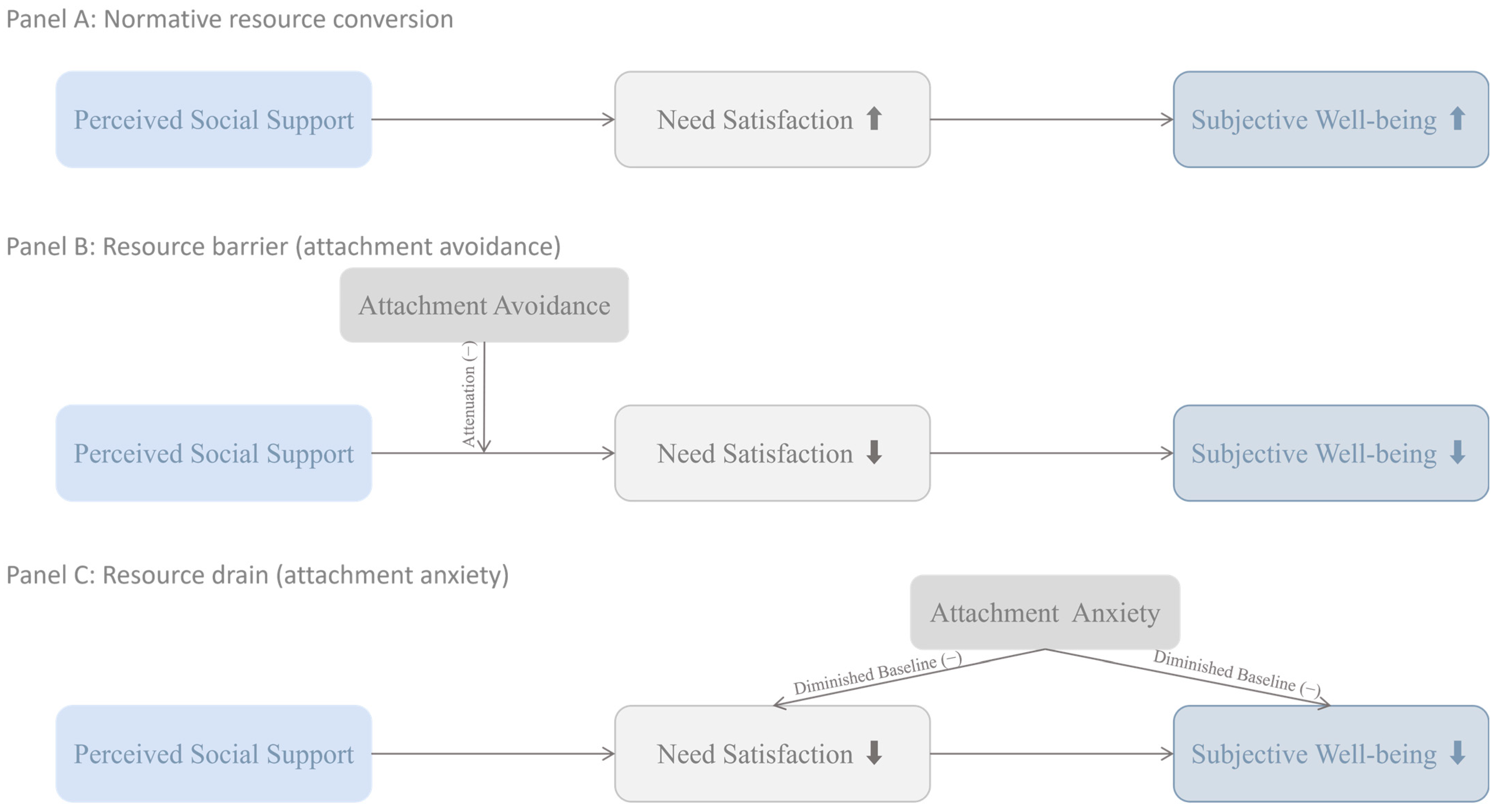
4.2.1. Attachment Avoidance as a “Resource Barrier”
4.2.2. Attachment Anxiety as a “Resource Drain”
4.3. Theoretical Contributions
4.4. Practical Implications
4.5. Limitations and Future Directions
5. Conclusions
Author Contributions
Funding
Institutional Review Board Statement
Informed Consent Statement
Data Availability Statement
Acknowledgments
Conflicts of Interest
Abbreviations
| SWB | Subjective Well-Being |
| COR | Conservation of Resources |
| SDT | Self-Determination Theory |
| MSPSS | Multidimensional Scale of Perceived Social Support |
| ECR-C | Experiences in Close Relationships Scale-Chinese Version |
| BPNSS | Basic Psychological Need Satisfaction Scale |
| SWLS | Satisfaction with Life Scale |
| PANAS | Positive and Negative Affect Schedule |
| PA | Positive Affect |
| NA | Negative Affect |
| CFA | Confirmatory Factor Analysis |
| CR | Composite Reliability |
| AVE | Average Variance Extracted |
| SEM | Structural Equation Modeling |
| CI | Confidence Interval |
| LLCI | Lower Limit Confidence Interval |
| ULCI | Upper Limit Confidence Interval |
References
- Aiken, L. S., & West, S. G. (1991). Multiple regression: Testing and interpreting interactions. Sage Publications. [Google Scholar]
- Alvarado-García, P. A. A., Cubas Romero, T. L., Sánchez, L. P. R., Bocanegra, V. A. S., & Soto-Vásquez, M. R. (2026). Perceived social support and well-being: Mediation and buffering of the stress–depression link in rural older adults. Healthcare, 14(3), 336. [Google Scholar] [CrossRef] [Scilit] [PubMed]
- Arnett, J. J. (2000). Emerging adulthood: A theory of development from the late teens through the twenties. American Psychologist, 55(5), 469–480. [Google Scholar] [CrossRef]
- Bandura, A. (1997). Self-efficacy: The exercise of control. W. H. Freeman. [Google Scholar]
- Bartholomew, K., & Horowitz, L. M. (1991). Attachment styles among young adults: A test of a four-category model. Journal of Personality and Social Psychology, 61(2), 226–244. [Google Scholar] [CrossRef] [PubMed]
- Baumeister, R. F., & Leary, M. R. (1995). The need to belong: Desire for interpersonal attachments as a fundamental human motivation. Psychological Bulletin, 117(3), 497–529. [Google Scholar] [CrossRef]
- Bowlby, J. (1982). Attachment and loss: Vol. 1. Attachment (2nd ed.). Basic Books. [Google Scholar]
- Brennan, K. A., Clark, C. L., & Shaver, P. R. (1998). Self-report measurement of adult attachment: An integrative overview. In J. A. Simpson, & W. S. Rholes (Eds.), Attachment theory and close relationships (pp. 46–76). Guilford Press. [Google Scholar]
- Cassidy, J., Shaver, P. R., Mikulincer, M., & Lavy, S. (2009). Experimentally induced security influences responses to psychological pain. Journal of Social and Clinical Psychology, 28(4), 463–478. [Google Scholar] [CrossRef] [Scilit]
- Chen, B., Vansteenkiste, M., Beyers, W., Boone, L., Deci, E. L., Van der Kaap-Deeder, J., Duriez, B., Lens, W., Matos, L., Mouratidis, A., Ryan, R. M., Sheldon, K. M., Soenens, B., Van Petegem, S., & Verstuyf, J. (2015). Basic psychological need satisfaction, need frustration, and need strength across four cultures. Motivation and Emotion, 39(2), 216–236. [Google Scholar] [CrossRef] [Scilit]
- Chen, X., Khir, A. M., Hamsan, H. H., & Burhan, N. A. S. (2025). From attachment and support to college students’ well-being: A systematic review through the lens of self-determination theory. Multidisciplinary Reviews, 9(3), 2026103. [Google Scholar] [CrossRef] [Scilit]
- Cobb, S. (1976). Social support as a moderator of life stress. Psychosomatic Medicine, 38(5), 300–314. [Google Scholar] [CrossRef] [Scilit] [PubMed]
- Cohen, J. (1988). Statistical power analysis for the behavioral sciences (2nd ed.). Lawrence Erlbaum Associates. [Google Scholar]
- Cohen, R., & Katz, I. (2024). Students’ academic competence beliefs as an antecedent of perceived teachers’ autonomy support and motivation: A longitudinal model. Current Psychology, 43, 34601–34612. [Google Scholar] [CrossRef] [Scilit]
- Cohen, S., & Wills, T. A. (1985). Stress, social support, and the buffering hypothesis. Psychological Bulletin, 98(2), 310–357. [Google Scholar] [CrossRef]
- Costa-Cordella, S., Vivanco-Carlevari, A., Rossi, A., Arévalo-Romero, C., & Silva, J. R. (2022). Social support and depressive symptoms in the context of COVID-19 lockdown: The moderating role of attachment styles. International Journal of Public Health, 67, 1604401. [Google Scholar] [CrossRef] [Scilit] [PubMed]
- Dambi, J. M., Corten, L., Chiwaridzo, M., Jack, H., Mlambo, T., Burnhams, W., & Jelsma, J. (2018). A systematic review of the psychometric properties of the cross-cultural translations and adaptations of the Multidimensional Perceived Social Support Scale (MSPSS). Health and Quality of Life Outcomes, 16, 80. [Google Scholar] [CrossRef] [Scilit] [PubMed]
- Dark-Freudeman, A., Pond, R. S., Jr., Paschall, R. E., & Greskovich, L. (2020). Attachment style in adulthood: Attachment style moderates the impact of social support on depressive symptoms. Journal of Social and Personal Relationships, 37(10–11), 2871–2889. [Google Scholar] [CrossRef] [Scilit]
- Deci, E. L., & Ryan, R. M. (2000). The “what” and “why” of goal pursuits: Human needs and the self-determination of behavior. Psychological Inquiry, 11(4), 227–268. [Google Scholar] [CrossRef] [Scilit]
- Diener, E. (1984). Subjective well-being. Psychological Bulletin, 95(3), 542–575. [Google Scholar] [CrossRef]
- Diener, E., Emmons, R. A., Larsen, R. J., & Griffin, S. (1985). The satisfaction with life scale. Journal of Personality Assessment, 49(1), 71–75. [Google Scholar] [CrossRef] [Scilit] [PubMed]
- Diener, E., Oishi, S., & Tay, L. (2018). Advances in subjective well-being research. Nature Human Behaviour, 2(4), 253–260. [Google Scholar] [CrossRef] [Scilit] [PubMed]
- Gehreke, L., Schilling, H., & Kauffeld, S. (2024). Effectiveness of peer mentoring in the study entry phase: A systematic review. Review of Education, 12, e3462. [Google Scholar] [CrossRef] [Scilit]
- Halbesleben, J. R. B., Neveu, J.-P., Paustian-Underdahl, S. C., & Westman, M. (2014). Getting to the “COR”: Understanding the role of resources in conservation of resources theory. Journal of Management, 40(5), 1334–1364. [Google Scholar] [CrossRef] [Scilit]
- Hayes, A. F. (2022). Introduction to mediation, moderation, and conditional process analysis: A regression-based approach (3rd ed.). Guilford Press. [Google Scholar]
- Hazan, C., & Shaver, P. (1987). Romantic love conceptualized as an attachment process. Journal of Personality and Social Psychology, 52(3), 511–524. [Google Scholar] [CrossRef] [PubMed]
- Hobfoll, S. E. (1989). Conservation of resources: A new attempt at conceptualizing stress. American Psychologist, 44(3), 513–524. [Google Scholar] [CrossRef] [PubMed]
- Hobfoll, S. E. (2011). Conservation of resource caravans and engaged settings. Journal of Occupational and Organizational Psychology, 84(1), 116–122. [Google Scholar] [CrossRef] [Scilit]
- Hobfoll, S. E., Halbesleben, J., Neveu, J.-P., & Westman, M. (2018). Conservation of resources in the organizational context: The reality of resources and their consequences. Annual Review of Organizational Psychology and Organizational Behavior, 5, 103–128. [Google Scholar] [CrossRef] [Scilit]
- Holt-Lunstad, J. (2022). Social connection as a public health issue: The evidence and a systemic framework for prioritizing the “social” in social determinants of health. Annual Review of Public Health, 43, 193–213. [Google Scholar] [CrossRef] [Scilit] [PubMed]
- Huang, L., Yang, T. Z., & Ji, Z. M. (2003). Applicability of the positive and negative affect scale in Chinese. Chinese Mental Health Journal, 17(1), 54–56. [Google Scholar]
- Huang, L., & Zhang, T. (2022). Perceived social support, psychological capital, and subjective well-being among college students in the context of online learning during the COVID-19 pandemic. The Asia-Pacific Education Researcher, 31, 563–574. [Google Scholar] [CrossRef] [Scilit]
- Hwang, K.-K. (2012). Foundations of Chinese psychology: Confucian social relations. Springer. [Google Scholar] [CrossRef] [Scilit]
- Johnson, S. M. (2019). Attachment theory in practice: Emotionally focused therapy (EFT) with individuals, couples, and families. Guilford Press. [Google Scholar]
- Kim, H. S., Sherman, D. K., & Taylor, S. E. (2008). Culture and social support. American Psychologist, 63(6), 518–526. [Google Scholar] [CrossRef] [Scilit] [PubMed]
- Knight, J., & Gunatilaka, R. (2010). The rural-urban divide in China: Income but not happiness? Journal of Development Studies, 46(3), 506–534. [Google Scholar] [CrossRef] [Scilit]
- Lakey, B., & Orehek, E. (2011). Relational regulation theory: A new approach to explain the link between perceived social support and mental health. Psychological Review, 118(3), 482–495. [Google Scholar] [CrossRef] [Scilit] [PubMed]
- Lenzo, V., Sardella, A., Musetti, A., Faraone, C., & Quattropani, M. C. (2022). Toward a preventive approach to prolonged grief disorder in palliative care: Insecure attachment moderates the impact of perceived support on the severity of symptoms. PLoS ONE, 17(12), e0266289. [Google Scholar] [CrossRef] [Scilit] [PubMed]
- Li, T., & Kato, K. (2006). Measuring adult attachment: Chinese adaptation of the ECR scale. Acta Psychologica Sinica, 38(3), 399–406. [Google Scholar]
- Li, X., & Bian, Y. (2024). Social networks in China: A thematic review of guanxi scholarship in the past decade. Chinese Journal of Sociology, 10(4), 531–562. [Google Scholar] [CrossRef] [Scilit]
- Liu, J., Lin, L., Lv, Y., Wei, C., Zhou, Y., & Chen, X. (2013). Reliability and validity of the Chinese version of the basic psychological needs scale. Chinese Mental Health Journal, 27(10), 791–795. [Google Scholar] [CrossRef]
- Liu, W., Li, Z., Ling, Y., & Cai, T. (2016). Core self-evaluations and coping styles as mediators between social support and well-being. Personality and Individual Differences, 88, 35–39. [Google Scholar] [CrossRef] [Scilit]
- Luyckx, K., Vansteenkiste, M., Goossens, L., & Duriez, B. (2009). Basic need satisfaction and identity formation: Bridging self-determination theory and process-oriented identity research. Journal of Counseling Psychology, 56(2), 276–288. [Google Scholar] [CrossRef] [Scilit]
- Maas, J., Schoch, S., Scholz, U., Rackow, P., Schüler, J., Wegner, M., & Keller, R. (2022). Satisfying the need for relatedness among teachers: Benefits of searching for social support. Frontiers in Education, 7, 851819. [Google Scholar] [CrossRef] [Scilit]
- MacDonald, G., & Park, Y. (2022). Associations of attachment avoidance and anxiety with life satisfaction, satisfaction with singlehood, and desire for a romantic partner. Personal Relationships, 29(1), 163–176. [Google Scholar] [CrossRef] [Scilit]
- Marsh, H. W., Wen, Z., & Hau, K.-T. (2004). Structural equation models of latent interactions: Evaluation of alternative estimation strategies and indicator construction. Psychological Methods, 9(3), 275–300. [Google Scholar] [CrossRef] [Scilit] [PubMed]
- Martela, F., Lehmus-Sun, A., Parker, P. D., Pessi, A. B., & Ryan, R. M. (2023). Needs and well-being across Europe: Basic psychological needs are closely connected with well-being, meaning, and symptoms of depression in 27 European countries. Social Psychological and Personality Science, 14(5), 501–514. [Google Scholar] [CrossRef] [Scilit]
- Maslowsky, J., Jager, J., & Hemken, D. (2015). Estimating and interpreting latent variable interactions: A tutorial for applying the latent moderated structural equations method. International Journal of Behavioral Development, 39(1), 87–96. [Google Scholar] [CrossRef] [Scilit] [PubMed]
- Maxwell, S. E., & Cole, D. A. (2007). Bias in cross-sectional analyses of longitudinal mediation. Psychological Methods, 12(1), 23–44. [Google Scholar] [CrossRef] [Scilit] [PubMed]
- Messina, I., Calvo, V., & Grecucci, A. (2023). Attachment orientations and emotion regulation: New insights from the study of interpersonal emotion regulation strategies. Research in Psychotherapy: Psychopathology, Process and Outcome, 26(3), 703. [Google Scholar] [CrossRef] [Scilit] [PubMed]
- Mikulincer, M., & Shaver, P. R. (2009). An attachment and behavioral systems perspective on social support. Journal of Social and Personal Relationships, 26(1), 7–19. [Google Scholar] [CrossRef] [Scilit]
- Mikulincer, M., & Shaver, P. R. (2016). Attachment in adulthood: Structure, dynamics, and change (2nd ed.). Guilford Press. [Google Scholar]
- Mikulincer, M., & Shaver, P. R. (2023). Attachment theory applied: Fostering personal growth through healthy relationships. Guilford Press. [Google Scholar]
- Ozer, S. (2024). Social support, self-efficacy, self-esteem, and well-being during COVID-19 lockdown: A two-wave study of Danish students. Scandinavian Journal of Psychology, 65(1), 42–52. [Google Scholar] [CrossRef] [Scilit] [PubMed]
- Patrick, H., Knee, C. R., Canevello, A., & Lonsbary, C. (2007). The role of need fulfillment in relationship functioning and well-being: A self-determination theory perspective. Journal of Personality and Social Psychology, 92(3), 434–457. [Google Scholar] [CrossRef] [Scilit] [PubMed]
- Podsakoff, P. M., MacKenzie, S. B., Lee, J. Y., & Podsakoff, N. P. (2003). Common method biases in behavioral research: A critical review of the literature and recommended remedies. Journal of Applied Psychology, 88(5), 879–903. [Google Scholar] [CrossRef] [Scilit] [PubMed]
- Razurel, C., Kaiser, B., Sellenet, C., & Epiney, M. (2013). Relation between perceived stress, social support, and coping strategies and maternal well-being: A review of the literature. Women & Health, 53(1), 74–99. [Google Scholar] [CrossRef] [Scilit] [PubMed]
- Reeve, J., & Cheon, S. H. (2021). Autonomy-supportive teaching: Its malleability, benefits, and potential to improve educational practice. Educational Psychologist, 56(1), 54–77. [Google Scholar] [CrossRef] [Scilit]
- Richardson, E., Beath, A., & Boag, S. (2023). Default defenses: The character defenses of attachment-anxiety and attachment-avoidance. Current Psychology, 42, 28755–28770. [Google Scholar] [CrossRef] [Scilit]
- Richardson, E., & Boag, S. (2024). When foundations falter: The emergence of defensive narratives from insecure attachment dynamics. Theory & Psychology, 34(5), 646–670. [Google Scholar] [CrossRef] [Scilit]
- Ryan, R. M., & Deci, E. L. (2000). Self-determination theory and the facilitation of intrinsic motivation, social development, and well-being. American Psychologist, 55(1), 68–78. [Google Scholar] [CrossRef] [PubMed]
- Ryan, R. M., & Deci, E. L. (2017). Self-determination theory: Basic psychological needs in motivation, development, and wellness. Guilford Press. [Google Scholar] [CrossRef] [Scilit]
- Ryan, R. M., & Deci, E. L. (2020). Intrinsic and extrinsic motivation from a self-determination theory perspective: Definitions, theory, practices, and future directions. Contemporary Educational Psychology, 61, 101860. [Google Scholar] [CrossRef] [Scilit]
- Sharifian, N., & Grühn, D. (2018). The differential impact of social participation and social support on psychological well-being: Evidence from the Wisconsin longitudinal study. The International Journal of Aging and Human Development, 88(2), 107–126. [Google Scholar] [CrossRef] [Scilit] [PubMed]
- Sheldon, E., Simmonds-Buckley, M., Bone, C., Mascarenhas, T., Chan, N., Wincott, M., Gleeson, H., Sow, K., Hind, D., & Barkham, M. (2021). Prevalence and risk factors for mental health problems in university undergraduate students: A systematic review with meta-analysis. Journal of Affective Disorders, 287, 282–292. [Google Scholar] [CrossRef] [Scilit] [PubMed]
- Sheldon, K. M., & Elliot, A. J. (1999). Goal striving, need satisfaction, and longitudinal well-being: The self-concordance model. Journal of Personality and Social Psychology, 76(3), 482–497. [Google Scholar] [CrossRef] [PubMed]
- Snyder, M. D., Sun, E. R., Nie, J., & Jakubiak, B. K. (2024). When and how do people share? Attachment anxiety predicts support-seeking strategies. Personal Relationships, 31(4), 1113–1132. [Google Scholar] [CrossRef] [Scilit]
- Taylor, S. E., Klein, L. C., Lewis, B. P., Gruenewald, T. L., Gurung, R. A. R., & Updegraff, J. A. (2000). Biobehavioral responses to stress in females: Tend-and-befriend, not fight-or-flight. Psychological Review, 107(3), 411–429. [Google Scholar] [CrossRef] [PubMed]
- Thoits, P. A. (2011). Mechanisms linking social ties and support to physical and mental health. Journal of Health and Social Behavior, 52(2), 145–161. [Google Scholar] [CrossRef] [Scilit] [PubMed]
- Vansteenkiste, M., Ryan, R. M., & Soenens, B. (2020). Basic psychological need theory: Advancements, critical themes, and future directions. Motivation and Emotion, 44(1), 1–31. [Google Scholar] [CrossRef] [Scilit]
- Vowels, L. M., Vowels, M. J., Carnelley, K. B., Millings, A., & Gibson-Miller, J. (2023). Toward a causal link between attachment styles and mental health during the COVID-19 pandemic. British Journal of Clinical Psychology, 62(3), 605–620. [Google Scholar] [CrossRef] [Scilit] [PubMed]
- Wang, Y., & Tong, Y. (2025). Academic pressure and perceived stress: The mediating role of life satisfaction. Social Behavior and Personality, 53(1), e14020. [Google Scholar] [CrossRef] [Scilit]
- Watson, D., Clark, L. A., & Tellegen, A. (1988). Development and validation of brief measures of positive and negative affect: The PANAS scales. Journal of Personality and Social Psychology, 54(6), 1063–1070. [Google Scholar] [CrossRef] [PubMed]
- Xiong, C., & Xu, Y. (2009). Reliability and validity of the Satisfaction with Life Scale for Chinese demos. Chinese Journal of Health Psychology, 17(8), 948–949. [Google Scholar] [CrossRef]
- Yan, B., & Zheng, X. (2006). Researches into relations among social support, self-esteem and subjective well-being of college students. Psychological Development and Education, 11(3), 60–64. [Google Scholar] [CrossRef]
- Yeo, G., Lansford, J. E., & Rudolph, K. D. (2025). How does perceived social support relate to human thriving? A systematic review with meta-analyses. Psychological Bulletin, 151(9), 1089–1124. [Google Scholar] [CrossRef] [Scilit] [PubMed]
- Zhang, X., Li, J., Xie, F., Chen, X., Xu, W., & Hudson, N. W. (2022). The relationship between adult attachment and mental health: A meta-analysis. Journal of Personality and Social Psychology, 123(5), 1089–1137. [Google Scholar] [CrossRef] [Scilit] [PubMed]
- Zheng, L., & Yan, F. (2024). Changes in employment psychology of Chinese university students during the two stages of COVID-19 control and their impacts on their employment intentions. Frontiers in Psychology, 15, 1447103. [Google Scholar] [CrossRef] [Scilit] [PubMed]
- Zhou, L., & Xie, L. (2025). Exploring the relationships between perceived social support, social engagement, mindfulness, and psychological well-being among Chinese university students: A mixed-methods study. Sage Open, 15(4), 21582440251370442. [Google Scholar] [CrossRef] [Scilit]
- Zimet, G. D., Dahlem, N. W., Zimet, S. G., & Farley, G. K. (1988). The multidimensional scale of perceived social support. Journal of Personality Assessment, 52(1), 30–41. [Google Scholar] [CrossRef] [Scilit]



| Variable | Category | Frequency | Percentage |
|---|---|---|---|
| Gender | Male | 234 | 48.0 |
| Female | 254 | 52.0 | |
| Household Registration (Hukou) | Urban | 367 | 75.2 |
| Rural | 121 | 24.8 | |
| Grade Level | Freshman (Grade 1) | 122 | 25.0 |
| Sophomore (Grade 2) | 120 | 24.6 | |
| Junior (Grade 3) | 122 | 25.0 | |
| Senior (Grade 4) | 124 | 25.4 |
| Variable | M | SD | 1 | 2 | 3 | 4 | 5 | 6 | 7 |
|---|---|---|---|---|---|---|---|---|---|
| 1. Attachment Anxiety | 3.58 | 1.04 | 1 | ||||||
| 2. Attachment Avoidance | 3.45 | 0.89 | 0.11 * | 1 | |||||
| 3. Social Support | 56.63 | 11.25 | −0.12 ** | −0.47 ** | 1 | ||||
| 4. Autonomy | 28.67 | 6.49 | −0.35 ** | −0.30 ** | 0.50 ** | 1 | |||
| 5. Competence | 26.68 | 6.26 | −0.52 ** | −0.29 ** | 0.39 ** | 0.62 ** | 1 | ||
| 6. Relatedness | 40.95 | 7.08 | −0.30 ** | −0.32 ** | 0.44 ** | 0.35 ** | 0.39 ** | 1 | |
| 7. Subjective Well-being | 0.00 | 2.24 | −0.47 ** | −0.27 ** | 0.43 ** | 0.59 ** | 0.64 ** | 0.50 ** | 1 |
| Effects | β | SE | t | p | 95% LLCI | 95% ULCI |
| Total Effect (Support → SWB) | 0.51 | 0.04 | 11.64 | <0.001 | 0.426 | 0.599 |
| Direct Effect (Support → SWB) | 0.12 | 0.04 | 2.93 | 0.004 | 0.039 | 0.198 |
| Indirect Effects | Effect | Boot SE | Boot LLCI | Boot ULCI | ||
| Total Indirect Effect | 0.39 | 0.04 | 0.318 | 0.475 | ||
| Ind 1: via Autonomy | 0.12 | 0.03 | 0.067 | 0.175 | ||
| Ind 2: via Competence | 0.15 | 0.03 | 0.096 | 0.223 | ||
| Ind 3: via Relatedness | 0.12 | 0.02 | 0.081 | 0.166 |
| Predictors | Model 1: Autonomy | Model 2: Competence | Model 3: Relatedness | Model 4: Subjective Well-Being | ||||
|---|---|---|---|---|---|---|---|---|
| β | SE | β | SE | β | SE | β | SE | |
| Controls | ||||||||
| Gender | 0.12 | 0.08 | 0.10 | 0.07 | −0.15 | 0.08 | −0.12 * | 0.06 |
| Hukou | −0.08 | 0.09 | −0.10 | 0.08 | 0.06 | 0.09 | −0.11 | 0.07 |
| Covariate | ||||||||
| Attachment Anxiety | −0.28 *** | 0.04 | −0.44 *** | 0.04 | −0.21 *** | 0.04 | −0.13 *** | 0.04 |
| Main Effects | ||||||||
| Social Support (X) | 0.42 *** | 0.04 | 0.28 *** | 0.04 | 0.36 *** | 0.04 | 0.14 *** | 0.04 |
| Attachment Avoidance (W) | −0.06 | 0.04 | −0.11 ** | 0.04 | −0.13 ** | 0.04 | 0.04 | 0.03 |
| Mediators | ||||||||
| Autonomy | 0.21 *** | 0.04 | ||||||
| Competence | 0.31 *** | 0.04 | ||||||
| Relatedness | 0.23 *** | 0.03 | ||||||
| Interaction | ||||||||
| Support × Avoidance | −0.07 * | 0.03 | −0.15 *** | 0.03 | −0.08 * | 0.03 | −0.02 | 0.03 |
| ΔR2 | 0.01 | 0.03 | 0.01 | 0.00 | ||||
| R2 | 0.35 | 0.42 | 0.28 | 0.59 | ||||
| F | 42.64 *** | 57.60 *** | 30.76 *** | 75.05 *** | ||||
| Index of Moderated Mediation | Index | 95% CI | Index | 95% CI | Index | 95% CI | ||
| Autonomy | −0.015 | [−0.036, 0.002] | ||||||
| Competence | −0.046 | [−0.073, −0.022] | ||||||
| Relatedness | −0.018 | [−0.042, 0.001] | ||||||
| Need Dimension | Avoidance Level | Effect | SE | t | p | 95% LLCI | 95% ULCI |
|---|---|---|---|---|---|---|---|
| Autonomy | Low (−1 SD) | 0.50 | 0.05 | 9.44 | <0.001 | 0.393 | 0.599 |
| Autonomy | High (+1 SD) | 0.35 | 0.05 | 6.78 | <0.001 | 0.250 | 0.454 |
| Competence | Low (−1 SD) | 0.43 | 0.05 | 8.62 | <0.001 | 0.330 | 0.525 |
| Competence | High (+1 SD) | 0.13 | 0.05 | 2.55 | 0.011 | 0.029 | 0.221 |
| Relatedness | Low (−1 SD) | 0.43 | 0.06 | 7.82 | <0.001 | 0.323 | 0.540 |
| Relatedness | High (+1 SD) | 0.28 | 0.05 | 5.12 | <0.001 | 0.172 | 0.387 |
| Predictors | Model 1: Autonomy | Model 2: Competence | Model 3: Relatedness | Model 4: Subjective Well-Being | ||||
|---|---|---|---|---|---|---|---|---|
| β | SE | β | SE | β | SE | β | SE | |
| Controls | ||||||||
| Gender | 0.11 | 0.08 | 0.07 | 0.07 | −0.16 * | 0.08 | −0.12 * | 0.06 |
| Hukou | −0.09 | 0.09 | −0.11 | 0.08 | 0.05 | 0.09 | −0.11 | 0.07 |
| Covariate | ||||||||
| Attachment Avoidance | −0.06 | 0.04 | −0.10 * | 0.04 | −0.13 ** | 0.04 | 0.04 | 0.03 |
| Main Effects | ||||||||
| Social Support (X) | 0.42 *** | 0.04 | 0.28 *** | 0.04 | 0.35 *** | 0.05 | 0.14 *** | 0.04 |
| Attachment Anxiety (W) | −0.30 *** | 0.04 | −0.47 *** | 0.04 | −0.23 *** | 0.04 | −0.13 *** | 0.04 |
| Mediators | ||||||||
| Autonomy | 0.21 *** | 0.04 | ||||||
| Competence | 0.31 *** | 0.04 | ||||||
| Relatedness | 0.24 *** | 0.03 | ||||||
| Interaction | ||||||||
| Support × Anxiety | −0.01 | 0.03 | 0.04 | 0.03 | −0.01 | 0.03 | −0.02 | 0.02 |
| ΔR2 | 0.00 | 0.00 | 0.00 | 0.00 | ||||
| R2 | 0.34 | 0.39 | 0.27 | 0.59 | ||||
| F | 41.24 *** | 50.56 *** | 29.51 *** | 75.12 *** | ||||
| Index of Moderated Mediation | Index | 95% CI | Index | 95% CI | Index | 95% CI | ||
| Autonomy | −0.001 | [−0.020, 0.017] | ||||||
| Competence | 0.012 | [−0.016, 0.036] | ||||||
| Relatedness | −0.003 | [−0.024, 0.022] | ||||||
Disclaimer/Publisher’s Note: The statements, opinions and data contained in all publications are solely those of the individual author(s) and contributor(s) and not of MDPI and/or the editor(s). MDPI and/or the editor(s) disclaim responsibility for any injury to people or property resulting from any ideas, methods, instructions or products referred to in the content. |
© 2026 by the authors. Licensee MDPI, Basel, Switzerland. This article is an open access article distributed under the terms and conditions of the Creative Commons Attribution (CC BY) license.
Share and Cite
Chen, X.; Khir, A.M.; Hamsan, H.H.; Burhan, N.A.S. Resource Barrier Versus Resource Drain: Adult Attachment Differentially Moderates the Impact of Social Support on Well-Being Through Need Satisfaction. Behav. Sci. 2026, 16, 1170. https://doi.org/10.3390/bs16071170
Chen X, Khir AM, Hamsan HH, Burhan NAS. Resource Barrier Versus Resource Drain: Adult Attachment Differentially Moderates the Impact of Social Support on Well-Being Through Need Satisfaction. Behavioral Sciences. 2026; 16(7):1170. https://doi.org/10.3390/bs16071170
Chicago/Turabian StyleChen, Xi, Azlina Mohd Khir, Hanina Halimatusaadiah Hamsan, and Nik Ahmad Sufian Burhan. 2026. "Resource Barrier Versus Resource Drain: Adult Attachment Differentially Moderates the Impact of Social Support on Well-Being Through Need Satisfaction" Behavioral Sciences 16, no. 7: 1170. https://doi.org/10.3390/bs16071170
APA StyleChen, X., Khir, A. M., Hamsan, H. H., & Burhan, N. A. S. (2026). Resource Barrier Versus Resource Drain: Adult Attachment Differentially Moderates the Impact of Social Support on Well-Being Through Need Satisfaction. Behavioral Sciences, 16(7), 1170. https://doi.org/10.3390/bs16071170