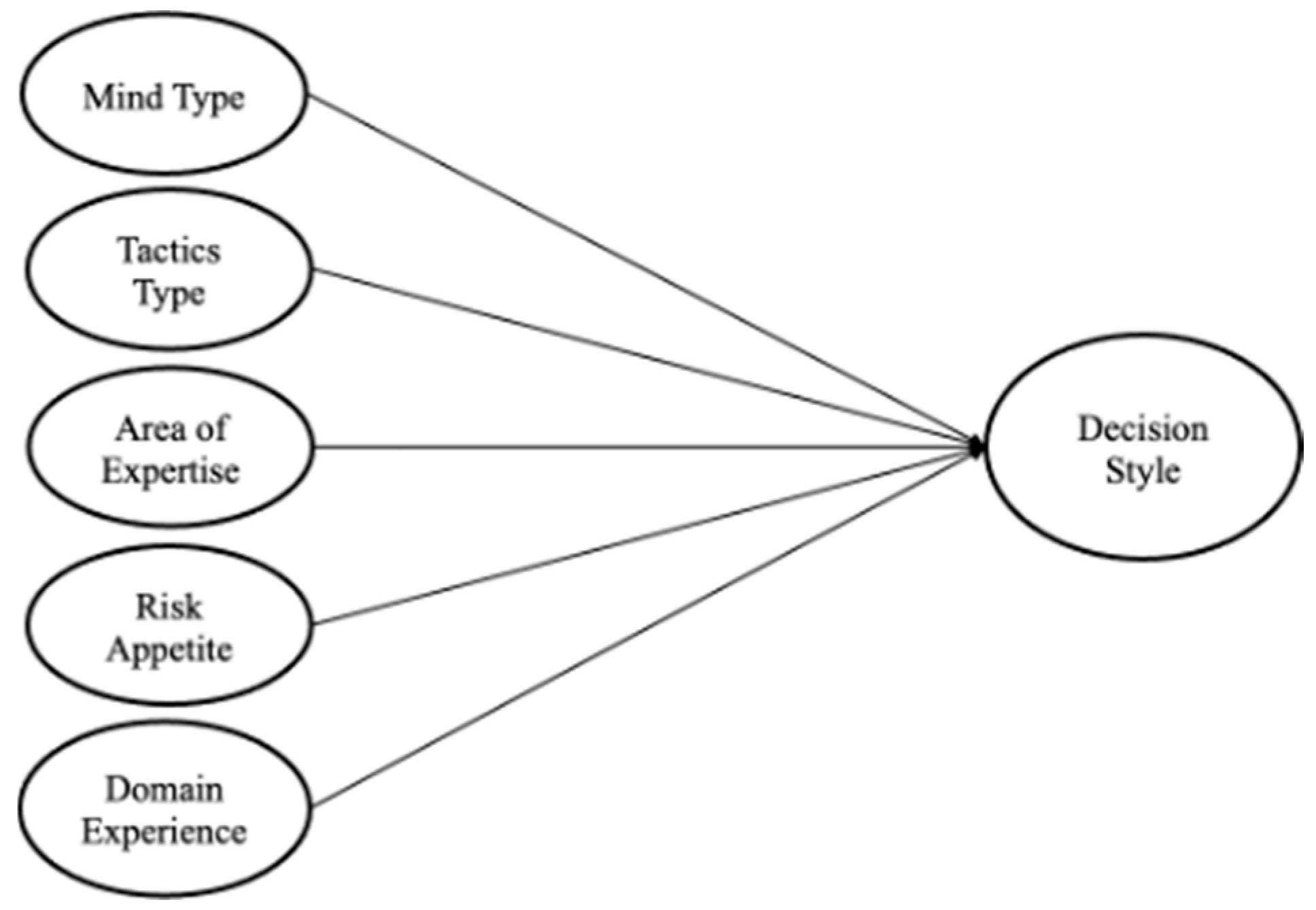
Founder Attributes and Self-Reported Decision-Making Styles in Startup Execution: A Dual-Process Perspective on Strategic and Operational Decision Contexts


Abstract
1. Introduction
2. Literature Review
2.1. Entrepreneurship, Startups, and the Centrality of Decision-Making
2.2. Entrepreneurial Cognition and Decision-Making Under Uncertainty
2.3. Founder Attributes and Decision-Making Processes
2.4. Decision-Making in Startup Execution: Strategic and Operational Contexts
2.5. Dual-Process Theory in Startup Execution Contexts
2.6. Research Gap and Theoretical Positioning
3. Methodology
3.1. Research Design
3.2. Qualitative Phase
3.2.1. Sample and Data Collection
3.2.2. Data Analysis
3.3. Emergent Constructs, Conceptual Framework, and Hypothesis
3.4. Quantitative Phase
3.4.1. Sample and Data Collection
3.4.2. Measures
3.4.3. Data Analysis
3.5. Measurement Model Assessment
4. Findings
4.1. Qualitative Findings
4.1.1. Decision Types
4.1.2. Strategic Decision-Making Styles
4.1.3. Operational Decision-Making Styles
4.1.4. Founder Attributes and Contextual Adaptation
4.1.5. Summary of Qualitative Insights
4.2. Quantitative Results
4.2.1. Collinearity Assessment
4.2.2. Structural Model Results
4.2.3. Comparative Summary
4.3. Integrated Findings
5. Discussion
5.1. Theoretical Contributions
5.1.1. Applying Dual-Process Theory to Strategic and Operational Decision Contexts
5.1.2. Advancing Process-Based Accounts of Entrepreneurial Decision-Making
5.1.3. Reconceptualizing the Startup Execution Phase
5.2. Managerial Implications
5.3. Limitations and Future Research
6. Conclusions
Author Contributions
Funding
Institutional Review Board Statement
Informed Consent Statement
Data Availability Statement
Acknowledgments
Conflicts of Interest
Appendix A. Semi-Structured Interview Guide
- Section A: Founder Profile
- Name (optional/coded ID)
- Startup Name (optional/coded ID)
- Year of founding
- Age at the time of starting the venture
- Gender
- Educational background
- Area of expertise/specialization
- Nature of venture (Product/Service/Hybrid)
- Business model (B2B/B2C/B2B2C)
- Prior industry/domain experience
- Years of experience in the venture domain
- Prior entrepreneurial experience
- Current team size
- Funding status (Bootstrapped/Funded)
- Section B: Entrepreneurial Motivation and Background
- 15.
- Can you describe the key trigger or motivation that led you to start your venture?
- 16.
- How did your educational and professional background prepare you for starting this venture?
- 17.
- Can you describe situations where your expertise helped you make important business decisions?
- 18.
- Have there been situations where a lack of experience or expertise created challenges in decision-making?
- Section C: Risk Appetite
- 19.
- How would you describe your approach to risk as an entrepreneur?
- 20.
- Can you share an example of a decision that involved significant uncertainty or risk?
- 21.
- What factors influence your willingness to take risks?
- Probe: Comfort with ambiguity, Resource commitment, Calculated vs intuitive risk-taking, Risk mitigation approaches
- Section D: Decision-Making Process
- 22.
- Can you walk me through how you typically make important business decisions as a founder?
- 23.
- What factors influence your decisions? (Probe role of intuition, analysis, experience, and decision context in decision-making)
- 24.
- How do you make decisions when information is incomplete or uncertain?
- 25.
- Can you describe two recent important decisions you have made and explain how you arrived at them?
- Probe: Level of uncertainty, Use of data, Role of intuition, Alternatives considered, Speed of decision
- Section E: Decision-Making Style & Reflection
- 26.
- Do you find that your approach changes depending on the type of decision being made? Please provide examples.
- 27.
- Are there situations where you rely more on intuition than analysis? What drives that choice?
- 28.
- Are there situations where you rely more on analysis than intuition? What drives that choice?
- 29.
- How has your decision-making approach evolved over time?
- Probe: Nature of the decision, Time horizon
- Section F: Cognitive Preferences
- 30.
- When evaluating a new situation or problem, do you tend to focus more on immediate facts and practical realities, or on future possibilities and patterns? Can you provide an example?
- 31.
- Do you rely more on concrete information that is directly available, or do you often draw conclusions based on patterns, connections, and possibilities? Why?
- Probe: Attention to facts versus possibilities, Practicality versus exploration, Experience versus future orientation, Detail orientation versus big-picture thinking
- 32.
- When managing important decisions, do you prefer having a clear plan and defined milestones, or do you prefer keeping options open as circumstances evolve? Why?
- 33.
- How do you respond when unexpected opportunities or challenges require you to modify existing plans?
- Probe: Preference for structure, Flexibility and adaptability, Closure versus exploration, Planning versus improvisation
Appendix B. Survey Questionnaire
- Section A: Founder Profile
- Your Name (optional/coded ID):
- Startup Name (optional/coded ID):
- Year Started:
- Age at the time of starting the venture:
- Gender:
- Educational background:
- Domain/Area of the startup:
- Nature of venture (Product/Service/Hybrid):
- Business model (B2B/B2C/B2B2C):
- Current team size (<50, 50–200, >200):
- Funding status (Bootstrapped/Funded):
- Years of experience prior to starting the venture:
- Years of experience in the domain of the startup:
- Area of expertise (formal education, professional experience, or specialized training):□ Finance/Management □ Technology/Engineering □ Sales/Marketing □ Operations□ Healthcare/Pharma. □ Other __________
- Please indicate how much you agree with each of the following statements as they apply to you as a founder (Scale: Strongly Disagree, Disagree, Neither agree nor disagree, Agree, Strongly agree).
- 15.
- I had no prior experience in my startup’s industry/domain before launching it.
- 16.
- Before starting my venture, I possessed expertise in finance or management (formal education, professional experience, or specialized training).
- Section B: Risk Appetite
- 17.
- I am comfortable committing significant resources to an opportunity even when outcomes are uncertain.
- 18.
- I am willing to make important business decisions despite incomplete information.
- 19.
- I actively pursue opportunities that involve substantial uncertainty and risk.
- Section C: Mind Type
- 20.
- I often rely on my gut feeling or intuition when making important decisions.
- 21.
- I frequently recognize patterns or opportunities before they become obvious to others.
- 22.
- I tend to focus on future possibilities rather than immediate realities when evaluating opportunities.
- 23.
- I often trust my instincts when assessing new business opportunities.
- Section D: Tactics Type
- 24.
- I prefer having a clear and structured plan before execution rather than improvising.
- 25.
- Once a course of action is decided, I prefer focusing on execution rather than continuing to explore alternatives.
- 26.
- I prefer clearly defined goals and milestones when pursuing business objectives.
- 27.
- I prefer making decisions and moving forward rather than keeping multiple options open.
- Section E: Strategic Decision-Making Style
- Strategic decisions refer to major decisions such as entering new markets, launching new products, raising capital, partnerships, acquisitions, or changing business models.
- 28.
- When making strategic decisions, I rely primarily on structured analysis and data.
- 29.
- I carefully evaluate multiple alternatives before making strategic decisions.
- 30.
- When making strategic decisions, I rely primarily on intuition and experience.
- 31.
- I prefer to act instinctively rather than overanalyse strategic decisions.
- Section F: Operational Decision-Making Style
- Operational decisions refer to day-to-day decisions related to execution, people, processes, customers, quality, and business operations.
- 32.
- When making operational decisions, I rely primarily on structured analysis and data.
- 33.
- I carefully evaluate multiple alternatives before making operational decisions.
- 34.
- When making operational decisions, I rely primarily on intuition and experience.
- 35.
- I prefer to act instinctively rather than overanalyse operational decisions.
References
- Allinson, C. W., & Hayes, J. (1996). The Cognitive Style Index: A measure of intuition–analysis for organizational research. Journal of Management Studies, 33(1), 119–135. [Google Scholar] [CrossRef] [Scilit]
- Alvarez, S. A., & Barney, J. B. (2007). Discovery and creation: Alternative theories of entrepreneurial action. Strategic Entrepreneurship Journal, 1(1–2), 11–26. [Google Scholar] [CrossRef] [Scilit]
- Baron, R. A. (2004). The cognitive perspective: A valuable tool for answering entrepreneurship’s basic ‘why’ questions. Journal of Business Venturing, 19(2), 221–239. [Google Scholar] [CrossRef] [Scilit]
- Blank, S. G. (2013). Why the lean start-up changes everything. Harvard Business Review, 91(5), 63–72. [Google Scholar]
- Brandstätter, H. (2011). Personality aspects of entrepreneurship: A look at five meta-analyses. Personality and Individual Differences, 51(3), 222–230. [Google Scholar] [CrossRef] [Scilit]
- Busenitz, L. W., & Barney, J. B. (1997). Differences between entrepreneurs and managers in large organizations. Journal of Business Venturing, 12(1), 9–30. [Google Scholar] [CrossRef] [Scilit]
- Byrd, N. (2025). A two-factor explication of “Reflection”: Unifying, making sense of, and guiding the philosophy and science of reflective reasoning. Res Philosophica, 102(3), 373–392. [Google Scholar] [CrossRef] [Scilit]
- Byrd, N., Joseph, B., Gongora, G., & Sirota, M. (2023). Tell us what you really think: A think aloud protocol analysis of the verbal cognitive reflection test. Journal of Intelligence, 11(4), 76. [Google Scholar] [CrossRef] [Scilit] [PubMed]
- Carver, C. S., & Connor-Smith, J. (2010). Personality and coping. Annual Review of Psychology, 61, 679–704. [Google Scholar] [CrossRef] [Scilit] [PubMed]
- Creswell, J. W., & Plano Clark, V. L. (2018). Designing and conducting mixed methods research (3rd ed.). SAGE Publications. [Google Scholar]
- Davidsson, P. (2016). Entrepreneurial opportunities and the entrepreneurship nexus: A re-conceptualization. Journal of Business Venturing, 31(5), 674–695. [Google Scholar] [CrossRef] [Scilit]
- Delmar, F., & Shane, S. (2003). Does business planning facilitate the development of new ventures? Strategic Management Journal, 24(12), 1165–1185. [Google Scholar] [CrossRef] [Scilit]
- Dimov, D. (2011). Grappling with the unbearable elusiveness of entrepreneurial opportunities. Entrepreneurship Theory and Practice, 35(1), 57–81. [Google Scholar] [CrossRef] [Scilit]
- Eisenhardt, K. M., & Zbaracki, M. J. (1992). Strategic decision making. Strategic Management Journal, 13, 17–37. [Google Scholar] [CrossRef] [Scilit]
- Evans, J. S. B. T., & Frankish, K. (Eds.). (2009). In two minds: Dual processes and beyond. Oxford University Press. [Google Scholar]
- Foss, N. J., & Klein, P. G. (2012). Organizing entrepreneurial judgment: A new approach to the firm. Cambridge University Press. [Google Scholar]
- Ghezzi, A., & Cavallo, A. (2020). Agile business model innovation in digital entrepreneurship: Lean startup approaches. Journal of Business Research, 110, 519–537. [Google Scholar] [CrossRef] [Scilit]
- Grégoire, D. A., Barr, P. S., & Shepherd, D. A. (2010). Cognitive processes of opportunity recognition: The role of structural alignment. Organization Science, 21(2), 413–431. [Google Scholar] [CrossRef] [Scilit]
- Hair, J. F., Hult, G. T. M., Ringle, C. M., & Sarstedt, M. (2022). A primer on partial least squares structural equation modeling (PLS-SEM) (3rd ed.). SAGE Publications. [Google Scholar]
- Henseler, J., Ringle, C. M., & Sarstedt, M. (2015). A new criterion for assessing discriminant validity in variance-based structural equation modeling. Journal of the Academy of Marketing Science, 43, 115–135. [Google Scholar] [CrossRef] [Scilit]
- Hmieleski, K. M., & Corbett, A. C. (2008). The contrasting interaction effects of improvisational behavior with entrepreneurial self-efficacy on new venture performance and entrepreneur work satisfaction. Journal of Business Venturing, 23(4), 482–496. [Google Scholar] [CrossRef] [Scilit]
- Hodgkinson, G. P., & Sadler-Smith, E. (2018). The dynamics of intuition and analysis in managerial and organizational decision making. Academy of Management Perspectives, 32(4), 473–492. [Google Scholar] [CrossRef] [Scilit]
- Judge, T. A., Bono, J. E., Ilies, R., & Gerhardt, M. W. (2002). Personality and leadership: A qualitative and quantitative review. The Journal of Applied Psychology, 87(4), 765–780. [Google Scholar] [CrossRef] [PubMed]
- Kahneman, D. (2011). Thinking, fast and slow. Farrar, Straus and Giroux. [Google Scholar]
- Krejcie, R. V., & Morgan, D. W. (1970). Determining sample size for research activities. Educational and Psychological Measurement, 30(3), 607–610. [Google Scholar] [CrossRef] [Scilit]
- Krueger, N. F., Jr., & Dickson, P. R. (1994). How believing in ourselves increases risk taking: Perceived self-efficacy and opportunity recognition. Decision Sciences, 25(3), 385–400. [Google Scholar] [CrossRef] [Scilit]
- Luthans, F., Avolio, B. J., Avey, J. B., & Norman, S. M. (2007). Positive psychological capital: Measurement and relationship with performance and satisfaction. Personnel Psychology, 60, 541–572. [Google Scholar] [CrossRef] [Scilit]
- Markowska, M., & Wiklund, J. (2020). Entrepreneurial learning under uncertainty: Exploring the role of self-efficacy and perceived complexity. Entrepreneurship & Regional Development, 32(7–8), 606–628. [Google Scholar] [CrossRef] [Scilit]
- McMullen, J. S., & Shepherd, D. A. (2006). Entrepreneurial action and the role of uncertainty in the theory of the entrepreneur. Academy of Management Review, 31(1), 132–152. [Google Scholar] [CrossRef] [Scilit]
- McVea, J. F. (2009). A field study of entrepreneurial decision-making and moral imagination. Journal of Business Venturing, 24(5), 491–504. [Google Scholar] [CrossRef] [Scilit]
- Mintzberg, H., Raisinghani, D., & Theoret, A. (1976). The structure of “Unstructured” decision processes. Administrative Science Quarterly, 21, 246–275. [Google Scholar] [CrossRef] [Scilit] [PubMed]
- Mitchell, R. K., Busenitz, L. W., Lant, T., McDougall, P. P., Morse, E. A., & Smith, J. B. (2004). The distinctive and inclusive domain of entrepreneurial cognition research. Entrepreneurship Theory and Practice, 28(6), 505–518. [Google Scholar] [CrossRef] [Scilit]
- Obschonka, M., Moeller, J., & Goethner, M. (2019). Entrepreneurial passion and personality: The case of academic entrepreneurship. Frontiers in Psychology, 9, 2697. [Google Scholar] [CrossRef] [Scilit] [PubMed]
- Patel, P. C., & Fiet, J. O. (2009). Systematic search and its relationship to firm founding. Entrepreneurship Theory and Practice, 33(2), 501–526. [Google Scholar] [CrossRef] [Scilit]
- Ries, E. (2011). The lean startup. Crown Business. [Google Scholar]
- Sarasvathy, S. D. (2001). Causation and effectuation: Toward a theoretical shift from economic inevitability to entrepreneurial contingency. Academy of Management Review, 26(2), 243–263. [Google Scholar] [CrossRef] [Scilit]
- Scott, S. G., & Bruce, R. A. (1995). Decision-making style: The development and assessment of a new measure. Educational and Psychological Measurement, 55(5), 818–831. [Google Scholar] [CrossRef] [Scilit]
- Shane, S. (2000). Prior knowledge and the discovery of entrepreneurial opportunities. Organization Science, 11(4), 448–469. [Google Scholar] [CrossRef] [Scilit]
- Shane, S. (2003). A general theory of entrepreneurship: The individual-opportunity nexus. Edward Elgar Publishing. [Google Scholar]
- Shane, S., & Venkataraman, S. (2000). The promise of entrepreneurship as a field of research. Academy of Management Review, 25(1), 217–226. [Google Scholar] [CrossRef] [Scilit]
- Shepherd, D. A. (2020). COVID-19 and entrepreneurship: Time to pivot? Journal of Management Studies, 57(8), 1750–1753. [Google Scholar] [CrossRef] [Scilit]
- Shepherd, D. A., & Gruber, M. (2020). The lean startup framework: Closing the academic–practitioner divide. Entrepreneurship Theory and Practice, 45, 967–998. [Google Scholar] [CrossRef] [Scilit]
- Shepherd, D. A., Williams, T. A., & Patzelt, H. (2015). Thinking about entrepreneurial decision making: Review and research agenda. Journal of Management, 41(1), 11–46. [Google Scholar] [CrossRef] [Scilit]
- Startup Genome. (2019). Global startup ecosystem report 2019. Startup Genome LLC. [Google Scholar]
- Strauss, A., & Corbin, J. (1998). Basics of qualitative research: Techniques and procedures for developing grounded theory (2nd ed.). SAGE Publications. [Google Scholar]
- Ucbasaran, D., Westhead, P., & Wright, M. (2008). Opportunity identification and pursuit: Does an entrepreneur’s human capital matter? Small Business Economics, 30(2), 153–173. [Google Scholar] [CrossRef] [Scilit]
- Zhao, H., & Seibert, S. E. (2006). The Big Five personality dimensions and entrepreneurial status: A meta-analytical review. Journal of Applied Psychology, 91(2), 259–271. [Google Scholar] [CrossRef] [Scilit] [PubMed]
- Zhao, H., Seibert, S. E., & Lumpkin, G. T. (2010). The relationship of personality to entrepreneurial intentions and performance: A meta-analytic review. Journal of Management, 36(2), 381–404. [Google Scholar] [CrossRef] [Scilit]

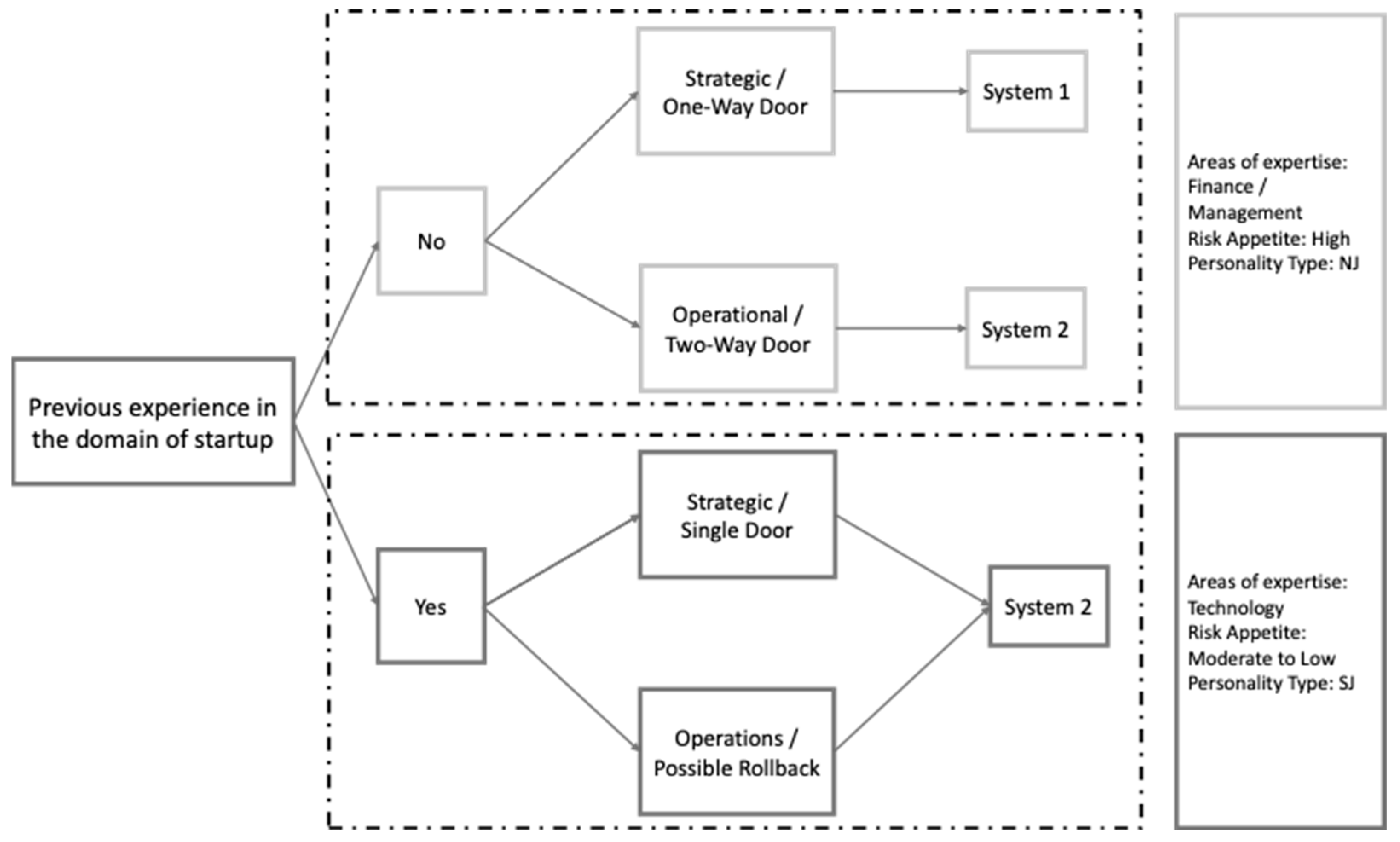

| Variable | Category | Qualitative (n = 20) | Quantitative (n = 350) | ||
|---|---|---|---|---|---|
| Freq. | % | Freq. | % | ||
| Prior Domain Exp. | Yes | 11 | 55% | 167 | 48% |
| No | 9 | 45% | 183 | 52% | |
| Founder Age | <35 years | 8 | 40% | 199 | 57% |
| >35 years | 12 | 60% | 151 | 43% | |
| Gender | Male | 17 | 85% | 292 | 83% |
| Female | 3 | 15% | 58 | 17% | |
| Education | Bachelors | 8 | 40% | 186 | 53% |
| Masters & Above | 12 | 60% | 164 | 47% | |
| Area of Expertise | Finance | 4 | 20% | 63 | 18% |
| Management | 6 | 30% | 135 | 39% | |
| Others | 10 | 50% | 152 | 43% | |
| Venture Age | 2–5 years | 9 | 45% | 193 | 55% |
| 5+ years | 11 | 55% | 157 | 45% | |
| Venture Type | B2B | 10 | 50% | 133 | 38% |
| B2C | 8 | 40% | 165 | 47% | |
| B2B2C | 2 | 10% | 52 | 15% | |
| Venture Category | Product | 8 | 40% | 157 | 45% |
| Service | 12 | 60% | 193 | 55% | |
| Venture Size | Small (<50) | 8 | 40% | 137 | 39% |
| Medium (50–200) | 6 | 30% | 119 | 34% | |
| Large (>200) | 6 | 30% | 94 | 27% |
| Representative Quote | Open Code | Axial Category | Selective Theme |
|---|---|---|---|
| “I transitioned from finance to healthtech.” | No Prior Domain Experience | Domain Experience | Founder Attributes |
| “I’m willing to take big risks for big rewards.” | High Risk Appetite | Entrepreneurial Attributes | Founder Attributes |
| “These decisions are difficult to reverse and influence the future of the business.” | Strategic Decision | Decision Type | Decision Context |
| “I go by intuition, make fast decisions, and move on.” | Intuitive Processing | Decision Style | Decision-Making Style |
| “I use data and draw on past experience before deciding.” | Analytical Processing | Decision Style | Decision-Making Style |
| Construct | Items | Example Item | Source |
|---|---|---|---|
| Domain Experience | 1 | “I had no prior experience in my startup’s industry/domain before launching it.” | Developed for this study |
| Area of Expertise | 1 | “Before starting my venture, I possessed expertise in finance or management.” | Developed for this study |
| Risk Appetite | 3 | “I am comfortable committing significant resources to an opportunity even when outcomes are uncertain.” | Adapted from Zhao et al. (2010) |
| Mind Type | 2 | “I often rely on my gut feeling or intuition when making important decisions.” | Adapted from Allinson and Hayes (1996) |
| Tactics Type | 2 | “I prefer having a clear and structured plan before execution rather than improvising.” | Adapted from Scott and Bruce (1995) |
| Strategic Decision Style | 2 | “When making strategic decisions, I rely primarily on intuition and experience.” | Developed for this study |
| Operational Decision Style | 2 | “When making operational decisions, I rely primarily on intuition and experience.” | Developed for this study |
| Construct | Indicator | Outer Loading | Composite Reliability (CR) | AVE | Cronbach’s Alpha |
|---|---|---|---|---|---|
| Mind Type | MT1 | 0.968 | 0.967 | 0.937 | 0.932 |
| MT2 | 0.968 | ||||
| Risk Appetite | RA1 | 0.907 | 0.935 | 0.827 | 0.896 |
| RA2 | 0.913 | ||||
| RA3 | 0.908 | ||||
| Tactics Type | TT1 | 0.823 | 0.910 | 0.910 | 0.926 |
| TT2 | 0.997 | ||||
| Strategic Decision Style | SDS3 | 0.967 | 0.968 | 0.938 | 0.934 |
| SDS4 | 0.970 | ||||
| Operational Decision Style | ODS3 | 0.952 | 0.956 | 0.929 | 0.932 |
| ODS4 | 0.962 |
| Construct | AOE | DE | MT | RA | TT | SDS | ODS |
|---|---|---|---|---|---|---|---|
| Area of Expertise (AOE) | - | ||||||
| Domain Experience (DE) | 0.190 | - | |||||
| Mind Type (MT) | 0.258 | 0.794 | - | ||||
| Risk Appetite (RA) | 0.174 | 0.587 | 0.521 | - | |||
| Tactics Type (TT) | 0.120 | 0.019 | 0.120 | 0.143 | - | ||
| Strategic Decision Style (SDS) | 0.110 | 0.662 | 0.661 | 0.588 | 0.026 | - | |
| Operational Decision Style (ODS) | 0.126 | 0.218 | 0.246 | 0.355 | 0.115 | - |
| Predictor Variable | VIF |
|---|---|
| Strategic Decision Context | |
| Area of Expertise → Strategic Decision Style | 1.076 |
| Domain Experience → Strategic Decision Style | 2.745 |
| Mind Type → Strategic Decision Style | 2.542 |
| Risk Appetite → Strategic Decision Style | 1.499 |
| Tactics Type → Strategic Decision Style | 1.038 |
| Operational Decision Context | |
| Area of Expertise → Operational Decision Style | 1.092 |
| Domain Experience → Operational Decision Style | 2.736 |
| Mind Type → Operational Decision Style | 2.613 |
| Risk Appetite → Operational Decision Style | 1.507 |
| Tactics Type → Operational Decision Style | 1.087 |
| Path | Β | t-Value | p-Value | Result |
|---|---|---|---|---|
| Area of Expertise → Strategic Decision Style | −0.067 | 1.656 | 0.098 | Not Significant |
| Domain Experience → Strategic Decision Style | 0.286 | 3.881 | <0.001 | Significant *** |
| Mind Type → Strategic Decision Style | 0.302 | 4.167 | <0.001 | Significant *** |
| Risk Appetite → Strategic Decision Style | 0.240 | 5.778 | <0.001 | Significant *** |
| Tactics Type → Strategic Decision Style | −0.042 | 0.971 | 0.332 | Not Significant |
| Path | Β | t-Value | p-Value | Result |
|---|---|---|---|---|
| Area of Expertise → Operational Decision Style | 0.042 | 0.778 | 0.436 | Not Significant |
| Domain Experience → Operational Decision Style | −0.050 | 0.538 | 0.591 | Not Significant |
| Mind Type → Operational Decision Style | 0.138 | 1.541 | 0.123 | Not Significant |
| Risk Appetite → Operational Decision Style | 0.280 | 5.683 | <0.001 | Significant *** |
| Tactics Type → Operational Decision Style | −0.059 | 0.922 | 0.356 | Not Significant |
| Predictor | Strategic β (p-Value) | Operational β (p-Value) | Interpretation |
|---|---|---|---|
| Mind Type | 0.302 (<0.001) | 0.138 (=0.123) | Significant only in the strategic decision context |
| Risk Appetite | 0.240 (<0.001) | 0.280 (<0.001) | Significant across both decision contexts |
| Domain Experience | 0.286 (<0.001) | −0.050 (=0.591) | Significant only in the strategic decision context |
| Area of Expertise | −0.067 (=0.098) | 0.042 (=0.436) | Not significant in either context |
| Tactics Type | −0.042 (=0.332) | −0.059 (=0.356) | Not significant in either context |
Disclaimer/Publisher’s Note: The statements, opinions and data contained in all publications are solely those of the individual author(s) and contributor(s) and not of MDPI and/or the editor(s). MDPI and/or the editor(s) disclaim responsibility for any injury to people or property resulting from any ideas, methods, instructions or products referred to in the content. |
© 2026 by the authors. Licensee MDPI, Basel, Switzerland. This article is an open access article distributed under the terms and conditions of the Creative Commons Attribution (CC BY) license.
Share and Cite
Menon, R.; James, L.; N, E.; Babu T, R.C. Founder Attributes and Self-Reported Decision-Making Styles in Startup Execution: A Dual-Process Perspective on Strategic and Operational Decision Contexts. Behav. Sci. 2026, 16, 1130. https://doi.org/10.3390/bs16071130
Menon R, James L, N E, Babu T RC. Founder Attributes and Self-Reported Decision-Making Styles in Startup Execution: A Dual-Process Perspective on Strategic and Operational Decision Contexts. Behavioral Sciences. 2026; 16(7):1130. https://doi.org/10.3390/bs16071130
Chicago/Turabian StyleMenon, Ramesh, Leena James, Elangovan N, and Ramesh Chandra Babu T. 2026. "Founder Attributes and Self-Reported Decision-Making Styles in Startup Execution: A Dual-Process Perspective on Strategic and Operational Decision Contexts" Behavioral Sciences 16, no. 7: 1130. https://doi.org/10.3390/bs16071130
APA StyleMenon, R., James, L., N, E., & Babu T, R. C. (2026). Founder Attributes and Self-Reported Decision-Making Styles in Startup Execution: A Dual-Process Perspective on Strategic and Operational Decision Contexts. Behavioral Sciences, 16(7), 1130. https://doi.org/10.3390/bs16071130