1. Introduction
Fake news refers to false content that mimics the format of legitimate news (
Duffy et al., 2020). Closely related terms also include disinformation and misinformation. Specifically, misinformation refers to false information that is spread without malicious intent (
Wardle & Derakhshan, 2017), whereas disinformation refers to false information deliberately created to deceive or cause harm to a specific entity (
Wardle & Derakhshan, 2017). Fake news often intertwines the characteristics of misinformation and disinformation. With the explosive growth of social media users, the spread of misinformation on social media platforms has become alarmingly prevalent and can no longer be ignored. For instance, Xiaohongshu (RedNote), one of China’s mainstream social media platforms, released its 2025 mid-year content moderation report. The platform removed 3.2 million deceptive posts, banned 10,000 accounts with identity fraud, and deleted 600,000 low-quality posts with AI-generated content (AIGC) (
China Daily, 2025). Users often struggle to identify false information on social media platforms, leading to its rapid spread online (
Sun & Xie, 2024).
Uses and Gratifications Theory (UGT) posits that individuals use media to satisfy their needs, thereby obtaining gratifications (
Ruggiero, 2000).
Gratification refers to a sense of psychological satisfaction or experience obtained by users through active participation in media activities (
Stafford et al., 2004). In recent years, Uses and Gratifications theory has been widely applied to explain individuals’ social media usage behaviors. Scholars proposed diverse classification systems for gratifications based on specific contexts. In the fields of information dissemination and social media research, gratifications are categorized into three major dimensions—hedonic, social, and utilitarian gratifications (
Gan & Li, 2018;
Gan & Wang, 2015;
Nijjer & Raj, 2020;
Sampat & Raj, 2022). When investigating the impact of gratifications on the continuous usage intention of Chinese WeChat users,
Gan and Li (
2018) classified gratifications into four categories: hedonic gratification (perceived enjoyment, time-passing), social gratification (social interaction, social presence), utilitarian gratification (self-presentation, information recording, information sharing), and technological gratification (media appeal). To explore the relationship between gratifications and fake news-sharing behavior among Indian social media users,
Sampat and Raj (
2022) divided user gratifications into three types: hedonic (entertainment, time-passing), social (socializing), and utilitarian (information sharing, information seeking). Drawing upon relevant studies on fake news sharing (
Ajina et al., 2024;
Apuke & Omar, 2021a;
Balakrishnan et al., 2021;
Sampat & Raj, 2022), this study categorizes gratifications into three types: hedonic gratification (relating to the fulfillment of hedonic expectations, including time-passing and entertainment), social gratification (associating with the fulfillment of social expectations), and utilitarian gratification (referring to the practical satisfaction users gain from engaging with social media platforms, including information sharing and information seeking). Consistent with previous research, this study employed a structured questionnaire to measure gratification. As noted above, there are three dimensions in total. Each dimension comprises three to five items, and all the items are scored on a 5-point Likert scale.
Gratifications have been found to influence fake news sharing (
Apuke & Omar, 2021a;
Balakrishnan et al., 2021;
Wei et al., 2024). However, discrepancies exist among research findings regarding how different dimensions of gratification may affect fake news-sharing behavior. For instance,
Balakrishnan et al. (
2021) identified altruism (i.e., sharing with the intent to help others) as the primary motivation driving the spread of fake news, whereas time-passing exhibited no significant effect. In their investigation of the underlying motives for sharing fake news online in Malaysia during the COVID-19 pandemic, the results revealed that altruism, ignorance, and entertainment significantly and positively predicted fake news-sharing behavior, with altruism exerting the strongest influence. Conversely, usability, engagement, time-passing, and fear of missing out (FoMO) demonstrated no significant impact. Collectively, this model accounted for 49.2% of the variance in fake news-sharing behavior.
Adnan et al. (
2021) also found that altruistic motivation was the primary predictor of fake news sharing among Pakistani social media users; however, factors such as time-passing, information sharing, socializing, and information seeking also exerted significant effects on fake news-sharing behavior during the pandemic. Conversely,
Wei et al. (
2024) found that time-passing was a key predictor of fake news sharing among Pakistani university students. Information seeking showed a positive yet nonsignificant effect on fake news sharing. Social networking, entertainment, and information sharing all displayed nonsignificant negative trends. Similarly,
Apuke and Omar (
2021a) observed that time-passing (along with information sharing, socializing, and information seeking) significantly predicted the sharing of COVID-19-related fake news among Nigerian social media users. In contrast, entertainment showed no significant relationship with fake news sharing.
Concurrently, a limited number of studies have focused on the mechanisms through which gratifications influence fake news sharing.
Sampat and Raj (
2022) explored how gratifications impact fake news-sharing behavior among Indian social media users within the Stimulus–Organism–Response (S-O-R) framework. Their results revealed that time-passing, information seeking, information sharing, and socializing gratifications significantly and positively predicted instant news sharing. The personality traits of extraversion, neuroticism, and openness also significantly and positively predicted instant news sharing, whereas agreeableness and conscientiousness promoted fact-checking. Furthermore, instant news sharing significantly and positively predicted fake news sharing, while fact-checking significantly and negatively predicted fake news sharing. These findings suggest that the impulse for instant sharing, driven by specific gratifications (particularly information sharing) and personality traits, is a critical mechanism underlying the spread of fake news. Conversely, verification behaviors can effectively reduce its spread. Similarly,
Ajina et al. (
2024) further used the S-O-R framework to validate how various gratifications (Stimulus) significantly influence the fake news-sharing intentions (Response) of Pakistani social media users through cognitive and affective attitudes (Organism).
Although existing studies have shown some evidence that gratifications affect information sharing behavior, the limited research and inconsistent findings make the conclusion uncertain. Cultural differences among participants may be the primary reason for these inconsistencies. The detection and sharing of fake news can vary across cultures. For instance, a cross-cultural study by
Ahmed et al. (
2024) encompassing eight countries (e.g., China, the United States, the United Kingdom, and Singapore) revealed that although the illusory truth effect of fake news appears to be universal, it also exhibits cultural differences. Among these countries, Chinese participants demonstrated the highest baseline trust in misinformation. Furthermore,
Chan et al. (
2026) found regional differences in how analytical thinking and conspiracy thinking impact the ability to discern news accuracy on social media. Analytical thinking only decreased the perceived accuracy of misinformation among residents of the United Kingdom and Hong Kong (China). In contrast, conspiracy thinking only increased the perceived accuracy of misinformation among residents of the United States and the United Kingdom. Currently, research on fake news lacks cultural diversity.
Murphy et al. (
2023) conducted a scoping review of misinformation-related studies published between 2016 and 2022, revealing that 78.12% of these studies originated from the United States (49.93%) or Europe (28.19%), with other regions contributing very little (e.g., East Asia at 5.53% and Africa at 5.27%). Another scoping review focusing on experimental studies regarding misinformation beliefs reached a similar conclusion (
Bryanov & Vziatysheva, 2021). In terms of the relationship between gratifications and fake news sharing, the participants were mainly from Pakistan (
Ajina et al., 2024), Malaysia (
Balakrishnan et al., 2021), and India (
Sampat & Raj, 2022).
More importantly, existing research has paid little attention to the relationship between the
questionnaire-based general willingness to share news and the
willingness to share in experimental task scenarios. The majority of findings and conclusions are derived from cross-sectional survey data (
Apuke & Omar, 2021a,
2021b;
Sampat & Raj, 2022), which assess individuals’ general willingness to share fake news. Few studies have investigated whether self-reported general intentions can effectively predict fake news-sharing intentions in specific task scenarios.
Furthermore, regarding data analysis methodology, the existing literature has mainly relied on linear models such as structural equation modeling (SEM) (
Apuke & Omar, 2021a,
2021b;
Sampat & Raj, 2022) or linear regression analysis (
Adnan et al., 2021). SEM were used to examine the isolated effects of independent variables on fake news sharing. However, fake news sharing is a highly complex psychological behavior driven by distinct, equifinal antecedent configurations rather than simple linear relationships. Although SEM can effectively reveal general linear relationships and the net effects among variables, it is limited in revealing the asymmetric pathways and complex configurations of antecedents that lead to high sharing behavior. Conversely, fuzzy-set qualitative comparative analysis (fsQCA) can compensate for this limitation of SEM.
Kaya et al. (
2020) proposed that using fsQCA (an asymmetric method) as a complement to partial least squares structural equation modeling (PLS-SEM, a symmetric method) enables researchers to not only observe the overall trends among variables but also examine the holistic interactions among various elements.
Kang et al. (
2024) also suggested that combining fsQCA and PLS-SEM can provide a more comprehensive causal explanation, thereby overcoming the limitations of employing a single method. Using a mixed-methods approach combining PLS-SEM and fsQCA,
Yan et al. (
2023) explored the impact of information technology empowerment on customer engagement. In a study on the continuous usage intention of Chinese smart voice assistant users,
Kang et al. (
2024) initially employed SEM and identified responsiveness as the strongest influencing factor. However, further analysis using fsQCA revealed that the combination of responsiveness, subjective well-being, two-way communication, and psychological ownership constituted the core configuration driving users’ strong continuous usage intentions. Therefore, applying the combination of fsQCA and PLS-SEM to study how gratifications influence fake news-sharing intentions is both feasible and necessary.
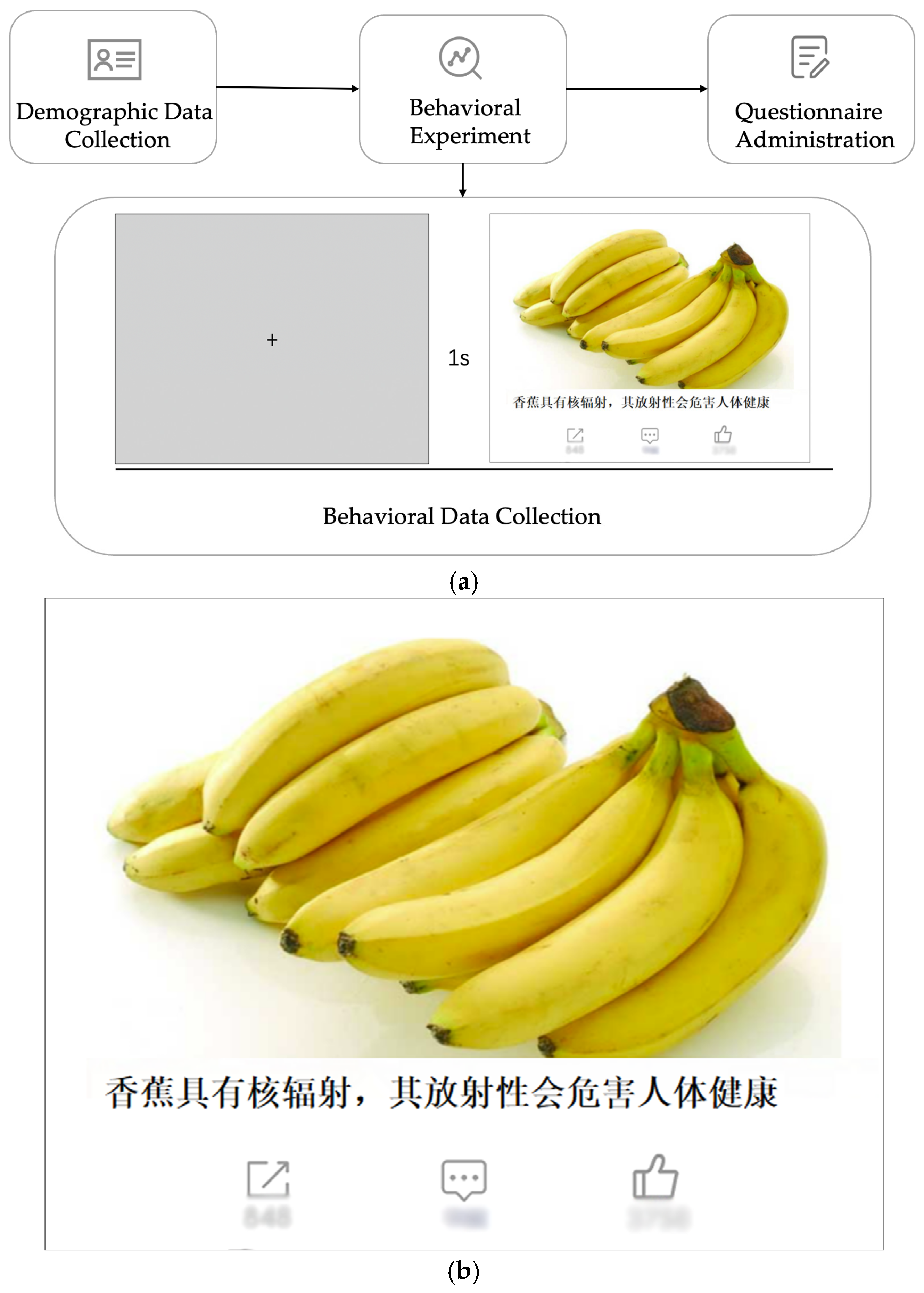
In summary, under the Stimulus–Organism–Response (S-O-R) framework, this research recruited Chinese social media users as participants and combined two data analysis methods: PLS-SEM and fsQCA. Study 1 aimed to examine the impact of gratifications on the sharing of fake news and the underlying mechanisms. Subsequently, to verify the ecological validity of the findings from Study 1, Study 2 further examined the predictive validity of self-reported fake news-sharing intentions for fake news-sharing behavior within specific task contexts. This research would clarify the impact of gratifications on the sharing of fake news among Chinese social media users. It would further identify the configurations of antecedents that lead to high levels of fake news sharing. Moreover, by focusing on Chinese social media users, the results would help to generate more universally applicable conclusions about how gratifications influence fake news sharing and its mechanisms.
This study primarily addressed the following three research questions:
RQ1: How do gratifications influence fake news sharing among Chinese users?
RQ2: What configurations of gratifications drive fake news sharing among Chinese users?
RQ3: Can self-reported fake news-sharing intentions predict fake news-sharing behavior within specific task contexts?
2. The Stimulus–Organism–Response (S-O-R) Theoretical Framework
The Stimulus–Organism–Response (S-O-R) theoretical framework was initially proposed by Mehrabian and Russell within the field of environmental psychology (
Mehrabian & Russell, 1974). This framework comprises three core elements: Stimulus (S), Organism (O), and Response (R). Its central premise is that external stimuli influence an individual’s cognitive and affective evaluations, which in turn prompt the individual to generate positive or negative behavioral responses. Specifically,
Stimulus represents environmental factors capable of eliciting an individual’s cognitive and affective evaluations.
Organism refers to the internal process of these cognitive and affective evaluations.
Response denotes the behavioral outcomes resulting from such evaluations, encompassing both behavioral intentions and actual actions (
Kang et al., 2024;
Shang et al., 2023).
The S-O-R framework has been widely applied to understand consumer behavior, serving as a robust theoretical tool for explaining how gratifications influence individuals’ behavior. In recent years, the S-O-R framework has also begun to be applied to understand how users’ gratifications, acting as Stimulus factors, influence their fake news-sharing behavior through Organism factors (
Ajina et al., 2024;
Sampat & Raj, 2022). For example, in their investigation of fake news-sharing behavior,
Sampat and Raj (
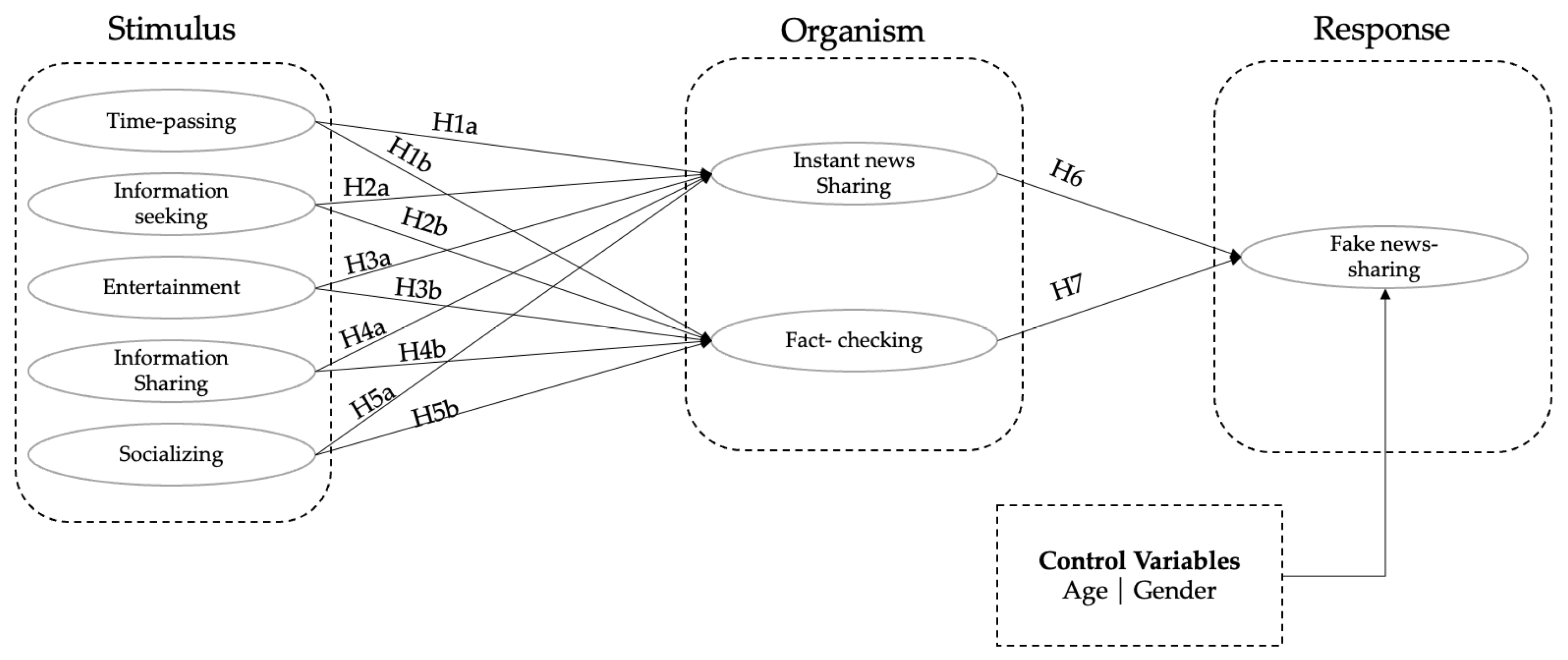
2022) used five gratification dimensions (time-passing, information seeking, entertainment, information sharing, and socializing) and five personality traits (agreeableness, conscientiousness, extraversion, openness, and neuroticism) as Stimulus variables (S). They used instant news sharing and fact-checking as Organism variables (O), and fake news sharing as the Response variable (R). Building upon the research of
Sampat and Raj (
2022),
Ajina et al. (
2024) tested and validated a modified Stimulus–Organism–Response (S-O-R) theoretical model. They conceptualized three categories of gratifications (hedonic, social, and utilitarian) as Stimulus variables (S), dual-dimensional attitudes (cognitive and affective) as Organism variables (O), and fake news-sharing intentions as the Response variable (R).
Based on existing research, this study conceptualized gratifications as Stimulus factors, encompassing three dimensions and five elements: utilitarian gratification (information sharing and information seeking), hedonic gratification (time-passing and entertainment), and social gratification (socializing). Furthermore, instant news sharing and fact-checking were designated as Organism variables. Finally, fake news sharing served as the Response variable.
6. Conclusions and Discussion
Using PLS-SEM and fsQCA analytical methods, this study systematically uncovered the decision-making processes and configurations of antecedents through which gratifications influence fake news sharing. Furthermore, it investigated the relationship between self-reported fake news-sharing intentions and fake news-sharing behavior within experimental task contexts. The findings of Study 1 revealed that time-passing, entertainment, and socializing gratifications positively influence instant news sharing, whereas information seeking exerts a negative effect. Simultaneously, entertainment gratification positively affects the fact-checking. Regarding the behavioral decision-making process, instant news sharing significantly promotes self-reported fake news-sharing intentions, whereas fact-checking effectively inhibits this tendency. Additionally, the fsQCA analysis revealed three configurations of antecedents that lead to high levels of fake news sharing, confirming the existence of multiple concurrent driving pathways for this behavior. More importantly, the behavioral experiment verified the predictive validity of self-reported fake news-sharing intentions for fake news-sharing behavior within specific task contexts for the first time. Thus, the results in Study 2 provided robust support for the generalizability of the findings from Study 1. Overall, this study not only elucidates the decision-making mechanisms by which gratifications impact fake news-sharing. It also demonstrates that users’ self-reported scale data can effectively predict their sharing decisions in experimental scenarios. In doing so, this study helps bridge the disconnect between “self-reports” and “actual behavior” that has been prevalent in prior research.
6.1. Relationships Between Gratifications and Fake News-Sharing Behavior
Regarding the relationship between the Stimulus variables (gratifications) and the Organism variable (instant news sharing), the present results partially support the hypotheses. Specifically, information seeking gratification significantly and negatively predicted instant news sharing, whereas information sharing gratification exhibited no significant association with instant news sharing. Overall, these findings align with existing literature, suggesting that gratifications can influence the behavioral decision-making processes involved in fake news sharing. However, concerning the specific relationships between the various dimensions of gratifications and fake news sharing, the present findings are not entirely consistent with the prior literature. Similarly, within the S-O-R theoretical framework,
Sampat and Raj (
2022) found that time-passing and socializing gratifications positively predicted instant news sharing among Indian social media users, which aligns with our results. They also discovered that information seeking and information sharing gratifications significantly and positively predicted instant news sharing, while entertainment gratification did not significantly predict INS. Those findings diverged from our results.
Additionally, given that instant news sharing can predict fake news sharing (
Apuke & Omar, 2021b;
Talwar et al., 2020), it is reasonable to infer that gratifications that influence fake news sharing may also influence instant news sharing. Therefore, the literature examining the relationship between gratifications and fake news sharing provides valuable reference points. However, discrepancies also exist among the findings within those studies. Some findings are consistent with the results of the present study. The relationship between specific gratifications and fake news sharing is well documented, though empirical findings remain highly inconsistent. In alignment with our results, previous research has frequently identified hedonic and social motives (such as entertainment, time-passing, and socializing) as significant positive predictors of fake news dissemination across various demographic groups (
Ajina et al., 2024;
Apuke & Omar, 2021a,
2021b;
Balakrishnan et al., 2021;
Wei et al., 2024). Conversely, by highlighting the complexity of this behavior, our findings diverge from certain studies that reported nonsignificant effects for time-passing, entertainment, or socializing gratifications (
Ajina et al., 2024;
Balakrishnan et al., 2021;
Wei et al., 2024). A further divergence concerns information-oriented gratifications. Previous studies have observed that information seeking and information sharing actively promote the spread of fake news (
Ajina et al., 2024;
Apuke & Omar, 2021a). However, our results align with
Wei et al. (
2024) regarding information sharing and do not reflect this positive pattern.
Regarding the relationship between the Stimulus variables (gratifications) and the Organism variable (fact-checking), the present results did not support the hypotheses. H1b to H5b examined the negative predictive effects of time-passing, entertainment, information seeking, information sharing, and socializing gratifications on the fact-checking, respectively. Time-passing, information seeking, information sharing, and socializing showed no significant association with news authentication, whereas entertainment significantly and positively predicted it. These results diverge from the existing literature. For instance,
Sampat and Raj (
2022) discovered that information seeking and entertainment gratifications significantly and negatively predicted fact-checking among Indian social media users.
The results indicate that the impact of gratifications on instant news sharing, fake news sharing, and fact-checking exhibits both cultural universality and cultural differences. The universal pattern lies in the general influence of gratifications on fake news-sharing and verification behavior. At the same time, the cultural specificity is reflected in the differential effects of distinct gratification dimensions on these behaviors. However, as noted in the introduction, empirical evidence remains limited both across and within cultural contexts. Consequently, it is difficult to derive more definitive and directional conclusions regarding how gratifications influence fake news sharing.
Regarding the relationship between the Organism variables and the Response variable (fake news-sharing intentions), the results supported hypotheses H6 and H7. Instant news sharing positively predicted fake news sharing, while fact-checking significantly and negatively predicted fake news sharing. This is consistent with the results of
Sampat and Raj (
2022), who also discovered that instant news sharing significantly and positively predicted fake news sharing, whereas fact-checking significantly and negatively predicted it. Furthermore, these results support the findings of
Talwar et al. (
2020) and
Apuke and Omar (
2021b).
Talwar et al. (
2020) integrated qualitative and quantitative research methods to explore the specific behavioral manifestations and motivational pathways that lead social media users to share fake news. Their findings revealed that instant sharing behavior driven by the motivation to attract others’ attention had a significant positive impact on fake news sharing. In exploring the motivational factors behind social media users sharing fake news during the COVID-19 pandemic,
Apuke and Omar (
2021b) similarly found a positive predictive effect of instant news sharing on the sharing of COVID-19 fake news among Nigerian adults. Evidently, research across different cultural backgrounds has yielded similar results, suggesting that the impact of Organism variables on the Response variable may possess cultural universality. However,
Talwar et al. (
2020) also found that the habit or willingness to authenticate the news before sharing under the influence of time pressure and a sense of moral obligation failed to produce any significant inhibitory effect on reducing fake news sharing. This also indicates that the relationship between the fact-checking and fake news sharing may be partially influenced by temporal contexts or environmental variables.
6.2. Complex Antecedent Configurations of Fake News Sharing
PLS-SEM in Study 1 effectively reveals how a single gratification variable linearly influences sharing fake news. However, in real-world contexts, users’ sharing behaviors are rarely triggered by a single form of gratification. Instead, they come from the complex concurrence of multiple motives and organismic factors. Therefore, this study employed fsQCA to conduct a configurational analysis, identifying three sufficient configurations that lead to sharing fake news. Meanwhile, these results are consistent with the conclusions of hypotheses H1a, H2a, H6, and H7 validated by PLS-SEM. These analyses not only achieve cross-method validation but also profoundly reveal the synergistic effects and the “equifinality” mechanism among various factors, substantially extending Study 1.
An in-depth analysis of these three configurations reveals two core psychological evolution pathways. Configurations 1 and 2 share a commonality: both highlight the dominant role of high instant news sharing. However, in terms of their micro-mechanisms, they exhibit fundamentally different cognitive patterns.
Configuration 1 illustrates a sharing logic under “cognitive overload.” When users are highly aroused by multiple motives such as information seeking, entertainment, and socialization, the complex motivational load easily triggers heuristic information processing. In this state, the strong impulse for instant news sharing dominates and bypasses cognitive verification, which is manifested as the concurrent absence of fact-checking. Consequently, individuals rapidly spread false content relying on intuition and instinct.
In contrast, Configuration 2 uncovers a more covert pathway of “confirmation bias.” In this configuration, multiple interactive motives are superimposed with a high-intensity intention to pass time. Although users exhibit a certain degree of fact-checking, the outcome still led to the sharing of fake news. This indicates that under the strong inertia of instant news sharing, such superficial authentication is merely a formality. Driven by strong hedonic and social orientations, users’ cognitive authentication processes are highly susceptible to self-serving bias. The ineffective authentication fails to block the spread of fake news.
Furthermore, Configuration 3 independently reveals a “self-directed” mechanism for SFN. In this configuration, a high level of time-passing and information seeking, with a low level of fact-checking, collectively constitute the core conditions. These results suggest that even if individuals lack the gratifications from interpersonal communication (e.g., low information sharing and low socialization), the transmission of fake news may still be facilitated. As long as there are strong motives of time-passing and information seeking, the sharing behavior could occur. Those findings imply that for users exhibiting “low-involvement” and “lurking” characteristics, aimless browsing and unidirectional information consumption are the norms. Once lacking critical authentication awareness, they could be prone to inadvertently becoming implicit nodes in the spread of fake news.
In conclusion, the fsQCA results not only corroborated the core findings of the PLS-SEM but also deeply elucidated the synergistic interactions and substitution relationships among different gratifications in eliciting aberrant sharing behaviors, thereby providing a robust extension and complement to the linear analysis.
6.3. Implications
6.3.1. Theoretical Implications
First, by integrating the Stimulus–Organism–Response (S-O-R) framework and UGT, this study focused on how Chinese social media users engage in fake news sharing. Despite the vast scale of internet and social media use in China, empirical research examining fake news-sharing behaviors remains insufficient. The findings of this study contribute to a more comprehensive understanding of the relationship between gratifications and fake news sharing, shedding light on both cultural universality and cultural specificity within the domain of fake news sharing.
Second, building on conventional PLS-SEM, this study further applied fsQCA to uncover the complex configurations of antecedents driving fake news sharing. The results provide a more comprehensive framework for understanding fake news-sharing behaviors in the real world, marking a novel contribution to the field.
Third, departing from prior research that relies solely on surveys, this study extended beyond questionnaire surveys by designing a behavioral experiment to validate the predictive validity of self-reported fake news-sharing intentions in fake news-sharing behavior within experimental task contexts. Although existing questionnaires have established validity, the findings of this study remain innovative, particularly within the context of fake news sharing. The results provide robust evidence for the generalizability of fake news-sharing questionnaires grounded in the S-O-R framework, contributing to their wider application and the continued accumulation of empirical data on fake news sharing.
6.3.2. Practical Implications
The findings of this study offer the following important practical implications.
First, this study confirmed that time-passing, entertainment, and socializing gratifications drive users to engage in instant news sharing on social media. The tendency to share instant news is positively associated with fake news-sharing behavior. In contrast, the tendency toward fact-checking is negatively associated with fake news-sharing behavior. This study suggests that prior to sharing news driven by hedonic (including time-passing and entertainment) and social motives, social media users should verify the authenticity of information through multiple channels, such as fact-checking platforms. In addition, users should rationally infer the authenticity of the news by synthesizing various cues (e.g., the credibility and professionalism of the news source). Policymakers should launch campaigns promoting news literacy and media awareness to enhance users’ ability to discern the authenticity of information and their discernment in sharing. For users driven by specific gratifications, educational initiatives should cultivate rapid cognitive heuristics, enabling them to develop conditioned, intuitive truth-discernment reflexes during momentary browsing.
Second, the fsQCA identified three configurations that drive users to share misinformation, indicating the complexity of the impact of gratifications on fake news sharing. However, users across all configurations commonly exhibit frequent Instant news sharing or a low willingness for presharing authentication as a core condition. Policymakers should optimize social media algorithmic recommendations, design targeted interventions for instant sharing, and reduce the operational barriers to information verification. These improvements may increase the likelihood of users authenticating the news before sharing and reduce their impulses for instant sharing at the structural and interface levels. Social media platforms can implement ‘friction’ mechanisms in their interface design. For instance, whenever a user clicks ‘share,’ the platform could trigger a confirmation prompt, such as: ‘You have not read the full article. Are you sure you want to share?’ or ‘This information contains controversial content; verification is recommended.’
Finally, government agencies should continuously improve online detection technologies and fact-checking systems for fake news. By promptly correcting fake news on mainstream social media and fact-checking platforms, they may minimize its exposure and ensure that corrective information reaches a wider audience. At the regulatory level, relevant government authorities could establish a standardized, official fact-checking API and mandate its integration across mainstream media platforms. Once high-traffic content is verified as fake news on one platform, this system would immediately trigger cross-platform coordination to proactively restrict its dissemination.
6.4. Limitations and Future Research Directions
The present study is subject to several limitations. First, regarding sample representativeness and external validity, data collection primarily relied on convenience sampling, focusing on enrolled university students. Although this demographic represents a high-frequency transmission group for fake news (
Zhang et al., 2026), their homogeneous educational and economic backgrounds limit the generalizability of our findings to other age groups (e.g., middle-aged and older adults) or broader social strata. Furthermore, females constituted a larger share of the sample in Study 1, although the current data did not indicate severe gender bias. Future research should employ stratified random sampling to balance gender ratios and incorporate diverse age cohorts to validate the robust applicability of the current findings across different populations.
Second, the current measurement design did not explicitly differentiate users’ truth-discernment capabilities prior to sharing information. Consequently, this study could not strictly distinguish between different behavioral subtypes, such as “blind sharing” (unaware of the falsehood), “warning-oriented sharing” (sharing to alert others), or “hedonic-driven sharing” (knowingly sharing for amusement). Future studies should incorporate truth-discernment assessments in the survey design to untangle the distinct psychological mechanisms and antecedent configurations underlying these three behavioral types.
Third, this study incorporated a behavioral experiment to observe users’ sharing decisions, addressing the limitations of relying solely on self-reported questionnaires. However, the cross-sectional nature of the survey data in Study 1 still restricts rigorous causal inferences regarding the mechanisms linking various gratifications to fake news-sharing behavior. Future research could further validate their dynamic associations through longitudinal designs. Additionally, the current experiment employed static images as stimuli. Compared with the short-video content that currently dominates mainstream platforms, their ecological validity may be constrained. Subsequent experimental designs should focus on investigating the dissemination characteristics of multimodal misinformation in online network environments.