The Double-Edged Sword Effect of Government Chatbot Empathy on Citizens’ Continued Usage Intention
Abstract
1. Introduction
2. Literature Review
2.1. Government Chatbot Empathy
2.2. Social Presence Theory
2.3. The Impact of Government Chatbot Empathy on Citizens’ Continued Usage Intention
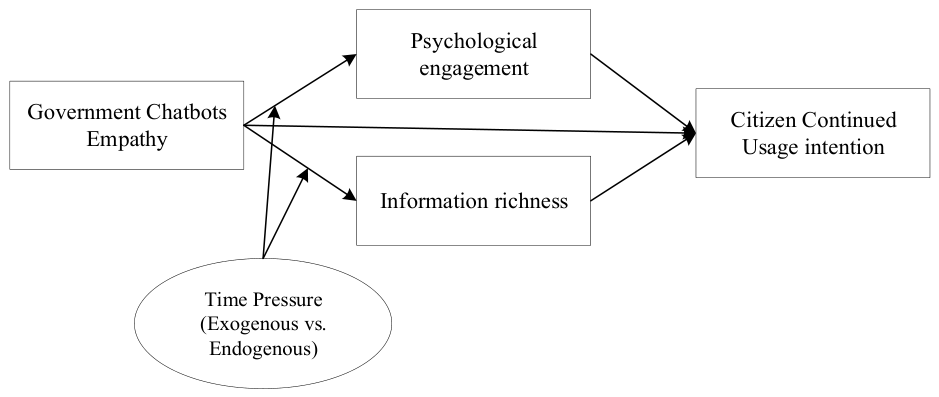
2.4. The Mediating Role of Psychological Engagement and Information Richness
2.5. The Regulatory Role of Exogenous and Endogenous Time Pressure
3. Empirical Research
3.1. Experiment 1
3.1.1. Experimental Design
3.1.2. Experimental Results
3.1.3. Discussion
3.2. Experiment 2
3.2.1. Experimental Design
3.2.2. Experimental Results
3.2.3. Discussion
4. General Discussion
4.1. Theoretical Implications
4.2. Practice Implications
5. Conclusions and Limitations
5.1. Conclusions
5.2. Research Limitations
Author Contributions
Funding
Institutional Review Board Statement
Informed Consent Statement
Data Availability Statement
Acknowledgments
Conflicts of Interest
References
- Adam, M., Wessel, M., & Benlian, A. (2021). AI-based chatbots in customer service and their effects on user compliance. Electronic Markets, 31(2), 427–445. [Google Scholar]
- Adler, S. J., Röseler, L., & Schoeniger, M. K. (2023). A toolbox to evaluate the trustworthiness of published findings. Journal of Business Research, 167, 114189. [Google Scholar] [CrossRef] [Scilit]
- Baer, M., & Oldham, G. R. (2006). The curvilinear relation between experienced creative time pressure and creativity: Moderating effects of openness to experience and support for creativity. Journal of Applied Psychology, 91(4), 963–970. [Google Scholar] [CrossRef] [Scilit] [PubMed]
- Bifulco, A., Mahon, J., Kwon, J. H., Moran, P. M., & Jacobs, C. (2003). The Vulnerable attachment style questionnaire (VASQ): An interview-based measure of attachment styles that predict depressive disorder. Psychological Medicine, 33(6), 1099–1110. [Google Scholar] [CrossRef] [Scilit] [PubMed]
- Biocca, F., Harms, C., & Burgoon, J. K. (2003). Toward a more robust theory and measure of social presence: Review and suggested criteria. Presence: Teleoperators & Virtual Environments, 12(5), 456–480. [Google Scholar] [CrossRef] [Scilit]
- Castelo, N., Boegershausen, J., Hildebrand, C., & Henkel, A. P. (2023). Understanding and improving consumer reactions to service bots. Journal of Consumer Research, 50(4), 848–863. [Google Scholar] [CrossRef] [Scilit]
- Cavanaugh, M. A., Boswell, W. R., Roehling, M. V., & Boudreau, J. W. (2000). An empirical examination of self-reported work stress among U. S. managers. Journal of Applied Psychology, 85(1), 65–74. [Google Scholar] [CrossRef] [Scilit] [PubMed]
- Chen, G. L., Zhang, S. W., & Chen, W. N. (2023). Conjoint experiments in public management research: Literature review, basic principles, and result implementation. Public Administration and Policy Review, 12(03), 152–168. [Google Scholar]
- Chen, J., Zhang, Y., & Wang, L. (2025). The impact of service robot communication style on consumers’ continued willingness to use. Collabra: Psychology, 11(1), 128020. [Google Scholar] [CrossRef] [Scilit]
- Choi, S., Mattila, A. S., & Bolton, L. E. (2021). To err is human(-oid): How do consumers react to robot service failure and recovery? Journal of Service Research, 24(3), 354–371. [Google Scholar]
- Chong, D. S., Van Eerde, W., Chai, K. H., & Rutte, C. G. (2011). A double-edged sword: The effects of challenge and hindrance time pressure on new product development teams. IEEE Transactions on Engineering Management, 58(1), 71–86. [Google Scholar]
- Dai, X., & Lu, H. (2015). Development of social presence in multiple fields and its marketing research implications. Chinese Journal of Management, 12(8), 1172–1183. [Google Scholar]
- De Gennaro, M., Krumhuber, E. G., & Lucas, G. (2020). Effectiveness of an empathic chatbot in combating adverse effects of social exclusion on mood. Frontiers in Psychology, 10, 495952. [Google Scholar] [CrossRef] [Scilit] [PubMed]
- Fan, H., Gao, W., & Han, B. (2022). How does (im)balanced acceptance of robots between customers and frontline employees affect hotels’ service quality? Computers in Human Behavior, 133, 107287. [Google Scholar] [CrossRef] [Scilit]
- Fan, J., Sun, T., Liu, J., Zhao, T., Zhang, B., Chen, Z., Glorioso, M., & Hack, E. (2023). How well can an AI chatbot infer personality? Examining psychometric properties of machine-inferred personality scores. Journal of Applied Psychology, 108(8), 1277. [Google Scholar] [CrossRef] [Scilit] [PubMed]
- Ha, Y., & Im, H. (2012). Role of web site design quality in satisfaction and word of mouth generation. Journal of Service Management, 23(1), 79–96. [Google Scholar] [CrossRef] [Scilit]
- Holloway, B. B., & Beatty, S. E. (2008). Satisfiers and dissatisfiers in the online environment: A critical incident assessment. Journal of Service Research, 10(4), 347–364. [Google Scholar] [CrossRef] [Scilit]
- Huang, M. H., & Rust, R. T. (2021). Engaged to a robot? The role of AI in service. Journal of Service Research, 24(1), 30–41. [Google Scholar]
- Hunt, T. E., & Sandhu, K. K. (2017). Endogenous and exogenous time pressure: Interactions with mathematics anxiety in explaining arithmetic performance. International Journal of Educational Research, 82(1), 91–98. [Google Scholar] [CrossRef] [Scilit]
- Juquelier, A., Poncin, I., & Hazée, S. (2025). Empathic chatbots: A double-edged sword in customer experiences. Journal of Business Research, 188, 115074. [Google Scholar]
- Kim, H., & Niehm, L. S. (2009). The impact of website quality on information quality, value, and loyalty intentions in apparel retailing. Journal of Interactive Marketing, 23(3), 221–233. [Google Scholar] [CrossRef] [Scilit]
- Kim, M. (2024). Unveiling the e-servicescape of ChatGPT: Exploring user psychology and engagement in AI-powered chatbot experiences. Behavioral Sciences, 14(7), 558. [Google Scholar] [PubMed]
- Leite, I., Pereira, A., Mascarenhas, S., Martinho, C., Prada, R., & Paiva, A. (2013). The influence of empathy in human–robot relations. International Journal of Human-Computer Studies, 71(3), 250–260. [Google Scholar] [CrossRef] [Scilit]
- Li, G., Zhao, Z., Li, L., Li, Y., Zhu, M., & Jiao, Y. (2024). The relationship between AI stimuli and customer stickiness, and the roles of social presence and customer traits. Journal of Research in Interactive Marketing, 18(1), 38–53. [Google Scholar]
- Li, M., & Wang, R. (2023). Chatbots in e-commerce: The effect of chatbot language style on customers’ continuance usage intention and attitude toward brand. Journal of Retailing and Consumer Services, 71, 103209. [Google Scholar]
- Li, X., & Wang, J. (2024). Should government chatbots behave like civil servants? The effect of chatbot identity characteristics on citizen experience. Government Information Quarterly, 41(3), 101957. [Google Scholar] [CrossRef] [Scilit]
- Lim, A., & Okuno, H. G. (2015). A recipe for empathy: Integrating the mirror system, insula, somatosensory cortex and motherese. International Journal of Social Robotics, 7(1), 35–49. [Google Scholar]
- Liu, B., & Sundar, S. S. (2018). Should machines express sympathy and empathy? Experiments with a health advice chatbot. Cyberpsychology, Behavior, and Social Networking, 21(10), 625–636. [Google Scholar] [CrossRef] [Scilit] [PubMed]
- Liu, X., Zhang, X., & Cui, T. (2017). Research on the relationship between time pressure and creativity: The cross-level moderating effect of time leadership. R&D Management, 29(5), 13–21. [Google Scholar]
- Liu, Y. L., Hu, B., Yan, W., & Lin, Z. (2023). Can chatbots satisfy me? A mixed-method comparative study of satisfaction with task-oriented chatbots in mainland China and Hong Kong. Computers in Human Behavior, 143, 107716. [Google Scholar]
- Liu-Thompkins, Y., Okazaki, S., & Li, H. (2022). Artificial empathy in marketing interactions: Bridging the human-AI gap in affective and social customer experience. Journal of the Academy of Marketing Science, 50(6), 1198–1218. [Google Scholar] [CrossRef] [Scilit]
- Luo, L., Wang, K., Hu, J., & Xu, S. (2025). When artificial intelligence faces human emotions: The influence mechanism of service robot emotional expression on user experience. Advances in Psychological Science, 33(6), 1006–1026. [Google Scholar]
- Mao, C. L., & Yuan, Q. J. (2018). Social Presence Theory and its application and prospects in the field of information systems. Journal of Intelligence, 37(8), 186–194. [Google Scholar]
- Mariani, M. M., Hashemi, N., & Wirtz, J. (2023). Artificial intelligence empowered conversational agents: A systematic literature review and research agenda. Journal of Business Research, 161, 113838. [Google Scholar] [CrossRef] [Scilit]
- Markovitch, D. G., Stough, R. A., & Huang, D. (2024). Consumer reactions to chatbot versus human service: An investigation in the role of outcome valence and perceived empathy. Journal of Retailing and Consumer Services, 79, 103847. [Google Scholar] [CrossRef] [Scilit]
- Meng, Q. G., & Ju, J. R. (2021). Platform government supported by artificial intelligence: Technical framework and practical path. E-Government, 9, 37–46. [Google Scholar]
- Moffett, J. W., Folse, J. A. G., & Palmatier, R. W. (2021). A theory of multiformat communication: Mechanisms, dynamics, and strategies. Journal of the Academy of Marketing Science, 49, 441–461. [Google Scholar] [PubMed]
- Ngo, V. (2025). Humanizing AI for trust: The critical role of social presence in adoption. AI & SOCIETY, 41, 1803–1819. [Google Scholar] [CrossRef] [Scilit]
- Nielsen, J. A., Andersen, K. N., & Sigh, A. (2016). Robots conquering local government services: A case study of eldercare in Denmark. Information Polity, 21(2), 139–151. [Google Scholar] [CrossRef] [Scilit]
- Nißen, M., Selimi, D., Janssen, A., Cardona, D. R., Breitner, M. H., Kowatsch, T., & von Wangenheim, F. (2022). See you soon again, chatbot? A design taxonomy to characterize user-chatbot relationships with different time horizons. Computers in Human Behavior, 127, 107043. [Google Scholar] [CrossRef] [Scilit]
- Ohly, S., & Fritz, C. (2010). Work characteristics, challenge appraisal, creativity, and proactive behavior: A multi-level study. Journal of Organizational Behavior, 31(4), 543–565. [Google Scholar]
- Ostrom, A. L., Field, J. M., Fotheringham, D., Subramony, M., Gustafsson, A., Lemon, K. N., Huang, M. H., & McColl-Kennedy, J. R. (2021). Service research priorities: Managing and delivering service in turbulent times. Journal of Service Research, 24(3), 329–353. [Google Scholar] [CrossRef] [Scilit]
- Park, G., Yim, M. C., Chung, J., & Lee, S. (2023). Effect of AI chatbot empathy and identity disclosure on willingness to donate: The mediation of humanness and social presence. Behaviour & Information Technology, 42, 1998–2010. [Google Scholar]
- Park, Y., Kim, J., Jiang, Q., & Kim, K. H. (2024). Impact of artificial intelligence (AI) chatbot characteristics on customer experience and customer satisfaction. Journal of Global Scholars of Marketing Science, 34(3), 439–457. [Google Scholar] [CrossRef] [Scilit]
- Pieters, R., & Warlop, L. (1999). Visual attention during brand choice the impact of time pressure and task motivation. International Journal of Research in Marketing, 16(1), 1–16. [Google Scholar] [CrossRef] [Scilit]
- Qin, D., & Li, C. P. (2020). Review and prospects of situational experimental research in organizational behavior. Modernization of Management, 40(2), 71–75. [Google Scholar]
- Roy, R., & Naidoo, V. (2021). Enhancing chatbot effectiveness: The role of anthropomorphic conversational styles and time orientation. Journal of Business Research, 126, 23–34. [Google Scholar] [CrossRef] [Scilit]
- Salinäs, E. L. (2002). Collaboration in multi-modal virtual worlds: Comparing touch, text, voice and video. In The social life of avatars: Presence and interaction in shared virtual environments (pp. 172–187). Springer. [Google Scholar]
- Shi, H., Yin, B., Teng, L., & Ma, B. (2025). Empathetic AI encounters: Pathways to prosocial behavior. Journal of Service Research, 28(3), 456–472. [Google Scholar]
- Short, J., Williams, E., & Christie, B. (1976). The social psychology of telecommunications. Wiley. [Google Scholar]
- Spreng, R. A., Harrell, G. D., & Mackoy, R. D. (1995). Service recovery: Impact on satisfaction and intentions. Journal of Services Marketing, 9(1), 15–23. [Google Scholar] [CrossRef] [Scilit]
- Straub, D., & Karahanna, E. (1998). Knowledge worker communications and recipient availability: Toward a task closure explanation of media choice. Organization Science, 9(2), 160–175. [Google Scholar] [CrossRef] [Scilit]
- Suchman, A. L., Markakis, K., Beckman, H. B., & Frankel, R. (1997). A model of empathic communication in the medical interview. JAMA, 277(8), 678–682. [Google Scholar] [CrossRef] [Scilit] [PubMed]
- Teng, Y. Y. (2013). A review of social presence research. Modern Educational Technology, 23(3), 64–70. [Google Scholar]
- Trivedi, J. (2019). Examining the customer experience of using banking chatbots and its impact on brand love: The moderating role of perceived risk. Journal of Internet Commerce, 18(1), 91–111. [Google Scholar] [CrossRef] [Scilit]
- Van Noordt, C., & Misuraca, G. (2022). Artificial intelligence for the public sector: Results of landscaping the use of AI in government across the European Union. Government Information Quarterly, 39(3), 101714. [Google Scholar] [CrossRef] [Scilit]
- Wahbi, A., Khaddouj, K., & Lahlimi, N. (2023). Study of the relationship between chatbot technology and customer experience and satisfaction. International Journal of Accounting, Finance, Auditing, Management and Economics, 4, 758–771. [Google Scholar]
- Wang, B., & Niu, C. W. (2023). From ChatGPT to GovGPT: Generative AI-driven construction of government service ecosystem. E-Government, 9, 25–38. [Google Scholar]
- Wang, C., Teo, T. S. H., & Janssen, M. (2021). Public and private value creation using artificial intelligence: An empirical study of AI voice robot users in Chinese public sector. International Journal of Information Management, 61, 102401. [Google Scholar] [CrossRef] [Scilit]
- Whitford, A. B., Yates, J., Burchfield, A., Anastasopoulos, J. L., & Anderson, D. M. (2020). The adoption of robotics by government agencies: Evidence from crime labs. Public Administration Review, 80(6), 976–988. [Google Scholar] [CrossRef] [Scilit]
- Xu, J., Benbasat, I., & Cenfetelli, R. T. (2013). Integrating service quality with system and information quality: An empirical test in the e-service context. MIS Quarterly, 37, 777–794. [Google Scholar] [CrossRef] [Scilit]
- Xu, X., & Liu, J. (2022). Artificial intelligence humor in service recovery. Annals of Tourism Research, 95, 103439. [Google Scholar] [CrossRef] [Scilit]
- Zapf, D. (1993). Stress-oriented analysis of computerized office work. European Work and Organizational Psychologist, 3(2), 85–100. [Google Scholar] [CrossRef] [Scilit]
- Zhou, M., Liu, L., & Feng, Y. (2025). Building citizen trust to enhance satisfaction in digital public services: The role of empathetic chatbot communication. Behaviour & Information Technology, 44(16), 3859–3878. [Google Scholar] [CrossRef] [Scilit]


| Literature | Theory | Sector(s) | Social-Related Mediator(s) | Information Richness | Moderator(s) | Outcome(s) |
|---|---|---|---|---|---|---|
| B. Liu and Sundar (2018) | CASA | Healthcare | X | Customer-related | Overall evaluation | |
| Adam et al. (2021) | CASA | Banking | X | User compliance | ||
| J. Fan et al. (2023) | Confirmation theory | Hospitality | Chatbot- and employee-related | Customer retention | ||
| Markovitch et al. (2024) | Attribution theory | Retail | Chatbot-related | Customer satisfaction | ||
| This study | Social presence theory | Public sector | X | X | Context-related (time pressure) | Citizens’ Continued Usage Intention |
| Experiment 1 | Experiment 2 | ||
|---|---|---|---|
| Variable | Classification | N = 148 | N = 120 |
| Gender | female | 72 | 52 |
| Male | 76 | 68 | |
| Age | 18–22 | 69 | 63 |
| 23–27 | 30 | 32 | |
| 28–32 | 26 | 15 | |
| ≥33 | 23 | 10 | |
| Level of Education | Undergraduate | 91 | 70 |
| Master’s degree | 55 | 32 | |
| Ph.D. | 2 | 18 |
| Low-Empathy Human–Computer Dialogue Script for Government Chatbot | High-Empathy Human–Computer Dialogue Script for Government Chatbots |
|---|---|
|
|
| Groups | Samples | Mean | SD | p Value |
|---|---|---|---|---|
| Low-empathy group | 74 | 4.221 | 1.433 | <0.001 |
| High-empathy group | 74 | 5.884 | 1.067 | <0.001 |
| Variables | Mean | SD | t Value | Cohen’s d | p Value | |
|---|---|---|---|---|---|---|
| Citizens’ continued usage intention | Low-empathy group | 3.327 | 1.797 | 8.938 | 1.469 | <0.001 |
| High-empathy group | 5.642 | 1.318 | ||||
| Effect | β | SE | p Value | 95% CI | |
|---|---|---|---|---|---|
| Lower | Upper | ||||
| Total effect (government chatbot empathy on continued usage intention) | 1.327 | 0.198 | <0.001 | — | — |
| Direct effect (government chatbot empathy on continued usage intention) | 0.150 | 0.252 | >0.05 | — | — |
| Indirect effect (government chatbot empathy on continued usage intention via psychological engagement) | 0.501 | 0.141 | <0.001 | 0.240 | 0.790 |
| Indirect effect via (government chatbot empathy on continued usage intention via perceived information richness) | 0.677 | 0.142 | <0.001 | 0.410 | 0.960 |
| Groups | Samples | Mean | SD | p Value |
|---|---|---|---|---|
| Low-empathy group | 60 | 4.114 | 1.397 | <0.001 |
| High-empathy group | 60 | 5.752 | 1.106 | <0.001 |
| Exogenous time pressure group | 60 | 6.214 | 1.367 | <0.001 |
| Endogenous time pressure group | 60 | 2.973 | 1.549 | <0.001 |
| Dependent Variable: Psychological Engagement | β | SE | p Value | 95% CI | |
|---|---|---|---|---|---|
| Lower | Upper | ||||
| Exogenous time pressure | −3.201 | 0.724 | <0.001 | −4.632 | −1.770 |
| Government chatbot empathy | 0.346 | 0.157 | <0.05 | 0.038 | 0.654 |
| Exogenous time pressure × Government chatbot empathy | −0.458 | 0.132 | <0.001 | −0.717 | −0.199 |
| Endogenous time pressure | 0.127 | 0.109 | 0.247 | −0.088 | 0.342 |
| Government chatbot empathy | 0.582 | 0.144 | <0.001 | 0.299 | 0.865 |
| Endogenous time pressure × Government chatbot empathy | 0.186 | 0.094 | <0.05 | 0.002 | 0.370 |
| Dependent Variable | Time Pressure Condition | β | SE | p Value | 95% CI | |
|---|---|---|---|---|---|---|
| Lower | Upper | |||||
| Psychological engagement | Exogenous | −0.112 | 0.205 | 0.586 | −0.514 | 0.290 |
| Endogenous | 0.768 | 0.172 | <0.001 | 0.431 | 1.105 | |
| Perceived information richness | Exogenous | 0.694 | 0.999 | 0.487 | −1.264 | 2.652 |
| Endogenous | 0.796 | 0.159 | <0.001 | 0.484 | 1.108 | |
| Dependent Variable: Information Richness | β | SE | p Value | 95% CI | |
|---|---|---|---|---|---|
| Lower | Upper | ||||
| Exogenous time pressure | −3.102 | 0.521 | <0.001 | −4.124 | −2.080 |
| Government chatbot empathy | 0.846 | 0.997 | =0.397 | −1.108 | 2.800 |
| Exogenous time pressure × Government chatbot empathy | −0.152 | 0.065 | <0.05 | −0.279 | −0.025 |
| Endogenous time pressure | 1.524 | 0.168 | <0.001 | 1.194 | 1.854 |
| Government chatbot empathy | 0.582 | 0.137 | <0.001 | 0.313 | 0.851 |
| Endogenous time pressure × Government chatbot empathy | 0.214 | 0.081 | <0.01 | 0.055 | 0.373 |
Disclaimer/Publisher’s Note: The statements, opinions and data contained in all publications are solely those of the individual author(s) and contributor(s) and not of MDPI and/or the editor(s). MDPI and/or the editor(s) disclaim responsibility for any injury to people or property resulting from any ideas, methods, instructions or products referred to in the content. |
© 2026 by the authors. Licensee MDPI, Basel, Switzerland. This article is an open access article distributed under the terms and conditions of the Creative Commons Attribution (CC BY) license.
Share and Cite
Li, X.; Zhou, Y.; Hu, M. The Double-Edged Sword Effect of Government Chatbot Empathy on Citizens’ Continued Usage Intention. Behav. Sci. 2026, 16, 1095. https://doi.org/10.3390/bs16071095
Li X, Zhou Y, Hu M. The Double-Edged Sword Effect of Government Chatbot Empathy on Citizens’ Continued Usage Intention. Behavioral Sciences. 2026; 16(7):1095. https://doi.org/10.3390/bs16071095
Chicago/Turabian StyleLi, Xuesong, Yangying Zhou, and Muqun Hu. 2026. "The Double-Edged Sword Effect of Government Chatbot Empathy on Citizens’ Continued Usage Intention" Behavioral Sciences 16, no. 7: 1095. https://doi.org/10.3390/bs16071095
APA StyleLi, X., Zhou, Y., & Hu, M. (2026). The Double-Edged Sword Effect of Government Chatbot Empathy on Citizens’ Continued Usage Intention. Behavioral Sciences, 16(7), 1095. https://doi.org/10.3390/bs16071095