


A Novel Approach to the Involvement of Loved Ones in the Treatment of Individuals with Eating Disorders: The Family Integration Model

Abstract
1. Introduction
2. Materials and Methods
2.1. Participants and Procedure
2.2. Treatment
2.3. Family Integration Model
2.4. Measures
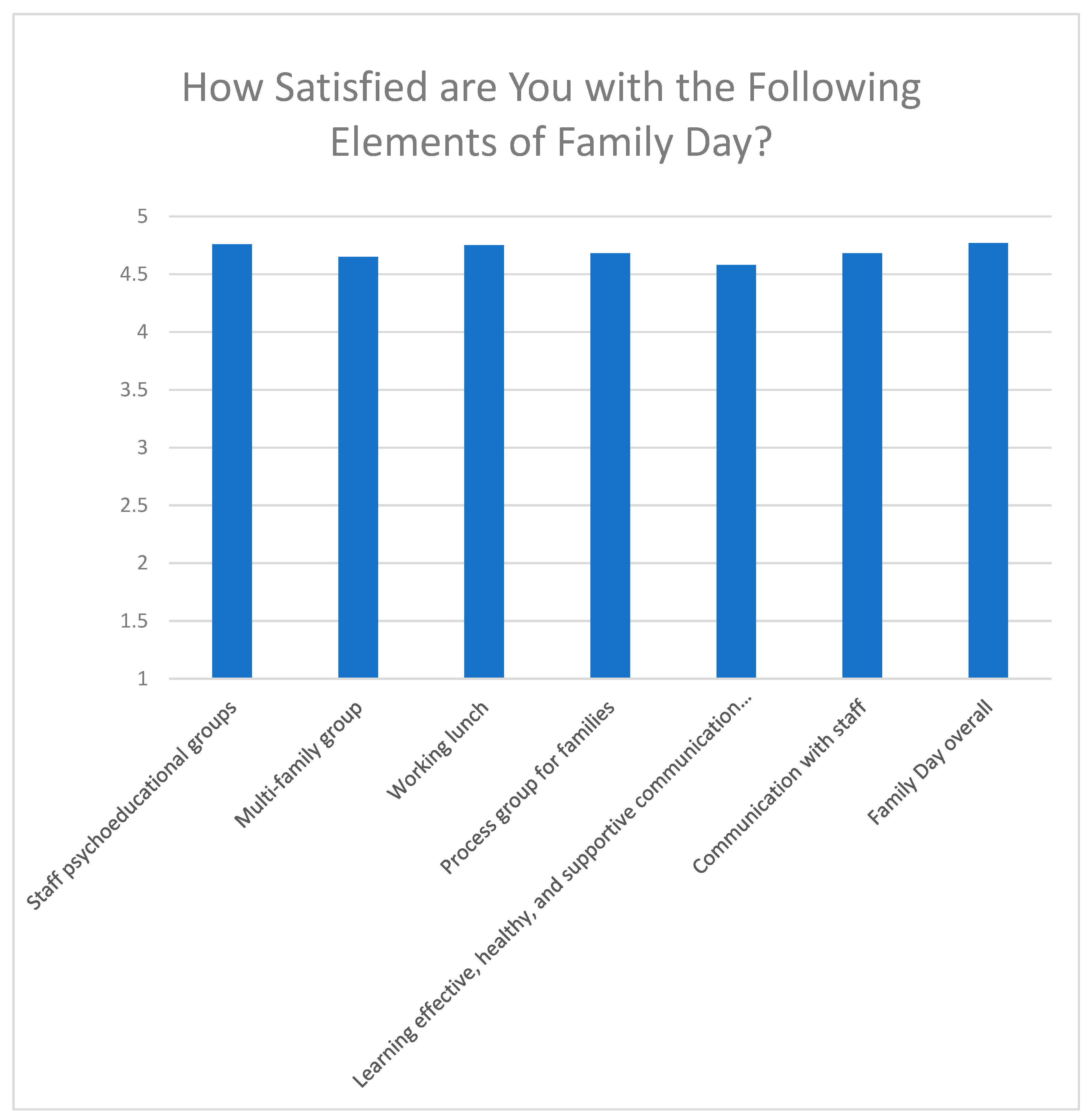
2.5. Carer Satisfaction
2.6. Statistical Analyses
3. Results
3.1. Eating Disorder Symptoms
3.2. Depression
3.3. Anxiety
3.4. Severity Subgroup Analyses
4. Discussion
5. Conclusions
Author Contributions
Funding
Institutional Review Board Statement
Informed Consent Statement
Data Availability Statement
Acknowledgments
Conflicts of Interest
Appendix A
- Accepting Uncertainty
- Anger
- Anxiety
- Apologizing and Forgiveness
- Attachment Styles
- Behavior Chaining
- Boundaries
- Communication Skills
- Conflict
- Core Beliefs
- Dialectical Behavior Therapy Skills
- Dialectics
- Harmful Behaviors/Antidotes
- Justifying/Arguing/Denying/Explaining
- Stages of Change
- Stages of Development
- Support
- Thinking Errors
- Urge Surfing
- Validation
- Acceptance and Commitment Therapy
- Adolescent Development
- Boundaries
- Cognitive–Behavioral Therapy
- Communication
- Dangers of Rushing Treatment
- Dialectical Behavior Therapy
- Movement
- Nutrition
- Personality Disorders
- Role of the Care Partner
- Role of the Care Team
- Sick Role
- Stepping Down to Intensive Outpatient Programming
- Trauma
- Treatment-Undermining Behaviors
- Understanding Anger
- Understanding Treatment
References
- American Psychiatric Association. (1994). Diagnostic and statistical manual of mental disorders (4th ed.). American Psychiatric Association. [Google Scholar]
- Anderson, L. M., Smith, K. E., Nuñez, M. C., & Farrell, N. R. (2021). Family accommodation in eating disorders: A preliminary examination of correlates with familial burden and cognitive-behavioral treatment outcomes. Eating Disorders: The Journal of Treatment & Prevention, 29, 327–343. [Google Scholar] [CrossRef] [PubMed]
- Batchelor, R., Cribben, H., Macdonald, P., Treasure, J., Cini, E., Nicholls, D., & Kan, C. (2022). The experiential perspectives of siblings and partners caring for a loved one with an eating disorder in the UK. BJPsychOpen, 8, e76. [Google Scholar] [CrossRef] [PubMed]
- Baudinet, J., Eisler, I., Dawson, L., Simic, M., & Schmidt, U. (2021). Multi-family therapy for eating disorders: A systematic scoping review of the quantitative and qualitative findings. International Journal of Eating Disorders, 54, 2095–2120. [Google Scholar] [CrossRef] [PubMed]
- Brinchmann, B. S., & Krvavac, S. (2021). “Breaking down the wall” patients’ and families’ experience of multifamily therapy for young adult women with severe eating disorders. Journal of Eating Disorders, 9, 56. [Google Scholar] [CrossRef] [PubMed]
- Bulik, C. M., Baucom, D. H., Kirby, J. S., & Pisetsky, E. (2011). Uniting couples (in the treatment of) anorexia nervosa (UCAN). International Journal of Eating Disorders, 44, 19–28. [Google Scholar] [PubMed]
- Calugi, S., El Ghoch, M., Conti, M., & Dalle Grave, R. (2014). Depression and treatment outcome in anorexia nervosa. Psychiatry Research, 218, 195–200. [Google Scholar] [CrossRef] [PubMed]
- Casasnovas, C., Fernández-Aranda, F., Granero, R., Krug, I., Jiménez-Murcia, S., Bulik, C. M., & Vallejo-Ruiloba, J. (2007). Motivation to change in eating disorders: Clinical and therapeutic implications. European Eating Disorders Review, 15, 449–456. [Google Scholar] [CrossRef] [PubMed]
- Champely, S. (2020). PWR: Basic functions for power analysis. R package version 1.3-0. Available online: https://CRAN.R-project.org/package=pwr (accessed on 3 March 2026).
- Christian, C., Butler, R. M., Burr, E. K., & Levinson, C. (2024). An Intensive time series investigation of the relationships across eating disorder-specific fear responses and behavior urges in partially remitted anorexia nervosa. Journal of Anxiety Disorders, 102, 102804. [Google Scholar] [CrossRef] [PubMed]
- Dare, C., & Eisler, I. (2000). A multi-family group day treatment programme for adolescent eating disorder. European Eating Disorders Review, 8, 4–18. [Google Scholar] [CrossRef]
- Dimitropoulos, G., Landers, A. L., Freeman, V., Novick, J., Garber, A., & Le Grange, D. (2018). Open trial of family-based treatment of anorexia nervosa for transition age youth. Journal of the Canadian Academy of Child and Adolescent Psychiatry, 27, 50. [Google Scholar] [CrossRef] [PubMed]
- Donkin, L., Sinclair, R., Rowland, S., McDougall, K., & Landon, J. (2026). “It’s never ending and overwhelmingly difficult”: A mixed-methods survey of the impact of caregiving for a loved one with an eating disorder in New Zealand. Journal of Eating Disorders, 14, 4. [Google Scholar] [CrossRef] [PubMed]
- Easton, E., Manwaring, J., Salada, G., Hartman, G., Bermudez, O., & Johnson, C. (2016). Family in residence program: A family empowerment model for higher levels of care. In S. Murray, L. Anderson, & L. Cohn (Eds.), Innovations in family therapy for eating disorders: Novel treatment developments, patient insights, and the role of carers (pp. 161–175). Routledge. [Google Scholar]
- Eisler, I., Simic, M., Hodsoll, J., Asen, E., Berelowitz, M., Connan, F., Ellis, G., Hugo, P., Schmidt, U., Treasure, J., Yi, I., & Landau, S. (2016). A pragmatic randomized multi-centre trial of multifamily and single family therapy for adolescent anorexia nervosa. BMC Psychiatry, 16, 422. [Google Scholar] [CrossRef] [PubMed]
- Fairburn, C. G., & Beglin, S. J. (1994). Assessment of eating disorders: Interview or self-report questionnaire? International Journal of Eating Disorders, 16, 363–370. [Google Scholar] [CrossRef] [PubMed]
- Fairburn, C. G., & Beglin, S. J. (2008). Eating disorder examination questionnaire (EDE-Q 6.0). In C. G. Fairburn (Ed.), Cognitive behavior therapy and eating disorders (pp. 309–313). Guilford Press. [Google Scholar]
- Fewell, L. K., Levinson, C. A., & Stark, L. (2017). Depression, worry, and psychosocial functioning predict eating disorder treatment outcomes in a residential and partial hospitalization setting. Eating and Weight Disorders, 22, 291–301. [Google Scholar] [CrossRef] [PubMed]
- Girz, L., Robinson, A. L., Foroughe, M., Jasper, K., & Boachie, A. (2013). Adapting family-based therapy to a day hospital programme for adolescents with eating disorders: Preliminary outcomes and trajectories of change. Journal of Family Therapy, 35, 102–120. [Google Scholar]
- Guarda, A. S., Pinto, A. M., Coughlin, J. W., Hussain, S., Haug, N. A., & Heinberg, L. J. (2007). Perceived coercion and change in perceived need for admission in patients hospitalized for eating disorders. American Journal of Psychiatry, 164, 108–114. [Google Scholar] [CrossRef] [PubMed]
- Haigh, R., & Treasure, J. (2003). Investigating the needs of carers in the area of eating disorders: Development of the carers’ needs assessment measure (CaNAM). European Eating Disorders Review, 11, 125–141. [Google Scholar]
- Halmi, K. A. (2013). Perplexities of treatment resistance in eating disorders. BMC Psychiatry, 13, 292. [Google Scholar] [CrossRef] [PubMed]
- Highet, N., Thompson, M., & King, R. M. (2005). The experience of living with a person with an eating disorder: The impact on the carers. Eating Disorders: The Journal of Treatment & Prevention, 13, 327–344. [Google Scholar] [CrossRef] [PubMed]
- Hoste, R. R. (2015). Incorporating family-based therapy principles into a partial hospitalization program for adolescents with anorexia nervosa: Challenges and considerations. Journal of Family Therapy, 37, 41–60. [Google Scholar]
- Hoste, R. R., Doyle, A. C., & Le Grange, D. (2012). Families as an integral part of the treatment team: Treatment culture and standard of care challenges. In J. Alexander, & J. Treasure (Eds.), A collaborative approach to eating disorders (pp. 136–143). Routledge. [Google Scholar]
- Johnson, J. G., Harris, E. S., Spitzer, R. L., & Williams, J. B. W. (2002). The patient health questionnaire for adolescents: Validation of an instrument for the assessment of mental disorders among adolescent primary care patients. Journal of Adolescent Health, 30, 196–204. [Google Scholar] [CrossRef]
- Karlstad, J., Moe, C. F., Wattum, M., & Brinchmann, B. S. (2021). The experiences and strategies of parents’ of adults with anorexia nervosa or bulimia nervosa: A qualitative study. BMC Psychiatry, 21, 338. [Google Scholar] [CrossRef] [PubMed]
- Kroenke, K., Spitzer, R. L., & Williams, J. B. W. (2001). The PHQ-9: Validity of a brief depression severity measure. Journal of General Internal Medicine, 16, 606–613. [Google Scholar] [CrossRef] [PubMed]
- Le Grange, D., Lock, J., Loeb, K., & Nicholls, D. (2010). Academy for Eating Disorders position paper: The role of the family in eating disorders. International Journal of Eating Disorders, 43, 1. [Google Scholar] [CrossRef] [PubMed]
- Lock, J., & Le Grange, D. (2013). Treatment manual for anorexia nervosa: A family-based approach (2nd ed.). Guilford Press. [Google Scholar]
- Mond, J. M., Myers, T. C., Crosby, R. D., Hay, P. J., Rodgers, B., Morgan, J. F., Lacey, J. H., & Mitcchell, J. E. (2008). Screening for eating disorders in primary care: EDE-Q versus SCOFF. Behaviour Research and Therapy, 46, 612–622. [Google Scholar] [CrossRef] [PubMed]
- National Institute for Health and Care Excellence. (2017). Eating disorders: Recognition and treatment (NG69). Available online: https://www.nice.org.uk/guidance/ng69/evidence/full-guideline-pdf-161214767896 (accessed on 3 March 2026).
- Posit Team. (2025). RStudio: Integrated development environment for R. posit software, PBC, Boston, MA. Available online: http://www.posit.co/ (accessed on 3 March 2026).
- Reilly, E. E., Gorrell, S., Duffy, A., Blalock, D. V., Mehler, P., Brandt, H., McClanahan, S., Zucker, K., Lynch, N., Singh, S., Drury, C. R., Le Grange, D., & Rienecke, R. D. (2024). Predictors of treatment outcome in higher levels of care among a large sample of adolescents with heterogeneous eating disorders. Child and Adolescent Psychiatry and Mental Health, 18, 131. [Google Scholar] [CrossRef] [PubMed]
- Salerno, L., Rhind, C., Hibbs, R., Micali, N., Schmidt, U., Gowers, S., Macdonald, P., Goddard, E., Todd, G., Lo Coco, G., & Treasure, J. (2016). An examination of the impact of care giving styles (accommodation and skilful communication and support) on the one year outcome of adolescent anorexia nervosa: Testing the assumptions of the cognitive interpersonal model in anorexia nervosa. Journal of Affective Disorders, 191, 230–236. [Google Scholar] [CrossRef] [PubMed]
- Schmidt, U., & Treasure, J. (2006). Anorexia nervosa: Valued and visible. A cognitive-interpersonal model and its implications for research and practice. British Journal of Clinical Psychology, 45, 343–366. [Google Scholar] [CrossRef] [PubMed]
- Schmidt, U., Wade, T. D., & Treasure, J. (2014). The maudsley model of anorexia nervosa treatment for adults (MANTRA): Development, key features, and preliminary evidence. Journal of Cognitive Psychotherapy: An International Quarterly, 28, 48–71. [Google Scholar] [CrossRef]
- Spitzer, R. L., Kroenke, K., Williams, J. B. W., & Löwe, B. (2006). A brief measure for assessing generalized anxiety disorder: The GAD-7. Archives of Internal Medicine, 166, 1092–1097. [Google Scholar] [CrossRef] [PubMed]
- Swinbourne, J. M., & Touyz, S. W. (2007). The co-morbidity of eating disorders and anxiety disorders: A review. European Eating Disorders Review, 15, 253–274. [Google Scholar] [CrossRef] [PubMed]
- Velkoff, E. A., Brown, T. A., Kaye, W. H., & Wierenga, C. E. (2023). Using clinical cutoff scores on the eating disorder examination-questionnaire to evaluate eating disorder symptoms during and after naturalistic intensive treatment. Eating Disorders: The Journal of Treatment & Prevention, 31, 464–478. [Google Scholar] [CrossRef] [PubMed]
- Wade, T. D., Shafran, R., & Cooper, Z. (2024). Developing a protocol to address co-occurring mental health conditions in the treatment of eating disorders. International Journal of Eating Disorders, 57, 1291–1299. [Google Scholar] [CrossRef] [PubMed]
- Whitney, J., & Eisler, I. (2005). Theoretical and empirical models around caring for someone with an eating disorder: The reorganization of family life and inter-personal maintenance factors. Journal of Mental Health, 14, 575–585. [Google Scholar] [CrossRef]
- Wilksch, S. M. (2023). Toward a more comprehensive understanding and support of parents with a child experiencing an eating disorder. International Journal of Eating Disorders, 56, 1275–1285. [Google Scholar] [CrossRef] [PubMed]
- Zabala, M. J., Macdonald, P., & Treasure, J. (2009). Appraisal of caregiving burden, expressed emotion and psychological distress in families of people with eating disorders: A systematic review. European Eating Disorders Review, 17, 338–349. [Google Scholar] [CrossRef] [PubMed]

| Adolescents (N = 61) | Adults (N = 136) | Overall (N = 197) | |
|---|---|---|---|
| Age (M, SD) | 16.21 (2.09) | 25.71 (8.09) | 22.77 (8.1) |
| Length of Stay in Days (M, SD) | 101.2 (75.26) | 112.35 (102.22) | 108.93 (94.73) |
| Gender (N, %) | |||
| Cisgender Female | 47 (77.0%) | 107 (78.7%) | 154 (78.2%) |
| Cisgender Male | 10 (16.4%) | 18 (13.2%) | 28 (14.2%) |
| Transgender Female | 0 (0.0%) | 0 (0.0%) | 0 (0.0%) |
| Transgender Male | 0 (0.0%) | 3 (2.2%) | 3 (1.5%) |
| Nonbinary/Non-gender conforming/Agender | 4 (6.6%) | 8 (5.9%) | 12 (6.1%) |
| Race (N, %) | |||
| Non-Hispanic White | 32 (52.5%) | 105 (77.2%) | 137 (69.5%) |
| White Hispanic/Latinx | 23 (37.7%) | 25 (18.4%) | 48 (24.4%) |
| African American | 3 (4.9%) | 1 (0.7%) | 4 (2.0%) |
| American Indian/Native American/Alaska Native | 0 (0.0%) | 0 (0.0%) | 0 (0.0%) |
| Asian/Asian American | 1 (1.6%) | 2 (1.5%) | 3 (1.5%) |
| Middle Eastern/Northern African | 1 (1.6%) | 1 (0.7%) | 2 (1.0%) |
| Native Hawaiian/Other Pacific Islander | 0 (0.0%) | 0 (0.0%) | 0 (0.0%) |
| Multiracial | 1 (1.6%) | 2 (1.5%) | 3 (1.5%) |
| Unsure/Do not know/Prefer not to say | 0 (0.0%) | 0 (0.0%) | 0 (0.0%) |
| Diagnosis (N, %) | |||
| AN | 39 (63.9%) | 79 (58.1%) | 118 (59.9%) |
| BN | 9 (14.8%) | 9 (6.6%) | 18 (9.1%) |
| BED | 2 (3.3%) | 20 (14.7%) | 22 (11.1%) |
| ARFID | 3 (4.9%) | 8 (5.9%) | 11 (5.6%) |
| OSFED | 5 (8.2%) | 12 (8.8%) | 17 (8.6%) |
| UFED | 3 (4.9%) | 6 (4.4%) | 9 (4.6%) |
| Missing/NA | 0 (0.0%) | 2 (1.4%) | 2 (1.0%) |
| Admission Level of Care (N, %) | |||
| IOP | 13 (21.3%) | 5 (3.7%) | 18 (9.1%) |
| PHP-8 h | 18 (29.5%) | 37 (27.2%) | 55 (28.0%) |
| PHP-12 h | 30 (49.2%) | 91 (66.9%) | 121 (61.4%) |
| Missing/NA | 0 (0.0%) | 3 (2.2%) | 3 (1.5%) |
| Adolescents | Adults | |||||||
|---|---|---|---|---|---|---|---|---|
| Admission M (SD) | Discharge M (SD) | t-Value, pbonf | Cohen’s d [95% CI] | Admission M (SD) | Discharge M (SD) | t-Value, pbonf | Cohen’s d [95% CI] | |
| EDE-Q Global Score | 2.93 (1.79) | 1.63 (1.45) | 6.49, <0.001 | 0.94 [0.90, 1.70] | 2.96 (1.56) | 1.72 (1.25) | 9.35, <0.001 | 0.98 [0.98, 1.51] |
| EDE-Q Restraint | 2.29 (1.96) | 0.89 (1.27) | 5.56, <0.001 | 0.80 [0.89, 1.91] | 2.22 (2.01) | 0.86 (1.34) | 7.51, <0.001 | 0.72 [1.00, 1.71] |
| EDE-Q Eating Concern | 2.45 (1.73) | 1.00 (1.31) | 6.63, <0.001 | 0.96 [1.01, 1.89] | 2.45 (1.53) | 1.11 (1.35) | 9.50, <0.001 | 0.91 [1.06, 1.62] |
| EDE-Q Shape Concern | 3.73 (1.90) | 2.57 (1.99) | 4.90, <0.001 | 0.71 [0.68, 1.64] | 3.85 (1.74) | 2.61 (2.01) | 8.13, <0.001 | 0.78 [0.94, 1.54] |
| EDE-Q Weight Concern | 3.25 (1.96) | 2.05 (1.82) | 5.22, <0.001 | 0.75 [0.74, 1.66] | 3.35 (1.80) | 2.25 (1.91) | 7.15, <0.001 | 0.69 [0.79, 1.40] |
| PHQ-A/PHQ-9 | 10.38 (7.97) | 6.62 (6.93) | 4.27, <0.001 | 0.70 [1.97, 5.54] | 14.41 (7.30) | 7.23 (6.61) | 9.21, <0.001 | 0.97 [5.63, 8.72] |
| GAD-7 | 9.26 (6.34) | 7.47 (6.78) | 2.21, 0.07 | 0.34 [0.15, 3.43] | 11.66 (6.08) | 7.17 (5.71) | 7.30, <0.001 | 0.75 [3.27, 5.71] |
| Adolescents | Adults | |||||||
|---|---|---|---|---|---|---|---|---|
| Admission M (SD) | Discharge M (SD) | t-Value, pbonf | Cohen’s d, [95% CI] | Admission M (SD) | Discharge M (SD) | t-Value, pbonf | Cohen’s d, [95% CI] | |
| EDE-Q Global Score | 4.33(0.84) | 2.32(1.52) | 7.48, <0.001 | 1.44 [1.46, 2.56] | 4.18(0.81) | 2.41(1.51) | 9.21, <0.001 | 1.20 [1.39, 2.16] |
| EDE-Q Restraint | 3.60(1.55) | 1.34(1.50) | 6.42, <0.001 | 1.24 [1.53, 2.98] | 3.47(1.72) | 1.33(1.56) | 8.48, <0.001 | 1.10 [1.64, 2.65] |
| EDE-Q Eating Concern | 3.79(0.94) | 1.46(1.53) | 8.49, <0.001 | 1.63 [1.76, 2.88] | 3.49(1.12) | 1.54(1.47) | 9.88, <0.001 | 1.29 [1.56, 2.35] |
| EDE-Q Shape Concern | 5.15(0.79) | 3.51(1.95) | 4.68, <0.001 | 0.90 [0.92, 2.36] | 5.09(0.85) | 3.58(1.86) | 6.39, <0.001 | 0.83 [1.04, 1.98] |
| EDE-Q Weight Concern | 4.77(0.91) | 2.96(1.86) | 5.42, <0.001 | 1.04 [1.12, 2.49] | 4.69(1.03) | 3.31(1.87) | 6.74, <0.001 | 0.88 [1.09, 2.02] |
| PHQ-A/PHQ-9 | 23.33(2.80) | 15.67(8.80) | 2.55, 0.257 | 1.04 [−0.06, 15.40] | 22.73(2.13) | 10.96(6.97) | 8.63, <0.001 | 1.69 [8.96, 14.58] |
| GAD-7 | 17.67(2.15) | 14.17(6.49) | 1.89, 0.342 | 0.55 [−0.58, 7.58] | 18.44(1.87) | 10.47(6.15) | 6.93, <0.001 | 1.23 [5.62, 10.31] |
Disclaimer/Publisher’s Note: The statements, opinions and data contained in all publications are solely those of the individual author(s) and contributor(s) and not of MDPI and/or the editor(s). MDPI and/or the editor(s) disclaim responsibility for any injury to people or property resulting from any ideas, methods, instructions or products referred to in the content. |
© 2026 by the authors. Licensee MDPI, Basel, Switzerland. This article is an open access article distributed under the terms and conditions of the Creative Commons Attribution (CC BY) license.
Share and Cite
Rienecke, R.D.; Perez, M.B.; Boyers, A.; Oliver-Pyatt, W. A Novel Approach to the Involvement of Loved Ones in the Treatment of Individuals with Eating Disorders: The Family Integration Model. Behav. Sci. 2026, 16, 1049. https://doi.org/10.3390/bs16071049
Rienecke RD, Perez MB, Boyers A, Oliver-Pyatt W. A Novel Approach to the Involvement of Loved Ones in the Treatment of Individuals with Eating Disorders: The Family Integration Model. Behavioral Sciences. 2026; 16(7):1049. https://doi.org/10.3390/bs16071049
Chicago/Turabian StyleRienecke, Renee D., Maria Bazo Perez, Amy Boyers, and Wendy Oliver-Pyatt. 2026. "A Novel Approach to the Involvement of Loved Ones in the Treatment of Individuals with Eating Disorders: The Family Integration Model" Behavioral Sciences 16, no. 7: 1049. https://doi.org/10.3390/bs16071049
APA StyleRienecke, R. D., Perez, M. B., Boyers, A., & Oliver-Pyatt, W. (2026). A Novel Approach to the Involvement of Loved Ones in the Treatment of Individuals with Eating Disorders: The Family Integration Model. Behavioral Sciences, 16(7), 1049. https://doi.org/10.3390/bs16071049

