


Examining the Impact of Intrinsic Rewards on Employee Retention: Perceived Organizational Pride as a Mediator in Saudi Higher Education

Abstract
1. Introduction
2. Literature Review and Hypotheses Development
2.1. Task Autonomy and Employee Retention
2.2. Personal Growth and Development Opportunities and Employee Retention
2.3. Self-Actualization and Employee Retention
2.4. Decision-Making Participation and Employee Retention
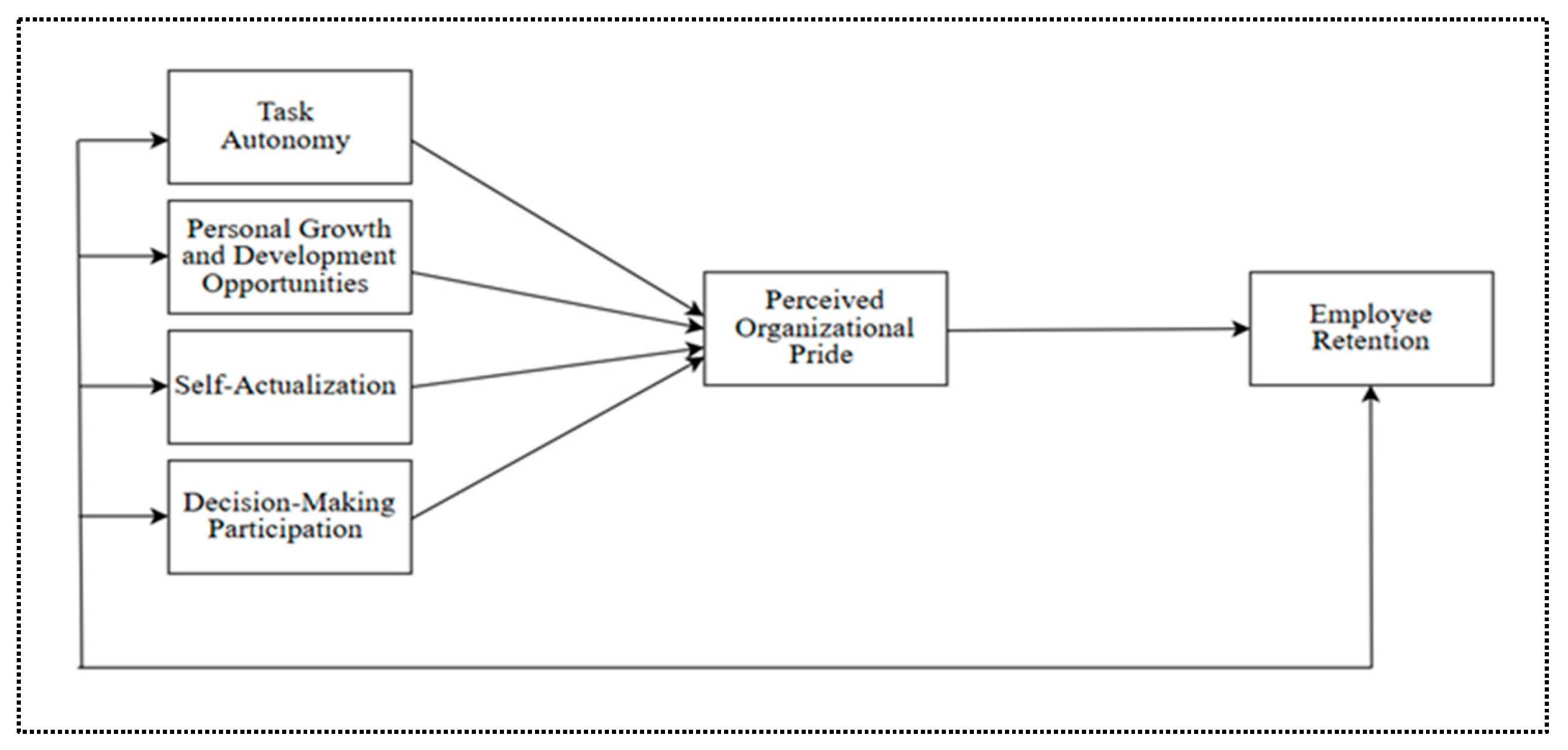
2.5. Perceived Organizational Pride as a Mediator
3. Methods
3.1. Sampling and Procedure
3.2. Measures
4. Results
4.1. Descriptive Statistics
4.2. Common Method Bias
4.3. Model Fitness
4.4. Discriminant Validity
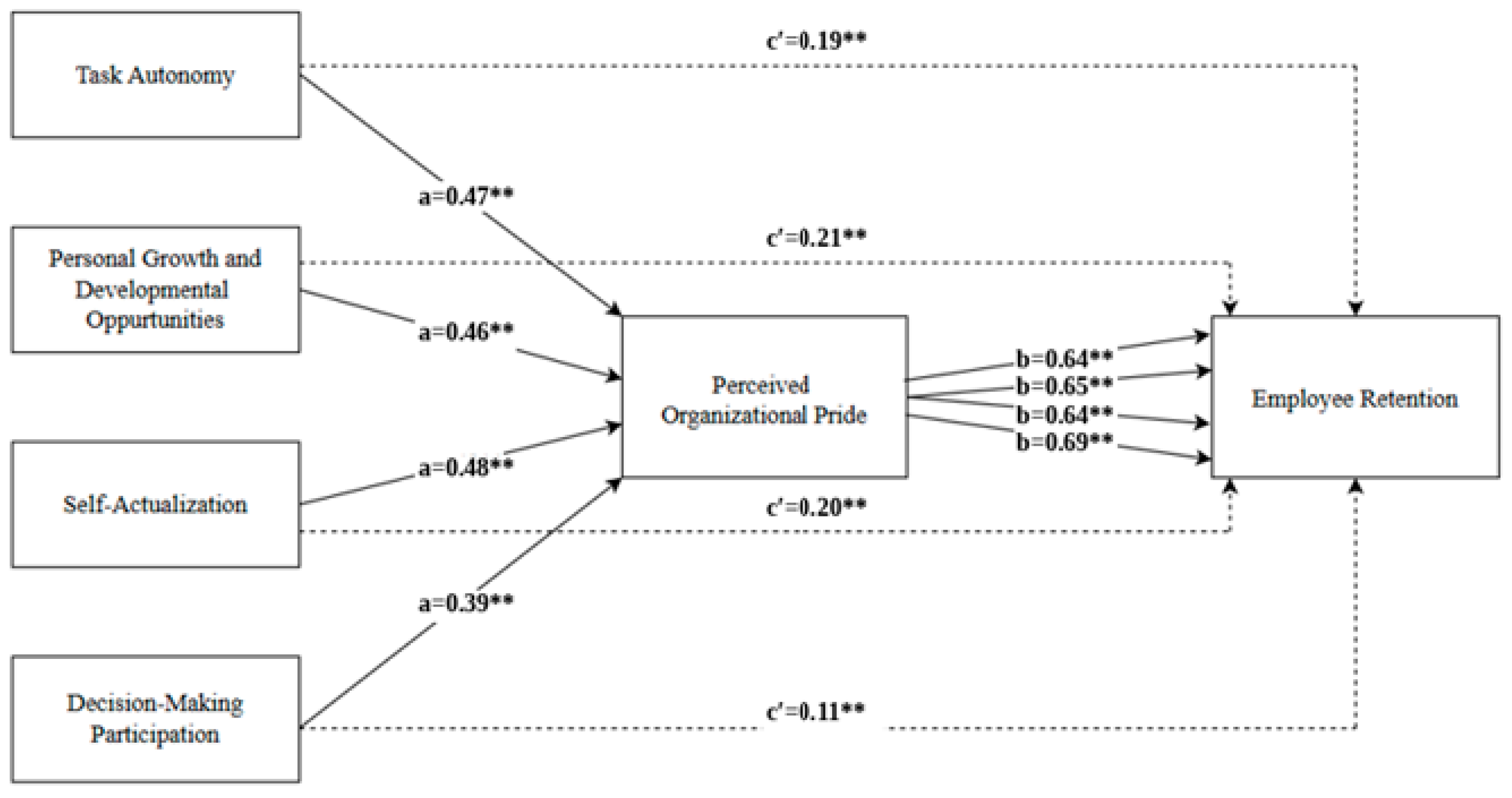
4.5. Hypotheses Results
5. Discussion
5.1. Theoretical Implications
5.2. Practical Implications
5.3. Limitation and Future Direction
5.4. Conclusions
Funding
Institutional Review Board Statement
Informed Consent Statement
Data Availability Statement
Acknowledgments
Conflicts of Interest
References
- Abdullateef, S. T., Alsheikh, R. M., & Mohammed, B. K. (2023). Making Saudi Vision 2030 a reality through educational transformation at the university level. Labour and Industry, 33(2), 225–240. [Google Scholar] [CrossRef]
- Altassan, M., & Rahman, I. (2023). Impact of organizational culture on employee retention in higher education institutions. Res Militaris, 13(3), 3350–3361. [Google Scholar]
- Arnold, J. A., Arad, S., Rhoades, J. A., & Drasgow, F. (2000). The empowering leadership questionnaire: The construction and validation of a new scale for measuring leader behaviors. Journal of Organizational Behavior, 21(3), 249–269. [Google Scholar] [CrossRef]
- Ashforth, B. E., & Mael, F. (1989). Social identity theory and the organization. The Academy of Management Review, 14(1), 20–39. [Google Scholar] [CrossRef]
- Bagozzi, R., & Yi, Y. (1988). On the evaluation of structural equation models. Journal of the Academy of Marketing Sciences, 16, 74–94. [Google Scholar] [CrossRef]
- Bichsel, J., Fuesting, M., Tubbs, D., & Schneider, J. (2023). The CUPA-HR 2023 higher education employee retention survey. ERIC. [Google Scholar]
- Brown, E. S., Palka, J., Helm, S. V., & Kulikova, A. (2022). The relative importance of reputation and pride as predictors of employee turnover in an academic medical center. Health Care Management Review, 47, 66–77. [Google Scholar] [CrossRef]
- Chandra, R., Yohana, C., & Effendi, M. S. (2025). Autonomous work motivation and it professional retention in digital transformation: A systematic literature review. In International student conference on business, education, economics, accounting, and management (ISC-BEAM) (Vol. 4, No. 2). Universitas Negeri Jakarta. [Google Scholar]
- Christian, M. S., Garza, A. S., & Slaughter, J. E. (2011). Work engagement: A quantitative review and test of its relations with task and contextual performance. Personnel psychology, 64(1), 89–136. [Google Scholar] [CrossRef]
- Cotič, L. P., Man, M. M. K., Soga, L. R., Konstantopoulou, A., & Lodorfos, G. (2025). Job characteristics for work engagement: Autonomy, feedback, skill variety, task identity, and task significance. Global Business and Organizational Excellence, 44(5), 75–85. [Google Scholar] [CrossRef]
- Deci, E. L., & Ryan, R. M. (2000). The “what” and “why” of goal pursuits: Human needs and the self-determination of behavior. Psychological Inquiry, 11(4), 227–268. [Google Scholar] [CrossRef]
- Deepa, R., Baral, R., & Saini, G. K. (2025). Proud of my organization: Conceptualizing the relationships between high-performance HR practices, leadership support, organizational pride, identification and innovative work behaviour. International Journal of Organizational Analysis, 33(2), 283–300. [Google Scholar] [CrossRef]
- Eisenberger, R., Huntington, R., Hutchison, S., & Sowa, D. (1986). Perceived organizational support. Journal of Applied Psychology, 71, 500–507. [Google Scholar] [CrossRef]
- Etikan, I., Musa, S. A., & Alkassim, R. S. (2016). Comparison of convenience sampling and purposive sampling. American Journal of Theoretical and Applied Statistics, 5(1), 1–4. [Google Scholar] [CrossRef]
- Fornell, C., & Larcker, D. F. (1981). Structural equation models with unobservable variables and measurement error: Algebra and statistics. Journal of Marketing Research, 18, 382–388. [Google Scholar] [CrossRef]
- Gagné, M., & Deci, E. L. (2005). Self-determination theory and work motivation. Journal of Organizational Behavior, 26, 331–362. [Google Scholar] [CrossRef]
- Gouthier, M. H. J., & Rhein, M. (2011). Organizational pride and its positive effects on employee behavior. Journal of Service Management, 22(5), 633–649. [Google Scholar] [CrossRef]
- Guan, Y., Du, L., Yang, C., & Hu, H.-L. (2025). Exploring the roles of self-actualization, language self-efficacy, and academic emotions in EMI students’ achievement: A structural equation modeling approach. Frontiers in Education, 10, 1567143. [Google Scholar] [CrossRef]
- Hackman, J. R., & Oldham, G. R. (1980). Work redesign. Addison-Wesley. [Google Scholar]
- Hair, J. F., Risher, J. J., Sarstedt, M., & Ringle, C. M. (2019). When to use and how to report the results of PLS-SEM. European Business Review, 31(1), 2–24. [Google Scholar] [CrossRef]
- Hayes, A. F. (2022). Introduction to mediation, moderation, and conditional process analysis: A regression-based approach (3rd ed.). Guilford Press. [Google Scholar]
- Haynes, S. N., Richard, D. C. S., & Kubany, E. S. (1995). Content validity in psychological assessment: A functional approach to concepts and methods. Psychological Assessment, 7, 238–247. [Google Scholar] [CrossRef]
- Hofstede, G. (2001). Culture’s consequences: Comparing values, behaviors, institutions and organizations across nations. International Educational and Professional. [Google Scholar]
- Hom, P. W., Lee, T. W., Shaw, J. D., & Hausknecht, J. P. (2017). One hundred years of employee turnover theory and research. Journal of Applied Psychology, 102(3), 530. [Google Scholar] [CrossRef]
- Jiang, K., Hu, J., Liu, S., & Lepak, D. P. (2017). Understanding employees’ perceptions of human resource practices: Effects of demographic dissimilarity to managers and coworkers. Human Resource Management, 56, 69–91. [Google Scholar] [CrossRef]
- Jones, A., & Crandall, R. (1986). Validation of a short index of self-actualization. Personality and Social Psychology Bulletin, 12(1), 63–73. [Google Scholar] [CrossRef]
- Kahn, W. A. (1990). Psychological conditions of personal engagement and disengagement at work. The Academy of Management Journal, 33(4), 692–724. [Google Scholar] [CrossRef] [PubMed]
- Kim, T., & Cho, W. (2024). Employee voice opportunities enhance organizational performance when faced with competing demands. Review of Public Personnel Administration, 44(3), 382–407. [Google Scholar] [CrossRef]
- Kline, R. B. (2016). Principles and practice of structural equation modeling (4th ed.). Guilford Publications. [Google Scholar]
- Ko, M., & Oh, S. (2025). Job autonomy or workplace learning? Exploring mediators between organizational culture and turnover intentions in SMEs: A focus on generational differences. Public Organization Review, 25(1), 327–347. [Google Scholar] [CrossRef]
- Koshak, A. K., Almadni, N. F., & Rajkhan, D. M. (2024). Job satisfaction and employees’ turnover intentions (An empirical study of universities in Saudi Arabia). IJRSP, 5(56), 236–262. [Google Scholar] [CrossRef]
- Kraemer, T., & Gouthier, M. H. J. (2014). How organizational pride and emotional exhaustion explain turnover intentions in call centers. Journal of Service Management, 25(1), 125–148. [Google Scholar] [CrossRef]
- Kyndt, E., Dochy, F., Michielsen, M., & Moeyaert, B. (2009). Employee retention: Organisational and personal perspectives. Vocations and Learning, 2(3), 195–215. [Google Scholar] [CrossRef]
- Laguerre, R. A., & Barnes-Farrell, J. L. (2025). Bringing self-determination theory to the forefront: Examining how human resource practices motivate employees of all ages to succeed. Journal of Business and Psychology, 40(1), 1–37. [Google Scholar] [CrossRef]
- London, M. (1993). Relationships between career motivation, empowerment and support for career development. Journal of Occupational and Organizational Psychology, 66(1), 55–69. [Google Scholar] [CrossRef]
- Maslow, A. H. (1943). A theory of human motivation. Psychological Review, 50(4), 370–396. [Google Scholar] [CrossRef]
- Meyer, J. P., & Allen, N. J. (1991). A three-component conceptualization of organizational commitment. Human Resource Management Review, 1, 61–89. [Google Scholar] [CrossRef]
- Meyer, J. P., Stanley, L. J., & Parfyonova, N. M. (2012). Employee commitment in context: The nature and implication of commitment profiles. Journal of Vocational Behavior, 80(1), 1–16. [Google Scholar] [CrossRef]
- Mitchell, T. R., Holtom, B. C., Lee, T. W., Sablynski, C. J., & Erez, M. (2001). Why people stay: Using job embeddedness to predict voluntary turnover. Academy of Management Journal, 44(6), 1102–1121. [Google Scholar] [CrossRef]
- Mohiuddin, K., Nasr, O. A., Miladi, M. N., & Fatima, H. (2023). Potentialities and priorities for higher educational development in Saudi Arabia for the next decade: Critical reflections of the vision 2030 framework. Heliyon, 9(5), e16368. [Google Scholar] [CrossRef]
- Mottaz, C. J. (1981). Some determinants of work alienation. The Sociological Quarterly, 22(4), 515–529. [Google Scholar] [CrossRef]
- Netemeyer, R. G., Bearden, W. O., & Sharma, S. (2003). Scaling procedures: Issues and applications. Sage Publications. [Google Scholar] [CrossRef]
- O’Callaghan, M. (2024). The impact of procedural justice on employee turnover intentions and the role of two mediators. Organization Management Journal, 21(2), 75–87. [Google Scholar] [CrossRef]
- Ogu, S. J. (2024). Employee participation in decision-making and organizational commitment: A study of modern organizations. Journal of Commerce, Management, and Tourism Studies, 3(1), 55–64. [Google Scholar] [CrossRef]
- Otoo, F. N. K. (2024). Does employee engagement mediate the nexus of job resource and employee turnover intentions? IIMT Journal of Management, 1(2), 130–170. [Google Scholar] [CrossRef]
- Presbitero, A., Roxas, B., & Chadee, D. (2016). Looking beyond HRM practices in enhancing employee retention in BPOs: Focus on employee–organisation value fit. International Journal of Human Resource Management, 27(6), 635–652. [Google Scholar] [CrossRef]
- Riketta, M. (2005). Organizational identification: A meta-analysis. Journal of Vocational Behavior, 66(2), 358–384. [Google Scholar] [CrossRef]
- Ryan, R. M., & Deci, E. L. (2024). Self-determination theory. In Encyclopedia of quality of life and well-being research (pp. 6229–6235). Springer International Publishing. [Google Scholar]
- Ryff, C. D. (1989). Happiness is everything, or is it? Explorations on the meaning of psychological well-being. Journal of Personality and Social Psychology, 57(6), 1069–1081. [Google Scholar] [CrossRef]
- Sakkara, M., & Bougie, R. (2016). Research methods for business: A skill building approach (7th ed.). Wiley. [Google Scholar]
- Schaefer, S. D., Cunningham, P., Diehl, S., & Terlutter, R. (2024). Employees’ positive perceptions of corporate social responsibility create beneficial outcomes for firms and their employees: Organizational pride as a mediator. Corporate Social Responsibility and Environmental Management, 31(3), 2574–2587. [Google Scholar] [CrossRef]
- Schaufeli, W. B., Salanova, M., González-Romá, V., & Bakker, A. B. (2002). The Measurement of engagement and burnout: A two sample confirmatory factor analytic approach. Journal of Happiness Studies, 3, 71–92. [Google Scholar] [CrossRef]
- Schilpzand, P., de Pater, I. E., & Erez, A. (2025). Pride in the workplace: An integrative review, synthesis, and future research agenda. Journal of Organizational Behavior, 46(1), 1–24. [Google Scholar] [CrossRef]
- Shahzad, M. F., Martins, J. M., Rita, J., Xu, S., & Mushtaq, H. M. (2024). Assessing the impact of strategic HR practices on talent retention through job satisfaction and work engagement: Moderating role of psychological empowerment. SAGE Open, 14(3), 1–18. [Google Scholar] [CrossRef]
- Singh, R., Bhatt, V., & Jha, S. (2023). Influence of training and development interventions on employee retention: An employer brand-based agenda. LBS Journal of Management & Research, 21(1), 157–170. [Google Scholar] [CrossRef]
- Smidts, A., Pruyn, A. T. H., & Van Riel, C. B. M. (2001). The impact of employee communication and perceived external prestige on organizational identification. Academy of Management Journal, 44, 1051–1062. [Google Scholar] [CrossRef]
- Tajfel, H., & Turner, J. C. (1986). The social identity theory of intergroup behavior. In S. Worchel, & W. G. Austin (Eds.), Psychology of intergroup relations (pp. 7–24). Nelson-Hall. [Google Scholar]
- Teodorovicz, T., Karim, S., & Higgins, M. (2024). Shaping organizational performance via employee participation and vetting in managerial selection. In Academy of management proceedings (Vol. 2024, No. 1, p. 19706). Academy of Management. [Google Scholar]
- Tian, H., Iqbal, S., Akhtar, S., Qalati, S. A., Anwar, F., & Khan, M. A. S. (2020). The impact of transformational leadership on employee retention: Mediation and moderation through organizational citizenship behavior and communication. Frontiers in Psychology, 11, 314. [Google Scholar] [CrossRef] [PubMed]
- Tiffin, P. A., Cabrera, R., Dexter-Smith, S., & Van den Broeck, A. (2024). Capturing autonomy, competence, and relatedness at work: Further examining and validating an English language version of the work-related basic need satisfaction scale. Frontiers in Psychology, 15, 1304309. [Google Scholar] [CrossRef]
- Tight, M. (2022). Academic staff in higher education: Research trends and foci 2000–2020. Higher Education Quarterly, 77(1), 108–127. [Google Scholar] [CrossRef]
- Triandis, H. C. (1995). Individualism and collectivism. Westview Press. [Google Scholar]
- Vela, C., Menchaca, V. D., & Silva, H. (2023). University faculty perceptions of professional development: Impact and effectiveness. Journal of Educational Leadership in Action, 9(1), 5. [Google Scholar] [CrossRef]
- Vision 2030. (2021). Human capability development program: Delivery plan 2021–2025. Government of Saudi Arabia. Available online: https://www.pif.gov.sa/en/private-sector-hub/leadership-vision/ (accessed on 23 December 2025).
- Yongho Hyun, M., Gao, L., Lee, S., & Kim, H. C. (2024). When does (Mis) fit between customer service orientation and internal service qualities matter for frontline employees’ pride in membership and their behaviors? Cornell Hospitality Quarterly, 65(4), 442–460. [Google Scholar] [CrossRef]

| Variable | M | SD | 1 | 2 | 3 | 4 | 5 | 6 | 7 | 8 |
|---|---|---|---|---|---|---|---|---|---|---|
| 1. Gender | 1.36 | 0.48 | ||||||||
| 2. Age | 36.1 | 0.68 | −0.08 | |||||||
| 3. TA | 3.03 | 0.74 | 0.01 | −0.15 | 0.83 | |||||
| 4. SA | 2.15 | 0.83 | 0.01 | −0.41 | 0.23 ** | 0.88 | ||||
| 5. PGD | 2.63 | 0.97 | 0.04 | −0.37 | 0.27 ** | 0.15 ** | 0.87 | |||
| 6. DMP | 2.98 | 1.03 | 0.02 | −0.38 | 0.23 ** | 0.16 ** | 0.18 ** | 0.94 | ||
| 7. POP | 2.36 | 1.02 | −0.04 | −0.36 | 0.48 ** | 0.48 ** | 0.45 ** | 0.39 ** | 0.89 | |
| 8. ER | 2.47 | 1.16 | −0.02 | −0.30 | 0.52 ** | 0.52 ** | 0.49 ** | 0.40 ** | 0.76 ** | 0.91 |
| Construct | Item | Factor Loading | CR | AVE |
|---|---|---|---|---|
| TA | TA1 | 0.681 | 0.79 | 0.56 |
| TA2 | 0.723 | |||
| TA3 | 0.427 (Drop) | |||
| TA4 | 0.838 | |||
| SA | SA1 | 0.469 (Drop) | ||
| SA2 | 0.787 | 0.91 | 0.71 | |
| SA3 | 0.656 | |||
| SA4 | 0.819 | |||
| SA5 | 0.834 | |||
| SA6 | 0.895 | |||
| PGD | PGD1 | 0.891 | 0.94 | 0.80 |
| PGD2 | 0.909 | |||
| PGD3 | 0.909 | |||
| PGD4 | 0.864 | |||
| PGD5 | 0.359 (Drop) | |||
| DMP | DMP1 | 0.882 | 0.95 | 0.78 |
| DMP2 | 0.951 | |||
| DMP3 | 0.860 | |||
| DMP4 | 0.882 | |||
| DMP5 | 0.801 | |||
| DMP6 | 0.827 | |||
| POP | POP1 | 0.939 | 0.97 | 0.81 |
| POP2 | 0.954 | |||
| POP3 | 0.880 | |||
| POP4 | 0.820 | |||
| POP5 | 0.942 | |||
| POP6 | 0.800 | |||
| POP7 | 0.932 | |||
| ER | ER1 | 0.980 | 0.98 | 0.91 |
| ER2 | 0.979 | |||
| ER3 | 0.946 | |||
| ER4 | 0.900 |
| Construct | TA | SA | PGD | DMP | POP | ER |
|---|---|---|---|---|---|---|
| TA | 0.75 | |||||
| SA | 0.70 | 0.84 | ||||
| PGD | 0.56 | 0.84 | 0.89 | |||
| DMP | 0.48 | 0.69 | 0.71 | 0.88 | ||
| POP | 0.48 | 0.77 | 0.74 | 0.75 | 0.90 | |
| ER | 0.38 | 0.64 | 0.63 | 0.61 | 0.82 | 0.95 |
| Hypotheses | Relationship | B | 95% CI |
|---|---|---|---|
| H1 | Task Autonomy → Employee Retention | 0.19 ** | [0.08 0.30] |
| H2 | Personal Growth and Development Opportunities → Employee Retention | 0.21 ** | [0.10, 0.31] |
| H3 | Self-Actualization → Employee Retention | 0.20 ** | [0.10, 0.31] |
| H4 | Decision-Making Participation → Employee Retention | 0.11 ** | [0.01, 0.22] |
| H5 | Task Autonomy → Perceived Organizational Pride → Employee Retention | 0.30 ** | [0.20, 0.40] |
| H6 | Personal Growth and Development Opportunities → Perceived Organizational Pride→ Employee Retention | 0.29 ** | [0.19, 0.42] |
| H7 | Self-Actualization → Perceived Organizational Pride→ Employee Retention | 0.31 ** | [0.21, 0.41] |
| H8 | Decision-Making Participation → Perceived Organizational Pride→ Employee Retention | 0.27 ** | [0.16, 0.38] |
Disclaimer/Publisher’s Note: The statements, opinions and data contained in all publications are solely those of the individual author(s) and contributor(s) and not of MDPI and/or the editor(s). MDPI and/or the editor(s) disclaim responsibility for any injury to people or property resulting from any ideas, methods, instructions or products referred to in the content. |
© 2026 by the author. Licensee MDPI, Basel, Switzerland. This article is an open access article distributed under the terms and conditions of the Creative Commons Attribution (CC BY) license.
Share and Cite
Alotaibi, H.S. Examining the Impact of Intrinsic Rewards on Employee Retention: Perceived Organizational Pride as a Mediator in Saudi Higher Education. Behav. Sci. 2026, 16, 982. https://doi.org/10.3390/bs16060982
Alotaibi HS. Examining the Impact of Intrinsic Rewards on Employee Retention: Perceived Organizational Pride as a Mediator in Saudi Higher Education. Behavioral Sciences. 2026; 16(6):982. https://doi.org/10.3390/bs16060982
Chicago/Turabian StyleAlotaibi, Hammad S. 2026. "Examining the Impact of Intrinsic Rewards on Employee Retention: Perceived Organizational Pride as a Mediator in Saudi Higher Education" Behavioral Sciences 16, no. 6: 982. https://doi.org/10.3390/bs16060982
APA StyleAlotaibi, H. S. (2026). Examining the Impact of Intrinsic Rewards on Employee Retention: Perceived Organizational Pride as a Mediator in Saudi Higher Education. Behavioral Sciences, 16(6), 982. https://doi.org/10.3390/bs16060982

