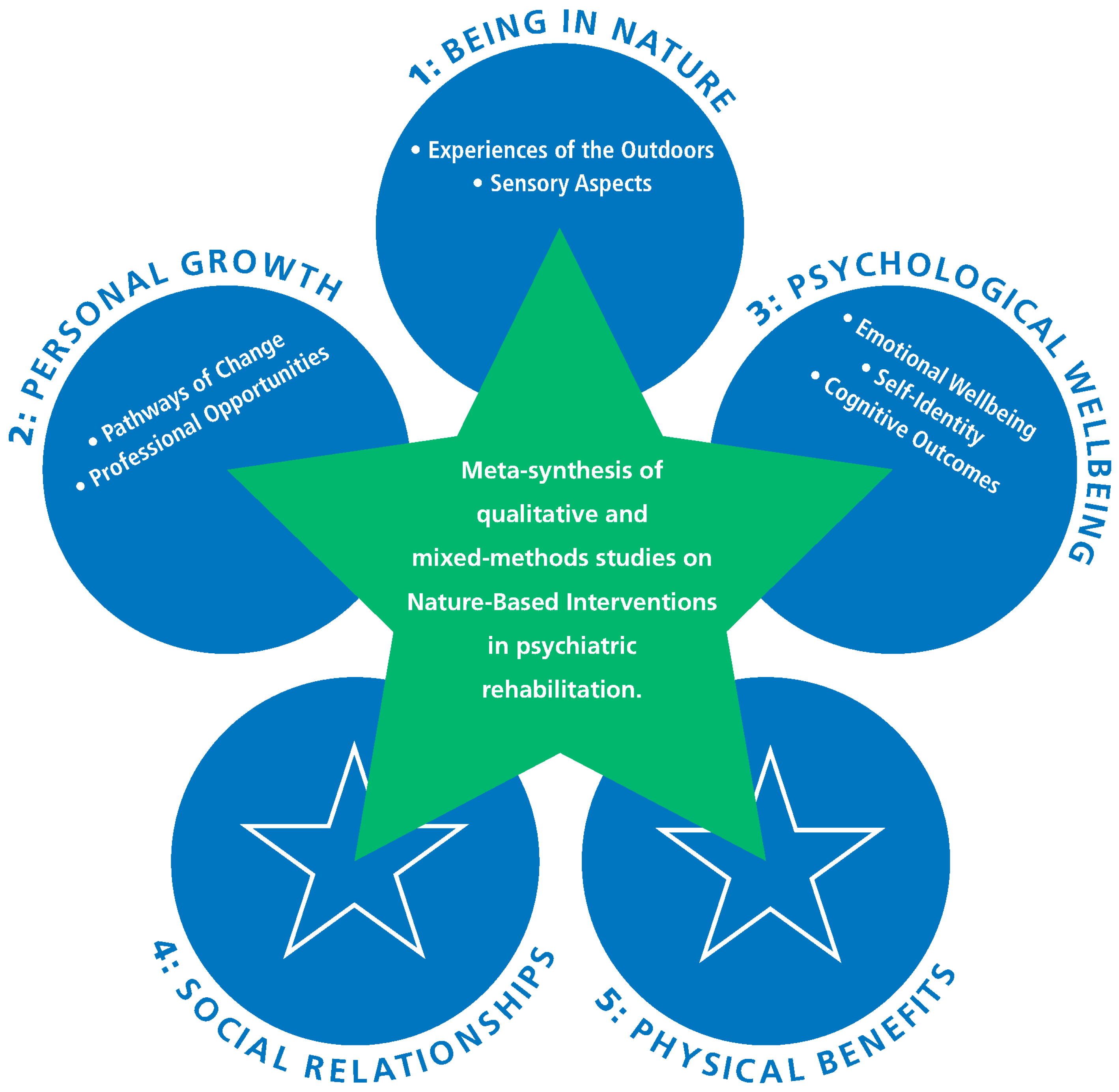
Nature-Based Interventions for Individuals with Psychiatric Disorders: A Mixed Methods Systematic Review with Random-Effects Meta-Analysis of Mental Health and Functional Outcomes
 , , , , , and
Abstract
1. Introduction
2. Materials and Methods
2.1. Search Strategy and Study Selection
2.2. Data Extraction
2.3. Study Quality
2.4. Random-Effects Meta-Analysis
2.5. Qualitative Synthesis
2.6. Integration
2.7. Patient and Public Involvement
3. Results
3.1. Study Selection
3.2. Study Characteristics
3.3. Quality Appraisal
3.4. Results of Individual Studies (Non-Pooled Domains)
3.4.1. Clinical Symptoms
3.4.2. Quality of Life and Wellbeing
3.4.3. Psychosocial
3.4.4. Functional Outcomes
3.4.5. Physical Health
3.5. Results of Syntheses
3.6. Qualitative Findings
3.7. Integration
4. Discussion and Conclusions
Supplementary Materials
Author Contributions
Funding
Institutional Review Board Statement
Informed Consent Statement
Data Availability Statement
Acknowledgments
Conflicts of Interest
References
- Aas, M., Pizzagalli, D. A., Laskemoen, J. F., Reponen, E. J., Ueland, T., Melle, I., Agartz, I., Steen, N. E., & Andreassen, O. A. (2019). Elevated hair cortisol is associated with childhood maltreatment and cognitive impairment in schizophrenia and in bipolar disorders. Schizophrenia Research, 213, 65–71. [Google Scholar] [CrossRef] [Scilit]
- Adorjan, K., & Falkai, P. (2019). Premature mortality, causes of death, and mental disorders. The Lancet, 394, 1784–1786. [Google Scholar] [CrossRef] [Scilit]
- Alonso, J., Petukhova, M., Vilagut, G., Chatterji, S., Heeringa, S., Üstün, T. B., Alhamzawi, A. O., Viana, M. C., Angermeyer, M., Bromet, E., Bruffaerts, R., de Girolamo, G., Florescu, S., Gureje, O., Haro, J. M., Hinkov, H., Hu, C., Karam, E. G., Kovess, V., … Kessler, R. C. (2011). Days out of role due to common physical and mental conditions: Results from the WHO World Mental Health surveys. Molecular Psychiatry, 16, 1234–1246. [Google Scholar] [CrossRef] [Scilit] [PubMed]
- Andresen, R., Oades, L., & Caputi, P. (2003). The experience of recovery from schizophrenia: Towards an empirically validated stage model. Australian and New Zealand Journal of Psychiatry, 37, 586–594. [Google Scholar] [CrossRef] [Scilit] [PubMed]
- Anthony, W. A. (1993). Recovery from mental illness: The guiding vision of the mental health service system in the 1990s. Psychosocial Rehabilitation Journal, 16, 11. [Google Scholar] [CrossRef] [Scilit]
- Atta, M. H. R., Salama, E. A., & Menessy, R. F. M. (2025). Effect of horticultural therapy program on psychological wellbeing, hope and social adjustment among patients with psychotic disorders: A nursing perspective. Journal of Psychiatric and Mental Health Nursing, 32, 1035–1052. [Google Scholar] [CrossRef] [Scilit]
- Barlattani, T., Cavatassi, A., Bologna, A., Socci, V., Trebbi, E., Malavolta, M., Rossi, A., Martiadis, V., Tomasetti, C., Berardis, D. D., Lorenzo, G. D., & Pacitti, F. (2025). Glymphatic system and psychiatric disorders: Need for a new paradigm? Frontiers in Psychiatry, 16, 1642605. [Google Scholar] [CrossRef] [Scilit]
- Barley, E. A., Robinson, S., & Sikorski, J. (2012). Primary-care based participatory rehabilitation: Users’ views of a horticultural and arts project. The British Journal of General Practice, 62, e127. [Google Scholar] [CrossRef] [Scilit] [PubMed]
- Barton, J., Griffin, M., & Pretty, J. (2012). Exercise-, nature-and socially interactive-based initiatives improve mood and self-esteem in the clinical population. Perspectives in Public Health, 132, 89–96. [Google Scholar] [CrossRef] [Scilit]
- Berget, B., Ekeberg, Ø., & Braastad, B. O. (2008). Animal-assisted therapy with farm animals for persons with psychiatric disorders: Effects on self-efficacy, coping ability and quality of life, a randomized controlled trial. Clinical Practice and Epidemiology in Mental Health, 4, 9. [Google Scholar] [CrossRef] [Scilit]
- Berget, B., Skarsaune, I., Ekeberg, Ø., & Braastad, B. O. (2007). Humans with mental disorders working with farm animals: A behavioral study. Occupational Therapy in Mental Health, 23, 101–117. [Google Scholar] [CrossRef] [Scilit]
- Bickerdike, L., Booth, A., Wilson, P. M., Farley, K., & Wright, K. (2017). Social prescribing: Less rhetoric and more reality. A systematic review of the evidence. BMJ Open, 7, e013384. [Google Scholar] [CrossRef] [Scilit] [PubMed]
- Brandt, L., De Prisco, M., Nocera, D., Rehm, M. C., Cohen, S., Kosker, D. N., von Luxburg, S., Ori, D., Pinzón-Espinosa, J., Scheuber, P., Sonntag, N., Radua, J., Hasan, A., Luykx, J. J., & the Global Evidence on Planetary Mental Health Study Group. (2026). Climate-related and nature-based interventions for mental health: An umbrella review and meta-analysis. JAMA Psychiatry, 83, 499–509. [Google Scholar] [CrossRef] [Scilit]
- Bratman, G. N., Hamilton, J. P., & Daily, G. C. (2012). The impacts of nature experience on human cognitive function and mental health. Annals of the New York Academy of Sciences, 1249, 118–136. [Google Scholar] [CrossRef] [Scilit]
- Busk, H., Sidenius, U., Kongstad, L. P., Corazon, S. S., Petersen, C. B., Poulsen, D. V., Nyed, P. K., & Stigsdotter, U. K. (2022). Economic evaluation of nature-based therapy interventions—A scoping review. Challenges, 13, 23. [Google Scholar] [CrossRef] [Scilit]
- Cerwén, G., Pedersen, E., & Pálsdóttir, A. M. (2016). The role of soundscape in nature-based rehabilitation: A patient perspective. International Journal of Environmental Research and Public Health, 13, 1229. [Google Scholar] [CrossRef] [Scilit]
- Cooley, S. J., Robertson, N., Jones, C. R., & Scordellis, J.-A. (2021). “Walk to wellbeing” in community mental health: Urban and green space walks provide transferable biopsychosocial benefits. Ecopsychology, 13, 84–95. [Google Scholar] [CrossRef] [Scilit]
- Coventry, P. A., Brown, J. E., Pervin, J., Brabyn, S., Pateman, R., Breedvelt, J., Gilbody, S., Stancliffe, R., McEachan, R., & White, P. L. (2021). Nature-based outdoor activities for mental and physical health: Systematic review and meta-analysis. SSM-Population Health, 16, 100934. [Google Scholar] [CrossRef] [Scilit] [PubMed]
- Cuthbert, S., Kellas, A., & Page, L. A. (2021). Green care in psychiatry. The British Journal of Psychiatry, 218, 73–74. [Google Scholar] [CrossRef] [Scilit]
- Fieldhouse, J. (2003). The impact of an allotment group on mental health clients’ health, wellbeing and social networking. British Journal of Occupational Therapy, 66, 286–296. [Google Scholar] [CrossRef] [Scilit]
- Fullam, J., Hunt, H., Lovell, R., Husk, K., Byng, R., Richards, D., Bloomfield, D., Warber, S., Tarrant, M., & Lloyd, J. (2021). A handbook for nature on prescription to promote mental health. University of Exeter. Available online: https://www.ecehh.org/wp/wp-content/uploads/2021/05/A-Handbook-for-Nature-on-Prescription-to-Promote-Mental-Health_FINAL.pdf (accessed on 28 June 2022).
- GBD 2019 Mental Disorders Collaborators. (2022). Global, regional, and national burden of 12 mental disorders in 204 countries and territories, 1990–2019: A systematic analysis for the Global Burden of Disease Study 2019. The Lancet Psychiatry, 9, 137–150. [Google Scholar] [CrossRef] [Scilit]
- Hardeveld, F., Spijker, J., De Graaf, R., Nolen, W. A., & Beekman, A. (2010). Prevalence and predictors of recurrence of major depressive disorder in the adult population. Acta Psychiatrica Scandinavica, 122, 184–191. [Google Scholar] [CrossRef] [Scilit]
- Harrison, H., Burns, M., Darko, N., & Jones, C. (2023). Exploring the benefits of nature-based interventions in socio-economically deprived communities: A narrative review of the evidence to date. Perspectives in Public Health, 143(3), 156–172. [Google Scholar] [CrossRef] [Scilit]
- He, H., Yu, Y., Li, J., Hu, L., & Zhou, F. (2020). Edible horticultural therapy for the rehabilitation of long-term hospitalized female schizophrenic patients. HortScience, 55, 699–702. [Google Scholar] [CrossRef] [Scilit]
- Hinde, S., Bojke, L., & Coventry, P. (2021). The cost effectiveness of ecotherapy as a healthcare intervention, separating the wood from the trees. International Journal of Environmental Research and Public Health, 18, 11599. [Google Scholar] [CrossRef] [Scilit]
- Hong, Q. N., Pluye, P., Bujold, M., & Wassef, M. (2017). Convergent and sequential synthesis designs: Implications for conducting and reporting systematic reviews of qualitative and quantitative evidence. Systematic Reviews, 6, 61. [Google Scholar] [CrossRef] [Scilit]
- Iancu, S. C., Zweekhorst, M. B., Veltman, D. J., van Balkom, A. J., & Bunders, J. F. (2014). Mental health recovery on care farms and day centres: A qualitative comparative study of users’ perspectives. Disability and Rehabilitation, 36, 573–583. [Google Scholar] [CrossRef] [Scilit]
- Iwata, Y., Dhubháin, Á. N., Brophy, J., Roddy, D., Burke, C., & Murphy, B. (2016). Benefits of group walking in forests for people with significant mental ill-health. Ecopsychology, 8, 16–26. [Google Scholar] [CrossRef] [Scilit]
- Jääskeläinen, E., Juola, P., Hirvonen, N., McGrath, J. J., Saha, S., Isohanni, M., Veijola, J., & Miettunen, J. (2013). A systematic review and meta-analysis of recovery in schizophrenia. Schizophrenia Bulletin, 39, 1296–1306. [Google Scholar] [CrossRef] [Scilit]
- Jessen, N. H., Løvschall, C., Skejø, S. D., Madsen, L. S. S., Corazon, S. S., Maribo, T., & Poulsen, D. V. (2025). Effect of nature-based health interventions for individuals diagnosed with anxiety, depression and/or experiencing stress—A systematic review and meta-analysis. BMJ Open, 15, e098598. [Google Scholar] [CrossRef] [Scilit]
- Johansson, G., Juuso, P., & Engström, Å. (2022). Nature-based interventions to promote health for people with stress-related illness: An integrative review. Scandinavian Journal of Caring Sciences, 36, 910–925. [Google Scholar] [CrossRef] [Scilit]
- Joung, J., Jeong, S., & Kang, K. I. (2025). Care farming experiences of individuals with schizophrenia: A focused ethnography in Korea. Issues in Mental Health Nursing, 46, 261–266. [Google Scholar] [CrossRef] [Scilit]
- Kaleta, B., Campbell, S., O’Keeffe, J., & Burke, J. (2025). Nature-based interventions: A systematic review of reviews. Frontiers in Psychology, 16, 1625294. [Google Scholar] [CrossRef] [Scilit]
- Kam, M. C., & Siu, A. M. (2010). Evaluation of a horticultural activity programme for persons with psychiatric illness. Hong Kong Journal of Occupational Therapy, 20, 80–86. [Google Scholar] [CrossRef]
- Kaplan, S. (1995). The restorative benefits of nature: Toward an integrative framework. Journal of Environmental Psychology, 15, 169–182. [Google Scholar] [CrossRef] [Scilit]
- Keenan, R., Lumber, R., Richardson, M., & Sheffield, D. (2021). Three good things in nature: A nature-based positive psychological intervention to improve mood and well-being for depression and anxiety. Journal of Public Mental Health, 20, 243–250. [Google Scholar] [CrossRef] [Scilit]
- Leamy, M., Bird, V., Le Boutillier, C., Williams, J., & Slade, M. (2011). Conceptual framework for personal recovery in mental health: Systematic review and narrative synthesis. The British Journal of Psychiatry, 199, 445–452. [Google Scholar] [CrossRef] [Scilit]
- Leighton, J., Lopez, K. J., & Johnson, C. W. (2021). “There is always progress to be made”: Reflective narratives on outdoor therapeutic recreation for mental health support. Therapeutic Recreation Journal, 55, 185–203. [Google Scholar] [CrossRef] [Scilit]
- Long, H. A., French, D. P., & Brooks, J. M. (2020). Optimising the value of the critical appraisal skills programme (CASP) tool for quality appraisal in qualitative evidence synthesis. Research Methods in Medicine & Health Sciences, 1, 31–42. [Google Scholar] [CrossRef] [Scilit]
- Lumivero, F. (2023). NVivo (Version 14) [Computer Software]. Lumivero.
- McMahan, E. A., & Estes, D. (2015). The effect of contact with natural environments on positive and negative affect: A meta-analysis. The Journal of Positive Psychology, 10, 507–519. [Google Scholar] [CrossRef] [Scilit]
- Moher, D., Liberati, A., Tetzlaff, J., & Altman, D. G. (2009). Preferred reporting items for systematic reviews and meta-analyses: The PRISMA statement. BMJ, 339, b2535. [Google Scholar] [CrossRef]
- Monteleone, P., Martiadis, V., & Maj, M. (2011). Circadian rhythms and treatment implications in depression. Progress in Neuro-Psychopharmacology and Biological Psychiatry, 35, 1569–1574. [Google Scholar] [CrossRef] [Scilit]
- Murray, C. J. (2022). The global burden of disease study at 30 years. Nature Medicine, 28, 2019–2026. [Google Scholar] [CrossRef] [Scilit] [PubMed]
- Müller, M. M., Zieris, P., Krebs-Fehrmann, M., Thümer, K., Loreth, P., Pokorny, D., Katzlberger, F., Grec, A., & Kals, E. (2025). A mindfulness-and relaxation-based nature intervention improves mood in depressed patients in psychosomatic rehabilitation: Results from the GREENCARE non-randomized controlled clinical trial. Journal of Environmental Psychology, 101, 102493. [Google Scholar] [CrossRef] [Scilit]
- Nguyen, P.-Y., Astell-Burt, T., Rahimi-Ardabili, H., & Feng, X. (2023). Effect of nature prescriptions on cardiometabolic and mental health, and physical activity: A systematic review. The Lancet Planetary Health, 7, e313–e328. [Google Scholar] [CrossRef] [Scilit]
- Oh, Y.-A., Park, S.-A., & Ahn, B.-E. (2018). Assessment of the psychopathological effects of a horticultural therapy program in patients with schizophrenia. Complementary Therapies in Medicine, 36, 54–58. [Google Scholar] [CrossRef] [Scilit]
- Ouzzani, M., Hammady, H., Fedorowicz, Z., & Elmagarmid, A. (2016). Rayyan—A web and mobile app for systematic reviews. Systematic Reviews, 5, 210. [Google Scholar] [CrossRef] [Scilit] [PubMed]
- Paredes-Céspedes, D. M., Vélez, N., Parada-López, A., Toloza-Pérez, Y. G., Téllez, E. M., Portilla, C., González, C., Blandón, L., Santacruz, J. C., & Malagón-Rojas, J. (2024). The effects of nature exposure therapies on stress, depression, and anxiety levels: A systematic review. European Journal of Investigation in Health, Psychology and Education, 14, 609–622. [Google Scholar] [CrossRef] [Scilit]
- Pálsdóttir, A. M., Spendrup, S., Mårtensson, L., & Wendin, K. (2021). Garden smellscape–experiences of plant scents in a nature-based intervention. Frontiers in Psychology, 12, 667957. [Google Scholar] [CrossRef] [Scilit]
- Pedersen, I., Ihlebæk, C., & Kirkevold, M. (2012a). Important elements in farm animal-assisted interventions for persons with clinical depression: A qualitative interview study. Disability and Rehabilitation, 34, 1526–1534. [Google Scholar] [CrossRef] [Scilit]
- Pedersen, I., Martinsen, E. W., Berget, B., & Braastad, B. O. (2012b). Farm animal-assisted intervention for people with clinical depression: A randomized controlled trial. Anthrozoös, 25, 149–160. [Google Scholar] [CrossRef] [Scilit]
- Pedersen, I., Nordaunet, T., Martinsen, E. W., Berget, B., & Braastad, B. O. (2011). Farm animal-assisted intervention: Relationship between work and contact with farm animals and change in depression, anxiety, and self-efficacy among persons with clinical depression. Issues in Mental Health Nursing, 32, 493–500. [Google Scholar] [CrossRef] [Scilit]
- Radua, J., Grunze, H., & Amann, B. L. (2017). Meta-analysis of the risk of subsequent mood episodes in bipolar disorder. Psychotherapy and Psychosomatics, 86, 90–98. [Google Scholar] [CrossRef] [Scilit]
- Reinhard, M. A., Dewald-Kaufmann, J., Wuestenberg, T., Musil, R., Barton, B. B., Jobst, A., & Padberg, F. (2020). The vicious circle of social exclusion and psychopathology: A systematic review of experimental ostracism research in psychiatric disorders. European Archives of Psychiatry and Clinical Neuroscience, 270, 521–532. [Google Scholar] [CrossRef] [Scilit]
- Salomon, R. E., Salomon, A. D., & Beeber, L. S. (2018). Green care as psychosocial intervention for depressive symptoms: What might be the key ingredients? Journal of the American Psychiatric Nurses Association, 24, 199–208. [Google Scholar] [CrossRef] [Scilit]
- Shanahan, D. F., Astell–Burt, T., Barber, E. A., Brymer, E., Cox, D. T., Dean, J., Depledge, M., Fuller, R. A., Hartig, T., & Irvine, K. N. (2019). Nature–based interventions for improving health and wellbeing: The purpose, the people and the outcomes. Sports, 7, 141. [Google Scholar] [CrossRef] [Scilit]
- Shimizu, N., Yamazaki, C., Asano, K., Ohe, S., & Ishida, M. (2023). Non-randomized controlled trial examining the effects of livestock on motivation and anxiety in patients with chronic psychiatric disorders. SAGE Open Medicine, 11, 20503121231175291. [Google Scholar] [CrossRef] [Scilit]
- Shrestha, T., Chi, C. V. Y., Cassarino, M., Foley, S., & Di Blasi, Z. (2025). Factors influencing the effectiveness of nature-based interventions (NBIs) aimed at improving mental health and wellbeing: An umbrella review. Environment International, 196, 109217. [Google Scholar] [CrossRef] [Scilit]
- Sisman, F. N., Kalaz, S., & Usta, A. (2020). The effect of a plant cultivating program conducted at a community mental health center on the functional remission of individuals with schizophrenia: A randomized controlled study. Archives of Psychiatric Nursing, 34, 459–466. [Google Scholar] [CrossRef] [Scilit]
- Siu, A. M., Kam, M., & Mok, I. (2020). Horticultural therapy program for people with mental illness: A mixed-method evaluation. International Journal of Environmental Research and Public Health, 17, 711. [Google Scholar] [CrossRef] [Scilit]
- Solmi, M., Cortese, S., Vita, G., De Prisco, M., Radua, J., Dragioti, E., Köhler-Forsberg, O., Madsen, N. M., Rohde, C., & Eudave, L. (2023). An umbrella review of candidate predictors of response, remission, recovery, and relapse across mental disorders. Molecular Psychiatry, 28, 3671–3687. [Google Scholar] [CrossRef] [Scilit]
- South London and Maudsley NHS Foundation Trust. (2025, April 22). World earth day: Four ways we’re working toward green and sustainable care. South London and Maudsley NHS Foundation Trust. Available online: https://slam.nhs.uk/blog/world-earth-day-four-ways-were-working-toward-green-and-sustainable-care-4429 (accessed on 5 April 2026).
- Thomas, J., & Harden, A. (2008). Methods for the thematic synthesis of qualitative research in systematic reviews. BMC Medical Research Methodology, 8, 45. [Google Scholar] [CrossRef] [Scilit]
- Trautmann, S., Rehm, J., & Wittchen, H. (2016). The economic costs of mental disorders: Do our societies react appropriately to the burden of mental disorders? EMBO Reports, 17, 1245–1249. [Google Scholar] [CrossRef] [Scilit]
- Twohig-Bennett, C., & Jones, A. (2018). The health benefits of the great outdoors: A systematic review and meta-analysis of greenspace exposure and health outcomes. Environmental Research, 166, 628–637. [Google Scholar] [CrossRef] [Scilit]
- Ulrich, R. S. (1984). View through a window may influence recovery from surgery. Science, 224, 420–421. [Google Scholar] [CrossRef] [Scilit]
- Vujcic Trkulja, M., Tomicevic-Dubljevic, J., Tosevski, D. L., Vukovic, O., & Toskovic, O. (2021). Development of evidence-based rehabilitation practice in botanical garden for people with mental health disorders. HERD: Health Environments Research & Design Journal, 14, 242–257. [Google Scholar]
- Wahrborg, P., Petersson, I., & Grahn, P. (2014). Nature-assisted rehabilitation for reactions to severe stress and/or depression in a rehabilitation garden: Long-term follow-up including comparisons with a matched population-based reference cohort. Journal of Rehabilitation Medicine, 46, 271–276. [Google Scholar] [CrossRef] [Scilit]
- Walter, K. H., Otis, N. P., Ray, T. N., Glassman, L. H., Beltran, J. L., Kobayashi Elliott, K. T., & Michalewicz-Kragh, B. (2023). A randomized controlled trial of surf and hike therapy for US active duty service members with major depressive disorder. BMC Psychiatry, 23, 109. [Google Scholar] [CrossRef] [Scilit]
- Wästberg, B. A., Harris, U., & Gunnarsson, A. B. (2021). Experiences of meaning in garden therapy in outpatient psychiatric care in Sweden. A narrative study. Scandinavian Journal of Occupational Therapy, 28, 415–425. [Google Scholar] [CrossRef] [Scilit]
- Wilkie, S., & Davinson, N. (2021). Prevalence and effectiveness of nature-based interventions to impact adult health-related behaviours and outcomes: A scoping review. Landscape and Urban Planning, 214, 104166. [Google Scholar] [CrossRef] [Scilit]
- Zhu, S., Wan, H., Lu, Z., Wu, H., Zhang, Q., Qian, X., & Ye, C. (2016). Treatment effect of antipsychotics in combination with horticultural therapy on patients with schizophrenia: A randomized, double-blind, placebo-controlled study. Shanghai Archives of Psychiatry, 28, 195–203. [Google Scholar]


| Author(s), Year | Country | Design, Analysis | NBI | Diagnosis (Criteria) | Duration | Frequency | N | Gender (M/F/O) | Age M (SD) | Ethnicity |
|---|---|---|---|---|---|---|---|---|---|---|
| Atta et al. (2025) | Egypt | Quantitative; Randomised Controlled Trial | Horticulture | Schizophrenia; bipolar disorder (Clinical diagnosis from records) | 8 weeks (approximately 56 days). | 1×/week × 30 min | 120 | NR | NR | NR |
| He et al. (2020) | China | Quantitative; Randomised Controlled Trial | Horticulture | Schizophrenia (ICD-10) | 6 weeks | 1×/week × 60 min | 60 | F | NR | NR |
| Sisman et al. (2020) | Turkey | Quantitative; Randomised Controlled Trial | Horticulture | Schizophrenia (Clinical diagnosis from records) | 6 weeks total (programme conducted over six sessions spanning 6 weeks) | 1×/week × NR (mix of 50–90 min across sessions) | 80 | 48/32 | 41.20 (9.19) | NR |
| Oh et al. (2018) | South Korea | Quantitative; Non-Randomised Controlled Trial | Horticulture | Schizophrenia (NR) | 12 weeks | 1×/week × ~120 min | 28 | 20/8 | NR | NR |
| Zhu et al. (2016) | China | Quantitative; Randomised Controlled Trial | Horticulture | Schizophrenia (ICD-10) | 12 weeks | 3×/week × 90 min | 110 | 48/52 | 46.5 (9.0) | NR |
| Wahrborg et al. (2014) | Sweden | Quantitative; Retrospective Cohort Study | Horticulture | Exhaustion syndrome; depression; PTSD 9 ICD-10) | 12 weeks | NR (individually adapted) | 781 | 89/692 | 46.25 (9.69) | NR |
| Pedersen et al. (2012b) | Norway | Quantitative; Randomised Controlled Trial | Care farming | Major depressive disorder (BDI-IA ≥ 14; DSM-IV major depression—MINI in subsample) | 12 weeks (≈84 days) | 2 × per week, 1.5–3 h | 29 | 6/23 | 37.8 (NR) | NR |
| Pedersen et al. (2011) | Norway | Quantitative; Within-Subject, Exploratory, Observational Intervention Study | Care farming | Depression (DSM-IV and BDI-IA) | 12 weeks | 2×/week × 1.5–3 h | 14 | 3/11 | 37.4 (NR) | NR |
| Berget et al. (2008) | Norway | Quantitative; Randomised Controlled Trial | Care farming | Schizophrenia/schizotypal; affective; anxiety/stress-related; personality disorders (ICD-10) | 12 weeks | 2×/week × 3 h | 90 | 31/59 | 34.7 (10.7) | NR |
| Shimizu et al. (2023) | Japan | Quantitative; Non-Randomised Controlled Trial | Care farming | Schizophrenia (DSM-IV-TR) | 1 day | 1× (day) × 10:30–15:00 | 14 | 9/5 | 56 (13.79) | NR |
| Walter et al. (2023) | USA | Quantitative; Randomised Controlled Trial | Exercise Focused | Major depressive disorder (MINI-7) | 6 weeks | 1×/week × 3–4 h | 96 | 46/50 | 28.1 (5.6) | White 40 (41.7%); Multiracial 19 (19.8%); Hispanic, Latinx, or Spanish origin 18 (18.8%); Black or African American 15 (15.6%); Asian or Asian American/Native American or Alaska Native 4 (4.2%) |
| Keenan et al. (2021) | Ireland | Quantitative; Randomised Controlled Trial | Exercise Focused | Anxiety; depression (NR) | 5 consecutive days | 5 days × 30 min | 50 | 20/30 | 40.34 (12.65) | NR |
| Barton et al. (2012) | UK | Quantitative; Non-Randomised Controlled Trial | Exercise Focused | Mixed mental health diagnoses (mood, anxiety, psychotic, substance-related) (Clinician-assigned DSM-IV Axis I diagnoses) | 6 weeks; one 45 min walk per week (≈6 sessions total). | 1×/week × 45 min | 53 | 20/33 | 53.0 (15.4) | NR |
| Müller et al. (2025) | Germany | Quantitative; Non-Randomised Controlled Trial | Integrating Alternative Therapies | Depression (NR) | Once a week | 1×/week × 4 h (Centre 1); NR (Centre 2) | 227 | 87/134/1 | 51.66 (NR) | NR |
| Vujcic Trkulja et al. (2021) | Serbia | Mixed Methods; Non-Randomised Controlled Trial, and On-Site Ethnographic Observations | Horticulture | Adjustment disorder, reaction to severe stress, anxiety, depression (ICD-10) | 5 weeks | 3×/week × 1 h | 27 | 19/8 | 43.92 (10.16) | NR |
| Siu et al. (2020) | China | Mixed Methods; Randomised Controlled Trial | Horticulture | Schizophrenia; Other Psychiatric Illness (NR) | 8 weeks | 1×/week × 50 min | 82 | 37/45 | 50.3 (9.6) | NR |
| Kam and Siu (2010) | Hong Kong | Mixed Methods; Single-blind RCT with embedded qualitative evaluation | Horticulture | Schizophrenia spectrum; bipolar disorder; major depression (NR) | 2 weeks (10 consecutive days) | 1×/day × 1 h | 24 | 17/7 | 44.3 (11.6) | NR |
| Iwata et al. (2016) | Ireland | Mixed Methods; Within-Subject, Observational Intervention Study with Thematic Analysis | Exercise Focused | Depression; bipolar disorder; anxiety disorder; other (NR) | 13 weeks | 1×/week × 2 h | 15 | 3/12 | 47.0 (NR) | NR |
| Pálsdóttir et al. (2021) | Sweden | Qualitative; Interpretative phenomenological analysis | Horticulture | Stress-related mental disorders, i.e., exhaustion disorder or depression (ICD-10) | 12 weeks | 4×/week × 4 h | 59 | 9/50 | 45.5 (NR) | NR |
| Wästberg et al. (2021) | Sweden | Qualitative; Narrative methodology | Horticulture | Depression; Anxiety; stress-related disorders (NR) | NR | 2×/week × ~3 h | 8 | 1/7 | NR | NR |
| Cerwén et al. (2016) | Sweden | Qualitative; Interpretative phenomenological analysis | Horticulture | Adjustment and stress-related disorders (including exhaustion disorder and depression) (ICD-10) | 12 weeks | 4×/week × 4 h | 59 | 9/50 | NR | NR |
| Barley et al. (2012) | UK | Qualitative; Constant Comparison and Thematic Analysis | Horticulture | Depression; bipolar disorder; mixed anxiety and depression, multiple sclerosis; psychotic disorder; social isolation (NR) | Interviewees were broadly representative of project users. Attendance ranged from 6 weeks to 4 years (n = 12). | 6 garden + 2 arts/week × 2.5–3 h | 16 | 9/7 | NR | NR |
| Fieldhouse (2003) | UK | Qualitative; Not reported | Horticulture | Mixed diagnoses (psychotic, mood, anxiety, substance misuse, undetermined) (NR) | (~14 years combined). | 1×/week × NR | 9 | 6/3 | 46.0 (13.53) | White UK (55.6%); African-Caribbean (11.1%); Thai (11.1%); Kurdish (11.1%); Indian (11.1%) |
| Joung et al. (2025) | Korea | Qualitative; Focused etnography | Care farming | Schizophrenia (NR) | ~16 weeks | 8 sessions 1 ×/2 weeks × 2 h | 6 | 2/4 | 39.0 (11.0) | NR |
| Iancu et al. (2014) | Netherlands | Qualitative; Not reported | Care farming | Common (depressive, anxiety) and severe (schizophrenia, personality) mental disorders (NR) | NR | Daily × NR | 26 | 16/10 | 42.5 (11.6) | NR |
| Pedersen et al. (2012a) | Norway | Qualitative; Individual thematic interviews | Care farming | Depression (MINI and/or BDI) | 12 weeks | 2×/week × NR | 8 | 1/7 | 37.62 (11.58) | NR |
| Leighton et al. (2021) | Canada | Qualitative; Thematic Analysis | Integrating Talking Therapies | Dual PTS-substance use disorder diagnosis (NR) | 6 h | 1× (day) × 6 h | 6 | 3/3 | NR | NR |
| Cooley et al. (2021) | UK | Qualitative; Ethnographical study guided by an experiential pragmatist approach | Exercise Focused | Depression; anxiety; PTSD; psychosis; schizophrenia (NR) | 23 weeks during a year | 23 walks over 23 weeks; 7 current patients (3 first-year, 4 with 1–7 years’ prior attendance) + 22 historical cases | 29 | 15/14 | 52.14 (6.20) | White British (85.7%); South Asian (14.3%) |
| Author(s) | NBI | Diagnosis (Criteria) | Outcome Tool | Subscale/Measure | Group | Statistical Test | Pre-Mean (SD) | Post Mean (SD) | p Value/Notes |
|---|---|---|---|---|---|---|---|---|---|
| He et al. | Horticulture | Schizophrenia (ICD-10) | BPRS | Total | IG/CG | Paired t-test | IG: 35.50 (6.27) CG: 37.86 (4.38) | IG: 31.83 (4.70) CG: 37.38 (4.62) | 0.000 |
| Oh et al. | Horticulture | Schizophrenia (NR) | BPRS | Total | IG/CG | Paired t-test | IG: 26.40 (9.83) CG: 20.77 (11.79) | IG: 19.53 (11.12) CG: 19.77 (11.56) | 0.000 |
| PANSS | Total | IG/CG | Paired t-test | IG: 102.00 (27.69) CG: 89.46 (32.10) | IG: 84.33 (27.63) CG: 89.46 (32.90) | 0.000 | |||
| Zhu et al. | Horticulture | Schizophrenia (ICD-10) | PANSS | Total | IG/CG | T-test; ANOVA; Repeated-measures ANOVA | IG: 48.1 (5.4) CG: 48.3 (5.8) | IG—After 4 weeks: 41.7 (4.6) CG—After 4 weeks: 45.3 (4.8) IG—After 12 weeks: 37.4 (3.4) CG—After 12 weeks: 41.7 (4.5) | <0.001 |
| Währborg et al. | Horticulture | Exhaustion syndrome; depression; PTSD 9 ICD-10) | Sick-leave status | Bed days (somatic, psychiatric, total) | IG/CG | ANOVA; Regression analysis | NR | NR | All p < 0.05 |
| Healthcare consumption | Somatic, psychiatric, primary, total | IG/CG | ANOVA; Regression analysis | IG: 28.7 CG: 18.3 | IG: 24.1 CG: 16.8 | SH NS; PSH NS; PRH < 0.05; OT < 0.05 | |||
| Trkulja et al. | Horticulture | Adjustment disorder, reaction to severe stress, anxiety, depression (ICD-10) | CGI | Severity (CGI-S), Improvement (CGI-I) | IG/CG | ANOVA (2 × 2 mixed) | IG: 4.20 (1.08) CG: 3.75 (1.14) | IG: 2.47 (1.19) CG: 3.75 (1.14) | 0.001 |
| Siu et al. | Horticulture | Schizophrenia; Other Psychiatric Illness (NR) | DASS-21 | Anxiety, Stress | IG/CG | Repeated-measures ANOVA | Anxiety: IG 0.59 (0.55), CG 0.71 (0.47); Stress: IG 0.73 (0.66), CG 0.85 (0.48) | Anxiety FU: IG 0.72 (0.59), CG 0.84 (0.68); Stress FU: IG 0.87 (0.68), CG 0.96 (0.66) | 0.29 (Anxiety); 0.36 (Stress) |
| Kam et al. | Horticulture | Schizophrenia spectrum; bipolar disorder; major depression (NR) | DASS-21 | Depression, Anxiety, Stress | IG/CG | T-test | Depression: 14.6 (9.1); Anxiety: 15.0 (7.8); Stress: 12.6 (7.7) | Depression: −9.20 (9.15); Anxiety: −9.0 (7.26); Stress: −6.00 (5.33) | Depression 0.04; Anxiety 0.01; Stress 0.05 |
| Pedersen et al. | Care farming | Major depressive disorder (BDI-IA ≥ 14; DSM-IV major depression—MINI in subsample) | BDI-IA | Total | IG/CG | Paired t-test | IG: 26.5 (9.2); CG: 32.0 (7.2) | IG: 17.3 (12.6); CG: 28.2 (11.0) | IG 0.003; CG NS |
| STAI-SS | Total | IG/CG | Paired t-test | IG: 55.0 (10.6); CG: 60.5 (8.6) | IG: 49.4 (13.9); CG: 55.5 (13.1) | IG 0.059; CG NS | |||
| Shimizu et al. | Care farming | Schizophrenia (DSM-IV-TR) | STAI | A-Trait, A-State | IG/CG | Mann–Whitney U-test | AT: IG: 45.33 (3.68), CG 46.64 (2.10); AS: IG: 40.75 (3.98), CG: 40.00 (3.75) | AT IG 44.00 (2.44), CG 42.55 (2.67). AS IG 35.67 (2.37), CG 41.18 (3.09) | AT 0.370; AS 0.198 |
| Berget et al. | Care farming | Schizophrenia/schizotypal; affective; anxiety/stress-related; personality disorders (ICD-10) | STAI | Total | IG | NA | 51.91 (2.33) | 50.50 (2.35) | NR |
| BDI | Total | IG | NA | 20.44 (1.96) | 16.91 (1.95) | NR | |||
| Pedersen et al. | Care farming | Depression (DSM-IV and BDI-IA) | BDI-IA | Total | IG | Spearman’s ρ | 25.9 (2.8) | 19.1 (3.9) | Milking p = 0.02; Moving p = 0.03 |
| STAI-SS | Total | IG | Spearman’s ρ | 55.3 (2.7) | 49.6 (4.1) | Milking p = 0.01; Moving p = 0.01; Grooming p = 0.02; Dialogue p = 0.05 | |||
| Walter et al. | Exercise Focused | Major depressive disorder (MINI-7) | MADRS | Total | IG (Surf)/CG (Hike) | Multilevel modelling | IG 25.92 (8.23); CG 28.02 (8.56) | Post: IG 18.62 (11.35), CG 21.46 (11.43); 3-month: IG 15.63 (11.79), CG 20.13 (13.45) | p < 0.001 (time effect) |
| PHQ-9 | Total | IG/CG | Multilevel modelling | IG 15.96 (4.78); CG 18.19 (4.78) | Post: IG 10.72 (6.61), CG 13.63 (6.98); 3-month: IG 8.88 (6.22), CG 12.13 (7.08) | p < 0.001 | |||
| Keenan et al. | Exercise Focused | Anxiety; depression (NR) | PANAS | Positive Affect (PA), Negative Affect (NA) | IG/CG | T-test | PA IG: 15.68 (2.23) CG: 15.12 (2.05) NA IG: 42.60 (4.37), CG: 43.76 (4.49) | PA: IG: 30.40 (4.01), CG: 17.88 (4.28) NA: IG: 29.68 (5.66) CG: 40.24 (5.95) PA Follow-up: IG: 36.88 (2.14) CG: 28.04 (3.01) NA Follow-up: IG: 36.60 (1.68) CG: 20.84 (4.03) | <0.05 |
| Barton et al. | Exercise Focused | Anxiety; depression (NR) | POMS (Short Form) | Total Mood Disturbance (TMD) | IG/CG | Paired t-test | Green Exercise: 154.3 (24.6); Swimming: 155.4 (26.4); Social: 142.4 (26.2) | Green Exercise: 143.1 (24.6); Swimming: 142.1 (21.1); Social: 134.4 (21.2) | <0.0001 (all) |
| Iwata et al. | Exercise Focused | Depression; bipolar disorder; anxiety disorder; other (NR) | HDRS-21 | Total | IG | — | 11.84 (NR) | 5.98 (NR) | — |
| PANAS | PA, NA | IG | ANOVA | PA Week 8: 33.6 (12.1), Week 13: 35.4 (12.5); NA Week 8: 21.1 (9.7), Week 13: 21.9 (9.7) | PA Week 8: 39.2 (12.1), Week 13: 40.2 (9.0); NA Week 8: 16.7 (6.7), Week 13: 17.7 (10.7) | PA W8 p < 0.001; W13 NS; NA W8 p < 0.05; W13 NS | |||
| BDI | Total | IG | — | 22.86 (NR) | 14.93 (NR) | — | |||
| Müller et al. | Integrating Alternative Therapies | Depression (NR) | PANAS-SF | PA, NA | IG/CG | Linear mixed models | PA: IG 2.46, CG: 2.50; NA: IG 2.98, CG: 2.88 | PA: IG 3.46, CG 3.18; NA: IG 1.98, CG 2.31 | PA 0.013; NA 0.005 |
| PHQ-9 | Total | IG/CG | Linear mixed models | IG 12.32; CG 12.31 | IG 7.38; CG 8.46 | 0.15 |
Disclaimer/Publisher’s Note: The statements, opinions and data contained in all publications are solely those of the individual author(s) and contributor(s) and not of MDPI and/or the editor(s). MDPI and/or the editor(s) disclaim responsibility for any injury to people or property resulting from any ideas, methods, instructions or products referred to in the content. |
© 2026 by the authors. Licensee MDPI, Basel, Switzerland. This article is an open access article distributed under the terms and conditions of the Creative Commons Attribution (CC BY) license.
Share and Cite
Giammanco, A.; Lawrence, E.G.; Madigan, A.; Basta, K.; Tripoli, G.; O’Neill, A.; Moses, N.; Farstad, H.; Coventry, P.; Zahid, U. Nature-Based Interventions for Individuals with Psychiatric Disorders: A Mixed Methods Systematic Review with Random-Effects Meta-Analysis of Mental Health and Functional Outcomes. Behav. Sci. 2026, 16, 974. https://doi.org/10.3390/bs16060974
Giammanco A, Lawrence EG, Madigan A, Basta K, Tripoli G, O’Neill A, Moses N, Farstad H, Coventry P, Zahid U. Nature-Based Interventions for Individuals with Psychiatric Disorders: A Mixed Methods Systematic Review with Random-Effects Meta-Analysis of Mental Health and Functional Outcomes. Behavioral Sciences. 2026; 16(6):974. https://doi.org/10.3390/bs16060974
Chicago/Turabian StyleGiammanco, Alessandra, Erin Grace Lawrence, Ailbhe Madigan, Karol Basta, Giada Tripoli, Aisling O’Neill, Natasha Moses, Helena Farstad, Peter Coventry, and Uzma Zahid. 2026. "Nature-Based Interventions for Individuals with Psychiatric Disorders: A Mixed Methods Systematic Review with Random-Effects Meta-Analysis of Mental Health and Functional Outcomes" Behavioral Sciences 16, no. 6: 974. https://doi.org/10.3390/bs16060974
APA StyleGiammanco, A., Lawrence, E. G., Madigan, A., Basta, K., Tripoli, G., O’Neill, A., Moses, N., Farstad, H., Coventry, P., & Zahid, U. (2026). Nature-Based Interventions for Individuals with Psychiatric Disorders: A Mixed Methods Systematic Review with Random-Effects Meta-Analysis of Mental Health and Functional Outcomes. Behavioral Sciences, 16(6), 974. https://doi.org/10.3390/bs16060974