


Compassion Fatigue as a Mediator Between Emotional Intelligence and Marital Anxiety Among Unmarried Mental Health Professionals Working in Family and Social Services

Abstract
1. Introduction
1.1. Marriage Anxiety
1.2. Emotional Intelligence
1.3. Compassion Fatigue
1.4. The Present Study
2. Method
2.1. Research Design
2.2. Participants
2.3. Procedure
2.4. Data Collection Tools
2.4.1. Compassion Fatigue—Short Scale
2.4.2. Marriage Anxiety Scale
2.4.3. The Trait Emotional Intelligence Questionnaire—Short Form (TEQue-SF)
2.5. Data Analysis
3. Findings
3.1. Descriptive Findings
3.2. Findings on the Relationship Between Emotional Intelligence, Compassion Fatigue, and Marital Anxiety
3.3. Findings Related to the Hypotheses
4. Discussion
5. Limitations and Future Research
Practice Implications
6. Conclusions
Author Contributions
Funding
Institutional Review Board Statement
Informed Consent Statement
Data Availability Statement
Acknowledgments
Conflicts of Interest
References
- Ackley, D. (2016). Emotional intelligence: A practical review of models, measures, and applications. Consulting Psychology Journal: Practice and Research, 68(4), 269–286. [Google Scholar] [CrossRef] [Scilit]
- Algan, T., & Özmete, E. (2025). Çözüm odaklı ailelerle sosyal hizmet müdahalesinin evli çiftlerin psikolojik iyi oluş ve aile yaşam doyumu düzeyleri üzerindeki etkisi. Sosyal Politika Çalışmaları Dergisi, 25(Aile Özel Sayısı Cilt-1), 249–287. [Google Scholar] [CrossRef] [Scilit]
- Altun, Ö. Ş., Kabakçı, K., & Olçun, Z. (2020). Hemşirelikte öz-şefkat. Archives Medical Review Journal, 29(3), 218–225. [Google Scholar]
- Amstad, F. T., Meier, L. L., Fasel, U., Elfering, A., & Semmer, N. K. (2011). A meta- analysis of work-family conflict and various outcomes with a special emphasis on cross-domain versus matching-domain relations. Journal of Occupational Health Psychology, 16(2), 151–169. [Google Scholar] [CrossRef] [Scilit]
- Asfaw, L. S., & Alene, G. D. (2023). Effectiveness of a marital relationship skills training intervention on marital adjustment among individuals in Hosanna Town, Southwest Ethiopia: A randomized-controlled trial. Journal of Marital and Family Therapy, 49(3), 541–560. [Google Scholar] [CrossRef] [Scilit]
- Avşar, G., & Kaşıkçı, M. (2010). Hemşirelik yüksekokulu öğrencilerinde duygusal zekâ düzeyi. Anadolu Hemşirelik ve Sağlık Bilimleri Dergisi, 13(1), 1–6. [Google Scholar]
- Baminiwatta, A., Fernando, R., Gadambanathan, T., Jiyatha, F., Maryam, K. H., Premaratne, I., Kuruppuarachchi, L., Wickremasinghe, R., & Hapangama, A. (2025). The buffering role of resilience on burnout, depression, anxiety, and stress among healthcare workers in Sri Lanka. Discover Psychology, 5(1), 19. [Google Scholar] [CrossRef] [Scilit]
- Beauvais, A., Andreychik, M., & Henkel, L. A. (2017). The role of emotional intelligence and empathy in compassionate nursing care. Mindfulness & Compassion, 2(2), 92–100. [Google Scholar] [CrossRef] [Scilit]
- Ben-Zur, H., & Michael, K. (2007). Burnout, social support, and coping at work among social workers, psychologists, and nurses: The role of challenge/control appraisals. Social Work in Health Care, 45(4), 63–82. [Google Scholar] [CrossRef] [Scilit]
- Berger, E., & Samuel, S. (2020). A qualitative analysis of the experiences, training, and support needs of school mental health workers regarding student trauma. Australian Psychologist, 55(5), 498–507. [Google Scholar] [CrossRef] [Scilit]
- Bike, D. H., Norcross, J. C., & Schatz, D. M. (2009). Processes and outcomes of psychotherapists’ personal therapy: Replication and extension 20 years later. Psychotherapy: Theory, Research, Practice, Training, 46(1), 19–31. [Google Scholar] [CrossRef] [Scilit] [PubMed]
- Bowman, K. L. (2025). Prevalence of intimacy satisfaction in relation to burnout and trauma saturation of first responders [Doctoral dissertation, Liberty University]. [Google Scholar]
- Boyas, J., & Wind, L. H. (2010). Employment-based social capital, job stress, and employee burnout: A public child welfare employee structural model. Children and Youth Services Review, 32(3), 380–388. [Google Scholar] [CrossRef] [Scilit]
- Brillon, P., Dewar, M., Lapointe, V., Paradis, A., & Philippe, F. L. (2025). Emotion regulation and compassion fatigue in mental health professionals in a context of stress: A longitudinal study. PLoS Mental Health, 2(2), e0000187. [Google Scholar] [CrossRef] [Scilit]
- Buchanan, M., Anderson, J. O., Uhlemann, M. R., & Horwitz, E. (2006). Secondary traumatic stress: An investigation of Canadian mental health workers. Traumatology, 12(4), 272–281. [Google Scholar] [CrossRef] [Scilit]
- Cadariu, I.-E., & Rad, D. (2025). Emotional regulation and burnout prevention: Psychological contributions to sustainable social work practice. Technium Social Sciences Journal, 71, 233–250. [Google Scholar] [CrossRef] [Scilit]
- Capili, B. (2021). Overview: Cross-sectional studies. American Journal of Nursing, 121(10), 59–62. [Google Scholar] [CrossRef] [Scilit] [PubMed]
- Chan, C. K., & Wong, P. W. (2024). The evaluation of a mindful coaching programme to reduce burnout in social workers in Hong Kong—A pilot study. Behavioral Sciences, 14(10), 915. [Google Scholar] [CrossRef] [Scilit]
- Chen, Y.-H., Lou, S.-Z., Yang, C.-W., Tang, H.-M., Lee, C.-H., & Jong, G.-P. (2022). Effect of marriage on burnout among healthcare workers during the COVID-19 Pandemic. International Journal of Environmental Research and Public Health, 19(23), 15811. [Google Scholar] [CrossRef] [Scilit]
- Chinchilla, F. L., Fernández, N. B., Queiruga, D. A., & Montañés Muro, P. (2024). The importance of emotional intelligence in social work students and its relation to perceived efficacy. Social Work, 69(4), 387–394. [Google Scholar] [CrossRef] [Scilit]
- Choi, G.-Y. (2017). Secondary traumatic stress and empowerment among social workers working with family violence or sexual assault survivors. Journal of Social Work, 17(3), 358–378. [Google Scholar] [CrossRef] [Scilit]
- Coetzee, S. K., & Klopper, H. C. (2010). Compassion fatigue within nursing practice: A concept analysis. Nursing & Health Sciences, 12(2), 235–243. [Google Scholar] [CrossRef] [Scilit]
- Coronado-Maldonado, I., & Benítez-Márquez, M.-D. (2023). Emotional intelligence, leadership, and work teams: A hybrid literature review. Heliyon, 9(10), e20356. [Google Scholar] [CrossRef] [Scilit]
- Creedon, P. S., & Hayes, A. F. (2015, May 21–24). Small sample mediation analysis: How far can we push the bootstrap? Annual Conference of the Association for Psychological Science, New York, NY, USA. [Google Scholar]
- Creswell, J. W. (2013). Araştırma deseni: Nitel, nicel ve karma yöntem yaklaşımları (S. B. Demir, Ed.). Eğiten Kitap. [Google Scholar]
- Çelik, E., & Erkilet, G. (2019). Development of marriage anxiety scale: A validity and reliability study. Journal of Aegean Scientific Research, 2(1), 47–57. [Google Scholar]
- Çüm, B., & Köroğlu, C. Z. (2021). Sosyal hizmet uzmanlarının çalışma yaşamlarında karşılaştıkları sorunlar: Burdur ili örneği. Optimum Ekonomi ve Yönetim Bilimleri Dergisi, 8(1), 165–182. [Google Scholar] [CrossRef] [Scilit]
- Deacon, S. A., Kirkpatrick, D. R., Wetchler, J. L., & Niedner, D. (1999). Marriage and family therapists’ problems and utilization of personal therapy. American Journal of Family Therapy, 27(1), 73–93. [Google Scholar] [CrossRef] [Scilit]
- Deniz, M. E., Özer, E., & Işık, E. (2013). Trait emotional intelligence questionnaire–short form: Validity and reliability studies. Education and Science, 38(169), 407–419. [Google Scholar] [CrossRef] [Scilit]
- Ervüz, C., & Türk, A. (2023). Özel bakım merkezinde çalışan sosyal hizmet uzmanlarının iş-aile yaşam çatışmaları ile tükenmişlik düzeyleri arasındaki ilişkinin incelenmesi. In D. Hartando (Ed.), 1st international conference on humanity and social sciences conference book (pp. 115–123). Academy Global Conferences & Journals. [Google Scholar]
- Eslami, A. A., Hasanzadeh, A., & Jamshidi, F. (2014). The relationship between emotional intelligence health and marital satisfaction: A comparative study. Journal of Education and Health Promotion, 3, 36–41. [Google Scholar] [CrossRef] [Scilit] [PubMed]
- Etesaminia, S., & Tarım, M. (2025). Investigation of the correlation between work-family conflict and compassion fatigue in healthcare professionals. Journal of International Health Sciences and Management, 11(21), 13–24. [Google Scholar] [CrossRef] [Scilit]
- Figley, C. R. (1995). Compassion fatigue as secondary traumatic stress disorder: An overview. In C. R. Figley (Ed.), Compassion fatigue: Coping with secondary traumatic stress disorder in those who treat the traumatized (pp. 1–20). Brunner/Mazel. [Google Scholar]
- Figley, C. R. (2002). Compassion fatigue: Psychotherapists’ chronic lack of self care. Journal of Clinical Psychology, 58(11), 1433–1441. [Google Scholar] [CrossRef] [Scilit]
- Finzi-Dottan, R., & Kormosh, M. B. (2016). Social workers in Israel: Compassion, fatigue, and spillover into married life. Journal of Social Service Research, 42(5), 703–717. [Google Scholar] [CrossRef] [Scilit]
- Finzi-Dottan, R., & Kormosh, M. B. (2018). The spillover of compassion fatigue into marital quality: A mediation model. Traumatology, 24(2), 113–122. [Google Scholar] [CrossRef] [Scilit]
- Fontin, F. M. B., Pino, E. C., Hang, J., & Dugan, E. (2021). Compassion satisfaction and compassion fatigue among violence intervention caseworkers. Journal of Social Service Research, 47(4), 486–495. [Google Scholar] [CrossRef] [Scilit]
- Fookolaee, S. P., Hadadian, F., Feizi, A., & Jouybari, L. (2025). Nurses’ experiences of providing emotional intelligence-based nursing care: A hermeneutic phenomenological study. BMC Nursing, 24, 1013. [Google Scholar] [CrossRef] [Scilit]
- Gibbons, S. W., Shafer, M., Aramanda, L., Hickling, E. J., & Benedek, D. M. (2014). Combat health care providers and resiliency: Adaptive coping mechanisms during and after deployment. Psychological Services, 11(2), 192–199. [Google Scholar] [CrossRef] [Scilit] [PubMed]
- Gill, G., Lane, A. M., Thelwell, R., & Devenport, T. (2011). Relationships between emotional intelligence and psychological skills. Indian Journal of Fitness, 7, 9–16. [Google Scholar]
- Gözen, Ö., & Buz, S. (2020). Türkiye’de koruyucu ve önleyici ruh sağlığı uygulamaları: Sosyal hizmet uzmanları ve hastaların deneyimlerine dair nitel bir araştırma. Psikiyatride Güncel Yaklaşımlar, 12, 18–42. [Google Scholar] [CrossRef] [Scilit]
- Grant, L., & Kinman, G. (2014). Emotional resilience in the helping professions and how it can be enhanced. Health and Social Care Education, 3(1), 23–34. [Google Scholar] [CrossRef] [Scilit]
- Gul, K., Tahir, W., Sabir, J., Bukhtiar, A., & Saleem, H. A. R. (2025). Examining marriage anxiety, psychological distress and social support among adults of separated and non-separated families. The Critical Review of Social Sciences Studies, 3(1), 1478–1493. [Google Scholar]
- Hamulić, R., Bajrić, A., Sivić, M., & Bajrić, A. (2024). The importance of emotional intelligence in the management of stress at work. Scripta Medica, 55(6), 795–802. [Google Scholar] [CrossRef] [Scilit]
- Hayes, A. F. (2022). Introduction to mediation, moderation, and conditional process analysis: A regression-based approach (3rd ed.). The Guilford Press. [Google Scholar]
- Heidari, M., & Kumar, G. V. (2021). Influence of emotional intelligence on marital satisfaction among married couples. International Journal of Scientific Research, 10(9), 61–65. [Google Scholar] [CrossRef] [Scilit]
- Herland, M. D. (2022). Emotional intelligence as a part of critical reflection in social work practice and research. Qualitative Social Work, 21(4), 662–678. [Google Scholar] [CrossRef] [Scilit]
- Huss, E., & Sela-Amit, M. (2019). Art in social work: Do we really need it? Research on Social Work Practice, 29(6), 721–726. [Google Scholar] [CrossRef] [Scilit]
- Ingram, R. (2013). Locating emotional intelligence at the heart of social work practice. The British Journal of Social Work, 43(5), 987–1004. [Google Scholar] [CrossRef] [Scilit]
- Issah, M. (2018). Change leadership: The role of emotional intelligence. Sage Open, 8(3), 1–6. [Google Scholar] [CrossRef] [Scilit]
- Jardine, B. B., Vannier, S., & Voyer, D. (2022). Emotional intelligence and romantic relationship satisfaction: A systematic review and meta-analysis. Personality and Individual Differences, 196, 111713. [Google Scholar] [CrossRef] [Scilit]
- Kabunga, A., Anyolitho, M. K., & Betty, A. (2020). Emotional intelligence and compassion fatigue among psychotherapists in selected districts of Northern Uganda. South African Journal of Psychology, 50(3), 359–370. [Google Scholar] [CrossRef] [Scilit]
- Kaçan, H., & Sakız, H. (2024). Relationship between empathy and burnout levels of professionals working in special education and rehabilitation centers. Current Approaches in Psychiatry, 16(Suppl 1), 98–109. [Google Scholar] [CrossRef] [Scilit]
- Kagitcibasi, C., Ataca, B., & Diri, A. (2010). Intergenerational relationships in the family: Ethnic, socioeconomic, and country variations in Germany, Israel, Palestine, and Turkey. Journal of Cross-Cultural Psychology, 41(5–6), 652–670. [Google Scholar] [CrossRef] [Scilit]
- Kapoulitsas, M., & Corcoran, T. (2015). Compassion fatigue and resilience: A qualitative analysis of social work practice. Qualitative Social Work, 14(1), 86–101. [Google Scholar] [CrossRef] [Scilit]
- Kinman, G., & Grant, L. (2020). Emotional demands, compassion and mental health in social workers. Occupational Medicine, 70(2), 89–94. [Google Scholar] [CrossRef] [Scilit] [PubMed]
- Kiran, W., & Nuzhat-ul-Ain. (2024). Trait emotional intelligence, secondary trauma self-efficacy, and compassion fatigue among doctors. Forman Journal of Social Sciences, 4(2), 1–20. [Google Scholar] [CrossRef] [Scilit]
- Kırçı, T., & Kızıler, E. (2021). Buzdağının görünmeyen yüzü: Hemşirelerde merhamet yorgunluğu. Türkiye Sağlık Bilimleri ve Araştırmaları Dergisi, 4(3), 11–21. [Google Scholar] [CrossRef] [Scilit]
- Kounenou, K., Kalamatianos, A., Nikoltsiou, P., & Kourmousi, N. (2023). The interplay among empathy, vicarious trauma, and burnout in Greek mental health practitioners. International Journal of Environmental Research and Public Health, 20(4), 3503. [Google Scholar] [CrossRef] [Scilit]
- Kovbuz, V. (2025). Emotional burnout among helping professionals: A theoretical review and practical implications. American Journal of Multidisciplinary Research & Development, 7(5), 9–18. [Google Scholar]
- Kurniawan, L. S. (2019). Emotional intelligence and marital decision: Study on Bali Family Center Clinic, Denpasar-Bali. International Journal of Health Sciences, 3(2), 11–20. [Google Scholar] [CrossRef] [Scilit]
- Kutlu, Ö. Ü. İ., & Kutlu, S. Ş. (2024). Sosyal hizmet merkezlerinde sosyal hizmet uygulamaları. In H. Z. Kara (Ed.), Sosyal hizmet uzmanının uygulama kılavuzu: Bütüncül bir rehber (pp. 27–51). Eğitim Yayınevi. [Google Scholar]
- Long, C. S., Yaacob, M., & Chuen, T. W. (2016). The relationship between emotional intelligence and occupational stress. International Journal of Philosophy and Social-Psychological Sciences, 2(3), 87–90. [Google Scholar]
- Malone, A. (2025). Behind the leash: Burnout, compassion fatigue, and occupational strain in dog trainers. Behavioral Sciences, 15(6), 798. [Google Scholar] [CrossRef] [Scilit]
- Matthews, H. (2022). The relevance of emotional intelligence in social work practice and education. Aotearoa New Zealand Social Work, 34(2), 100–104. [Google Scholar] [CrossRef] [Scilit]
- McCade, D., Frewen, A., & Fassnacht, D. B. (2021). Burnout and depression in Australian psychologists: The moderating role of self-compassion. Australian Psychologist, 56(2), 111–122. [Google Scholar] [CrossRef] [Scilit]
- Mesbah, I., Damirchi, E. S., Sheikholslamy, A., & Sharif, A. R. (2025). Investigating psychological and interpersonal problems in traumatic marriages among women: A phenomenological analysis of unwanted marriages. European Journal of Trauma & Dissociation, 9(2), 100526. [Google Scholar] [CrossRef] [Scilit]
- Miceli, M., & Castelfranchi, C. (2005). Anxiety as an “epistemic” emotion: An uncertainty theory of anxiety. Anxiety, Stress, & Coping, 18(4), 291–319. [Google Scholar] [CrossRef] [Scilit]
- Ministry of Family and Social Services/Aile ve Sosyal Hizmetler Bakanlığı (ASHB). (2023). 2023 yili faaliyet raporu. Available online: https://www.aile.gov.tr/media/160427/faaliyet-raporu-2023.pdf (accessed on 5 November 2025).
- Ministry of Family and Social Services/Aile ve Sosyal Hizmetler Bakanlığı (ASHB). (2024). 2024 yili faaliyet raporu. Available online: https://www.aile.gov.tr/media/197323/faaliyet-raporu-2024_son_28-02-2025.pdf (accessed on 5 November 2025).
- Monin, J. K., Levy, B., Doyle, M., Schulz, R., & Kershaw, T. (2019). The impact of both spousal caregivers’ and care recipients’ health on relationship satisfaction in the caregiver health effects study. Journal of Health Psychology, 24(12), 1744–1755. [Google Scholar] [CrossRef] [Scilit] [PubMed]
- Moore, A. C. (2021). An examination of counselors’ and therapists’ attitudes toward marriage [Doctoral dissertation, Walden University]. [Google Scholar]
- Morrison, T. (2007). Emotional intelligence, emotion and social work: Context, characteristics, complications and contribution. British Journal of Social Work, 37(2), 245–263. [Google Scholar] [CrossRef] [Scilit]
- Moudatsou, M., Stavropoulou, A., Philalithis, A., & Koukouli, S. (2020). The role of empathy in health and social care professionals. Healthcare, 8(1), 26. [Google Scholar] [CrossRef] [Scilit]
- Năstasă, L.-E., & Fărcaş, A. D. (2015). The effect of emotional intelligence on burnout in healthcare professionals. Procedia-Social and Behavioral Sciences, 187, 78–82. [Google Scholar] [CrossRef] [Scilit]
- Negash, S., & Sahin, S. (2011). Compassion fatigue in marriage and family therapy: Implications for therapists and clients. Journal of Marital and Family Therapy, 37(1), 1–13. [Google Scholar] [CrossRef] [Scilit]
- Negussie, A., Girma, E., & Kaba, M. (2023). A phenomenological study of the lived experiences of partner relationship breakup during pregnancy: Psychosocial effects, coping mechanisms, and the healthcare providers’ role. Frontiers in Global Women’s Health, 4, 1048366. [Google Scholar] [CrossRef] [Scilit] [PubMed]
- Nelson-Gardell, D., & Harris, D. (2003). Childhood abuse history, secondary traumatic stress, and child welfare workers. Child Welfare, 82(1), 5–26. [Google Scholar]
- Newell, J. M., & MacNeil, G. A. (2010). Professional burnout, vicarious trauma, secondary traumatic stress, and compassion fatigue. Best Practices in Mental Health, 2, 57–68. [Google Scholar] [CrossRef] [Scilit]
- Noor, A. M., Suryana, D., Kamarudin, E. M. E., Naidu, N. B. M., Kamsani, S. R., & Govindasamy, P. (2025). Compassion fatigue in helping professions: A scoping literature review. BMC Psychology, 13, 349. [Google Scholar] [CrossRef] [Scilit]
- Özdemir Ocaklı, B., & Yalçın, B. (2021). Perception of intergenerational conflict in Turkey. OPUS International Journal of Society Researches, 17(33), 67–94. [Google Scholar] [CrossRef] [Scilit]
- Paiva-Salisbury, M. L., & Schwanz, K. A. (2022). Building compassion fatigue resilience: Awareness, prevention, and intervention for pre-professionals and current practitioners. Journal of Health Service Psychology, 48, 39–46. [Google Scholar] [CrossRef] [Scilit] [PubMed]
- Parker, B., Ashton, A., Eccles, F., & Fletcher, I. (2024). The relationship between emotional intelligence, self-compassion and wellbeing in ambulance staff. International Journal of Paramedicine, 6, 62–82. [Google Scholar] [CrossRef] [Scilit]
- Pearlman, L. A., & Mac Ian, P. S. (1995). Vicarious traumatization: An empirical study of the effects of trauma work on trauma therapists. Professional Psychology: Research and Practice, 26(6), 558–565. [Google Scholar] [CrossRef]
- Petrides, K. V., & Furnham, A. (2000). On the dimensional structure of emotional intelligence. Personality and Individual Differences, 29(2), 313–320. [Google Scholar] [CrossRef] [Scilit]
- Petrides, K. V., & Furnham, A. (2001). Trait emotional intelligence: Psychometric investigation with reference to established trait taxonomies. European Journal of Personality, 15(6), 425–448. [Google Scholar] [CrossRef] [Scilit]
- Polat, G., & Kaya, K. Ç. (2025). Hemşirelerde mesleki bağlılık duygusu ve merhamet yorgunluğu arasındaki ilişki. Avrasya Sağlık Bilimleri Dergisi, 8(1), 1–9. [Google Scholar] [CrossRef] [Scilit]
- Rose, S., & Palattiyil, G. (2020). Surviving or thriving? Enhancing the emotional resilience of social workers in their organisational settings. Journal of Social Work, 20(1), 23–42. [Google Scholar] [CrossRef] [Scilit]
- Ruiz Fernández, M. D., Lirola, M.-J., Ramos-Pichardo, J. D., Ortíz-Amo, R., Ibáñez-Masero, O., Rodríguez Gómez, S., & Ortega-Galán, Á. M. (2021). Emotional intelligence and perceived health related to expressed compassion fatigue: A study in health sector at regional level. Frontiers in Psychology, 12, 729624. [Google Scholar] [CrossRef] [Scilit]
- Salameh-Ayanian, M., Tamer, N., & Jabbour Al Maalouf, N. (2025). The importance of emotional intelligence in managers and its impact on employee performance amid turbulent times. Administrative Sciences, 15(8), 300. [Google Scholar] [CrossRef] [Scilit]
- Salovey, P., & Mayer, J. D. (1990). Emotional intelligence. Imagination, Cognition and Personality, 9(3), 185–211. [Google Scholar] [CrossRef] [Scilit]
- Shafik, W. (2024). Science of emotional intelligence. In Enhancing and predicting digital consumer behavior with AI (pp. 284–310). IGI Global Scientific Publishing. [Google Scholar] [CrossRef] [Scilit]
- Sharma, B., & Jiwan, T. (2015). Self-compassion: Basis of quality nursing care. Asian Journal of Nursing Education and Research, 5(2), 279–282. [Google Scholar] [CrossRef] [Scilit]
- Siavoshi, H., Jahanian, A., Asl, M. A., & Mafakheri, M. (2016). The relationships between emotional intelligence, sensation seeking, and marital satisfaction among female teachers. Social Determinants of Health, 2(4), 148–154. [Google Scholar] [CrossRef] [Scilit]
- Sizer, Z. M., & Parlak, N. K. (2021). Sosyal hizmet öğrencilerinin duygusal zeka ve psikolojik sağlamlıkları arasındaki ilişki üzerine bir nicel araştırma. Yönetim ve Ekonomi Araştırmaları Dergisi, 19(4), 213–231. [Google Scholar] [CrossRef] [Scilit]
- Sönmez, N., & Aktaş, S. C. (2023). The relationships between attitudes towards gender roles, marriage and marriage anxiety of single youth individuals. Third Sector Social Economic Review, 58(2), 1118–1136. [Google Scholar] [CrossRef] [Scilit]
- Stanley, S., & Sebastine, A. J. (2023). Work-life balance, social support, and burnout: A quantitative study of social workers. Journal of Social Work, 23(6), 1135–1155. [Google Scholar] [CrossRef] [Scilit]
- Şahin, M. (2019). Korku, kaygı ve kaygı (anksiyete) bozuklukları. Avrasya Sosyal ve Ekonomi Araştırmaları Dergisi, 6(10), 117–135. [Google Scholar]
- Tabkhi, F., Manshadi, M. D., & Rezapour-Mirsaleh, Y. (2025). Phenomenological investigation of negative attitudes towards marriage in female students. BMC Psychology, 13, 654. [Google Scholar] [CrossRef] [Scilit]
- Tane, E., Fletcher, I., & Bensa, S. (2022). Staff compassion in acute mental health wards: A grounded theory investigation. Journal of Mental Health, 31(5), 657–665. [Google Scholar] [CrossRef] [Scilit]
- Uysal, G., & Mammadov, O. (2020). Duygusal zekâ ile duygusal emek arasındaki ilişki: İşletmelerde duygu yönetimi. Avrasya Sosyal ve Ekonomi Araştırmaları Dergisi, 7(2), 33–40. [Google Scholar]
- Venugopal, S., Madanagopal, D., Shalini, T. M., Gopinath, T., & Priyanga, S. D. (2025). Compassion fatigue and intimate partner relationship among mental health practitioners. In S. Katevarapu, A. P. Singh, P. Tiwari, A. Varshney, P. Lanka, A. Pradhan, N. Panwar, & K. S. Wangnue (Eds.), Health psychology in integrative health care (pp. 150–154). Routledge. [Google Scholar]
- Villarosa-Hurlocker, M. C., Cuccurullo, L.-A. J., Garcia, H. A., & Finley, E. P. (2019). Professional burnout of psychiatrists in a Veterans Health Administration: Exploring the role of the organizational treatment. Administration and Policy in Mental Health and Mental Health Services Research, 46(1), 1–9. [Google Scholar] [CrossRef] [Scilit] [PubMed]
- Wachter, K., Shaw, S. A., Baccam, Z., & Rodgers, G. (2026). Compassion satisfaction, secondary traumatic stress, and burnout among refugee resettlement workers in the United States. Journal of Social Service Research, 1–18. [Google Scholar] [CrossRef] [Scilit]
- Wagaman, M. A., Geiger, J. M., Shockley, C., & Segal, E. A. (2015). The role of empathy in burnout, compassion satisfaction, and secondary traumatic stress among social workers. Social Work, 60(3), 201–209. [Google Scholar] [CrossRef] [Scilit]
- Weilenmann, S., Schnyder, U., Parkinson, B., Corda, C., Von Kaenel, R., & Pfaltz, M. C. (2018). Emotion transfer, emotion regulation, and empathy-related processes in physician-patient interactions and their association with physician well-being: A theoretical model. Frontiers in Psychiatry, 9, 389. [Google Scholar] [CrossRef] [Scilit]
- Williams, A. M., Reed, B., Self, M. M., Robiner, W. N., & Ward, W. L. (2020). Psychologists’ practices, stressors, and wellness in academic health centers. Journal of Clinical Psychology in Medical Settings, 27, 818–829. [Google Scholar] [CrossRef] [Scilit]
- Yazıcı, H., & Özdemir, M. (2023). Predictors of secondary traumatic stress in mental health professionals: Trauma history, self-compassion, emotional intelligence. Journal of Rational-Emotive & Cognitive-Behavior Therapy, 41, 162–175. [Google Scholar] [CrossRef] [Scilit]
- Yıldırım, S., & Cavcav, F. (2020). The compassion fatigue-short scale for healthcare professionals: A Turkish study of validity and reliability. Perspectives in Psychiatric Care, 17(3), 1459–1465. [Google Scholar] [CrossRef] [Scilit]
- Yüce, T., & Yaman, Ö. M. (2023). Aile mahkemelerinde görev yapan sosyal çalışmacıların evlilik ve aile kurumuna bakışları üzerine nitel bir araştırma. Toplum ve Sosyal Hizmet, 34(1), 45–69. [Google Scholar] [CrossRef] [Scilit]
- Zheng, G., Lyu, X., Pan, L., & Chen, A. (2022). The role conflict-burnout-depression link among Chinese female health care and social service providers: The moderating effect of marriage and motherhood. BMC Public Health, 22, 230. [Google Scholar] [CrossRef] [Scilit] [PubMed]
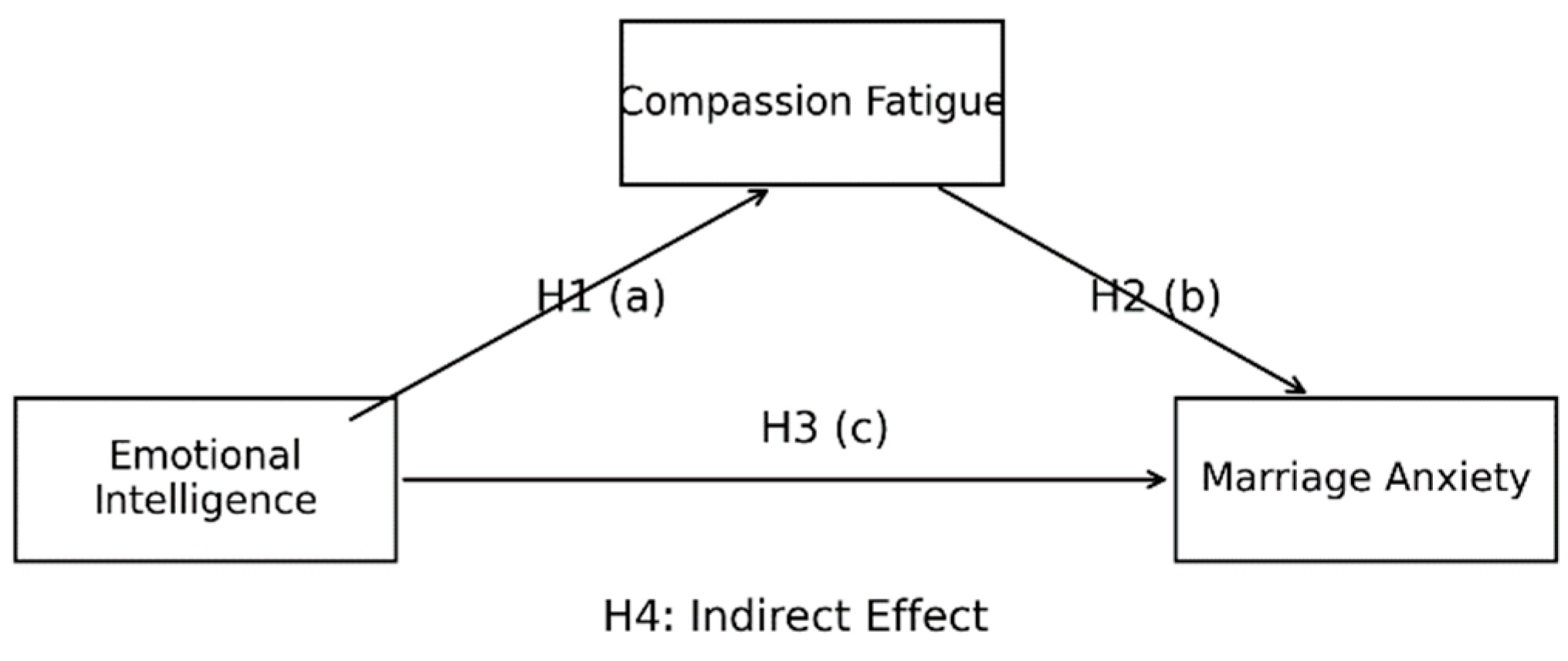

| Demographic Variable | Groups | N | % |
|---|---|---|---|
| Age Groups | 23–35 years | 188 | 60.5 |
| 36 years and above | 123 | 39.5 | |
| Gender | Female | 168 | 54.0 |
| Male | 143 | 46.0 | |
| Professional Title | Social Worker | 83 | 26.7 |
| Psychologist | 190 | 61.1 | |
| Psychological Counselor | 38 | 12.2 |
| Variable | α | N | Mean | SD | Skewness | Kurtosis |
|---|---|---|---|---|---|---|
| Emotional Intelligence | 0.780 | 311 | 95.20 | 14.97 | 0.138 | −0.452 |
| Marriage Anxiety | 0.928 | 311 | 15.46 | 8.17 | −0.080 | −0.297 |
| Compassion Fatigue | 0.921 | 311 | 51.81 | 26.28 | 0.304 | −0.060 |
| Variable | 1 | 2 | 3 |
|---|---|---|---|
| 1 Emotional Intelligence | 1 | −0.174 ** | −0.521 ** |
| 2 Marriage Anxiety | 1 | 0.321 * | |
| 3 Compassion Fatigue | 1 |
| Independent Variable | Path | Dependent Variable | H | β | T | p | BootLLCI 1 | BootULCI 1 |
|---|---|---|---|---|---|---|---|---|
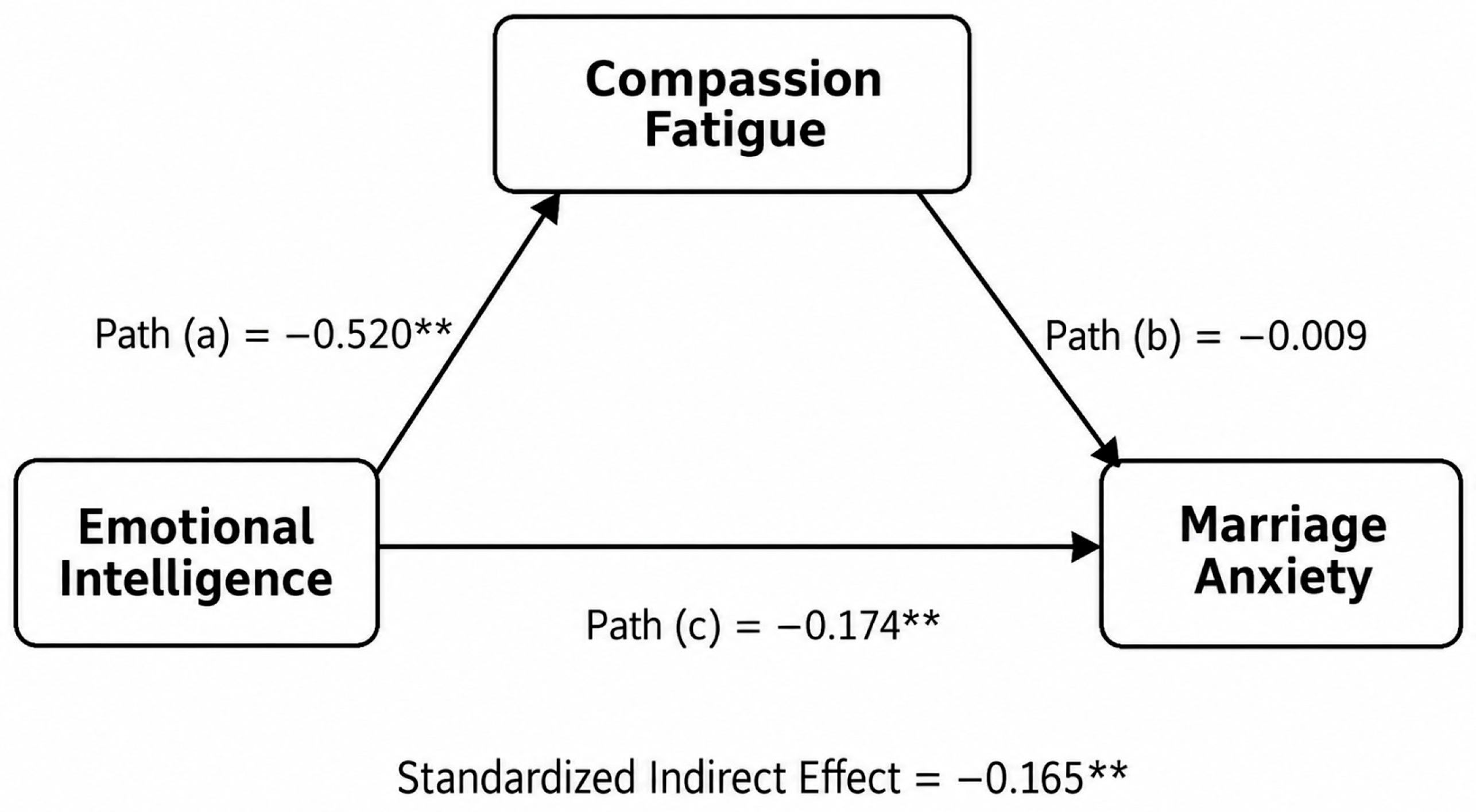
| Emotional Intelligence | → | Compassion Fatigue | H1 (a) | −0.520 | −10.718 | p < 0.01 | −0.635 | −0.402 |
| Compassion Fatigue | → | Marriage Anxiety | H2 (b) | −0.009 | −0.151 | 0.880 | −0.133 | 0.112 |
| Emotional Intelligence | → | Marriage Anxiety | H3 (c) | −0.174 | −3.106 | p < 0.01 | −0.155 | −0.035 |
| H | IE | SIE | SE | SSE | R2 | ΔR2 | BootLLCI/BootULCI | Standardized BootLLCI/BootULCI |
|---|---|---|---|---|---|---|---|---|
| H4 (c′) | −0.090 | −0.165 | 0.021 | 0.038 | 0.103 | 0.097 | −0.134/−0.050 | −0.244/−0.093 |
Disclaimer/Publisher’s Note: The statements, opinions and data contained in all publications are solely those of the individual author(s) and contributor(s) and not of MDPI and/or the editor(s). MDPI and/or the editor(s) disclaim responsibility for any injury to people or property resulting from any ideas, methods, instructions or products referred to in the content. |
© 2026 by the authors. Licensee MDPI, Basel, Switzerland. This article is an open access article distributed under the terms and conditions of the Creative Commons Attribution (CC BY) license.
Share and Cite
Mukba, G.; Oruç, S. Compassion Fatigue as a Mediator Between Emotional Intelligence and Marital Anxiety Among Unmarried Mental Health Professionals Working in Family and Social Services. Behav. Sci. 2026, 16, 969. https://doi.org/10.3390/bs16060969
Mukba G, Oruç S. Compassion Fatigue as a Mediator Between Emotional Intelligence and Marital Anxiety Among Unmarried Mental Health Professionals Working in Family and Social Services. Behavioral Sciences. 2026; 16(6):969. https://doi.org/10.3390/bs16060969
Chicago/Turabian StyleMukba, Gamze, and Serkan Oruç. 2026. "Compassion Fatigue as a Mediator Between Emotional Intelligence and Marital Anxiety Among Unmarried Mental Health Professionals Working in Family and Social Services" Behavioral Sciences 16, no. 6: 969. https://doi.org/10.3390/bs16060969
APA StyleMukba, G., & Oruç, S. (2026). Compassion Fatigue as a Mediator Between Emotional Intelligence and Marital Anxiety Among Unmarried Mental Health Professionals Working in Family and Social Services. Behavioral Sciences, 16(6), 969. https://doi.org/10.3390/bs16060969

