Personal Time, Parental Fairness, School Adjustment and Physical Activity Levels as Indicators of Executive Functions in Children and Adolescents

 ,
,  ,
, 
 , , ,
, , ,  ,
,  and
and 
Abstract
1. Introduction
2. Materials and Methods
2.1. Participants
2.2. Main Outcomes
2.2.1. Physical Activity Levels and Screen Time
2.2.2. Executive Functions
2.2.3. Health-Related Quality of Life
2.2.4. Sleep Duration
2.3. Analysis Procedure
3. Results
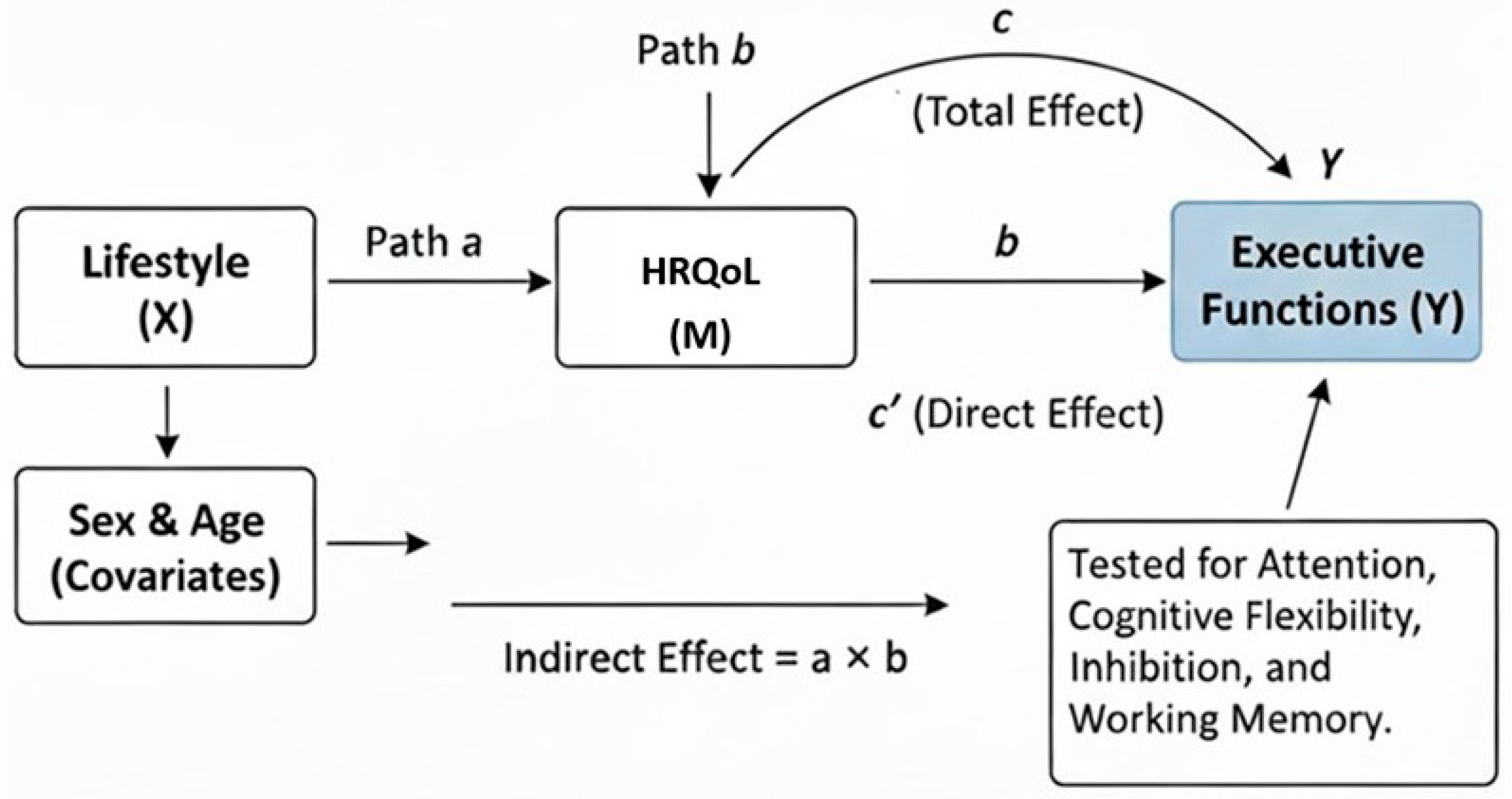
Mediation Analysis
4. Discussion
Strengths and Limitations
5. Conclusions
Author Contributions
Funding
Institutional Review Board Statement
Informed Consent Statement
Data Availability Statement
Acknowledgments
Conflicts of Interest
References
- Alhwaiti, M. (2025). The effects of exercise types on inhibitory control and working memory in children with attention deficit hyperactivity disorder: Network meta-analysis. Applied Neuropsychology: Child, 1–11. [Google Scholar] [CrossRef]
- Astill, R. G., Van der Heijden, K. B., Van Ijzendoorn, M. H., & Van Someren, E. J. (2012). Sleep, cognition, and behavioral problems in school-age children: A century of research meta-analyzed. Psychological Bulletin, 138(6), 1109–1138. [Google Scholar] [CrossRef]
- Bloomberg, M., Brocklebank, L., Hamer, M., & Steptoe, A. (2023). Joint associations of physical activity and sleep duration with cognitive ageing: Longitudinal analysis of an English cohort study. The Lancet Healthy Longevity, 4(7), e345–e353. [Google Scholar] [CrossRef]
- Cai, Y., Zhou, J., Scott, P. W., Tian, Q., Wanigatunga, A. A., Lipsitz, L., Simonsick, E. M., Resnick, S. M., Ferrucci, L., Ren, D., & Schrack, J. A. (2025). Physical activity complexity, cognition, and risk of cognitive impairment and dementia in the Baltimore Longitudinal Study of Aging. Alzheimer’s & Dementia: Translational Research & Clinical Interventions, 11(2), e70077. [Google Scholar] [CrossRef]
- Cassidy, A. R. (2016). Executive function and psychosocial adjustment in healthy children and adolescents: A latent variable modelling investigation. Child neuropsychology, 22(3), 292–317. [Google Scholar] [CrossRef]
- Chen, D., Wen, X., Zhou, Y., Zhang, Q., & Xu, W. (2024). Cognitive flexibility and social adjustment in daily life among children: The role of perceived social support. Current Psychology, 43(20), 18463–18473. [Google Scholar] [CrossRef]
- Chi, S.-A., Kim, S., & Kim, N.-H. (2018). A study of school adjustment related variables of young children. South African Journal of Education, 38(2), 1–9. [Google Scholar] [CrossRef]
- Contreras-Osorio, F., Guzmán-Guzmán, I. P., Cerda-Vega, E., Chirosa-Ríos, L., Ramírez-Campillo, R., & Campos-Jara, C. (2022). Anthropometric parameters, physical activity, physical fitness, and executive functions among primary school children. International Journal of Environmental Research and Public Health, 19(5), 3045. [Google Scholar] [CrossRef]
- Cushman, G. K., West, K. B., Davis, M., LaMotte, J., Eaton, C. K., Gutierrez-Colina, A. M., Suveg, C., & Blount, R. L. (2022). The role of executive functioning, healthcare management, and self-efficacy in college students’ health-related quality of life. Journal of American College Health, 70(8), 2356–2364. [Google Scholar] [CrossRef]
- Dadkhah, M., Saadat, M., Ghorbanpour, A. M., & Moradikor, N. (2023). Experimental and clinical evidence of physical exercise on BDNF and cognitive function: A comprehensive review from molecular basis to therapy. Brain Behavior and Immunity Integrative, 3, 100017. [Google Scholar] [CrossRef]
- Devine, R. T., Bignardi, G., & Hughes, C. (2016). Executive function mediates the relations between parental behaviors and children’s early academic ability. Frontiers in Psychology, 7, 1902. [Google Scholar] [CrossRef]
- Diamond, A. (2013). Executive functions. Annual Review of Psychology, 64(1), 135–168. [Google Scholar] [CrossRef] [PubMed]
- Donenfeld, J., Mudundi, M., Blaser, E., & Kaldy, Z. (2026). School changes minds: A meta-analysis shows that schooling modestly improves children’s executive functions. Journal of Experimental Child Psychology, 262, 106371. [Google Scholar] [CrossRef]
- Faul, F., Erdfelder, E., Lang, A. G., & Buchner, A. (2007). G*Power 3: A flexible statistical power analysis program for the social, behavioral, and biomedical sciences. Behav Res Methods, 39(2), 175–191. [Google Scholar] [CrossRef] [PubMed]
- Galle, S. A., Liu, J., Bonnechère, B., Amin, N., Milders, M. M., Deijen, J. B., Scherder, E. J., Drent, M. L., Voortman, T., Ikram, M. A., & Ikram, M. A. (2023). The long-term relation between physical activity and executive function in the Rotterdam Study. European Journal of Epidemiology, 38(1), 71–81. [Google Scholar] [CrossRef]
- García-Alonso, Y., Ramírez-Vélez, R., Legarra-Gorgoñon, G., Izquierdo, M., & Alonso-Martínez, A. M. (2025). Associations between physical fitness, physical activity, sedentary behavior and executive function in preschoolers. Pediatric Research, 98(4), 1492–1499. [Google Scholar] [CrossRef]
- Goethals, E. R., Volkening, L. K., & Laffel, L. M. (2021). Executive dysfunction is associated with poorer health-related quality of life in adolescents with type 1 diabetes: Differences by sex. Quality of Life Research, 30(3), 751–758. [Google Scholar] [CrossRef]
- Guzmán-Muñoz, E., Concha-Cisternas, Y., Jofré-Saldía, E., Castillo-Paredes, A., Molina-Márquez, I., & Yáñez-Sepúlveda, R. (2025). Physical activity and its effects on executive functions and brain outcomes in children: A narrative review. Brain Sciences, 15(11), 1238. [Google Scholar] [CrossRef]
- Hammud, G., Avital-Magen, A., Schusheim, G., Barzuza, I., & Engel-Yeger, B. (2023). How self-regulation and executive functions deficits affect quality of life of children/adolescents with emotional regulation disorders. Children, 10(10), 1622. [Google Scholar] [CrossRef] [PubMed]
- Henry, A., Katsoulis, M., Masi, S., Fatemifar, G., Denaxas, S., Acosta, D., Garfield, V., & Dale, C. E. (2019). The relationship between sleep duration, cognition and dementia: A Mendelian randomization study. International Journal of Epidemiology, 48(3), 849–860. [Google Scholar] [CrossRef]
- Huang, C.-C., Lu, S., Rios, J., Chen, Y., Stringham, M., & Cheung, S. (2020). Associations between mindfulness, executive function, social-emotional skills, and quality of life among hispanic children. International Journal of Environmental Research and Public Health, 17(21), 7796. [Google Scholar] [CrossRef]
- Hughes, C., & Devine, R. T. (2019). For better or for worse? Positive and negative parental influences on young children’s executive function. Child Development, 90(2), 593–609. [Google Scholar] [CrossRef]
- James, S.-N., Chiou, Y.-J., Fatih, N., Needham, L. P., Schott, J. M., & Richards, M. (2023). Timing of physical activity across adulthood on later-life cognition: 30 years follow-up in the 1946 British birth cohort. Journal of Neurology, Neurosurgery & Psychiatry, 94(5), 349–356. [Google Scholar] [CrossRef]
- Kim, J., & Tsethlikai, M. (2025). Longitudinal mediated relations between screen time and school adjustment through executive function difficulties. Journal of Cognition and Development, 26(5), 721–742. [Google Scholar] [CrossRef]
- Koşkulu-Sancar, S., van de Weijer-Bergsma, E., Mulder, H., & Blom, E. (2023). Examining the role of parents and teachers in executive function development in early and middle childhood: A systematic review. Developmental Review, 67, 101063. [Google Scholar] [CrossRef]
- Laera, G., Joly-Burra, E., Zuber, S., Ballhausen, N., Künzi, M., Ihle, A., da Silva Coelho, C., Haas, M., Mikneviciute, G., Tinello, D., & Tinello, D. (2023). Do executive functions explain older adults’ health-related quality of life beyond event-based prospective memory? Aging, Neuropsychology, and Cognition, 30(2), 135–149. [Google Scholar] [CrossRef] [PubMed]
- Lemes, V., Gaya, A. R., Sadarangani, K. P., Aguilar-Farias, N., Rodriguez-Rodriguez, F., Martins, C. M. d. L., Fochesatto, C., & Cristi-Montero, C. (2021). Physical fitness plays a crucial mediator role in relationships among personal, social, and lifestyle factors with adolescents’ cognitive performance in a structural equation model. The cogni-action project. Frontiers in Pediatrics, 9, 656916. [Google Scholar] [CrossRef] [PubMed]
- Liu, J., Riesch, S., Tien, J., Lipman, T., Pinto-Martin, J., & O’Sullivan, A. (2022). Screen media overuse and associated physical, cognitive, and emotional/behavioral outcomes in children and adolescents: An integrative review. Journal of Pediatric Health Care, 36(2), 99–109. [Google Scholar] [CrossRef]
- Liu, J., Wei, M., Li, X., Ablitip, A., Zhang, S., Ding, H., Zheng, K., Liu, R., & Ma, X. (2024). Substitution of physical activity for sedentary behaviour contributes to executive function improvement among young adults: A longitudinal study. BMC Public Health, 24(1), 3326. [Google Scholar] [CrossRef]
- Lobato-Ruiz, V., Romero-Ayuso, D., Toledano-González, A., & Triviño-Juárez, J. M. (2025). Quality of life and parental stress related to executive functioning, sensory processing, and activities of daily living in children and adolescents with neurodevelopmental disorders. PeerJ, 13, e19326. [Google Scholar] [CrossRef]
- Lucassen, N., Kok, R., Bakermans-Kranenburg, M. J., Van Ijzendoorn, M. H., Jaddoe, V. W., Hofman, A., Verhulst, F. C., Lambregtse-Van den Berg, M. P., & Tiemeier, H. (2015). Executive functions in early childhood: The role of maternal and paternal parenting practices. British Journal of Developmental Psychology, 33(4), 489–505. [Google Scholar] [CrossRef]
- Majem, L. S., Barba, L. R., Bartrina, J. A., Rodrigo, C. P., Santana, P. S., & Quintana, L. P. (2003). Obesidad infantil y juvenil en España. Resultados del Estudio enKid (1998–2000). Medicina Clinica, 121(19), 725–732. [Google Scholar] [CrossRef]
- Mikhaylova, O., Bochkor, A., Osipova, P., Popov, D., Chepeleva, M., & Rybakova, E. (2023). Child self-care autonomy in health (scale for parents): Development, internal structure, and sex/age correlates. Frontiers in Psychology, 14, 1243400. [Google Scholar] [CrossRef]
- Mora-Gonzalez, J., Barranco-Ruiz, Y., Bellón, D., & Rodriguez-Ayllon, M. (2025). Editorial: Physical activity: A promising modifiable behavior to protect brain, cognition, and mental health across the lifespan. Frontiers in Psychology, 16, 1636754. [Google Scholar] [CrossRef]
- Muntaner-Mas, A., Mazzoli, E., Abbott, G., Mavilidi, M. F., & Galmes-Panades, A. M. (2022). Do physical fitness and executive function mediate the relationship between physical activity and academic achievement? An examination using structural equation modelling. Children, 9(6), 823. [Google Scholar] [CrossRef]
- Nay, K., Smiles, W. J., Kaiser, J., McAloon, L. M., Loh, K., Galic, S., Oakhill, J. S., Gundlach, A. L., & Scott, J. W. (2021). Molecular mechanisms underlying the beneficial effects of exercise on brain function and neurological disorders. International Journal of Molecular Sciences, 22(8), 4052. [Google Scholar] [CrossRef]
- Northey, J. M., Raine, L. B., & Hillman, C. H. (2025). Are there sensitive periods for physical activity to influence the development of executive function in children? Journal of Sport and Health Science, 14, 101015. [Google Scholar] [CrossRef]
- Ortega, F. B., Ruiz, J. R., Castillo, R., Chillón, P., Labayen, I., Martínez-Gómez, D., Redondo, C., Marcos, A., & Moreno, L. A. (2010). Sleep duration and cognitive performance in adolescence. The AVENA study. Acta Paediatrica, 99(3), 454–456. [Google Scholar] [CrossRef]
- Pandey, A., Hale, D., Das, S., Goddings, A.-L., Blakemore, S.-J., & Viner, R. M. (2018). Effectiveness of universal self-regulation–based interventions in children and adolescents: A systematic review and meta-analysis. JAMA Pediatrics, 172(6), 566–575. [Google Scholar] [CrossRef]
- Preacher, k., & Hayes, A. (2004). SPSS and SAS procedures for estimating indirect effects in simple mediation models. Behavior Research Methods, Instruments, & Computers, 36(4), 717–731. [Google Scholar] [CrossRef]
- Ramos-Monsivais, C. L., Rodríguez-Cano, S., Lema-Moreira, E., & Delgado-Benito, V. (2024). Relationship between mental health and students’ academic performance through a literature review. Discover Psychology, 4(1), 119. [Google Scholar] [CrossRef]
- Ravens-Sieberer, U., Erhart, M., Rajmil, L., Herdman, M., Auquier, P., Bruil, J., Power, M., Duer, W., Abel, T., Czemy, L., & Kilroe, J. (2010). Reliability, construct and criterion validity of the KIDSCREEN-10 score: A short measure for children and adolescents’ well-being and health-related quality of life. Quality of Life Research, 19(10), 1487–1500. [Google Scholar] [CrossRef]
- Reina-Reina, C., Conesa, P. J., & Duñabeitia, J. A. (2023). Impact of a cognitive stimulation program on the reading comprehension of children in primary education. Frontiers in Psychology, 13, 985790. [Google Scholar] [CrossRef]
- Rungsattatharm, L., Tasingha, P., Trairatvorakul, P., & Chonchaiya, W. (2025). Longitudinal associations between executive function and positive parenting during early childhood and resilience, self-regulation, and behavioral problems in school-age children. Child and Adolescent Psychiatry and Mental Health, 19(1), 19. [Google Scholar] [CrossRef]
- Sasser, T. R., Bierman, K. L., & Heinrichs, B. (2015). Executive functioning and school adjustment: The mediational role of pre-kindergarten learning-related behaviors. Early Childhood Research Quarterly, 30, 70–79. [Google Scholar] [CrossRef]
- Selman, S. B., & Dilworth-Bart, J. E. (2024). Routines and child development: A systematic review. Journal of Family Theory & Review, 16(2), 272–328. [Google Scholar]
- Sosic-Vasic, Z., Kröner, J., Schneider, S., Vasic, N., Spitzer, M., & Streb, J. (2017). The association between parenting behavior and executive functioning in children and young adolescents. Frontiers in Psychology, 8, 472. [Google Scholar] [CrossRef]
- Subramanyam, A. A., Somaiya, M., & De Sousa, A. (2024). Mental health and well-being in children and adolescents. Indian Journal of Psychiatry, 66(Suppl. 2), S304–S319. [Google Scholar] [CrossRef]
- Tai, X. Y., Chen, C., Manohar, S., & Husain, M. (2022). Impact of sleep duration on executive function and brain structure. Communications Biology, 5(1), 201. [Google Scholar] [CrossRef]
- Tapia, J. L., Rocabado, F., & Duñabeitia, J. A. (2022). Cognitive estimation of speed, movement and time across the lifespan. Journal of Integrative Neuroscience, 21(1), 10. [Google Scholar] [CrossRef]
- Toth, C., Osser, B., Bondar, L. I., Fazakas, R., Marcu, F. M., Pascalau, N. A., Suciu, R. N., & Dogaru, B. G. (2025). Associations between screen time, sleep, and executive function in school-aged children and adolescents: The moderating role of digital content and age. Journal of Clinical Medicine, 14(24), 8842. [Google Scholar] [CrossRef]
- Turnes, V. H. S., & Piacentini, N. (2025). Introduction to executive functions. In Neuropsychology and substance use disorders: Assessment and treatment (pp. 271–282). Springer. [Google Scholar]
- Valcan, D. S., Davis, H., & Pino-Pasternak, D. (2018). Parental behaviours predicting early childhood executive functions: A meta-analysis. Educational Psychology Review, 30(3), 607–649. [Google Scholar] [CrossRef]
- Xu, Z., Niu, M., Du, W., & Dang, T. (2025). The effect of sleep quality on learning engagement of junior high school students: The moderating role of mental health. Frontiers in Psychology, 16, 1476840. [Google Scholar] [CrossRef]
- Zeng, X., Cai, L., Yang, W., Tan, W., Huang, W., & Chen, Y. (2022). Association between the 24-h movement guidelines and executive function among Chinese children. BMC Public Health, 22(1), 1017. [Google Scholar] [CrossRef]


| Variable | Boys (n = 461) | Girls (n = 482) | Total (N = 943) | p-Value | F-Value |
|---|---|---|---|---|---|
| Age (years) | 13.83 ± 2.02 | 13.82 ± 2.00 | 13.82 ± 2.01 | 0.932 | 0.01 |
| Screen Time (h/day) | 3.38 ± 1.64 | 2.99 ± 1.61 | 3.18 ± 1.63 | 0.000 | 13.88 |
| Physical Activity (h/week) | 2.72 ± 1.85 | 2.18 ± 1.65 | 2.44 ± 1.77 | 0.000 | 21.38 |
| Lifestyle (PA + ST) | 4.57 ± 2.34 | 4.39 ± 2.20 | 4.47 ± 2.27 | 0.252 | 1.31 |
| Sleep Duration (h/day) | 8.01 ± 1.47 | 7.83 ± 1.53 | 7.92 ± 1.50 | 0.070 | 3.29 |
| Health Related to Quality of Life | 28.44 ± 6.19 | 23.95 ± 6.34 | 26.15 ± 6.65 | 0.000 | 121.43 |
| Cognitive Area: Attention | 428.06 ± 150.66 | 399.54 ± 158.39 | 413.49 ± 155.22 | 0.008 | 7.02 |
| EFs: Cognitive Flexibility | 403.40 ± 237.88 | 353.04 ± 239.80 | 377.73 ± 240.04 | 0.003 | 9.15 |
| EFs: Inhibition | 312.28 ± 225.61 | 325.79 ± 248.16 | 319.17 ± 237.32 | 0.415 | 0.67 |
| EFs: Working Memory | 256.17 ± 224.85 | 213.10 ± 196.79 | 234.22 ± 211.98 | 0.003 | 8.58 |
| 0 | b | 95%CI | SE | t | p-Value | ||
|---|---|---|---|---|---|---|---|
| Attention | |||||||
| Model 1 | Lifestyle (PA + ST) | 8.49 | 3.36 | 13.63 | 2.62 | 3.25 | 0.001 |
| Sleep (h) | −15.46 | −22.98 | −7.93 | 3.83 | −4.03 | p < 0.001 | |
| HRQoL | 3.45 | 1.70 | 5.20 | 0.89 | 3.88 | p < 0.001 | |
| Model 2 | Lifestyle (PA + ST) | 8.40 | 3.24 | 13.57 | 2.63 | 3.19 | 0.001 |
| Sleep (h) | −15.44 | −23.06 | −7.83 | 3.88 | −3.98 | p < 0.001 | |
| HRQoL | 2.93 | 1.10 | 4.77 | 0.93 | 3.15 | 0.002 | |
| Cognitive Flexibility | |||||||
| Model 1 | Lifestyle (PA + ST) | 21.74 | 13.76 | 29.73 | 4.07 | 5.35 | p < 0.001 |
| Sleep (h) | −20.53 | −32.25 | −8.81 | 5.97 | −3.44 | 0.001 | |
| HRQoL | 4.33 | 1.60 | 7.05 | 1.39 | 3.12 | 0.002 | |
| Model 2 | Lifestyle (PA + ST) | 20.34 | 12.36 | 28.32 | 4.06 | 5.00 | 0.000 |
| Sleep (h) | −18.05 | −29.83 | −6.26 | 6.00 | −3.01 | 0.003 | |
| HRQoL | 3.73 | 0.90 | 6.55 | 1.44 | 2.59 | 0.010 | |
| Inhibition | |||||||
| Model 1 | Lifestyle (PA + ST) | 23.63 | 15.78 | 31.48 | 4.00 | 5.91 | p < 0.001 |
| Sleep (h) | −6.34 | −17.87 | 5.20 | 5.87 | −1.08 | 0.281 | |
| HRQoL | 1.86 | −0.82 | 4.54 | 1.36 | 1.36 | 0.173 | |
| Model 2 | Lifestyle (PA + ST) | 22.36 | 14.48 | 30.24 | 4.02 | 5.57 | 0.000 |
| Sleep (h) | −3.74 | −15.39 | 7.91 | 5.93 | −0.63 | 0.528 | |
| HRQoL | 2.59 | −0.21 | 5.39 | 1.42 | 1.82 | 0.069 | |
| Working Memory | |||||||
| Model 1 | Lifestyle (PA + ST) | 22.37 | 15.33 | 29.41 | 3.58 | 6.24 | p < 0.001 |
| Sleep (h) | −14.55 | −24.89 | −4.22 | 5.26 | −2.77 | 0.006 | |
| HRQoL | 3.28 | 0.88 | 5.68 | 1.22 | 2.68 | 0.007 | |
| Model 2 | Lifestyle (PA + ST) | 20.41 | 13.45 | 27.37 | 3.54 | 5.76 | p < 0.001 |
| Sleep (h) | −11.00 | −21.28 | −0.73 | 5.23 | −2.10 | 0.036 | |
| HRQoL | 2.75 | 0.28 | 5.21 | 1.26 | 2.18 | 0.029 | |
| KIDSCREEN-10 Item | Attention b (95% CI) | p-Value | Cognitive Flexibility b (95% CI) | p-Value |
|---|---|---|---|---|
| 1. Physical well-being | 2.57 (−9.34, 14.47) | 0.672 | 9.26 (−9.19, 27.70) | 0.325 |
| 2. Energy levels | −7.63 (−18.75, 3.50) | 0.179 | −12.82 (−30.07, 4.43) | 0.145 |
| 3. Sadness | −9.14 (−20.89, 2.61) | 0.127 | −4.07 (−22.36, 14.21) | 0.662 |
| 4. Loneliness | 6.77 (−4.28, 17.81) | 0.229 | 3.99 (−13.11, 21.08) | 0.647 |
| 5. Time for self | 12.60 (1.53, 23.66) | 0.026 | 14.17 (−2.95, 31.30) | 0.105 |
| 6. Free time activities | −2.83 (−13.78, 8.11) | 0.612 | −12.28 (−29.24, 4.67) | 0.155 |
| 7. Fairness (Parents) | 13.89 (4.03, 23.75) | 0.006 | 22.93 (7.65, 38.21) | 0.003 |
| 8. Fun with friends | −3.87 (−14.98, 7.23) | 0.494 | −2.90 (−20.17, 14.38) | 0.742 |
| 9. School performance | 16.39 (2.81, 29.96) | 0.018 | 30.65 (9.43, 51.86) | 0.005 |
| 10. Attention capacity | 5.21 (−8.17, 18.58) | 0.445 | 9.20 (−11.61, 30.02) | 0.386 |
| Inhibition b (95% CI) | p-Value | Working Memory b (95% CI) | p-Value | |
| 1. Physical well-being | 7.84 (−10.51, 26.19) | 0.402 | 0.95 (−15.22, 17.13) | 0.908 |
| 2. Energy levels | −14.34 (−31.50, 2.83) | 0.101 | −9.79 (−24.92, 5.34) | 0.204 |
| 3. Sadness | −4.44 (−22.63, 13.75) | 0.632 | −8.06 (−24.09, 7.98) | 0.324 |
| 4. Loneliness | 9.81 (−7.20, 26.82) | 0.258 | 3.15 (−11.84, 18.14) | 0.68 |
| 5. Time for self | 15.01 (−2.03, 32.05) | 0.084 | 4.50 (−10.52, 19.52) | 0.557 |
| 6. Free time activities | −15.26 (−32.13, 1.61) | 0.076 | −14.68 (−29.55, 0.19) | 0.053 |
| 7. Fairness (Parents) | 14.95 (−0.26, 30.15) | 0.054 | 25.42 (12.02, 38.83) | <0.001 |
| 8. Fun with friends | −1.51 (−18.70, 15.68) | 0.863 | −4.03 (−19.18, 11.12) | 0.602 |
| 9. School performance | 24.66 (3.55, 45.77) | 0.022 | 42.33 (23.73, 60.94) | <0.001 |
| 10. Attention capacity | 12.16 (−8.55, 32.87) | 0.249 | 0.22 (−18.04, 18.47) | 0.981 |
| Dependent Variable (Y) and Mediation Paths | Coeff (b) | SE | t | p-Value | 95% CI | Mediation Proportion (%) |
|---|---|---|---|---|---|---|
| Attention | ||||||
| Path a: | 0.35 | 0.11 | 3.22 | 0.001 | [0.14, 0.56] | — |
| Path b: | 2.70 | 0.93 | 2.91 | 0.004 | [0.88, 4.52] | — |
| Direct Effect (c’) | 8.84 | 2.64 | 3.34 | <0.001 | [3.65, 14.03] | — |
| Total Effect (c) | 9.77 | 2.64 | 3.70 | <0.001 | [4.59, 14.95] | — |
| Indirect Effect (a × b) | 0.93 | 0.42 | — | — | [0.23, 1.85] | 9.55% |
| Cognitive Flexibility | ||||||
| Path a: | 0.35 | 0.11 | 3.22 | 0.001 | [0.13, 0.56] | — |
| Path b: | 3.46 | 1.43 | 2.43 | 0.015 | [0.66, 6.26] | — |
| Direct Effect (c’) | 20.69 | 4.05 | 5.10 | <0.0001 | [12.73, 28.65] | — |
| Total Effect (c) | 21.89 | 4.04 | 5.42 | <0.0001 | [13.96, 29.82] | — |
| Indirect Effect (a × b) | 1.19 | 0.62 | — | — | [0.17, 2.59] | 5.45% |
| Inhibition | ||||||
| Path a: | 0.35 | 0.11 | 3.22 | 0.001 | [0.13, 0.56] | — |
| Path b: | 2.74 | 1.4 | 1.96 | 0.050 | [−0.01, 5.48] | — |
| Direct Effect (c’) | 23.02 | 3.98 | 5.79 | <0.0001 | [15.21, 30.83] | — |
| Total Effect (c) | 23.97 | 3.96 | 6.06 | <0.0001 | [16.20, 31.73] | — |
| Indirect Effect (a × b) | 0.94 | 0.58 | — | — | [−0.01, 2.21] | No mediation |
| Working Memory | ||||||
| Path a: | 0.35 | 0.11 | 3.22 | 0.001 | [0.13, 0.56] | — |
| Path b: | 2.62 | 1.24 | 2.12 | 0.035 | [0.19, 5.05] | — |
| Direct Effect (c’) | 20.94 | 3.52 | 5.95 | <0.0001 | [14.03, 27.86] | — |
| Total Effect (c) | 21.85 | 3.5 | 6.23 | <0.0001 | [14.97, 28.73] | — |
| Indirect Effect (a × b) | 0.9 | 0.52 | — | — | [0.06, 2.09] | 4.14% |
Disclaimer/Publisher’s Note: The statements, opinions and data contained in all publications are solely those of the individual author(s) and contributor(s) and not of MDPI and/or the editor(s). MDPI and/or the editor(s) disclaim responsibility for any injury to people or property resulting from any ideas, methods, instructions or products referred to in the content. |
© 2026 by the authors. Licensee MDPI, Basel, Switzerland. This article is an open access article distributed under the terms and conditions of the Creative Commons Attribution (CC BY) license.
Share and Cite
Caamaño-Navarrete, F.; Arriagada-Hernández, C.; Jara-Tomckowiack, L.; Contreras-Diaz, G.; Álvarez, C.; Hernández-Mosqueira, C.; Figueroa-Saavedra, C.; Lagos-Hernández, R.; Fuentes-Vilugrón, G.; Delgado-Floody, P. Personal Time, Parental Fairness, School Adjustment and Physical Activity Levels as Indicators of Executive Functions in Children and Adolescents. Behav. Sci. 2026, 16, 941. https://doi.org/10.3390/bs16060941
Caamaño-Navarrete F, Arriagada-Hernández C, Jara-Tomckowiack L, Contreras-Diaz G, Álvarez C, Hernández-Mosqueira C, Figueroa-Saavedra C, Lagos-Hernández R, Fuentes-Vilugrón G, Delgado-Floody P. Personal Time, Parental Fairness, School Adjustment and Physical Activity Levels as Indicators of Executive Functions in Children and Adolescents. Behavioral Sciences. 2026; 16(6):941. https://doi.org/10.3390/bs16060941
Chicago/Turabian StyleCaamaño-Navarrete, Felipe, Carlos Arriagada-Hernández, Lorena Jara-Tomckowiack, Guido Contreras-Diaz, Cristian Álvarez, Claudio Hernández-Mosqueira, Carla Figueroa-Saavedra, Roberto Lagos-Hernández, Gerardo Fuentes-Vilugrón, and Pedro Delgado-Floody. 2026. "Personal Time, Parental Fairness, School Adjustment and Physical Activity Levels as Indicators of Executive Functions in Children and Adolescents" Behavioral Sciences 16, no. 6: 941. https://doi.org/10.3390/bs16060941
APA StyleCaamaño-Navarrete, F., Arriagada-Hernández, C., Jara-Tomckowiack, L., Contreras-Diaz, G., Álvarez, C., Hernández-Mosqueira, C., Figueroa-Saavedra, C., Lagos-Hernández, R., Fuentes-Vilugrón, G., & Delgado-Floody, P. (2026). Personal Time, Parental Fairness, School Adjustment and Physical Activity Levels as Indicators of Executive Functions in Children and Adolescents. Behavioral Sciences, 16(6), 941. https://doi.org/10.3390/bs16060941