Digital Life Balance and Adolescent Flourishing: The Mediating Roles of Life Satisfaction and Self-Esteem

Abstract
1. Introduction
1.1. Relationship Between Digital Life Balance and Well-Being
1.2. Relationship Between Digital Life Balance and Life Satisfaction
1.3. Digital Life Balance and Self-Esteem
1.4. Relationship Between Life Satisfaction, Self-Esteem and Well-Being
1.5. The Mediating Role of Self-Esteem and Life Satisfaction in the Relationship Between Digital Life Balance and Flourishing
2. Materials and Methods
2.1. Participants
2.2. Procedure
2.3. Ethical Considerations
2.4. Measures
2.5. Statistical Strategies
3. Results
3.1. Sociodemographic Characteristics of the Sample
3.2. Controlling Common Method Bias (CMB)
3.3. Descriptive and Correlational Analyses
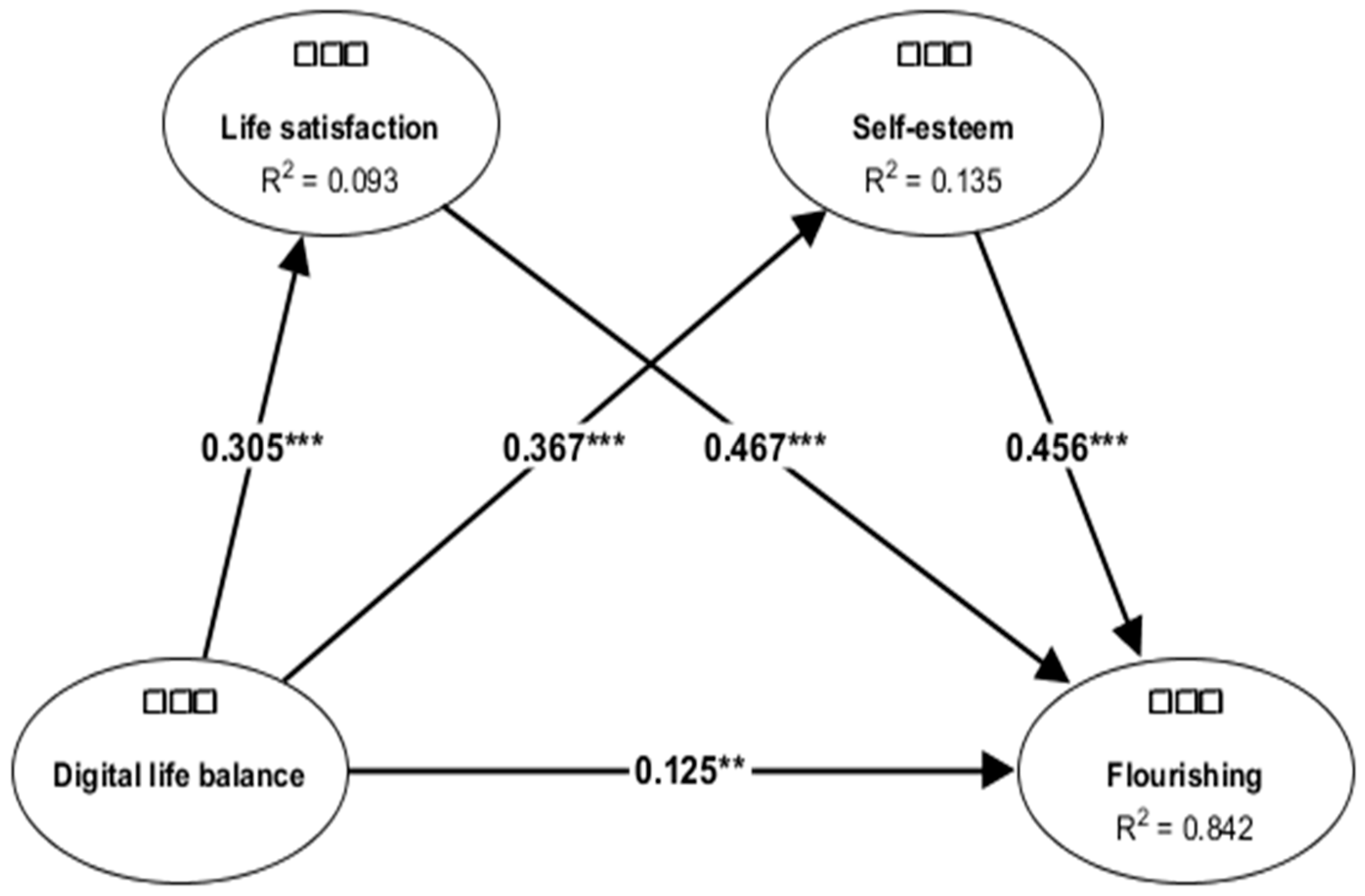
3.4. The Mediating Role of Self-Esteem and Life Satisfaction
4. Discussion
Theoretical and Practical Implications
5. Conclusions
Author Contributions
Funding
Institutional Review Board Statement
Informed Consent Statement
Data Availability Statement
Conflicts of Interest
Abbreviations
| ICT | Information and Communication Technology |
| DLB | Digital life balance |
| FL | Flourishing |
| LS | Life satisfaction |
| SE | Self-esteem |
| PLS-SEM | Partial Least Square-Structural Equation Modeling |
References
- Aldbyani, A., Wang, G., Chuanxia, Z., & Alhimaidi, A. (2025). Dispositional mindfulness is associated with lower smartphone addiction through digital life balance among Chinese university students. Frontiers in Psychology, 16, 1653620. [Google Scholar] [CrossRef] [PubMed]
- Alotaibi, M. S., Fox, M., Coman, R., Ratan, Z. A., & Hosseinzadeh, H. (2022). Smartphone addiction prevalence and its association on academic performance, physical health, and mental well-being among university students in Umm Al-Qura University (UQU), Saudi Arabia. International Journal of Environmental Research and Public Health, 19(6), 3710. [Google Scholar] [CrossRef] [PubMed]
- Appel, M., Marker, C., & Gnambs, T. (2020). Are social media ruining our lives? A review of meta-analytic evidence. Review of General Psychology, 24(1), 60–74. [Google Scholar] [CrossRef]
- Balgiu, B. A., & Simionescu-Panait, A. (2024). Flourishing in education: Psychometric properties of the Flourishing Scale in a sample of Romanian teachers. Behavioral Sciences, 14(5), 366. [Google Scholar] [CrossRef]
- Berk, L. E. (2018). Development through the lifespan (7th ed.). Pearson. [Google Scholar]
- Boers, E., Afzali, M. H., Newton, N., & Conrod, P. (2019). Association of screen time and depression in adolescence. JAMA Pediatrics, 173(9), 853–859. [Google Scholar] [CrossRef] [PubMed]
- Caqueo-Urízar, A., Atencio, D., Urzúa, A., & Flores, J. (2022). Integration, social competence and life satisfaction: The mediating effect of resilience and self-esteem in adolescents. Child Indicators Research, 15(2), 617–629. [Google Scholar] [CrossRef]
- Cazan, A. M. (2014). The Romanian version of the satisfaction with life scale. Romanian Journal of Experimental Applied Psychology, 5(1), 42–47. [Google Scholar] [CrossRef]
- Chen, J., Lin, C. H., & Chen, G. (2024). Extramural ICT factors impact adolescents’ academic performance and well-being differently: Types of self-regulated learners also matter. Education and Information Technologies, 29(15), 20459–20491. [Google Scholar] [CrossRef]
- Chen, X., Cai, Z., He, J., & Fan, X. (2020). Gender differences in life satisfaction among children and adolescents: A meta-analysis. Journal of Happiness Studies, 21(6), 2279–2307. [Google Scholar] [CrossRef]
- Coyne, S. M., Rogers, A. A., Zurcher, J. D., Stockdale, L., & Booth, M. (2020). Does time spent using social media impact mental health? An eight-year longitudinal study. Computers in Human Behavior, 104, 106160. [Google Scholar] [CrossRef]
- Çikrıkci, Ö. (2016). The effect of Internet use on well-being: Meta-analysis. Computers in Human Behavior, 65, 560–566. [Google Scholar] [CrossRef]
- Deci, E. L., & Ryan, R. M. (2000). The “what” and “why” of goal pursuits: Human needs and the self-determination of behavior. Psychological Inquiry, 11(4), 227–268. [Google Scholar] [CrossRef]
- Diener, E., Emmons, R. A., Larsen, R. J., & Griffin, S. (1985). The satisfaction with life scale. Journal of Personality Assessment, 49(1), 71–75. [Google Scholar] [CrossRef]
- Diener, E., Oishi, S., & Tay, L. (2018). Advances in subjective well-being research. Nature Human Behaviour, 2(4), 253–260. [Google Scholar] [CrossRef]
- Diener, E., Wirtz, D., Tov, W., Kim-Prieto, C., Choi, D., Oishi, S., & Biswas-Diener, R. (2010). New well-being measures: Short scales to assess flourishing and positive and negative feelings. Social Indicators Research, 97(2), 143–156. [Google Scholar] [CrossRef]
- Di Fabio, A., & Tsuda, A. (2018). The psychology of harmony and harmonization: Advancing the perspectives for the psychology of sustainability and sustainable development. Sustainability, 10(12), 4726. [Google Scholar] [CrossRef]
- Dimitrova, R., Buzea, C., Abubakar, A., & Stefenel, D. (2016). Measurement invariance of the satisfaction with life scale in Roma minority and Romanian majority adolescents in Romania. Psihologia Resurselor Umane [Human Resources Psychology], 14(2), 111–121. Available online: https://hrp-journal.com/index.php/pru/article/view/73 (accessed on 17 May 2026).
- Duradoni, M., Serritella, E., Avolio, C., Arnetoli, C., & Guazzini, A. (2022). Development and validation of the digital life balance (DLB) scale: A brand-new measure for both harmonic and disharmonic use of ICTs. Behavioral Sciences, 12(12), 489. [Google Scholar] [CrossRef]
- Ernala, S. K., Burke, M., Leavitt, A., & Ellison, N. B. (2022, April 30–May 5). Mindsets matter: How beliefs about Facebook moderate the association between time spent and well-being [Conference session]. 2022 CHI Conference on Human Factors in Computing Systems (pp. 1–13), Article 201. New Orleans, LA, USA. [Google Scholar] [CrossRef]
- Eurostat. (2025). 97% of young people in the EU use the internet daily. Available online: https://ec.europa.eu/eurostat/web/products-eurostat-news/w/edn-20250715-1 (accessed on 17 May 2026).
- Fuller, C. M., Simmering, M. J., Atinc, G., Atinc, Y., & Babin, B. J. (2016). Common methods variance detection in business research. Journal of Business Research, 69(8), 3192–3198. [Google Scholar] [CrossRef]
- Goldbeck, L., Schmitz, T. G., Besier, T., Herschbach, P., & Henrich, G. (2007). Life satisfaction decreases during adolescence. Quality of Life Research, 16(6), 969–979. [Google Scholar] [CrossRef]
- Goñi Palacios, E., Esnaola, I., Rodríguez-Fernández, A., & Ortiz de Barrón, I. C. (2015). Personal self-concept and satisfaction with life in adolescence, youth and adulthood. Psicothema, 27(1), 52–58. [Google Scholar] [CrossRef]
- Greenhaus, J. H., Collins, K. M., & Shaw, J. D. (2003). The relation between work–family balance and quality of life. Journal of Vocational Behavior, 63(3), 510–531. [Google Scholar] [CrossRef]
- Gui, M., Fasoli, M., & Carradore, R. (2017). Digital well-being: Developing a new theoretical tool for media literacy research. Italian Journal of Sociology of Education, 9(1), 155–173. [Google Scholar] [CrossRef]
- Hair, J. F., Hult, G. T. M., Ringle, C. M., & Sarstedt, M. (2022). A primer on partial least squares structural equation modeling (PLS-SEM) (3rd ed.). Sage Publishing. [Google Scholar]
- Harris, M. A., & Orth, U. (2020). The link between self-esteem and social relationships: A meta-analysis of longitudinal studies. Journal of Personality and Social Psychology, 119(6), 1459–1477. [Google Scholar] [CrossRef] [PubMed]
- Helliwell, J. F., Layard, R., Sachs, J. D., De Neve, J.-E., Aknin, L. B., & Wang, S. (2023). World happiness report 2023 (11th ed.). Sustainable Development Solutions Network. [Google Scholar]
- Henseler, J. (2021). Composite-based structural equation modeling: Analyzing latent and emergent variables. Guilford Press. [Google Scholar]
- Henseler, J., Hubona, G., & Ray, P. A. (2016). Using PLS path modeling in new technology research: Updated guidelines. Industrial Management & Data Systems, 116(1), 2–20. [Google Scholar] [CrossRef]
- Huppert, F. A., & So, T. T. (2013). Flourishing across Europe: Application of a new conceptual framework for defining well-being. Social Indicator Research, 110(3), 837–861. [Google Scholar] [CrossRef]
- Ivanova, A., Gorbaniuk, O., Blachnio, A., Przepiorka, A., Mraka, N., Polishchuk, V., & Gorbaniuk, J. (2020). Mobile phone addiction, phubbing, and depression among men and women: A moderated mediation analysis. Psychiatric Quarterly, 91(3), 655–668. [Google Scholar] [CrossRef]
- Jarden, R. J., Joshanloo, M., Weijers, D., Sandham, M. H., & Jarden, A. J. (2022). Predictors of life satisfaction in New Zealand: Analysis of a national dataset. International Journal of Environmental Research and Public Health, 19(9), 5612. [Google Scholar] [CrossRef]
- Kim, H. Y. (2013). Statistical notes for clinical researchers: Assessing normal distribution (2) using skewness and kurtosis. Restorative Dentistry & Endodontics, 38(1), 52–54. [Google Scholar] [CrossRef]
- Kline, R. B. (2023). Principles and practice of structural equation modeling (5th ed.). Guilford Press. [Google Scholar]
- Kock, N. (2015). Common method bias in PLS-SEM: A full collinearity assessment approach. International Journal of e-Collaboration, 11(4), 1–10. [Google Scholar] [CrossRef]
- Kushlev, K., Dwyer, R., & Dunn, E. W. (2019). The social price of constant connectivity: Smartphones impose subtle costs on well-being. Current Directions in Psychological Science, 28(4), 347–352. [Google Scholar] [CrossRef]
- Lapierre, M. A. (2020). Smartphones and loneliness in love: Testing links between smartphone engagement, loneliness, and relational health. Psychology of Popular Media, 9(2), 125–134. [Google Scholar] [CrossRef]
- Lee, A. Y., & Hancock, J. T. (2024). Social media mindsets: A new approach to understanding social media use and psychological well-being. Journal of Computer-Mediated Communication, 29(1), Zmad048. [Google Scholar] [CrossRef]
- Lepp, A., Barkley, J. E., & Karpinski, A. C. (2015). The relationship between cell phone use and academic performance in a sample of U.S. college students. SAGE Open, 5(1), 343–350. [Google Scholar] [CrossRef]
- Lima-Costa, A. R., Tosti, A. E., Bonfá-Araujo, B., & Duradoni, M. (2024). Digital life balance and need for online social feedback: Cross-cultural psychometric analysis in Brazil. Human Behavior and Emerging Technologies, 2024, 1179740. [Google Scholar] [CrossRef]
- Liu, P., Wang, J., Zuo, Q., Han, T., & Zhang, J. (2026). Depression and social media addiction among teenagers in a longitudinal study with dual moderation. Scientific Reports, 16, 8569. [Google Scholar] [CrossRef] [PubMed]
- Malas, O., Blanch, A., Guazzini, A., & Duradoni, M. (2026). The digital life balance scale: Psychometric validation and its role in smartphone addiction, anxiety, and life satisfaction in the Spanish context. Human Behavior and Emerging Technologies, 2026, 7957318. [Google Scholar] [CrossRef]
- Malas, O., Khan, M., Zubair, A., Guazzini, A., & Duradoni, M. (2025). Psychometric validation of the digital life balance scale in Urdu and its relationship with life satisfaction, social media addiction, and internet addiction. Human Behavior and Emerging Technologies, 7873343. [Google Scholar] [CrossRef]
- O’Day, E. B., & Heimberg, R. G. (2021). Social media use, social anxiety, and loneliness: A systematic review. Computers in Human Behavior Reports, 3, 100070. [Google Scholar] [CrossRef]
- Odgers, C. L. (2021). Adolescent development and depression in the digital age: Frequently asked questions with fact- versus fear-based answers. Kids & Technology Essay Series—November 2021. Available online: https://static1.squarespace.com/static/5ea874746663b45e14a384a4/t/61893ba6ec16171f98d9764d/1636383655041/Odgers_Nov21.pdf (accessed on 4 April 2026).
- Odgers, C. L., & Jensen, M. R. (2020). Annual research review: Adolescent mental health in the digital age: Facts, fears, and future directions. Journal of Child Psychology and Psychiatry, 61(3), 336–348. [Google Scholar] [CrossRef]
- Orth, U., Erol, R. Y., & Luciano, E. C. (2018). Development of self-esteem from age 4 to 94 years: A meta-analysis of longitudinal studies. Psychological Bulletin, 144(10), 1045–1080. [Google Scholar] [CrossRef]
- Orth, U., & Robins, R. W. (2022). Is high self-esteem beneficial? Revisiting a classic question. American Psychologist, 77(1), 5–17. [Google Scholar] [CrossRef]
- Parola, A., & Marcionetti, J. (2023). Positive resources for flourishing: The effect of courage, self-esteem, and career adaptability in adolescence. Societies, 13(1), 5. [Google Scholar] [CrossRef]
- Pourasadi, Z., González-Carrasco, M., Cerrato, S. M., & Aznar, F. C. (2026). Longitudinal study of gender differences in adolescent sense of loneliness: The roles of subjective well-being, bullying, and problematic internet use. Child Indicators Research, 19, 823–857. [Google Scholar] [CrossRef]
- Purnama, H., Darmawati, I., & Mulyatin, W. (2021). Social media addiction and the association with self-esteem among adolescents in rural areas of Indonesia. In The 4th International Virtual Conference on Nursing (pp. 671–679). KnE Life Sciences. [Google Scholar] [CrossRef]
- Robu, V., Sandovici, A., & Pruteanu, L. M. (2015). Scala Rosenberg pentru evaluarea stimei de sine: Uni- sau multidimensionalitate? Rezultate ale unui studiu psihometric în populaţia de adolescenţi [The Rosenberg Self-Esteem Scale: Uni- or multidimensional? Results of a psychometric study in the adolescent population]. Revista de Psihologie, 61(3), 203–210. Available online: https://www.researchgate.net/publication/307477083 (accessed on 20 May 2026).
- Rohrer, J., Seifert, I. S., Arslan, R. C., Sun, J., & Schmukle, S. C. (2024). The effects of satisfaction with different domains of life on general life satisfaction vary between individuals (but we cannot tell you why). Collabra: Psychology, 10(1), 121238. [Google Scholar] [CrossRef]
- Romanian Ministry of Education and Research. (2025, February 20). Comunicat privind utilizarea telefoanelor mobile în școli și implicarea în activități care interferează cu procesul educational [Statement on the use of mobile phones in schools and involvement in activities that interfere with the educational process]. Available online: https://edu.ro/comunicat_presa_07_2025_regim_riguros_utilizare_telefoane_scoli (accessed on 20 May 2026).
- Rosenberg, M. (1989). Society and the adolescent self-image (Rev. ed.). Wesleyan University Press. [Google Scholar]
- Ryan, R. M., & Deci, E. L. (2017). Self-determination theory: Basic psychological needs in motivation, development and wellness. Guilford Press. [Google Scholar]
- Sanders, C. E., Field, T. M., Diego, M., & Kaplan, M. (2000). The relationship of Internet use to depression and social isolation among adolescents. Adolescence, 35(138), 237–242. [Google Scholar]
- Seligman, M. (2018). PERMA and the building blocks of well-being. The Journal of Positive Psychology, 13(4), 333–335. [Google Scholar] [CrossRef]
- Seligman, M. E. P. (2011). Flourish: A visionary new understanding of happiness and well-being. William Heinemann. [Google Scholar]
- Sezgin, M., & Güler, Ş. (2020). The role of digital feedback on the self-esteem of digital natives. Türkiye İletişim Araştırmaları Dergisi, 35, 46–62. [Google Scholar] [CrossRef]
- Sirgy, M. J., & Lee, D. J. (2018). Work-life balance: An integrative review. Applied Research in Quality of Life, 13(1), 229–254. [Google Scholar] [CrossRef]
- Sousa, V. D., & Rojjanasrirat, W. (2010). Translation, adaptation and validation of instruments or scales for use in cross-cultural health care research: A clear and user-friendly guideline. Journal of Evaluation in Clinical Practice, 17, 268–274. [Google Scholar] [CrossRef]
- Soysal, F., Öz, E. S., Kosar, E., Gursesli, M. C., Guazzini, A., & Duradoni, M. (2024). Digital life balance scale: Validity and reliability in the Turkish context. Human Behavior and Emerging Technologies, 2024, 9454784. [Google Scholar] [CrossRef]
- Szabo, A., Allen, J., Stephens, C., & Alpass, F. (2019). Longitudinal analysis of the relationship between purposes of internet use and well-being among older adults. The Gerontologist, 59(1), 58–68. [Google Scholar] [CrossRef]
- Tehseen, S., Ramayah, T., & Sajilan, S. (2017). Testing and controlling for common method variance: A review of available methods. Journal of Management Sciences, 4(2), 142–168. [Google Scholar] [CrossRef]
- Tian, L., Zhao, J., & Huebner, E. S. (2015). School-related social support and subjective well-being in school among adolescents: The role of self-system factors. Journal of Adolescence, 45, 138–148. [Google Scholar] [CrossRef]
- Tosti, A. E., Shyroka, A., Chorna, A., Guazzini, A., & Duradoni, M. (2026). Understanding digital well-being: Validation of the Digital Life Balance scale in the Ukrainian population. International Journal of Human–Computer Interaction, 1–15. [Google Scholar] [CrossRef]
- Tosti, A. E., Tereshchenko, S., Evert, L., Guazzini, A., & Duradoni, M. (2025). The digital life balance scale: Validation and gender invariance among urban Russian adolescents. International Journal of Human–Computer Interaction, 42(2), 1–12. [Google Scholar] [CrossRef]
- Twenge, J. M. (2026). International declines in academic performance and increases in loneliness are linked to electronic devices. Journal of Adolescence, 98(1), 250–261. [Google Scholar] [CrossRef]
- Valkenburg, P. M., Meier, A., & Beyens, I. (2022). Social media use and its impact on adolescent mental health: An umbrella review of the evidence. Current Opinion in Psychology, 44, 58–68. [Google Scholar] [CrossRef]
- Van de Casteele, M., Flamant, N., Ponnet, K., Soenens, B., Van Hees, V., & Vansteenkiste, M. (2024). Adolescents’ mental health in the social-media era: The role of offline and online need-based experiences. Journal of Adolescence, 96(3), 612–631. [Google Scholar] [CrossRef]
- Wang, J., Wang, N., Liu, P., & Liu, Y. (2025). Social network site addiction, sleep quality, depression and adolescent difficulty describing feelings: A moderated mediation model. BMC Psychology, 13(1), 57. [Google Scholar] [CrossRef]
- Zhang, C. A., Tang, L., & Liu, Z. (2023). How social media usage affects psychological and subjective well-being: Testing a moderated mediation model. BMC Psychology, 11(1), 286. [Google Scholar] [CrossRef]
- Zhang, L., Yu, Q., Zhang, Q., Guo, Y., & Chen, J. (2020). The relationship between explicit self-esteem and subjective well-being: The moderating effect of implicit self-esteem. The Journal of General Psychology, 147(1), 1–17. [Google Scholar] [CrossRef]

| Variables | N = 338 | |
|---|---|---|
| Age | 14–18 years | Mean age = 16.17, SD = 1.26 |
| Sex | Boys | 115 (34.0) * |
| Girls | 223 (66.0) | |
| Residence | Urban | 292 (86.4) |
| Rural | 46 (13.6) | |
| Grade | IX–X | 200 (59.2) |
| XI–XII | 138 (40.8) | |
| Variables | M | SD | PR | OR | Skew. | Kurt. | ω |
|---|---|---|---|---|---|---|---|
| DLB | 4.648 | 1.21 | 1–7 | 1.00–7.00 | −0.118 | −0.334 | 0.794 |
| FL | 5.302 | 0.97 | 1–7 | 1.63–7.00 | −0.704 | 0.175 | 0.860 |
| SE | 2.860 | 0.60 | 1–4 | 1.20–3.90 | −0.267 | −0.555 | 0.867 |
| LS | 4.807 | 1.28 | 1–7 | 1.00–7.00 | −0.379 | −0.361 | 0.858 |
| Variables | 1 | 2 | 3 |
|---|---|---|---|
| DLB | – | ||
| FL | 0.359 *** | – | |
| SE | 0.295 *** | 0.702 *** | – |
| LS | 0.229 *** | 0.722 *** | 0.626 *** |
| Variables | ρA (>0.70) | ρc (>0.70) | α (>0.70) | Loadings (Interval) | VIF (<3.30) | AVE (>0.50) |
|---|---|---|---|---|---|---|
| DLB | 0.796 | 0.776 | 0.774 | 0.64–0.84 | 1.21–2.29 | 0.497 |
| FL | 0.883 | 0.876 | 0.861 | 0.34–0.84 | 1.43–2.33 | 0.475 |
| SE | 0.885 | 0.874 | 0.856 | 0.61–0.84 | 1.57–2.78 | 0.503 |
| LS | 0.881 | 0.868 | 0.867 | 0.62–0.91 | 1.65–2.69 | 0.573 |
| Constructs | 1 | 2 | 3 |
|---|---|---|---|
| 1. DLB | – | ||
| 2. FL | 0.432 | – | |
| 3. SE | 0.352 | 0.834 | – |
| 4. LS | 0.273 | 0.835 | 0.750 |
| Direct Effect | β | 95% CI | SErr | t-Value | p-Value < |
|---|---|---|---|---|---|
| DLB → FL | 0.125 | 0.0382, 0.1958 | 0.03 | 3.157 | 0.001 |
| DLB → SE | 0.367 | 0.2490, 0.4810 | 0.05 | 6.237 | 0.001 |
| DLB → LS | 0.305 | 0.1946, 0.4218 | 0.05 | 5.295 | 0.001 |
| SE → FL | 0.456 | 0.3270, 0.5758 | 0.06 | 7.199 | 0.001 |
| LS → FL | 0.467 | 0.3512, 0.5964 | 0.06 | 7.495 | 0.001 |
| Indirect effect | |||||
| DLB → FL | 0.309 | 0.2197, 0.4064 | 0.04 | 6.622 | 0.001 |
| Specific indirect effect | |||||
| DLB → SE → FL | 0.166 | 0.1036, 0.2490 | 0.03 | 4.481 | 0.001 |
| DLB → LS → FL | 0.143 | 0.0857, 0.2160 | 0.03 | 4.311 | 0.001 |
| Total effect | |||||
| DLB → FL | 0.434 | 0.3236, 0.5405 | 0.05 | 7.729 | 0.001 |
Disclaimer/Publisher’s Note: The statements, opinions and data contained in all publications are solely those of the individual author(s) and contributor(s) and not of MDPI and/or the editor(s). MDPI and/or the editor(s) disclaim responsibility for any injury to people or property resulting from any ideas, methods, instructions or products referred to in the content. |
© 2026 by the authors. Licensee MDPI, Basel, Switzerland. This article is an open access article distributed under the terms and conditions of the Creative Commons Attribution (CC BY) license.
Share and Cite
Balgiu, B.A.; Radu, A.-M. Digital Life Balance and Adolescent Flourishing: The Mediating Roles of Life Satisfaction and Self-Esteem. Behav. Sci. 2026, 16, 901. https://doi.org/10.3390/bs16060901
Balgiu BA, Radu A-M. Digital Life Balance and Adolescent Flourishing: The Mediating Roles of Life Satisfaction and Self-Esteem. Behavioral Sciences. 2026; 16(6):901. https://doi.org/10.3390/bs16060901
Chicago/Turabian StyleBalgiu, Beatrice Adriana, and Ana-Maria Radu. 2026. "Digital Life Balance and Adolescent Flourishing: The Mediating Roles of Life Satisfaction and Self-Esteem" Behavioral Sciences 16, no. 6: 901. https://doi.org/10.3390/bs16060901
APA StyleBalgiu, B. A., & Radu, A.-M. (2026). Digital Life Balance and Adolescent Flourishing: The Mediating Roles of Life Satisfaction and Self-Esteem. Behavioral Sciences, 16(6), 901. https://doi.org/10.3390/bs16060901